
20 Must-Try Street Foods at Seomun Market, Daegu (Part 1)
Table of Contents
18 items
Last weekend, I went to Seomun Market in Daegu, a major city about 1 hour and 50 minutes south of Seoul by KTX high-speed train.
Honestly, before I went, I figured it would just be another old traditional market. But the moment I arrived, it was completely different. Maybe because it was the weekend, but the crowds were absolutely insane — every alley was packed with people. The deeper I went into the market, the more I realized just how massive this place is. Seomun Market actually has over 4,000 shops spread across 6 districts, making it one of the largest traditional markets in Korea. During the Joseon Dynasty, it was counted among the top 3 markets in the entire country alongside Pyeongyang Market and Ganggyeong Market, and that history is still alive today. I genuinely felt like I could get lost in there.
The reason I put this post together is simple. I wanted to show you exactly what kinds of food you can find in a Korean traditional market — everything I personally saw and ate. Especially for international travelers planning a trip to Korea who might be wondering, "What should I eat when I go to a Korean market?" I hope this Seomun Market street food guide can be a genuinely useful resource.
Just one thing — don't get the wrong idea. Not every Korean market is like this. Only the big, nationally famous markets like Seomun have this kind of scale and variety. Smaller neighborhood markets have great vibes, but the food options drop off significantly. Among all of them, Seomun Market in Daegu is the one place you absolutely have to visit if you're experiencing Korean market culture for the first time.
Since there's so much to cover, I'm splitting this into 2 parts. I'll show you everything in the exact order I walked through and photographed it. Let's get started with Part 1.
Candied Sweet Potato — The First Snack at Seomun Market
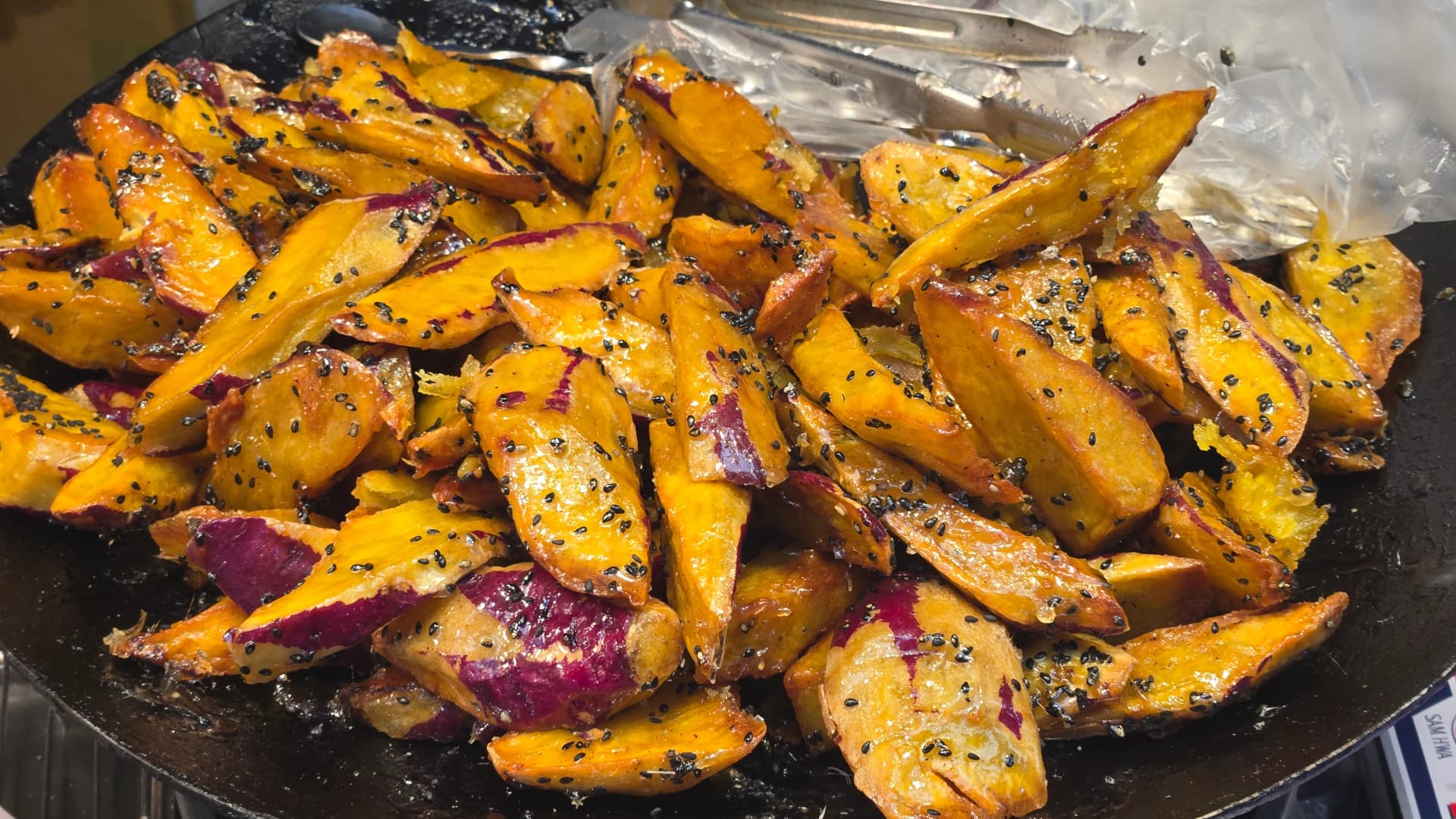
The very first thing that caught my eye as I turned into the first alley past the market entrance was this. Piles and piles of candied sweet potato on a hot plate. It's a traditional Korean street food snack — sweet potato cut into chunky pieces, deep-fried, coated in sugar syrup, and sprinkled with black sesame seeds.
I hadn't eaten anything yet, so I grabbed this as my first pick. When you tap the outside with your finger, the thin hardened syrup shell cracks with a satisfying crunch, and inside you get this soft, fluffy, moist sweet potato. Freshly made ones still have warm syrup that stretches, but the batch I got had cooled down a bit so the coating was firmer. Still just as sweet though. One pack cost about ₩4,000 (around $3 USD).
In English, this is best described as "Candied Sweet Potato" — basically sugar-coated deep-fried sweet potato. Think of it as Korea's version of a caramelized treat.
Walnut Pastry — Korea's Iconic Highway Rest Stop Snack
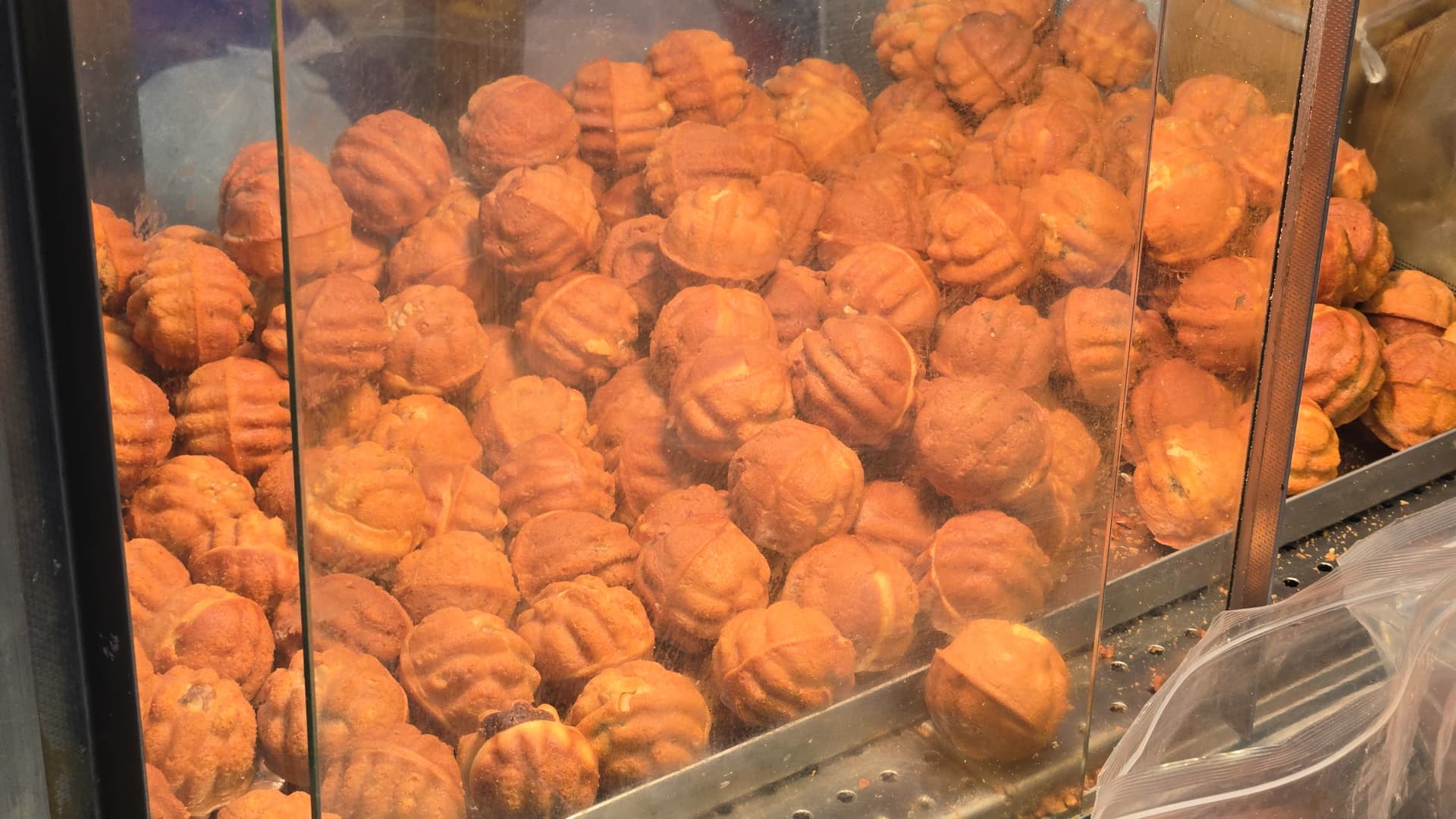
The second thing that caught my eye was a glass display case packed with walnut-shaped pastries. They're baked in walnut-shaped molds, and each one is about the size of two thumbs.
Walnut pastries are famous in Korea as the quintessential highway rest stop snack, so for me this was a familiar flavor. But the ones fresh out of the mold at the market are on a different level. The shell is still warm so it's soft and slightly chewy, and inside you get smooth red bean paste with tiny pieces of walnut. When they cool down, the shell gets a little crispy — but personally, I liked them way better warm. 10 pieces for ₩3,000 (about $2 USD).
In English: "Walnut-shaped pastry with red bean filling." Despite having "walnut" in the name, walnut isn't the main ingredient — the mold is shaped like a walnut, which is how it got its name.
Hotteok — The Scalding Trap of Daegu-Style Deep-Fried Pancakes
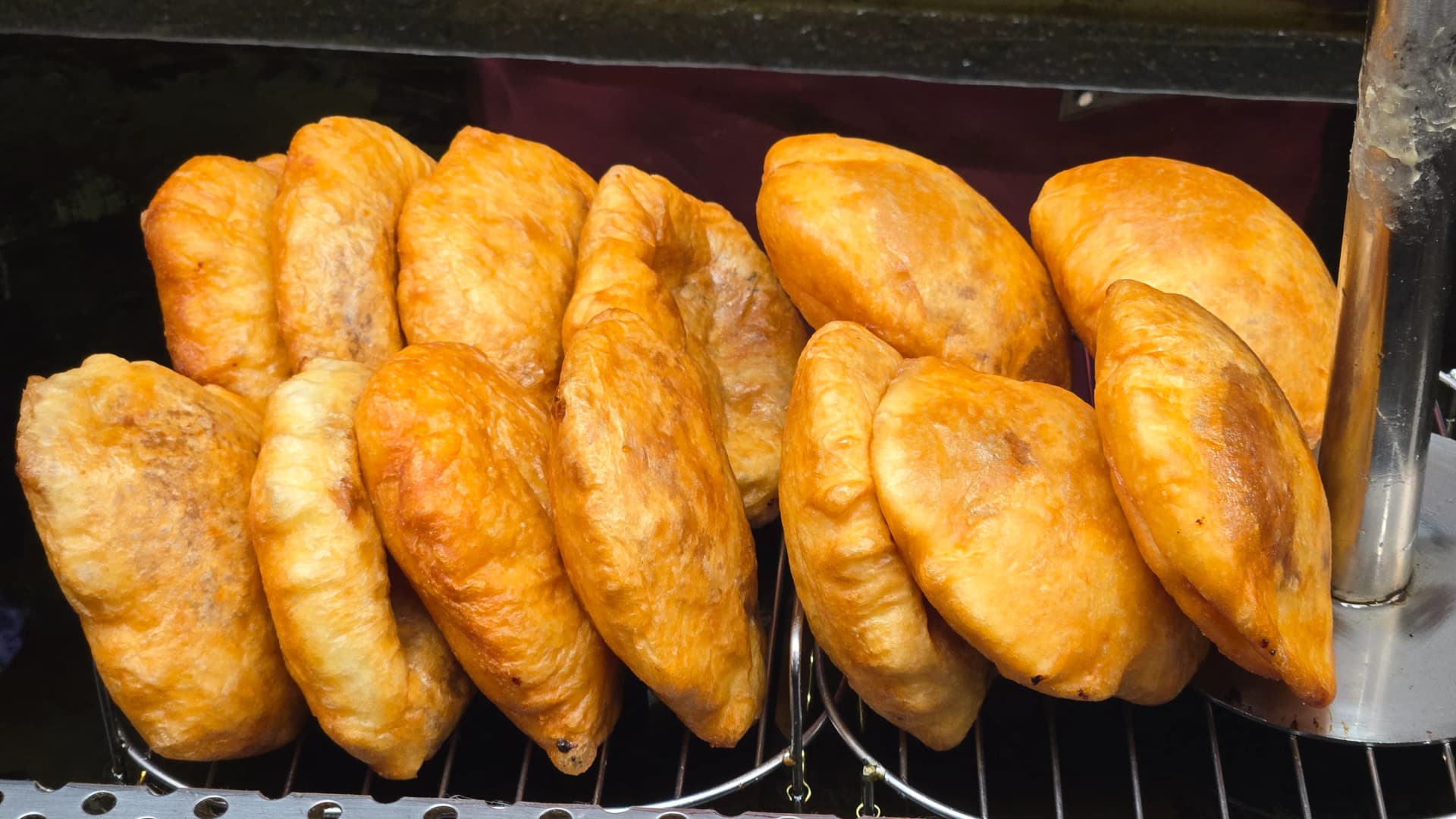
The third stop was a hotteok stall. Normally, hotteok is pressed flat and cooked on a griddle, but this was completely different. These are deep-fried whole in oil, so they're palm-sized with a round, puffy shape like a donut.
The line was pretty long, so I waited about 5 minutes. While waiting, the smell of frying oil mixed with cinnamon made me even hungrier. I grabbed mine and immediately took a bite — and that was a mistake. Inside, brown sugar and cinnamon have melted into a syrup that comes flooding out all at once, and it is seriously hot. I nearly burned the roof of my mouth. If it's your first time, definitely break it in half and let the syrup cool down before eating.
In English: "Hotteok — Korean sweet pancake filled with brown sugar and cinnamon." It's one of Korea's most iconic winter street foods, and the deep-fried style like you find at Seomun Market is more common in the Daegu area. One piece for ₩2,000 (about $1.50 USD).
10-Won Bread — The #1 Korean Street Food Reaction from Foreigners
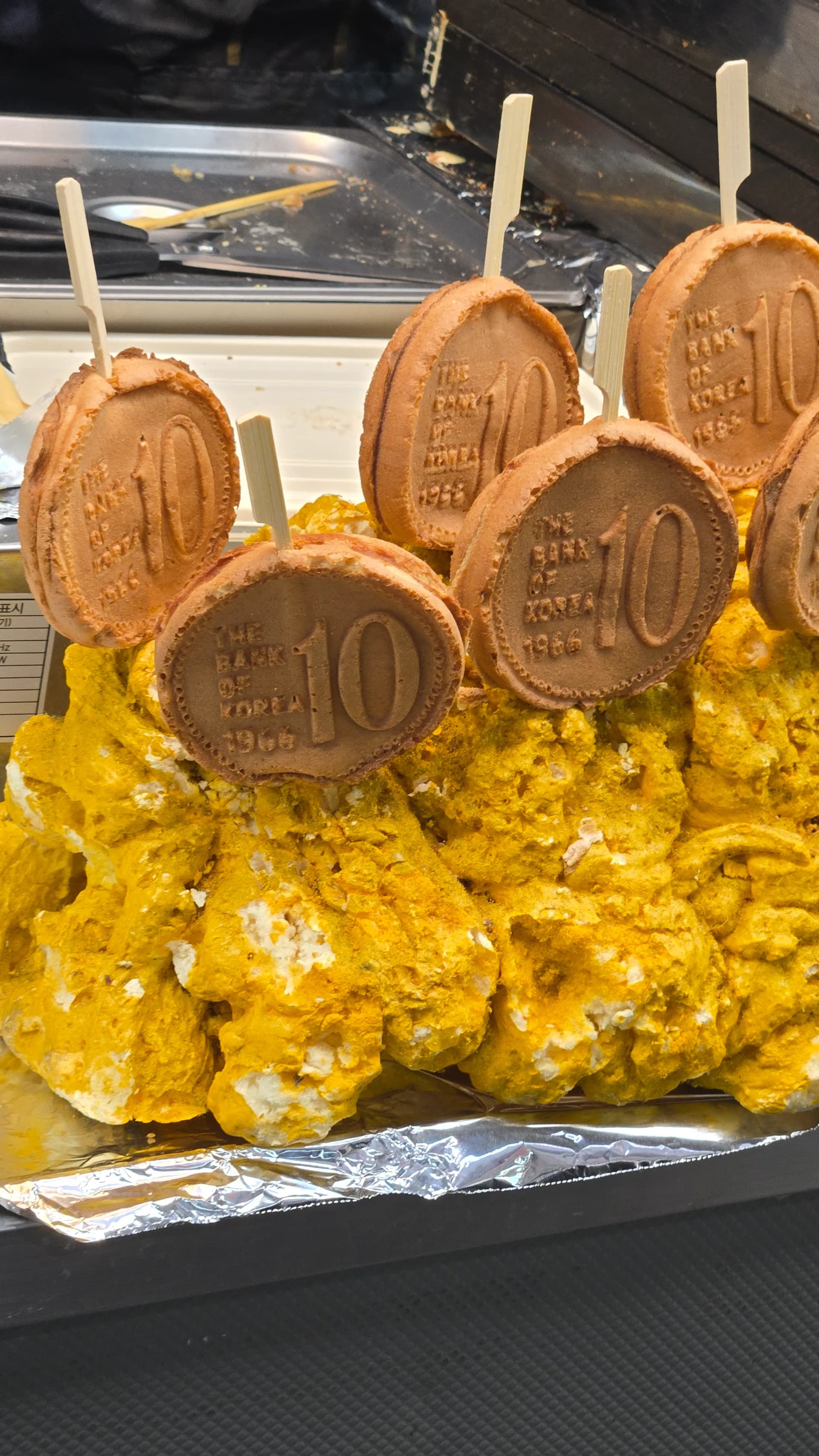
These are little breads baked in molds shaped like Korea's old 10-won coins. They originally went viral in Gyeongju, but now you can find them practically everywhere in Korea as a beloved Korean street food.
There was no line for this one so I could buy them right away. The yellow blob you see in the photo is cheese. They stuff a generous amount of cheese inside, so when you split one in half, the cheese stretches out long and gooey. The visual was so fun that I took a photo before eating. The combination of salty, savory cheese and bread is simple, but I kept reaching for more.
Among international visitors, this is hands down the street food that gets the best reaction. The coin-shaped design is novel, and the moment the cheese stretches, everyone whips out their cameras. Search "10-won Bread — Korean coin-shaped cheese bread" and you'll find tons of videos. 3 pieces for ₩2,000 (about $1.50 USD).
Korean Market Sandwich — How Is It Different from a Western Sandwich?
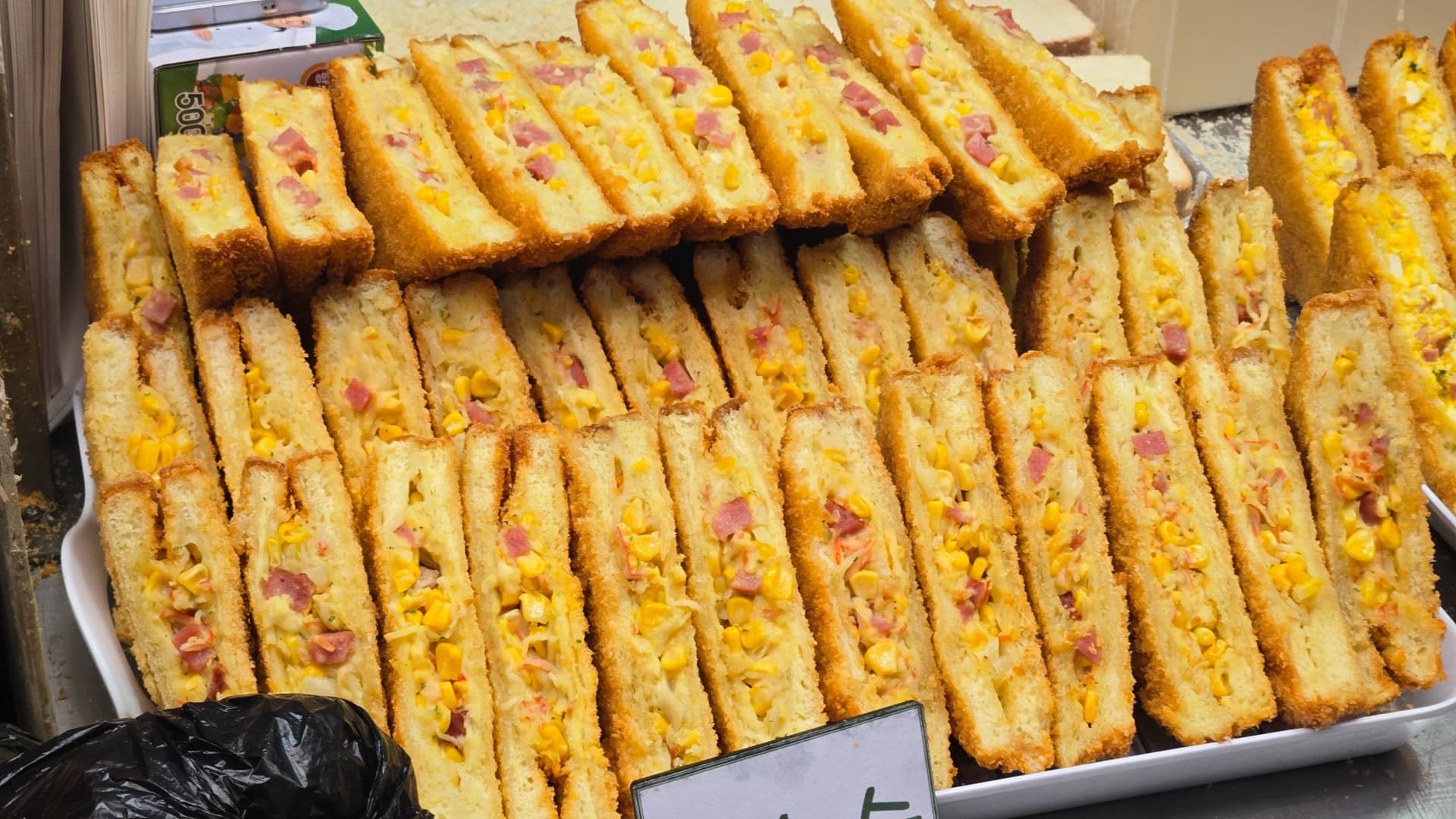
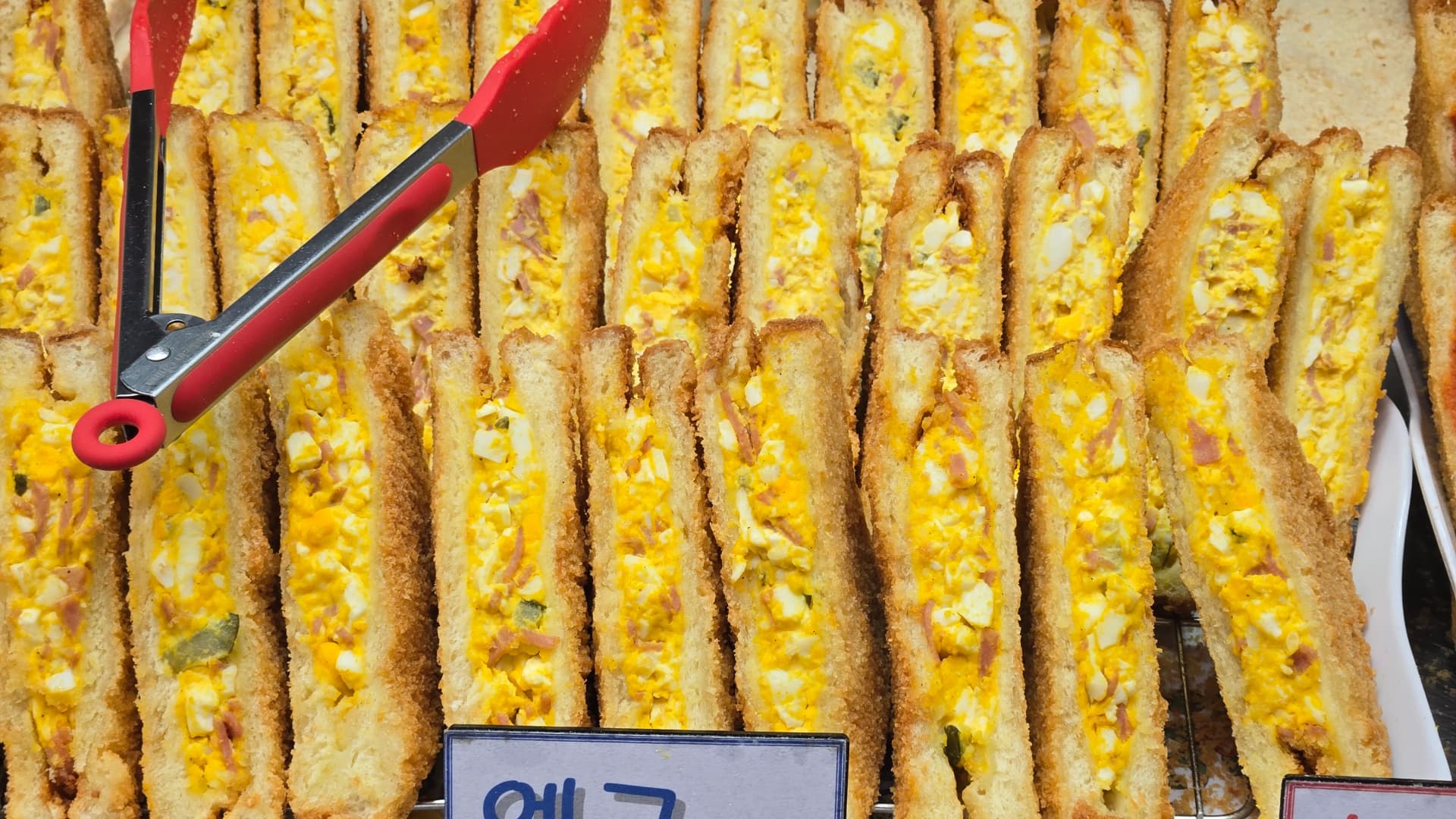
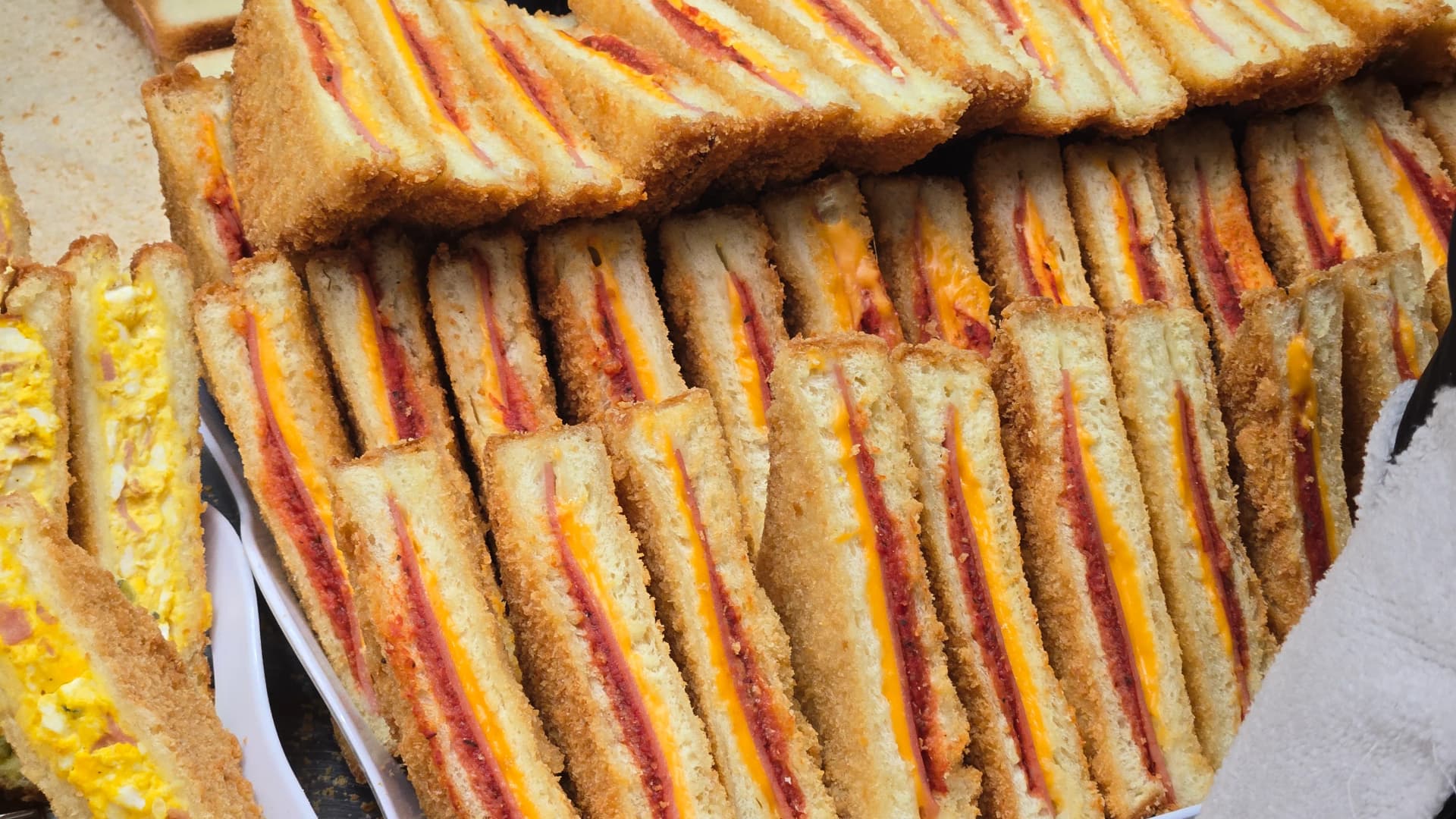
Walking through Seomun Market, you'll run into multiple stalls selling market sandwiches. I bought one to try, and it's a completely different animal from a Western sandwich. I figured some of you might see the word "sandwich" and set certain expectations, so I broke down the differences.
Based on my own experience eating one, comparing it to a Western sandwich is basically meaningless — they're totally different foods. It's more accurate to think of it as a "Korean-style mayonnaise toast."
Bread
Soft white bread, baguette, or various bread types
Filling
Vegetables, meat, cheese, and other ingredients layered in stacks
Taste
Clean, light style that lets each ingredient's natural flavor shine
Style
Sit-down meal or takeout · Usually $5+ at a café
Bread
White bread fried or toasted until the outside is crispy
Filling
Densely packed filling mixed in mayonnaise
Taste
Mayonnaise-based, rich and savory flavor profile
Style
Eat-while-walking street food style · About $1.50–2 USD
Pork Heart Skewer — The Korean Market Offal I Hesitated On
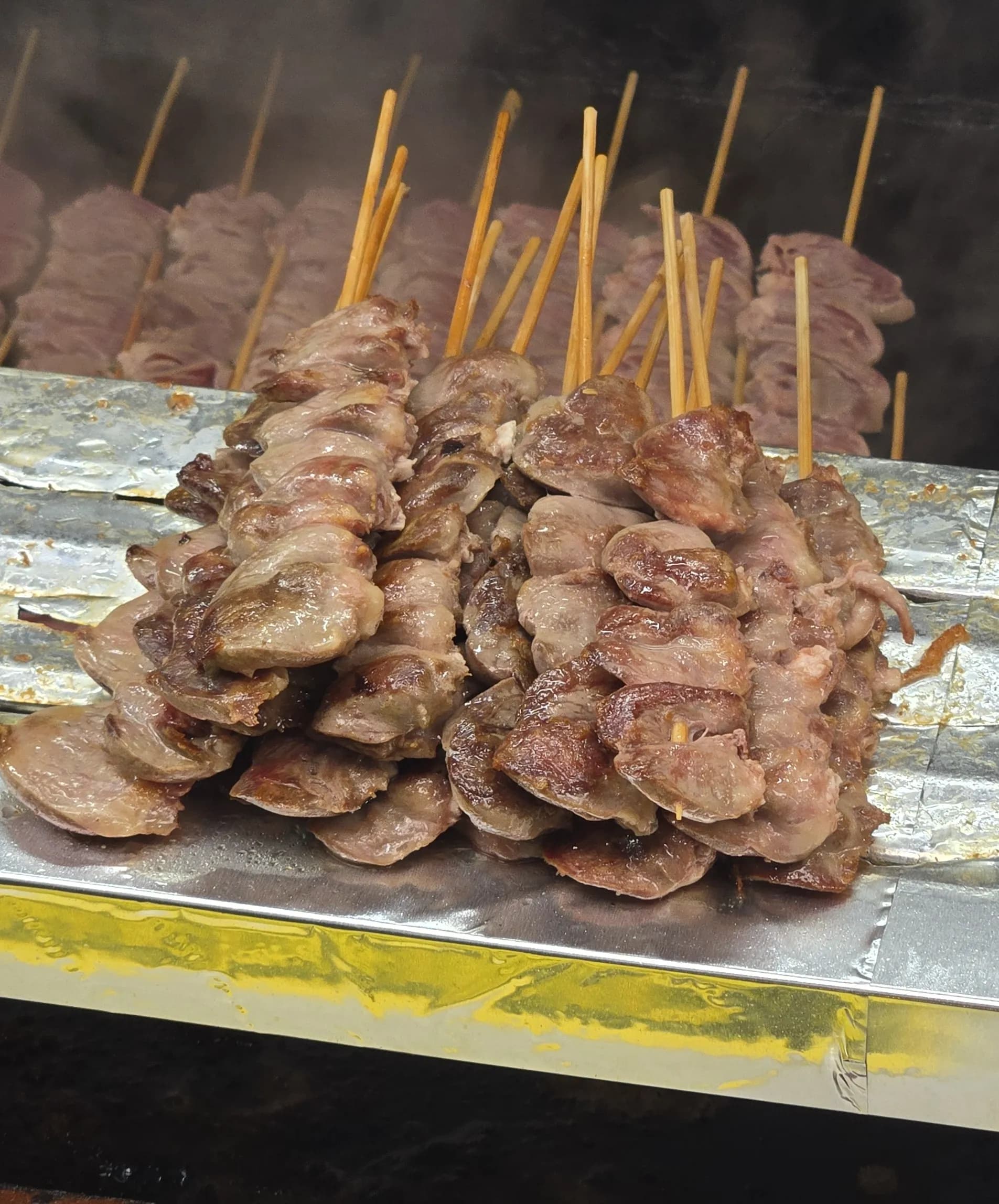
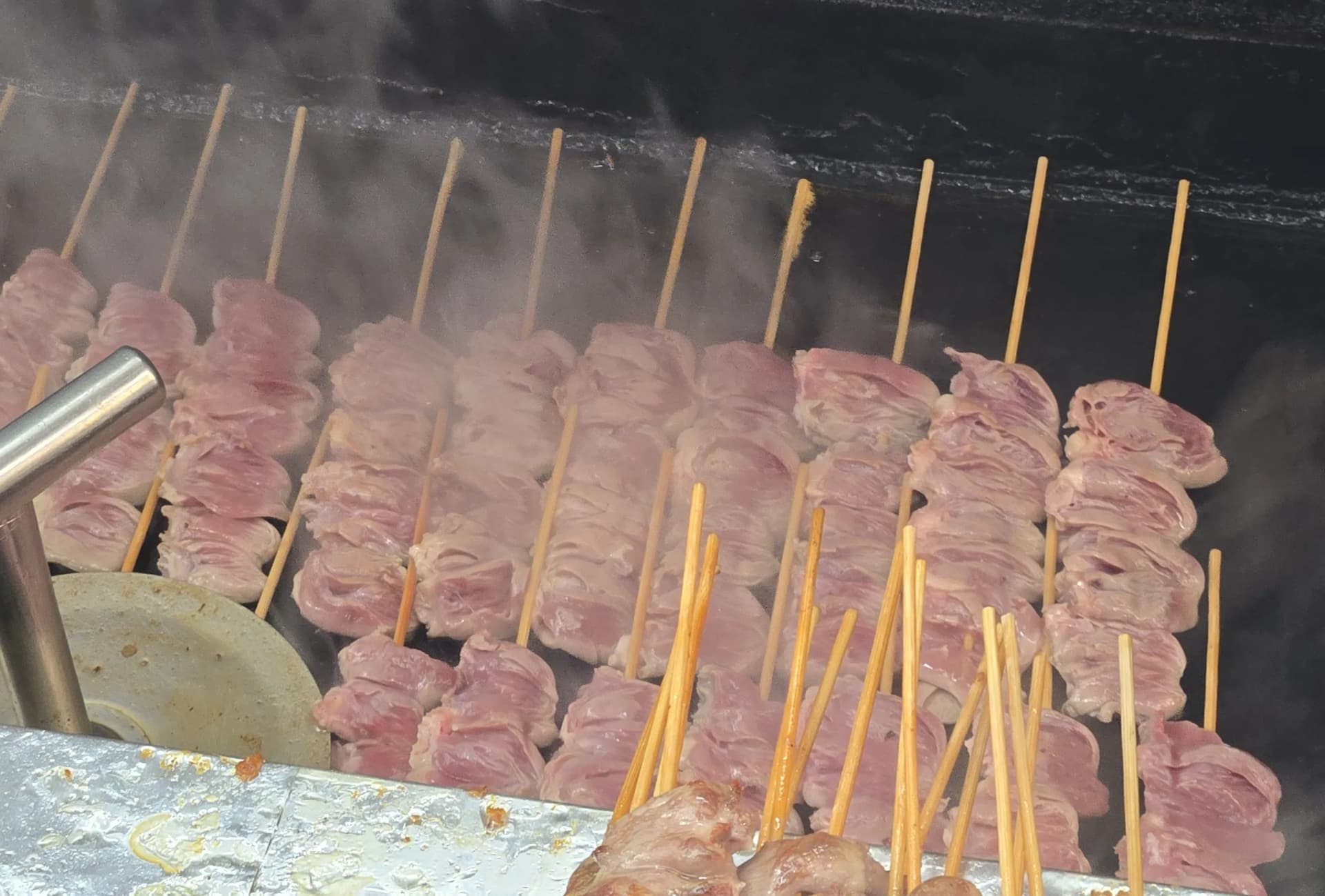
This is where the vibe shifted. As I went deeper into the food alley, thick smoke from grilling meat hung in the air.
Yeomtong is pork heart. They slice it thin and flat, layer the pieces onto a skewer, and grill it. Honestly, I hesitated at first. The word "heart" itself can be off-putting, right? But I watched the guy next to me eating his with obvious enjoyment, so I bought one.
Bottom line: it was way more mild than I expected. The texture is firmer and chewier than regular pork, with almost no greasiness. The more you chew, the more a savory, nutty flavor develops, and there was absolutely none of that funky "offal" smell. If you're someone who's curious about offal food, this is a great one to try. In English: "Grilled pork heart skewer."
Chapssal-ppang — My Personal Top 3 of the Day
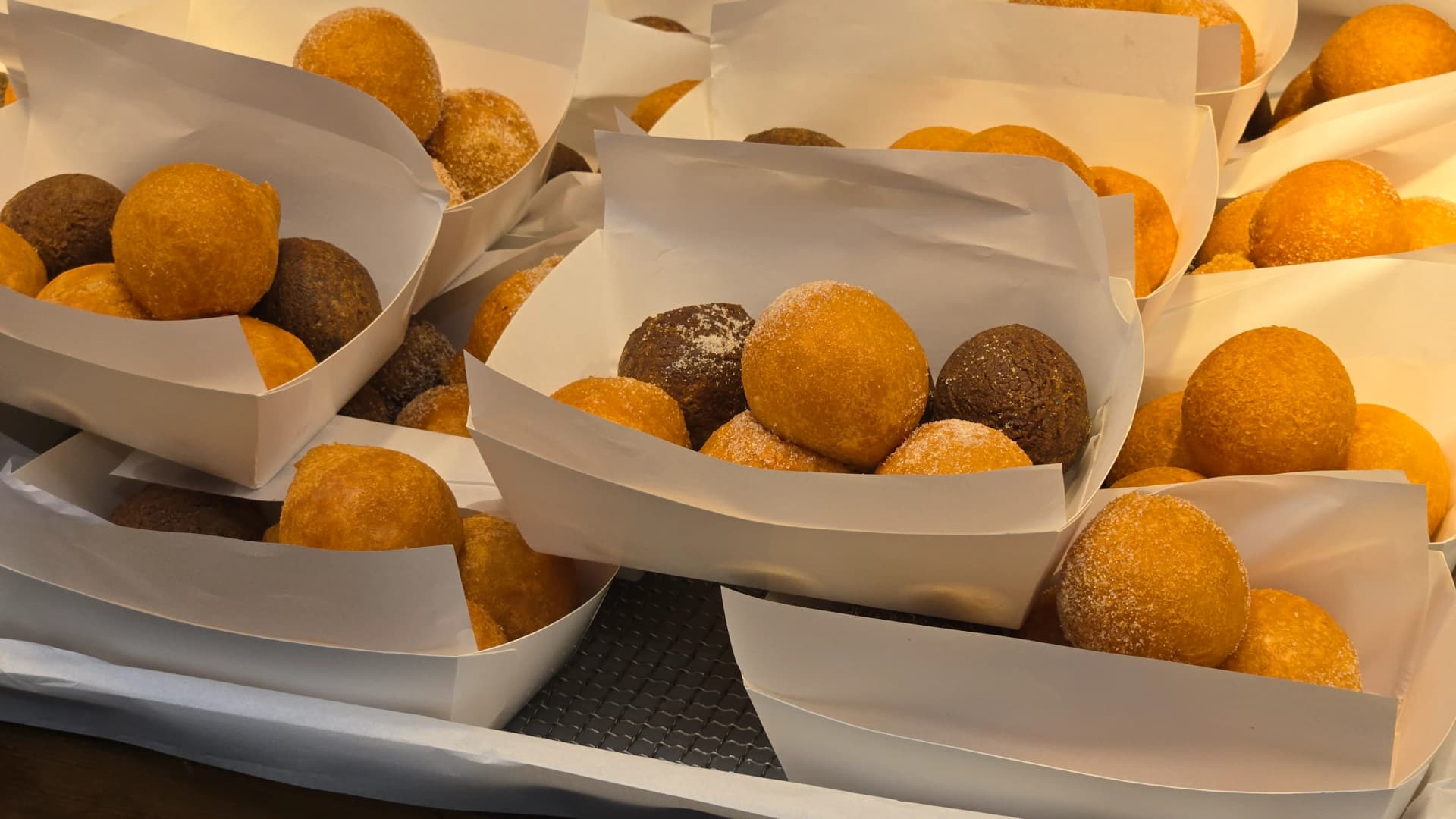
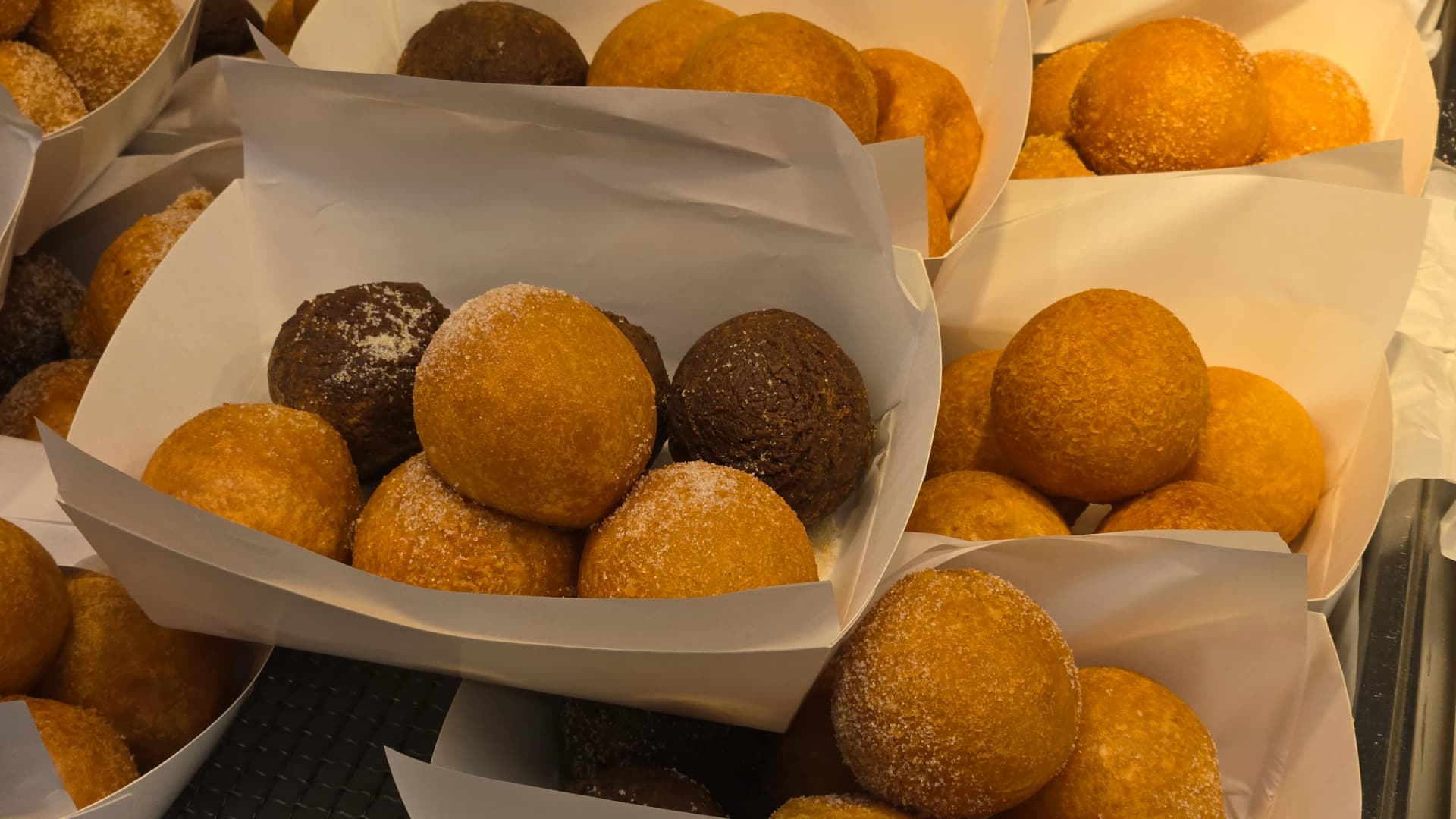
This is a Seomun Market street food that I personally want to put in my top 3 of the day. It's a snack made by shaping glutinous rice dough into balls, deep-frying them, and rolling them in sugar. There are two kinds: plain ones with an empty center, and ones filled with sweet red bean paste.
I went with the red bean version, and it's completely different from a regular wheat flour donut. Glutinous rice has this unique chewy, springy texture, so it feels like something halfway between a rice cake and a donut. The outside has a slightly crispy sugar coating, and the inside stretches and pulls as you bite into it. You need to eat these while they're still warm for the texture to really come alive.
In English: "Chapssal-ppang — Deep-fried glutinous rice ball." If you've had mochi donuts, you'll get the idea. 2 pieces for ₩2,000 (about $1.50 USD).
Fish Cake in Hot Broth — The Symbol of Korean Traditional Markets
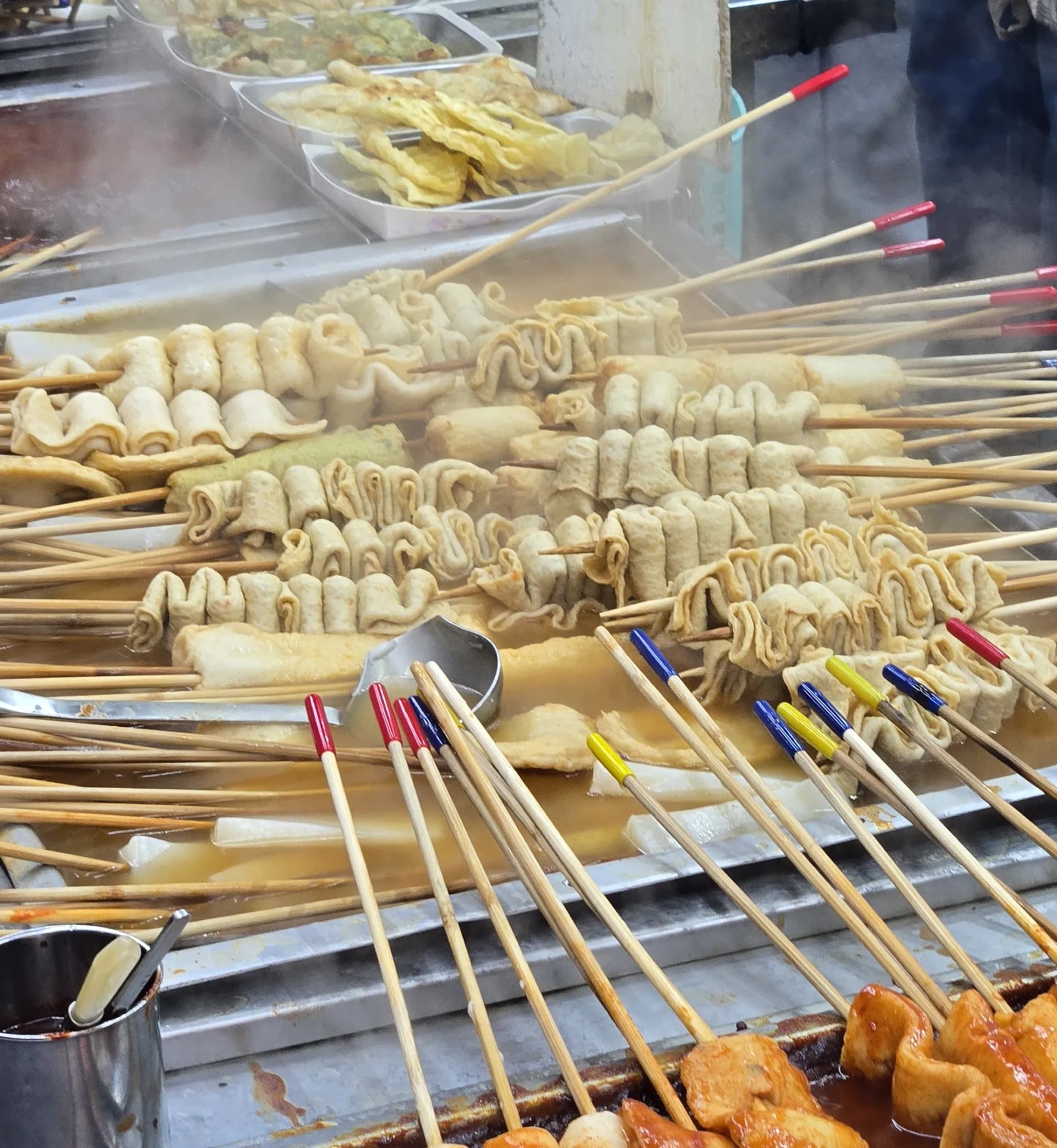
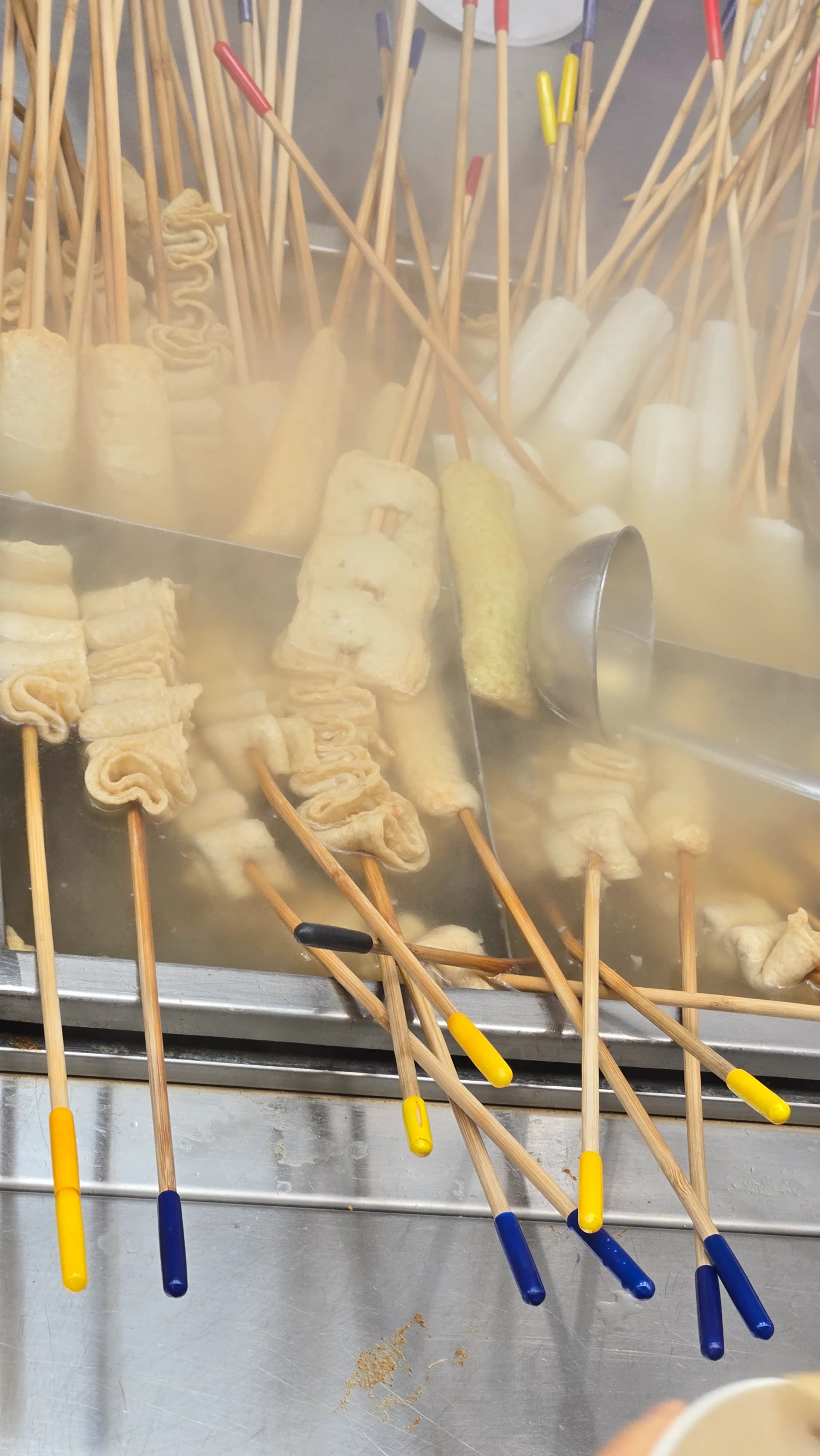
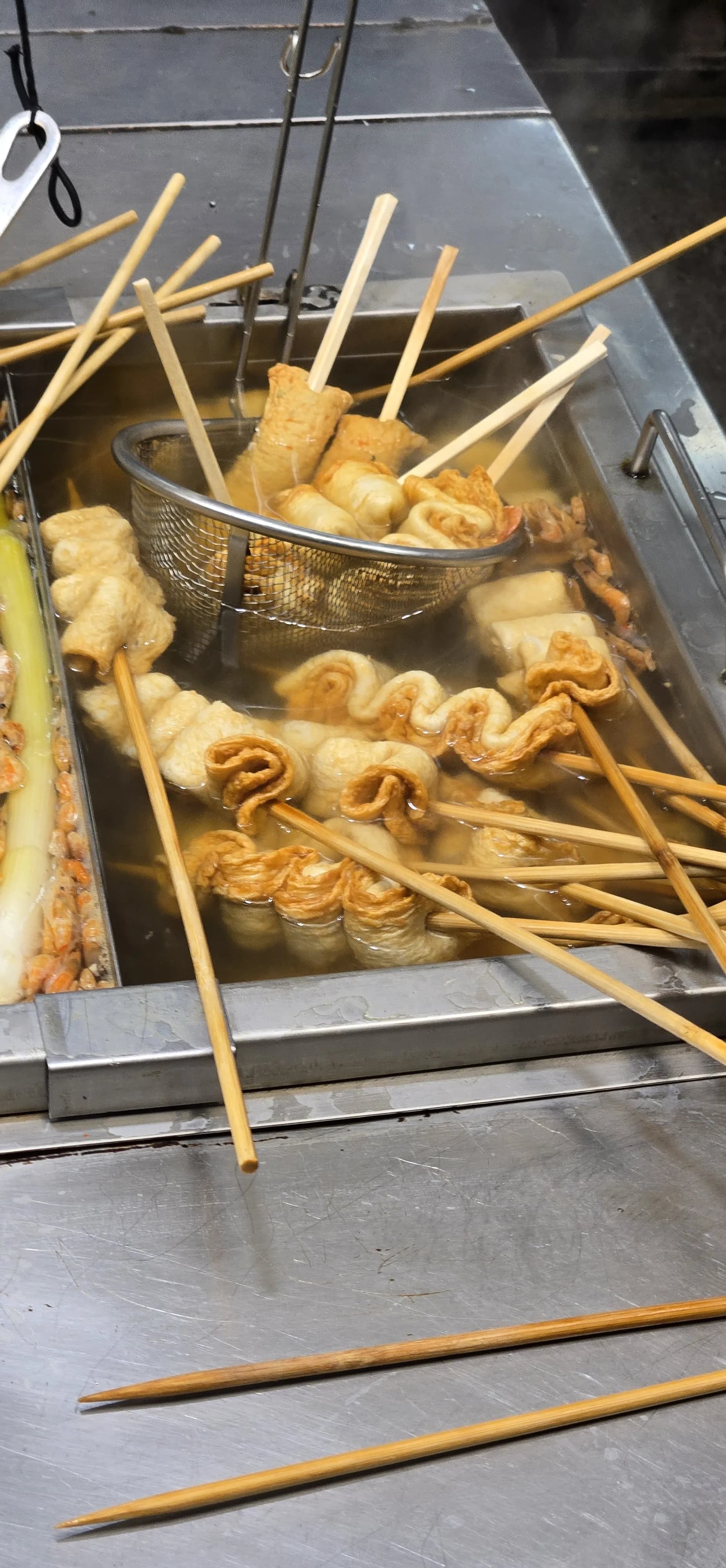
If you've ever been to Korea before, you've definitely seen this. It's ground fish paste spread thin, threaded onto skewers, and soaked in piping hot broth — one of Korea's most representative street foods. Whether you're in Seoul, Busan, or Jeju, you'll find it at every single market.
Seomun Market alone had over 10 of these fish cake broth stalls. I ate at one roughly in the middle of the market, and the broth made from anchovies and kelp smelled absolutely incredible. The fish cake itself has a soft, bouncy texture, and the longer it soaks, the more the broth flavor seeps into it. But the real key is this: after you finish eating the fish cake, you take a sip of the broth. That warm, savory, slightly salty broth filling you up from the inside — on a cold day, that alone is reason enough to come to the market.
In English: "Eomuk — Korean fish cake skewer in hot broth." Drinking the broth along with it is the Korean way. One skewer usually costs ₩1,000 (about $0.75 USD), and the broth is free.
Gochujang Skewer — The Most Striking Scene at Seomun Market
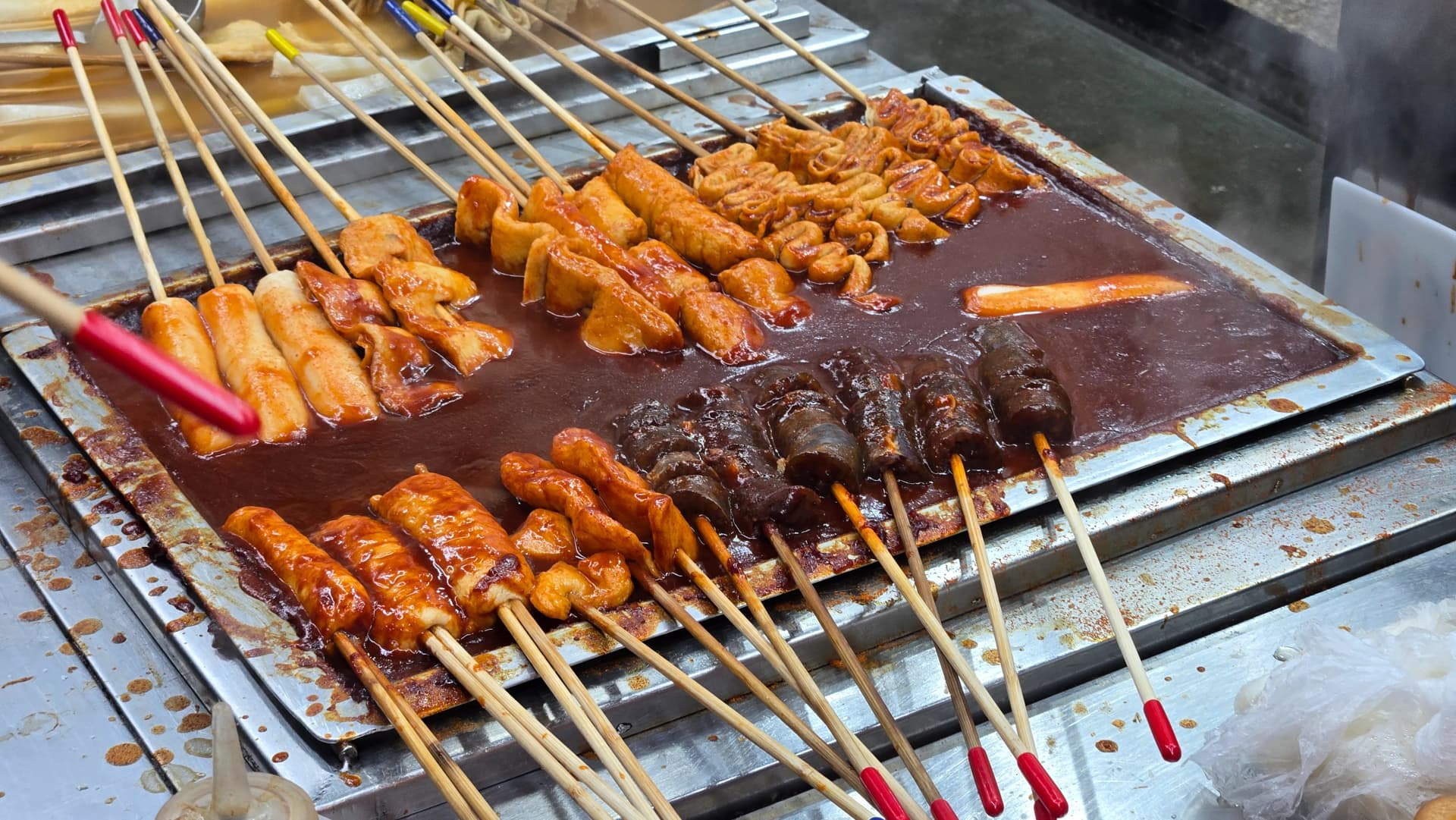
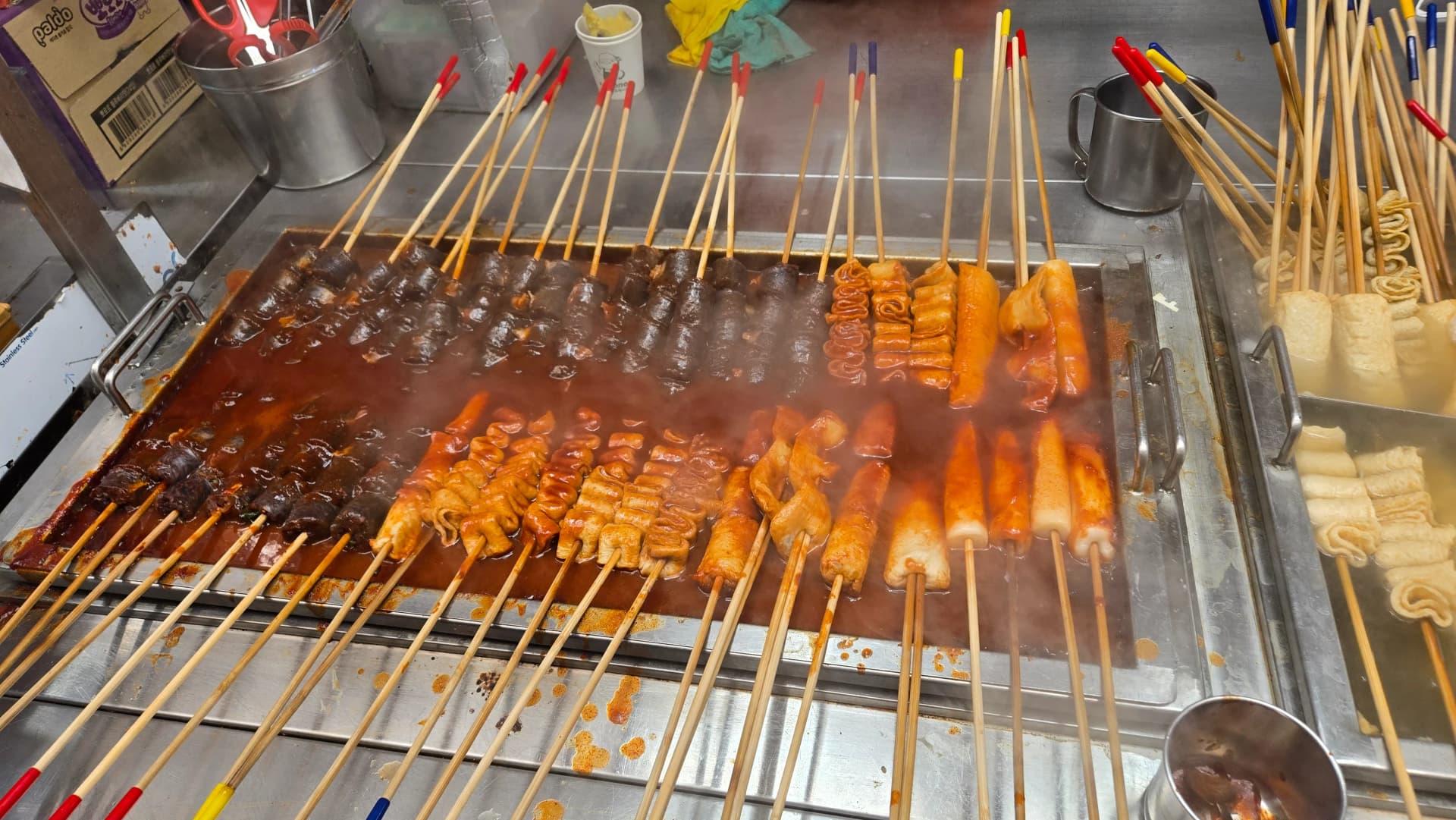
This was one of the most striking scenes I saw at Seomun Market. A wide hot plate filled to the brim with gochujang (red chili paste) sauce, with rows and rows of skewers lined up — visually, it was stunning.
Rice cake, fish cake, and sundae are threaded onto skewers and simmered in thick gochujang sauce. This was originally a dish you could only find in certain regions. These days you occasionally see it in Seoul too, but it's not something you commonly find at your average street stall. To see it done properly like this, you really need to come to a large-scale Korean traditional market like Seomun.
I picked the rice cake skewer, and the gochujang had soaked all the way through — chewy, spicy, and sweet all at once. Spicy, sweet, and salty flavors hit you simultaneously. Koreans sometimes call this "tteokbokki without the soup."
In English: "Gochujang skewer — rice cake, fish cake, or sundae (Korean blood sausage) simmered in red chili paste." If you love spicy food, strongly recommended.
Sundae Skewer, Spicy Fish Cake Skewer, Red Stir-Fried Fish Cake, and More Broth Fish Cake Stalls
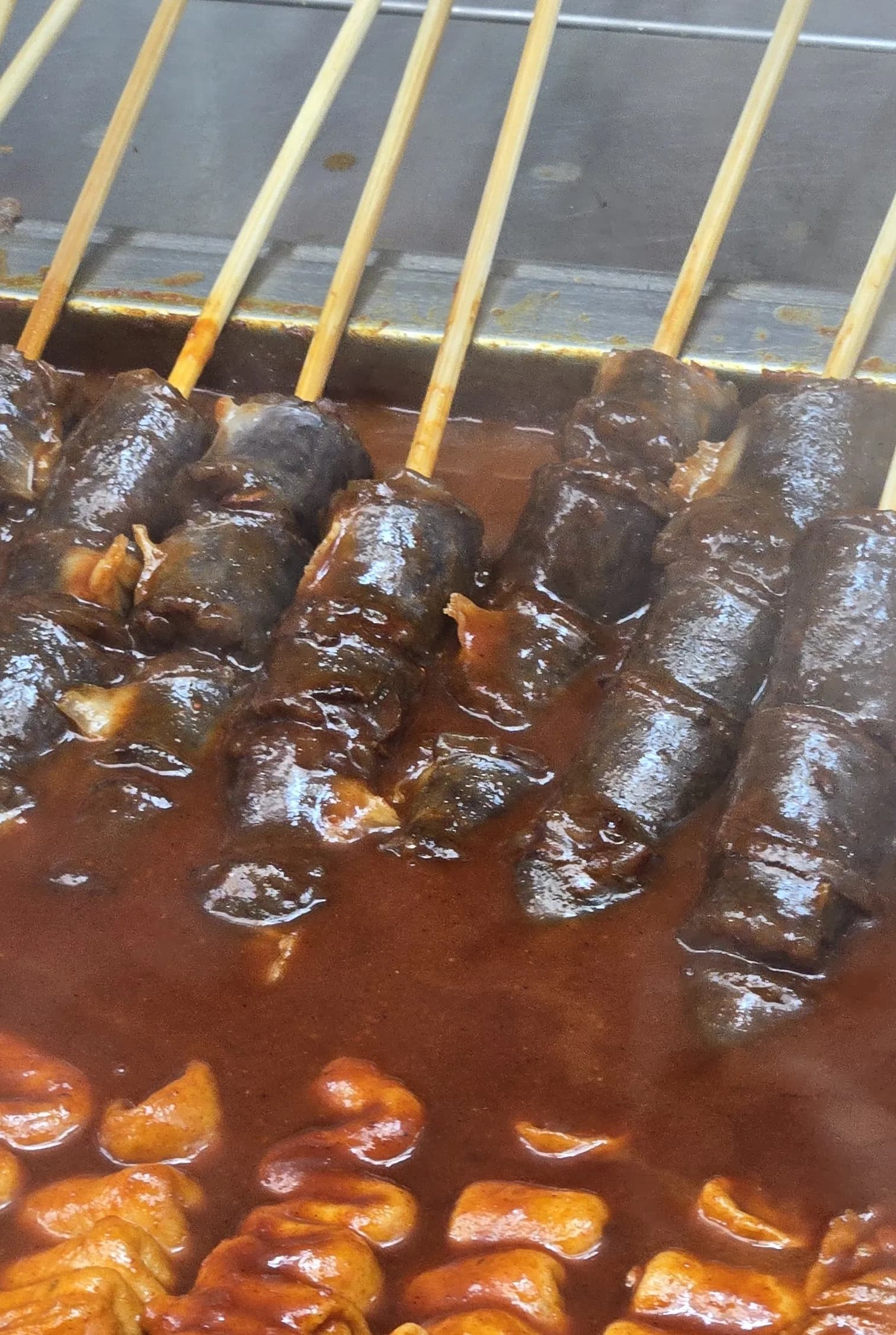
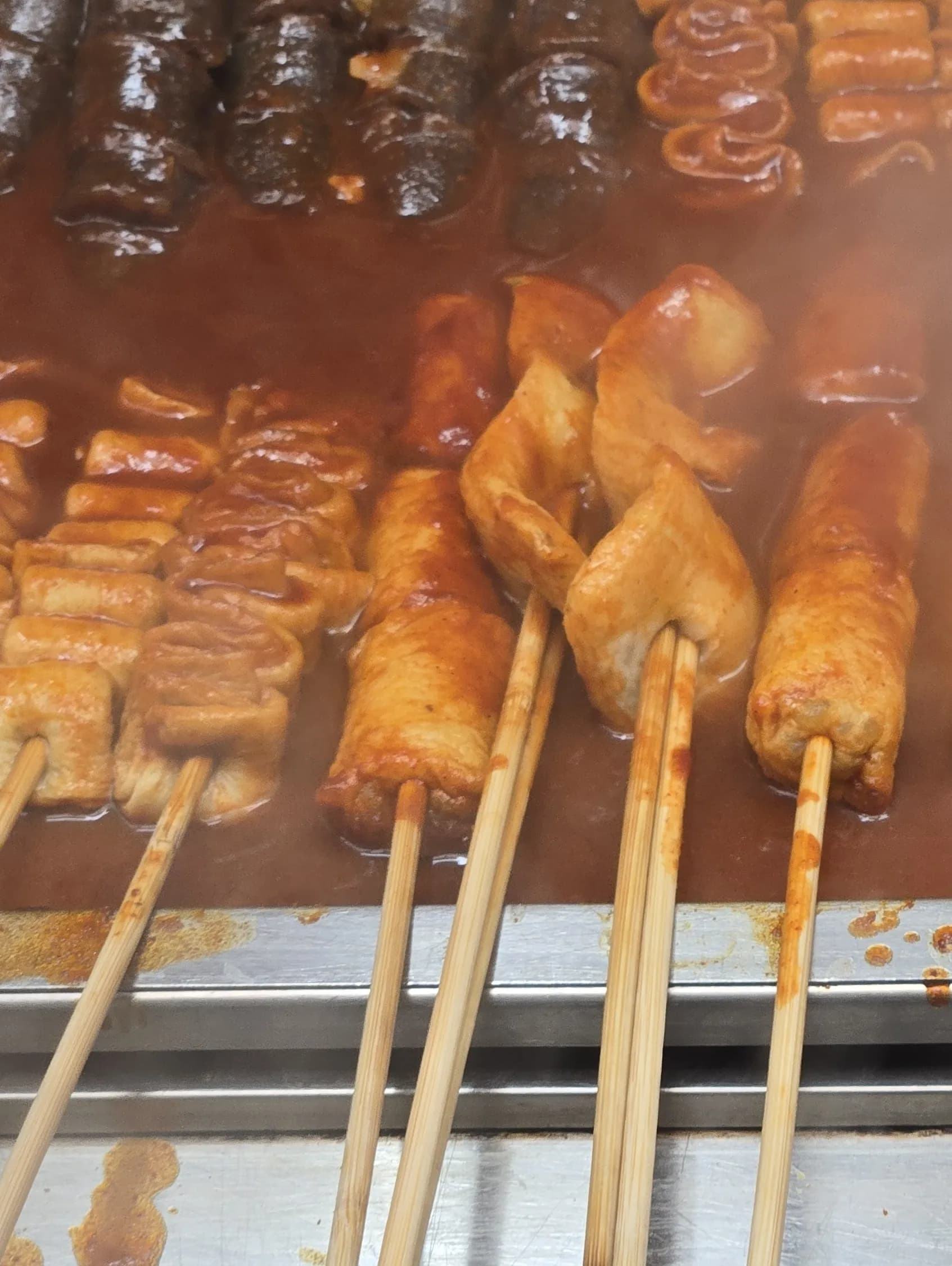
Around the gochujang skewer stall, similar items were clustered together. I grabbed a sundae skewer from the stall right next door. Sundae is a traditional Korean food made by stuffing pig intestine with glass noodles and vegetables. This version was threaded on a skewer and simmered deep in gochujang sauce, so the flavor had soaked all the way through — giving it a rich, heavy taste. A lot of foreigners trying sundae for the first time are surprised by the "blood sausage" description, but when you actually eat it, the chewy glass noodle texture dominates and it's gentler than you'd expect. In English: "Sundae — Korean blood sausage stuffed with glass noodles and vegetables."
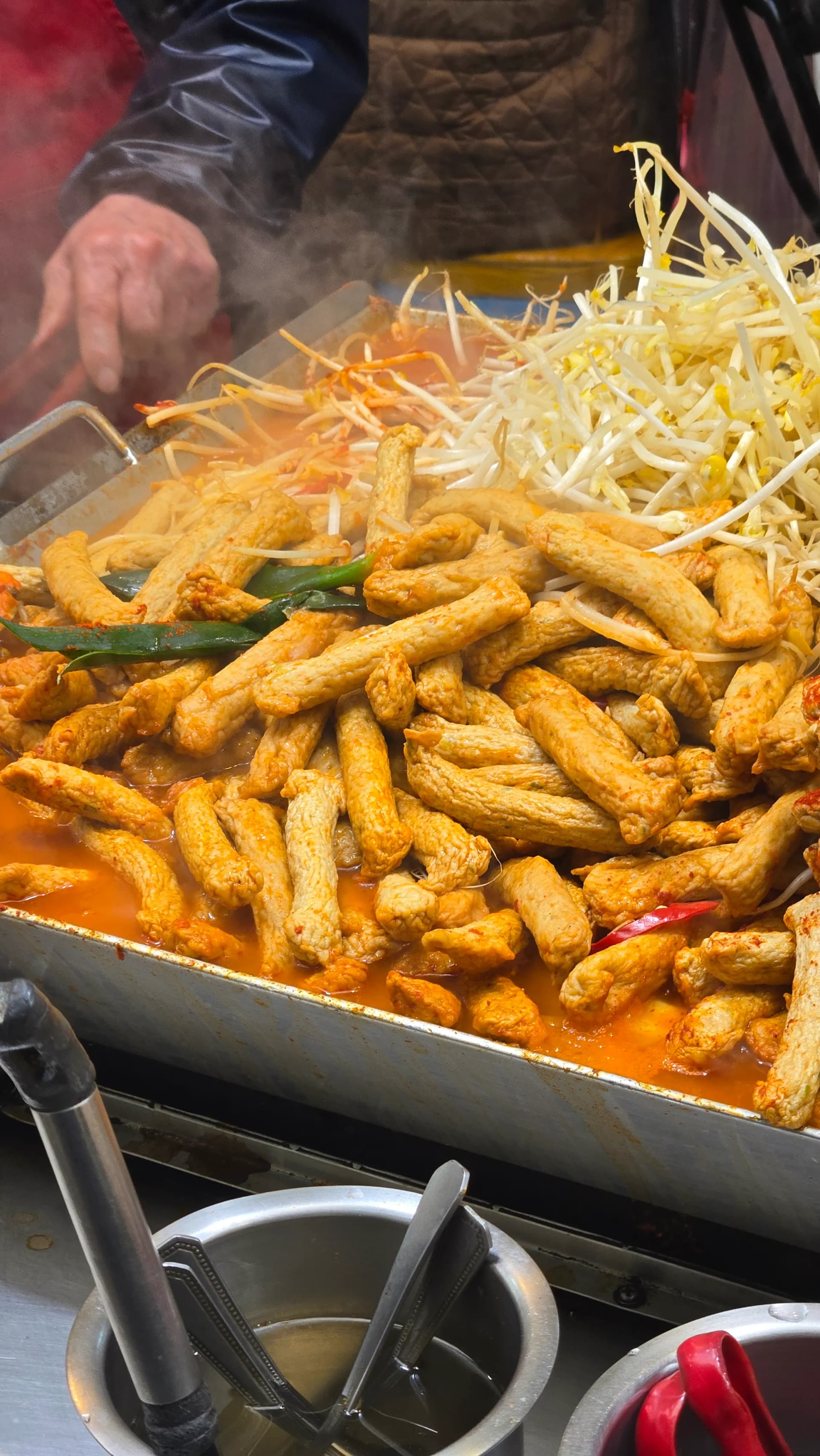
There were also spicy fish cake skewers. These are a completely different version from the clear broth fish cake I mentioned earlier — they're simmered on a hot plate bubbling with gochujang sauce, so the entire fish cake is dyed red. I ate the clear broth fish cake first and then tried this, and it was hard to believe they were the same fish cake. The bold, punchy flavor really kicks in.
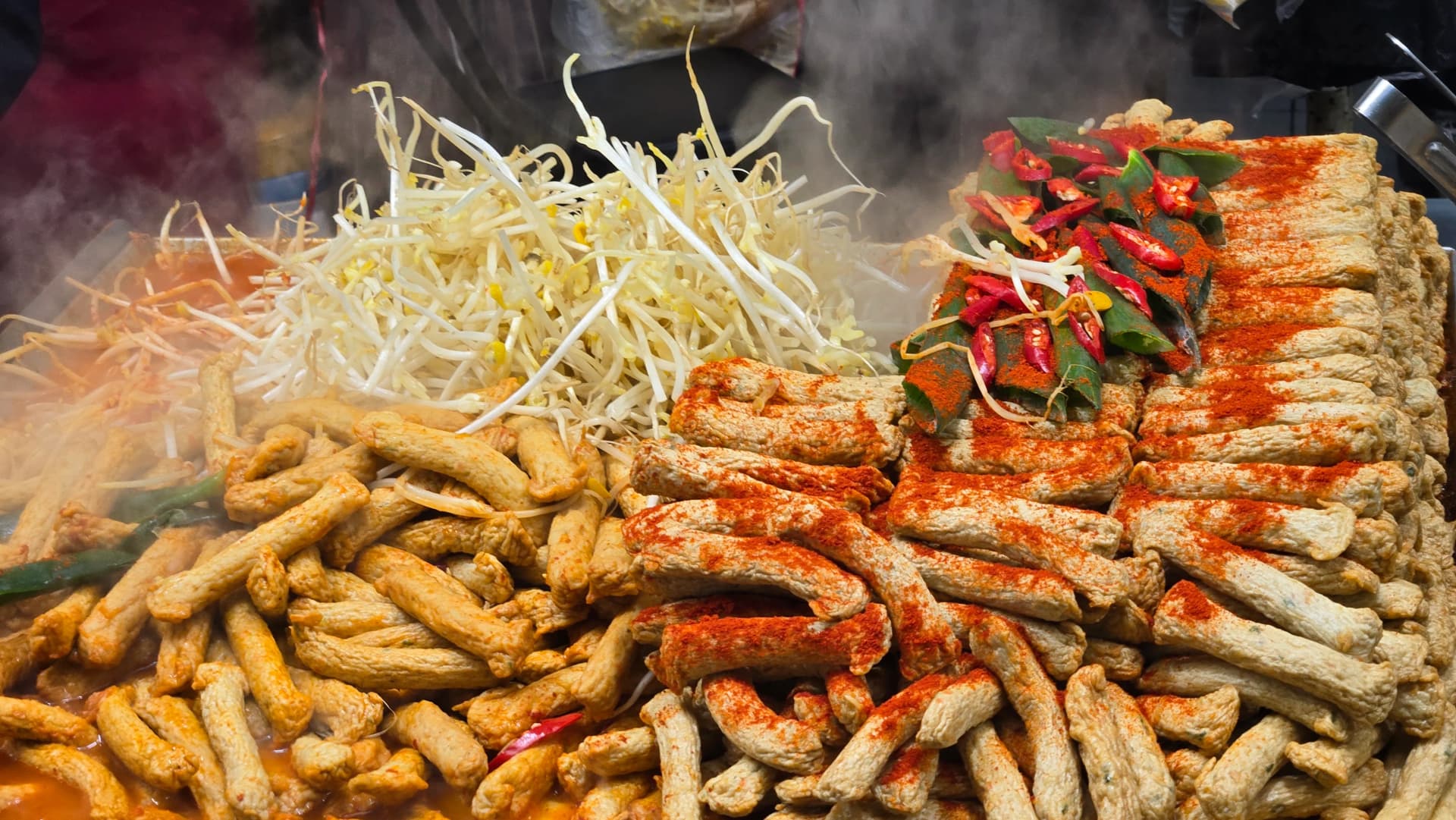
The red stir-fried fish cake is a dish where short, thick-cut fish cake pieces are stir-fried in spicy seasoning. Bean sprouts, cheongyang chili peppers (Korea's spiciest common pepper), and chili powder are piled on top, making it look intense just from the color. The interesting thing is that this isn't unique to one stall. Walking through the Seomun Market alleys, you'll find multiple places cooking fish cake this way, and each one has a different seasoning ratio. I tried two spots — one was on the sweeter side, while the other loaded up the cheongyang chili peppers and was noticeably hotter.
And the fish cake broth stalls deserve another mention. There are over 10 of these stalls inside Seomun Market alone. Each one's broth tastes slightly different, so there's a fun game in walking through the alleys and comparing them. I actually tried the broth at two places — one had a strong anchovy flavor and the other had a more prominent kelp taste. At ₩1,000 (about $0.75 USD) per skewer with free broth, there's no pressure in trying several spots.
Korean Deep-Fried Snacks — I Saw Deep-Fried Gimbap for the First Time
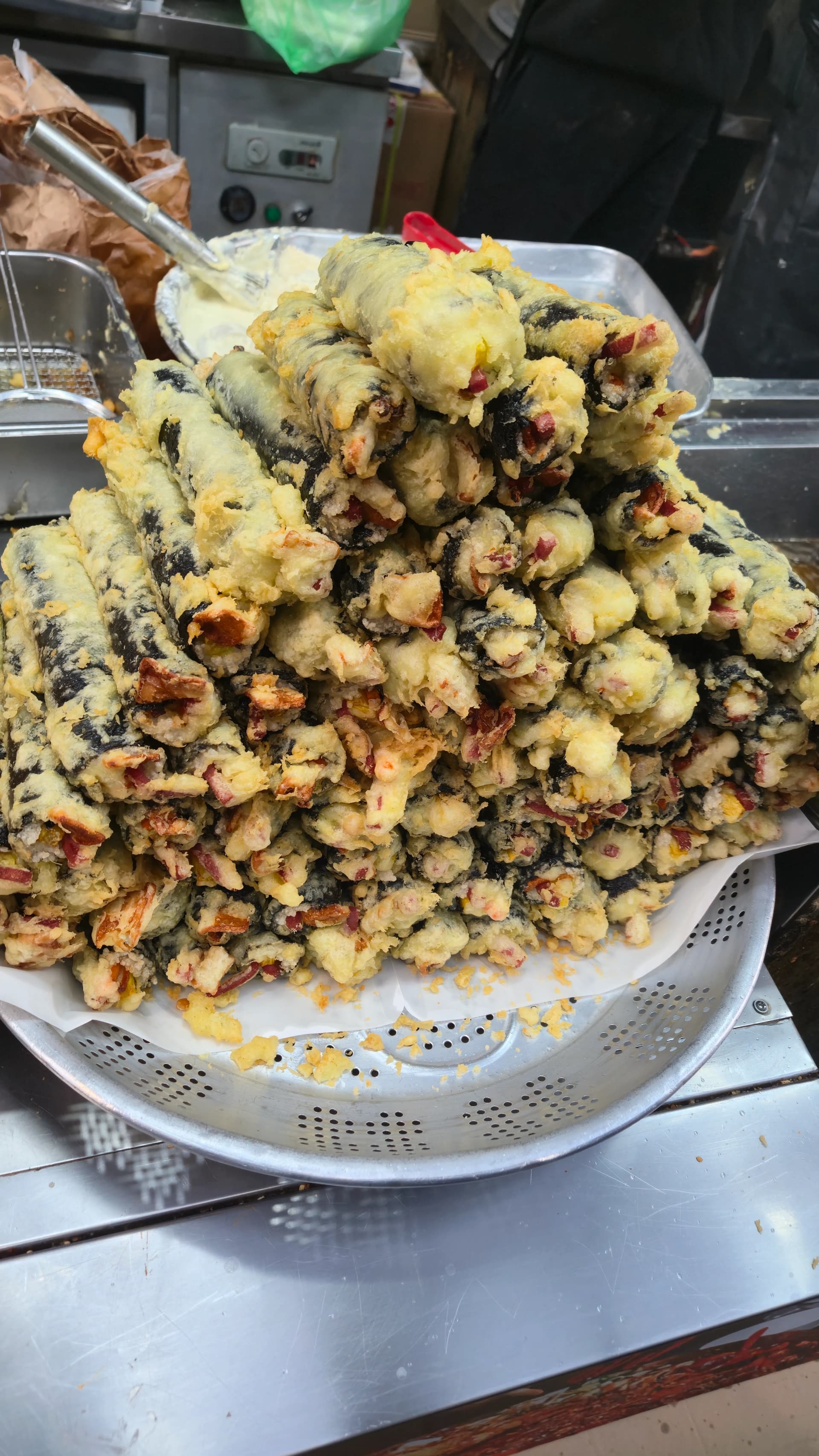
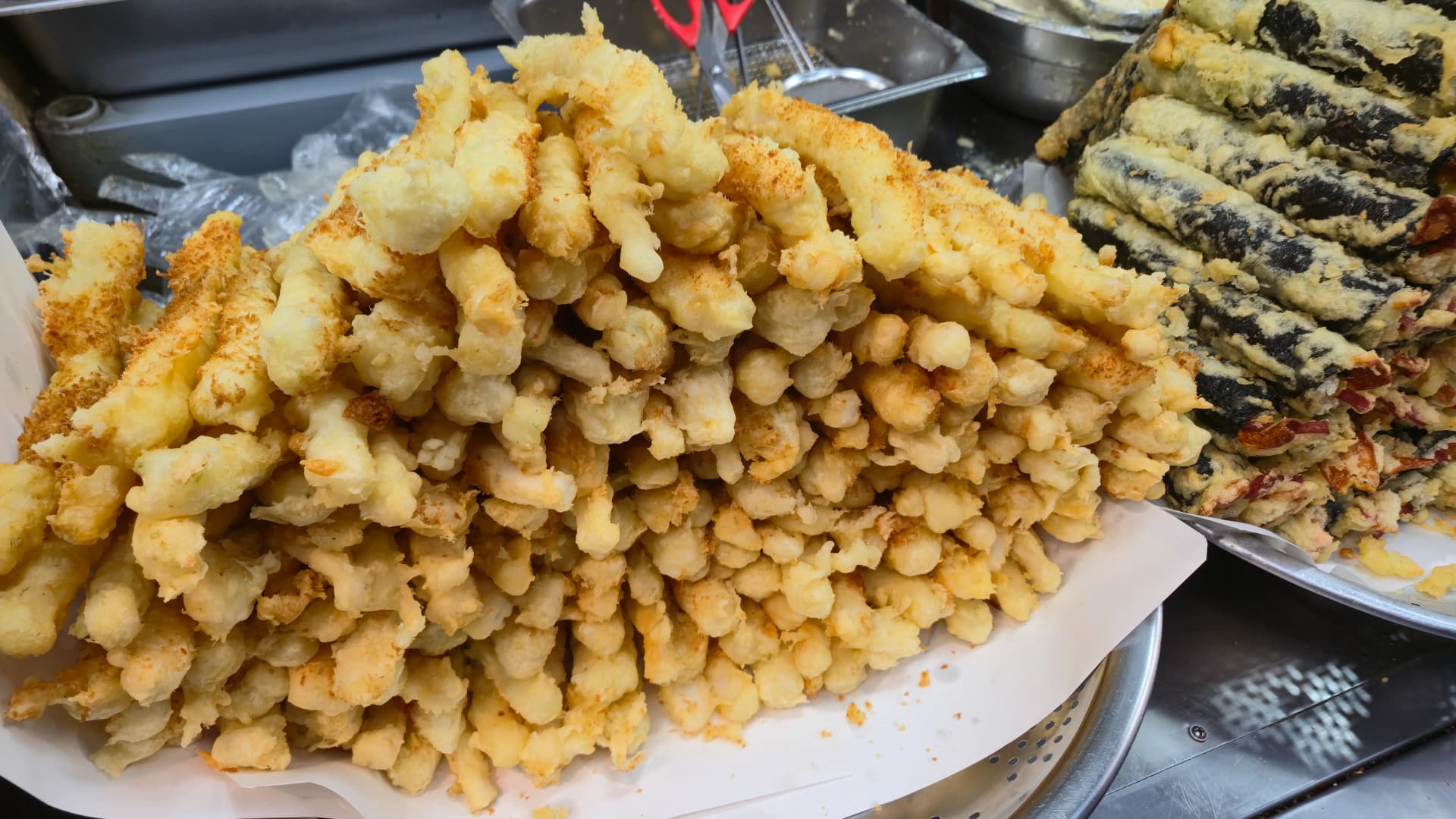
At Korean traditional markets, the standard deep-fried options are chili peppers, squid, and vegetables. But here, I discovered something I had genuinely never seen in my life — deep-fried gimbap. An entire roll of gimbap, deep-fried.
They make the gimbap first, then coat it in batter and drop it in oil. The outside is a crispy fried shell with a whole gimbap roll sitting inside. Honestly, I thought, "Is this even going to taste good?" But the savory oil and seaweed flavor worked together surprisingly well. I also grabbed some fried chili peppers from the same stall — cheongyang chili peppers coated in batter, so the outside is savory and the inside hits you with a sharp kick of heat. If you're sensitive to spice, be careful.
In English, the general term is "Twigim — Korean deep-fried snacks." It's similar to Japanese tempura, but Korean-style batter tends to be thicker, and people often eat it without any dipping sauce.
Chicken Skewer and Dak-gangjeong — Korean Chicken Culture, Street-Style
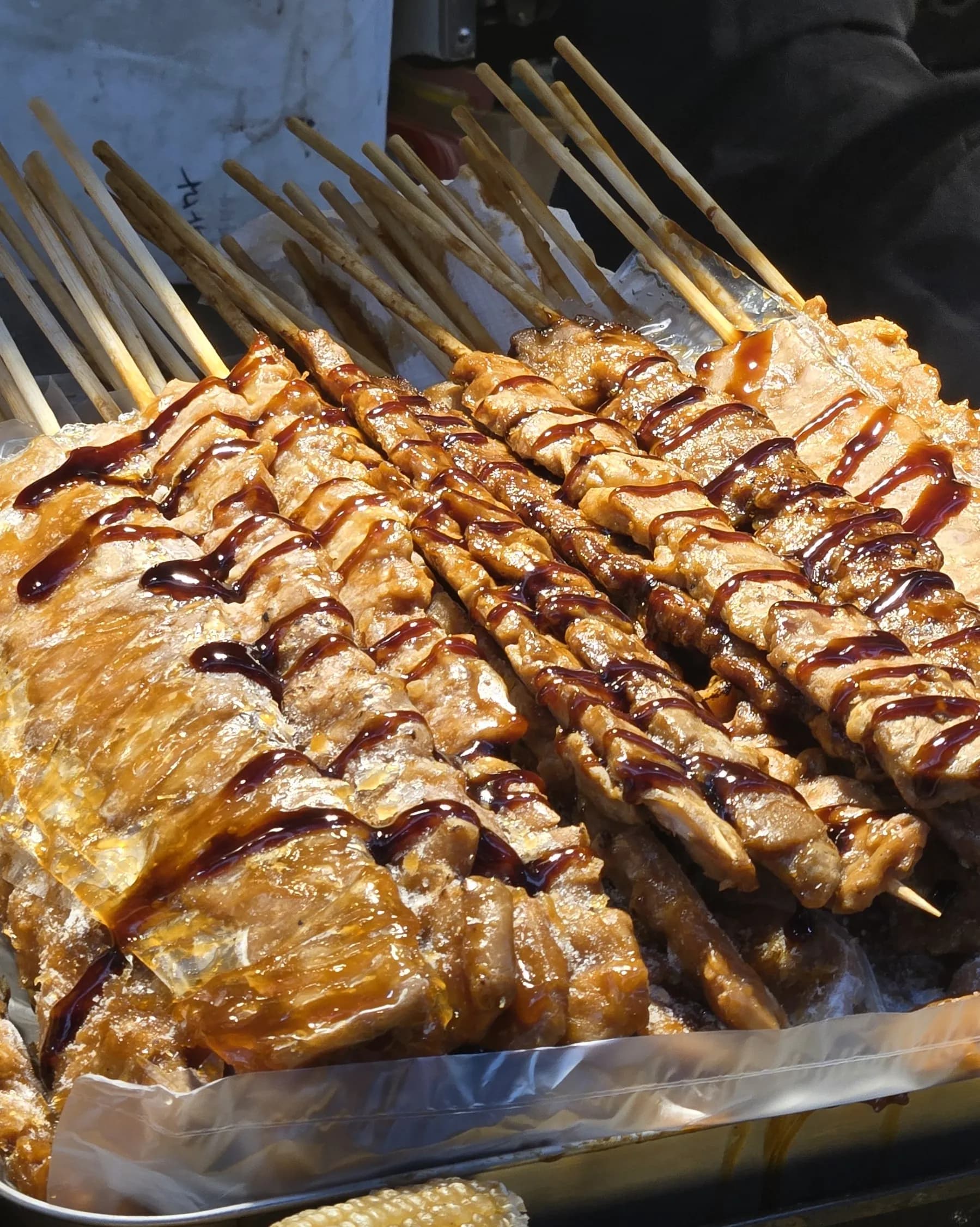
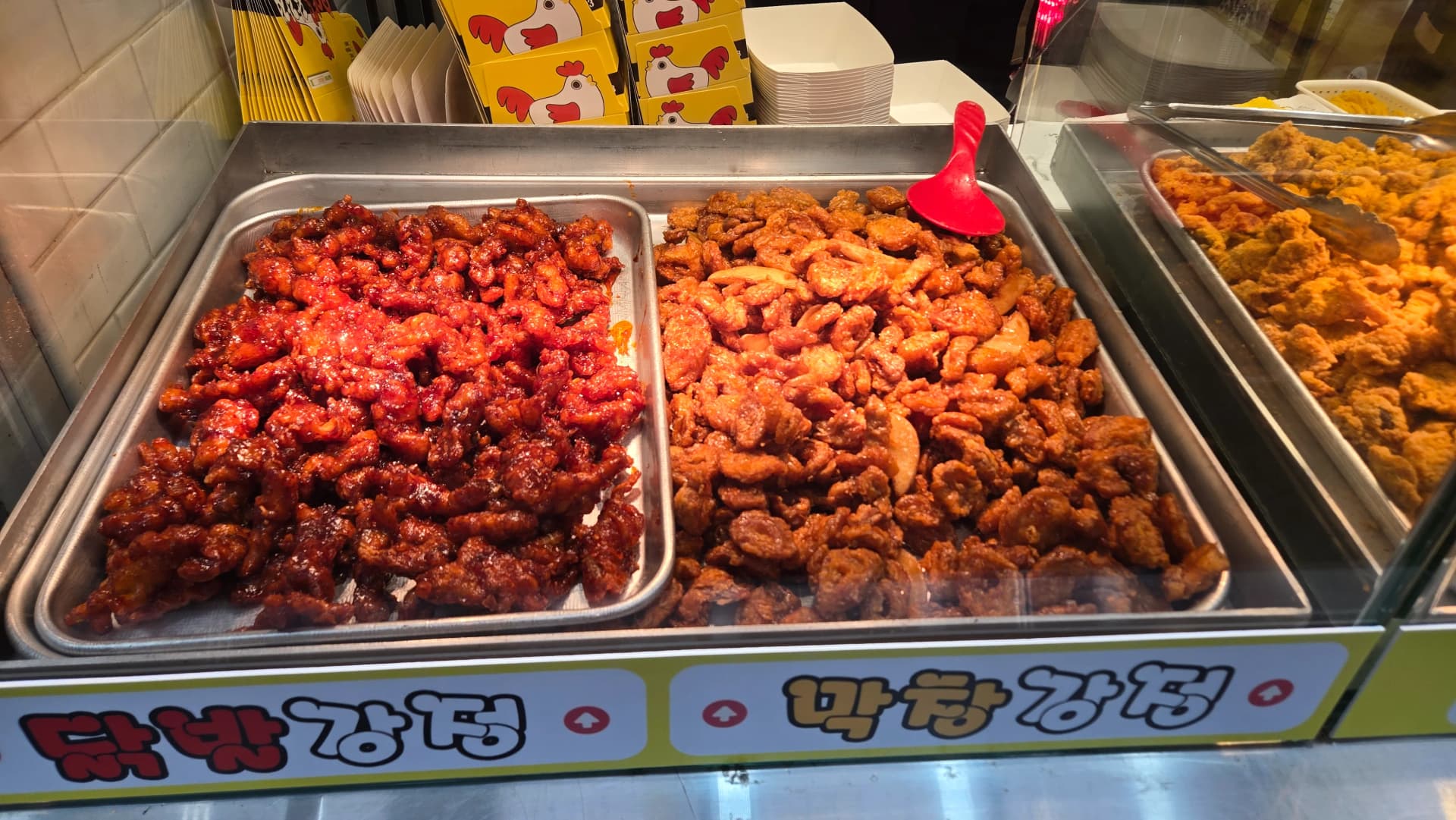
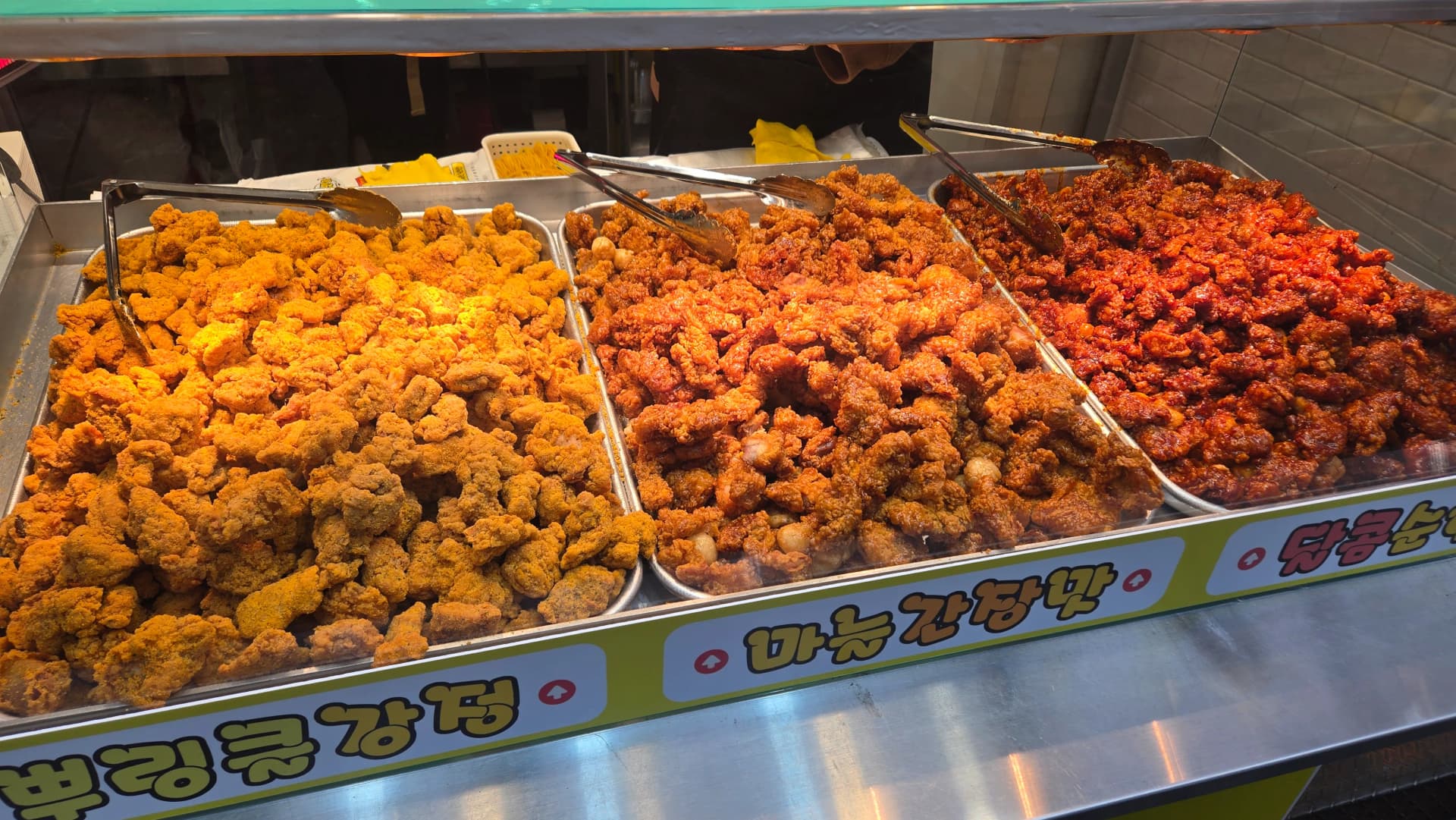
Chicken skewers are called a "national snack" in Korea — something literally everyone, young and old, loves. Chicken pieces are threaded onto a skewer, grilled, and finished with a generous coating of sweet and savory sauce. You might think this is nothing special since you can get it anywhere in Korea, but the ones grilled fresh at a market stall are definitely different. There's this aroma that comes from the sauce caramelizing over an open flame. One for ₩3,000 (about $2 USD). In English: "Dak-kkochi — Korean grilled chicken skewer with sweet soy glaze."
Right next door was a dak-gangjeong shop. Usually dak-gangjeong comes in one flavor, but this place had a huge variety — chicken feet gangjeong, intestine gangjeong, cheese powder gangjeong, garlic soy, and spicy. I picked garlic soy, and the sauce was coated sticky-thick on the outside, delivering a strong sweet-and-salty punch.
A lot of foreign visitors ask, "How is dak-gangjeong different from fried chicken?" The difference is actually pretty clear. I've laid it out below.
Shape
A whole chicken or large pieces deep-fried
Texture
Thin, crispy batter on the outside, juicy chicken on the inside
Style
Delivered or eaten at a chicken restaurant with beer — a "meal" culture (chi-maek)
Shape
Bite-sized pieces fried and tossed in a sweet-spicy sauce
Texture
Sauce-coated exterior gives a sticky, chewy texture
Style
Scooped into a bag at the market and eaten on the go — a "snack" style
Tornado Potato, Steamed Corn, and Sweet Potato Fries — Light Bites at Seomun Market
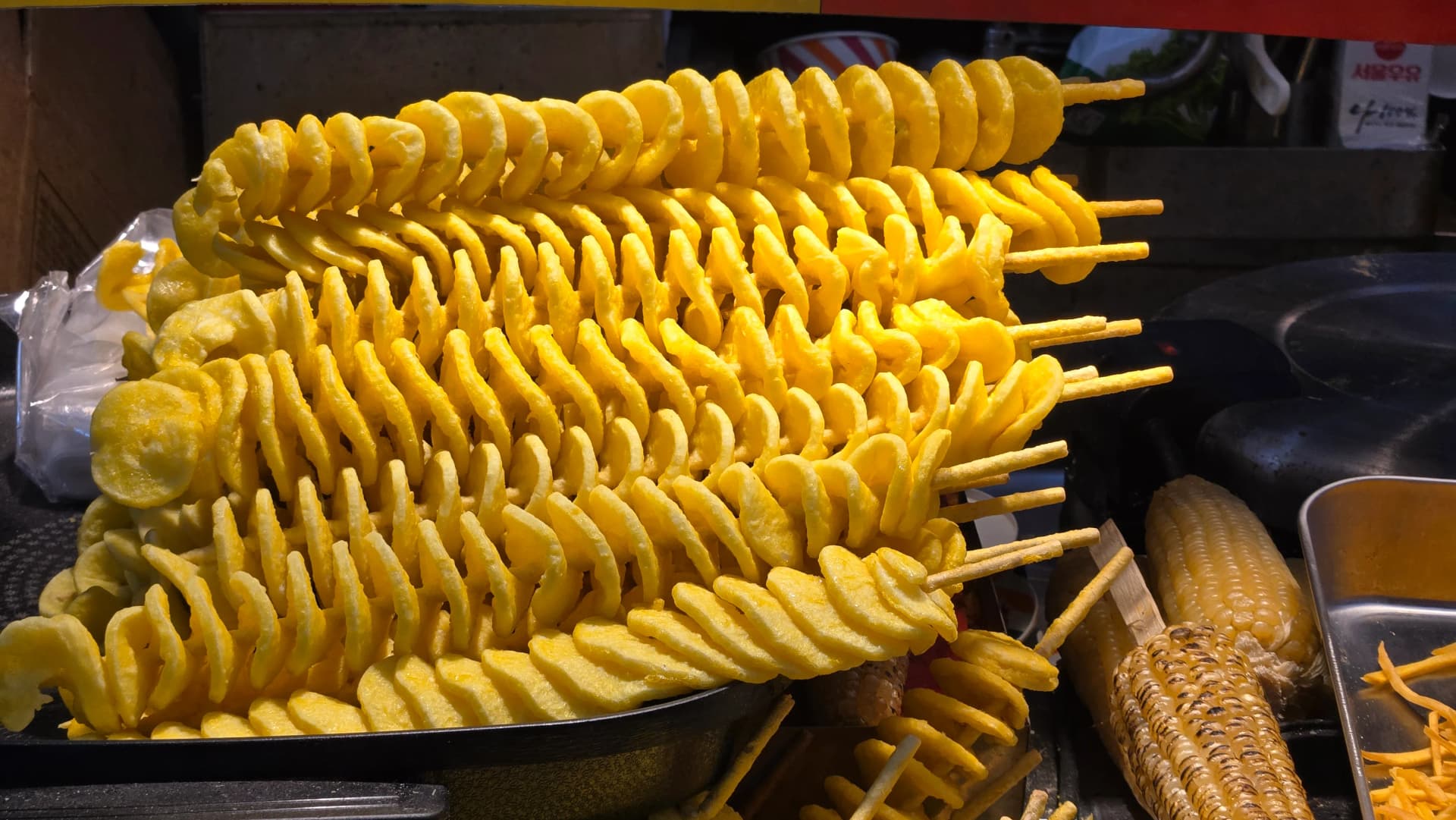
Tornado potato is one whole potato spiral-sliced super thin, threaded onto a skewer, and deep-fried. You've probably seen it on social media as "Tornado Potato." Honestly, the taste isn't drastically different from potato chips — savory and salty. But the shape is perfect for walking and snacking, so it's great to have one in your hand while you explore the market.
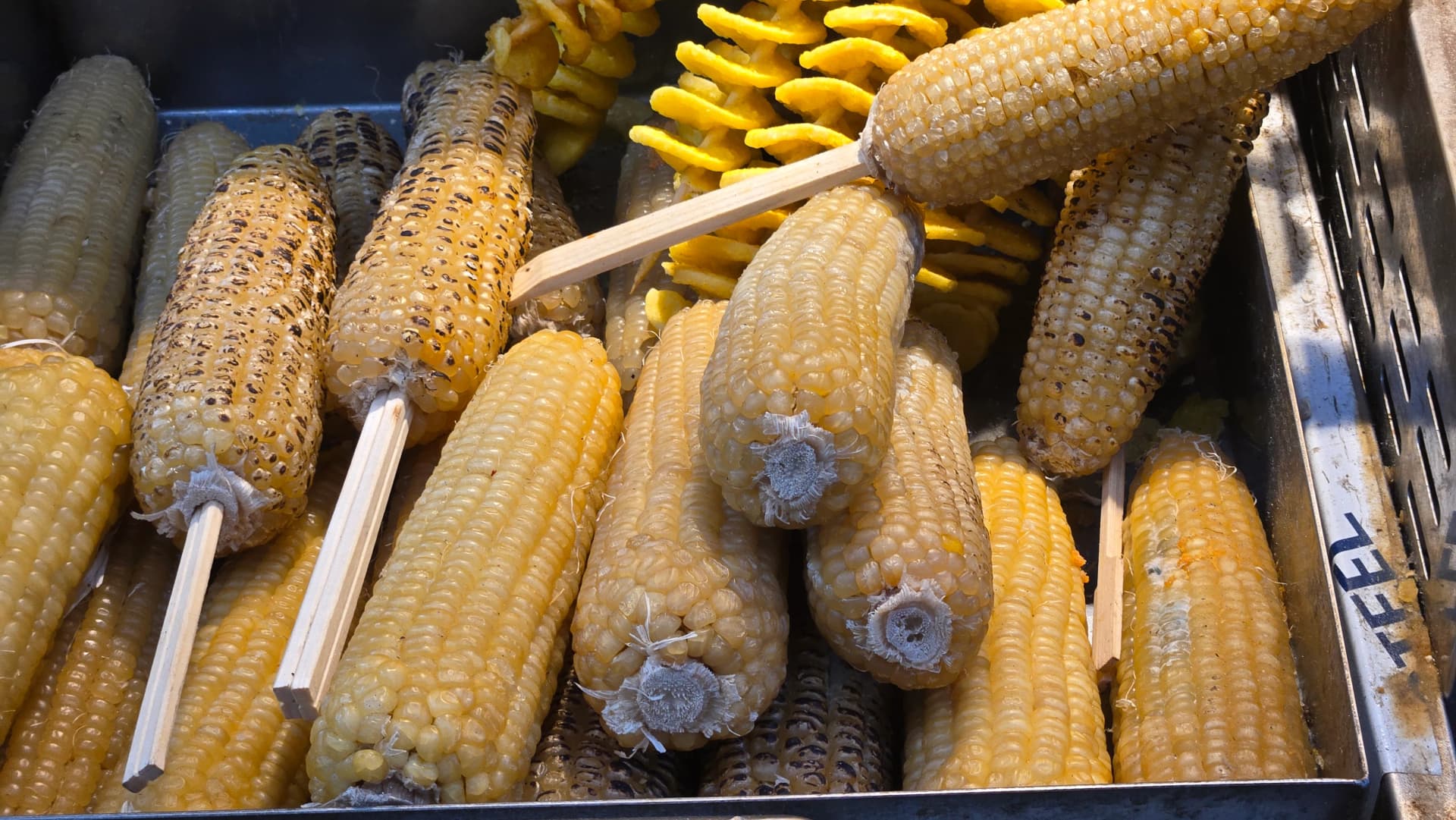
Steamed corn is one of the most basic snacks that's been sold at Korean markets since forever. There's not much to explain here, but eating it in the market atmosphere makes it somehow taste better. The kernels are plump and bursting with sweet juice — simple but you never get tired of it. One for ₩2,000 (about $1.50 USD).
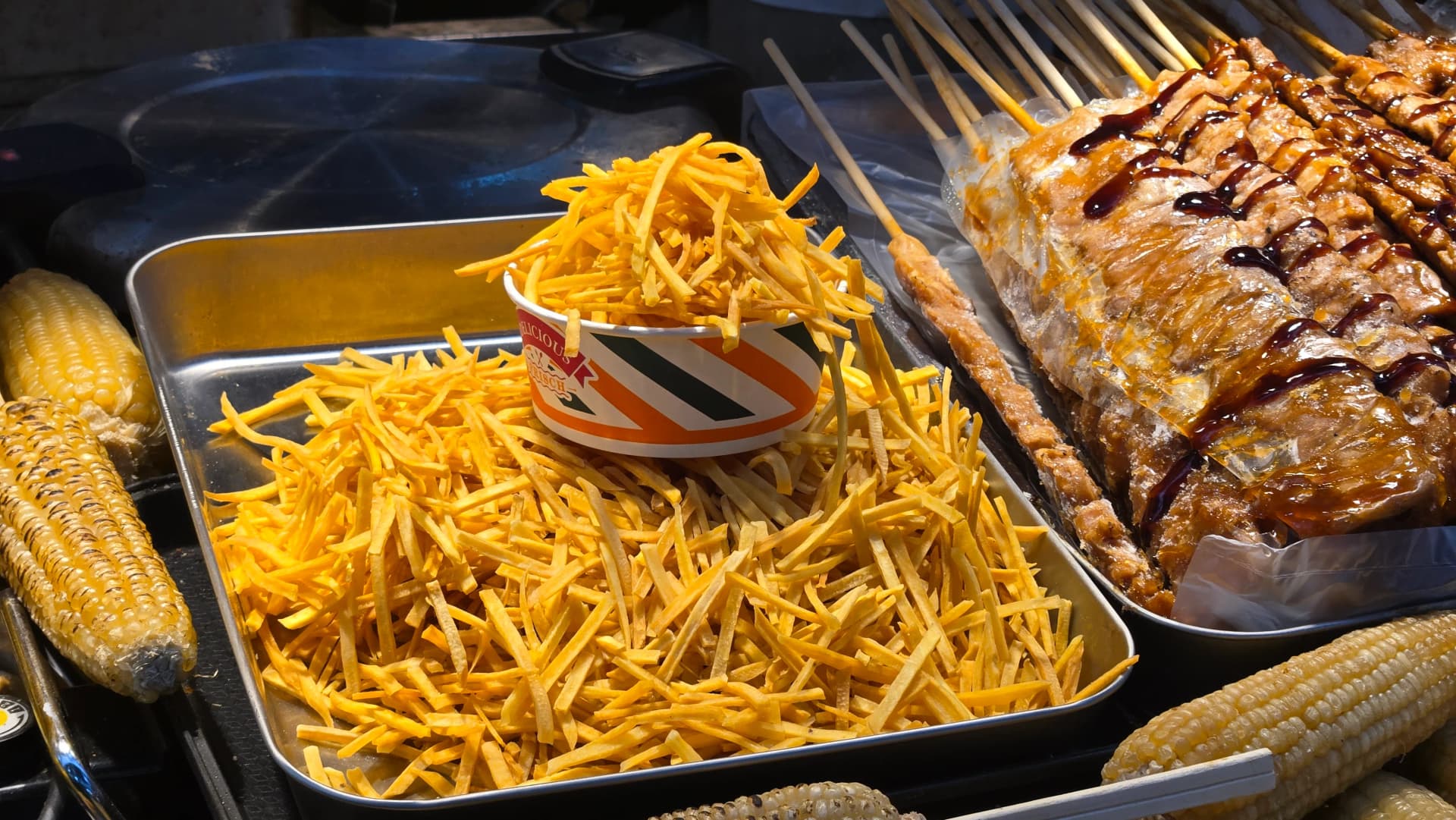
Sweet potato fries are thinly shredded sweet potato fried until crispy. They look similar to French fries, but the taste is different. Sweet potato's natural sweetness means you can eat them without any sauce. I saw them piled high at one stall and couldn't walk past without buying some, and once I started eating, I couldn't stop. In English: "Sweet potato fries."
Tangsuyuk — Korean-Chinese Cuisine at the Market
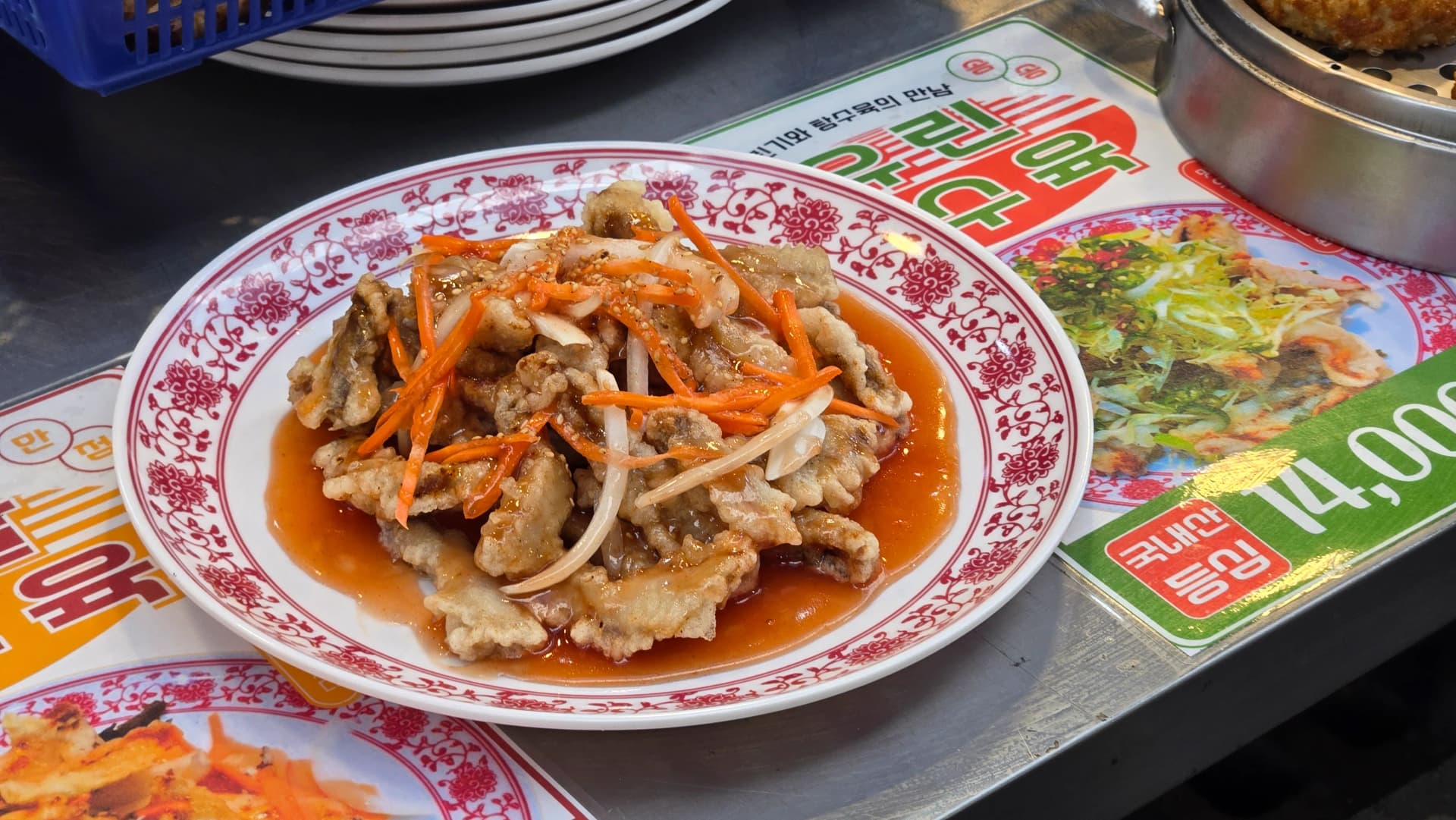
This is a Korean-Chinese dish where pork is deep-fried and then topped with a sweet and tangy sauce. Carrots and onions are served on top of the meat along with the sauce.
In Korea, tangsuyuk is so popular that it consistently ranks as one of the top Chinese food delivery items. But you normally order it for delivery from a Chinese restaurant — seeing it served on a plate at a market is pretty unusual, which is what caught my attention. The taste is a crispy fried exterior paired with a sweet-and-sour sauce. It's similar to Chinese tangcurou (糖醋肉), but the Korean version has a thinner, more tart sauce. In English: "Tangsuyuk — Korean-style sweet and sour pork."
Pan-Fried Dumplings — Wrapping Up the Seomun Market Food Tour
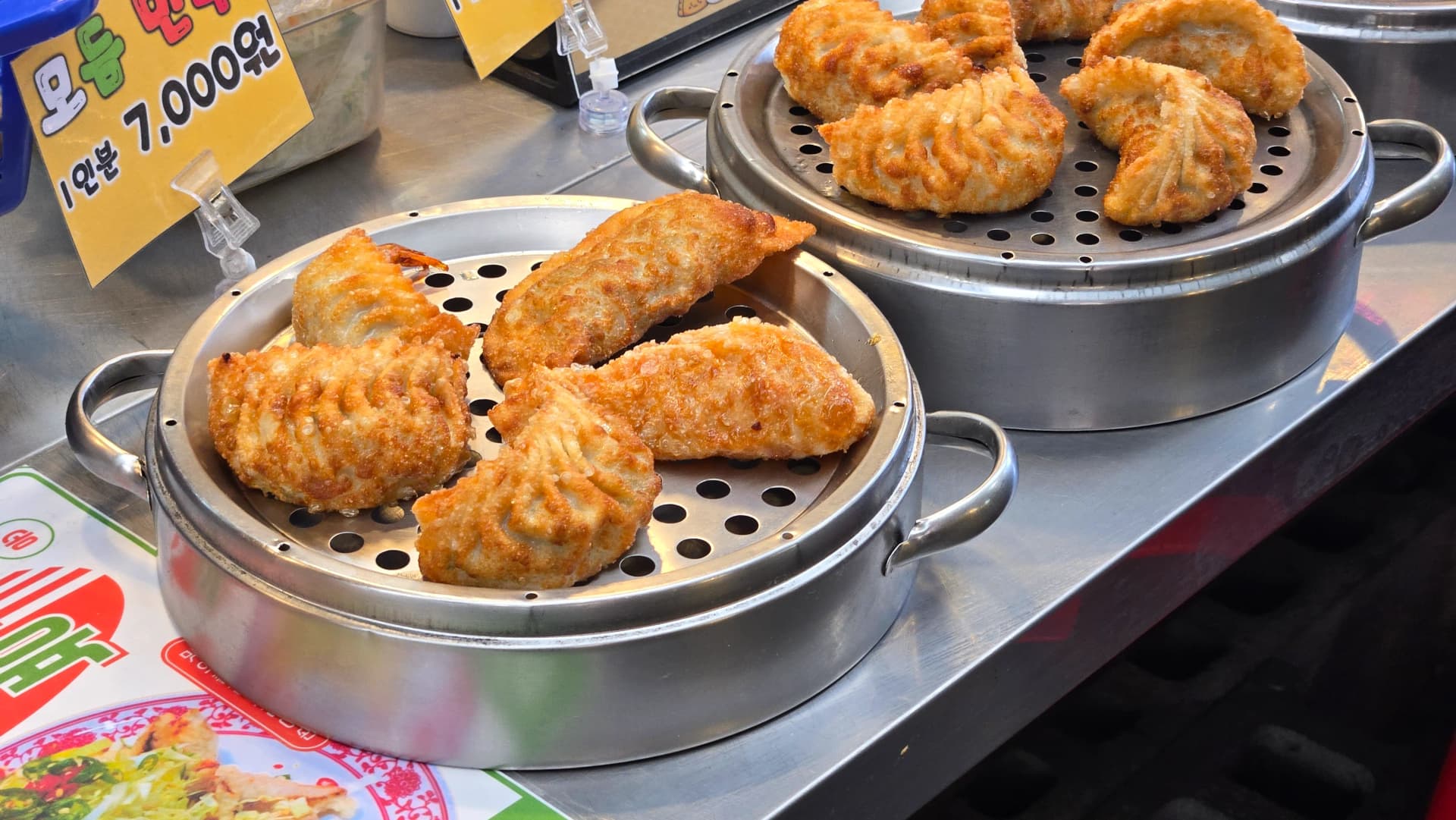
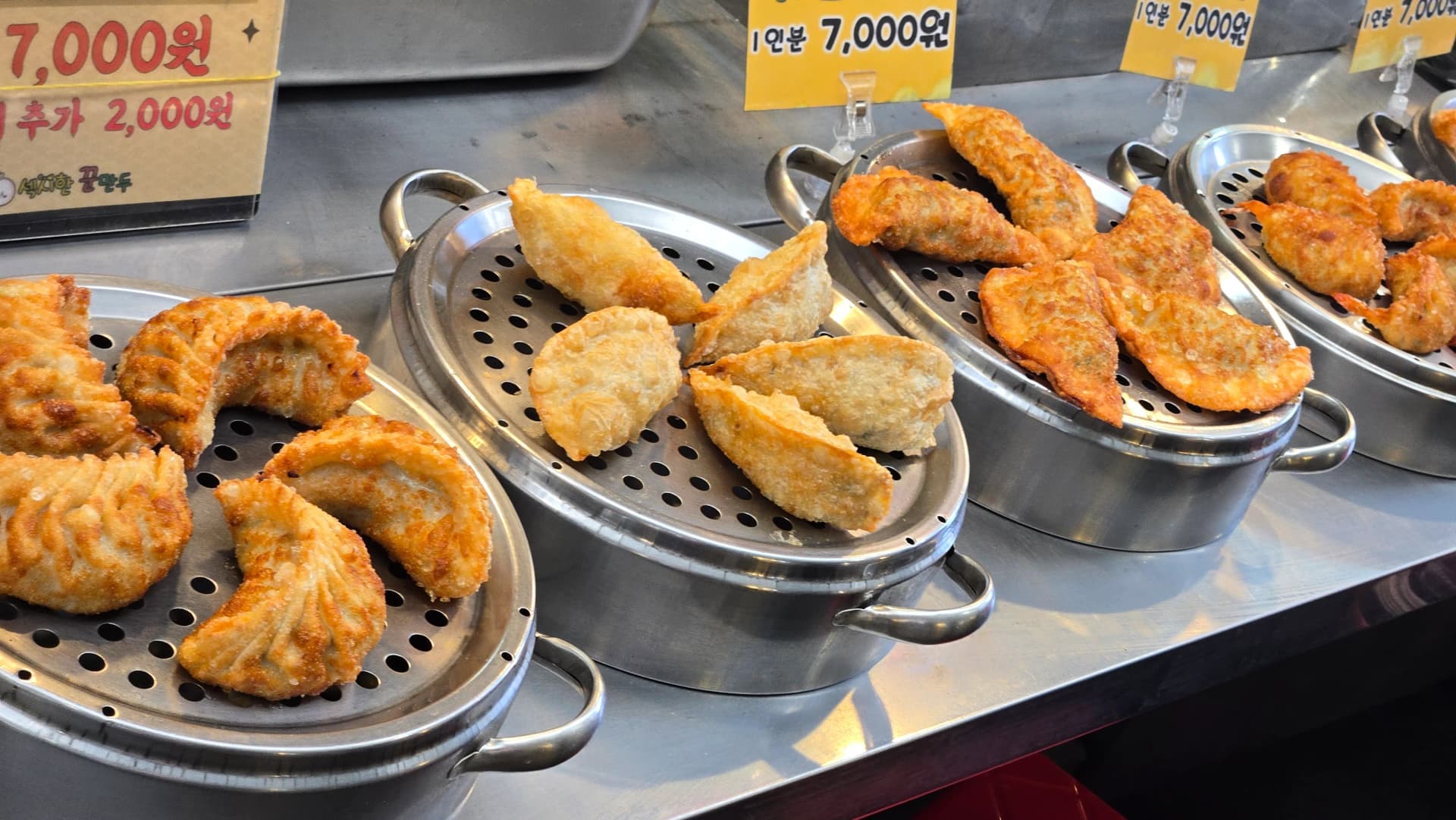
These are Korean-style dumplings — meat and vegetables wrapped in flour dough skin and pan-fried until golden. Seeing them arranged on stainless steel steamer trays was one of those warm, homey Seomun Market scenes.
A single serving is ₩7,000 (about $5 USD) and comes with multiple types — flat ones, round ones, long ones, all different shapes. They're pretty big too, so this alone could fill you up. Honestly, at that price, it's a pretty solid deal by Korean standards.
In English: "Gun-mandu — Korean pan-fried dumplings." They're similar to Japanese gyoza or Chinese guotie (鍋貼), but Korean mandu typically has thicker wrappers and includes glass noodles in the filling.
Wrapping Up Part 1 — $20 Was Enough for a Seomun Market Street Food Feast
That's everything from Part 1 of my Seomun Market street food guide — all the foods I personally walked through and captured in Daegu. And this isn't even all of it. There are still quite a few foods I haven't covered, so I'll continue with Part 2.
If you've read through this entire post, you've probably noticed that most Korean traditional market foods are small-portion snacks priced around ₩2,000–4,000 ($1.50–3 USD) each. That means you can sample a bunch of different things a little at a time. I ate over 10 items that day, and my total spending was around ₩30,000. For international travelers, being able to experience this much variety in Korean street food for about $20–25 USD is a pretty attractive deal, I think.
Part 2 is coming soon.
Seomun Market Visitor Information
Address
45 Keunjang-ro 26-gil, Jung-gu, Daegu, South Korea
Market Hours
09:00 – 18:00
※ Hours may vary by individual shop
Night Market Hours
Fri & Sat 19:00 – 23:30 / Sun 19:00 – 22:30
※ Scheduled to reopen late March 2026 · Closed Mon–Thu · Winter closure (Jan–Mar)
※ Check exact opening dates at the Seomun Night Market official site
Regular Closing Days
1st and 3rd Sunday of each month
※ Individual shops may have their own closing days
Weekend Crowd Levels
※ Peak hours 12:00–15:00 · Morning visits recommended
How to Get to Seomun Market
STEP 1
Board the KTX at Seoul Station or SRT at Suseo Station
Approx. 1 hour 50 minutes
STEP 2
Get off at Dongdaegu Station → Take Subway Line 1
STEP 3
Transfer to Line 3 at Banwoldang Station → Get off at Seomun Market Station
STEP 4
Exit 3 at Seomun Market Station → 3-minute walk
STEP 1
Board at Gangnam Express Bus Terminal or Dong Seoul Terminal
Approx. 3 hours 10 minutes
STEP 2
Get off at Seo-Daegu Express Bus Terminal
STEP 3
Take Line 3 from Manpyeong Station (in front of terminal) → Get off at Seomun Market Station
STEP 4
Exit 3 at Seomun Market Station → 3-minute walk
STEP 1
Board the KTX at Busan Station
Approx. 50 minutes
STEP 2
Get off at Dongdaegu Station → Take Subway Line 1
STEP 3
Transfer to Line 3 at Banwoldang Station → Get off at Seomun Market Station
STEP 4
Exit 3 at Seomun Market Station → 3-minute walk
STEP 1
Board an intercity bus at Busan Sasang (West) Terminal
Approx. 2 hours · 13 departures daily · First bus 07:00, last bus 19:00
STEP 2
Get off at Daegu West Bus Terminal → About 10-minute walk to Seomun Market
The drop-off is so close to the market that this can actually be more convenient than KTX
STEP 1
From Daegu Airport, take Bus 401 or Express Bus 1 → Ayanggyo Station
STEP 2
Subway Line 1 → Transfer to Line 3 at Banwoldang Station → Get off at Seomun Market Station
STEP 3
Exit 3 at Seomun Market Station → 3-minute walk
Total travel time approx. 40–50 minutes
※ Fares and travel times are based on March 2026 and may change. For the latest information, check Korail, SRT, or Express Bus Booking.
This post was originally published on https://hi-jsb.blog.