
Category

🇯🇵日本語
韓国カルグクス食べ比べ|あさりvs辛口●17 items
One fall evening, my buddy hit me up out of nowhere. "Let's go get kalguksu." When you live in Daejeon — a city in central South Korea that's basically the kalguksu capital — there's at least one noodle shop on every block. Hundreds of them scattered across the city, easy. He said he'd already scoped out a spot, so I headed straight there after work. Kalguksu is one of Korea's signature noodle dishes: you take flour dough, roll it out thin, slice it into noodles by hand with a knife, and cook them in a hot broth. It doesn't have the instant name recognition of ramen or tteokbokki, but once you've lived in Korea for a while, you find yourself craving it more often than you'd expect. I went with the clam version, my friend picked the spicy one, and when neither of us felt full enough, we tacked on a plate of bossam pork. For the record, that particular shop has since closed down, but the memory of that meal stuck with me vividly enough that I figured it was worth writing about.
What Is Kalguksu?
The Name
"Kal" means knife and "guksu" means noodle soup — so kalguksu literally translates to "knife-cut noodle soup." The whole point is that the noodles are hand-rolled and sliced with a knife, not extruded by a machine.
How It's Cooked
The freshly cut noodles go straight into a pot of hot broth made from anchovy, clam, chicken, or other bases. Every shop uses a different broth, so the same dish can taste surprisingly different from place to place.
The Texture
Thicker and chewier than ramen or udon. The noodles themselves carry a wheaty, almost nutty flavor, so when you eat them with the broth there's a real satisfying bite to every mouthful.
How to Eat It
Pick up the noodles with chopsticks, sip the broth with a spoon. And yes, slurping is totally fine — in Korea, it's the natural way to eat noodle soup. No side-eyes at the table.
Price Range
Usually about $5 to $7 a bowl. There's a kalguksu spot in practically every neighborhood, and it's cheap enough to pop in solo for a quick lunch without thinking twice.
Popular Varieties
Clear-broth clam kalguksu (bajirak), spicy red-broth kalguksu (eolkeuni), chicken-broth kalguksu, and nutty perilla seed kalguksu (deulkkae) — there's a whole spectrum to explore.
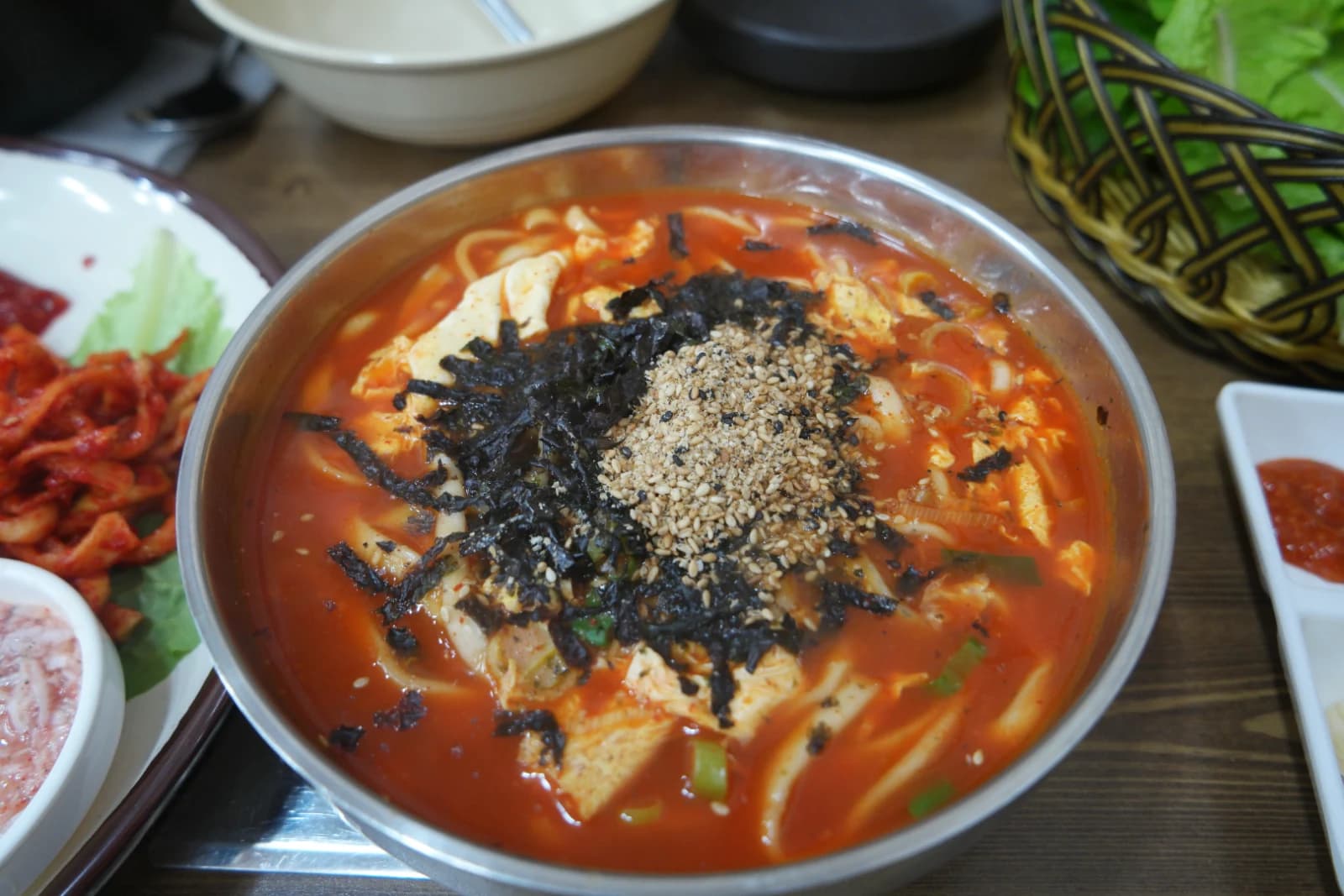
This is eolkeuni kalguksu — the spicy version. While regular kalguksu comes in a clear broth, this one gets a dose of red chili powder seasoning that turns the whole thing into a fiery bowl. It's similar to jang-kalguksu (which uses chili paste), though the exact seasoning base varies from shop to shop. You can see right away from the photo how red that broth is. There's a heap of dried seaweed flakes and sesame seeds on top, and you can just barely make out noodles, green onions, and bits of zucchini peeking through the broth. In Korea, most kalguksu places list the regular and spicy versions side by side on the menu, so you just pick one or the other. People who like heat almost always go for the spicy side.
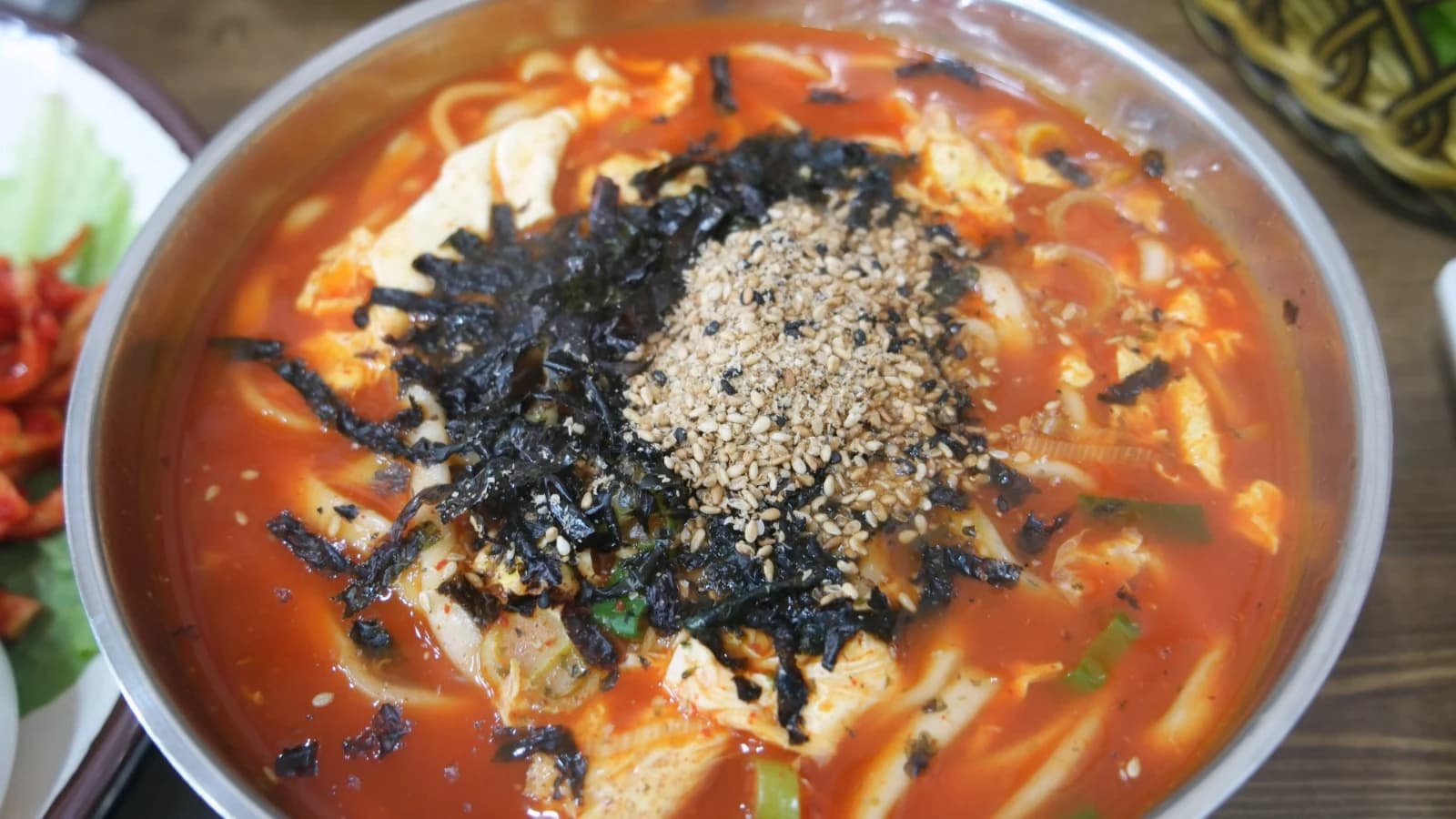
Here's a closer look — seaweed flakes scattered across the red broth with a little mountain of sesame seeds right in the center. Based on the color alone, you'd expect it to be scorching hot, but honestly it's more of a sharp, savory kick than a tongue-numbing burn. When you dig your chopsticks in and lift the noodles out, those thick strands come up draped in red broth, and it looks seriously appetizing. Mixed in between were chunks of tofu, green onion, and sliced zucchini, so there was no shortage of stuff in the bowl.
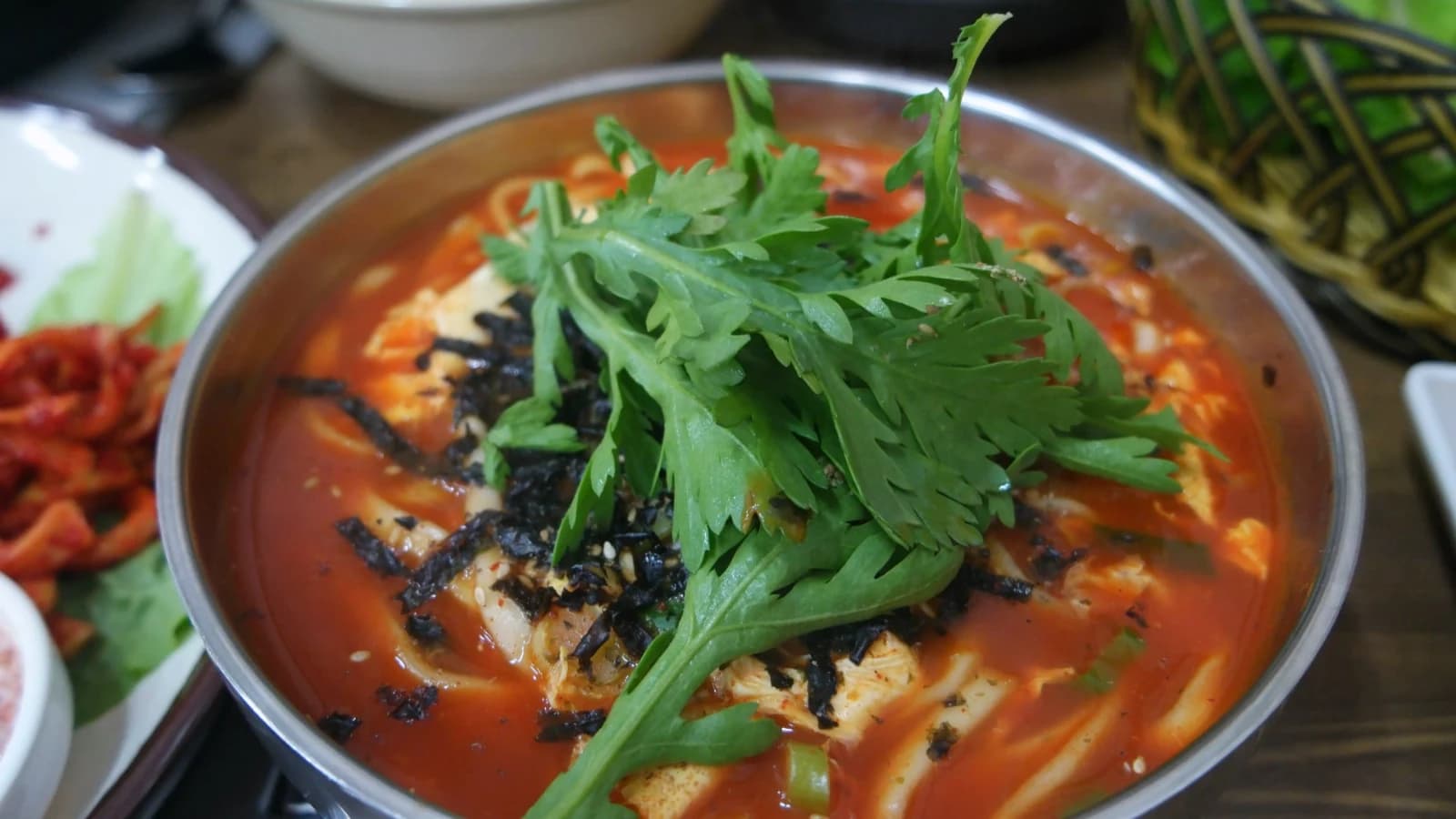
Here I loaded a big handful of crown daisy on top. Crown daisy (ssukgat) is a leafy green with a strong herbal fragrance, and in the Daejeon area, piling it onto your spicy kalguksu is basically standard practice. The contrast of all that bright green sitting on fiery red broth is a sight, and when you dip the leaves briefly into the broth and slurp them up with the noodles, this fresh, almost minty aroma cuts right through the heat. Personally, I feel like spicy kalguksu is missing something without it, but my friend is one of those people who normally won't touch the stuff. He actually asked me why I was putting it in. Of course, once it was swimming around in the broth, he caved and started adding it to his own bowl too.
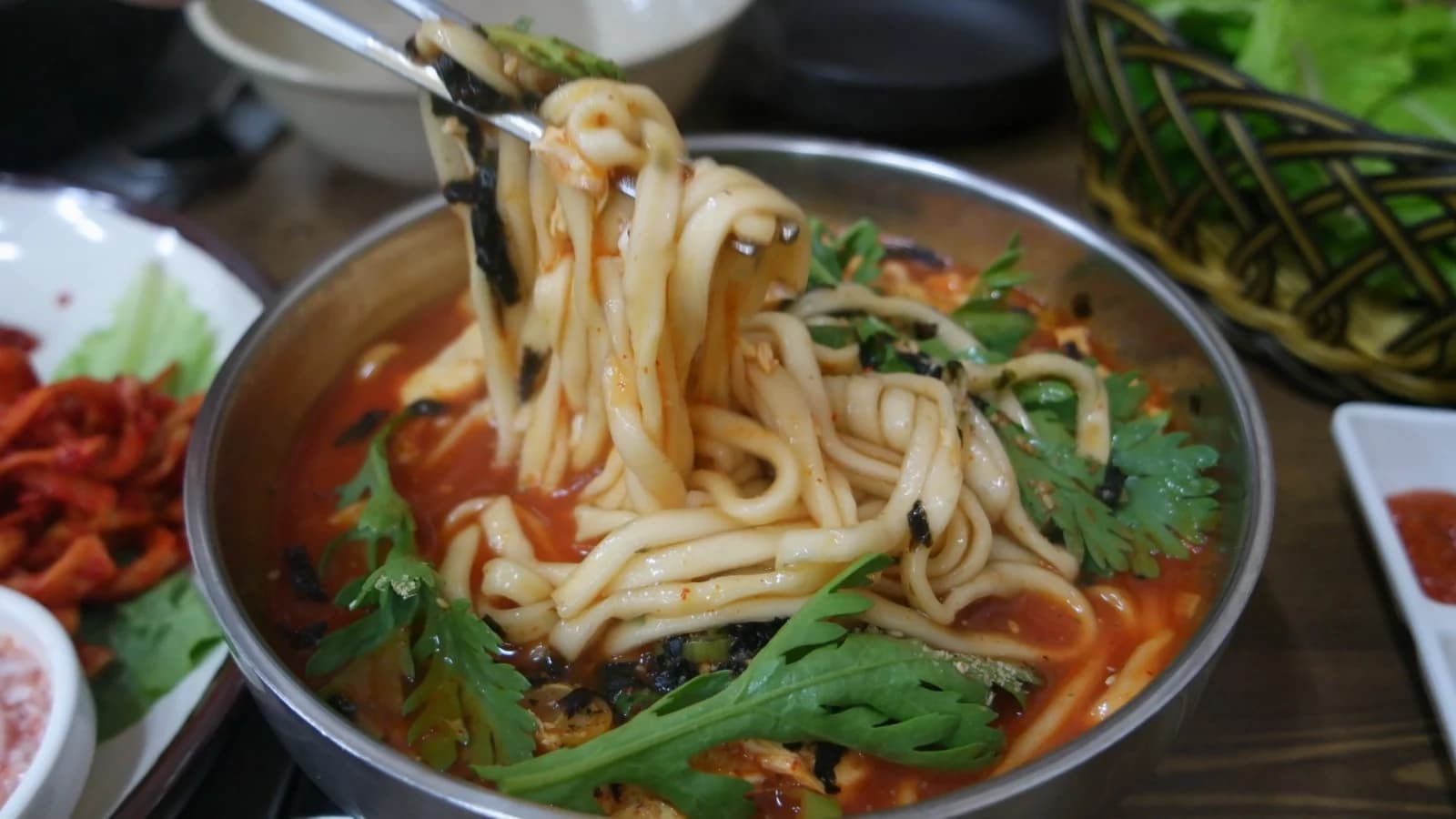
I lifted a bunch of noodles with my chopsticks, and you can see the strands are all different widths. Some are thick, some are thin. Since kalguksu noodles aren't machine-pressed but hand-rolled and knife-cut, they come out uneven like this — and that's not a flaw, it's the whole point. In a single chopstick-load, the thick strands give you that satisfying chew while the thin ones soak up broth like little sponges, so the texture is never one-note. Red broth clings to every strand, and bits of crown daisy come along for the ride — you just slurp the whole thing down.
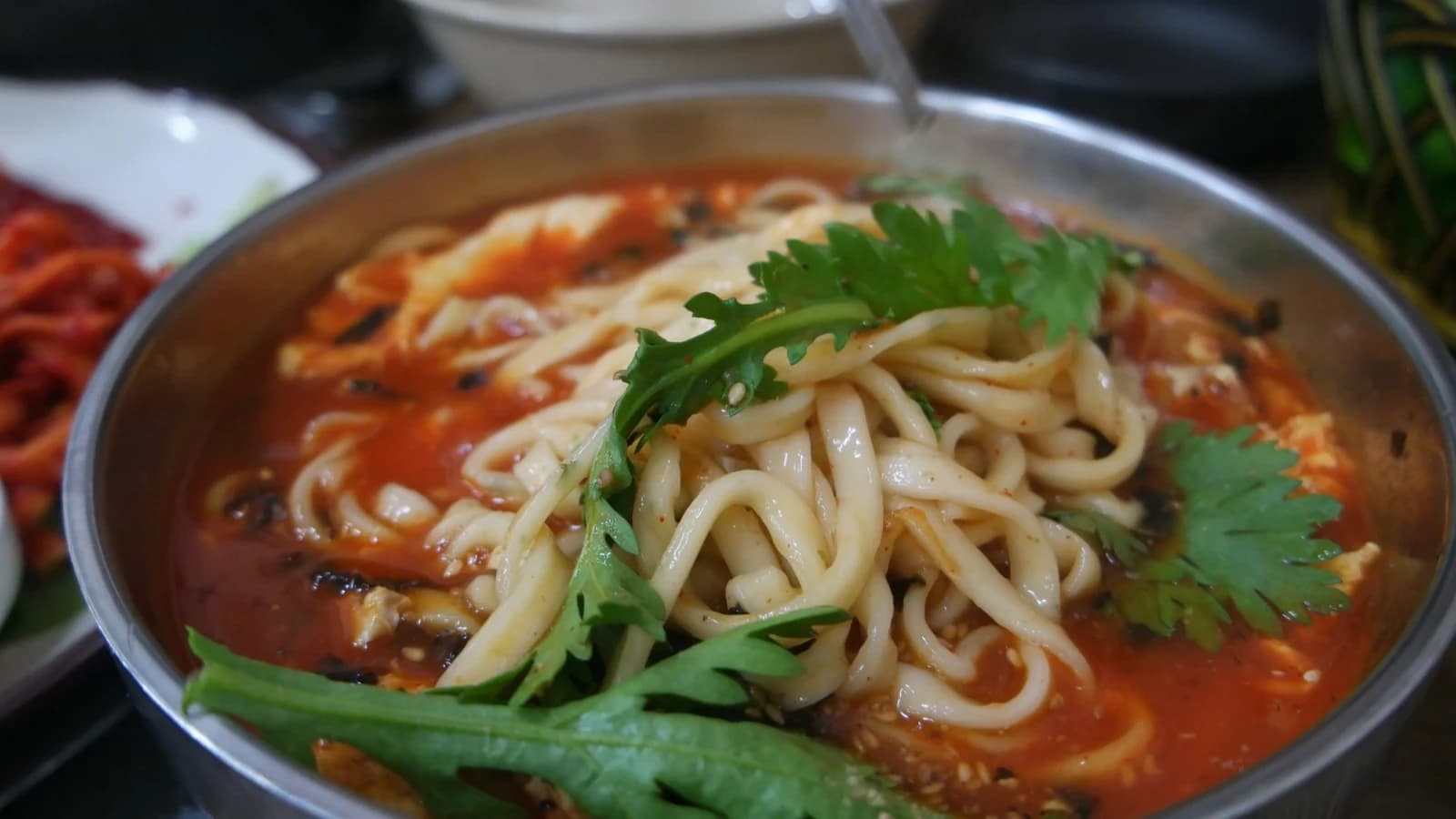
After mixing everything together, the noodles and crown daisy have blended into the broth and the color has gone even deeper than before. You can spot some egg swirled in there too. At this point, you just grab your chopsticks and go.
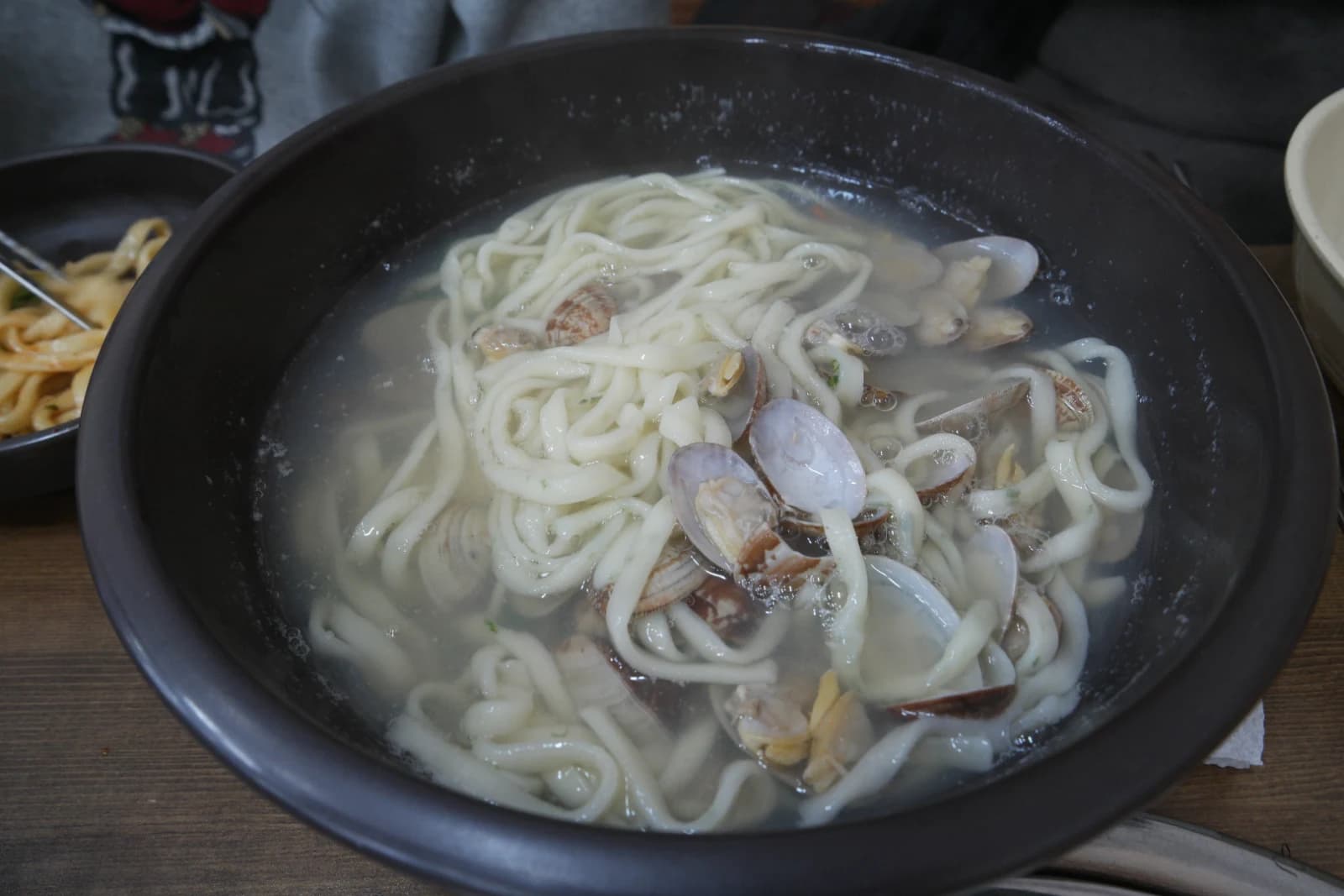
My order was the clam kalguksu. Set it next to the spicy one and the difference is night and day — this broth is completely clear. Bajirak are small clams commonly used in Korean cooking, and here they're tossed in shell and all to make the stock that the noodles cook in. The broth has this clean, savory depth — umami without any heaviness. Clam shells are scattered throughout the noodles, so part of the fun is picking them out and popping the meat into your mouth as you eat. Whenever a shell turns up, you just pluck the clam out with your chopsticks and set the empty shell aside on a spare dish or the pot lid. If the spicy version is all about bold, in-your-face heat, the clam version is light, refreshing, and clean. Order both at the same table and it really hits you how the same base dish can go in two completely different directions.
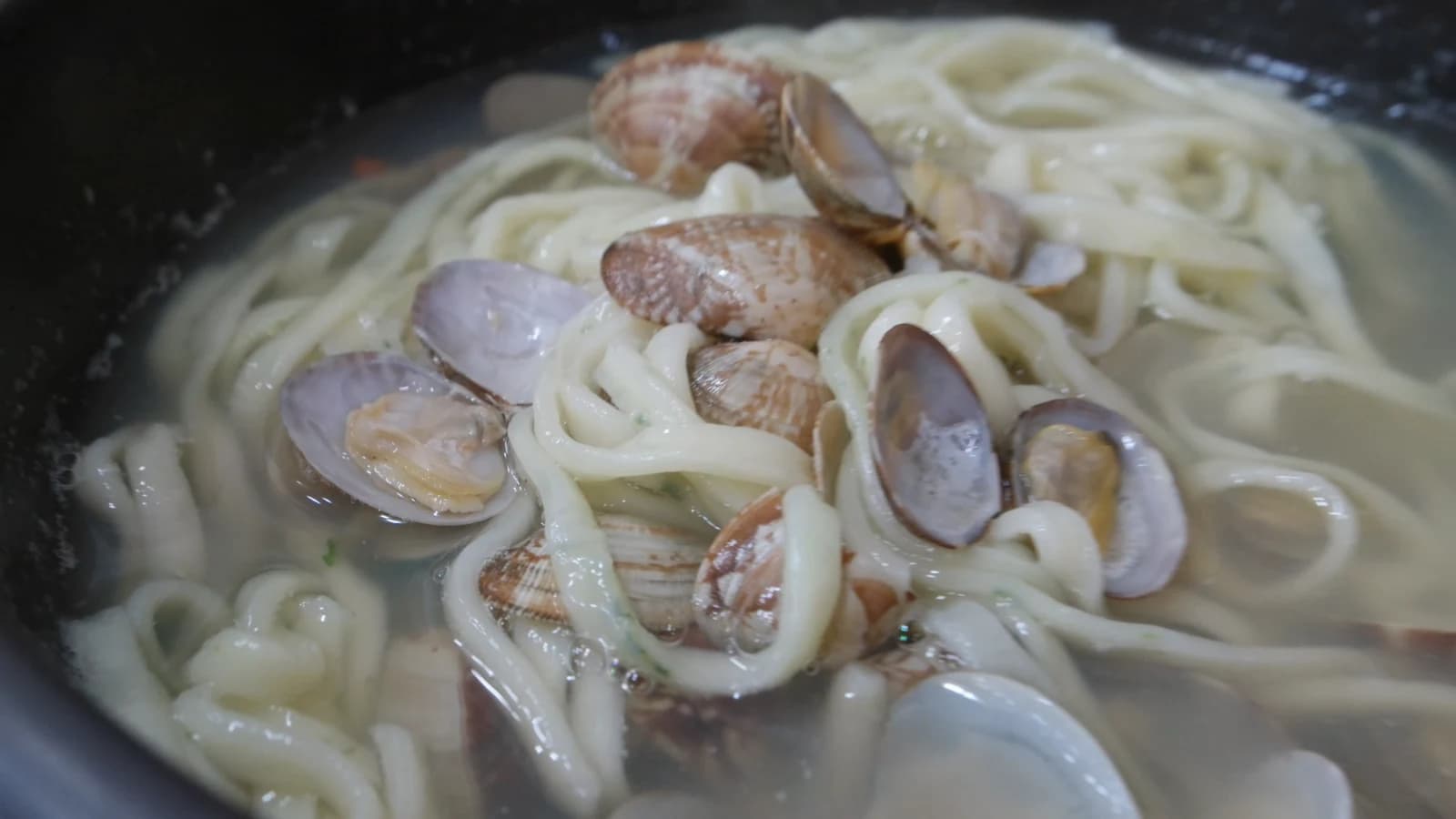
Up close, these clams are a decent size. You can see the shells cracked open with the meat exposed inside — they open up as they cook in the broth, and that's what gives the soup its flavor. Bajirak clams come mostly from Korea's west coast and they're not expensive, which is why kalguksu shops can afford to be generous with them. Eating them is simple: as you work through the noodles, just pick the clam meat out from between the shells with your chopsticks. Each one is small enough to pop whole into your mouth, and when you bite down there's this briny, ocean-forward burst of flavor. Honestly, the clam meat alone isn't going to fill you up — the real star is the umami it releases into the broth. Finish all the noodles and then sip the soup on its own with a spoon, and you'll taste exactly what I mean.
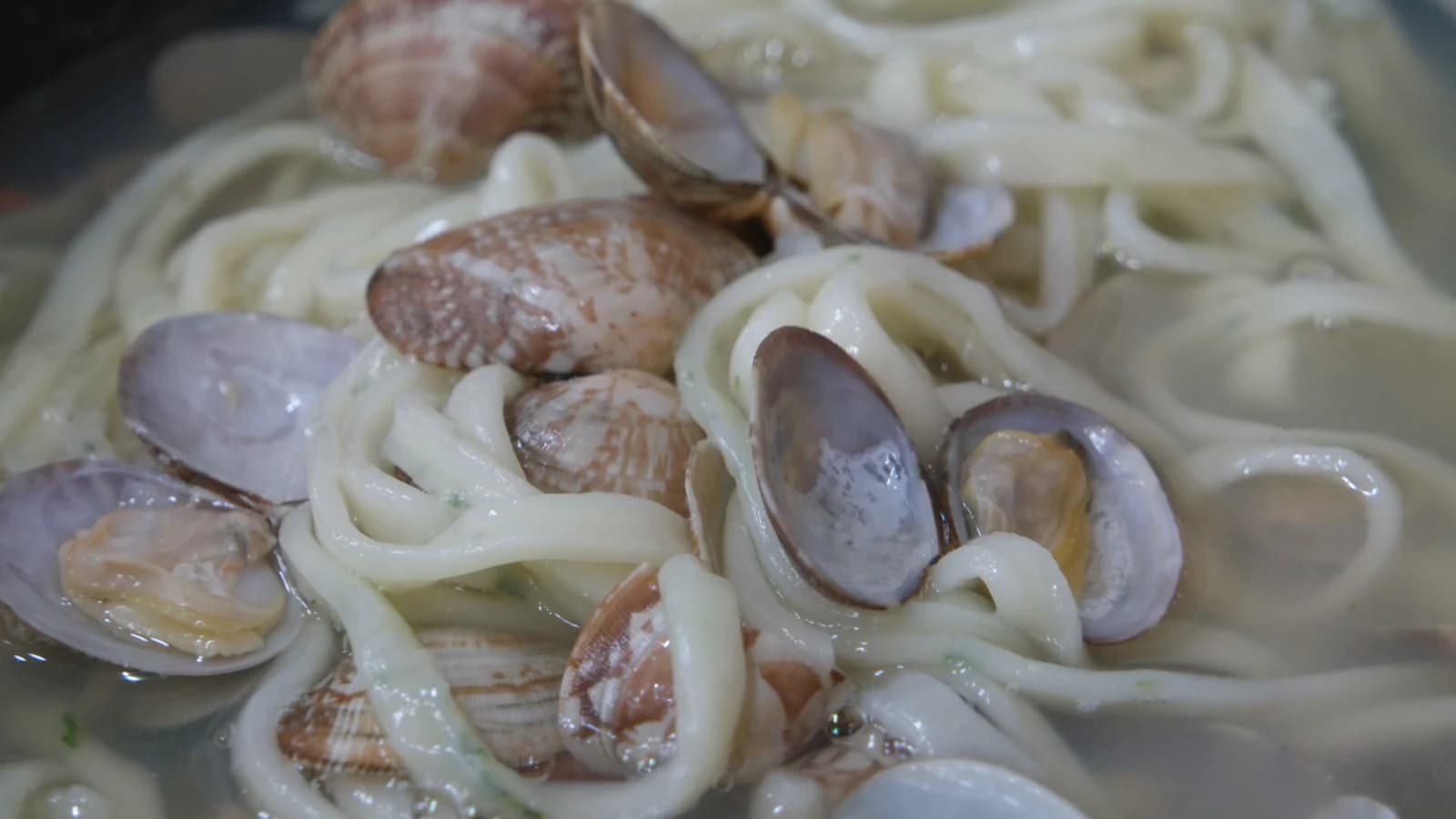
Even closer now — you can see the shell split wide open with a plump little clam sitting snugly inside. Noodles tangled up with clams all over the place — that's the signature look of clam kalguksu.
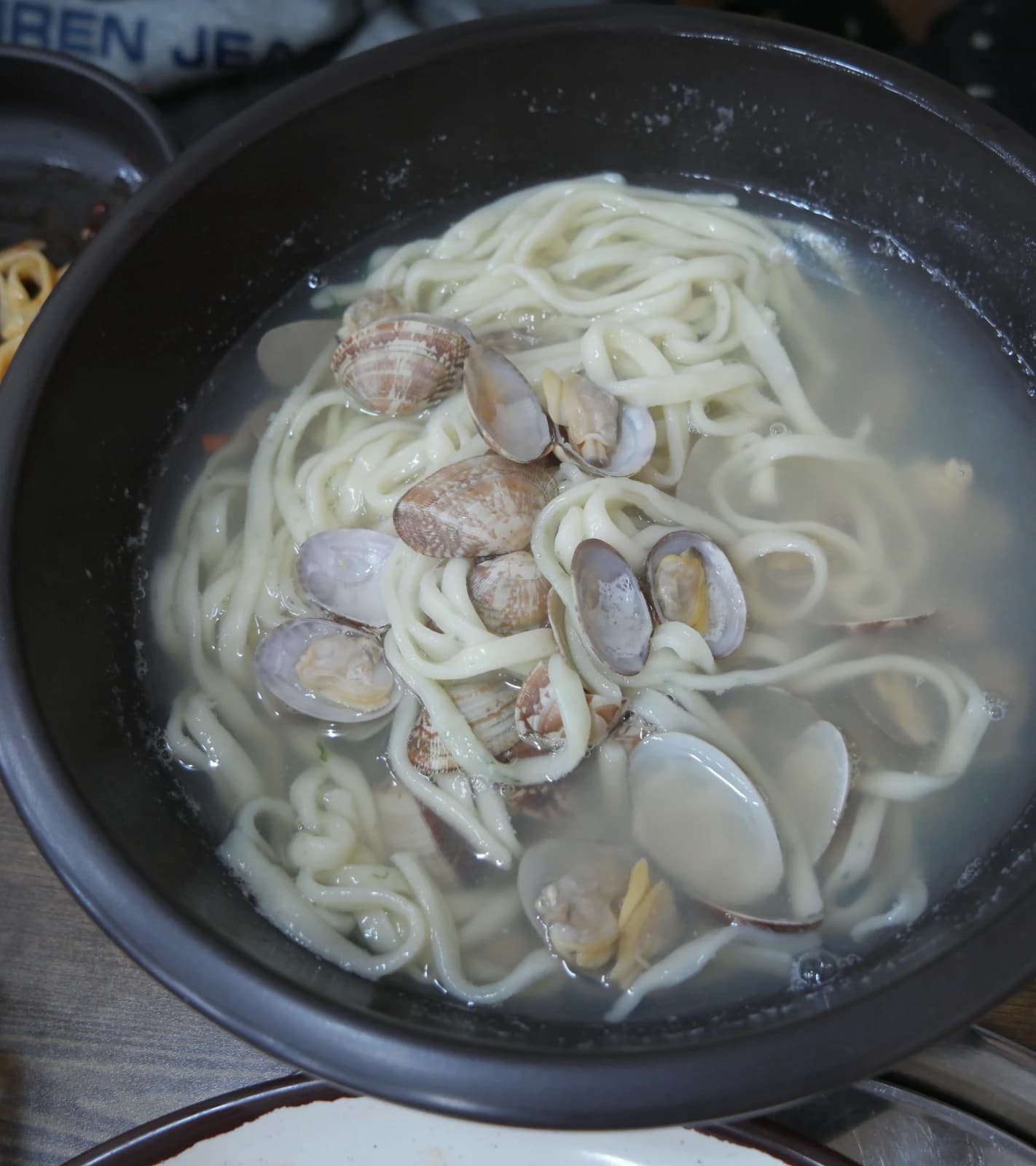
After eating through a good portion of the noodles, the broth has turned noticeably cloudier. That's flour starch leaching out of the noodles as they sit in the hot liquid — it's a signature trait of kalguksu. The longer you eat, the thicker and more porridge-like the broth gets, so by the end it tastes a bit different from those first few sips.
Clam Kalguksu vs Spicy Kalguksu
Clam Kalguksu (Bajirak)
Broth
Clear stock made by simmering whole clams, shells and all
Flavor
Light and clean with a deep, briny umami from the clams running through the entire broth
Heat Level
Not spicy at all — a safe pick if you can't handle heat
Toppings
Clam shells, zucchini, green onion. The fun of prying out little clam meats as you eat
How the Broth Changes
Flour starch seeps out of the noodles, so the broth gradually turns cloudy and thicker as you go
Spicy Kalguksu (Eolkeuni)
Broth
Anchovy or clam stock with chili powder seasoning stirred in, turning it bright red
Flavor
Savory and spicy with a sharp kick — not face-melting, more like a warm heat layered over umami
Heat Level
Medium. Mild by Korean standards, but if you're not used to spicy food you'll definitely feel it
Toppings
Tofu, zucchini, green onion, egg. Add crown daisy on top for a fresh herbal contrast
How the Broth Changes
Already bold and concentrated from the start, so the flavor stays pretty consistent throughout
Most kalguksu shops carry both versions, so if you're eating with someone, I'd recommend ordering one of each to compare.
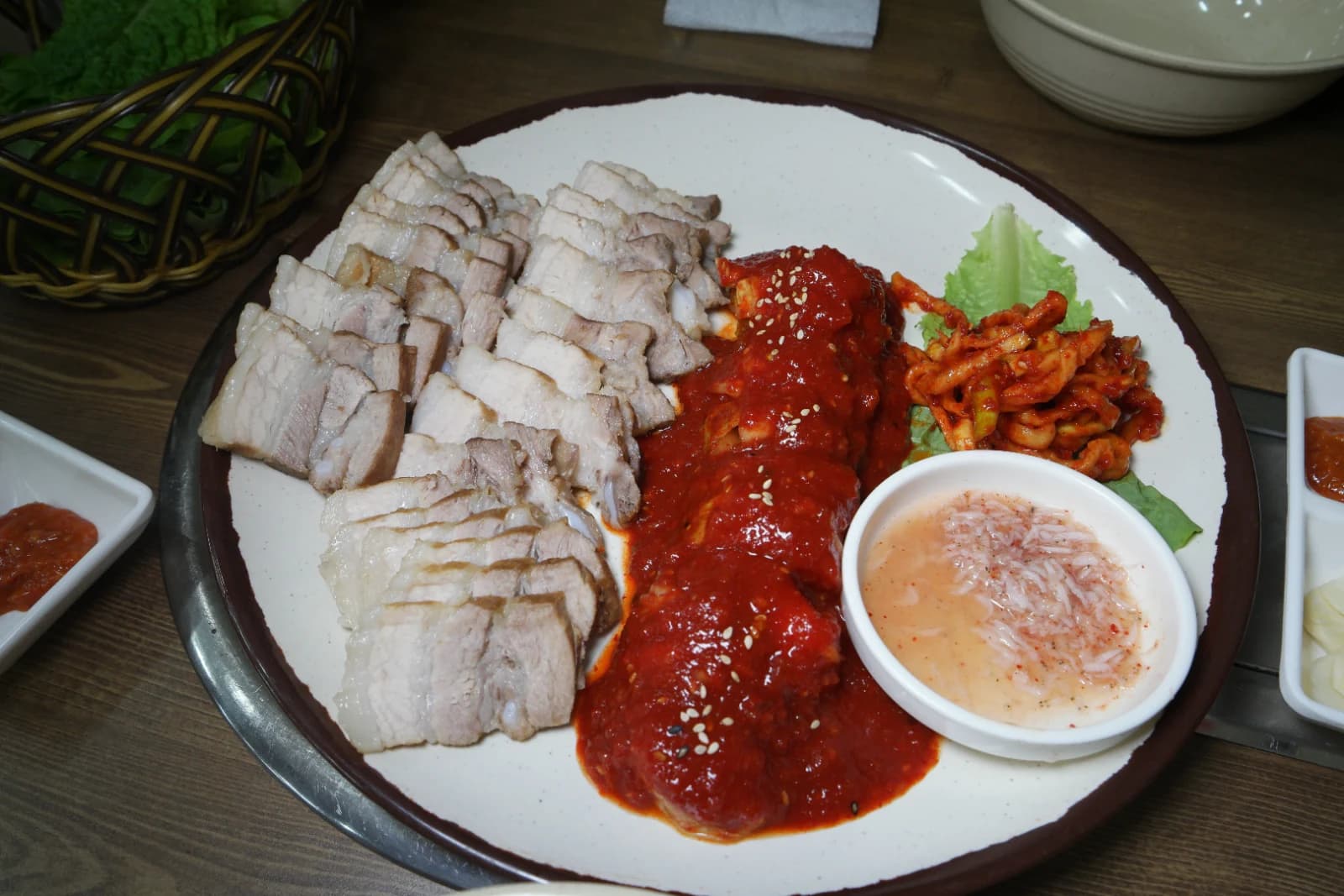
Two bowls of kalguksu between us and honestly, we were still hungry. Some kalguksu shops only do noodles, but plenty of them carry side dishes like bossam or boiled pork. My friend spotted it on the menu — "Oh, they have bossam" — and we added one without hesitation. Bossam is a Korean dish where a whole chunk of pork shoulder or neck is boiled, sliced thin, and eaten wrapped in lettuce or perilla leaves with kimchi. The moment that bossam platter hit our table, the whole vibe changed from casual noodle lunch to an actual spread. Kimchi sat in the center swimming in its juices, sliced pork fanned out on both sides — my friend took one look and said, "Man, this is a soju situation, isn't it?" But we'd both driven, so we held the line.
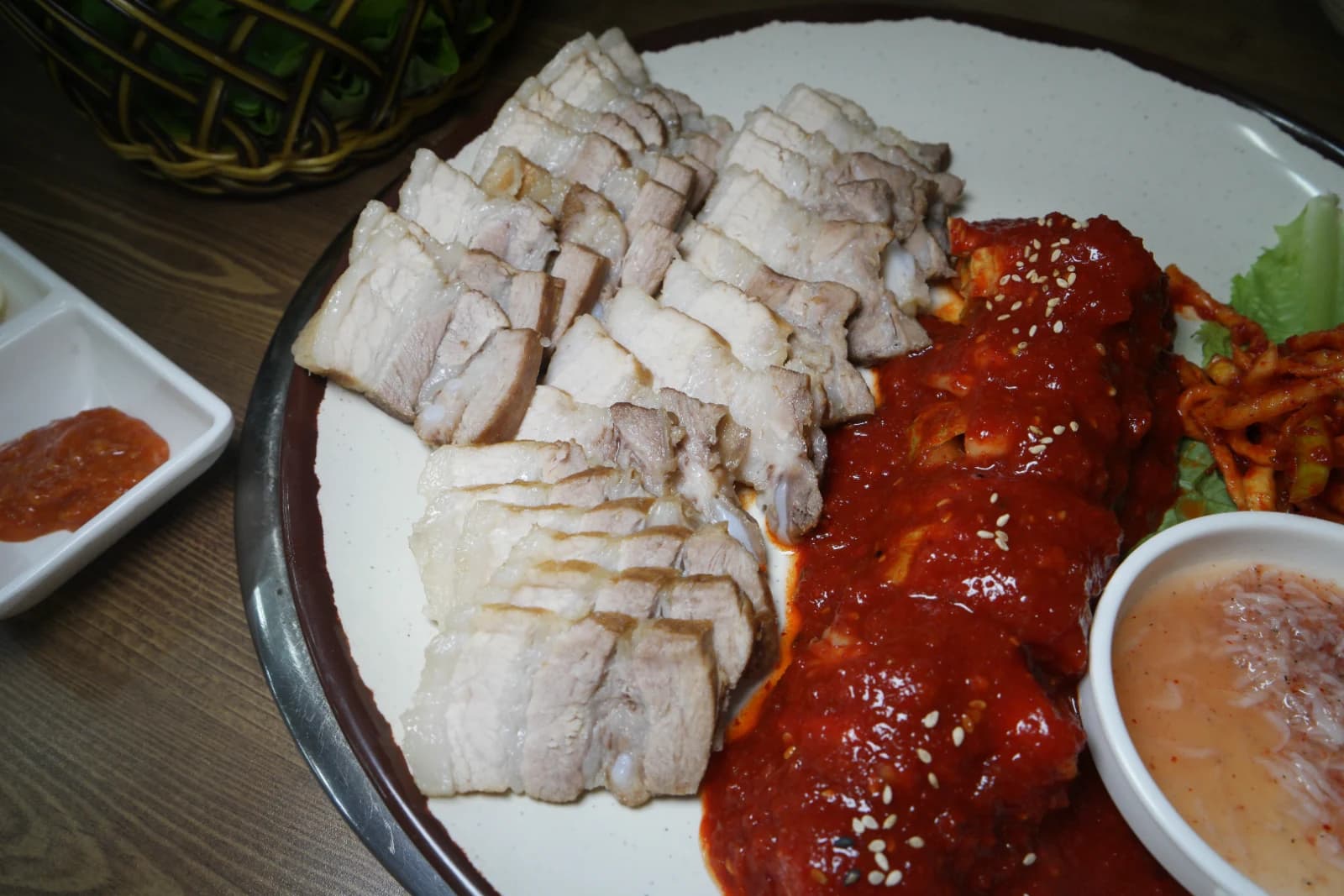
The kimchi that came with the pork was a little different from your standard stuff. It was sitting in a shallow pool of its own liquid — this is bossam kimchi, a variety that's specifically prepared to pair with boiled pork. You stack a piece of it on top of the meat and eat them together in one bite; the kimchi's tangy acidity cuts right through the pork fat, and the juices kind of burst in your mouth. That said, I'll be honest — the kimchi liquid was a bit on the salty side. Fine when you ate it with the meat, but a little aggressive on its own.
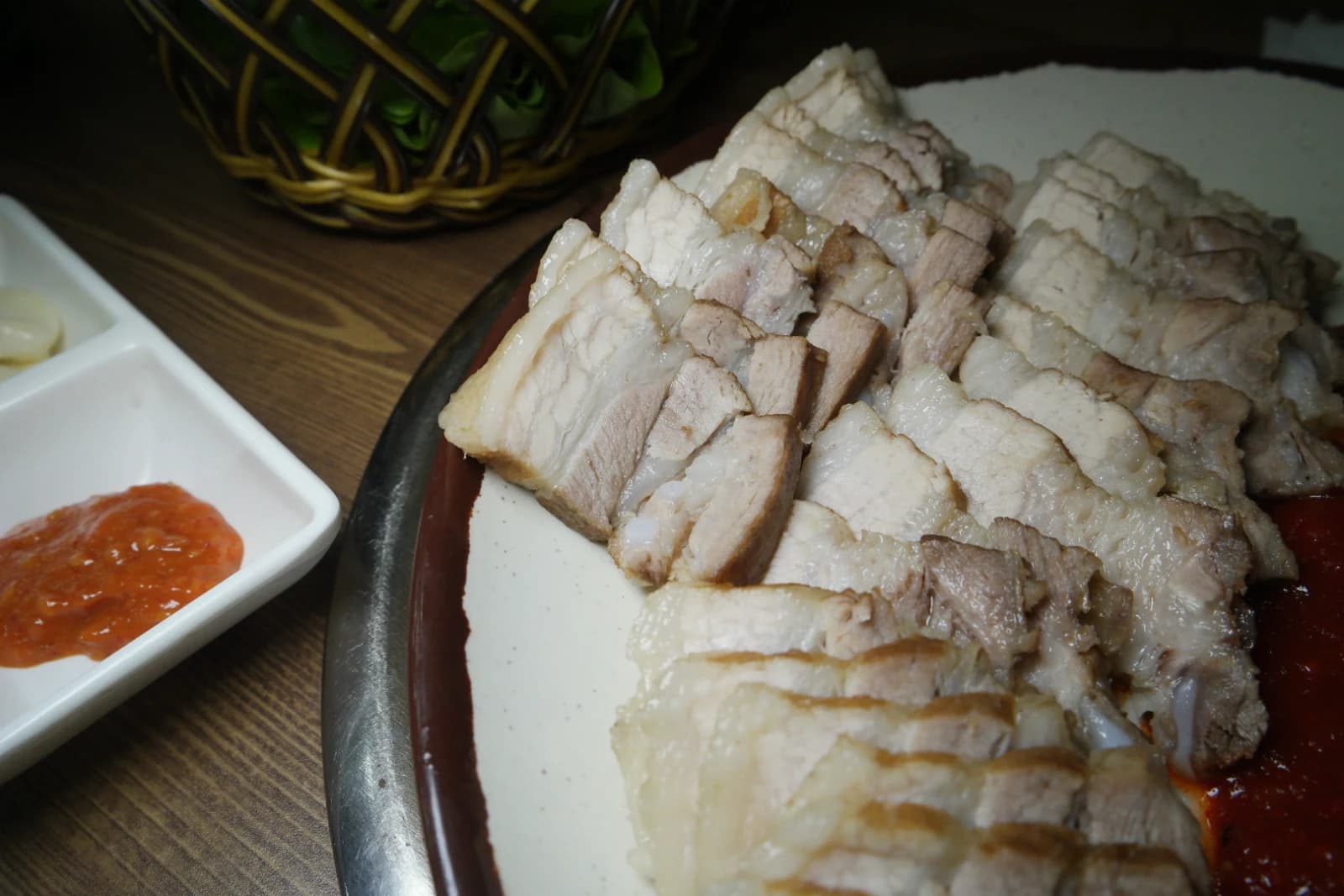
Here's the meat on its own. Thinly sliced boiled pork with distinct layers of lean meat and fat stacked together. When bossam is done right, the fat turns translucent and almost jelly-soft without being greasy, and the lean part should pull apart along the grain nice and tender. This batch wasn't quite at that level. The lean portions were a touch dry and tough — but hey, this was a side order at a noodle shop, so expecting pork-specialist quality was probably a stretch.
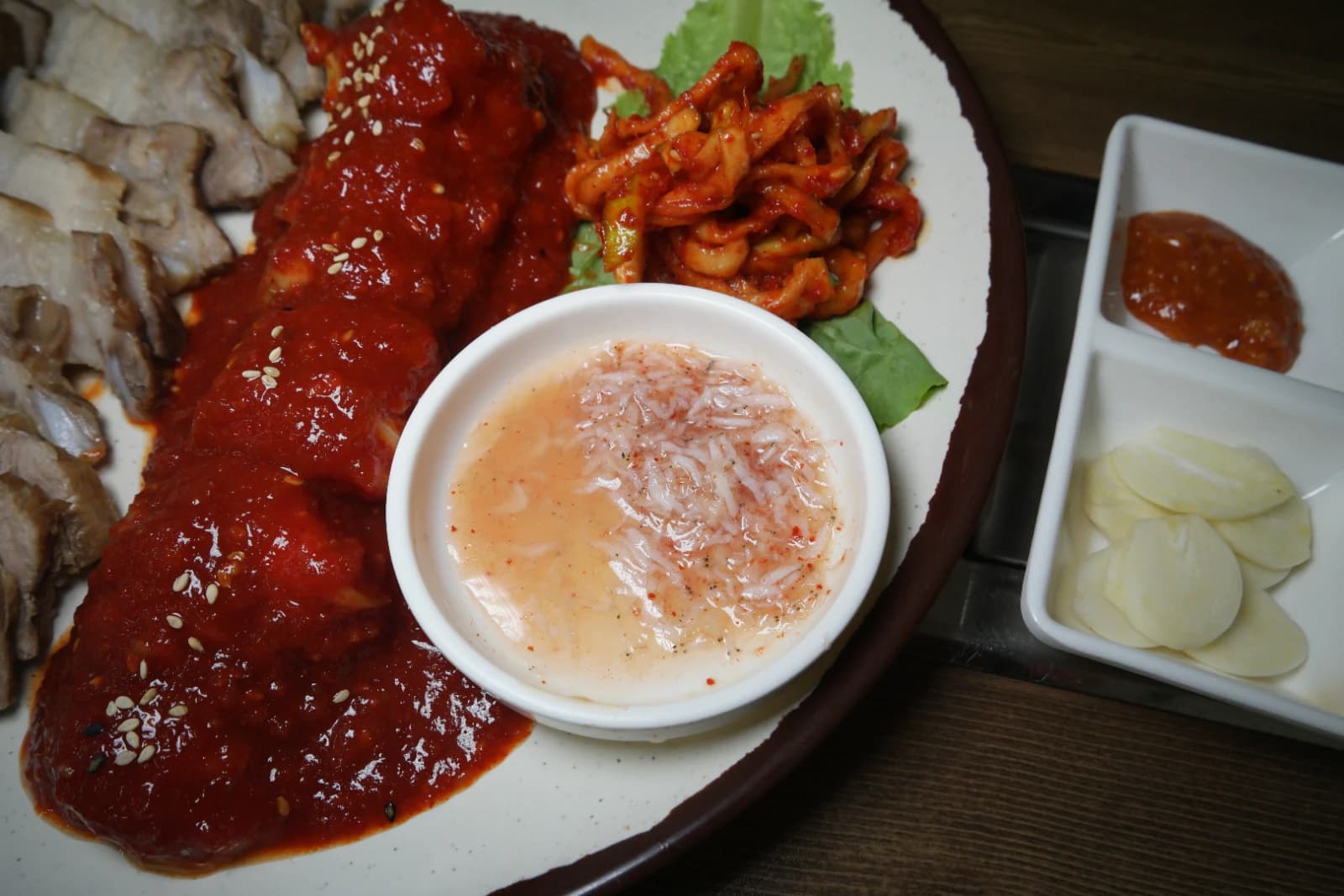
This is saeujeot — tiny shrimp fermented in salt, a classic Korean condiment, and basically the one dipping sauce you can't skip when eating bossam. Grab a slice of pork, dab it lightly in this stuff, and the salty, funky umami just explodes. The portion they gave us was pretty small, so we had to ration it — except my friend went heavy on the dipping early on and by the end the dish was practically empty.
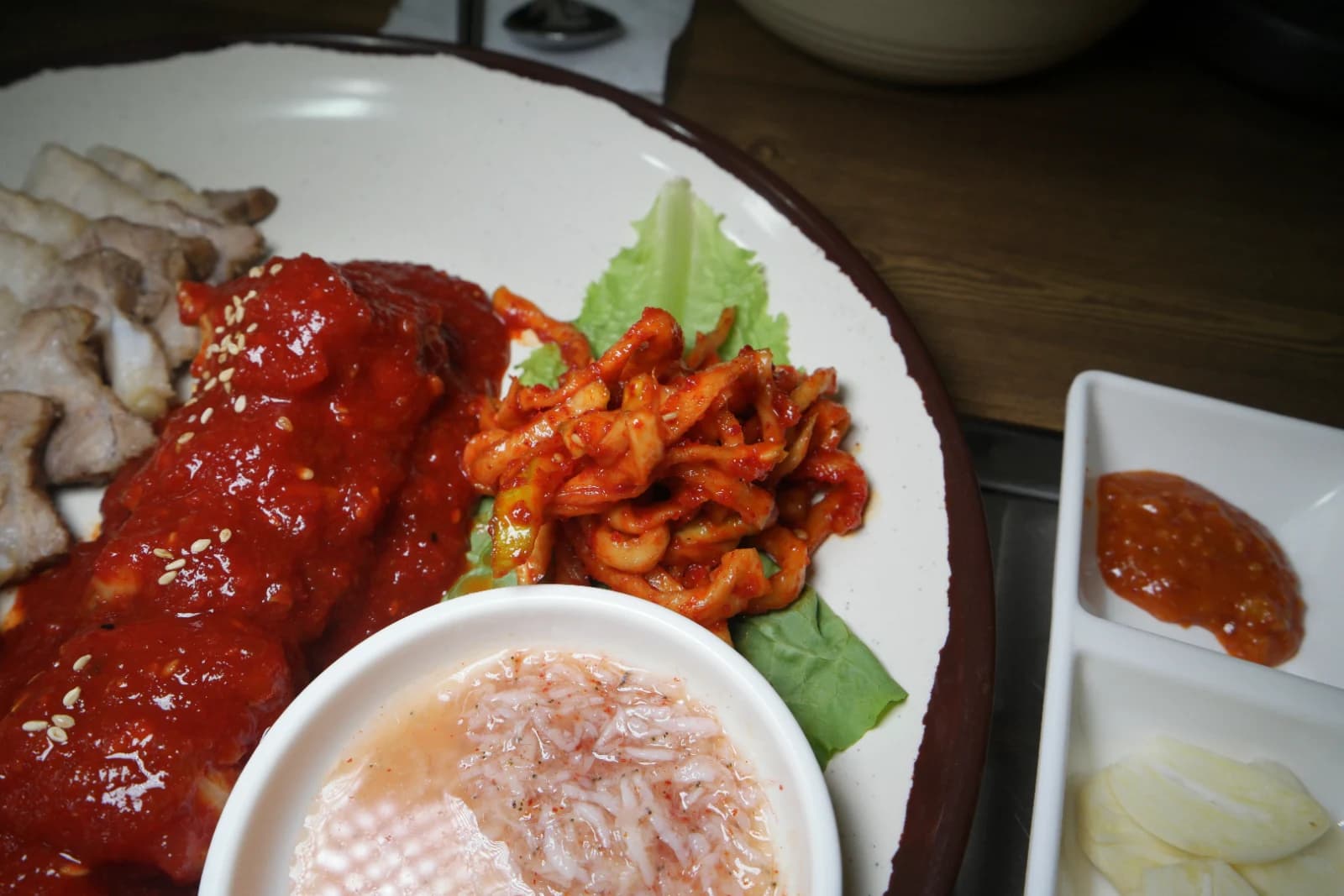
This is mumallaengi — dried radish strips tossed in chili powder seasoning. Radish is one of the most common root vegetables in Korean cooking, and when you slice it thin, dry it out, and season it up, you get this crunchy, slightly sweet side dish. It's not really something you eat with the bossam directly — it's more of a palate cleanser you pick at between bites of pork. Nothing special about this particular batch; perfectly fine, just standard.
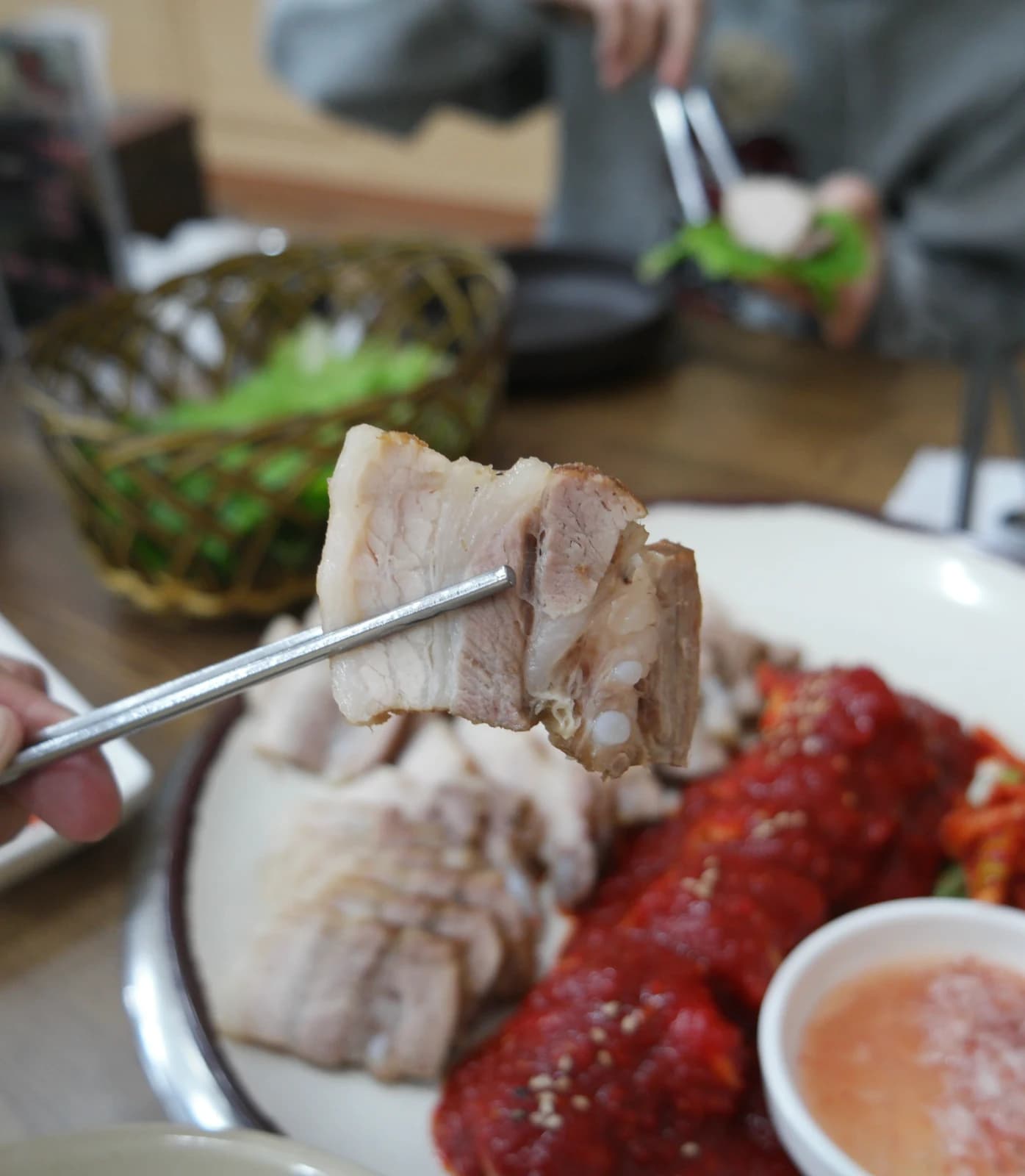
I picked up a slice with my chopsticks — you can clearly see the layered cross-section of lean and fat. In the background you can just barely catch my friend in the middle of building his wrap. The way you eat bossam is you lay the meat on a piece of lettuce or perilla leaf, pile on some kimchi and a dab of fermented shrimp paste, then stuff the whole bundle into your mouth in one go. The slices were cut pretty generously thick, so even a single piece filled your whole mouth.
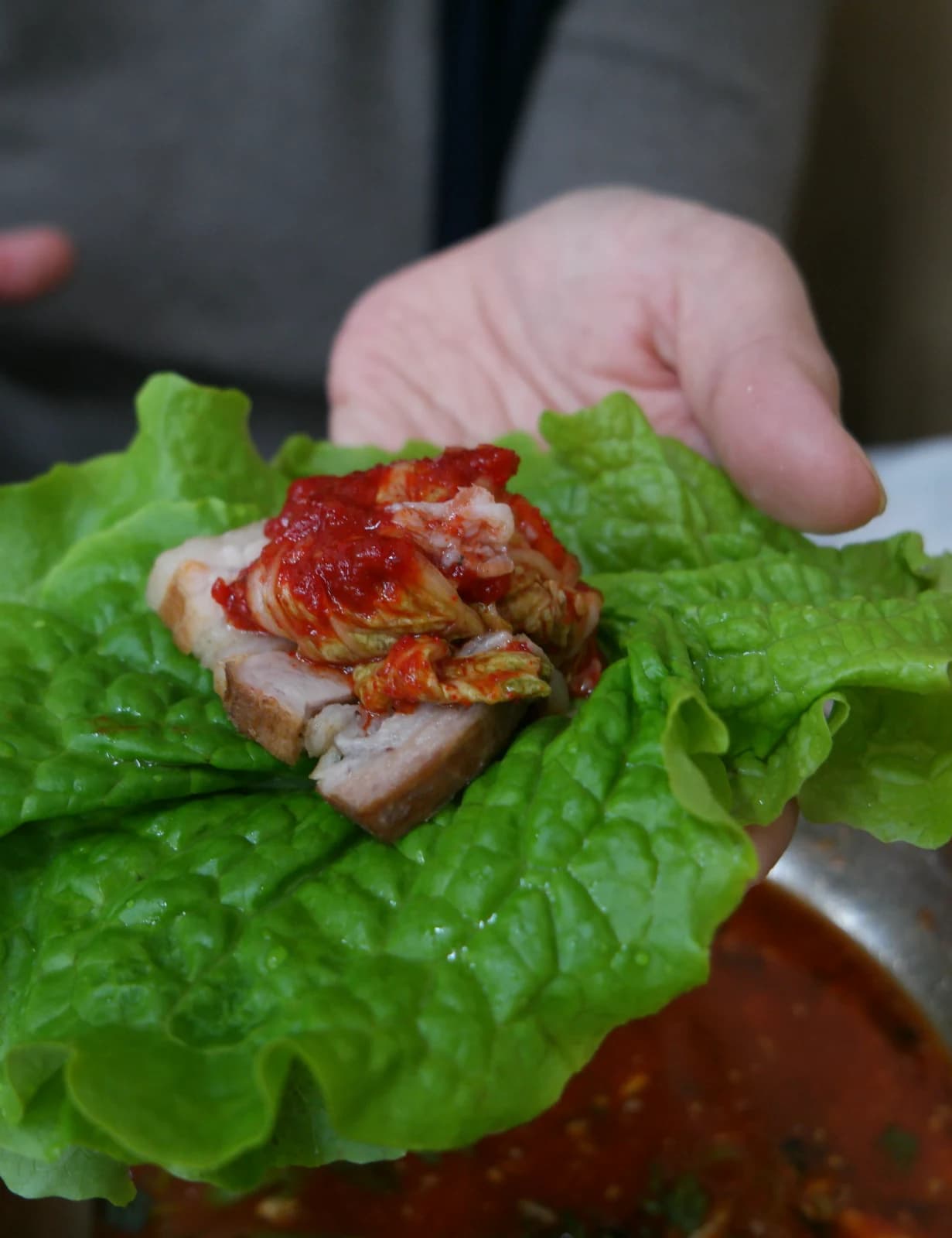
This is how you do it. Spread a lettuce leaf flat on your palm, lay a piece or two of pork on it, top it with a scoop of that red bossam kimchi, and pop the whole thing in your mouth. I asked my friend to hold his wrap up for a second so I could snap a photo and he was losing it — apparently kimchi juice was dripping all over his hand the entire time.
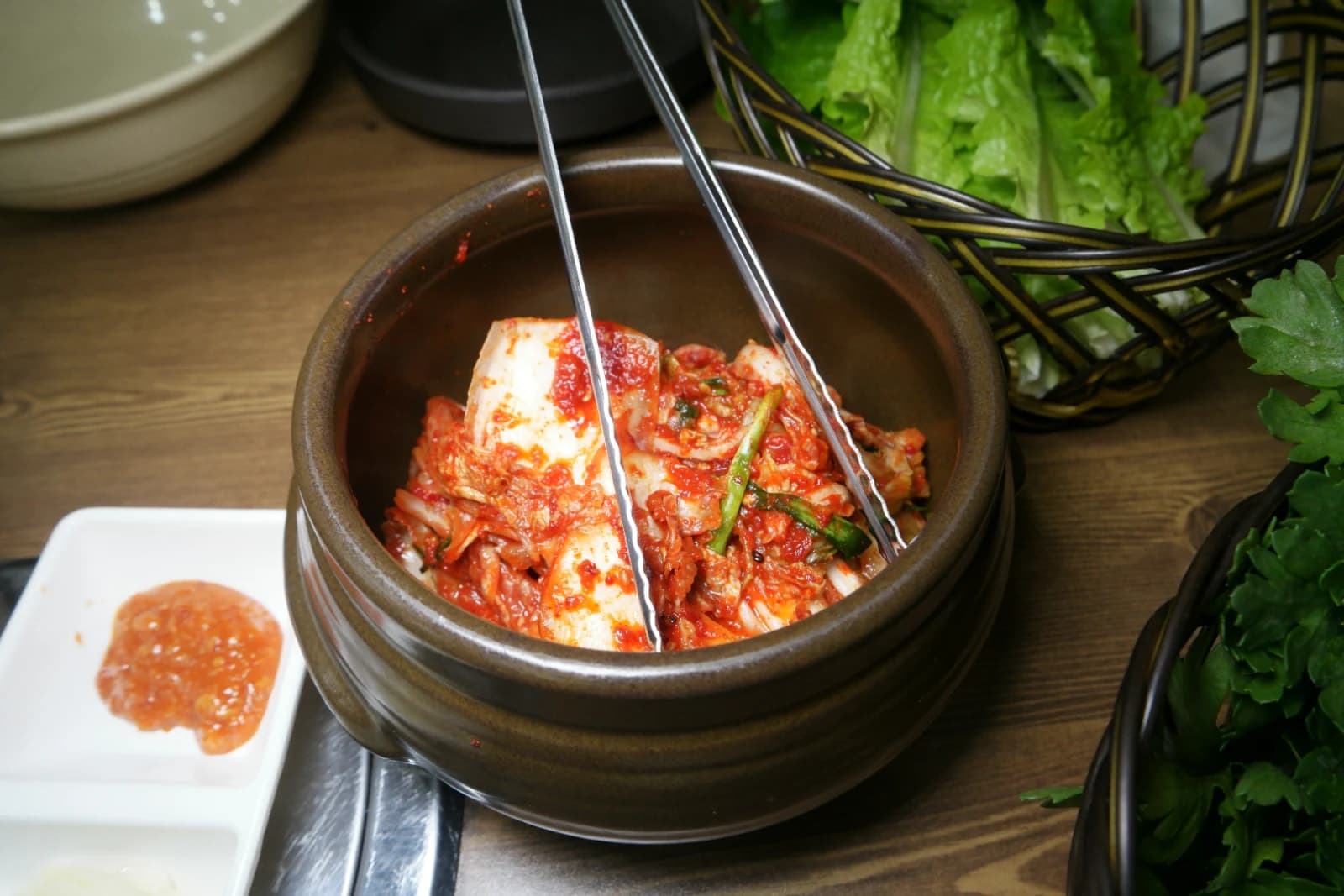
Here's the bossam kimchi pulled straight from the jar, and this gives you a more accurate sense of the color than what was on the plate earlier. Napa cabbage absolutely caked in red chili seasoning, sitting in a shallow bath of its own juice. The kimchi served at bossam places is different from regular table kimchi — the fermentation is dialed in to hit that sweet spot where it pairs perfectly with the pork.
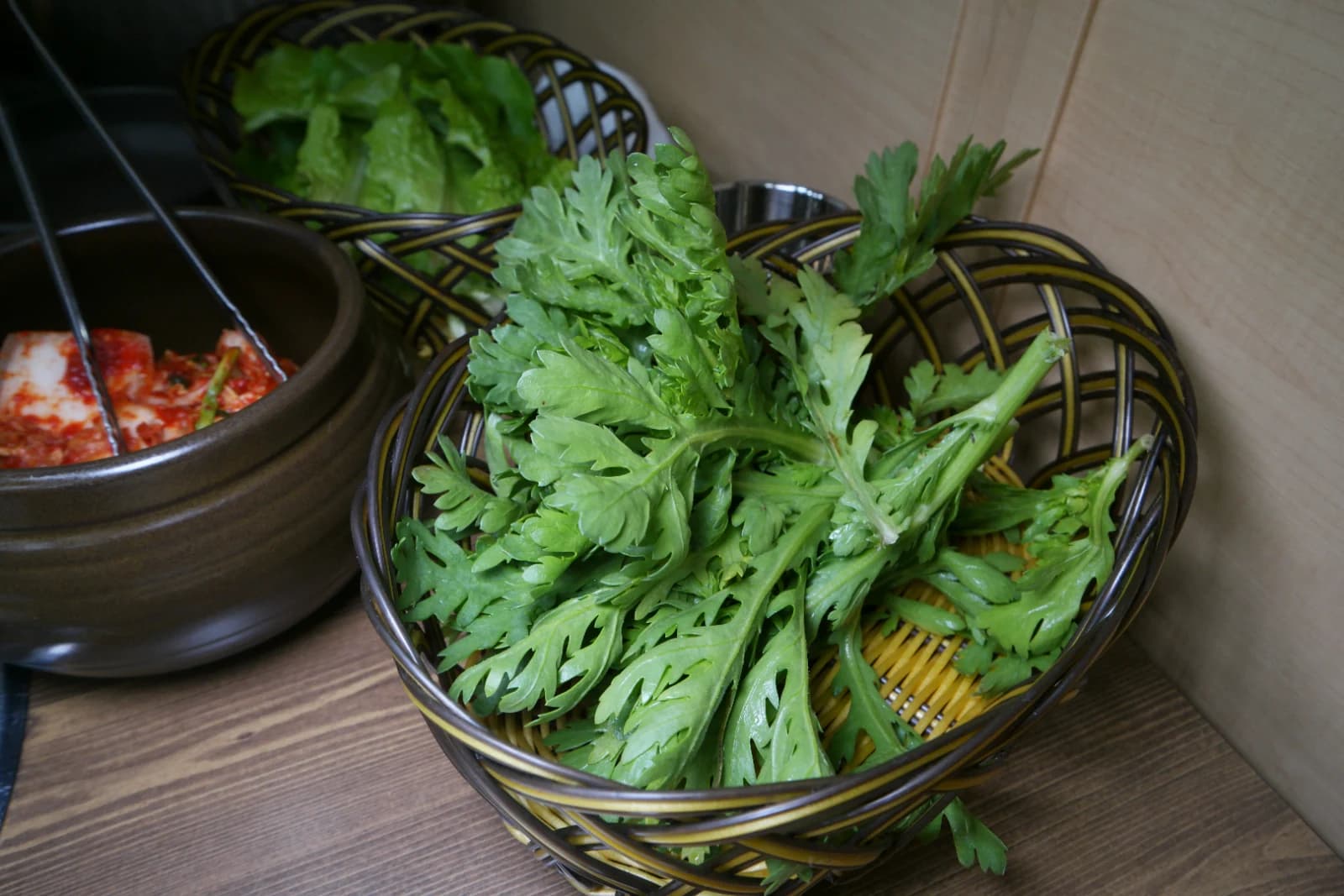
Crown daisy came out in its own basket on the side. Same herb that went onto the spicy kalguksu earlier — this place served it not just for noodles but as a bossam wrap green too. The Daejeon area really does not mess around when it comes to crown daisy. They put it in everything.
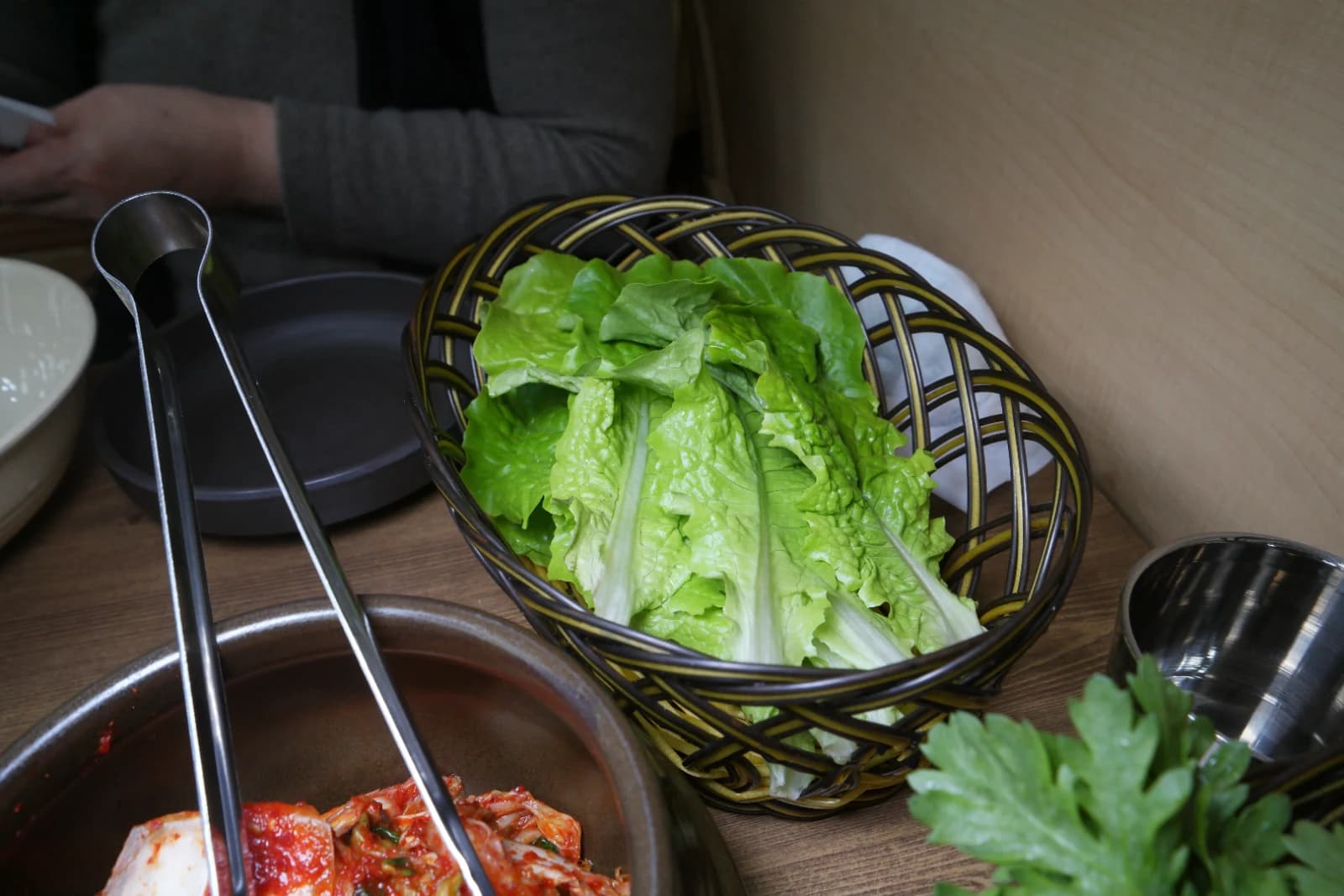
Lettuce is the standard bossam wrap leaf. A basket piled high with bright green leaves — you lay the pork on top, add kimchi, and eat it as a wrap, just like I showed earlier. You can see the kimchi jar and the crown daisy basket sitting side by side next to it, and I did appreciate how generous they were with the wrap ingredients. That said, the actual meat portion was a little underwhelming for two people splitting it.
Two bowls of kalguksu plus a plate of bossam, and the whole bill for two of us came in under about $22. Each bowl of kalguksu was around $7, and the bossam brought it up from there. We were definitely full, but as we walked out, my friend had to say it: "The kalguksu was good, but wasn't that pork kind of dry?" I'd honestly been thinking the same thing — I just hadn't noticed in the moment because I was eating it with kimchi the whole time. On the drive home, we said we should go to a proper bossam restaurant next time to do it right. That promise still hasn't been kept.
Kalguksu restaurants are everywhere in Korea — doesn't matter which city you're in. Just type "칼국수" (kalguksu) into any Korean map app like Naver Map or Kakao Map and a bunch of nearby options will pop up. Most bowls run around $7 or so, so it's an easy, low-commitment meal to walk into. A lot of shops have the same menu format where you pick between clam kalguksu and spicy kalguksu, so here's the simple rule: if you can't handle heat, go clam; if you want a kick, go spicy.
The shop is gone now, so I couldn't go back even if I wanted to. But every time I sit down at a kalguksu place, that evening floats back. The crown daisy piled on the spicy kalguksu. My friend insisting he didn't like crown daisy and then quietly adding it to his own bowl anyway. It wasn't a remarkable day by any stretch. It was just one of those days.