
Spicy Korean Ramen Review: Teumsae Is 3x Hotter Than Shin Ramyun—Why Can't I Stop Eating It?
Table of Contents
25 items
1. How I Discovered This at the Grocery Store
Hey there! I'm Hi-JSB.
So, do you like spicy food? Because I genuinely cannot eat a meal without something spicy. Kimchi jjigae needs extra cheongyang peppers to feel satisfying, and I always order my tteokbokki at the highest spice level. That's just who I am. So today, I want to introduce you to a ramen that I've been absolutely obsessed with lately: Paldo Teumsae Ramen Ppalgaetteok.

A few days ago, I was grocery shopping and wandering through the ramen aisle when this bright red package immediately caught my eye. It said "Intensely Delicious Spicy Flavor!" and "Ppalgaetteok" (which means "spicy pride" in Korean slang), and I instantly thought, "Oh, this must be that famous Teumsae Ramen I've heard so much about."
I'd heard the name Teumsae Ramen countless times but somehow never actually tried it. I've eaten Shin Ramyun and Buldak Fire Noodles more times than I can count, so why hadn't I tried this one? That question alone was enough to make me toss it into my cart immediately.

I picked up the 5-pack multipack. Looking at the side, I could see five individual packages through the transparent plastic wrap. Each packet is 120g (about 4.2 oz), so that's 600g total. My plan was simple: try one, and if it's good, I'll happily eat the rest. If not, well, that's a problem for future me.
2. Opening the Package

Once I got home, I pulled out one packet. The individual packaging has the same red background with a flame character mascot, and I noticed it says "since 1981" on it. 1981? That's way before I was even born. Has this ramen really been around that long?
I got curious and did some research, and there's actually a fascinating history behind it. In 1981, a man named Kim Bok-hyun started a tiny ramen shop in a narrow alley (or "teumsae" in Korean) between buildings in Myeongdong, Seoul. The ramen he served there became famous for being incredibly spicy, and that's how "Teumsae Ramen" got its name. "Ppalgaetteok" comes from combining three Korean words: "ppal" (red), "gye" (egg), and "tteok" (rice cake)—because the traditional way to eat it is with added egg and rice cakes. Paldo later turned this legendary shop's recipe into the instant version we can buy at stores today.
And look at that photo on the package—red broth with an egg and green onions on top. Doesn't it just make your mouth water? I was staring at it thinking, "I need to cook this immediately."
3. Checking the Cooking Instructions First

The back of the package has the cooking instructions, so I gave them a quick read.
Boil 500ml (about 2 cups) of water, add the noodles, powder seasoning, and dried vegetable packet, then cook for approximately 4 minutes and 30 seconds for delicious results.
But here's the pro tip they included: adding an egg and rice cakes will give you the authentic "Ppalgaetteok" experience. Since the name literally means "red-egg-rice cake," I guess that's the proper way to enjoy it. I'll definitely try adding rice cakes next time.
There's also a note that says "adjust the amount of seasoning to control sodium intake," but obviously I'm going to use all of it. I bought this specifically for the spice—why would I hold back on the seasoning?
4. Nutrition Information

For those of you watching your diet, here's what you're looking at:
| Nutrient | Amount | Daily Value |
|---|---|---|
| Calories | 500kcal | - |
| Sodium | 1,690mg | 85% |
| Carbohydrates | 79g | 24% |
| Sugars | - | 4% |
| Fat | 16g | 30% |
| Trans Fat | 0g | - |
| Saturated Fat | 7g | 47% |
| Cholesterol | 2mg | 1% |
| Protein | 10g | 18% |
One packet comes in at 500 calories. Korean instant ramen was originally designed as a full meal replacement rather than just a snack, so this is actually a reasonable amount for lunch or dinner. The sodium is 85% of your daily recommended intake, so if you drink all the broth, it's definitely on the salty side. But did I drink all of it anyway? Absolutely. It was too good not to.
5. Allergen Information—Please Read If This Applies to You

5.1 Ingredients
The noodles are made from wheat flour, palm oil, potato starch, and other ingredients. The seasoning packets contain red pepper powder, dried green onions, seasoned beef powder, and bone broth powder. The secret behind the spiciness is Vietnamese bird's eye chili (also known as "sky-pointing chili" or "Prik Ki Nu" in Thai cuisine)—I'll explain more about this later.
5.2 Allergens
This product contains: egg, milk, soy, wheat, pork, and beef.
If you have any food allergies, please check the label carefully.
5.3 Dietary and Religious Considerations
For international readers or anyone with specific dietary restrictions, here's what you need to know: This product contains both pork and beef ingredients and is not Halal certified. This means it's not suitable for Muslim consumers, not suitable for Hindu consumers who avoid beef, and not suitable for vegetarians or vegans.
5.4 Manufacturer Information
Teumsae Ramen is manufactured by Paldo, with factories located in Icheon (Gyeonggi Province) and Naju (South Jeolla Province), South Korea. For inquiries within Korea, you can contact them at 1577-8593 (Korea Standard Time).
6. What's Inside the Packet

When I opened the packet, I found one block of noodles and two seasoning packets—one powder seasoning and one dried vegetables packet.
6.1 Powder Seasoning

The silver packet is the powder seasoning—this is where all that spicy flavor comes from. The packet says "adjust seasoning amount according to preference to control sodium intake," but as I mentioned before, I'm definitely using all of it.
6.2 Dried Vegetables Packet

The white packet contains the dried vegetables. It says "Proud of the Spice!" on it. Inside, you'll find dried green onions and bok choy-like vegetables.
7. Time to Actually Cook This
For today's cooking adventure, I decided to use a microwave-safe container instead of a pot. When you're eating solo, this method is so much easier for cleanup.
7.1 Adding All the Ingredients

I put the noodle block in the container and sprinkled both the powder seasoning and dried vegetables on top. The moment I opened that seasoning packet, I could already smell the spiciness wafting up. I immediately thought, "Oh, this is going to be seriously hot."
7.2 Adding Water
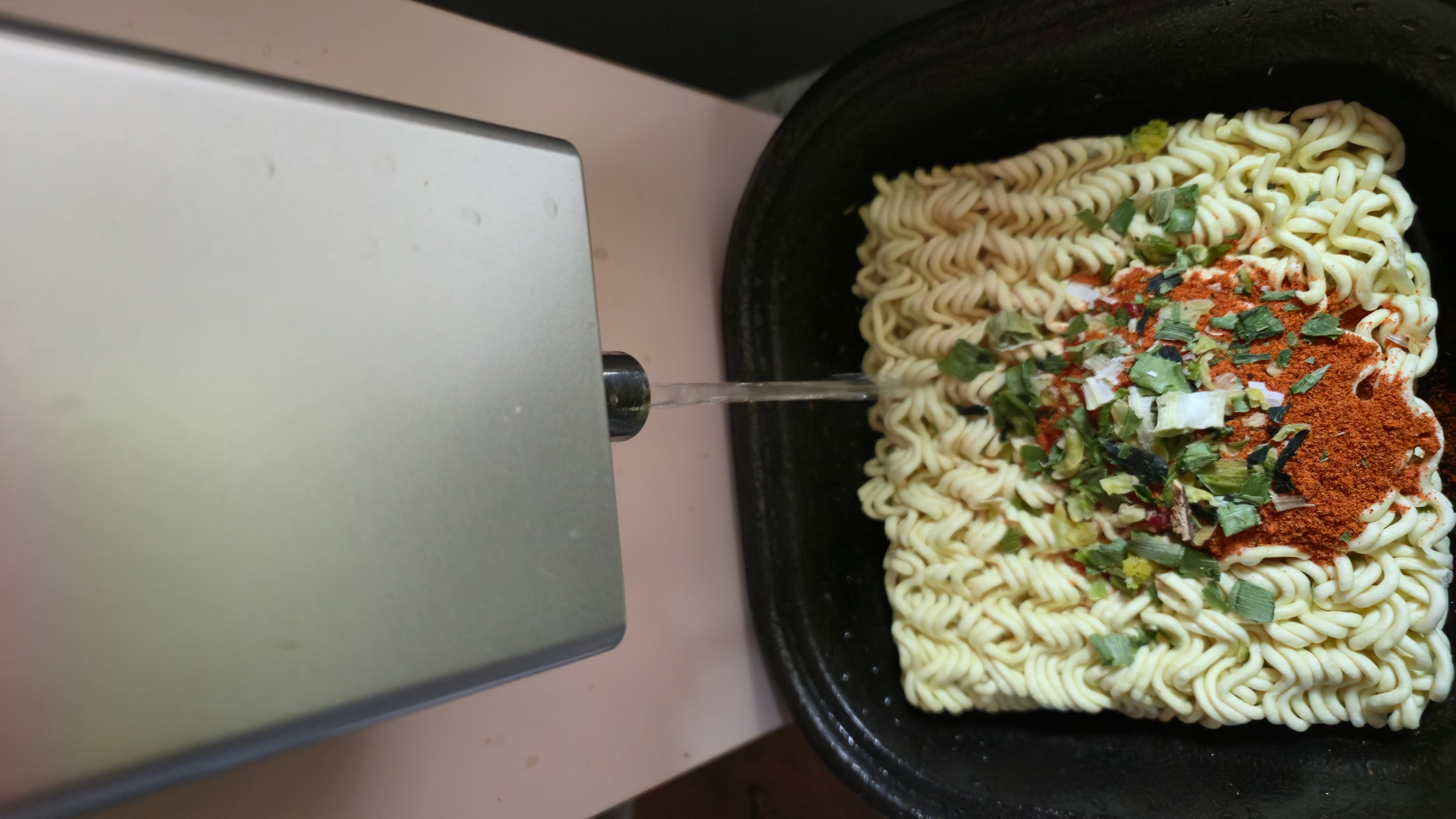
I used hot water from my water dispenser. Using hot water helps reduce the microwave cooking time significantly.
Microwave Cooking Tips:
With hot water: approximately 3 minutes
With cold water: approximately 3 minutes 30 seconds
7.3 Into the Microwave
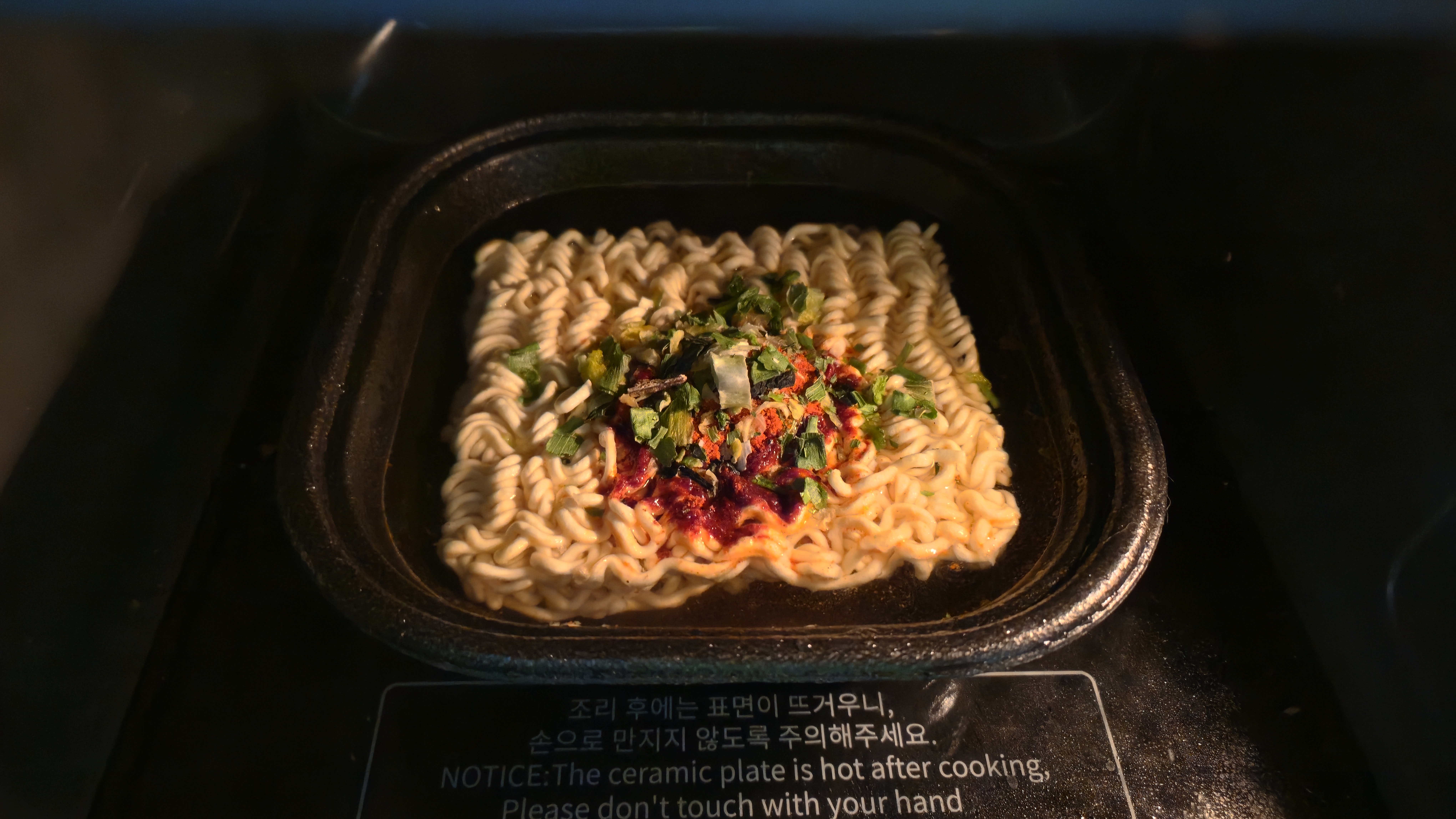
After adding the water, I popped it in the microwave. Since I used hot water, I only needed 3 minutes. While waiting, I could see the red broth bubbling away through the microwave door. The spicy aroma was already escaping through the vents.
7.4 Finally Done!
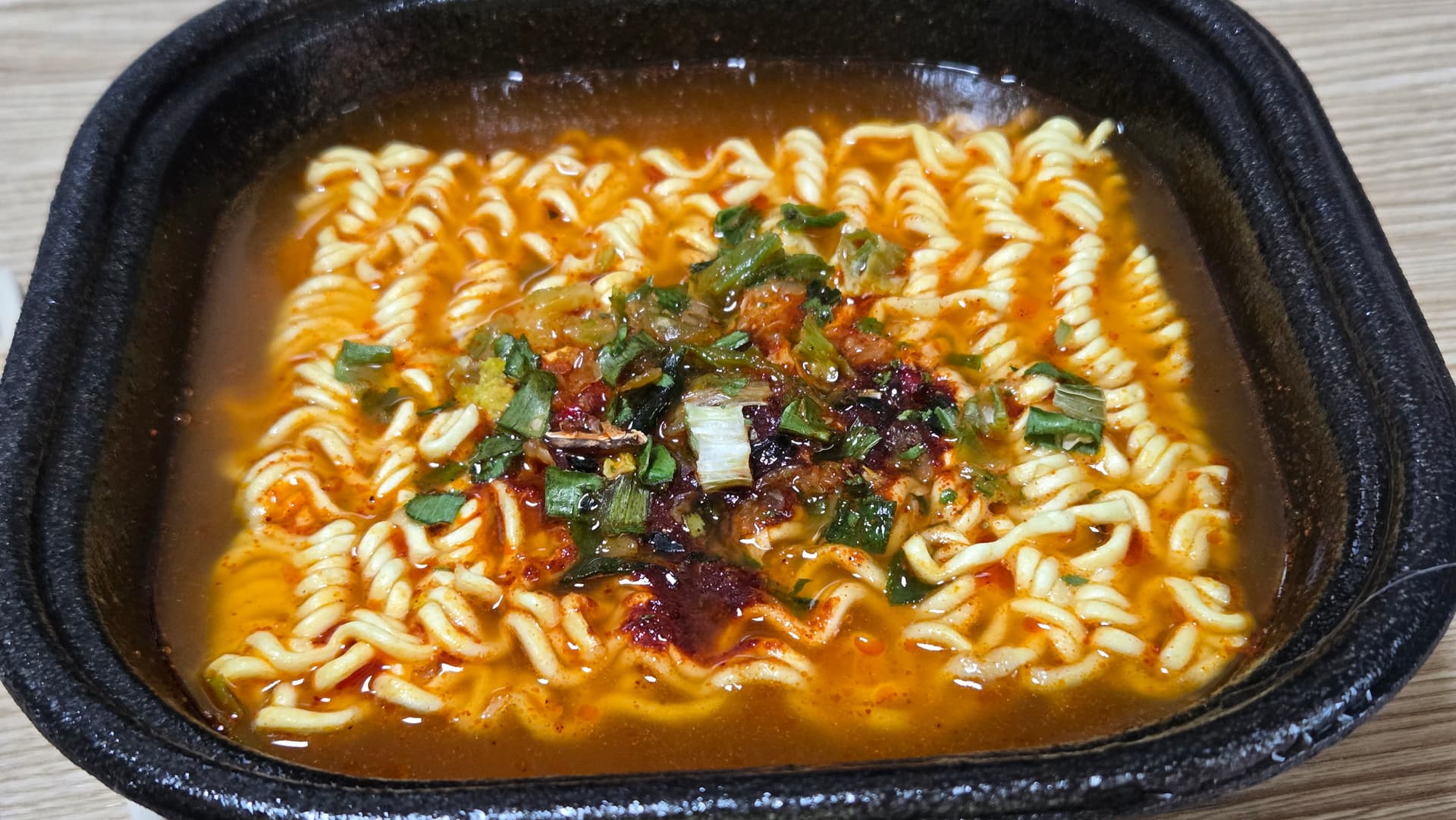
The moment I took it out of the microwave, the spicy aroma hit me like a wave. My nose was literally tingling. First, let's talk about the visuals—that broth is seriously RED. Not just regular red, but "this is definitely going to be spicy" red. The noodles were still slightly curled since they hadn't fully loosened up yet, and the green onion and bok choy pieces were floating on top.
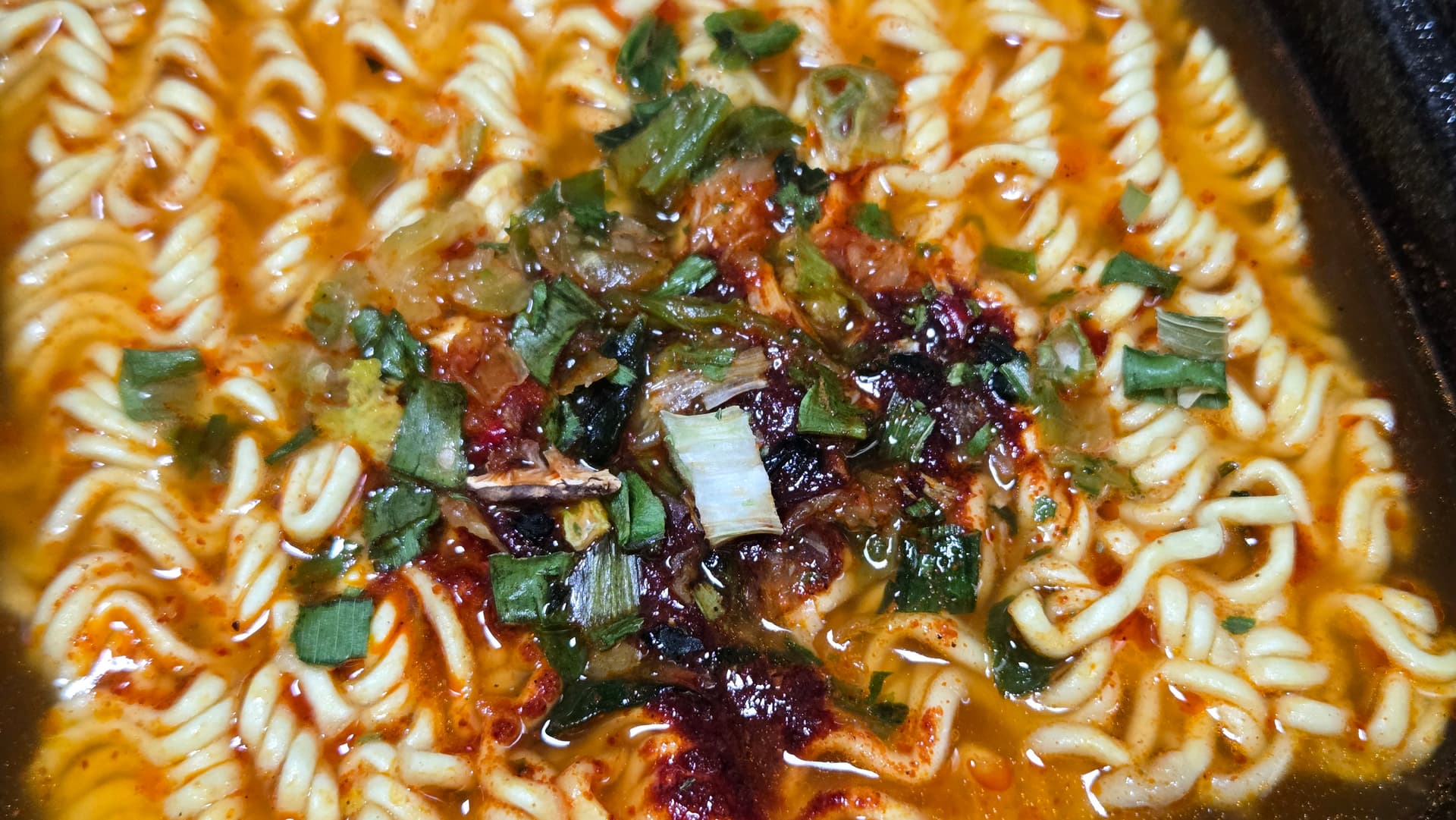
Looking closer, I could see actual red pepper flakes floating on the surface of the broth, with the oil giving it a beautiful glossy sheen. The green onion pieces were clearly visible too. Seeing this made me so impatient to eat that I barely took any decent photos.
8. The First Bite—My Honest Taste Review
8.1 Initial Impressions
I stirred the noodles with my chopsticks and lifted up a big mouthful. Red broth was dripping from the noodles, and my mouth was already watering just from looking at it. I blew on it to cool it down and took my first bite...
Wow.
This is legitimately spicy.
But it's not just spicy for the sake of being spicy. How do I explain this... It's spicy AND delicious. It doesn't taste like they just dumped a bunch of artificial capsaicin extract into it—you can actually taste the chili pepper itself. While I was eating, I kept saying "wow, this is hot, this is so hot" but my chopsticks never stopped moving.
8.2 The Secret Behind This Spiciness: Vietnamese Bird's Eye Chili
I looked it up later, and apparently the secret to Teumsae Ramen's heat is Vietnamese bird's eye chili (sometimes called "sky-pointing chili" because of how it grows pointing upward). This type of chili is known for having intense heat while maintaining a clean, sharp flavor profile. That explains why it made my mouth tingle but left such a refreshing aftertaste.
In terms of Scoville Heat Units (SHU), Teumsae Ramen clocks in at around 9,413 SHU. For comparison, Shin Ramyun is about 3,400 SHU, so Teumsae is nearly three times spicier. Korean cheongyang peppers range from 4,000-12,000 SHU, so this is roughly in that ballpark. But here's the interesting thing—even though the numbers suggest it should be extremely spicy, the heat doesn't feel unpleasant when you're actually eating it. Because the chili's natural aroma comes through with the heat, it actually tastes good rather than just painful.
8.3 The Broth Flavor
It's not all about the spice—the broth has genuine depth to it. With beef seasoning and bone broth powder in the mix, there's a savory, rich quality to the soup. That's what sets this apart from ramen that's just hot for the shock value. You can taste the umami weaving through all that heat.
Did I drink almost all of the broth? Yes. Yes I did. I know there's a lot of sodium, but when something's this good, what can you do?
8.4 The Noodle Texture
The noodles have that signature Paldo chewiness—that bouncy, QQ texture that Koreans love. They absorb the broth well while still having a nice bite to them. I was worried they might get mushy from microwave cooking, but they turned out better than expected. Sure, stovetop cooking would probably make them even chewier, but for a quick solo meal, this was more than satisfying.
8.5 Is It Filling?
After finishing one packet, I felt perfectly satisfied—not too full, not still hungry. Korean instant ramen was designed as a meal replacement rather than a snack, so one packet is genuinely enough for lunch or dinner. I had this for lunch today and didn't need anything else.
9. Post-Meal Thoughts
After finishing, I noticed beads of sweat forming on my forehead. My nose was running a little. My lips felt tingly. But you know that satisfaction you get from eating spicy food? That feeling where you're suffering but also weirdly happy? That's exactly what this was.
After I was done, I found myself thinking "that was so good" and taking one more sip of the broth. If you love spicy food, you know exactly what I'm talking about—cursing at the heat while already reaching for more.
10. Final Verdict
Teumsae Ramen Ppalgaetteok has officially entered my list of favorite instant ramens. From now on, whenever I walk through the ramen aisle, I'm grabbing this without hesitation.
If you're a spicy food lover, I highly recommend this. This isn't ramen that's just spicy for the sake of being spicy—it's deliciously spicy. That clean heat from the Vietnamese bird's eye chili is genuinely addictive.
However, if you can't handle spicy food well, proceed with caution. This is seriously hot. If you're trying it for the first time, you might want to use less of the seasoning powder. But if you're like me and live for the heat, use all of it. That's where the real flavor is.
Oh, and next time I'm definitely adding egg and rice cakes like the package suggests. The name is Ppalgaetteok (red-egg-rice cake) after all—I should experience it the proper way at least once.
I hope this review was helpful! I'll be back with more delicious finds soon!
This content was originally published at https://hi-jsb.blog