CategoryFood
LanguageEnglish (Australia)
17 items
One autumn arvo, a mate rang me up — reckoned we should grab some kalguksu. If you live in Daejeon, there's a kalguksu shop on nearly every corner. The city's famous for it, with hundreds of spots scattered through the downtown alone. He'd already clocked a place he wanted to try, so I knocked off work and met him there. Kalguksu is one of Korea's classic noodle dishes — wheat dough rolled out thin, sliced with a knife, and boiled straight into a hot broth. It's not the first thing people think of when you say "Korean food" (that'd be ramyeon or tteokbokki), but once you've been in Korea a while, you end up chasing it more often than you'd reckon. I ordered the clam kalguksu (bajirak kalguksu), he got the spicy one (eolkeuni kalguksu), and we ended up chucking a bossam pork platter on top because two bowls just weren't cutting it. That shop's since closed down, by the way, but the memory of that day stuck with me — so here we are.
What is kalguksu?
The name
"Kal" means knife and "guksu" means noodles — so literally "knife noodles". The dough is rolled flat by hand and sliced with a knife, not pushed through a machine. That's the whole point.
How it's cooked
Fresh noodles go straight into a hot broth made from anchovies, clams, chicken — whatever the shop's base is. Every place does the broth a bit differently, so the same dish can taste wildly different depending on where you go.
The noodles
Thicker and chewier than ramyeon or udon. You can still taste that wheaty, slightly nutty flavour in the noodle itself, which plays nicely with the broth. Proper bite to them.
How to eat it
Chopsticks for the noodles, spoon for the broth. Slurping is totally fine here — in fact, it's the natural way to eat noodles in Korea, so don't stress about being quiet.
Price
Usually A$8 to A$11 a bowl. They're everywhere — every neighbourhood has at least one kalguksu shop — and it's cheap enough to duck in solo for a lunch slurp without a second thought.
Main styles
Clear broth clam kalguksu (bajirak), spicy chilli-powder kalguksu (eolkeuni), chicken-broth kalguksu (dak), and nutty perilla-seed kalguksu (deulkkae). Plenty to pick from.
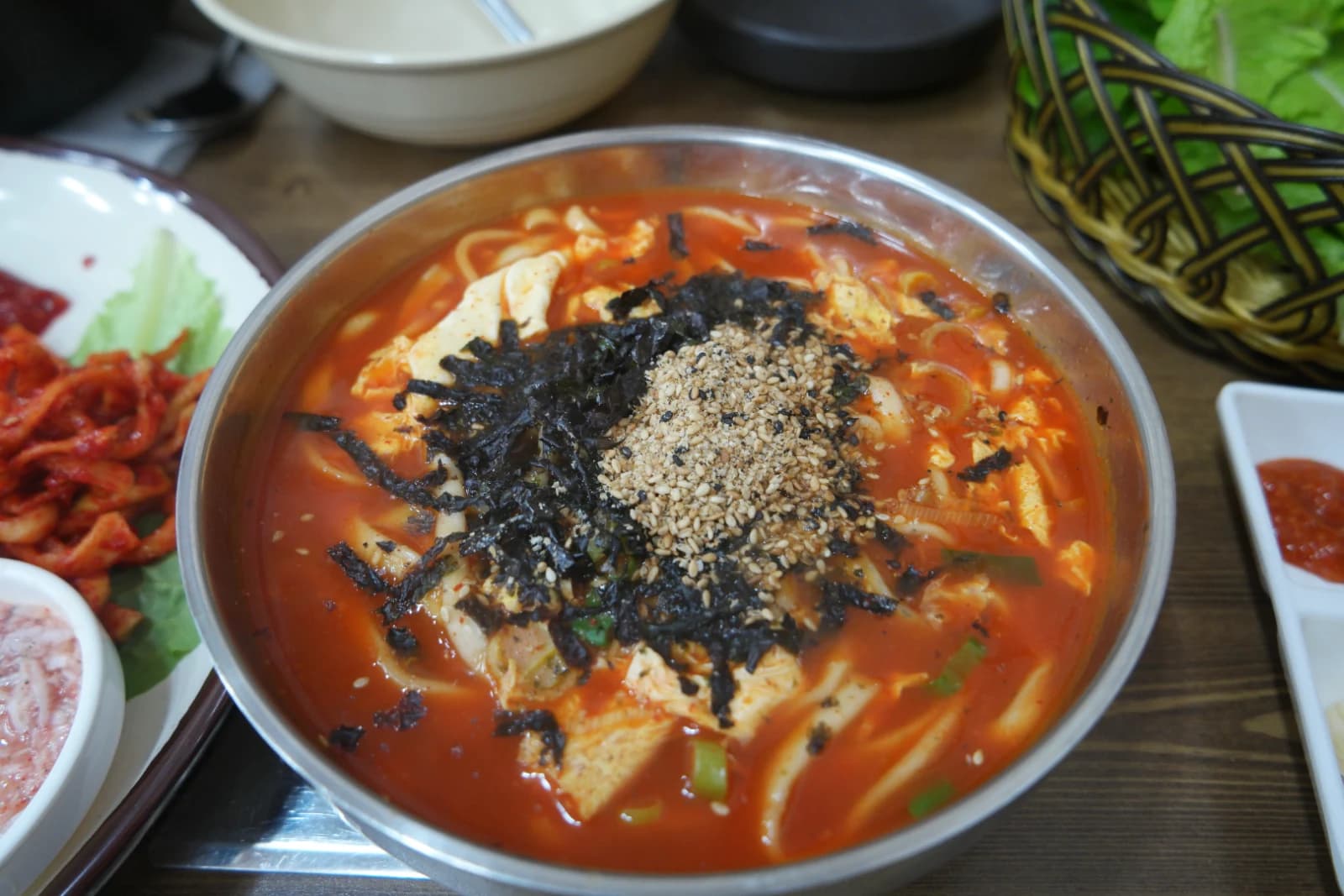
This is the spicy eolkeuni kalguksu. Regular kalguksu is noodles in a clear broth, but the spicy version adds chilli powder seasoning to fire it up. It's a cousin of jang kalguksu (which uses gochujang chilli paste), though every shop has its own twist on the seasoning base. Even in a photo you can clock how red that broth is. On top there's a heap of gim (roasted seaweed flakes) and toasted sesame seeds, and through the broth you can just spot the noodles with bits of spring onion and zucchini mixed in. When you walk into a kalguksu shop in Korea, the menu usually has regular and spicy right next to each other — you pick one or the other. Anyone who likes a bit of heat nearly always goes spicy.
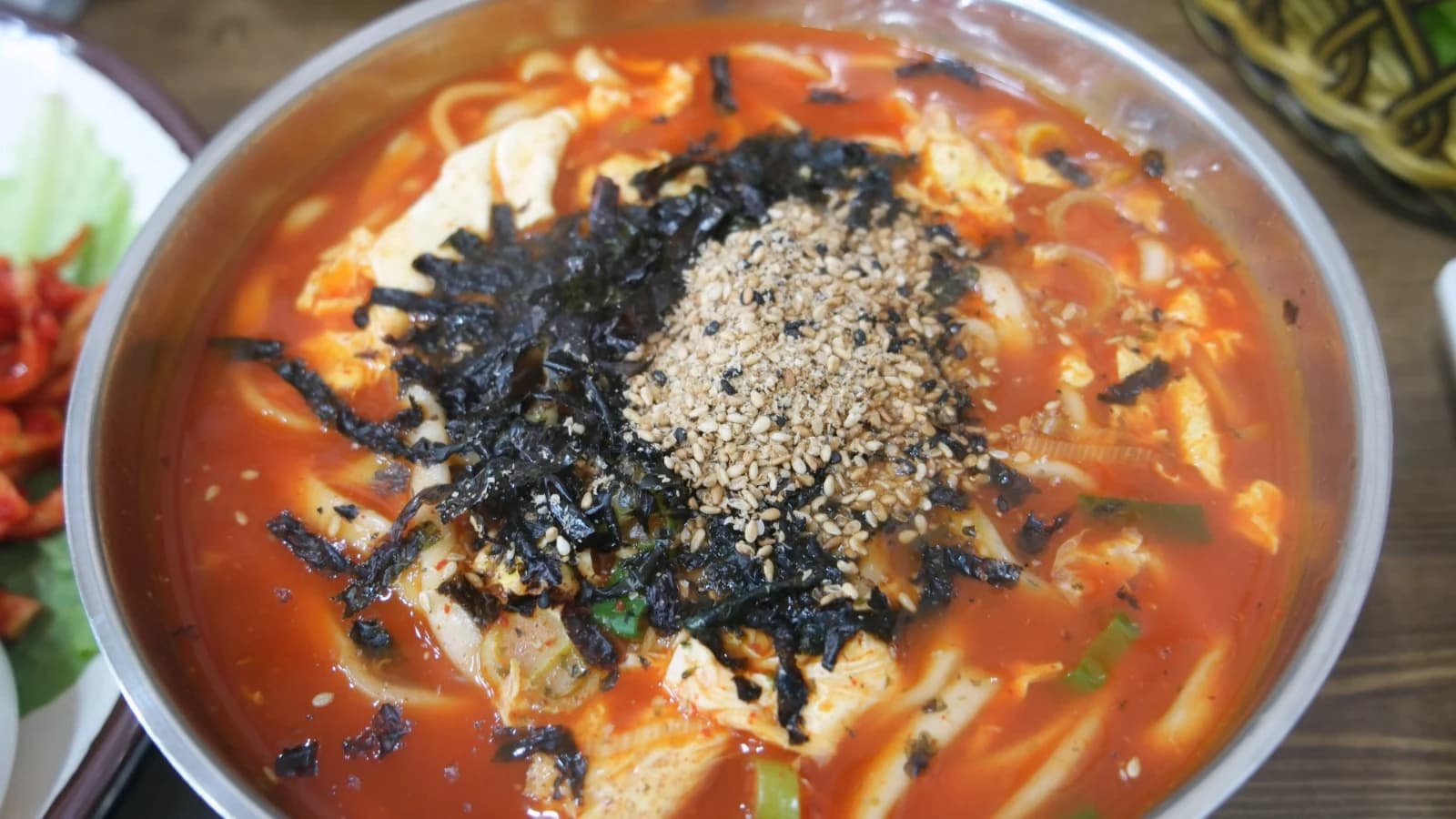
This is a closer look. Seaweed flakes scattered across the red broth, a little mountain of sesame seeds right in the middle. Just eyeballing the colour it looks like it'd blow your head off, but it's actually only moderately hot — a nice warm tingle, nothing tongue-numbing. The noodles sit submerged, and when you lift them with chopsticks the red broth clings to those thick strands in a proper appetising way. Mixed through you'll find tofu cubes, spring onion, and chunks of zucchini — plenty of stuff in there, not just noodles and liquid.
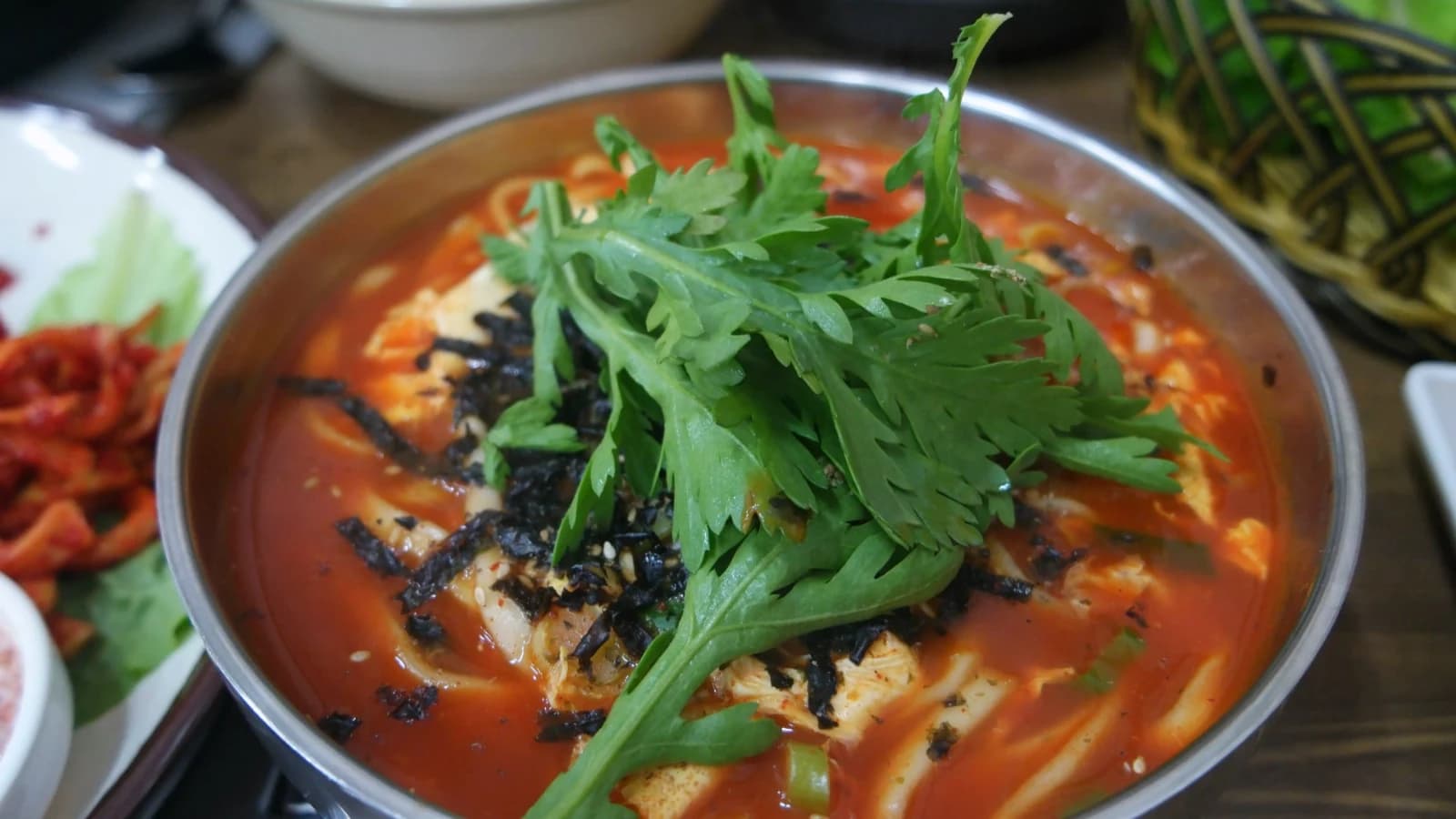
Here I piled on a handful of ssukgat — crown daisy greens, a leafy herb with a strong aromatic kick. Around Daejeon, chucking a big pile of ssukgat on top of your spicy kalguksu is basically the default. The contrast of red broth under bright green leaves looks ace, and once you dunk them in the broth and eat them with the noodles, that herby aroma cuts through the chilli heat brilliantly. I reckon eolkeuni feels naked without it, but my mate's never been into ssukgat — he asked why I was putting weeds in my soup. By the end though, he was sneaking some onto his bowl too. Funny how that works.
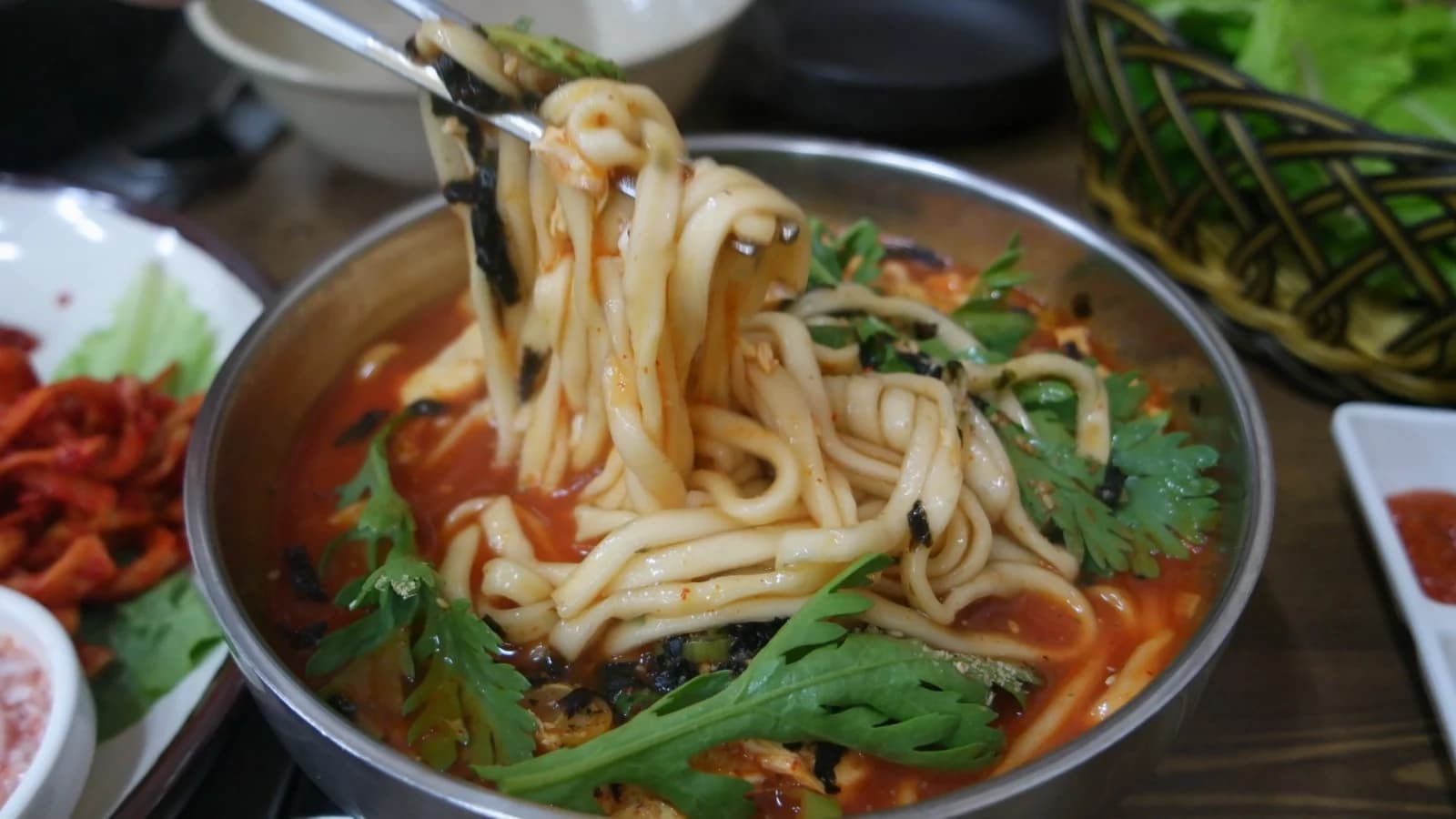
Lifted a load with chopsticks and you can see every strand's a different thickness. Some are thick, some thin. That's because kalguksu noodles aren't machine-extruded — someone rolls the dough flat with a pin and cuts it with a knife, which is why they come out uneven. That's not a flaw, that's the whole character of the dish. In a single mouthful the fat strands give you that chewy bite, while the thin ones soak up heaps of broth. Two textures in one go. You can see the red broth riding up between the strands, the ssukgat tagging along, and at that point you just inhale the lot.
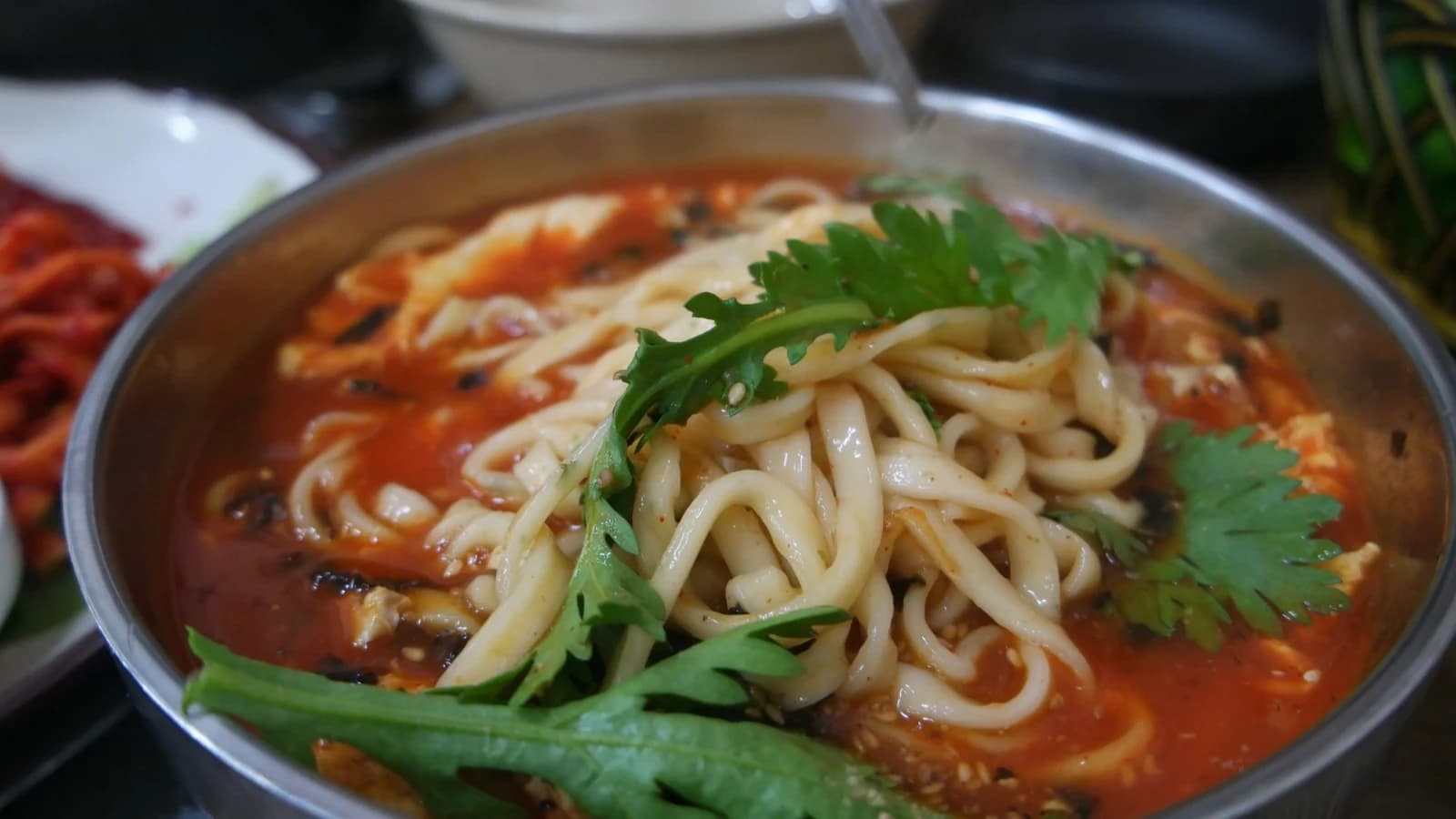
Given it a stir. The noodles and ssukgat have mixed through the broth, which has gone a shade darker. There's a bit of egg swirled in too, just visible. At this stage you basically just grab your chopsticks and go.
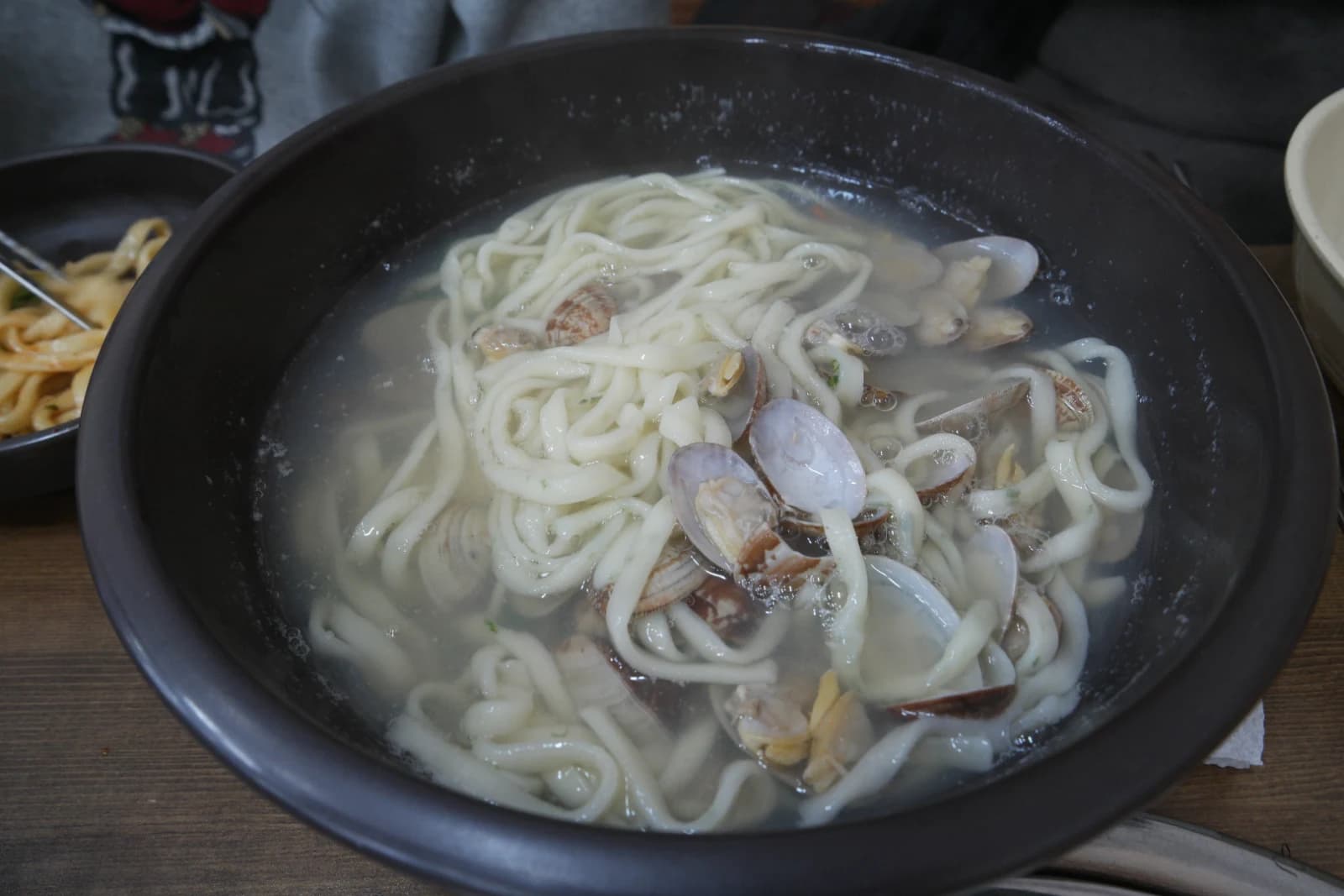
Mine was the bajirak kalguksu. Sit it next to the spicy one and the difference hits you straight away — the broth here is crystal clear. Bajirak are small clams, common as anything in Korea, and they go into the pot shell-on to make the broth before the noodles get cooked in it. The broth pulls all its savoury punch straight from the clams — rich but clean, no heaviness. Shells are mixed in among the noodles, so there's a bit of a treasure hunt going on while you eat. Pop out a clam, eat the meat, pile the empty shell on the lid or an empty bowl. Where the spicy version is all heat and kick, this one's mellow and refreshing. If you order both at the same table, it's mad how different the same dish can taste.
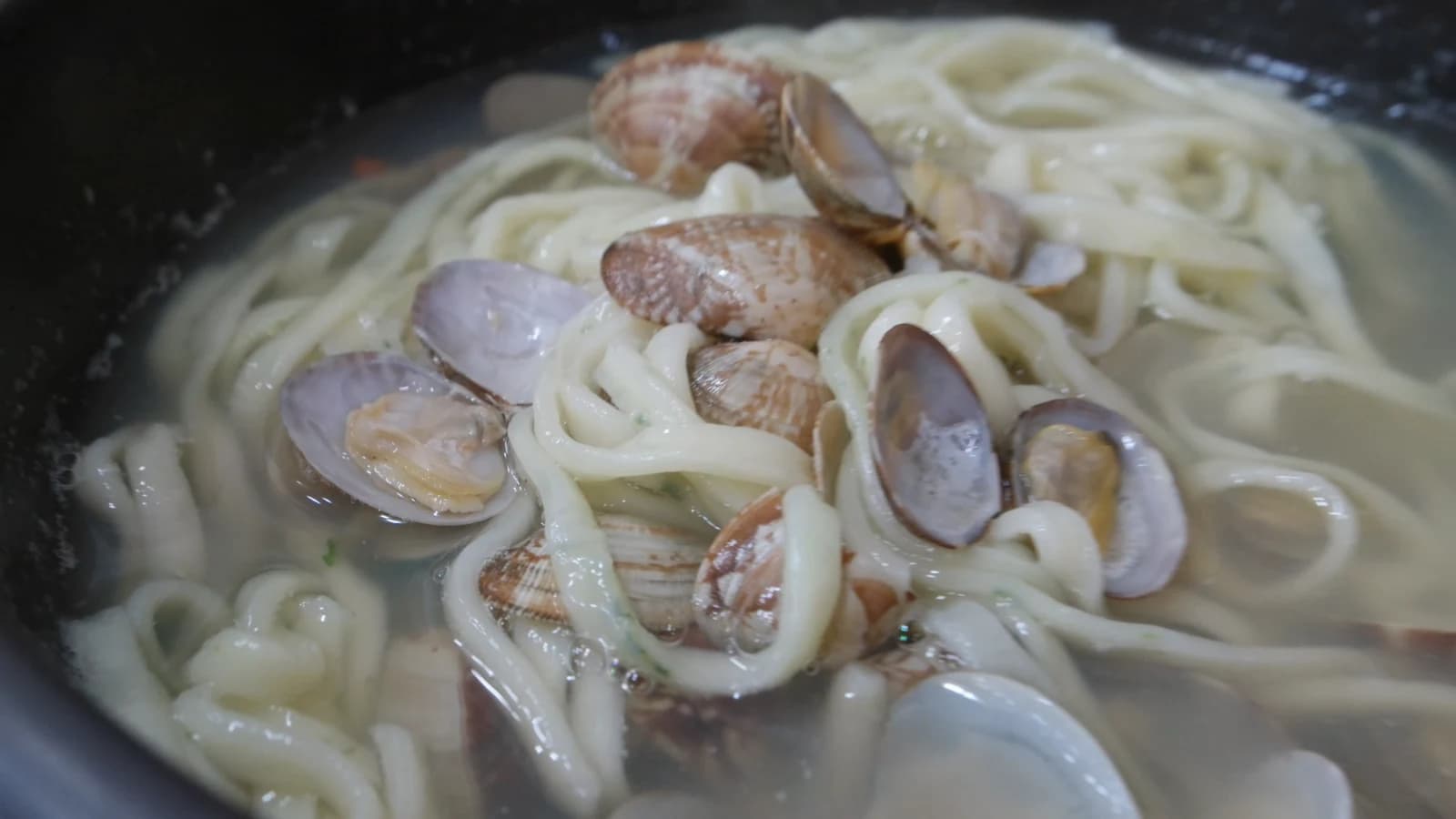
Zoomed in, you can see the clams are a decent size. Shells have cracked open and the meat is sitting there, simmering away in the broth and giving it all that flavour. Bajirak are harvested in huge quantities along Korea's west coast, so they're not pricey — which is why kalguksu shops can be generous with them. The method is simple: while you're eating the noodles, dig the meat out of any shells you come across with your chopsticks. Each one's small, bite-sized, but they pack a salty, sea-breeze flavour when you chew. Honestly the clams themselves aren't filling you up — the whole point is what they've contributed to the broth. Finish the noodles, spoon up just the broth on its own, and you'll taste the difference straight away.
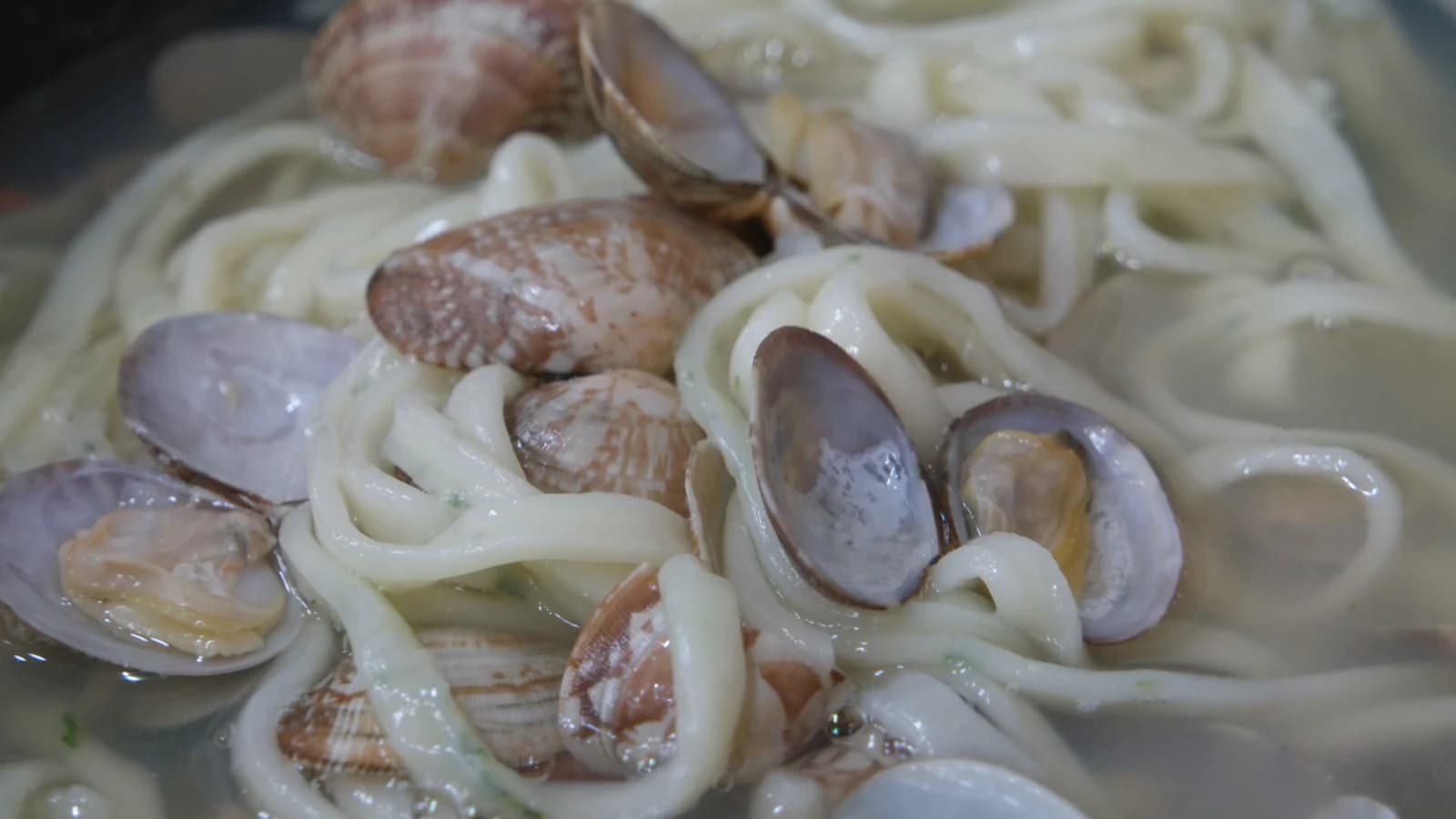
Even closer. The shells are wide open and the meat inside is plump. Noodles tangled up with clams — classic bajirak kalguksu look.
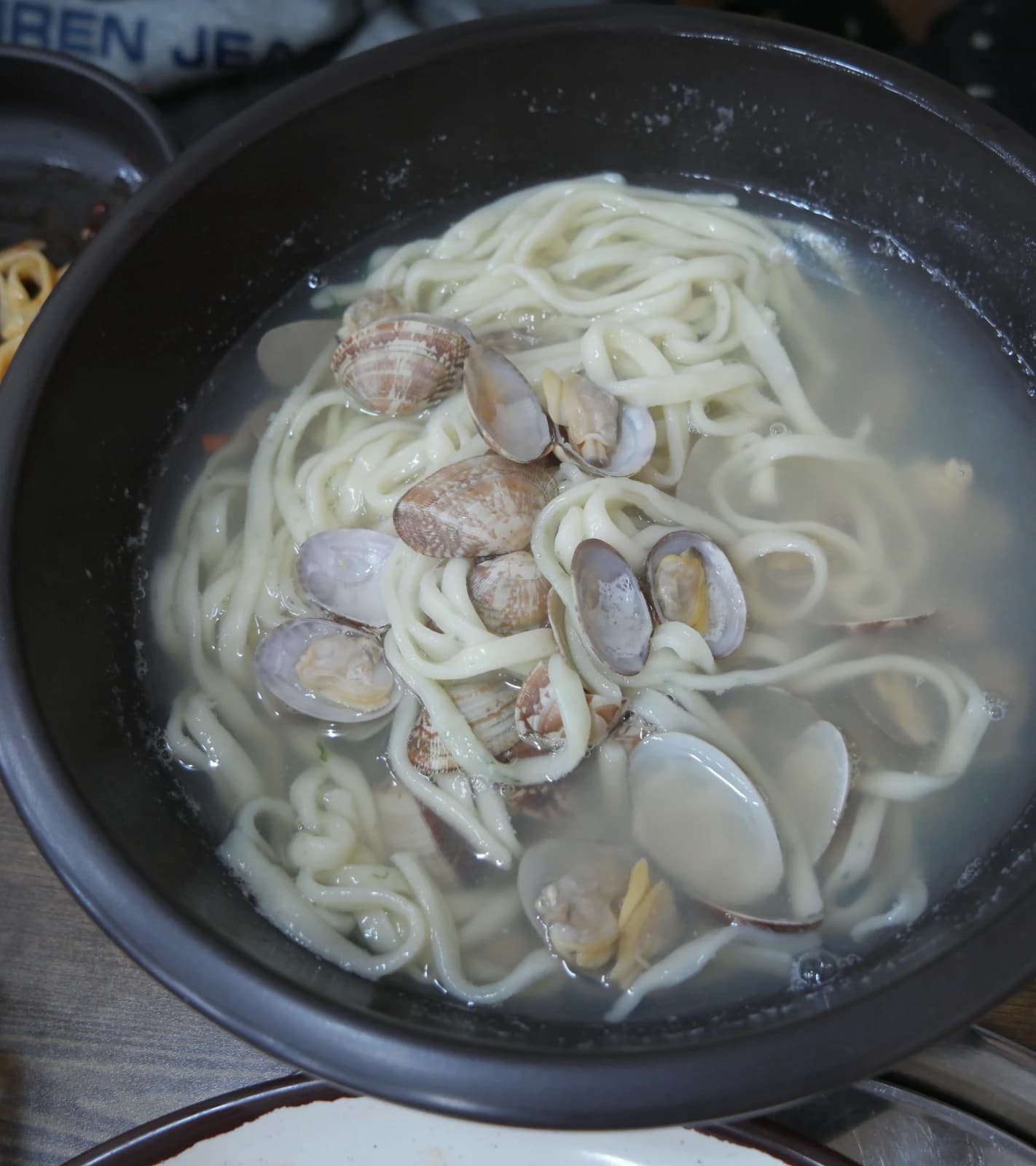
Got through a fair bit of the noodles by this point, and the broth's gone cloudier than when it arrived. That's starch coming off the noodles into the liquid, which is a kalguksu trademark. The longer you eat, the thicker and more clingy the broth gets, and the flavour at the end is a bit different from the start.
Bajirak vs Eolkeuni Kalguksu
Bajirak Kalguksu
Broth
Clear broth made by simmering shell-on clams to release their flavour
Taste
Clean and refreshing. That deep savoury clam flavour runs through the whole bowl
Heat level
Not spicy at all. Safe bet if you're after mild food
Add-ins
Clam shells, zucchini, spring onion. Popping the clams open as you eat is half the fun
How it changes
Noodle starch thickens the broth as you eat, turning it cloudier and richer
Eolkeuni Kalguksu
Broth
Anchovy or clam broth with chilli powder seasoning stirred through, giving it that red colour
Taste
Warm, punchy heat. Not tongue-numbing — the spice sits on top of a savoury base
Heat level
Medium. Mild by Korean food standards, but noticeable if you're not used to spicy stuff
Add-ins
Tofu, zucchini, spring onion, egg. Ssukgat crown daisy greens on top add a fresh herby lift
How it changes
Strong from the first sip, so the flavour stays fairly consistent all the way through
A lot of shops do both on the same menu, so if you've got a mate with you, order one of each and compare — it's the best way to suss out the difference.
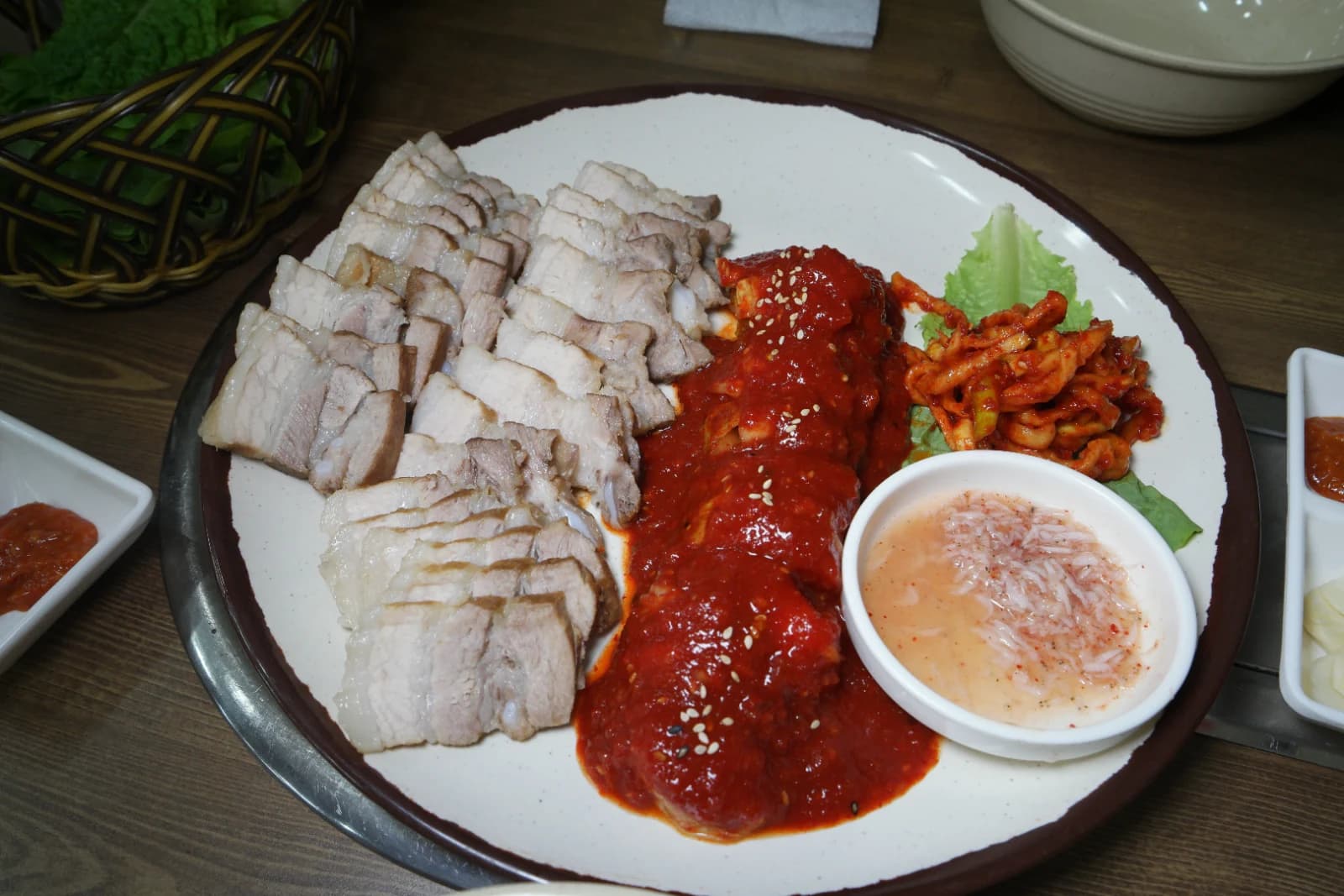
We knocked back a bowl each and we were still not full. Some kalguksu shops only do noodles, but plenty of them also serve bossam or suyuk (boiled pork dishes) as a side. My mate was flicking through the menu and spotted bossam, so we ordered a plate straight away. Bossam is Korean-style boiled pork — a hunk of pork shoulder or neck boiled whole, sliced thin, and eaten wrapped in kimchi or leafy greens. Once the plate landed, the vibe at the table shifted completely. Glossy kimchi sitting in its own juice in the middle, pork slices fanned out on either side. My mate took one look and said "mate, we should be drinking soju with this" — but we'd both driven in, so we had to pass. Classic mistake.
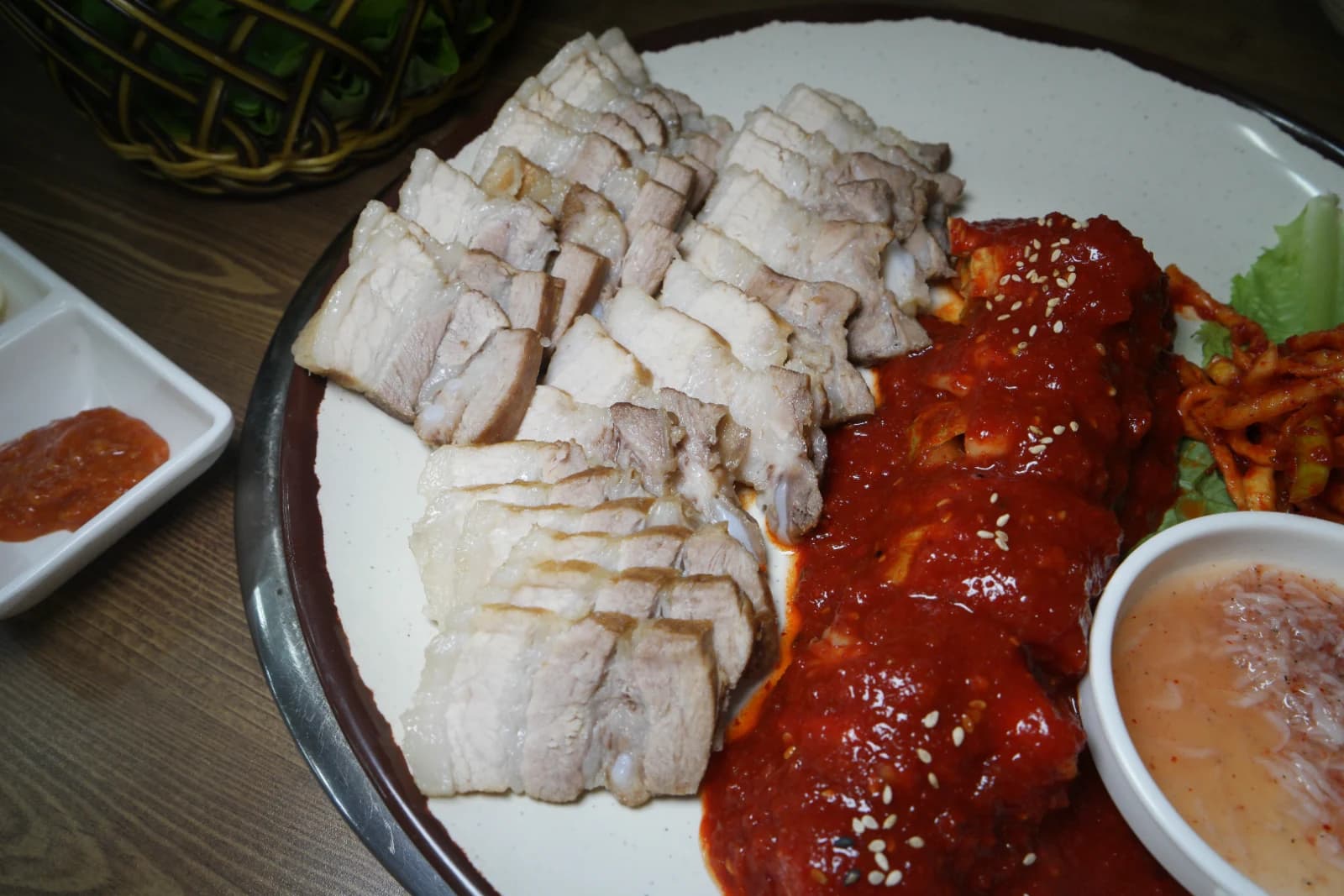
The kimchi next to the pork was a bit different from your standard side kimchi. It's sitting in a fair amount of juice, and it's called bossam kimchi — made specifically to go with bossam pork. Lay a piece on top of a slice of pork, eat it in one bite, and the sharp sourness cuts clean through the fatty pork while the juice bursts in your mouth. Being honest though, the kimchi juice was a touch on the salty side. Great with the pork, but eating the kimchi solo it was a bit full-on.
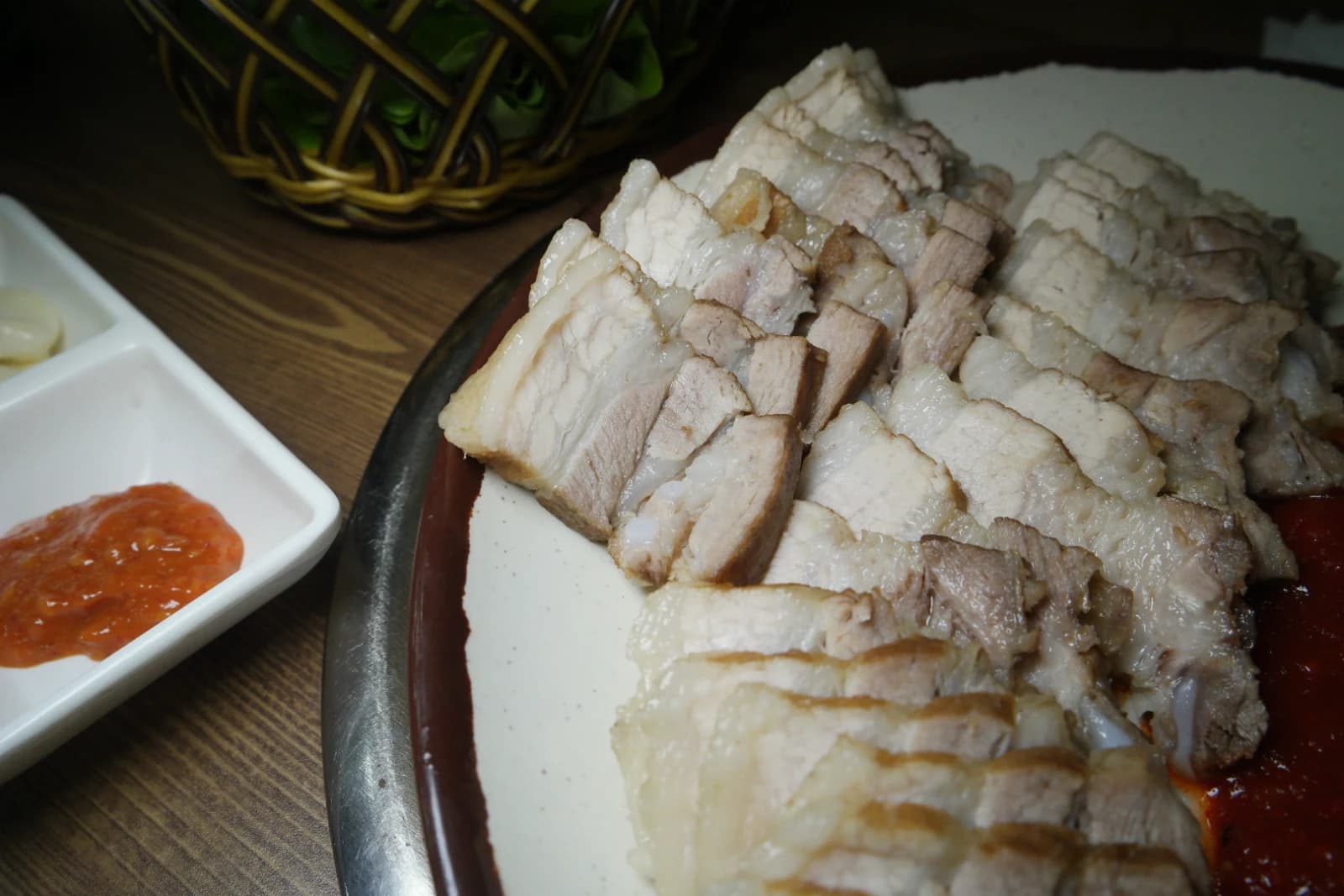
This is what the pork looks like on its own. Thin slices of boiled pork with lean meat and fat stacked in layers. Properly cooked bossam should have fat that's gone translucent and melt-in-your-mouth soft — not greasy — and the lean bit should pull apart easily along the grain. This particular plate wasn't quite there. The lean was a little dry, to be fair. But this is a kalguksu shop doing bossam on the side, so I wasn't expecting specialist-level quality.
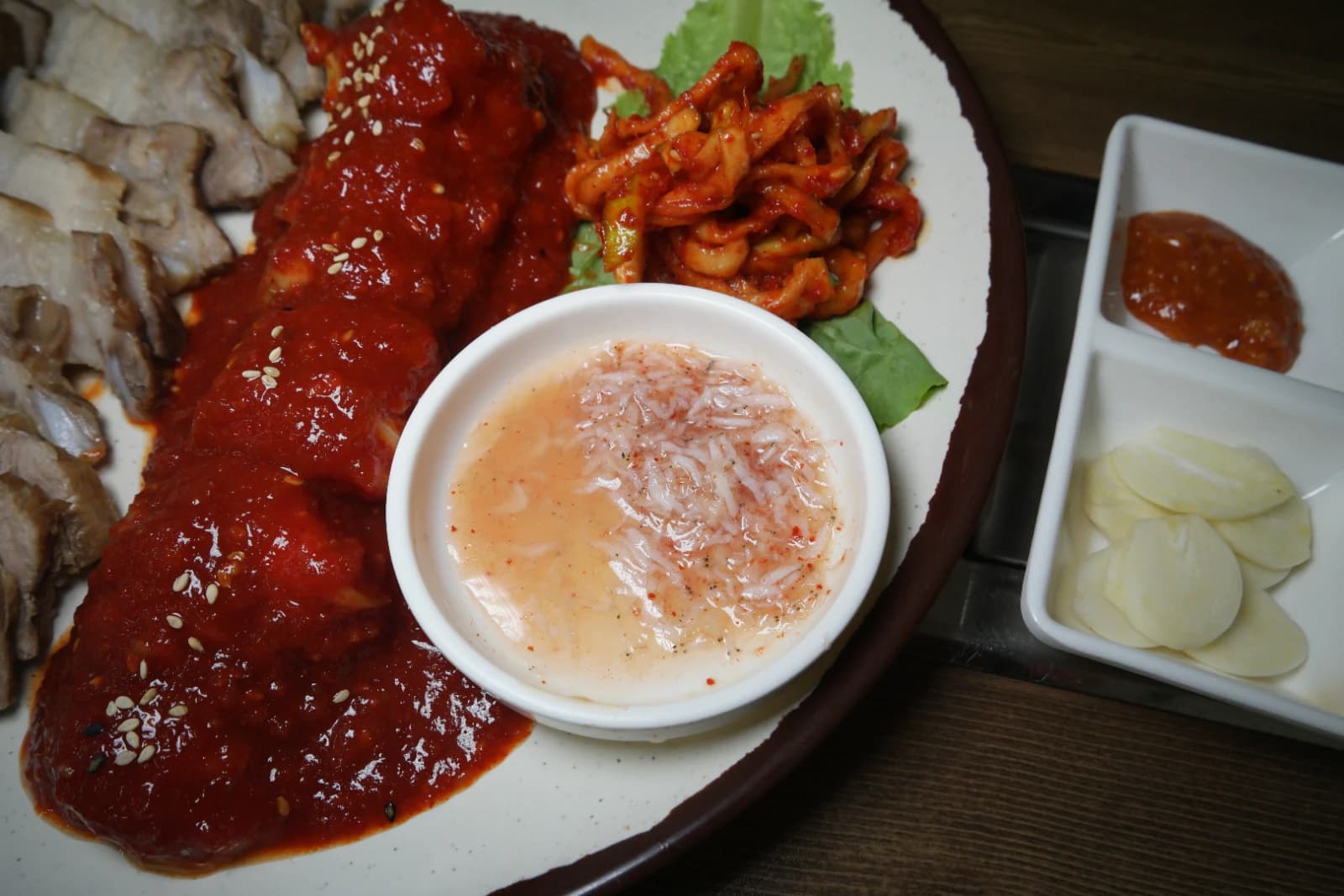
Saeujeot — tiny shrimp salted and fermented, a Korean condiment that's basically non-negotiable with bossam. Dip a slice of pork in it and the salty, savoury punch lifts the meat completely. The portion was pretty small so you had to go easy, but my mate went heavy early doors and we ran out with half the plate to go. Classic.
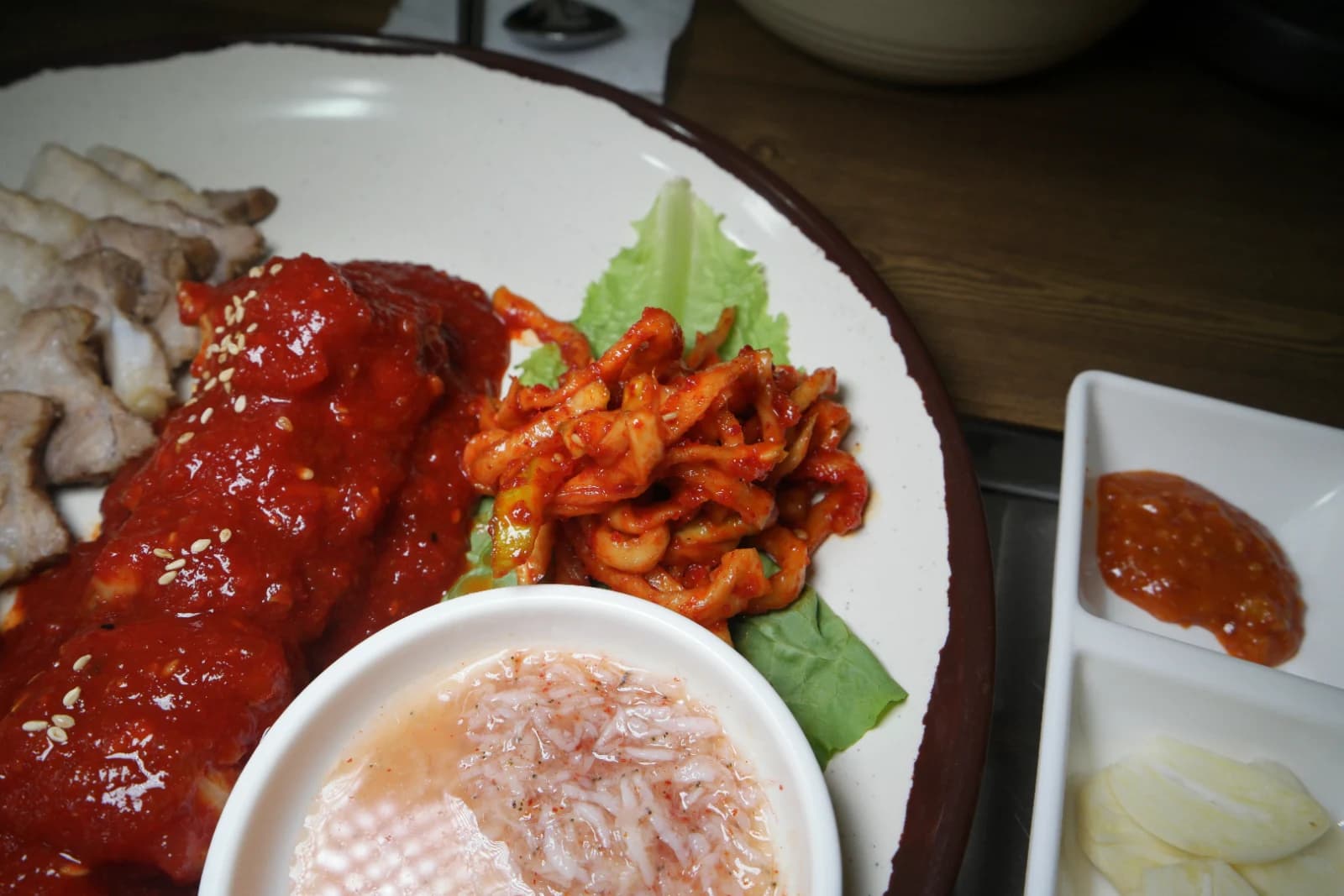
Mumallaengi. Radish (a common white root veg here in Korea) cut thin, dried out, then tossed in chilli seasoning. Crunchy and slightly sweet, and it works better as a palate cleanser between bites of pork than as something you actually wrap into the ssam. Nothing mind-blowing, but it did the job.
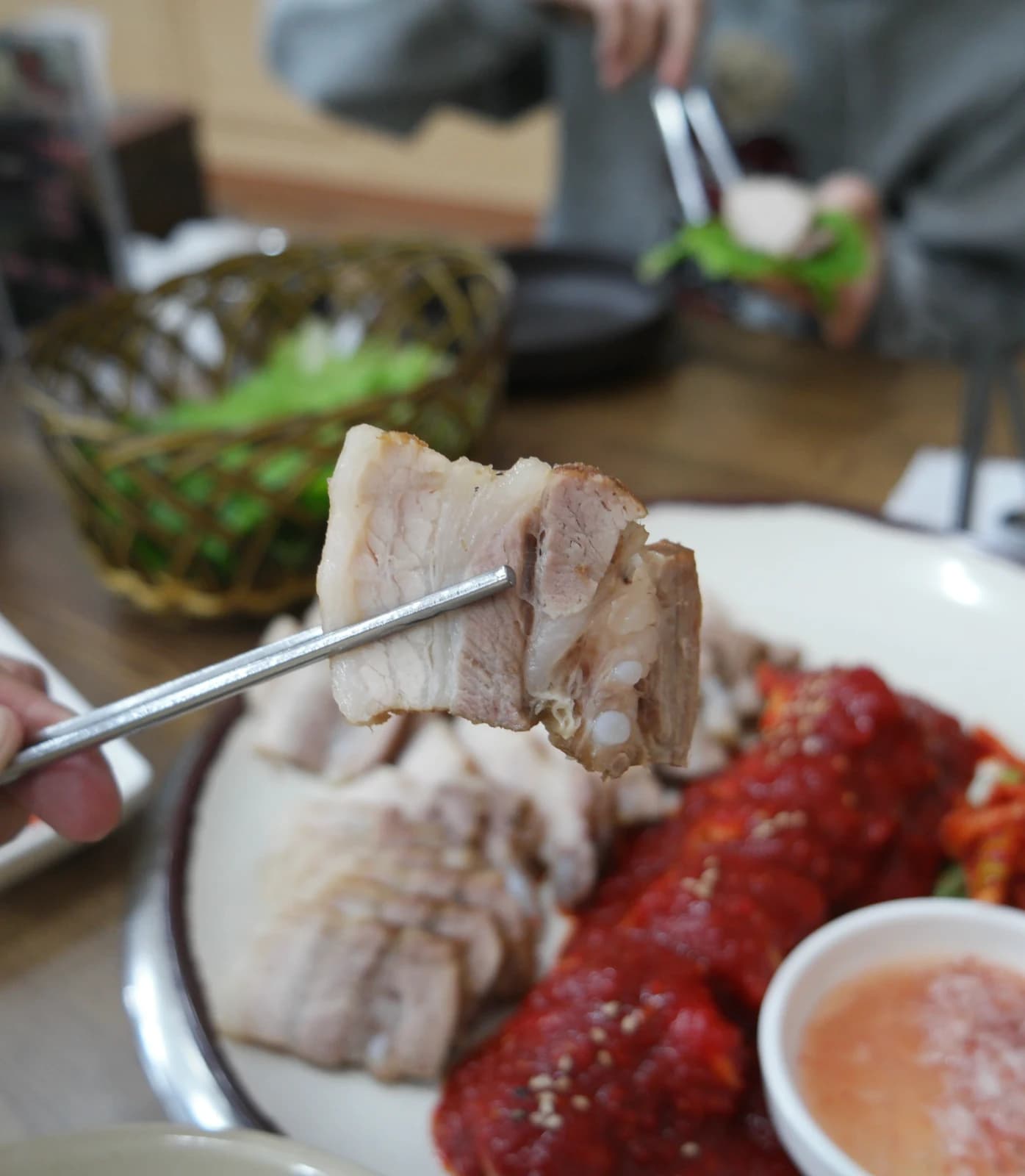
Picked up a piece with my chopsticks — you can see the layers of lean and fat in cross-section. In the background my mate was mid-wrap, which is how bossam works: lay a piece of pork on a lettuce or perilla leaf, add kimchi and a dab of saeujeot, then send the whole bundle in one bite. The slices were decently thick — one piece was more than enough to fill your mouth.
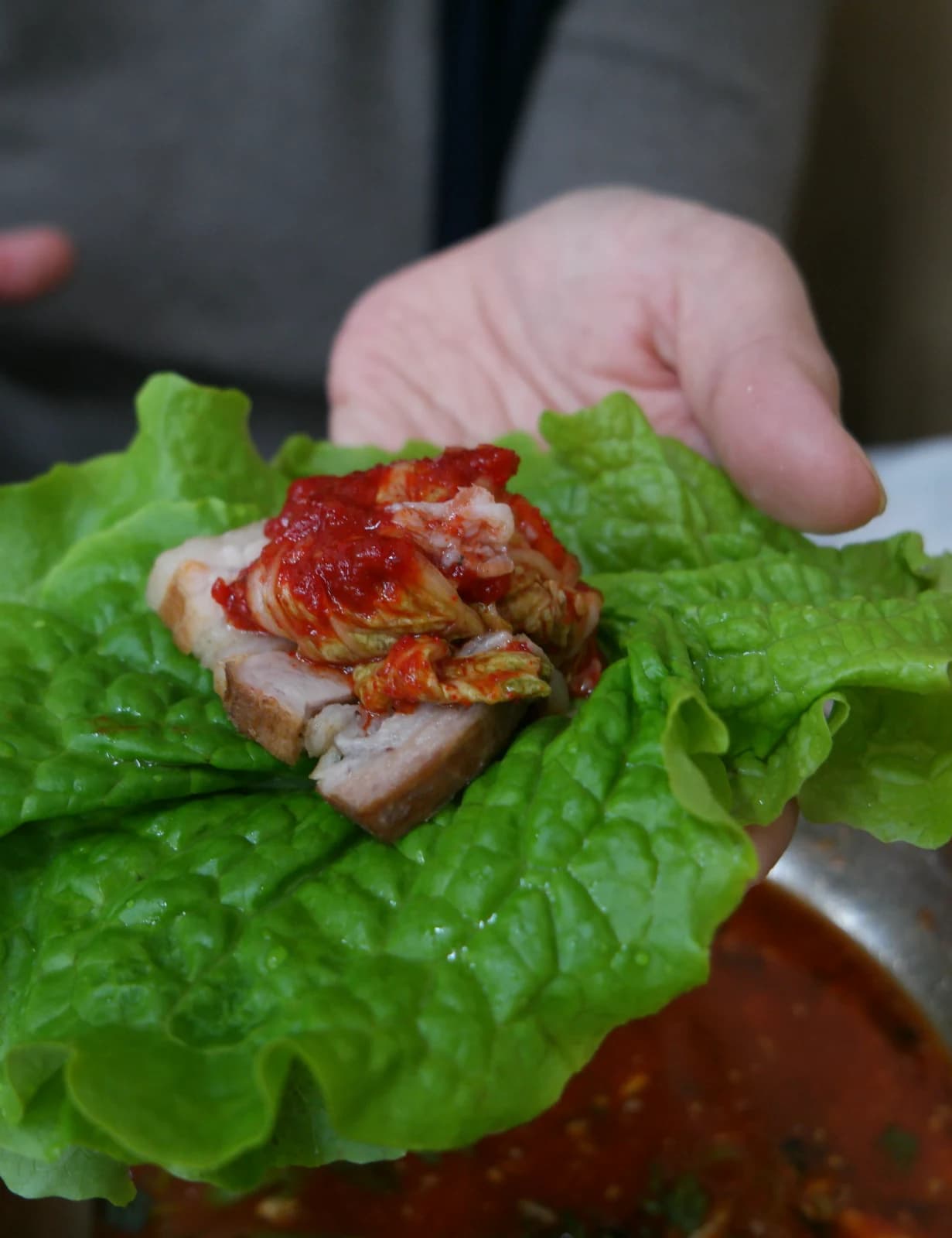
This is the move. Lettuce leaf flat on your palm, one or two slices of pork on top, red bossam kimchi on top of that, then fold it into a bite-sized parcel and send it. I asked my mate to hold his up for the photo and he was yelling at me to hurry up — kimchi juice was dripping through his fingers.
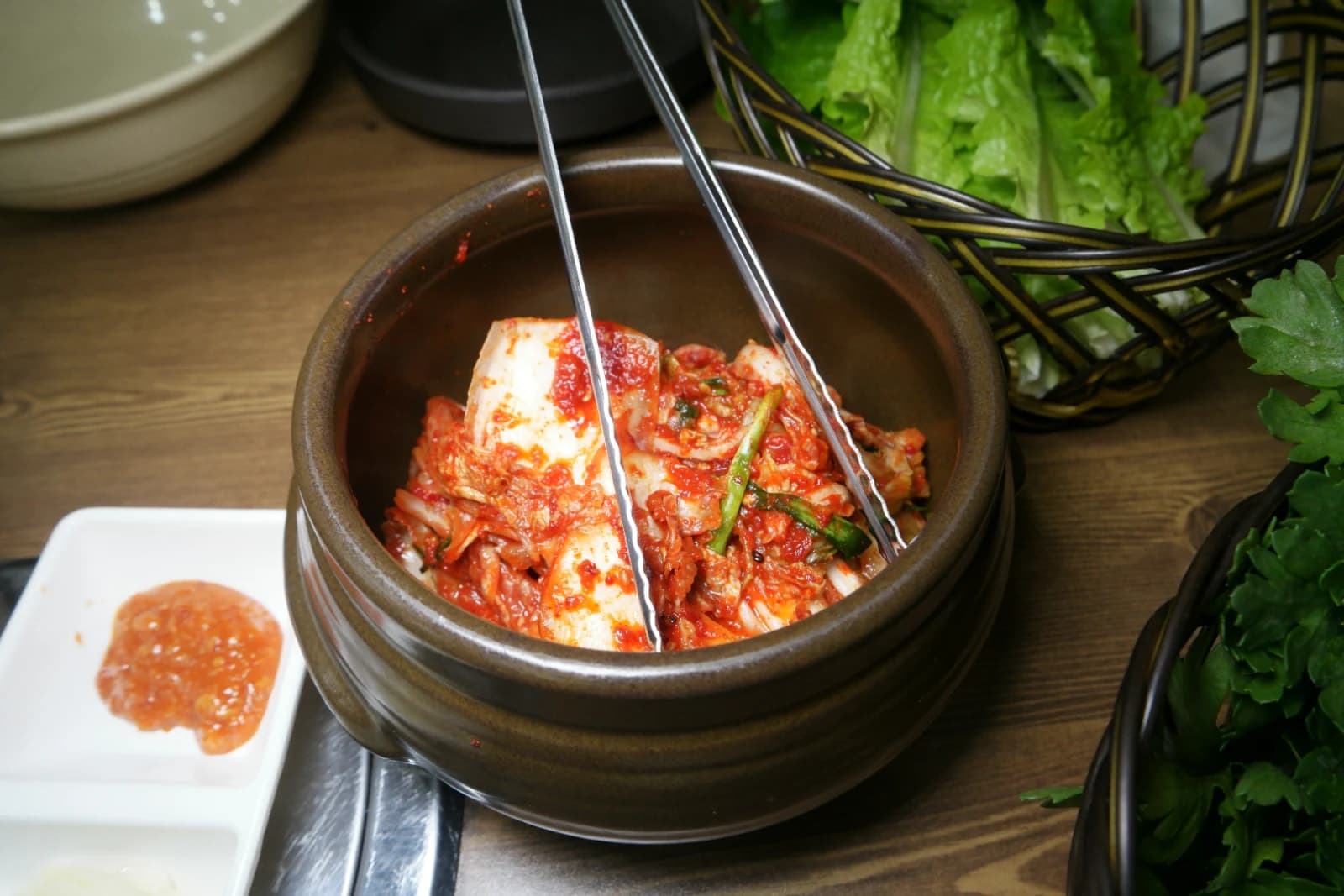
Bossam kimchi straight out of the jar, which shows the true colour better than the plated version did. The cabbage is smothered in red chilli seasoning and swimming in brine. Bossam-shop kimchi is fermented to a different stage than everyday table kimchi — aged exactly to the point where it plays best with pork.
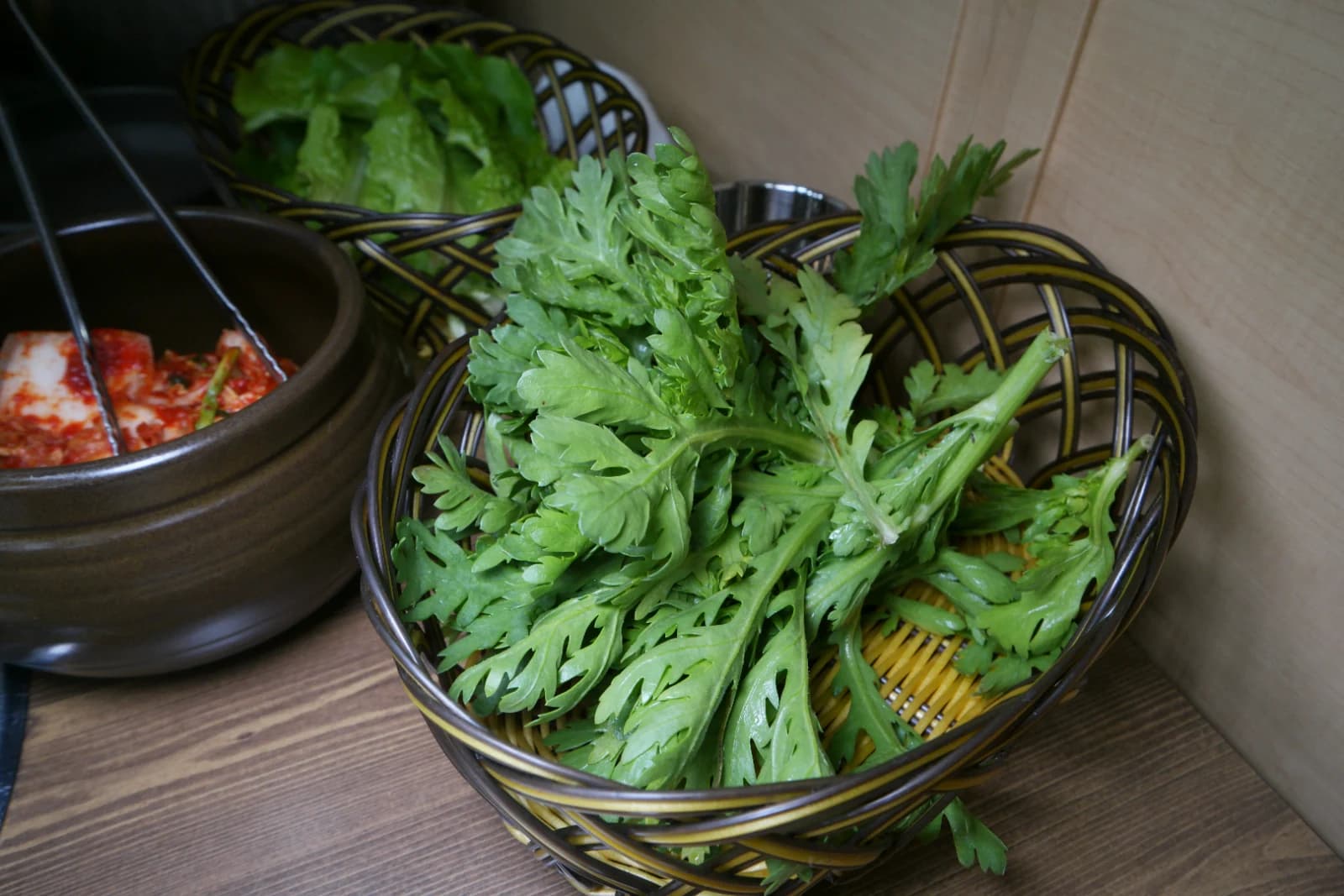
A basket of ssukgat arrived separately. Same crown daisy greens I was piling on the spicy kalguksu earlier — this shop serves them with bossam too as a wrap leaf. Daejeon just doesn't let up on the ssukgat, I swear.
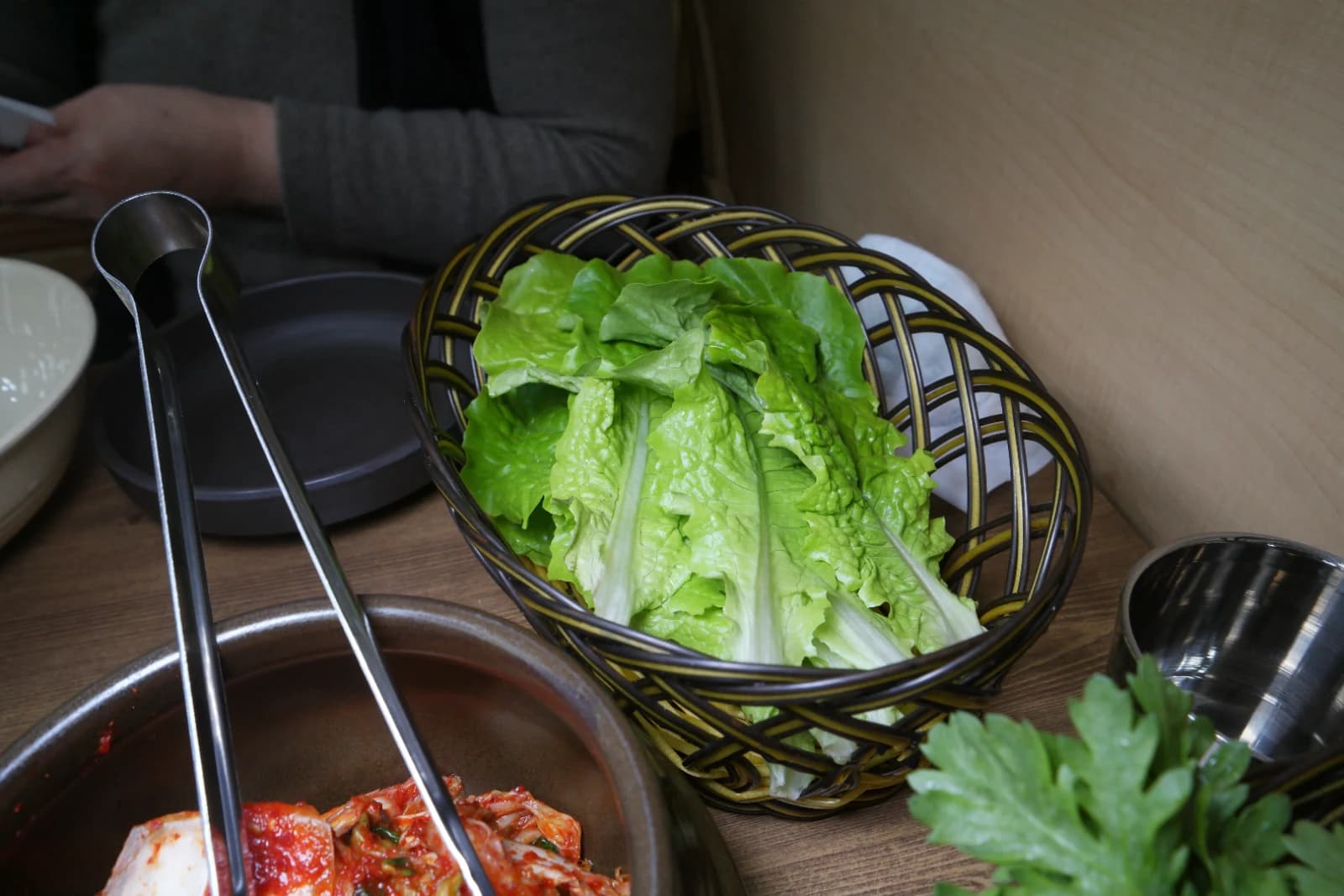
Lettuce is the bread-and-butter ssam leaf for bossam. Crisp green leaves piled high in a basket — this is what you build those wraps on. You can see the kimchi jar and the ssukgat basket sitting alongside, so the wrapping setup was generous, which I appreciated. Only gripe was the pork portion itself felt a touch small for two people to split.
Two bowls of kalguksu and a plate of bossam came in under A$33 between us. The kalguksu was around A$11 a bowl, and adding the bossam brought us to about that. Bellies were full, no complaints — but on the way out my mate dropped a line: the kalguksu was great, but wasn't the bossam pork a bit dry? Yeah, I'd clocked it too, but while we were eating it was all wrapped in kimchi and greens so I'd just rolled with it. Walking back we agreed next time we'd go to an actual bossam specialist. That plan is still outstanding. As of today, we have not been.
Kalguksu shops are everywhere in Korea, honestly any city you rock up to. Type "kalguksu" into a maps app and a pile of nearby places will pop up, and most are around A$11 so there's no stress about wandering in. Menus usually force you to pick between bajirak and eolkeuni — so if spicy's not your thing, go clam, and if you like a bit of heat, go the red one. Simple as.
The shop's gone now, so we can't go back even if we wanted to, but every time I end up eating kalguksu somewhere I think about that arvo. Piling ssukgat on the spicy bowl, my mate whinging about it and then secretly loading up his own. Not some grand day or anything — just one of those ones that sticks.
