CategoryFood
LanguageEnglish (UK)
Published
17 items
One autumn evening, my mate rang me up — fancy kalguksu? If you live in Daejeon, a city in central Korea, you'll know there's a kalguksu shop on practically every corner. The city is unofficially the knife-cut noodle capital of the country, with hundreds of places dotted around town, and he'd clocked a new spot he wanted to try. So I met him straight after work. Kalguksu is one of Korea's staple noodle dishes: a wheat-flour dough rolled thin, sliced by hand with a knife (hence the name), then cooked in hot broth. It doesn't have the instant name recognition of ramyeon or tteokbokki, but once you've lived in Korea a while, you find yourself ordering it more often than you'd expect. I went for the bajirak kalguksu (clam broth), my mate picked the eolkeuni kalguksu (the spicy red one), and because two bowls somehow weren't enough, we ended up tacking on bossam too. The shop has since closed, but the memory of that evening has stuck around, so I'm pulling it out here.
What is kalguksu?
The name
"Kal" means knife and "guksu" means noodles. The dough is rolled thin by hand and sliced with a knife rather than pushed through a machine — that hand-cut method is the whole point.
How it's made
The noodles are dropped straight into a simmering broth — usually anchovy, clam or chicken — and cooked through in minutes. Every shop has its own broth base, so two bowls of "the same" kalguksu can taste surprisingly different.
The noodles
Chunkier and chewier than ramyeon or udon, with a bit of wheaty bite to them. You definitely feel them when you chew, especially alongside a well-flavoured broth.
How to eat it
Chopsticks for the noodles, spoon for the broth. Slurping is perfectly fine — in Korea, that's just how noodles are eaten, so feel free to pull them in loudly.
Price
A bowl usually runs between about £4 and £6. Nearly every neighbourhood has at least one kalguksu shop, and it's an easy, low-stress solo lunch option.
Main types
Clear-broth bajirak (clam), spicy red eolkeuni with chilli, chicken-based dak kalguksu and nutty deulkkae (ground perilla seed) — there's more variety than you'd think.
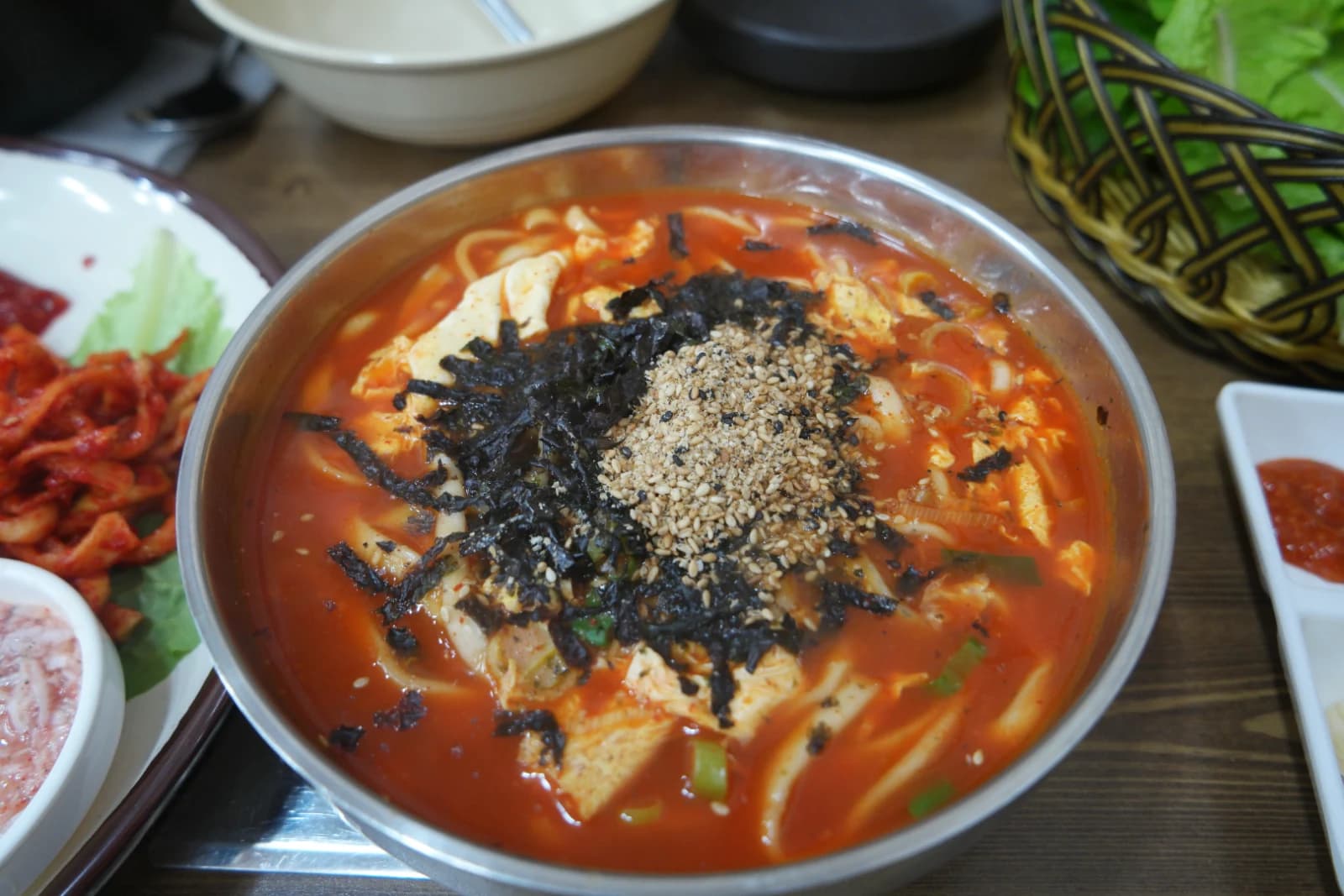
This is the eolkeuni kalguksu. If the standard version cooks the noodles in a clear broth, the eolkeuni version adds a chilli-based seasoning to turn it red and spicy. It's in the same ballpark as jang kalguksu (which uses fermented chilli paste), but the seasoning mix varies shop to shop. You can tell from the photo how vividly red the broth is — there's a generous pile of dried seaweed flakes and sesame seeds on top, and through the surface you can spot noodles, spring onion and a bit of courgette poking through. In most Korean kalguksu shops, the menu lists plain and spicy side by side, and honestly most spice fans default straight to the eolkeuni.
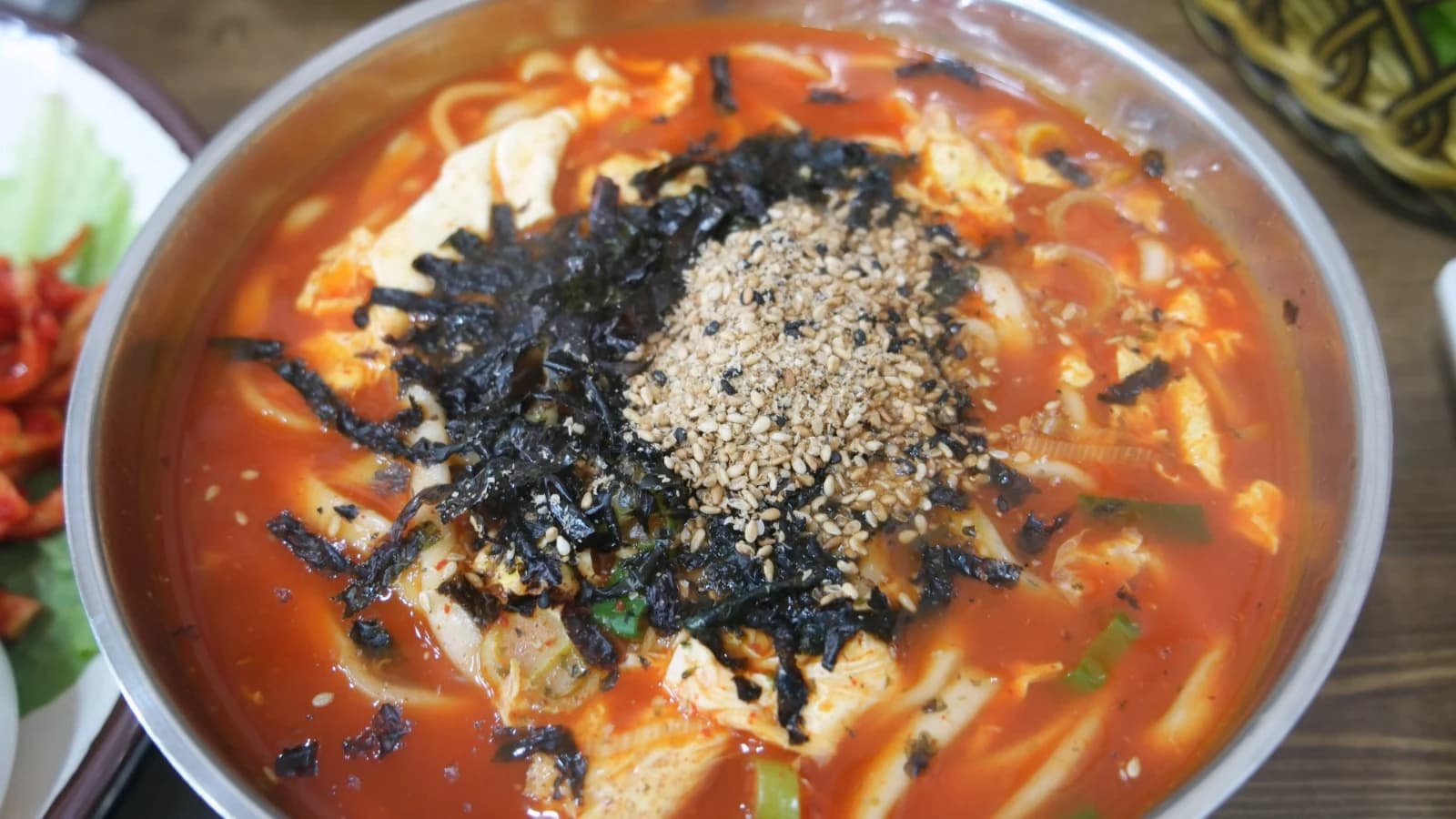
Here's a closer look. Seaweed flakes drift across the bright red surface, with a little mountain of sesame seeds piled in the middle. The colour screams seriously spicy, but in reality it's more of a warming kick than a tongue-numbing burn. When you lift a clump of noodles out, the thick strands come up carrying a streak of red broth, which looks proper appetising. Between the noodles you'll find cubes of tofu, spring onion and courgette — the toppings aren't stingy at all.
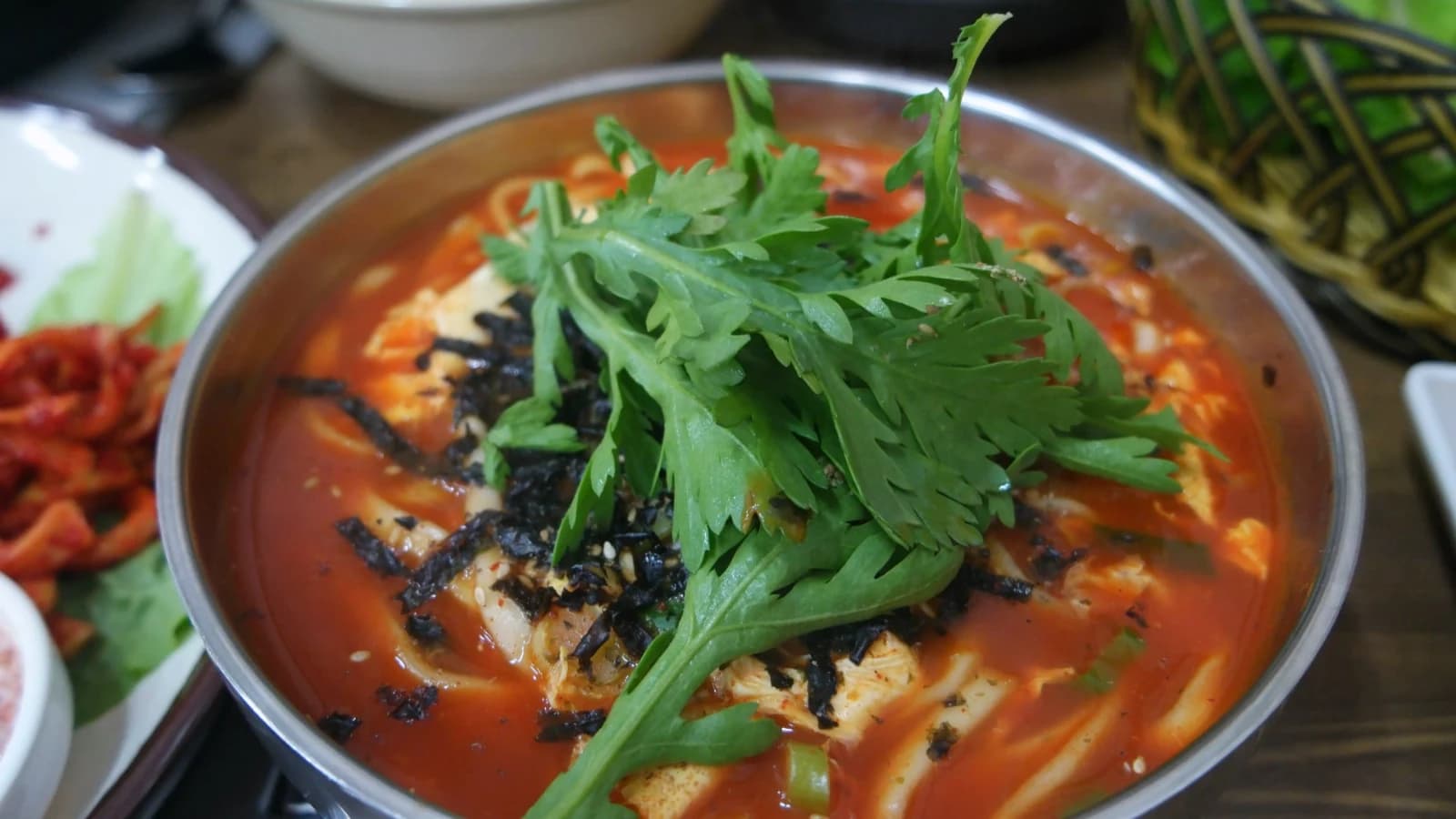
Now a handful of ssukgat goes on top. Ssukgat is crown daisy — an aromatic leafy green — and piling it over eolkeuni kalguksu is practically standard in Daejeon. The green against the red is proper striking, and once you dunk the leaves briefly in the broth and eat them with a bite of noodles, that herby fragrance cuts through the heat really nicely. I genuinely think it feels incomplete without it, though my mate normally avoids ssukgat and asked why on earth I was adding it. Turns out once it's mingled with the broth, he didn't mind at all — he ended up piling some onto his own bowl too.
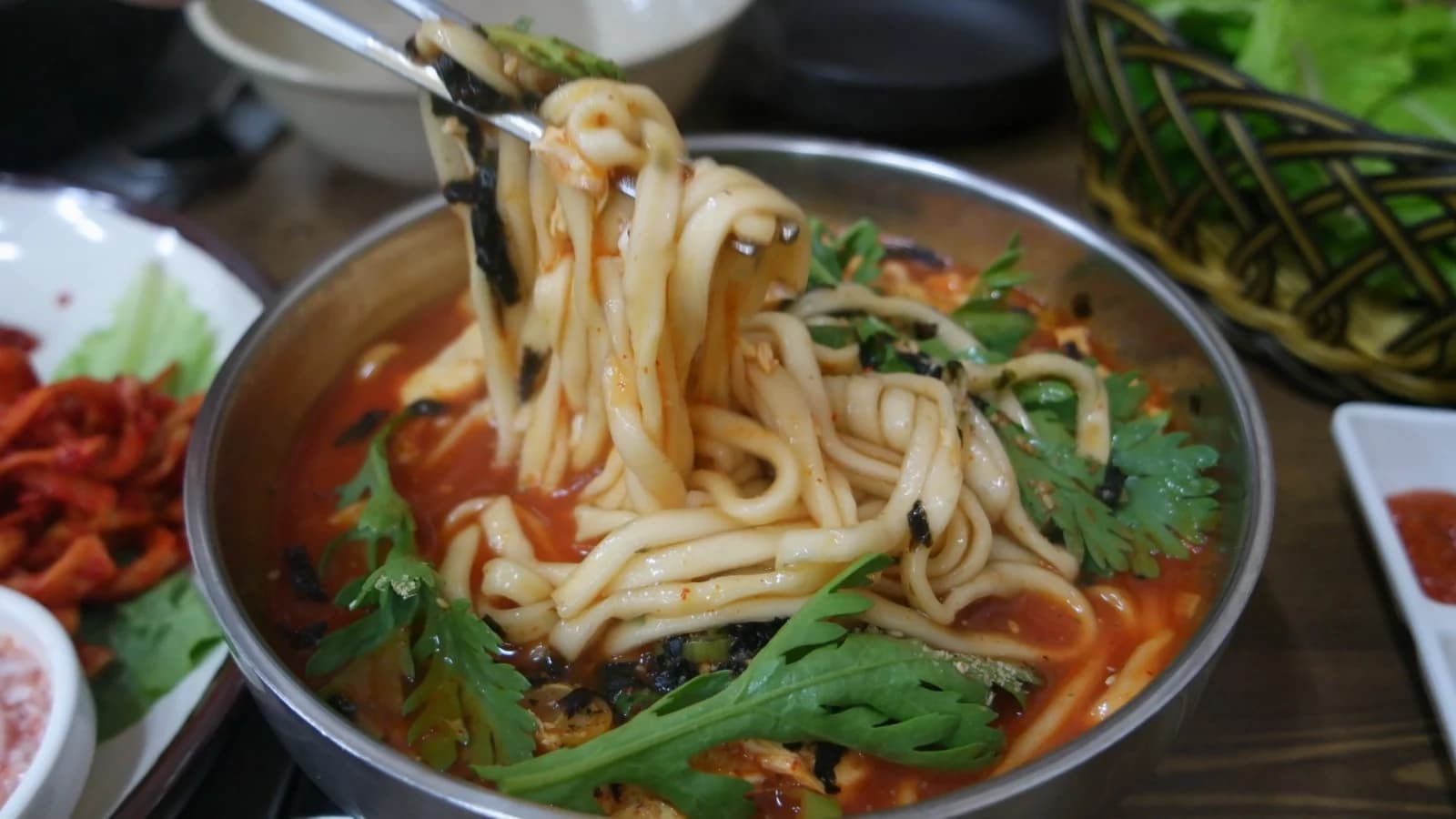
Lifting a chopstickful — and you can see the strands aren't a uniform thickness. Some are chunky, others noticeably thinner. That's because kalguksu is hand-cut rather than machine-extruded: the cook rolls the dough out with a pin and slices it by knife, so the gauge varies strand by strand. Far from a flaw, it's a defining feature. In one mouthful you'll get chewy thick strands alongside thinner ones that hang on to loads of broth, so the texture keeps shifting as you chew. The red broth clings in between, a bit of ssukgat comes up with the noodles, and from there you just slurp.
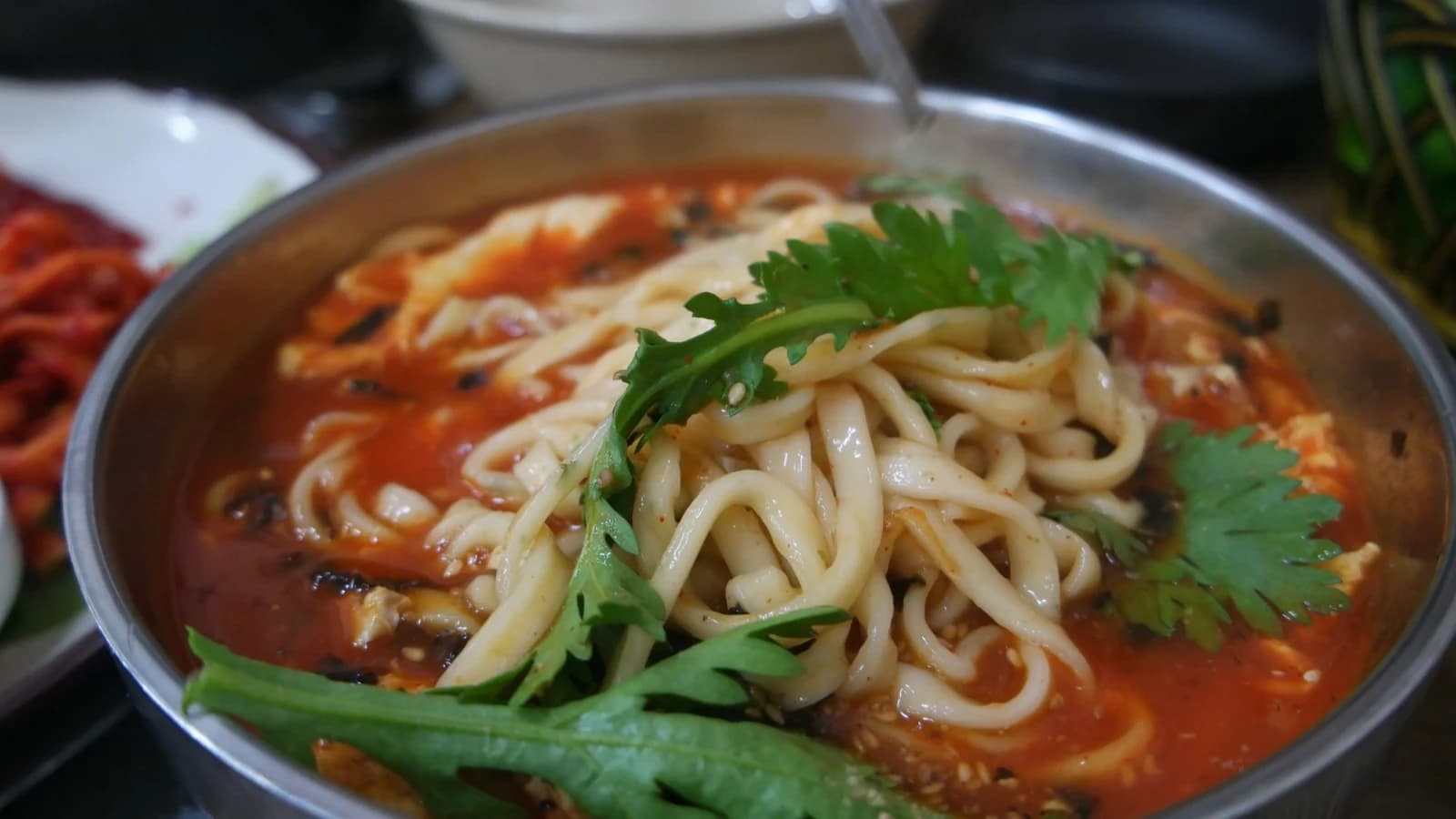
After a quick stir. The noodles and ssukgat have merged with the broth, which has darkened a shade. There's a broken egg mingling in as well, now that I look. At this point it's just head down, chopsticks in.
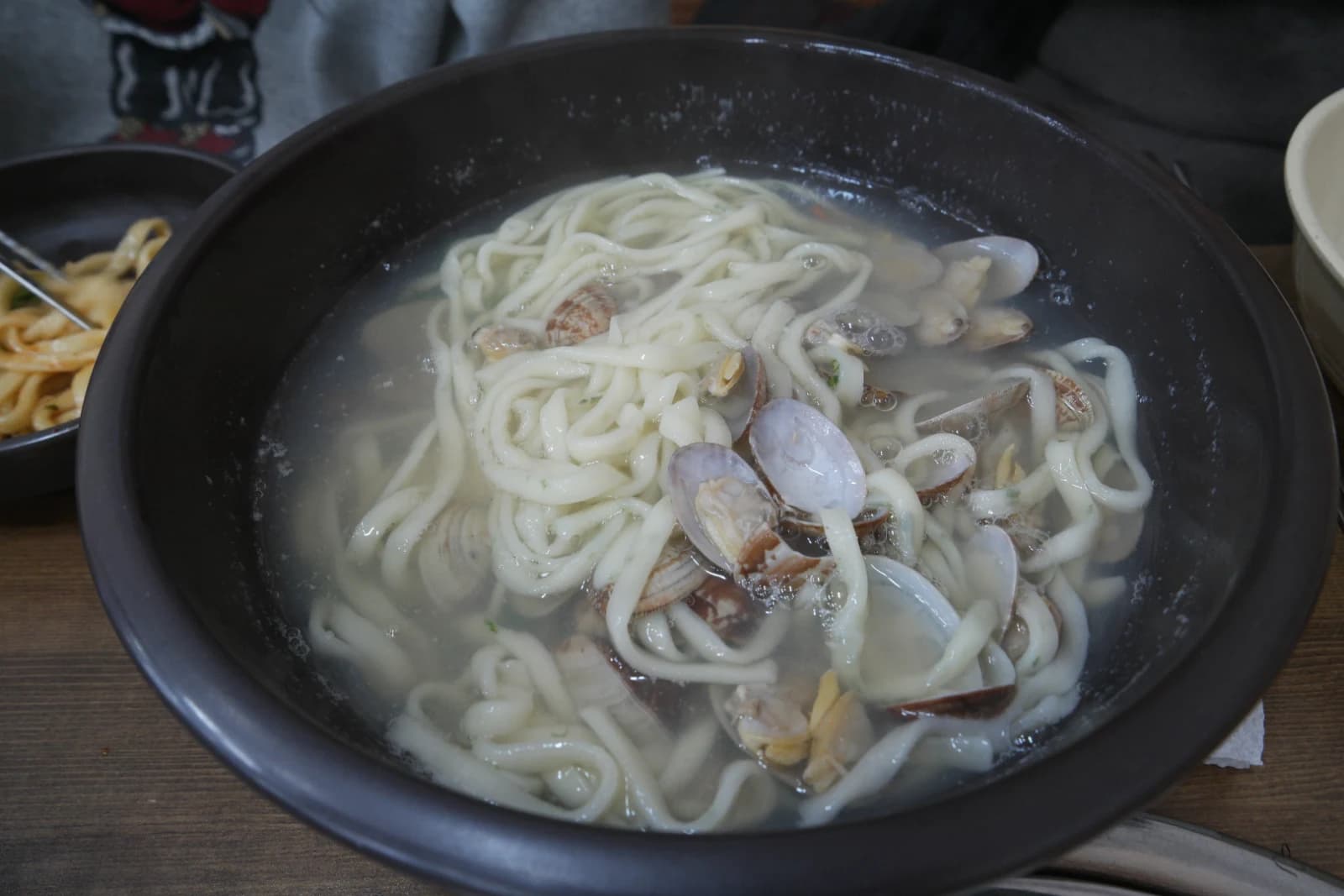
What I ordered was the bajirak kalguksu. Setting it next to the red bowl, the difference is immediate — the broth is totally clear. Bajirak are small manila clams, a common shellfish in Korea, and they're tipped into the pot shells and all to make the stock. The broth has that signature clam sweetness — savoury but never heavy. Shells are dotted between the noodles, so part of the fun is picking out the clams as you go. When a shell pops up, you fish the meat out with your chopsticks and stack the empty shell on a plate or lid. Where the eolkeuni leans bold and spicy, the bajirak is clean and almost cooling — ordering one of each at the same table is the easiest way to see how different two bowls of "kalguksu" can be.
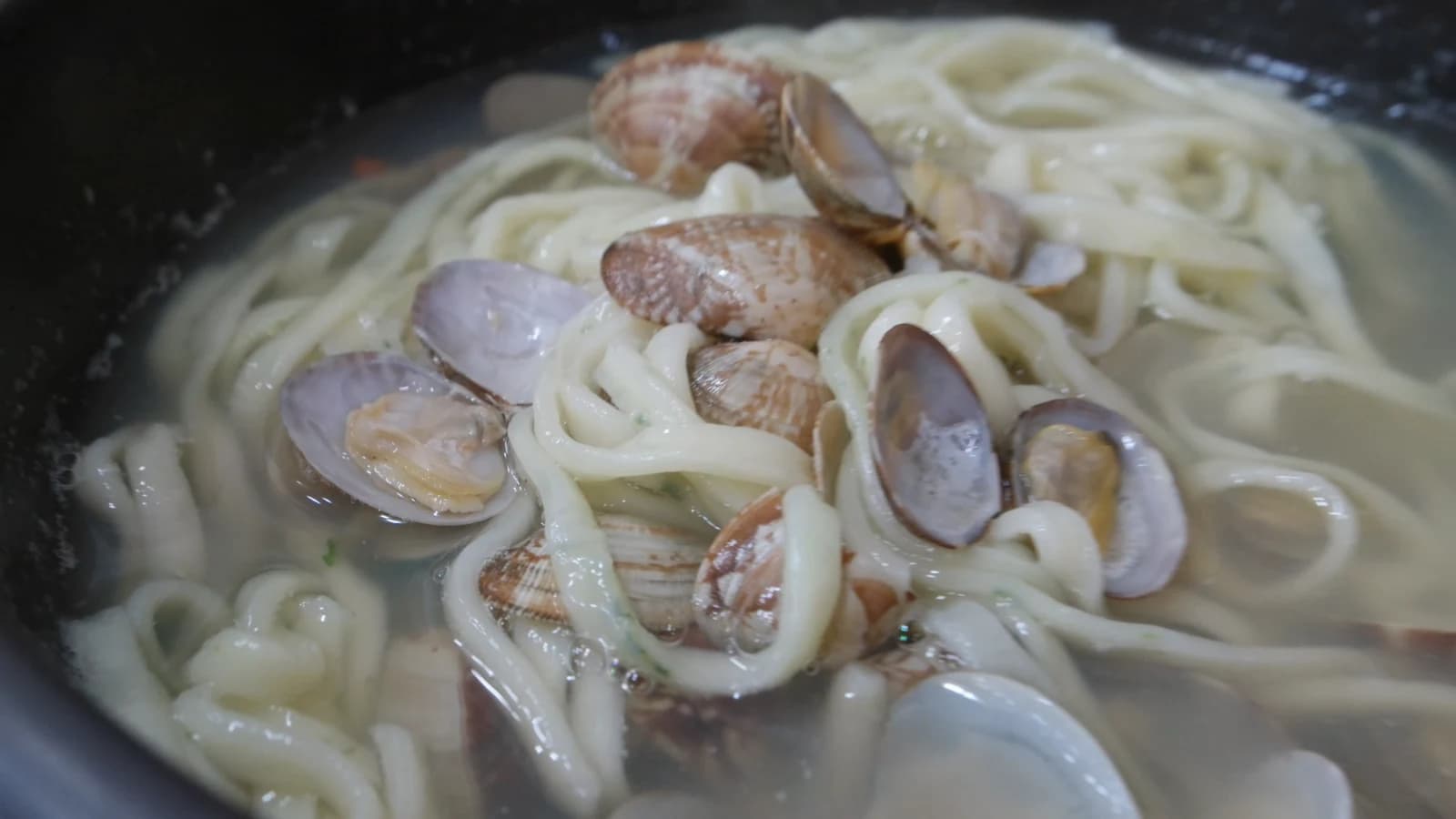
Up close, the clams are a decent size. The shells have opened as they cooked, the meat sitting there exposed, and that's exactly how they release their flavour into the broth. Manila clams are plentiful along Korea's west coast, so they're not an expensive ingredient — which is why kalguksu shops can be generous with them. Eating them is simple: spot a clam while working through the noodles, pull out the meat with your chopsticks and pop it in. Each one is a small, salty mouthful that tastes unmistakably of the sea. Honestly, the meat isn't what fills you up — what really matters is the depth those clams lend to the broth. Try a spoonful of the broth on its own after finishing the noodles and you'll notice the difference straight away.
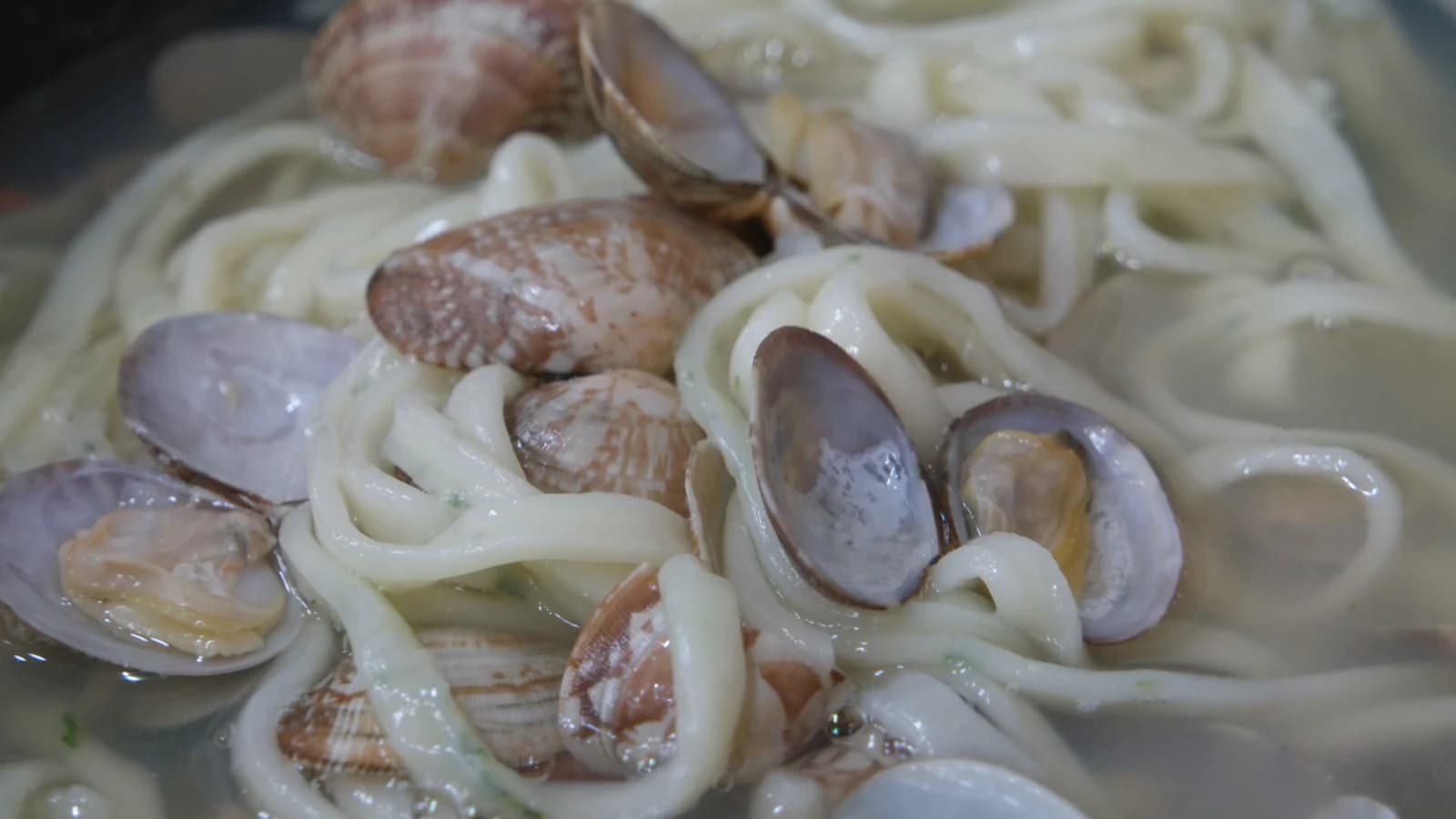
Zoomed in even further — the clams are properly plump inside those open shells, tangled with the noodles. This tangle of clams and noodles is the classic bajirak kalguksu look.
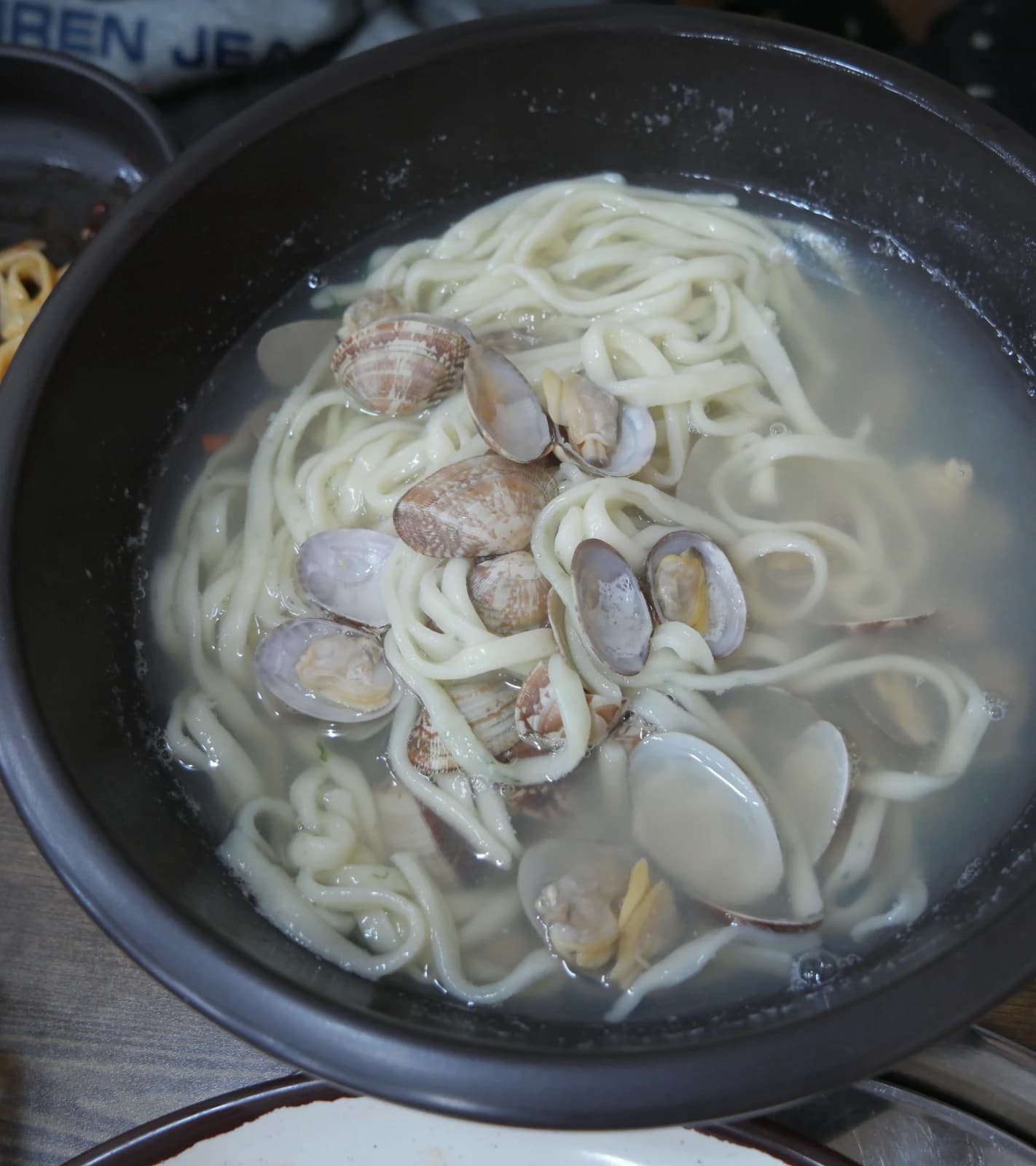
A few minutes in and the broth has gone visibly cloudier. That's wheat starch releasing from the noodles as they sit in the hot liquid — one of kalguksu's quirks. The longer it sits, the thicker it gets, and by the end the texture and flavour are different from the first spoonful.
Bajirak vs Eolkeuni Kalguksu
Bajirak Kalguksu (Clam)
Broth
Clear stock from manila clams simmered in their shells.
Flavour
Clean and savoury, with a natural sweetness from the shellfish carrying all the way through.
Heat level
None. A solid pick if you're not into spice.
Toppings
Clams in the shell, courgette and spring onion — picking the clam meat out is half the fun.
How the broth changes
Grows cloudier and thicker as starch from the noodles releases.
Eolkeuni Kalguksu (Spicy)
Broth
Anchovy or clam stock boosted with chilli seasoning, simmered until red.
Flavour
Warming, chilli-forward and savoury — heat sits on top of a proper umami base rather than overpowering it.
Heat level
Middling. Mild by Korean standards, but noticeable if you're not used to spice.
Toppings
Tofu, courgette, spring onion and egg. A handful of crown daisy on top lifts the whole thing.
How the broth changes
Already bold from the start, so the flavour stays roughly consistent bowl to bowl.
Most kalguksu shops serve both side by side — if you've got company, ordering one of each is the easiest way to compare.
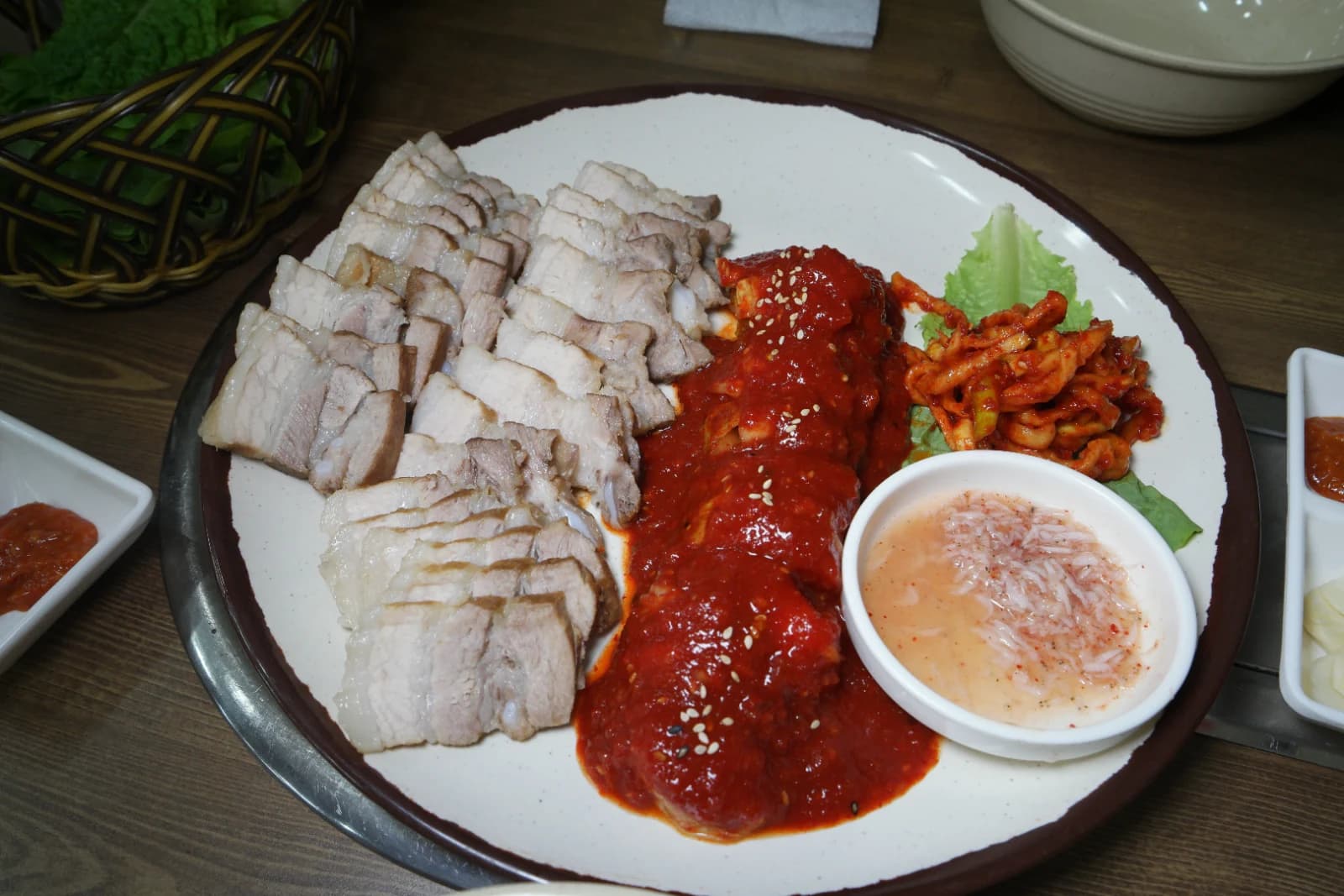
Two bowls of kalguksu between us turned out not to be enough. Plenty of kalguksu shops stick to noodles only, but a decent number also serve pork dishes like bossam or suyuk on the side. My mate spotted bossam on the menu and we tacked one on straight away. Bossam is a traditional Korean pork dish — a whole pork shoulder or collar is simmered until tender, then thinly sliced and wrapped in kimchi or lettuce leaves. Once the platter landed on the table, the whole vibe shifted — it went from a quick noodle stop to a proper meal. Kimchi sat in its juices in the middle, pork fanned out either side, and the second my mate saw it, he said, "Right, this needs soju, doesn't it?" Unfortunately we'd both driven, so we stuck to water.
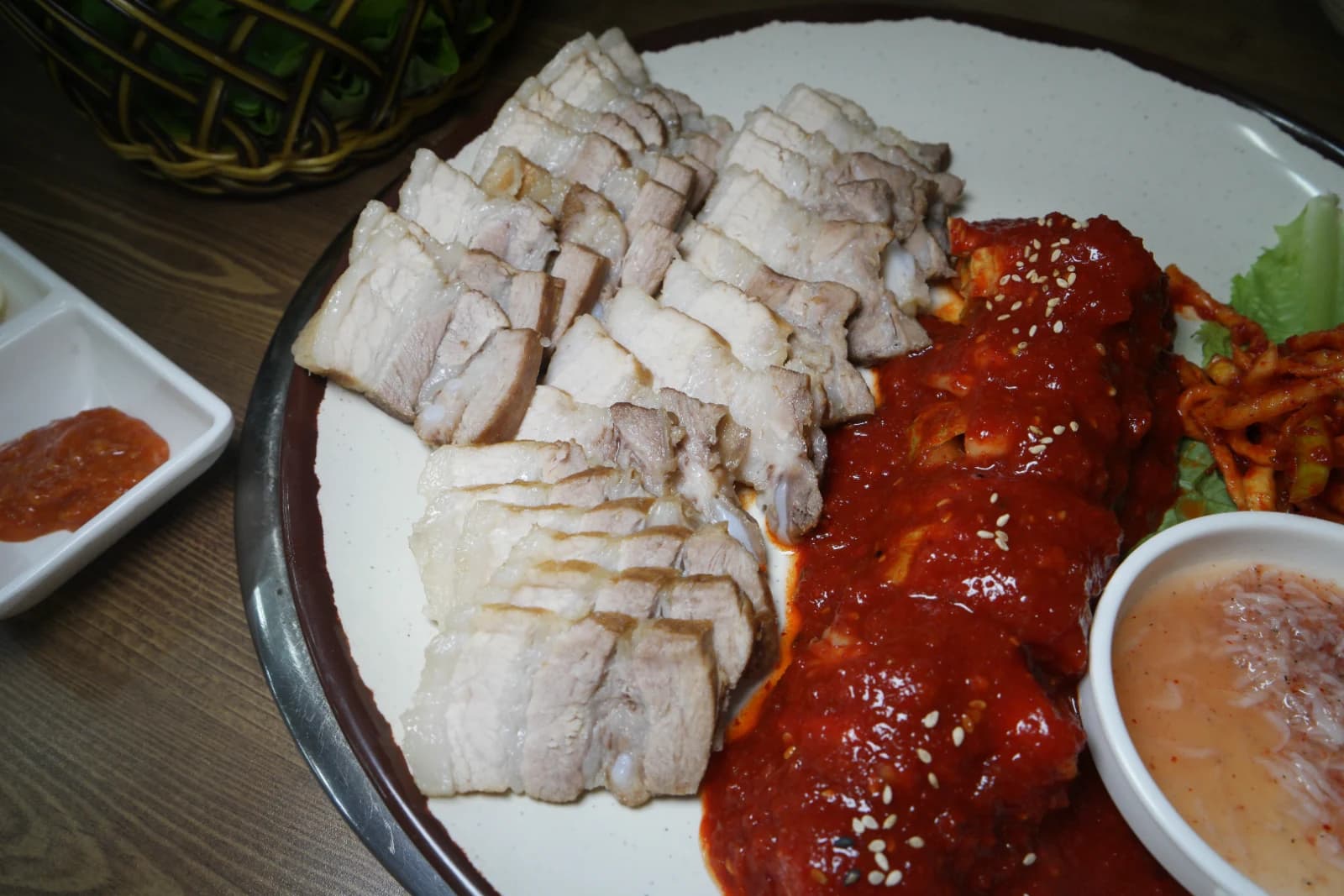
The kimchi next to the pork was a bit different from everyday table kimchi — it was swimming in its own juice. This is bossam kimchi, made specifically to be eaten alongside bossam. Lay a piece on top of a slice of pork, pop the whole thing in your mouth, and the tangy, juicy kimchi cuts right through the richness of the pork. Honestly though, on its own the kimchi juice was a shade on the salty side. Paired with the pork it worked brilliantly, but I wouldn't eat the kimchi by itself.
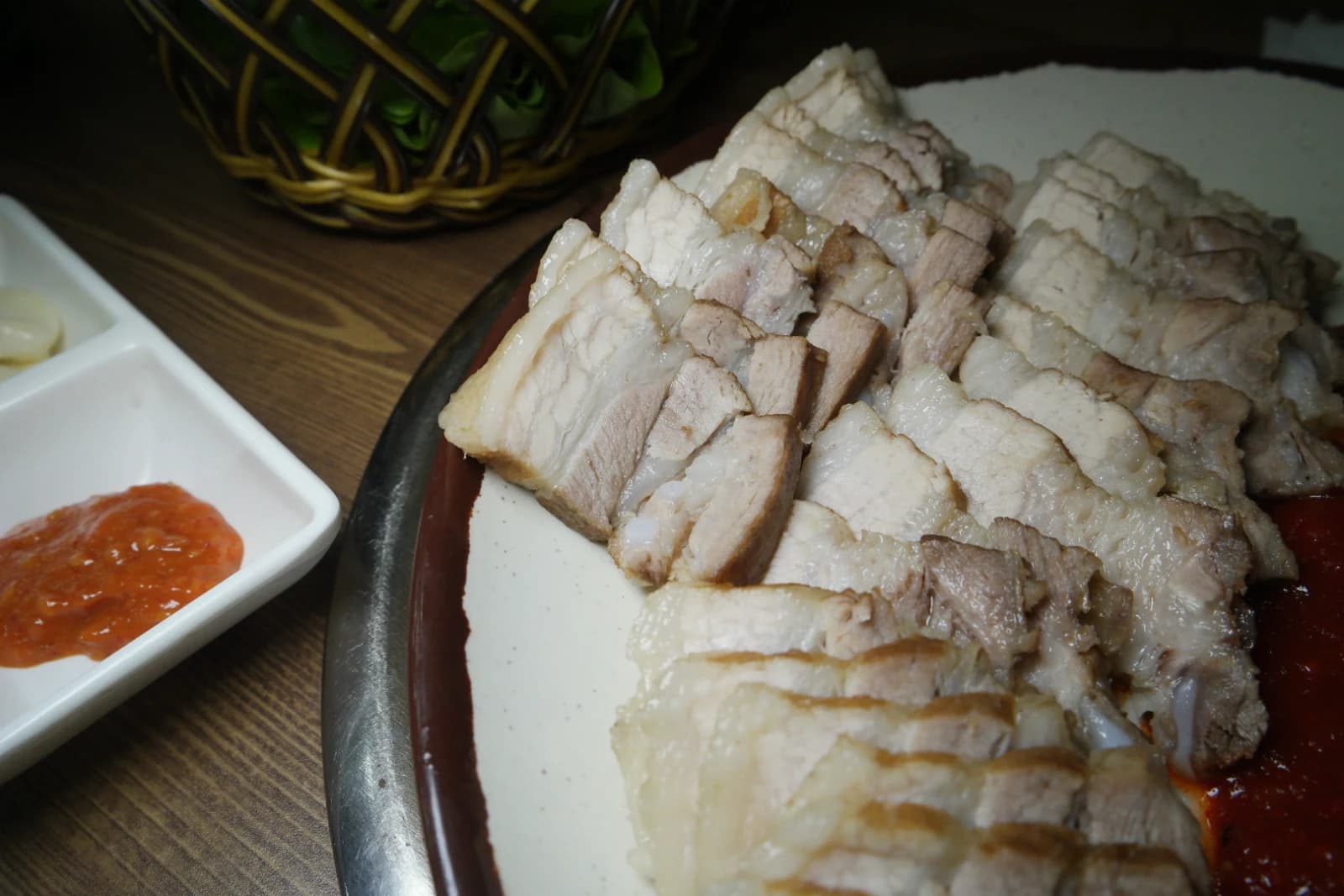
Here's the pork on its own. You can see the layers clearly — lean meat and fat alternating through each slice. Properly cooked bossam has fat that turns translucent and gelatinous rather than greasy, with lean meat that pulls apart cleanly along the grain. This one… wasn't quite there. The lean parts were a touch dry, to be honest. That said, this was a side order at a kalguksu shop rather than a dedicated bossam specialist, so I wasn't really expecting specialist-level pork.
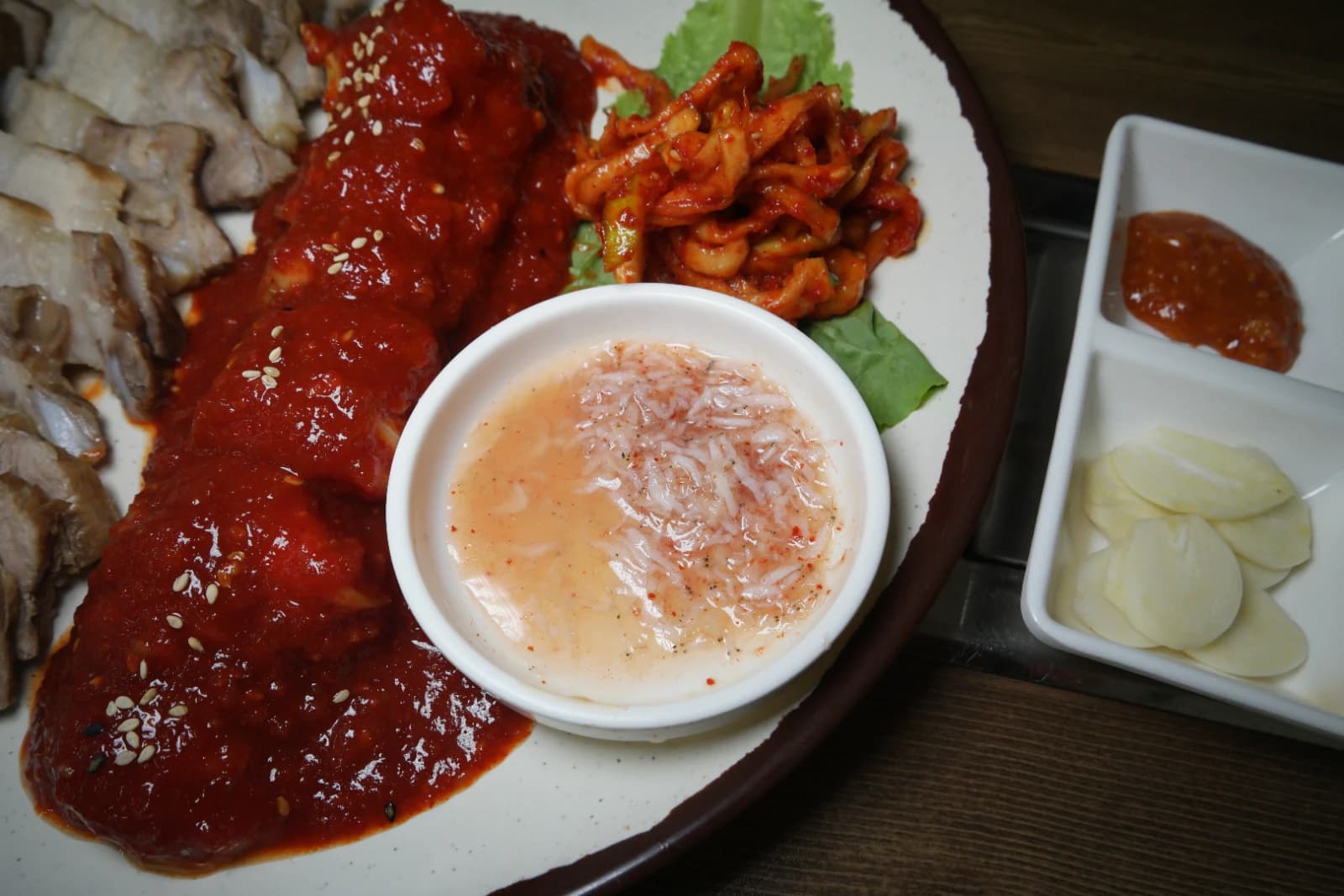
Saeujeot — tiny shrimp preserved in salt and fermented. Think of it as the non-negotiable dipping sauce for bossam. Dip a piece of pork lightly into it and you get a salty, deeply savoury hit that really wakes the meat up. They only gave us a small ramekin so I'd been trying to ration it, but my mate went heavy from the start, and by the time we were halfway through the pork it was basically empty.
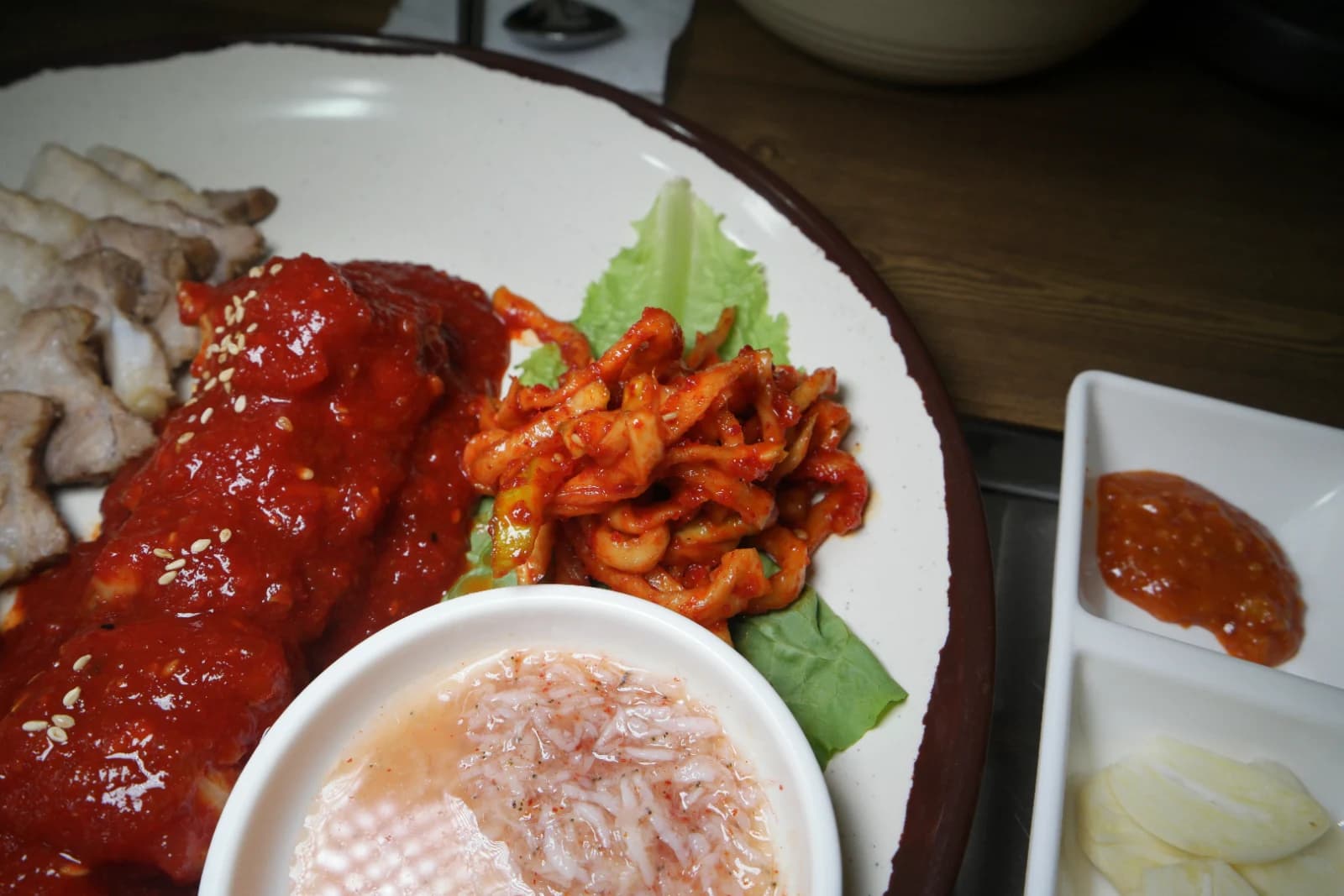
Mumallaengi — strips of Korean white radish that have been dried, then tossed in chilli seasoning. It's crunchy with a mild sweetness. Rather than eating it inside a wrap with the pork, it works better as a little palate refresher between bites. Nothing particularly special about this one, but perfectly fine.
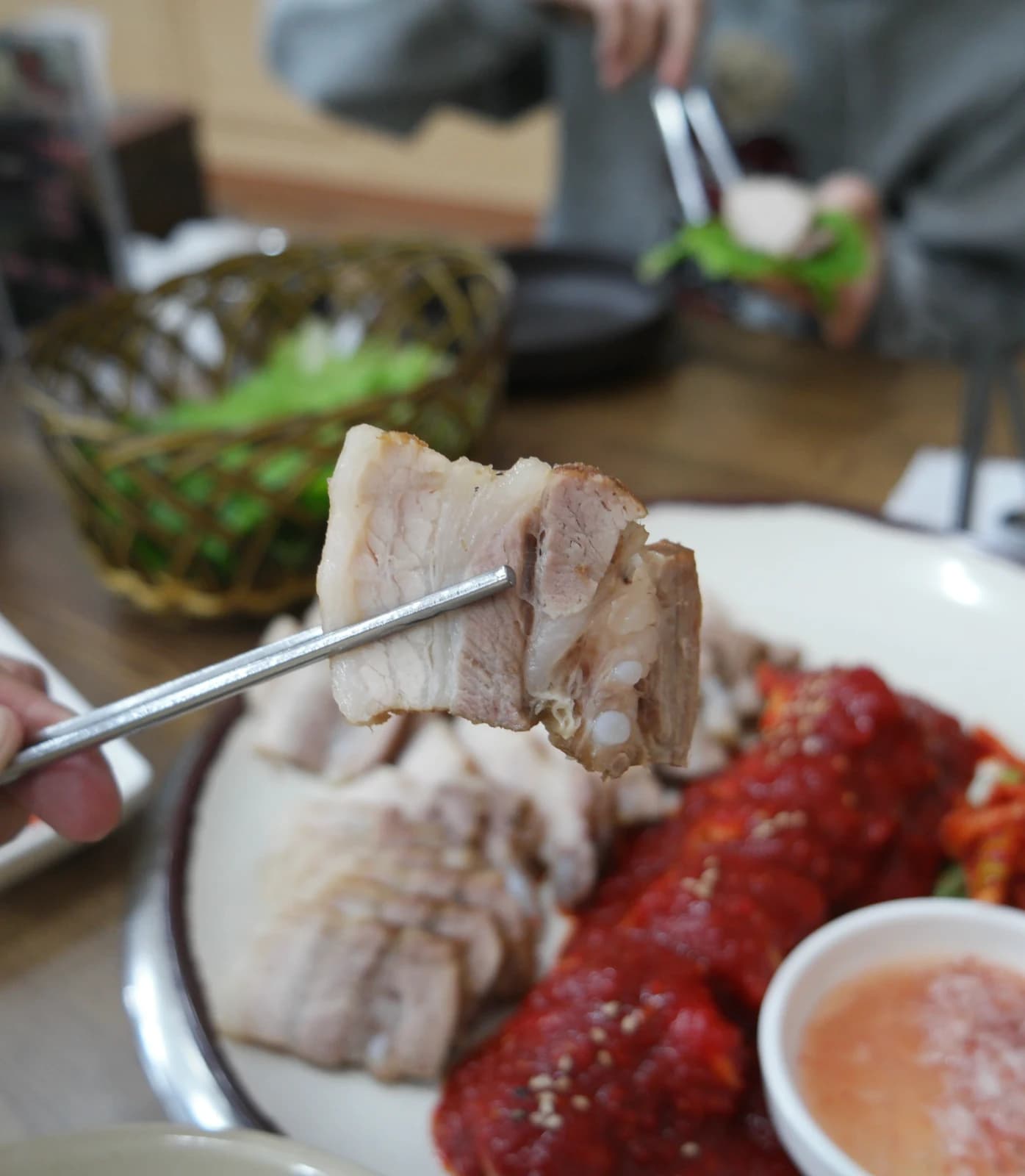
Picking up a slice with the chopsticks — you can see the layered belly in cross-section. In the background, my mate is (slightly blurrily) building a wrap. That's the whole idea with bossam: lay a slice or two on a lettuce or perilla leaf, add kimchi and a dab of saeujeot, then stuff the lot in your mouth in one go. The slices were cut properly thick too, so a single piece pretty much filled your cheeks.
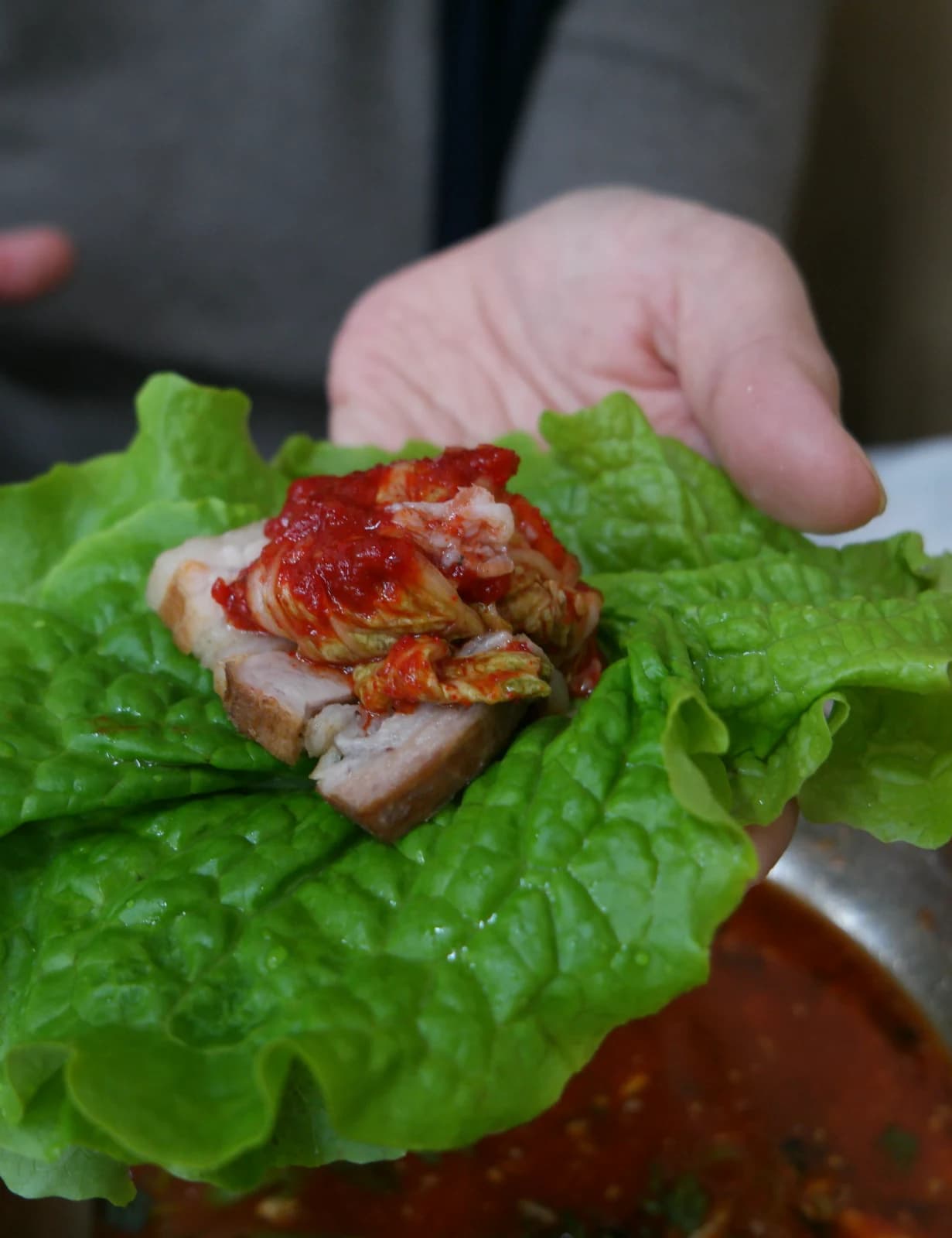
This is the wrap in action. Open out a lettuce leaf flat on your palm, add one or two slices of pork, drop a piece of that red bossam kimchi on top, and the whole bundle goes in. I asked my mate to hold it still for the photo, and he was hissing at me to hurry up — apparently the kimchi juice was dripping all over his hand.
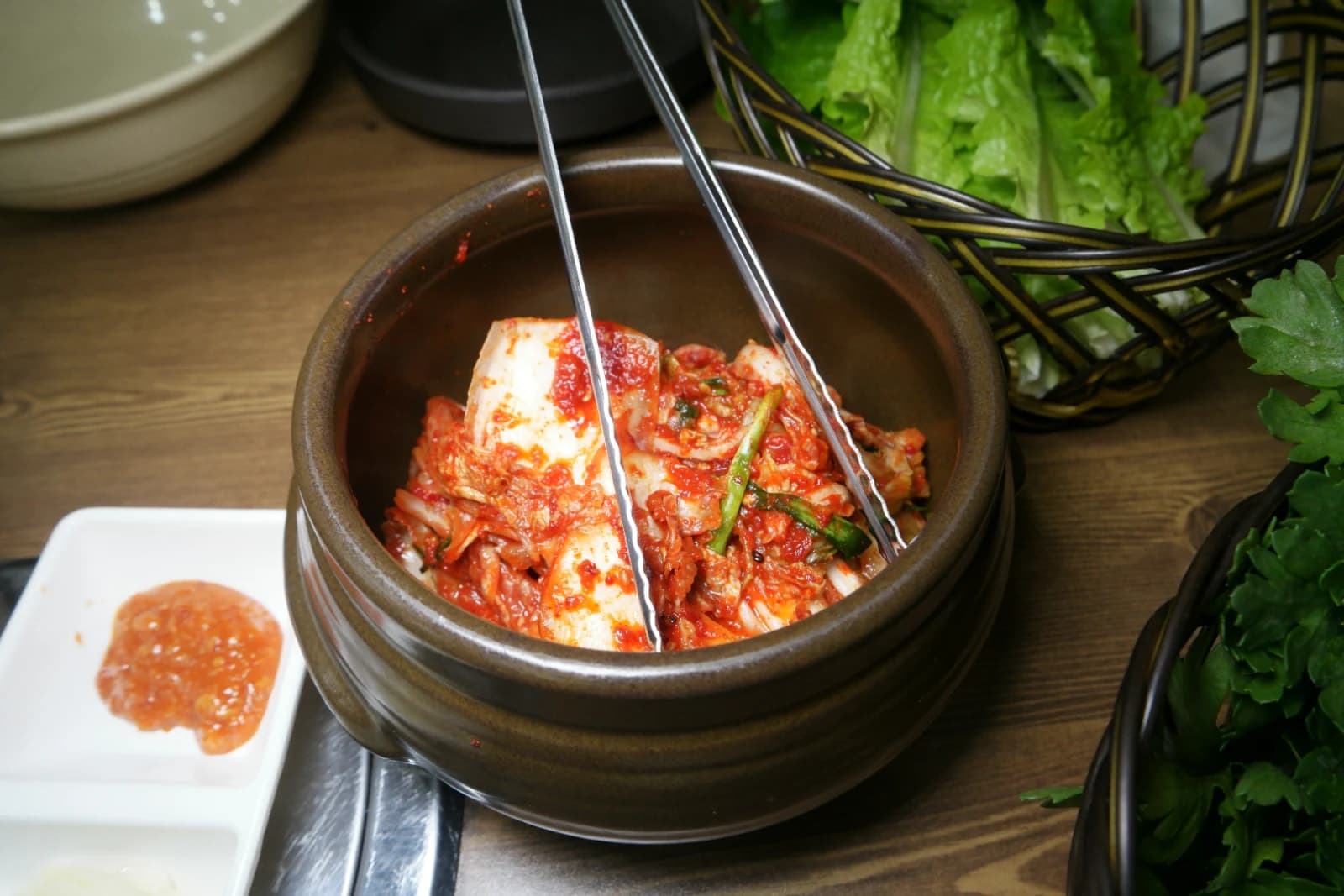
Here's the bossam kimchi being lifted out of the jar — a much truer picture of the colour than the plated version earlier. The cabbage is coated in a rich red chilli seasoning with juice pooled at the bottom. Kimchi served with bossam isn't the same as everyday household kimchi — the fermentation is dialled in specifically to pair with fatty pork, so it lands just right.
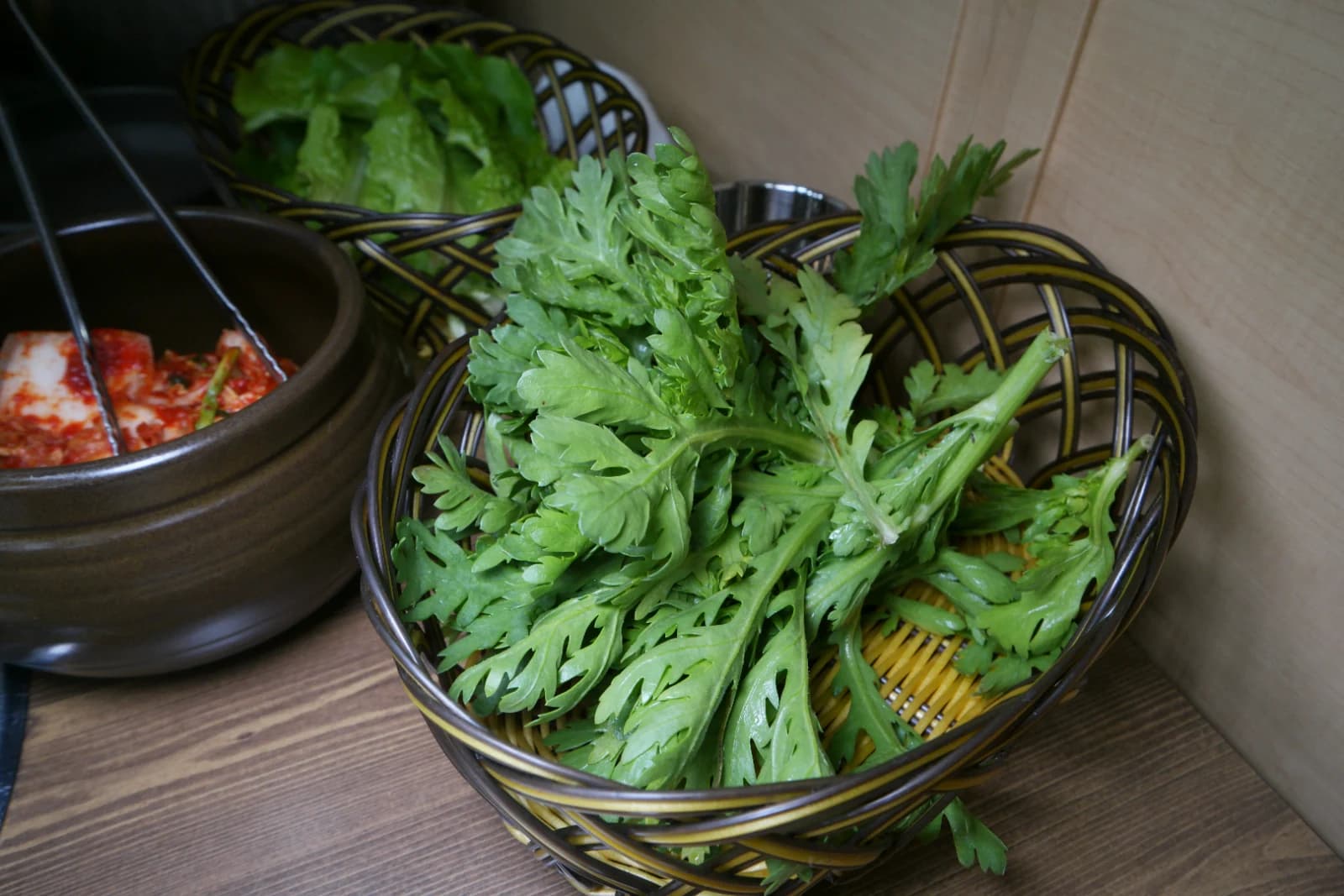
A basket of ssukgat showed up separately too. Same crown daisy I'd piled on top of the eolkeuni earlier — this place clearly uses it as a wrap green for bossam as well. Daejeon really doesn't let you escape the ssukgat.
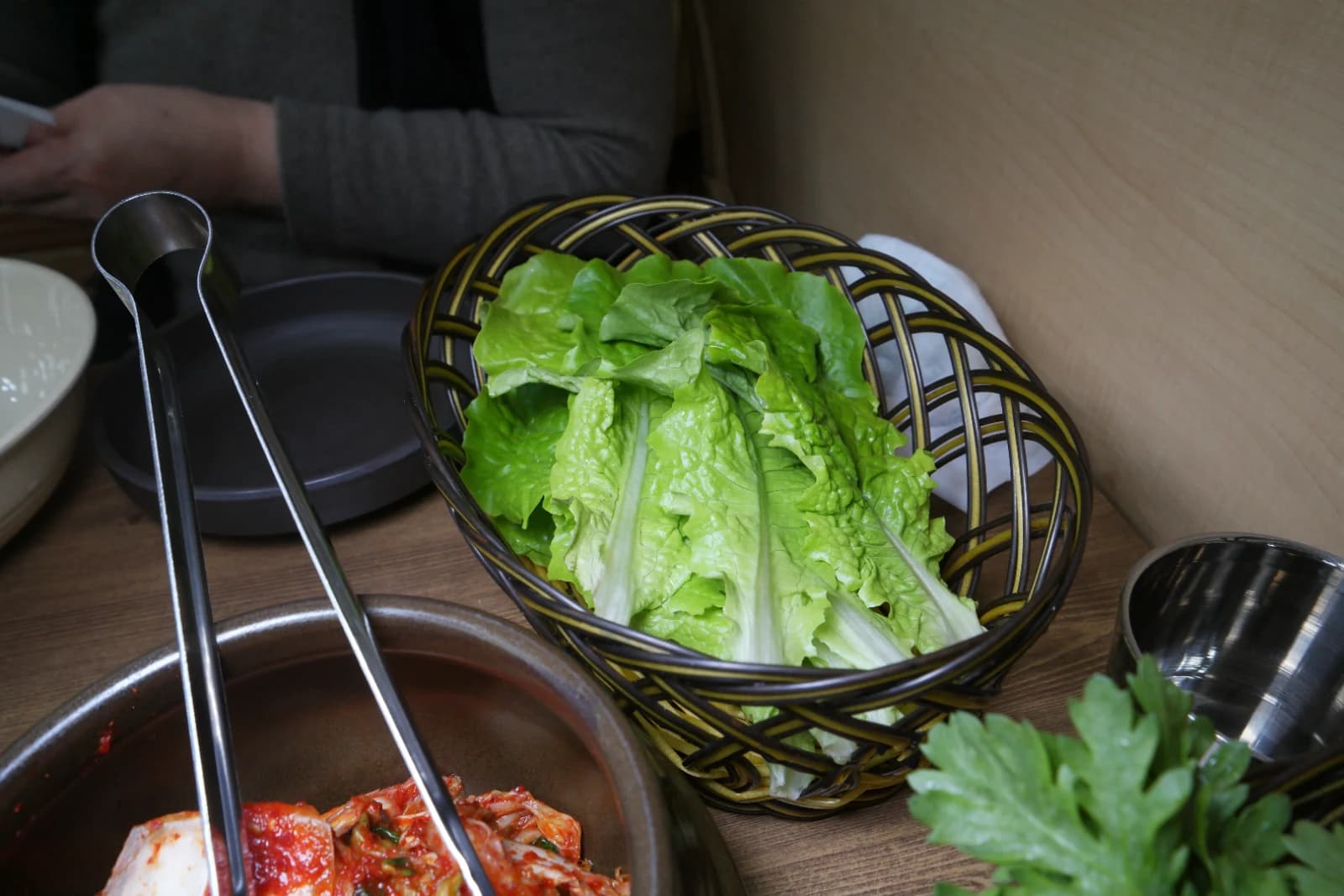
Lettuce is the workhorse wrap green for bossam. A proper pile of fresh leaves in a basket, ready for loading up with pork and kimchi as shown above. Next to it sits the kimchi jar and the ssukgat basket — credit where it's due, the wrap-greens setup was generous. The pork portion itself, though, was a little on the mean side for two people.
Two bowls of kalguksu plus a bossam platter, and the total came in under £16 for the pair of us. The kalguksu was about £6 a bowl and the bossam brought the bill up from there. We were definitely full by the end. On the way out my mate said what I'd been thinking — the kalguksu was great, but the pork was a bit dry, wasn't it? Honestly I'd clocked that during the meal, but the kimchi had been doing enough heavy lifting that I'd let it slide. We agreed on the way home we'd hit up a proper bossam specialist next time. Needless to say, that's still an outstanding promise.
Kalguksu shops are everywhere in Korea. Search "kalguksu" (or 칼국수) in any Korean map app and you'll get a list of nearby places in seconds, most of them sitting around £5–6 a bowl, so it's a very low-commitment lunch. Most menus come down to picking between bajirak and eolkeuni, and the rule is simple: can't handle spice — go bajirak; fancy a bit of heat — go eolkeuni.
That shop's gone now, so there's no going back to it, but whenever I sit down with a bowl of kalguksu the evening does drift into my head. The pile of ssukgat on the red broth. My mate grumbling about the crown daisy before quietly loading up his own bowl. Nothing particularly dramatic happened that night. It was just one of those evenings.
