Hidden Village Walk — A Quiet Hanok Neighbourhood With Zero Tourists
Table of Contents
14 items
When you think of a traditional village walk in Korea, Jeonju and Seoul's Bukchon probably come to mind. But there's a quiet hanok neighbourhood where there are no tourists, no entry fee, and people actually live in the houses. Sejong Goun-dong Hanok Village. About 46 traditional Korean houses — called hanok — clustered together in a small residential pocket, roughly 1.5 hours by car from Seoul and just 30 minutes from Daejeon, a major city in central South Korea. If you're after a peaceful stroll through stone-walled lanes with tile roofs overhead, or you're on a long drive between Seoul and Busan and want a proper rest stop that isn't a highway servo, this is the spot.
I went here last autumn with my wife. It's close to where we live, but we only found out about the hanok village embarrassingly late. That's the thing about Sejong — even Koreans go "what's actually there?" when you mention it. It's a purpose-built government city, so the image is all apartment blocks and ministry buildings. On this day we stopped first at Hemel, a hanok-style café right next to the village, then wandered through the neighbourhood on the way out. I'll do a separate review of Hemel, so I'll keep it brief here — they serve tea, coffee, and desserts inside a traditional Korean building, and it's the perfect pairing if you're visiting the village.
A traditional lane hidden inside a brand-new city
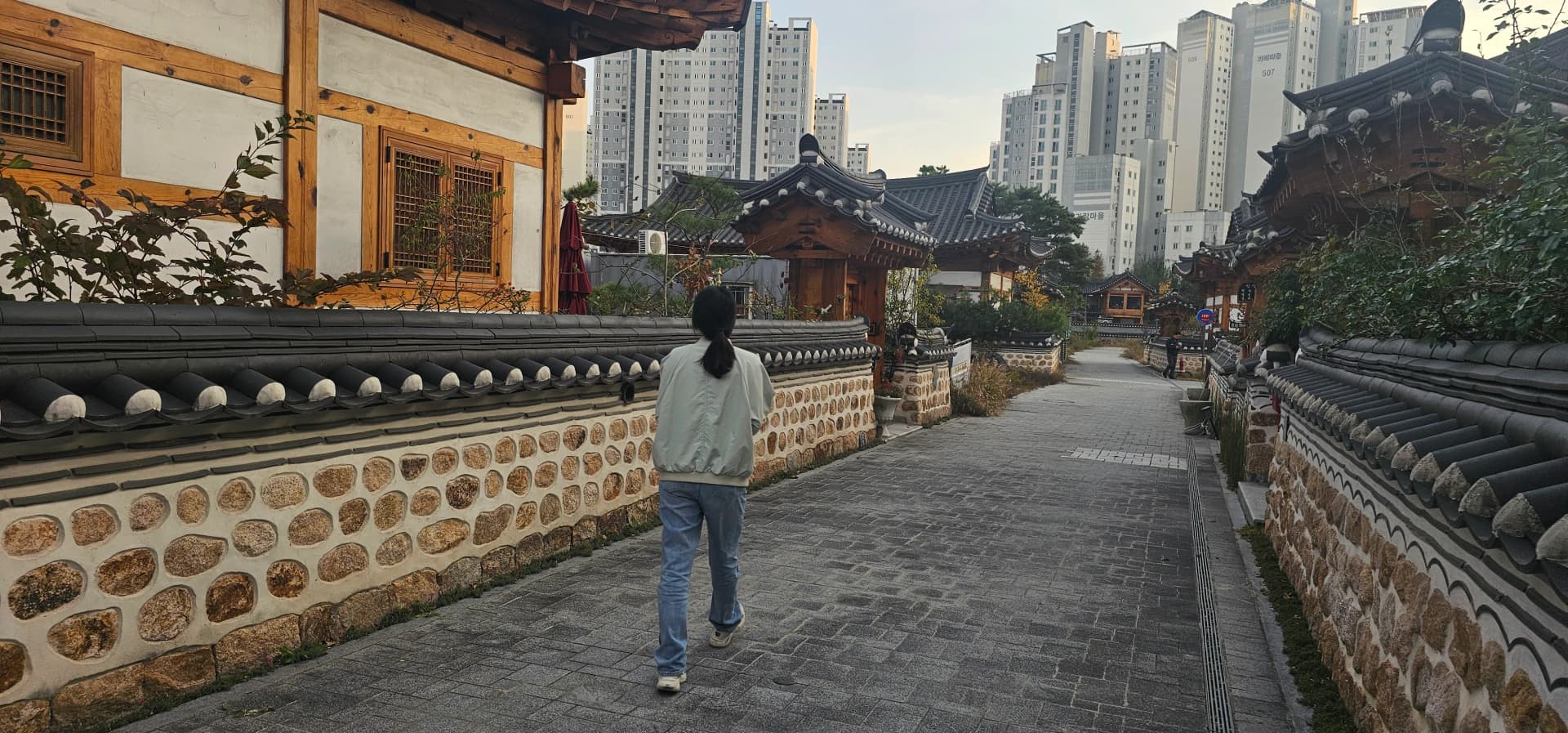
The moment you step into the inner lanes, low stone walls run along both sides and curved tile roofs fill your field of vision. This is Sejong's Goun-dong Hanok Village in a nutshell — a traditional Korean neighbourhood plonked right in the middle of a modern new city. But lift your eyes and there's a 20-storey apartment complex looming just behind. That's the first impression, and it's a weird one. Standing inside the lane, the air genuinely feels different. Then you glance back and the towers reappear. My wife turned to me and said, "Is this seriously a new city?" I was thinking exactly the same thing.
Walking between stone walls and dried hydrangeas
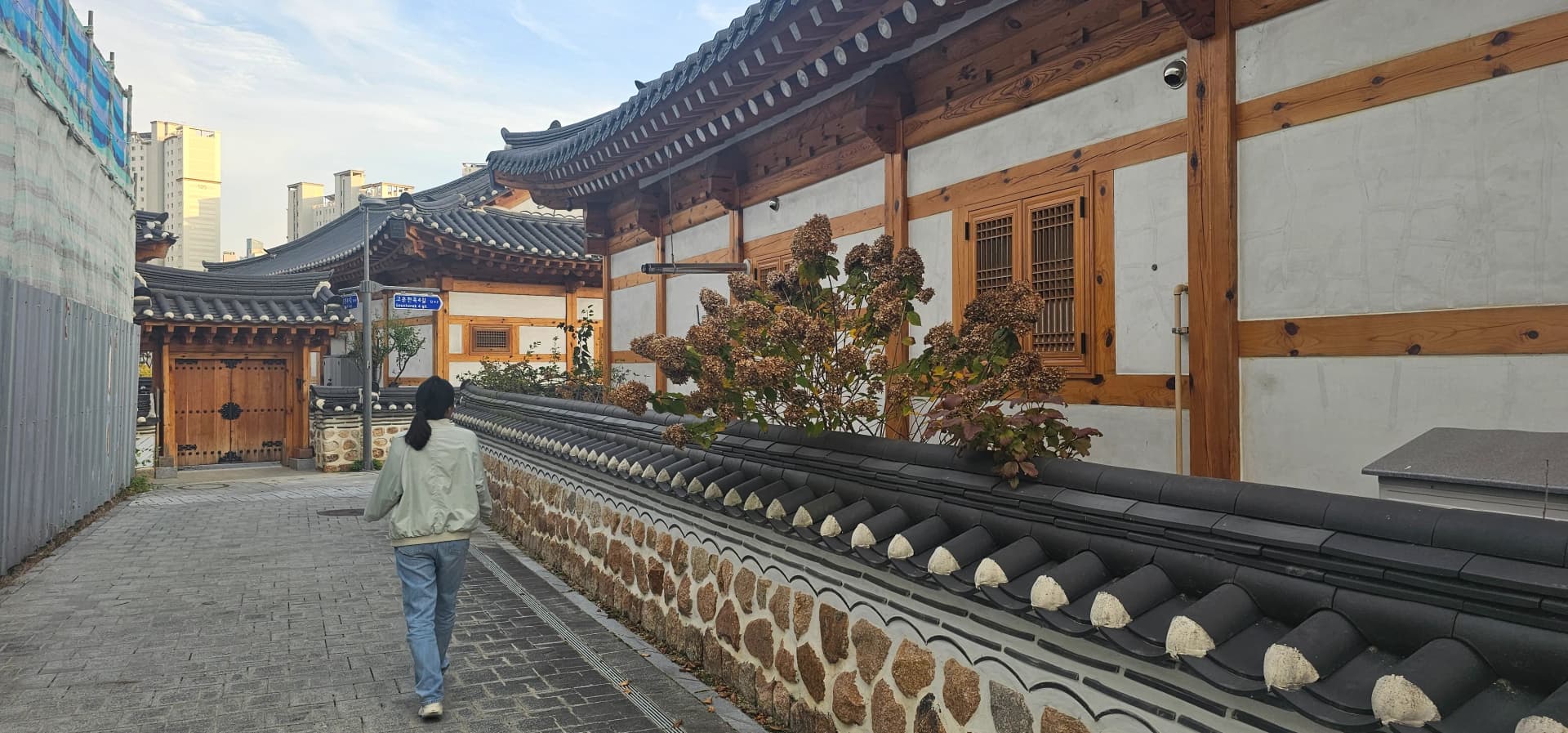
Go a bit deeper in and the apartment blocks gradually slip out of sight. Instead, dark-tiled stone walls stretch out on both sides, and dried hydrangeas poke their heads over the top. If it had been summer, they'd all be bursting blue, but we caught the tail end of autumn so they were brown and papery-crisp. Honestly though, it had its own kind of charm. Hanok walls and dried hydrangeas — pretty in a way nobody tries to curate. The lane was so quiet the only sound was our footsteps echoing off the stone paving.
Not a tourist attraction — a real neighbourhood where people live
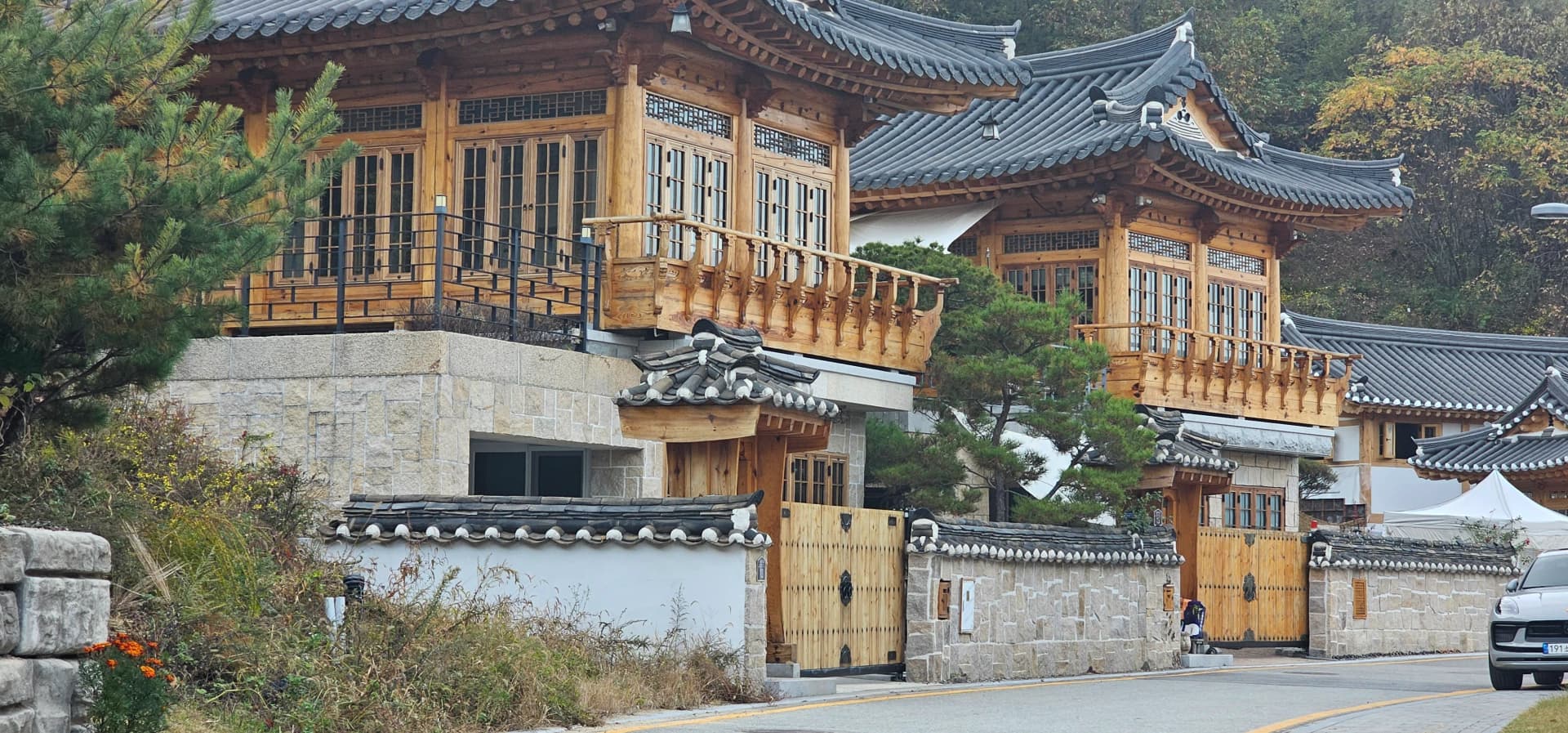
These are genuine homes. The two-storey hanok with its timber-railed balcony looks like it could be a boutique guesthouse or a heritage listing, but someone actually lives there. What makes this neighbourhood special isn't that old hanok were preserved — they were built new from the start, following traditional Korean architectural guidelines. Roof style, structure, wall materials — all built to a hanok review standard. That's why the whole village has this seamless, cohesive look with not a single building that jars.
If you've travelled around Korea, you'll know this country demolishes old buildings and throws up new apartments at a dizzying pace. Outside of palaces and temples, it's genuinely hard to come across traditional architecture in everyday life. Think of it like finding a whole cul-de-sac of heritage cottages in the middle of a brand-new Canberra suburb — that's essentially what this is. Goun-dong Hanok Village is a rare example of traditional Korean aesthetics being carried into a modern residential setting.
Pine trees and tile roofs on stone retaining walls
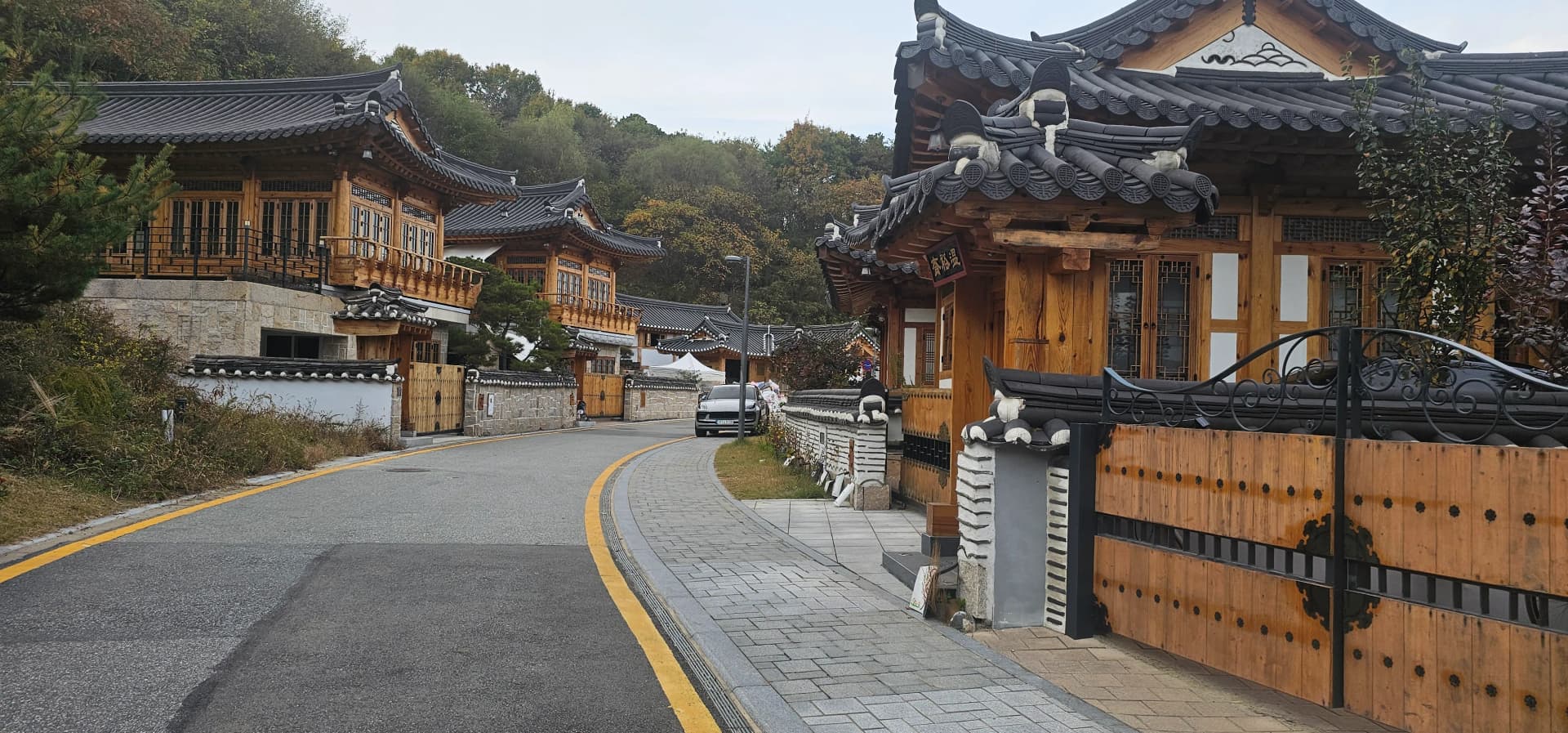
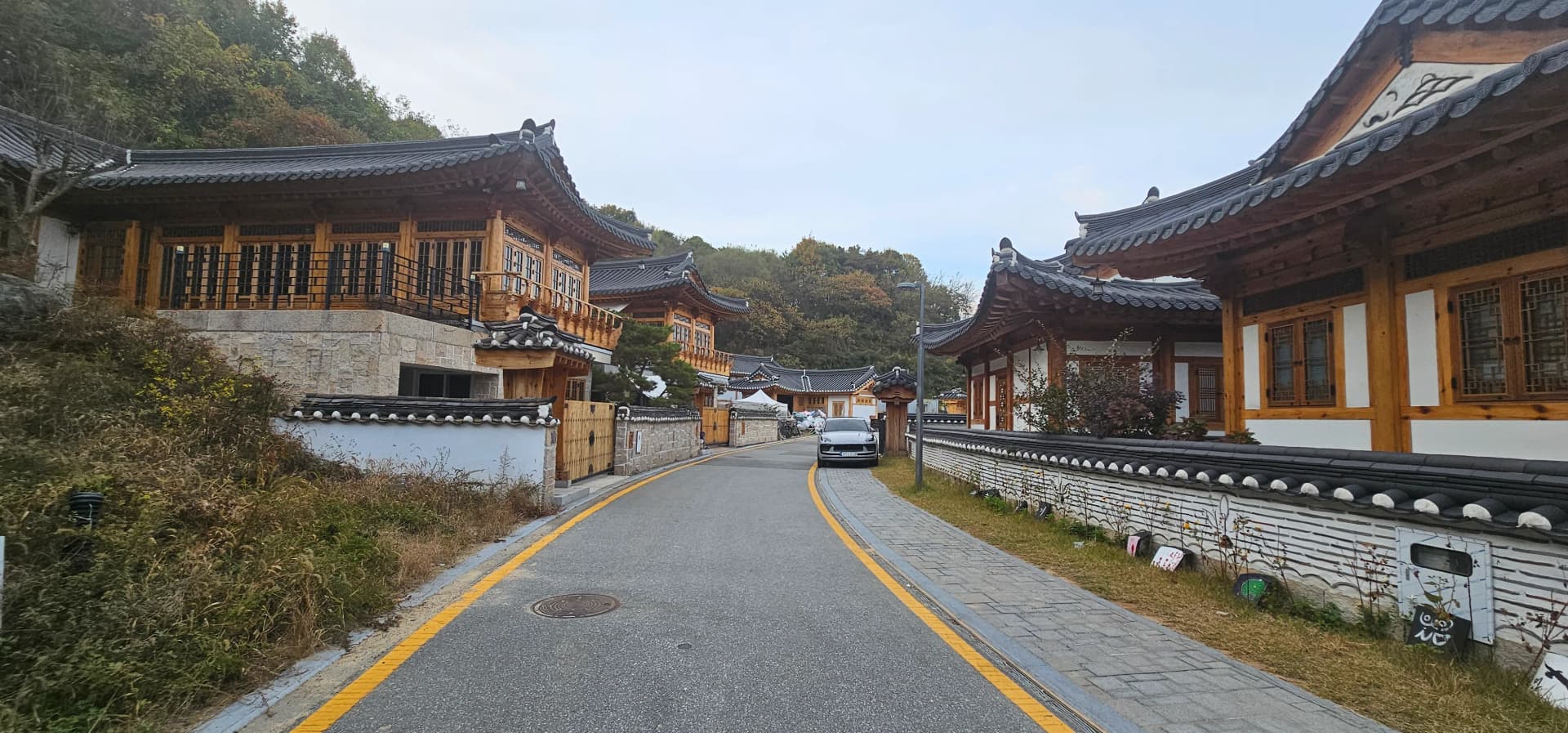
The tile-roof lines visible through the pine trees, the timber structures sitting on stone retaining walls — the attention to detail is serious and there's nothing half-hearted about it. If you've only ever seen traditional Korean houses in photos, this is probably the cleanest real-life version you'll find. These aren't hanok dressed up for tourists. They're hanok that someone walks into every single day after work.
The outer road — a hillside neighbourhood that looks like a hanok resort
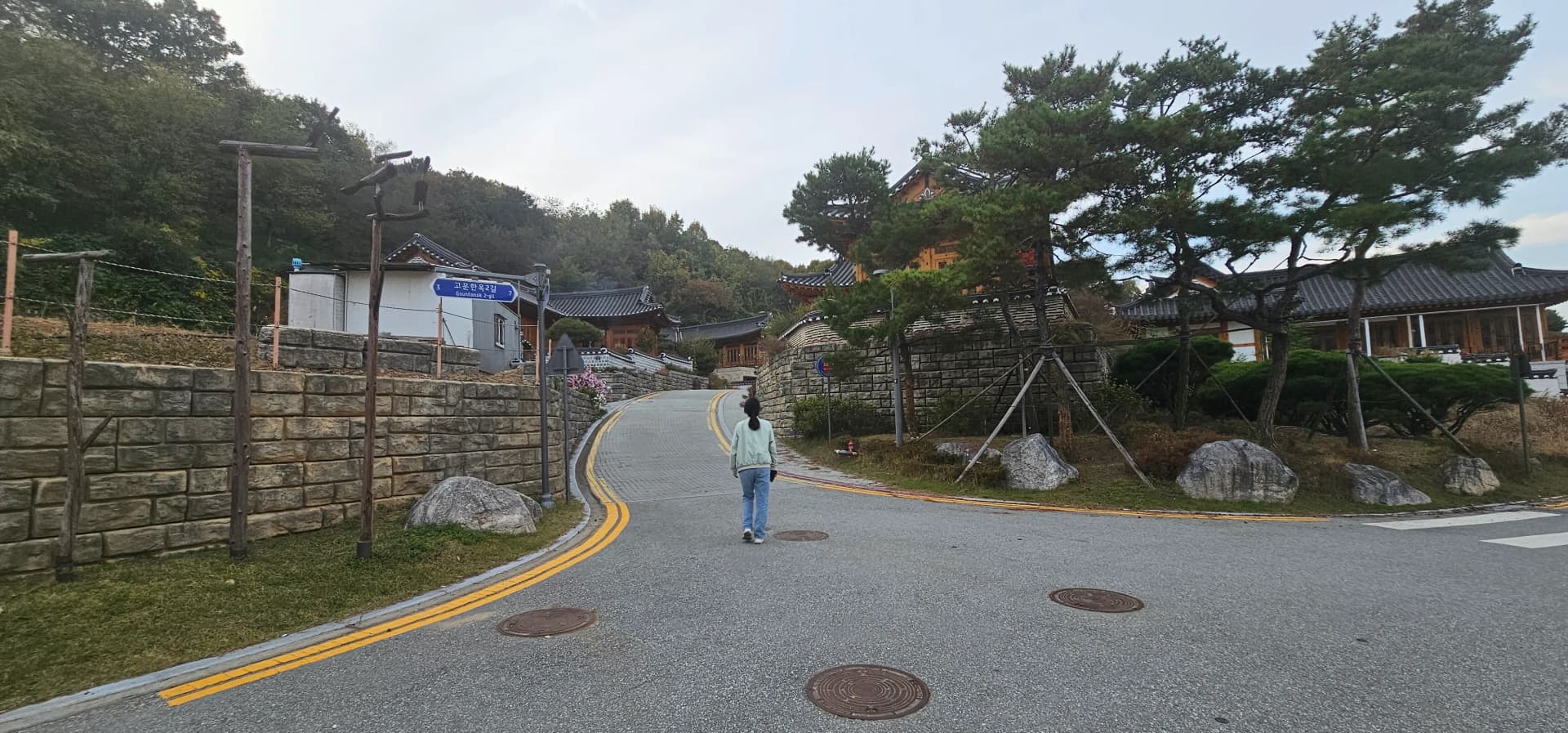
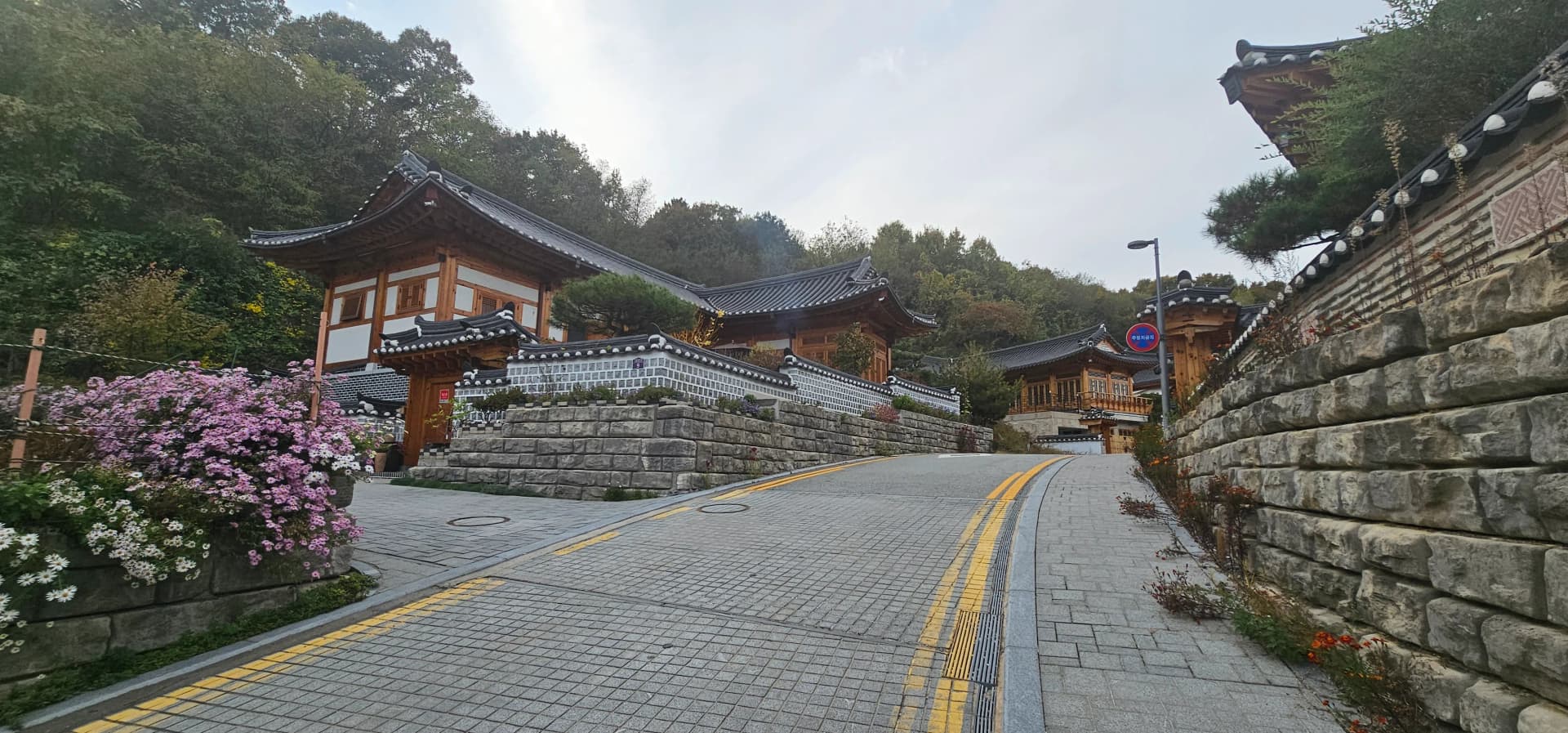
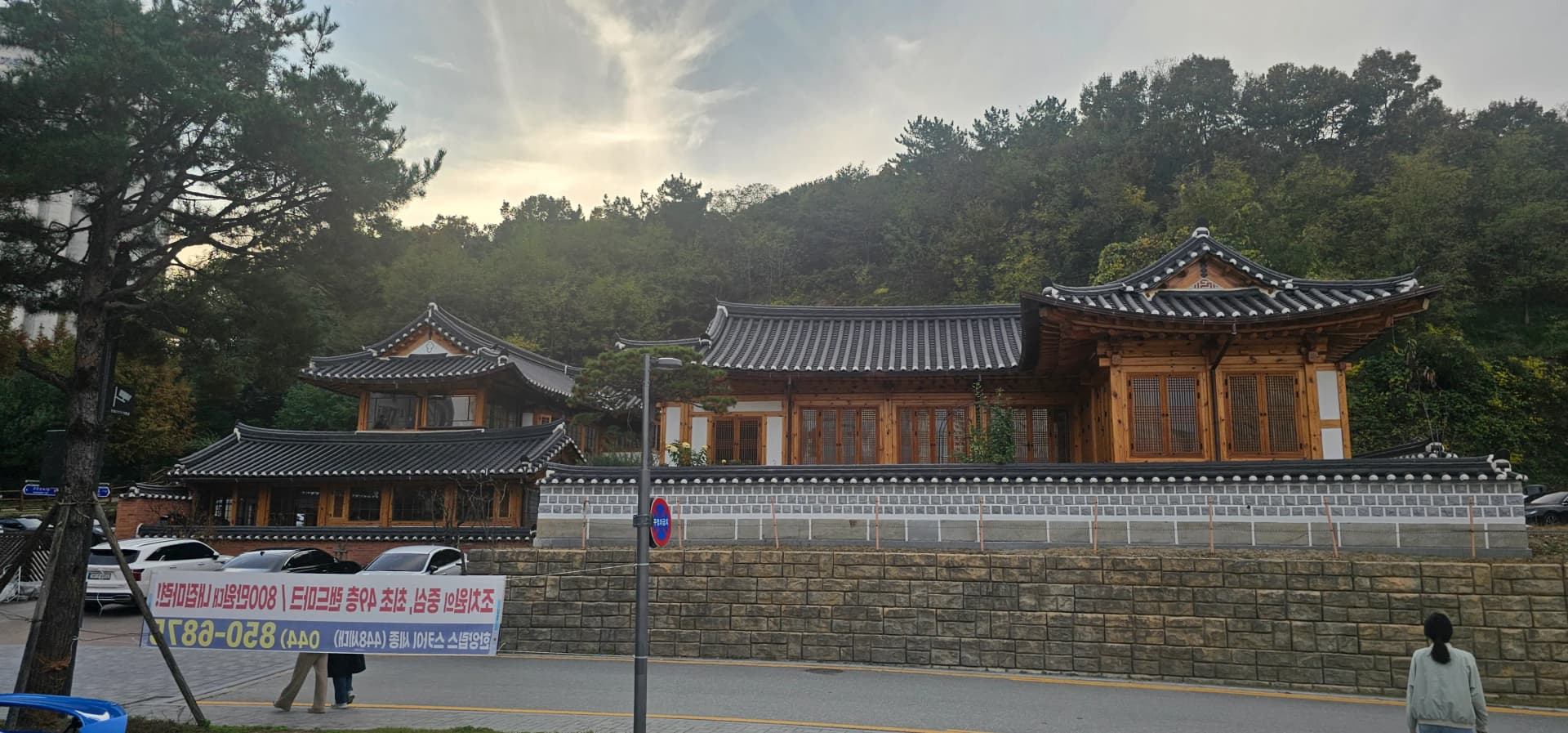
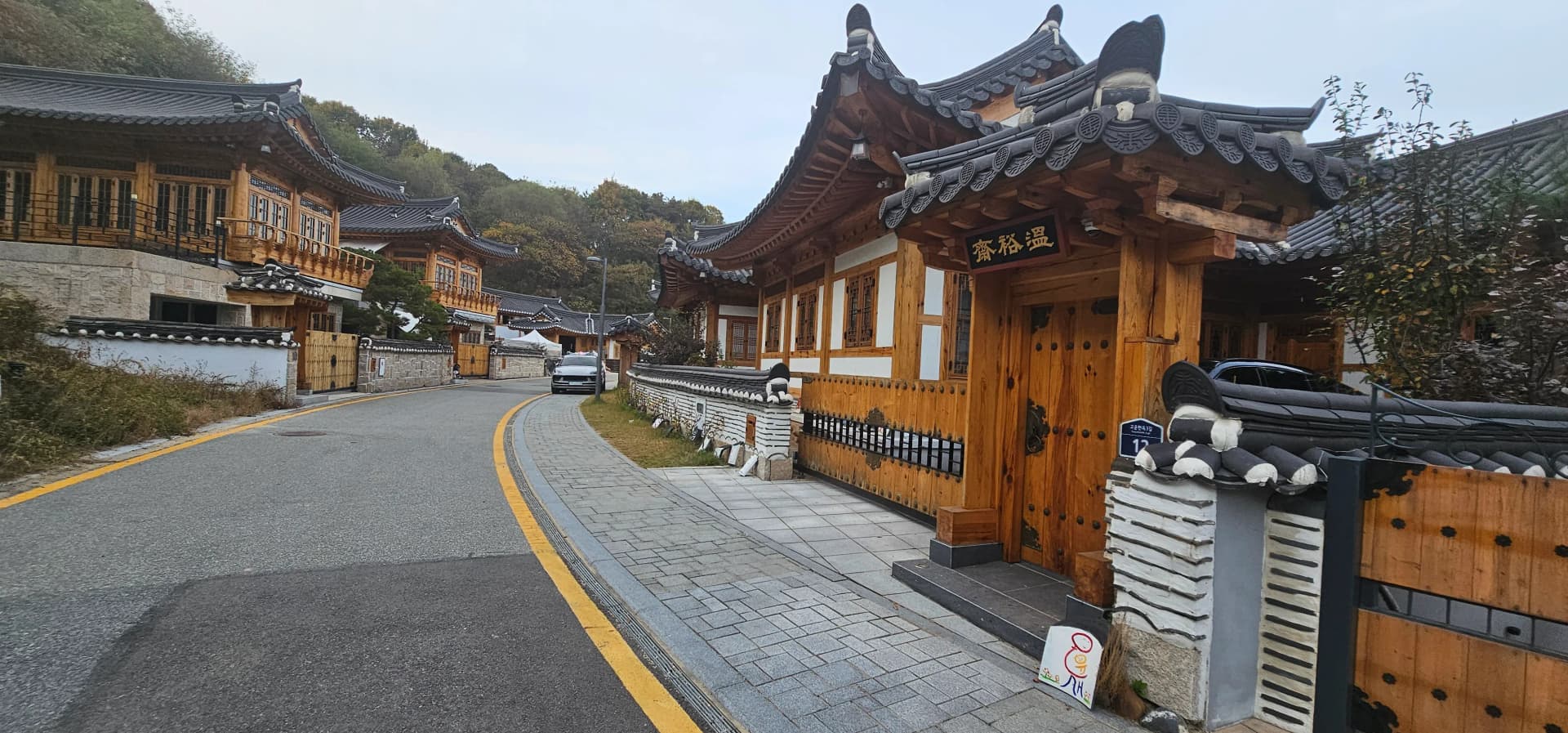
Head out to the outer road and the vibe shifts. The inner lanes were narrow and enclosed between stone walls, but here the road is wide and the hanok spread up the hillside on both sides. Each front gate has a house name written in Chinese characters, and two-storey hanok sit up on stone terraces — honestly, my first thought was "this looks more like a hanok resort than an actual neighbourhood." But see that car parked out front? That belongs to someone who lives here, full stop.
Behind the houses, the hillside was just starting to turn with early autumn colour, and where it overlapped with the tile-roof line, it made for a genuinely lovely scene. We were the only two on the road. It was quiet to the point of being almost awkward — like we'd snuck into someone's private estate. But the village is set up to welcome walkers, so no need to stress about it.
The top of the hill — the best spot for photos
Follow the road uphill and you reach the far edge of the village. From here the hillside bush is right up close, so you get pine trees and tile roofs overlapping — a different scene from the city side. Instead of "hanok between apartment towers," it's hanok nestled into a mountain slope. It actually felt more like a countryside heritage village up here.
Here's what I didn't expect: there was a whole cluster of azaleas blooming along the stone terrace, tucked away on this hill that nobody visits. Hanok walls, pink flowers, green hills behind — for photos, this was easily the best section of the village. But almost nobody makes it up here. Most people pop into the café near the entrance and turn back, so this upper stretch was completely ours.
The silhouette of tile roofs in the late afternoon light
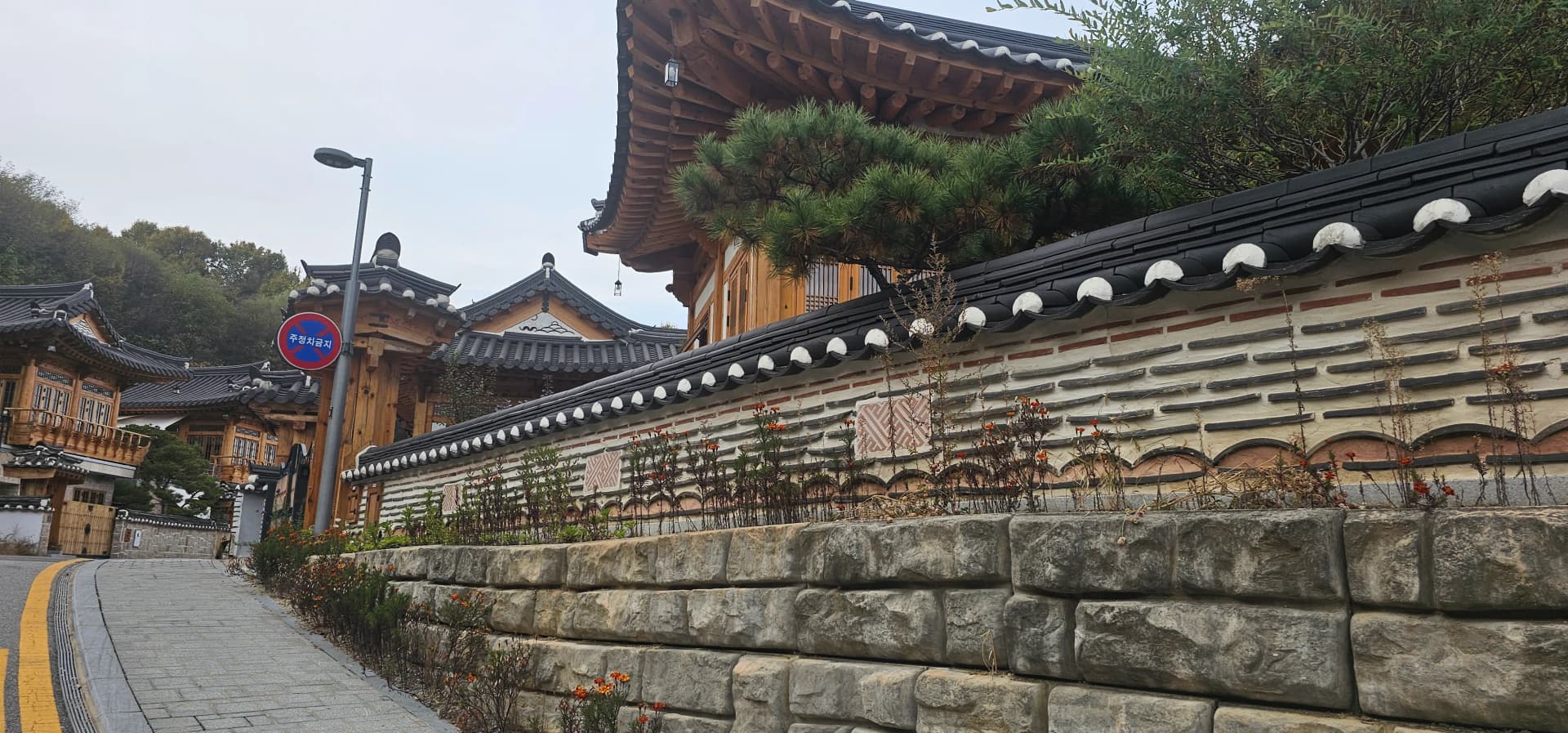
From the bottom of the road looking up, two or three hanok sit side by side on the stone terrace, and with the sun dropping behind the hill, only the roof outlines were caught in backlight. The timing was spot on. If you visit late in the arvo, you can catch this kind of scene. Honestly, it'd be worth timing your visit specifically for this — the golden hour silhouettes are that good.
Wall details — things you only notice when you slow down
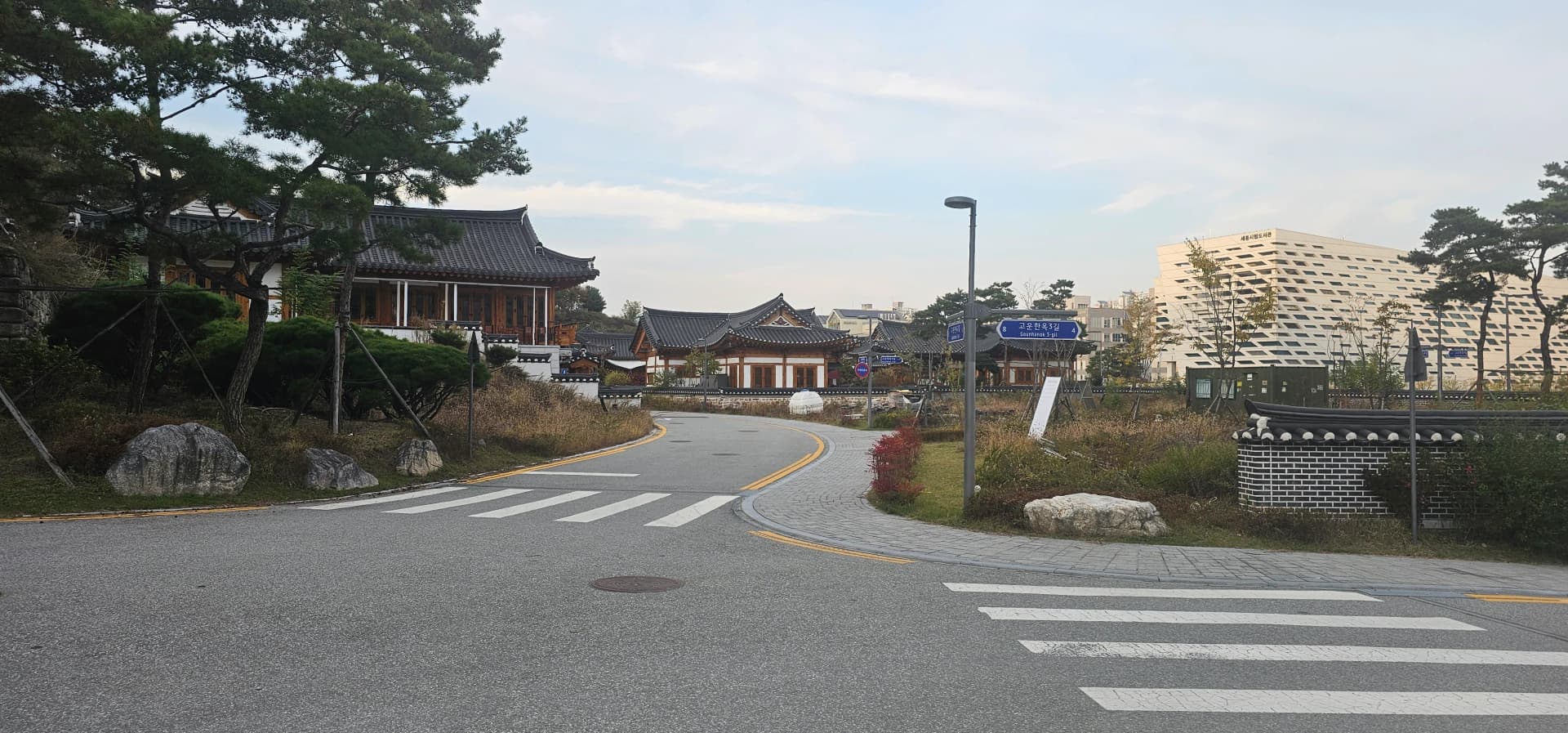
The wall details caught my eye so I went in for a closer look. It's a traditional patterned wall — tile fragments and bricks mixed together in a decorative layout, with a pine tree poking up from the terrace above and small flowers planted at the base. This kind of thing doesn't show up well in photos. You really need to walk past it slowly, in person, to appreciate it.
Parking heads-up — park inside the village and you'll cop a fine
One thing to watch out for. Most roads inside the village are no-stopping zones. In Korea, if you park where these signs are posted, you get fined — and they mean it. If you've come in a rental car, don't leave it on the village streets. Use the Hemel café car park or the public parking area in the centre of the village instead. The lanes look picturesque and it's tempting to just pull over, but you might find a fine waiting for you when you return the rental. I parked at Hemel's car park and there were heaps of spaces — easy as.
Hanok and high-rises in a single frame
Step back from the village entrance and look around: to the left, tile roofs peek through the pine trees. To the far right, modern buildings sit on the horizon. That single view basically sums up Sejong as a city. Hanok and a new city in the same frame — that's the identity of this neighbourhood. There's something oddly compelling about crossing one pedestrian crossing and feeling like you've jumped between centuries.
Is it worth visiting — honest take
Honestly, this village alone isn't worth making a dedicated trip to Sejong for. It's small — you can walk the whole thing in 20 minutes. But if you're passing through Sejong, that changes the equation entirely. Anyone driving from Seoul towards Busan, Gwangju, or Daejeon passes through or near Sejong. Duck off the highway, and it's 10–15 minutes to the village. Instead of another highway rest stop, spend 30 minutes to an hour here. Walk the hanok lanes, grab a cuppa at the café next door, then get back on the road.
If you live near Sejong like I do, it's a heaps good spot for a casual stroll. If you're a traveller passing through, a quick loop of the hanok lanes is more than enough. It's not a place that's been done up to impress visitors — it's a real neighbourhood you walk through quietly, and that's exactly what makes Goun-dong Hanok Village worth a stop.
How to get to Sejong Goun-dong Hanok Village
📍 Address
Goun Hanok-gil area, Goun-dong, Sejong Special Autonomous City, South Korea
Goun Hanok-gil, Goun-dong, Sejong Special Autonomous City, South Korea
🔍 Navigation search terms
"Sejong Hanok Village" or "Goun-dong Hanok Village" or "Hemel Cafe Sejong"
🅿️ Parking
Hemel Tea House car park recommended (free with café purchase). There's also a free public car park in the village centre.
Park at Hemel Tea House (free with cafe purchase). Free public parking also available at village center. Street parking inside the village is prohibited — fines apply.
🎟️ Entry fee
Free
🚗 Travel time from major cities
Seoul → approx. 1.5–2 hours (via highway)
Daejeon → approx. 30 minutes
Sejong city centre → approx. 10 minutes
🚶 Walking time
Full village loop on foot: approx. 20 minutes. Including the café: allow 1–1.5 hours.
📸 Best time to visit
Afternoon between 2–5 pm is ideal for a stroll. Backlit roof silhouettes are brilliant around sunset. Weekdays are much quieter than weekends.
Worth checking out near the Hanok Village
If the hanok village alone feels a bit quick, there's plenty nearby to bundle it into a solid half-day out.
Hemel Tea House (Hanok Café)
Right next to the hanok village. A traditional Korean building serving tea, coffee, and desserts. The car park is spacious, making it the easiest place to leave your car when visiting the village. Separate review coming soon.
Address: 3 Goun Hanok 1-gil, Sejong | Hours: Weekdays 09:30–18:00 / Weekends 10:00–20:00
Hemel on Instagram →National Sejong Arboretum
Korea's first urban arboretum. The four-season greenhouse is genuinely impressive, and the outdoor gardens are expansive. A 10-minute drive from the hanok village.
Address: 136 Sumogwon-ro, Sejong | Entry: Adults A$5 / Teens A$4 / Children A$3 | Closed Mondays
Summer 09:00–18:00 / Winter 09:00–17:00
National Sejong Arboretum official website →Sejong Lake Park
One of Korea's largest artificial lake parks. Walking paths, bike trails, and a floating stage. Free entry, free parking. A 5-minute drive from the hanok village.
Address: 216 Dasom-ro, Sejong | Open 05:00–23:00 (year-round)
Suggested half-day itinerary
Sejong Hanok Village Half-Day Itinerary
Arrive at Hemel Tea House → park → enjoy a cuppa (approx. 40 min–1 hour)
Stroll through Goun-dong Hanok Village (approx. 20–30 min)
Drive to National Sejong Arboretum or Sejong Lake Park (5–10 min drive, approx. 1–2 hours)
Grab a meal in Sejong city, then head to your next destination
This post was originally published on https://hi-jsb.blog.