
Korean Table Setting Explained | 8 Free Banchan, Stone Pot Rice More
Table of Contents
37 items
One Meal That Explains How Korean Restaurants Work
I was exploring Gyeongju — an ancient capital city about 3.5 hours southeast of Seoul, packed with UNESCO heritage sites and royal tombs — when hunger hit. Sightseeing burns through energy faster than you'd expect, and in a city like this, what you eat is just as much part of the trip as what you see. The food here can feel just as historic as the ruins.
If you're planning a trip to Korea or you're already here, there's one thing I really want you to know. When you order at a Korean restaurant, you don't just get what you ordered. A better way to describe it is that the table gets "set" for you. Side dishes come out, soup comes out, rice comes out, and all of it fills the table at once. If it's your first time, you might genuinely wonder if they brought someone else's food by mistake. Nope — it's all included. No extra charge.
Today I had lunch at a place that shows exactly how a Korean table setting works. It's a stone pot rice restaurant near Hwangnidan-gil, Gyeongju's trendy walking street. Let me walk you through the photos and show you how a Korean restaurant actually operates.
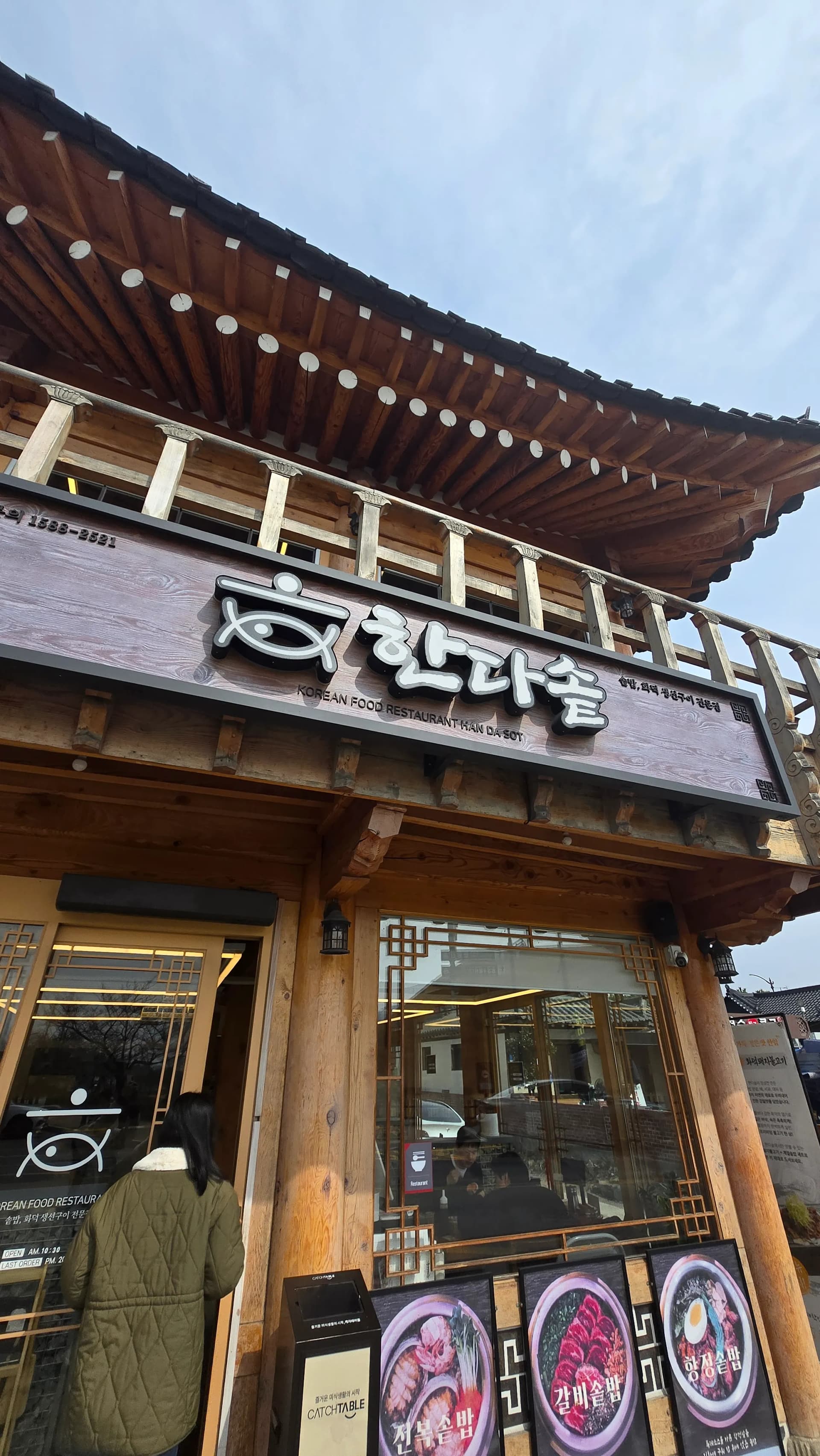
Why I Picked This Restaurant in Gyeongju
I'll be honest — I didn't choose Handasot because of some top-10 food ranking. It was all about location. It's within a 5-minute walk from Hwangnidan-gil, Cheomseongdae Observatory, and Daereungwon Royal Tombs. Gyeongju's tourist spots are pretty spread out, and if you're not careful, you can end up taking a long bus ride or hailing a cab just to grab lunch. I was traveling solo, so my walking route basically dictated my stamina. Taste matters, sure, but I didn't want to burn extra energy just because of a meal. So I looked for something right next to the sights first, and Handasot checked every box.
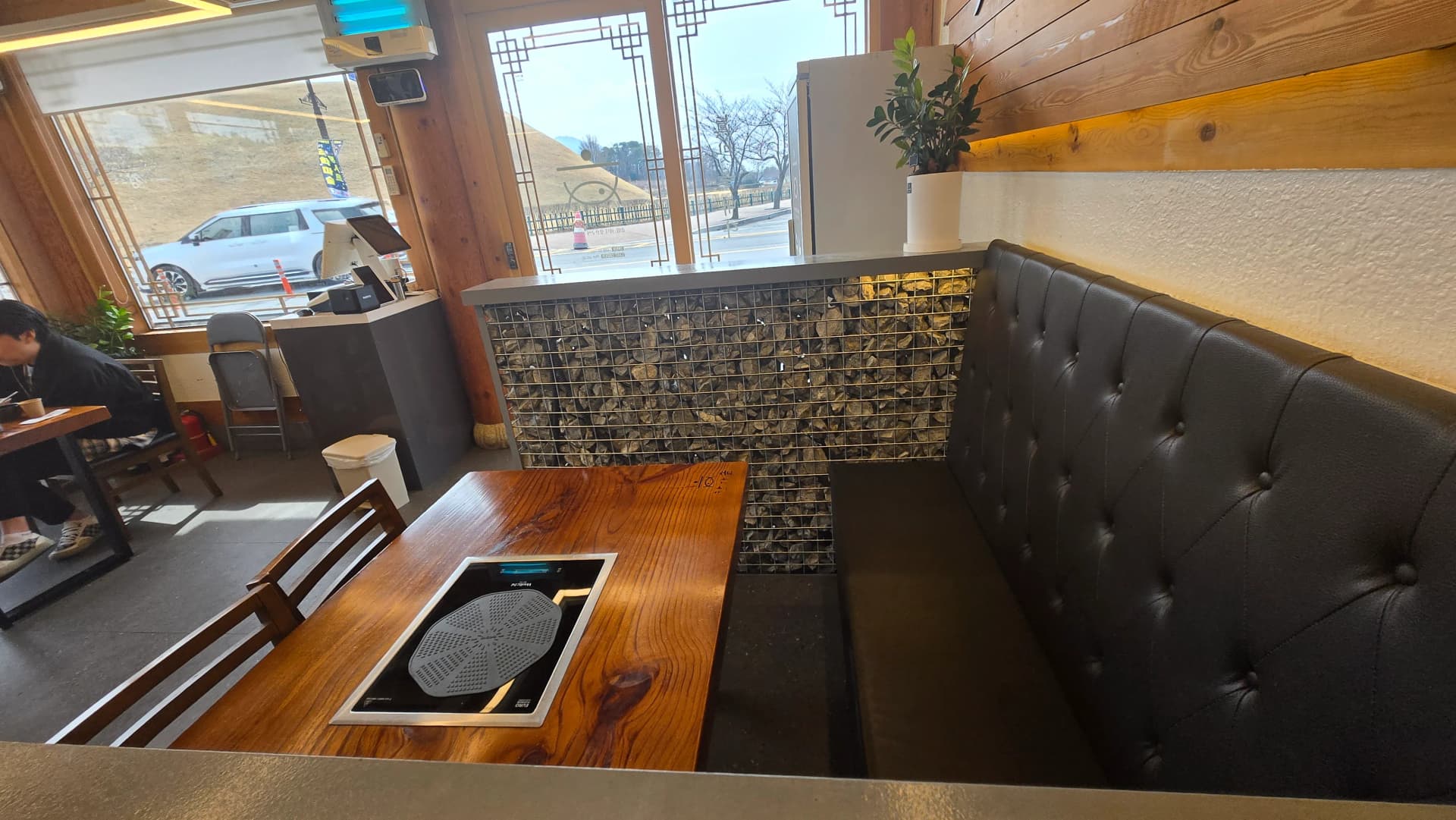
What You See When You Sit Down
There's an induction burner built right into the center of each table. That's where the stone pot goes so your rice stays hot the whole time. The seats are spacious, and through the window you can literally see the ancient royal burial mounds of Daereungwon. The interior has a traditional Korean house vibe with stone-wall partitions separating the tables, so you're not elbow-to-elbow with strangers. That actually mattered more than I expected — the place was packed since it's right next to tourist spots.
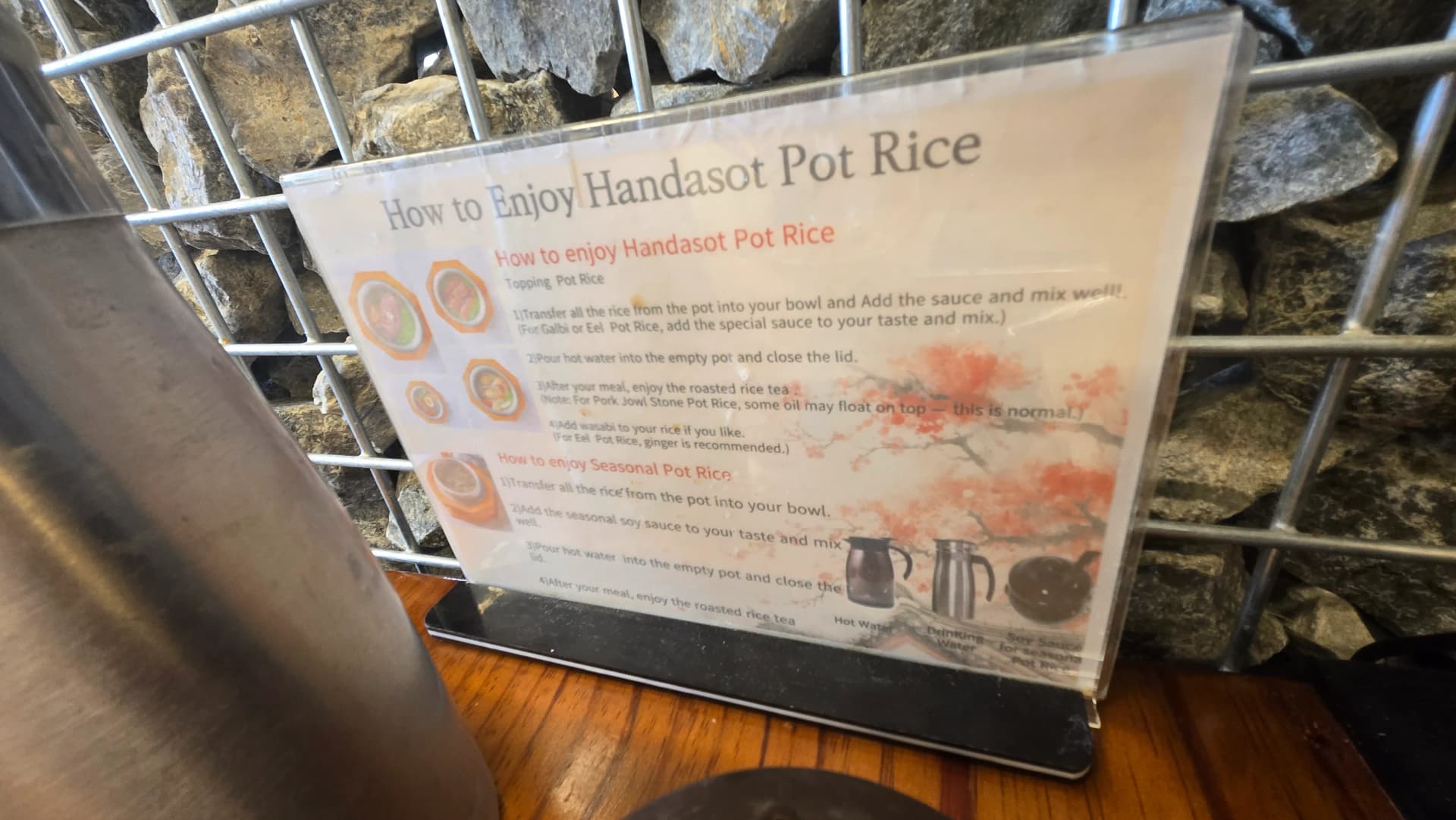
Every table has an English instruction card. It walks you through how to eat stone pot rice step by step — scoop the rice into your bowl, add sauce, then pour water into the empty pot to make scorched rice tea. Even if you don't speak a word of Korean, you can follow along without any trouble.
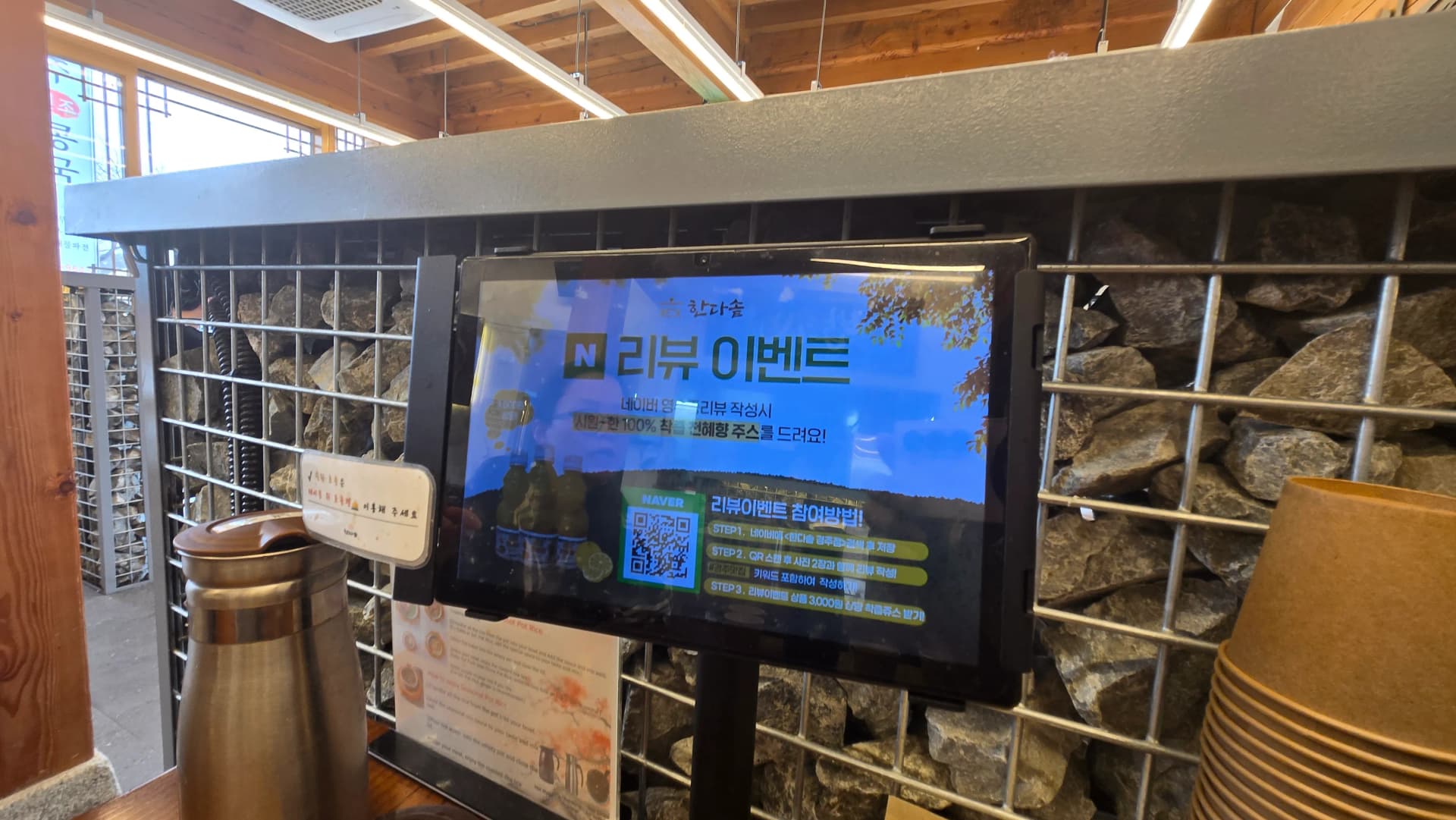
Ordering on the Table Kiosk
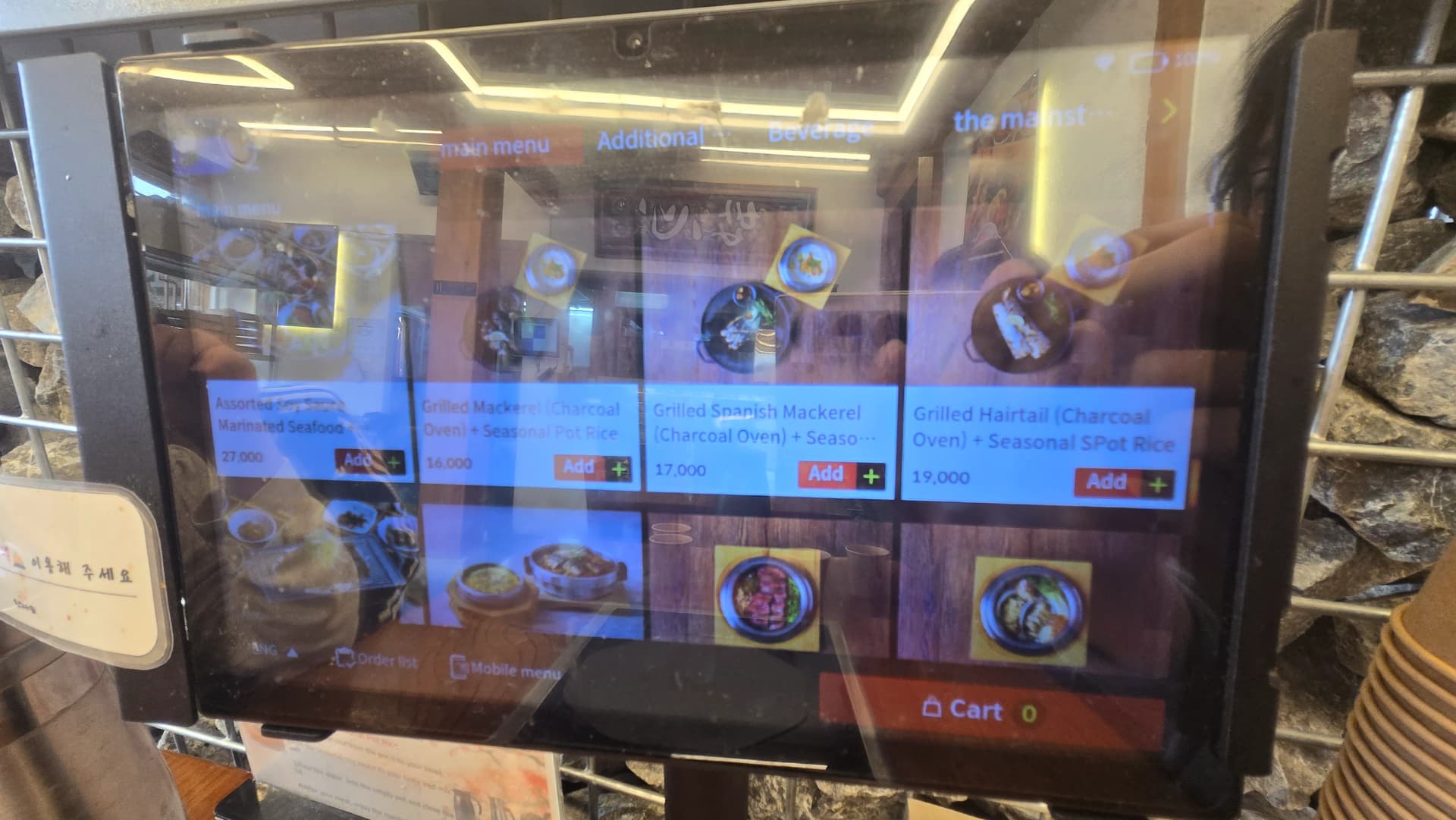
A lot of Korean restaurants have switched to table-side kiosks these days. You don't need to flag down a server — just order right from your seat. This place had one too. English was available by default, and every menu item had a photo, so even with zero Korean you could get through the ordering process just fine. That said, the translations weren't perfect. Some of the dish names came across a bit awkward in English, but with photos right there, it wasn't really an issue.
The Banchan Spread Arrived
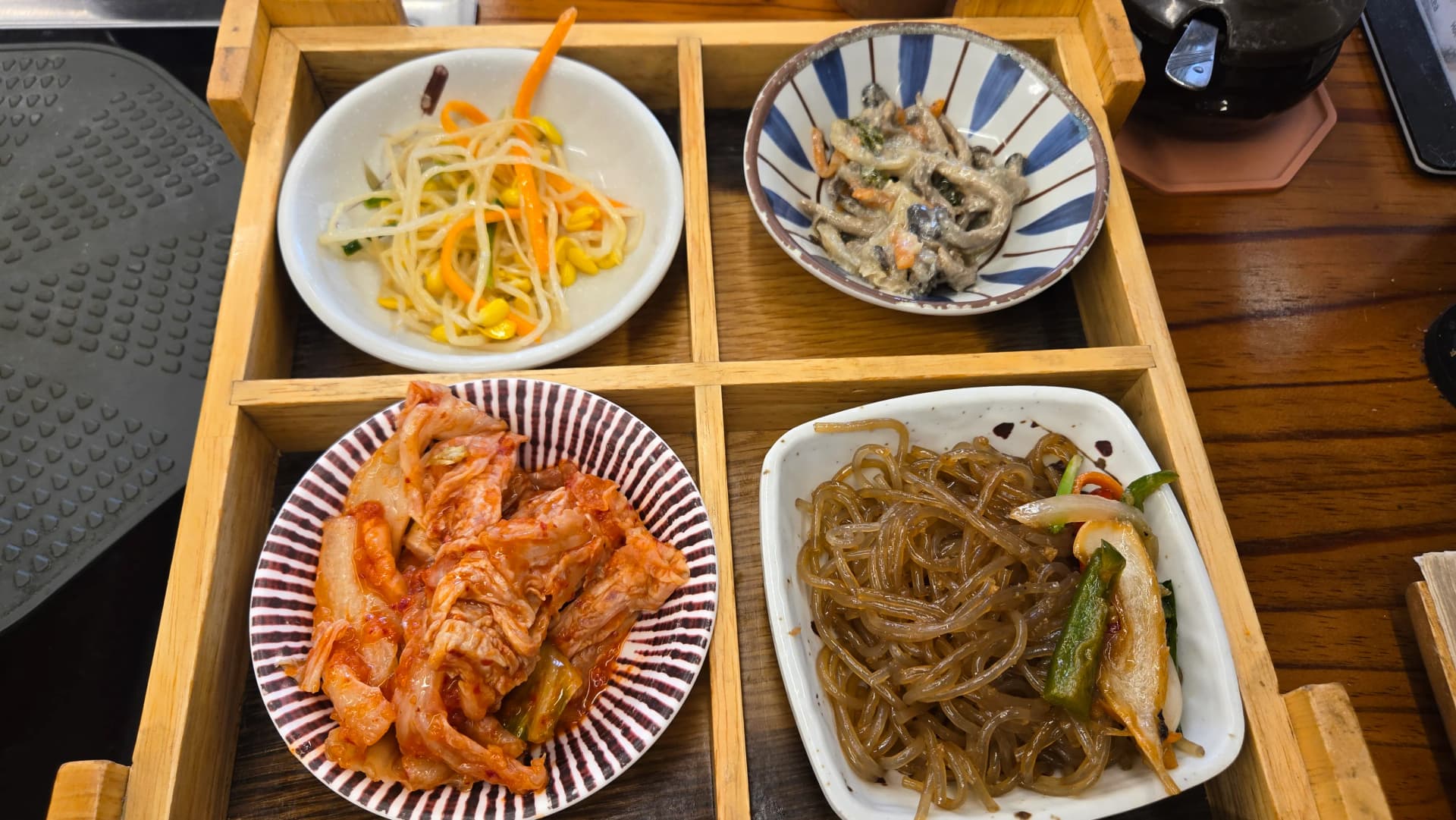
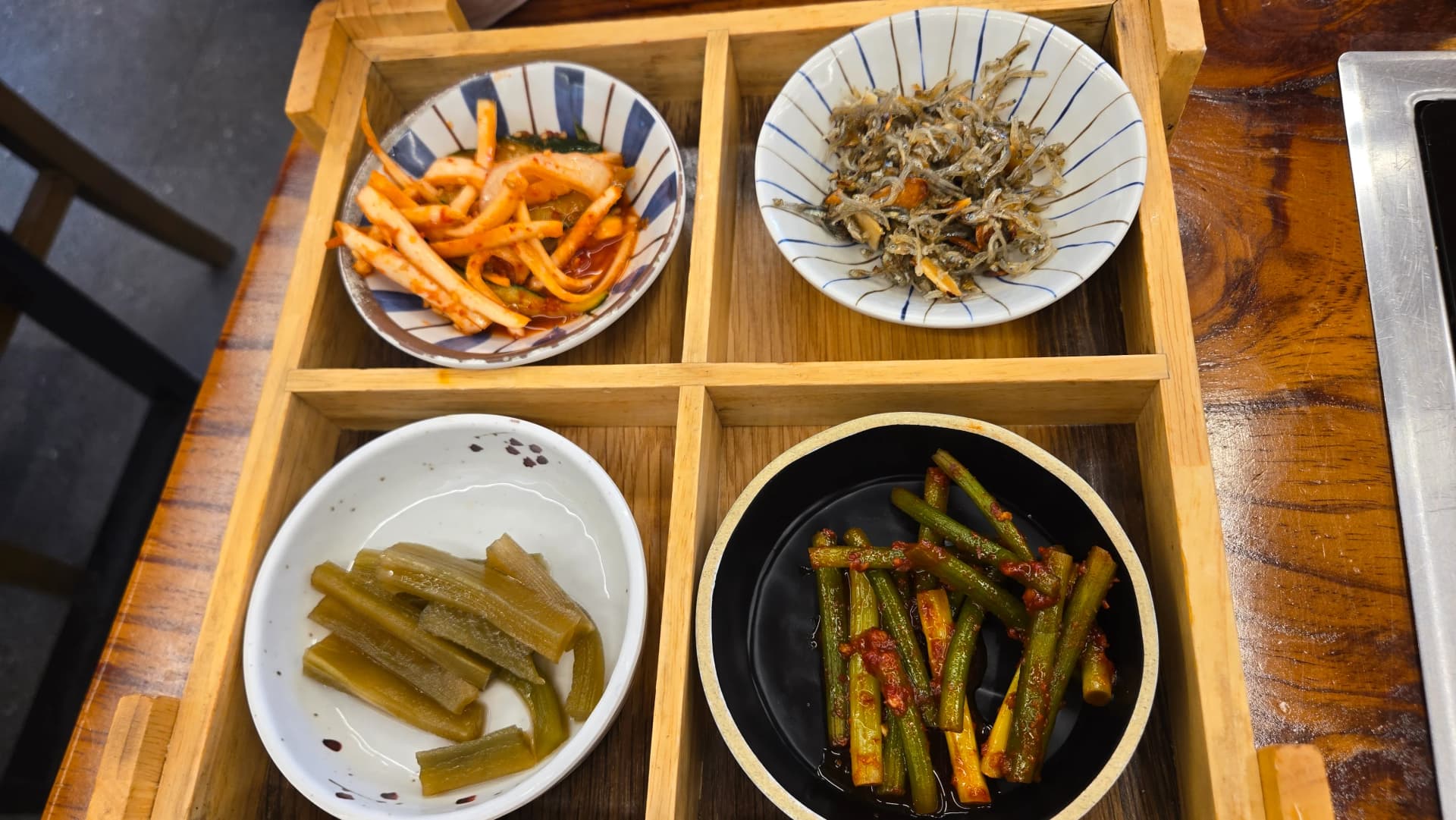
The side dishes came on wooden trays with divided compartments — 4 dishes per tray, 2 trays total. That's 8 banchan in all.
At most Korean restaurants, the banchan come out in individual little dishes scattered across the table. But here, they were arranged in trays like a set and placed down all at once. Seems like a small difference, but it actually felt different when you're on the receiving end. Everything lined up neatly in the tray instead of bowls everywhere — it almost felt like getting a course meal.
Korean Food Culture
How Korean Side Dishes (Banchan) Work
Why ordering one dish fills your entire table
So What Exactly Is Banchan?
When you order a main dish at a Korean restaurant, it comes with rice, soup, and a bunch of small side dishes called banchan. Here's the important part — they're all free. You don't order them separately, and there's no extra charge. You ordered one thing, but suddenly the whole table is covered. If it's your first time, it's honestly a bit shocking.
Banchan generally fall into a few categories: seasoned vegetables (namul), kimchi, stir-fried dishes, and pickled items. You'll see everything from mild blanched spinach to fermented napa cabbage kimchi, sweet-salty stir-fried anchovies, and tangy pickled vegetables. Every restaurant has a different lineup, and even the same restaurant might swap things out depending on the season. So the spread you get can be a little different every time.
How Many Dishes Do You Usually Get?
A typical Korean restaurant serves 3 to 5 banchan as standard. At a hanjeongsik place — a traditional Korean full-course restaurant — you'll get 8 or more, and the upscale ones can go well past 10. Even cheap cafeteria-style joints usually put out 5 or 6. There's this general understanding that more banchan means the restaurant puts in more effort, so places tend to take their side dish lineup pretty seriously.
Wait, Free Refills Too?
Yep. If you finish a banchan, you can ask for more, and that's free too. Just tell the server or hold up your empty dish — they'll bring it right over. If you're coming from a country where every extra side costs money, this part alone might blow your mind.
There is one piece of etiquette though. Only ask for as much as you'll actually eat. Leaving a bunch of food behind is considered pretty rude. Refills are free, but wasting food isn't really the vibe at a Korean table.
How Is This Different From Other Asian Restaurants?
In Japan, Taiwan, and China, side dishes are ordered separately and each one adds to your bill. In Korea, the moment you order a main dish, banchan automatically come along for the ride. It's a fundamentally different system.
🇰🇷 Korea
Order a main, get 3–10 banchan free. Refills are also free.
🇯🇵 🇹🇼 🇨🇳 Japan · Taiwan · China
Sides ordered separately, each one costs extra, no refill concept.
Why Do They Go This Far?
Korean dining culture puts a lot of emphasis on balancing different flavors within a single meal. Salty, spicy, mild, tangy — they all show up on the same table, and that's by design. It's not just about flavor either. Textures get the same treatment. Soft, crunchy, chewy — everything's mixed in so you never get bored eating.
Banchan also change with the seasons and the region. Since seasonal produce gets worked in, you might visit the same restaurant twice and find a different lineup. In a city like Gyeongju, local specialties sometimes make their way into the banchan too. Eating in Korea isn't just having a meal — it's experiencing the food of that place, in that season.
Honest Thoughts on the 8 Banchan
Out of the 8 side dishes, a few definitely stood out.
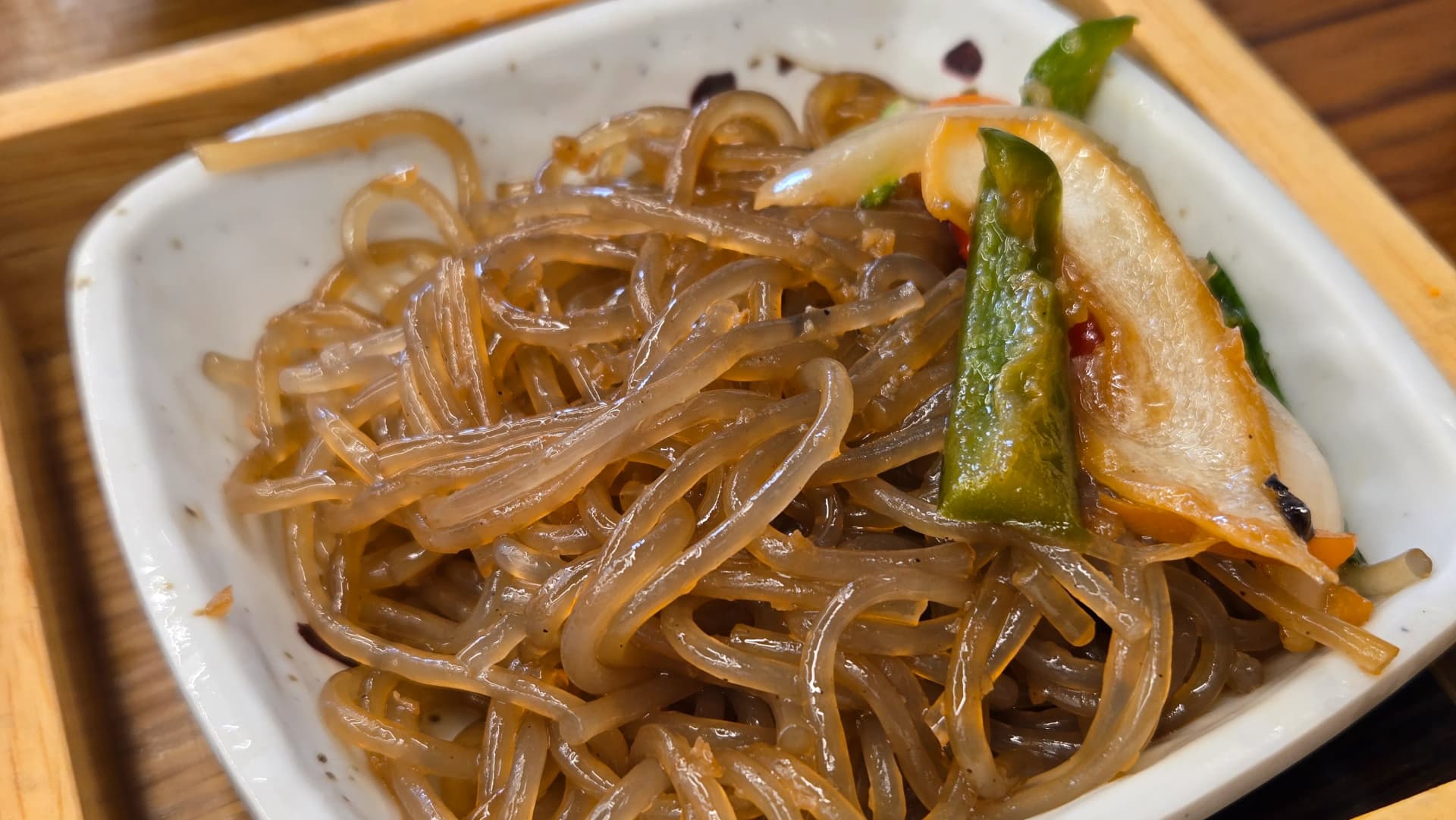
Japchae was my favorite. It's glass noodles made from sweet potato starch, stir-fried with spinach, carrots, and mushrooms in a soy sauce and sesame oil seasoning. The chewy texture paired really well with the stone pot rice. Apparently it's a staple at Korean celebration feasts, and I can see why.
The stir-fried anchovies were impressive too. Tiny dried anchovies cooked in a sweet-salty glaze, and here they tossed in peanuts as well. Pile some on top of your rice and the nuttiness just hits different. Heads up if you have a peanut allergy though.
Kimchi goes without saying — you'll find it at literally every Korean restaurant. Napa cabbage seasoned with chili flakes, garlic, and fermented fish sauce, then left to age. It's spicy, sour, and deeply savory all at once. The rest was a standard spread: seasoned bean sprouts, marinated mushrooms, stir-fried garlic scapes, and Korean pickles. Honestly, the pickles were on the salty side. But since the stone pot rice was so mild, the saltiness actually worked as a counterbalance. When you think about the whole table as one meal, it makes sense.
The 7 Banchan Side Dishes at Handasot
Included free with every stone pot rice order · most are refillable
Japchae
Glass Noodle Stir-frySweet potato starch noodles stir-fried with spinach, carrots, and mushrooms in soy sauce and sesame oil. The chewy noodles paired great with the stone pot rice. It's a Korean celebration essential, and honestly most people love it regardless of where they're from.
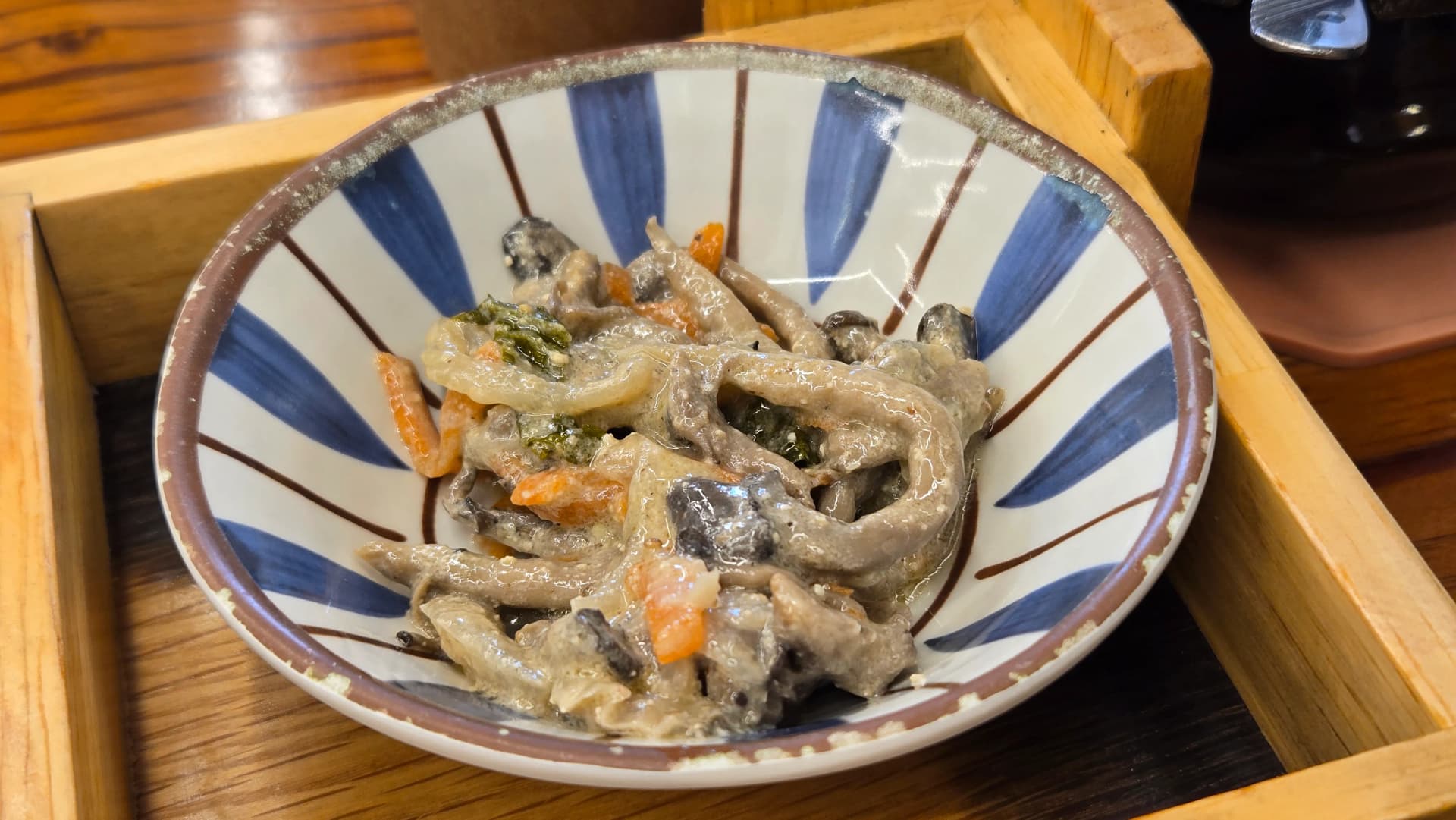
Seasoned Mushrooms
Mushroom NamulBlanched mushrooms dressed with soy sauce, sesame oil, and sesame seeds. Slightly chewy, very mild — this one acts as a palate cleanser between the bolder banchan.
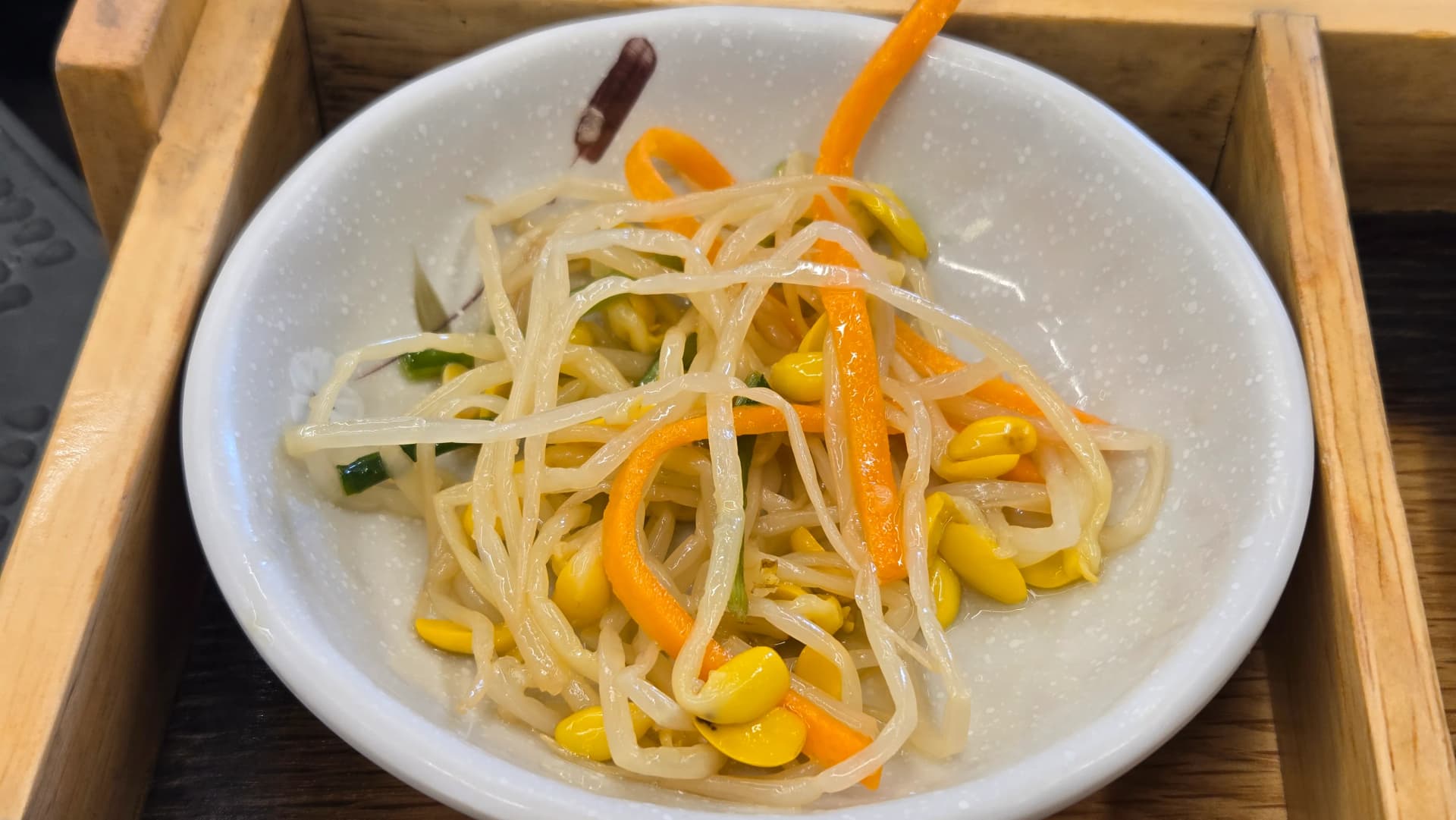
Bean Sprout Salad
Kongnamul MuchimCrunchy bean sprouts lightly seasoned with salt, sesame oil, and sesame seeds. This is probably the single most common banchan you'll encounter at any Korean restaurant. Simple, clean, nutty.
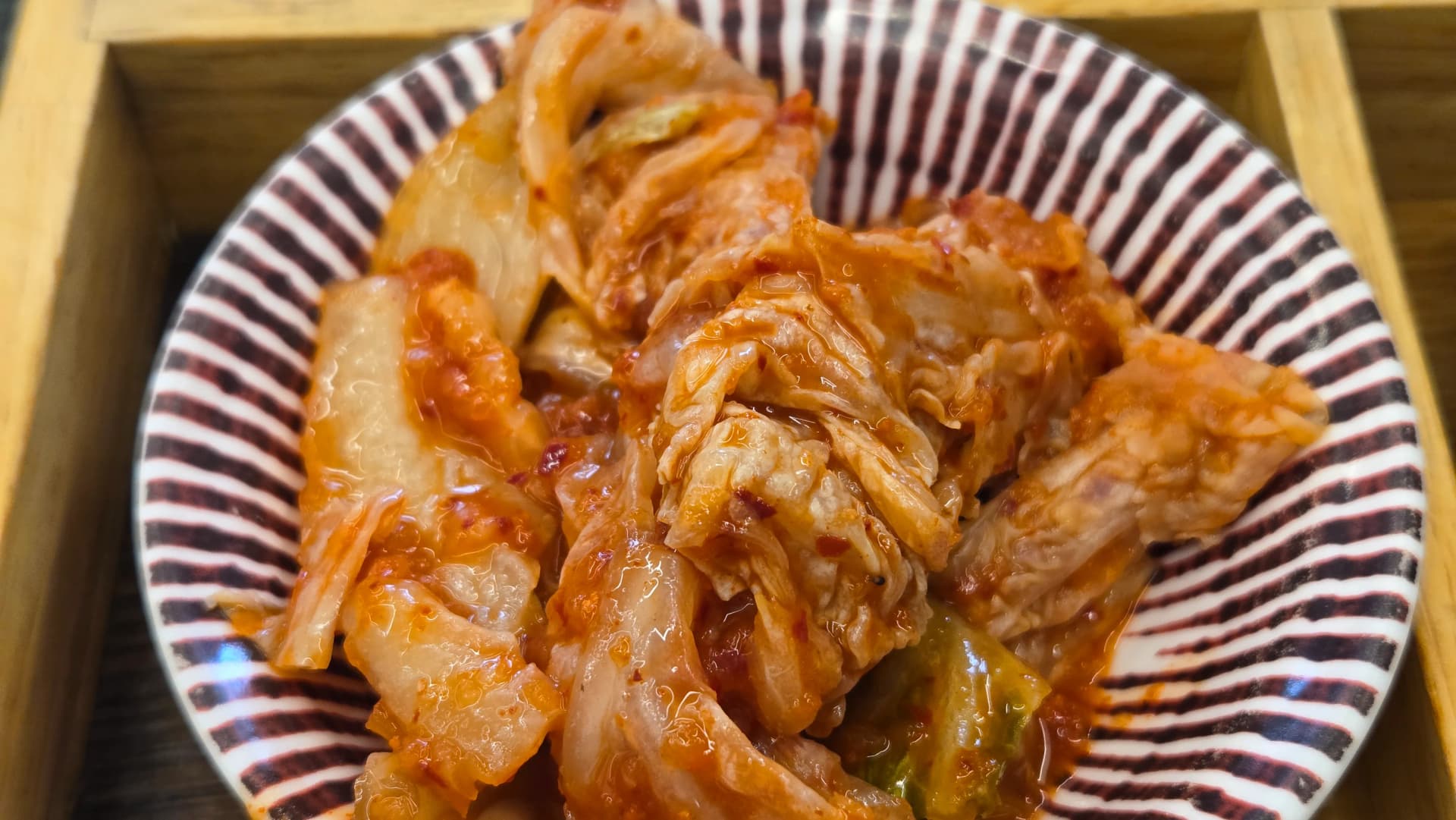
Kimchi
Fermented Napa CabbageKorea's most iconic fermented food. Napa cabbage seasoned with chili flakes, garlic, and fish sauce, then aged until it develops that signature spicy-sour depth. Every Korean restaurant in the country serves it. Every single one.
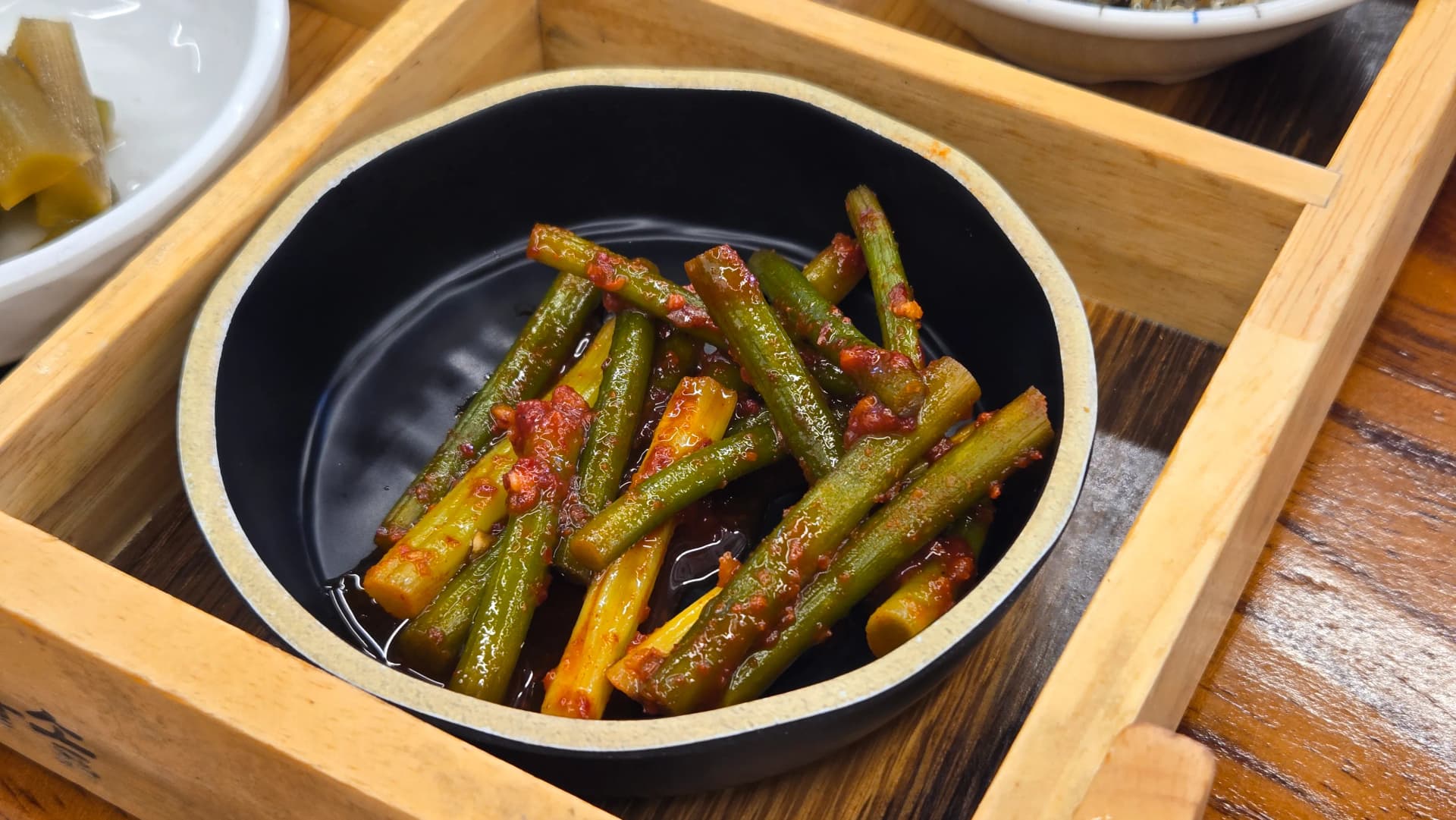
Garlic Scapes
Stir-fried ManeuljjongThese are the flower stalks that grow from garlic bulbs. They have this unique crunch, and when stir-fried with soy sauce and sesame oil, they get this peppery, sweet-savory thing going on. Even if you've never seen them before, one bite and you'll remember them.
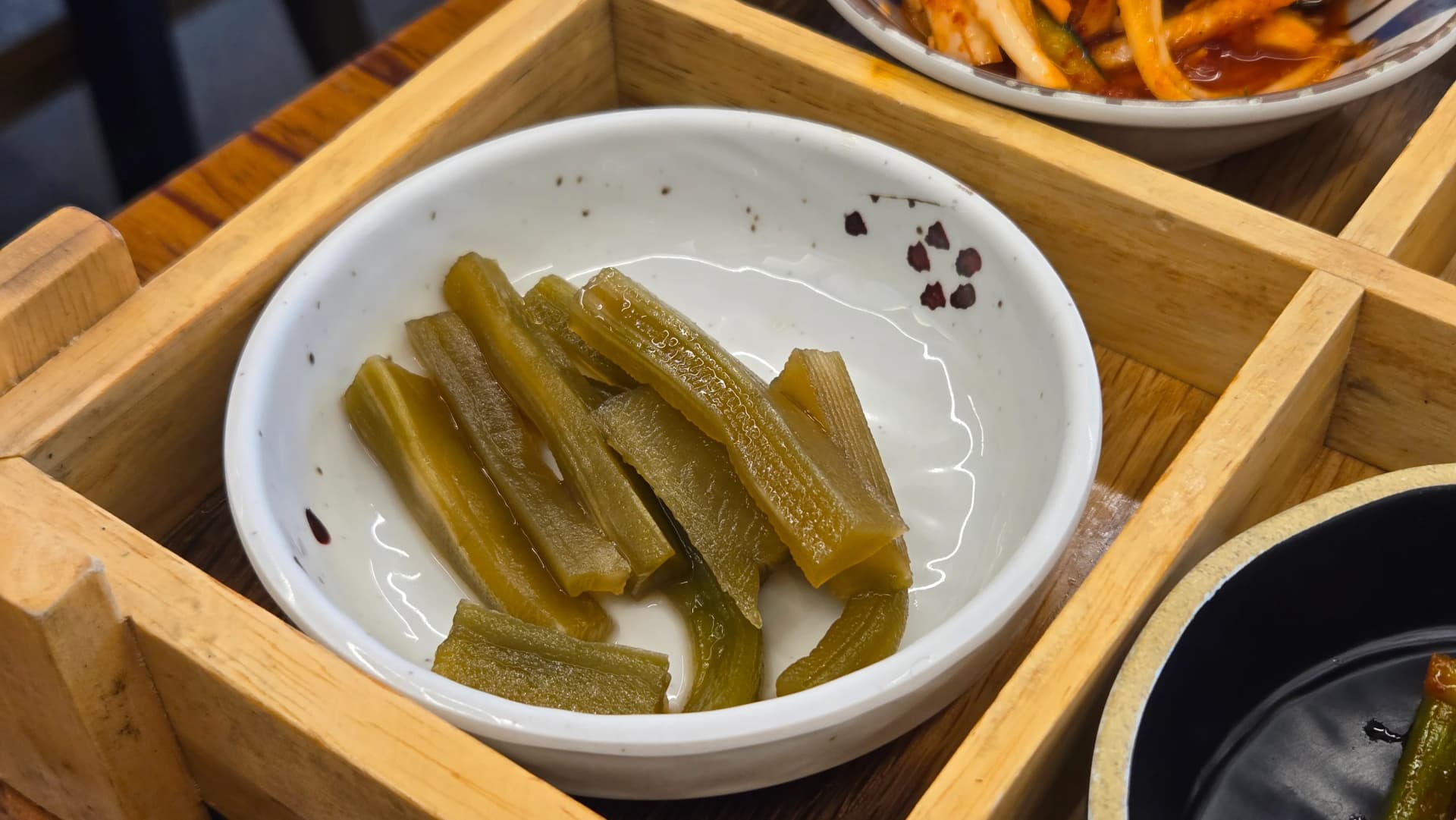
Korean Pickles
JangajjiVegetables cured in soy sauce or vinegar — Korea's answer to pickles. Salty and tangy, they're meant to perk up your appetite alongside mild mains like stone pot rice. Honestly, these ones were a touch too salty for me, but eaten together with the rice, it somehow balanced out.
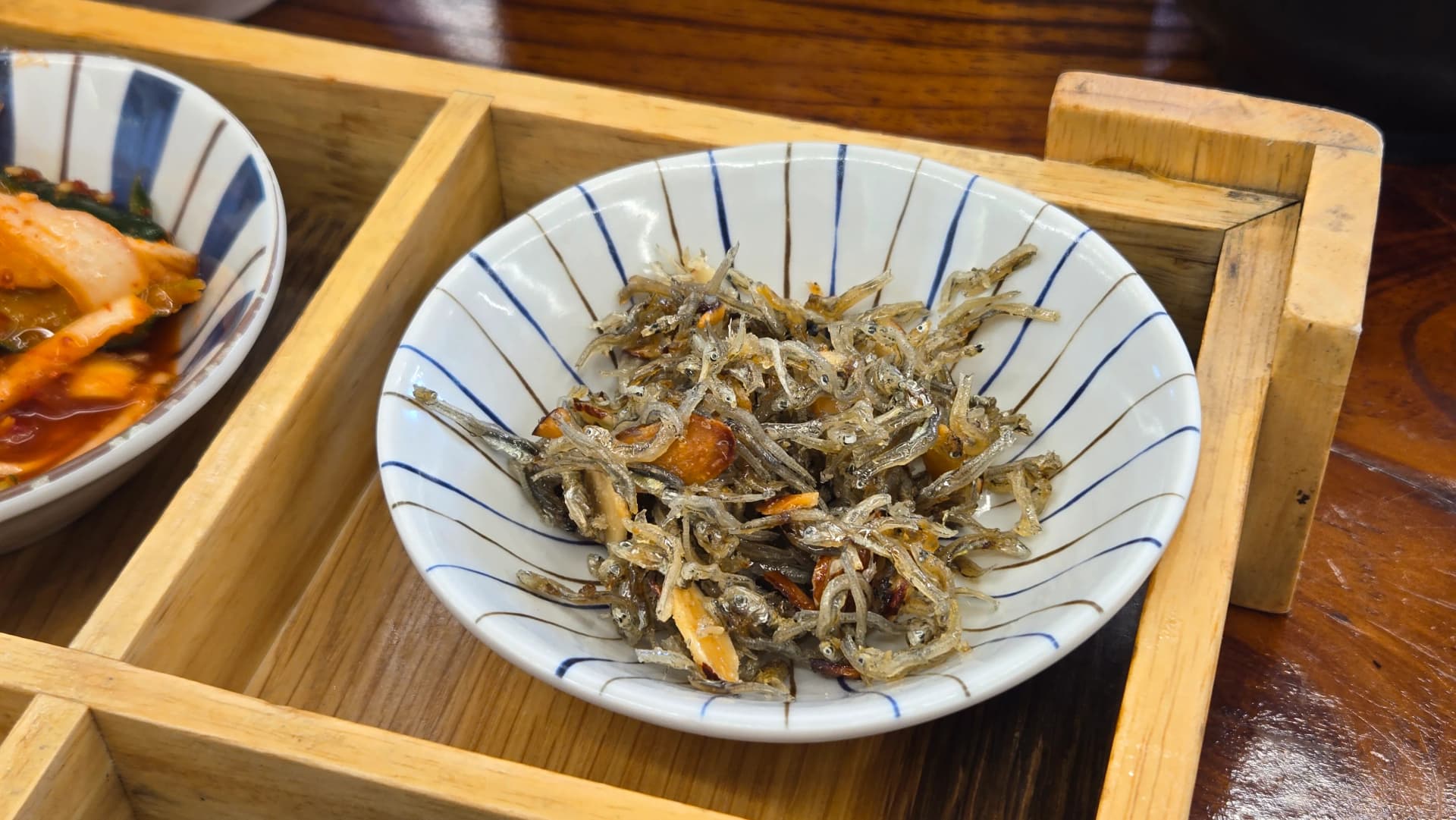
Stir-fried Anchovies
Myeolchi Bokkeum with Peanuts 🥜 Contains PeanutsTiny dried anchovies glazed in a sweet-salty sauce — this is basically a Korean national side dish. Here they added peanuts, which took the nuttiness up a notch. Put some on top of your rice and the umami just explodes. Personally, this was the biggest rice thief on the table. If you have a peanut allergy, be careful with this one.
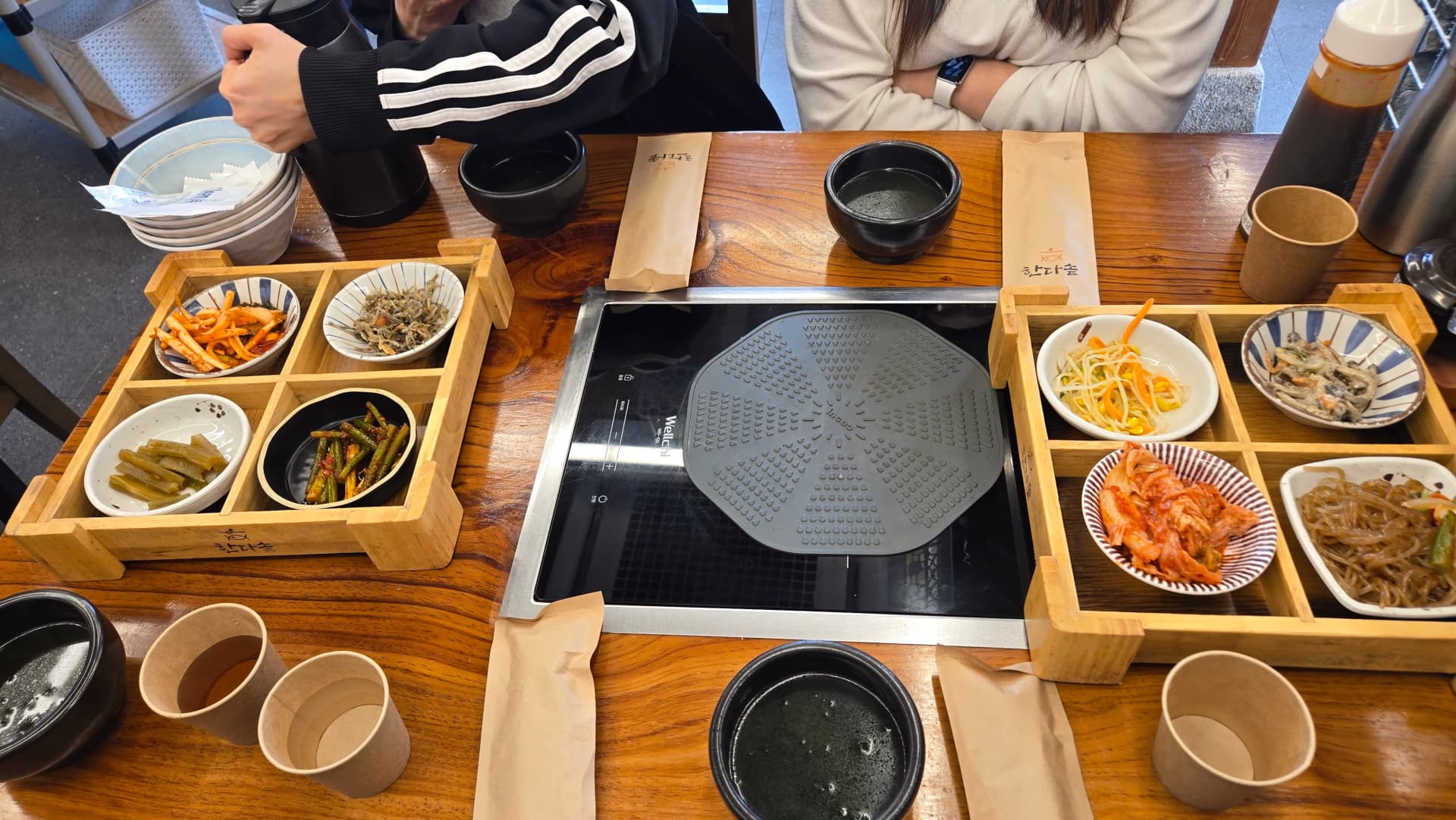
Two trays placed on either side of the table, with the induction burner in the middle already waiting for the stone pot. A server brings the trays over all at once, so all 8 banchan hit the table in one shot.
The Main Dishes Arrived
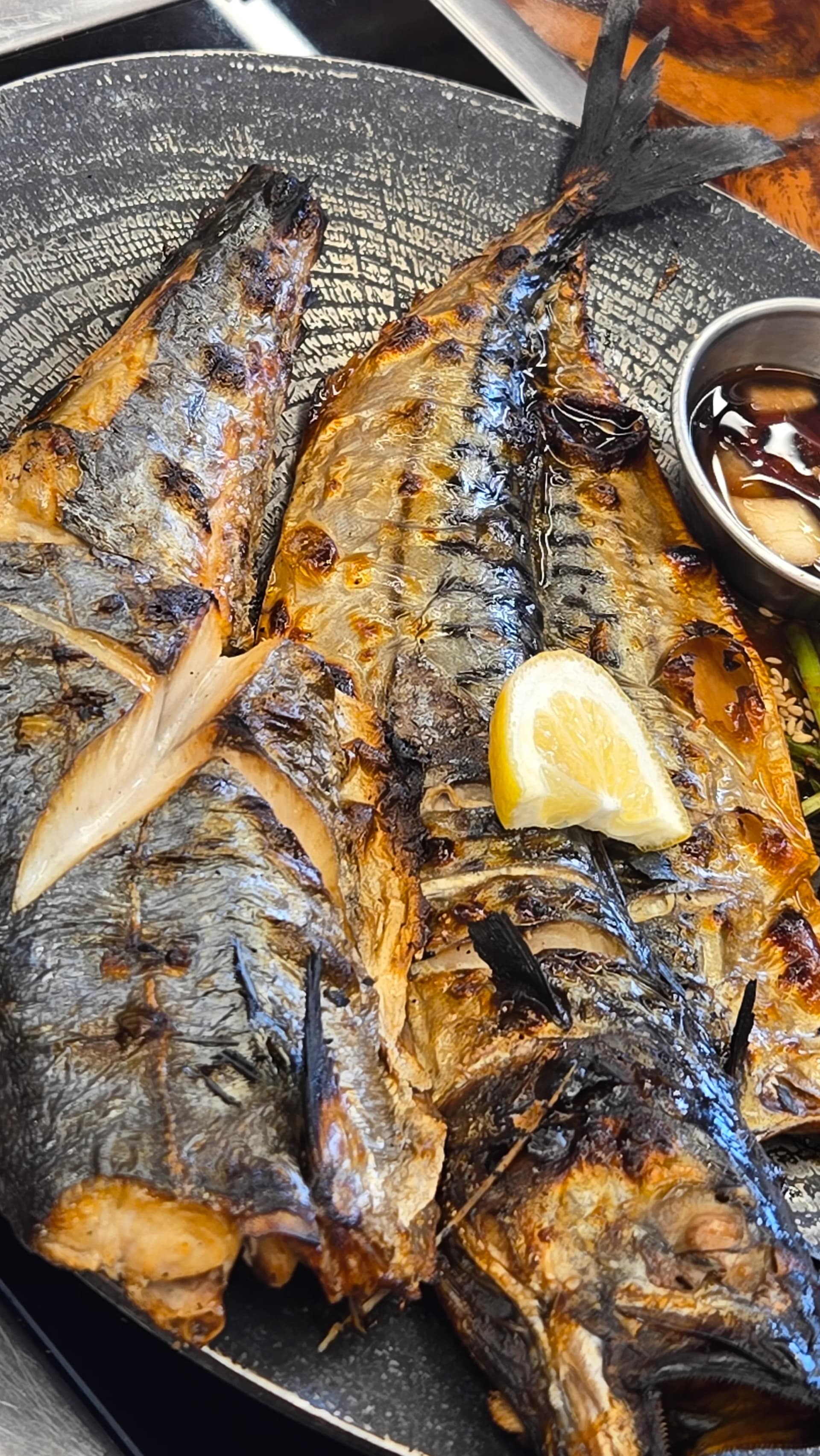
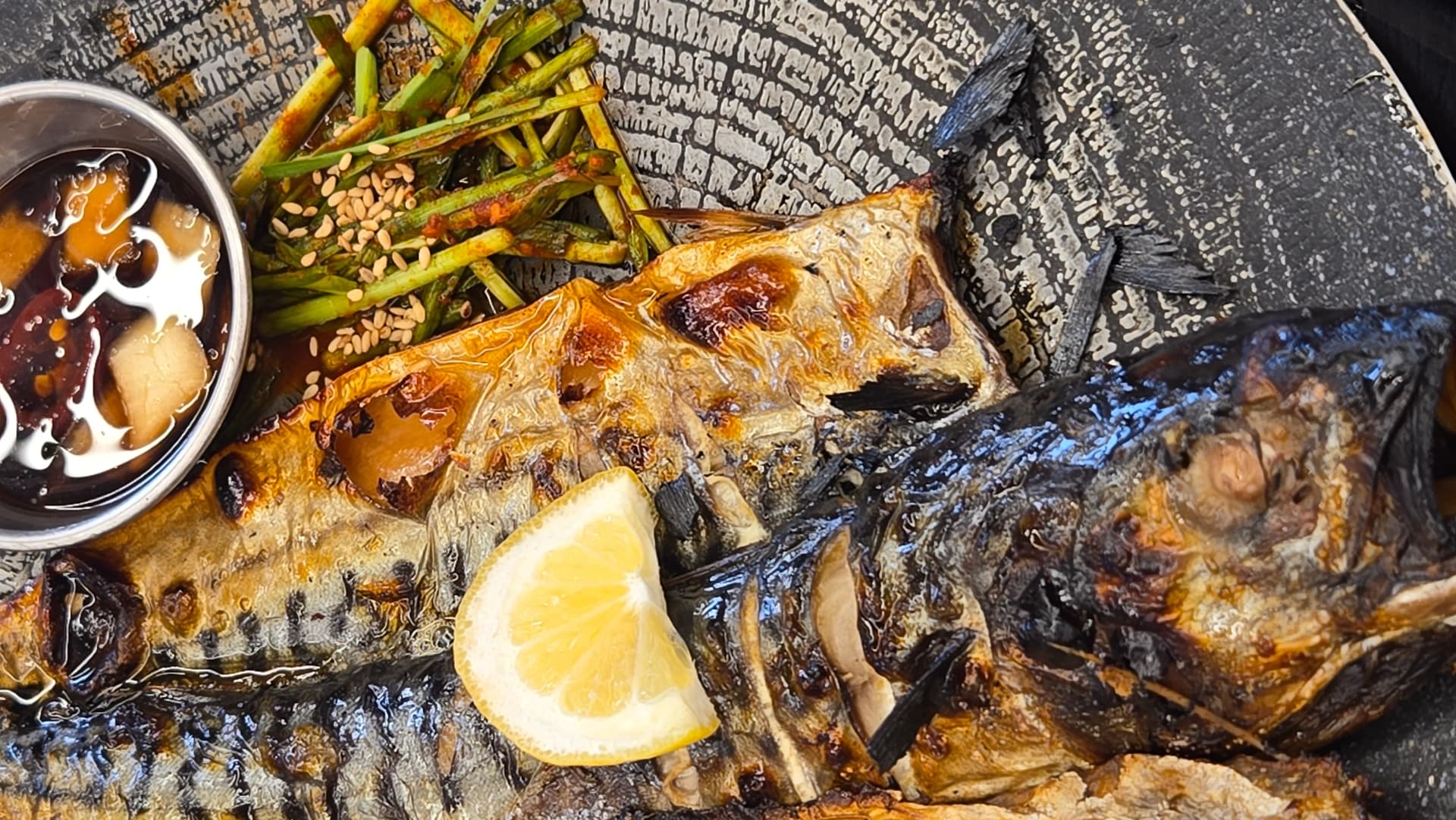
The mains showed up. We ordered grilled mackerel and grilled Spanish mackerel separately. In Korea, it's totally normal for everyone at the table to order different dishes and share — so this way we got to try two kinds of grilled fish from one table.
The mackerel had crispy skin and moist, flaky flesh. It's an oily fish, so there's some richness to it, but eaten with rice that richness actually becomes a plus. The Spanish mackerel was thicker-cut and leaner. Barely any fishy smell at all — even people who usually skip fish would probably be fine with this one.
Galbi Stone Pot Rice
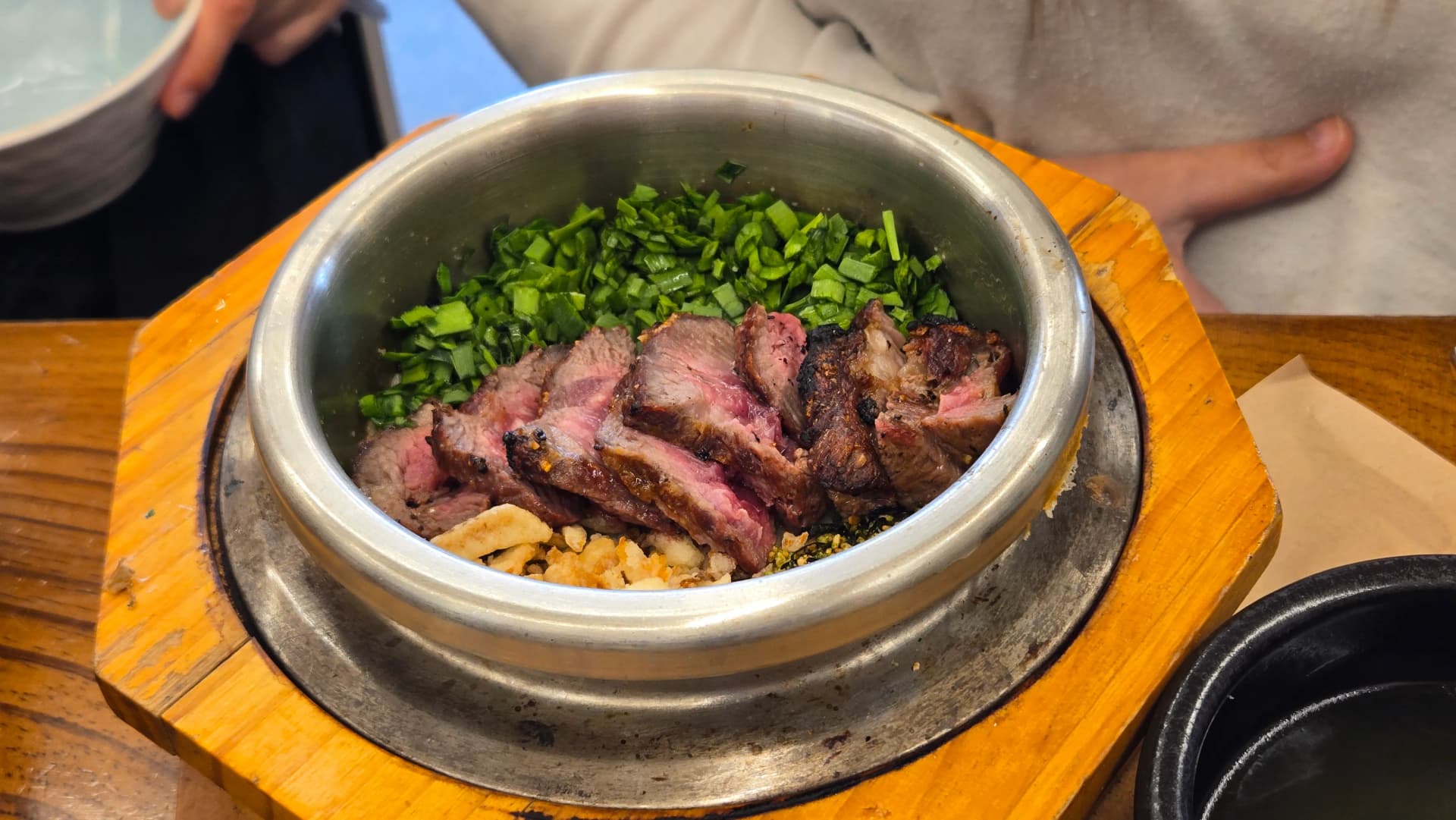
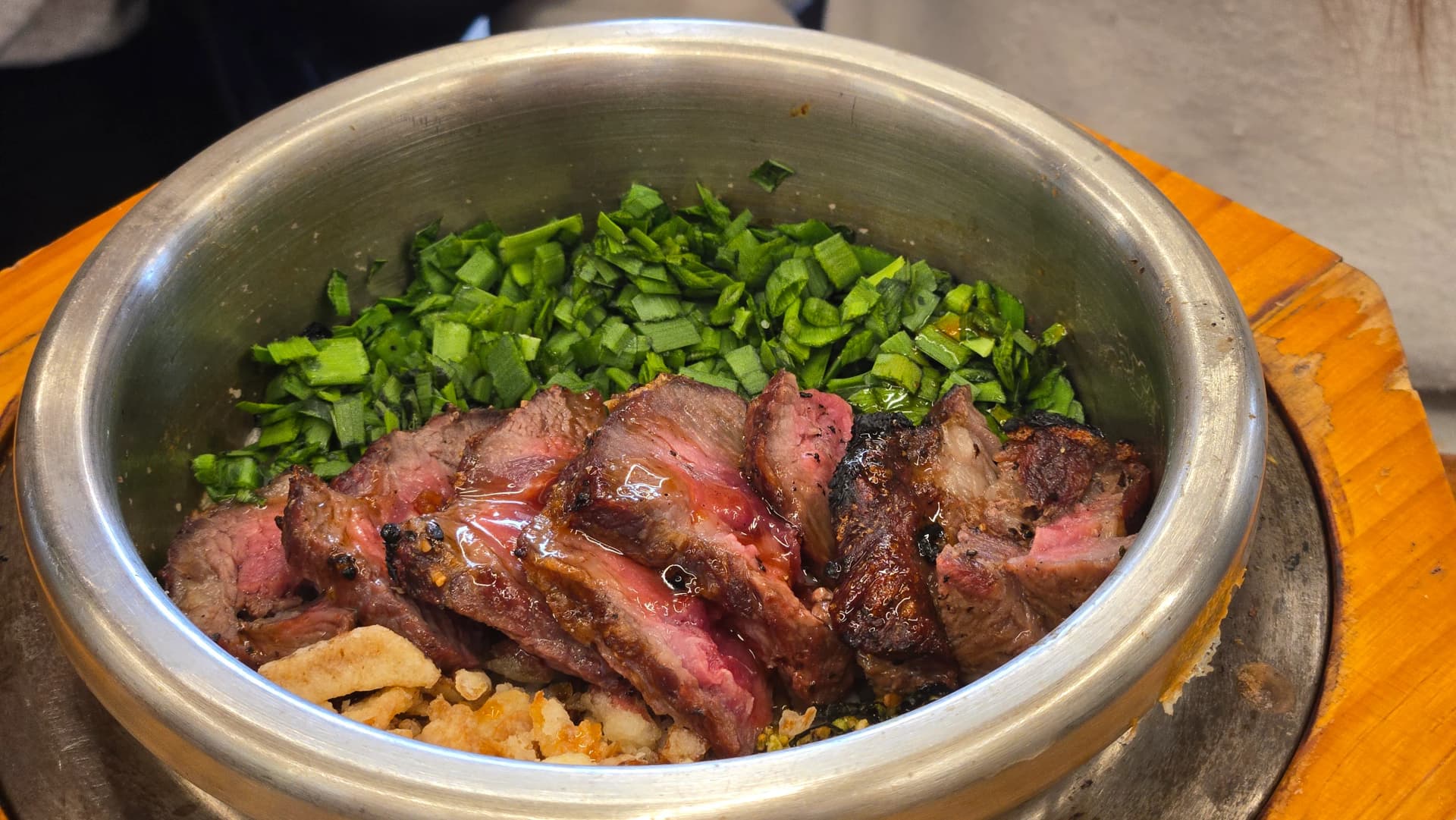
This is the galbi sotbap — stone pot rice with beef short ribs. Thick slices of beef sit right on top of the rice in the pot, cooked to about medium so the inside is still pink. The outside has a nice char to it and the juices are completely intact. Chopped scallions are piled on top, which cuts through the richness of the meat. The fact that the hot stone pot keeps the beef warm the whole time is a nice touch. Honestly, this felt more like eating a steak than traditional Korean ribs.
Wood-Fired Pork Bulgogi
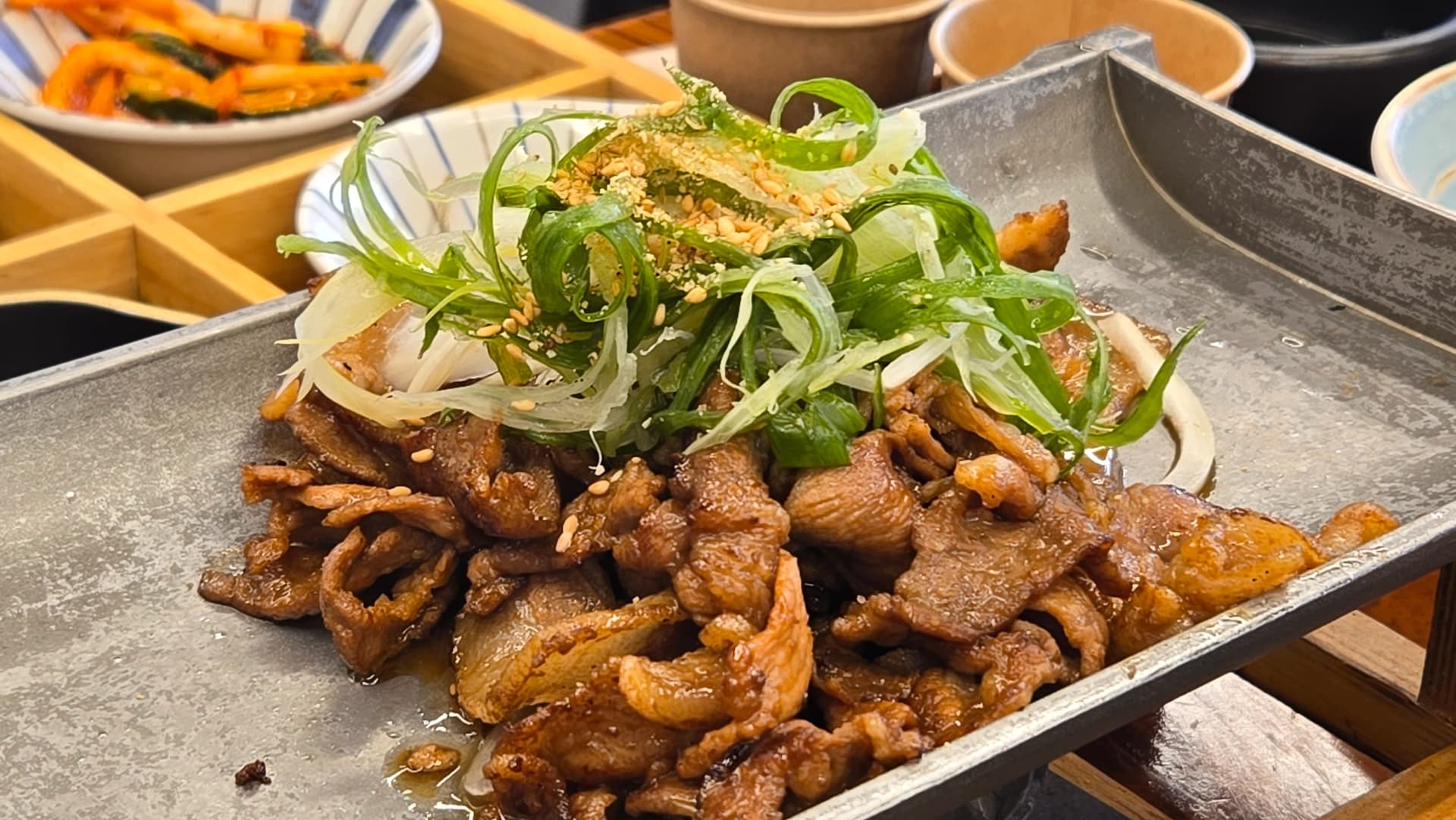
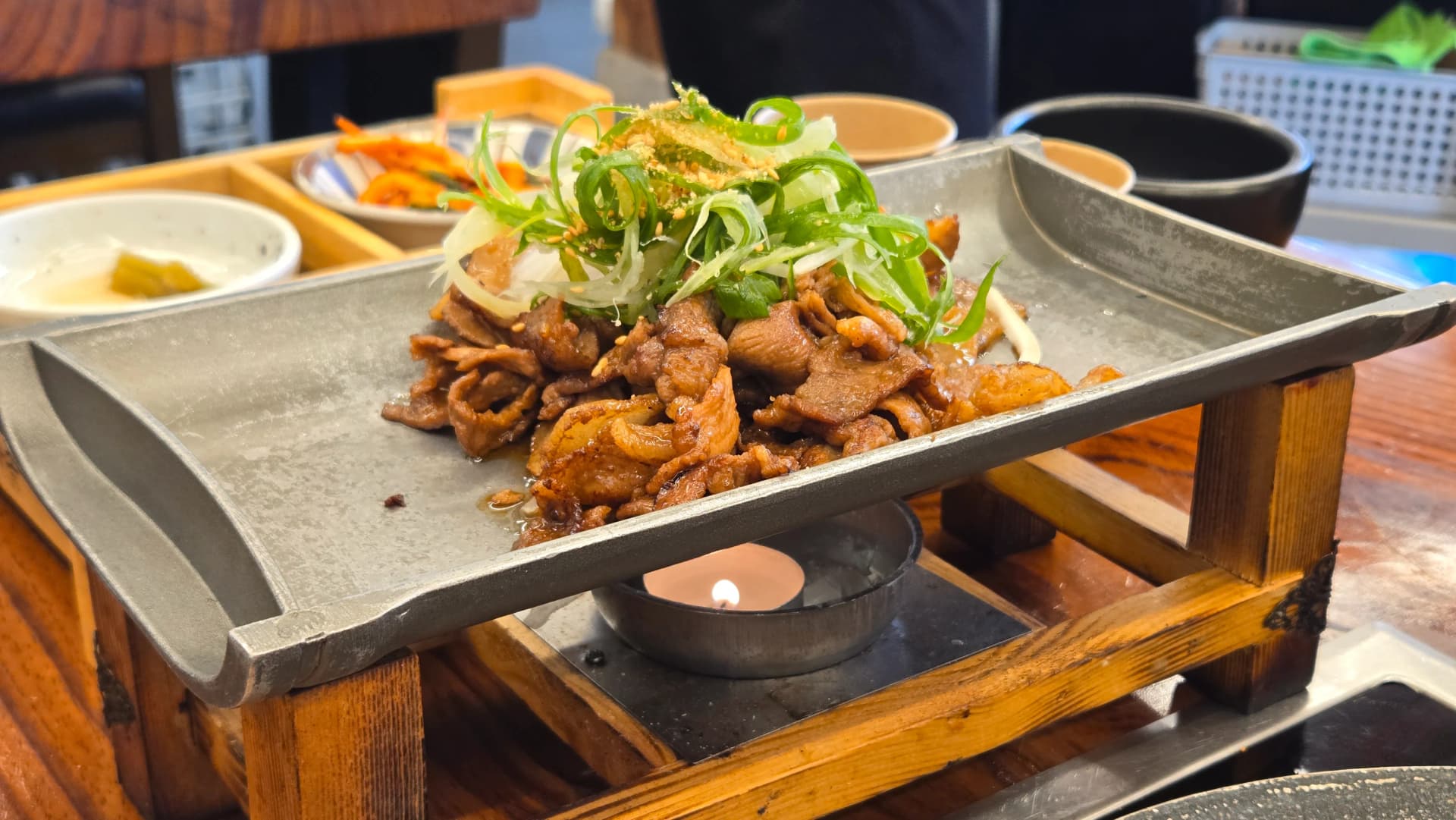
Wood-fired pork bulgogi. Thinly sliced pork marinated in a sweet-salty sauce and roasted in a wood-fire oven — the smoky flavor was baked deep into the meat. Shredded scallions and sesame seeds were heaped on top, and the whole thing sat on a wooden stand with a candle underneath to keep it warm. It never went cold, even toward the end of the meal. Paired with the stone pot rice, the seasoned meat and fluffy grains were a perfect match. Combo-wise, this was the best one at the table.
Stone Pot Rice — Not Just Regular Rice
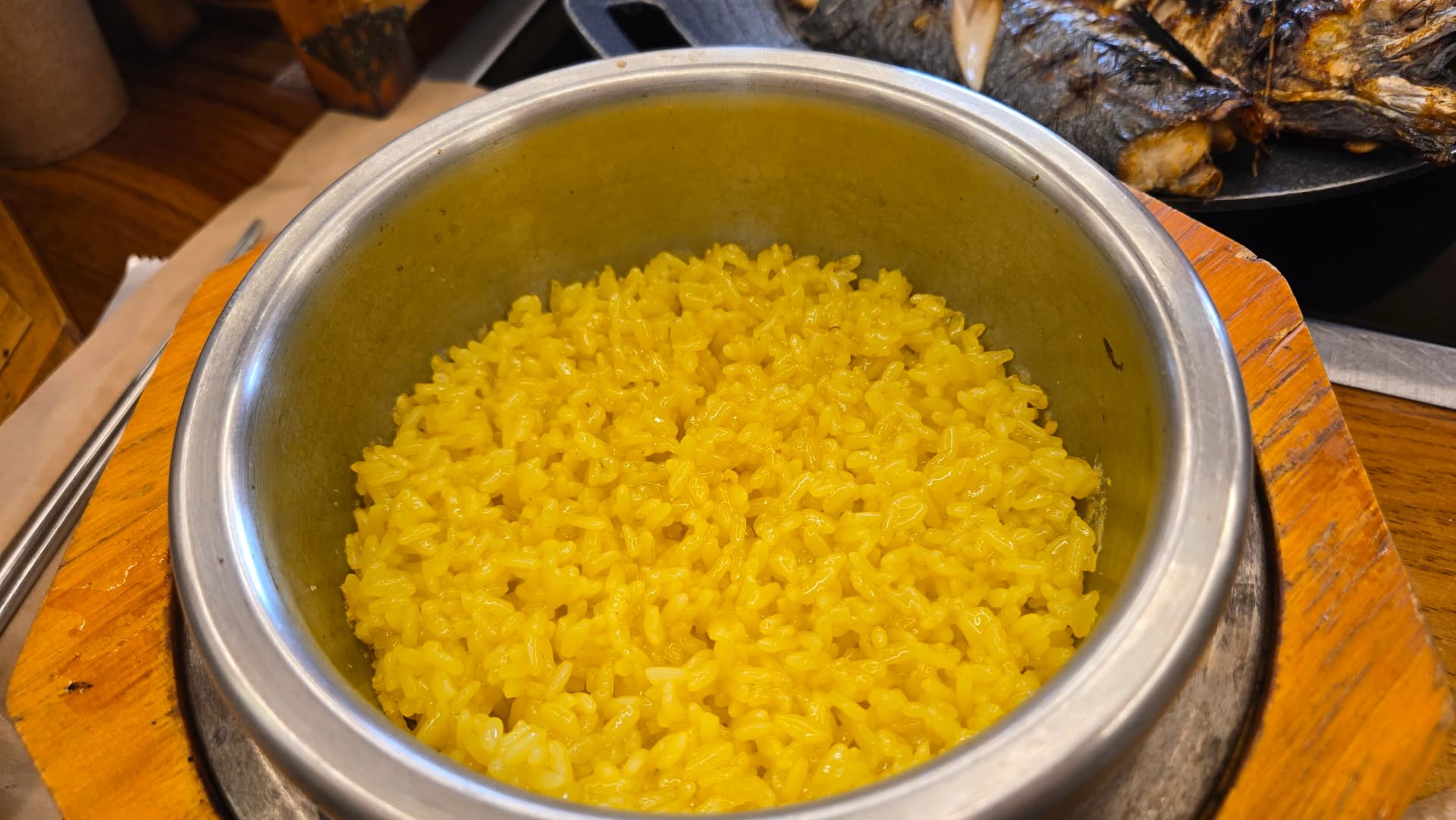
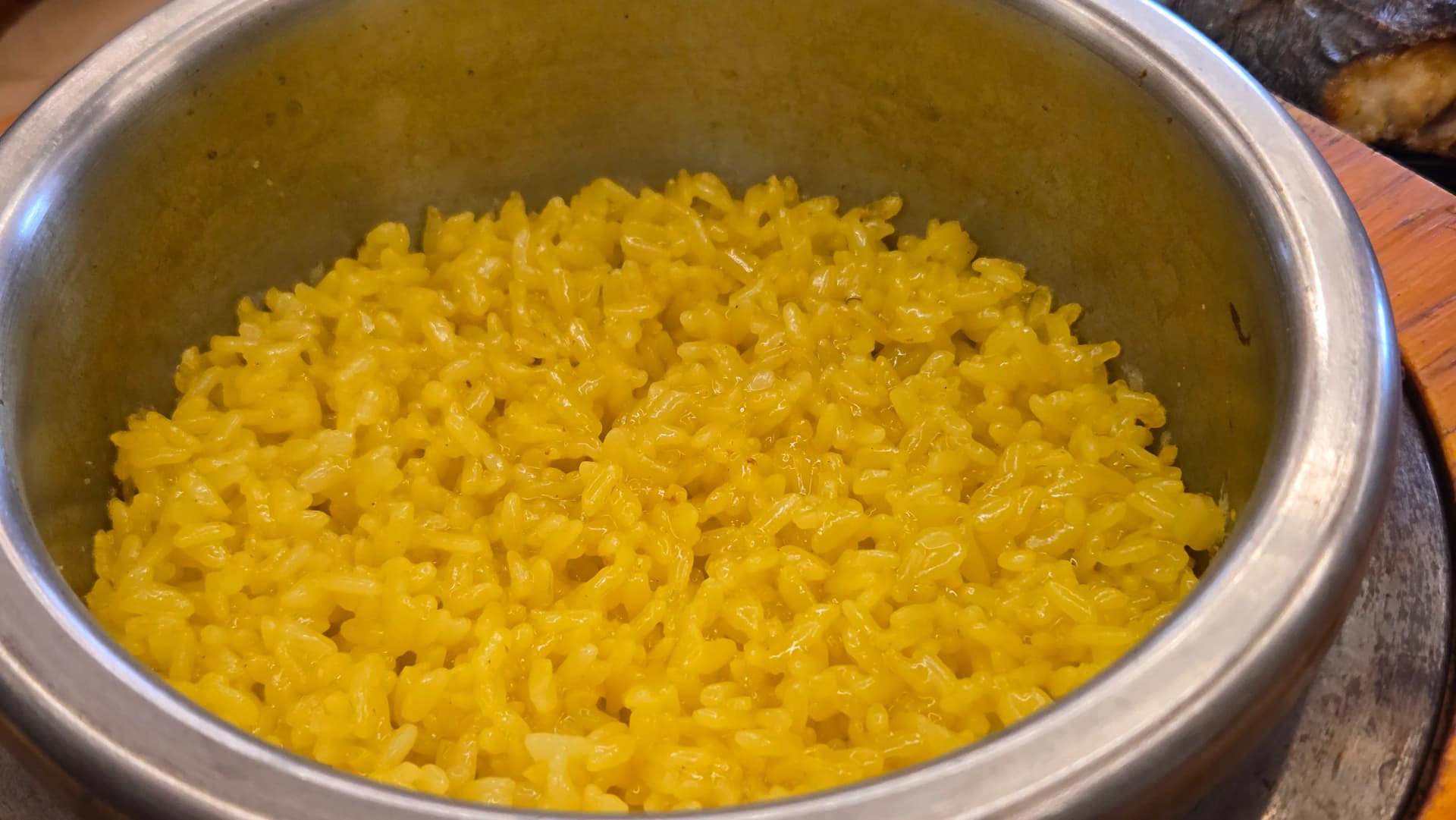
This isn't regular pre-scooped rice. It's cooked to order inside a stone pot and brought to the table still in the pot. Every grain is fluffy and glossy. The yellowish tint comes from turmeric mixed into the rice. It's noticeably different from standard restaurant rice — the rice itself is so good that it makes the banchan taste even better.
How to Eat
What Is Korean Stone Pot Rice?
Dolsotbap · Everything you need to know for your first time
Here's What It Is
Dolsotbap is rice cooked directly inside a heavy stone pot. Unlike regular rice, which is pre-made and scooped into a bowl, stone pot rice is prepared to order and served in the pot itself. The stone holds heat for a long time, so your rice stays warm down to the very last spoonful. That's the biggest difference.
The Crispy Rice at the Bottom
The best part of stone pot rice is what happens at the bottom. After you scoop out the rice, there's a layer of grains that have crisped up against the hot stone — that's nurungji, or scorched rice. It's nutty and crunchy, and a lot of people scrape it off and eat it on its own. If it's not your thing, you can skip it, but I'd say try it at least once. It's better than you'd expect.
Scorched Rice Tea to Finish
After you've eaten the rice, you pour hot water into the empty pot. The scorched bits dissolve and turn into a toasty, slightly nutty tea called sungnyung — that's the traditional Korean after-meal drink. Instead of coffee or tea, you finish your meal with this. I'll be real though, it's a bit of a mixed bag. Some people find it more bland than nutty. But after greasy meat and salty banchan, it does clear your palate pretty nicely.
How to Eat It, Step by Step
When the pot arrives, open the lid and check the rice.
Scoop out only as much as you'll eat into the separate bowl they give you. You don't eat directly from the pot.
Eat it with your banchan and main dishes. If there's a sauce, mixing it into the rice is totally fine.
When you're done, pour hot water into the empty pot, close the lid, and wait 2–3 minutes. That's your scorched rice tea.
If you want to try the crispy rice, scrape it off before adding the water.
Stone Pot vs. Regular Rice
Regular Rice
Pre-cooked and scooped into a bowl. Cools down quickly. No crispy bottom, no tea.
Stone Pot Rice
Cooked to order in the pot. Stays hot until the end. Crispy nurungji and sungnyung tea included.
Eating the Stone Pot Rice
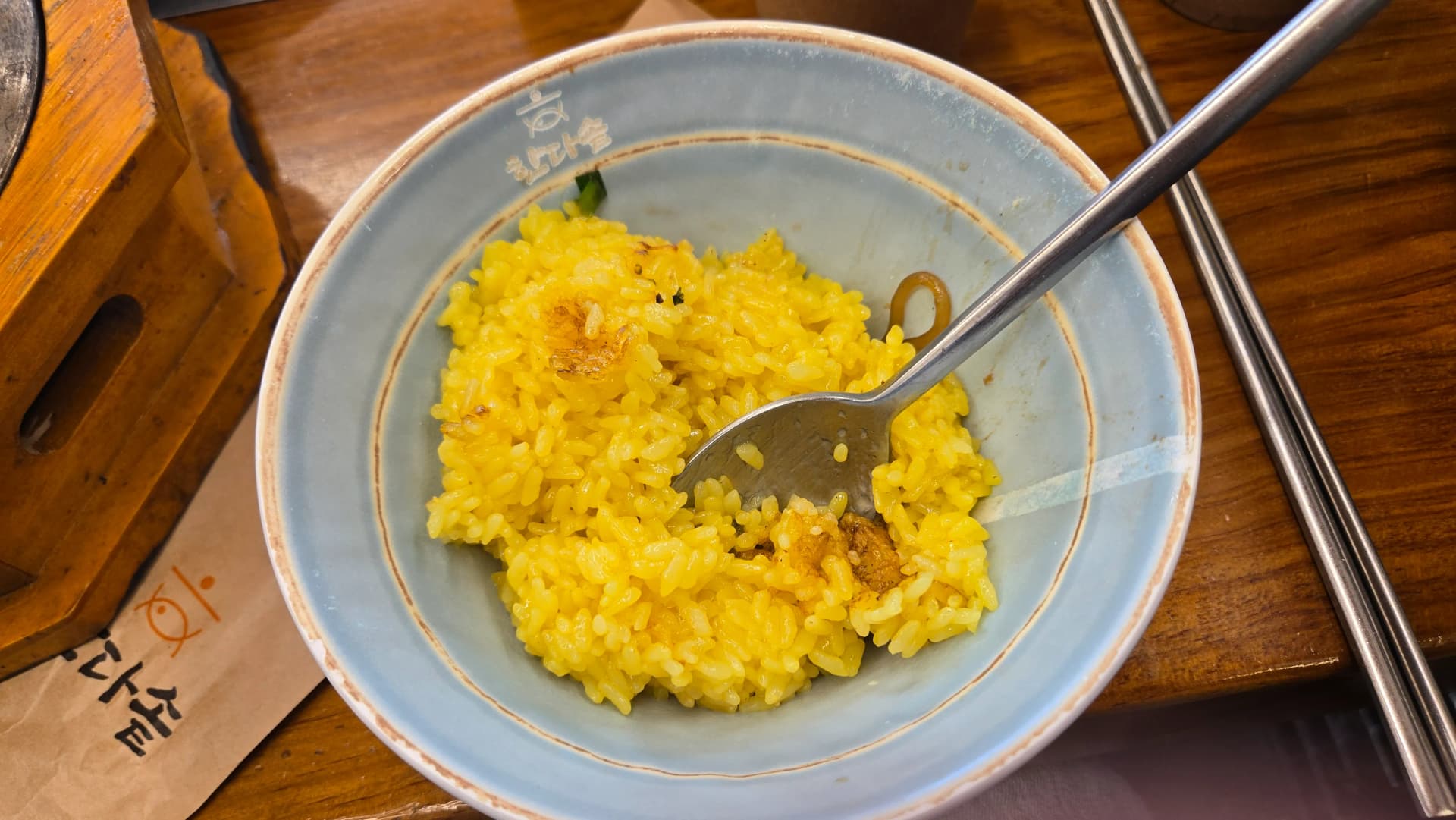
When the stone pot arrives, you scoop the rice out into your bowl like this. You don't eat straight from the pot — you transfer it. You can see little bits of crispy rice mixed in, and those are nutty and delicious. It's not complicated at all. Just scoop and eat.
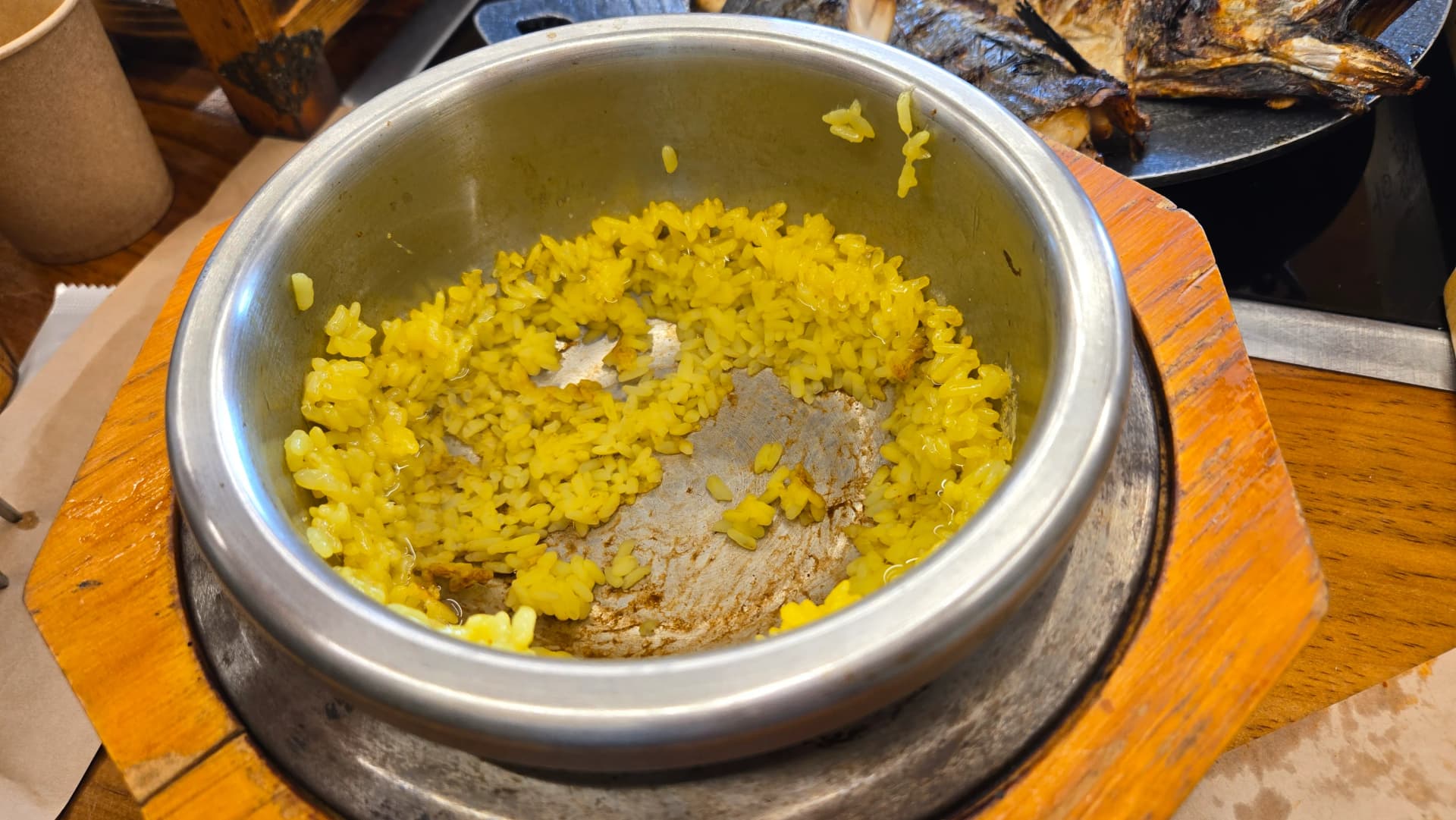
This is the pot after the rice has been scooped out. See the scorched rice stuck to the bottom? Pour water in, close the lid, wait a couple minutes, and you've got your sungnyung.
The Full Korean Table Setting
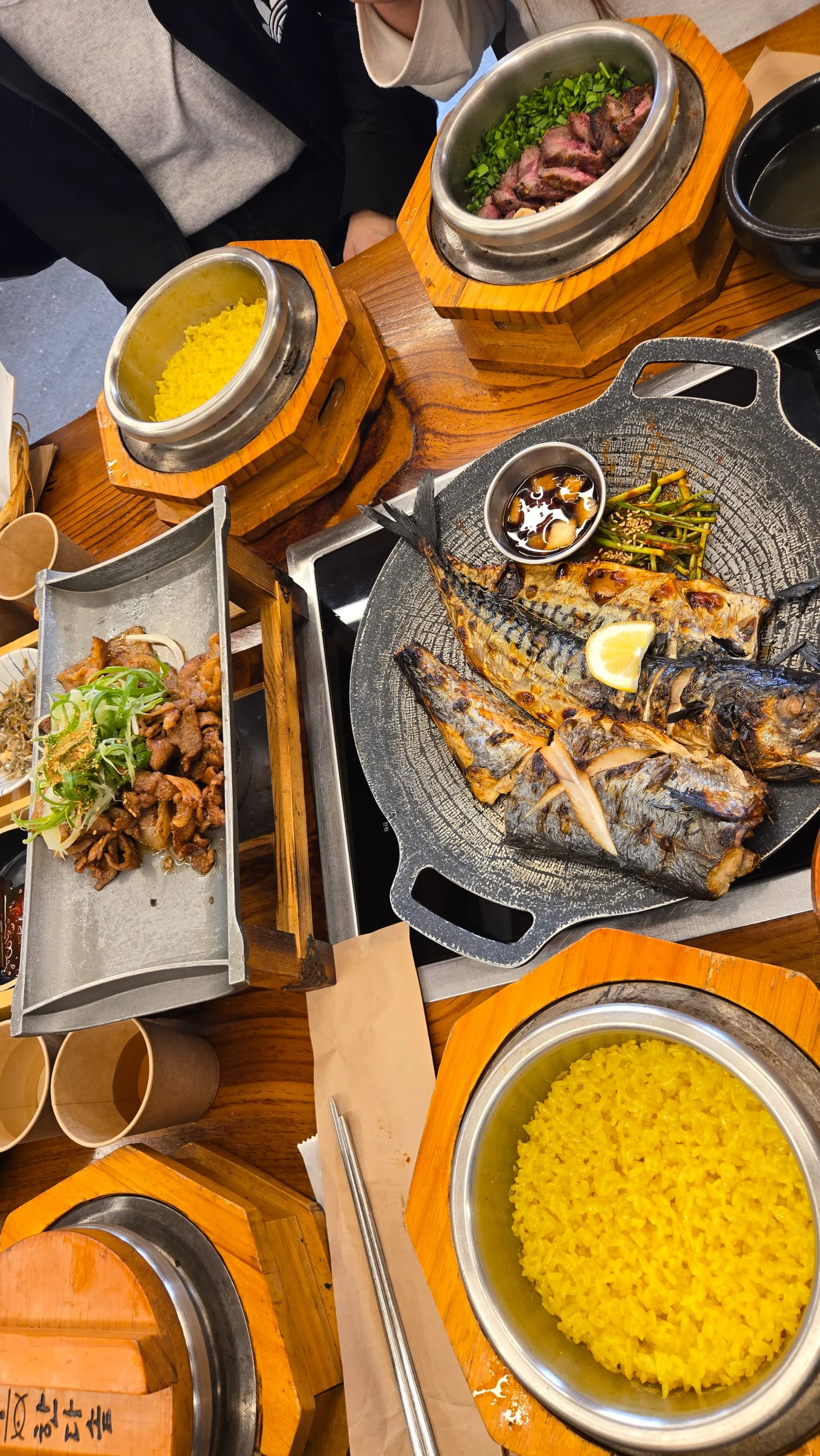
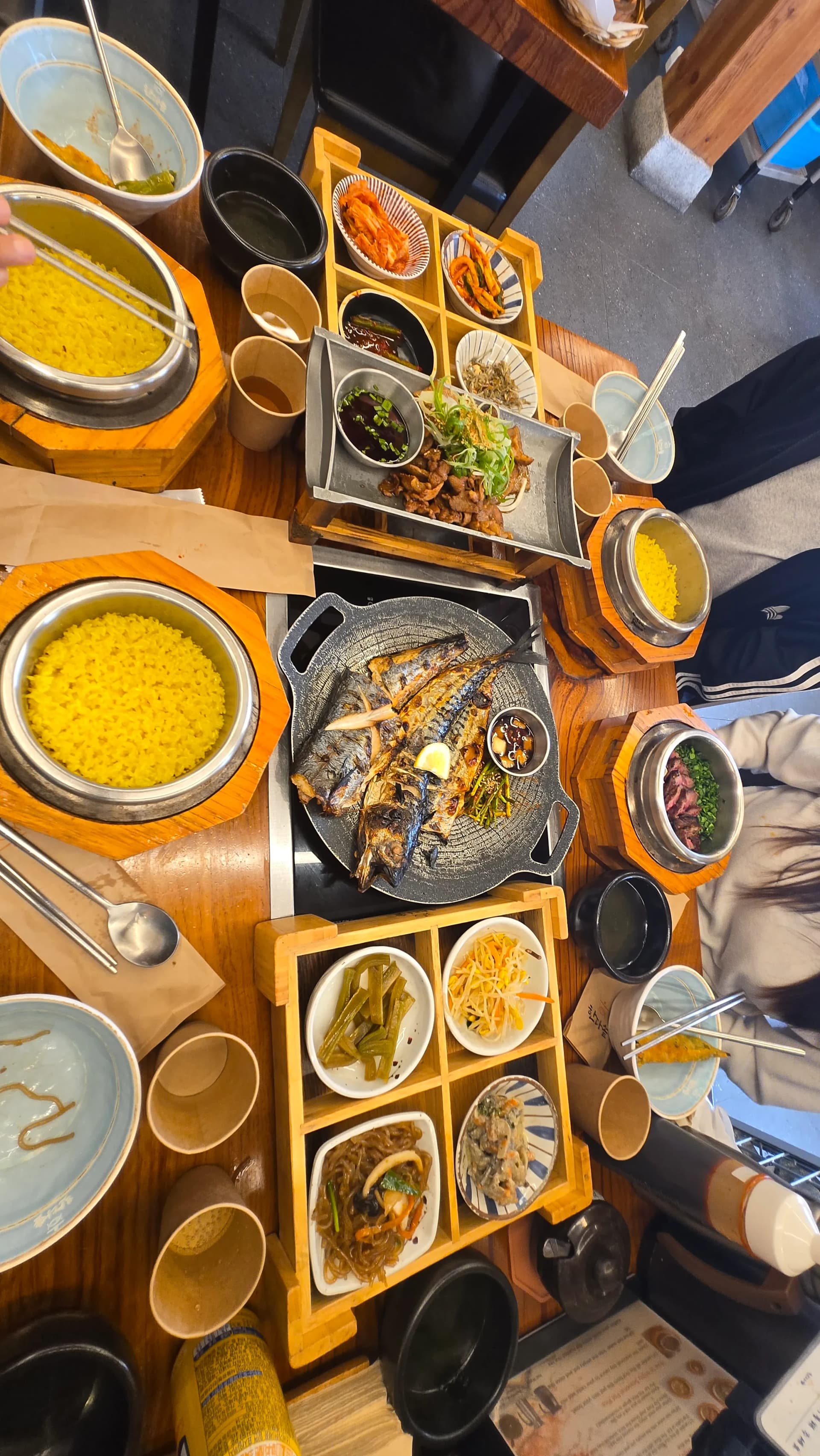
Here's the full table. Four stone pots, grilled mackerel and Spanish mackerel, wood-fired pork bulgogi, galbi stone pot rice, and two banchan trays. Every inch of the table is covered, but somehow it doesn't look chaotic. The wooden stands, stone pots, and trays are all evenly spaced, so it actually looks elegant.
This is what a Korean meal looks like. It's not just one dish sitting alone on the table — banchan, rice, soup, and mains all arrive at the same time. Even when everyone orders something different, the food naturally gets shared across the table, which means the more people you have, the more variety you get. That's exactly why sharing is the default in Korean dining culture — it comes from this style of table setting.
Close-Up Shots
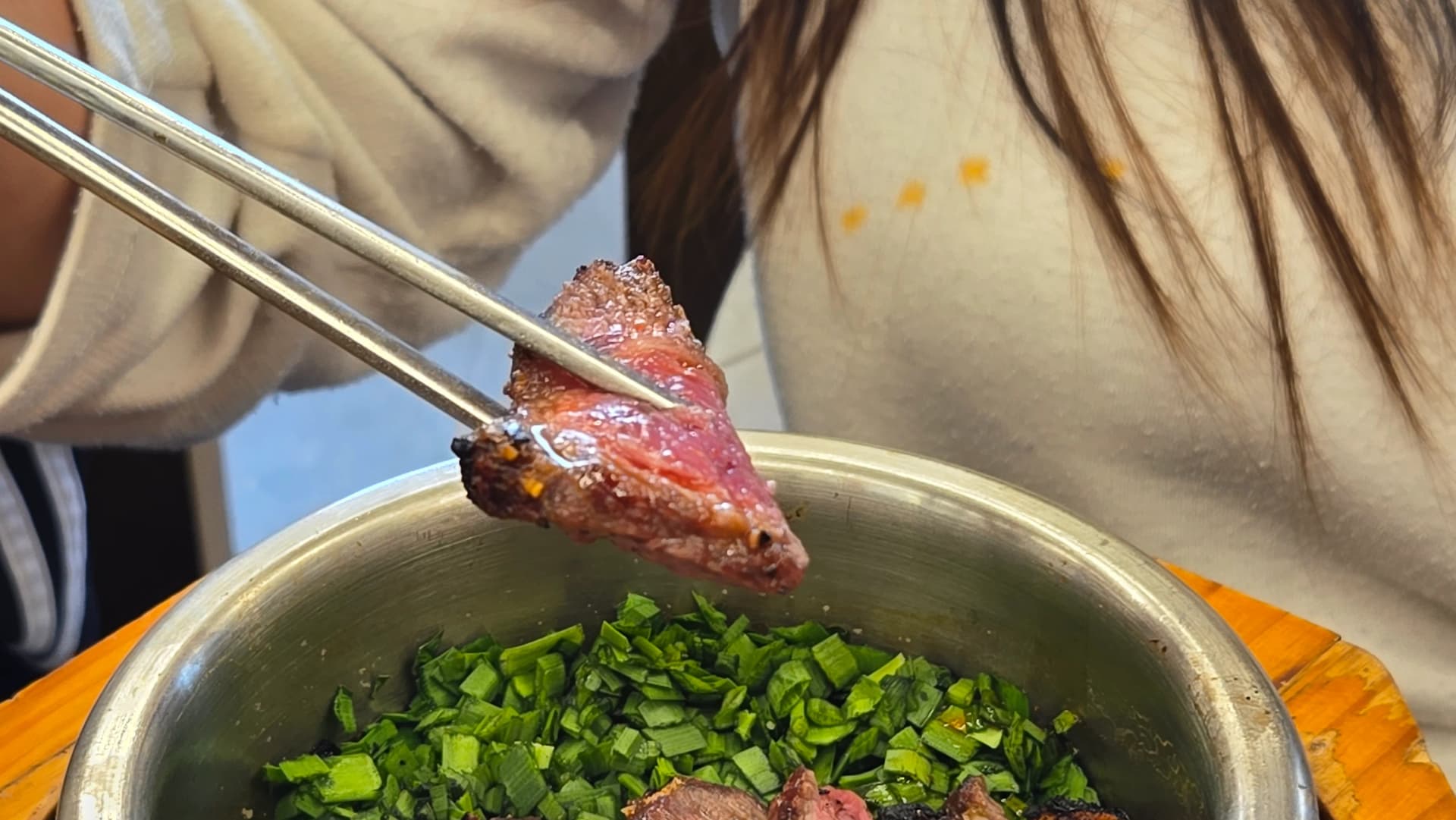
A close-up of the galbi lifted from the stone pot. Cooked to medium — still pink inside, juices running down. It's Korean-style short rib, but the cross-section looks like something off a steakhouse plate.
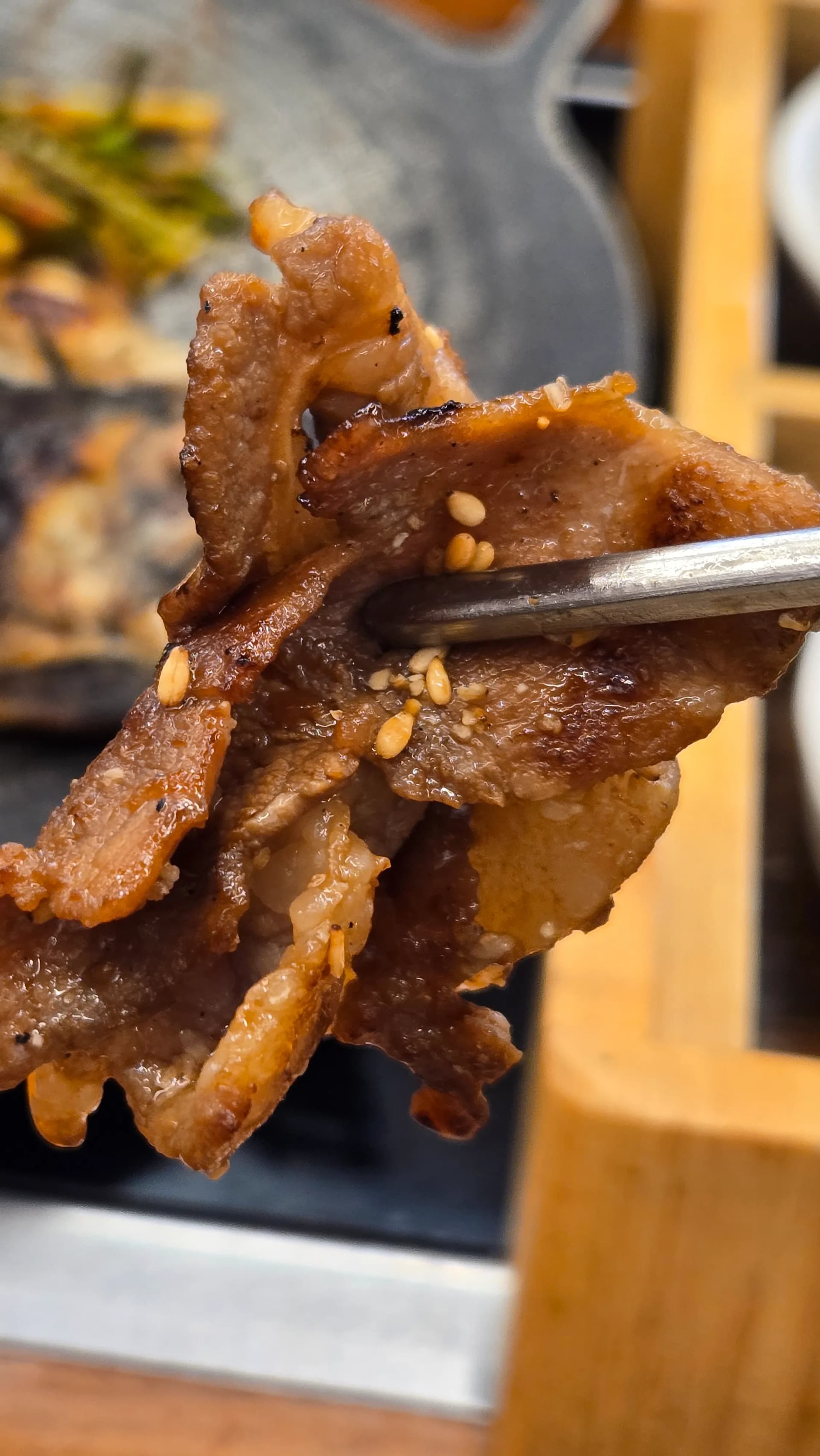
Close-up of the pork bulgogi. The marinade has soaked in and the surface is glistening. The edges are slightly caramelized, and sesame seeds are pressed into the meat. It's sliced thin, so one bite delivers the full sweet-salty punch instantly.
After the Meal — The Empty Table
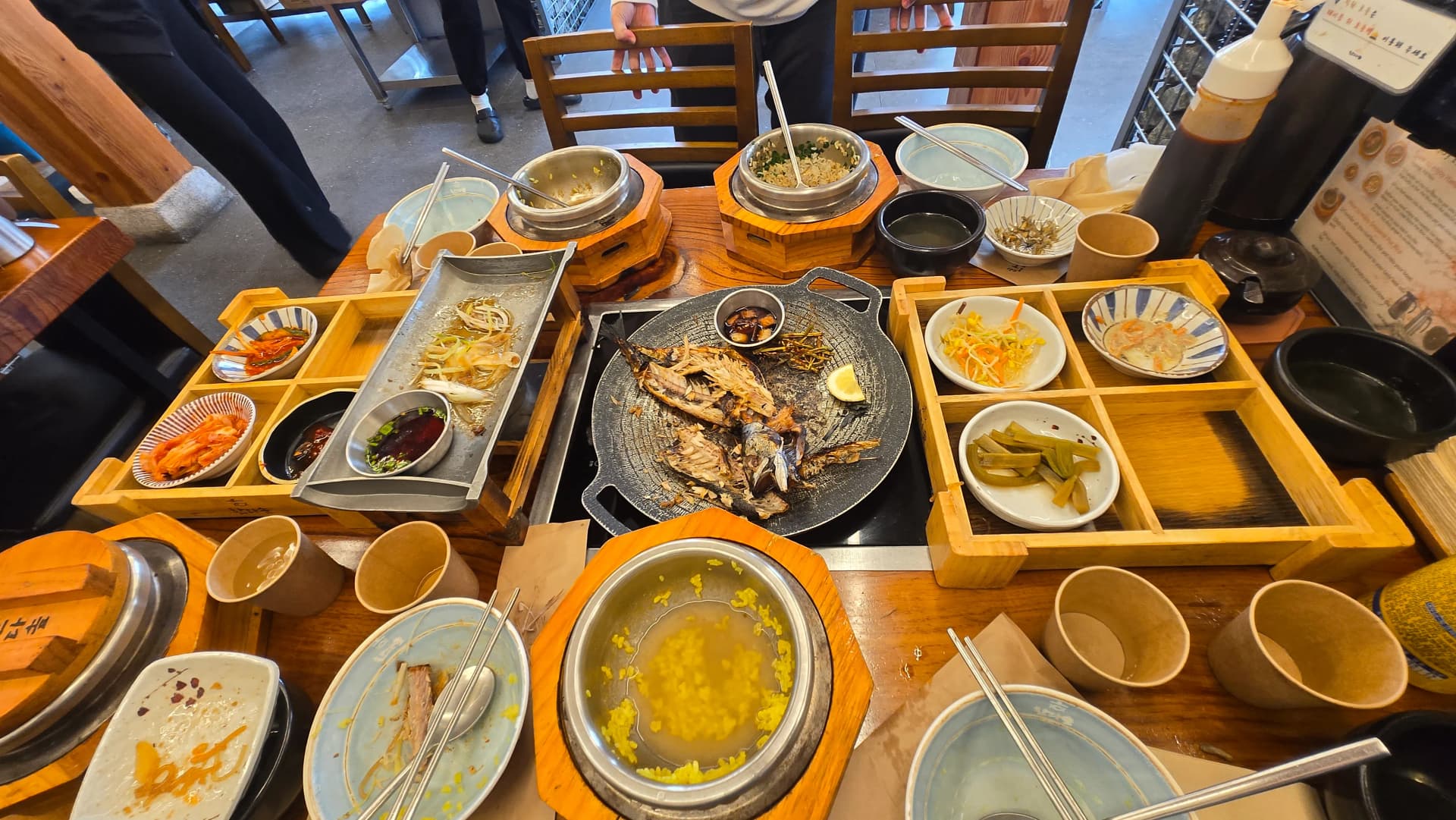
The table after we finished. The stone pots have sungnyung slowly brewing inside, the fish plates have nothing left but bones, and the banchan trays are nearly cleaned out. Compared to how packed the table looked at the start, this after-shot says "we ate well" better than any words could.
That was one proper meal in Gyeongju. If you're walking around the sights and hunger hits, you don't have to go far — right near Hwangnidan-gil you can get the full Korean table experience. Stone pot rice, 8 free banchan, grilled fish, and meat all landing on your table at once. The food was good, but honestly, the whole table setting itself is a spectacle if you've never seen one before.
One last tip: don't load up on banchan all at once. Take a little, eat it, and ask for a refill if you want more. Refills are free so don't be shy — just don't leave a mountain of leftovers. That's the basic etiquette at a Korean table.
FAQ
Korean Restaurant Basics You Should Know
The questions first-timers ask most
Are the side dishes really all free?
Yes, completely free. Order a main dish and the banchan come out automatically. No separate ordering, no extra charge. The number of dishes varies by restaurant, but you'll get at least 3.
What if I want more banchan?
Just ask the server or hold up your empty dish. Most places refill for free. Even if you don't speak Korean, showing an empty plate gets the message across just fine.
Is it okay to leave banchan unfinished?
Leaving a little is fine. But piling your plate high and then barely touching it is considered rude. Take small amounts and refill as needed — that's the etiquette.
Why do I get both chopsticks and a spoon?
In Korea, rice and soup are eaten with the spoon, and banchan with chopsticks. Unlike Japan or China, you don't pick up the rice bowl — it stays on the table and you use the spoon. Holding both the spoon and chopsticks at the same time is considered bad manners.
Can vegetarians eat any of the banchan?
The vegetable dishes and pickles look safe, but kimchi often contains fermented fish sauce. If you're fully vegan, ask about fish sauce and meat-based broth before ordering. Seasoned vegetable namul and tofu dishes are usually the safest bets.
Any allergy concerns I should know about?
Sesame oil and sesame seeds are in almost every banchan. If you have a nut allergy, watch out for peanuts in stir-fried dishes like the anchovies. Fermented fish sauce, shellfish, and chili are also used frequently, so check with the restaurant before ordering if any of those are a concern.
Restaurant Info
Handasot Gyeongju
Hwangnidan-gil · Stone Pot Rice Set
Address
111 Cheomseong-ro, Hwangnam-dong, Gyeongju-si, Gyeongsangbuk-do
Hours
Daily 10:30 AM — 9:00 PM (Last order 8:30 PM)
Phone
+82-54-776-7088
Parking
On-site parking available · Hwangnidan-gil public parking nearby
Access
Within a 5-minute walk from Cheomseongdae, Daereungwon, and Hwangnidan-gil
What We Ordered
Galbi Stone Pot Rice
~$12
Wood-Fired Pork Bulgogi Set
~$12
Wood-Fired Mackerel Set
~$11
Wood-Fired Spanish Mackerel Set
~$11
※ All sets include stone pot rice + 8 banchan. Prices are approximate and may vary.
This post was originally published on https://hi-jsb.blog.