
Daegu Seomun Market Street Food Guide — 20 Must-Try Bites (Part 2)
Table of Contents
11 items
In Part 1, I showed you everything from the entrance of Seomun Market to about halfway through the food alley — but honestly, that was only half of it. Every time I turned a corner, some new food I'd never seen before popped up, and I literally could not put my camera down. If you haven't read Part 1 yet, I'd recommend checking it out first so the flow makes sense.
Read the previous post Part 1: Daegu Seomun Market Street Food Guide — 20 Must-Try Korean Traditional Market SnacksIn Part 2, I'm covering the rest — traditional Korean grain brittle, rice ball skewers, fish-shaped pastries, gimbap, braised pig's feet, and more street food finds from the deeper alleys of Seomun Market.
The vibe really changes the further in you go. Near the entrance, it's buzzing with tourists and that classic busy-market energy. But deeper inside, it's a whole different world — local regulars greeting the aunties by name, doing their weekly grocery runs. The stall lineup changes too. Instead of the skewer-after-skewer setup from Part 1, a completely different cast of Daegu Seomun Market street food started catching my eye.
Hangwa Gangjeong — Traditional Korean Sweets You Can Only Find at a Market Like This
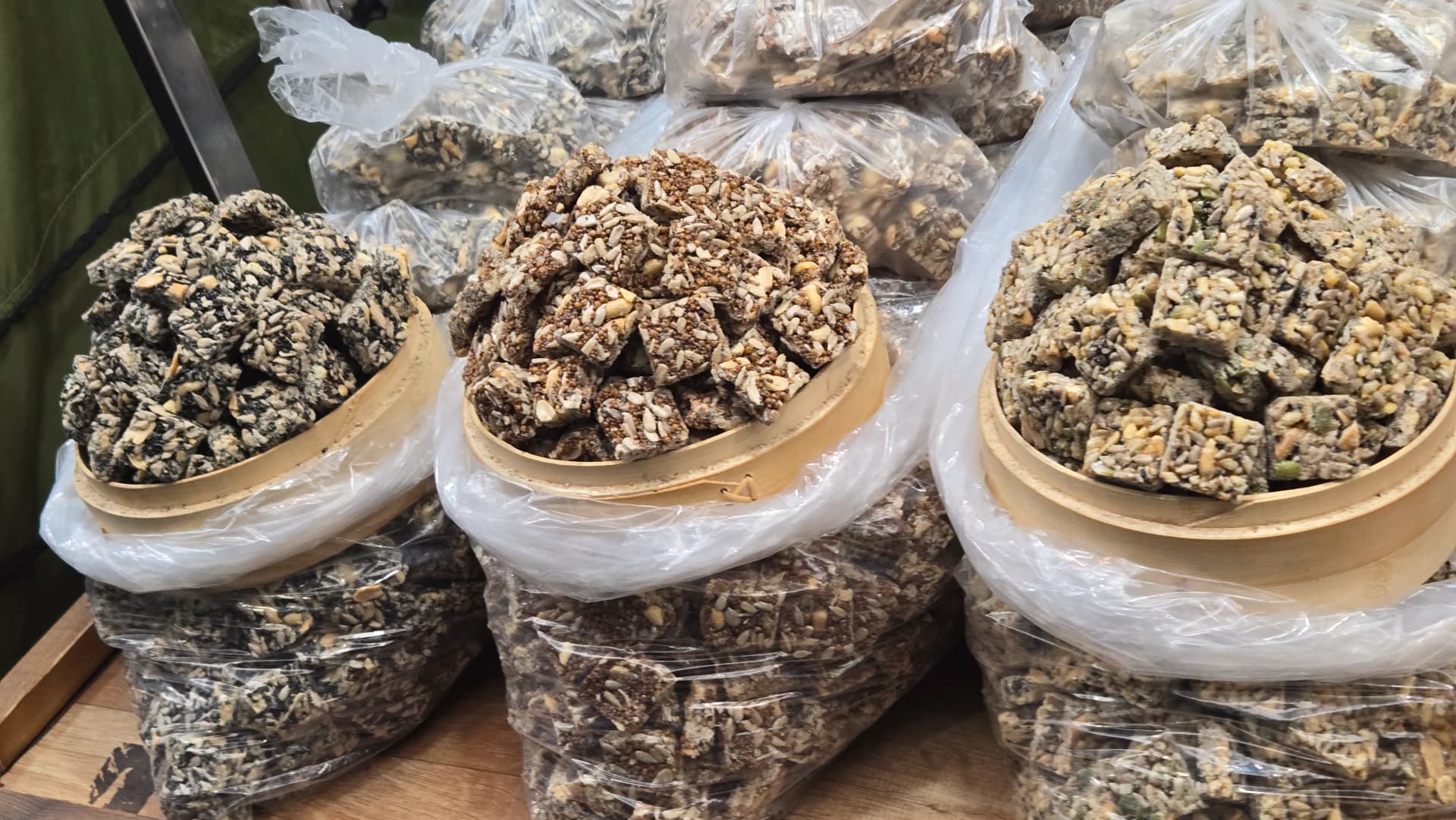
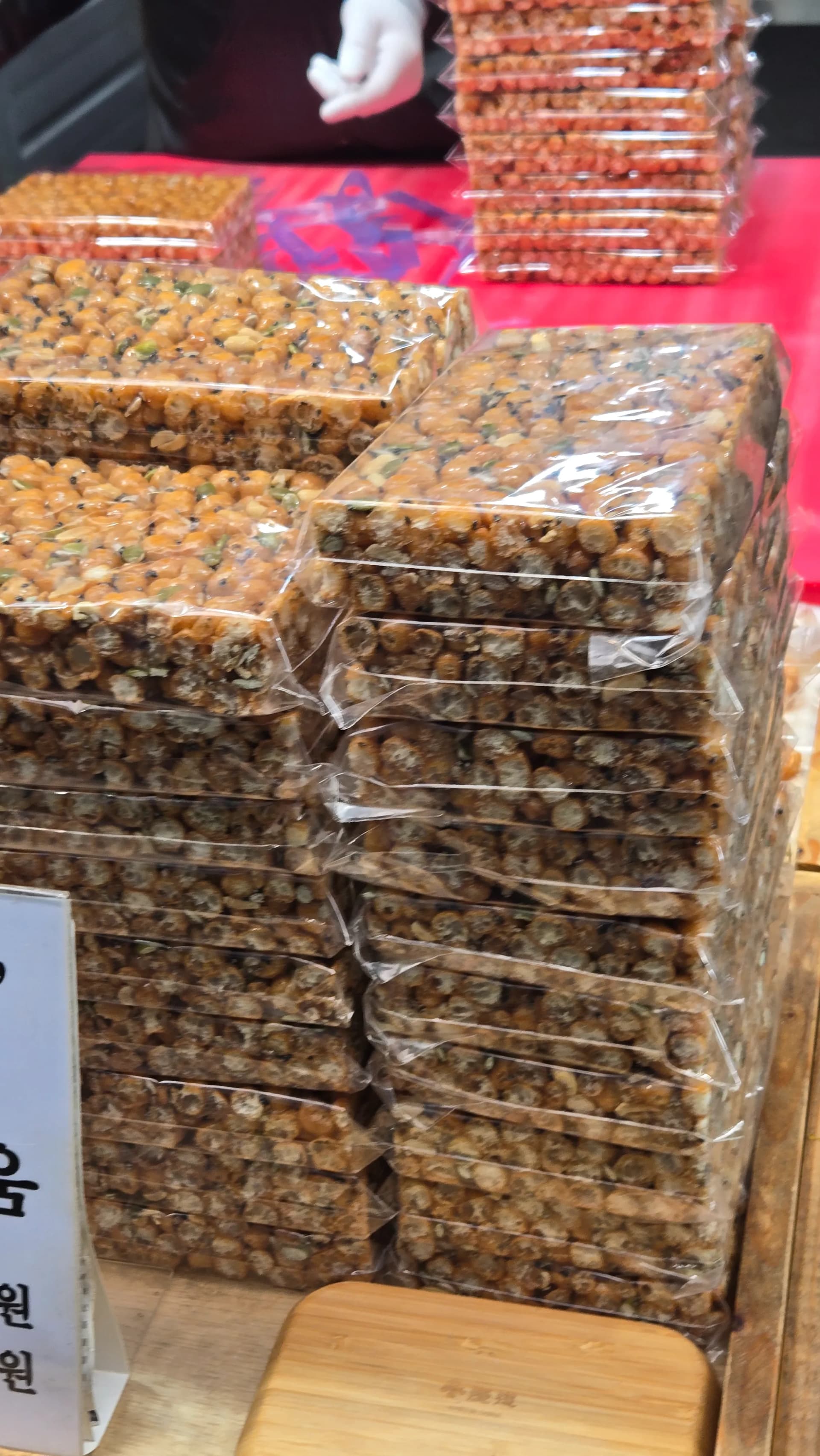
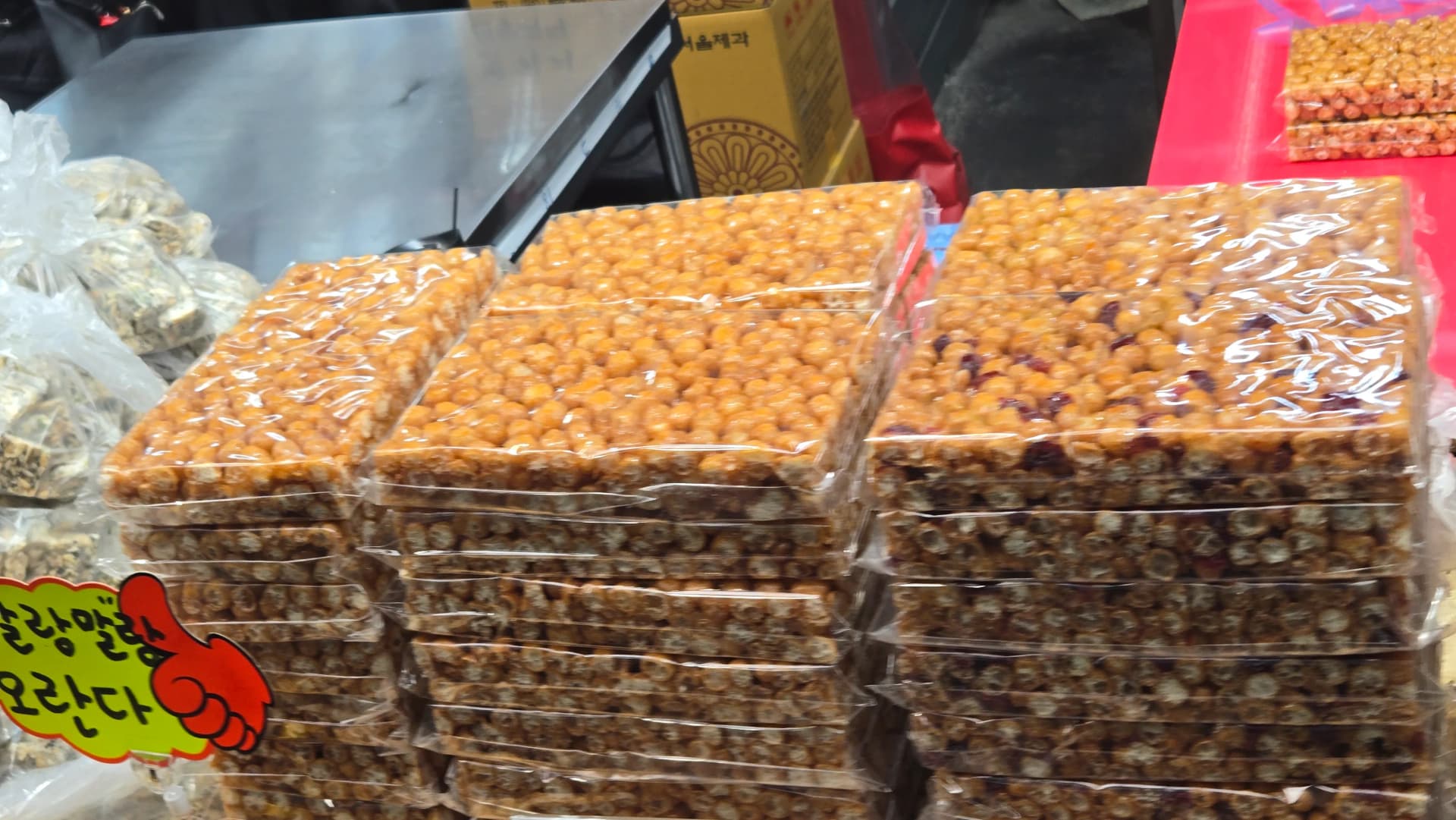
Walking through the inner alley, I noticed one entire wall lined with clear plastic bags stacked to the brim. Hangwa Gangjeong — traditional Korean confections made by binding nuts, seeds like sesame and sunflower, and grains together with rice syrup, then pressing them into firm squares. They were sorted by type into big baskets: black sesame gangjeong, sunflower seed gangjeong, pumpkin seed gangjeong, and next to those, a puffed rice version called oranda.
This isn't the kind of snack you tear open and munch on the spot. It's more of a take-home gift — you buy a few bags and bring them back for family. The aunties around me were picking out multiple bags at a time. Gangjeong is a staple for Korean holidays and ancestral rites, and it's also a familiar tea-time snack for older folks.
The closest English comparison would be "traditional Korean grain and nut brittle." If you think of a granola bar, you're in the right neighborhood — but the texture is way firmer, and the sweetness from the rice syrup has this subtle, mellow quality that's totally different from plain sugar.
Fresh Carrot Juice — The Perfect Handheld Drink for a Market Stroll
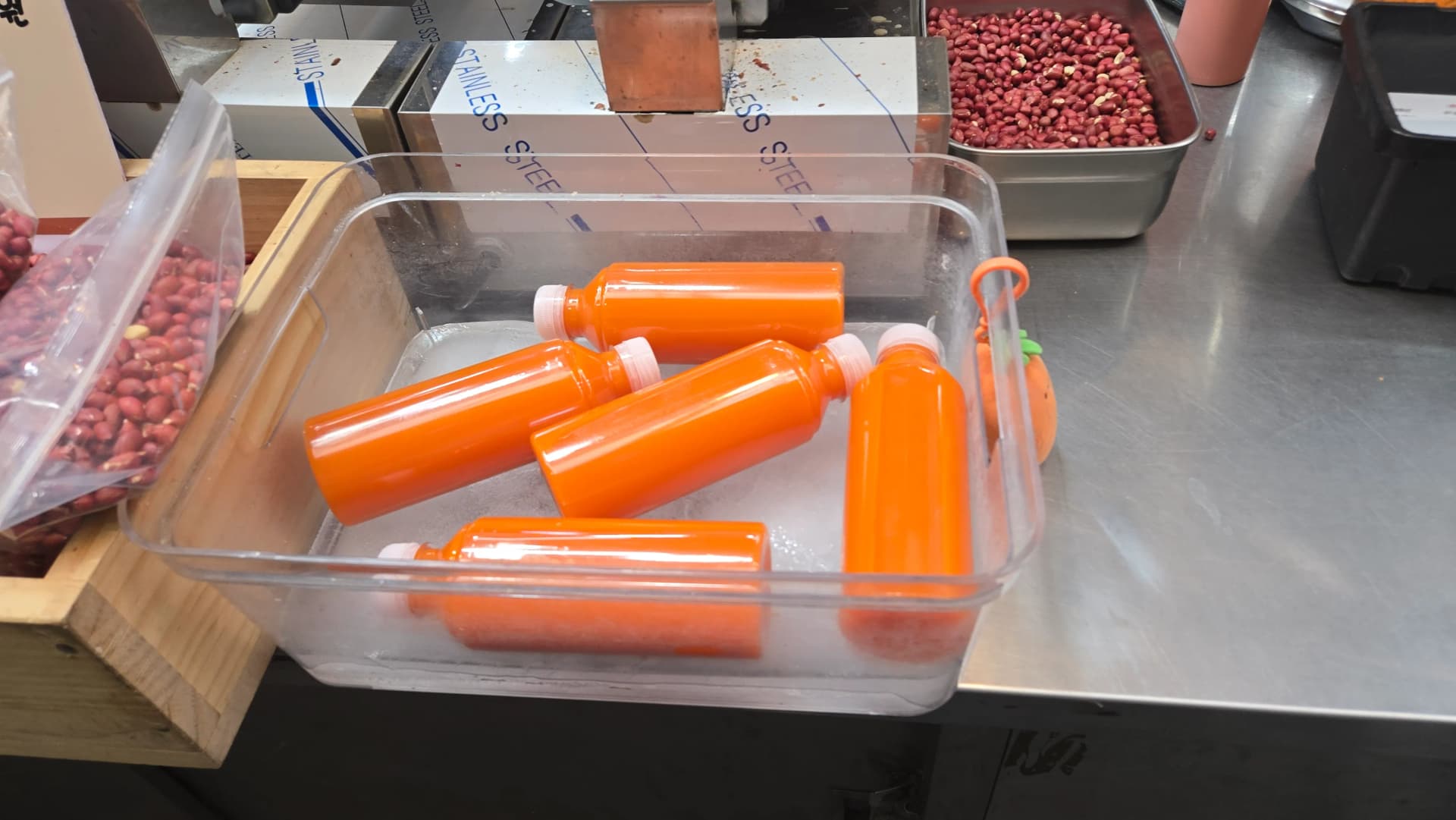
Right next to the gangjeong stall, I spotted bright orange bottles sitting submerged in ice water. 100% fresh-pressed carrot juice. The color was so vibrant, and each bottle had a cute little carrot-shaped keychain dangling from it — pretty hard to walk past without noticing. It was the perfect grab-and-go size for sipping while wandering the Seomun Market alleys.
Griddle-Fried Potatoes — Just Potatoes and Oil, Nothing Else
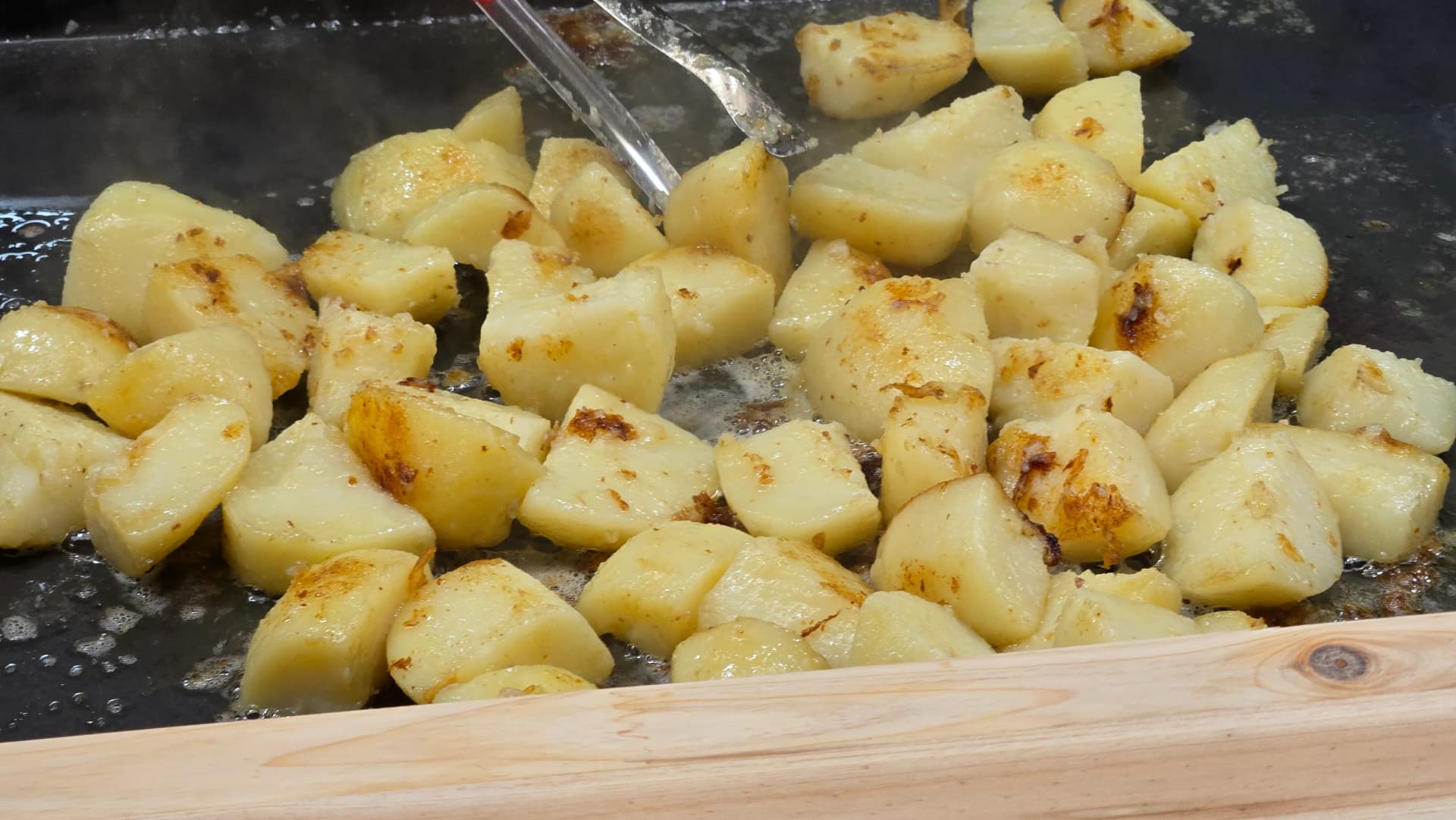
Big chunky cubes of potato were sizzling away on a flat griddle, getting fried up golden in oil. No seasoning — just potatoes and oil. Simple as it gets, but you could see those caramelized brown edges here and there, and you just knew they'd be super nutty and crispy. It's actually pretty uncommon to see potatoes done like this on a griddle at Korean traditional markets, which is exactly why it caught my attention.
Gyeongdan Skewers — Rice Ball Sticks with Over Ten Different Toppings
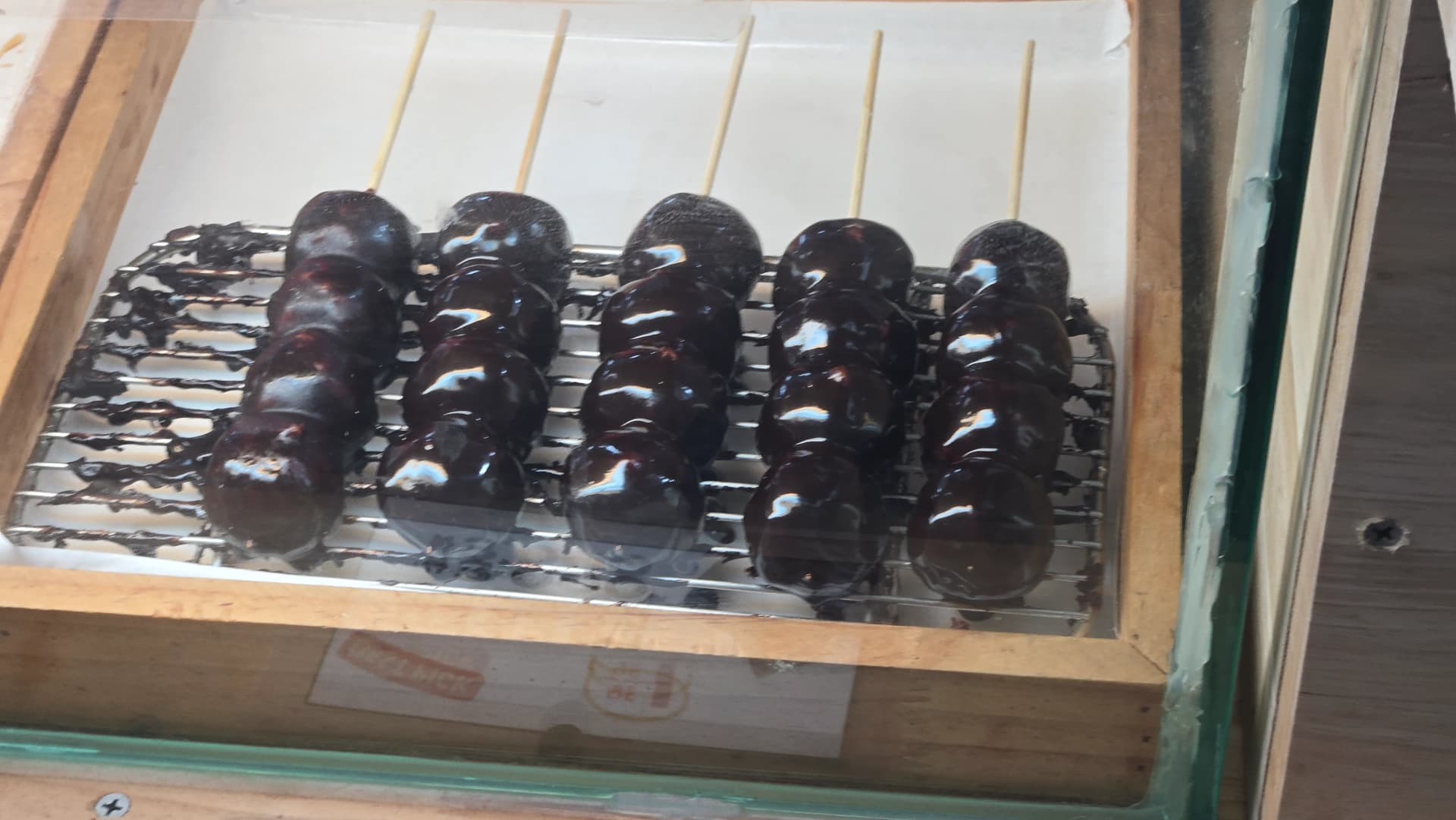
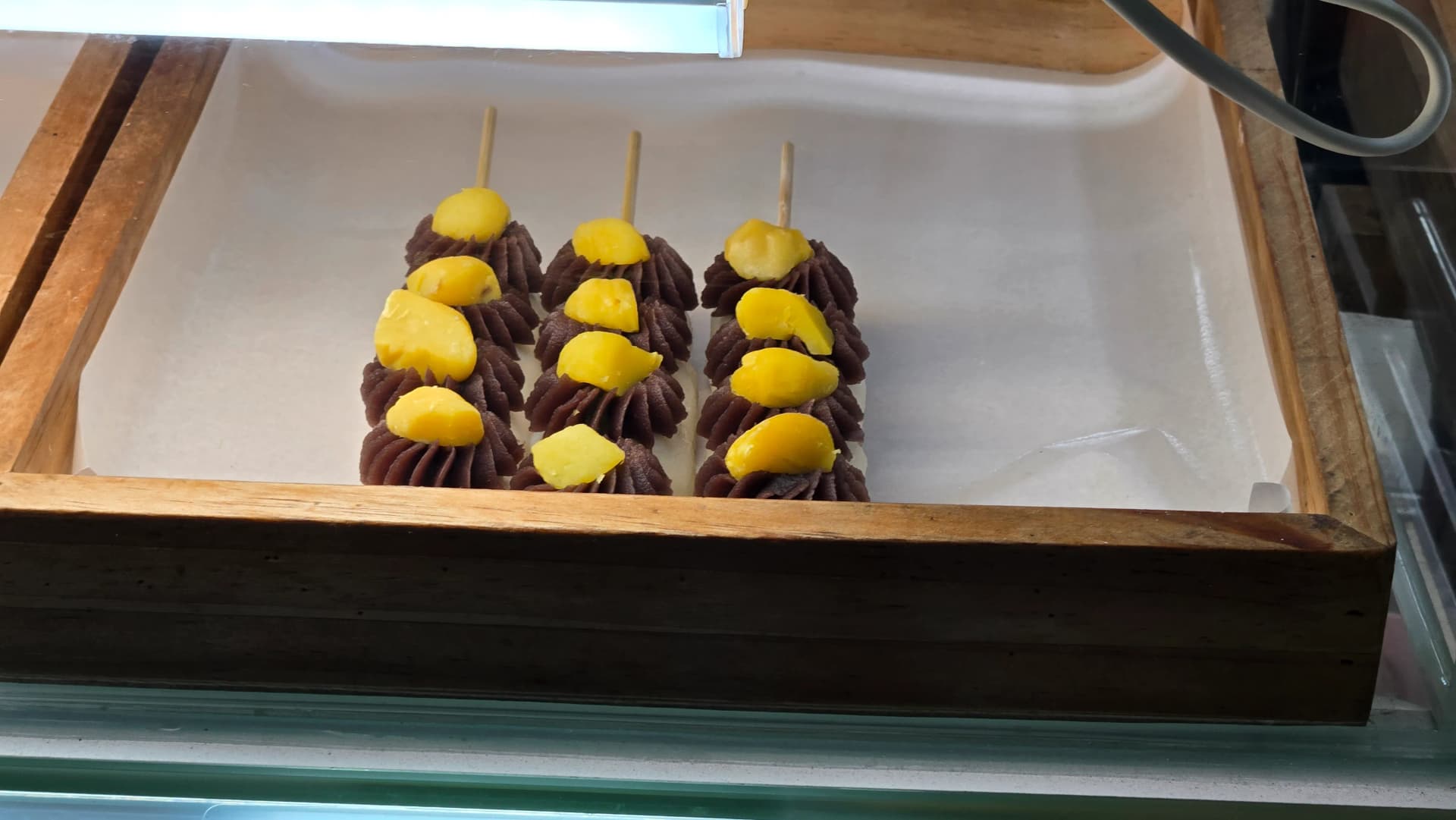
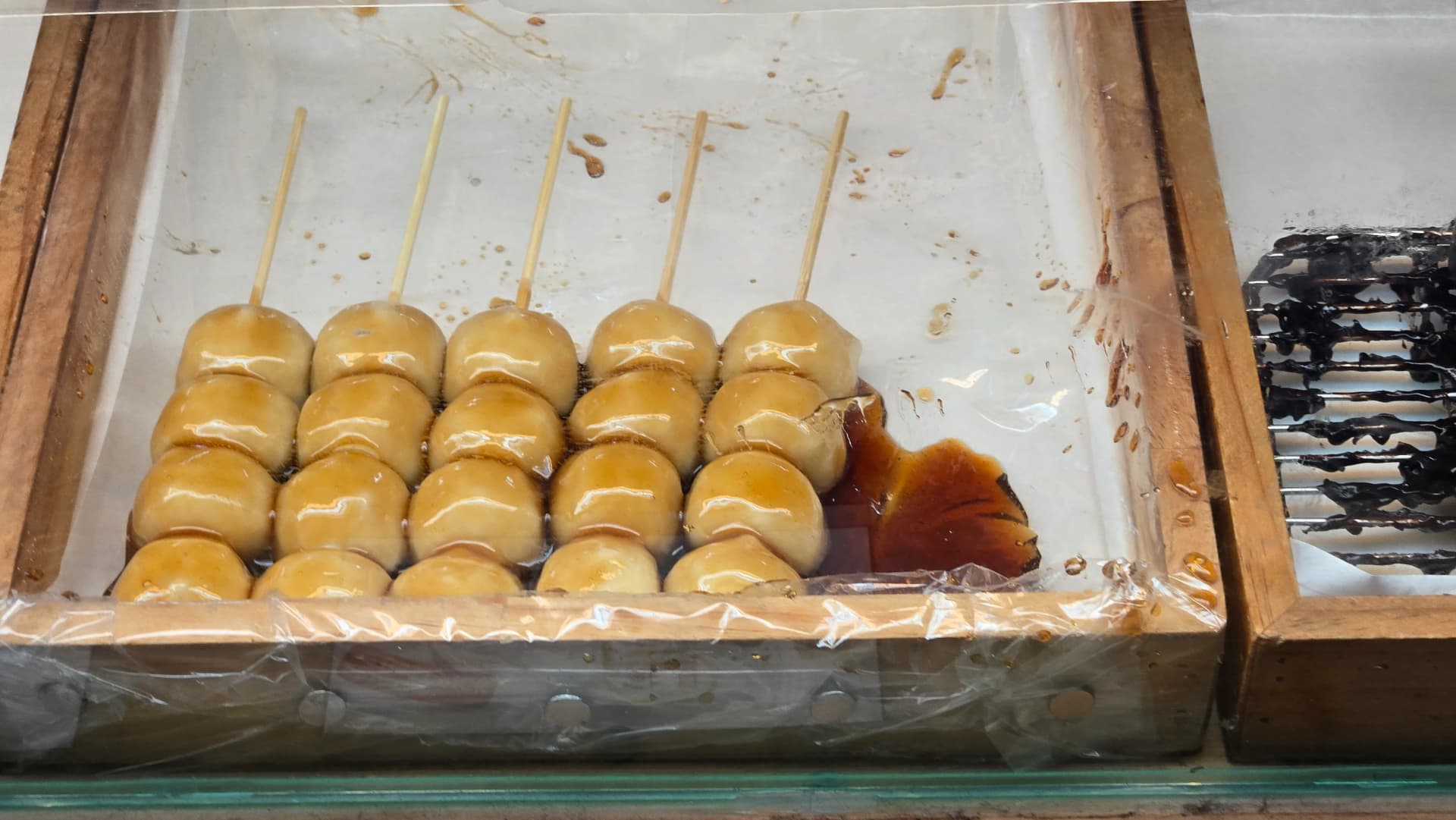
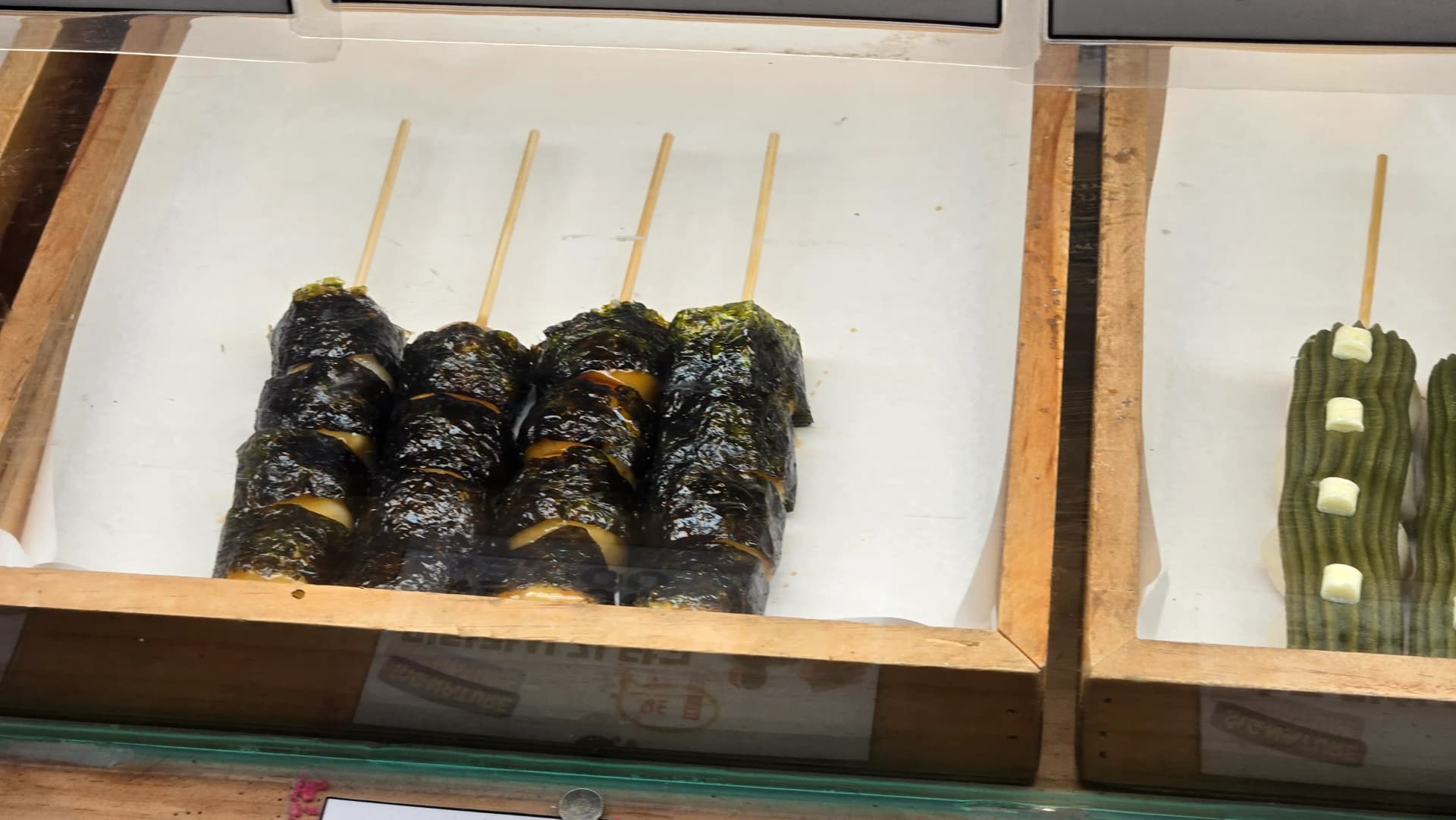
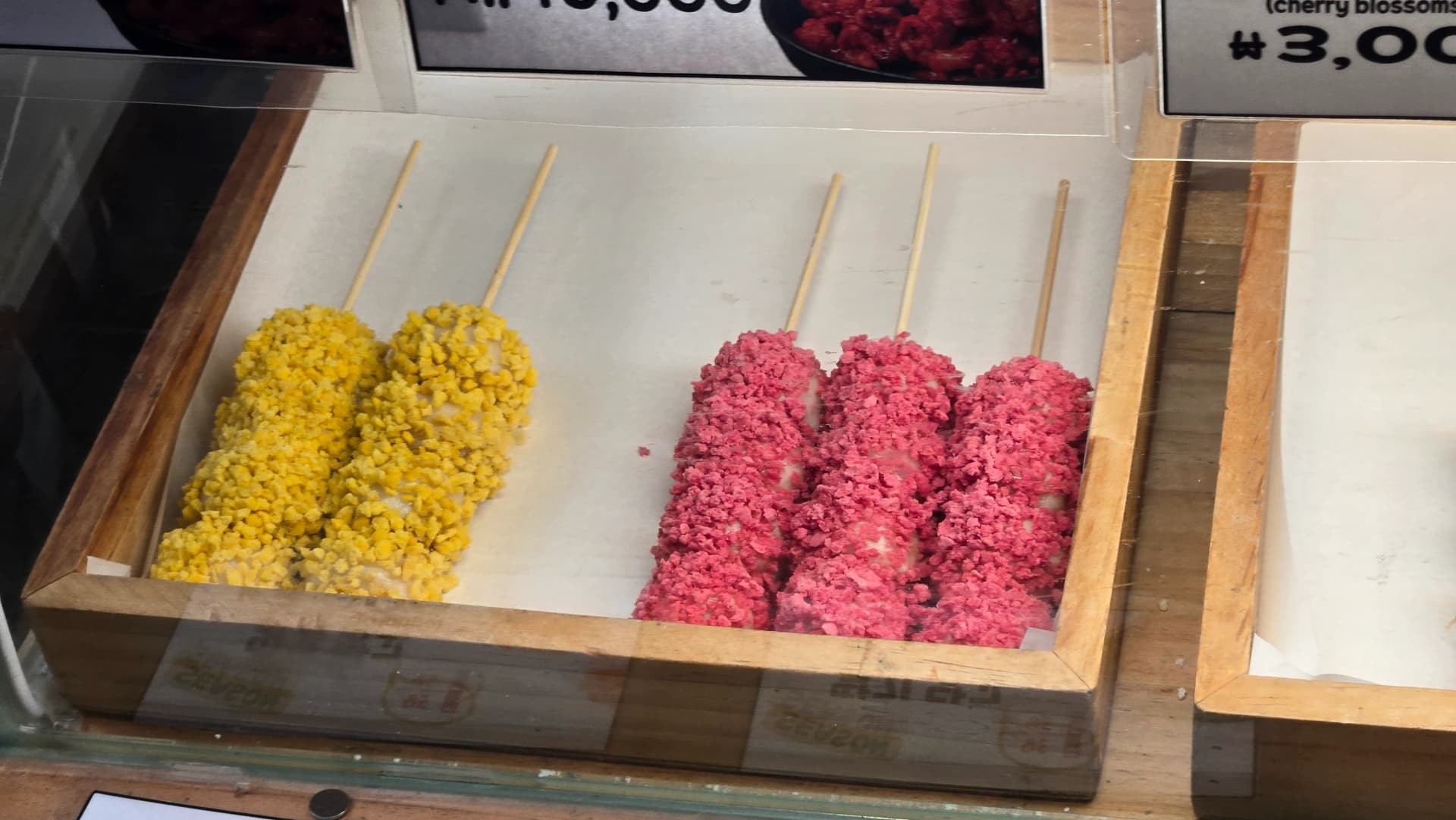
Inside the glass display case, round little rice balls were threaded 3–4 per skewer, lined up in neat rows by flavor. At first I thought they were Japanese dango, but in Korea these are called gyeongdan skewers or tteok-kkochi. They're a traditional Korean rice cake snack made from glutinous rice dough, shaped into balls and threaded onto sticks.
And the variety was seriously impressive. Some didn't even have labels so you had to go by color — deep black ones drenched in chocolate sauce, ones topped with yellow chestnut pieces over red bean paste, glossy brown ones glazed in soy sauce, and a savory version wrapped in seaweed. Next to those were green ones made with matcha dough topped with cream cheese, yellow ones coated in puffed rice crumbs, and pink ones rolled in crunchy bits — the price tag said "cherry blossoms" so I'm guessing they were cherry blossom flavored. About $2.20 each.
Honestly, I regret not buying one to try. I was so busy snapping photos just from the visuals alone, but if I'd actually tasted one, this write-up would've been so much richer. For reference, in English you'd describe these as "Gyeongdan skewer — Korean glutinous rice ball skewer with various toppings."
Hotteok — The OG Korean Street Food Griddled on a Flat Iron
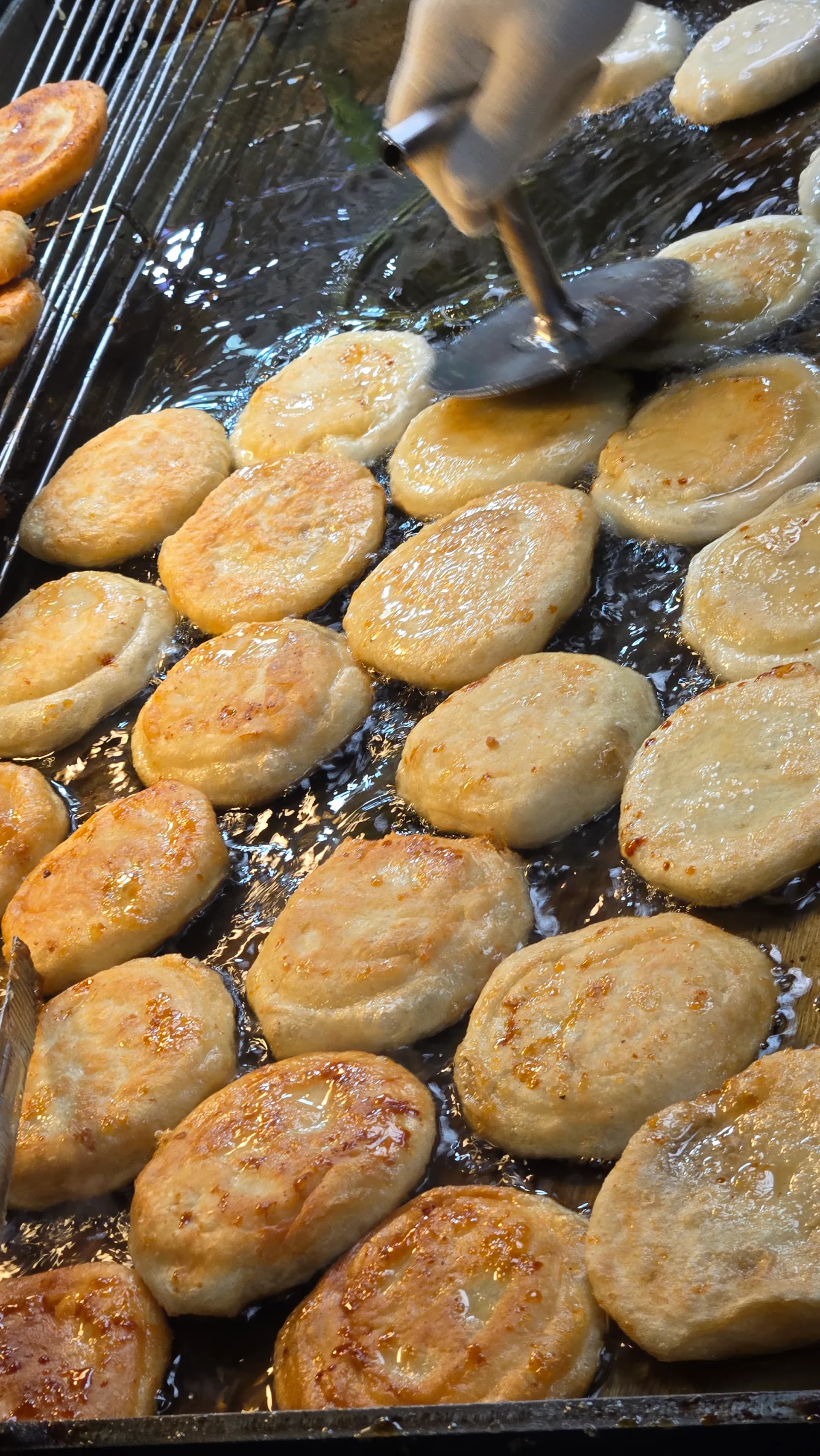
This is a different version from the deep-fried Daegu-style hotteok I showed you in Part 1. The most common type of hotteok in Korea is this kind — placed on a flat griddle and pressed down flat while it cooks. You can find this version literally anywhere in the country. It's the absolute baseline of Korean street food.
Compare the two See the deep-fried Daegu-style hotteok from Part 1While the deep-fried hotteok was round and puffy from being submerged in oil, this one is flat and thin from being pressed on the griddle. The vendor was flipping them one by one with tongs, and the toasted surface had this gorgeous golden-brown color with a glossy sheen of oil. Inside, it's the same filling — brown sugar and crushed nuts — but compared to the fried version, it's less greasy and the outer shell crisps up thinner.
If the deep-fried version was closer to a donut, this one's more like a pancake. In English: "Hotteok — Korean sugar-filled griddled pancake." If you come across hotteok on the streets during a trip to Korea, it'll most likely be this griddled version.
Gimbap — Market Gimbap Is on a Completely Different Level from Convenience Store Rolls
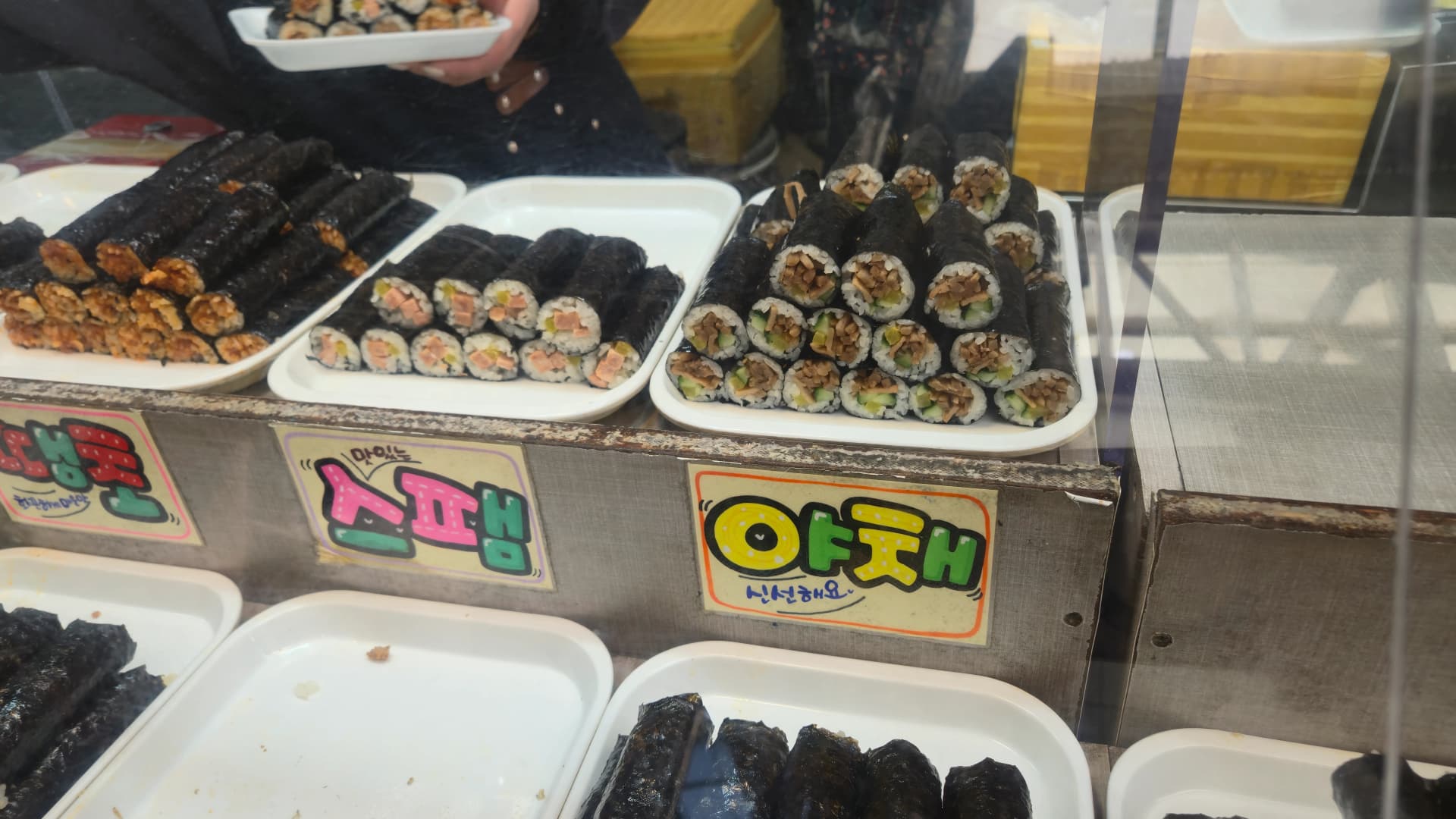
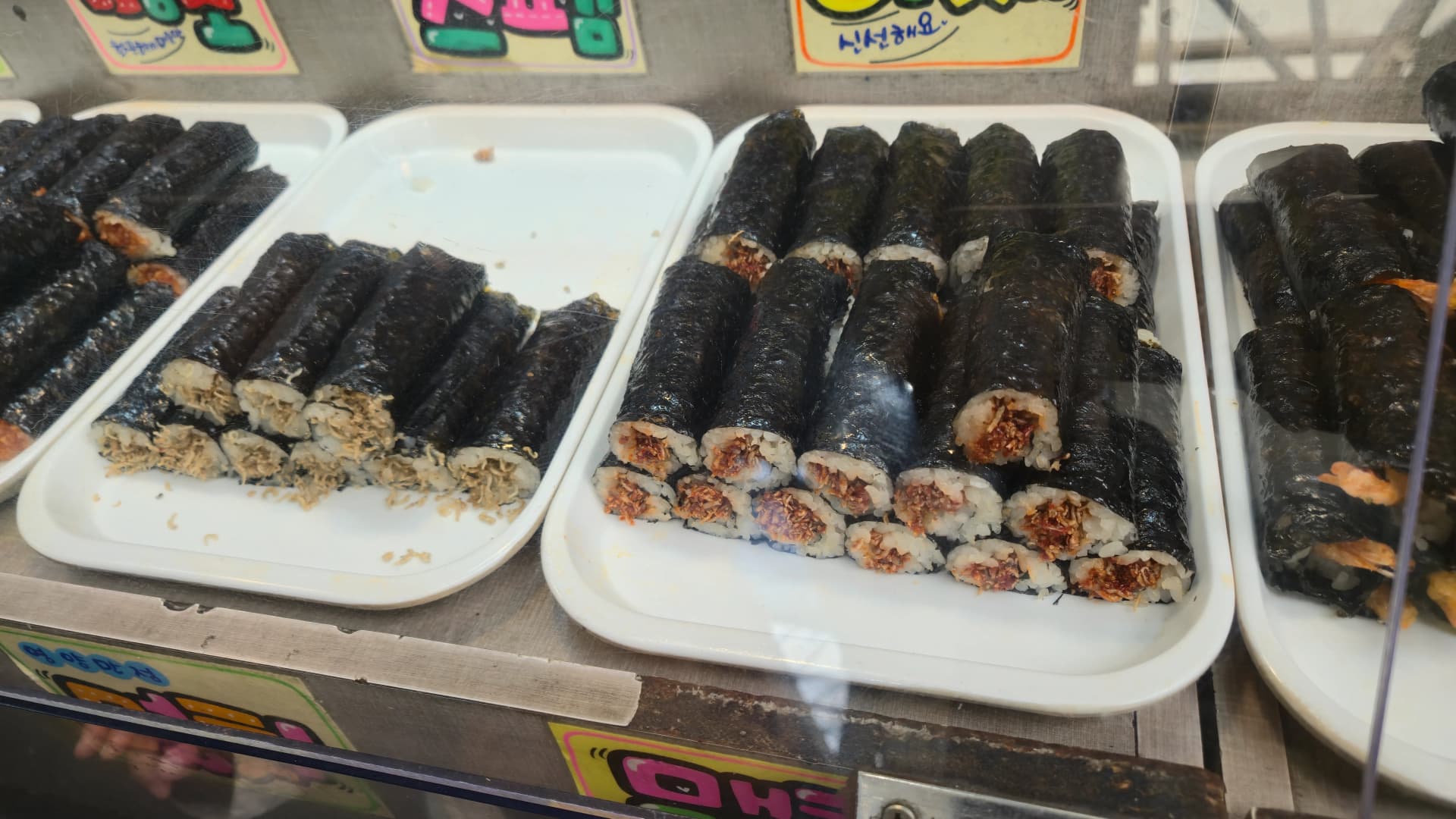
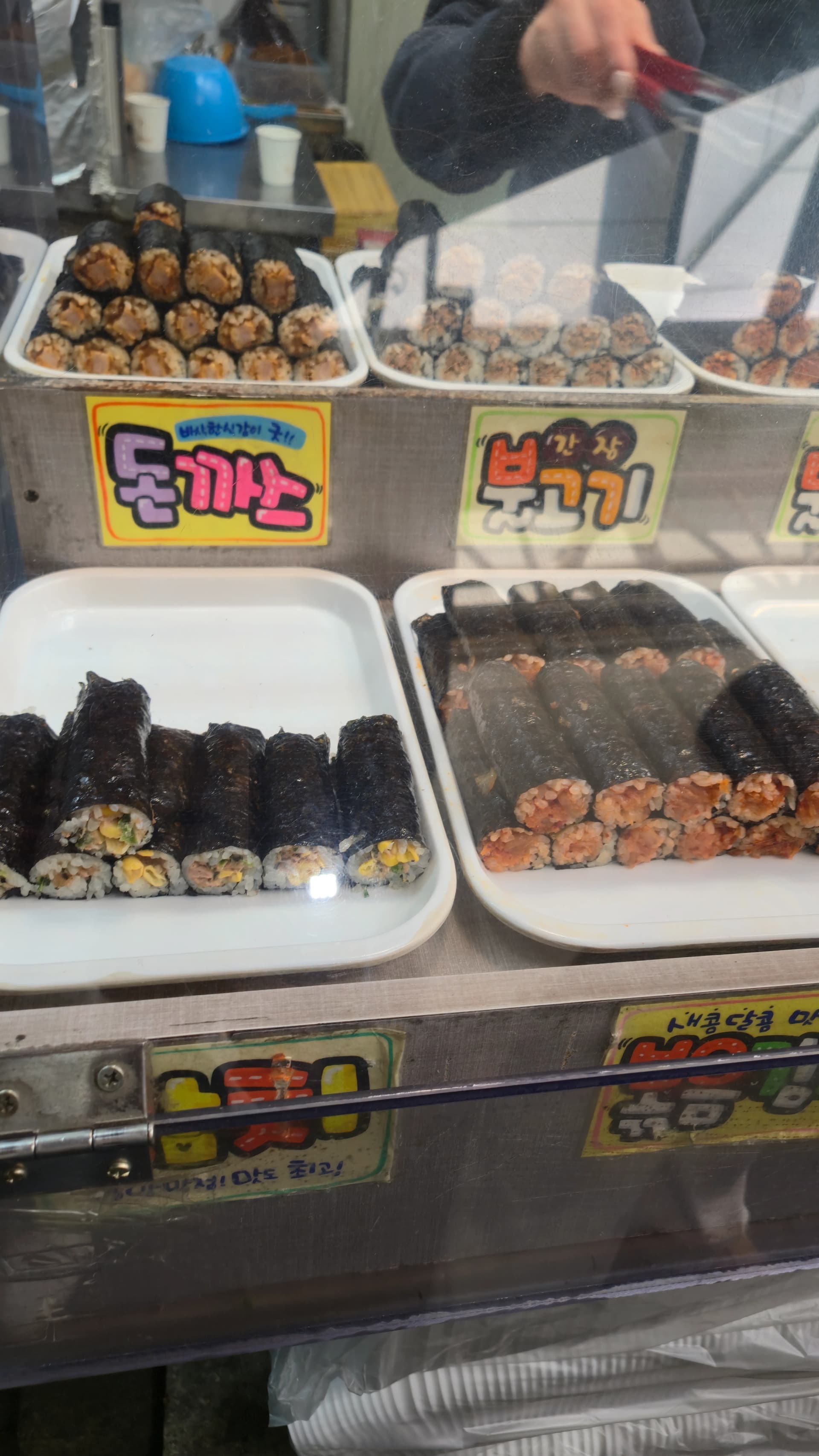
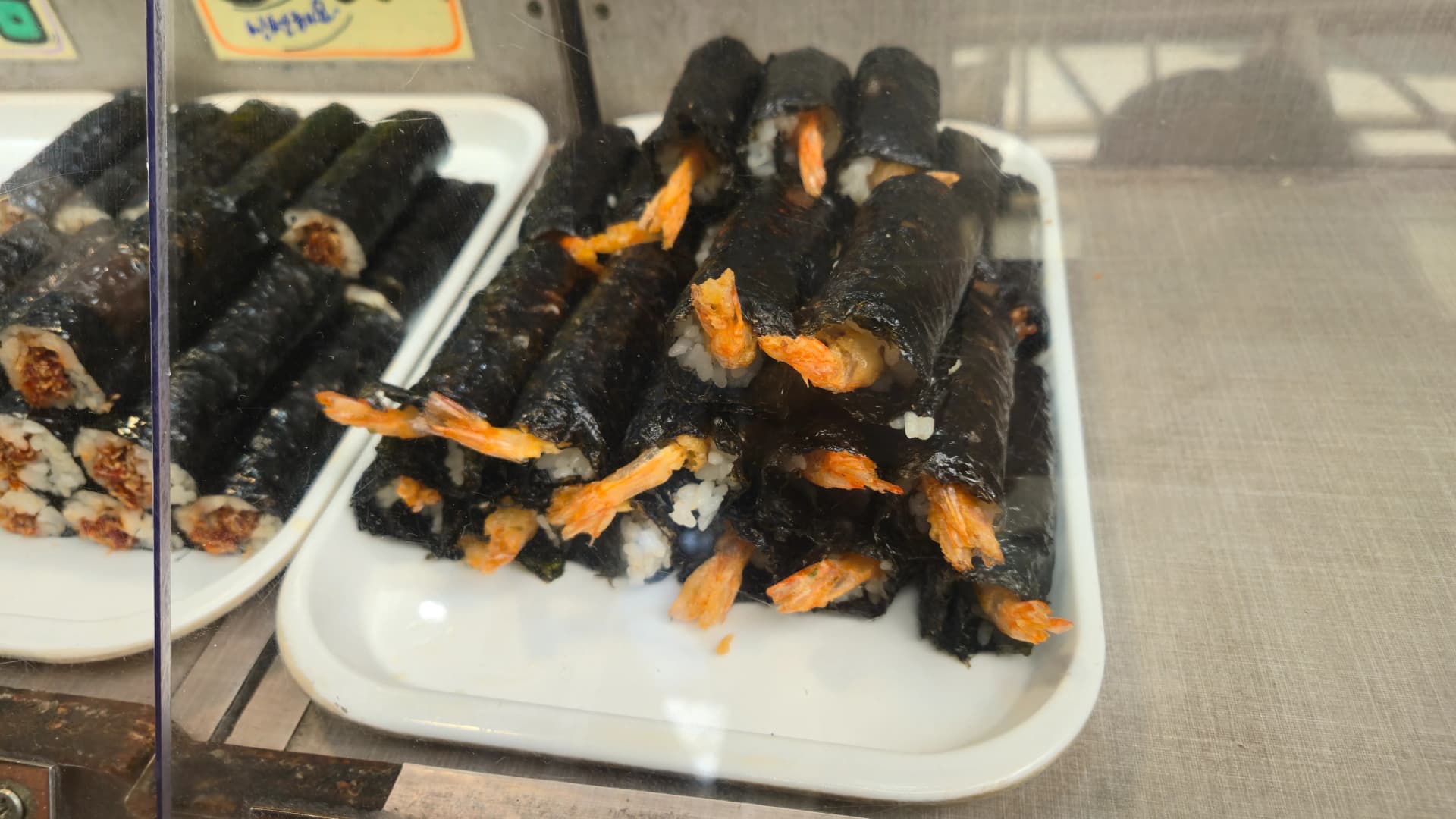
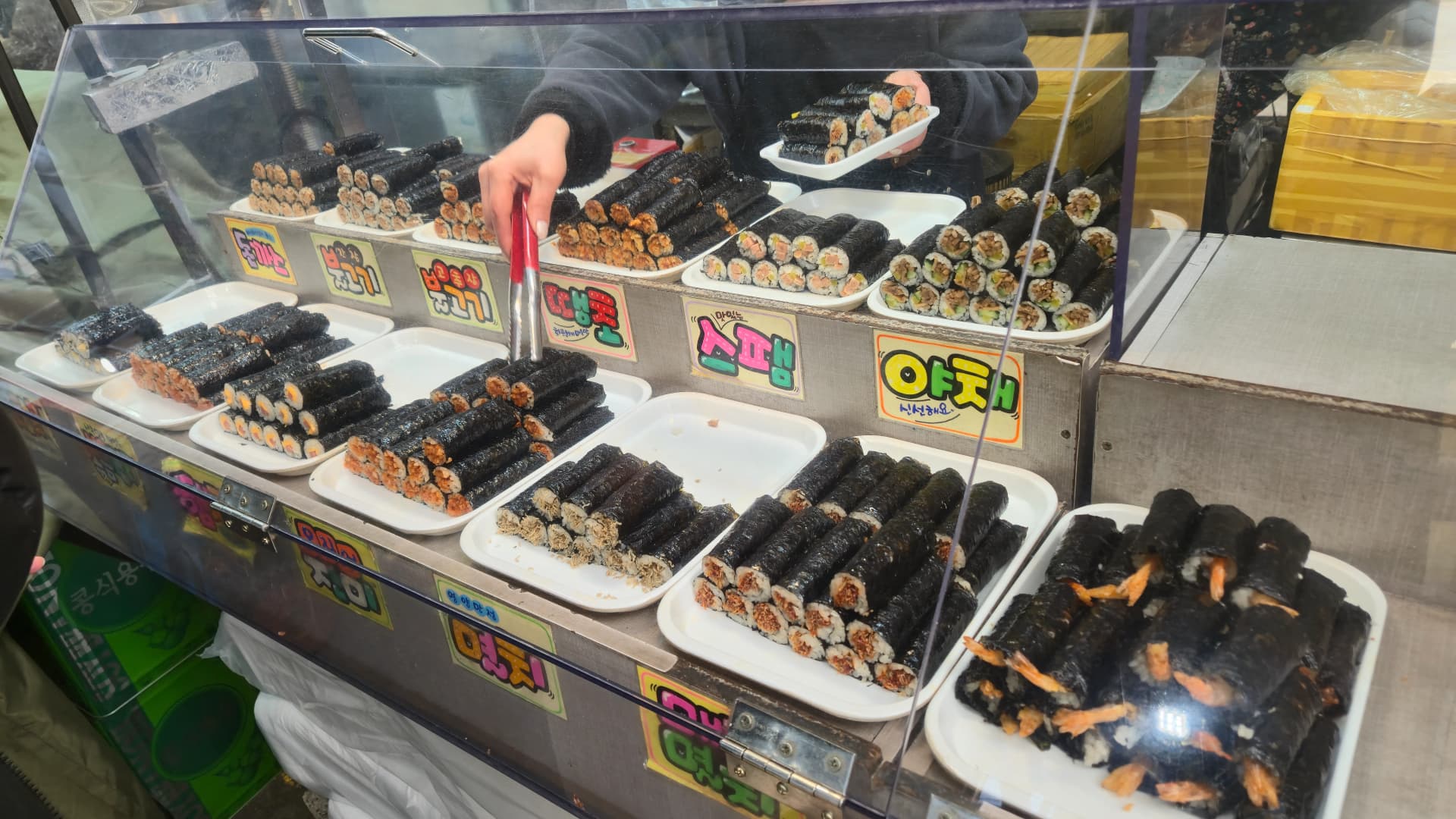
I was about to walk right past the gimbap stall, but then I saw the display and stopped dead. There were over ten varieties, each with completely different fillings. The names on the price tags — spam gimbap and veggie gimbap were just the basics. Then there was tonkatsu gimbap, soy sauce bulgogi gimbap, shrimp gimbap with a whole fried shrimp sticking out the end, anchovy gimbap, and even nude gimbap (inside-out, no seaweed on the outside).
The shrimp gimbap especially caught my eye — the fried shrimp tail was literally poking out from the end of the roll. The tonkatsu gimbap, looking at the cross-section, had an entire pork cutlet rolled inside, making it about twice as thick as a regular roll. The vendor was using tongs to place them one by one onto plates for customers, and there was a solid line forming. Sure, you can buy gimbap at any convenience store, but market gimbap is a whole different game — the sheer amount of filling is just incomparable.
For anyone seeing gimbap for the first time, a lot of people think of Japanese sushi — but they're completely different foods. Sushi is raw fish on vinegared rice, while gimbap is seaweed with rice spread on it and various cooked ingredients rolled inside. Since there's nothing raw, it's perfect for eating with your hands on the go. In Korea, gimbap is the go-to food people pack for picnics and day trips.
Mukbap, Udon & Noodles — The Quick Meal Noodle Corner at Seomun Market
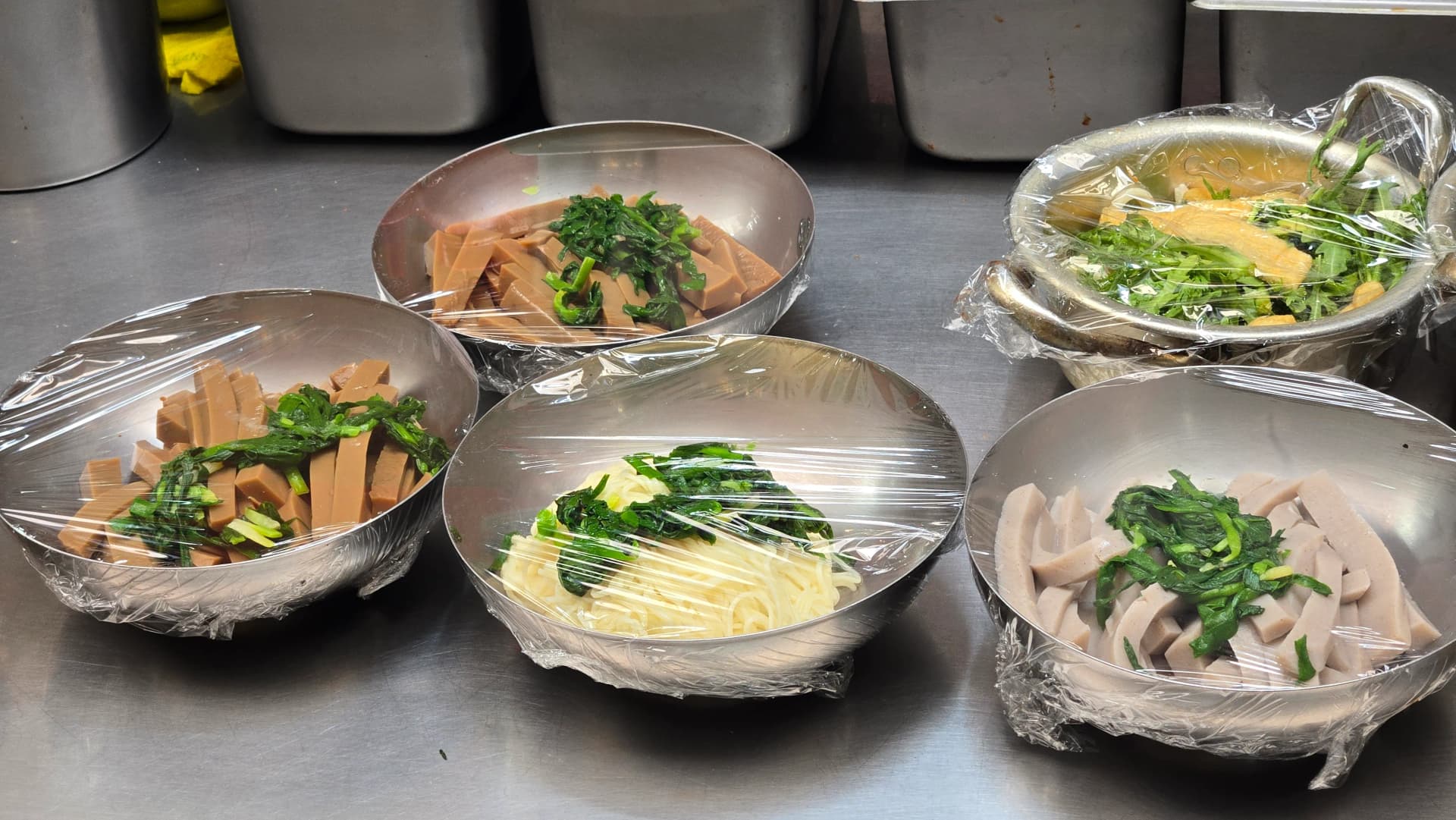
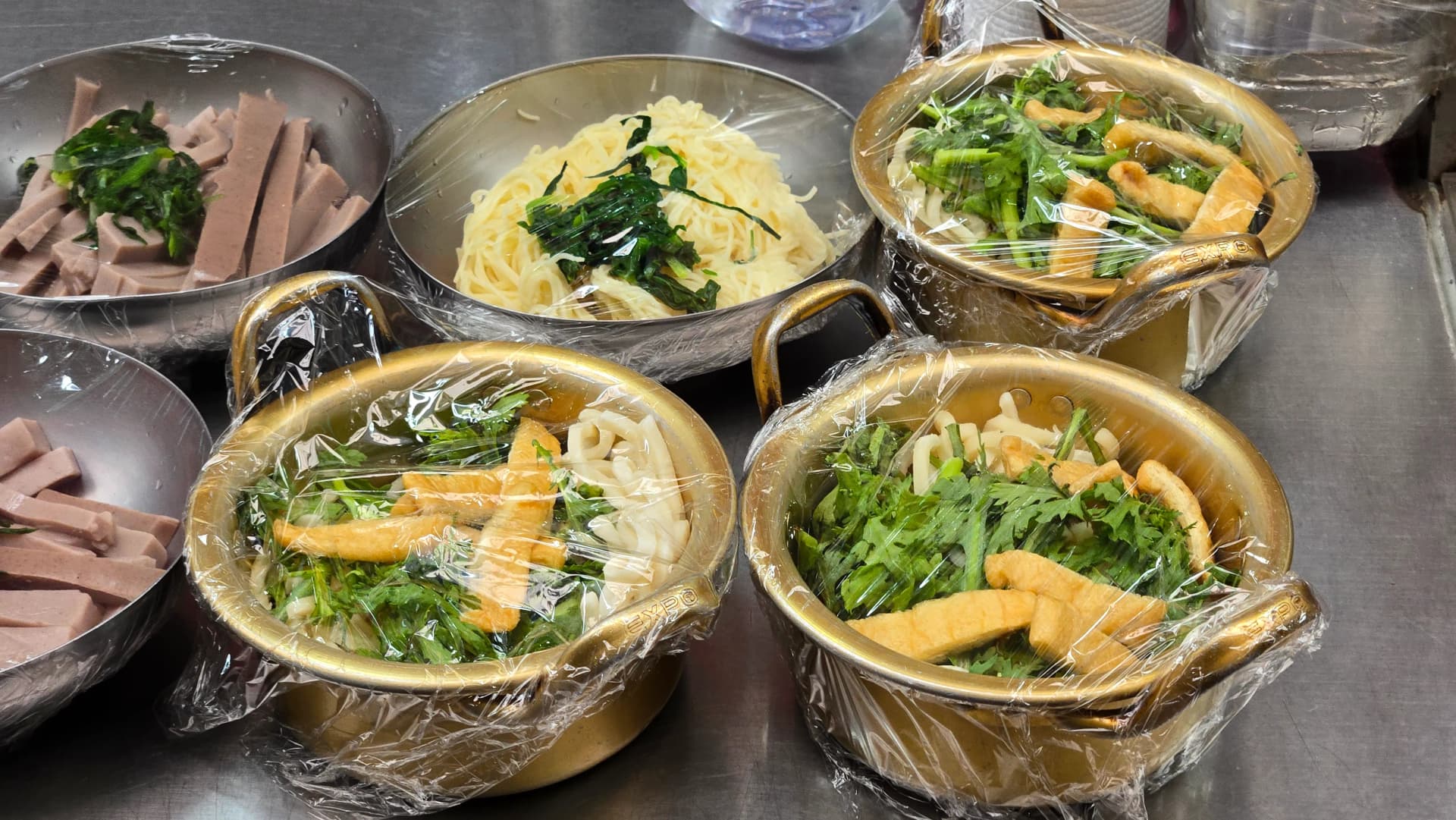
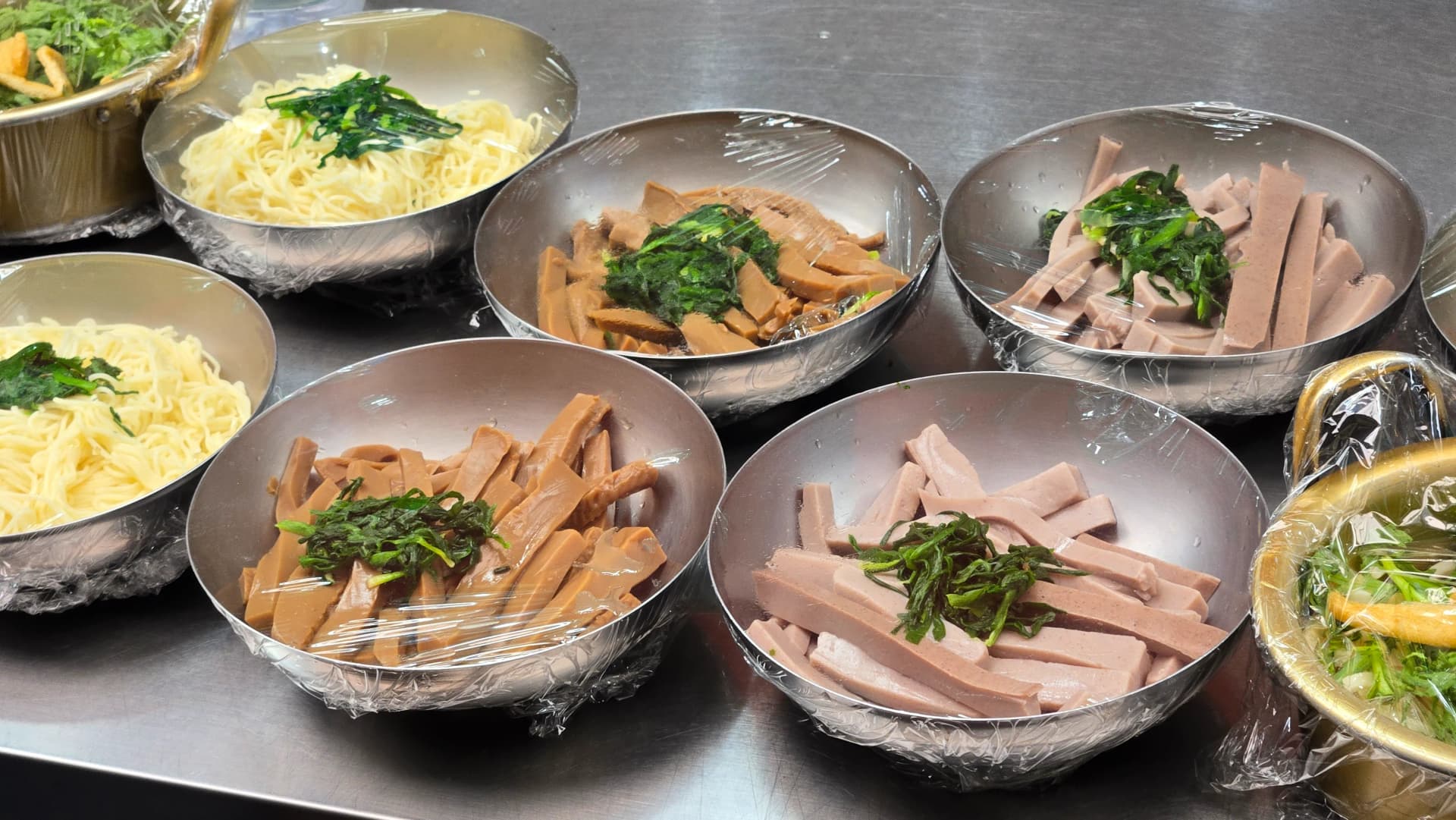
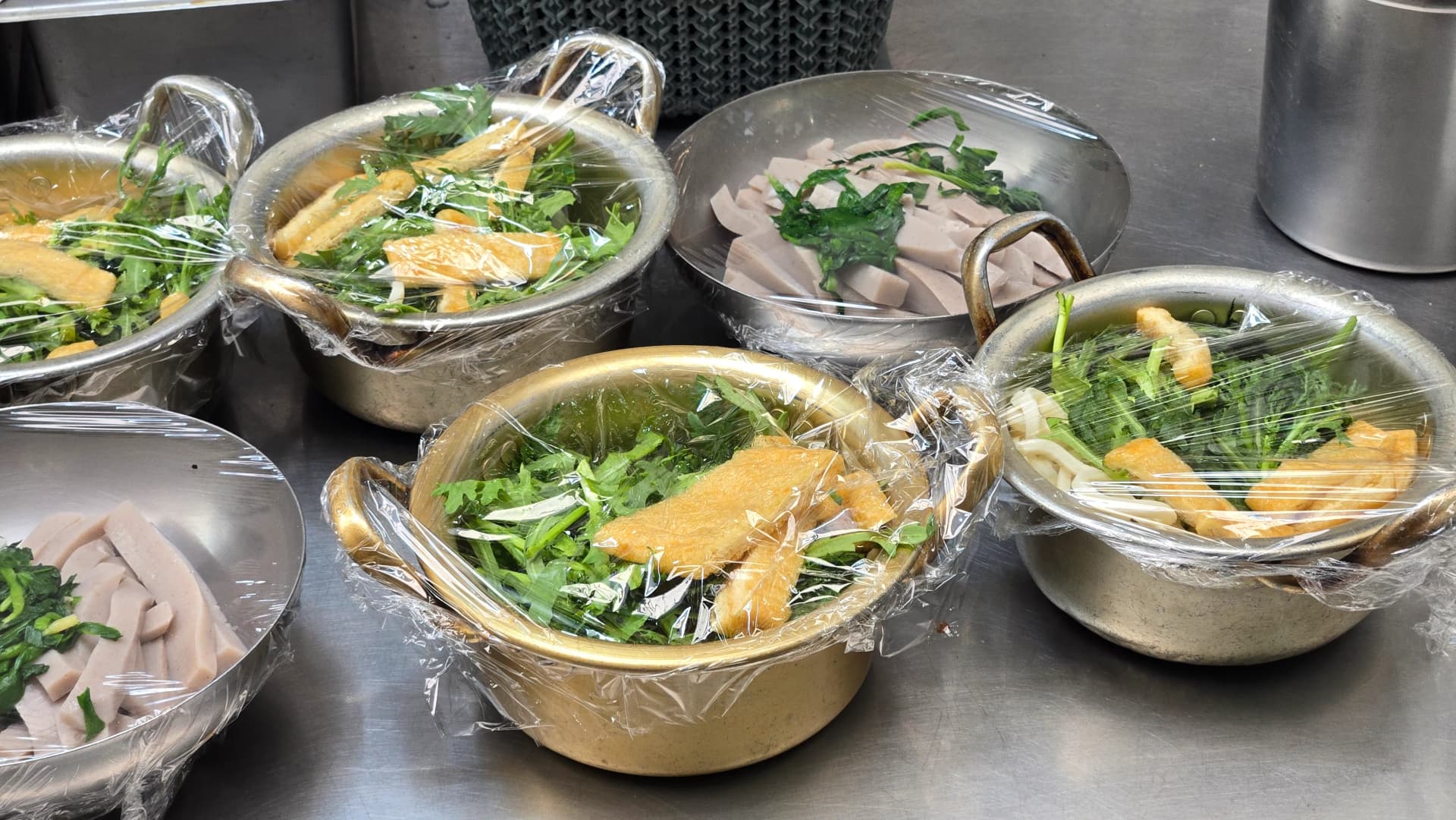
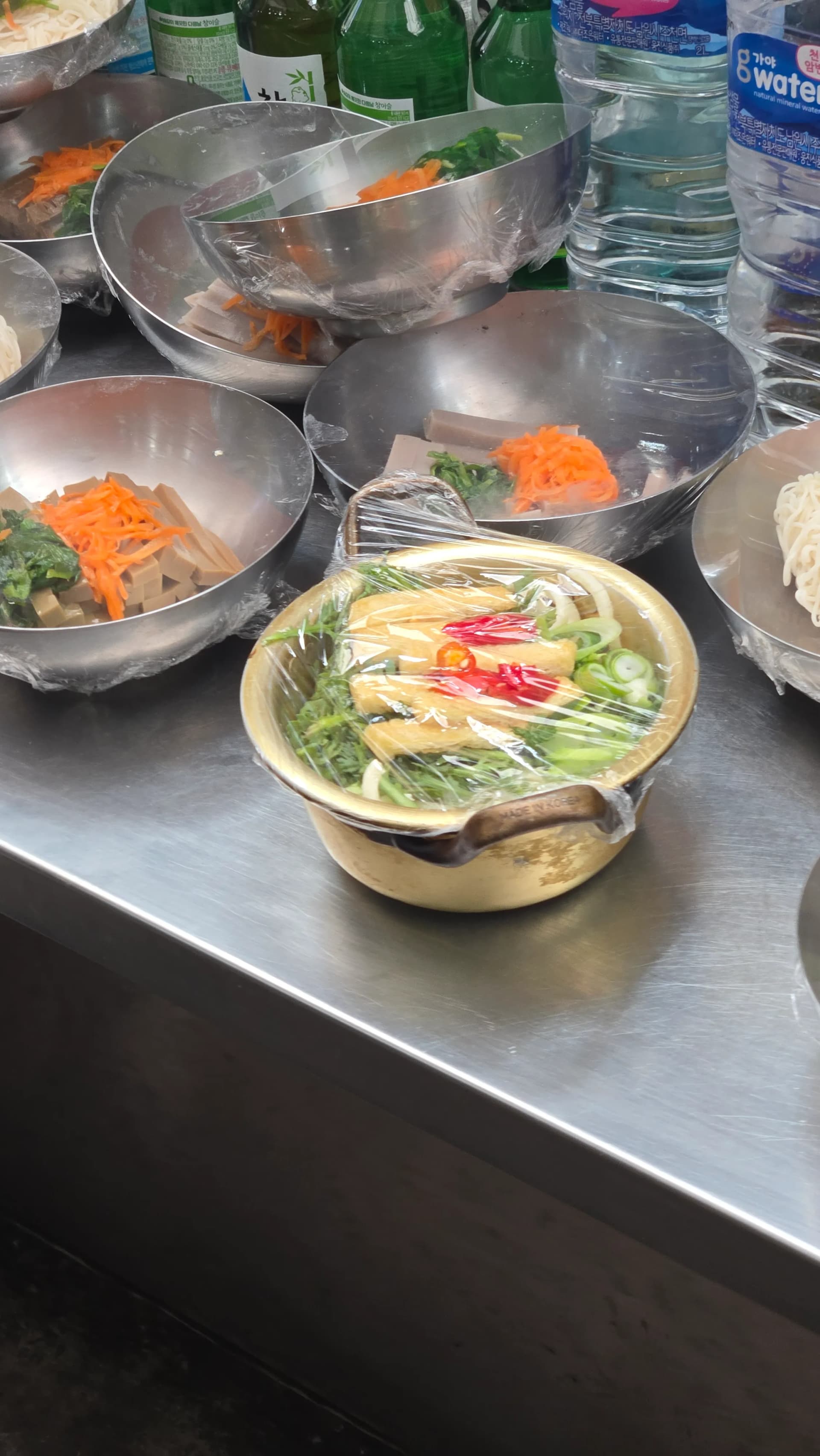
Deeper into the market, there was a section where several stalls were lined up side by side — a quick-meal noodle corner. Menu boards hung overhead, and mukbap, udon, and noodle dishes were all clustered in one zone. It felt like this was where people naturally gathered when they wanted to sit down and have a proper meal.
The way they set things up was pretty unique. For mukbap, the muk jelly and toppings were pre-portioned in bowls, and when someone ordered, they'd pour hot broth over it right there to finish the dish. Next to that, thin wheat noodles and udon were stacked in individual plastic-wrapped portions. Since the noodles were pre-boiled and packaged, all they had to do was heat up the broth and serve — so the turnover was super fast. A single stall was running three or four different noodle types at once.
There were also two types of muk sitting side by side, and they looked different in both color and texture. I'm pretty sure it was acorn muk versus buckwheat muk, but there were no labels so I can't say for certain. For reference, muk is a jelly-like food made by solidifying acorn or buckwheat starch. You eat it drizzled with seasoned soy sauce, and the texture is this soft, wobbly, slippery thing that's actually pretty satisfying.
Bungeoppang — The Winter Street Snack That's Evolved Way Beyond Red Bean
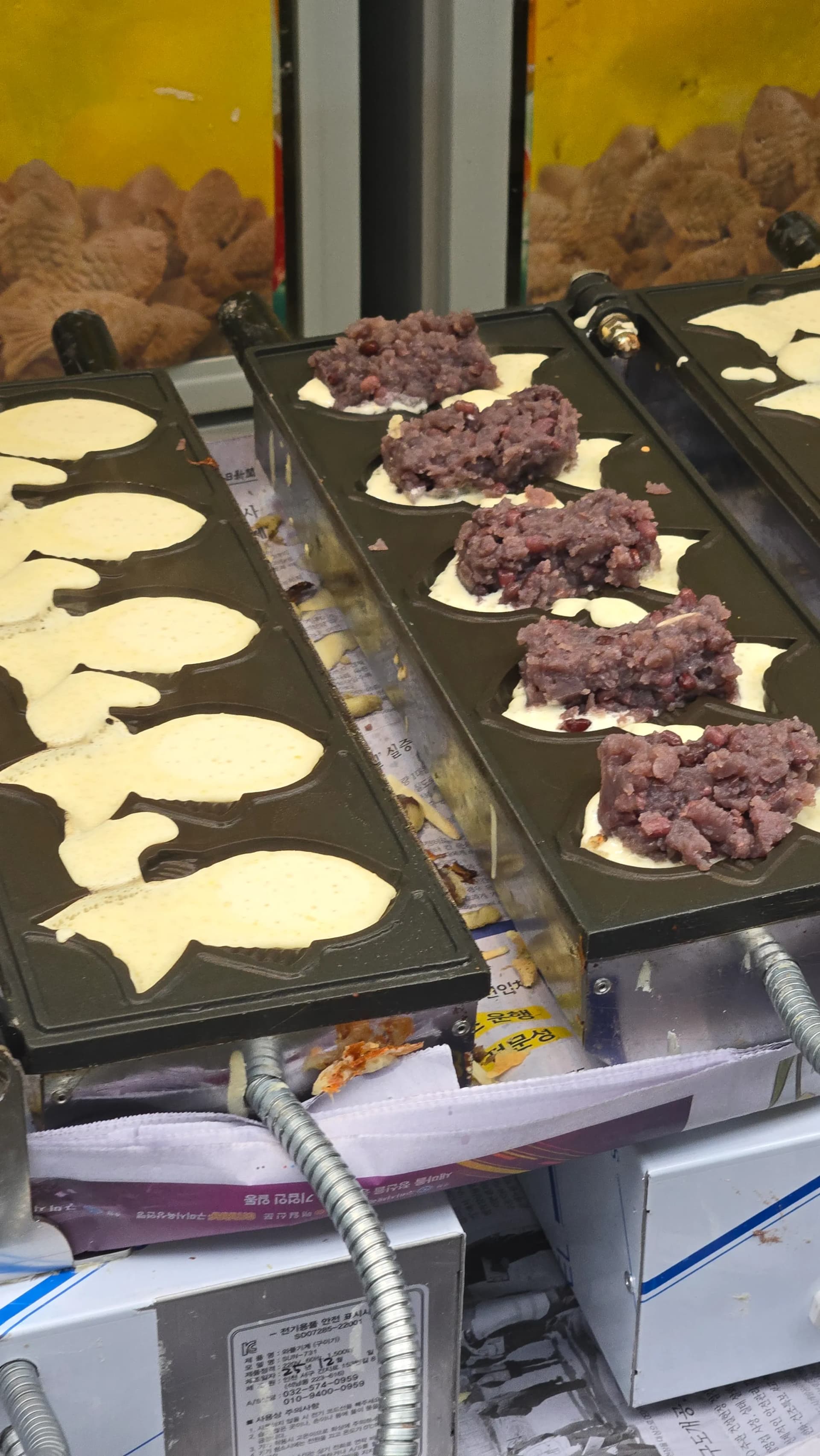
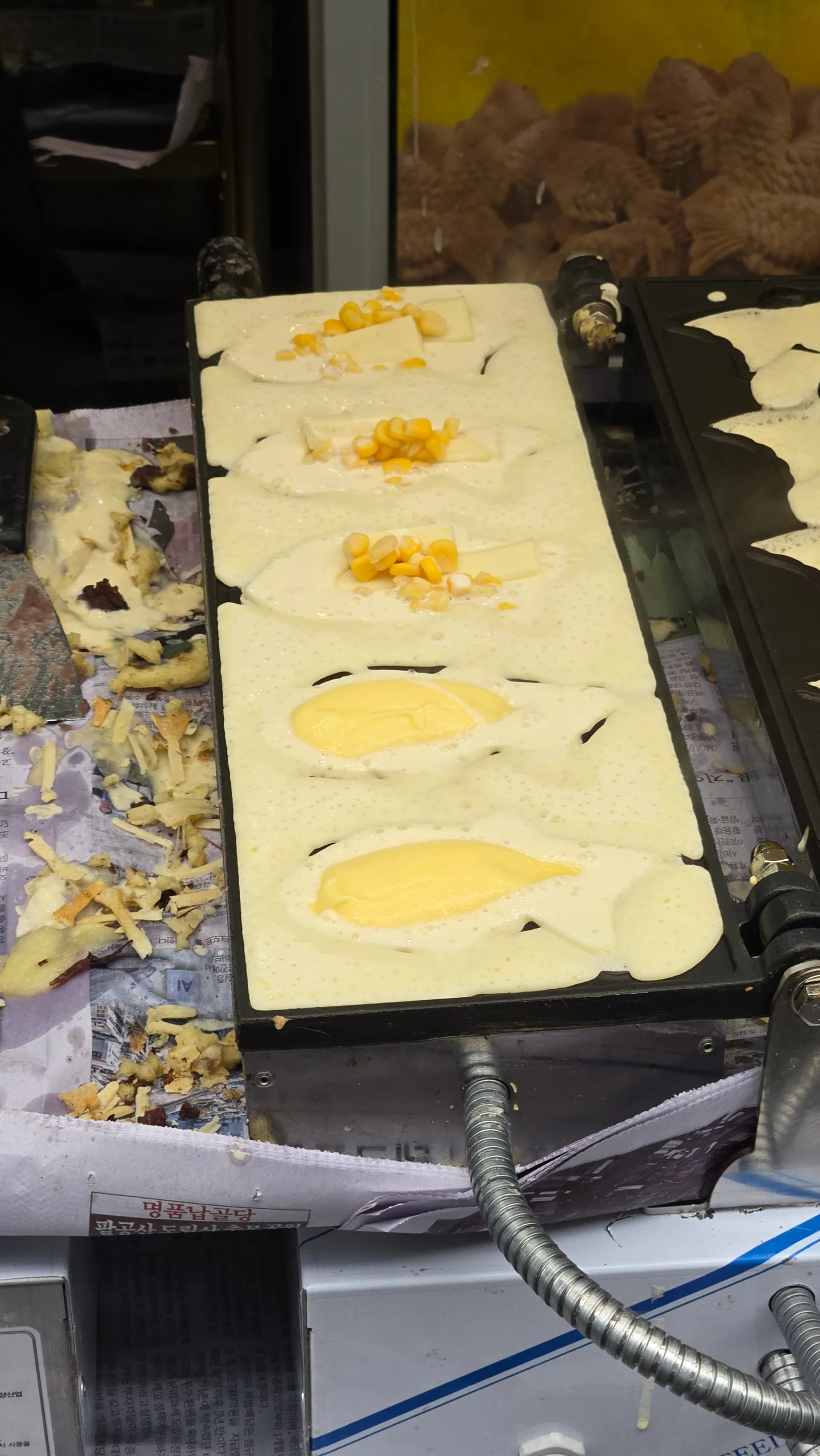
I could see batter spread into fish-shaped iron molds with a generous heap of sweet red bean paste piled on top. Behind the glass, there was already a mountain of finished bungeoppang stacked up. They were really loading in the red bean — it looked like there was more filling than batter.
But looking at the mold next to it, the fillings were different. Some had bright yellow custard cream, and others had corn kernels and cheese chunks on top. These days, bungeoppang (Korean fish-shaped pastry) has long moved past the red-bean-only era. Cream, sweet potato, cheese corn — spin-off flavors keep popping up, and it's now totally normal for a single stall to bake two or three flavors at once. It's an absolute must-try Korean street food if you're visiting Korea in winter.
Peanut Jeonbyeong — That Crunchy Old-School Snack from Grandma's House
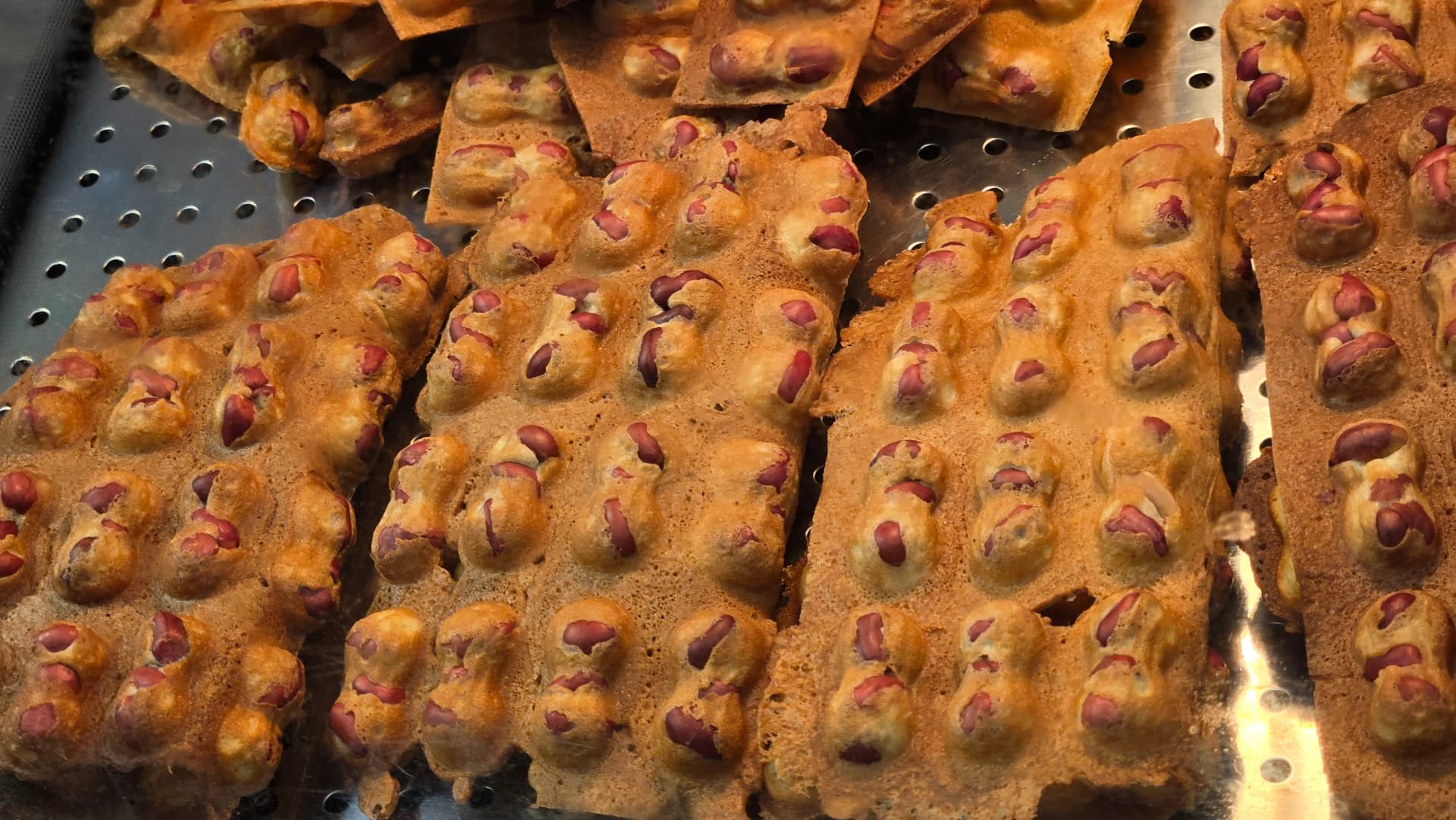
There were these flat, crispy wafers with whole peanuts embedded right into the batter. They looked like they'd been pressed in some kind of waffle iron — they came out as thin, flat sheets with individual peanuts poking out all over. Usually called peanut jeonbyeong or peanut gwajul, they're made by mixing a bit of sugar into flour batter, packing in as many peanuts as possible, and pressing the whole thing flat on an iron griddle. That crunch when you bite down followed by wave after wave of nutty, toasty peanut flavor — it's pure nostalgic old-school Korean snack vibes.
Pyeonyuk — Boiled and Pressed Pork Slices
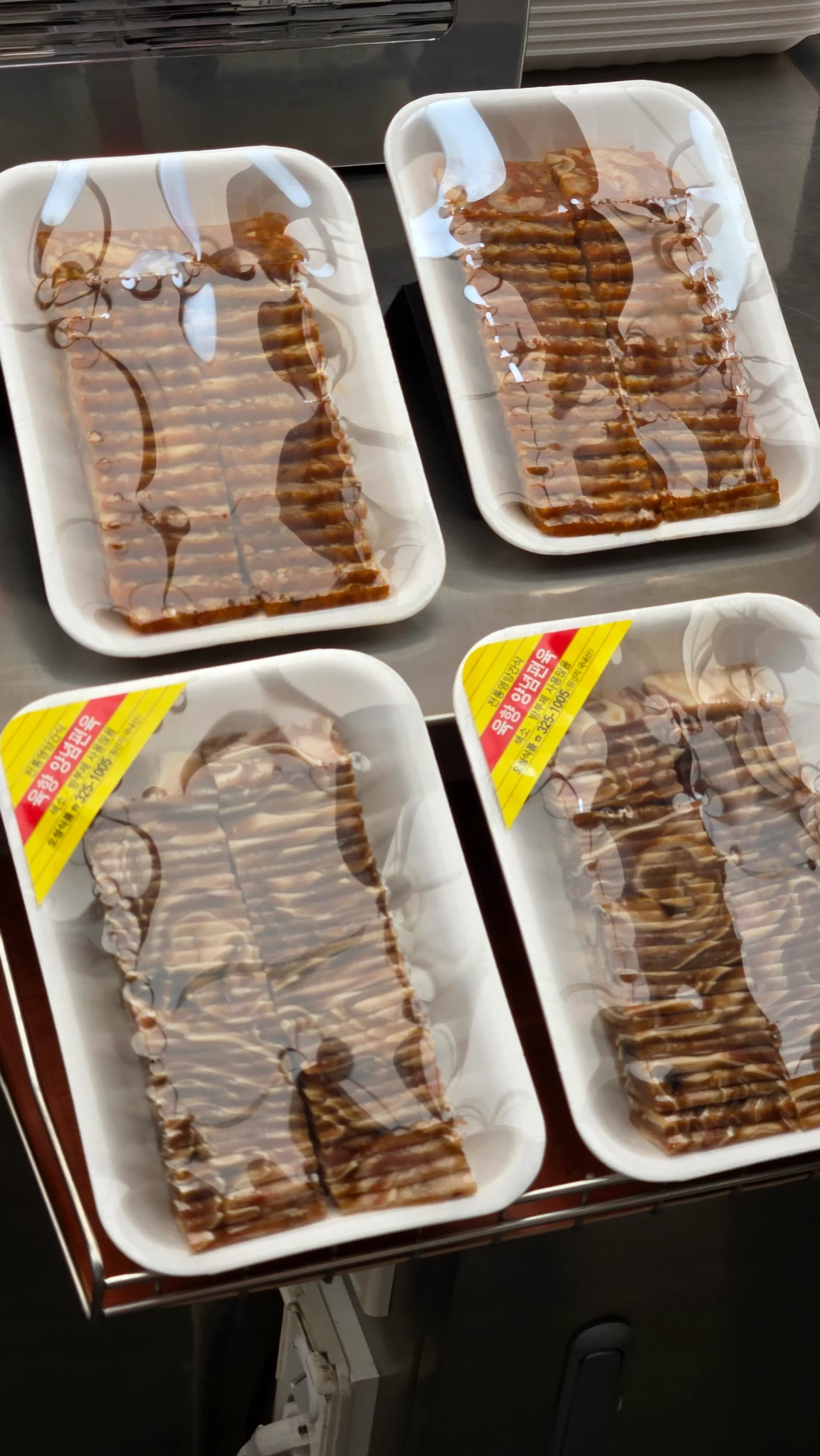
These were being sold on styrofoam trays wrapped in plastic film. Pyeonyuk is pork shoulder or shank that's been slow-boiled for a long time, then pressed into a firm block and sliced thin. You can see the cross-section showing alternating layers of lean meat and fat. The standard way to eat it is dipped in salted shrimp sauce or mustard sauce, and it works great as a drinking snack too. It's a staple on Korean holiday and ancestral rite tables, and at the market, plenty of people were buying whole trays of the pre-made stuff to take home.
Jokbal — Soy-Braised Pig's Feet Packed with Collagen
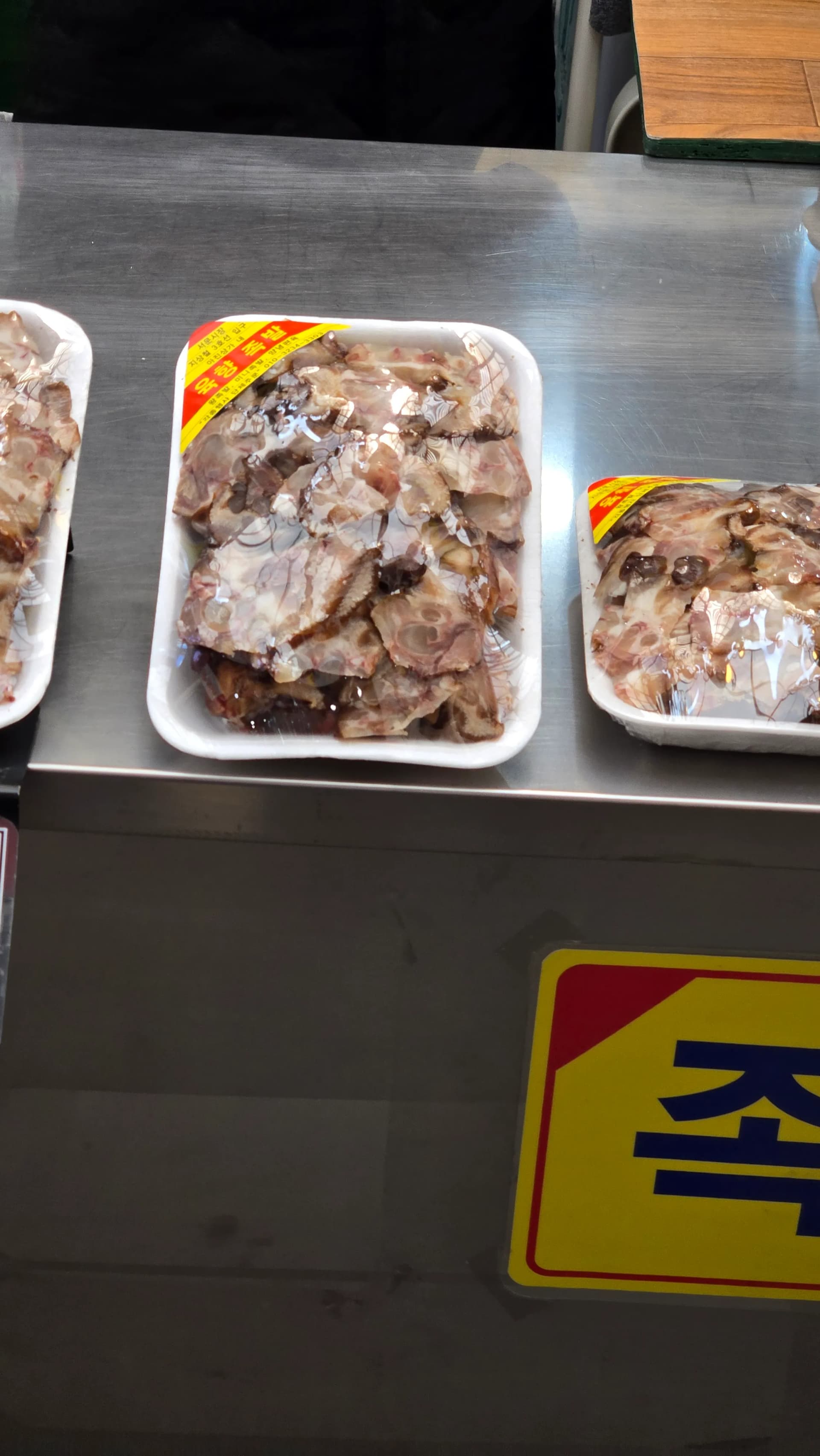
Pig's trotters slow-braised in soy sauce seasoning, deboned, and sliced into ready-to-eat pieces. Since the bones were already removed, the tray was just filled with neat slices of meat — take it home, fan them out on a plate, and you're done. Jokbal is a collagen-rich cut, so the texture is distinctly chewy and bouncy. Dipped in ssamjang (Korean seasoned soybean paste) or salted shrimp sauce, it works as both a side dish and a drinking snack.
In Korea, jokbal is a hugely popular choice for late-night cravings and team dinners. I could faintly see a price tag that just said "Jokbal" on it.
Honestly, even while sorting through all these photos, I kept thinking — did all of this really come from a single market? From traditional grain brittle to rice ball skewers, bungeoppang, gimbap, instant noodles, and pig's feet — combined with Part 1, I saw close to 40 different street foods at Daegu's Seomun Market alone.
And that's not even everything. There were things I didn't get to photograph, and entire alleys I walked right past. That's just how massive Seomun Market is. But let me say it again — not every Korean traditional market is like this. This is one of the biggest markets in the entire country, which is why the variety is this insane. Smaller neighborhood markets have a completely different feel.
Market location, operating hours, how to get there, and other basic info — I covered all of that in Part 1, so if you haven't checked it out yet, start there.
Start from the beginning Part 1: Daegu Seomun Market Street Food Guide — 20 Must-Try Korean Traditional Market SnacksThis post was originally published on https://hi-jsb.blog.