
Korean Market Udon & Kkoma Gimbap — Street Food Guide
Table of Contents
13 items
I've been sharing all kinds of Korean food with you through this blog. Korean market udon (Sijang Udon) and kkoma gimbap (Kkoma Gimbap) — these were dishes I always wanted to show you someday.
I don't always take a ton of photos every time I go out to eat. Some days I was too focused on eating to even pull out my camera, and honestly, there were days when another spoonful felt way more urgent than a photo. That day was one of those days. It was a small bunsik shop near the market in Eunhaeng-dong, Daejeon — a mid-sized city about 2 hours south of Seoul. It was drizzling a little, and the place was emptier than usual. So I actually got to eat in peace for once.
I don't have many photos. But I figured a few shots would be enough to tell the story of this food.
Today I'm talking about two things. The classic combo of Korean traditional market street food — sijang udon and kkoma gimbap. If you're Korean, no explanation needed. If you're traveling in Korea, you're bound to run into these at least once.
Market Udon and Kkoma Gimbap in Daejeon's Eunhaeng-dong
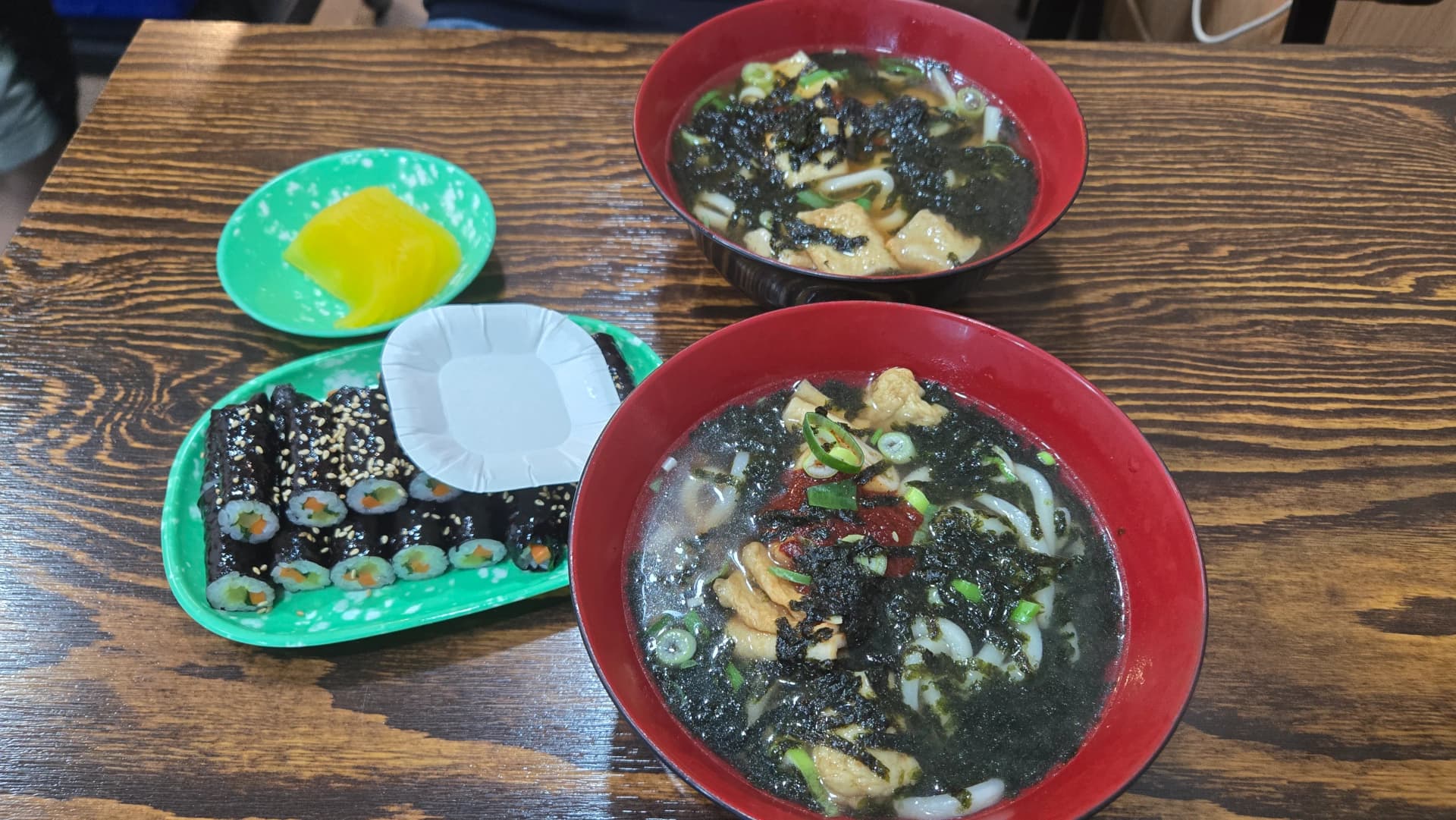
Here's today's spread. Two bowls of udon in red bowls, kkoma gimbap lined up on a green plate, and yellow danmuji (pickled radish) on the side. Ordered at a bunsik shop near the market in Eunhaeng-dong, Daejeon. This is the most common setup you'll see at a Korean bunsikjip — a casual Korean snack restaurant. Nothing fancy. But it's delicious. Seriously.
This udon — it's pretty different from Japanese udon.
Japanese Udon vs. Korean Market Udon — What's the Difference?
Japanese Udon
The broth is clear. It's made from katsuobushi (bonito flakes) and kombu, so the color is light and the flavor is delicate.
The noodles are the star of the show. Thick, chewy texture is everything, and there are even styles where you eat just the noodles without any broth at all.
Toppings are usually tempura, aburaage (fried tofu), and green onion. It's a clean, minimalist kind of dish.
Korean Sijang Udon (Market Udon)
The broth is completely different. Anchovy, kelp, plus a soy-based seasoning paste — so the color is dark and rich. This udon is nothing without its broth.
The seasoning paste is the key. Soy sauce mixed with chili flakes, minced garlic, and green onion, stirred right into the broth. It brings a spicy, savory punch that hits you right away.
Eomuk (fish cake) is almost always in there. It's flat slices of fish paste that soak up the broth, so when you bite into them, the soup just bursts in your mouth. On top: crushed gim (roasted seaweed) and green onion.
The noodles tend to be softer than Japanese-style. It's all about that soft, broth-soaked texture.
Some places sell kimchi udon too, where kimchi is boiled right into the broth. Every market udon shop does things a little differently.
If Japanese udon is about enjoying the noodles, Korean market udon is all about enjoying the broth.
First Impressions of Market Udon
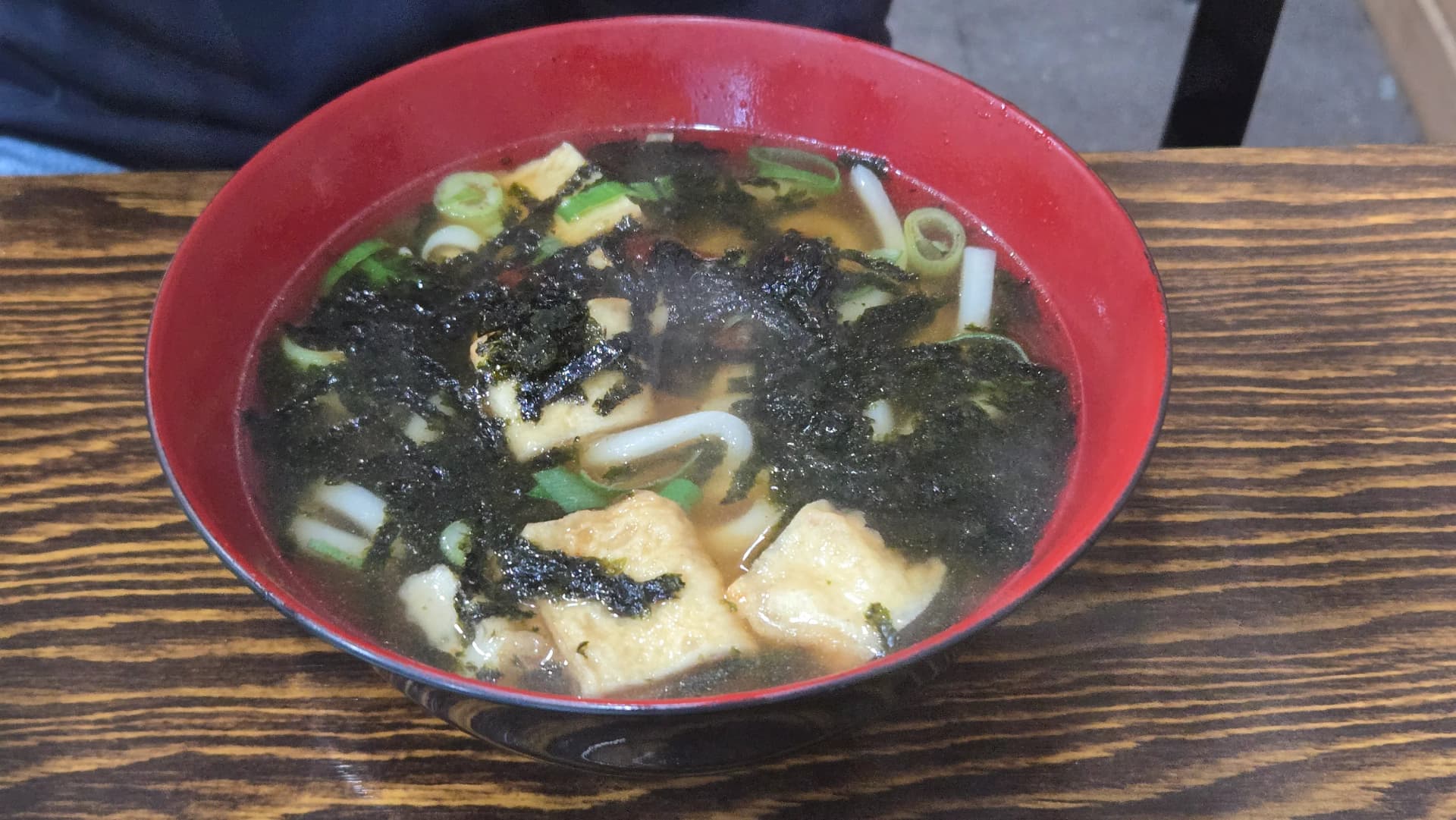
Look — the broth isn't clear at all. It's dark and rich. There's a mountain of crushed seaweed sprinkled on top, chunks of fish cake submerged in the broth, and sliced green onion scattered across. If you came in expecting Japanese udon, you might be a little thrown off. This rough, rustic look — that's Korean market udon for you.
The Seasoning Paste — This Changes Everything
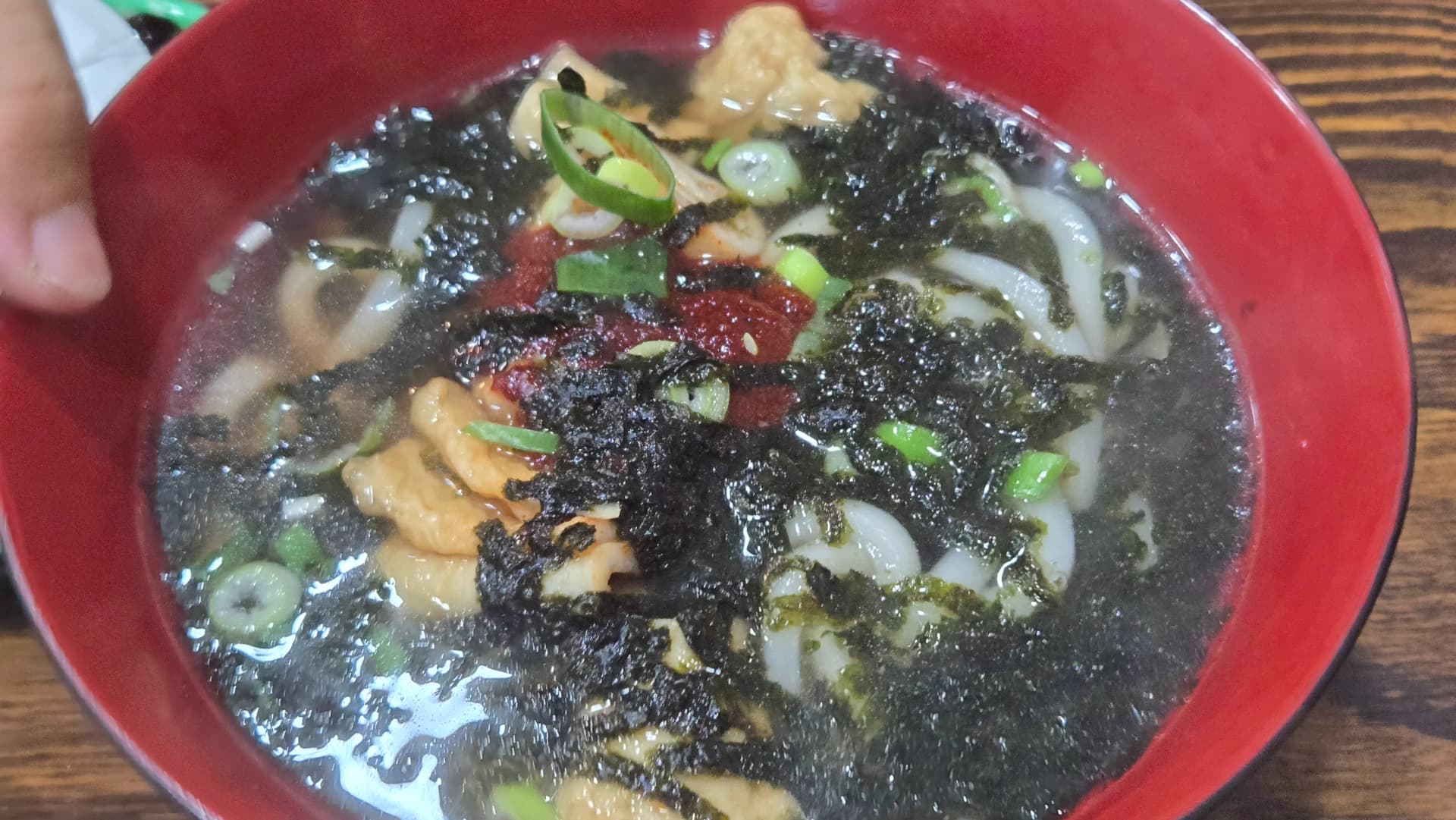
See that red stuff on top of the broth? That's the seasoning paste — chili flakes, soy sauce, and minced garlic mixed together. You stir this into the broth and eat. Before and after mixing? Completely different dish.
Udon is originally a Japanese dish. That's true. But when it came to Korea, it became something entirely different. The broth color alone is nothing alike. Same name, but honestly it's better to think of them as two separate foods.
If you're traveling in Korea, give it a try. You can find it at any market or bunsik shop, and it's super cheap.
After Stirring in the Seasoning Paste
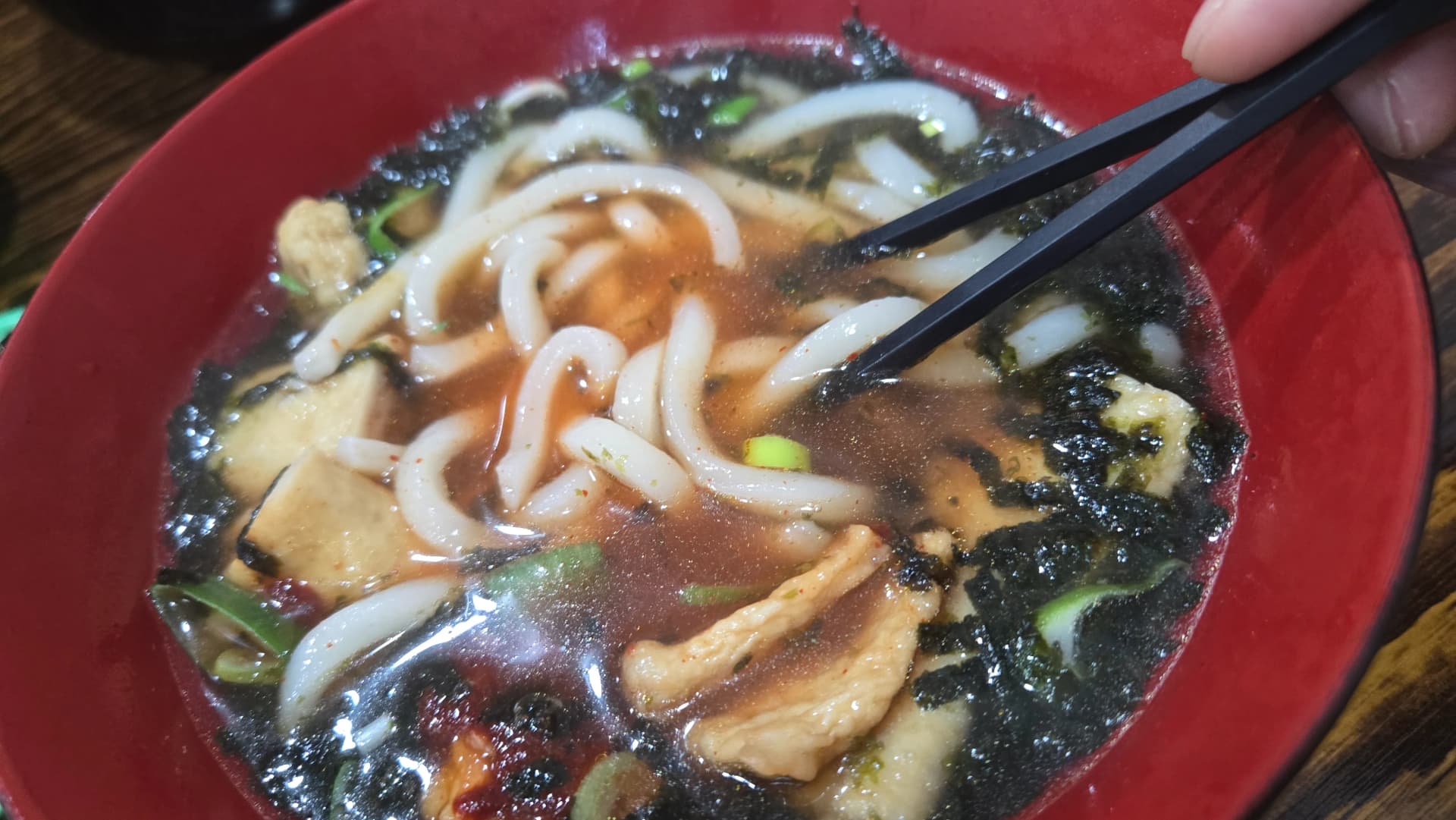
Mixed in the seasoning paste and gave it a good stir. Oh man, the second you mix it, the aroma just hits you. White noodles swirling around in the reddish broth, fish cake and seaweed flakes tangled up between the noodles. The broth got way darker. It took me forever to take the photo. The broth got cold. Still tasted amazing though.
How Do You Even Describe This Broth?
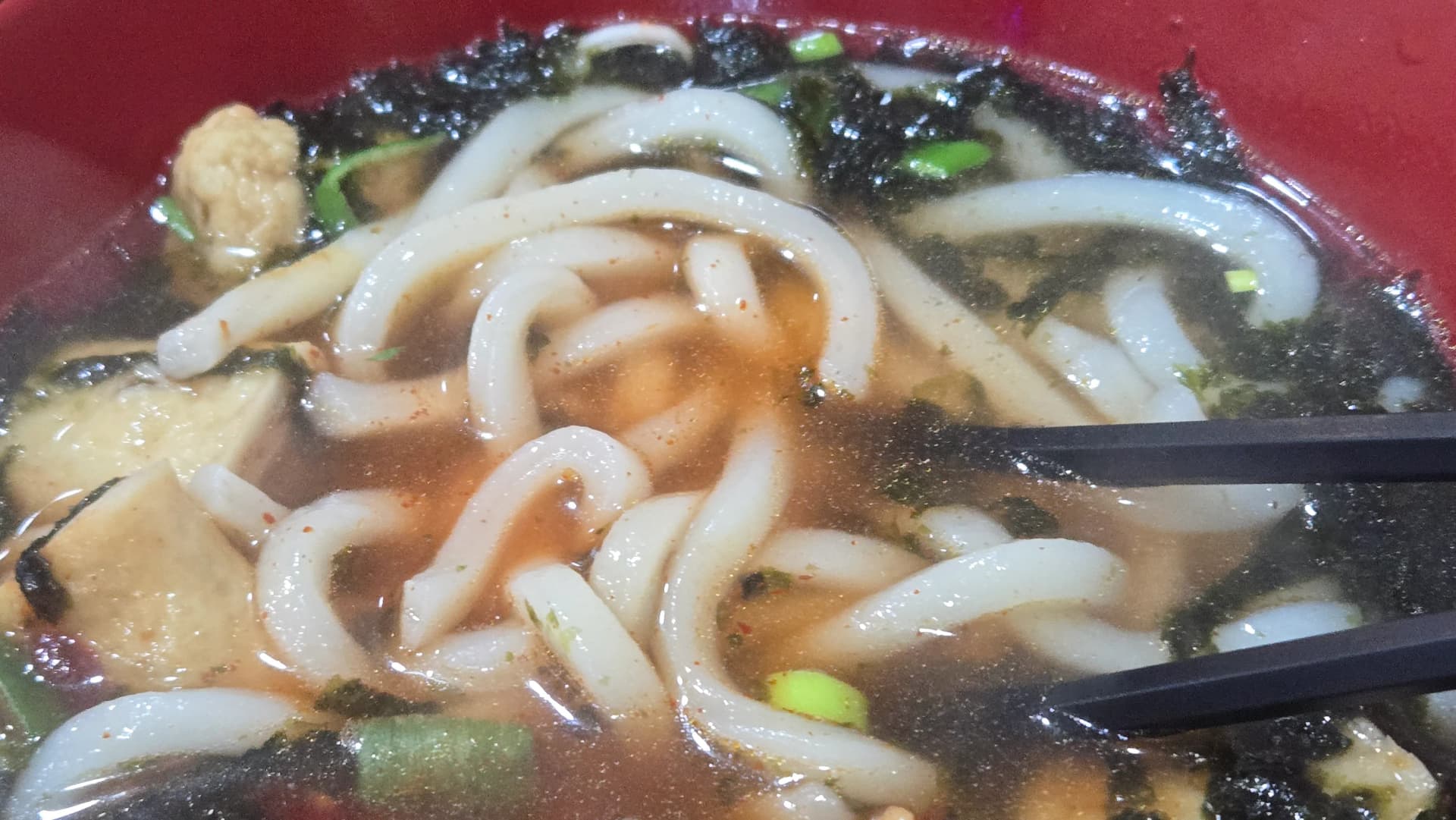
You can see the chili flake particles clinging to the surface of the noodles. This broth isn't just spicy. It's savory, nutty, and the heat kind of sneaks in between. Take a big spoonful and slurp it up, and you go — ah, so THIS is why people crave this on cold days. It's a hard flavor to describe. You really just have to try it yourself.
Kkoma Gimbap — At First I Thought It Was Bland
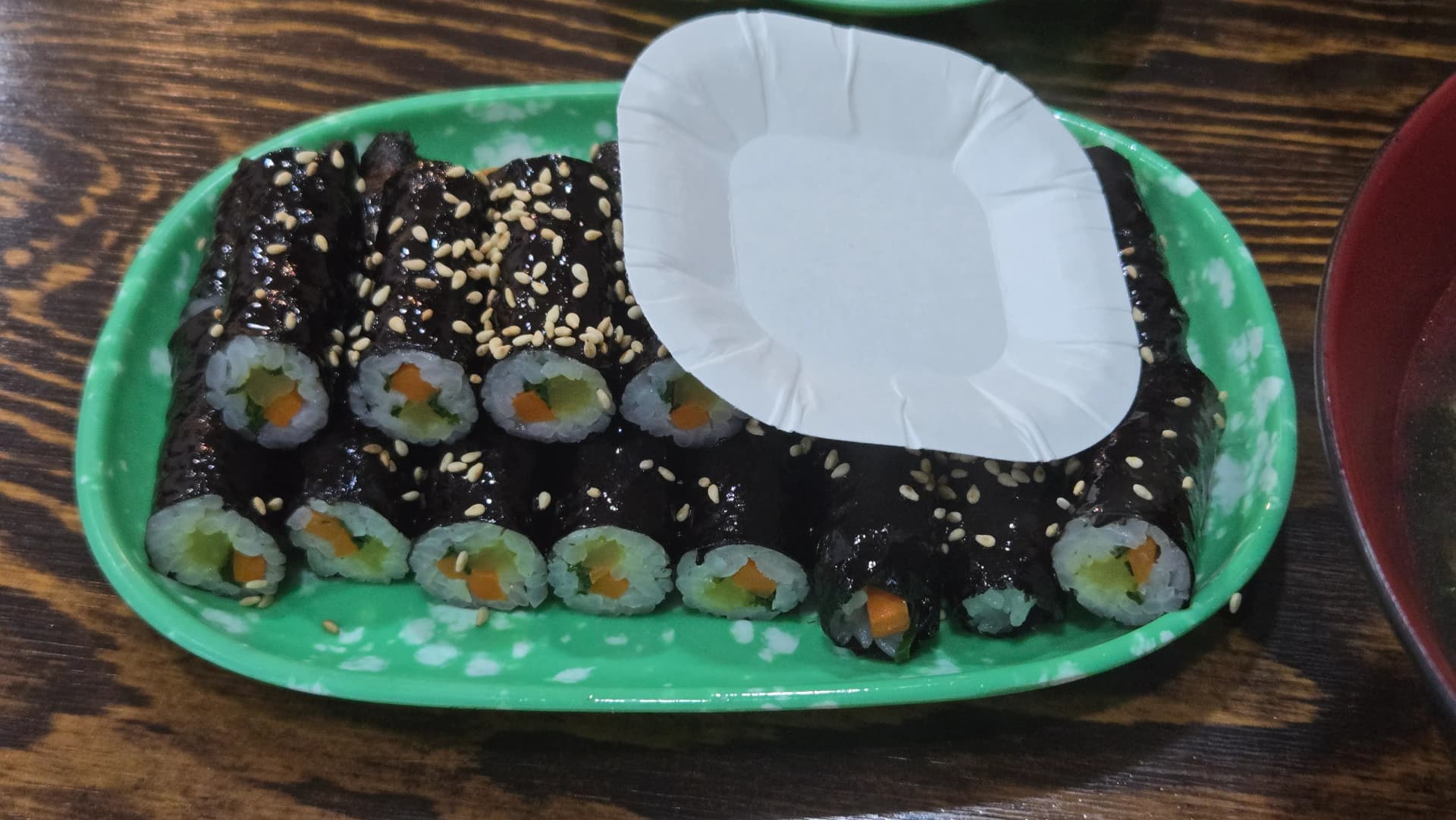
Next up: kkoma gimbap. Little gimbap rolls lined up on a green plate, sesame seeds dotted all over. The white paper plate in the middle is for danmuji (pickled radish).
If you look at the cross-section — carrot and spinach. That's it. It doesn't have all the ham, egg, fish cake, and burdock root stuffed inside like regular gimbap.
Honestly, when I first saw it, I was like — what am I supposed to feel from this? But then I ate one. Then two. By the third one, I couldn't stop. The rice is seasoned with sesame oil and salt, and the seaweed wraps it all tightly. When you take a bite, the sesame oil aroma hits you first. Because there are so few ingredients, the flavor of the rice and seaweed actually comes through way more clearly.
They're smaller than regular gimbap too. One-bite size. "Kkoma" means little kid in Korean. So it basically means cute little gimbap.
How to Eat Them Together
You pop these one by one between sips of udon broth. Take a sip of the spicy broth, then a bite of nutty kkoma gimbap. Then more broth. Then more gimbap. This rhythm is the Korean bunsik way of eating. Once you start, it's really hard to stop until the bowl is empty.
Kkoma Gimbap Cross-Section
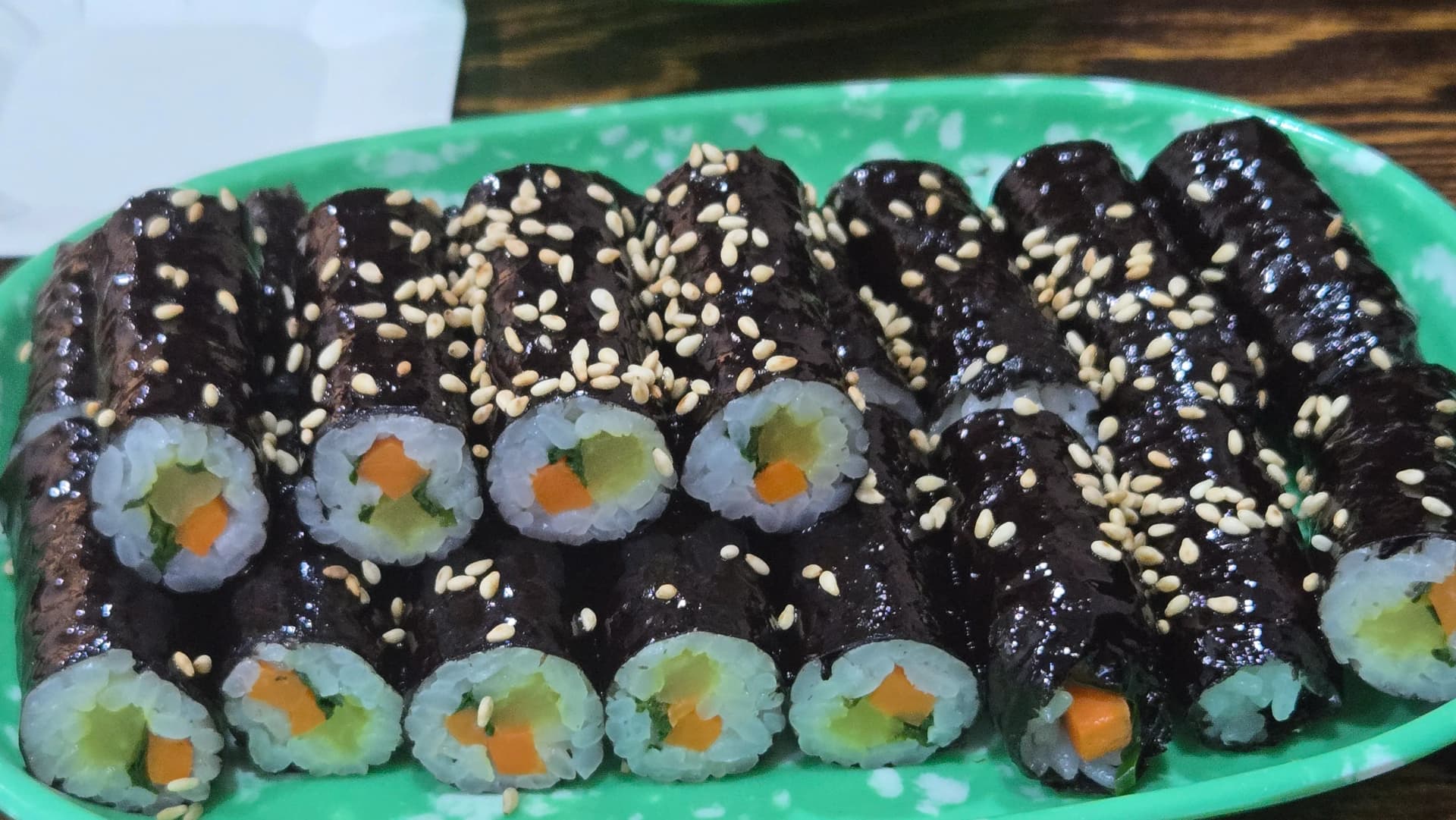
Up close, you can see sesame seeds packed tightly onto the seaweed surface, glistening with sesame oil. The cross-section is white, orange, and green. The colors pop against the black seaweed.
Each piece is about the thickness of your thumb. Pick one up with chopsticks, pop it in your mouth — the seaweed crisps first, then the sesame oil-coated rice spreads its nuttiness, and the carrot gives a little crunch. That's it. Just a handful of ingredients, but you keep reaching for more. It's a weird food, honestly.
A bowl of udon runs about $2–$3.50, and a roll of kkoma gimbap is about $1.50–$3. Order both and you're still under $7. Even if you can't read the menu, just saying "udon" and "kkoma gimbap" — those two words are all you need.
Where Can You Get Market Udon and Kkoma Gimbap?
The place I went this time was in Eunhaeng-dong, Daejeon. A small bunsik shop near the market. But honestly, you don't need to seek out any specific restaurant for this combo.
Pretty much every Korean traditional market has it. In Seoul, there's Gwangjang Market, Namdaemun Market, or Tongin Market. In Busan, check out the street food stalls near the BIFF Square area or Seomyeon Market. In Daegu, there's Seomun Market. And beyond these big markets, even small neighborhood markets will have a bunsik stall somewhere.
It doesn't even have to be a traditional market. Anywhere in Korea, if you walk into a shop with "bunsik" written on the sign, udon and kkoma gimbap are almost always on the menu. Even that run-down little shop tucked away in an alley will have them. You don't need to go hunting — just walk around and you'll stumble into one. That's the beauty of this food.
💡 Travel Tip
Ask for a "set" — at many places, ordering the combo deal is cheaper than ordering separately. Udon runs $2–$3.50, kkoma gimbap $1.50–$3. Even combined, you're looking at under $7.
Frequently Asked Questions
Q. Is Korean market udon spicy?
The broth itself isn't spicy. It gets spicy when you stir in the seasoning paste, but you can just skip it. One phrase does the trick: "an maepge haeju-seyo" (not spicy, please).
Q. Does kkoma gimbap contain meat or fish?
The standard filling is just carrot, spinach, and danmuji (pickled radish). Meat and fish aren't usually included. That said, ingredients can vary by shop, and the rice is seasoned with sesame oil, so it may not be fully vegan. If you have allergies, ask before ordering.
Q. How much does it cost?
Udon is about $2–$3.50, kkoma gimbap about $1.50–$3. Both together still come in under $7.
This post was originally published on https://hi-jsb.blog.