
11 Types of Black Bean Noodles: Korean Jjajangmyeon Menu Guide
Table of Contents
23 items
Jjajangmyeon — one dish, eleven versions
Walk into a Korean-Chinese restaurant and open the menu to order jjajangmyeon (짜장면, Korean black bean noodles), and you'll find five or six different variations staring back at you. Jjajangmyeon, ganjjajang, samseon jjajang, yuni jjajang, sacheon jjajang, jaengban jjajang… Just reading the names tells you absolutely nothing. Even most Koreans haven't tried every single one.
I'm Korean, living in Korea. My wife is from abroad. We eat at Korean-Chinese restaurants almost every month, and I still remember the look on her face the first time she opened the menu — "Wait, these are ALL jjajangmyeon?" That reaction is exactly why I wrote this article. So you never have to stare at the menu in confusion again, I'm breaking down every type with photos. These pictures aren't from one restaurant, by the way — I collected them from visits to different Korean-Chinese spots over time.
Jjajangmyeon — the classic starting point
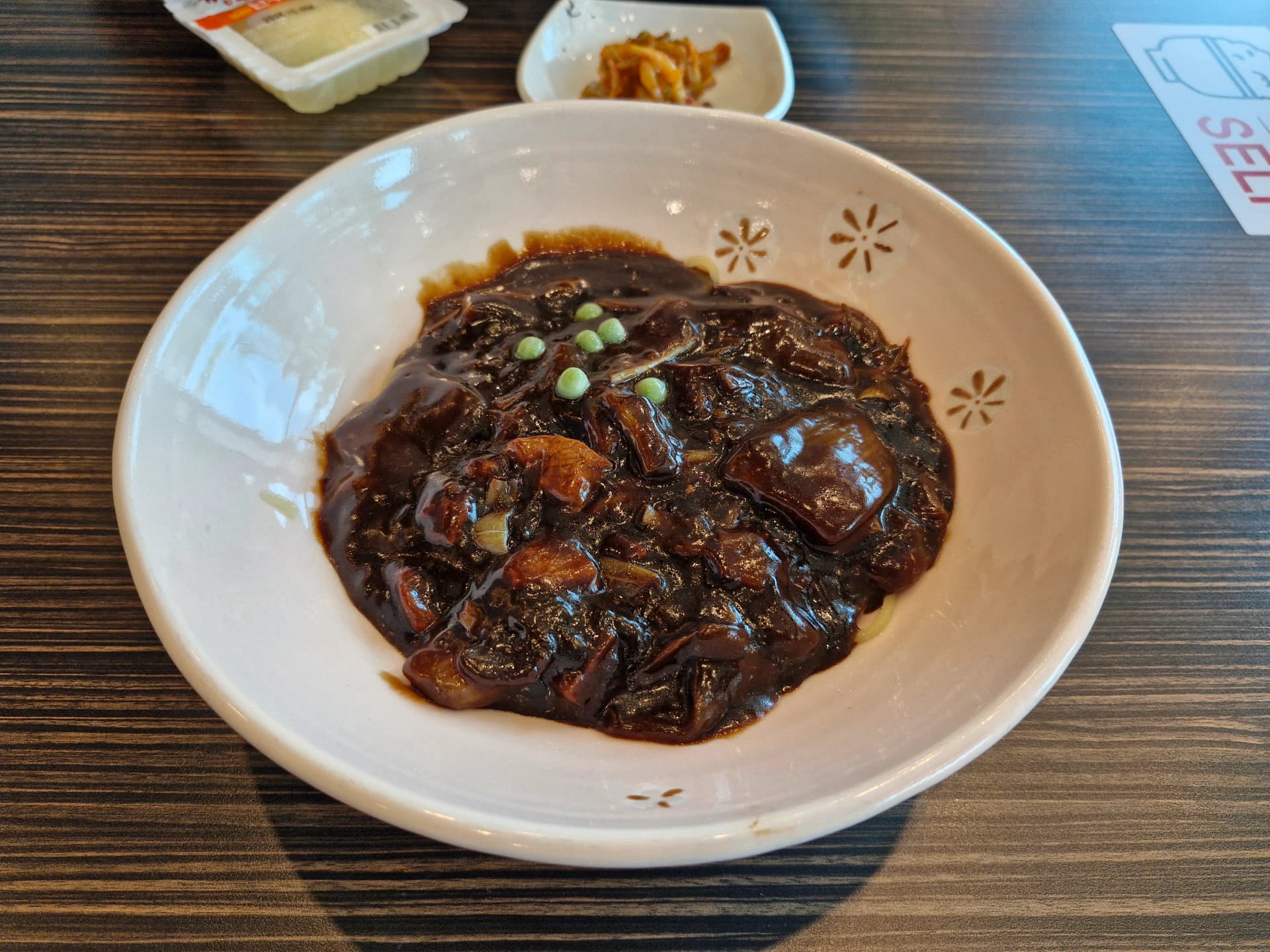
This is jjajangmyeon — the original black bean noodle dish. If the menu just says "jjajangmyeon" with no other words attached, this is what shows up. A cherry-blossom patterned bowl filled with noodles completely buried under jet-black chunjang (black bean paste) sauce, with a few green peas scattered on top. On the side, you'll find danmuji (pickled radish — crunchy and sweet, somewhat like a bread-and-butter pickle) and pickled onion slices. These always come free with any jjajangmyeon order at a Korean-Chinese restaurant. They're there to reset your palate between bites of the rich, sweet sauce — kind of like ginger with sushi.
The sauce is made in large batches each morning and ladled over freshly boiled noodles with every order, so it comes out fast. Flavor-wise, it's smooth and sweet. There's a salty edge from the chunjang paste, but overall the sweetness hits first, and there's zero spice. If this is your first time trying black bean noodles, start here.
This was the first jjajangmyeon my wife ever had in Korea. After one bite, she looked at me and said, "How is this supposed to be Chinese food?" And yeah — if you order jjajangmyeon in China, it tastes completely different. This is a flavor Korea spent over 100 years making its own.
Samseon jjajang — black bean noodles with seafood
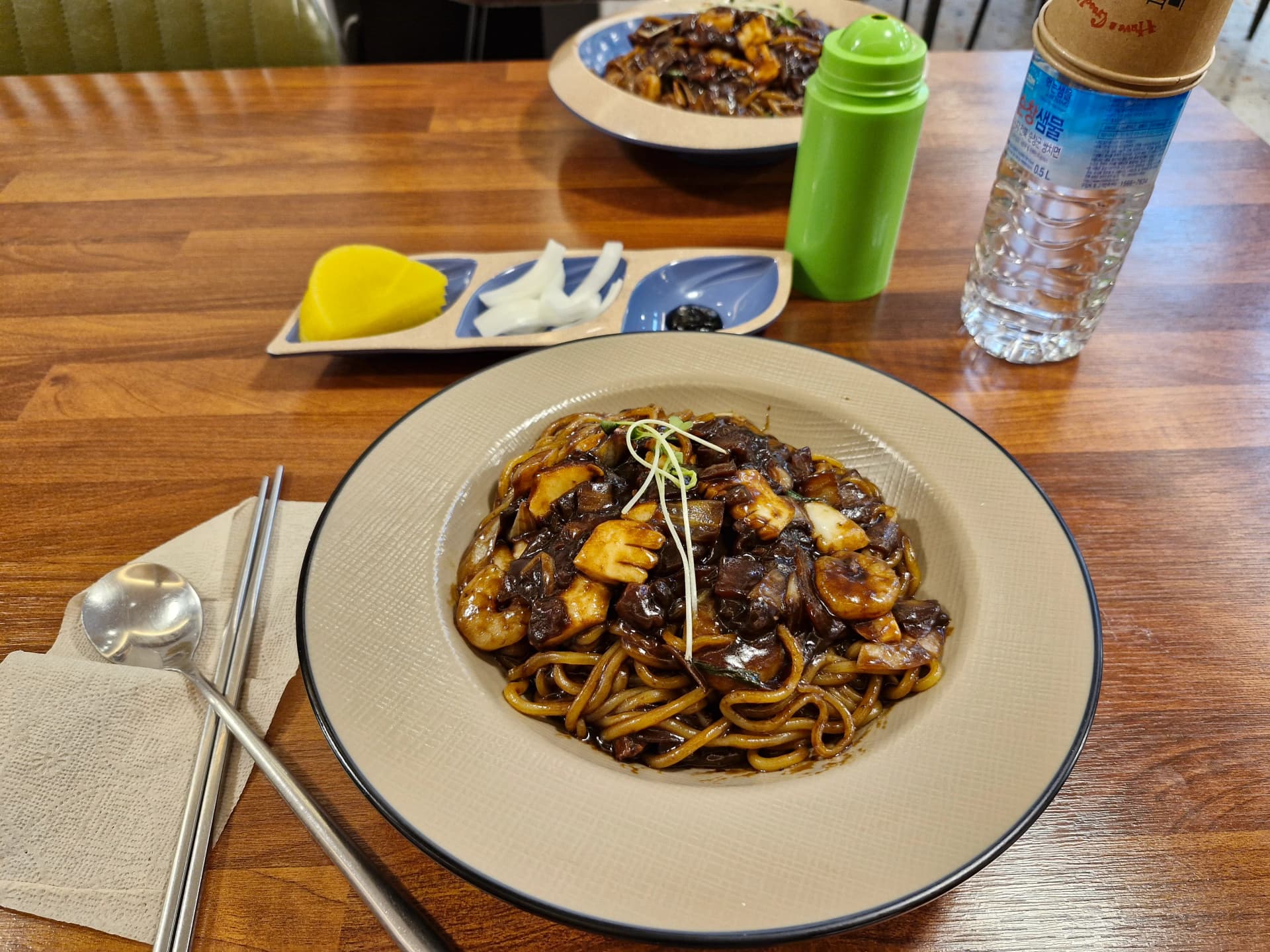
This is samseon jjajang (삼선짜장, seafood black bean noodles). My wife ordered it, and on that day it was 9,000 won (about $7). You can see the whole table in this shot, which gives you a feel for what a typical Korean-Chinese restaurant setup looks like. Samseon jjajang is in front, ganjjajang in the back, with pickled radish and onion slices to the side. The water bottle we grabbed ourselves — most of these restaurants are self-serve for drinks.
Samseon jjajang is basically regular jjajangmyeon with seafood added on top. Shrimp and squid sit visibly on the sauce, so it looks noticeably different right from the start. My wife loves seafood, so she orders samseon jjajang almost every time we go. At first, she didn't know how it was different from regular jjajangmyeon, but after trying it once, she stopped looking at the menu altogether — just goes straight for samseon jjajang every time.
Samseon jjajang noodles and seafood up close
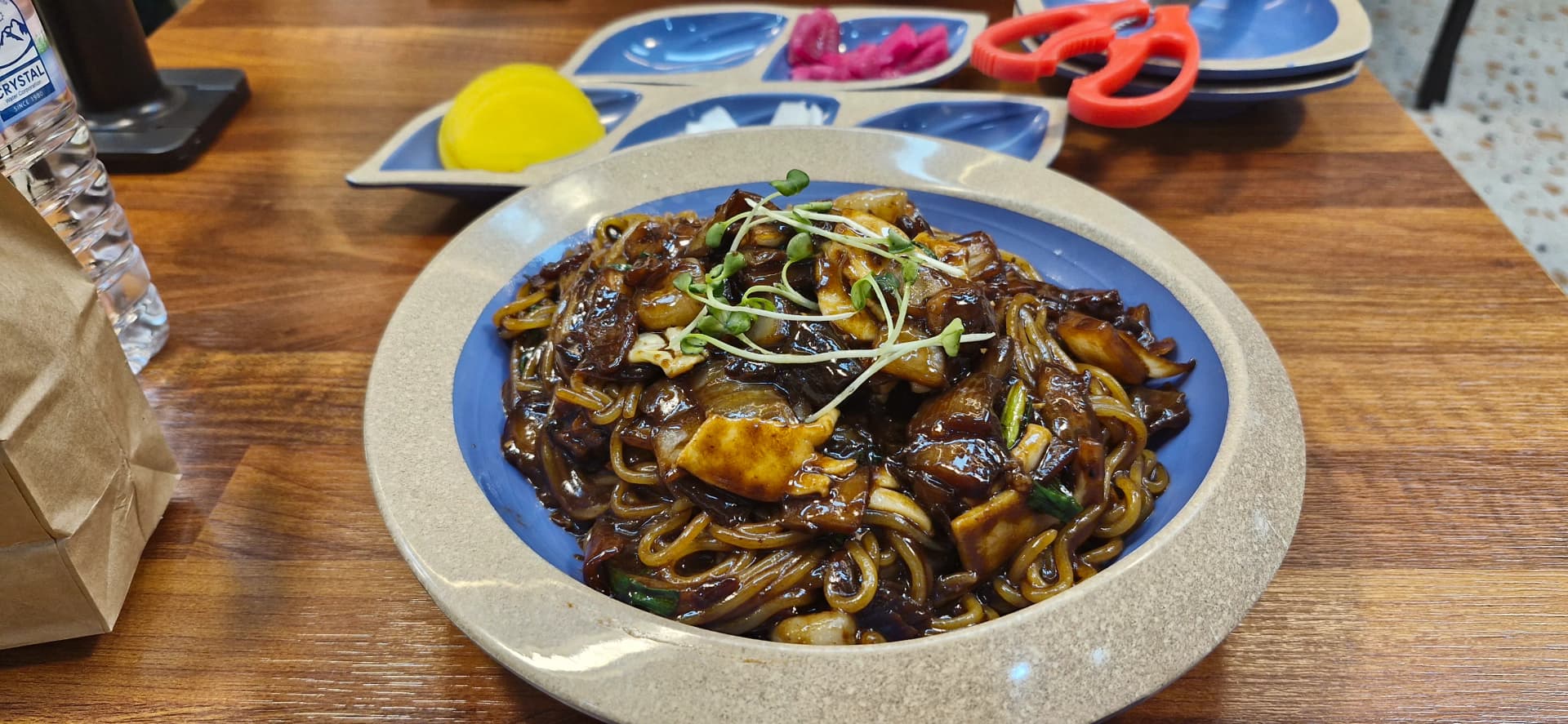
Up close, you can see the noodles and sauce came already mixed together. Regular jjajangmyeon usually arrives with the sauce sitting on top of the noodles, but with samseon jjajang it varies — some restaurants mix it before serving, others bring it separate. There are sprouts on top, and you can spot chunks of seafood tucked between the noodle strands. Compared to regular jjajangmyeon, the toppings are bigger and more varied, so there's definitely more to chew on.
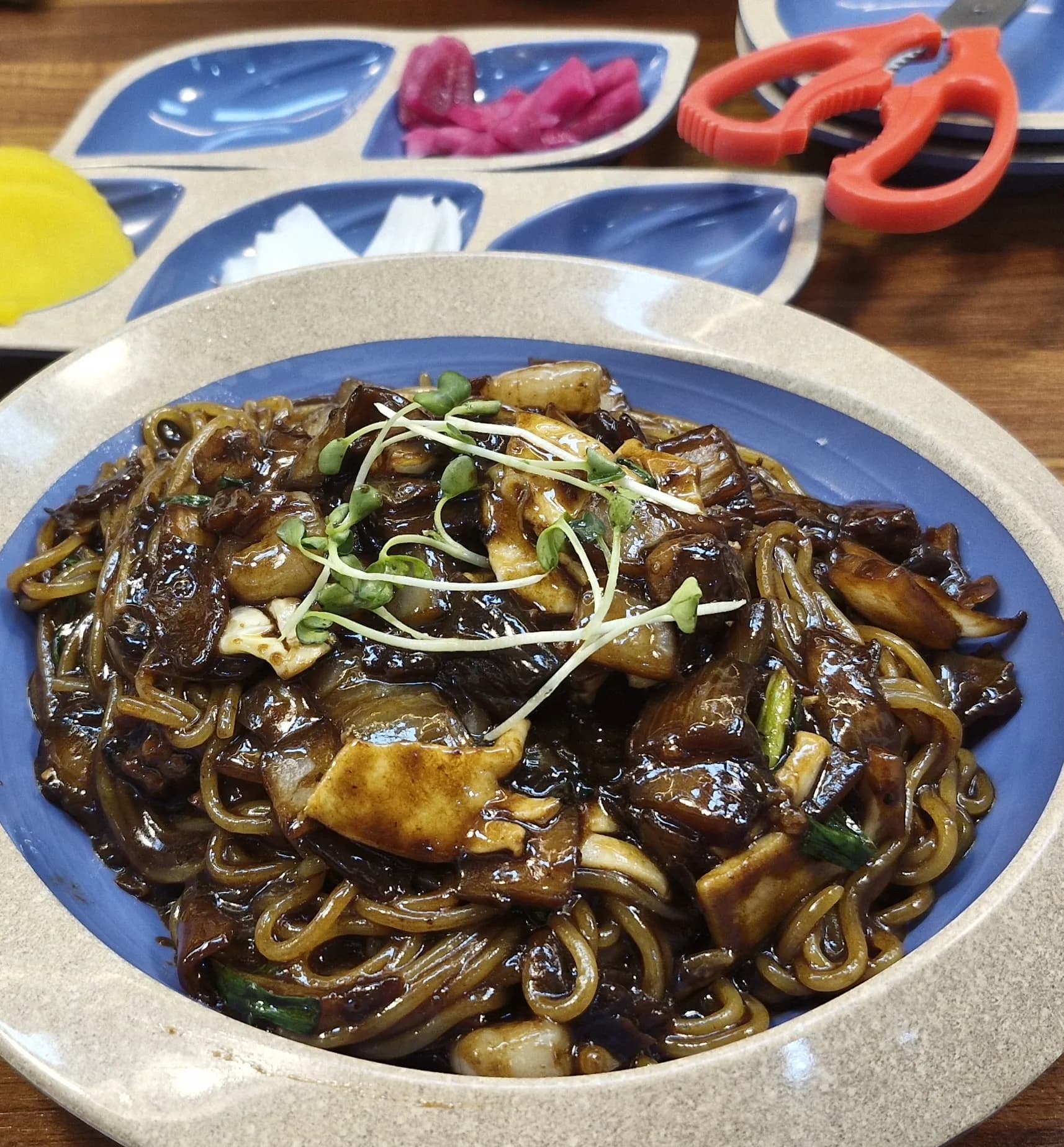
Zooming in even more, you can really see each piece of seafood. Squid and shrimp coated in that glossy sauce, plus generous chunks of onion. In the partitioned side dish behind it, you'll see danmuji, pickled onion, and a pink garnish — that's pickled ginger. The side dishes vary from restaurant to restaurant, but danmuji shows up everywhere without exception.
Samseon jjajang typically costs about 3,000–5,000 won (roughly $2–4) more than regular jjajangmyeon. It was 9,000 won (about $7) that day, and considering the amount of seafood, the price felt fair.
Ganjjajang — the wok-fried, made-to-order version
Now we're getting into ganjjajang (간짜장, dry-fried black bean noodles). Personally, this is the one I order most often out of all the jjajangmyeon varieties. The reason is simple — it tastes like it was just made. Because it was.
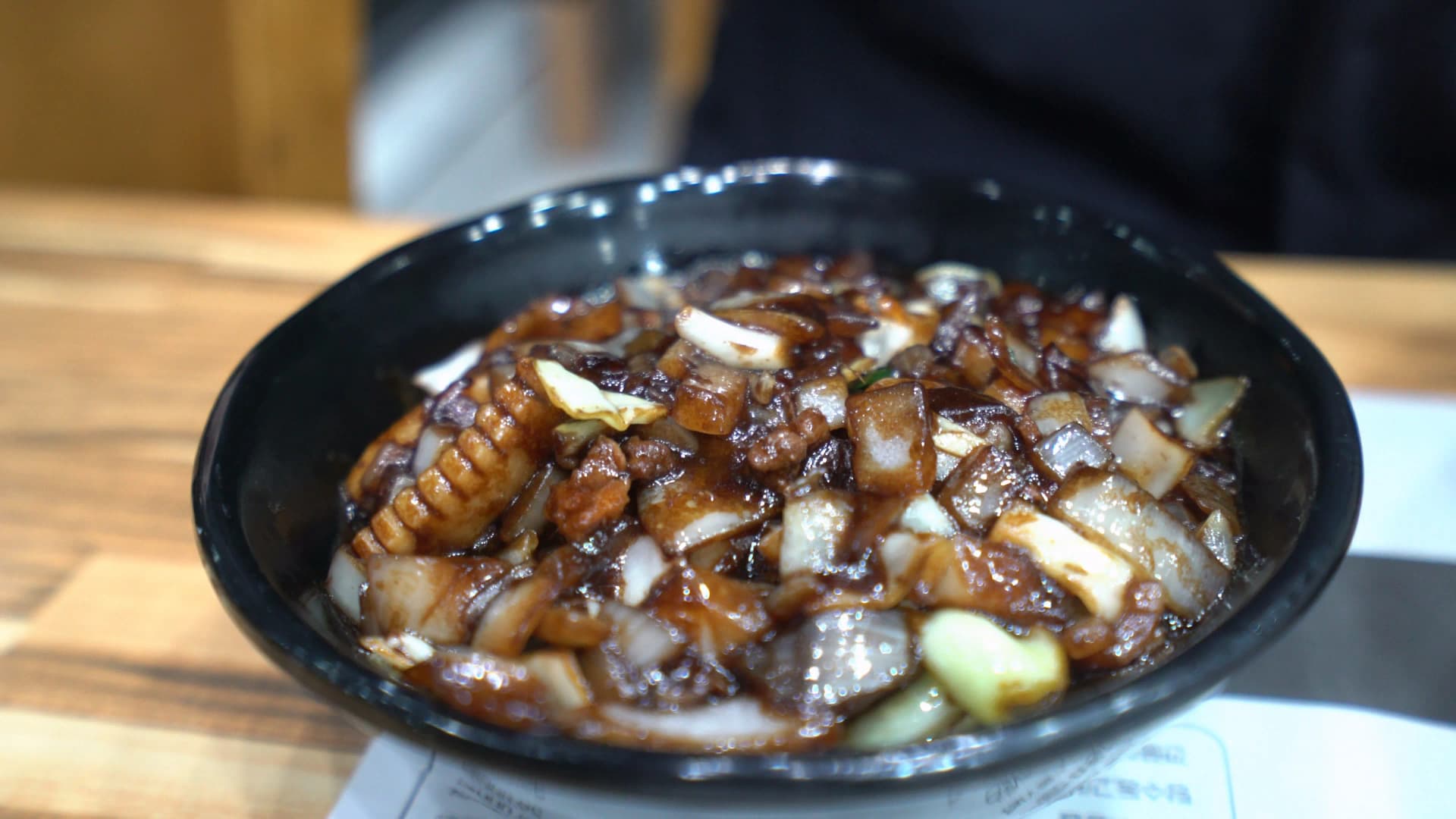
This is ganjjajang. Regular jjajangmyeon uses sauce that's pre-made in the morning and ladled over noodles when you order. Ganjjajang, on the other hand, is cooked from scratch in the wok right after you place your order. No water, no starch — just stir-fried directly in oil. That's why the sauce is so much more intense, and the wok char flavor (what you might call wok hei) comes through loud and clear.
Look at the photo — onion and pork are cut into big, chunky pieces and sitting right in the sauce. Unlike regular jjajangmyeon where the sauce flows smoothly over the noodles, here the individual ingredients stay intact and prominent. The noodles are hiding underneath all of that, so you have to mix everything together yourself.
Ganjjajang comes with noodles and sauce separated
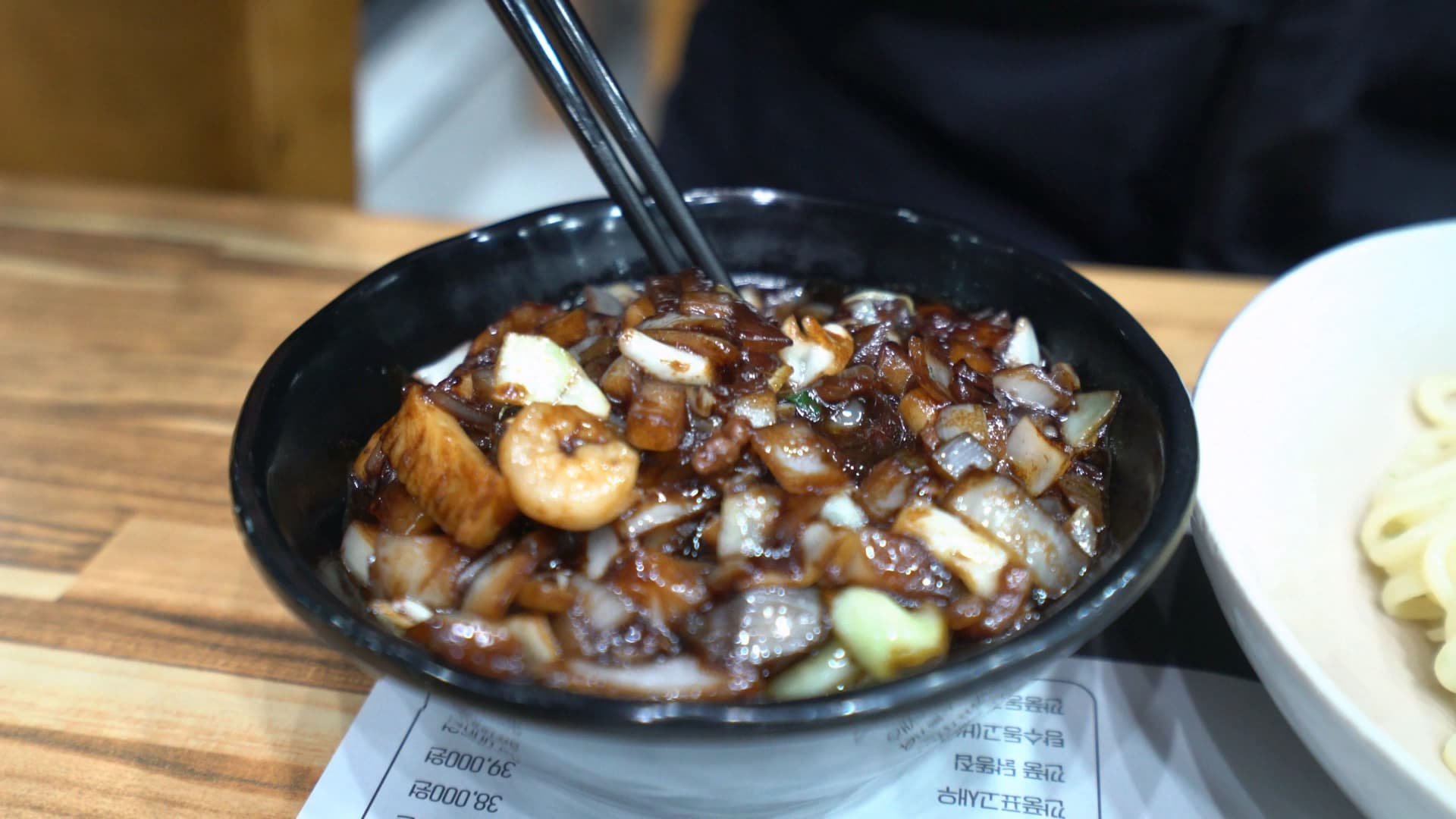
When you order ganjjajang, the sauce and noodles arrive in separate bowls. You can just barely see the noodle bowl on the right. Give the sauce a stir with your chopsticks and you'll notice immediately — the onions are still crunchy, and the meat tastes like it literally just left the pan.
With regular jjajangmyeon, the sauce is batch-cooked in the morning and poured over noodles to order, so the onions are already soft throughout and the whole sauce has a uniform flavor. That's not worse, just different. But because of the fresh cooking process, ganjjajang runs about 1,000–2,000 won (roughly $0.75–1.50) more than the basic version. Still, for that wok char aroma and the snappy texture of the ingredients, I reach for ganjjajang every single time.
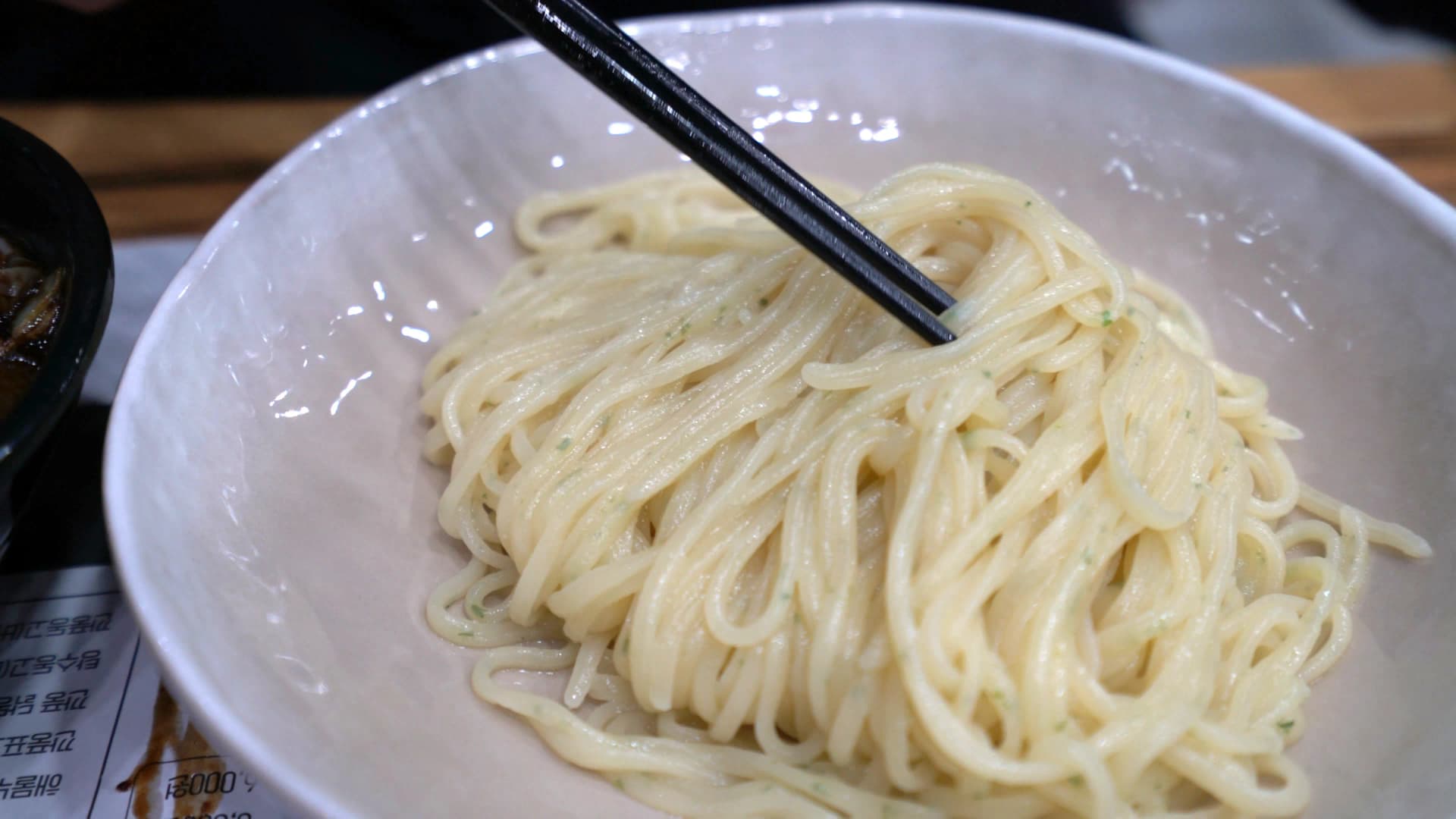
Most restaurants serve it exactly like this — noodles and sauce in separate bowls. A white bowl with nothing but noodles, a dark bowl with the sauce beside it. You pour the sauce onto the noodles yourself and mix.
My wife was kind of confused the first time she got ganjjajang. With regular jjajangmyeon, the sauce is already on the noodles, so you just mix and eat. But this? She stared at the two bowls not knowing what to do. When I poured the sauce over the noodles and started mixing, she went, "Oh — I'm supposed to do that myself?"
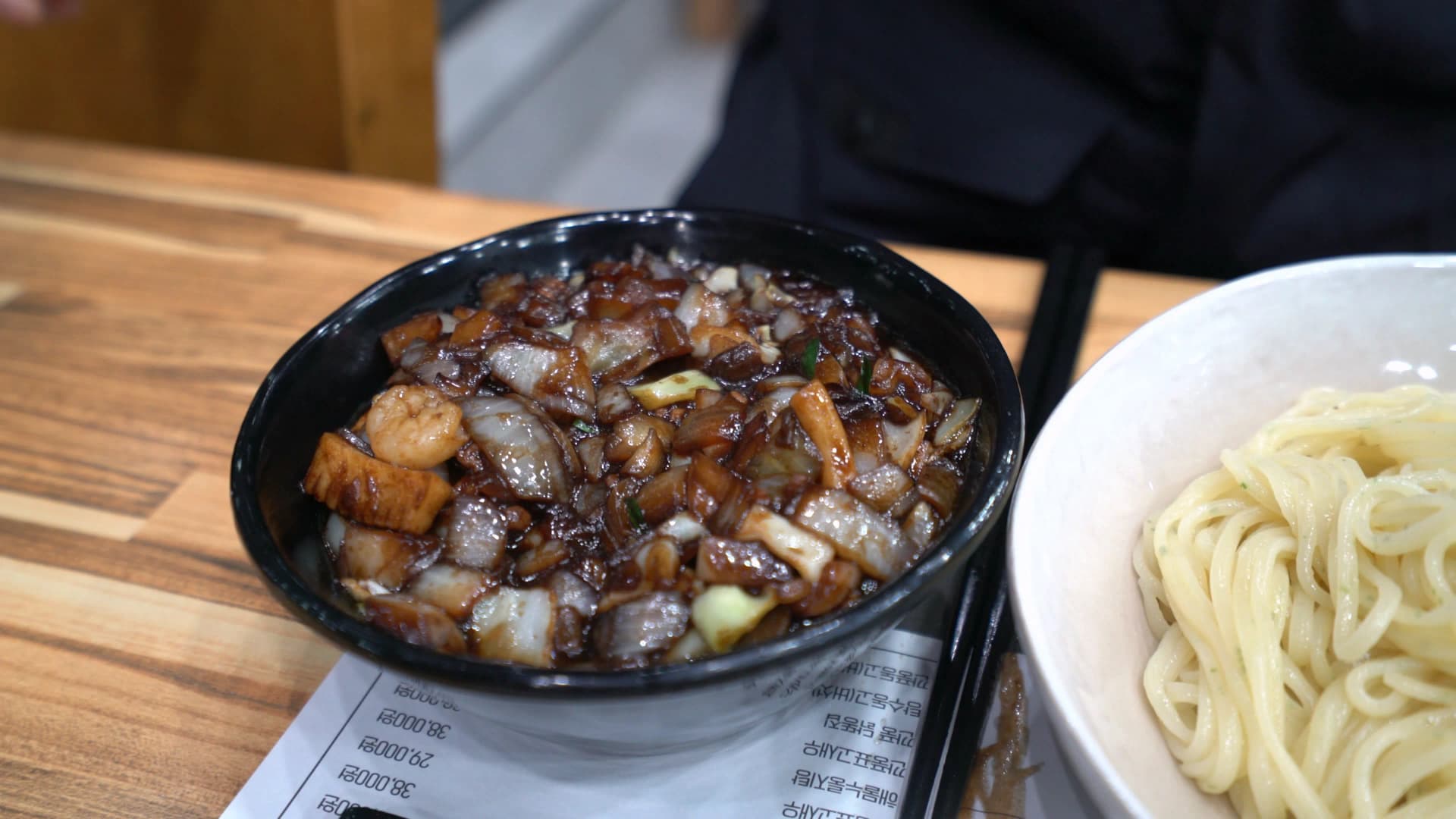
This is how it looks on the table — sauce bowl and noodle bowl sitting next to each other. Dark sauce in one, pale noodles in the other. Once it's set down like this, the rest is up to you.
Mixing — this is the real highlight
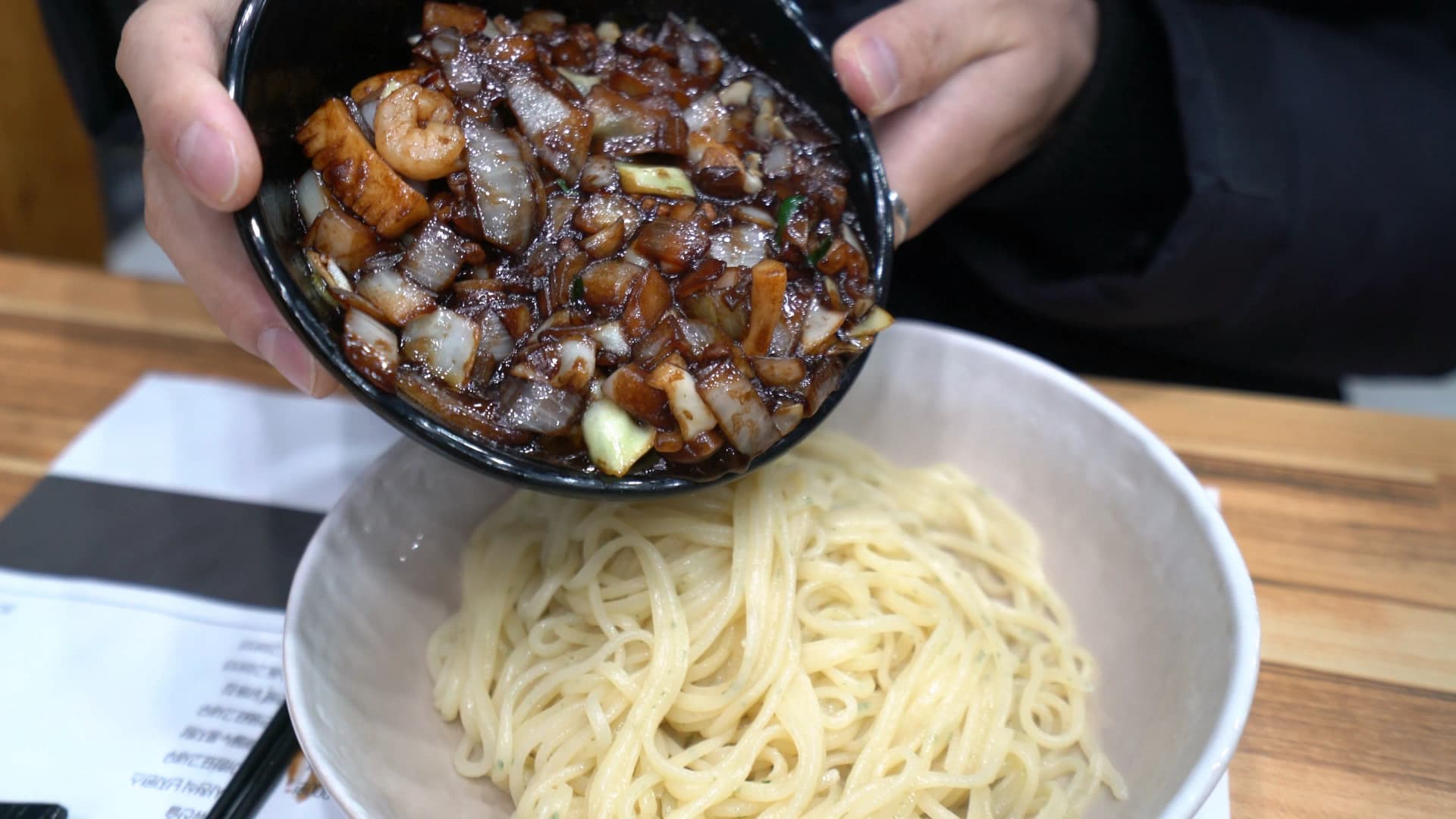
This is the moment the sauce hits the noodles. You pick up the dark bowl and pour the sauce over the pale noodles — this is where the ganjjajang experience begins. You need to mix quickly so the sauce coats every strand.
I'll be honest — I missed the ideal mixing window while trying to take this photo. Pouring sauce with one hand and holding a phone with the other isn't exactly easy. My wife was calling from across the table, "Mix it already, the noodles are going to clump!" I ignored her and kept shooting. The blogger's curse.
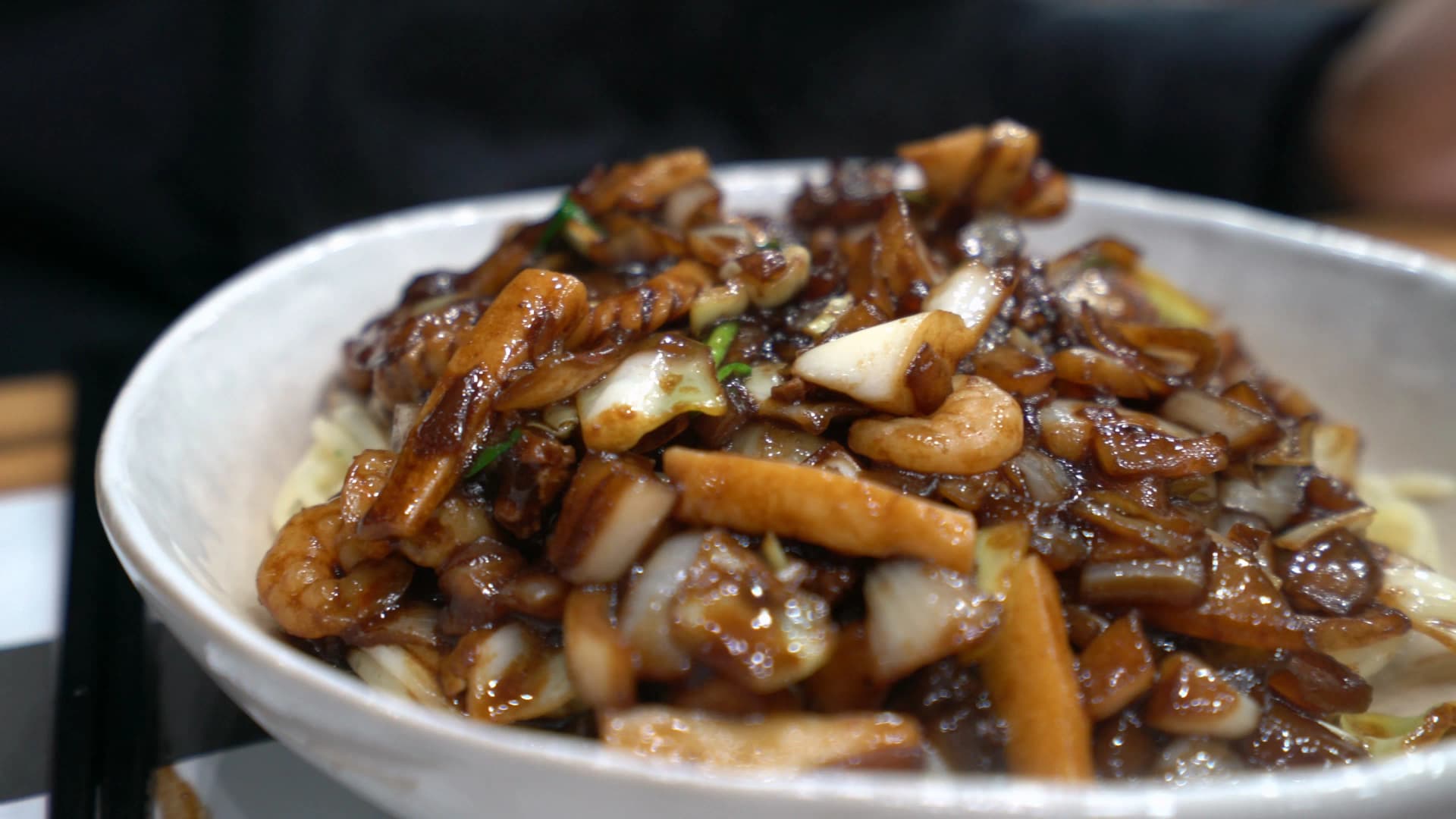
Once all the sauce is on, this is what you're looking at. Onions, pork, squid piled high on top of the noodles, the chunjang sauce glistening with oil as it wraps around everything. The noodles are completely buried underneath — now you flip everything from bottom to top with your chopsticks and start mixing.
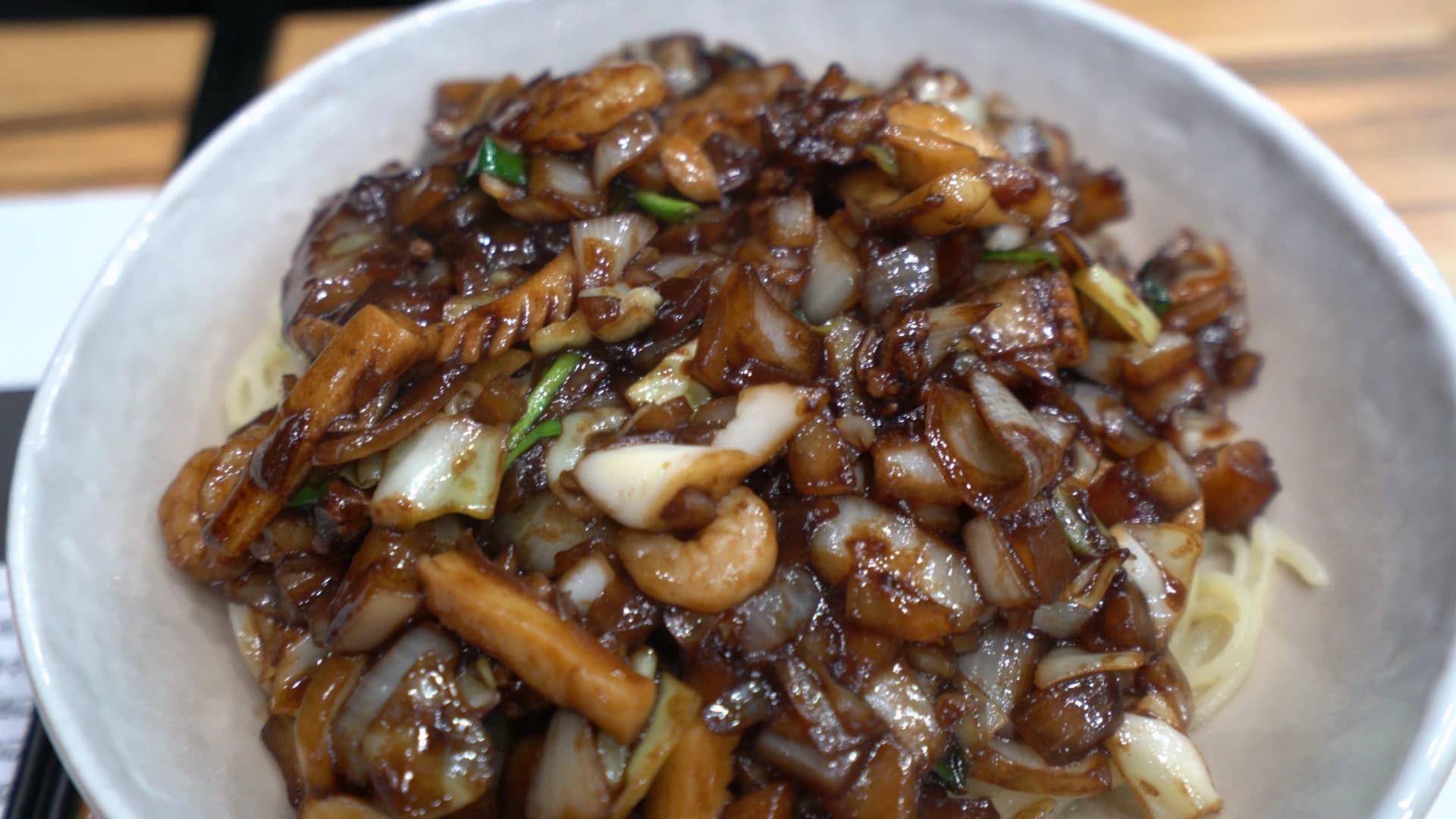
Even closer, you can see every individual piece. The onions have turned translucent but still hold their shape, the meat is cut to just the right size. A thin, glossy film of sauce coats each surface — not sloppy or wet, just gleaming. You can tell at a glance this wasn't stretched with water. This is concentrated, pure black bean sauce.
A few noodles peek out at the edge of the bowl. With this much topping, I figured once I mixed it, there'd probably be more sauce than noodle on every bite. And yep — that's exactly what happened.
Mixing it up — cut corners here and the flavor suffers
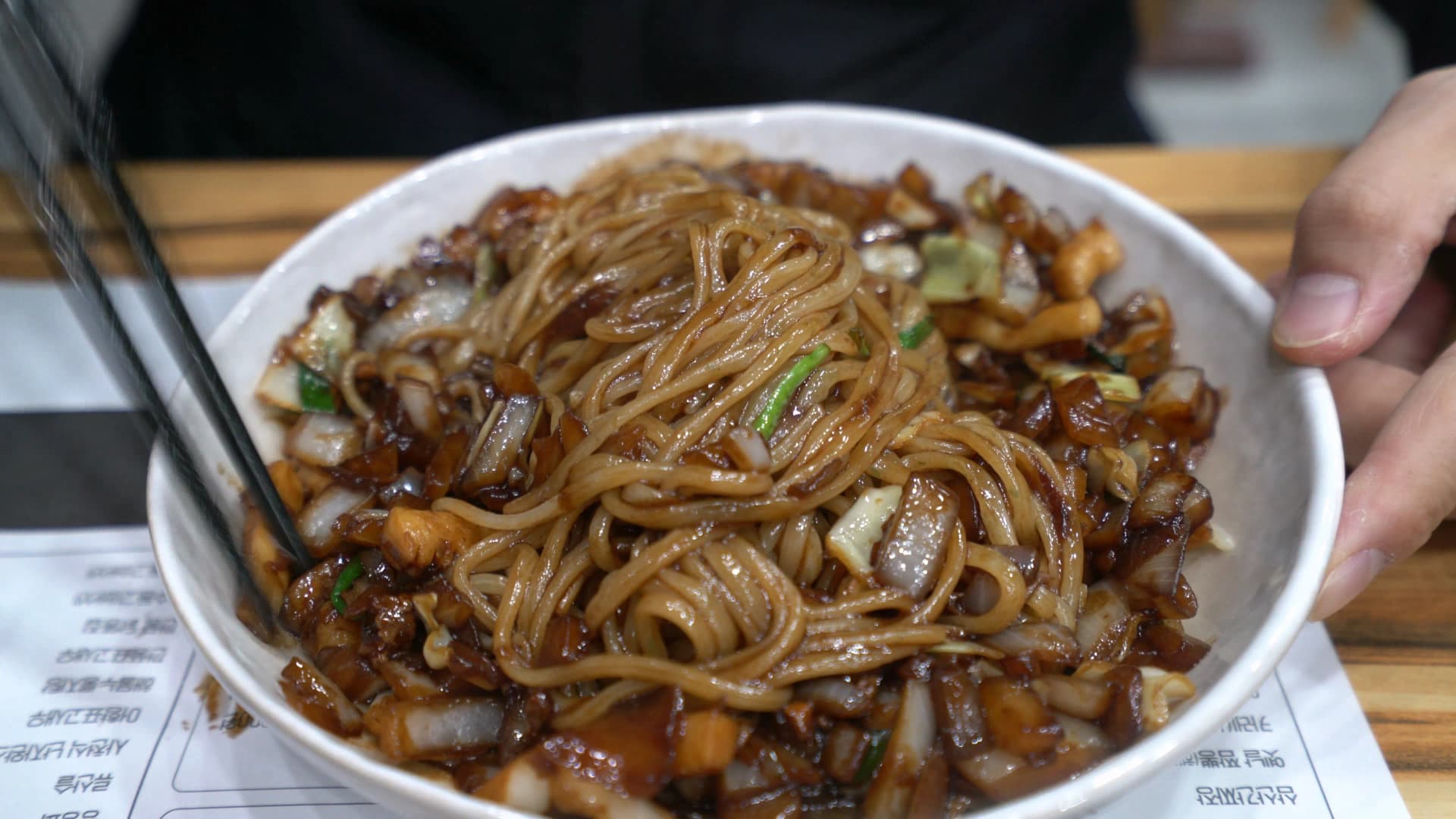
This is what it looks like once you start mixing. You lift the noodles from underneath with your chopsticks and fold them into the sauce — the noodles that were just white are already turning dark.
Because the ganjjajang sauce has almost no liquid, it doesn't blend as easily as regular jjajangmyeon. You have to keep lifting noodles from the bottom and folding them over so the sauce reaches every strand. If you mix halfheartedly, you'll end up with some noodles drenched in sauce and others still completely bare. It takes a bit of effort, but it's the only way to get a consistent flavor in every bite.
My wife said the mixing part was pretty tiring. "My wrist hurts," she told me. And honestly, it does take more arm work than regular jjajangmyeon. The sauce isn't a flowing gravy — it's closer to an oily stir-fry.
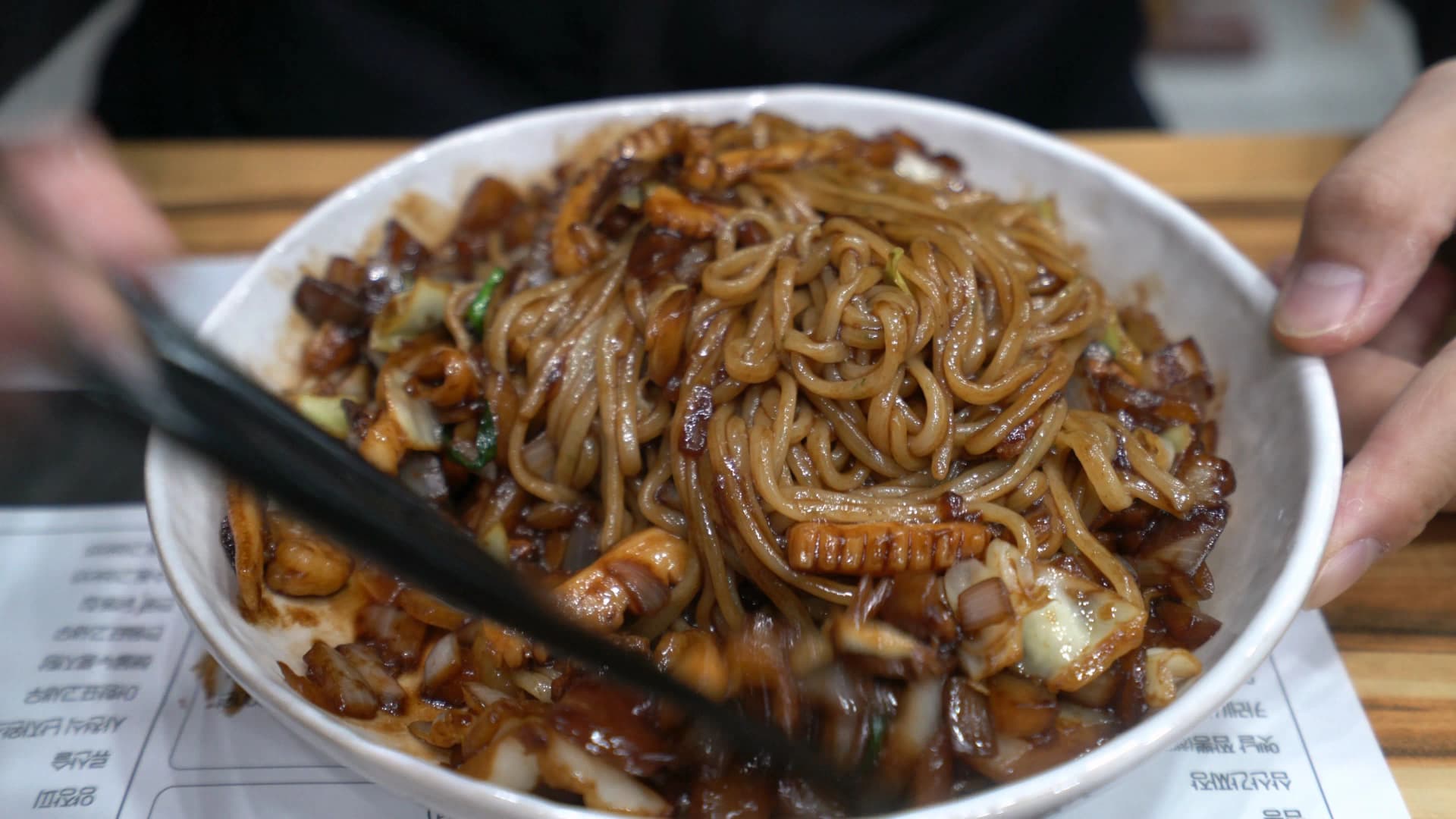
A bit more mixing and you're here. The noodles have gone uniformly brown-black, and the toppings have worked their way in between the strands. You can see sauce smeared on the rim of the bowl — proof that this took some real elbow grease.
The finished ganjjajang — this is what properly mixed looks like
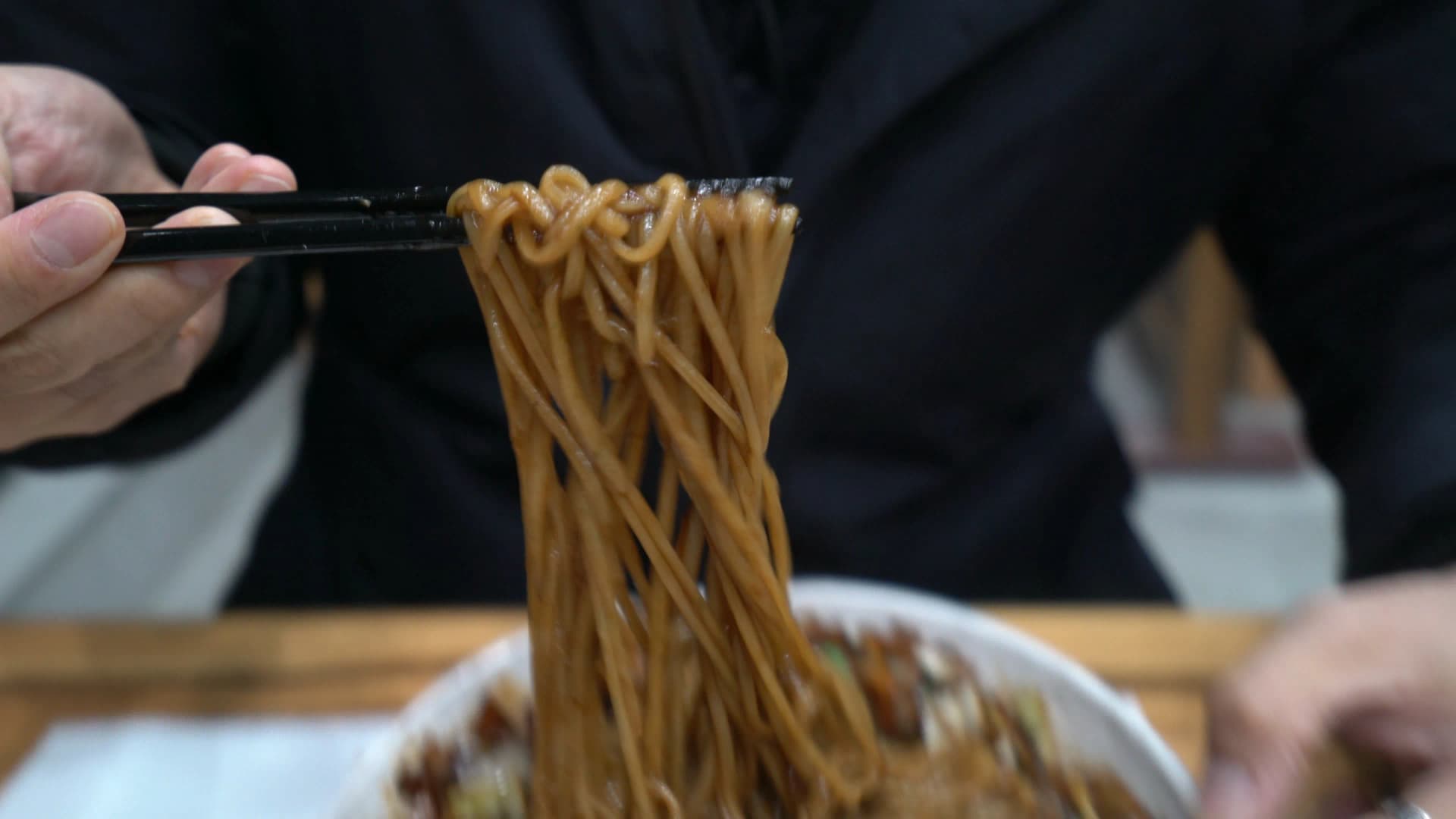
I lifted the noodles high with my chopsticks to check. Every single strand is evenly coated with sauce — that's how you know it's properly mixed. The noodles stretch long without snapping, which is that signature chewy bounce you get from Chinese-style wheat noodles. Imagine that springy texture coated in rich, dark black bean sauce — you can practically taste it just from the photo.
I showed this shot to my wife and told her it was my best one of the day. Her response: "The food looks good, but your hand came out better than the noodles."
Regular jjajangmyeon vs. ganjjajang vs. samseon jjajang — which should you pick?
Comparing ganjjajang directly against regular jjajangmyeon, ganjjajang definitely tastes better. That fresh wok char and crunchy onion texture is something the pre-made sauce simply can't deliver. But I'll be honest — because the sauce has almost no liquid, mixing is genuinely hard work. If you don't mix thoroughly, half your noodles end up unsauced, and for a first-timer that can be frustrating.
If it's your first time, just go with regular jjajangmyeon. The sweet, mild sauce already sits on the noodles — just mix and eat, done. If you like it, try ganjjajang or samseon jjajang next time. Love seafood? Go for samseon jjajang. Want to really taste the depth of the sauce itself? Ganjjajang is your pick. I live in Korea and I still haven't tried every black bean noodle variant on the menu, so there's no rush — just work your way through them one at a time.
All 11 jjajangmyeon types explained — your menu cheat sheet
Beyond the three types I showed with photos above — regular jjajangmyeon, samseon jjajang, and ganjjajang — Korean-Chinese restaurant menus have a whole lineup of other black bean noodle variations. I haven't personally tried every single one, but so you never freeze up in front of the menu again, here's a breakdown of what each name means. I'll add photos as I work my way through them.
Jjajangmyeon
짜장면 — The basic version
This is the foundation of all black bean noodles. The chunjang sauce is batch-cooked each morning, and with every order, it's ladled over freshly boiled noodles. The sauce is smooth, mildly sweet, and not spicy at all — perfect if you've never tried it before. It's also the cheapest option on the menu.
Ganjjajang
간짜장 — Made to order, richer flavor
The biggest difference from regular jjajangmyeon is how it's cooked. Instead of pre-made sauce, everything is stir-fried fresh in the wok right after you order. No water, no starch — just oil and heat. The sauce comes out much more concentrated, with a wok char aroma you won't find in the standard version. Noodles and sauce arrive separately, so you pour and mix yourself. Runs about 1,000–2,000 won ($0.75–1.50) more than the basic, but it's worth every bit.
Samseon Jjajang
삼선짜장 — Seafood version
Samseon (三鮮) literally means "three delicacies" — from land, sea, and sky. In practice, the toppings are mainly seafood: shrimp, squid, and sea cucumber. Think of it as regular jjajangmyeon with a seafood upgrade. The addition of seafood gives the black bean sauce an extra layer of richness. It costs more, but it's a step up in flavor.
Yuni Jjajang
유니짜장 — Finely minced meat
Yuni (肉泥) means "meat paste." The pork and onions are minced so finely that the sauce turns silky-smooth, and the meat flavor comes through intensely. You can barely feel individual pieces — everything blends into one velvety texture. If you prefer smooth over chunky, you'll love this. That said, some people find the lack of bite a bit monotonous, so opinions are split.
Sacheon Jjajang
사천짜장 — The spicy one
Named after China's Sichuan province, famous for its fiery cuisine. Instead of chunjang, this one uses doubanjiang (chili bean paste) as the base, which gives it a serious kick. Seafood is often included, and depending on the restaurant, the sauce can range from dark red to bright crimson. The spice level varies by spot, but the concept is the same: jjajangmyeon's sweetness meets Sichuan heat.
Jaengban Jjajang
쟁반짜장 — Giant platter to share
Jaengban (쟁반) means "large tray." Noodles, sauce, seafood, and other ingredients are stir-fried together and served on one big platter. It starts at two servings minimum, so it's designed for sharing, not solo dining. Everything arrives already mixed and fried, so there's no assembly required — just dig in.
Yetnal Jjajang
옛날짜장 — Retro, old-school style
Yetnal (옛날) means "the old days." This version recreates how jjajangmyeon used to be made decades ago in Korea. The sauce is thinner, with chunks of potato and zucchini, and a fried egg sits on top. The chunjang flavor is gentler, and the whole bowl has a humble, homey feel. For Koreans, this is pure nostalgia — the jjajangmyeon you ate at the neighborhood Chinese place as a kid.
Yuseul Jjajang
유슬짜장 — Julienne-cut strips
Yuseul (肉絲) means "shredded meat." Meat and vegetables are cut into long, thin strips — almost like additional noodles — and stir-fried together. The long, stringy shape of the ingredients creates a unique texture when eaten with the actual noodles. It's often served on a large platter. If yuni jjajang is "finely minced," yuseul jjajang is the exact opposite: long and thin.
Haemul Jjajang
해물짜장 — Another seafood option
Haemul (해물) simply means "seafood." It's similar to samseon jjajang, but the type and amount of seafood varies more from restaurant to restaurant. Typical additions include squid, shrimp, and clams. Pricing usually sits slightly below samseon jjajang, so it's a solid pick if you want seafood without paying the premium price.
Bokkeum Jjajang
볶음짜장 — Wok-fried noodles
Bokkeum (볶음) means "stir-fried." While regular jjajangmyeon pours sauce over boiled noodles, bokkeum jjajang throws both noodles and sauce into a wok and fries everything together over high heat. The smoky wok flavor gets baked right into the noodles, and the sauce is fully absorbed before it hits the table. No mixing required, and you get a toasty, nutty depth that the other versions don't have.
Naeng Jjajang
냉짜장 — Cold summer version
Naeng (冷) means "cold." Many restaurants only offer this during the summer. The noodles are boiled, rinsed in cold water until chilled, and then topped with black bean sauce. Cucumber strips often go on top. It's perfect on a hot day when a steaming bowl feels like too much. Not every Korean-Chinese restaurant carries it, so if you see it on the menu, count yourself lucky.
Frequently asked questions about jjajangmyeon
Jjajangmyeon or ganjjajang — what should I order the first time?
Start with regular jjajangmyeon. The sauce is smooth and sweet, and basically everyone likes it. If it works for you, try ganjjajang next time. Ganjjajang has a more intense sauce and the mixing is part of the experience — it's just more enjoyable when you already know what jjajangmyeon tastes like as a baseline.
How much does jjajangmyeon usually cost?
A regular jjajangmyeon runs about 6,000–8,000 won (roughly $4.50–6). Ganjjajang adds 1,000–2,000 won to that, and samseon jjajang with seafood sits around 9,000–12,000 won ($7–9). For a full meal in Korea, that's pretty affordable.
Is jjajangmyeon spicy?
Regular jjajangmyeon, ganjjajang, and samseon jjajang have zero spice. The flavor profile is sweet first, salty second. If you want heat, order sacheon jjajang — it's listed separately on the menu, so there's no risk of accidentally ending up with something spicy.
Can you get jjajangmyeon delivered?
Absolutely. In Korea, jjajangmyeon is THE delivery food — it's practically synonymous with ordering in. Search "Chinese restaurant" or "jjajangmyeon" on any delivery app and you'll get instant results. Delivery prices may be about 1,000–2,000 won ($0.75–1.50) higher than dine-in.
Is jjajangmyeon vegan?
Not by default. The sauce contains pork, and ganjjajang or samseon jjajang definitely include meat or seafood. Fully vegan jjajangmyeon is still rare in Korea — only a handful of specialized restaurants offer it.
Can kids eat jjajangmyeon?
It's not spicy at all and has a mild, sweet flavor, so kids tend to love it. In Korea, jjajangmyeon is one of the most popular restaurant meals for children. If the regular portion is too big, just order the standard size instead of the large (which is called "gopbaegi").
What's the difference between jjajangmyeon and jjamppong?
Jjajangmyeon is a sweet, savory noodle dish with black bean sauce — not spicy. Jjamppong (짬뽕) is a fiery red seafood noodle soup — very spicy. They're completely different dishes, but in Korean-Chinese restaurants they're always listed right next to each other on the menu. Want mild? Jjajangmyeon. Want hot broth with a kick? Jjamppong.
Does jjajangmyeon taste the same in China?
Not even close. China's version, zhájiàngmiàn (炸醬麵), uses a salty soybean paste that's neither sweet nor jet-black. The Korean version evolved for over 100 years into something so different that it's essentially a separate dish altogether — same name, completely different experience.
This post was originally published on https://hi-jsb.blog.