Sushi Kurado Obihiro | A Hokkaido Omakase I Can't Forget
Table of Contents
14 items
Winter 2016, a tiny sushi place in Obihiro, Hokkaido
If you've ever eaten Japanese sushi in Japan, you probably know exactly what I mean — sushi back home and sushi over there are just different somehow. The ingredients aren't wildly exotic or anything, but the moment you pop a piece into your mouth, something clicks. There's this quiet "hang on, this isn't the same thing at all" feeling. The first place I ever experienced that difference was a little sushi bar called Kurado in Obihiro, a small city on Japan's northern island of Hokkaido.
It must have been winter 2016. A mate of mine and I had taken a trip to Obihiro — not exactly a tourist hotspot, more of a quiet agricultural town in the Hokkaido interior. We had absolutely no plan for dinner and were just wandering about near Obihiro station when we ducked into Kurado. It wasn't the kind of place you'd find in a guidebook; just a quiet little restaurant tucked away on a side street. I've been to quite a few restaurants across Hokkaido over the years and most of them have faded from memory, but the taste of the sushi from that evening is still oddly vivid. It's been ages, so things may well have changed since then. Still, let me tell you about it.
Ten minutes of bewilderment in front of a Japanese menu
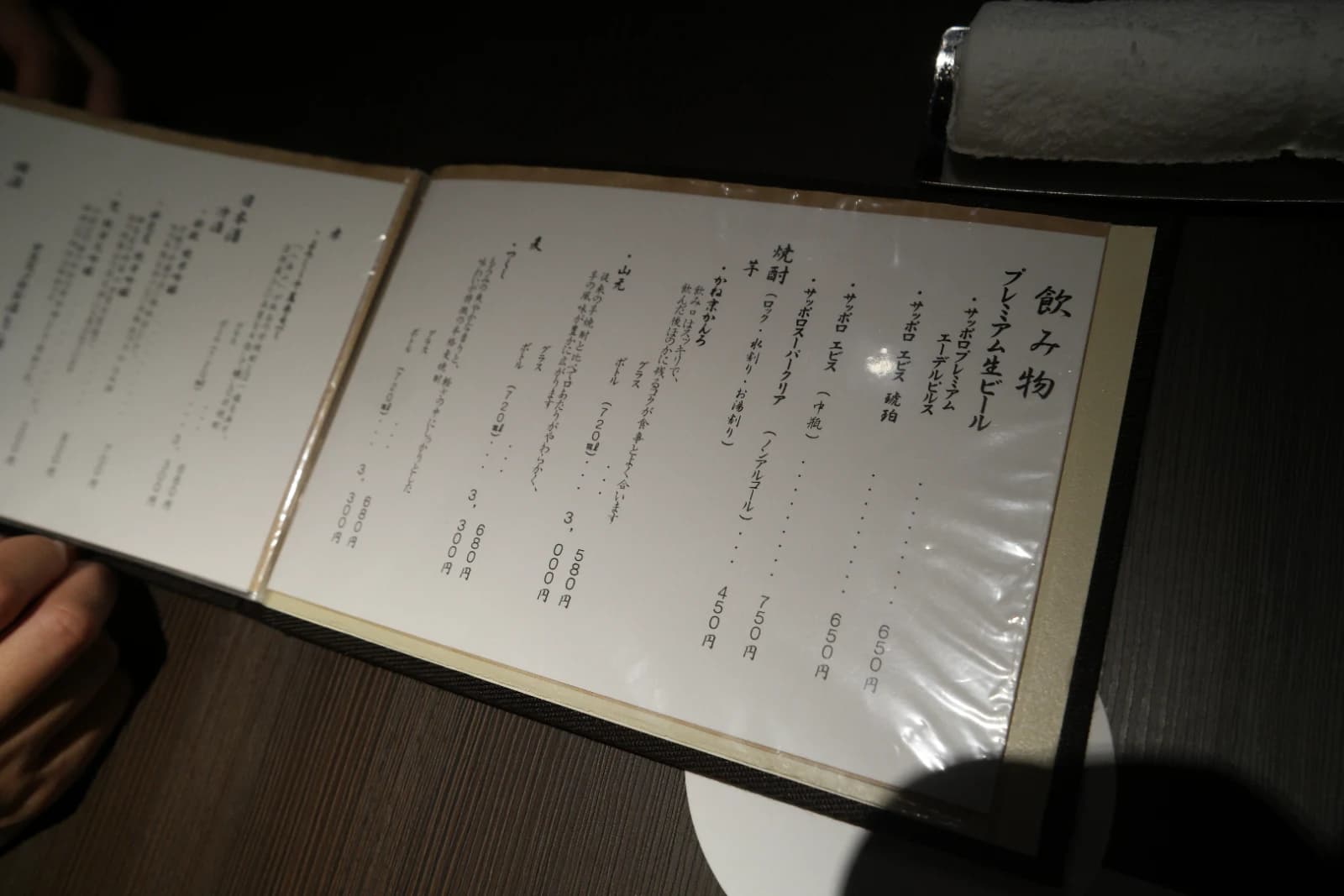
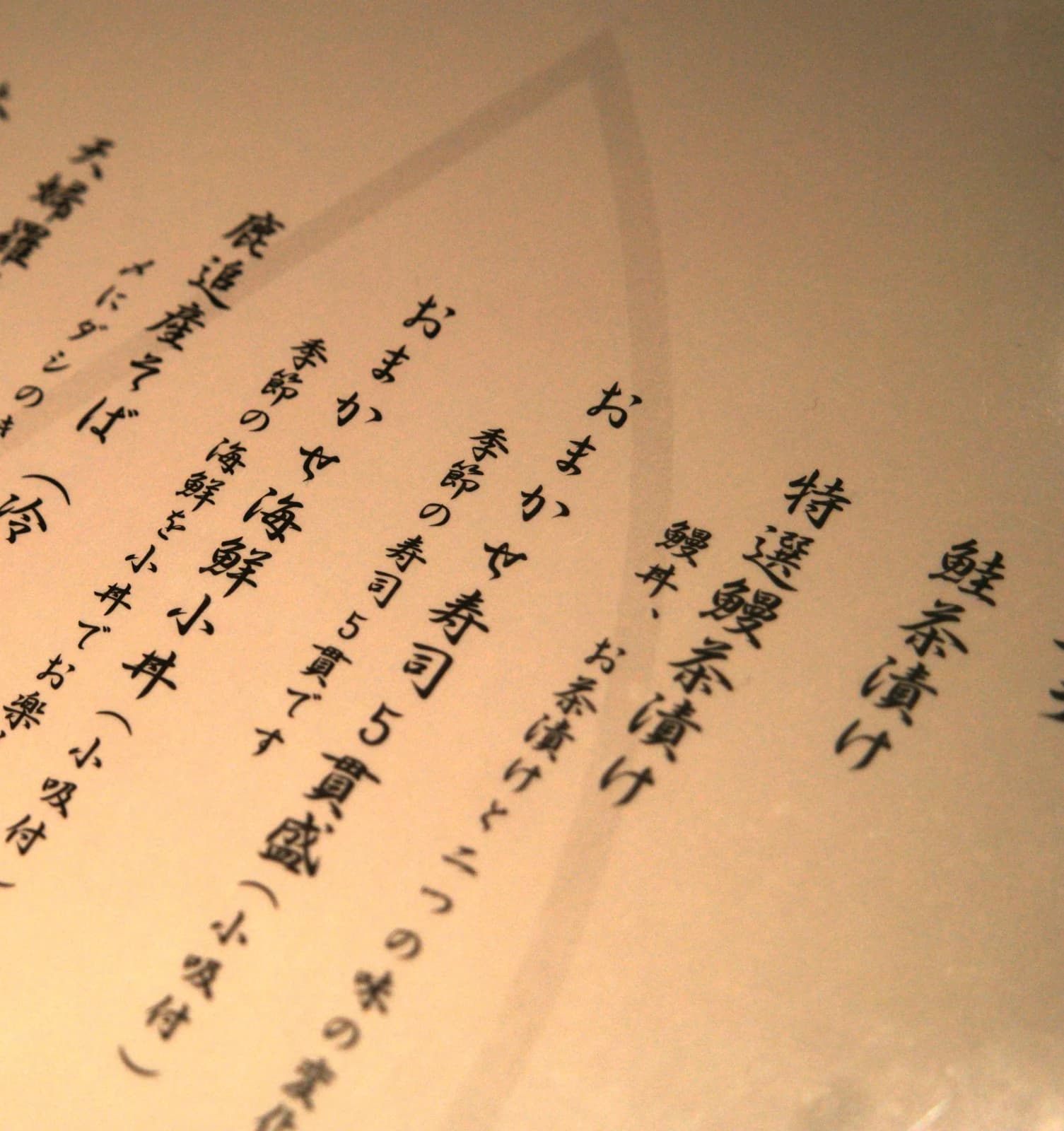
We sat down and were handed a hot towel and the menu, but back in 2016 phone translators were nowhere near as good as they are now, so we spent an embarrassing amount of time staring at a menu entirely in Japanese. The two of us sat there photographing each character one by one, trying to piece together what anything meant — it must have taken a good ten minutes just to order. The right-hand page was drinks: premium draft beer at 650 yen (roughly £3.50), shochu starting from 450 yen (about £2.40). Flip to the left and you got into the sake and food side. The second photo shows the food menu — there was salmon ochazuke, which is rice topped with salmon and doused in hot tea broth, plus a premium eel ochazuke and an eel rice bowl. There was also the Japanese omakase option, where the chef picks the best ingredients that came in that day and makes you a sushi set from them. A seasonal seafood rice bowl was on there too. In the end, I went for the seafood soba listed at the far left of the menu — cold buckwheat noodles topped with seafood — and honestly, I only chose it because it was the first thing I could half-read.
Why the chopsticks are placed horizontally
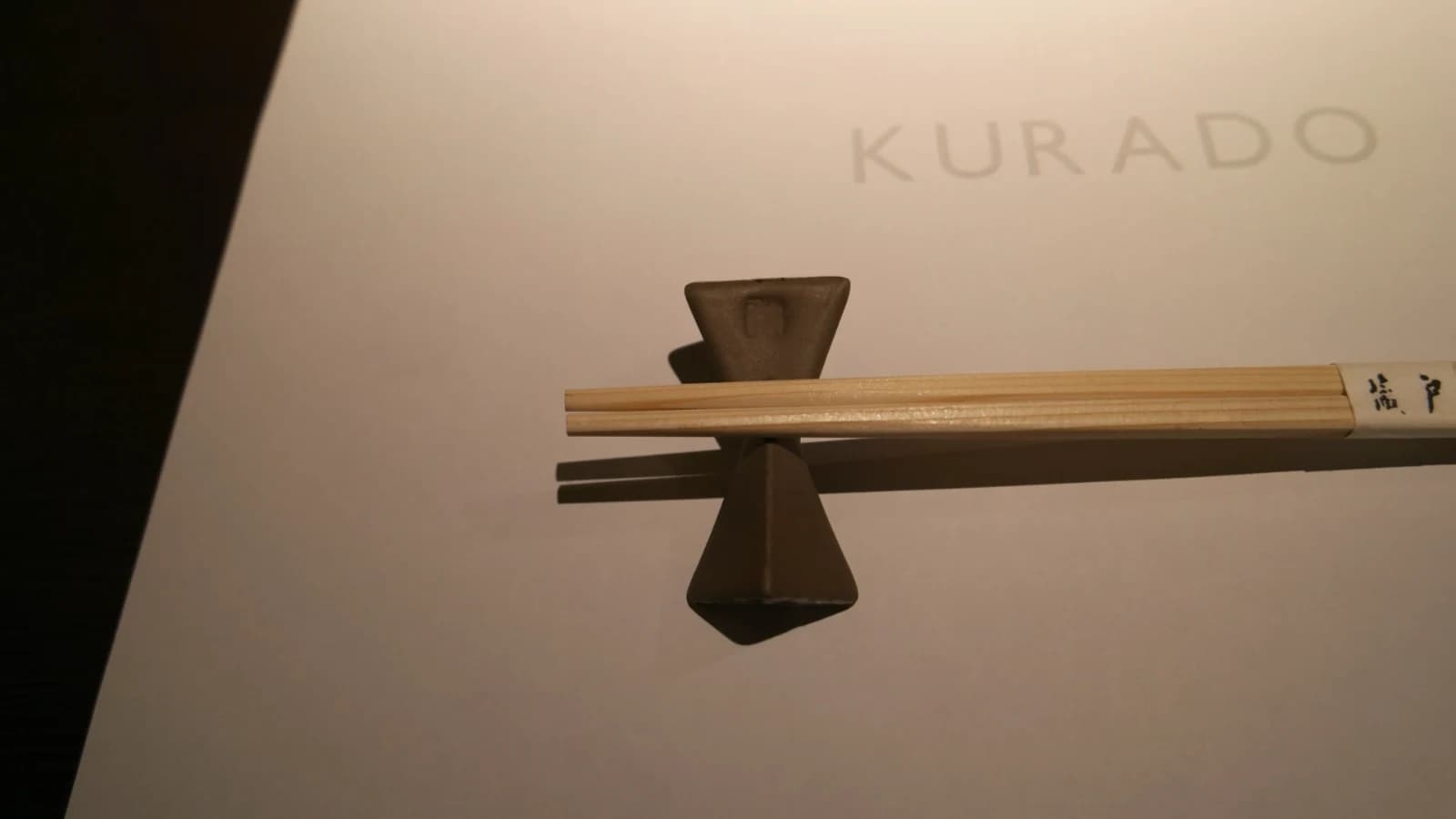
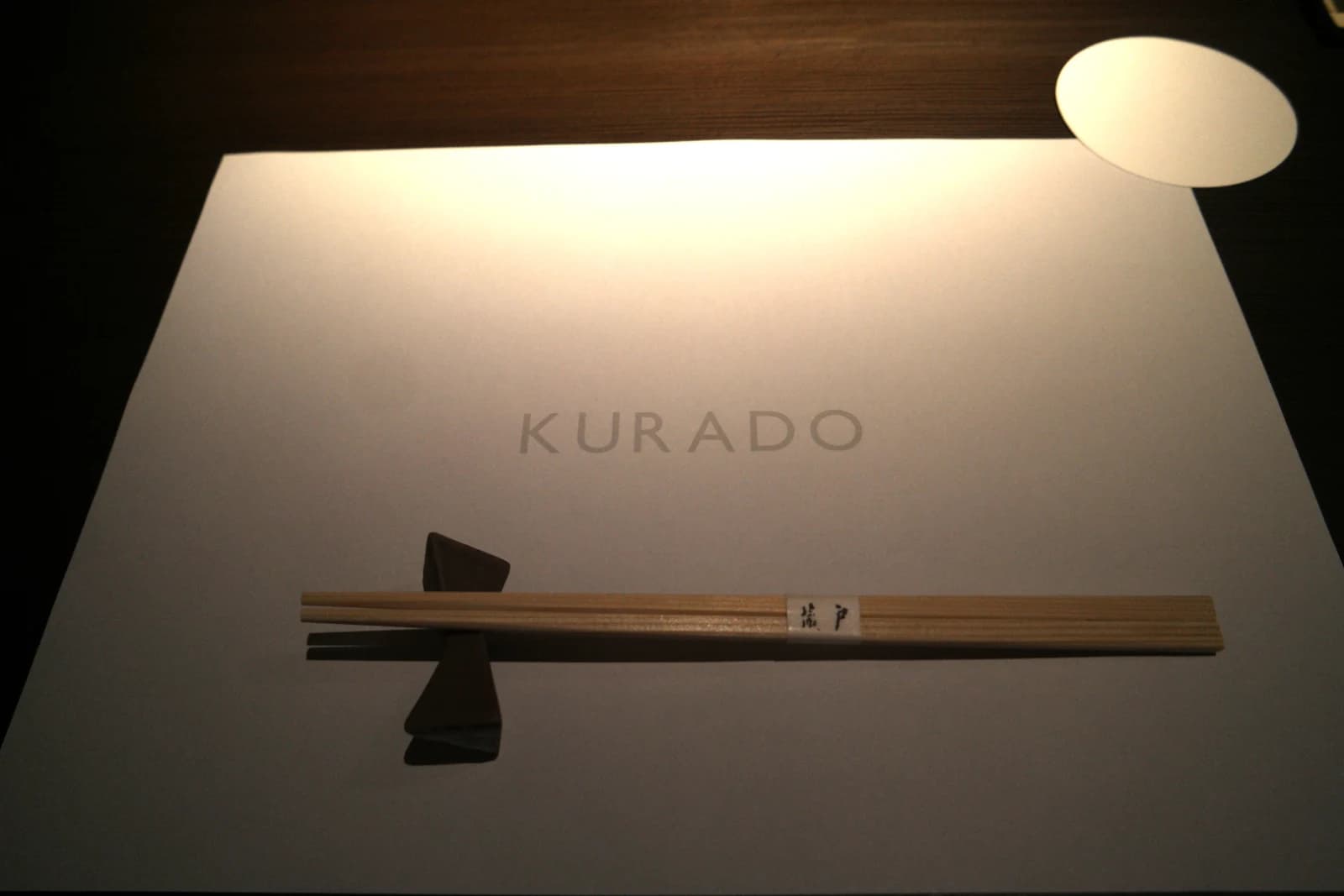
The table setting was immaculate. A white paper placemat with the restaurant name stamped in silver, and wooden chopsticks sitting neatly on a ceramic rest — even the chopsticks had the restaurant's name printed on them.
There's a rather lovely detail here. In many East Asian countries, chopsticks are placed vertically, with the handle end facing you. In Japan, though, they're set horizontally like this. It's not just a quirk of habit — there's a proper cultural reason behind it. In Japan, pointing the tips of your chopsticks towards another person is considered quite rude, so laying them sideways ensures the ends don't point at anyone. There's another layer to it as well: the horizontal chopsticks are said to act as a boundary between your space and the food, a sort of symbolic gesture meaning "I gratefully receive this meal." It's a bit like saying grace before dinner, in a way. In Korea, cutlery is traditionally placed vertically as standard table setting, so if you're not used to the Japanese way, it does look a bit odd at first. My mate had no idea about any of this, promptly turned his chopsticks vertical and tucked in. The Japanese diners at the next table gave him a sideways glance — I still remember that clearly.
First plate: agedashi dofu
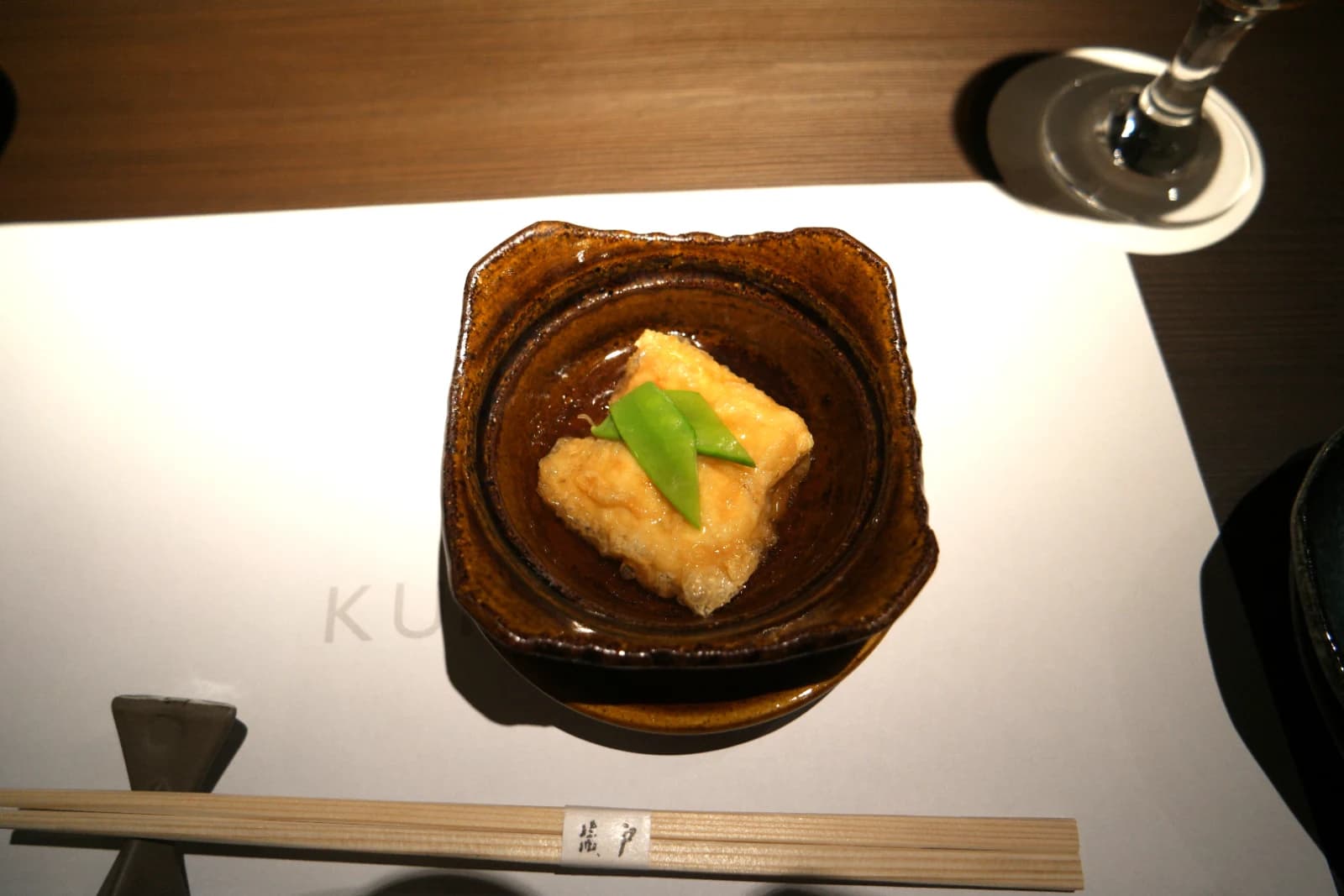
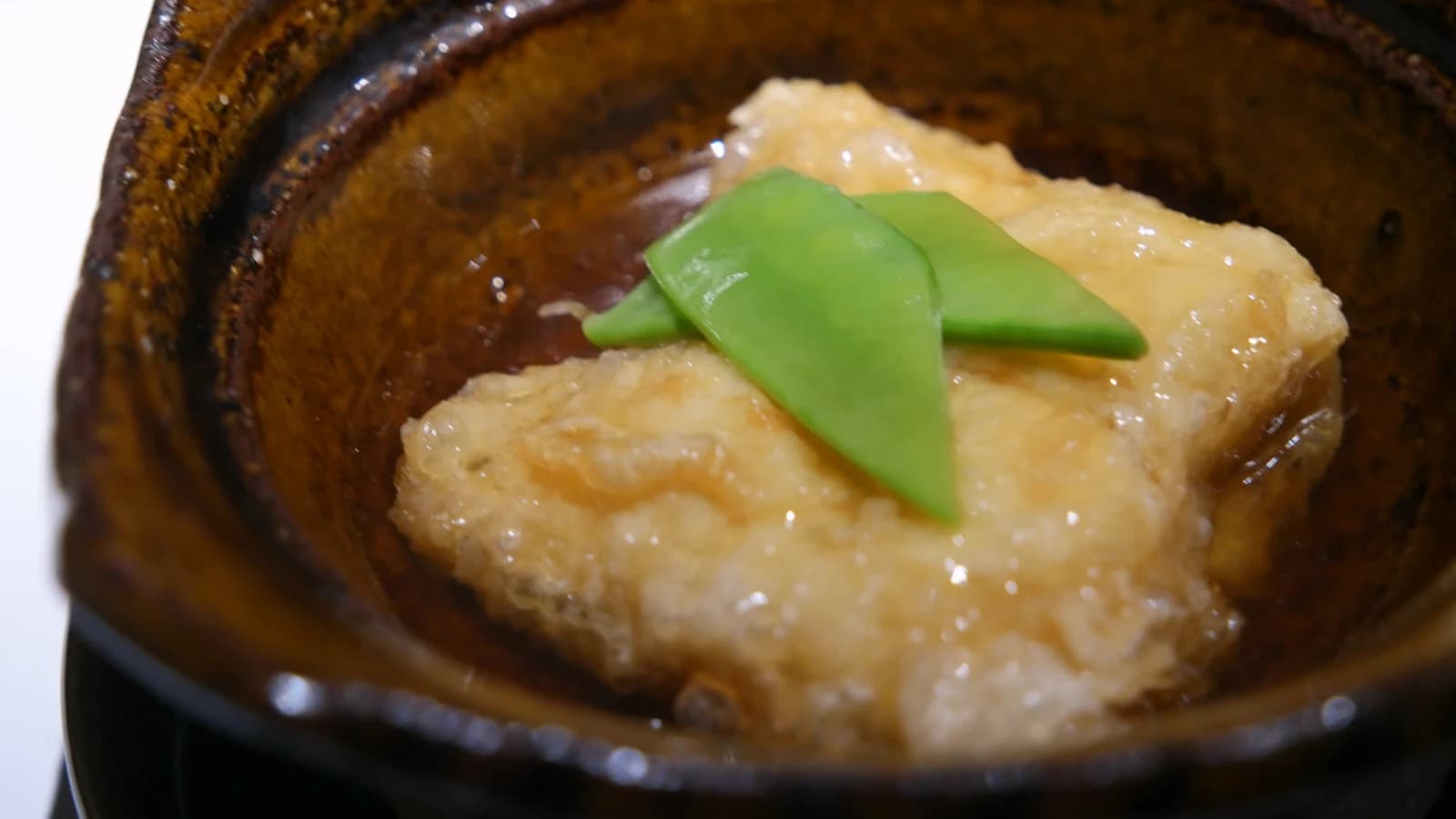
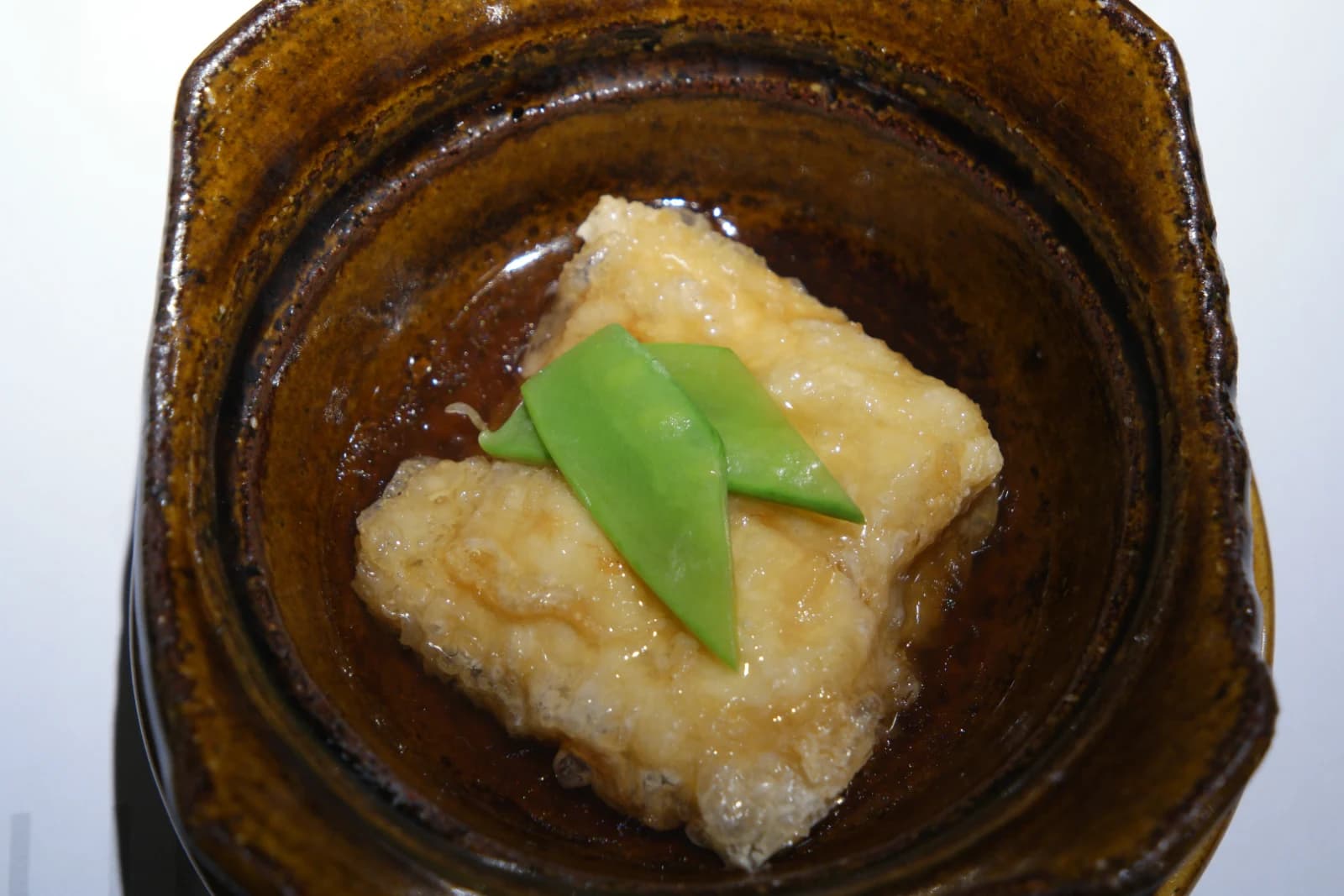
The very first thing to arrive was this small dish. It came in a brown ceramic bowl and I genuinely had no idea what it was at first. Two little pea shoots sat on top, and beneath them a golden, fried-looking block was submerged in a clear broth. I lifted it carefully with my chopsticks and discovered it was agedashi dofu — tofu coated in a thin layer of starch, deep-fried until crisp, and served in a warm dashi broth. One bite and the outside still had a gentle crunch to it whilst the inside was astonishingly soft. The dashi was soy-based but not at all salty, just a quiet, rounded umami that had seeped right through the tofu. It was completely unlike any tofu dish I'd had before. My mate thought it was inari — that's the thin fried tofu shaped into little pouches — but this was a whole block of tofu fried in one piece, quite different. The portion was genuinely tiny, but from that single piece alone you could tell this kitchen knew what it was doing.
A salad finished tableside
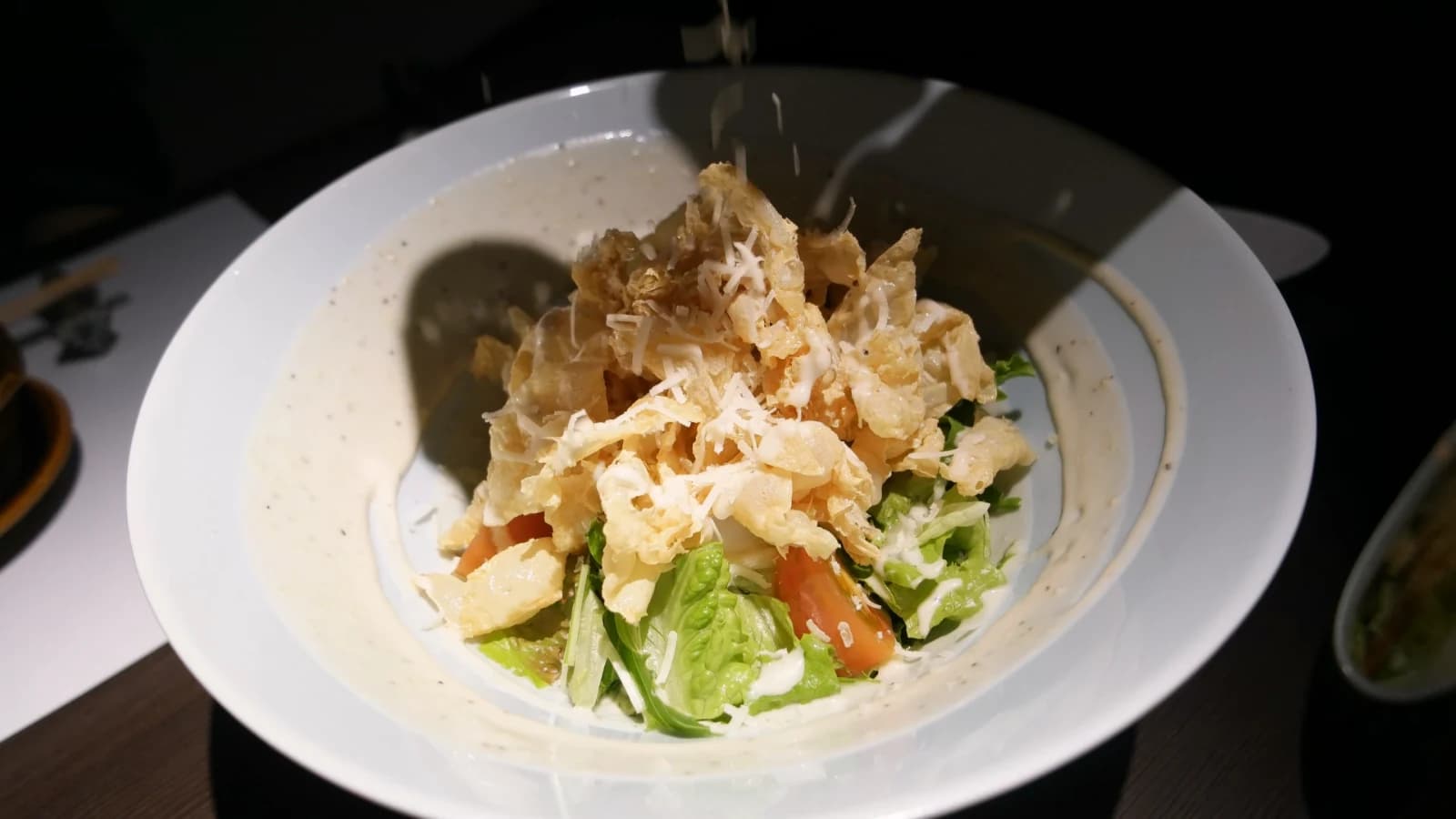
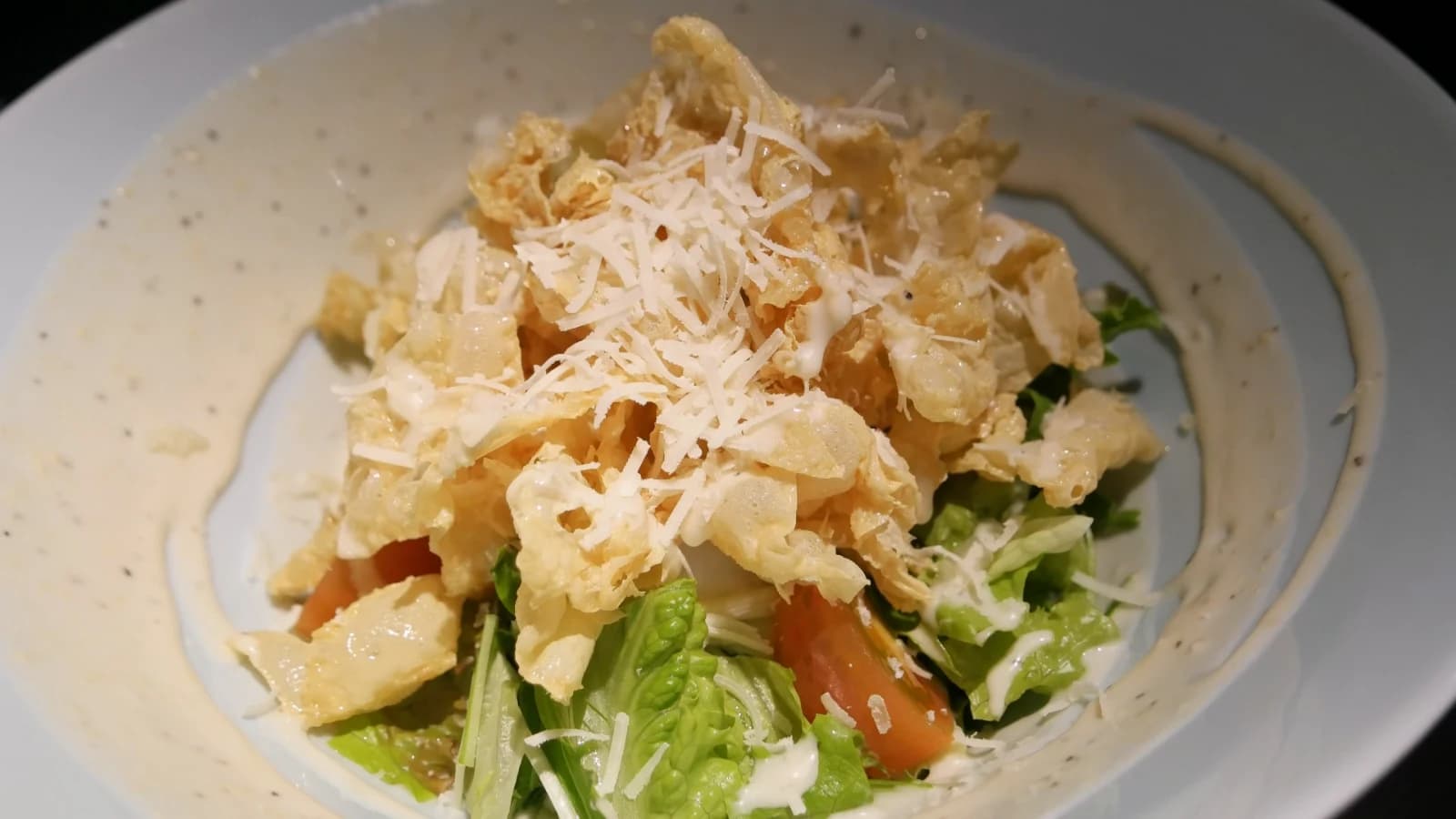
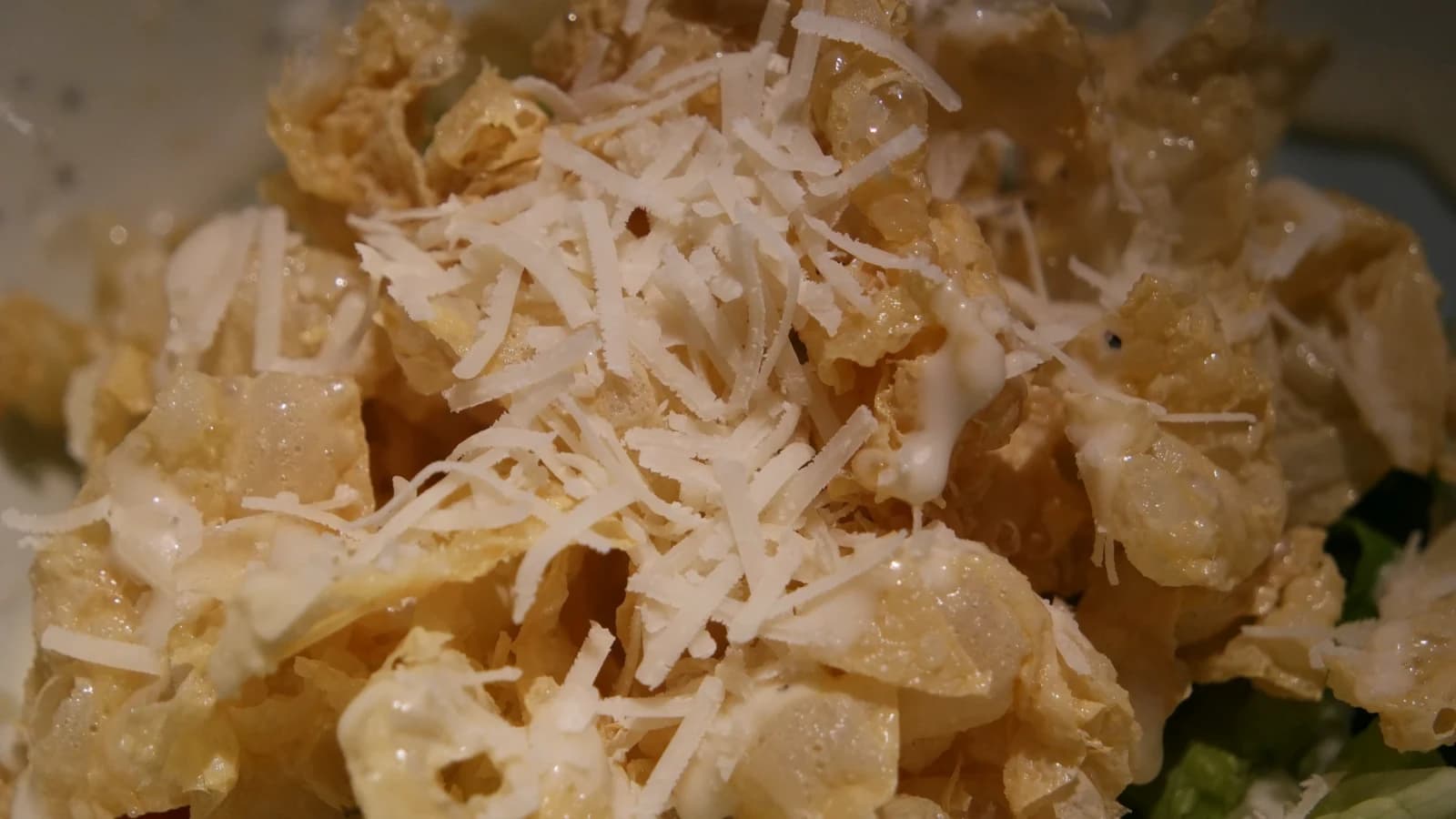
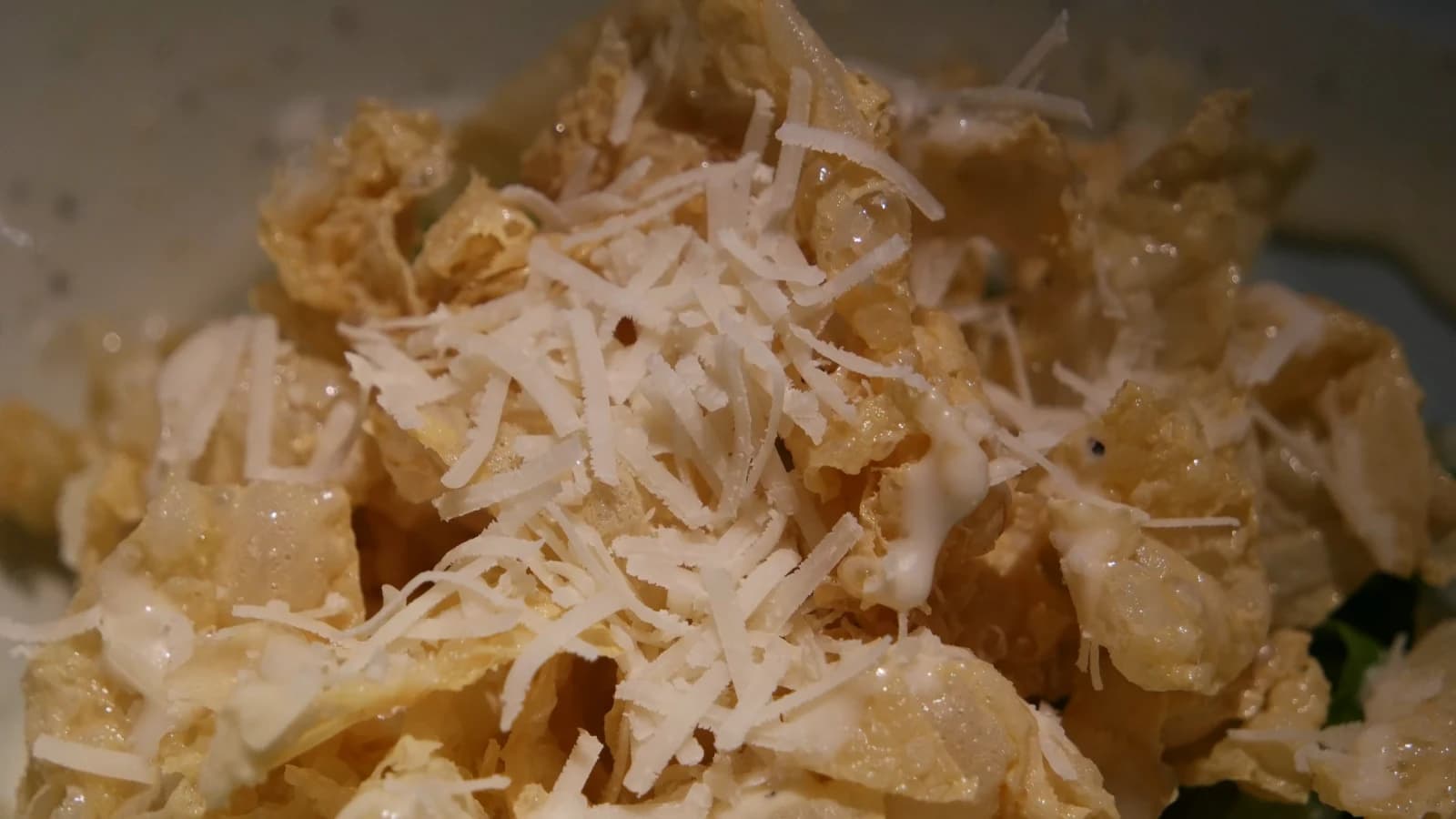
Next up was the salad. A wide white plate came out with a bed of lettuce and tomato, but that was only the start. The server set it down, scattered a generous handful of crispy tempura-like crumbs on top, and then finely grated white cheese over the lot — it fell like snow. Having it finished right there at the table was a proper bit of theatre. Up close, those fried bits were impossibly thin and light — they could have been wonton wrappers or perhaps yuba, that delicate tofu skin, crisped up. I still don't know exactly what they were, but when you grabbed a clump of greens and crumbs together with your chopsticks, the fresh crunch layered against the crispy bits was genuinely fun to eat. My mate had zero expectations for a salad, took a disinterested bite, and immediately went "wait, what? This is actually good?" before reaching his chopsticks across into mine. The portion wasn't as generous as it looked, mind — sharing it between two felt a touch mean.
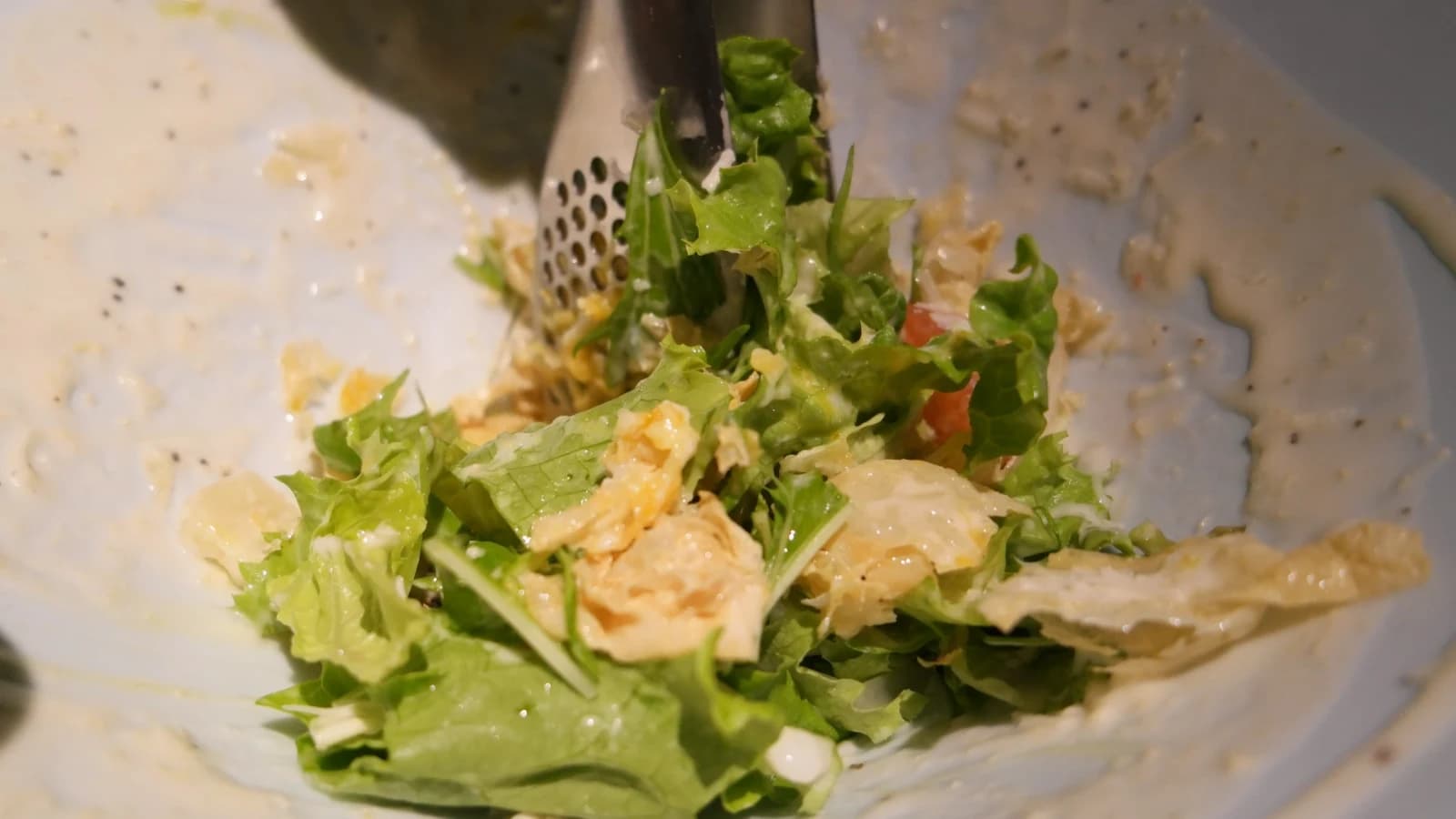
We demolished it. Nothing left on the plate but traces of dressing, and I'll be honest, I briefly considered running my finger along the bottom because even the dressing was that good. Japanese food really does earn its reputation in moments like this — the quality of every single ingredient was genuinely impressive. The veg was crisp, the sauce tasted like someone had actually bothered. But here's the thing: for someone used to a proper British dinner — or indeed any normal-sized meal — it was nowhere near enough food. Back home, for similar money you'd get a full main course with sides. Here it was a beautiful plate with a morsel, another beautiful plate with two morsels, and so on. The eyes were having a lovely time but the stomach was sending increasingly urgent signals. My mate leaned over and said "is that actually all of it?" and I had absolutely nothing to say.
The satsuma-age that changed how I think about fish cake
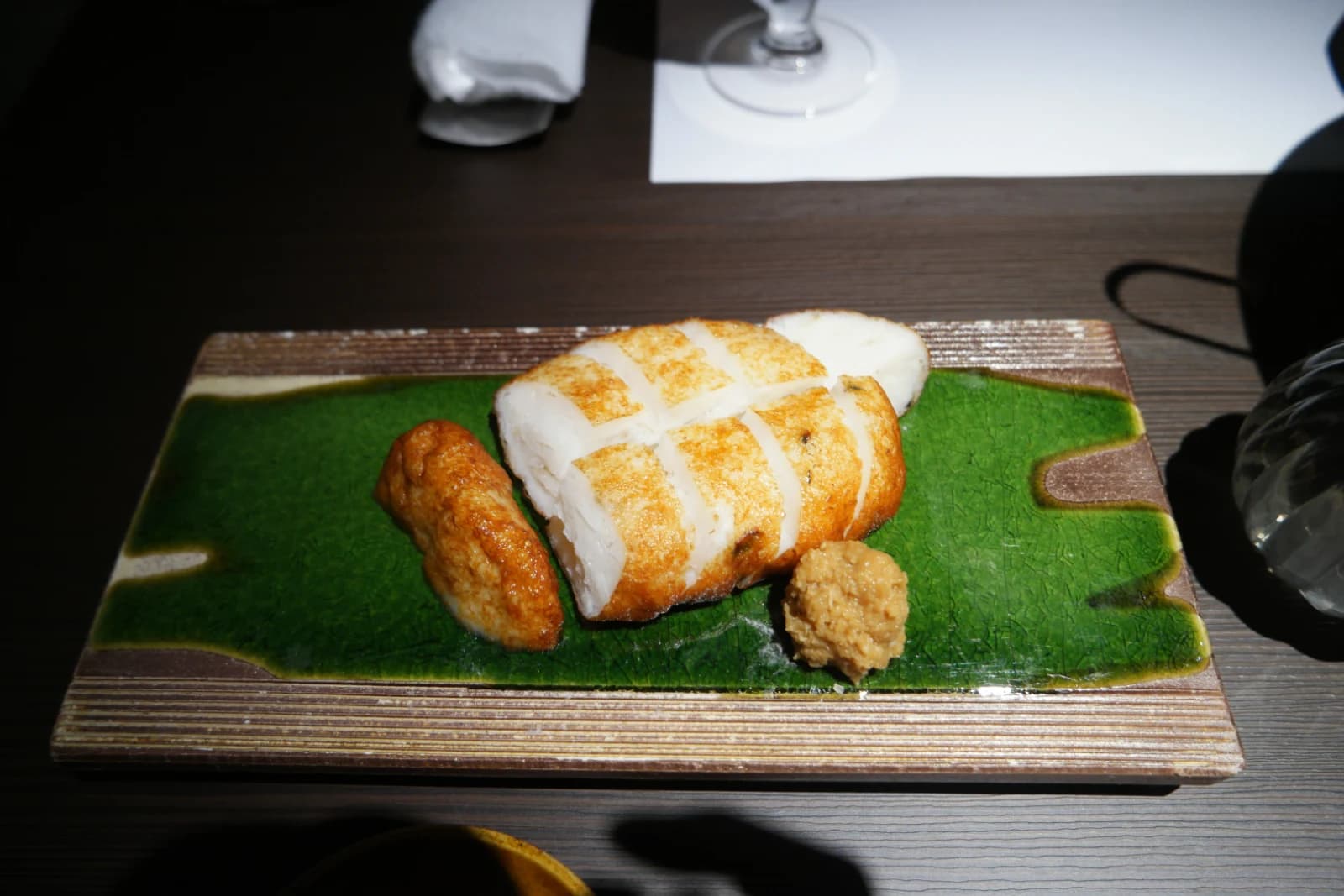
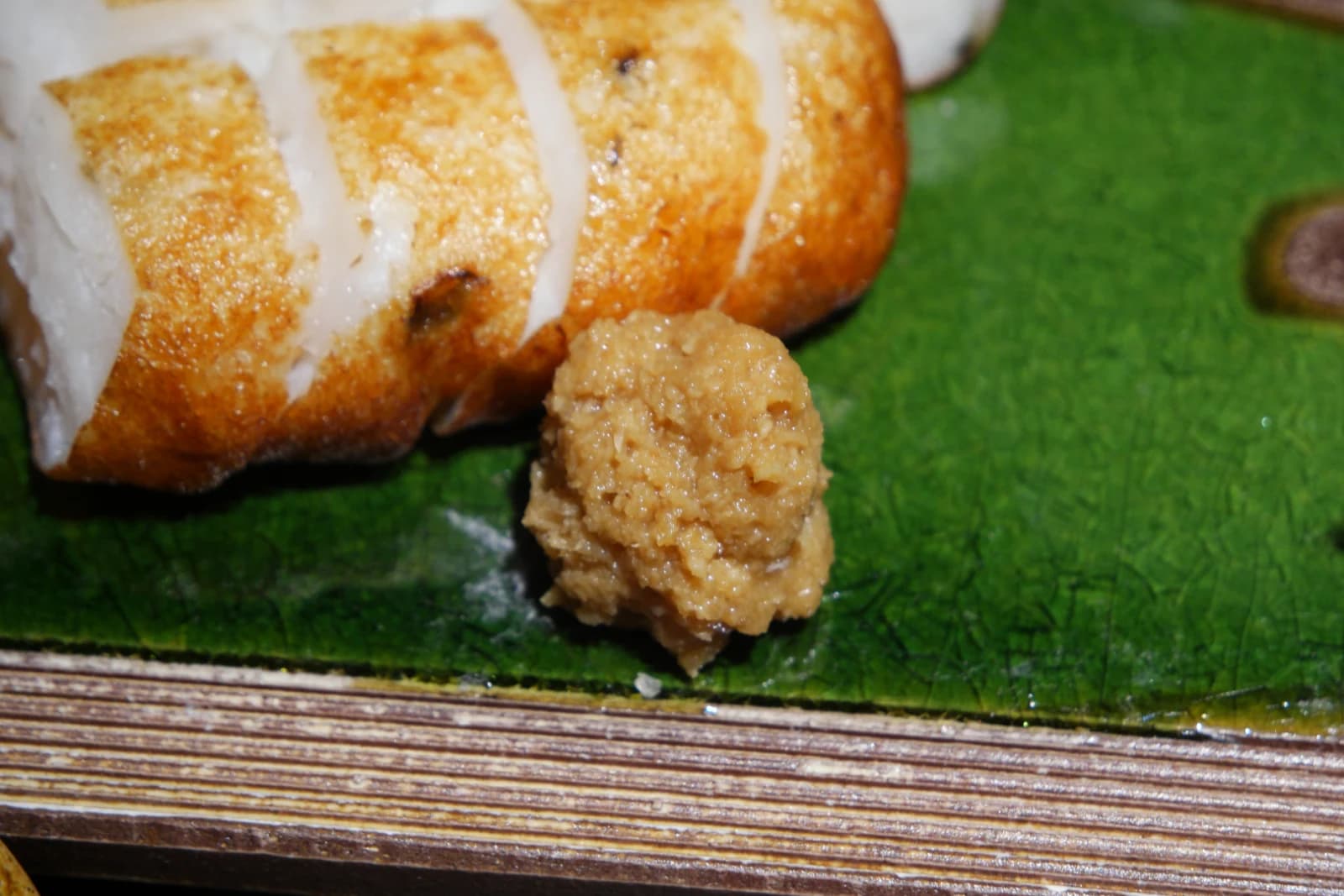
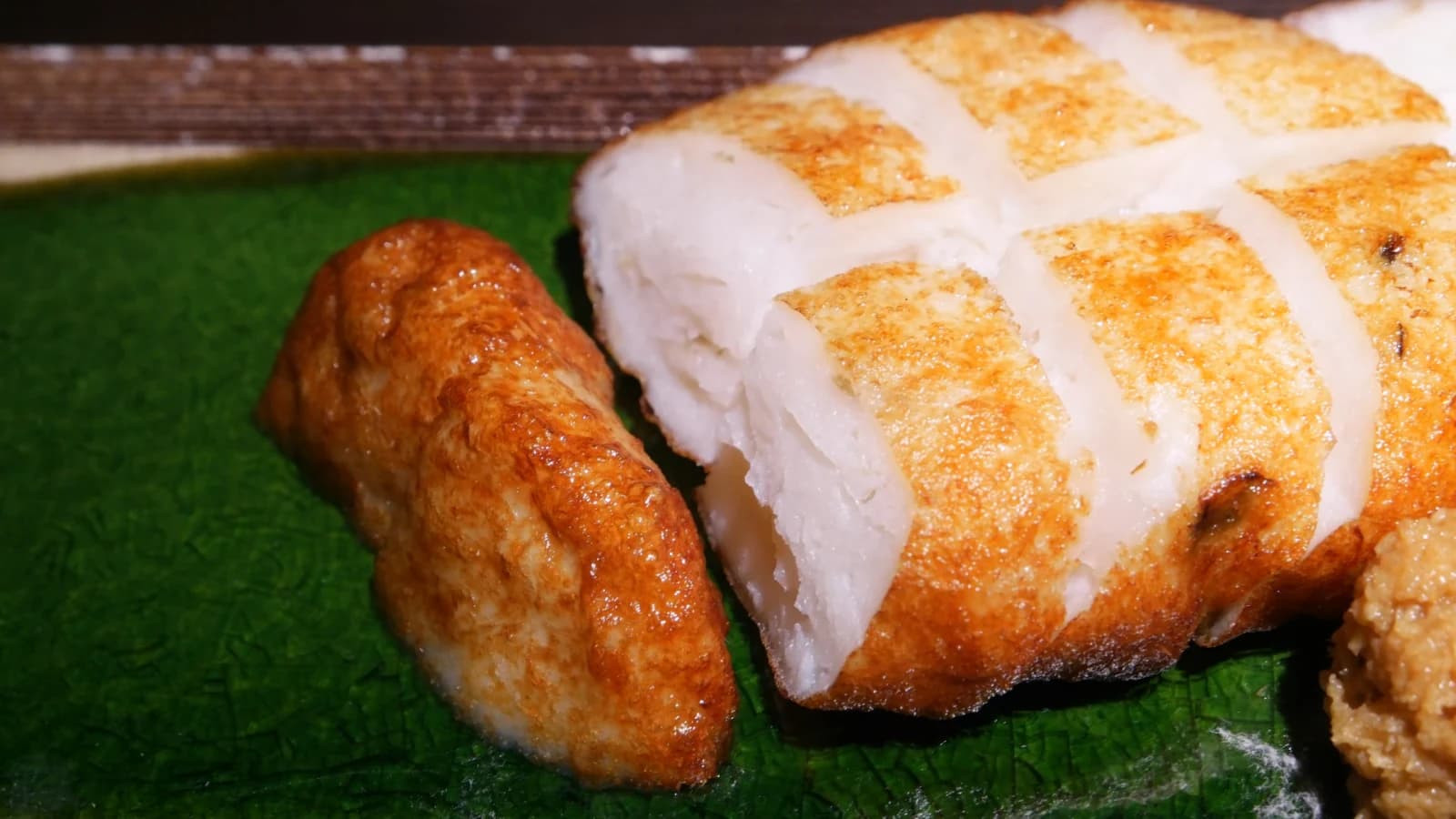
What came next was sitting on a green leaf-shaped plate. The surface was nicely browned and scored in a crosshatch pattern — I initially thought it was grilled fish. A small blob of wasabi sat alongside it, and behind the main piece was a smaller grilled portion as well.
I cut off a bite and realised it was fish cake. Satsuma-age, specifically — a Japanese-style fish cake made from finely ground fish paste, shaped and grilled until golden. The texture was surprisingly different from the fish cakes you'd find in a British chippy. Ours tend to have that dense, springy quality. This was far softer and the actual flavour of the fish came through much more intensely. The outside had a slight char to it whilst the inside was moist and almost flaky. A dab of wasabi cleared the sinuses instantly and made the savoury depth of the fish even more pronounced. "This is fish cake?" I remember asking my mate. It just bore no resemblance whatsoever to any fish cake I'd encountered before.
Omakase sushi — 5 pieces, and that's for two?
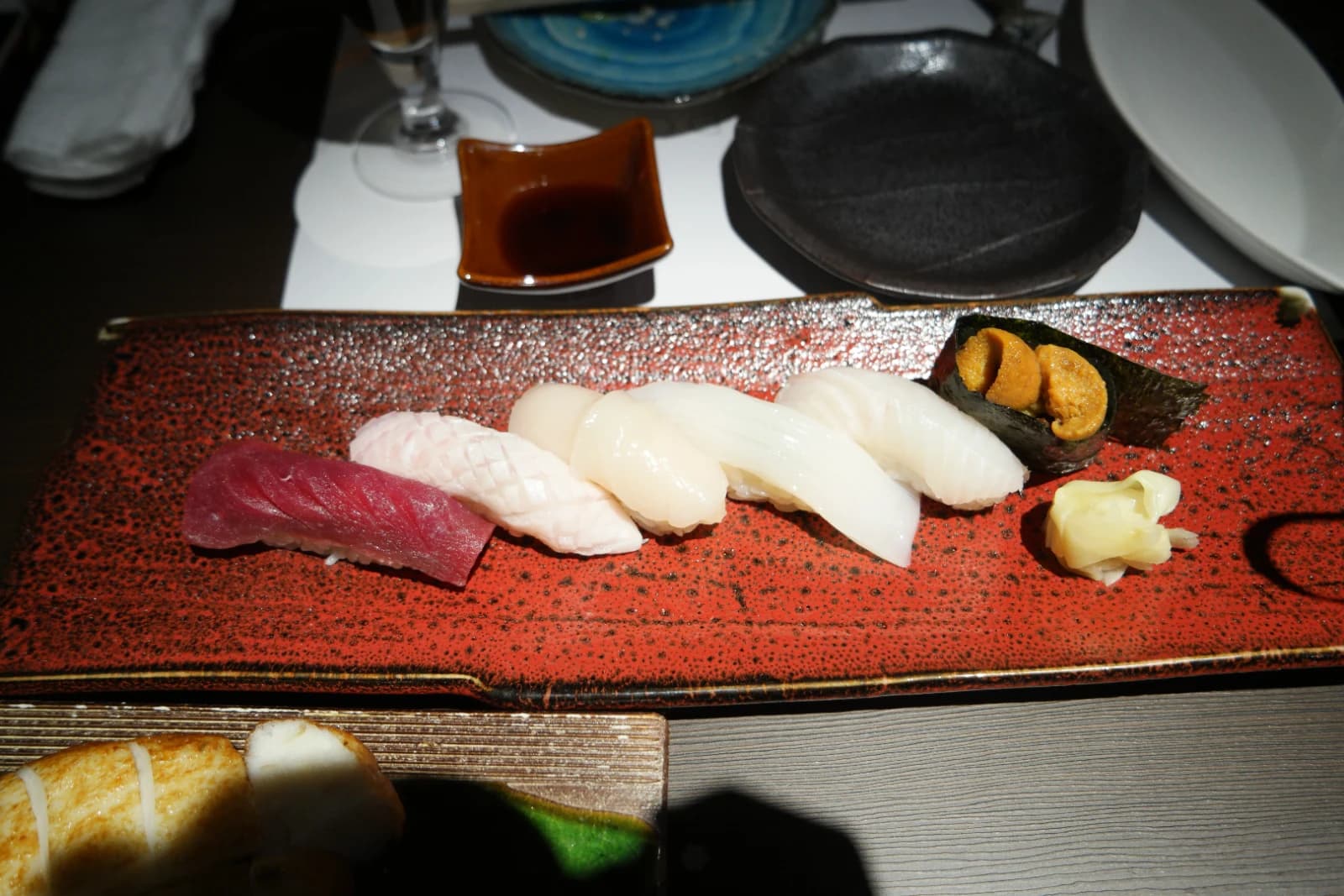
And then, finally, the main event arrived. Japanese omakase — the chef selects the day's finest ingredients and prepares a sushi set from them, piece by piece. They were lined up neatly on a long red plate. From left to right: tuna, then a scored white fish, what appeared to be translucent scallop, another white fish, and at the far right a gunkan-maki — a little ship of nori-wrapped rice topped with sea urchin. In the centre sat gari, the thin slices of pickled ginger that cleanse your palate between pieces, and above it all a small dish of soy sauce.
The thing is, this was for the two of us. Five pieces total. Two and a half each. The moment we saw the plate, we both looked up and caught each other's eyes with the exact same expression: "Is that it?" If you order sushi at a restaurant back home you're used to getting a platter piled high. So yes, we were a bit taken aback. But as it turned out, this wasn't actually the end — more was still to come.
Sea urchin: the piece that changed everything
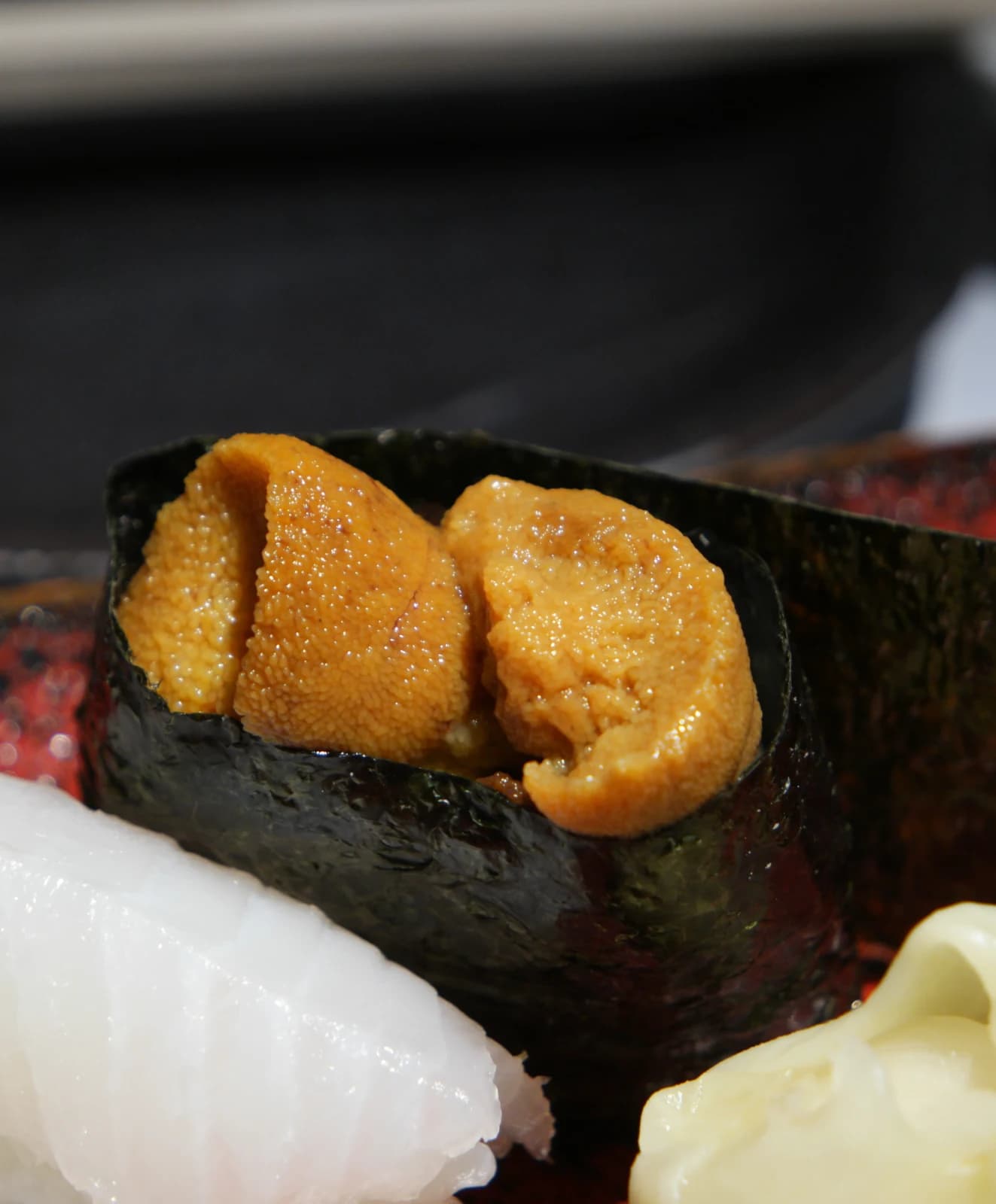
This is sea urchin — uni, as the Japanese call it. A little parcel of nori-wrapped rice with a crown of bright orange uni on top. There was exactly one piece. My mate couldn't stand the distinctive fishy smell of sea urchin, so he wouldn't even look at it, and it naturally ended up in front of me. Honestly, I wasn't expecting much either. I'd always given uni a wide berth whenever it appeared at a seafood restaurant — the smell just put me off. But it was part of the course and it seemed wasteful not to try, so I shut my eyes and popped the whole thing in. There was no fishy smell at all. Genuinely, none. It wasn't the taste of the sea in some aggressive way — it was more like the sweetness of the sea. Creamy, melting on the tongue, with a gentle sweetness lingering at the end. In that moment I thought, "Ah, so this is what sea urchin is actually supposed to taste like." I told my mate, "Seriously, this has zero fishiness, just try one bite," but he shook his head firmly. I'm still gutted about it. I wish he'd shared that moment with me.
Breaking down the omakase, piece by piece
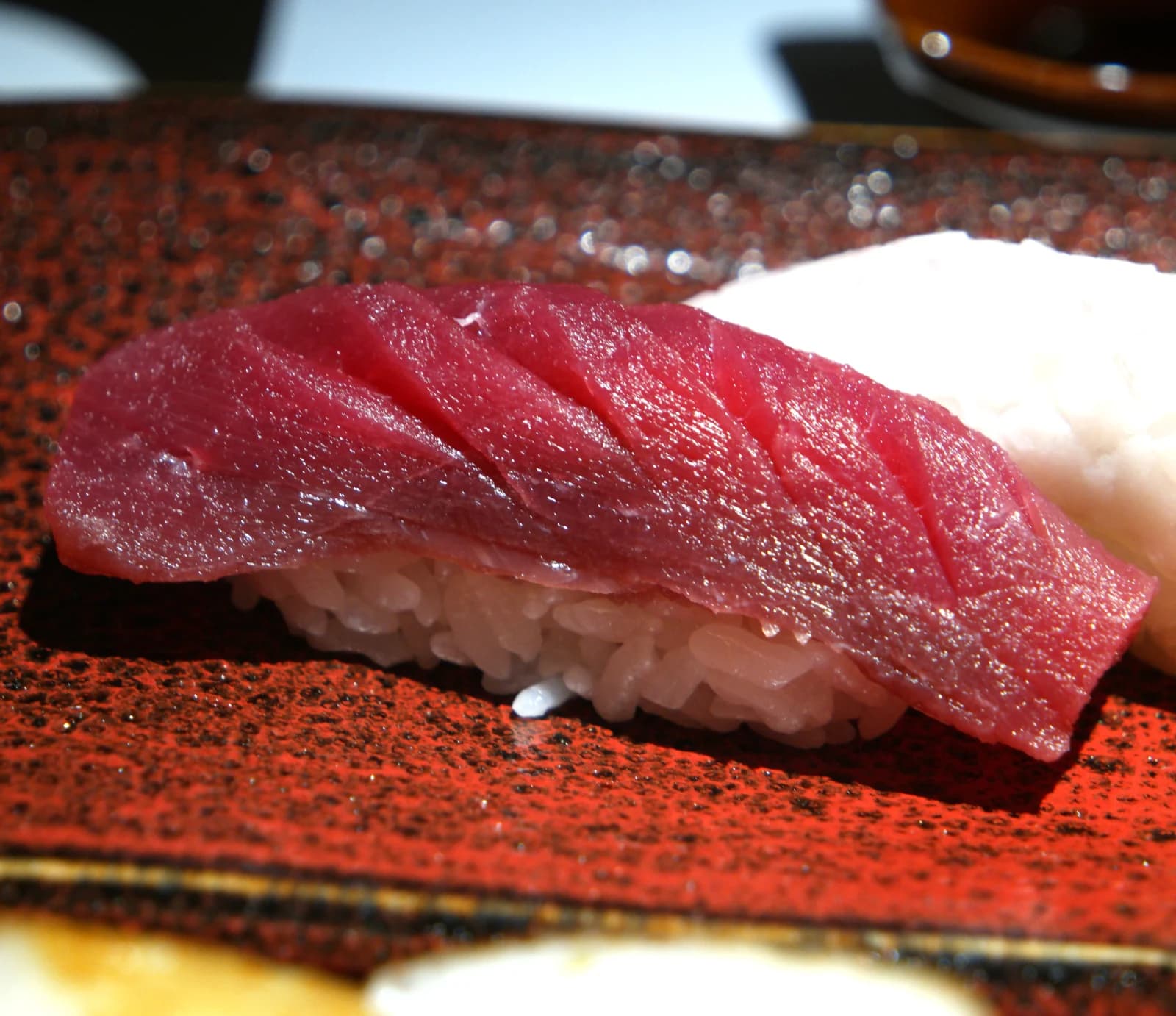
The tuna against the red plate was a stunning contrast. A deep ruby-red cut with tight grain lines and a sheen that caught the light beautifully. It was sliced thick enough over the rice that you could barely see the grains underneath. Put it in your mouth and "chewing" isn't quite the right word — "melting" is closer. It seemed to be a cut with fine threads of fat running between the muscle fibres, and at that perfect temperature — neither cold nor lukewarm — the rich, savoury flavour of the fish simply bloomed.
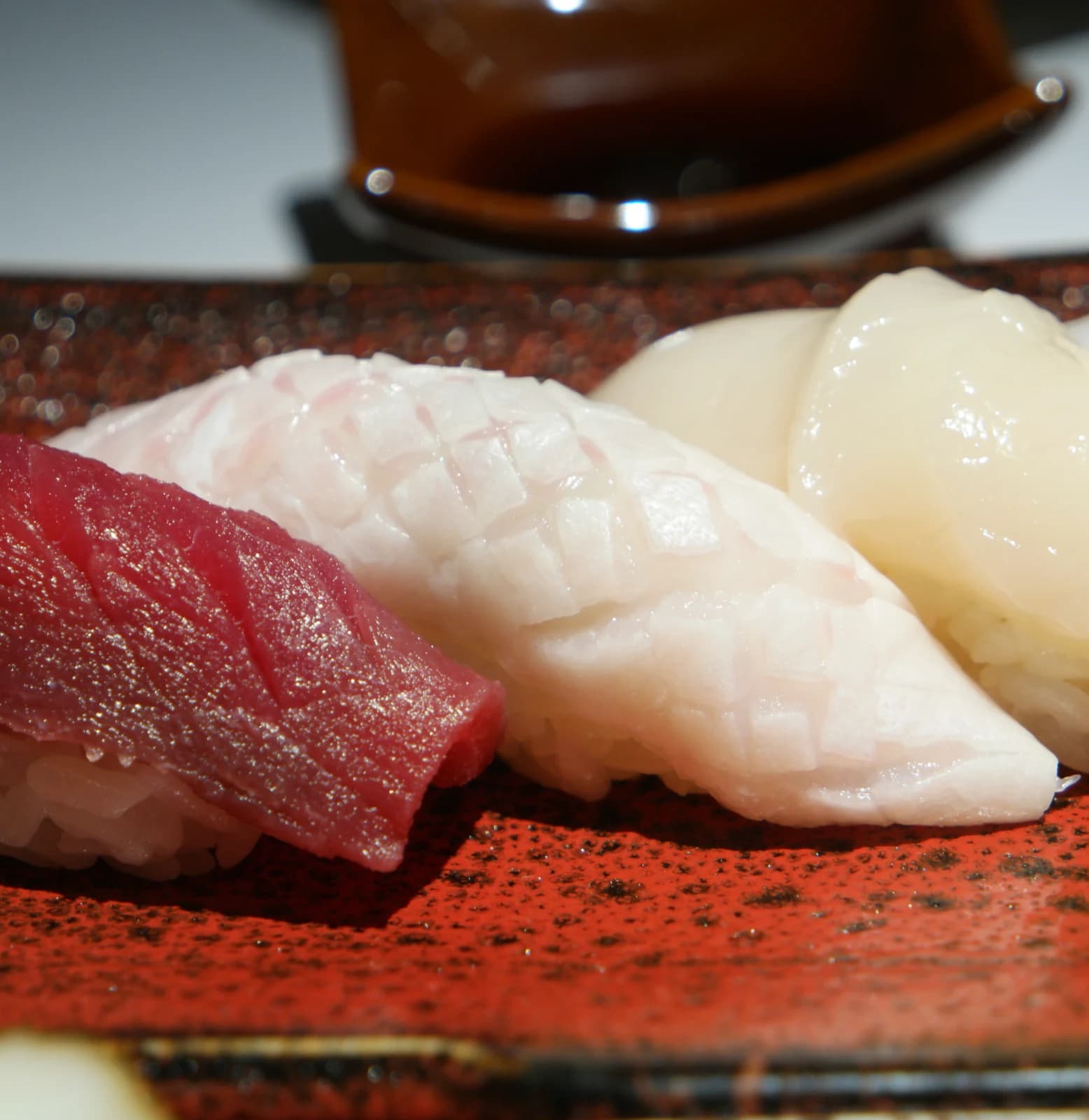
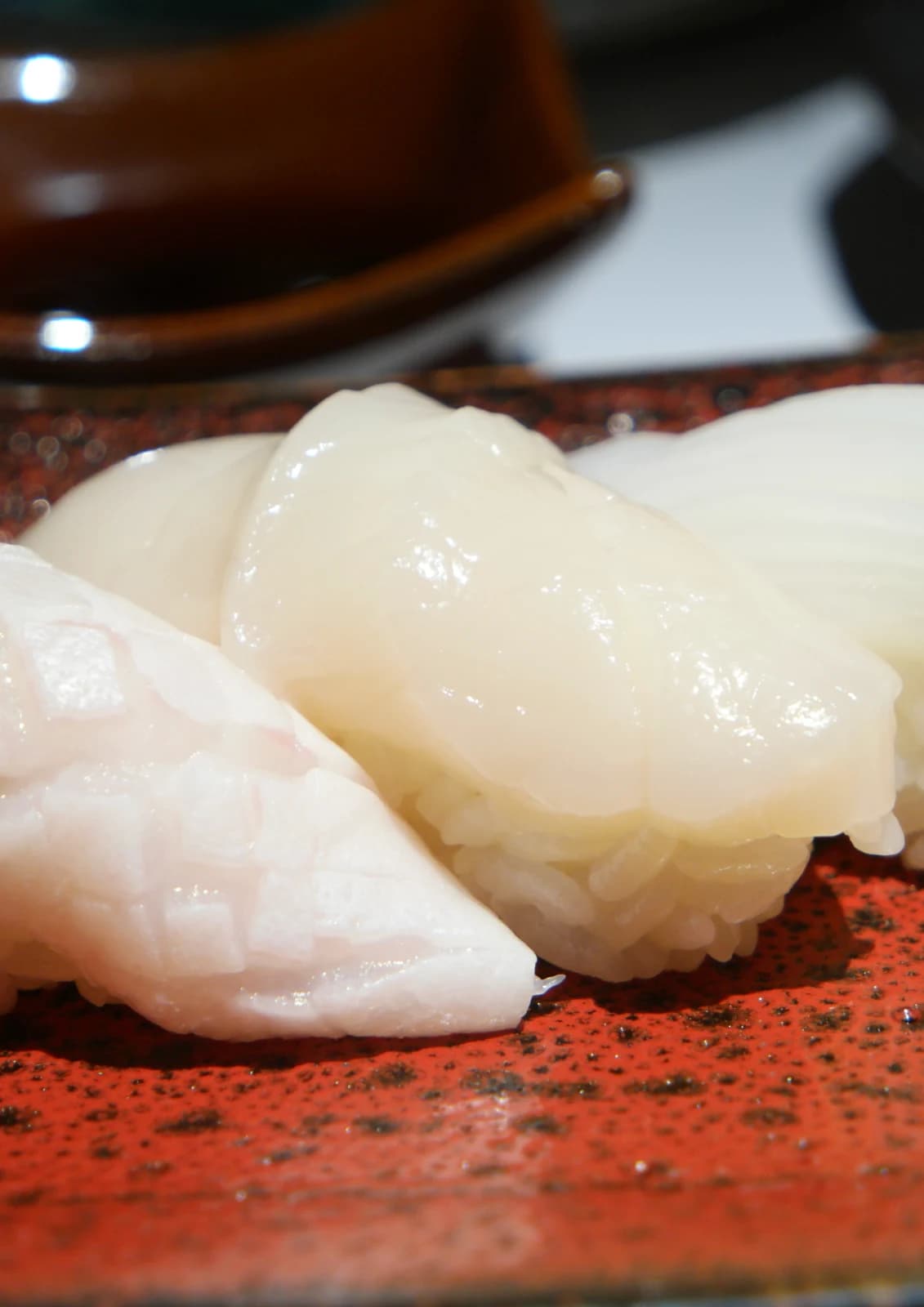
The scored white piece next to it turned out to be squid. Fine crosshatch cuts across the surface allowed the soy sauce to seep in between the lines, and those cuts also meant the texture wasn't chewy or tough at all — just tender. Each bite had a slight springiness to it but your teeth went through easily. Right beside it was the translucent white piece, which I'm fairly sure was scallop — the surface was smooth, glossy and glistening. The first thing you tasted was sweetness, followed by a quiet, understated wave of the sea. They looked similar, both being white, but the flavours went in completely different directions.
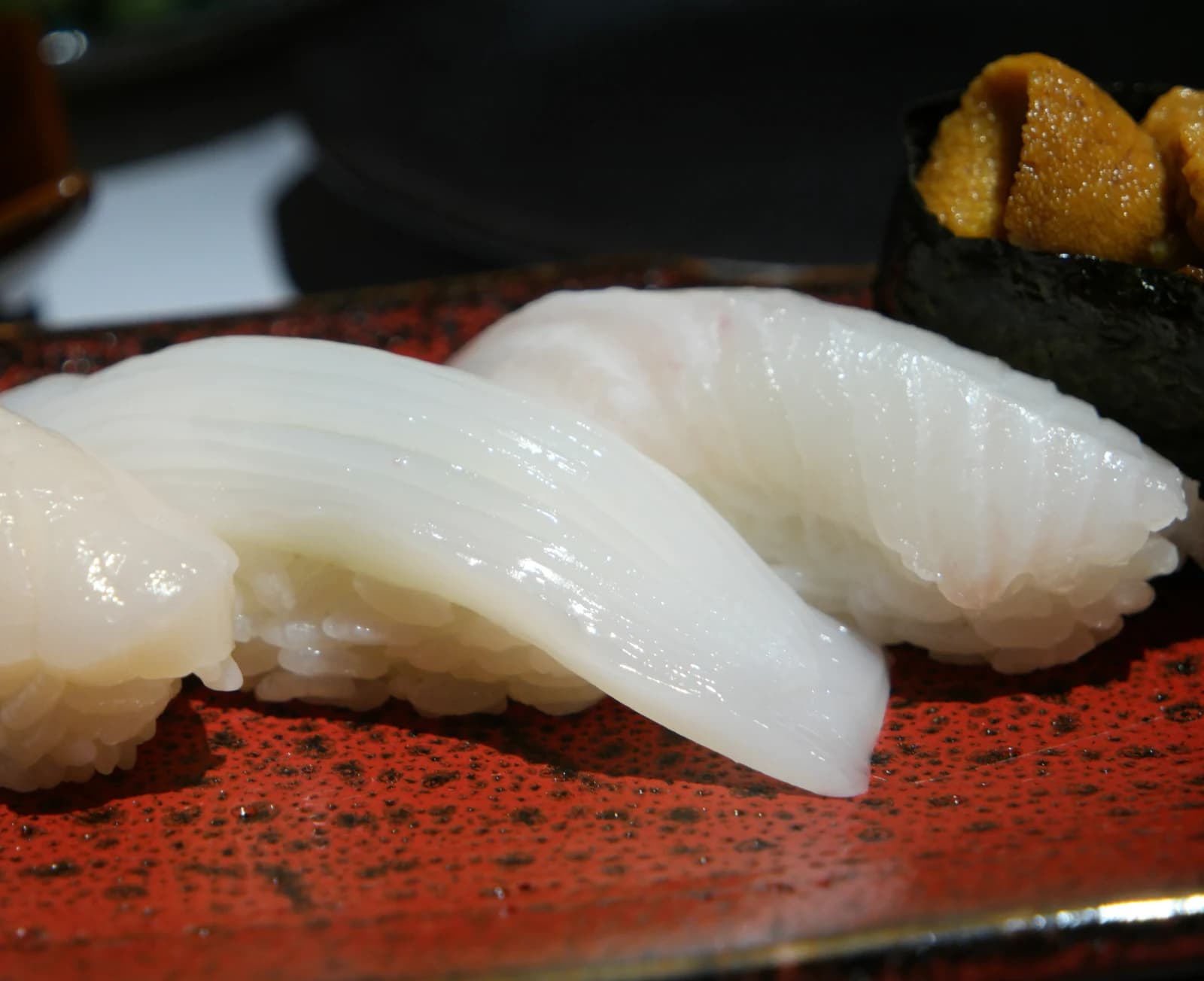
The last piece was squid again, but this time without any scoring — just thinly sliced with the natural grain left intact. It had a lovely chewy, sticky texture that lingered in the mouth for ages. Even my mate, the one who'd been going on about the convenience store, had gone properly quiet by this point.
The avocado roll that came out of nowhere
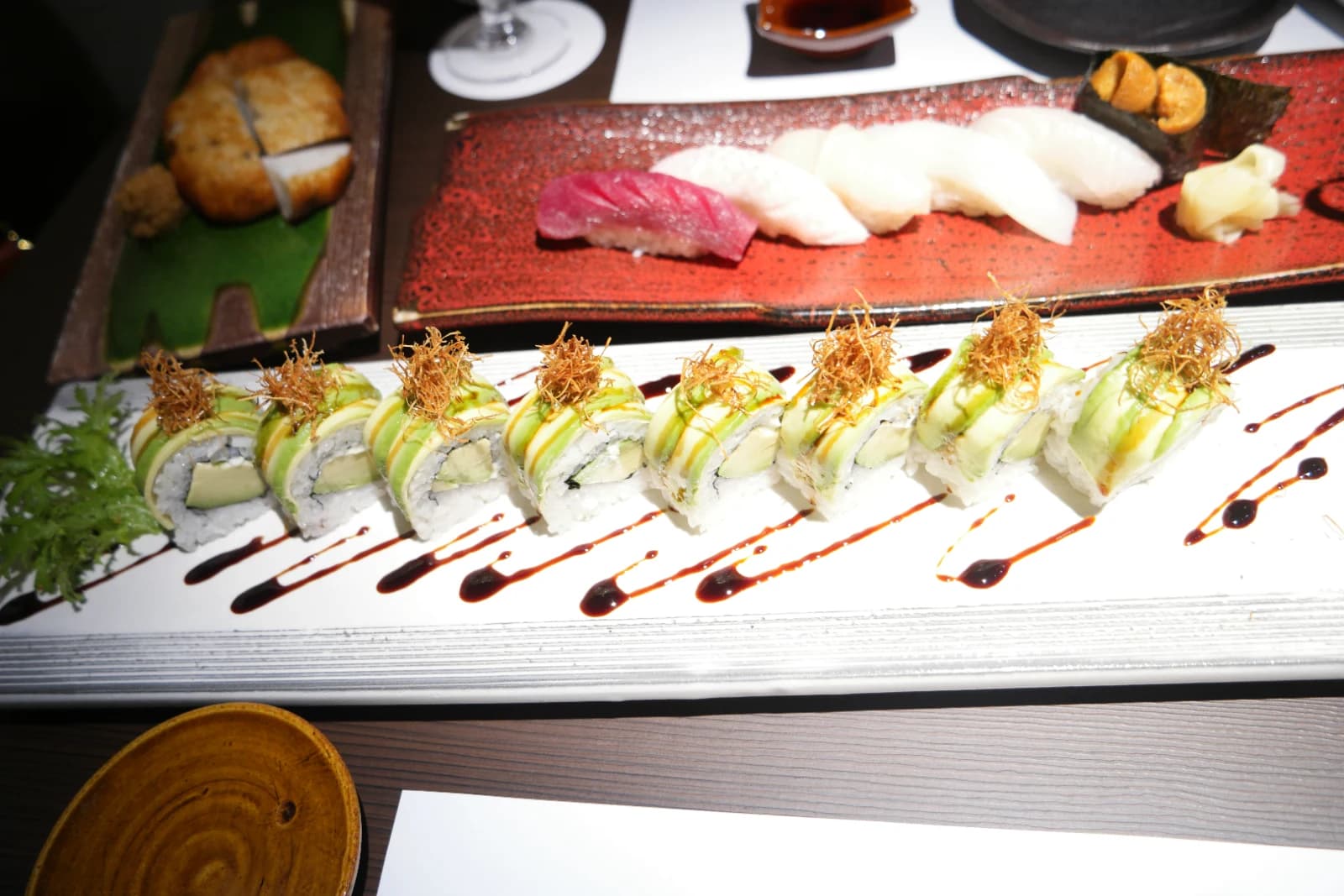
Next came the avocado roll. It arrived on a long plate in a neat row, and I'll be straight with you — at this point I wasn't expecting much. Avocado in sushi can be a bit divisive. It's one of those love-it-or-hate-it things, and back then I wasn't particularly fond of it. My mate saw the plate, said "Is that avocado? I'll pass," and put his chopsticks down.
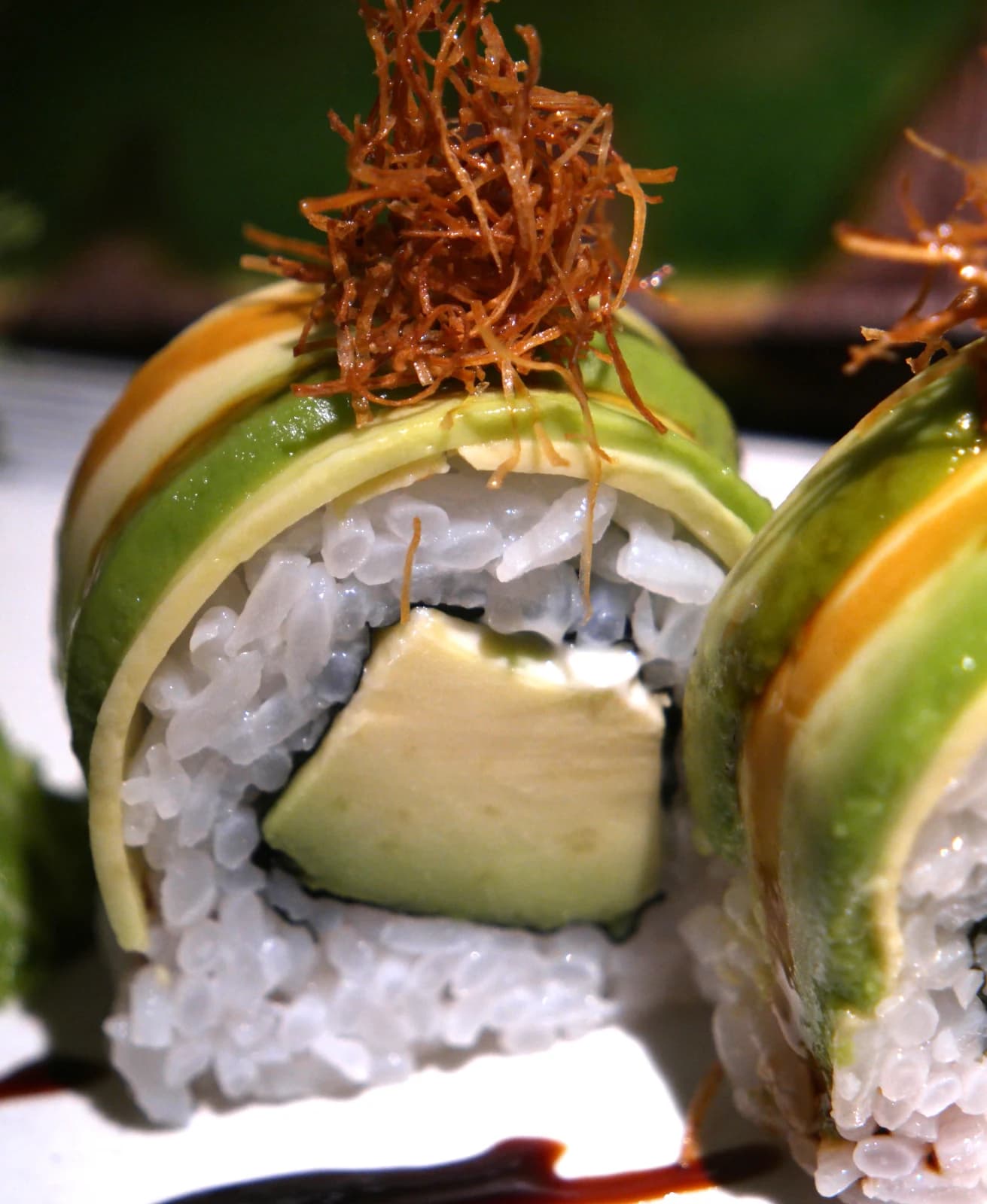
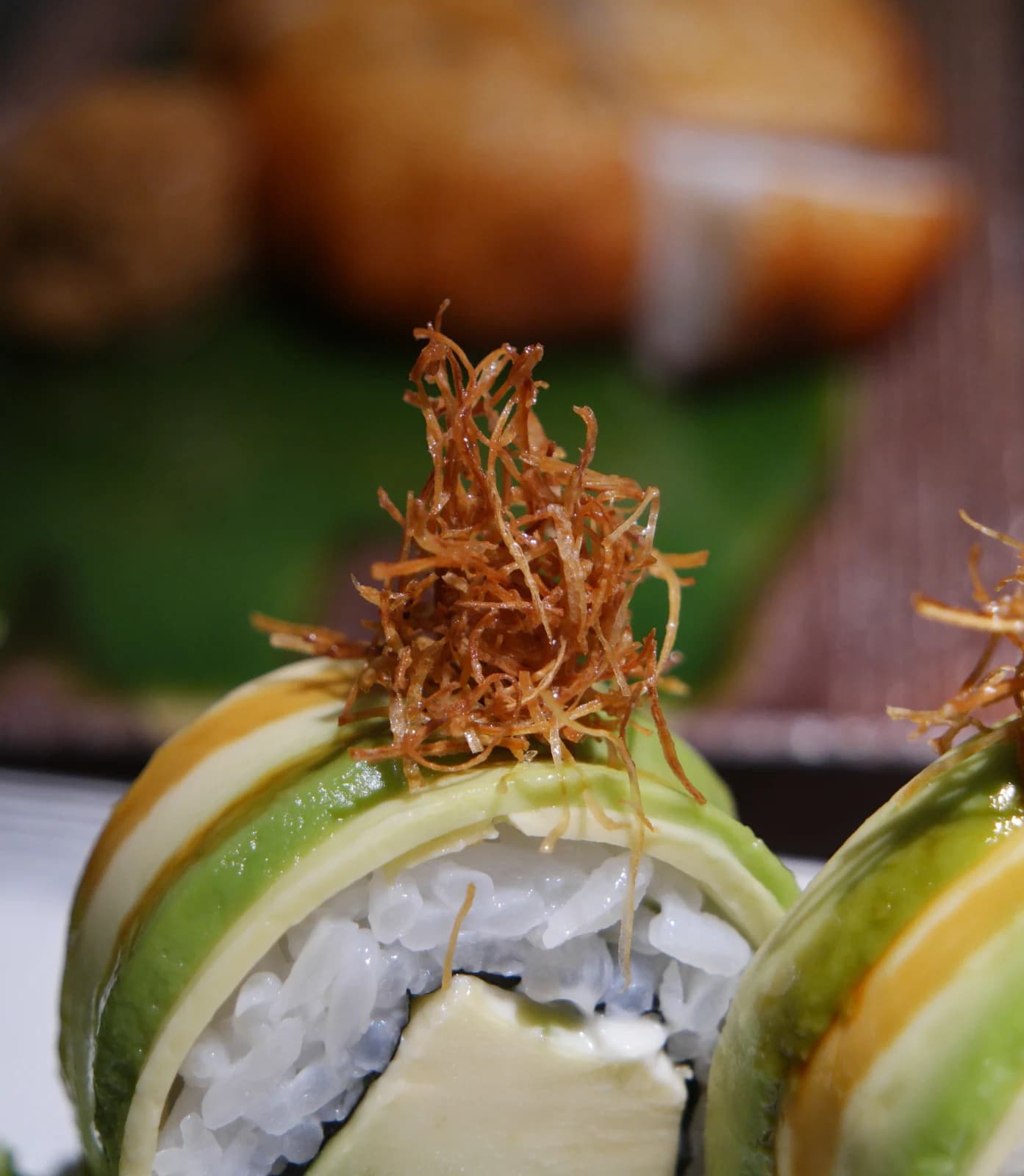
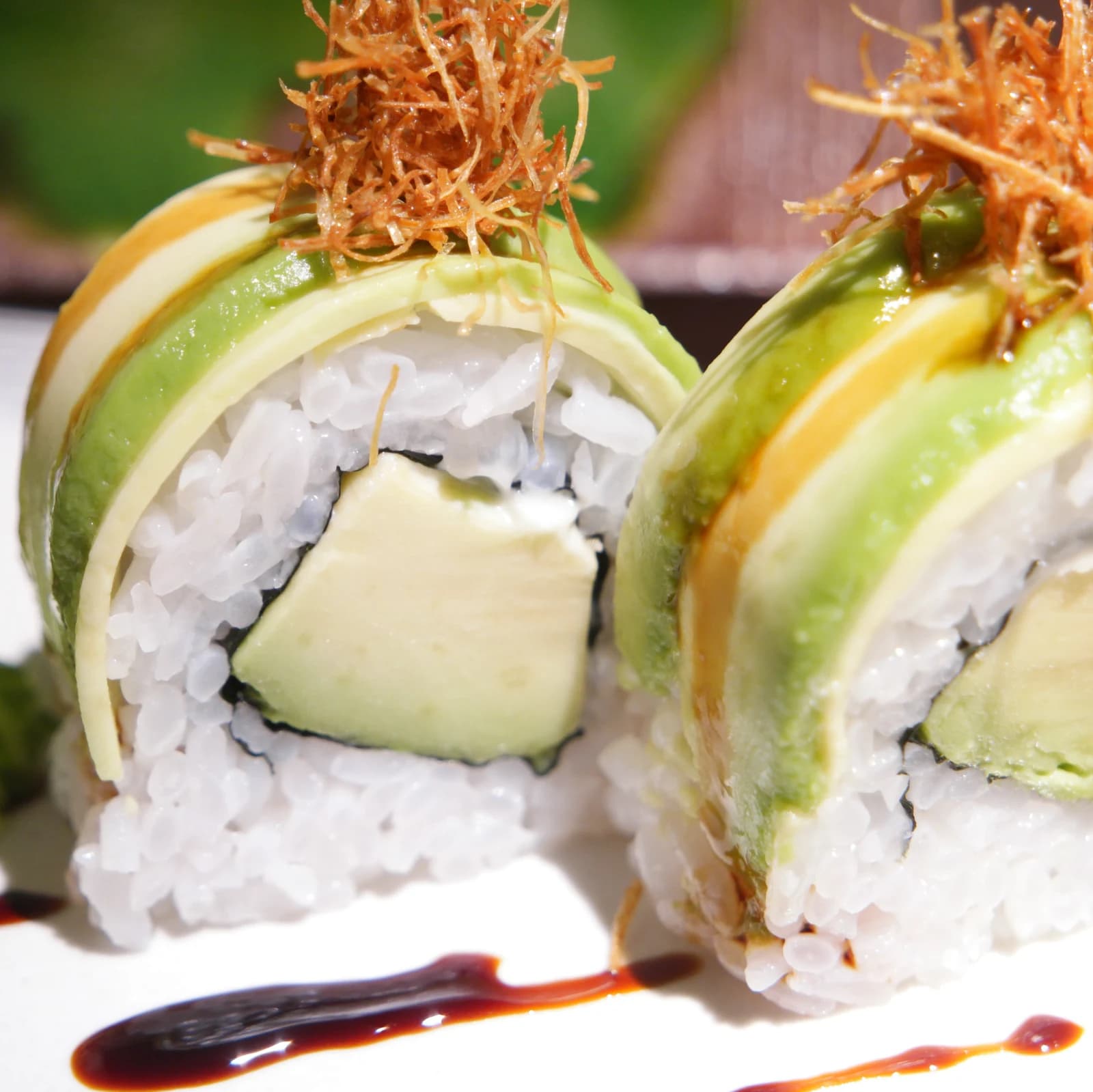
Up close, though, the quality was honestly staggering. The avocado had been sliced paper-thin and layered on one piece at a time, creating a perfectly even green gradient across the surface. The crispy tempura bits on top were all uniform in size, and the sauce had been drizzled in precise zigzags. You could just see the filling peeking out between the rice — seafood packed in tightly with no gaps whatsoever. Looking at the cross-section, every individual grain of rice was distinct and separate, not clumped together at all. I'd started with no expectations but my eyes had already conceded before my mouth got involved.
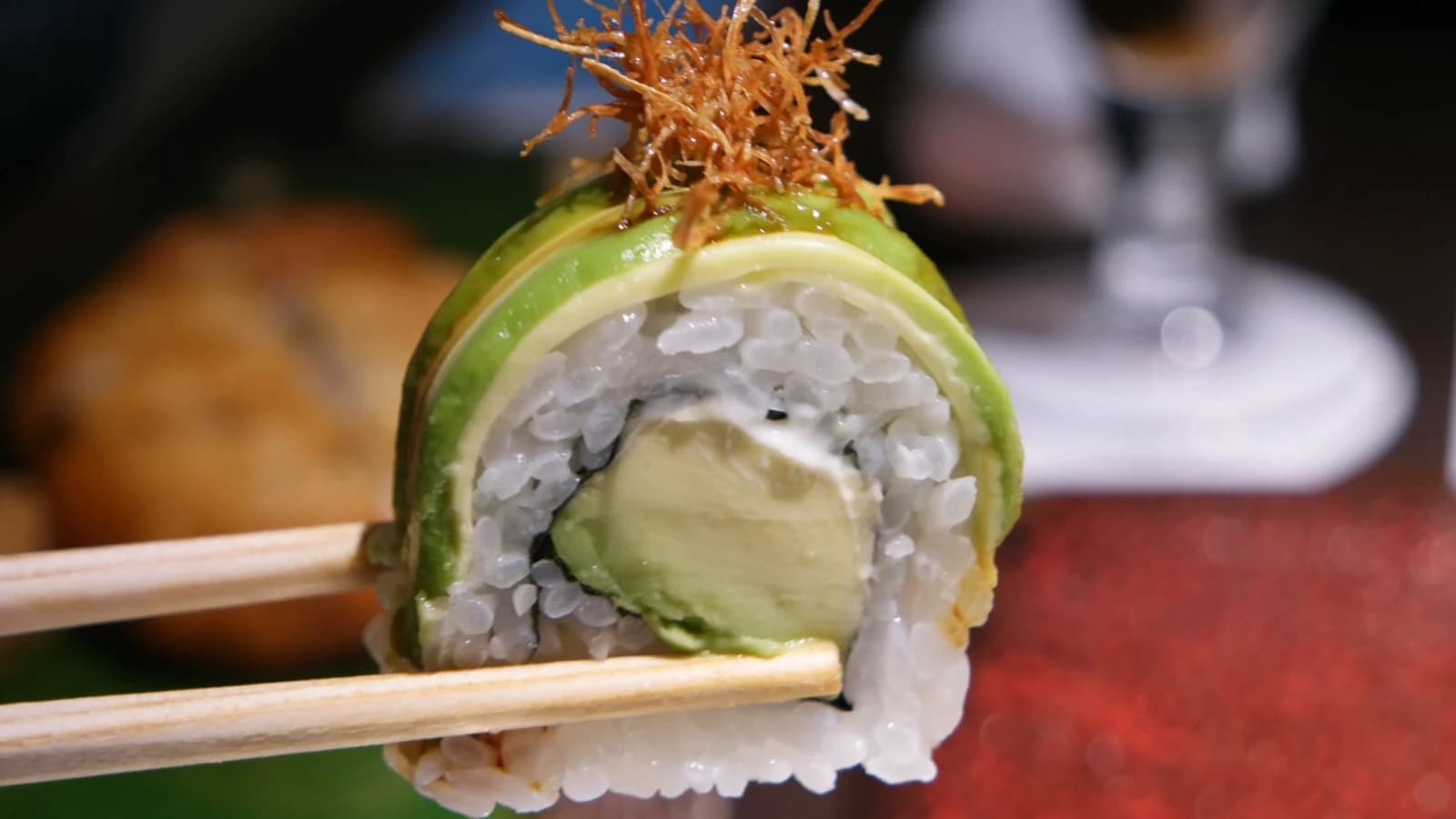
This photo shows one piece held up with chopsticks — the avocado wrapping thinly around the outside, the rice grains tightly packed in the cross-section, and the whole thing holding its shape perfectly without falling apart. Even the crispy tempura shreds on top stayed put. You could see the precision of the hands that made it.
As I mentioned, avocado in sushi really does divide opinion. So I took a bite genuinely expecting nothing, and the moment it started to melt in my mouth, I completely changed my mind. It wasn't that bland, mushy avocado thing — it was smooth with a rich, almost cheesy savouriness spreading across the palate. Chewing it with the rice brought a gentle vinegar acidity that cut through any heaviness at exactly the right moment. It was hard to believe it was even the same ingredient I'd been lukewarm about. That single bite was the first time I truly understood how different sushi eaten in Japan can be.
Sushi on the chopsticks
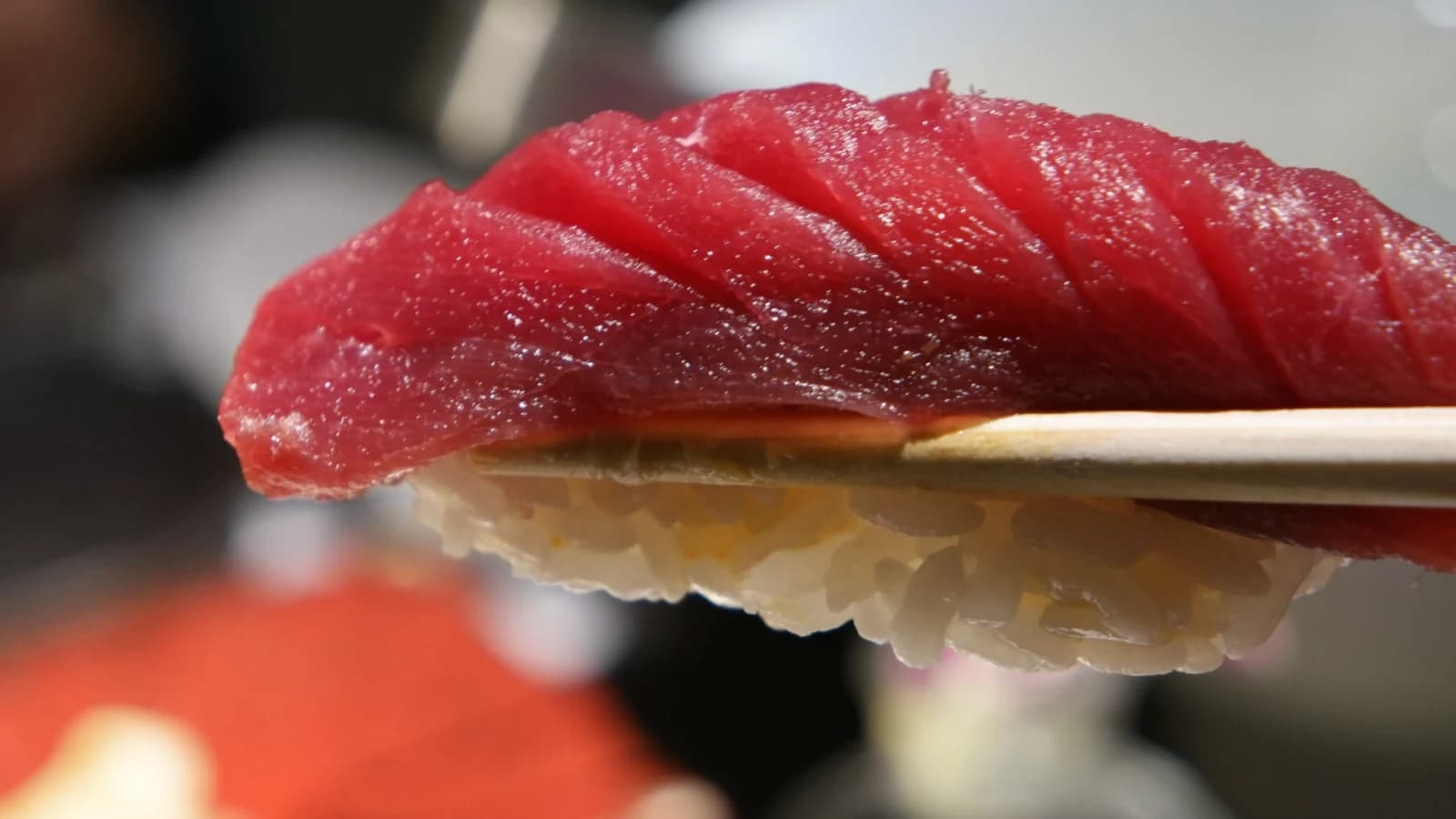
Lifting the tuna with chopsticks, the colour hit you first. A vivid ruby red with tight, fine grain and a glossy sheen that caught the restaurant lighting and sparkled. The slice was generous enough on top of the rice that the grains were barely visible underneath.
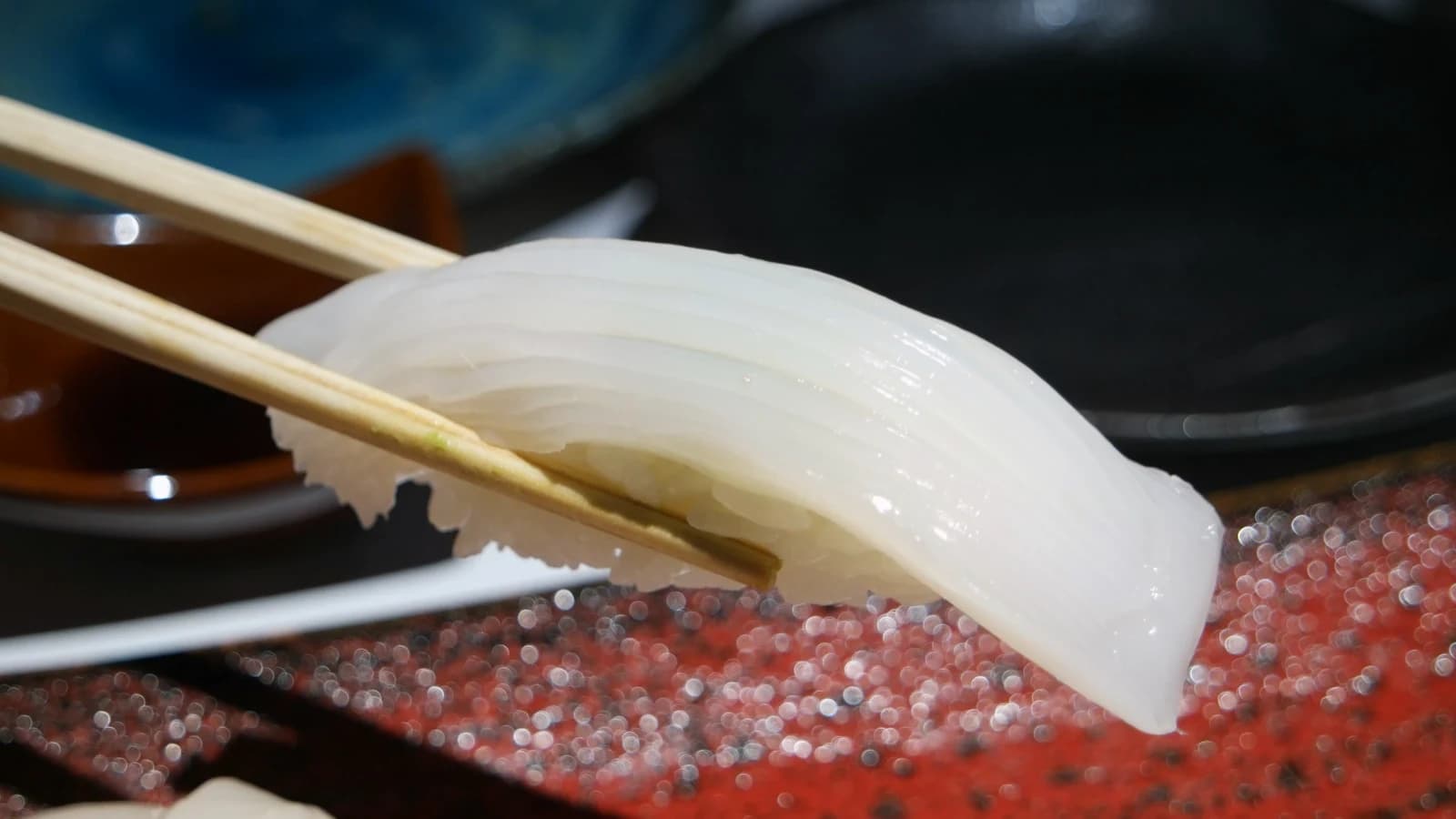
The squid was striking in its translucent white. The scoring was packed tight and when it caught on the chopsticks it bent slightly without snapping. The surface had a smooth, clean shine to it — you could tell instantly just by looking that it was fresh.
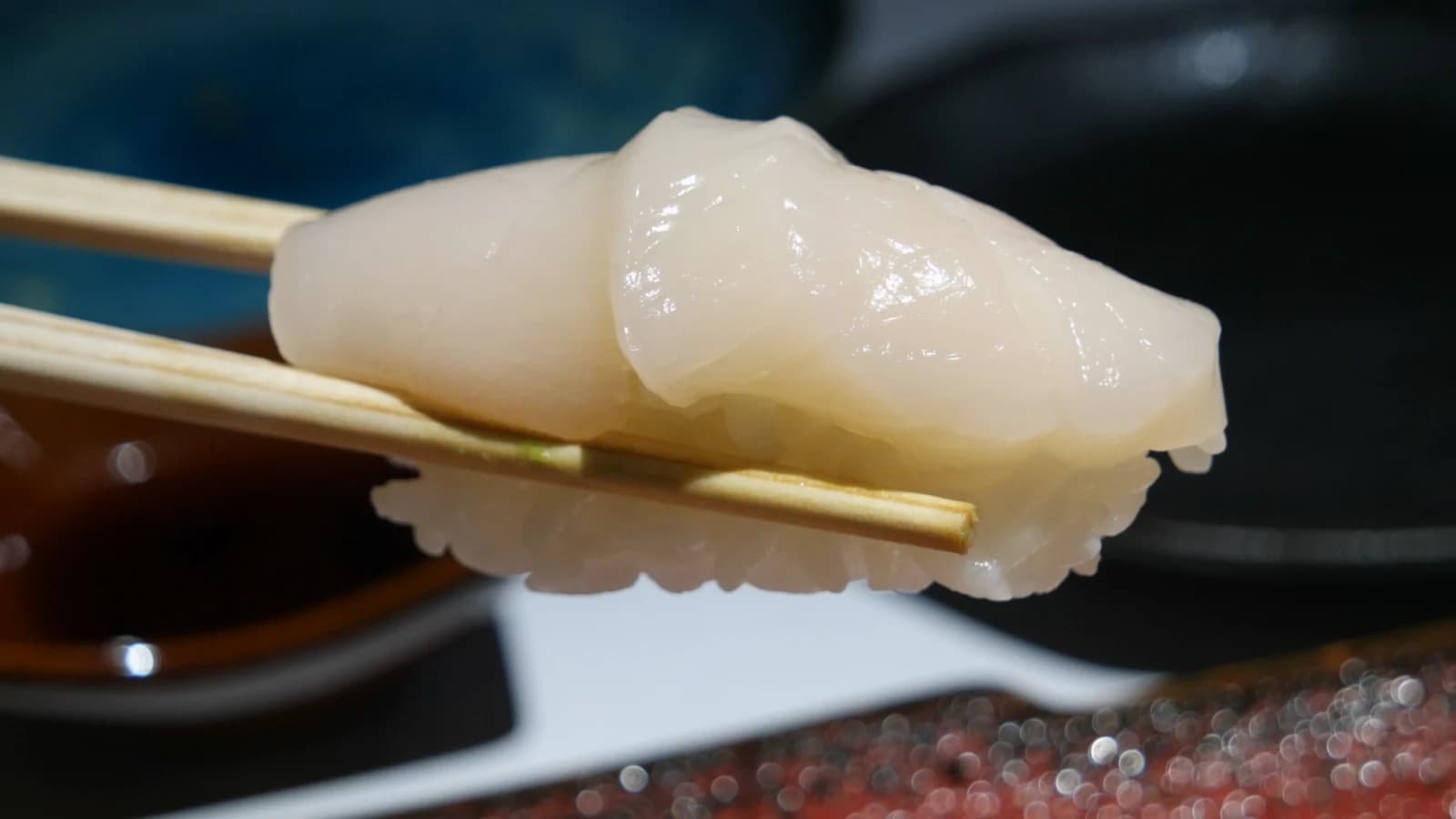
This was Hokkaido scallop. The meat was plump and sat heavily on the chopsticks — properly thick and substantial. The colour was an opalescent white with light passing through it almost translucently, and the texture was in a different league entirely from the scallops you'd typically see at a fishmonger's or in a restaurant over here.
Clean plates and an honest grumble
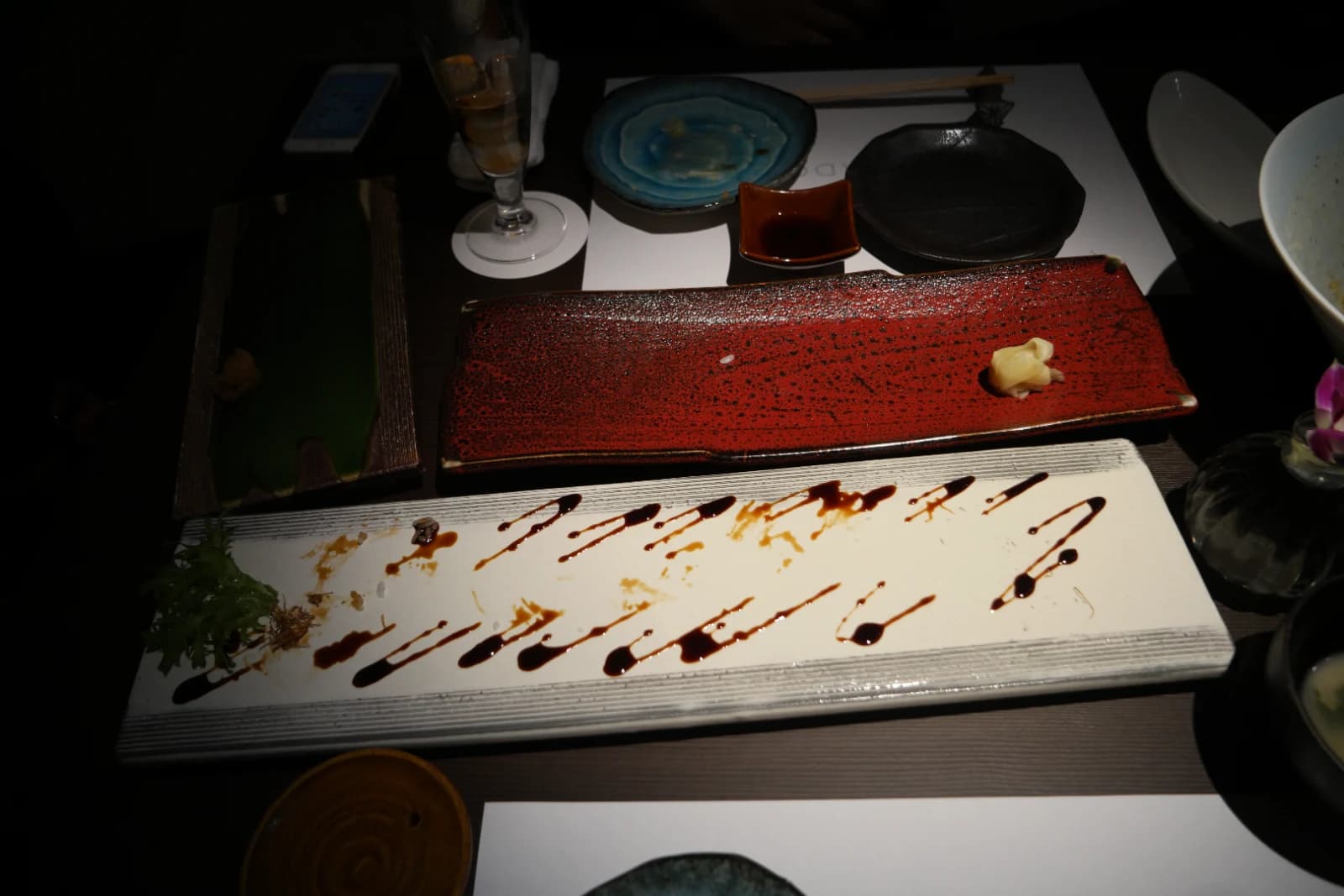
We absolutely demolished everything. The red plate had a single forlorn piece of gari sitting on it, and the white plate just had sauce traces left in zigzags that honestly looked like abstract art. The green leaf plate was completely bare and even the soy sauce dish was spotless. Between the two of us, not a scrap remained.
In terms of flavour, I genuinely have nothing negative to say. From the agedashi dofu through the salad, the grilled fish cake, the omakase sushi and the avocado roll — not a single dish put a foot wrong. Every plate that came out showed a chef who clearly wasn't cutting any corners. But there is one thing, and I'll say it plainly: the portions. For a normal appetite, they simply weren't enough. You'd be mid-gasp of admiration and then the plate would be empty before you knew it, followed by that same deflating "already?" feeling, over and over.
Kurado prices and current opening details
I can't remember the exact bill from that night, but looking at Kurado's current pricing: the 6,000 yen course (around £30) includes 6 dishes, the 8,000 yen course (£40) includes 8 dishes, and the 11,000 yen course (£55) includes 8 or more dishes. The 5-piece omakase sushi is available à la carte for 1,520 yen (about £8). The average evening budget is roughly 5,000 yen (£25) per person, so the two of us with drinks probably came in just over 10,000 yen (£50) total. At the exchange rates back in 2016, that would have been roughly similar in sterling.
It's the kind of small place that barely shows up when you search for Obihiro restaurants, but I've checked and Kurado is still open in the same spot. It's a 12-minute walk from Obihiro station, open Monday to Saturday from 5:30 pm to 10:00 pm, and closed on Sundays. The phone number is 0155-66-5858 (from the UK: +81-155-66-5858).
A flavour that's stayed with me for 8 years
We ended up at a konbini — one of Japan's ubiquitous 24-hour convenience shops — that night, buying a couple of onigiri (those triangular rice balls wrapped in nori) to take back to the hotel. As my mate was unwrapping his, he said, "I can't stop thinking about that sea urchin." Neither could I. There are brilliant sushi restaurants all over the world, including here in the UK. Places with outstanding fish and genuinely superb quality, no question about it. But when a craftsman shapes a piece of sushi with his bare hands in the country where the dish was born, using the same ingredients you'd find anywhere — there's something in the grain of it that's just different. It's not that sushi elsewhere is worse; it's more that the artisan tradition in its home country creates a quality you can feel but can't quite articulate. I first understood that in this tiny restaurant. We turned off the lights and lay in bed, and my mate said one thing in the darkness: "Let's go back there for lunch tomorrow." We never did make it back the next day, but eight years on, I still think about those words.