Cold Seafood Soup: Spicy Korean Mulhoe
Table of Contents
16 items
Mulhoe, the cold seafood dish I crave when summer begins
It has been warm enough lately to wear short sleeves in the middle of the day. Around this time of year, there is one dish I always end up thinking about: mulhoe. It is made by tossing fresh raw fish in a spicy, tangy sauce, then pouring over a chilled broth. Some places even serve it with ice bobbing on top, so the first spoonful feels as if the heat has been switched off. To be honest, this story is from quite a while ago. It must be more than ten years now, but I still remember the mulhoe I had with a friend near Shintanjin in Daejeon at the start of summer. So today I am going to talk about that meal.
Before the mulhoe arrived — starting with the side dishes
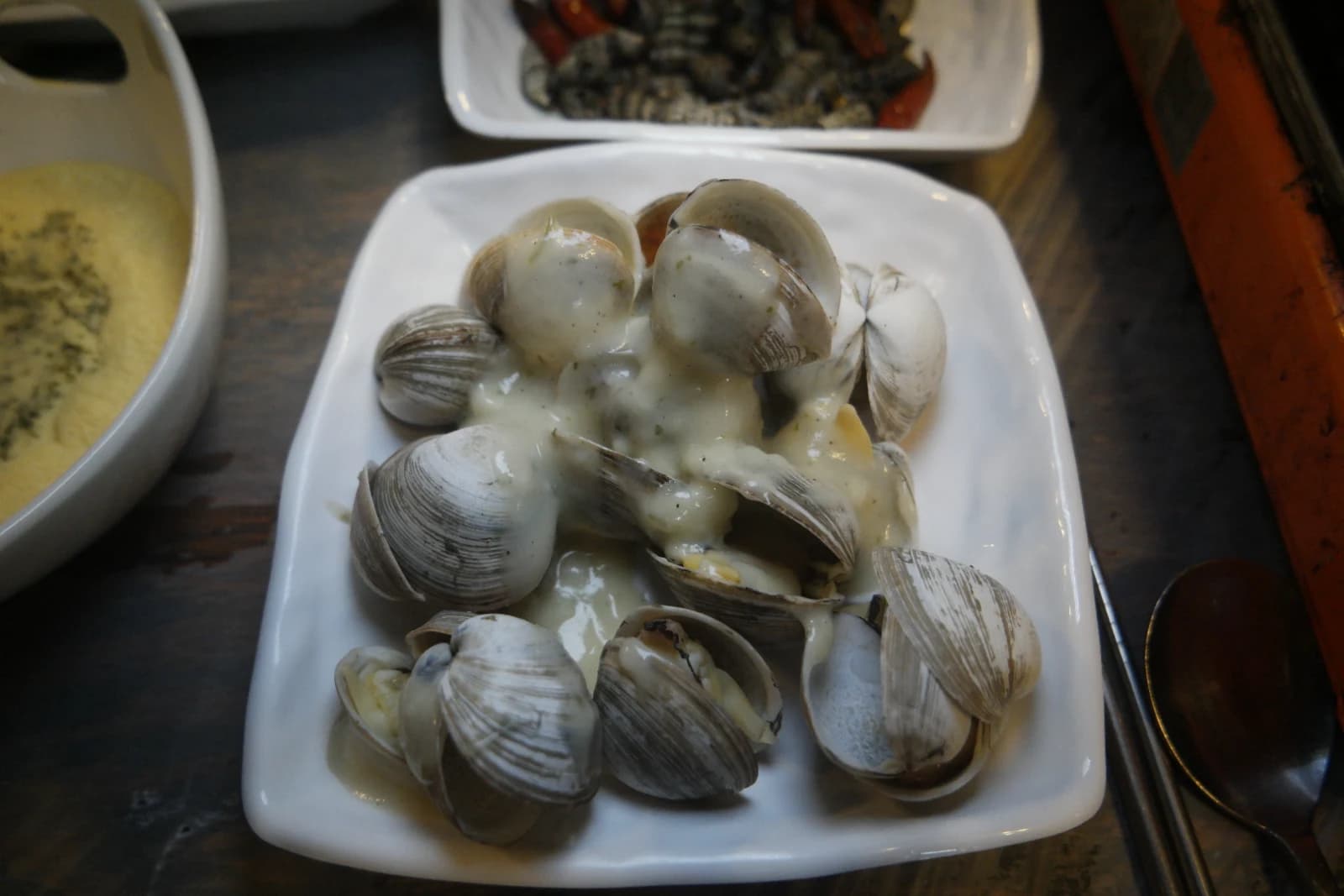
Before the mulhoe came out, we were served a few side dishes first. One was steamed clams topped with a cream sauce. The clams were piled high on a white plate, with a thick creamy sauce running over the top. I had not expected anything like that at a mulhoe restaurant, but my friend picked one up first, opened it, and started eating them one after another, saying, “This is good.”
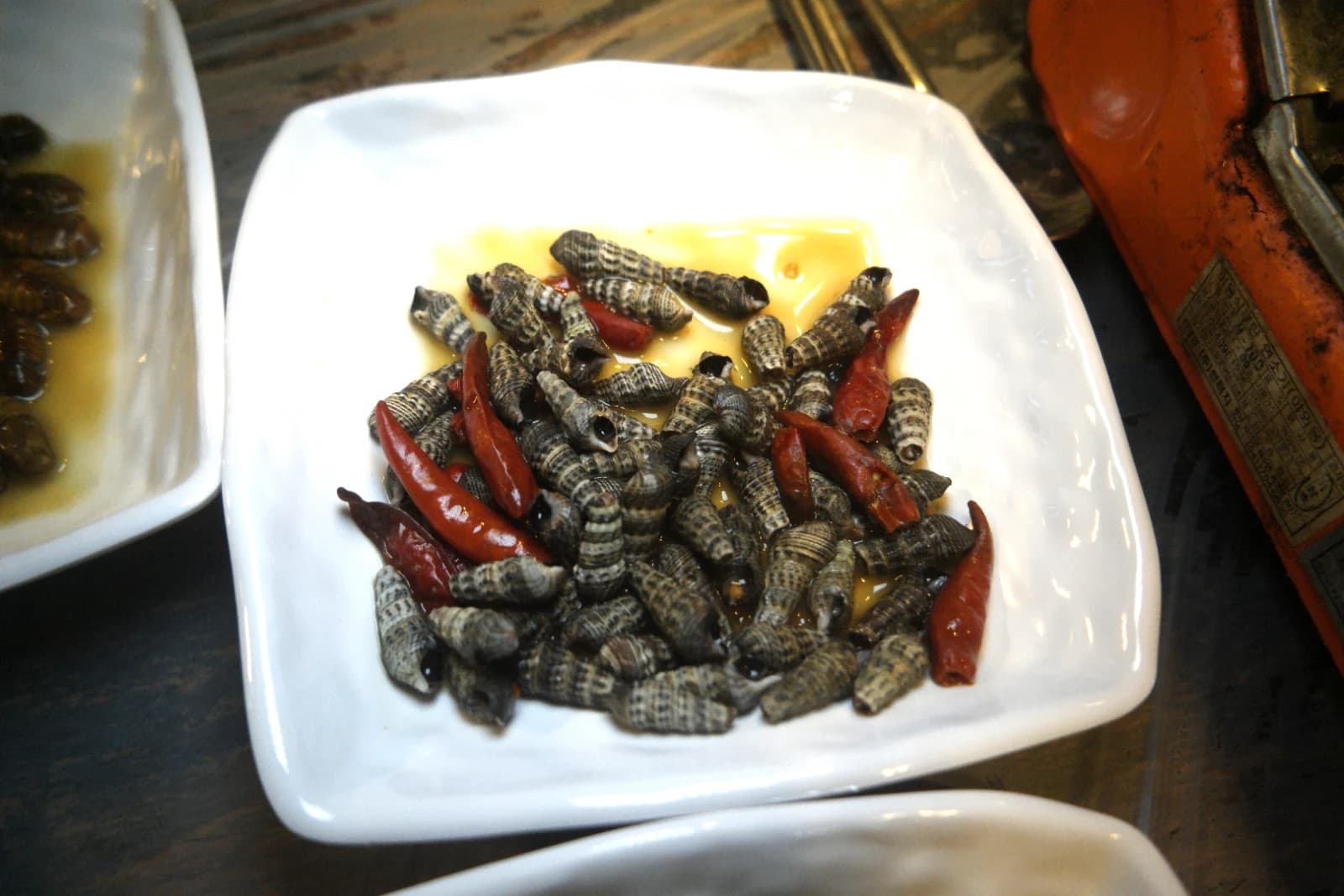
We also had daseulgi, tiny freshwater snails, braised with dried chilli. They tasted salty with a gentle bit of heat. You pick them out with a toothpick, and for some reason your hand just keeps going back for more. The only downside was the portion. The plate was empty in no time, so before the mulhoe arrived we had run out of things to nibble on.
The mulhoe finally arrived — first impressions
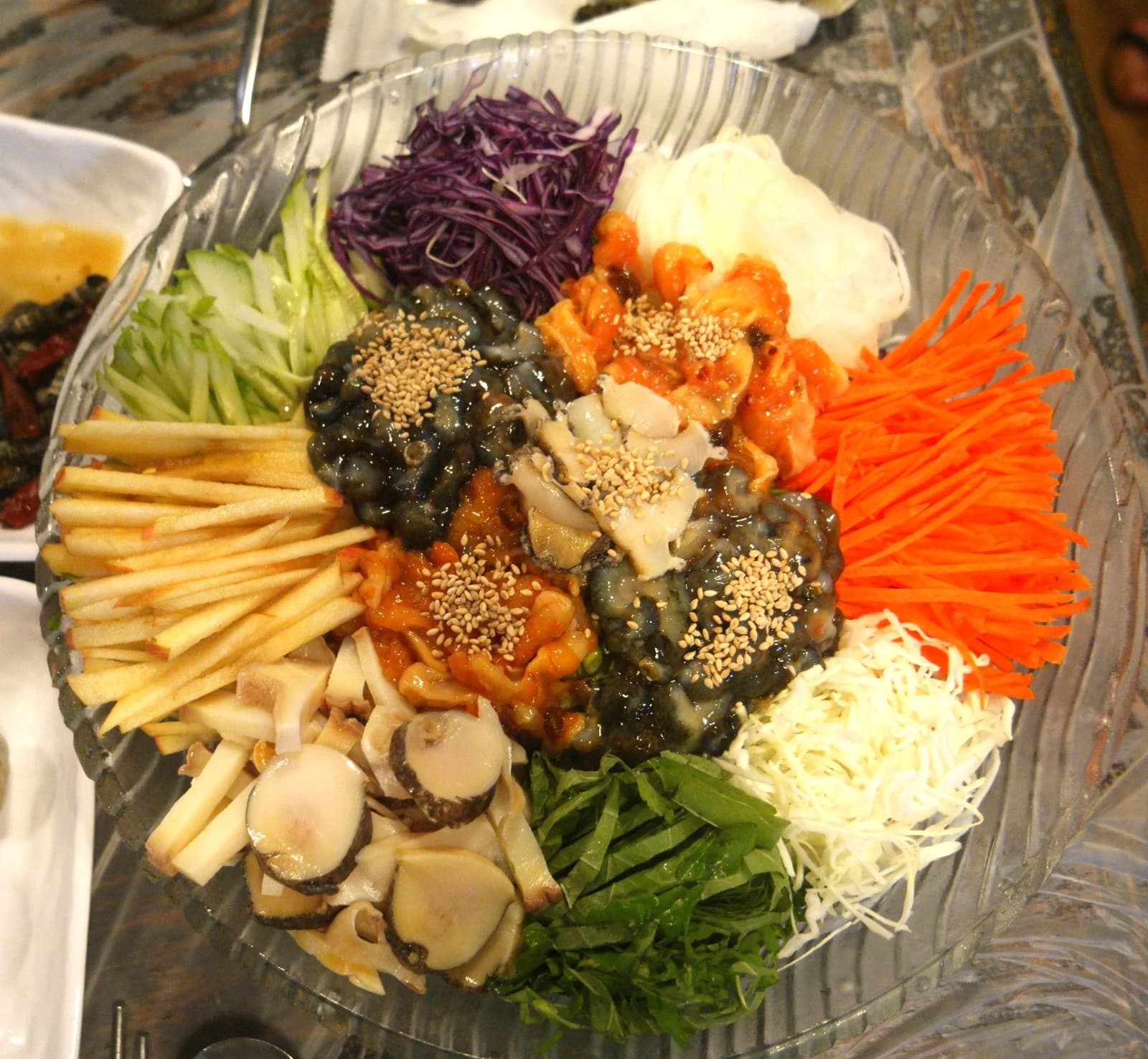
The mulhoe finally arrived. It was served in a clear glass bowl, with shredded carrot, cucumber, red cabbage, pear, kkaennip and white cabbage arranged around the edge. In the middle were the mulhoe ingredients: seafood and raw fish mixed in a spicy sauce, sprinkled with sesame seeds on top. The colours were so bright that I stared at it for a good while before touching it with my chopsticks. Once you pour in the cold broth and mix everything together, the mulhoe is complete. I will get to that part later.
What is mulhoe?
What is mulhoe?
A Korean iced seafood mixing soup
Base — fresh raw fish
White fish such as flounder or rockfish is sliced thinly and tossed in a spicy, tangy sauce called chogochujang, made by mixing gochujang with vinegar. Seafood such as sea cucumber or meongge may also be added on top.
Vegetables — colourful garnish
Vegetables and fruit such as cucumber, carrot, white cabbage, red cabbage, kkaennip and pear are sliced into fine strips and arranged around the bowl. The crunchy texture mixes with the raw fish, making each mouthful taste slightly different.
Broth — properly ice-cold
It is finished with a chilled broth, often made from anchovy or dashima kelp. Many restaurants serve it with pieces of ice floating in the bowl, and that cold, refreshing broth is the main reason people crave mulhoe on hot days.
How to eat it — mix and slurp
You can add rice or somyeon, thin wheat noodles, then mix everything thoroughly with the sauce and eat it by the spoonful. Finishing the broth is the proper way to do it.
A seasonal dish many Koreans start looking for as soon as summer begins
Mulhoe seafood — sea cucumber, meongge and clam meat
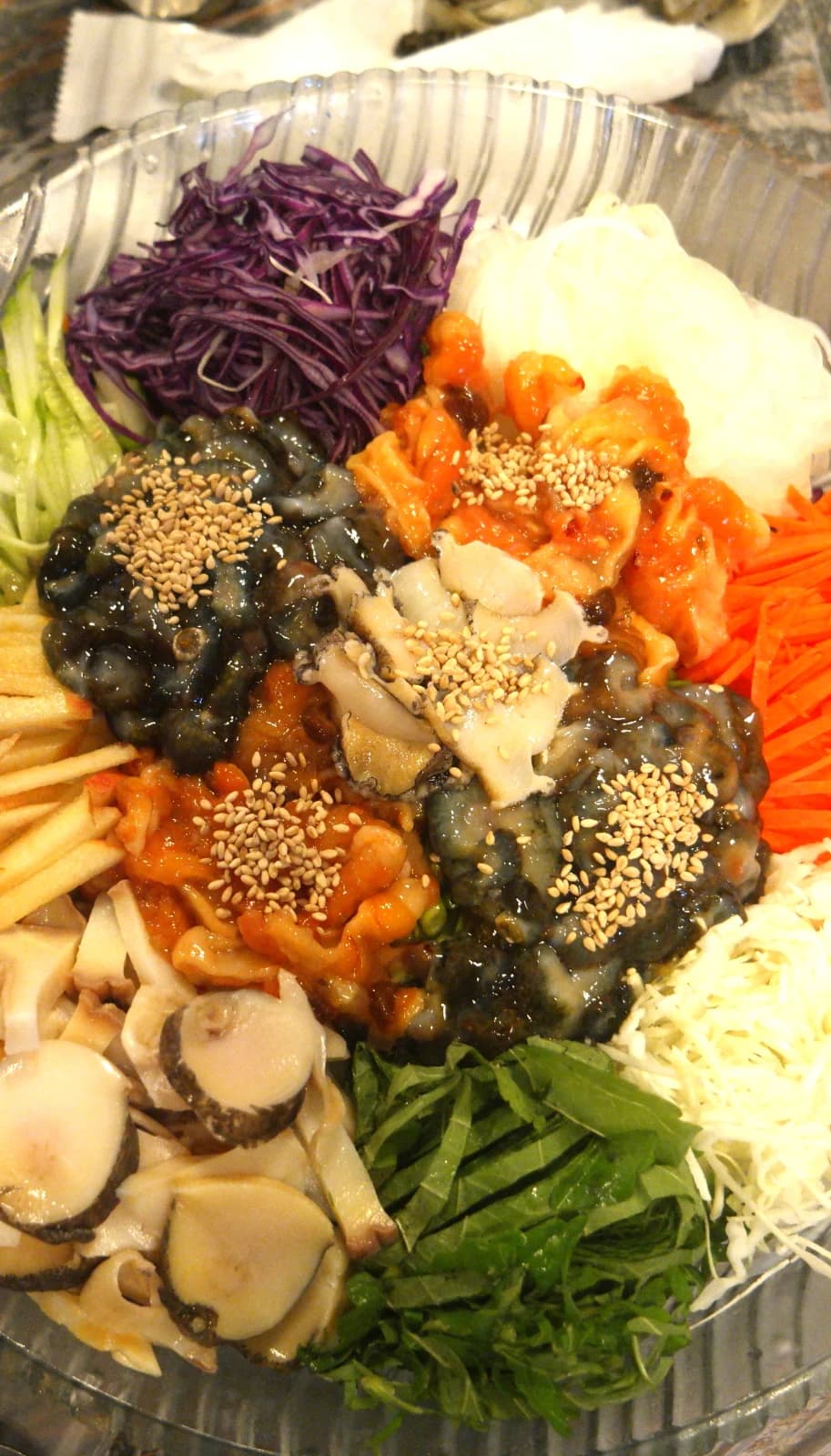
I took a closer photo. The dark lump in the middle was sea cucumber, and its soft, slightly rubbery texture really splits opinion. The orange piece next to it, coated in sauce, was meongge, also known as sea squirt. It has such a strong taste of the sea that people trying it for the first time can be properly startled. My friend was exactly like that. He had never eaten meongge before, so he put one piece in his mouth, his eyes went round, and he said, “What is this taste?” I asked whether he liked it or hated it, and he answered, “…both.” The clam meat was sliced thinly and hidden between the sauce. It was chewy with a little sweetness, so out of the three it was the easiest to enjoy. Because sea cucumber, meongge and clam meat were tucked between the vegetables, every spoonful had a bit of surprise to it, which was rather fun.
Sora and pear
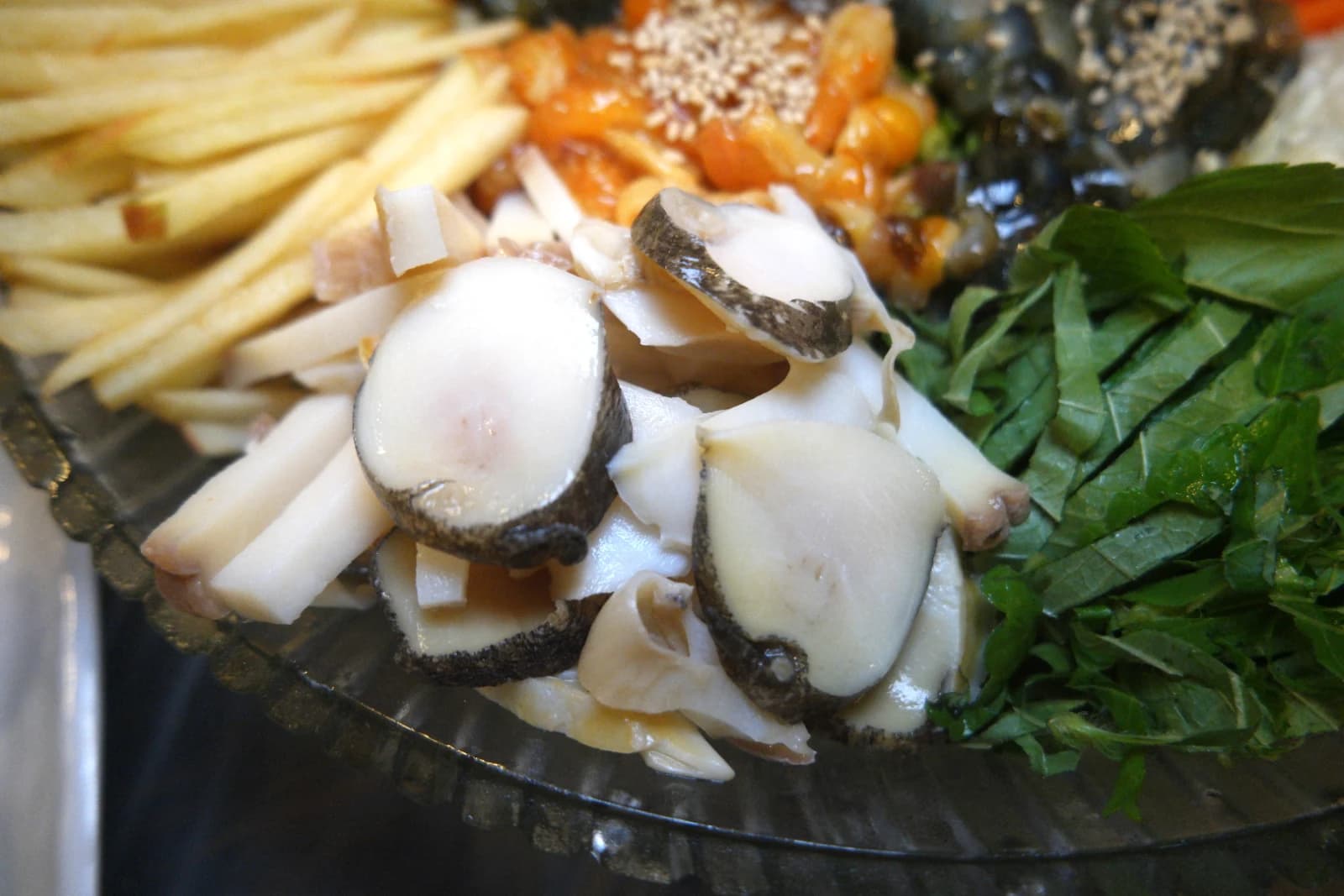
This was sora, a kind of sea snail, sliced thinly. The round slices with a clear dark edge have that distinctive sora look. When you chew it, it is springy and savoury, and the flavour lingers for quite a while. The yellow strips beside it were pear. It was crisp and sweet, so once mixed with the spicy sauce it helped freshen up the mouth. At first, I found it a bit odd to see fruit in mulhoe, but after mixing it in and eating it, I felt the bowl would have seemed oddly empty without it.
Meongge and sea cucumber — mulhoe ingredients that divide people
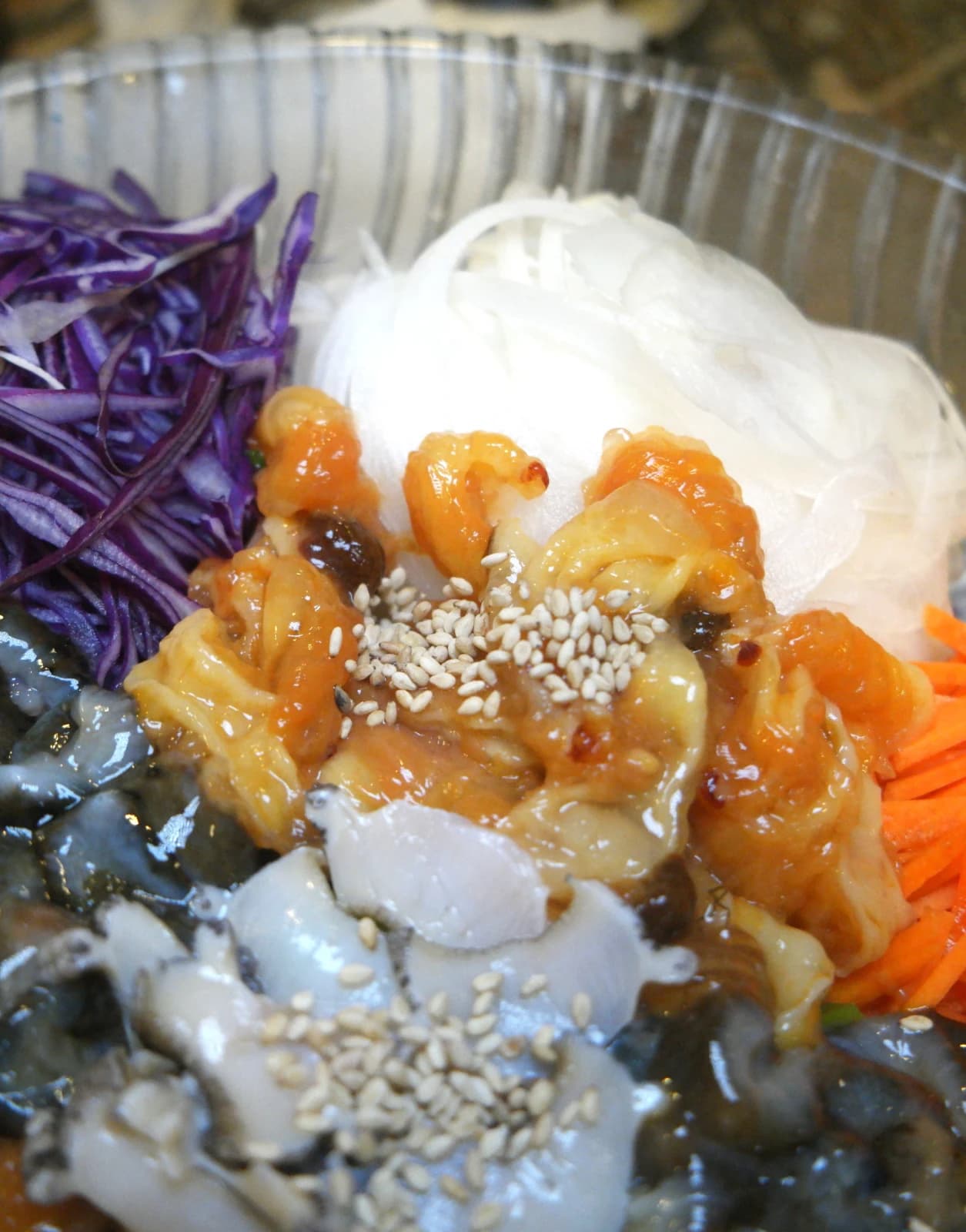
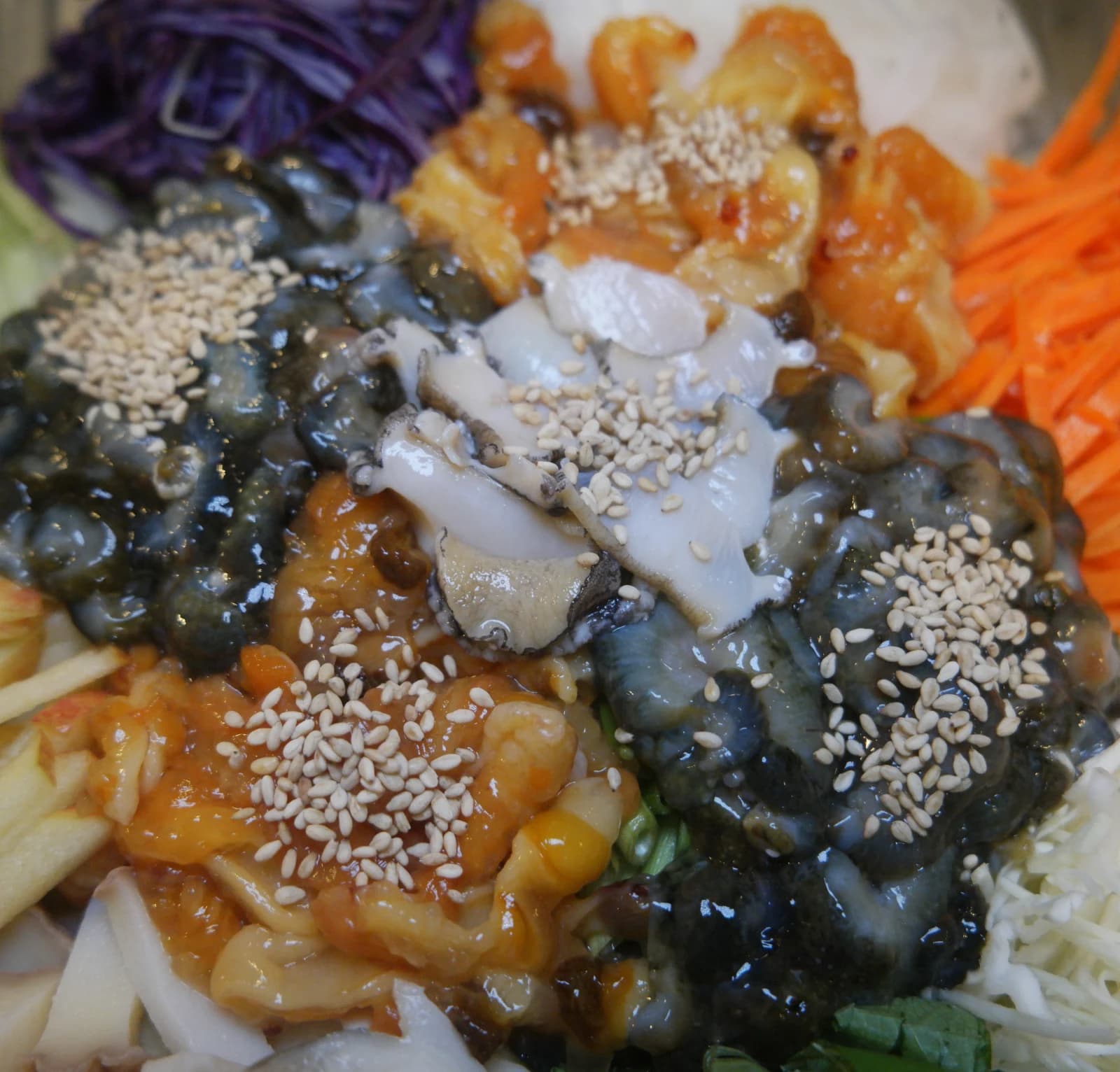
I took a close-up of the centre. The bumpy orange ingredient was meongge, and the black, slippery-looking one was sea cucumber. With sesame seeds scattered on top, it actually looked quite convincing. Still, to someone seeing it for the first time, it can be a slightly alarming sight. My friend even asked at first, “Are we sure this is edible?”
🟠
Meongge
The ingredient often called the pineapple of the sea
Appearance
The outside is covered in a bumpy orange skin, and only the flesh inside is eaten. In mulhoe, it is usually served already mixed with the seasoning.
Taste
From the first bite, the aroma of the sea fills your mouth. It has a distinctive umami flavour, a little sweet at first with a slightly bitter finish. People who like it get hooked; people who dislike it will not go near it with chopsticks.
Texture
It is soft and just a little squishy. Rather than something you chew, it feels closer to something that melts on the tongue.
Love-it-or-hate-it level
★★★★★ Complete extremes
Even among Koreans, it is one of those ingredients that strongly divides opinion.
⚫
Sea cucumber
The ingredient nicknamed the ginseng of the sea
Appearance
It has a black, slippery surface with small raised bumps. In mulhoe, it is cut into bite-sized pieces before serving.
Taste
To be honest, it barely has much flavour of its own. It is so mild it is almost plain, but when eaten with the sauce, it takes on that seasoning completely.
Texture
This is the main point. It is chewy yet soft, with a texture that is hard to compare with anything else. Put kindly, it is unique; put less kindly, some people find it a bit grotesque.
Love-it-or-hate-it level
★★★★☆ The texture is everything
People tend to be divided more by the texture than by the taste. Those who cannot eat it usually blame that squishy feeling.
Mulhoe vegetables — kkaennip, cabbage, carrot and fruit
Kkaennip — the Korean leaf many foreigners struggle with
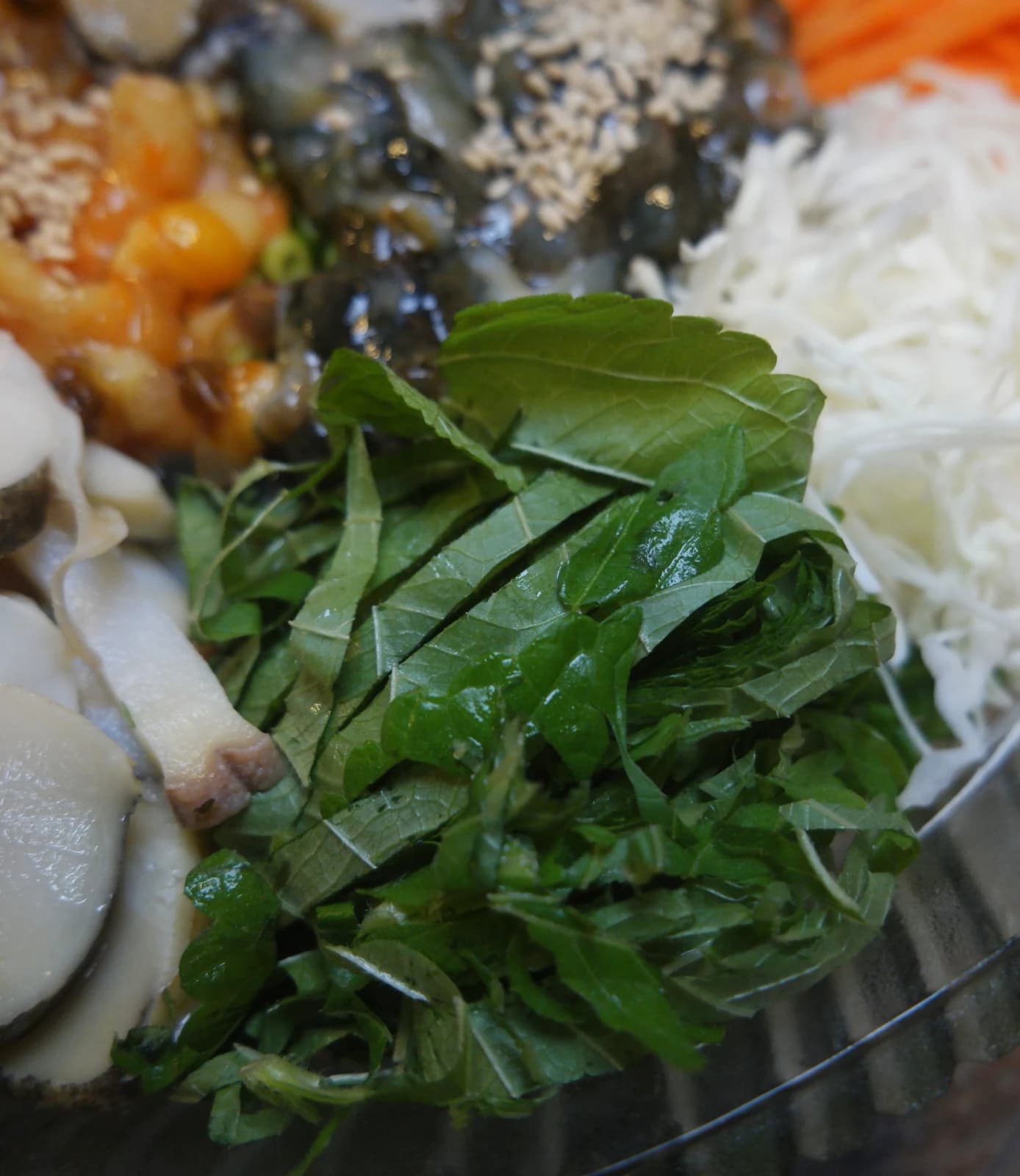
The kkaennip had been shredded and piled generously on one side. To Koreans, this is an extremely familiar leaf. They wrap grilled meat in it, eat it as a side dish, and it is often used in mulhoe like this too. But it can be divisive. Koreans tend to find it fragrant, while many foreigners find the aroma quite strong at first and are put off by it. Later, when my wife first came to Korea, she smelled kkaennip and pushed it to the side of the plate, saying, “Is this not some kind of medicinal herb?” These days, though, she feels something is missing if there is no kkaennip. She said it took her about half a year to get used to it. In mulhoe, that kkaennip aroma mixes with the spicy sauce and helps cut through the fishy smell. If you leave it out, the flavour changes noticeably.
Cabbage and carrot
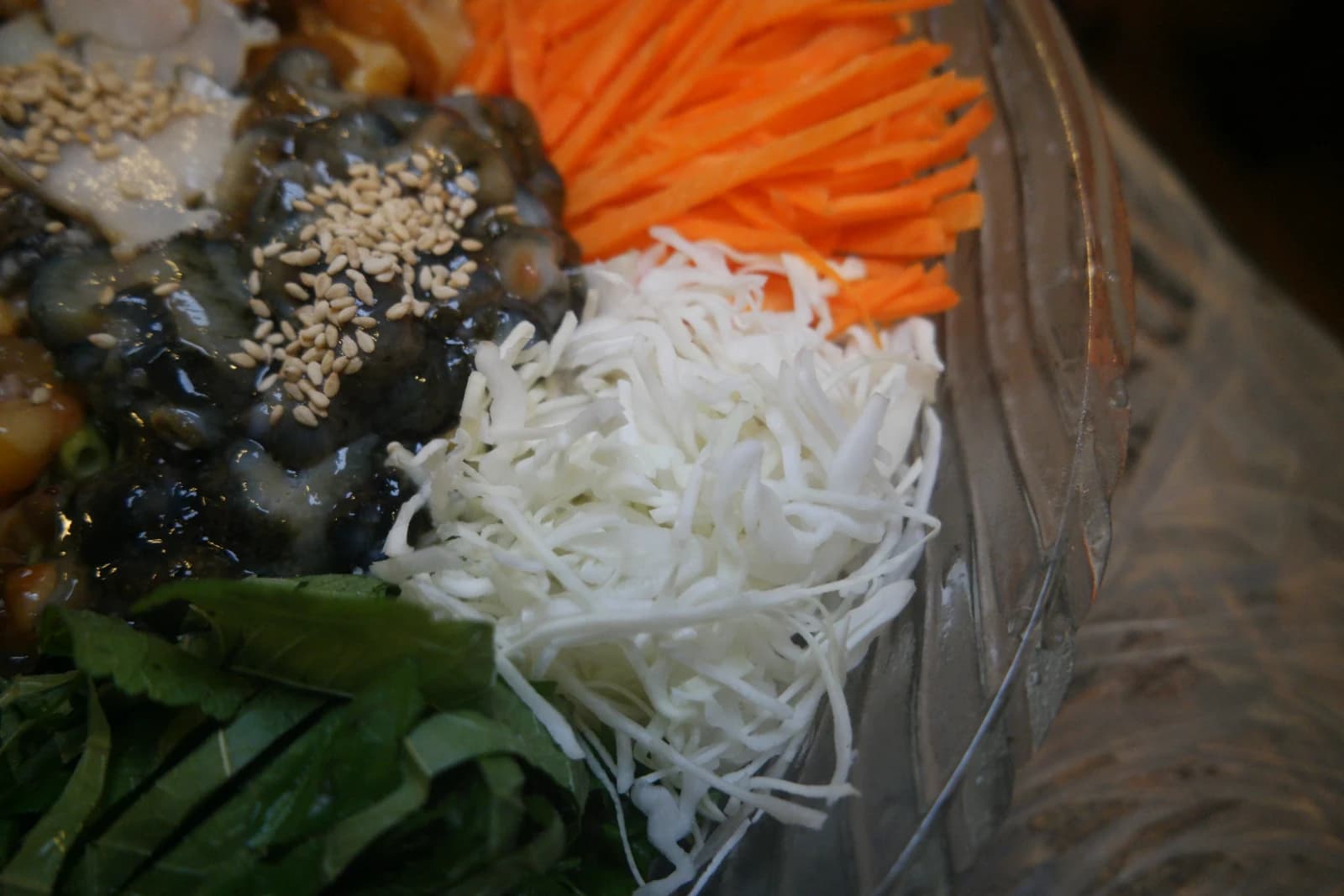
Cabbage and carrot do not need much explanation. They were sliced thinly and added on top, mainly to bring crunch when everything is mixed together. Without them, it would just be seafood and sauce, which could get tiring quite quickly. Because there was something crisp to bite into, I could finish the whole bowl without getting bored.
Apple and cucumber
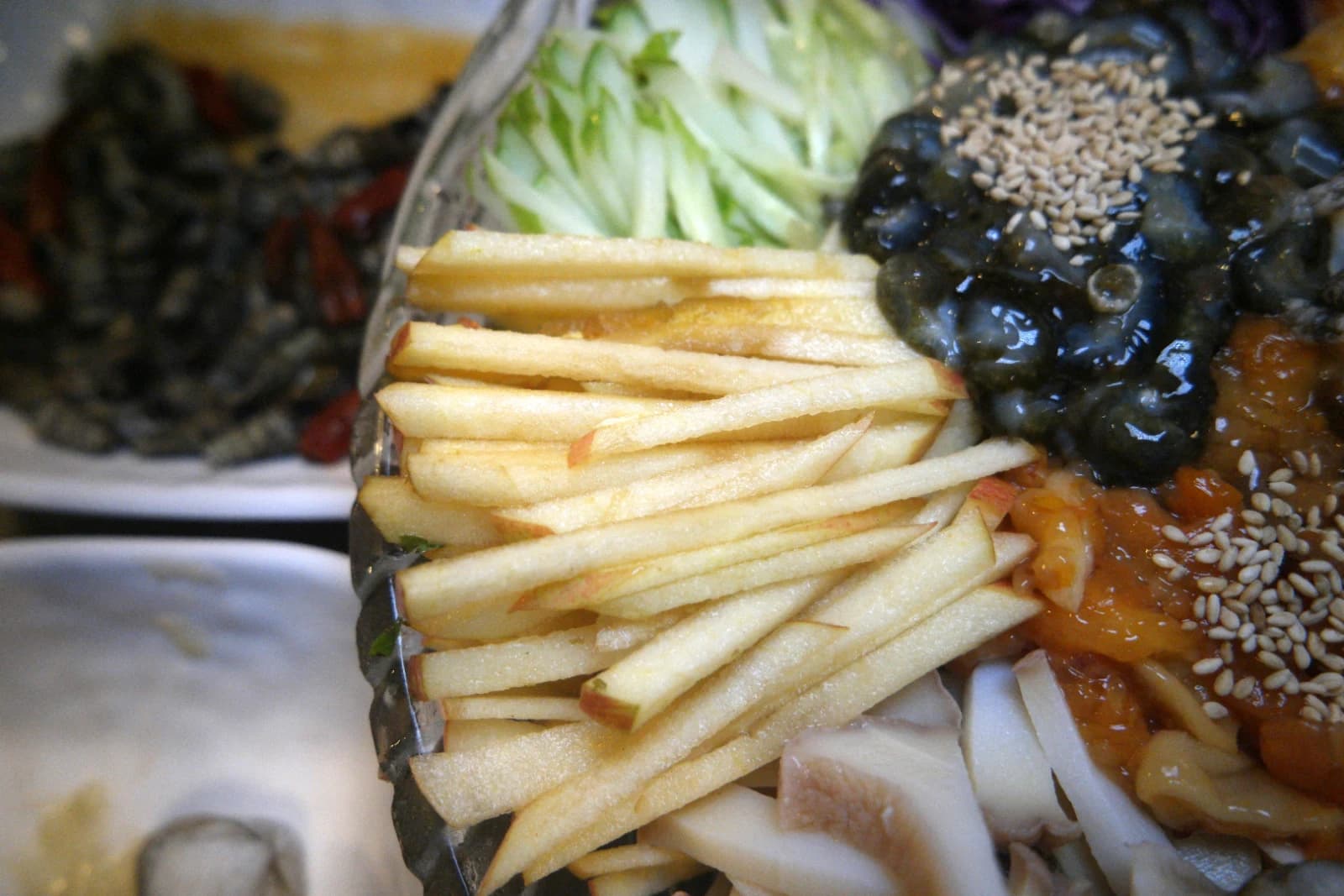
The apple had also been cut into thin matchstick-like strips. There was pear as well, so with apple added too, the sweetness felt quite full. Between the spicy sauce, that cool sweetness from the fruit kept coming through and almost reset the mouth. At the back, the pale green strips were cucumber, which of course was there for crunch and freshness. At first, I had not realised mulhoe contained this many vegetables and fruits, but once you eat it, you can tell each one has a job to do.
Red cabbage and onion
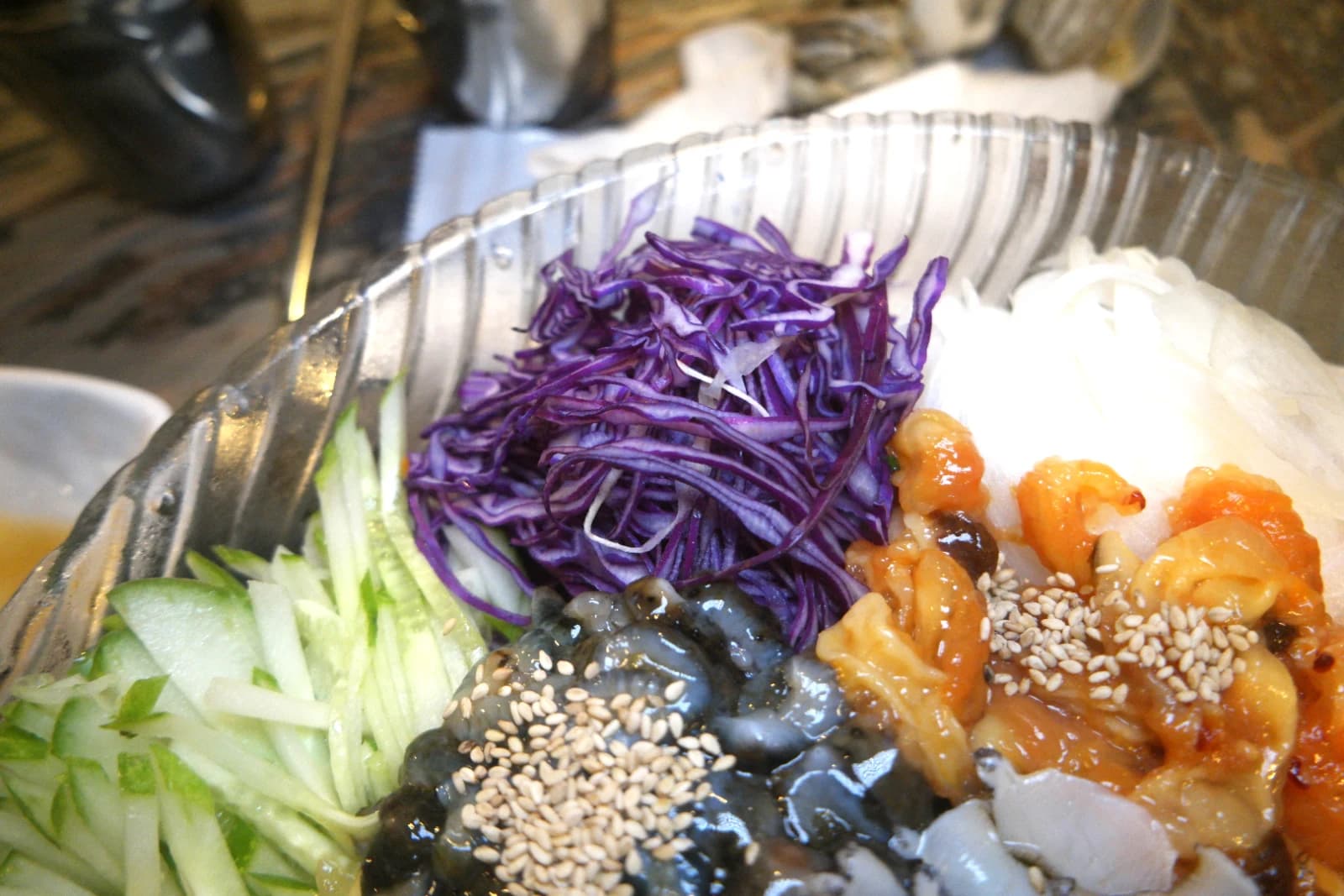
Red cabbage and onion were also taking up one side of the bowl. The red cabbage had such a vivid purple colour that it did a lot for the overall look of the mulhoe. The white onion was only just visible beside it, but once mixed in, it brought a sharp little bite that worked well with the sauce.
How to eat mulhoe — pour in the broth and mix
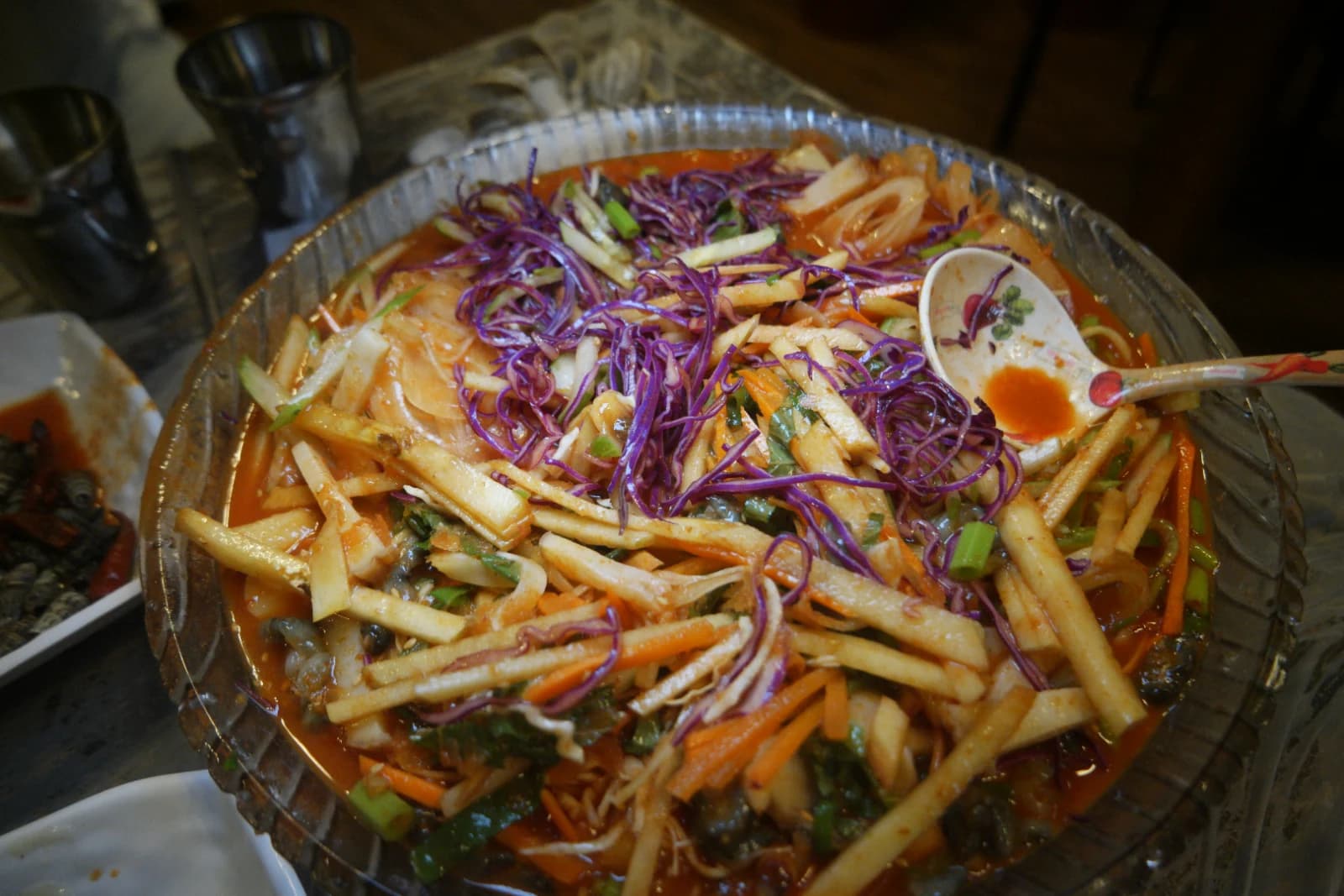
Right, now I will show you how to eat mulhoe. I poured in the cold broth and mixed everything together. That pretty arrangement from earlier disappeared completely, and the vegetables and seafood became tangled in a spicy red broth, turning into what looked like a totally different dish. Honestly, it looked much better before mixing, but this is where the real flavour is. Scoop up a big spoonful and sea cucumber, meongge, apple and kkaennip all come up together, then burst in your mouth with a spicy, cold, refreshing taste. My friend watched me mix it and said, “Why would you do that to something that looked so pretty?” I told him this was how it was meant to be eaten, but he still looked as though it was a bit of a shame.
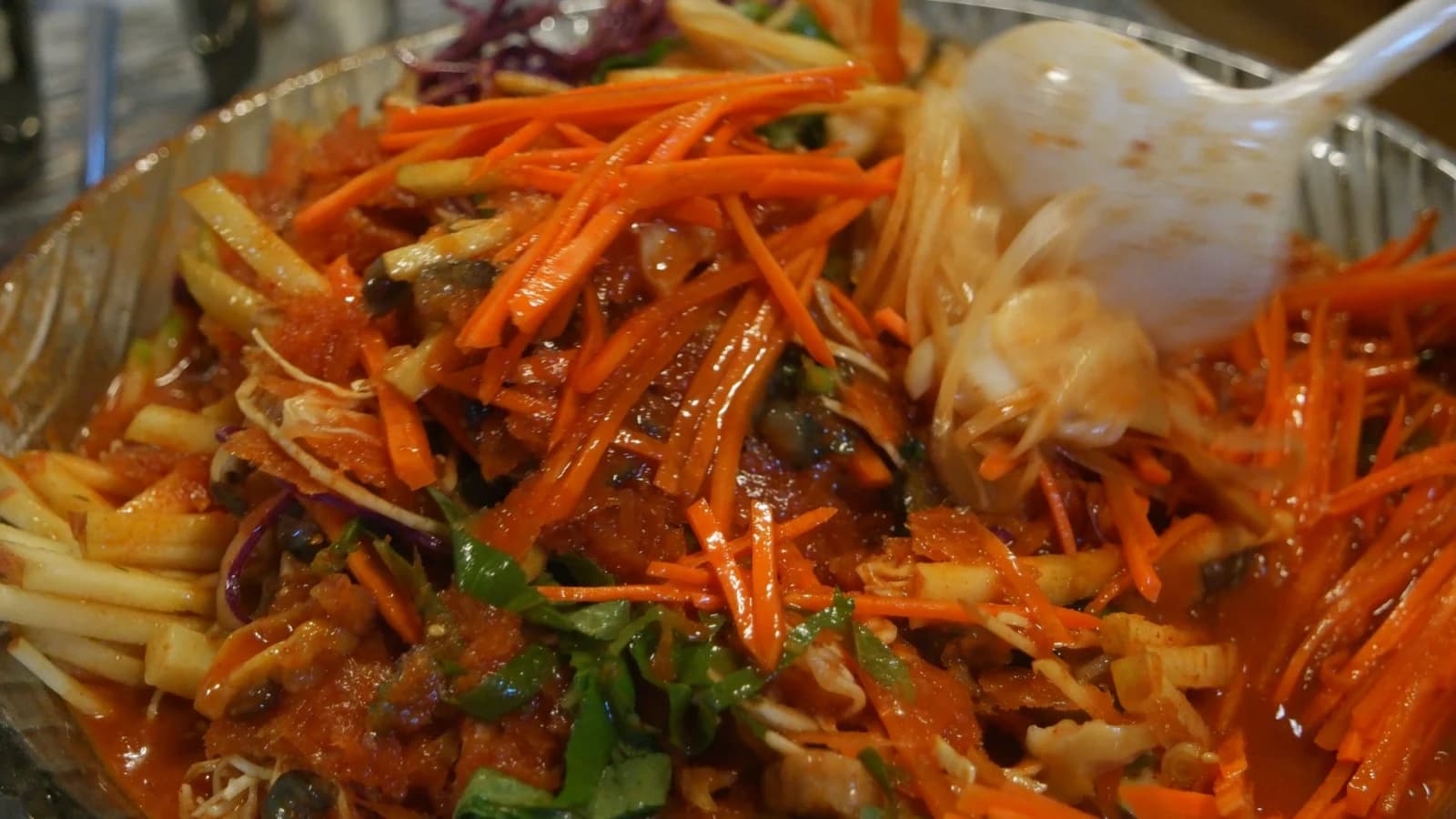
I mixed it with a ladle, turning it over from the bottom. The seasoning settles underneath, so simply stirring the top is not enough. After a few big turns, the carrot, apple and kkaennip were all coated in red sauce, and it finally looked like proper mulhoe. That said, the seasoning was a little salty. The broth diluted it, but in the first one or two spoonfuls, the saltiness hit first and left my mouth slightly numb.
Mulhoe somyeon — finishing with noodles in the leftover broth
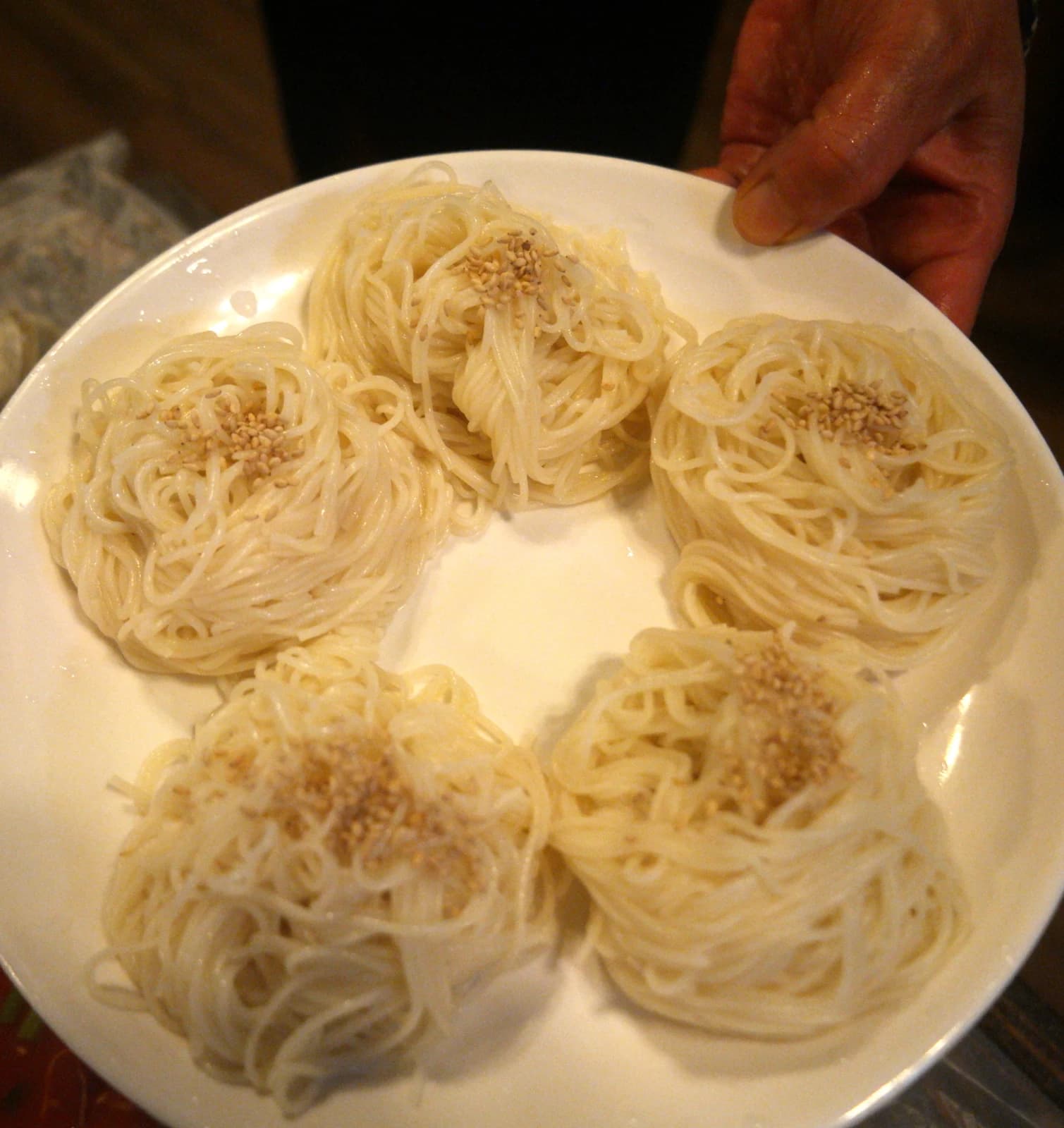
Once you have eaten a fair bit of mulhoe, the classic finish is to order somyeon, thin wheat noodles, and put them into the leftover broth. They come rolled into small bite-sized bundles on a plate, with a little sesame sprinkled over the top. Drop them into the mulhoe broth, mix them through, and the spicy broth soaks right into the noodles, turning it into another meal. My friend actually said he liked the somyeon more than the mulhoe itself. The broth had absorbed all that seafood flavour, so it was definitely a level above noodles simply mixed with a spicy sauce.
When you add somyeon to the broth
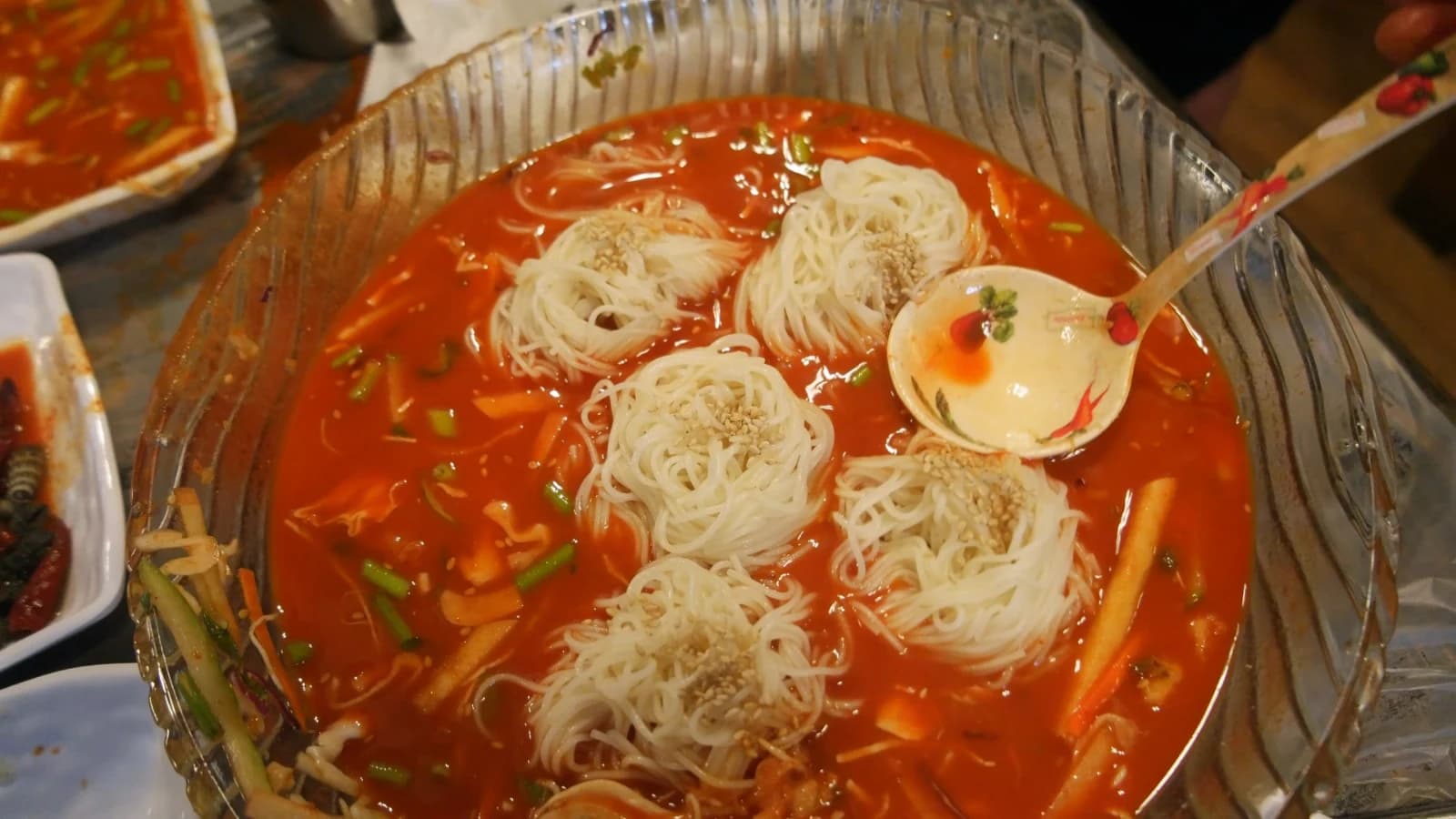
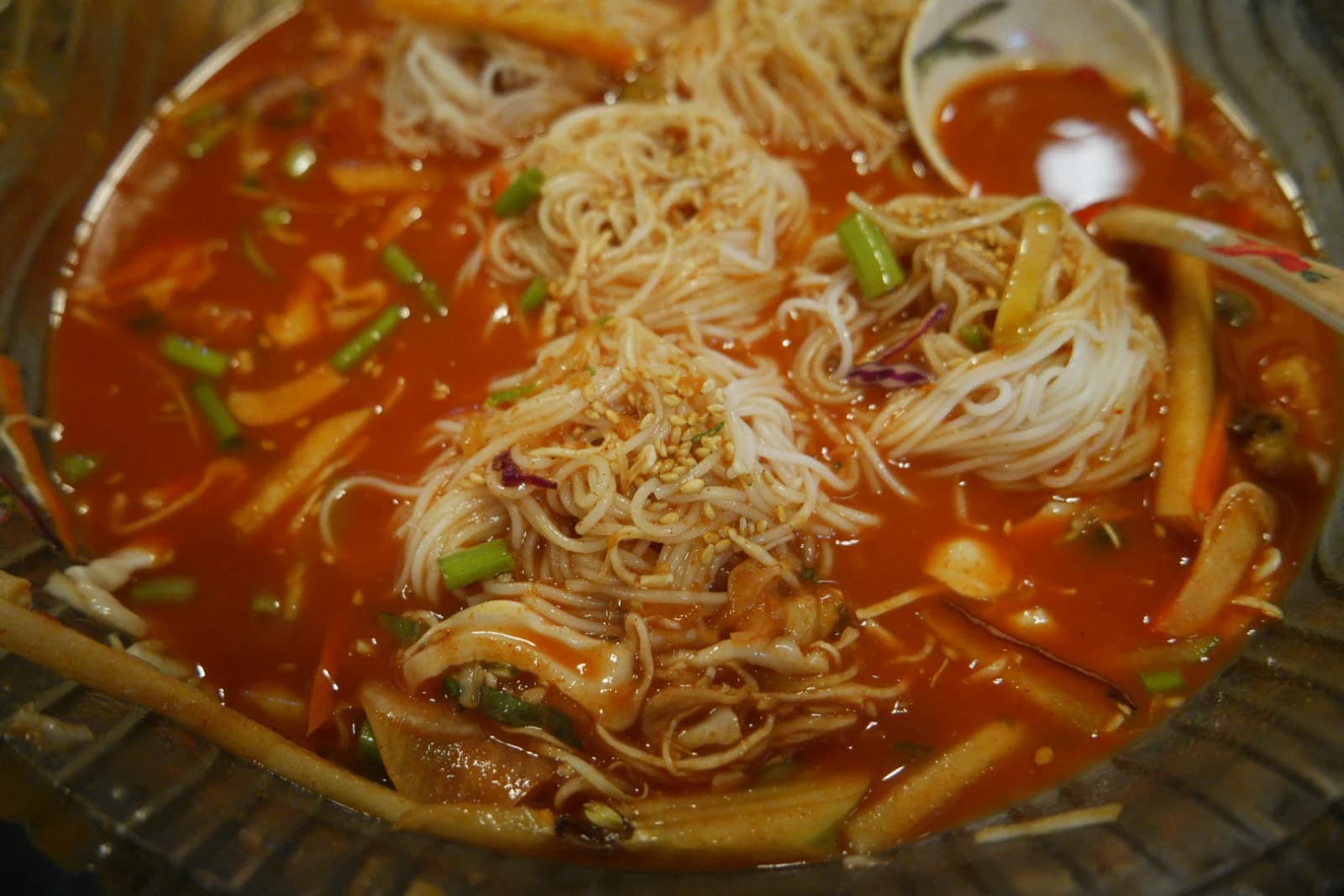
The portion of somyeon was bigger than I expected. I got greedy and put it all in at once, then found it a bit much towards the end. It would have been better to add half first and save the rest for later, but I did not know that at the time. You could see the white bundles of noodles floating on the red broth, and when I lifted them, bits of vegetables and seafood from the bottom came up with them. It felt as if I was eating mulhoe for a second round.
About 40,000 won for two, then the way home
As we were leaving, I asked my friend what he thought. He said, “Everything was good except the meongge.” So in the end, he never quite got used to it. I actually liked the meongge the most, and maybe that is part of what makes mulhoe interesting. Even when two people are eating from the same bowl, they end up picking out different things. From what I remember, the two of us paid about 40,000 won for the mulhoe with extra somyeon, roughly £22. Considering how much seafood was in it, it did not feel bad at all. On the way back, neither of us said much. I am not sure whether it was because we were full or because the cold broth had made us pleasantly drowsy. The restaurant we visited back then has closed now, but there are still plenty of places around Daejeon that serve mulhoe, so it should not be hard to find one. Even now, whenever the weather starts to warm up, I think of that bowl of mulhoe.