
Spicy Chilled Seafood Bowl — Korea's Ultimate Summer Dish
Table of Contents
16 items
The Dish That Calls My Name Every Summer — Mulhoe
It's getting hot enough to go out in short sleeves again, and right around this time every year, there's one dish I absolutely have to track down: mulhoe. It's a cold seafood bowl — fresh raw fish tossed in a sweet-and-spicy red pepper sauce, then doused with ice-cold broth. They float actual ice in it, so the very first spoonful just obliterates the heat. This story actually goes way back — probably over ten years now — to a summer day when a buddy and I hit up a mulhoe spot near Sintanjin, a neighborhood in Daejeon (a major city in central South Korea). I still can't forget that bowl. Let me tell you about it.
Before the Mulhoe — Side Dishes First
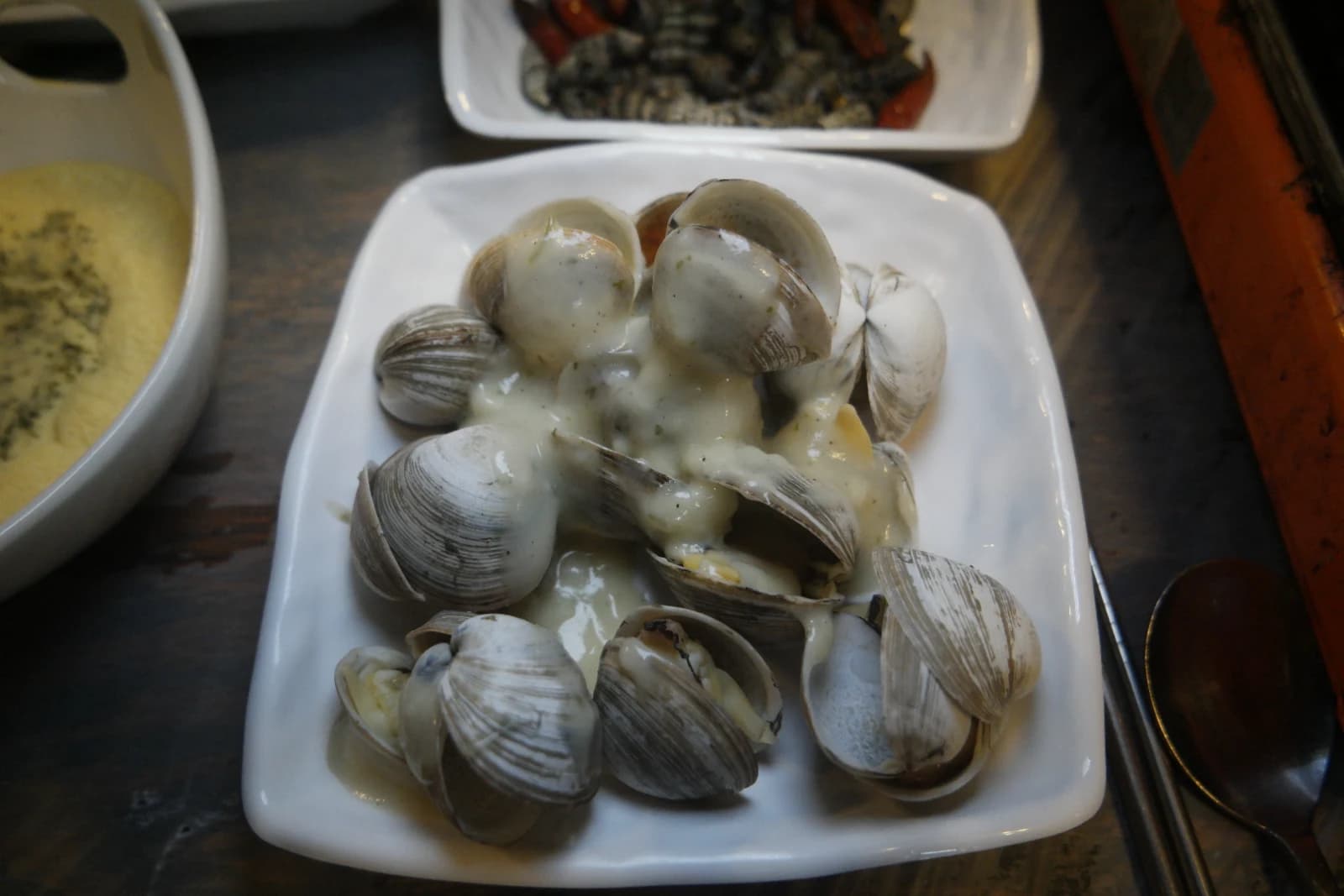
Before the main event arrived, they brought out a side dish — steamed clams in cream sauce. A white plate heaped with Manila clams, thick cream sauce dripping down over them. I honestly didn't expect something like this at a mulhoe joint, but my friend grabbed one, popped it open, said "oh, this is good," and just started shucking and eating them one after another without looking up.
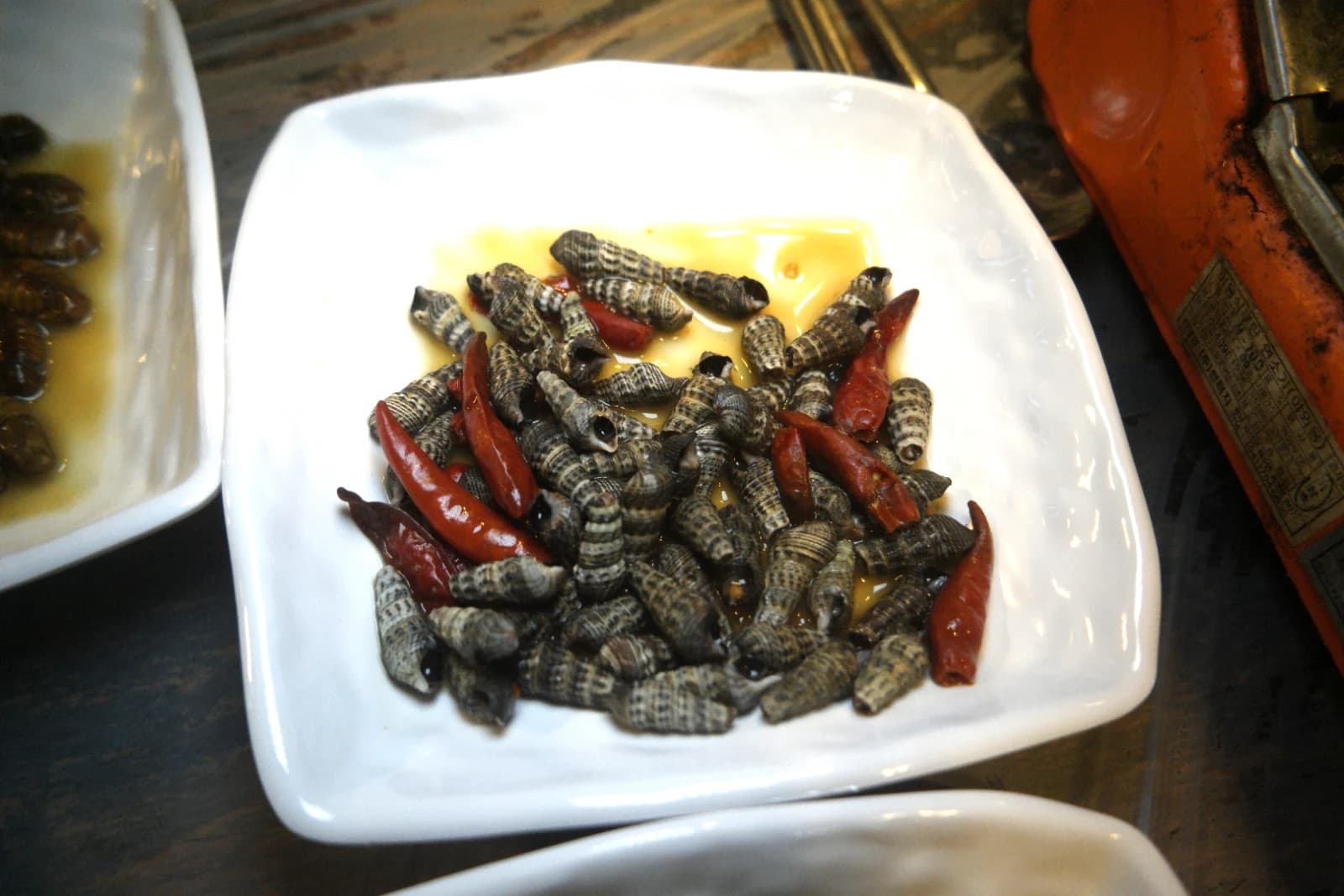
They also brought out marsh snails — tiny freshwater snails braised with dried chili peppers, so they had this salty, slightly spicy thing going on. You pick the meat out with a toothpick, and somehow your hand just keeps reaching for more. The only downside was the portion — one plate disappeared fast and we were left twiddling our thumbs waiting for the mulhoe.
The Mulhoe Finally Arrives — First Impressions
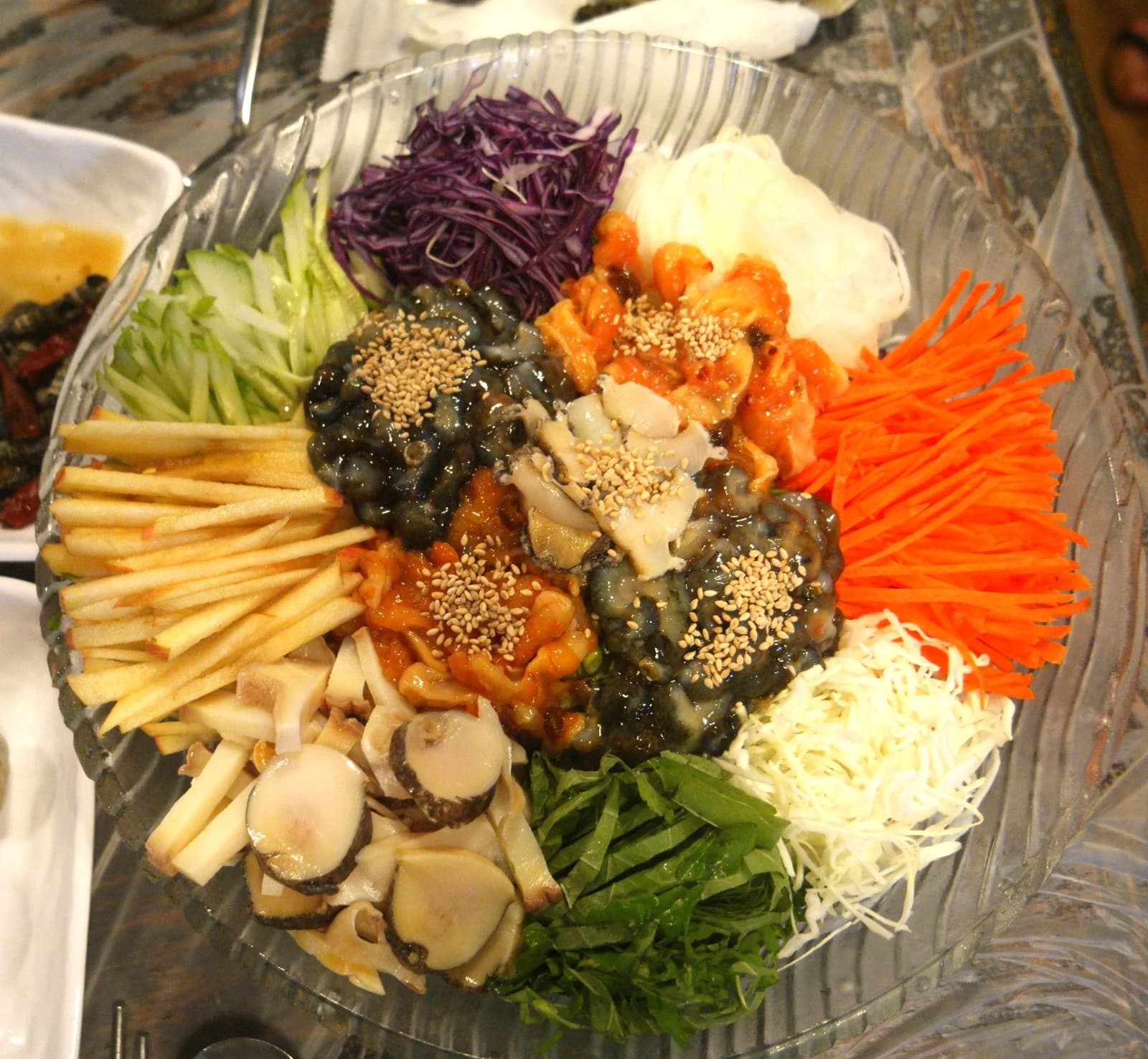
And then the mulhoe came out. In a big clear glass bowl, julienned carrots, cucumber, red cabbage, Korean pear, perilla leaves, and cabbage were arranged in a ring around the edge, and the main ingredients sat piled in the center — raw seafood and sliced fish tossed in spicy red sauce with sesame seeds scattered on top. The colors were so vivid I just stared at it for a while before picking up my chopsticks. You finish it by pouring ice-cold broth over the whole thing and mixing it up, but I'll get to that part later.
What Exactly Is Mulhoe?
What Is Mulhoe?
Korea's Icy Spiced Seafood Bowl
The Base — Fresh Raw Fish
Thinly sliced white fish like flounder or rockfish gets tossed in chogochujang — a sweet-sour-spicy sauce made from red pepper paste mixed with vinegar. Some versions also pile on seafood like sea cucumber and sea squirt.
The Veggies — A Colorful Ring of Garnish
Cucumber, carrot, cabbage, red cabbage, perilla leaves, and pear are all cut into thin strips and arranged around the rim of the bowl. Their crunch mixes with the raw fish so every bite tastes a little different.
The Broth — Ice Cold
A chilled broth made from anchovy and kelp gets poured in to finish the dish. Many places float ice cubes right in the bowl, and that freezing broth is the single biggest reason people crave mulhoe on hot days.
How to Eat It — Mix and Slurp
Drop in rice or thin wheat noodles (somyeon), stir everything together with the sauce, and go at it with a spoon. Drinking every last drop of the broth is the proper way to finish.
The first seasonal dish Koreans reach for when summer begins
The Seafood — Sea Cucumber, Sea Squirt, and Clam Meat
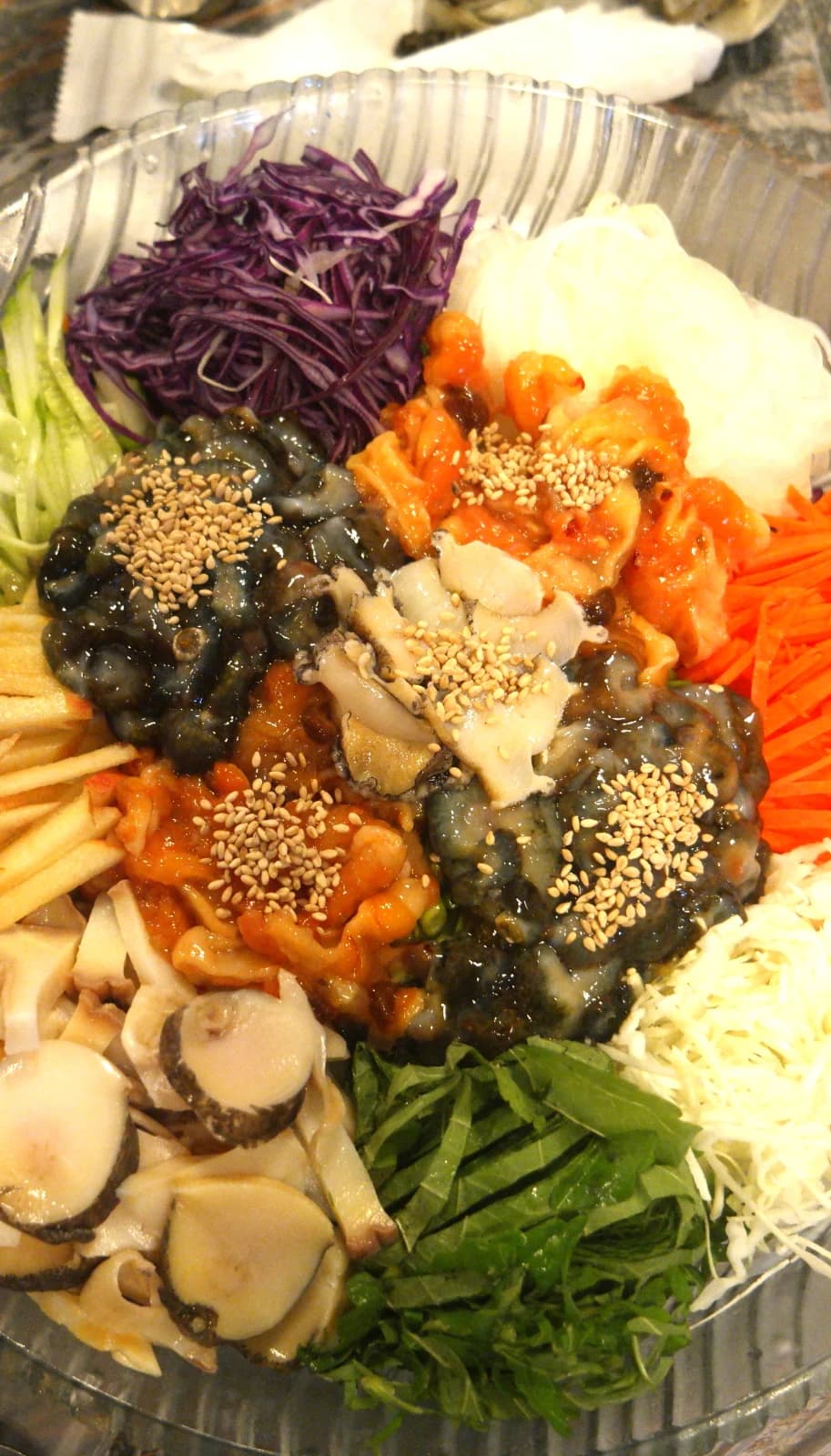
I zoomed in for a closer shot. That dark chunk in the middle is sea cucumber — it has a soft, almost gelatinous texture that people either love or hate. Next to it, coated in orange-red sauce, is sea squirt (meongge). It hits you with this intense ocean flavor that floods your entire mouth, so first-timers usually do a double-take. My friend was exactly that guy. He'd never tried sea squirt before. He popped one in, his eyes went wide, and he goes, "What IS this flavor?" I asked if that meant he liked it or hated it, and after a pause he just said, "...both." The clam meat was sliced thin and tucked between layers of sauce — chewy with a subtle sweetness, easily the most approachable of the three. With sea cucumber, sea squirt, and clam meat scattered throughout the vegetables, every spoonful was a little surprise — you never knew what you'd scoop up next.
Conch and Pear
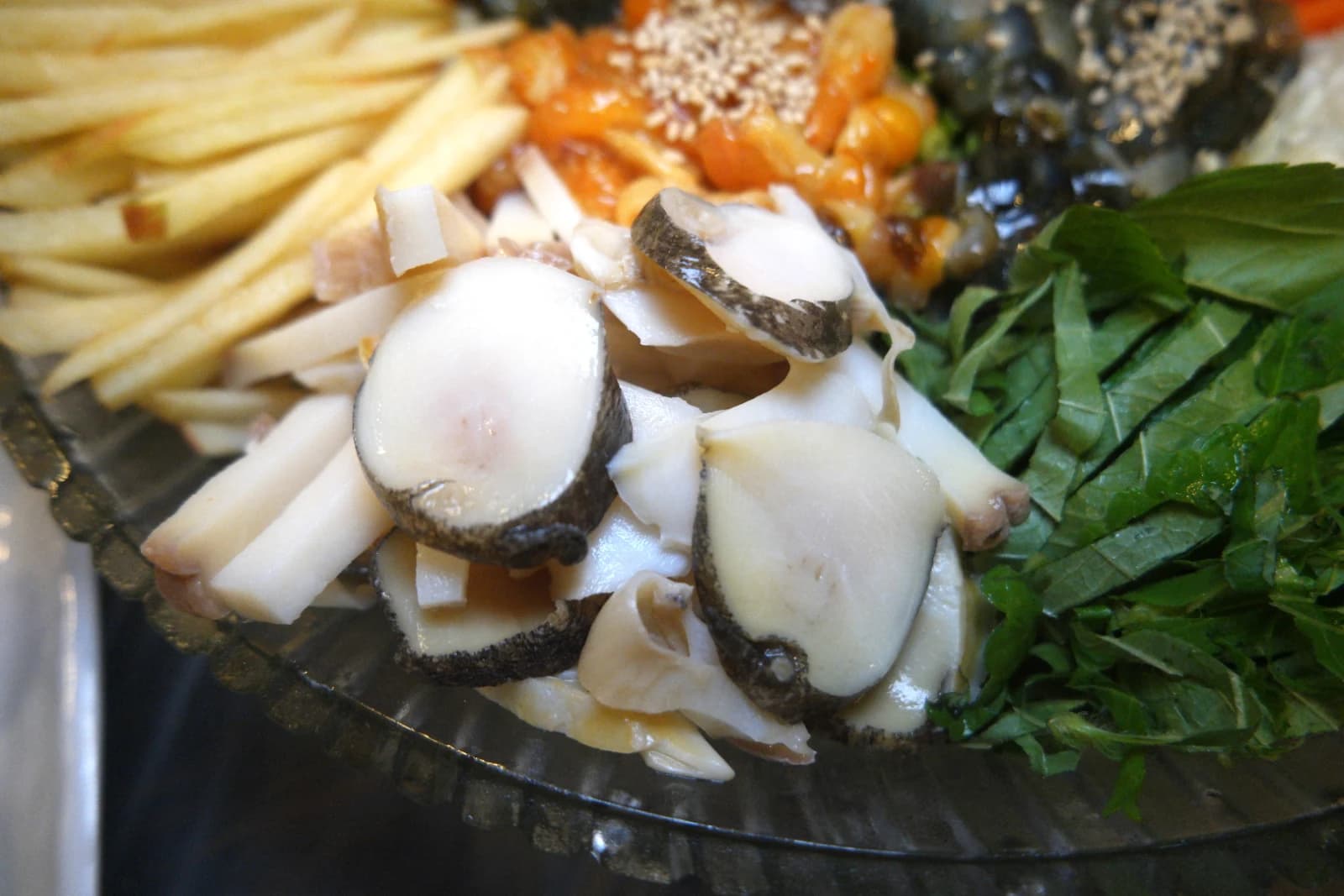
These are thin slices of conch. You can see the distinctive dark rim around each round cross-section — that's the telltale look. Chewy and subtly savory, the flavor lingers for a while. The pale yellow strips next to it are Korean pear, crisp and sweet, and when you mix them in with the spicy sauce they kind of reset your palate. I thought fruit in a seafood bowl was weird at first, but after one mixed bite I realized it'd feel incomplete without it.
Sea Squirt and Sea Cucumber — The Love-'Em-or-Hate-'Em Ingredients
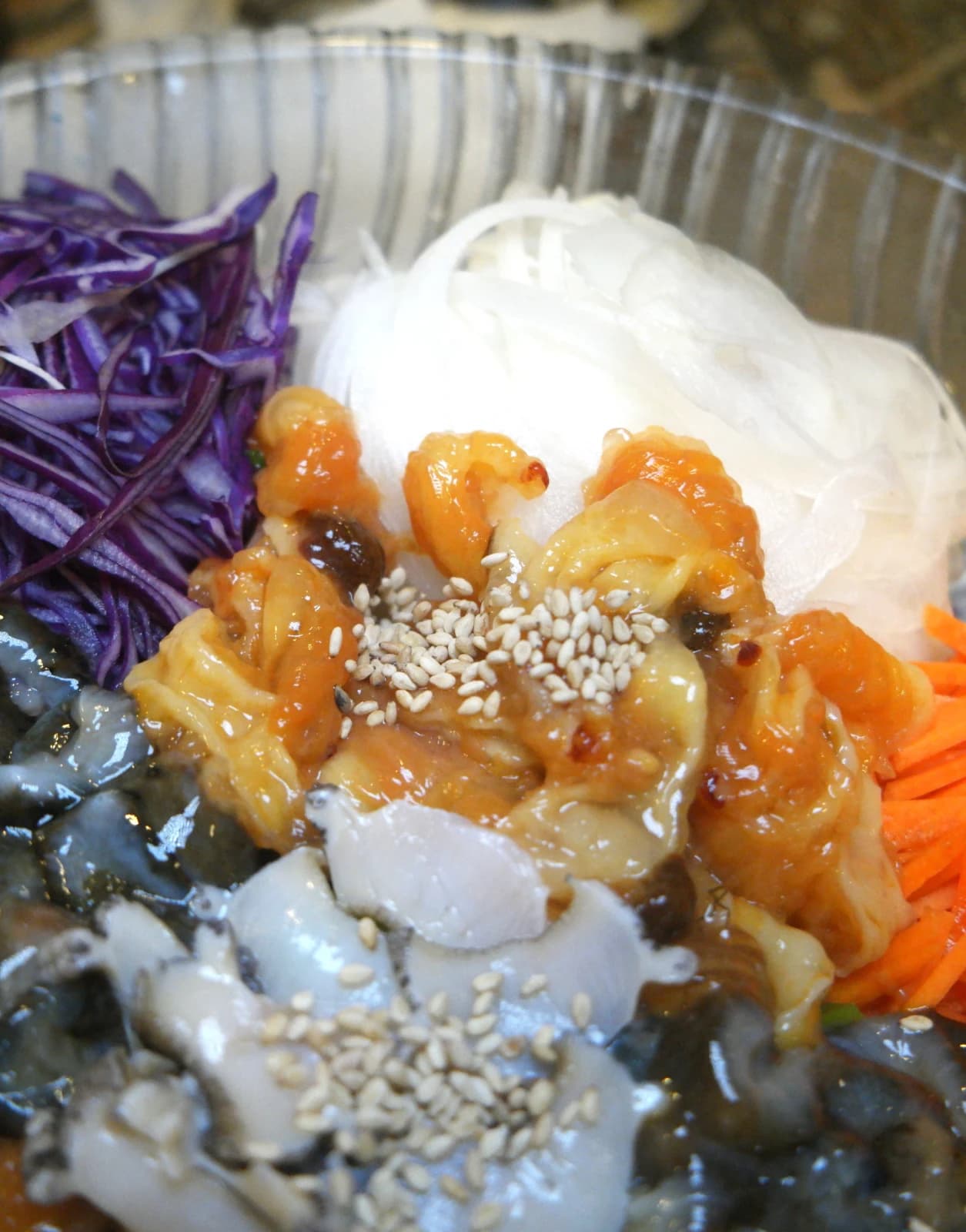
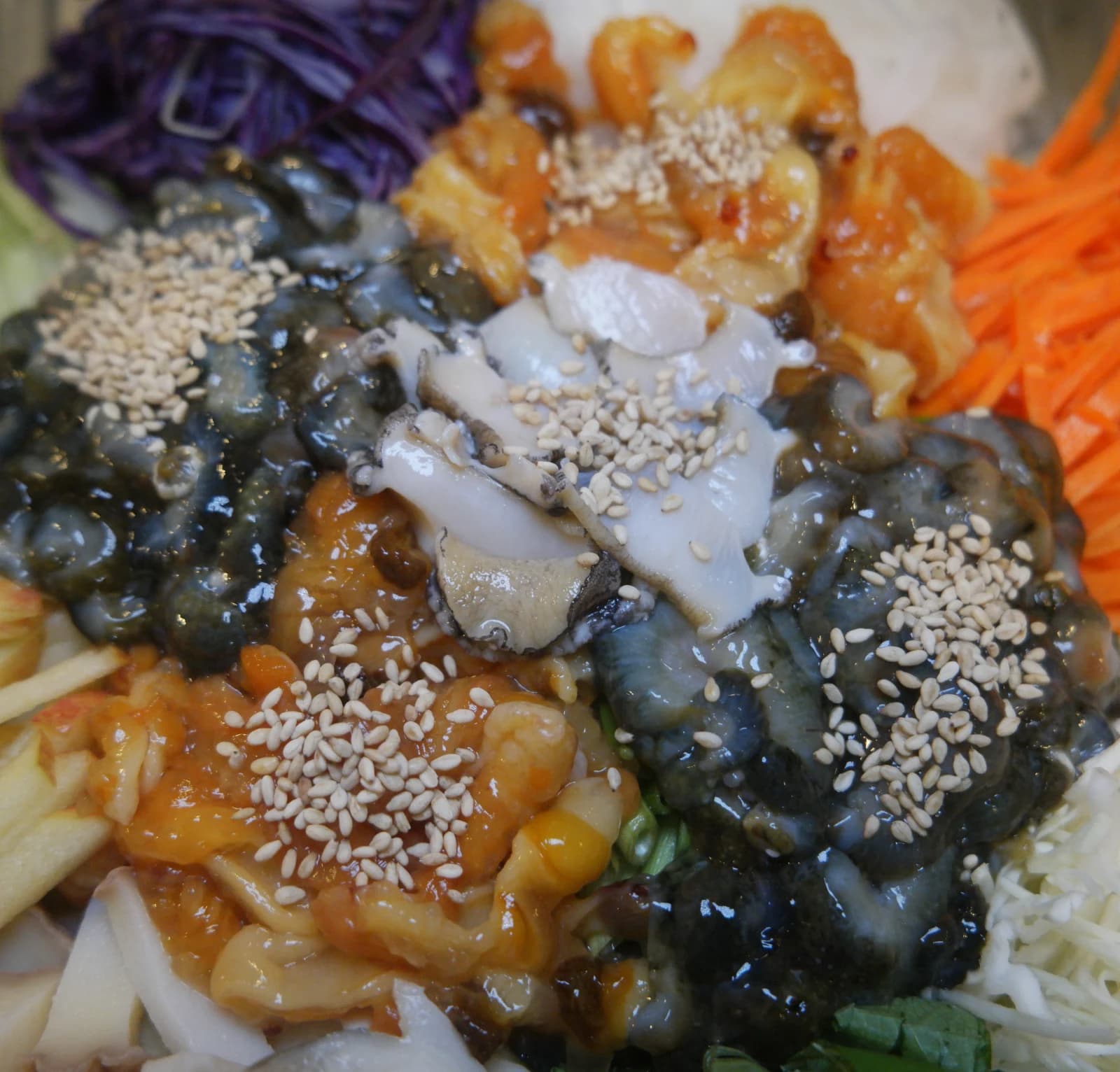
I got a close-up of the center of the bowl. The bumpy orange pieces are sea squirt, the dark slippery ones are sea cucumber, and there's a dusting of whole sesame seeds over everything that actually made it look pretty decent. Honestly though, for someone seeing this for the first time, it's a bit startling. My friend's exact words were, "Are you sure this is food?"
🟠
Sea Squirt (Meongge)
Nicknamed "the pineapple of the sea"
Appearance
The outside is a bumpy orange shell; only the inner flesh is eaten. In mulhoe, it shows up already tossed in the spicy sauce.
Flavor
The first bite sends a wave of ocean across your whole mouth. It's sort of sweet up front with a bitter finish — a uniquely savory taste. People who love it get addicted; people who don't won't even touch it with chopsticks.
Texture
Soft with a slight squish. It's less about chewing and more about it melting on your tongue.
Polarizing Rating
★★★★★ Total extremes
Even among Koreans, this is one of the most divisive ingredients out there.
⚫
Sea Cucumber (Haesam)
Known as "the ginseng of the sea"
Appearance
Dark and slippery with little bumps all over the surface. In mulhoe, it's cut into bite-sized pieces.
Flavor
Honestly, there's almost no flavor on its own. It's so mild it borders on tasteless, but paired with sauce it absorbs every bit of that seasoning.
Texture
This is the main event. It's chewy yet gelatinous — there's really nothing else to compare it to. Generously, you'd call it unique. Less generously, some people call it gross.
Polarizing Rating
★★★★☆ Texture is the dealbreaker
It's the texture, not the taste, that splits people. Anyone who says they can't do sea cucumber is almost always talking about that squishy feel.
The Vegetables — Perilla Leaves, Cabbage, Carrots, and Even Fruit
Perilla Leaves — The Korean Herb That Throws Foreigners Off
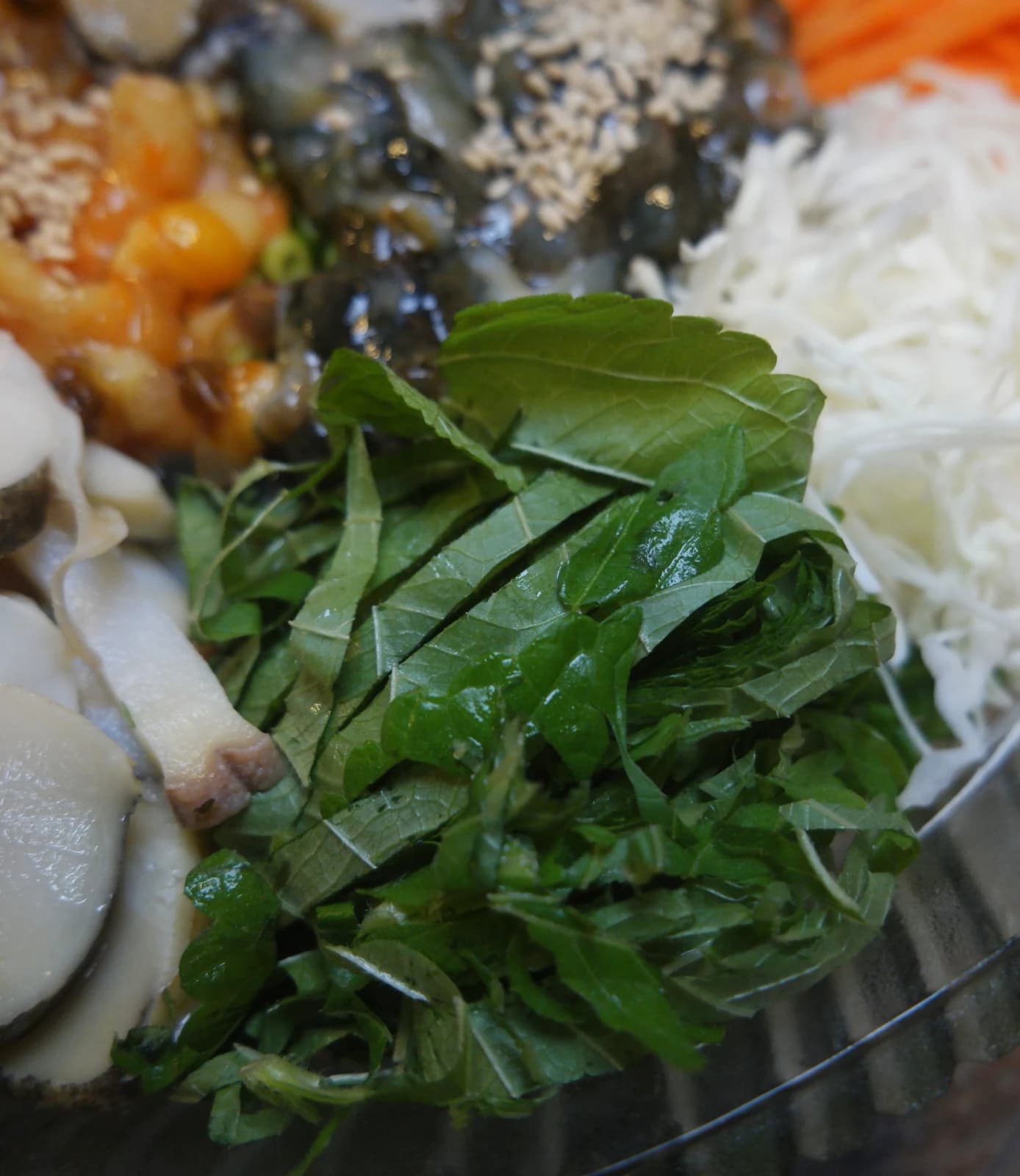
A heap of shredded perilla leaves sat on one side of the bowl, and for Koreans, this is as everyday as basil is in Italian cooking. They use it as a wrap for grilled meat, serve it pickled as a side dish, and of course it shows up in mulhoe too. But it's polarizing. Koreans find it fragrant and herby; a lot of foreigners think the aroma is overpowering and recoil at first. When my wife first came to Korea, she sniffed a perilla leaf and said, "Isn't this some kind of medicinal herb?" — then pushed it to the side of her plate. Now she gets disappointed if it's missing from a dish. She says it took about six months to come around. In mulhoe, the perilla's strong herbal scent mixes with the spicy sauce and actually tames the fishiness. Leave it out and the flavor totally changes.
Cabbage and Carrots
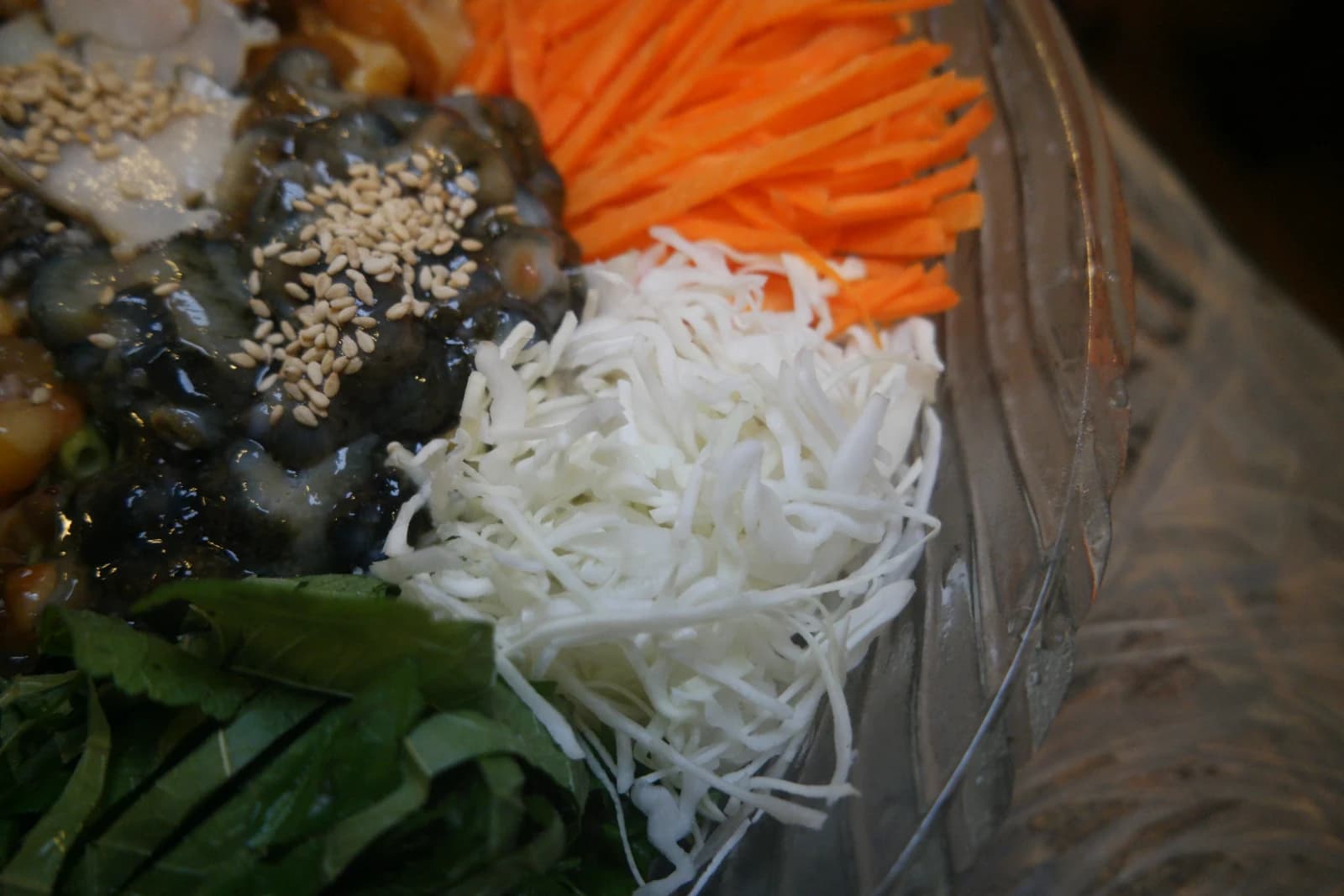
Cabbage and carrots — not much to explain here. Both are sliced into thin strips that add crunch when you mix everything together. Without them, you'd just have seafood and sauce, and that would get monotonous fast. Having something crisp to chew on is what kept me going all the way to the bottom of the bowl without getting tired of it.
Apple and Cucumber
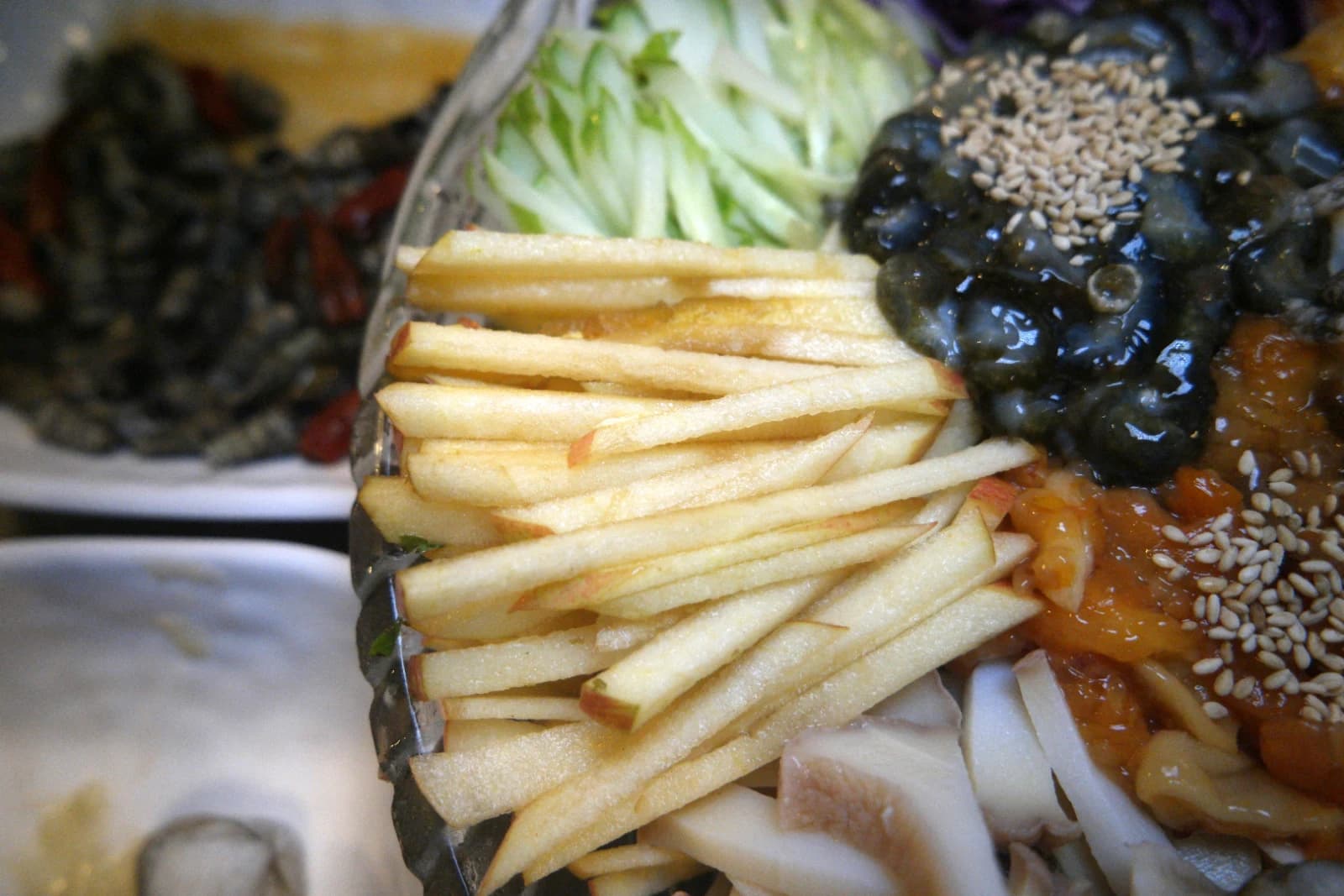
The apple was cut into thin matchstick strips too. With both pear and apple in there, the sweetness was surprisingly generous. That cool, clean fruit sweetness cutting through the spicy sauce between bites — it just kept resetting my mouth. The light green strips toward the back are cucumber, which basically handles crunch duty. I had no idea mulhoe came with this many vegetables and fruits, but once you eat it you realize every single one is pulling its weight.
Red Cabbage and Onion
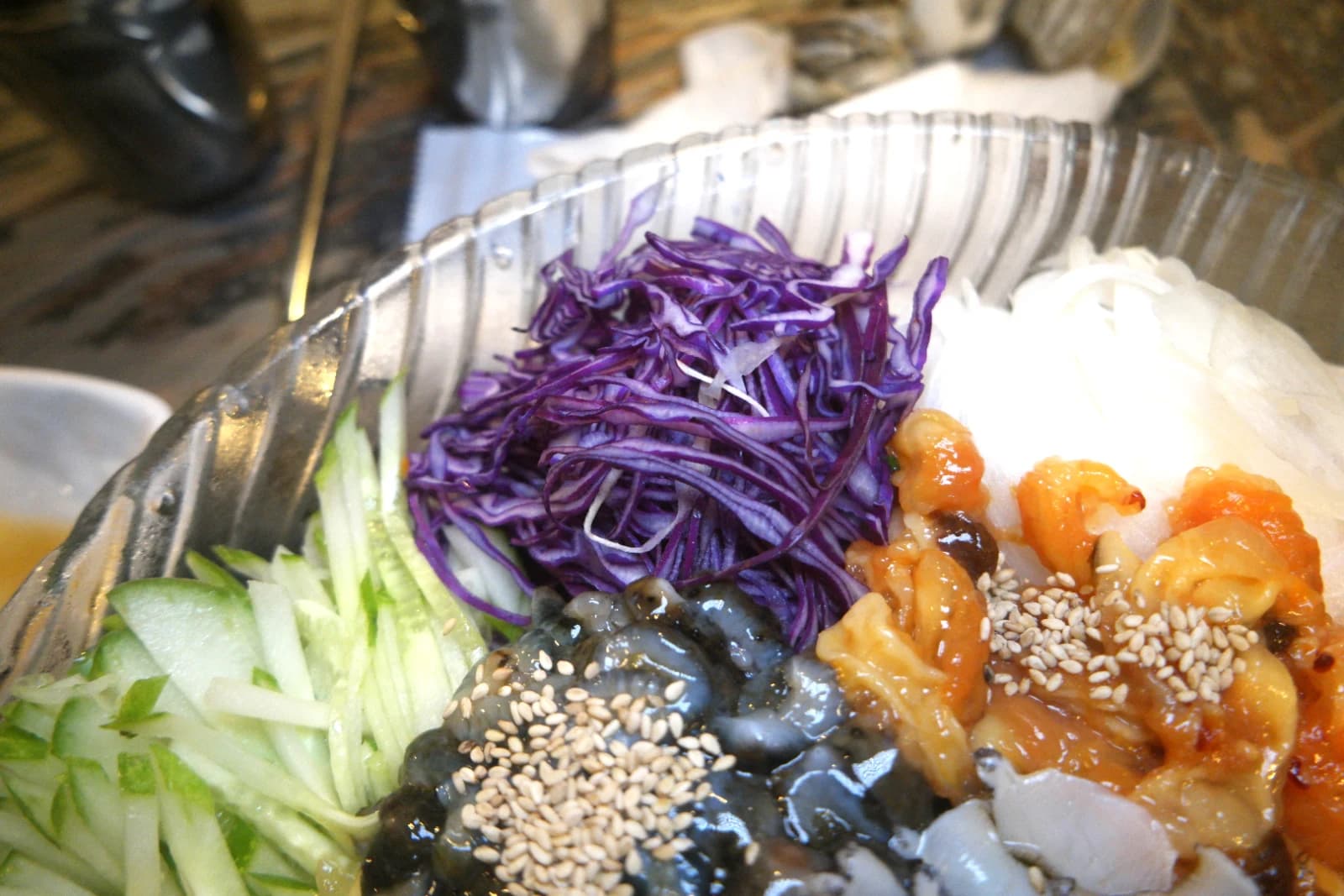
Red cabbage and onion claimed their own section of the bowl too. The red cabbage is so vibrantly purple it basically makes the whole dish pop visually, and the thinly sliced white onion peeking out next to it adds this sharp, slightly pungent kick when mixed in that pairs really well with the sauce.
How to Eat Mulhoe — Pour the Broth and Mix It Up
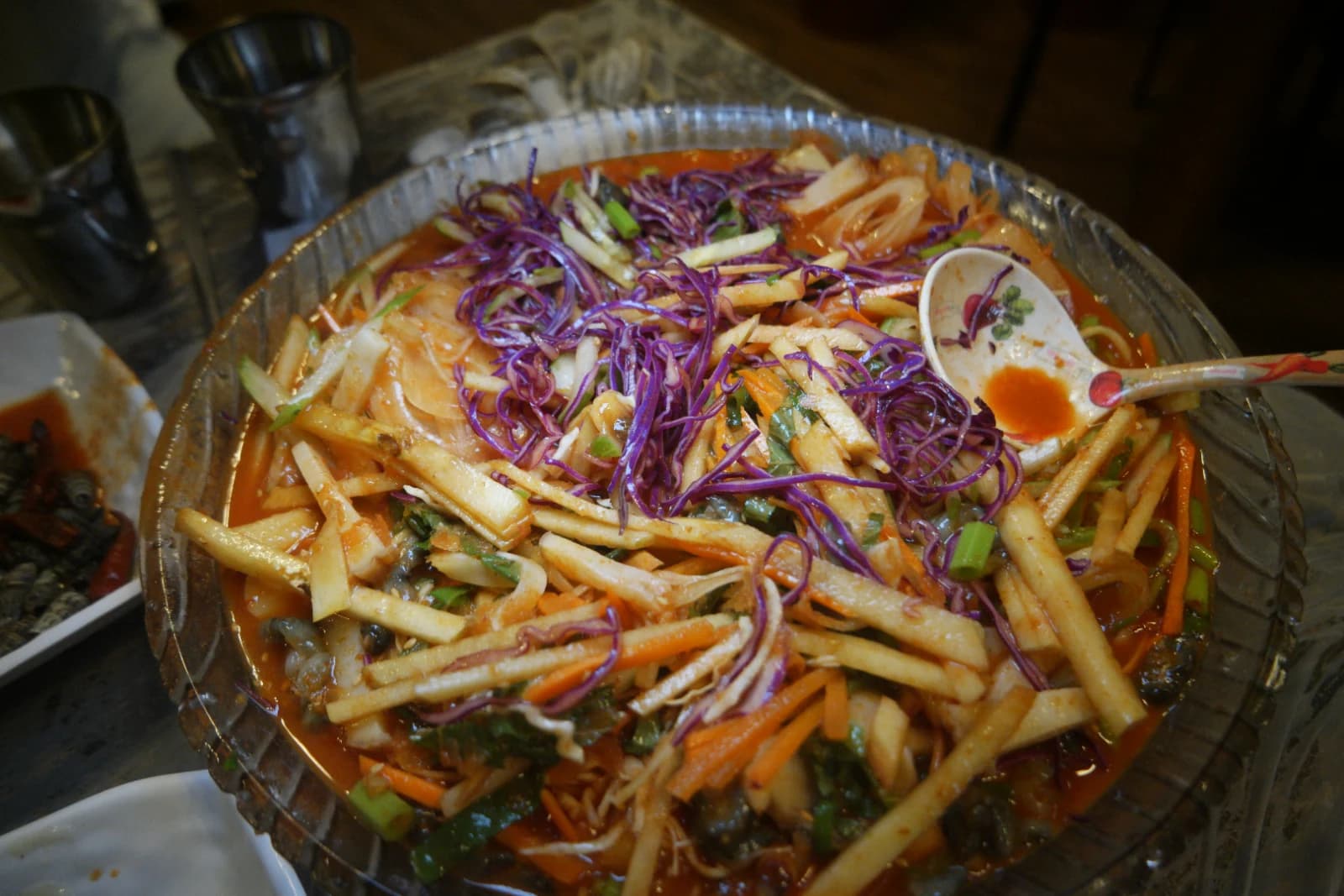
Alright, here's how to actually eat mulhoe. You pour the ice-cold broth right in and just go to town mixing. That pretty arrangement from before? Gone. Now it's a jumble of vegetables and seafood swimming in fiery red broth — basically a completely different dish. I'll be honest, it looked way better before the mixing, but the flavor? This is the real deal. One big spoonful and you pull up sea cucumber, sea squirt, apple, and perilla leaves all at once — they hit your mouth together and this spicy, freezing-cold burst just explodes. My friend watched me stir it up and said, "Why'd you ruin the pretty one?" I told him this is how you're supposed to eat it, and he looked genuinely sad about it.
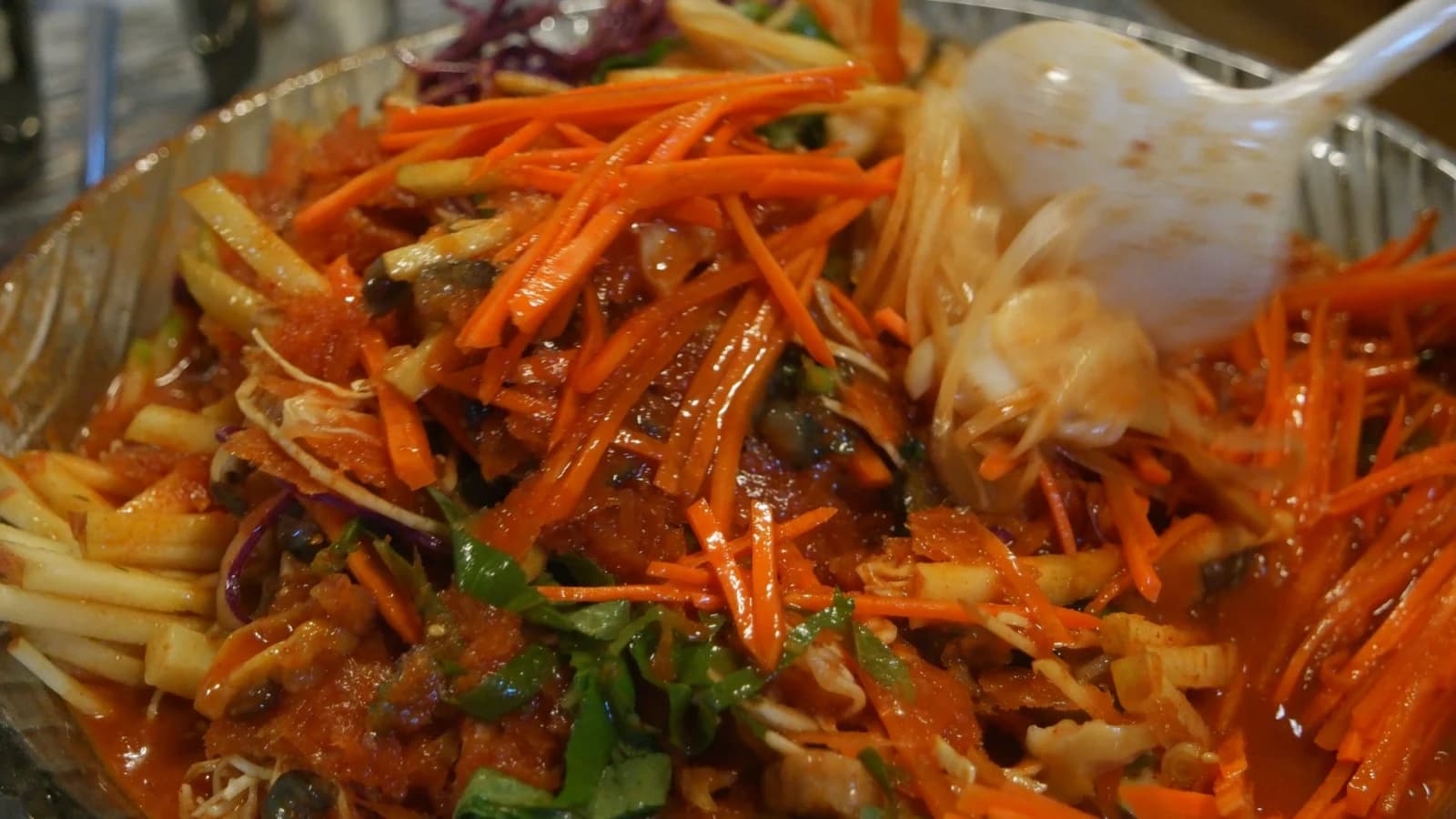
I used a ladle to scoop from the very bottom and flip everything over in big sweeps. The sauce sinks to the bottom, so just stirring the top won't cut it. After a few good flips, every strand of carrot, apple, and perilla leaf came up coated in red sauce, and now it finally looked like proper mulhoe. One thing though — the seasoning was a bit salty. Pouring in the broth dilutes it somewhat, but those first couple of spoonfuls hit my mouth with a salt punch before anything else.
Mulhoe Noodles — The Finale in the Leftover Broth
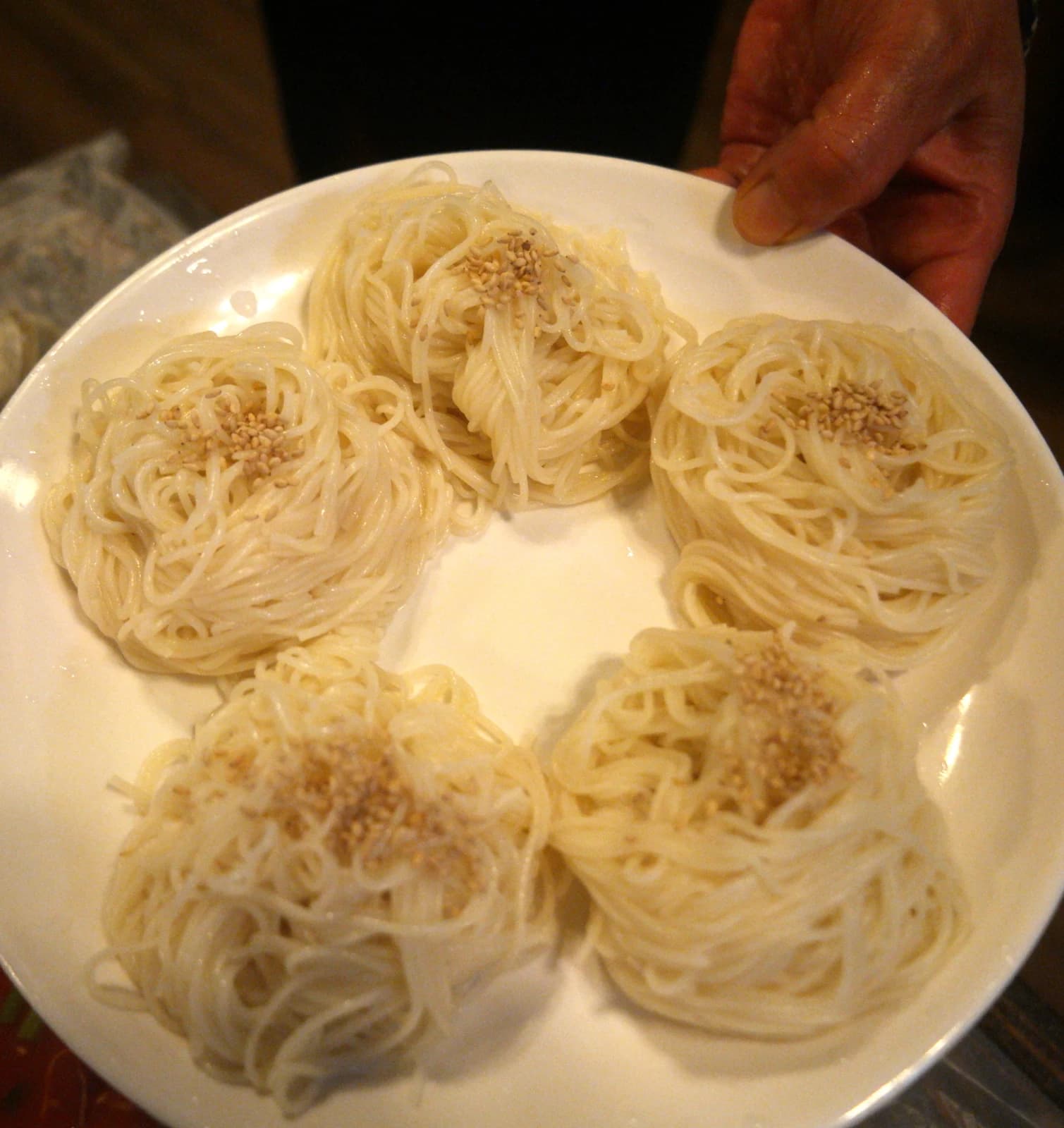
Once you've eaten through most of the mulhoe, the move is to order somyeon — super thin wheat noodles — and drop them into the leftover broth. They came on a plate, neatly rolled into little bite-sized nests with a sprinkle of sesame seeds on top. You plunk them into the mulhoe broth, mix it all up, and suddenly that spicy liquid coats every strand and you've basically got a whole second meal. My friend actually said he liked the noodles more than the mulhoe itself. And honestly, fair — all that seafood flavor had seeped into the broth, so these were on a completely different level from plain noodles tossed in sauce.
Once the Noodles Hit the Broth
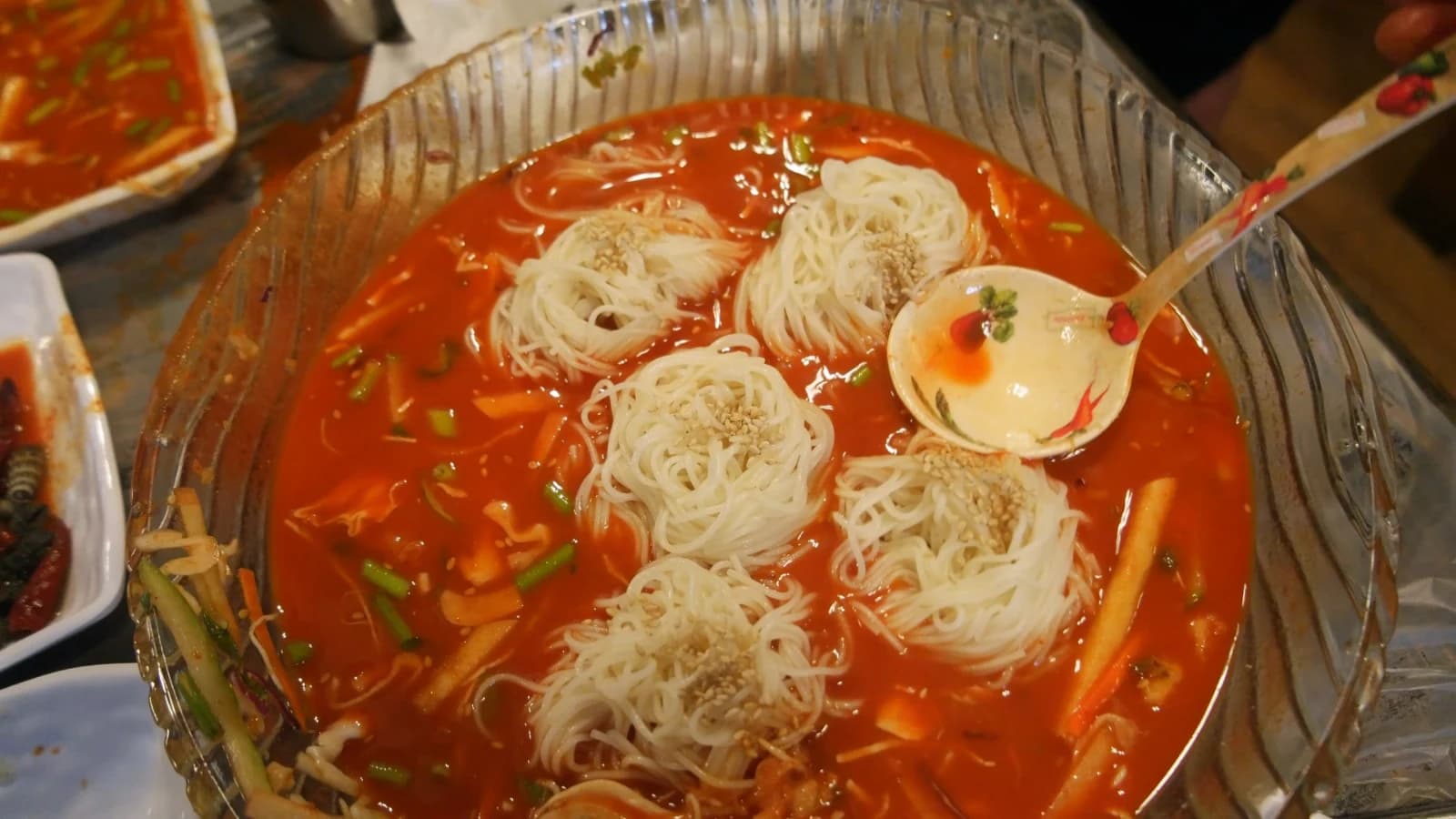
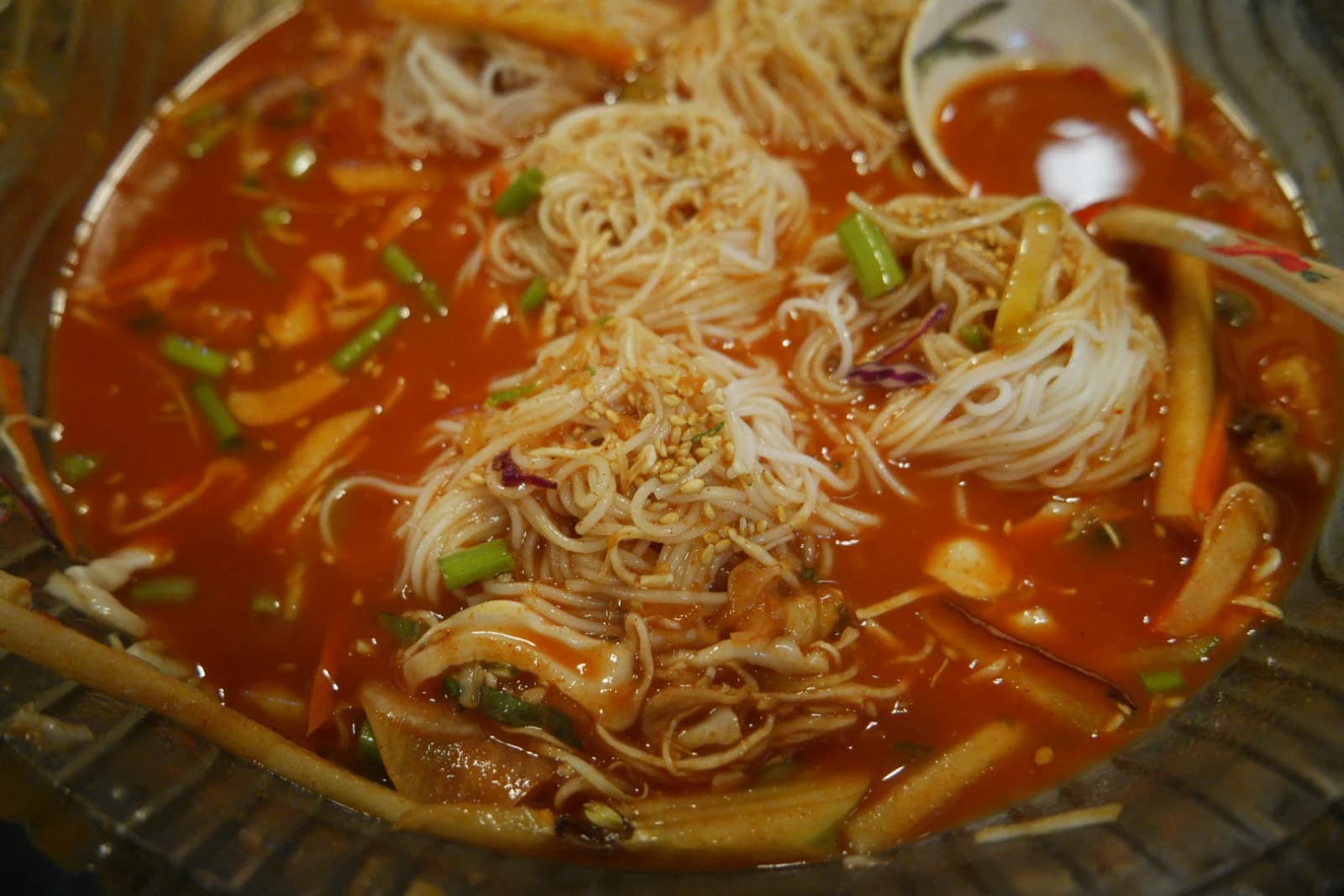
The noodle portion was bigger than I expected. I got greedy and dumped them all in at once, and by the end I was kind of over it. Should've done half and added the rest later, but hey, I didn't know that then. You can see the white noodle bundle floating on top of the red broth — and when you stir, bits of vegetable and seafood that had settled at the bottom come up tangled with the noodles, so it felt like eating the mulhoe all over again.
About $30 for Two, and the Quiet Ride Home
On the way out I asked my friend what he thought, and he said, "Everything was great except the sea squirt." So he never came around on that one. Personally, the sea squirt was my favorite part — but that's the beauty of mulhoe, right? Same bowl, totally different experience depending on what you fish out with your spoon. The two of us paid around 40,000 won (roughly $30 USD) for mulhoe plus the noodle add-on, and considering how loaded it was with seafood, it felt like a solid deal. We were both quiet on the drive back — I'm not sure if it was because we were stuffed or because that cold broth had put us into a food coma. For what it's worth, the place we went to has since closed, but there are still plenty of mulhoe spots in the Daejeon area — a quick search should turn them right up. Even now, the second the weather starts heating up, I think about that bowl.