Hollys Coffee Korea: 4am Café Visit, Menu Prices
Table of Contents
16 items
4am, Raining, and a Korean Café Still Has Its Lights On
It was four in the morning and I couldn't sleep. I was lying there doing nothing when I turned to my wife and said, "Shall we go out?" — she was up immediately. We threw on whatever was nearest and headed out, not entirely sure where we were going at that hour. Then we spotted Hollys Coffee, completely lit up. It was a 24-hour branch.
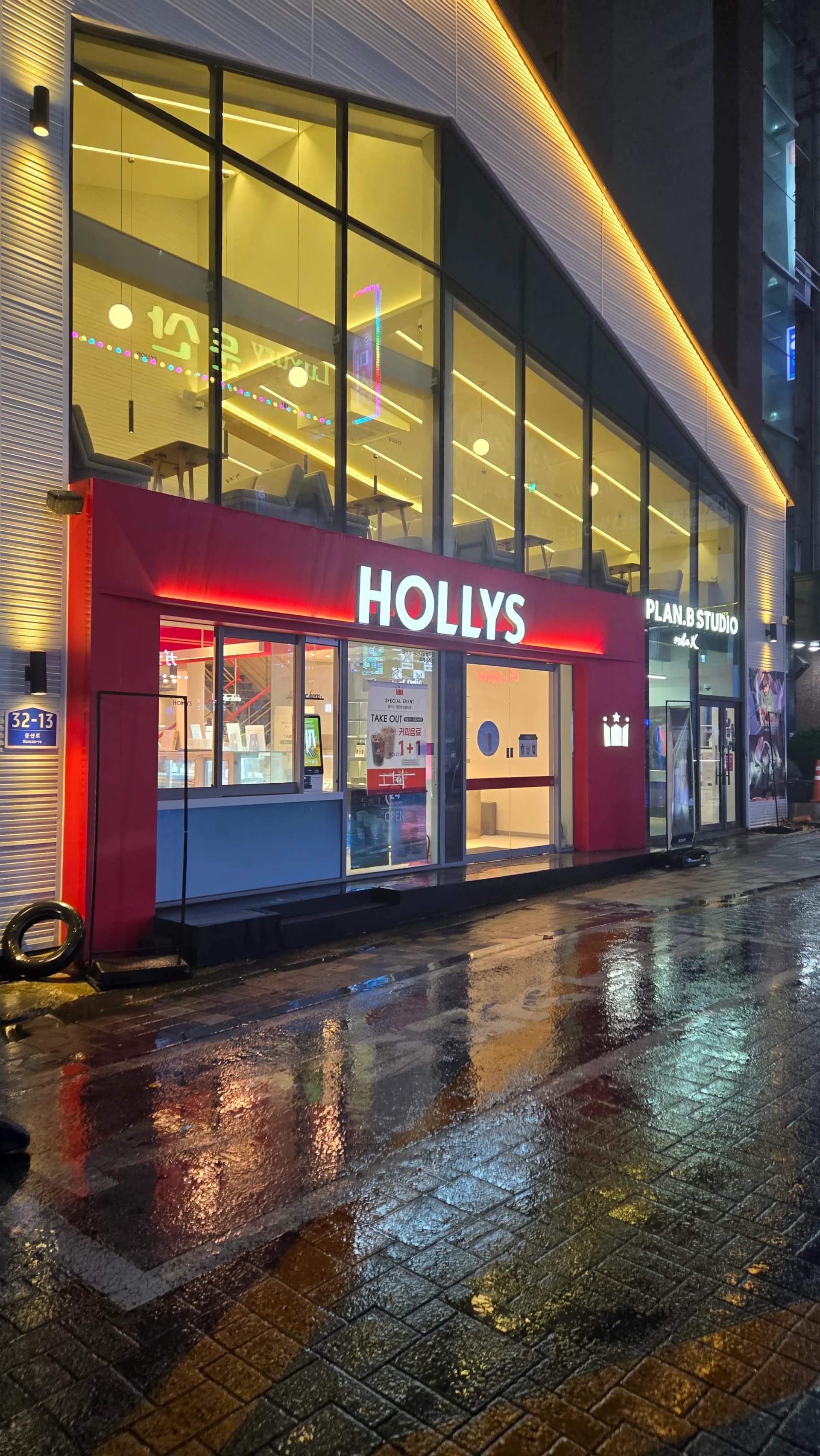
The rain had turned the pavement into a mirror for the café lights, which made the whole thing look rather more atmospheric than it had any right to. Standing alone in an empty street at that hour with a warm café glowing in front of you does something to your mood — in a good way. Not everyone knows that 24-hour cafés exist in South Korea, and they're not exactly on every corner, but you do find them dotted around the bigger cities. Not every Hollys Coffee branch operates around the clock — this one was a bit of a special case. If you're ever stuck at an odd hour during a trip to Korea, worth keeping in mind.
Ordering at a Korean Café Kiosk: Here's How It Works
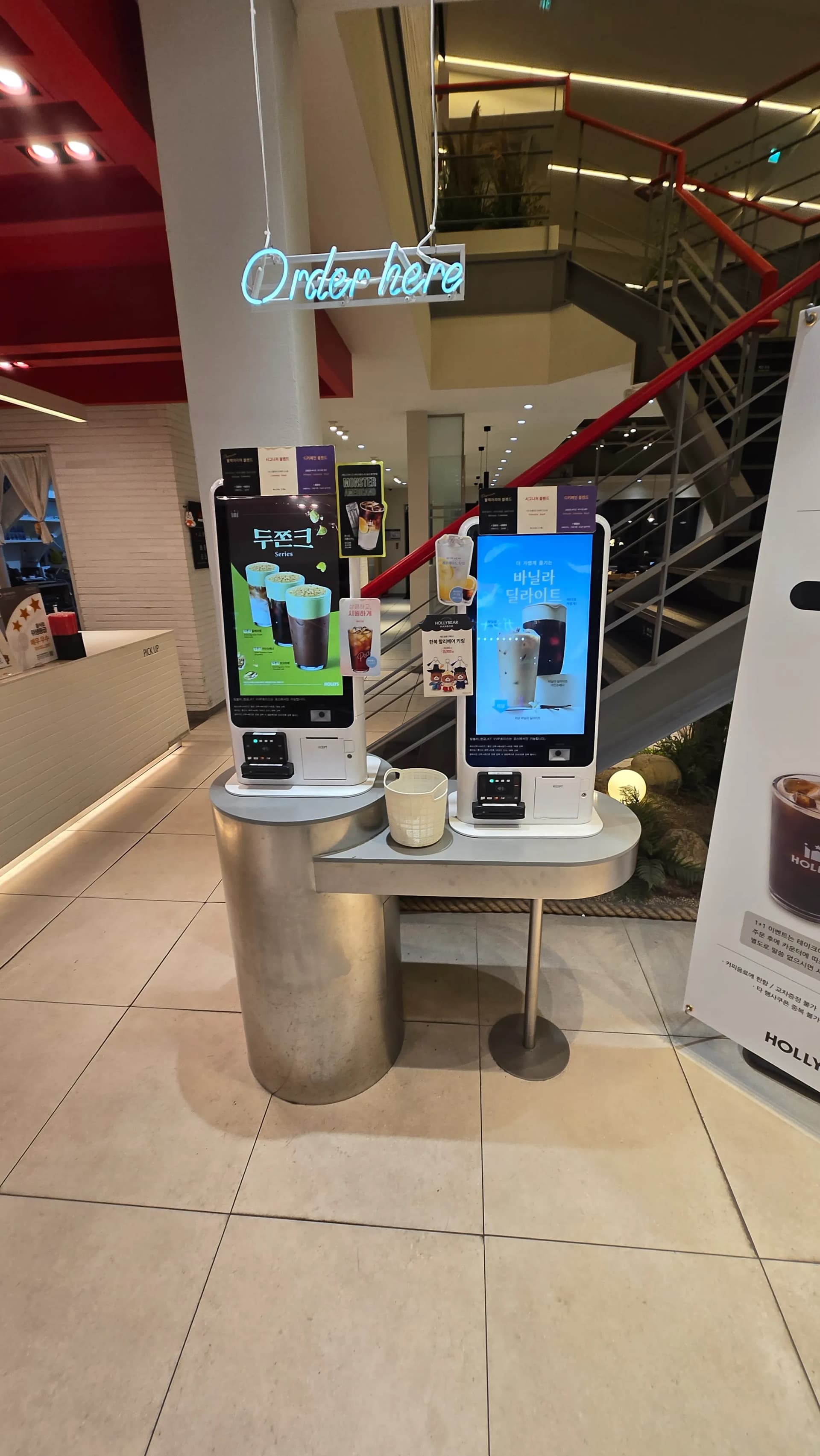
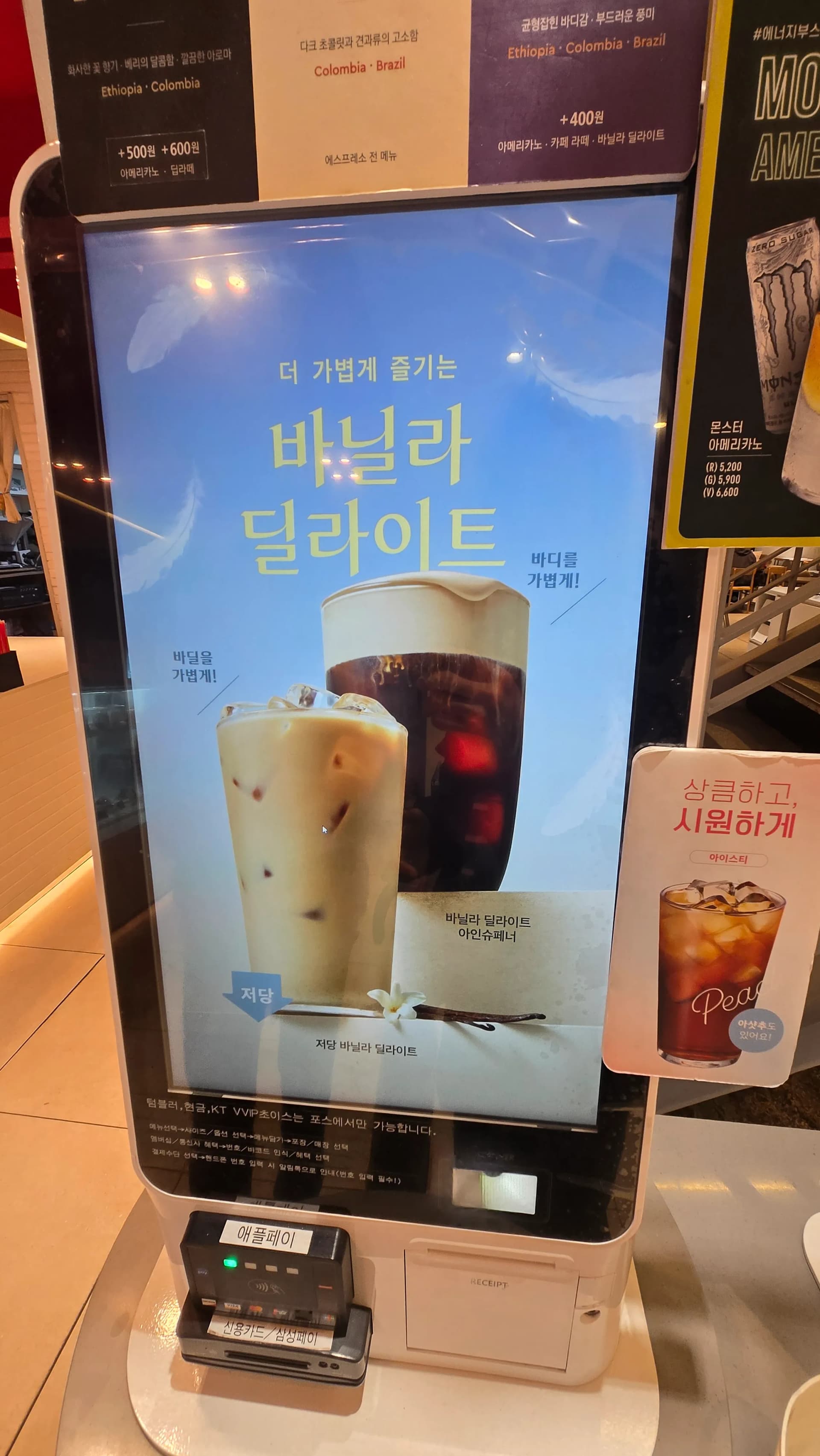
Walk through the door and the first thing you see is the kiosk. These days in South Korea, whether it's a café or a restaurant, kiosk ordering is more or less the default — Hollys included. You browse the menu on screen, then pay by card or mobile payment. Cash isn't accepted at the kiosk. If you're elderly, less confident with the technology, or only have cash on you, staff at the counter will help you order in person — just ask and they'll sort you out.
Hollys Coffee Menu Prices and Multilingual Support
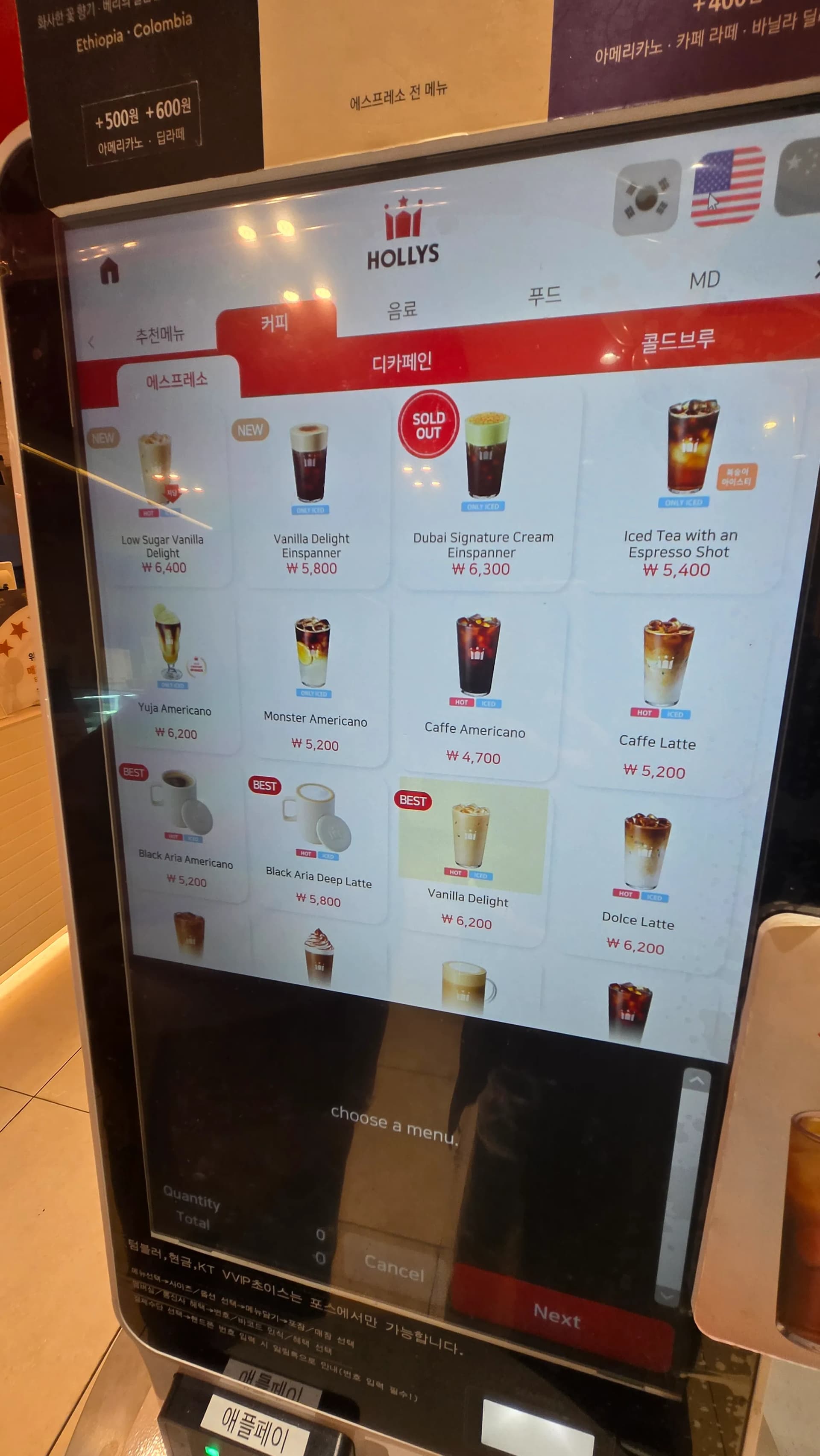
This is what the kiosk screen looks like — photos of each item alongside the name and price. It also supports multiple languages, so you won't be completely lost if you don't read Korean. There's a flag icon at the top of the screen to switch. Prices: Americano around £2.80, Café Latte around £3.10, Vanilla Delight around £3.70. That's pretty typical for a Korean franchise café — roughly on a par with Starbucks Korea, or a fraction cheaper. For those unfamiliar with Hollys: it's South Korea's very first espresso specialist café, opened in Gangnam, Seoul, in 1998 — a full year before Starbucks opened its first Korean branch. There are now close to 500 locations nationwide, which sounds like a lot but is well behind Starbucks or Twosome Place, so even people who've spent a fair bit of time in Korean cafés might not have visited one. I tend to default to Starbucks or Twosome myself, but there's something slightly different about Hollys that makes me seek it out every now and then.
Eat In or Takeaway — and Korea's Single-Use Cup Rules
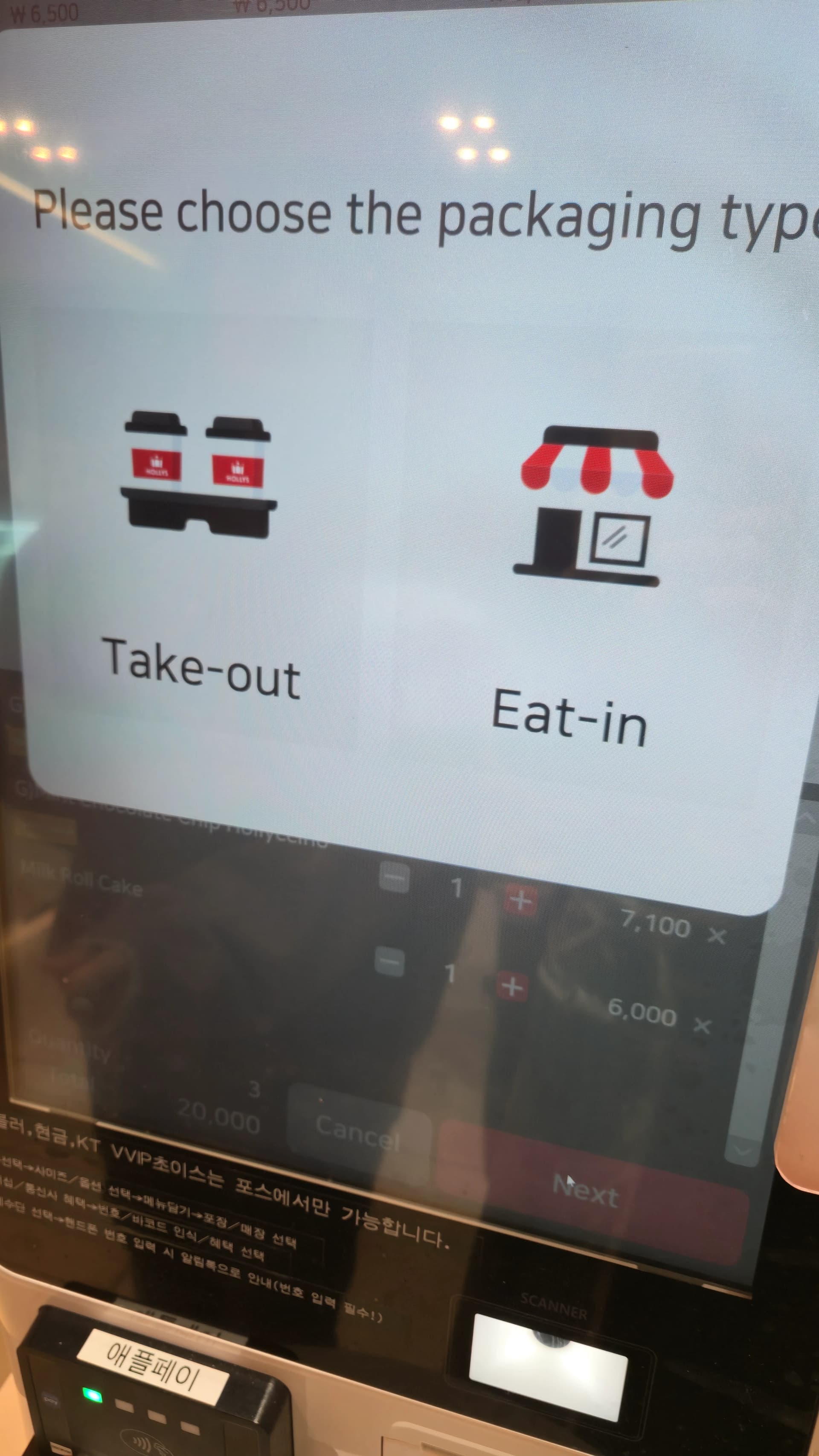
Once you've chosen your drinks, this screen appears: eat in or takeaway. It's not just a formality. In South Korea, single-use plastic cups are legally restricted for in-café use, so if you say you're eating in, your drink will come in a mug or reusable cup. Disposable cups are for takeaway only. The important bit: you can't select takeaway and then sit and drink from the disposable cup inside — the café can face a fine if that happens. I've seen quite a few visitors to Korea caught out by this when they first arrive. If you're staying in the café, choose eat in. If you need to leave mid-drink, just let the staff know and they'll transfer it to a takeaway cup for you.
Hollys Coffee Desserts: An Honest Assessment
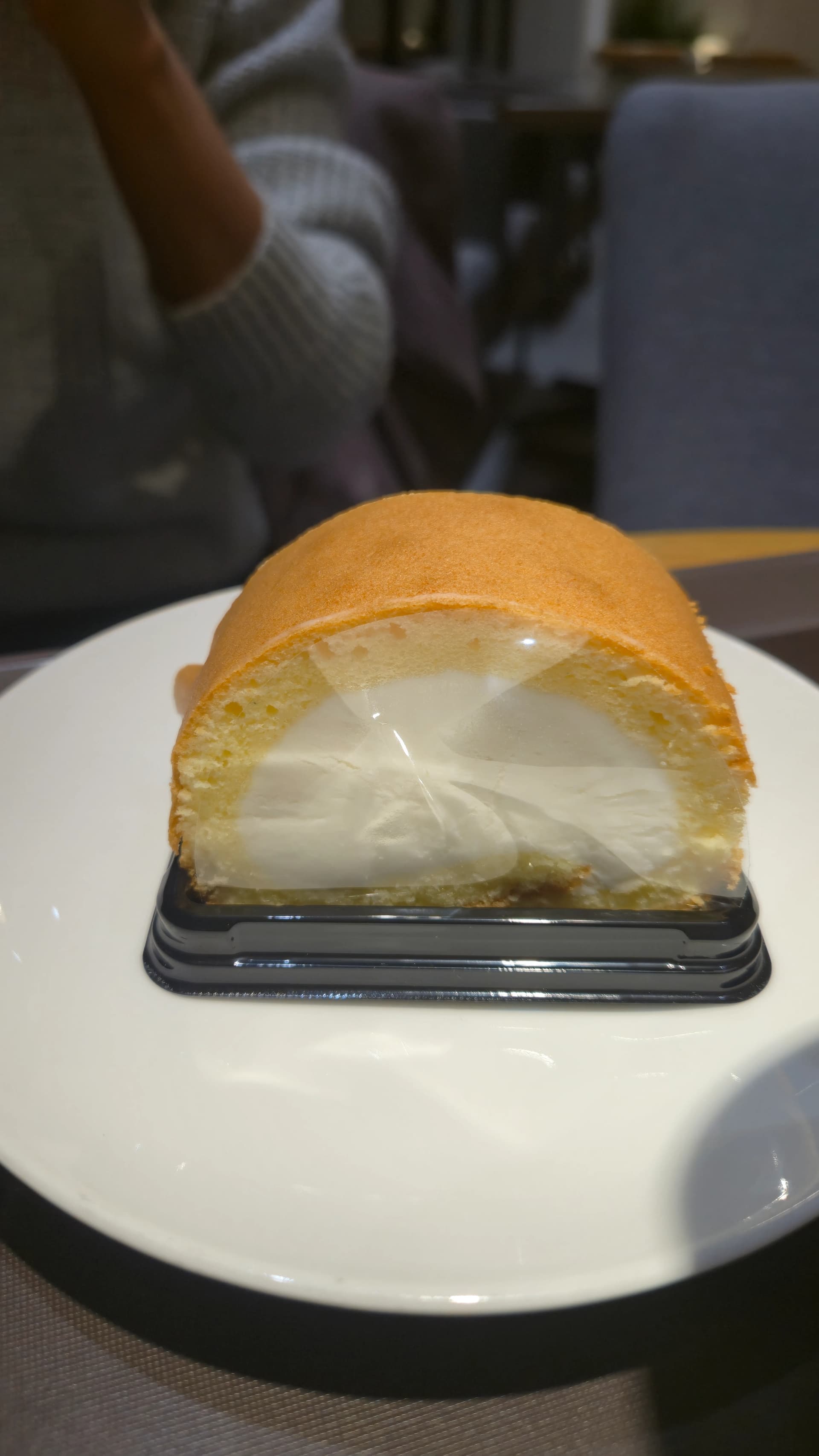
My wife ordered the Pure Milk Swiss Roll. The outside is a soft sponge and the inside is packed with fresh milk cream — sweet but not cloying, reasonably light. Decent alongside a coffee. That said, at around £3.60, it's a bit steep for the size. It tastes noticeably better than a convenience store roll cake, but when the price is nearly three times as much, you do pause for thought.
Hollys Dolce Latte — Condensed Milk Done Properly
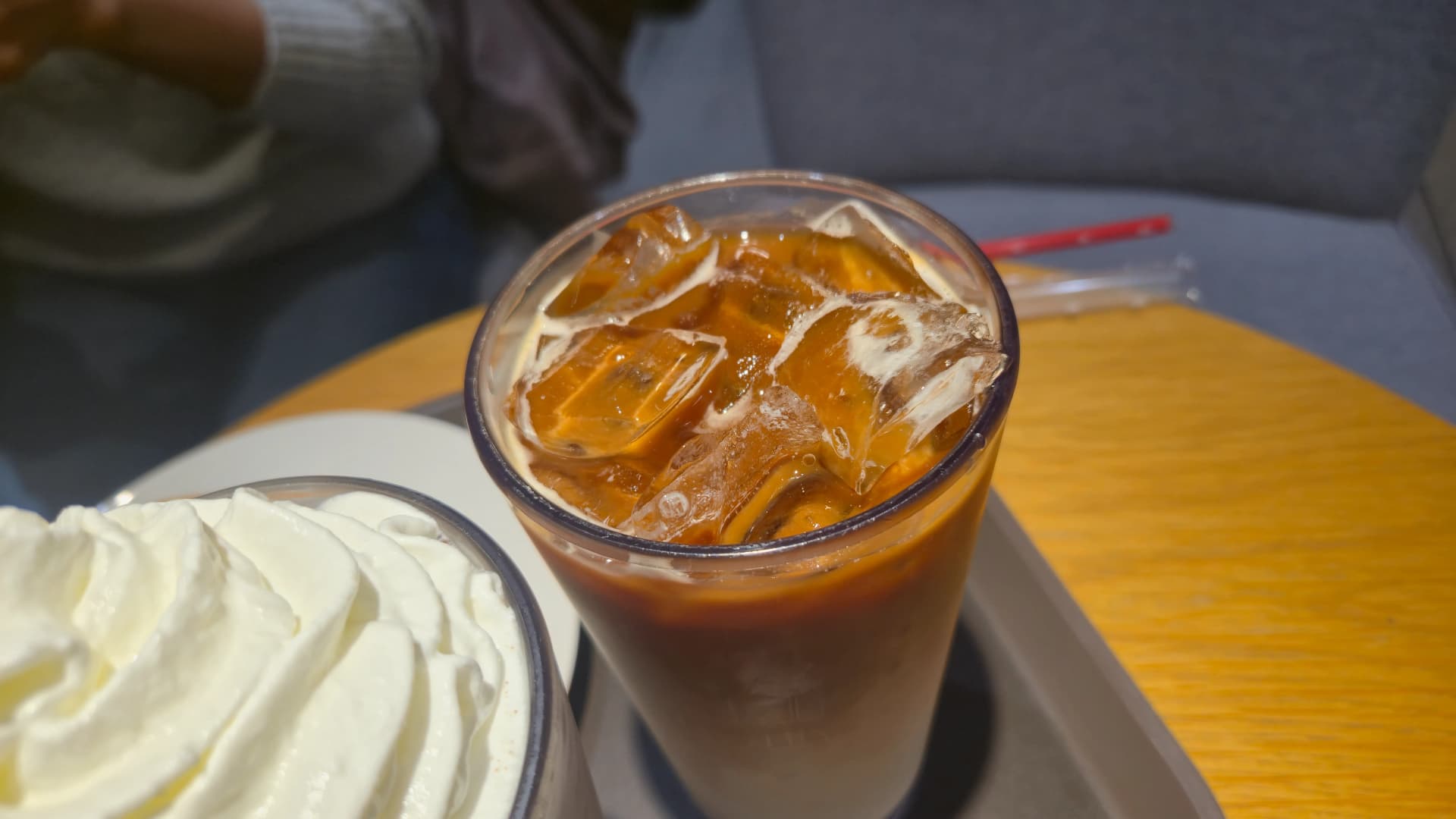
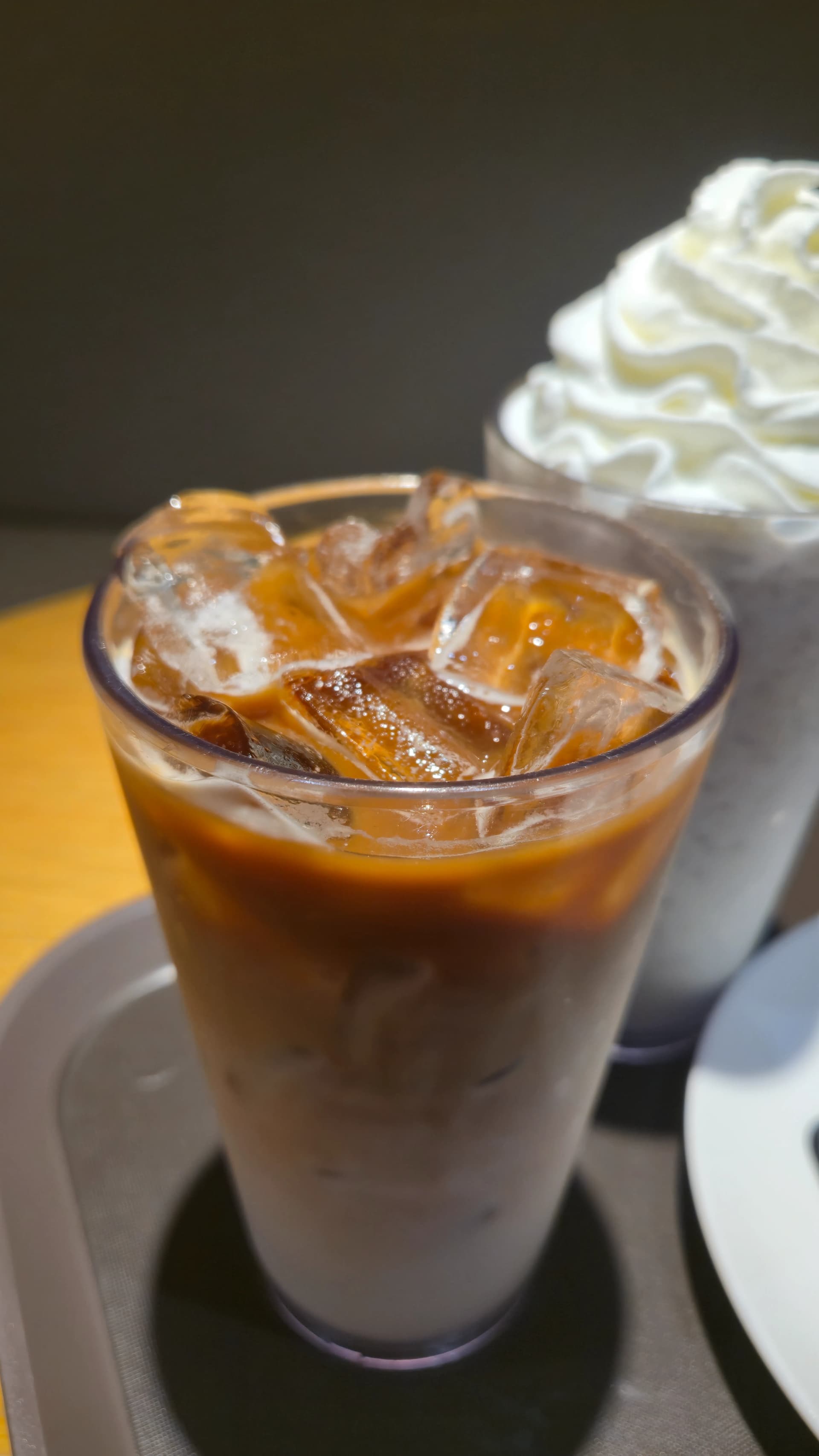
My wife also went for the Dolce Latte — an espresso-based latte made with condensed milk, and one of Hollys' longer-standing popular items. The condensed milk gives it a soft, rounded sweetness that plays nicely with the coffee without being sickly. She ordered it iced, and the condensed milk had settled at the bottom — you really do need to give it a stir before drinking. Without stirring, the top half tastes quite bland and the sweetness is all hiding at the bottom. My wife took one sip, looked puzzled, said "what's wrong with this?" — I stirred it, and suddenly it was exactly right.
Mint Choc Hallychino — For the True Believers
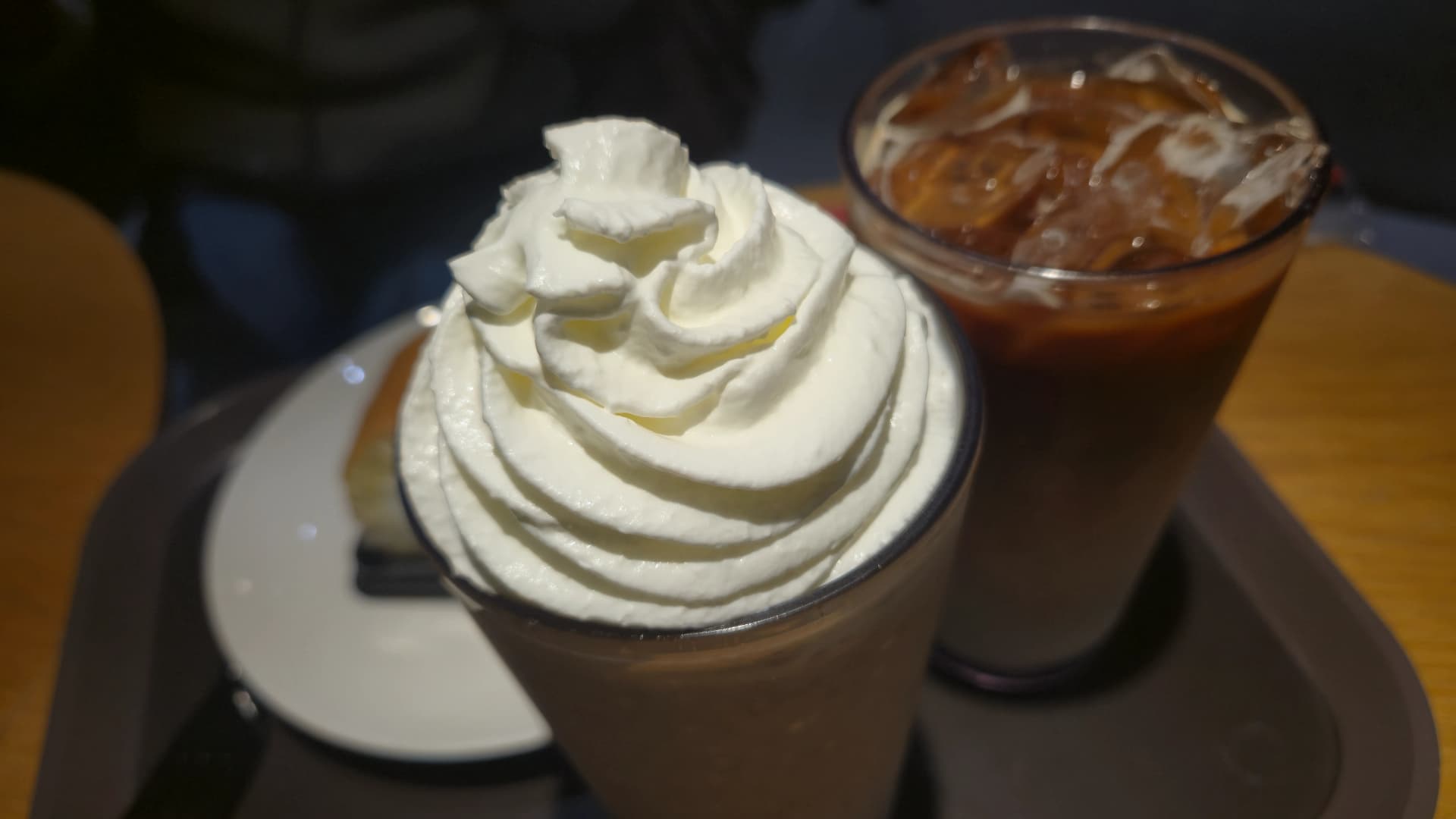
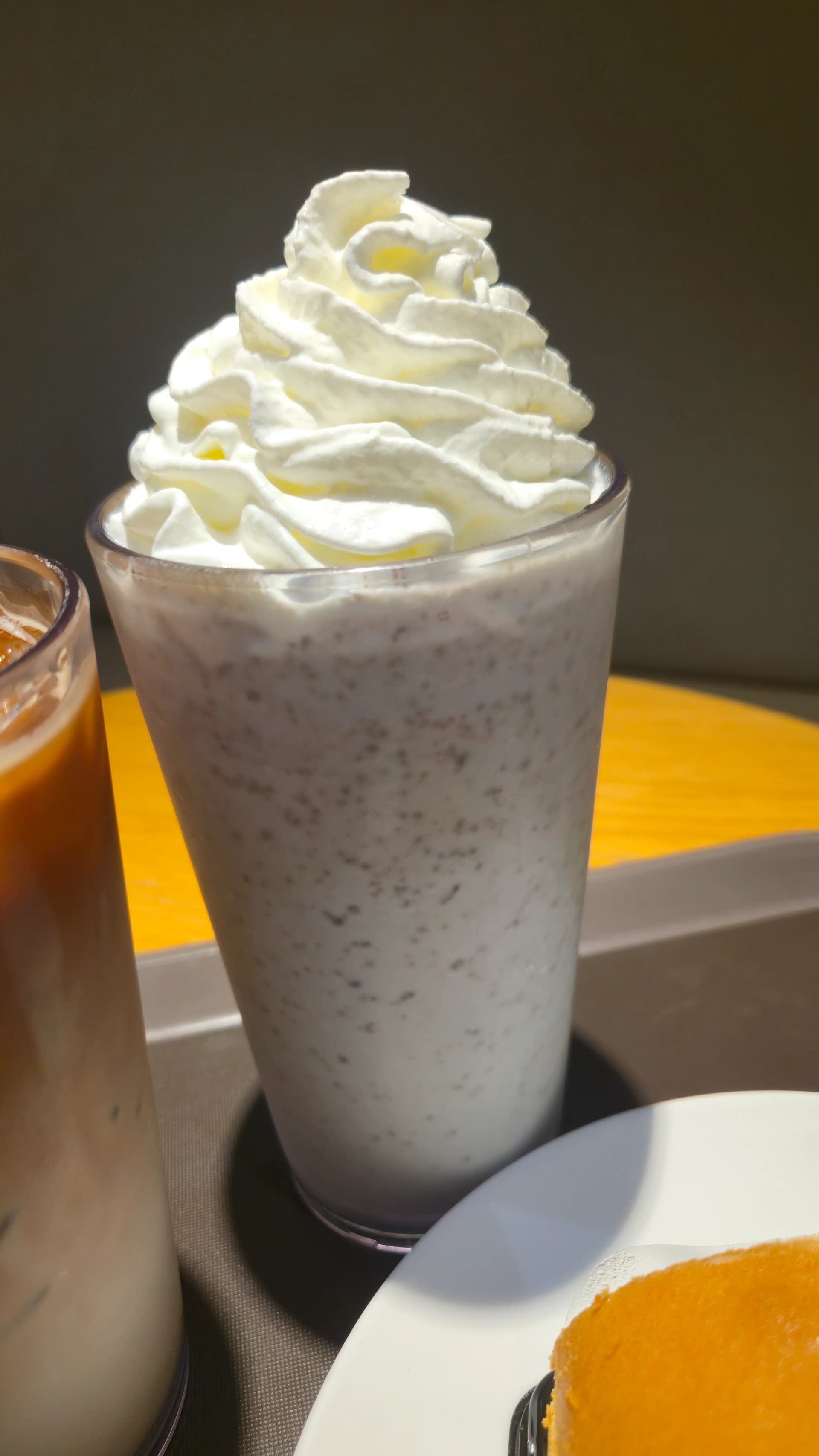
I went for the Mint Choc Hallychino. The Hallychino is Hollys' name for their blended drinks — essentially a slushie-style drink made by blending ice into the mix. This one came with a generous pile of whipped cream on top, chocolate chips dotted through a pale mint-coloured drink. The mint flavour was on the gentle side rather than aggressively mouthwashy, which I think would make it a reasonable starting point even for those who haven't fully committed to the mint choc camp yet. In Korea, mint chocolate is something of a cultural divide — you're either for it or firmly against it, and the two sides enjoy mock-arguing about it endlessly. I'm a mint choc enthusiast, so I order it whenever I see it on a menu. Sent a photo to a mate who can't stand the stuff and the response was entirely predictable — which is, of course, half the fun.
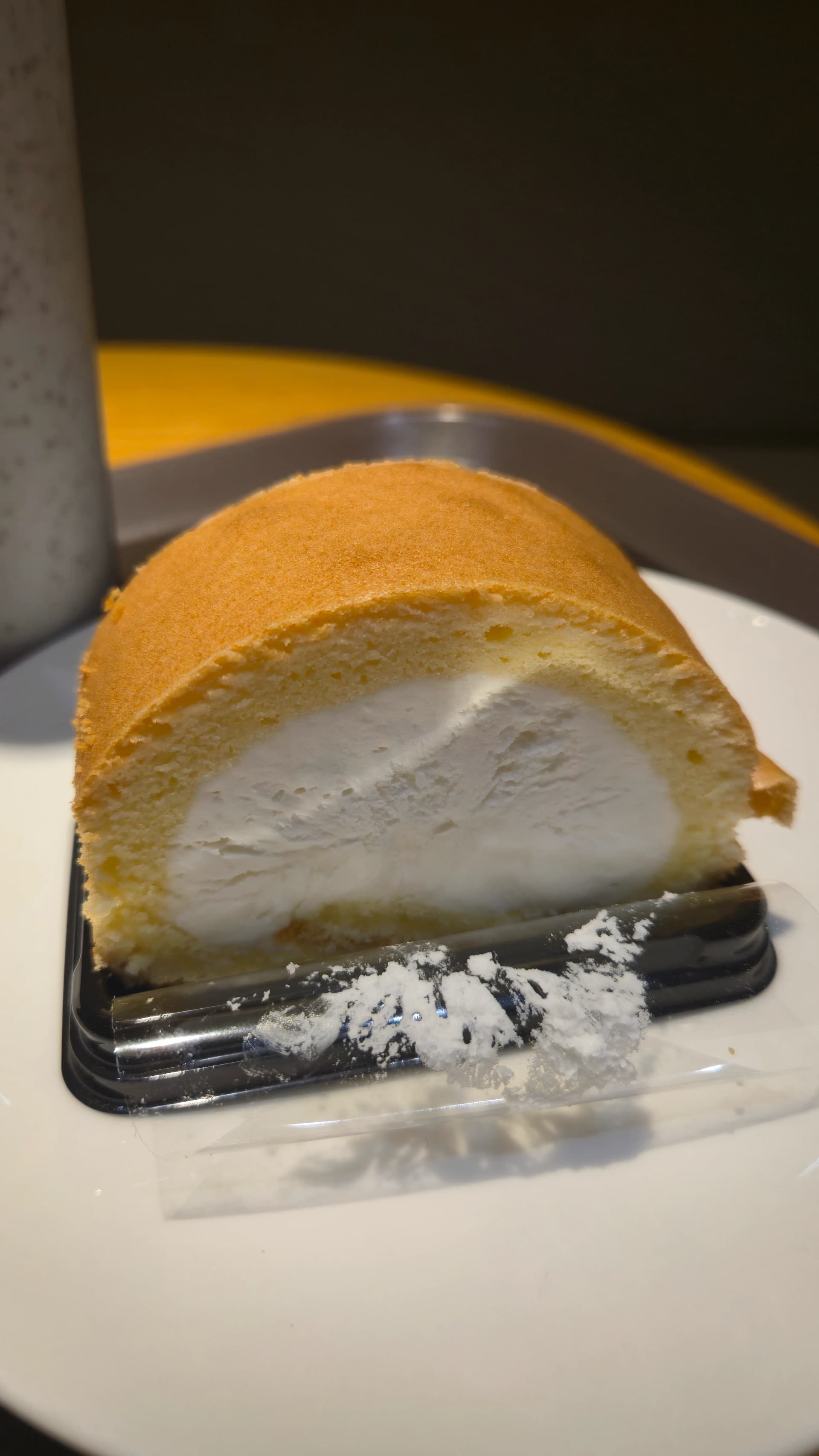
Back to that Swiss roll — here's what it looks like after the first bite. There's more cream than sponge in there, and it spills out the moment you cut into it. Taste-wise, it was perfectly fine. But at around £3.60, it's two or three bites and it's gone. A sweet treat at four in the morning is hard to argue with in principle, but would I order it again? Probably not — I'd rather put that money towards another drink.
Hollys Coffee Cake Display — Korean Café Dessert Prices Laid Out
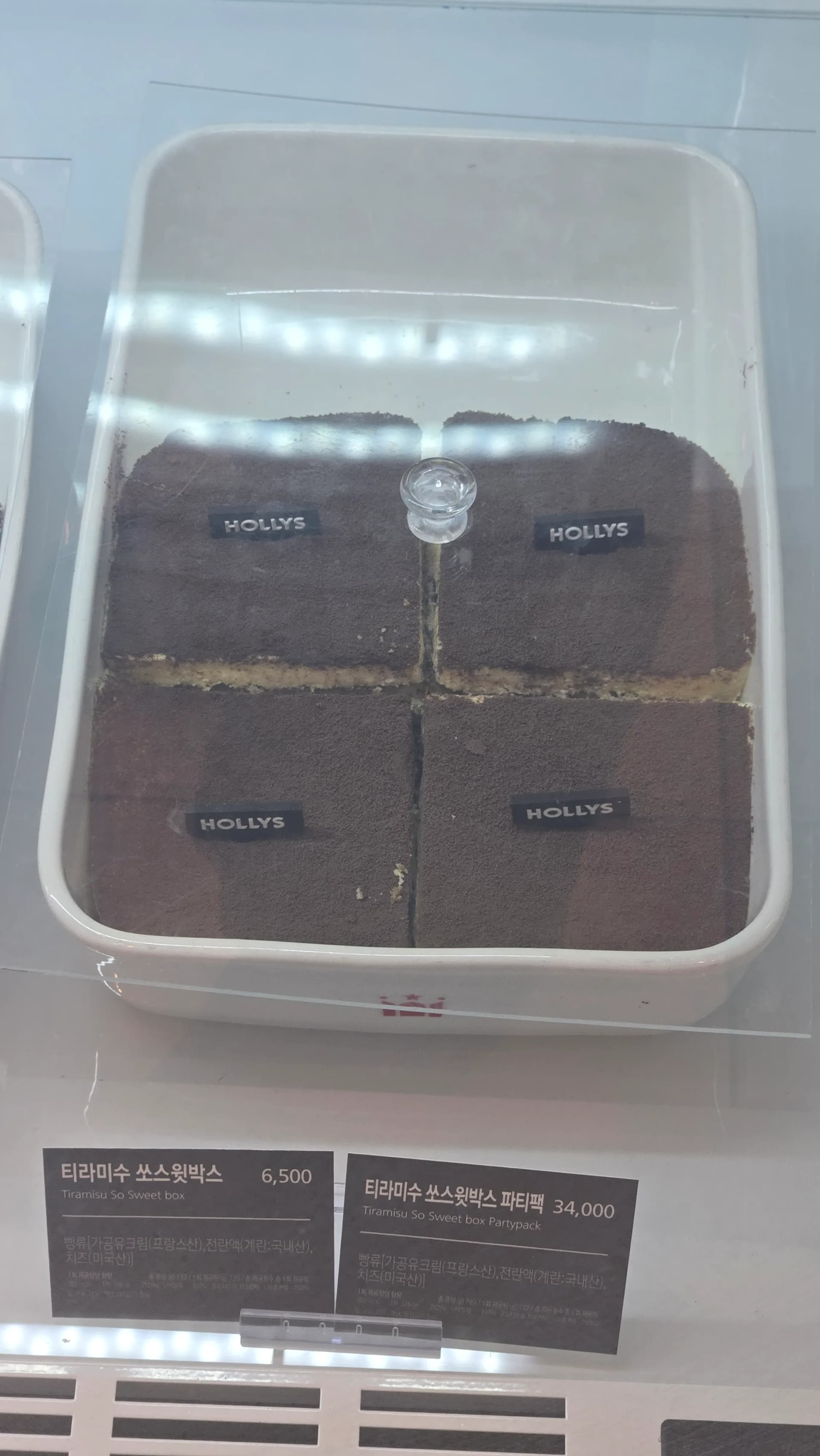
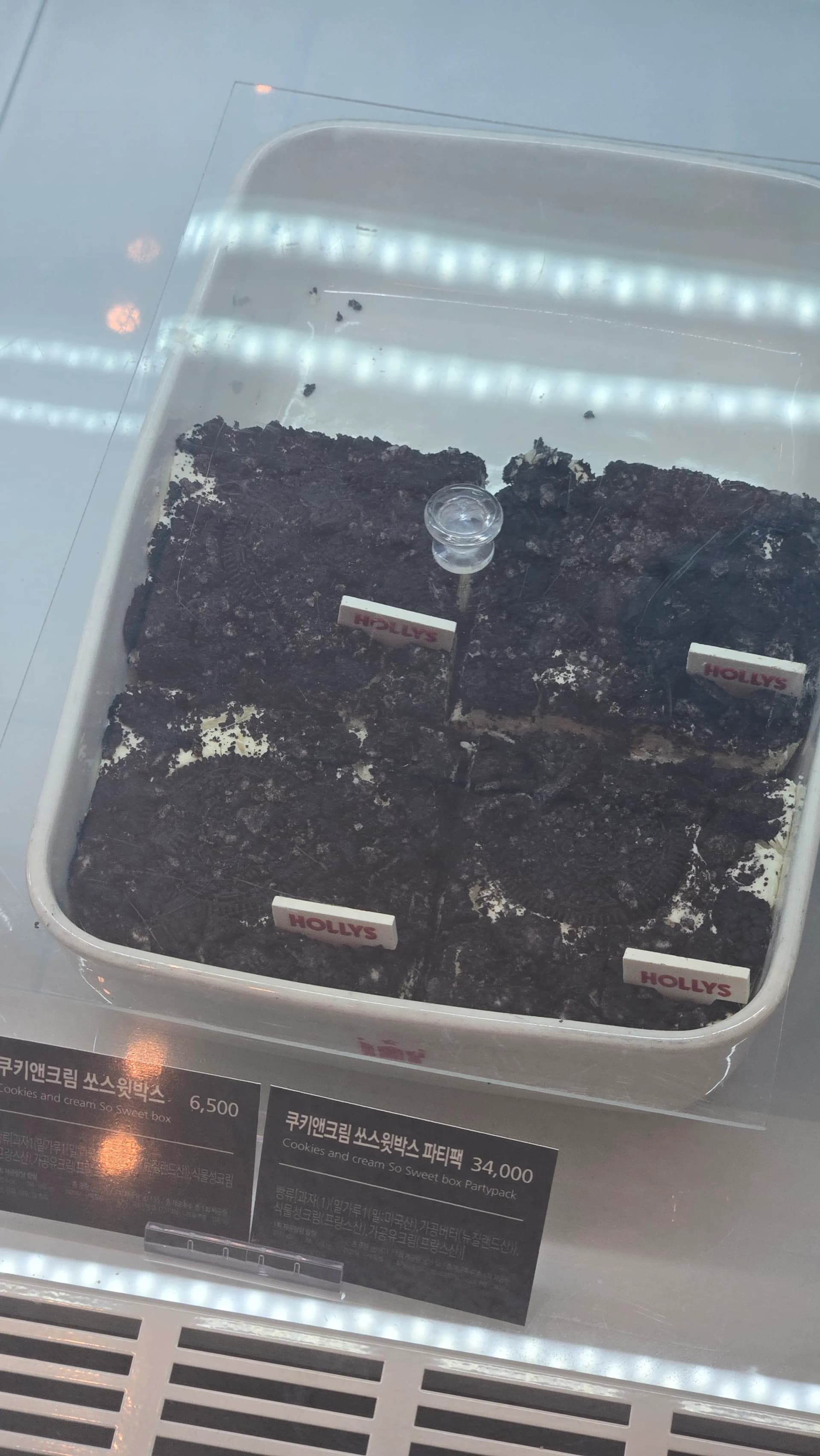
I had a browse through the cake display. Tiramisu So Sweet Box around £3.90, Cookies and Cream So Sweet Box also around £3.90. The Party Pack — a four-slice boxed dessert — comes in at roughly £20. Looking at it immediately brought Twosome Place to mind: they do a similar thing with sliced cakes in boxes. Hollys seems to be heading in the same direction, and that reflects a broader shift in South Korean café culture — franchises are increasingly pushing their dessert offerings because coffee alone isn't enough to differentiate. This isn't unique to Hollys; it's where the whole market has been moving. We were too full to order anything else, but the tiramisu went on the mental list for next time.
Miffy Collaboration Cakes and Korean Café Seasonal Menus
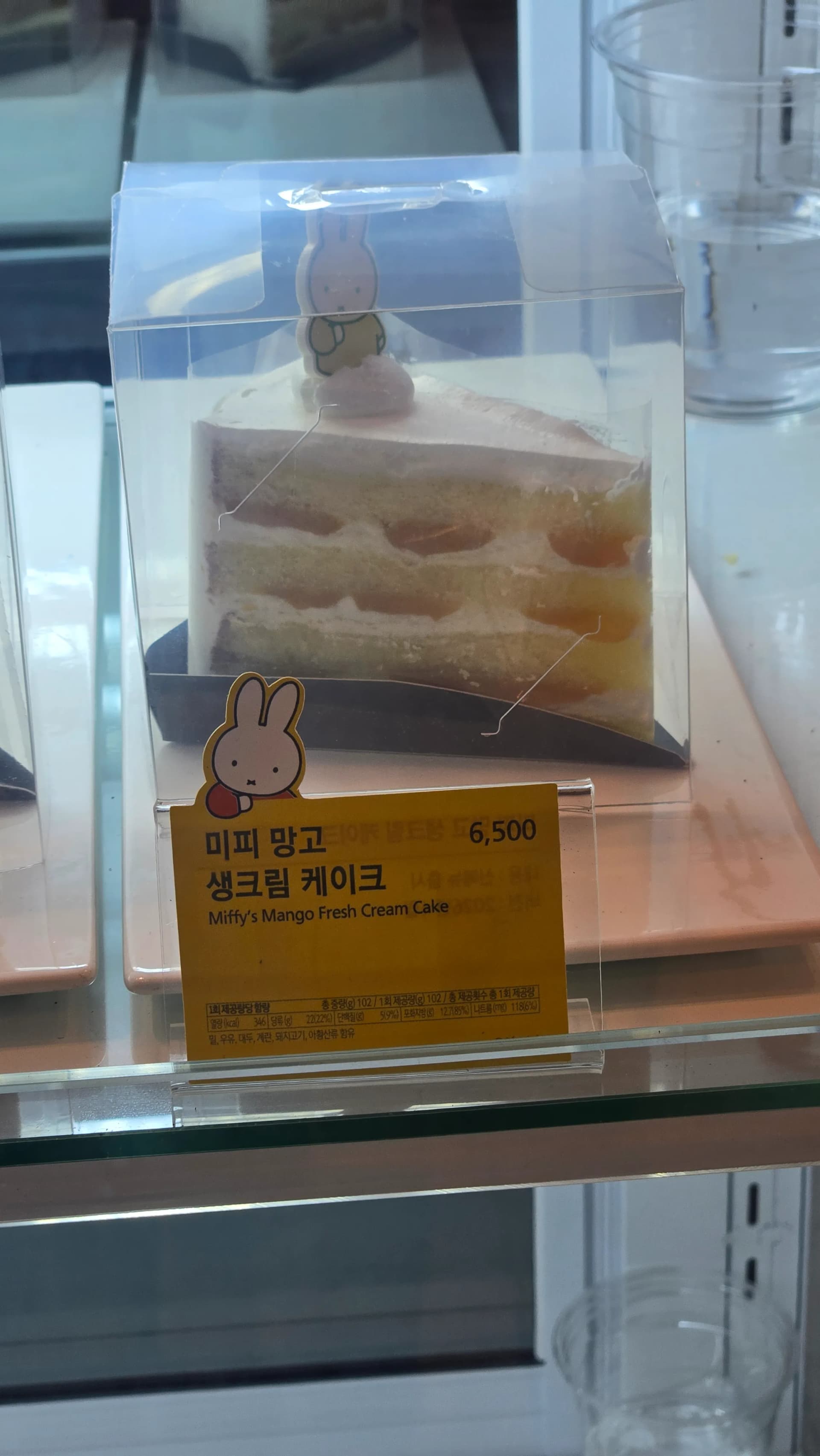
Miffy Mango Fresh Cream Cake — around £3.90. Hollys had an ongoing collaboration with the Miffy character at the time, so cakes came with a little Miffy topper. If Miffy isn't familiar, she's a Dutch rabbit character with quite a following in Korea. You could see pieces of mango tucked between the cream layers — cute to look at, certainly.
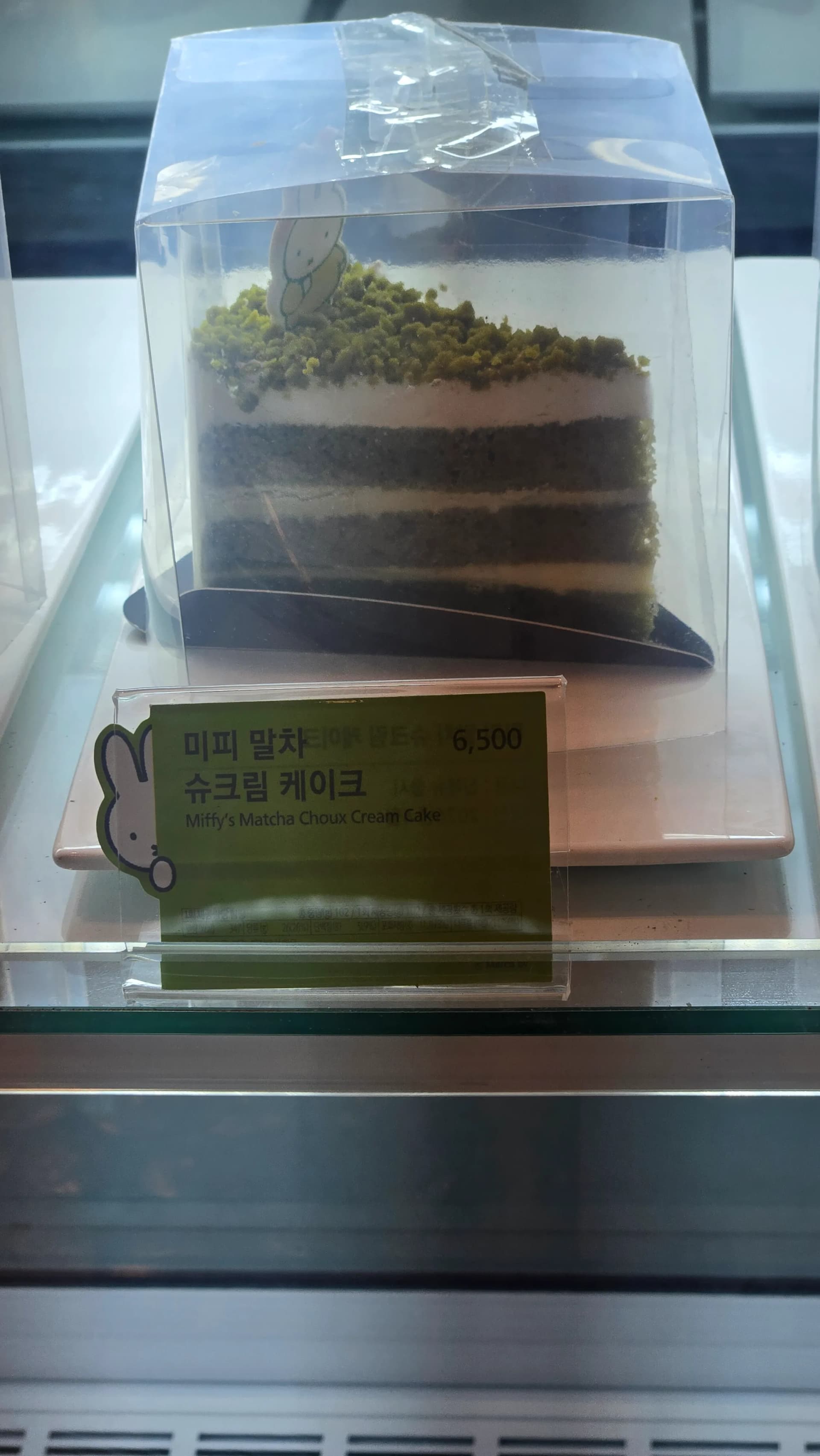
Miffy Matcha Choux Cream Cake, also around £3.90. The matcha sponge is a deep, vivid green, which makes for a nice cross-section. There's matcha powder dusted on top and a generous cream layer running through it. Matcha is having a proper moment in Korean café desserts right now — from Starbucks Korea to Twosome to independent cafés, you'd be hard-pressed to find a menu without it somewhere.
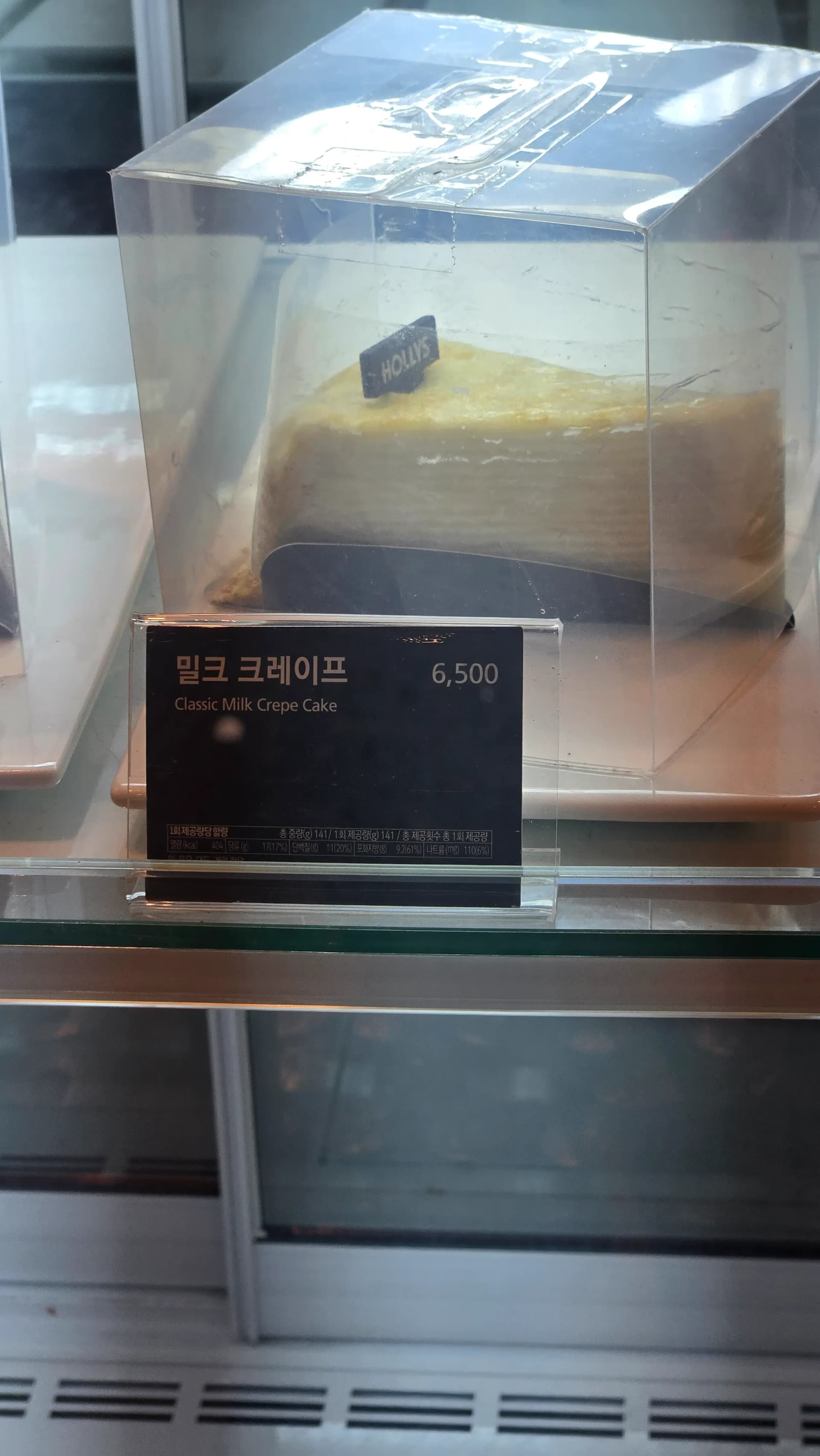
Milk Crêpe Cake — around £3.90. Thin layers of crêpe stacked up high. The display lighting was reflecting oddly so the photo came out a bit muddled, apologies. What struck me, though, is that crêpe cake is just sitting there in the display case of a franchise café like it's perfectly ordinary — which in South Korea, it is. When I was living in Bangkok, finding a crêpe cake required actually seeking out a specialist dessert café. Here it's just part of the standard lineup. The layered texture is quite different from a regular sponge cake; peeling off each layer as you go is its own little pleasure.
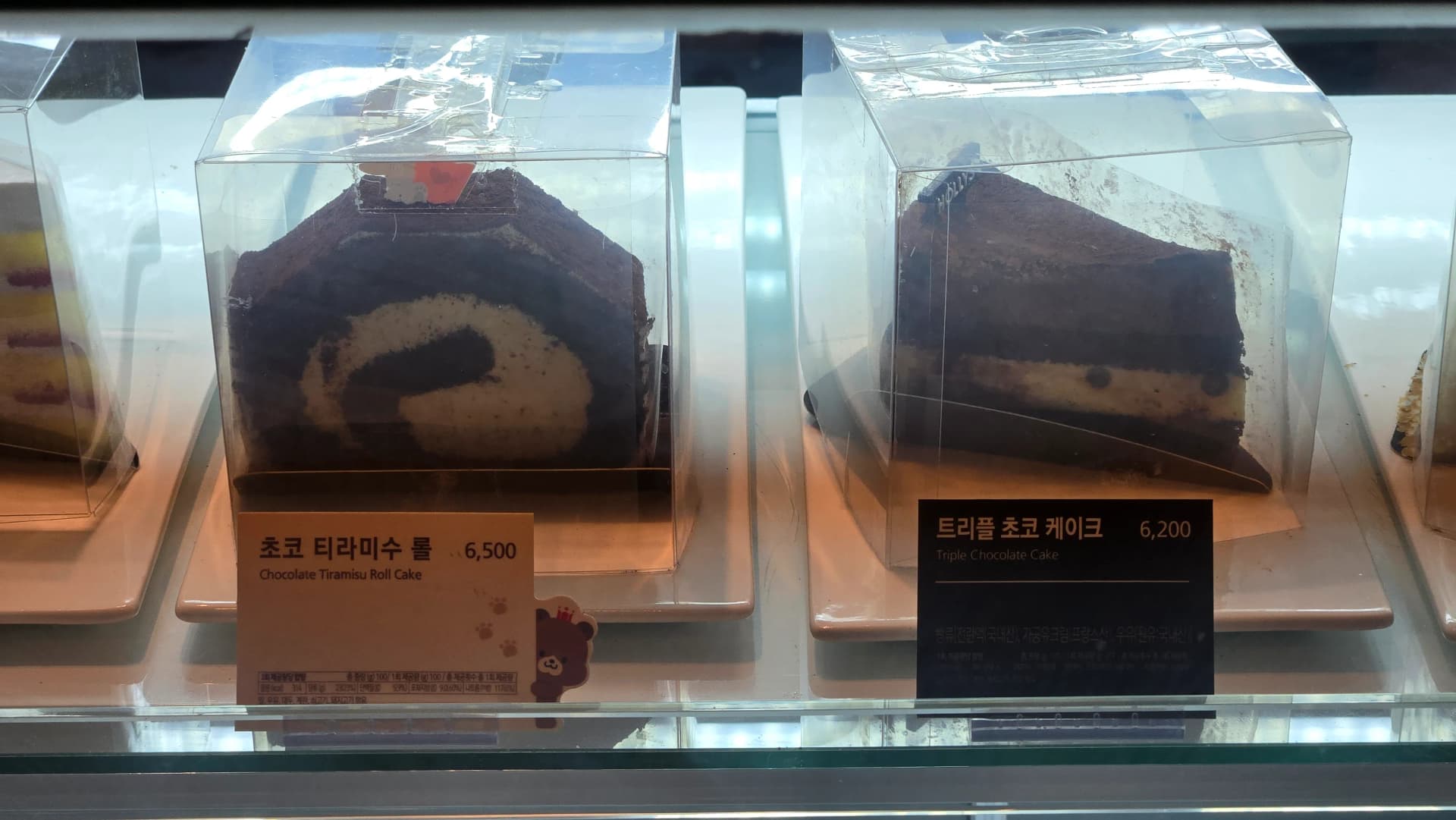
Choco Tiramisu Roll around £3.90, Triple Choco Cake around £3.70. The display lighting was flickering a bit so these shots came out slightly blurry — apologies for that. The Choco Tiramisu Roll is essentially a chocolate version of the milk roll I'd already tried, and the Triple Choco Cake goes full chocolate from sponge to cream throughout — perfect if you're that way inclined. Overall, Hollys' individual cake slices cluster between about £3.60 and £3.90, which is fairly standard for a Korean franchise café. Starbucks Korea's slices sit slightly higher, in the £3.90–£4.20 range, so Hollys comes in a touch cheaper. Though honestly, at these prices, you could find a more carefully made slice at a local independent café. That's the inherent limitation of franchise desserts, really.
Inside Hollys Coffee: A Look Around a Korean Café Interior
From here on it's about the space itself. Worth noting that Hollys interiors vary quite a bit between branches — this one was genuinely one of the better ones. Don't assume every Hollys looks like this.
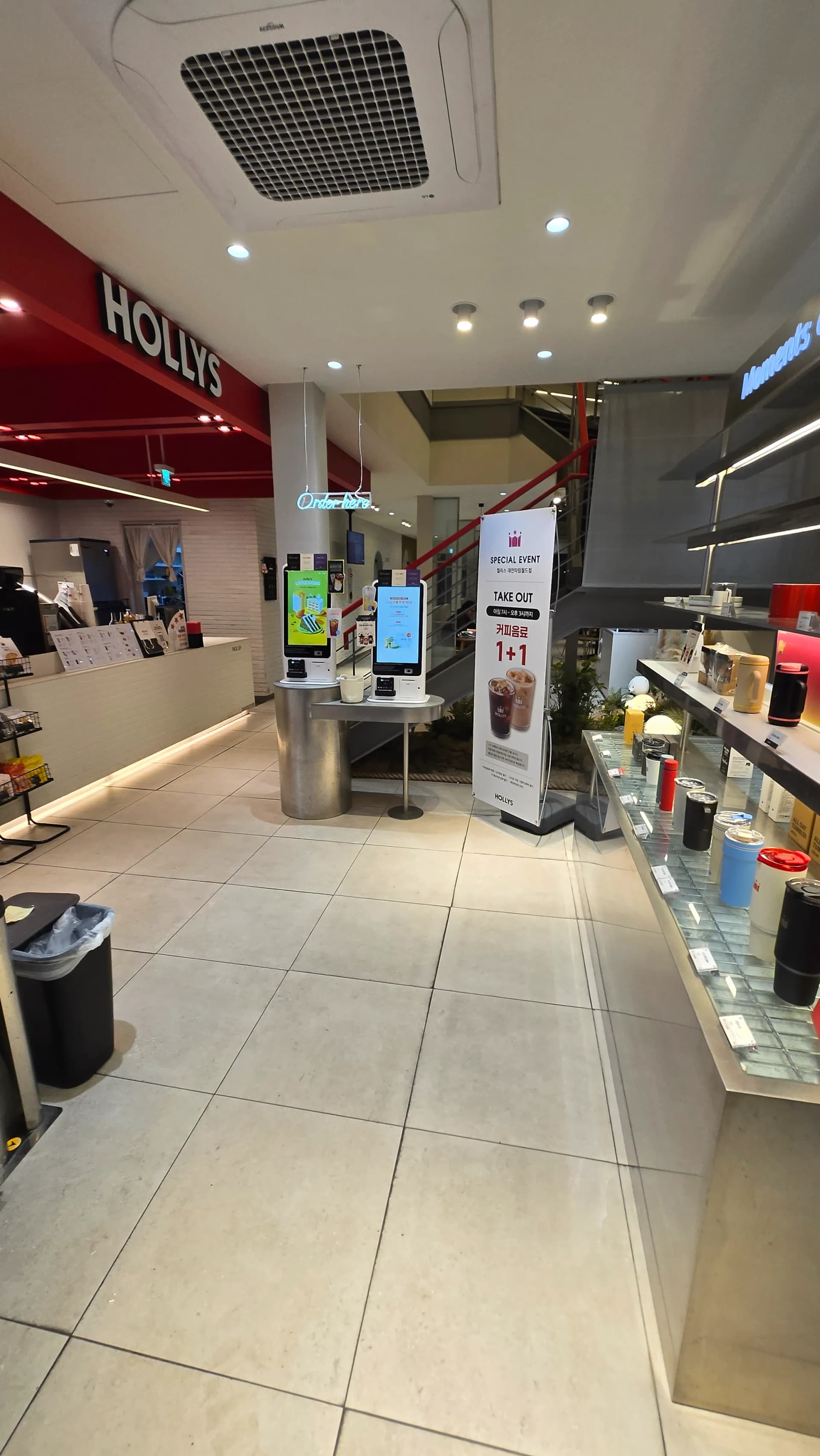
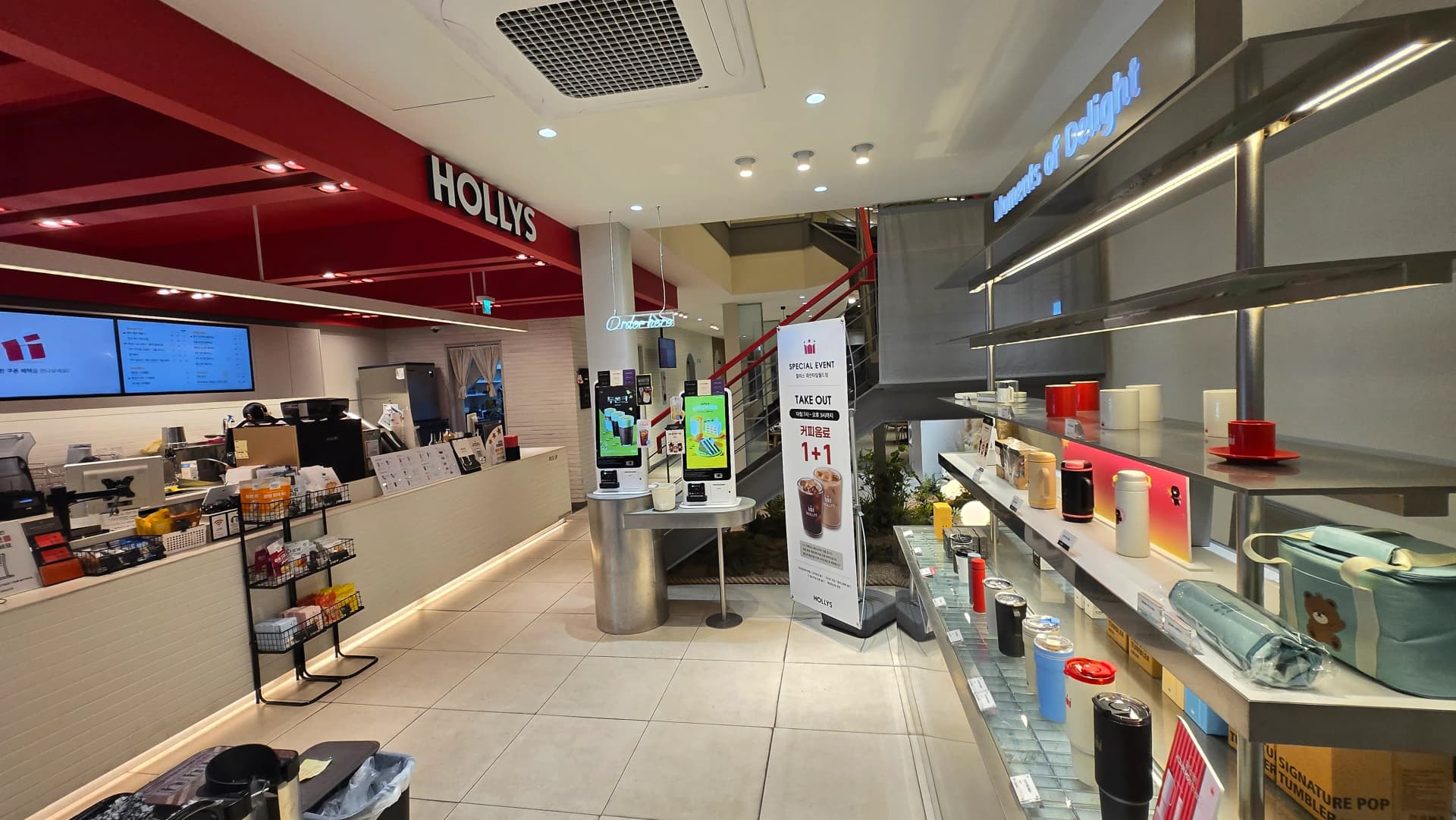
Walking in, you get the full picture straight away: counter to the left, kiosk in the middle, Hollys merchandise shelves to the right. At 4am, there wasn't another soul in sight — felt like having the place to ourselves. Korean franchise cafés often work like this: the ground floor is for ordering and collecting drinks, while the actual seating is upstairs. A red staircase leads up to the first floor here.
The Unexpected Snacks You Find at a Korean Café Counter
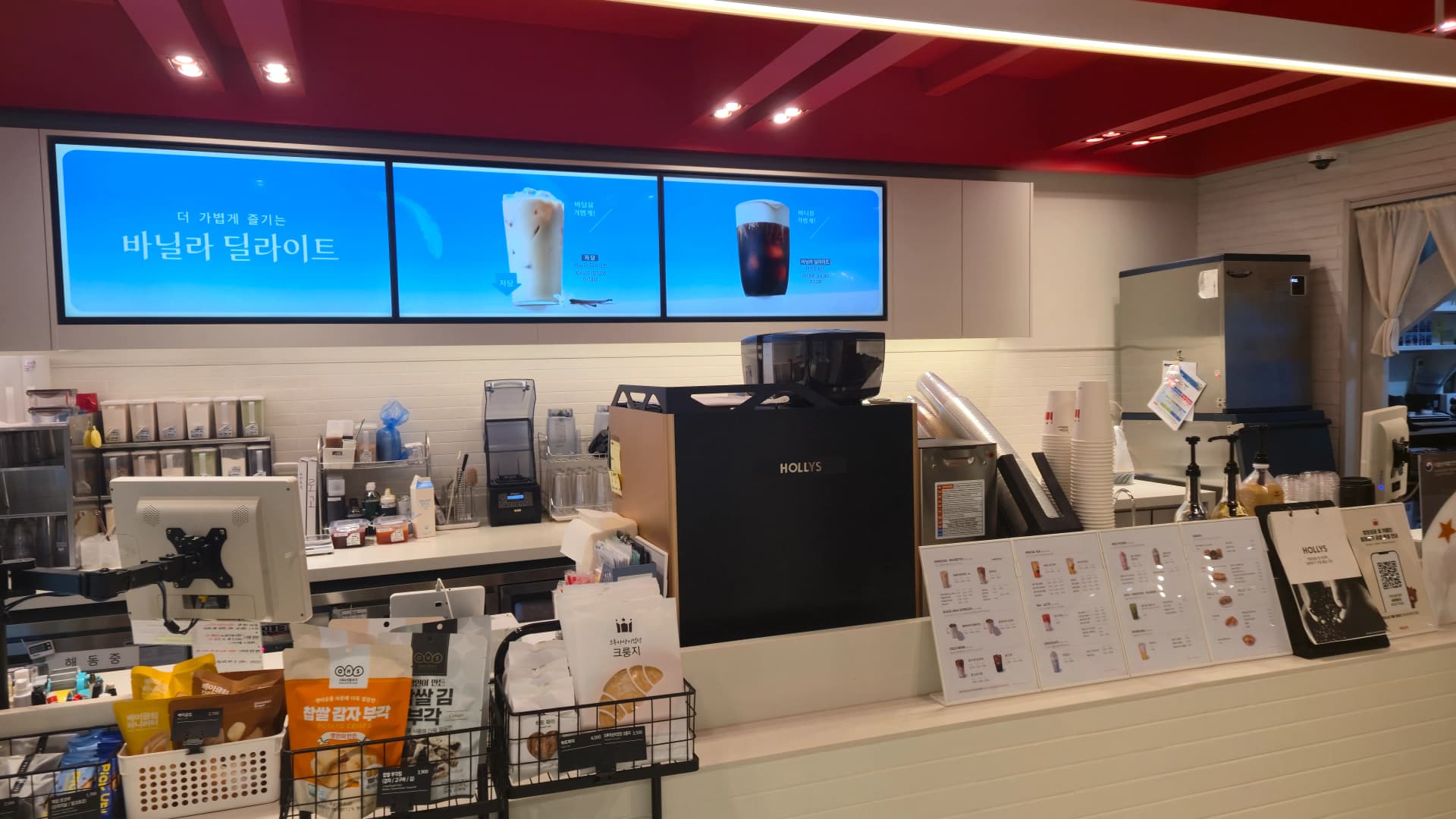
I got a closer look at the counter. There's a large promotional screen showing the Vanilla Delight behind the espresso equipment and all its associated kit. What caught my eye more, though, were the snacks arranged on the counter — things like chapsal gamja bugak (rice-flour potato crisps) and dried seasoned seaweed. Might seem odd for a coffee shop, but it's actually quite common in South Korea to find these sorts of nibbles near the counter. For the uninitiated: bugak is a traditional Korean snack made from thinly sliced potato coated in glutinous rice and then fried — crispy and lightly salty, and it goes with coffee rather better than you'd expect. A friend of mine tried some and couldn't quite place it: "It's like a crisp but it isn't, is it?" Exactly right.
Korean Café Seating Culture: A Surprisingly Thoughtful Layout
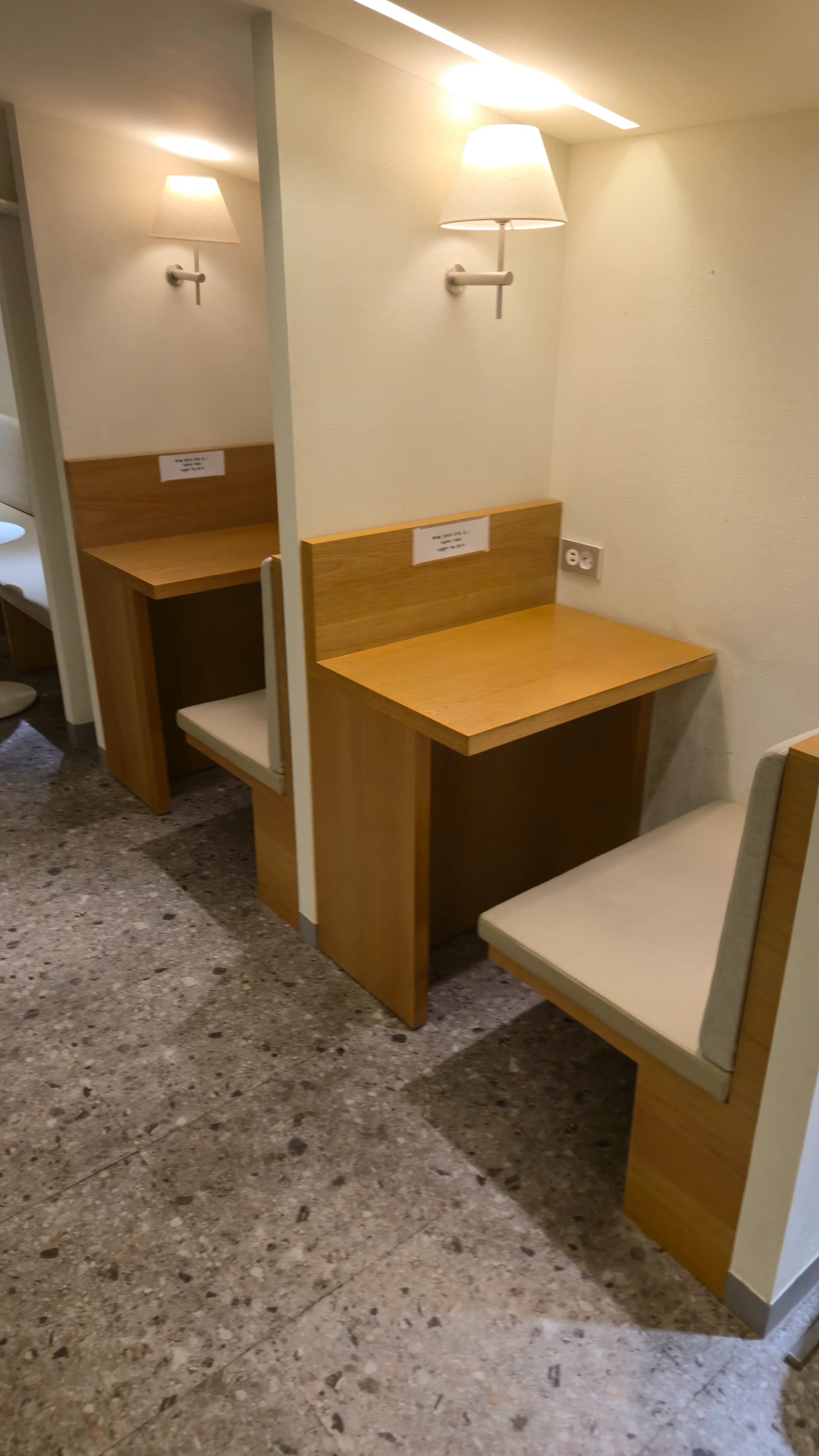
Upstairs there's a dedicated solo seating area, divided into individual booths with lighting and plug sockets at each spot. Ideal for working on a laptop. One of the distinctive features of Korean café culture is that coming to a café on your own is completely unremarkable — nobody bats an eyelid. You'll see people working on laptops, students studying, people reading, all sitting alone for hours at a stretch. It's perfectly natural. So Korean cafés increasingly build dedicated single-seat sections as a matter of course. I do a lot of café working myself, and a solo booth with a power socket is, genuinely, better than some offices. Visitors from abroad often find this side of Korean café life quite striking when they first encounter it.
Floor Seating in a Café — Korean Jwa-sik Culture
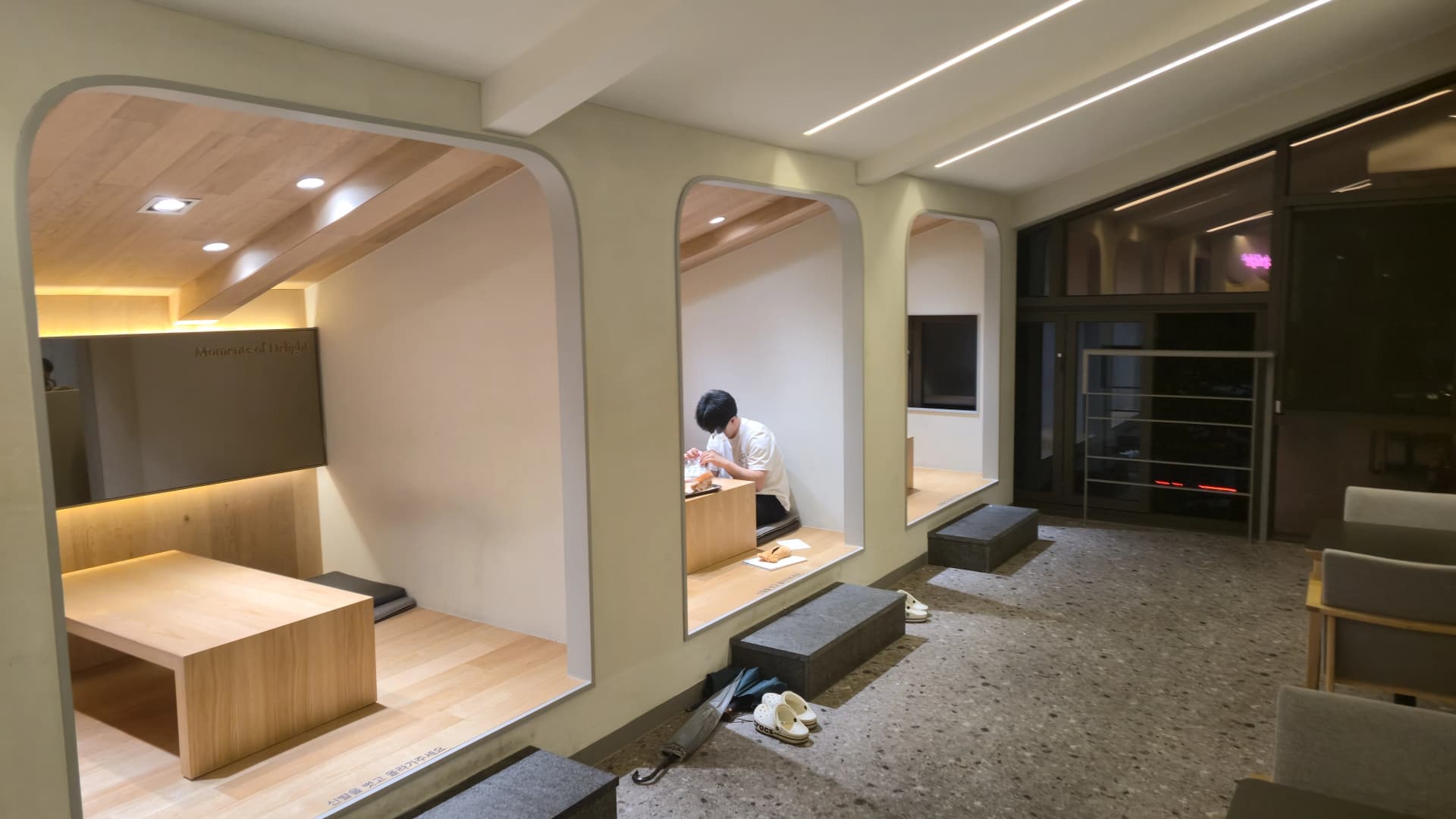
Also on the first floor, there's a floor-seating area — shoes off before you step up. The space is divided by arched wooden partitions that give it a semi-private, enclosed feel. It's set up for two people sitting across from each other and is surprisingly comfortable for long stays; being able to stretch your legs out means you don't stiffen up in the same way. Korean jwa-sik (좌식) culture — sitting on the floor — runs deep, and it shows up in cafés as well as homes and traditional restaurants. It can feel a bit unfamiliar at first if you haven't encountered it before, but most people find they take to it quickly. At that hour, someone was sitting there alone, quietly eating something. There's something vaguely reassuring about finding another person awake at 4am.
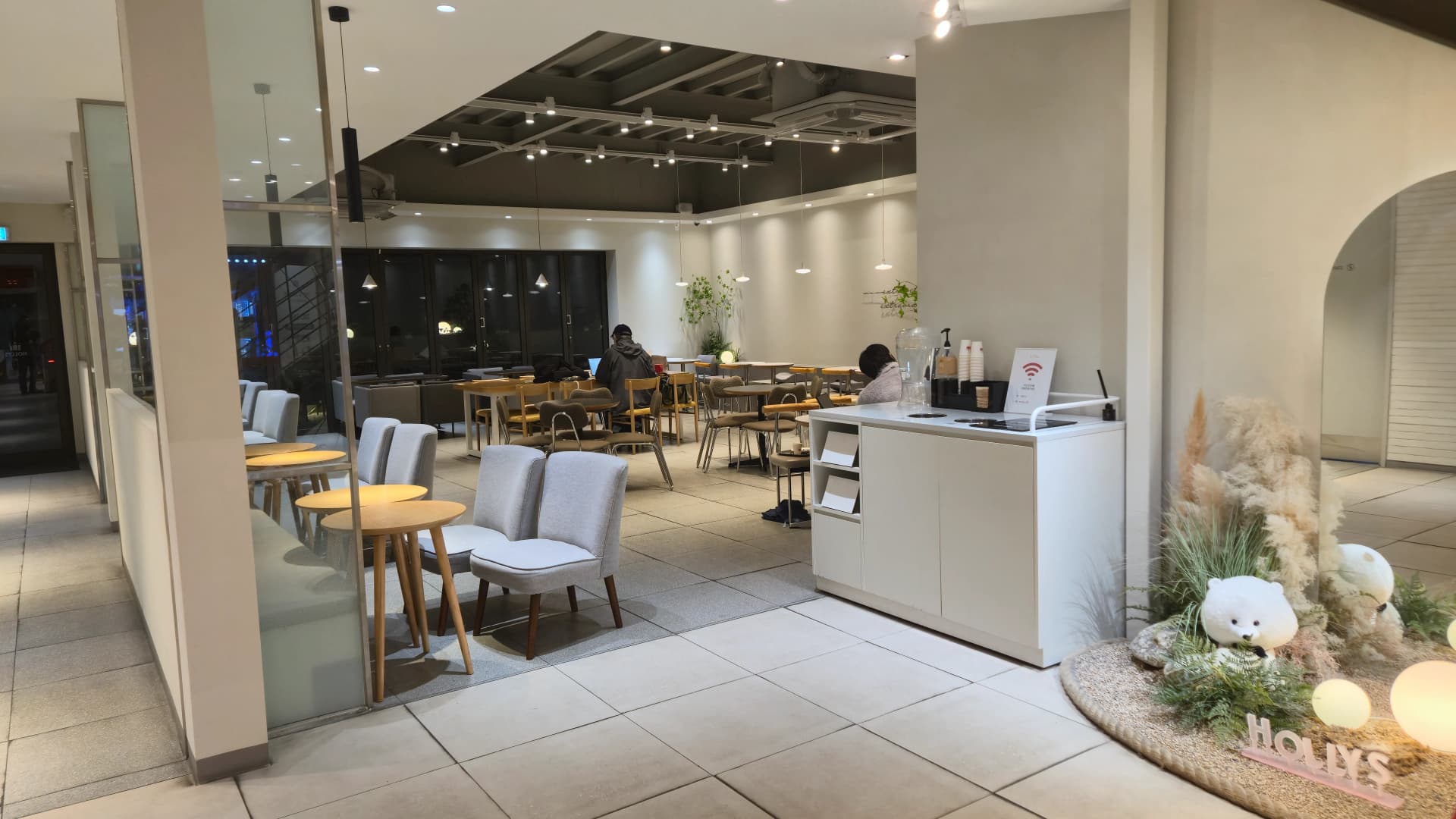
The central section of the first floor has group tables seating up to four. It's an open layout, which means it's not particularly private — you'll hear the table next to you if they're talking. Not the spot for a quiet, sensitive conversation. On the plus side, the ceiling is high, the windows are wide, and the lighting is pleasantly understated. Like virtually every café in South Korea, there's free Wi-Fi — the password is available from the counter if you ask.
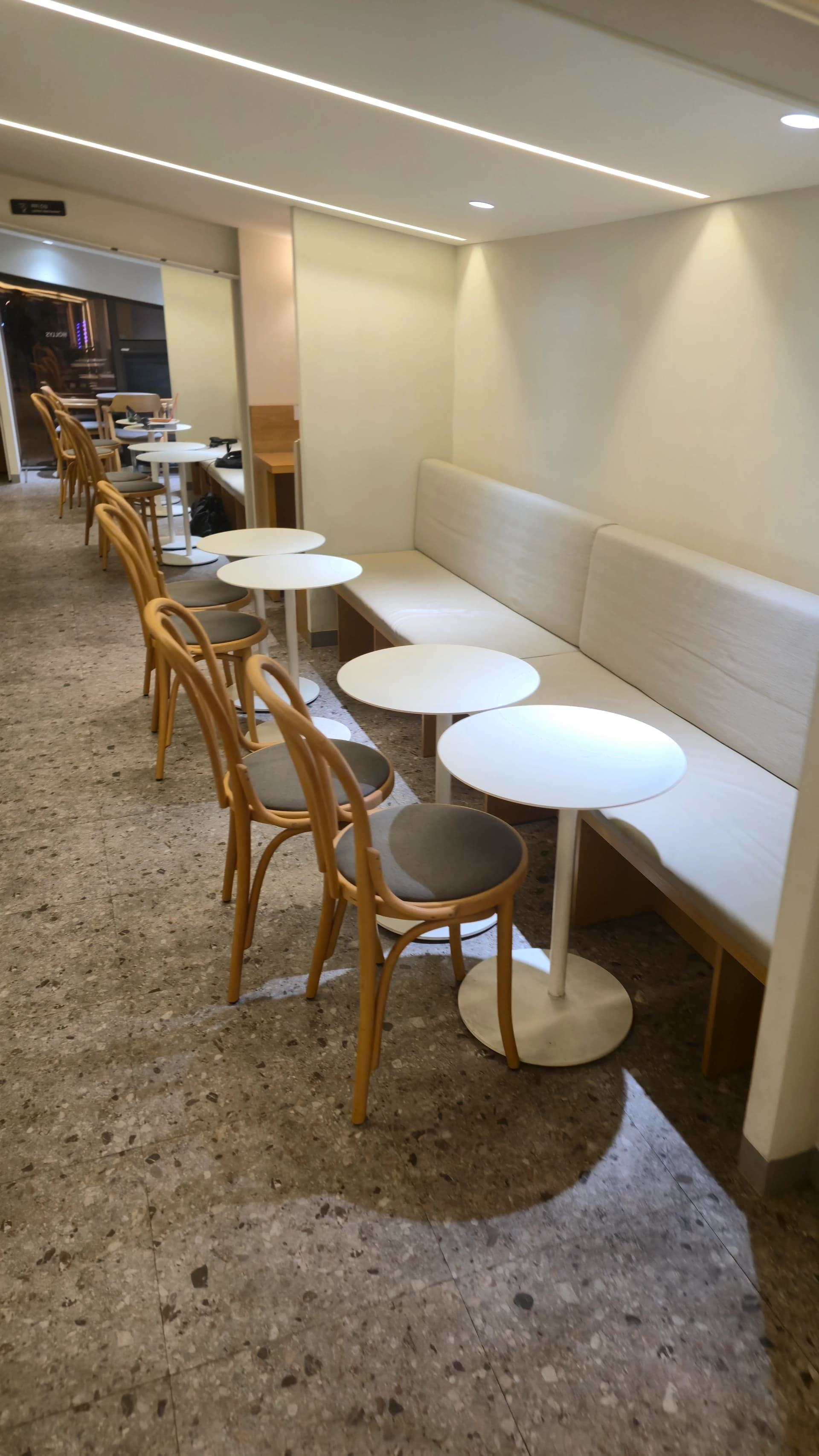
Along one wall there's a long banquette sofa with round tables in front at regular intervals — a two-person setup with curved wooden chairs opposite. The style felt a bit different from the rest of the space: lighter in tone, which would probably give it a different feel in daylight. Korean cafés often vary the seating style quite deliberately from zone to zone within the same space, so the same Hollys can feel like different rooms depending on where you sit.
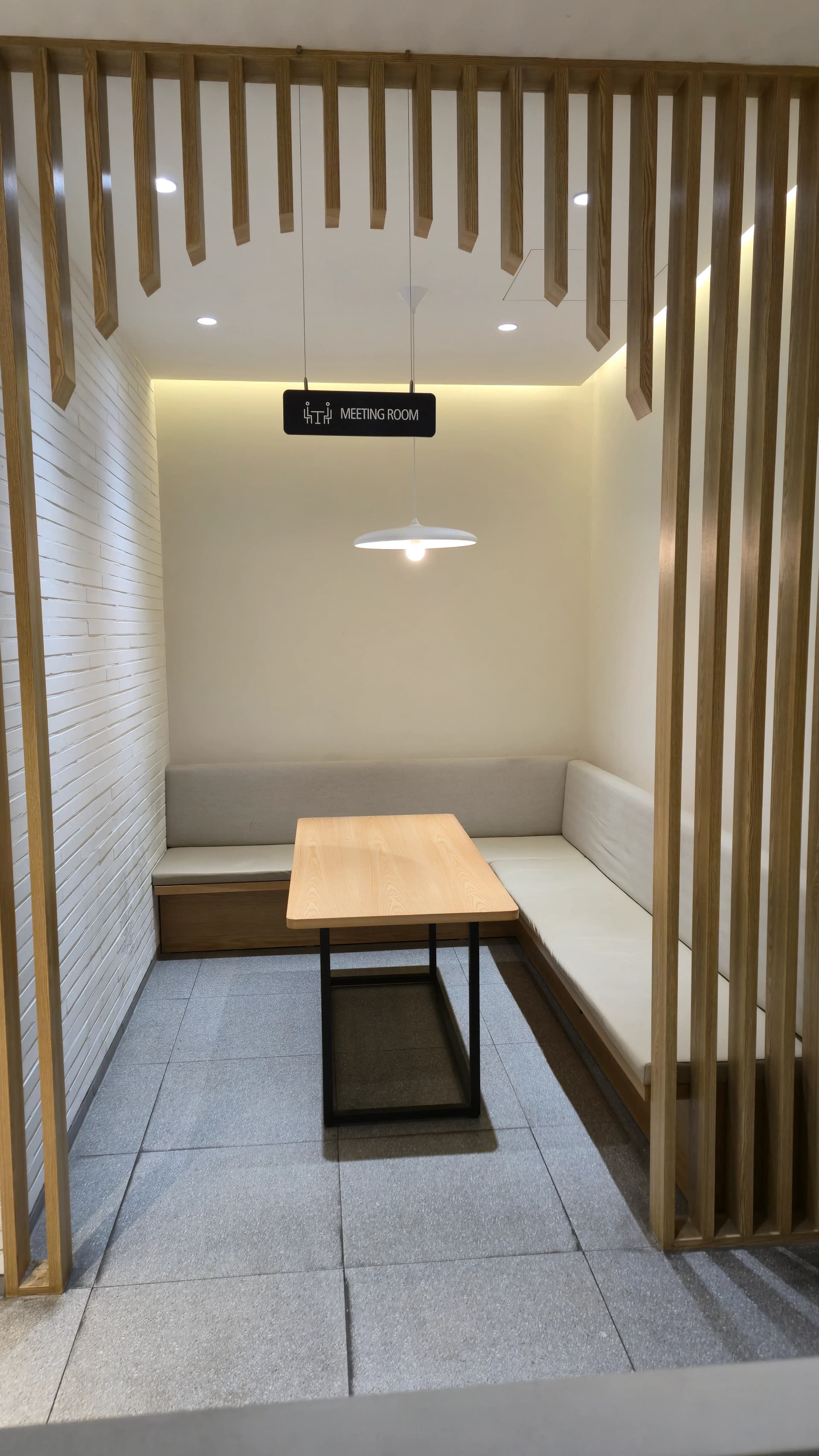
There's also a section marked as a meeting room. It isn't fully enclosed — no door — but a wooden lattice partition around it creates a clear sense of separation from the rest of the floor. Inside: an L-shaped sofa, one central table, room for four or five people comfortably. Korea has a strong café-as-study-group or café-as-informal-meeting culture, and this sort of semi-private space serves that use case well. It won't appear in every Hollys branch — more of a larger-format perk.
Working at 4am in a Korean Café — Not an Unusual Sight
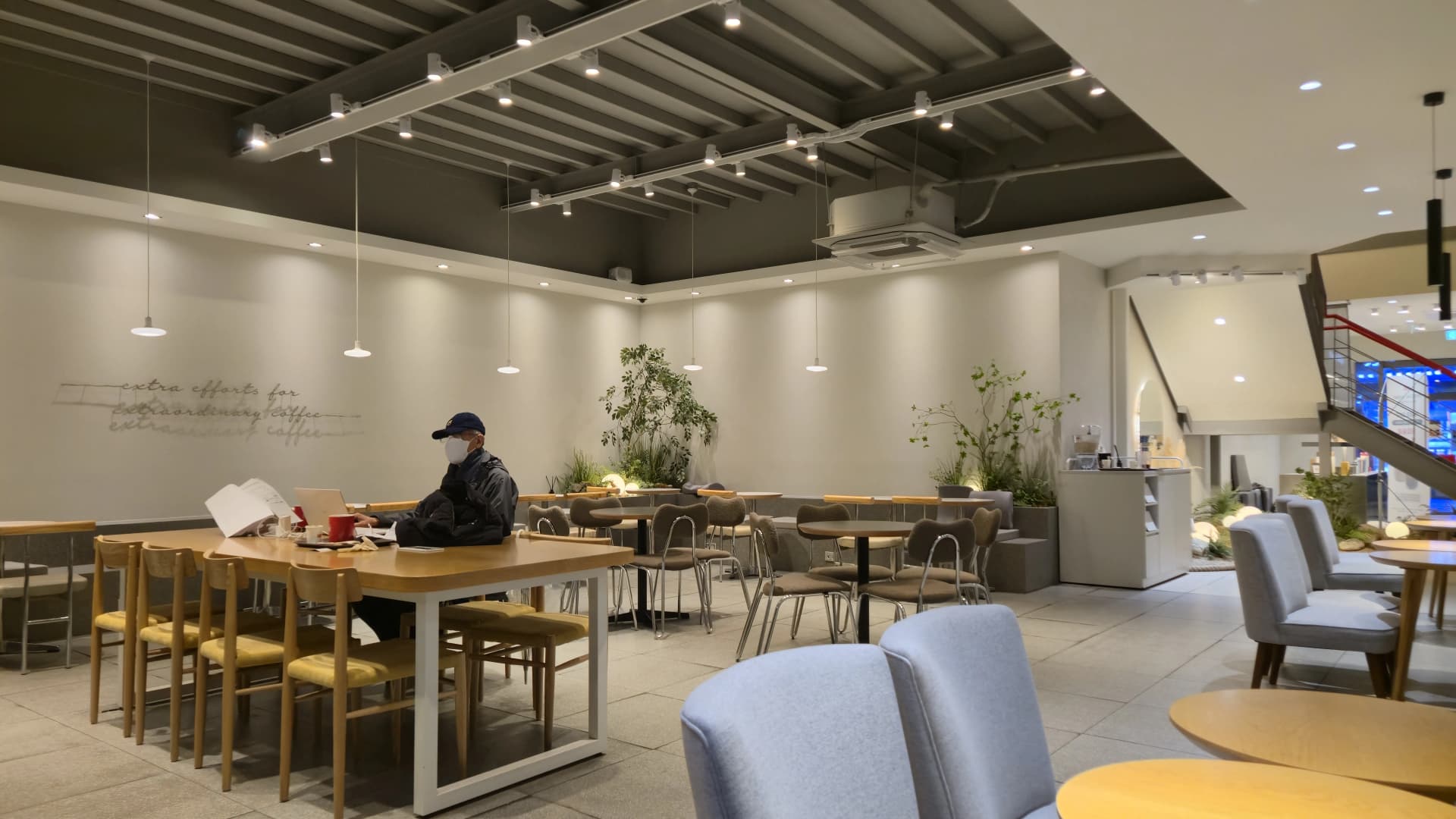
A view of the whole first floor. Dark ceiling, track lighting scattered throughout, calm overall atmosphere. Handwritten-style text on the walls, green plants in various corners — for a franchise, it felt considered rather than generic. At 4 in the morning, someone was sitting there with a laptop open, getting on with things. As I've said, in Korea this is entirely unremarkable. Korean cafés function as workspaces and study spaces just as much as places to drink coffee. With large tables, sofas, solo booths, and power sockets throughout, there's genuinely a spot for whatever you need.
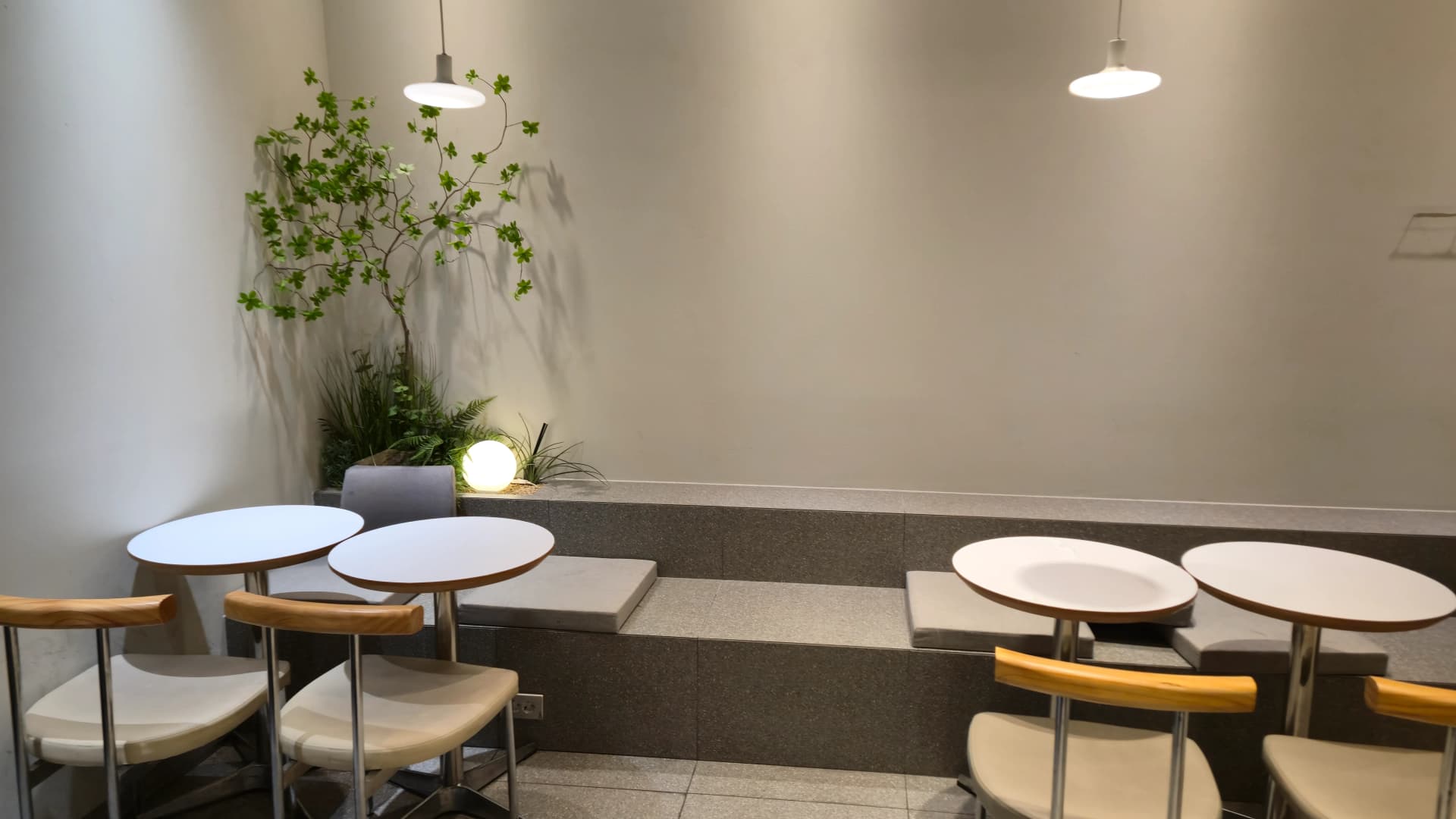
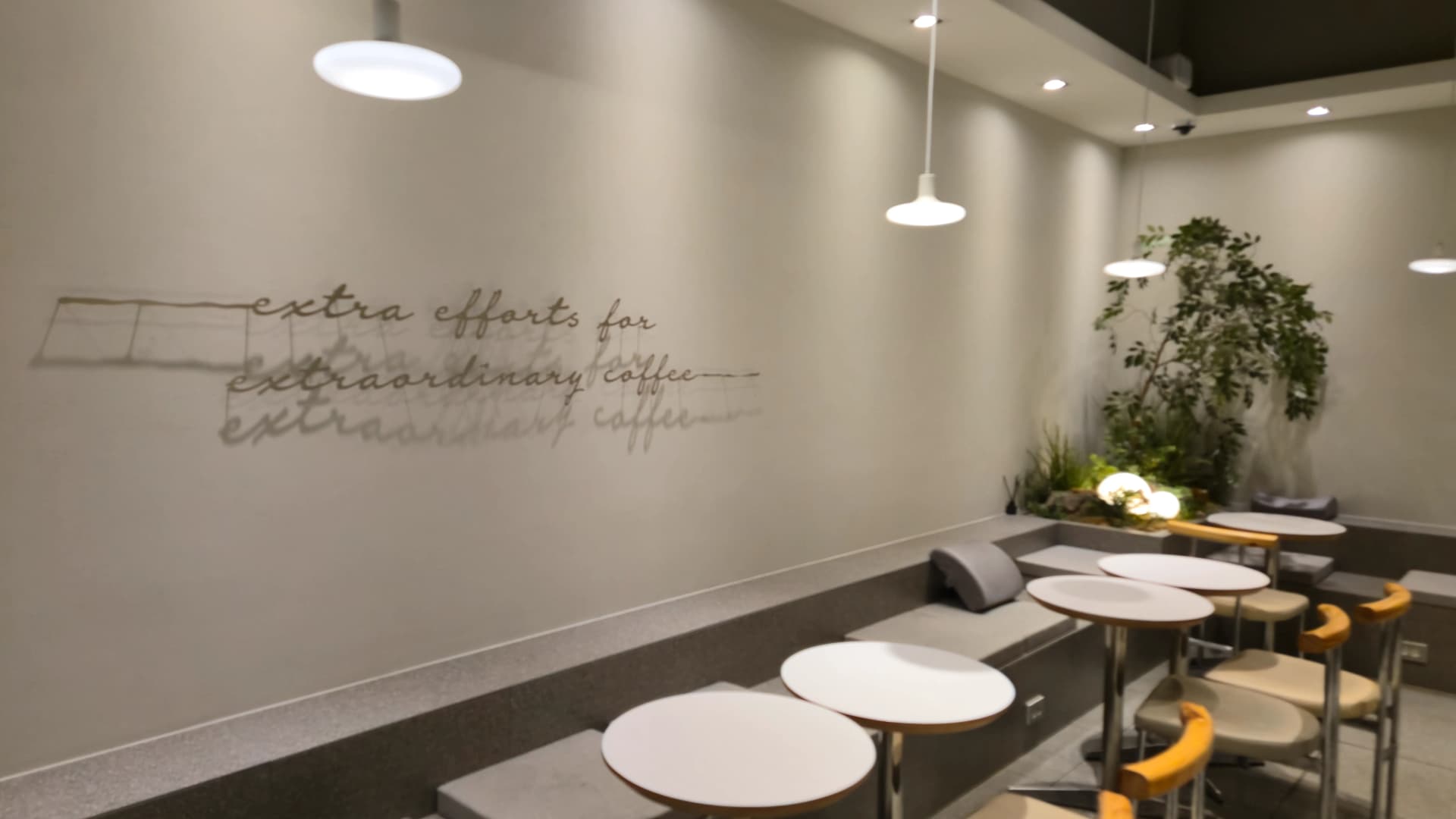
The far corner of the first floor — personally, my favourite spot in the whole place. Tiered seating, small green plants tucked into each alcove, warm circular mood lights glowing softly. It suited the small hours rather well. Power sockets at every seat too. I'll be honest: I'd always vaguely assumed Hollys lagged behind Starbucks and Twosome on interior quality. This particular branch changed my mind on that. Though the caveat stands — the variation between Hollys locations is real. I've been to other branches and thought "this one isn't quite right." Go in with reasonable expectations rather than anticipating a specific look, and you might be pleasantly surprised.
Hollys Coffee Merchandise — Korean Café Tumbler Prices
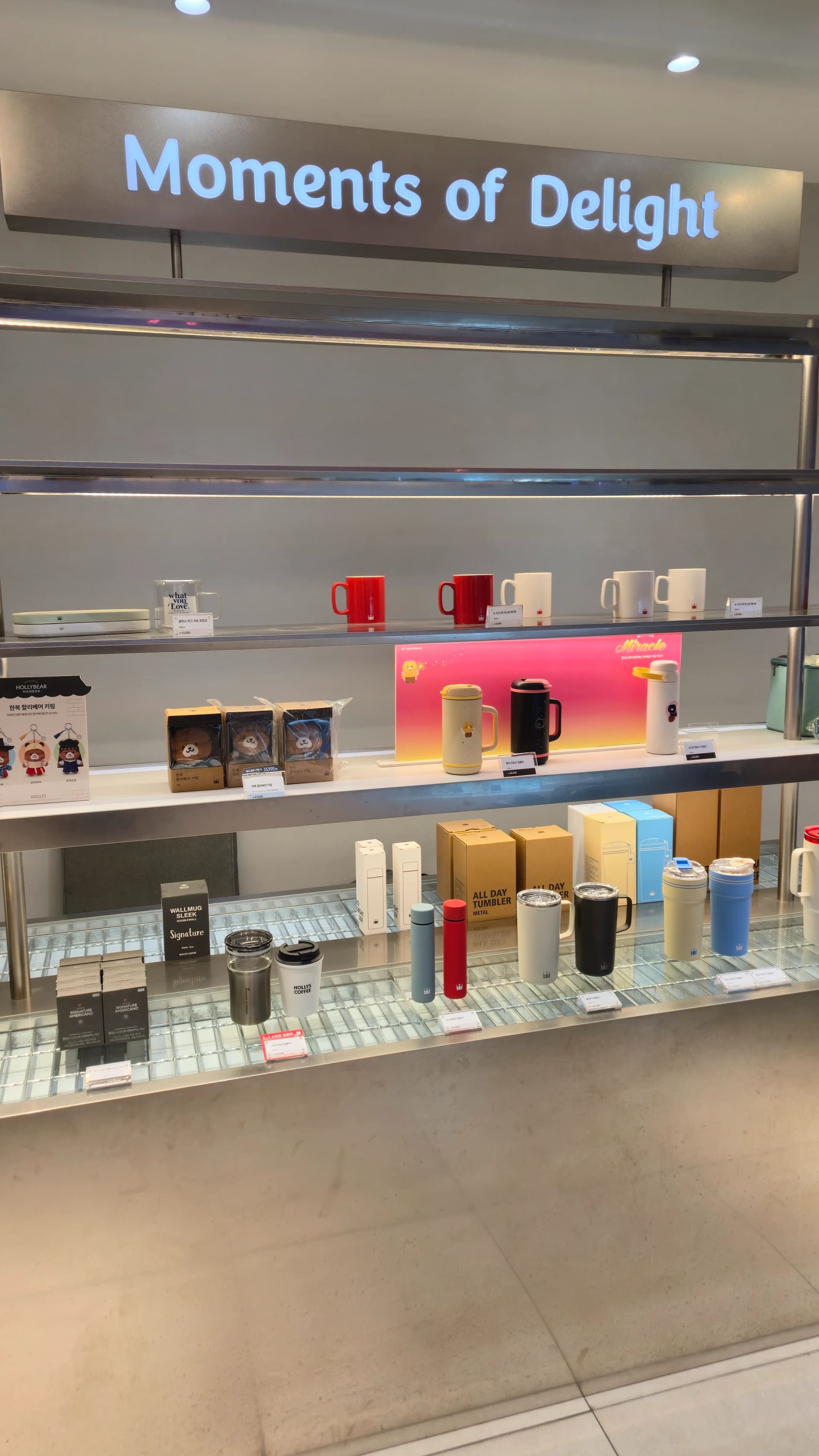
On the ground floor there's a merchandise display — tumblers, mugs, key rings. Much like Starbucks has its cult following for branded merchandise, Hollys produces and sells its own range. Korean café franchises have largely embraced merchandise as a meaningful revenue stream alongside drinks.
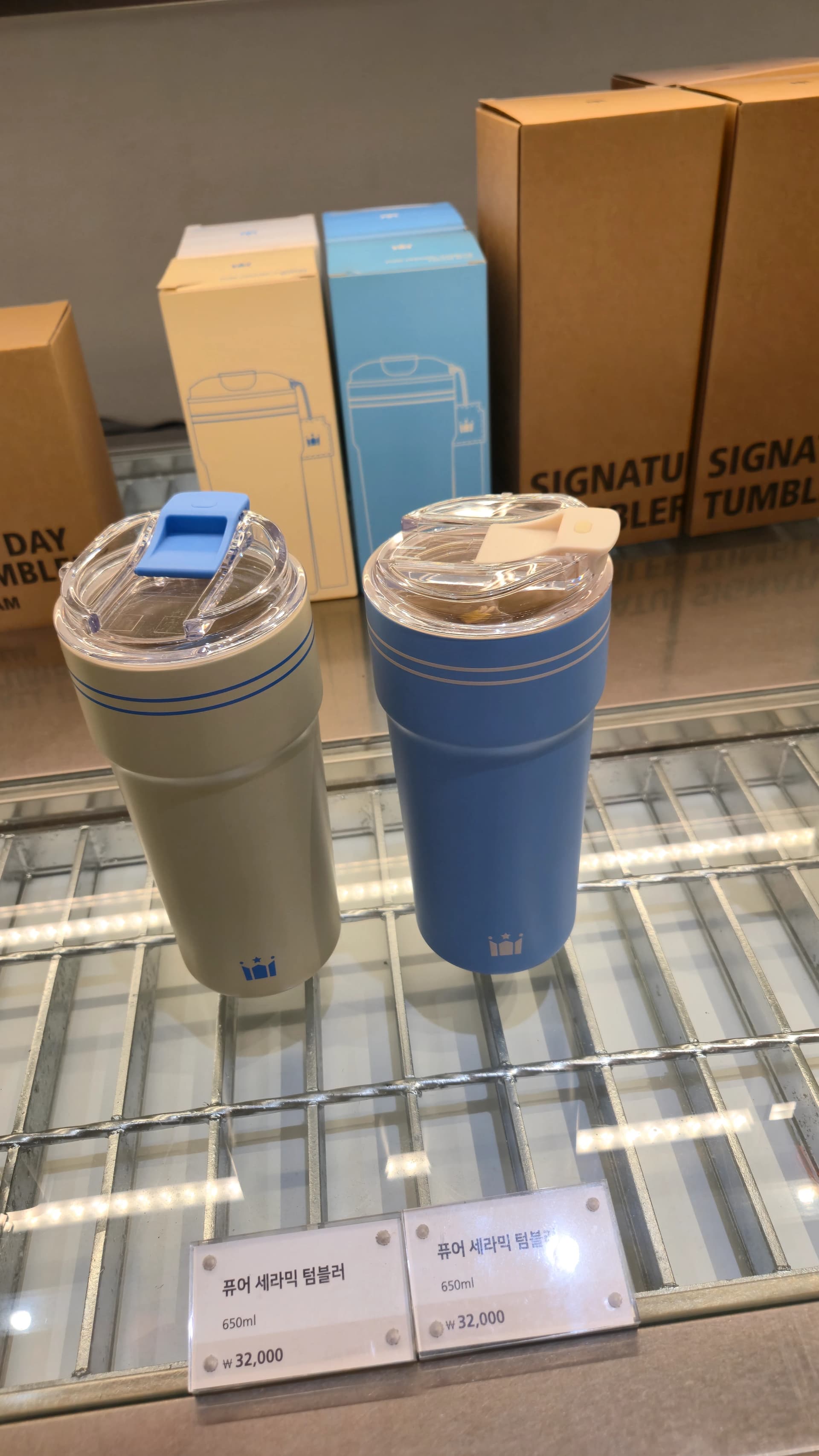
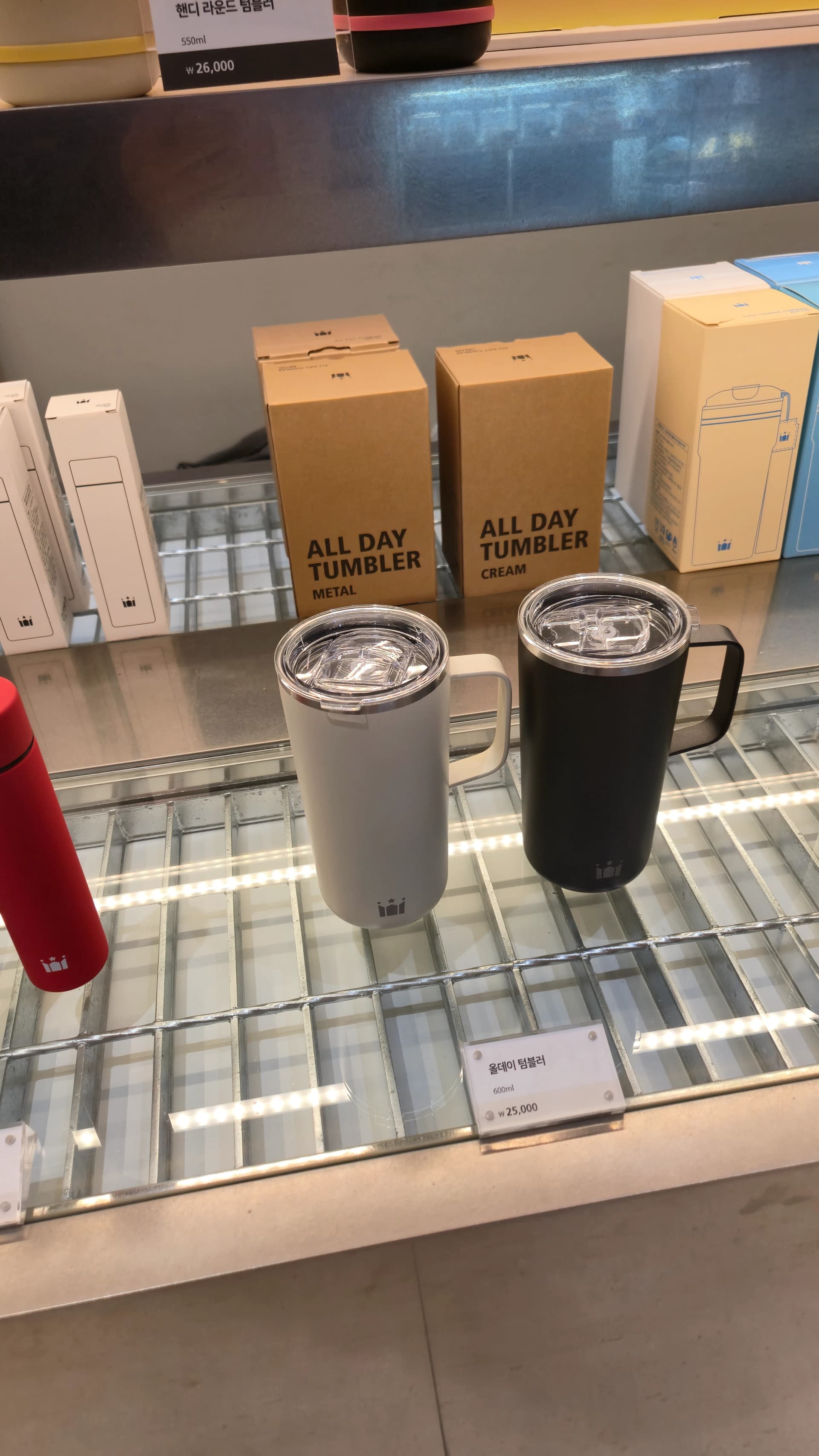
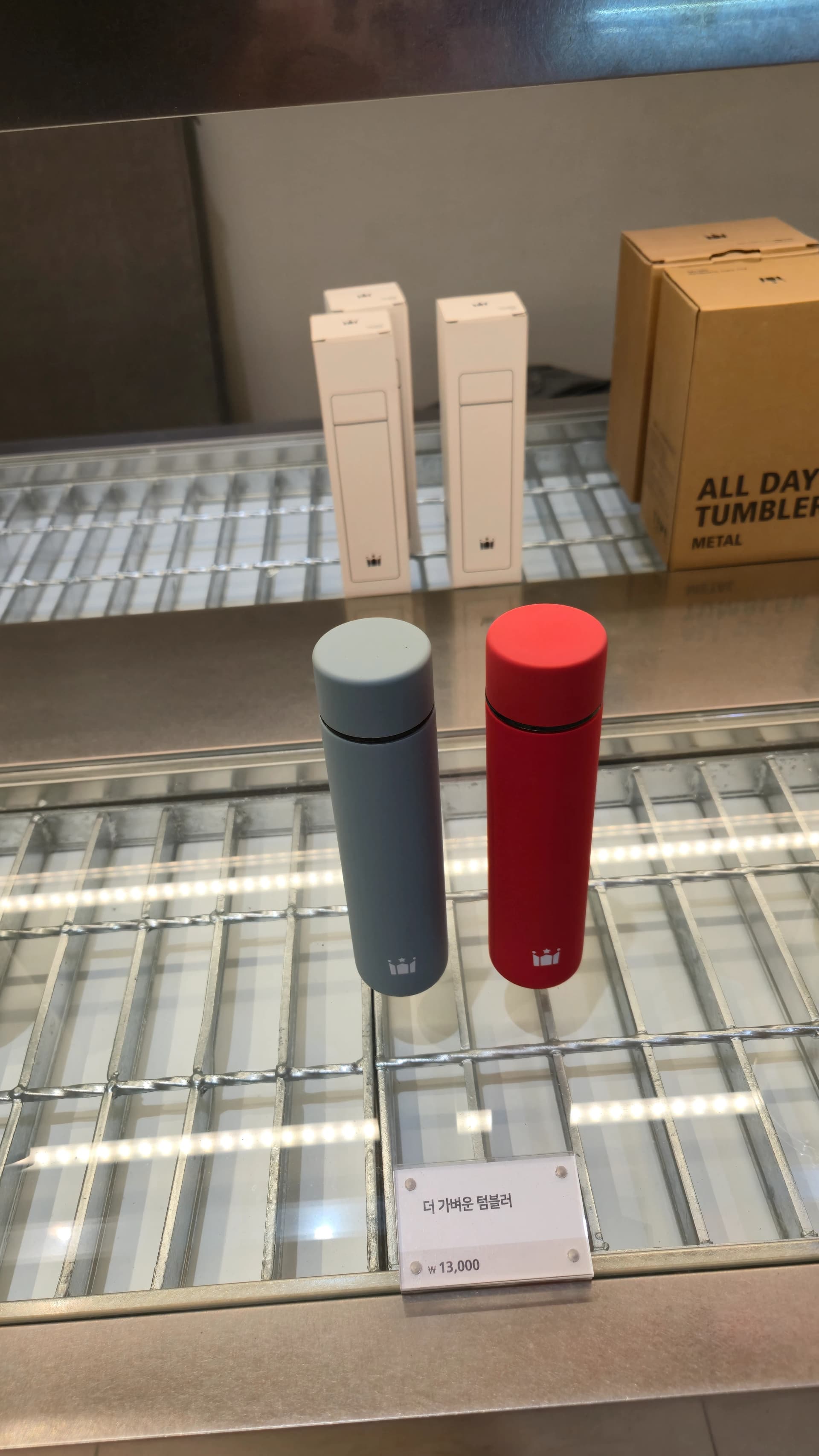
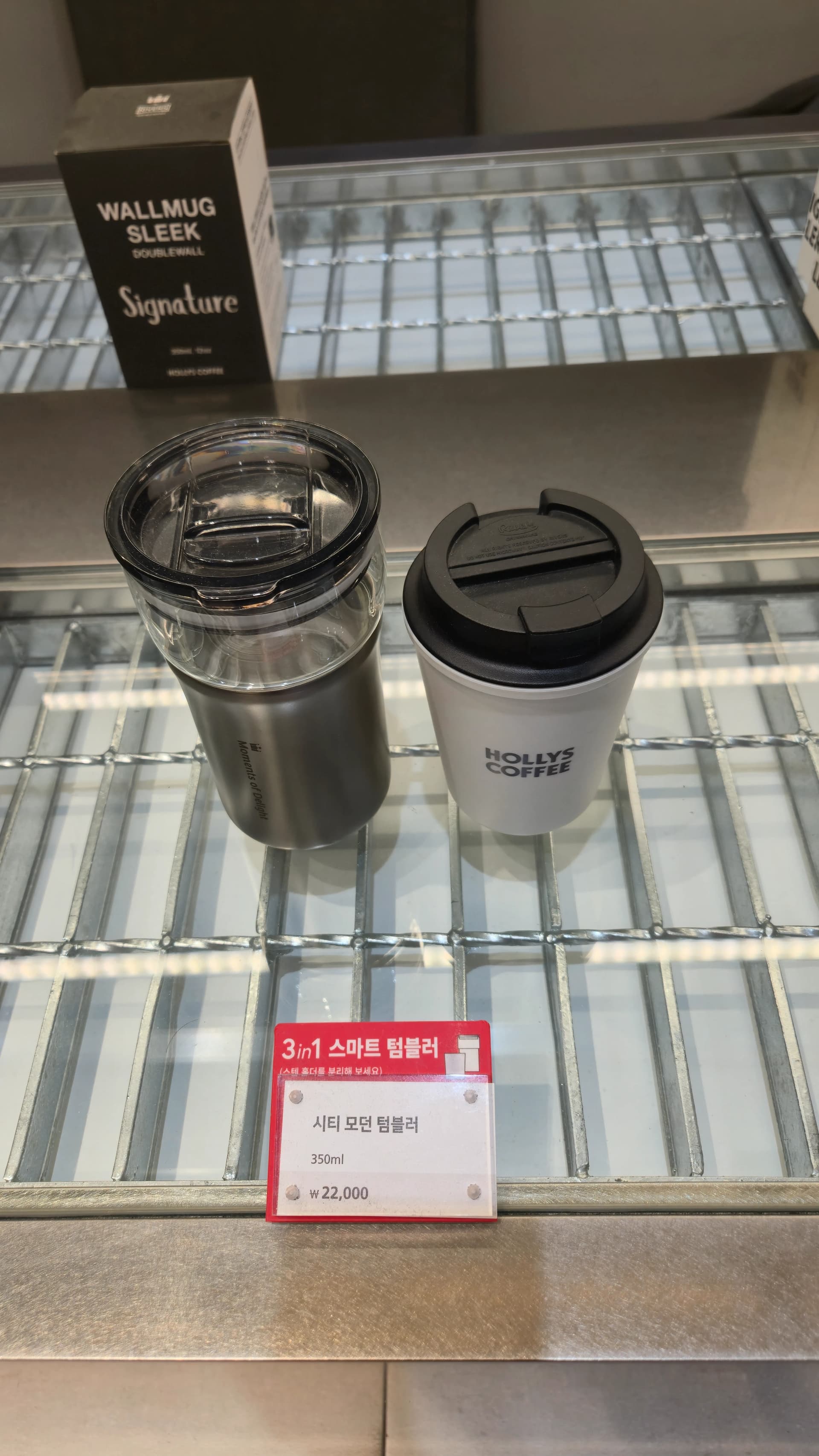
A closer look at the range: ceramic tumbler 650ml at roughly £19, handled mug-style tumbler around £15, slim tumbler around £7.80, City Modern tumbler 350ml around £13. From about £7.80 up to £19 — a reasonable spread, so there's something to suit most budgets. The designs are clean and the logo is fairly understated, meaning you can use them as a perfectly ordinary tumbler without advertising anything in particular. They don't have the collector-item appeal of Starbucks' limited edition drops, but that arguably makes them more practical for everyday use. The slim tumbler in particular — light, compact, not a burden in a bag — struck me as the sort of thing you'd actually take on holiday as a small souvenir.
I bought a Hollys tumbler years ago from a branch near the Korean Cultural Centre in Bangkok when I was living there. That branch closed around 2015 when Hollys pulled back from most of its overseas locations. The tumbler has since become a slightly odd memento — the café it came from no longer exists, but the brand is still going strong back in South Korea, as evidenced by a perfectly pleasant 4am visit.
Hollys Coffee — An Honest Verdict
We headed out at four in the morning with no particular expectations, and it turned out to be a rather good use of time. A lit-up café on a rainy, deserted street has a way of lifting your mood before you've even ordered anything. Hollys isn't quite the Korean café institution that Starbucks has become, but starting in 1998 as South Korea's first dedicated espresso café and still being very much here over two decades later counts for something. Prices are in line with the Korean franchise average, and the interiors have clearly come on a bit. The inconsistency between branches is a genuine weak point, and the cakes are slightly disappointing on value for money if we're being straightforward about it. But if you happen to find a 24-hour branch during a trip to Korea and you're at a loose end in the small hours, it's not a bad option at all. My wife and I sat there saying very little, drinking our coffees, watching the rain. Sometimes that's exactly what you need.