8 Side Dishes for £2.50 — A Real Korean Home Cooked Meal
Table of Contents
12 items
Home Cooked Side Dishes, Served at a Works Canteen
Baekban is the Korean word for an everyday set meal — rice, one stew, and a spread of small side dishes called banchan. It's essentially what Korean families eat at home every single day, and it's the backbone of Korean home cooking that most visitors never get to see. Think of it as the Korean equivalent of a proper Sunday roast dinner, except it happens at lunch, every day, and costs almost nothing.
Until last year, I was working in Daejeon, a major city about an hour and a half south of Seoul. When lunchtime rolled around, three or four of us from the office would head down to the works canteen. There was this one woman running the whole place by herself — in Korean, we'd call her "imo," which literally means "auntie" and is the affectionate term for the older women who cook at small canteens and eateries across the country. Every morning she'd go to the market alone, prep every ingredient, and cook the entire spread herself. The Korean home cooked meal she put together was different each day. Some days it was fish, other days the stew would change, and the banchan rotated in and out — but the basic structure never shifted: rice, one stew, and five or six side dishes. That's baekban. That's what Koreans actually eat.
When most people think of Korean food, they picture sizzling BBQ pork belly, colourful bibimbap, or spicy tteokbokki. But the reality is, the average Korean office worker's lunch looks far more humble. It's a bowl of rice, a bubbling stew to spoon over it, a bit of namul (seasoned vegetables), a piece of fish, and chopsticks moving between little dishes. That was my lunch every single day — and it cost just £2.50. Over eight different side dishes on one tray for £2.50. Even now, that feels almost absurd.
Let me walk you through everything that appeared on the table that day.
Pan-Fried Croaker — The Quintessential Korean Fish
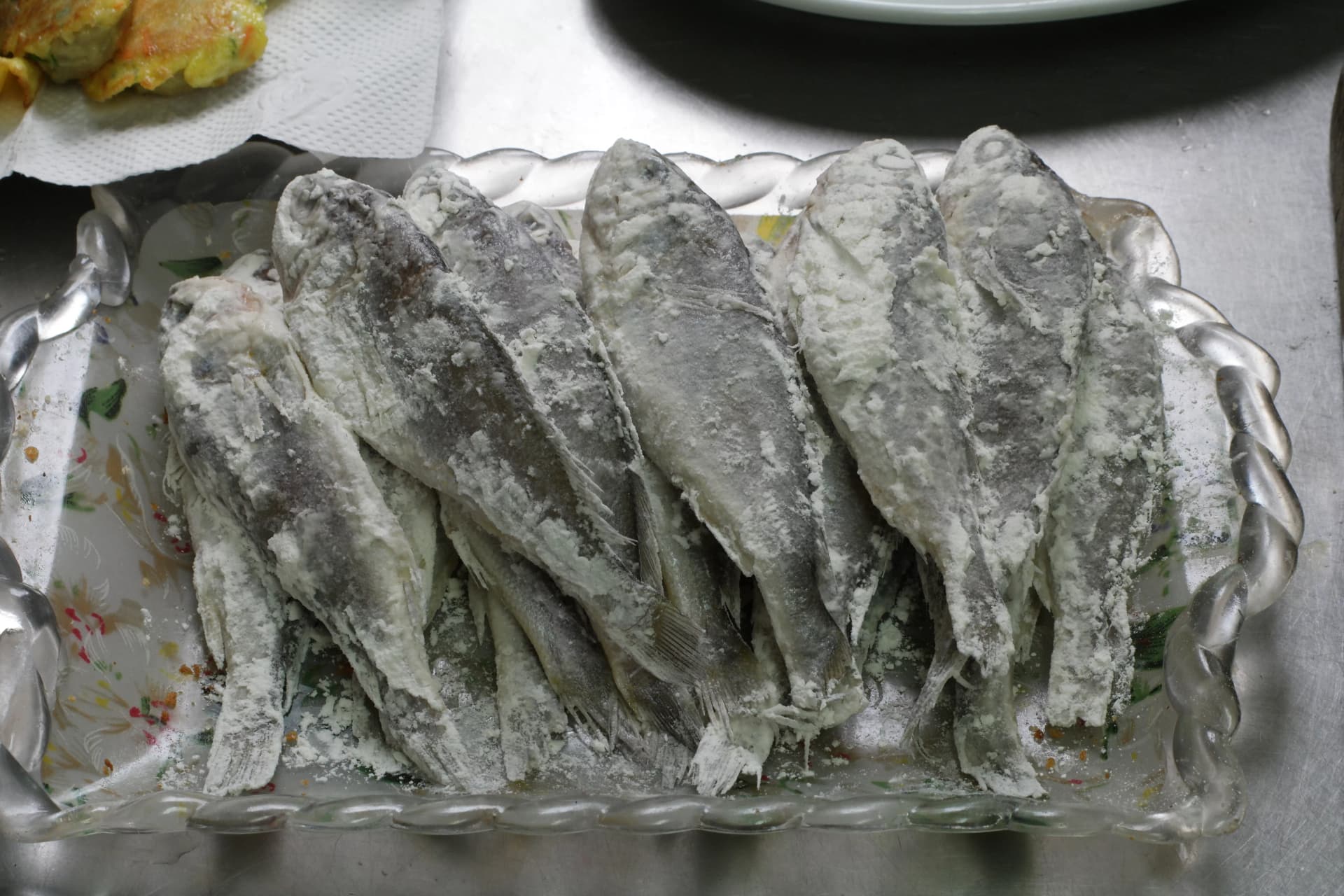
Pan-fried croaker (jogi-gui) is one of the most common fish dishes in Korean home cooking. The yellow croaker is a small, bony saltwater fish that's been a staple of Korean tables for centuries — it even appears on ancestral ceremony tables during Chuseok (Korean harvest festival) and Lunar New Year. Here, it's been dusted in a light coating of flour, ready for the pan.
This is the fish before it hits the oil. Each one had been rolled in flour front and back, and sitting on the plate like that, they looked almost ghostly white. When imo lined them up like this on the counter, it meant the frying pan was about to come out next. In Britain, you might think of fish and chips when someone says "fried fish," but this is nothing like that — no heavy batter, no deep-frying. It's a thin dusting of flour and a shallow pan with just a slick of oil. The result is completely different: delicate, flaky, and subtly savoury rather than crunchy and rich.
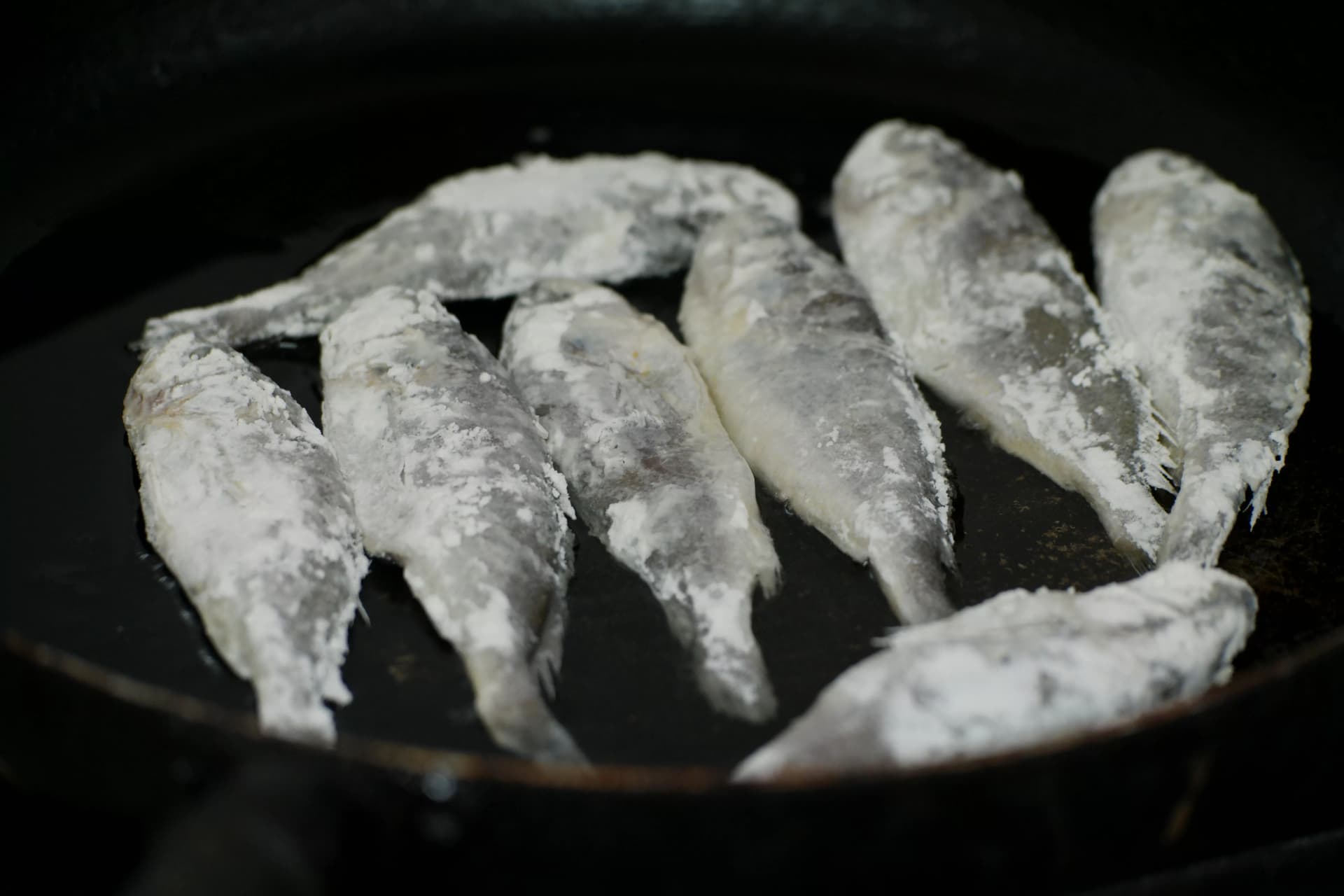
Into the oiled pan they went. The moment they started sizzling, the smell of toasted flour and fish drifted across the entire canteen. You didn't need to peek into the kitchen — one whiff and someone across the room would go, "Fish today, then." That one sentence was enough to get everyone quietly looking forward to lunch.
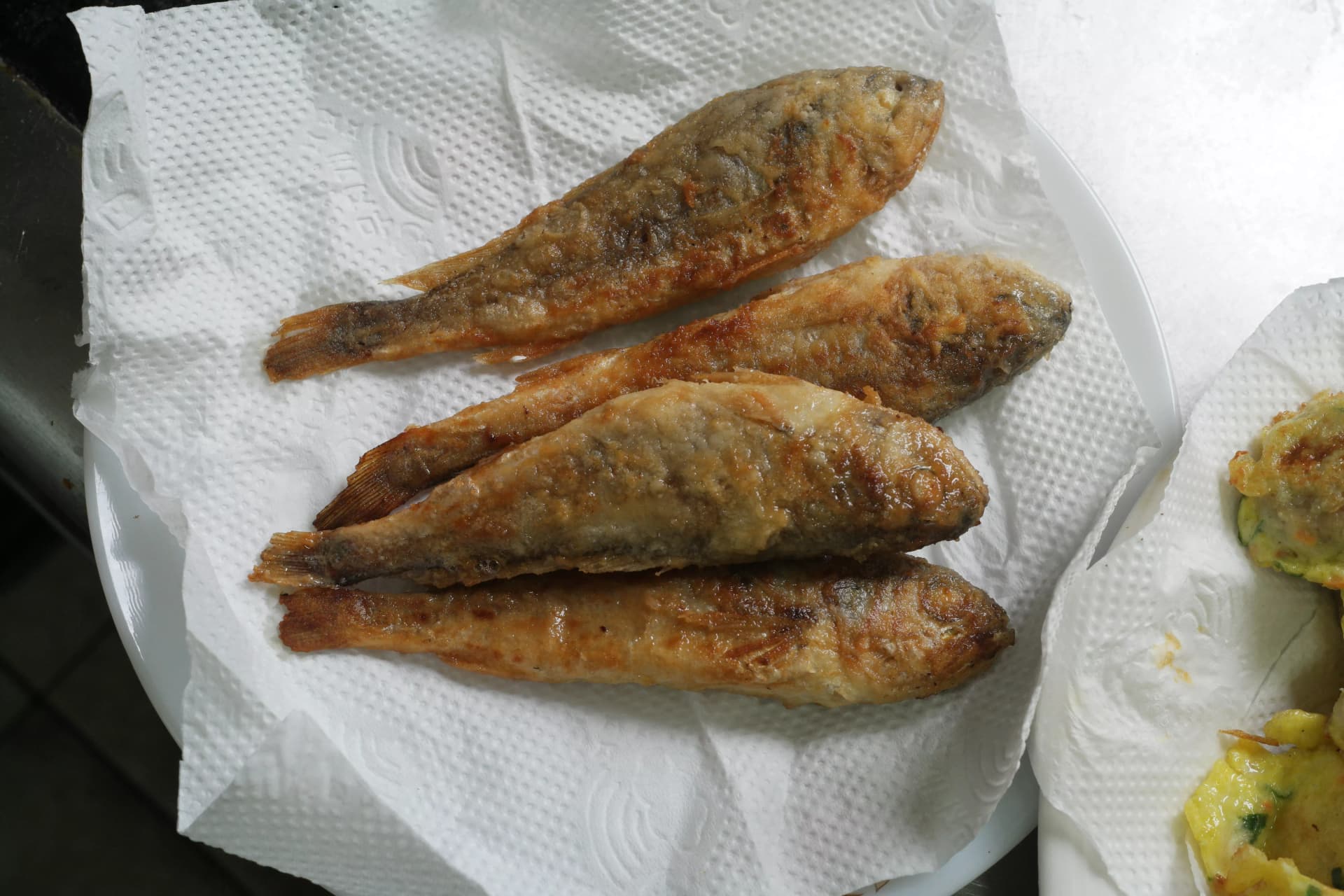
Once one side was done, they went onto kitchen towel to drain. The pale flour coating had turned a gorgeous golden colour. Imo always used to say, "The first batch is mine — yours starts from the second." Honestly though, I nicked one from the first batch more than a few times. There's a noticeable difference between one straight from the pan and one that's sat even for a minute. That initial crispness fades fast.
A Fish Every Korean Remembers From Childhood
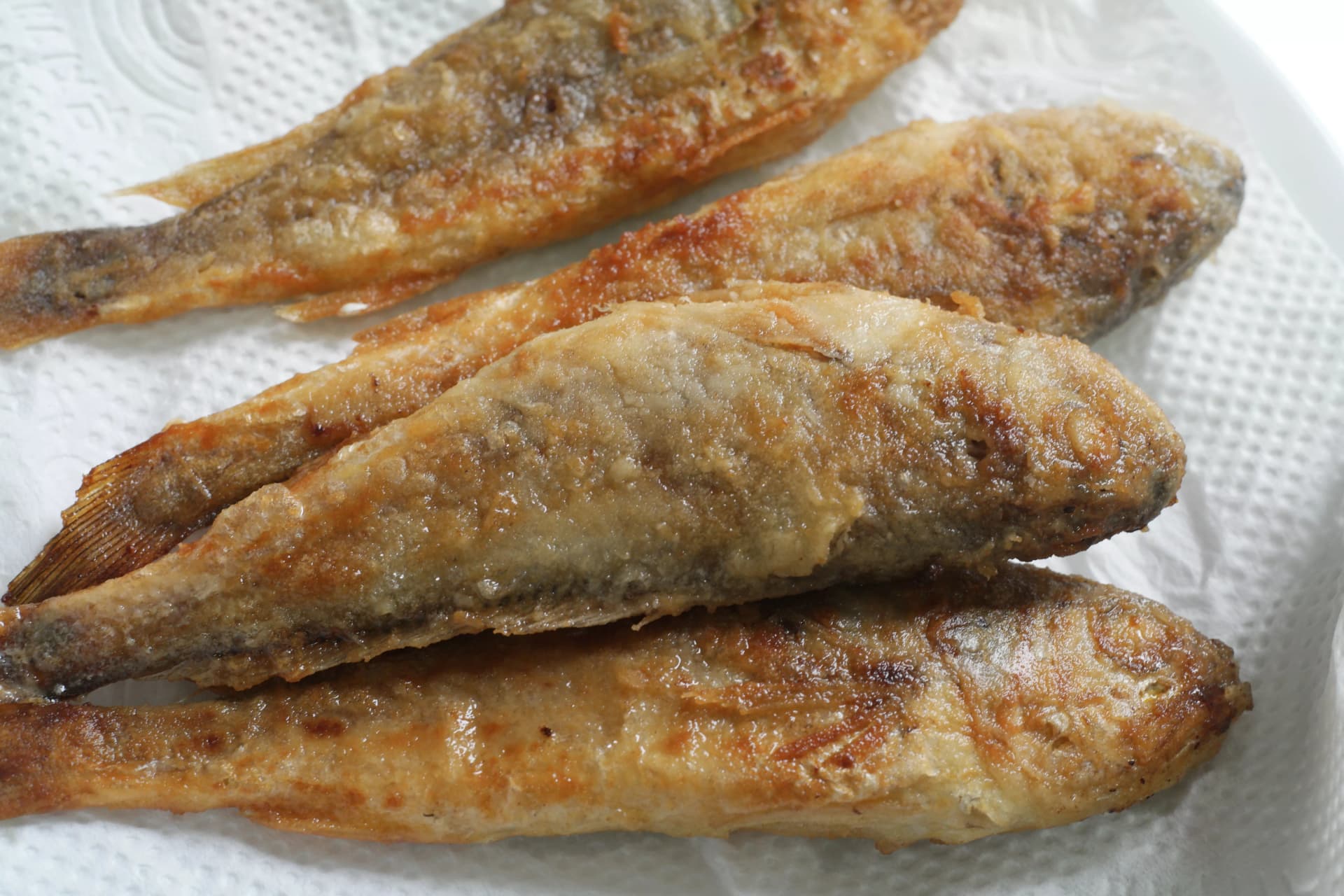
Up close, you can see how thin and crispy the skin stays while the flesh inside remains white and moist. If you asked any Korean, "Did your mum ever pan-fry fish at home when you were little?" most of them would name either croaker or hairtail before anything else. That's how deeply embedded this fish is in Korean home cooking. Croaker used to be cheap enough to count as an everyday side dish, but prices have climbed quite a bit in recent years. So whenever pan-fried croaker appeared in our canteen, someone would inevitably joke, "Imo must be in a good mood today."
Korean Rolled Omelette — The Side Dish Everyone Loves
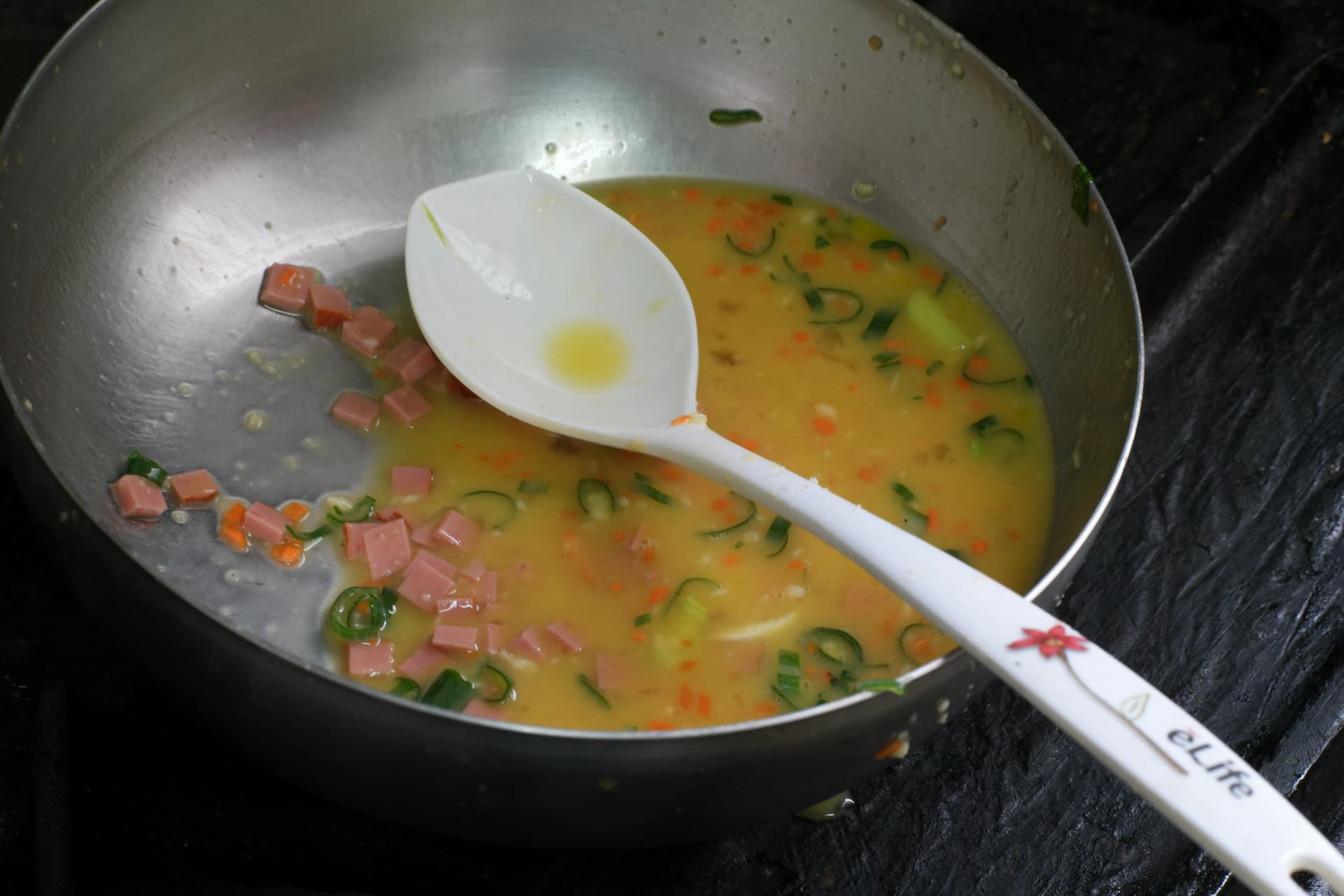
Korean rolled omelette, or gyeran-mari, is an egg-based side dish made by spreading a thin layer of beaten egg on a pan and rolling it up with fillings inside. It appears on virtually every Korean lunch tray, from school canteens to office cafeterias, and is second only to kimchi in frequency.
I spotted imo cracking eggs into a bowl and mixing something in, so I leaned over for a look. Diced ham, spring onion, and carrot — at that point I still wasn't sure what it would become.
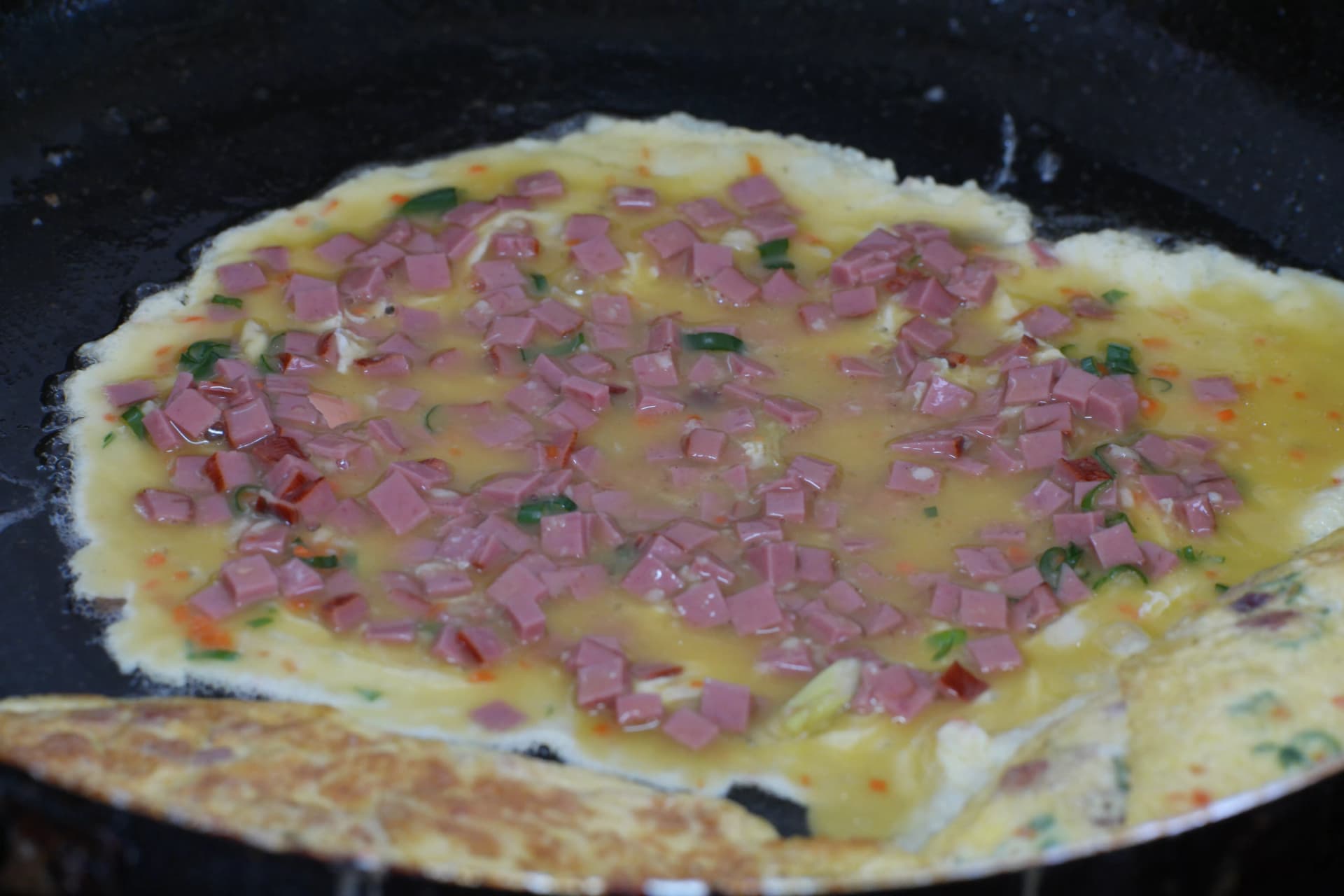
The moment she poured it into the pan and spread it out flat, it clicked. Gyeran-mari. Unlike a Western omelette, the Korean version is poured thin, almost like a crêpe, and then tightly rolled up. What goes inside varies from household to household — some people add cheese, others use crab sticks — but imo's version was generous with the ham.
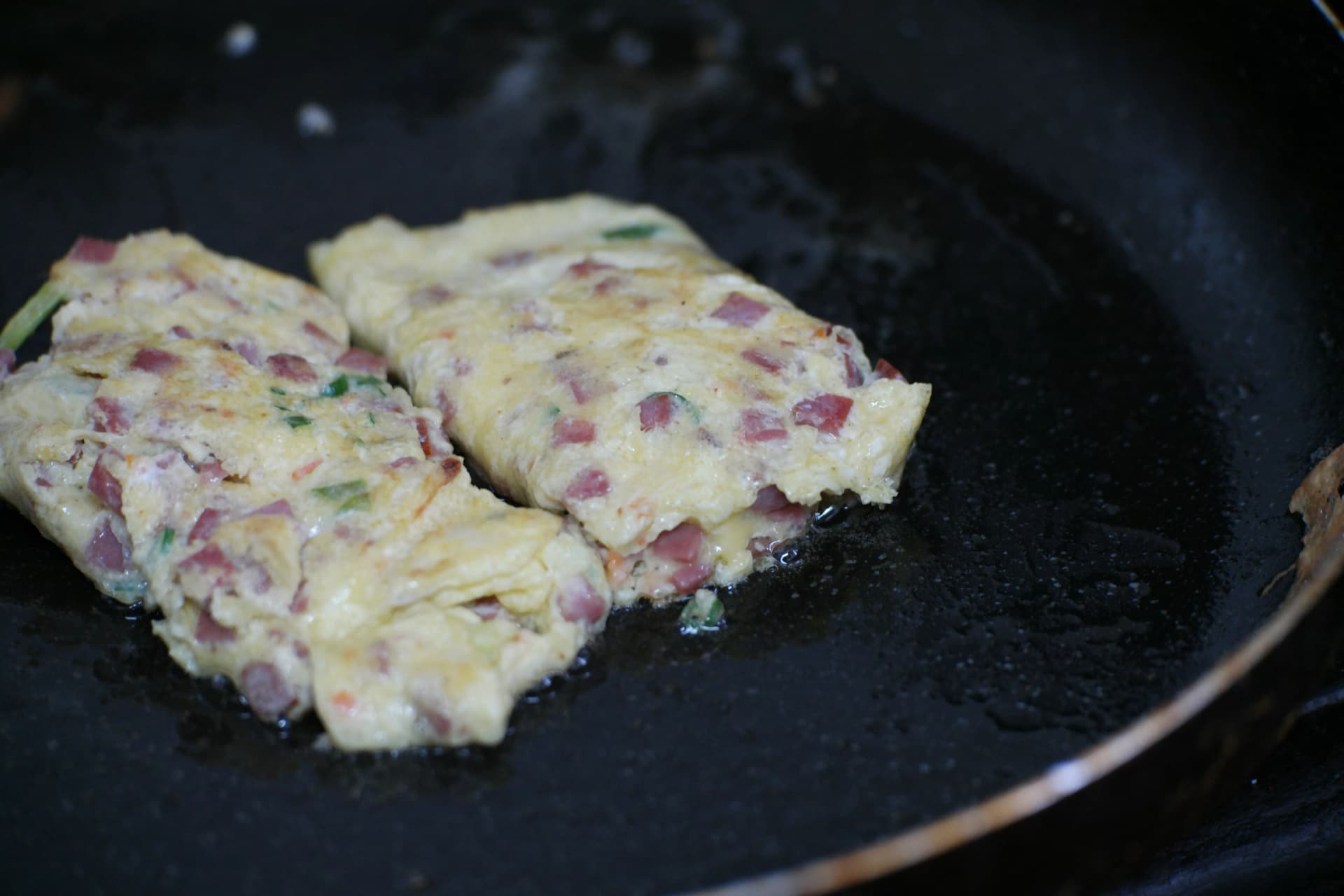
Once the bottom had set, she folded it over and flipped it. The timing on this is trickier than it looks — flip too early and the runny egg spills out; too late and the outside burns. Imo did it with a single flick of the wrist. Every time I've tried at home, mine tears apart. It looks dead simple, but getting it right is genuinely difficult.
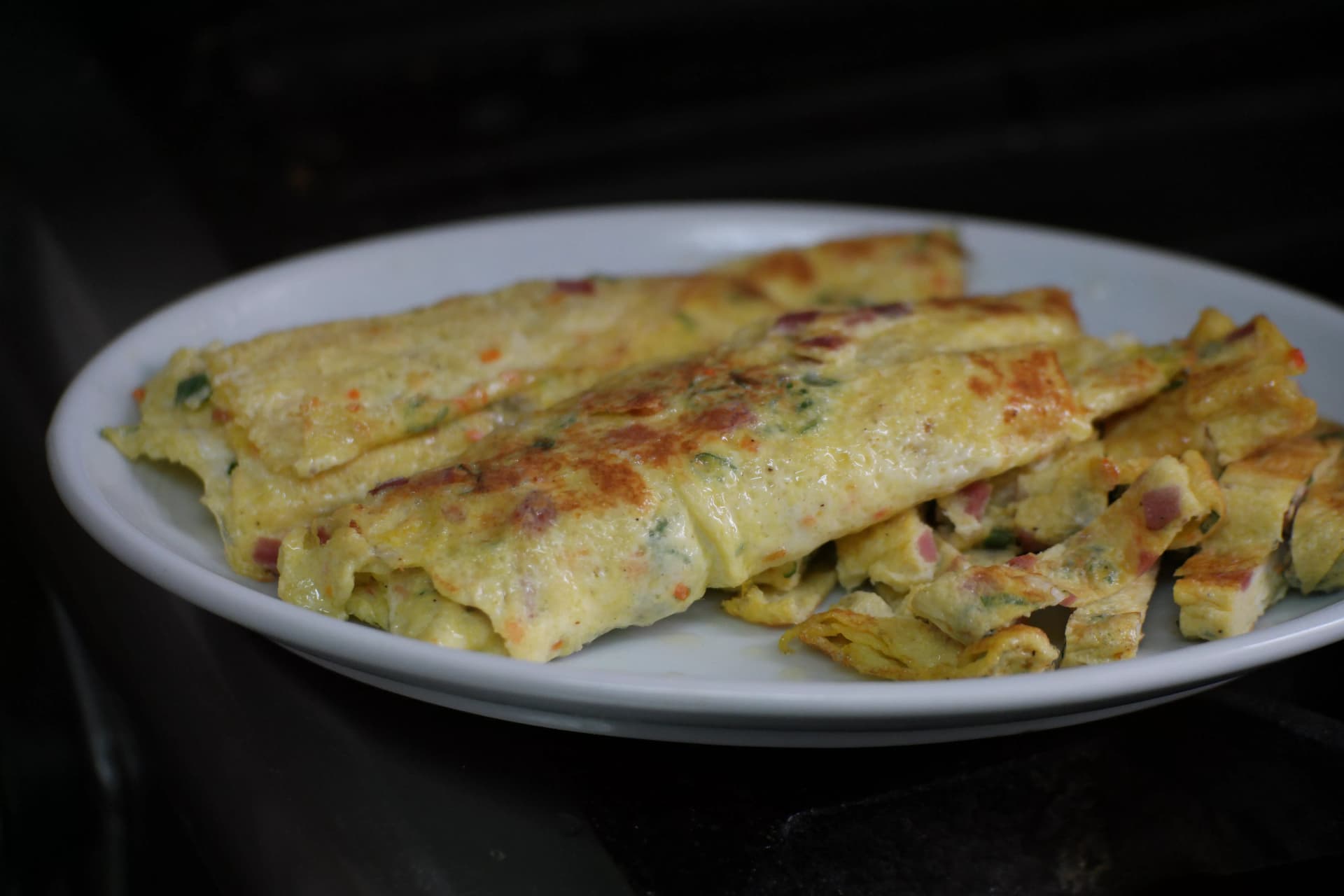
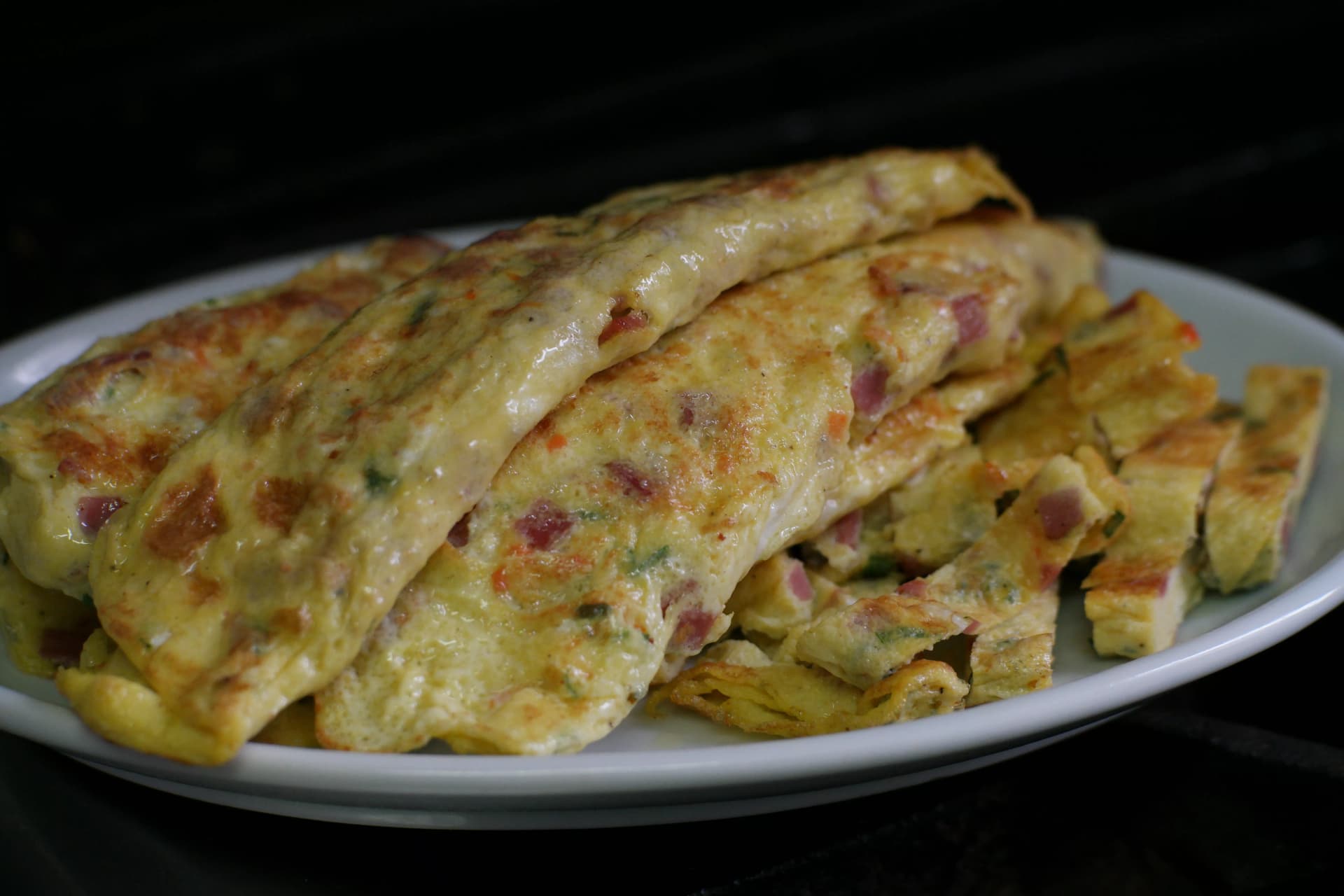
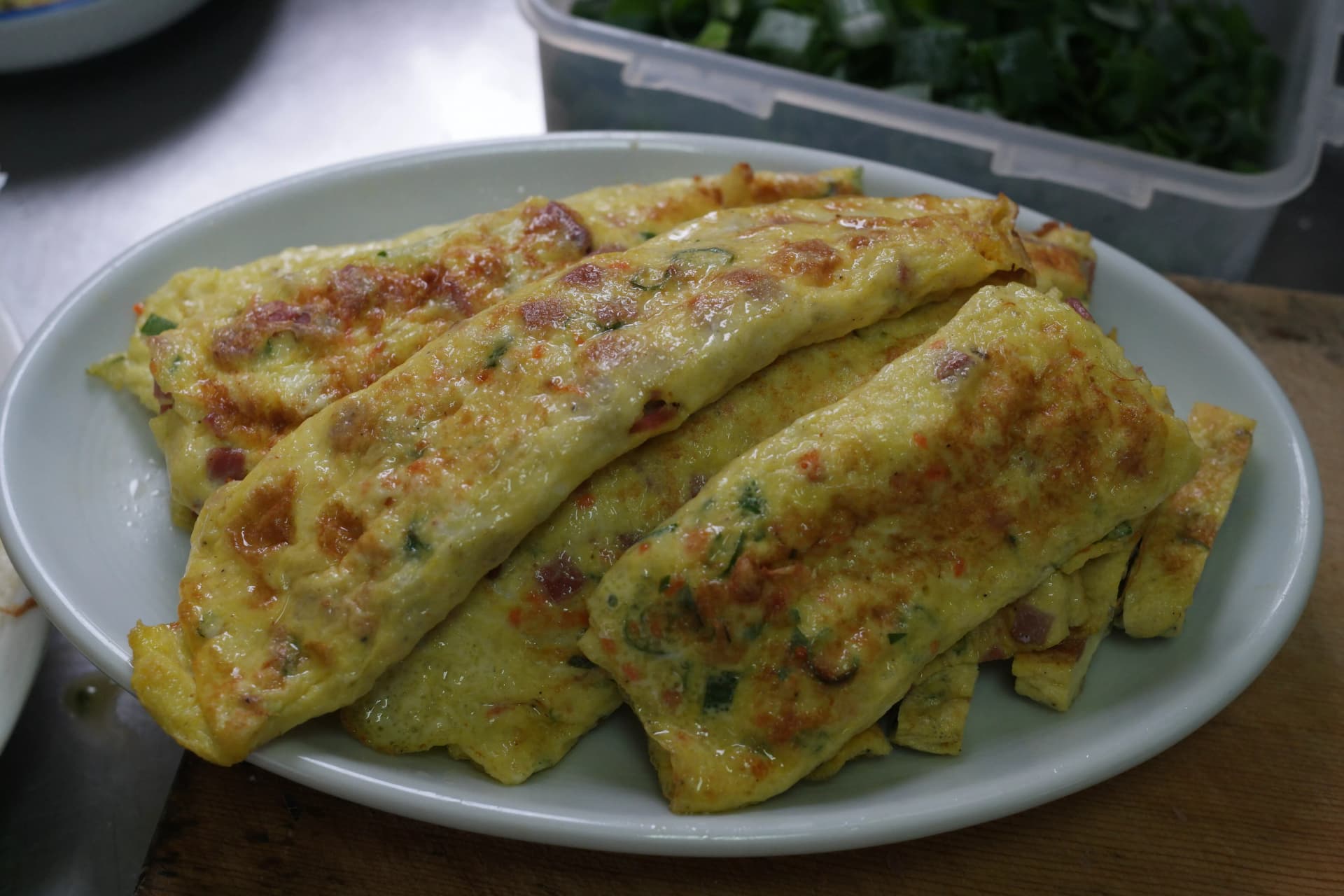
The finished rolled omelette. You can see bits of ham and spring onion studded through the golden exterior. Behind the plate, there's a green container of pre-chopped vegetables ready for the next side dish — imo was always working on two things at once, prepping the next banchan while the current one was still in the pan. On a Korean home cooked meal table, gyeran-mari is probably the dish that appears most often after kimchi. Whether it's a canteen lunch or a baekban restaurant, leaving it out would make the whole spread feel incomplete. It's the absolute foundation of Korean side dishes.
Donggeurangttaeng — The Most Labour-Intensive Side Dish
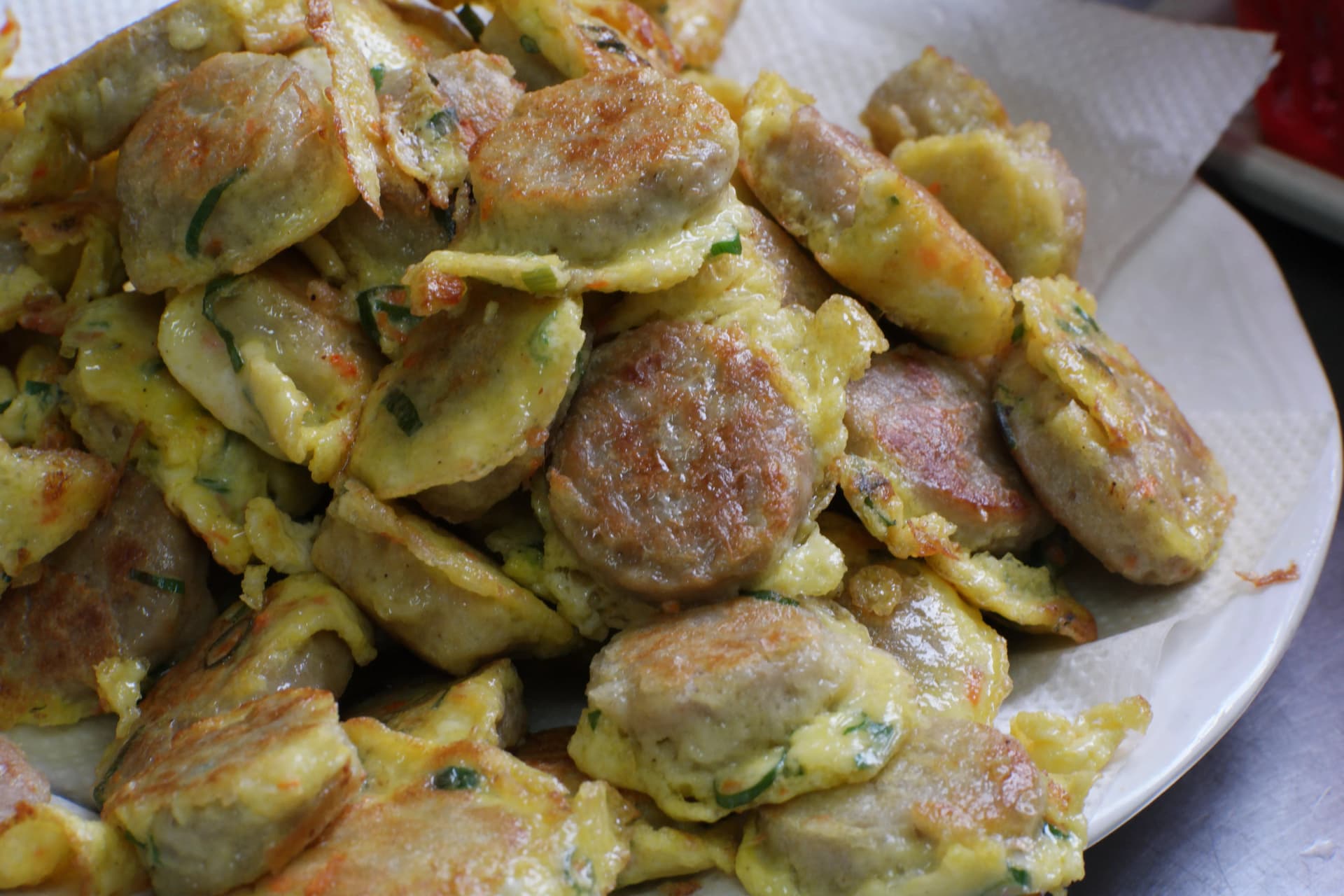
Donggeurangttaeng is a traditional Korean patty made by mixing crumbled tofu, minced pork, and finely chopped vegetables, shaping them into small rounds, coating them in egg, and pan-frying until golden. Of all Korean banchan, this one takes the most hands-on effort to make — and seeing a heaped plate of them tells you someone started very early in the morning.
Each one has to be individually shaped by hand, dipped in egg wash, then placed on a hot pan one at a time. Looking at the mountain piled on that plate, imo must have been at it since dawn. This is the kind of side dish that British home cooks might compare to making fishcakes or rissoles from scratch — not technically hard, but incredibly time-consuming when you're making dozens.
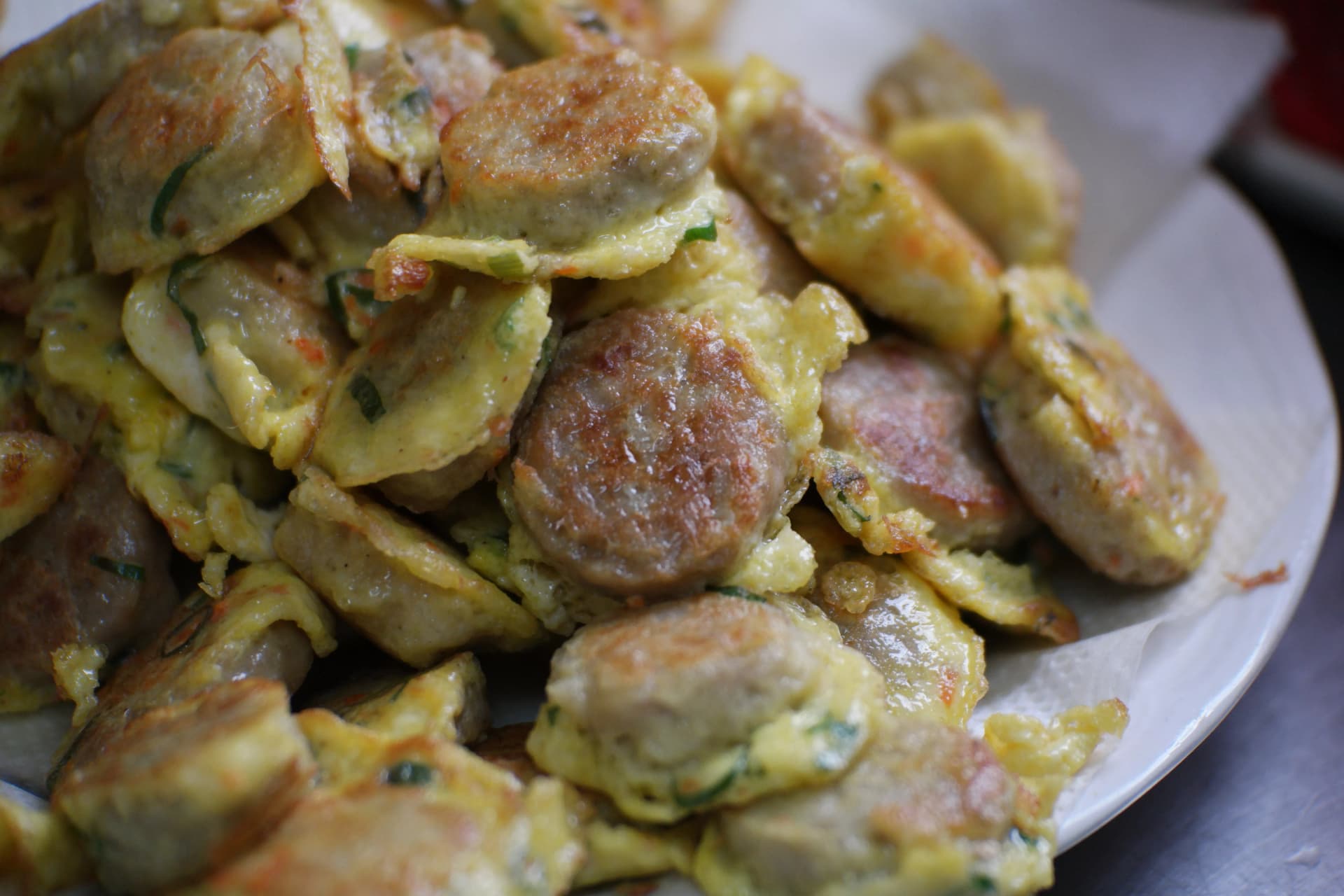
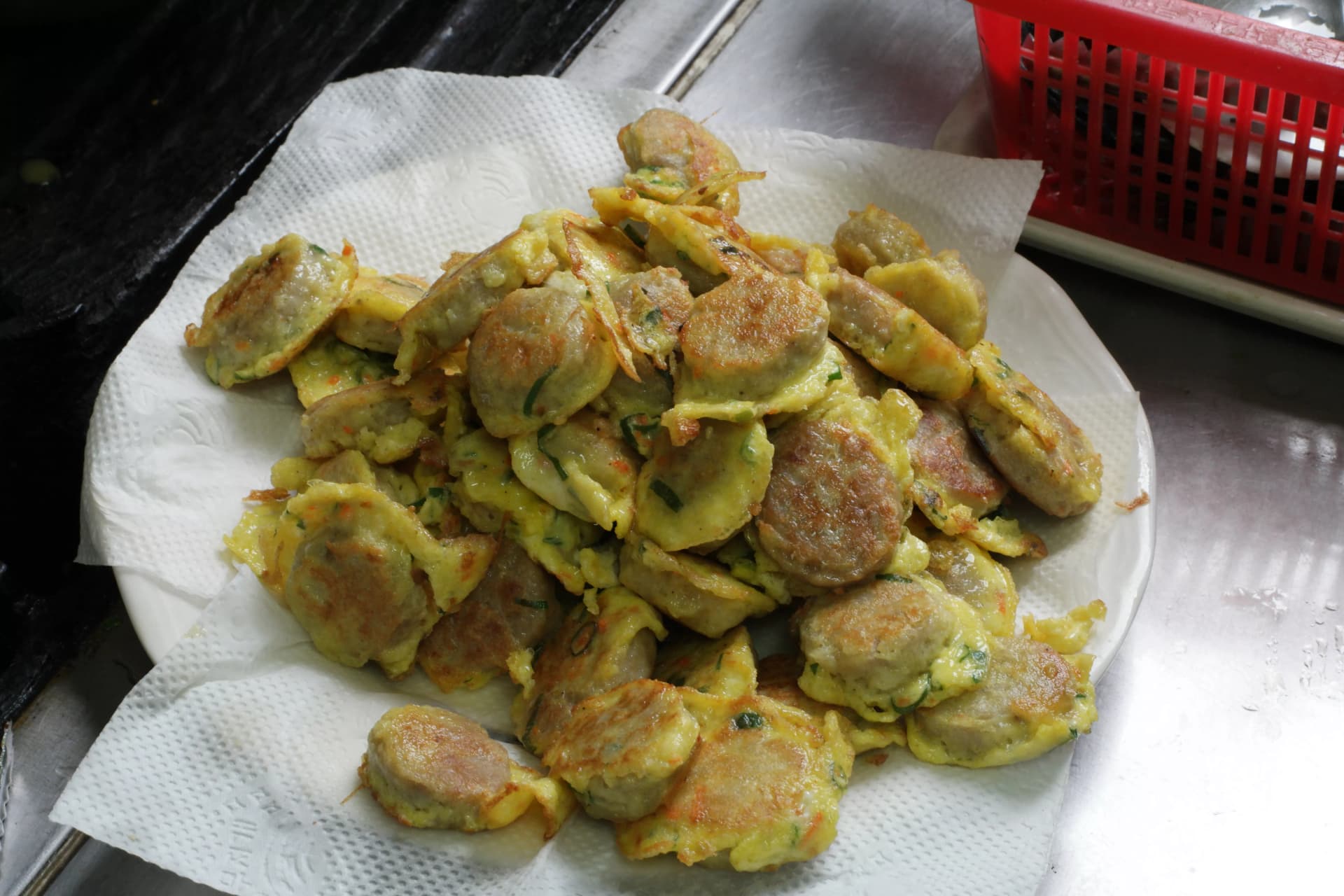
The cross-section reveals the mix of tofu and meat inside, with the egg coating clinging unevenly to the surface. That bumpiness is the hallmark of homemade — supermarket frozen versions are smooth and perfectly round, but hand-shaped ones come in all sizes and shapes. Fresh from the pan, the outside is crispy while the tofu keeps the inside soft. They're decent cold too, which is why they're a classic Korean lunchbox item. In Korea, there's a tradition during major holidays where the whole family gathers around the kitchen to fry stacks of these savoury pancakes and patties together. When donggeurangttaeng showed up on a regular weekday tray, one of my colleagues would always say, "Is it a bank holiday or something?"
Seasoned Vegetables That Balance the Whole Meal
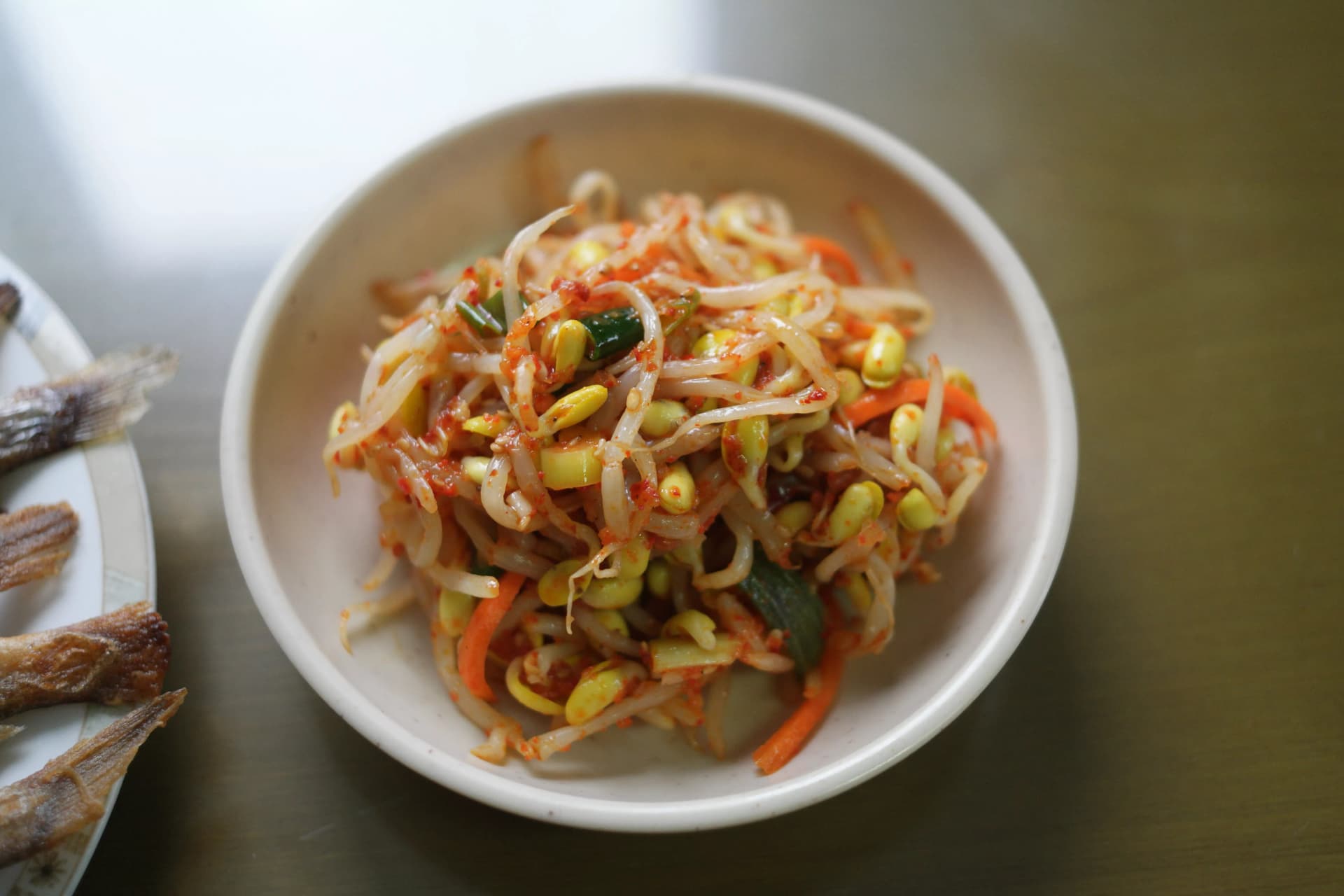
Kongnamul-muchim, or seasoned soybean sprout salad, is probably the single most frequently served side dish in all of Korean home cooking. Blanched sprouts are tossed with chilli flakes, sesame oil, spring onion, and a touch of carrot — and the crunchy texture pairs brilliantly with a bowl of steamed rice.
Even the same dish tastes completely different depending on who makes it. Imo's version was light on the chilli, so it leaned more tangy than spicy. Every Korean household has their own take — some add soy sauce, others go heavier on the garlic — but the crunch of bean sprouts with rice is a combination that just works, every single time.
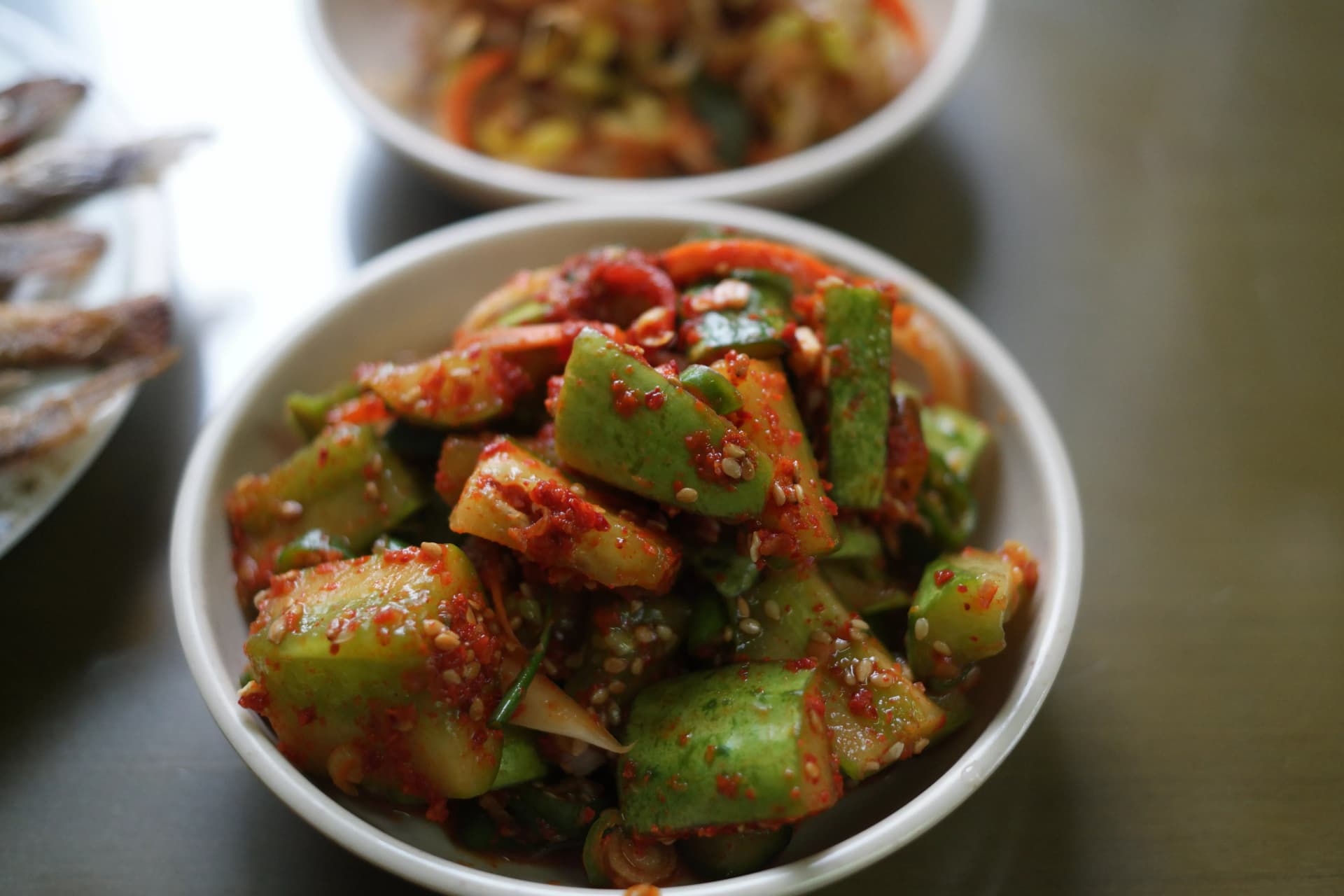
This is oi-muchim, a spicy cucumber side dish that sits somewhere between a salad and a quick pickle. The cucumber's been cut into thick chunks and tossed with chilli flakes, garlic, and sesame seeds — almost closer to a cucumber kimchi than a simple salad. It appeared more often in summer. On a sweltering day when nothing else appealed, just piling this on top of rice was enough for a full meal.
Mystery Greens and Braised Aubergine
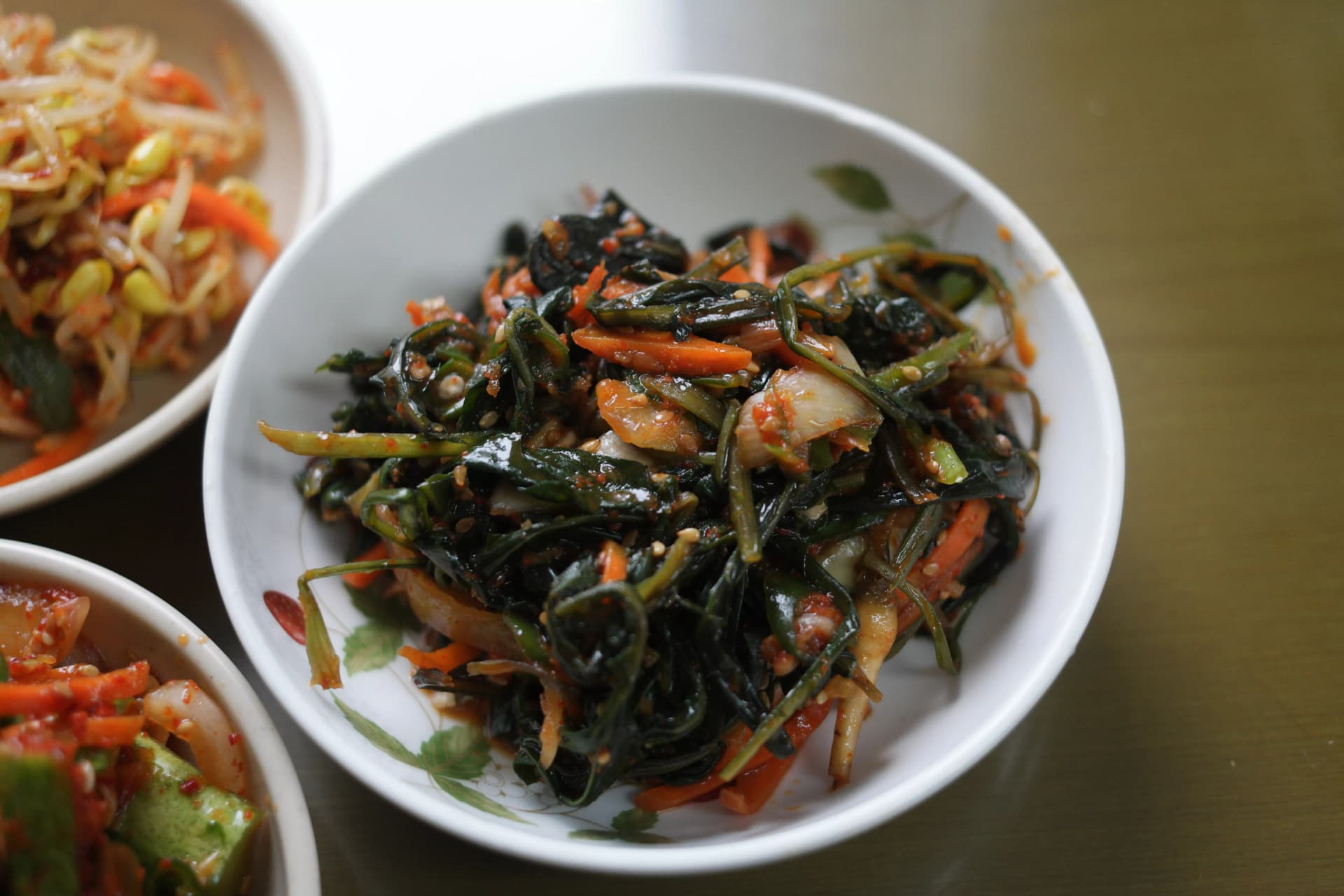
Korean home cooking always includes at least one namul — a seasoned vegetable or wild green side dish — and there's usually one that you can't quite identify. This particular dish had deep green stems, threads of carrot, and a scattering of sesame seeds in what was clearly a soy-based seasoning. It might have been sweet potato stems or seaweed stems — I honestly couldn't tell.
But that's rather the point. On any Korean home cooked meal table, there's almost always one mysterious namul that nobody can name precisely, and it quietly does the most important job: cutting through the richness of everything else. After a bite of something oily or heavily seasoned, picking up a bit of this sort of namul resets your palate completely.
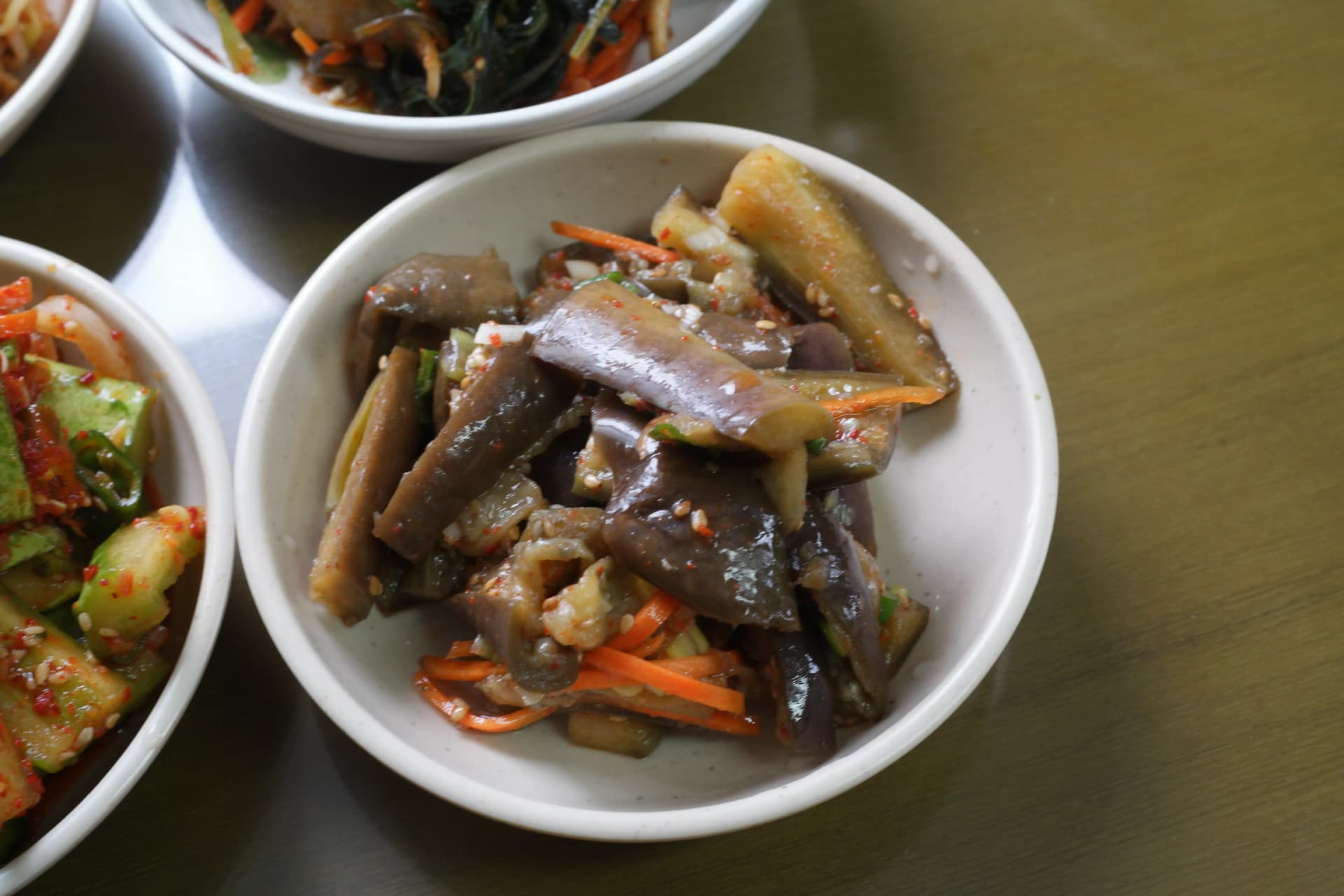
This is gaji-muchim — steamed aubergine in a soy and sesame oil dressing. Aubergine is one of the more divisive vegetables in Korea. Loads of people can't stand the soft, almost slippery texture, but when it's done well, it's less "mushy" and more "melts on your tongue." The soy sauce and sesame oil soak right into the flesh, making it savoury and nutty. I couldn't stand aubergine as a child either — I'd push it to the side of every plate — but somewhere along the way it became something I actively wanted. One colleague refused to touch it until the bitter end, though, so I'd always claim his portion too.
The Main Event — Kimchi Stew
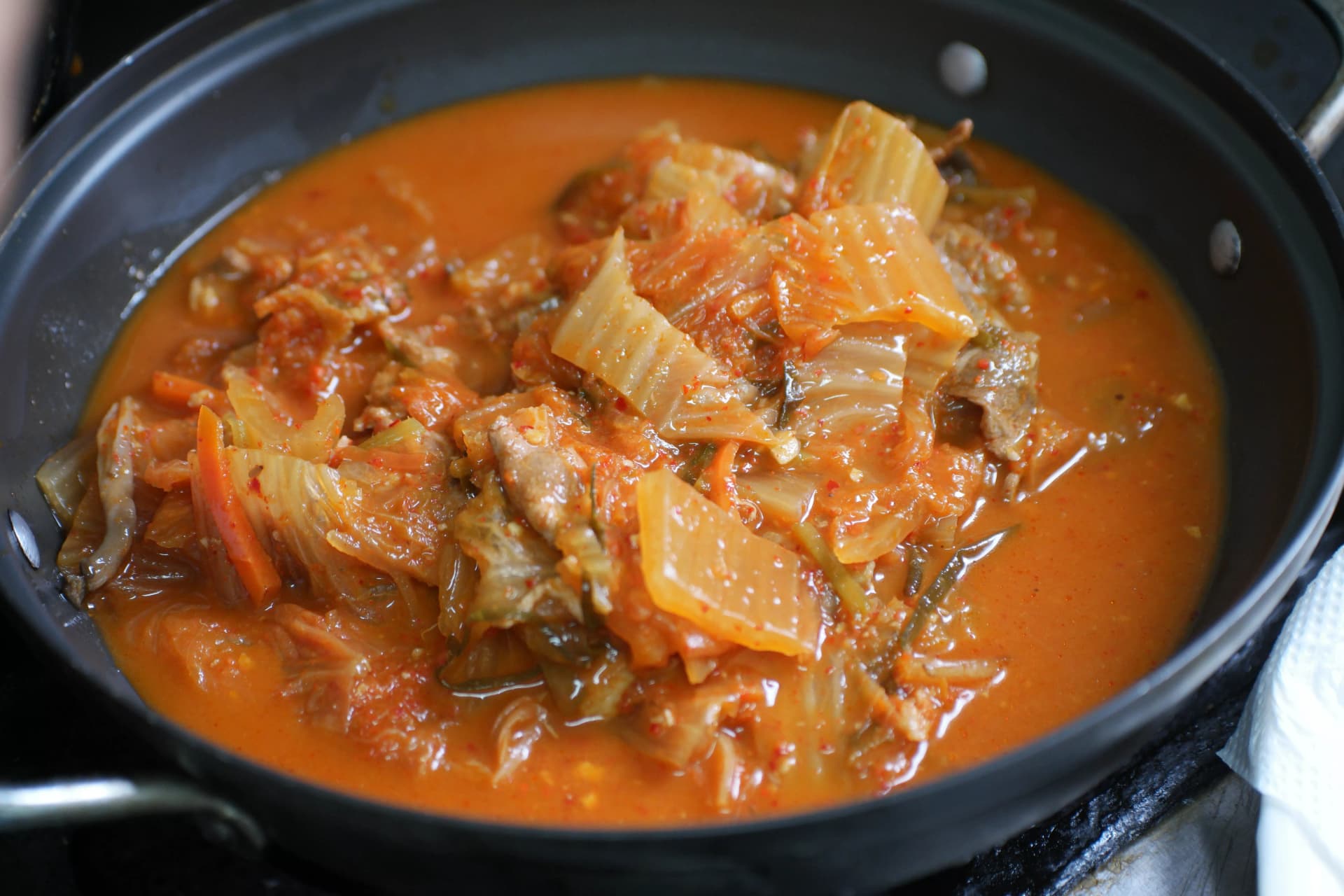
Kimchi jjigae is Korea's most iconic stew and the centrepiece of any baekban meal. Made with well-fermented aged kimchi (called mugeunji), pork, and tofu, it simmers until the broth turns deeply savoury and the kimchi practically dissolves. This is the dish that ties every Korean home cooked meal together.
Here's a detail that surprised me when I first learnt it: good kimchi stew isn't made with fresh kimchi. It needs kimchi that's been fermenting for months — the kind that's gone properly tangy and sour. That aged sourness is what gives the broth its depth. By the time I photographed this, the meat and kimchi had been bubbling away together long enough that the kimchi was starting to fall apart. That's when you know it's nearly there.
The Korean Way of Building a Stew in Stages
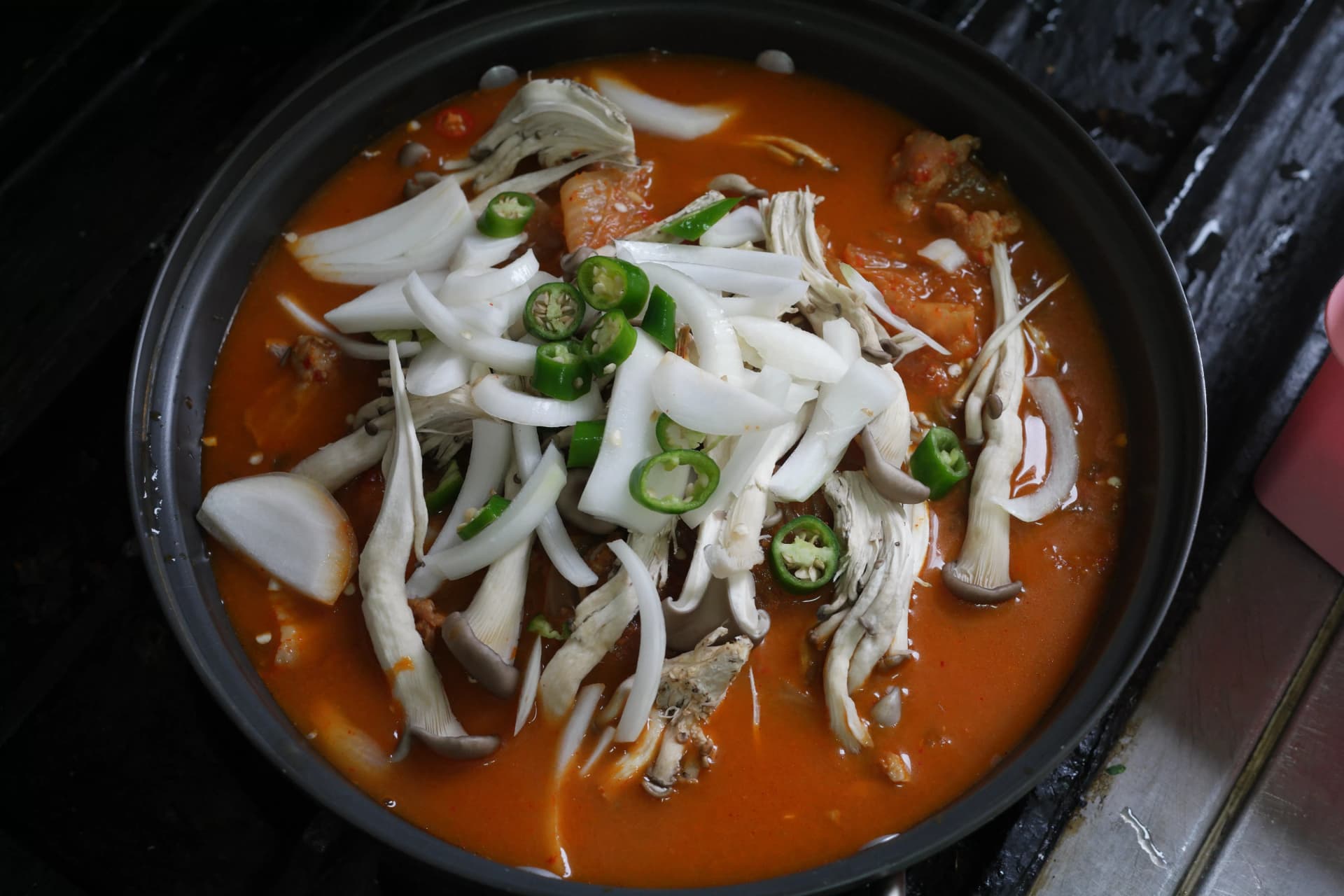
Next came oyster mushrooms and sliced cheongyang chilli (a fiery Korean green chilli, roughly four times hotter than a jalapeño). Not every household puts mushrooms in their kimchi stew, but imo always added a generous handful. Once the mushrooms soak up the broth and cook down, every bite releases a burst of that concentrated kimchi stew flavour. It's oddly addictive.
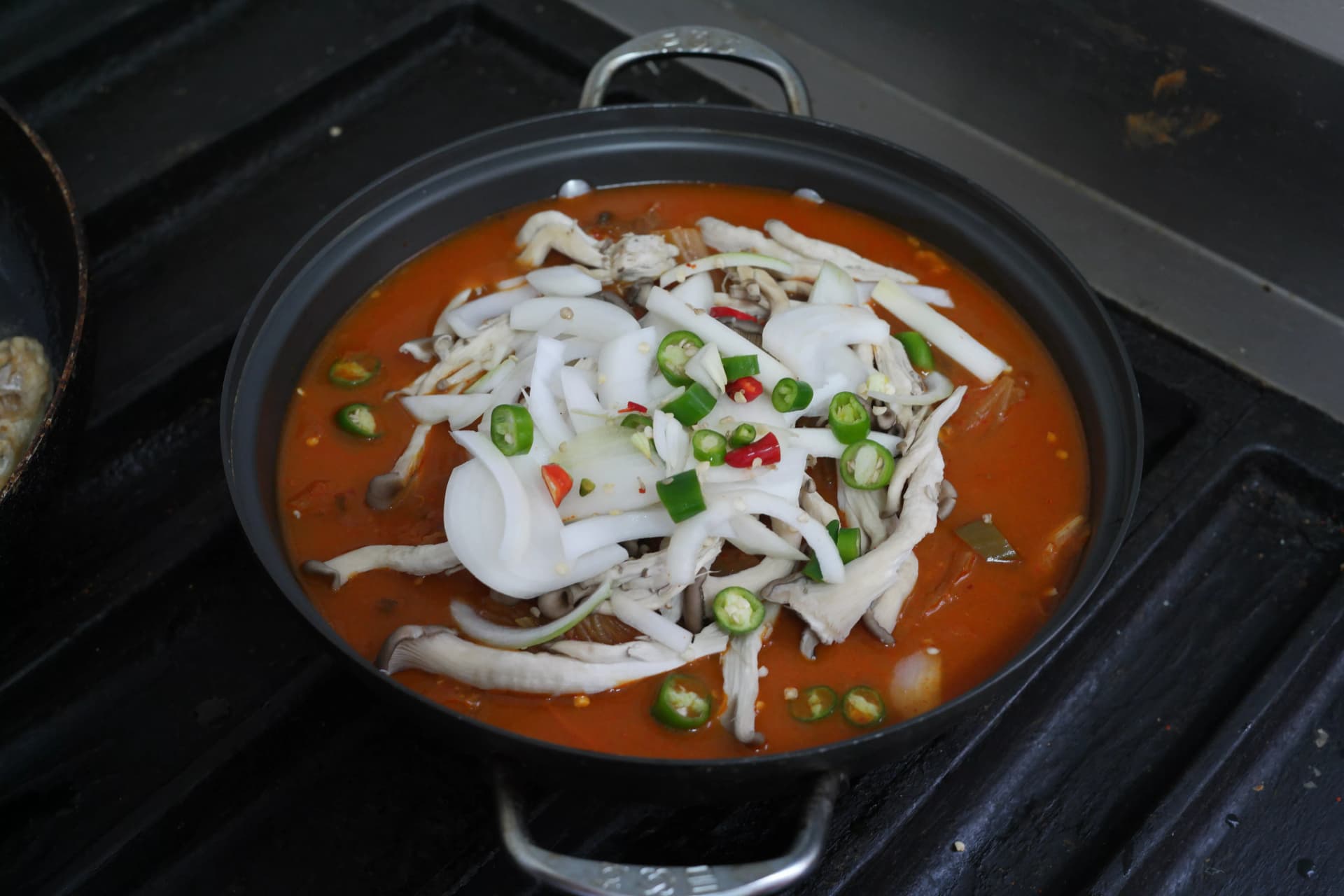
Onion went in next. Korean-style stews aren't thrown together all at once. Ingredients that need longer cooking go in first, and things that break down quickly — like onion — are added later. Cook onion for too long in a boiling stew and it vanishes entirely, so this was the right moment for it.
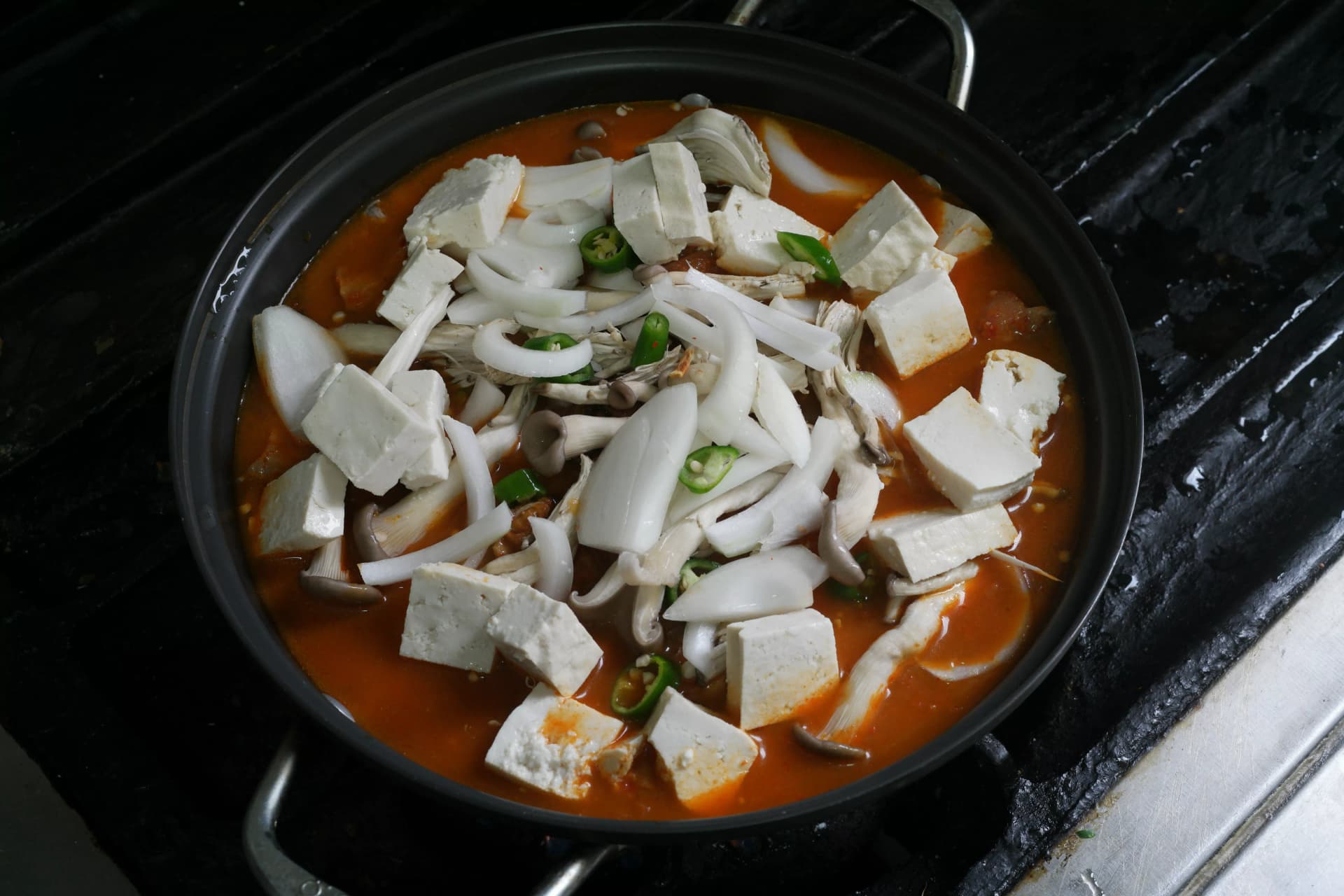
Last in was the tofu, cut into generous chunks. If you left tofu out of kimchi jjigae, most Koreans would be genuinely gutted. As it simmers, the tofu absorbs the broth — the outside firms up slightly while the inside stays silky. Fishing out a piece of tofu from the spicy red broth and eating it with rice gives you a moment of calm between the heat. It's like a palate cleanser built right into the stew itself.
Finished Kimchi Stew, Served Straight in the Pot
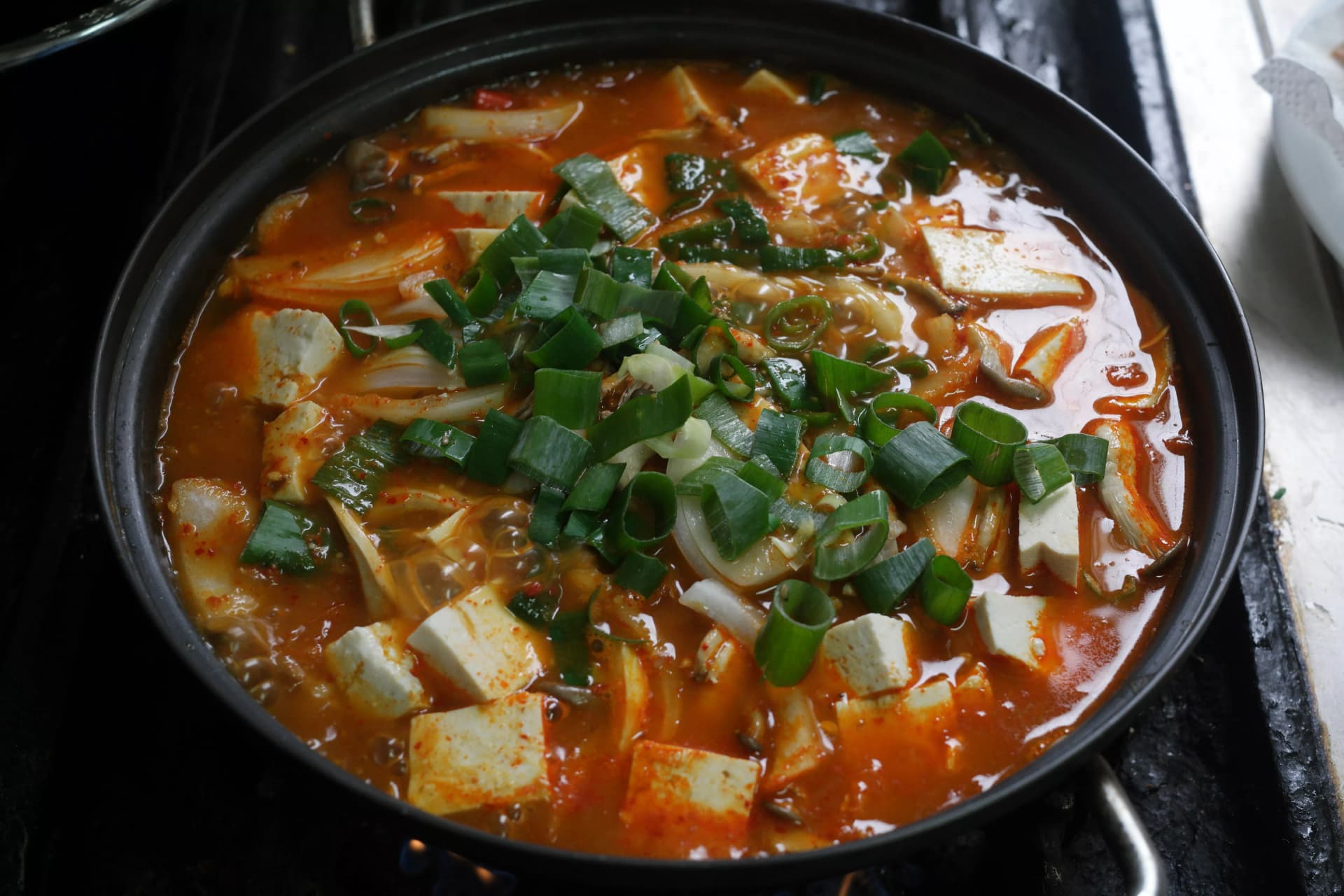
A scattering of sliced spring onion on top and it's done. The whole pot goes straight onto the middle of the table, still bubbling. In Korea, stew is never served in individual bowls — one pot sits in the centre and everyone spoons from it directly into their own rice bowls. You scoop broth and chunky bits of kimchi and tofu over your rice, and that's how you eat it.
One thing that was a bit rubbish, if I'm honest — the air conditioning in that canteen was weak. In summer, eating a scalding hot kimchi stew meant sweat absolutely pouring off your forehead. One colleague once said, "At this rate we'll need a shower before the afternoon shift," and the whole table cracked up. And I'll be frank — the kimchi stew appeared a bit too often. It felt like three or four days out of five, the stew was kimchi jjigae. I did once gently suggest to imo, "Maybe doenjang-jjigae tomorrow?" (that's the soybean paste stew — milder and earthy, Korea's other everyday stew). She smiled warmly. Then served kimchi jjigae again the next day.
The Full Korean Home Cooked Meal — Everything on One Tray
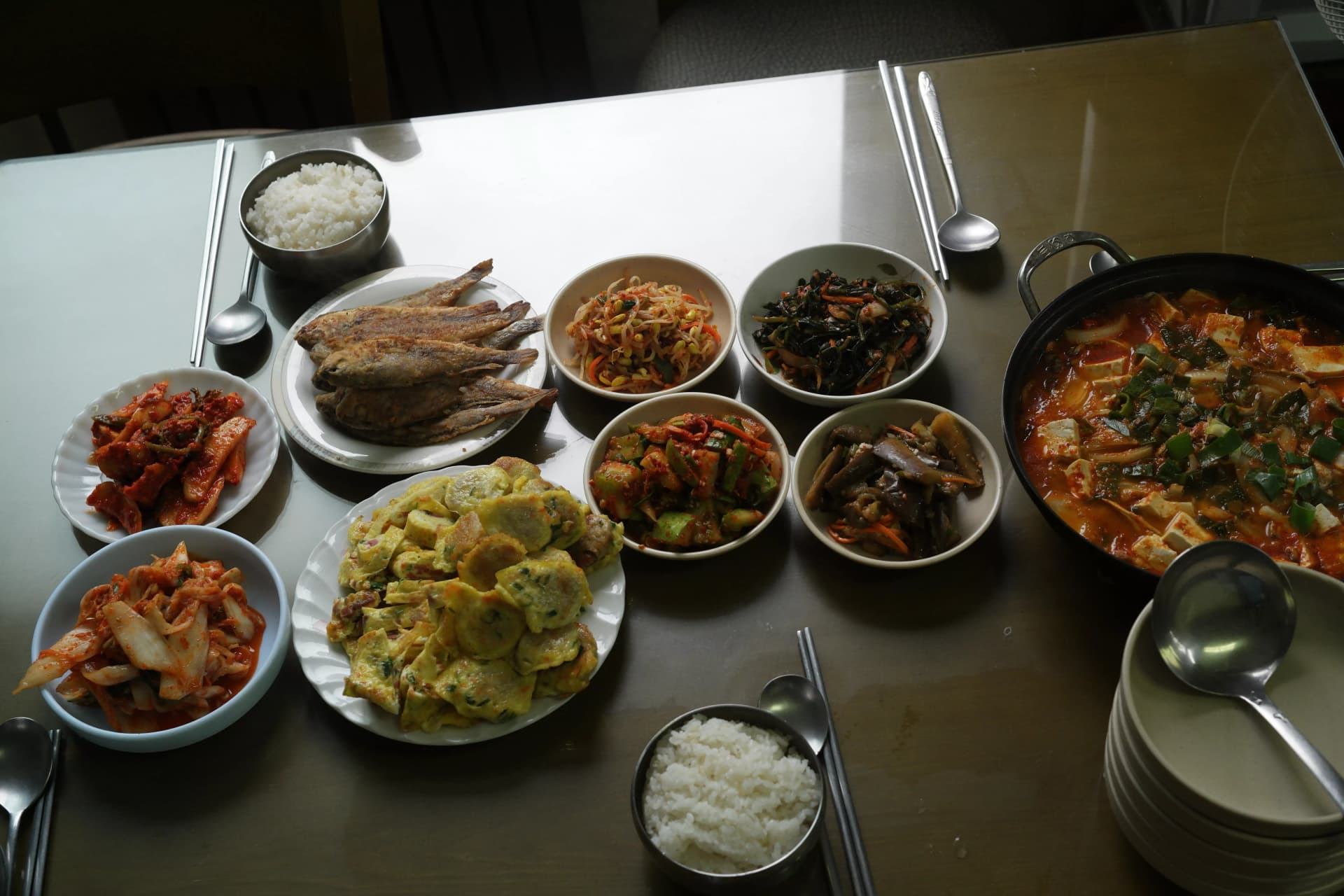
This is the full spread from that day. Laid out on the stainless steel table: rice, kimchi stew, pan-fried croaker, rolled omelette, donggeurangttaeng, soybean sprout salad, spicy cucumber, seasoned greens, braised aubergine, and kimchi. It looks nothing like the elegant Korean course meals (hanjeongsik) you might see at a fancy restaurant — the bowls are mismatched, there's zero plating artistry, and nothing's been arranged for Instagram. But this is what Koreans genuinely eat, day in, day out.
You'll notice a spoon and chopsticks placed side by side — that's standard Korean table setting. The spoon is for rice and stew; the chopsticks are for picking up banchan. Switching between the two feels odd at first, but give it a couple of days and it becomes second nature. Count the side dishes and you'll get past eight. All of that, prepared by one woman from scratch every single morning, for £2.50 a head. That's what a baekban lunch looked like.
Simple, Honest Food You Never Get Tired Of
A Korean home cooked meal isn't about any single star dish. It's rice in the middle, a stew beside it, a piece of fish, a few seasoned vegetables arranged around the edges — and the whole ensemble is the meal. Eaten individually, each side dish is nothing remarkable. But scoop a bit of rice onto your spoon, add a sliver of fish, dab it through some stew broth, and suddenly the flavour clicks into place. It's the combination that makes it work, not any one ingredient. That's the quiet genius of banchan culture.
Photos might not do it justice — it's not photogenic food. But if you ever visit Korea, do yourself a favour and skip the tourist restaurants for one meal. Find a local baekban spot in any neighbourhood — the kind with no English menu and a handwritten board outside — and just sit down. You'll get a tray like this one. It won't look like much. It will taste like someone's home. BBQ and fried chicken have their place, of course, but the food Koreans actually eat every day is this: a hot stew, a bowl of rice, and a handful of small dishes that somehow add up to more than the sum of their parts. I left that job over a year ago now, and I still think about those lunchtimes. Whether it's the food I miss or the people I sat across from — honestly, it's probably both.
This post was originally published on https://hi-jsb.blog.