7,500 SHU Scoville · When Regular Shin Just Won't Cut It
🤔 It Says "Shin Ramyun"… But This Isn't the Shin I Know
As someone who grew up on the classic original packet version,
I finally cracked open The Red cup noodle edition.
Familiar name. Completely different experience. Here's my honest take.
🌶 Heat Index — 7,500 SHU Scoville
🌶️🌶️🌶️🌶️☆
About twice the heat of regular Shin Ramyun. Tongue-tingling territory.
Not nuclear fire (like Samyang 2X Spicy), but "use half the red packet if you're spice-sensitive, go full throttle if you're a heat seeker" level.
🎬 What Happens When You Take That First Bite
1) First sip of broth — Wait, this tastes... different from regular Shin?
2) First bite of noodles — Thick, chewy strands. Actually impressive for cup noodles.
3) Heat creeps up slowly from the tip of your tongue
4) The tingle spreads... but your chopsticks keep moving
📦 Product Specs
• Brand: Nongshim · Cup Noodles (King Size Bowl) · 4.1 oz (117g)
• Scoville: 7,500 SHU (2x+ the original Shin)
• 520 calories · 1,680mg sodium (84% of daily value)
• Seasoning: Base soup powder + Final spicy red powder (2 packets)
• Cooking: 400ml boiling water → wait 3 min → add red packet → done
📊 Nutrition Facts (per 117g serving)
Nutrient
Amount
Daily Value (%)
Calories
520 kcal
—
Sodium
1,680 mg
84%
Carbohydrates
78 g
24%
Sugars
6 g
6%
Total Fat
18 g
33%
Saturated Fat
9 g
60%
Trans Fat
0 g
—
Cholesterol
Less than 5 mg
1%
Protein
11 g
20%
Calcium
150 mg
21%
※ Percent Daily Values based on 2,000 calorie diet
🍜 Two Ways to Cook This
Boiling Water Method (Recommended)
Open lid halfway → add base soup powder → pour 400ml boiling water → close lid, wait 3 min → add red spice packet, stir → done
👍 Perfect eating temperature in 3-4 minutes
Microwave Method
Remove lid completely → add base soup → pour 400ml boiling water → microwave 1,000W for 2 min (2:30 for 700W) → add red packet → done
⚠️ Lava-hot right after cooking — needs cooling time
🌍 Important for International Readers
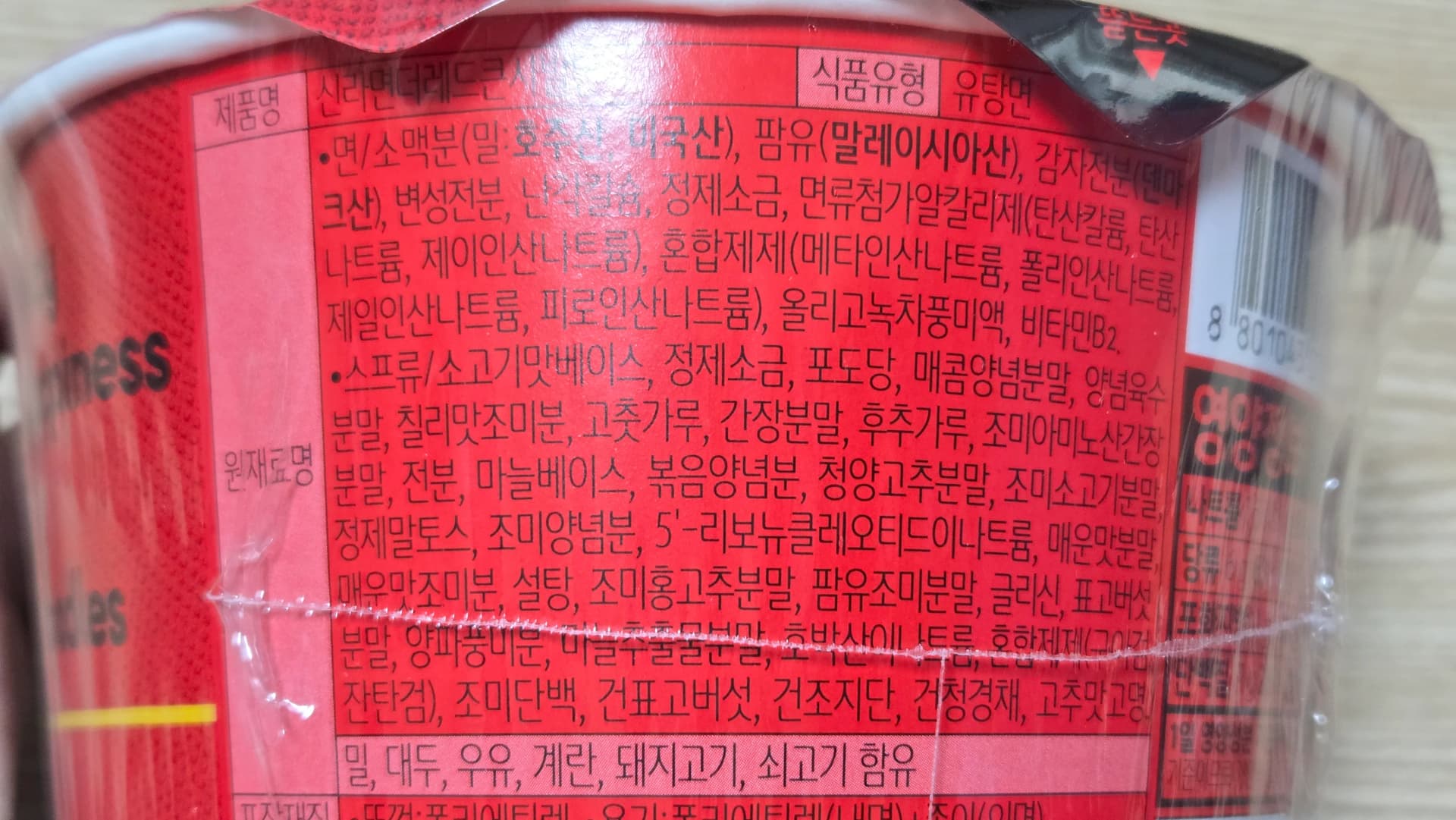
The Korean domestic version contains pork and beef, making it unsuitable for Muslim and Hindu consumers.
Halal-certified export versions are available in Indonesia, Saudi Arabia, and UAE. Look for the halal certification mark on the package.
❌ Looking for that classic packet Shin flavor in cup form
❌ Watching your sodium intake (one cup = 84% of daily limit)
⭐ Final Verdict
Wears the Shin Ramyun name, but delivers a completely different flavor experience.
Heat level definitely stepped up, and noodle quality is solid for cup noodles.
Just don't expect that familiar original Shin broth depth—you might be caught off guard.
🧾 TL;DR: "Moderately spicy, quick one-cup meal" = Shin Ramyun The Red King Size Bowl.
Table of Contents
11 items
Stumbling Upon Shin Ramyun The Red Cup Noodles at the Supermarket
On my way home from work today, I stopped by the neighborhood supermarket and was immediately drawn to an intensely red package on the shelf. When I got closer, I realized it was Shin Ramyun The Red cup noodles. I knew The Red version had been out for a while, but coming face-to-face with it like this made me think, "I've gotta try this."
Here's the thing—when it comes to Shin Ramyun, the original packet version is what's ingrained in my body. That spicy, hearty broth flavor I've been eating since childhood, cooked in a pot, is my baseline. So Shin Ramyun cup noodle versions have always felt slightly underwhelming to me. But this time it's not just Shin Ramyun, it's "The Red," right? With a Scoville rating of 7,500 SHU, more than double the original's heat level, I was genuinely curious whether Shin Ramyun The Red cup noodles could actually deliver that punch.
As someone who's loyal to the packet version, I'm going to give you my honest take on Shin Ramyun The Red cup noodles. Stay tuned!
Even the Shin Ramyun The Red Cup Noodles Lid Stands Out
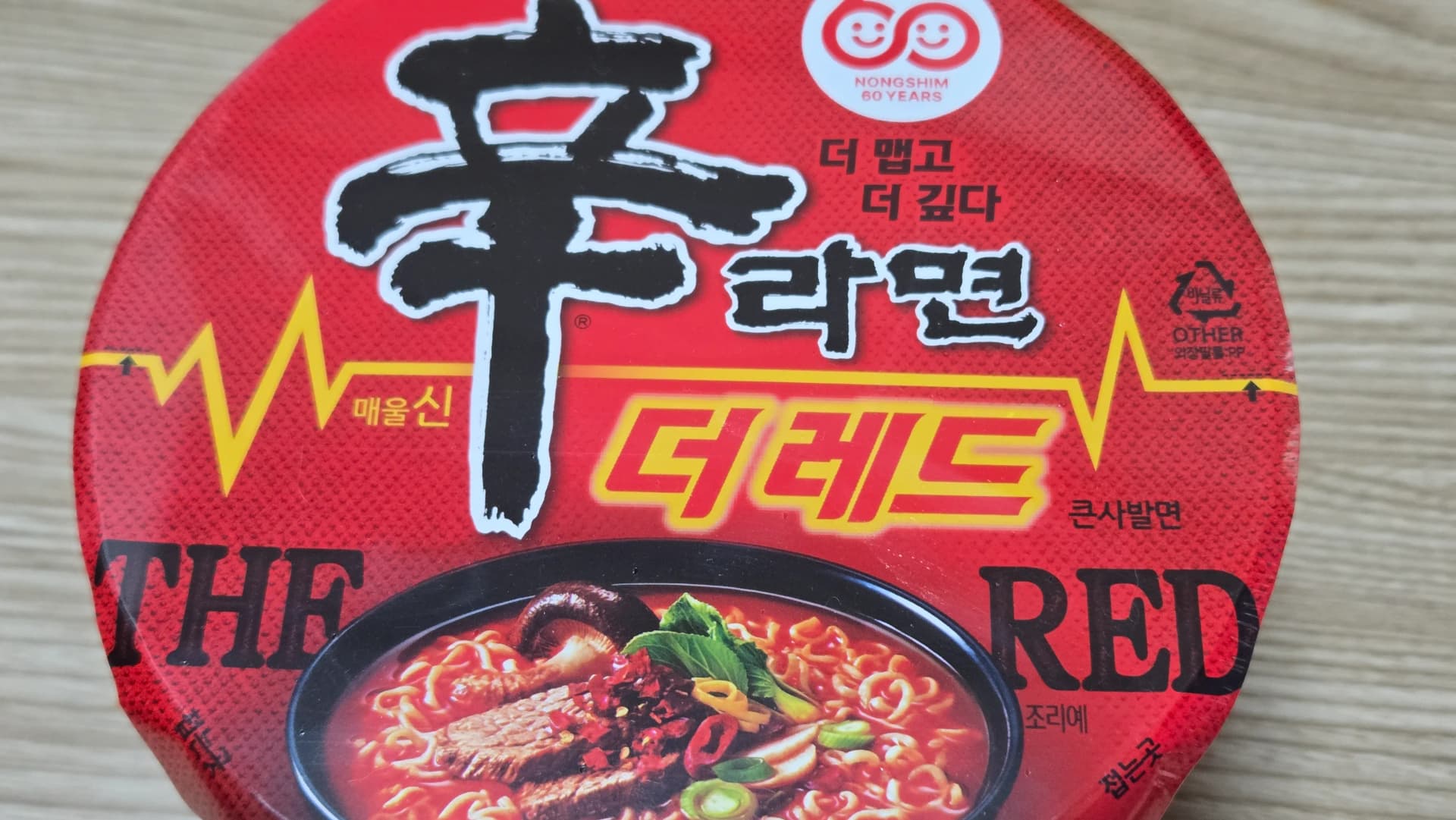
The lid alone is striking. It's got the phrase "Spicier and Deeper" stamped right on it, and if you place it next to a regular Shin Ramyun lid, the red tone is definitely more intense. There's also this yellow line that looks like a heartbeat monitor running across the lid, which is kind of a fun touch—as if to say, "This will make your heart race." Honestly, just looking at the lid made me think, "This is going to be different."
Shin Ramyun The Red Sodium Content—Let's Be Real
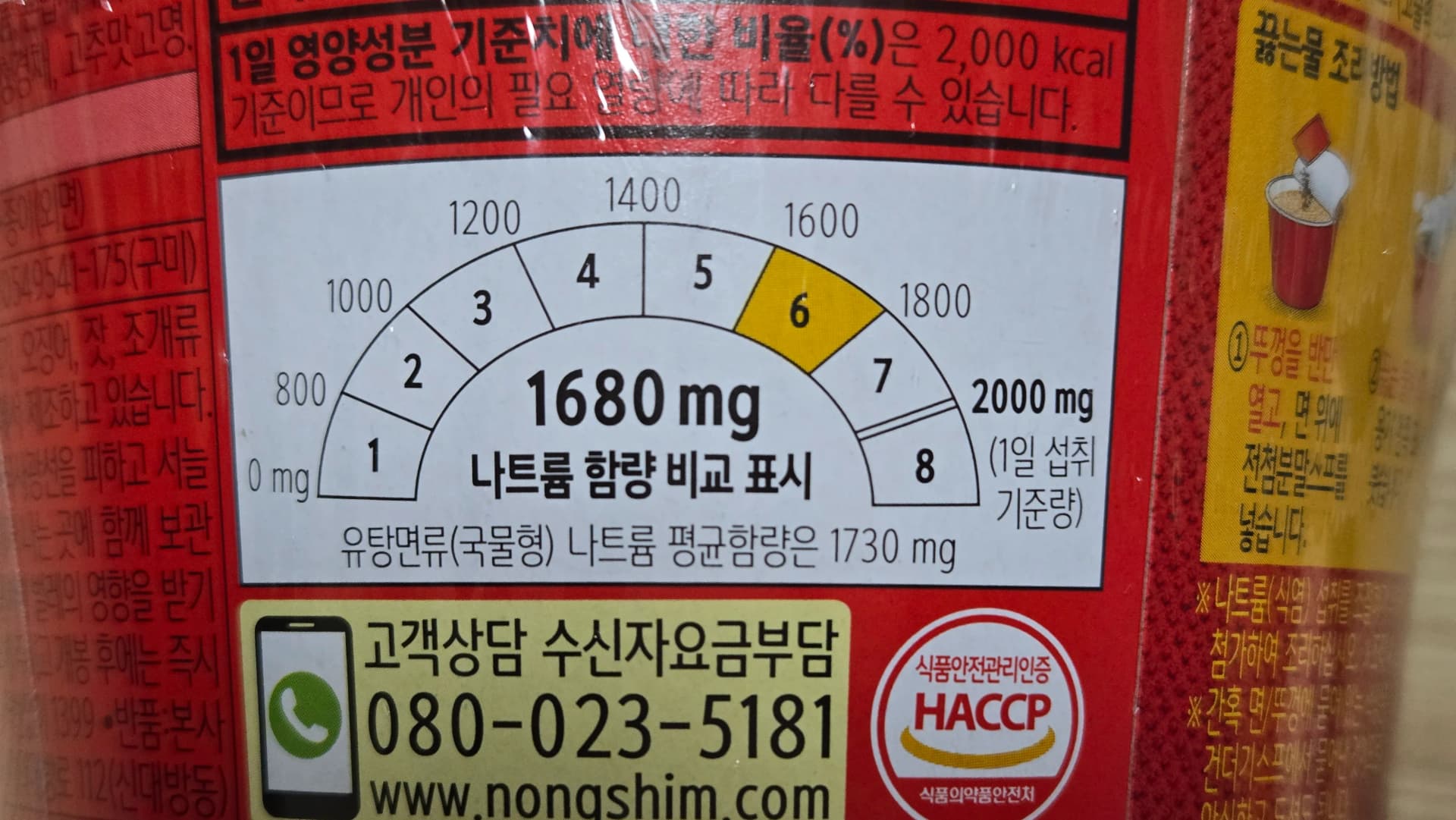
The sodium comparison chart catches my eye—it's at 1,680mg, which places it at level 6 out of 8. The average sodium for deep-fried noodles with broth is 1,730mg, so this is slightly below average, but... honestly, you're consuming 84% of the daily recommended 2,000mg from just this one cup of Shin Ramyun The Red.
For reference, the packet version of Shin Ramyun The Red has 1,790mg of sodium, so the cup noodles version is actually about 110mg lower. I guess it's because there's less broth in a cup, but still, 1,680mg in one meal is a heavy load. If you're sensitive to salt, I'd recommend leaving some broth behind or adjusting the amount of seasoning you use!
Complete Shin Ramyun The Red Cup Noodles Nutrition Facts
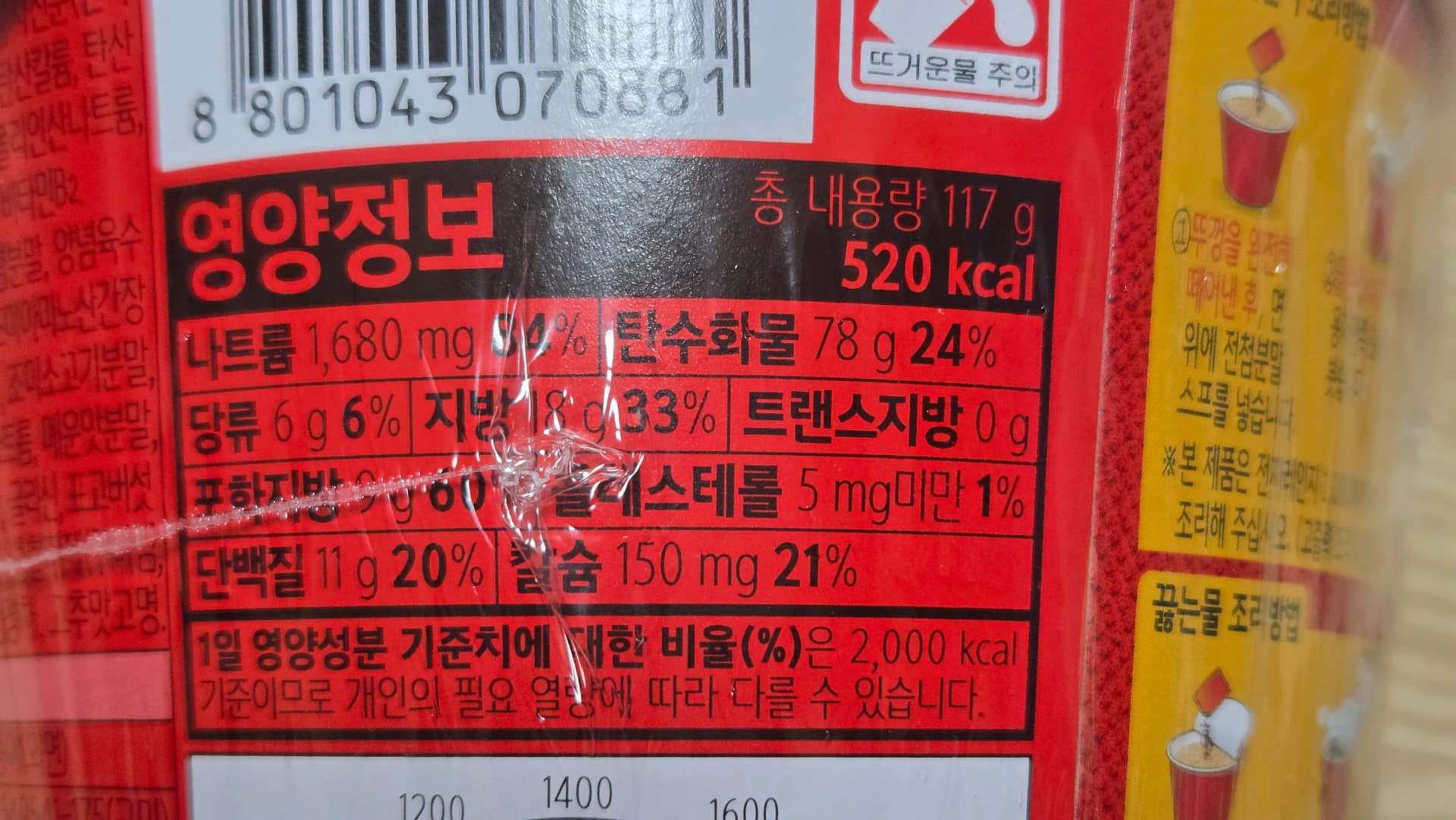
I took a close look at the nutrition information. Total content is 117g with 520 calories, which is pretty hefty for a single cup. The packet version of Shin Ramyun The Red is 535 calories, so they're nearly identical. It has 78g of carbs, 18g of fat (with saturated fat making up 9g, which is 60%!), and 11g of protein, which is actually higher than the packet version—that surprised me a bit. The 150mg of calcium (21%) is decent too. The good news is that trans fat is 0g, but that 60% saturated fat is somewhat concerning. An occasional late-night snack is fine, but every day? You know what I mean, right?
Nutrition FactsTotal Content 117 g 520 kcal
Sodium 1,680 mg84%Carbohydrates 78 g24%
Sugars 6 g6%Fat 18 g33%Trans Fat 0 g
Saturated Fat 9 g60%Cholesterol Less than 5 mg1%
Protein 11 g20%Calcium 150 mg21%
Percent Daily Values are based on a 2,000 calorie diet. Your daily values may be higher or lower depending on your calorie needs.
Shin Ramyun The Red Cup Noodles Cooking Methods—Boiling Water vs Microwave
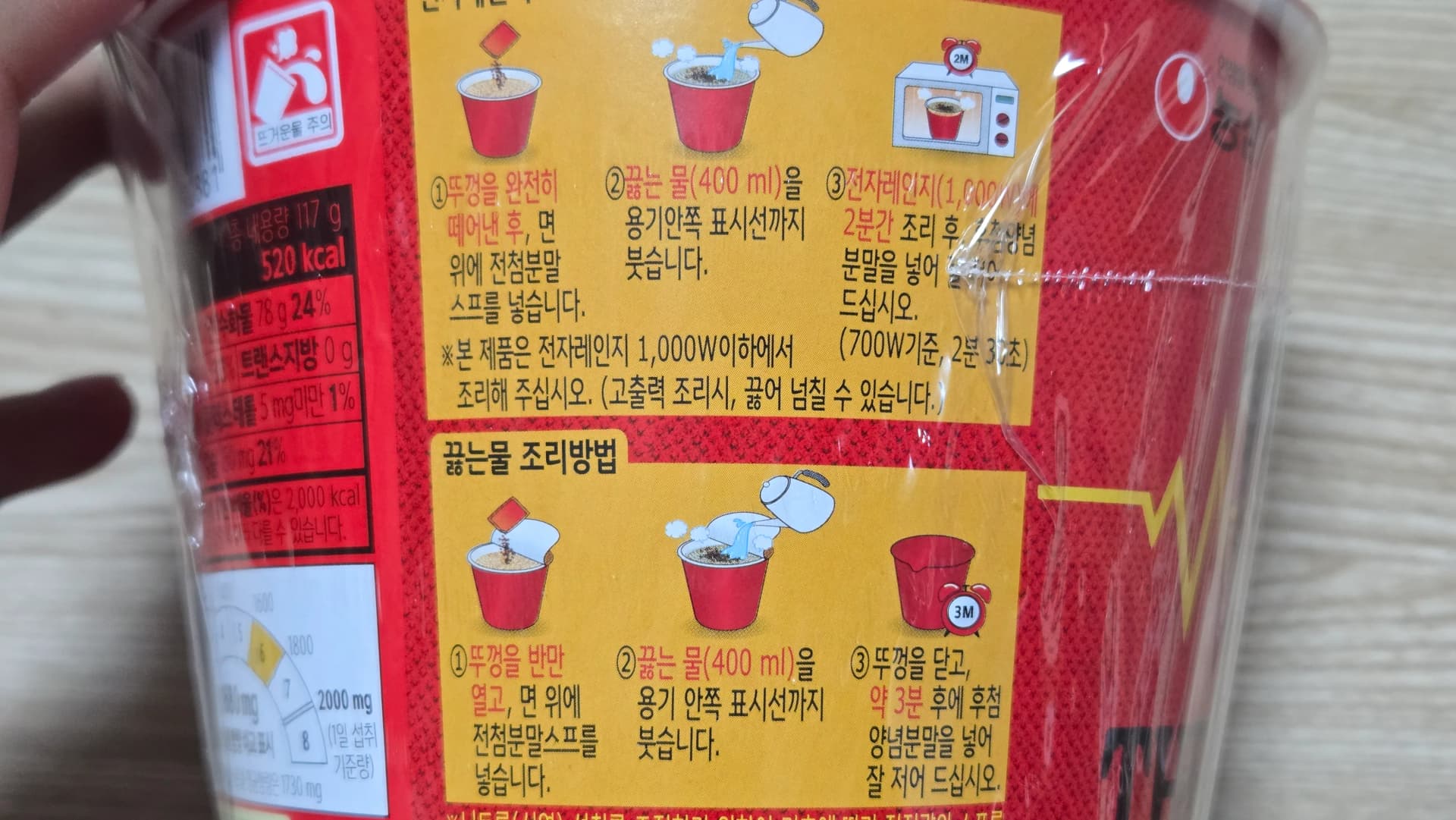
There are two cooking methods provided: microwave and boiling water. I went with the boiling water method.
For the microwave method, you completely remove the lid, add the pre-cooking powder soup on top of the noodles, pour 400ml of boiling water up to the fill line, microwave at 1,000W for 2 minutes, then add the post-cooking powder and mix well. If using 700W, it's 2 minutes and 30 seconds.
For the boiling water method, you open the lid halfway, add the pre-cooking powder soup on top of the noodles, pour 400ml of boiling water up to the fill line, close the lid and wait about 3 minutes, then add the post-cooking seasoning powder and stir well.
The key is the post-cooking powder. This is the core of Shin Ramyun The Red's spicy flavor, and it needs to be added later to preserve the heat. You can adjust the amount here to control the spice level to your preference.
Ingredient Check—International Readers, Please Read This
I looked at the ingredient list, and since our blog supports over 110 languages, there's an important point I need to address for international readers.
At the bottom of this product, it clearly states "Contains: wheat, soybean, milk, egg, pork, beef." Because it contains both pork and beef, the Korean domestic version of Shin Ramyun The Red cup noodles is not suitable for Muslim or Hindu consumers. Foreign travelers in Korea should definitely check this when purchasing at convenience stores or supermarkets.
However, Nongshim operates a dedicated halal production line at their Busan factory, so there is a halal-certified version of Shin Ramyun Red for export. The halal version removes meat components and substitutes them with soy and wheat-derived ingredients for flavor. It's distributed in Muslim countries like Indonesia, Saudi Arabia, and the UAE, so if you're in those countries, you can safely consume it by checking for the halal mark on the package.
As for other ingredients, the noodles contain wheat flour (from Australia and the USA), palm oil (from Malaysia), potato starch, and the soup base includes beef-flavored base, red pepper powder, and Cheongyang chili pepper powder. This Cheongyang chili pepper powder seems to be the key to Shin Ramyun The Red's spicy kick.
Shin Ramyun The Red Cup Noodles Contents
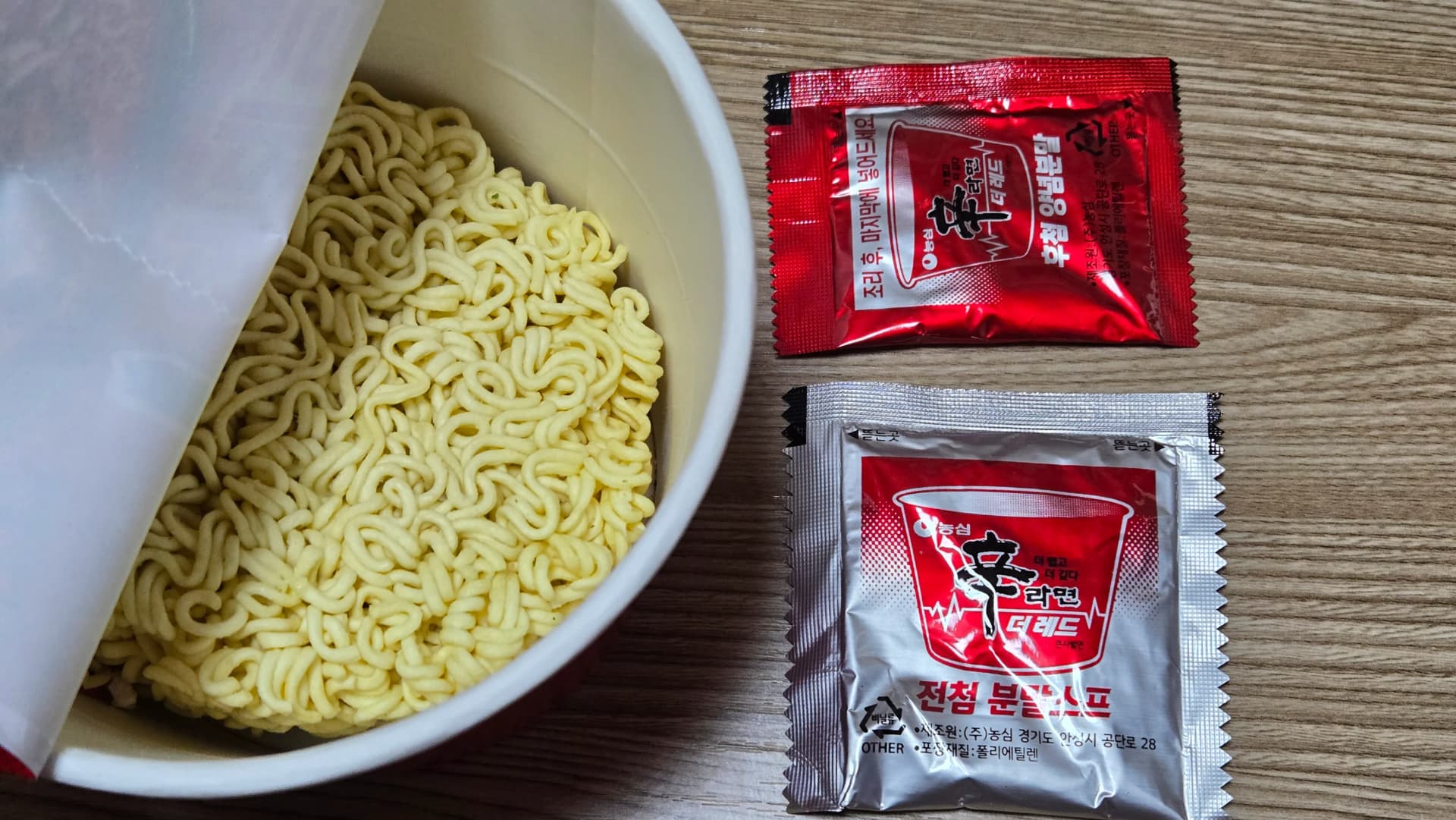
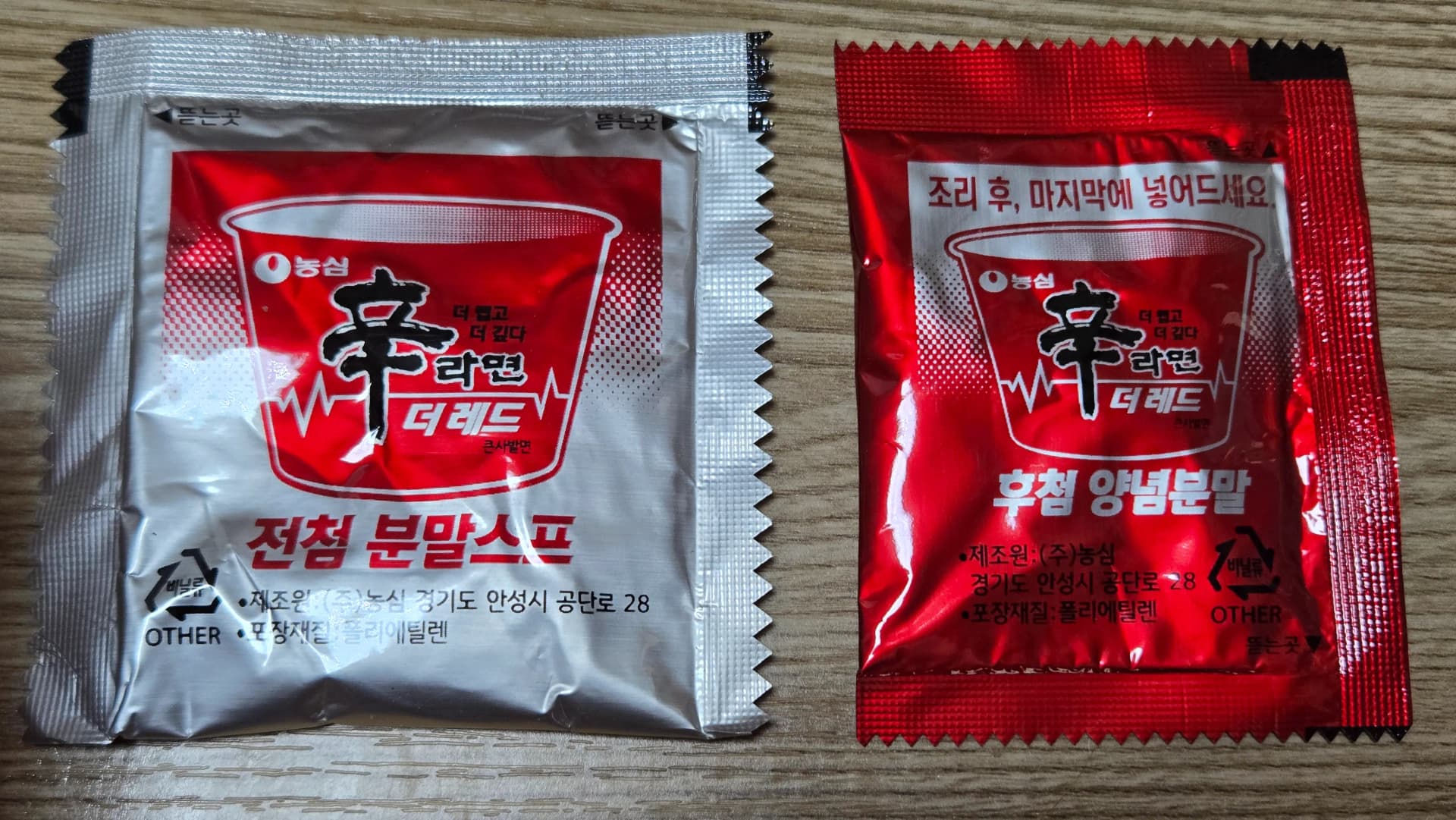
When I opened the lid, the contents were simple: noodles and two soup packets. The red packet is the post-cooking seasoning powder, and the silver packet is the pre-cooking powder soup. The pre-cooking one goes on top of the noodles before you add water, and the post-cooking one goes in after it's done—this post-cooking powder is the key that determines Shin Ramyun The Red's spice level. You can adjust the amount here.
When you place them side by side, the size difference is clear. The pre-cooking packet is much larger than the post-cooking one, and the post-cooking packet helpfully says "Add last, after cooking."
I Cooked Shin Ramyun The Red Cup Noodles Myself
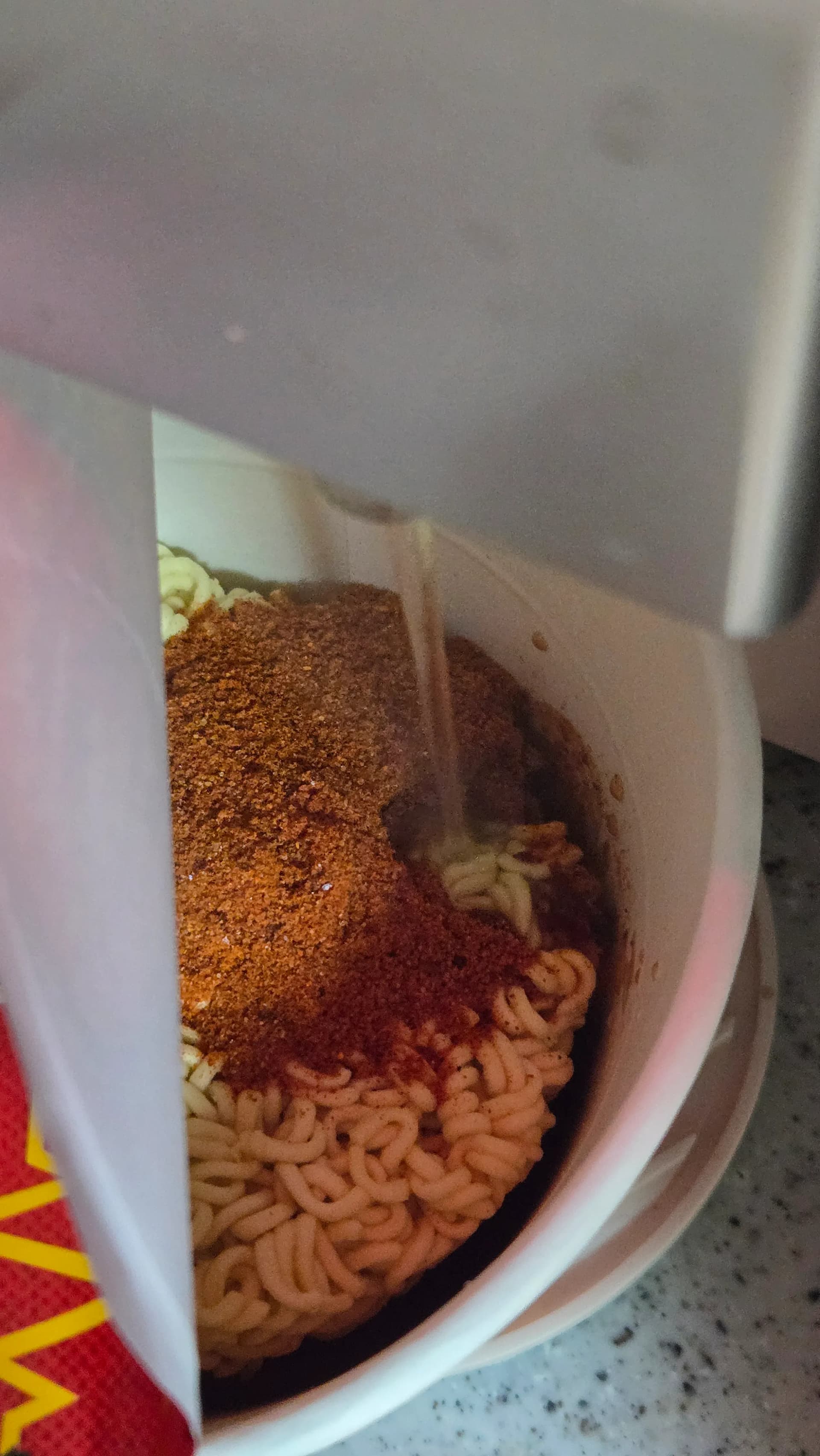
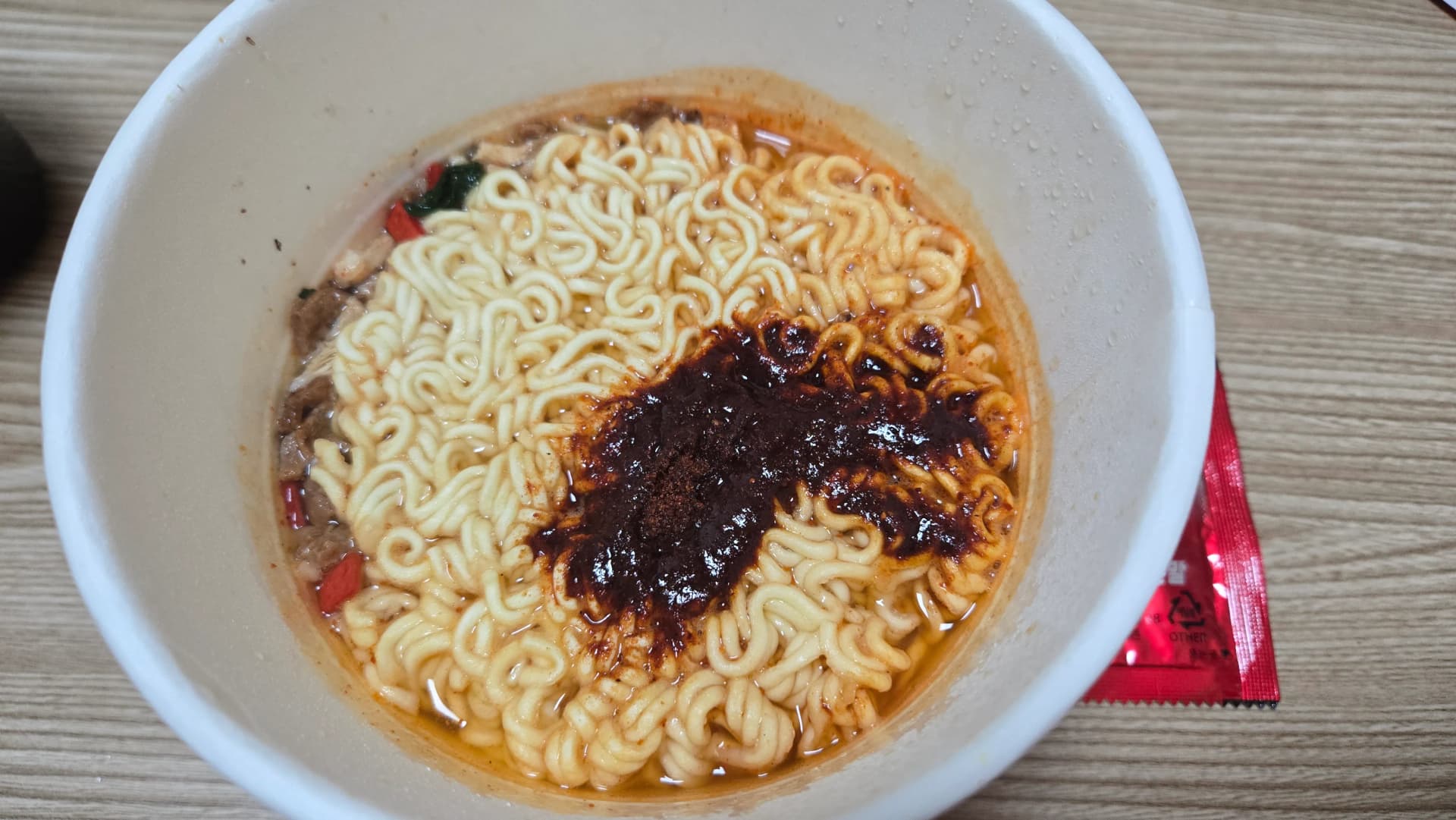
Sprinkling the pre-cooking soup and pouring boiling water. The red powder piles up on top of the noodles, and as soon as the water hits it, a spicy aroma wafts up. Even at this stage, you can already feel the spicy presence of Shin Ramyun The Red.
After closing the lid and waiting about 3 minutes, I opened it to find the noodles properly cooked and the broth turned a rich red. Even with just the pre-cooking soup added, the color is pretty intense. Now, adding the post-cooking seasoning powder will complete the true Shin Ramyun The Red.
Adding the Post-Cooking Seasoning Powder—The Real Heat Source
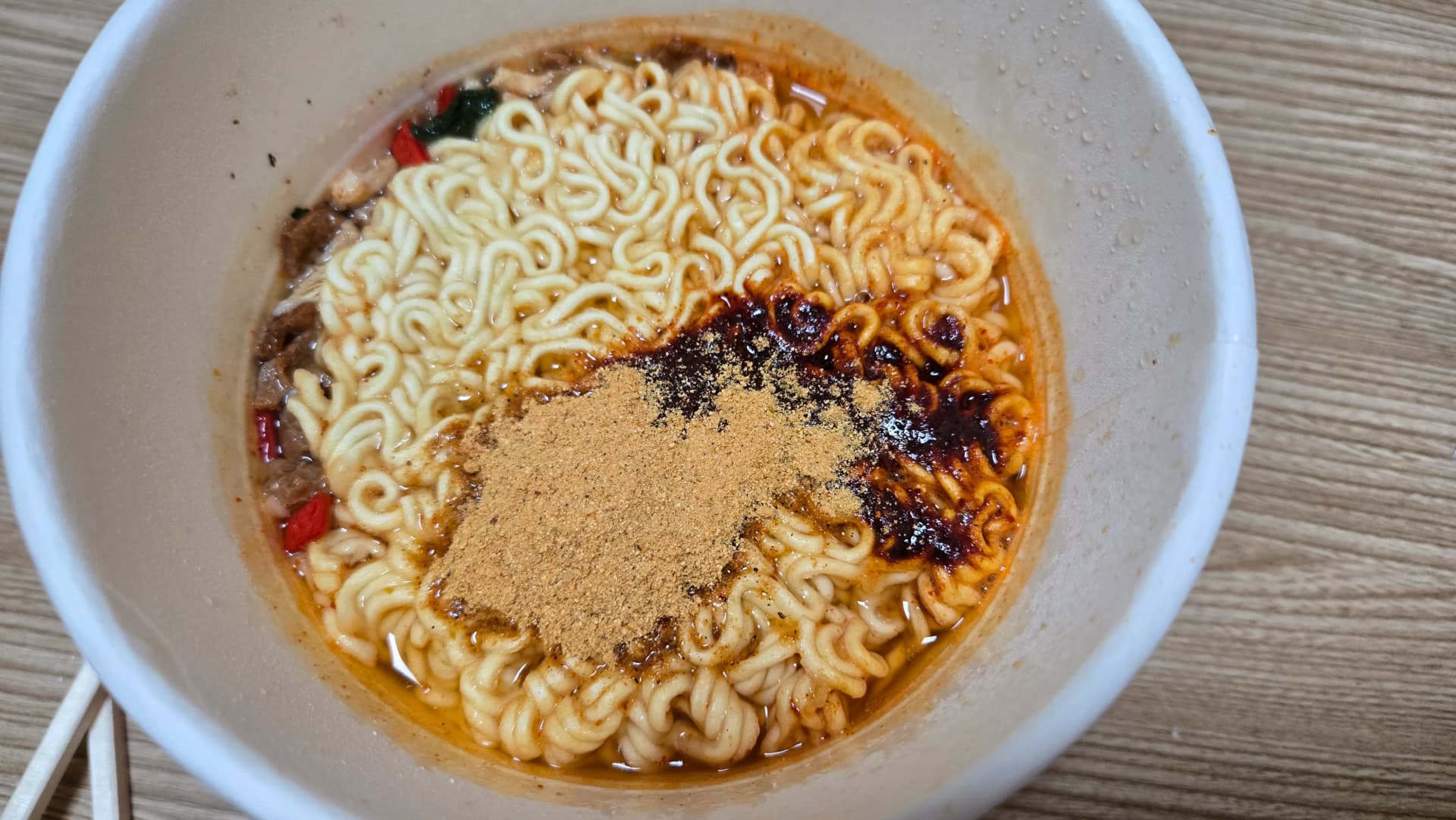
This is the moment I add the post-cooking seasoning powder. Brown powder piles up high on top of the noodles, and this is the true core of Shin Ramyun The Red's spicy flavor. Looking at the amount, it's more than I expected, making me think, "If I add all of this, it's gonna be really spicy." You can adjust the amount here based on your spice tolerance, but I went ahead and added it all.
Lifting Up the Noodles
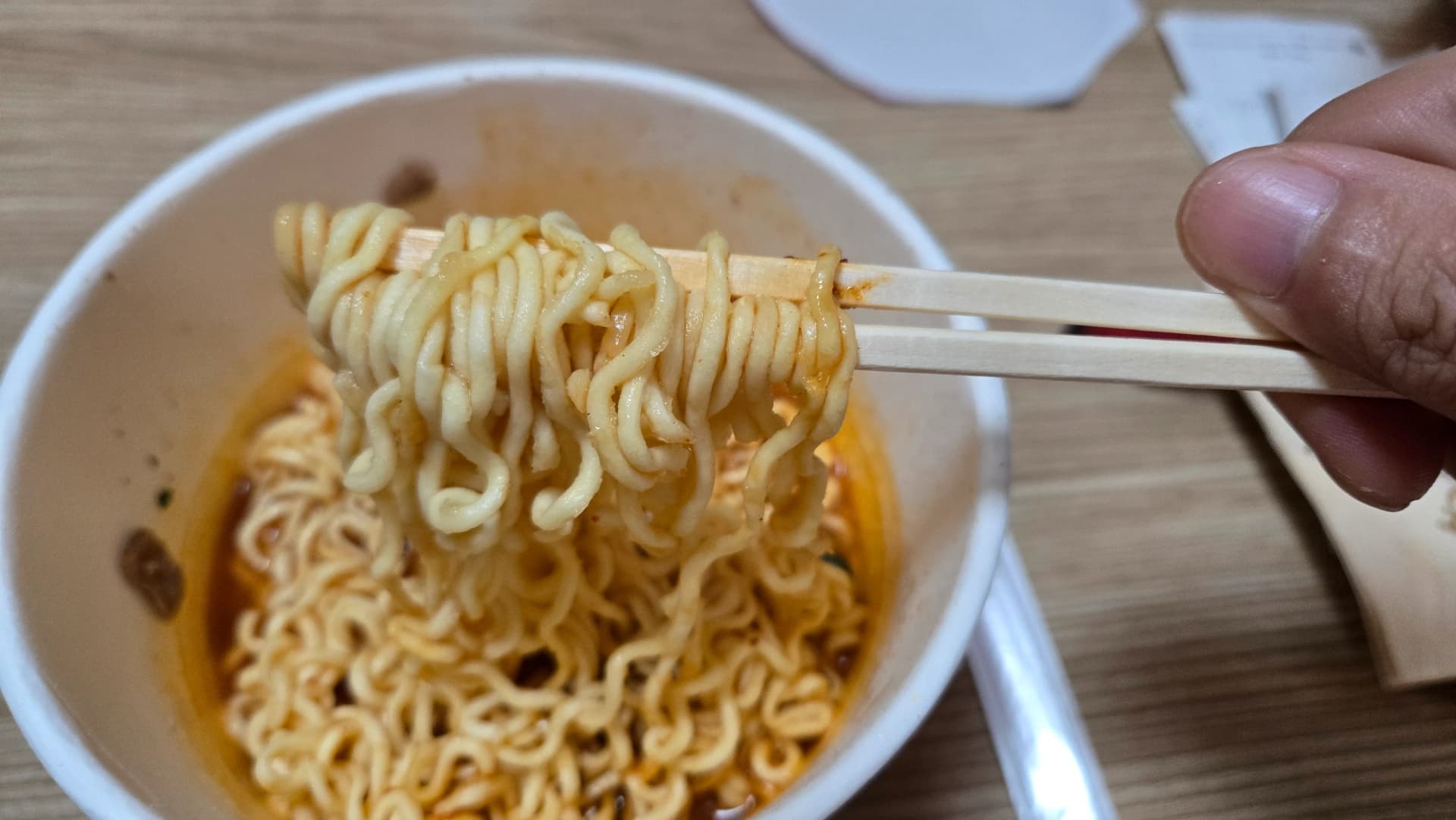
After mixing well, I lifted up the noodles. Shin Ramyun's characteristic thick noodles are soaked with broth, and you can see the red liquid dripping down. The thickness of the noodles is quintessentially Shin Ramyun. It looks like the texture will be almost identical to the packet version, and for Shin Ramyun The Red cup noodles, the noodles turned out really substantial. Now it's time to actually taste it.
Shin Ramyun The Red Cup Noodles Taste Evaluation—Less Spicy Than Expected, and an Unfamiliar Shin Ramyun
I took my first bite, and yes, the spice definitely kicks in. A tingling sensation spreads across my tongue, making me think, "Ah, so this is Shin Ramyun The Red," but... to be honest, it was less spicy than I expected. Given the 7,500 SHU rating, the perceived heat felt like it was a notch below what I'd anticipated.
Especially compared to truly spicy ramyun like Teumsae (Gap) ramyun, it's definitely not on that level. Teumsae makes you literally gasp for air while eating, but Shin Ramyun The Red doesn't go that far. For Koreans or people from countries that enjoy spicy food, this is at a comfortably edible level—it's absolutely not challenge-level spicy. If you were planning to film a "Red Challenge" video for YouTube, you might be disappointed.
What surprised me even more was the flavor. I was expecting that characteristic original Shin Ramyun broth taste—the familiar beef stock base with a spicy kick that I've been eating since childhood—but it felt like I was eating a completely different ramyun. It's not the traditional Shin Ramyun flavor with added spice; it's like they created an entirely new line of ramyun. The name "Shin Ramyun" is attached, but the flavor direction itself is different. The broth depth feels shallower than the original, and because the spice is emphasized, it seems like Shin Ramyun's inherent umami flavor gets buried.
If you're expecting that rich broth flavor of packet Shin Ramyun, you might be a bit taken aback. Don't get me wrong—I'm not saying it's bad. Just think of it as a different line of ramyun. This is purely my personal opinion.
The spicy flavor did create a tingling sensation on my tongue, but I kept reaching for more. I ended up finishing the whole thing, and it was enjoyable. As a meal replacement, it's a perfectly fine choice. However, given my age and health concerns, when I think about that 1,680mg sodium content, drinking all the broth feels like too much. It's probably better to just eat the noodles and ingredients and leave some broth behind.
Shin Ramyun The Red cup noodles will be a good choice for those who enjoy spicy food. I recommend it to anyone who wants a moderately tingly, filling meal, rather than extreme spice seekers.