
Boeing 747-8i Upper Deck Business Class — My Lucky Flight
Table of Contents
14 items
A China Airlines Delay and an Unexpected Upgrade to Korean Air's Boeing 747-8i Prestige Class
I've been on dozens of flights over the years, but this was the only time I was genuinely thrilled about a delay.
It was November 2019, and I was heading back to Korea after living in Thailand for three years. The original itinerary had me flying China Airlines business class from Bangkok's Suvarnabhumi Airport through Taipei Taoyuan International Airport, then connecting to Incheon Airport. When the check-in agent at Suvarnabhumi told me the Bangkok-to-Taipei leg was delayed and I'd miss my Taipei-to-Incheon connection, I was honestly pretty annoyed. All she said was they'd sort it out once I got to Taipei.
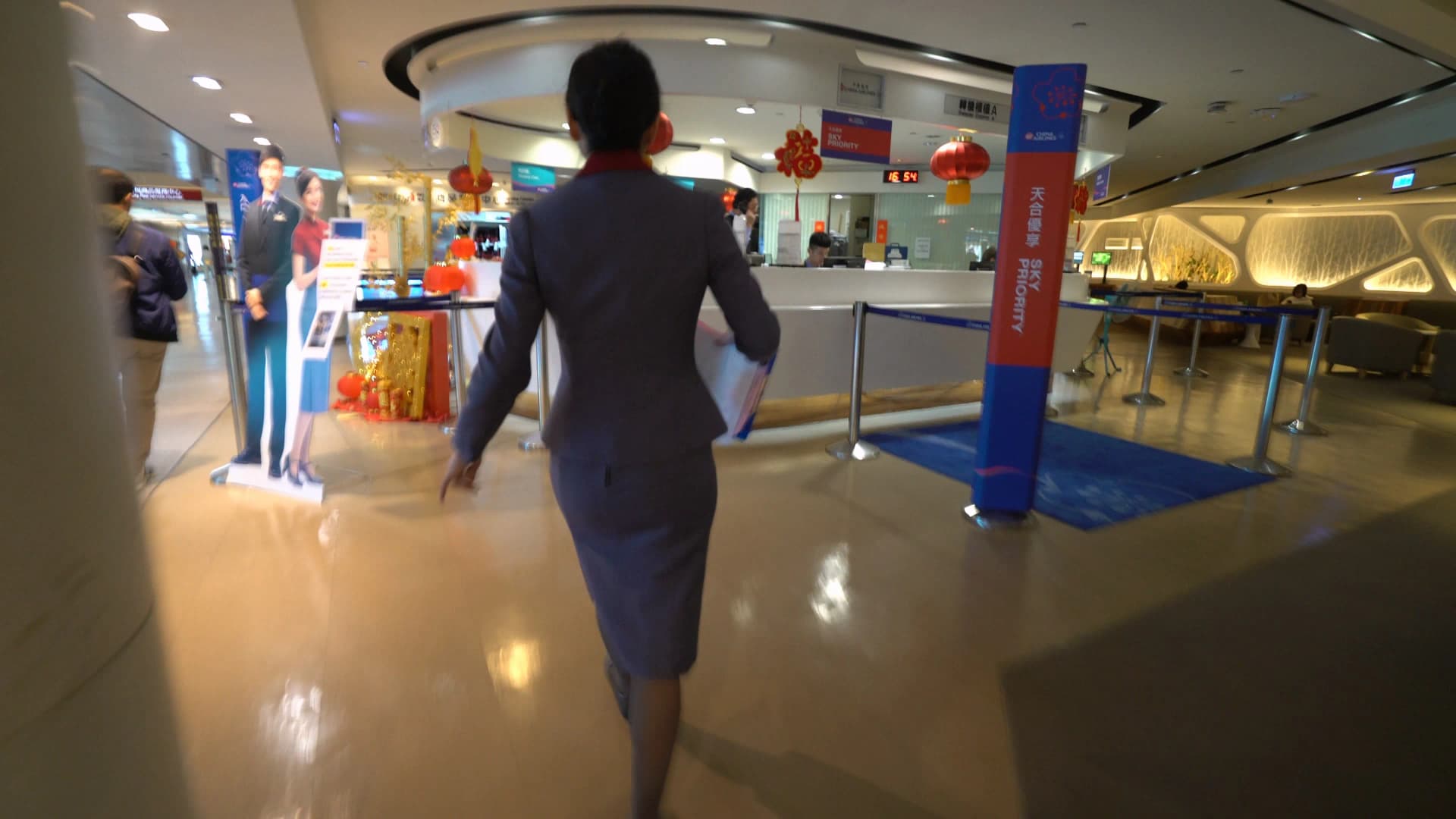
I boarded the Taipei flight anyway, and the China Airlines flight attendants on that leg really impressed me. Passengers were understandably on edge because of the delay, but the crew walked around the cabin individually explaining the connection situation to each affected passenger. It wasn't even their job, but I remember one of them with a concerned look saying, "It'll definitely be resolved in Taipei." That put me at ease, so I landed at Taoyuan and headed straight to the China Airlines counter. The agent apologized and handed me a rebooking ticket. I looked down at it — Korean Air, Boeing 747-8i, Prestige Class. For context, Korean Air's Prestige Class is their branding for what other airlines call business class. It's the same tier, just Korean Air's own name for it. Anyway — the 747-8i in Prestige. Every ounce of frustration about the delay evaporated on the spot.
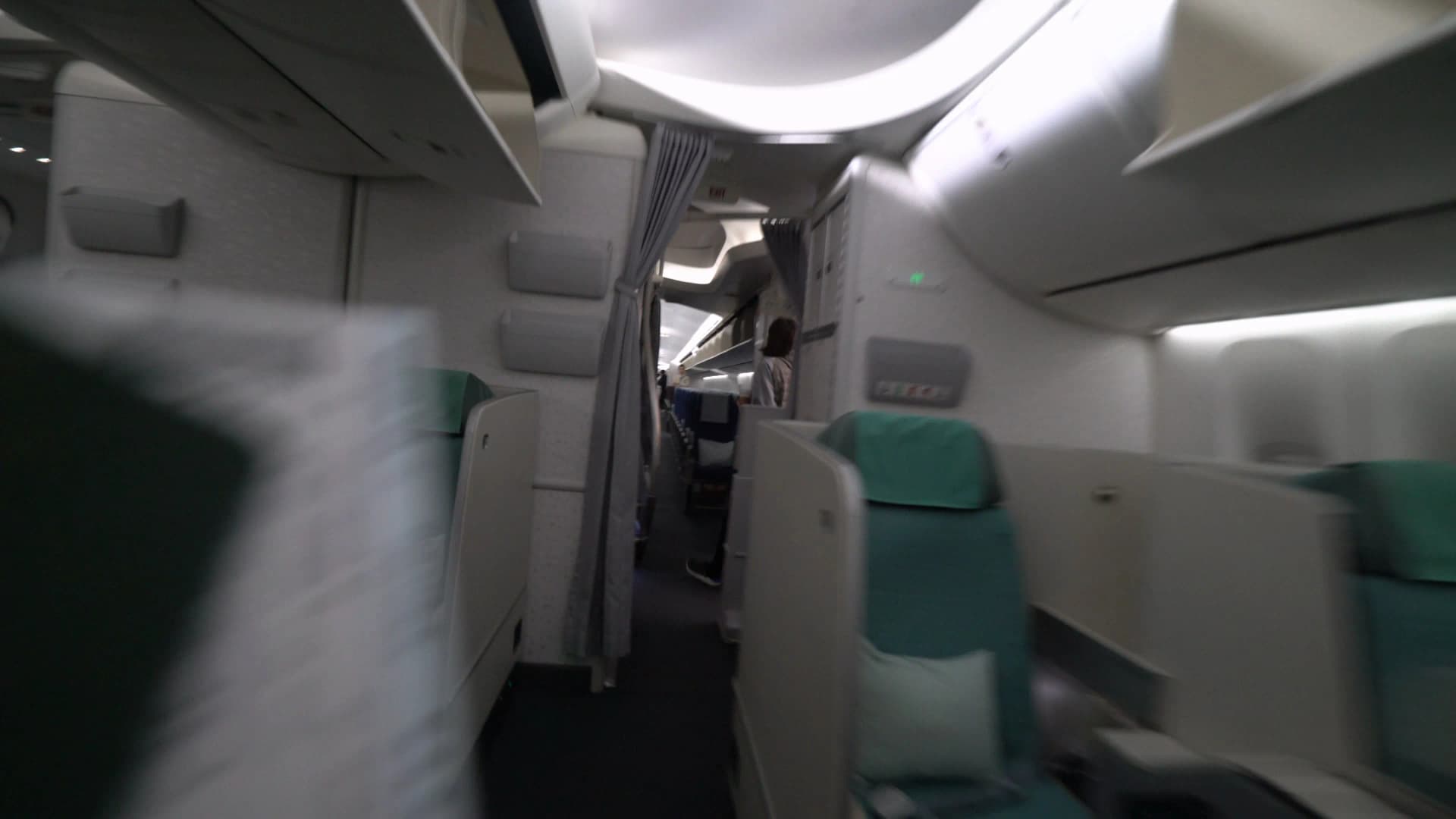
Why the Boeing 747-8i Is So Special — Only 48 Ever Built
The Boeing 747-8 Intercontinental is the final passenger variant of the legendary 747 series, known worldwide as the "Queen of the Skies." It represents the ultimate evolution of the most iconic commercial aircraft in aviation history. Lufthansa was the first airline to operate it commercially in 2012, and Korean Air became one of the largest operators globally, running 10 of these jets as of 2019.
But here's what makes this aircraft truly rare. Boeing built only 48 passenger versions of the 747-8i worldwide before permanently ending production in 2017. No more will ever be made. When I flew on it in 2019, it was already an uncommon bird, and the situation as of 2026 is even more dramatic. Today, only three airlines in the entire world still fly the 747-8i with regular passengers on board: Lufthansa with 19 aircraft, Air China with 7, and Korean Air with roughly 5. That's it. Just a few years ago Korean Air had 10, but they sold 5 — and where those planes ended up is a jaw-dropping story I'll get to at the end of this post.
The 747-8i isn't just for commercial airlines, either. Multiple governments operate it as a head-of-state transport. South Korea's presidential aircraft, known as "Code One," is a Korean Air 747-8i on a long-term lease. The next-generation U.S. Air Force One — the VC-25B — is also being built on the 747-8 platform. Beyond that, Brunei, Morocco, Kuwait, and Turkey all use VIP-configured 747-8i jets as their official state aircraft, and a Qatar royal family 747-8i was reportedly offered to President Trump in 2025 for potential use as an interim Air Force One. In short, this is a plane that doubles as both a commercial airliner regular people can fly on and a flying command center for world leaders. The fact that I ended up on one because of a delayed connection — well, you can probably guess how lucky I felt that day.
How Rare Is the Boeing 747-8i?
Total Produced (Passenger Version): 48 worldwide — production ended permanently (2017)
Airlines Still Flying It (2026): Lufthansa 19 / Air China 7 / Korean Air ~5 — only 3 airlines globally
Government/State Aircraft Operators: South Korea (Code One), USA (VC-25B in production), Brunei, Morocco, Kuwait, Turkey, Qatar Royal Family
Nickname: Queen of the Skies — the final passenger model of the Boeing 747 series
Sources: Simple Flying, Gate Checked, Wikipedia, Planespotters.net, official government disclosures (as of April 2026)
Korean Air Boeing 747-8i Prestige Class (Business Class) Key Specs
Aircraft: Boeing 747-8 Intercontinental (747-8i)
Total Seats: 368 (First 6 / Prestige 48 / Economy 314)
Upper Deck Prestige Layout: 2-2 staggered (~22 seats)
Main Deck Prestige Layout: 2-2-2 (~26 seats)
Seat Pitch: 75 inches / 191 cm
Seat Width: 21 inches / 53 cm
Bed Mode Length: ~72 inches / 183 cm
Recline: 180° full-flat
Seat Manufacturer: B/E Aerospace (now Collins Aerospace)
Monitor: 17-inch HD touchscreen + remote control with built-in secondary display
Power: 110V AC outlet + USB-A port
Sources: SeatMaps.com, Business Traveller, Korean Air official website
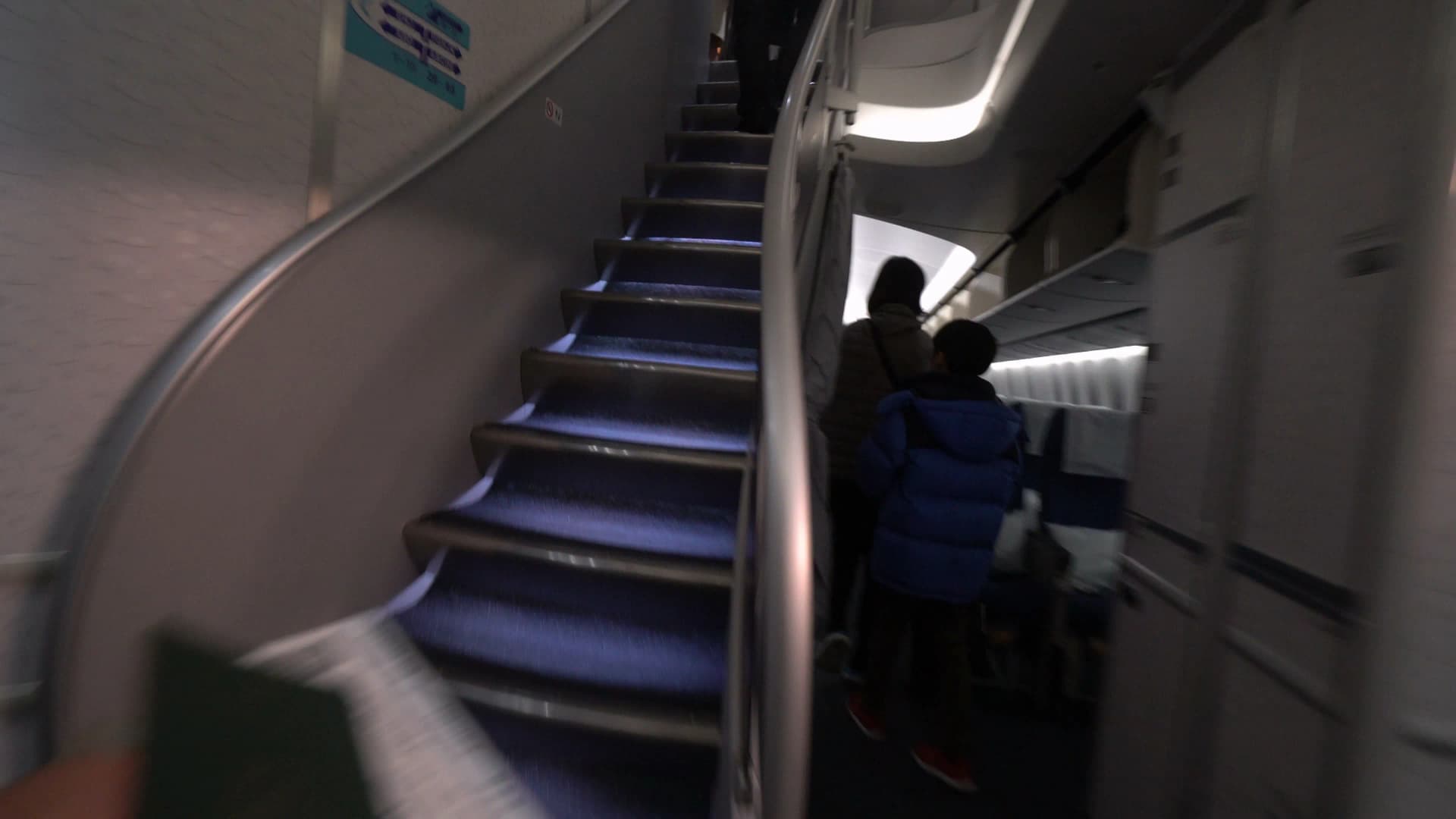
Boarding the Boeing 747-8i and Climbing the Stairs to the Upper Deck
The upper deck staircase is one of the most iconic features of any Boeing 747, and climbing it felt like stepping into a different world. I entered through the front door (L1 door) and immediately caught that distinctive cabin smell — a mix of new aircraft and in-flight meal prep. If you fly often, you know exactly what I mean. It's the smell that makes it feel real. Right inside, the main deck Prestige section was visible, but my seat was upstairs on the upper deck. I walked through the main deck Prestige cabin toward the back and there it was — the staircase leading up to the second floor. This was 2019, before Korean Air's cabin interior refresh, so if you've flown Korean Air more recently, the color scheme might look different from what you see in my photos. Back then, everything was deep blue and beige tones throughout.
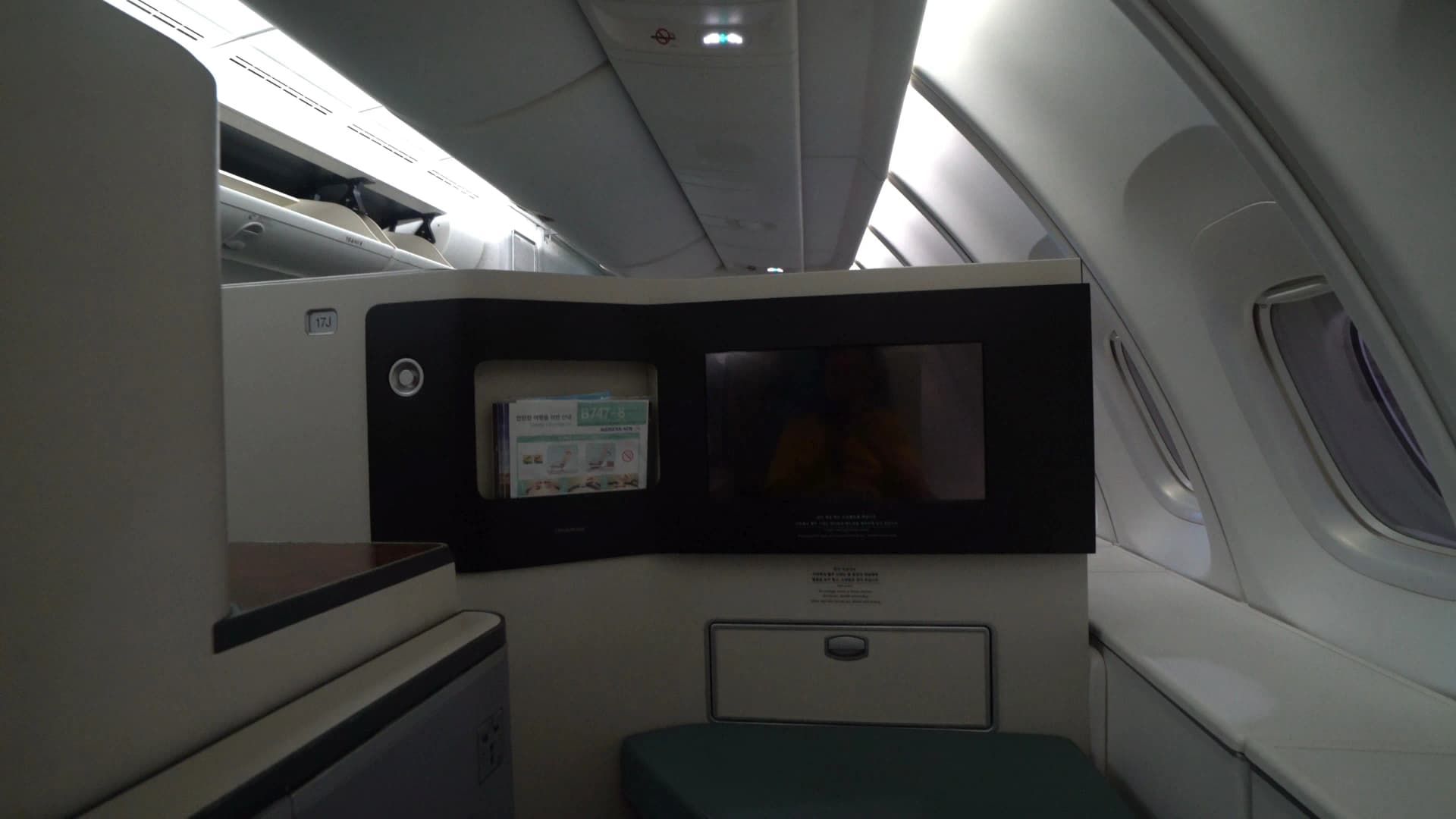
First Impressions of the Korean Air 747-8i Upper Deck Prestige Class Seat
Korean Air's upper deck Prestige Class on the 747-8i features a 2-2 staggered layout with roughly 22 seats — a noticeably more intimate configuration than the main deck's 2-2-2 arrangement. That means two fewer seats per row, which translates to more personal space and a quieter cabin. The moment I sat down, I could feel the difference immediately.
I found my window seat upstairs and settled in. The assigned flight attendant came over right away, greeted me by name, and thanked me for flying with them — as if I'd been a confirmed passenger all along rather than a last-minute rebooking from a delay. Coming off the warm service I'd just received from the China Airlines crew, I remember thinking how consistently good Asian carrier service is. Whether it's a Korean airline or a Taiwanese one, there's something about the way these flight attendants engage that's genuinely personal. Whenever my foreign friends ask me why they love Korean airlines, crew service is almost always the first thing they mention.
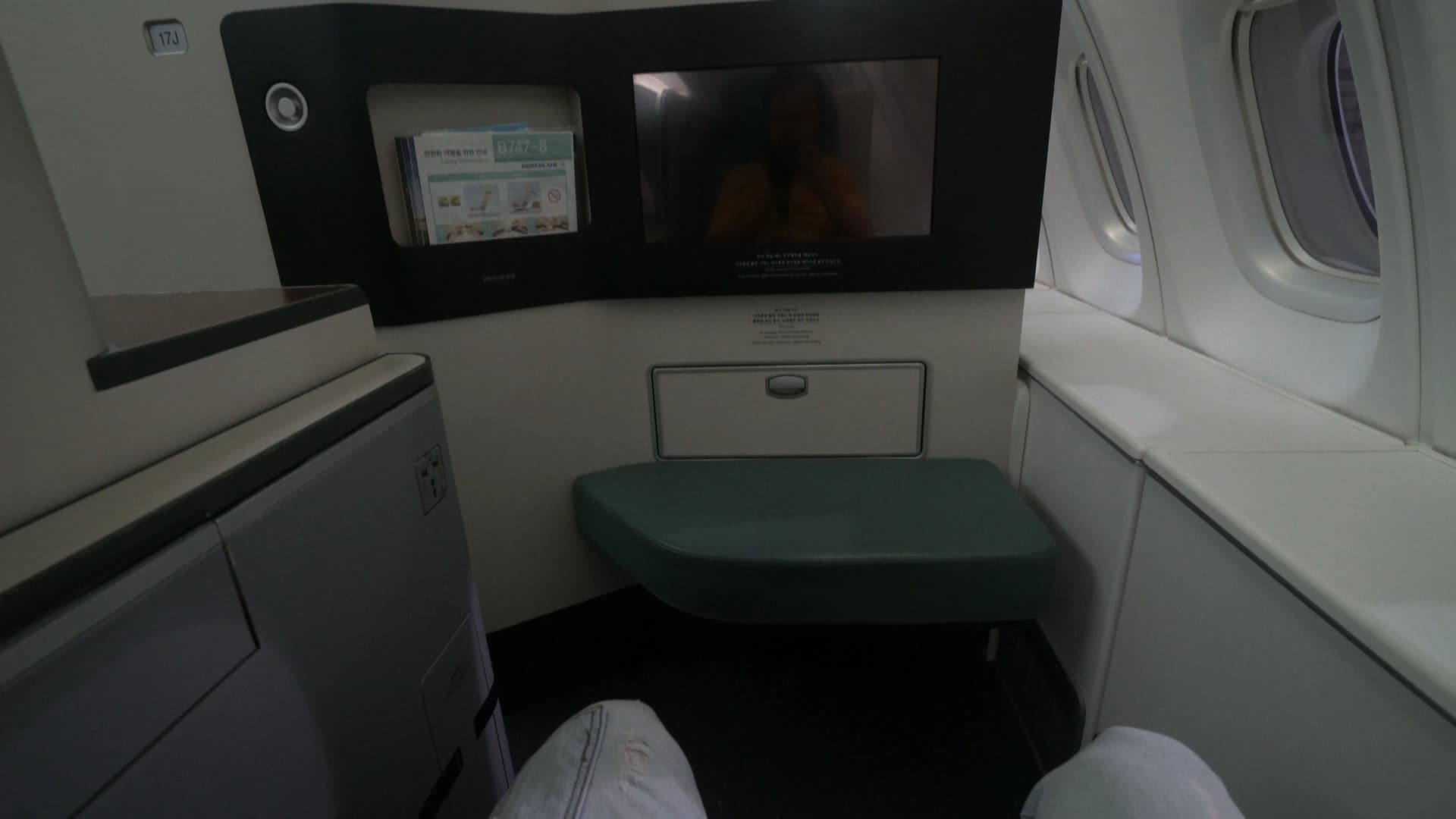
75-Inch Seat Pitch — Not Much Different from First Class in Practice
No exaggeration — a 75-inch (191 cm) seat pitch means your legs don't touch anything in front of you just sitting normally. I'd flown Korean Air First Class once before using miles, and honestly, the difference in legroom feel wasn't as dramatic as you'd expect. First Class has an 83-inch (211 cm) pitch, so there's technically an 8-inch gap on paper, but in Prestige I could still fully extend my legs and rest my feet on the footrest. The perceived difference felt smaller than the numbers suggest. I'd also just stepped off a China Airlines Boeing 777-300ER business class on the previous leg, so the contrast in spaciousness when I sat down in the 747-8i upper deck hit even harder.
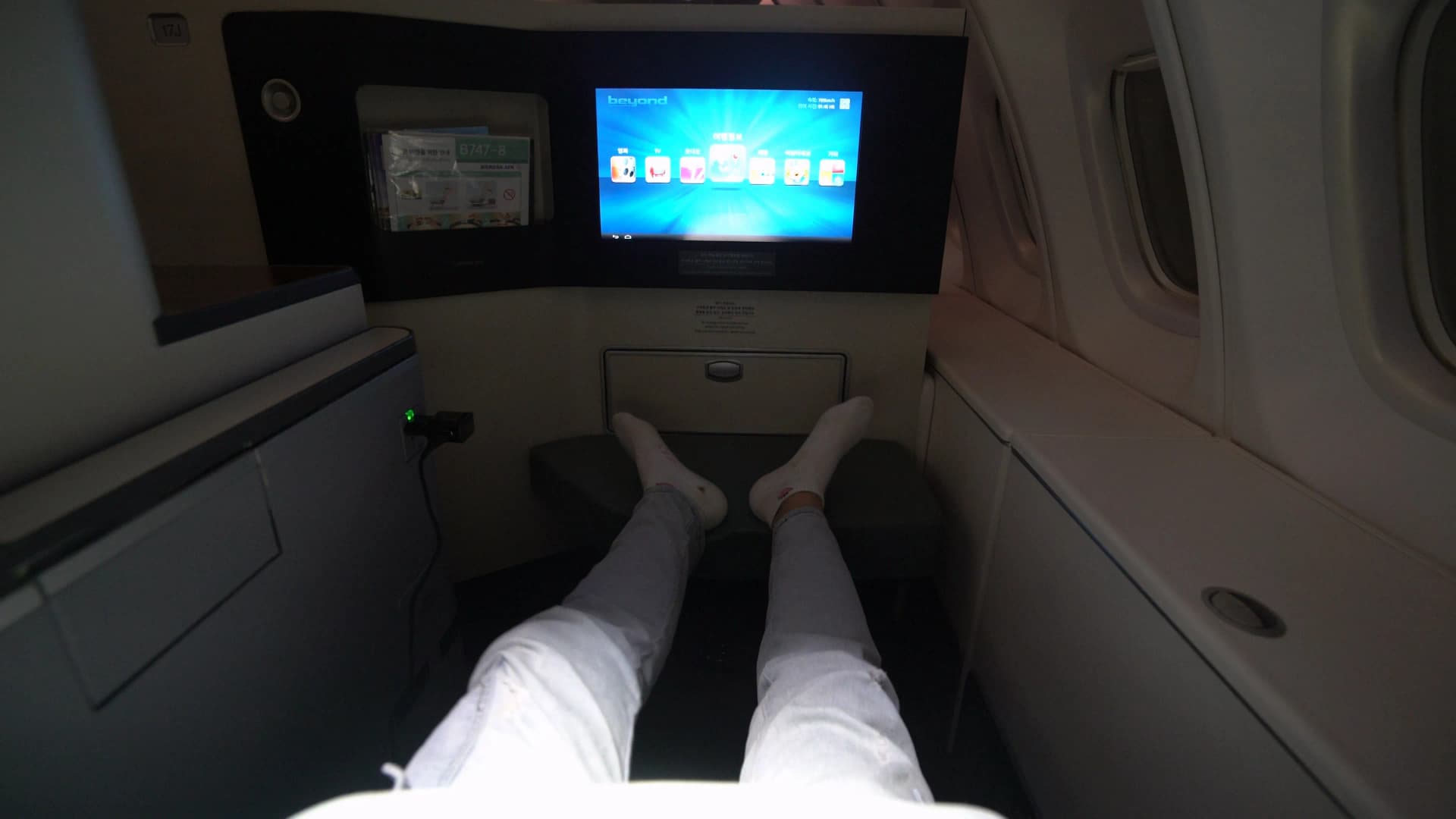
I stretched my legs all the way out and still couldn't reach the end. For reference, I'm 5'10" (178 cm). I spent the entire flight watching movies in this position, and 2 hours honestly felt too short for a seat this good.
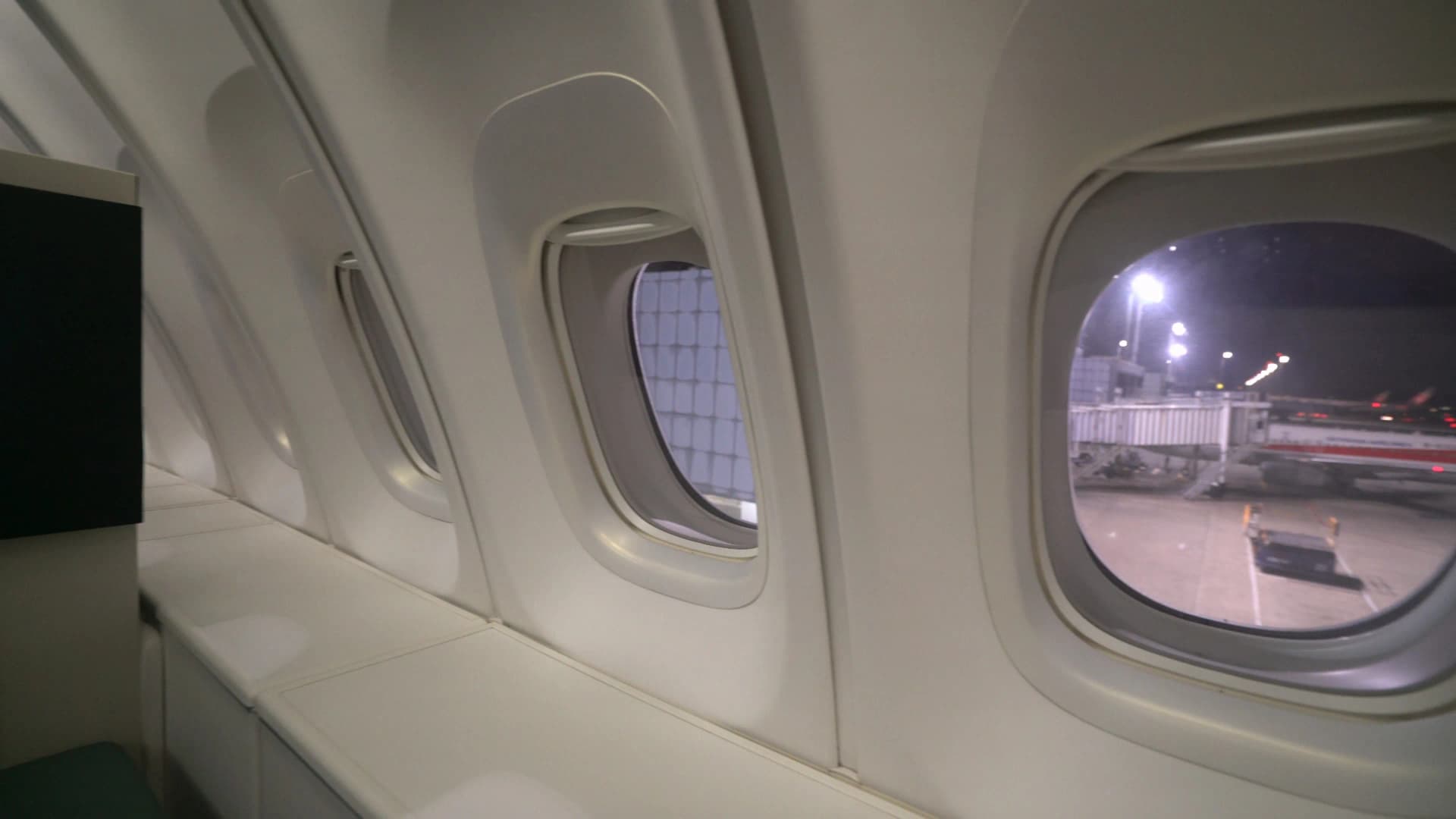
Four Windows All to Myself — The Real Perk of an Upper Deck Window Seat
Another standout feature of the window seat: I had four windows to myself. In economy, you're lucky if one window lines up with your seat. Here, I had four all to myself, which gave me a panoramic field of view. The upper deck window seats also benefit from the 747's distinctive curved fuselage wall, which creates a cozy, almost cocoon-like feeling. Below the curved wall, there's a deep personal storage nook — big enough to comfortably fit a backpack — so you don't need to keep getting up to access the overhead bin.
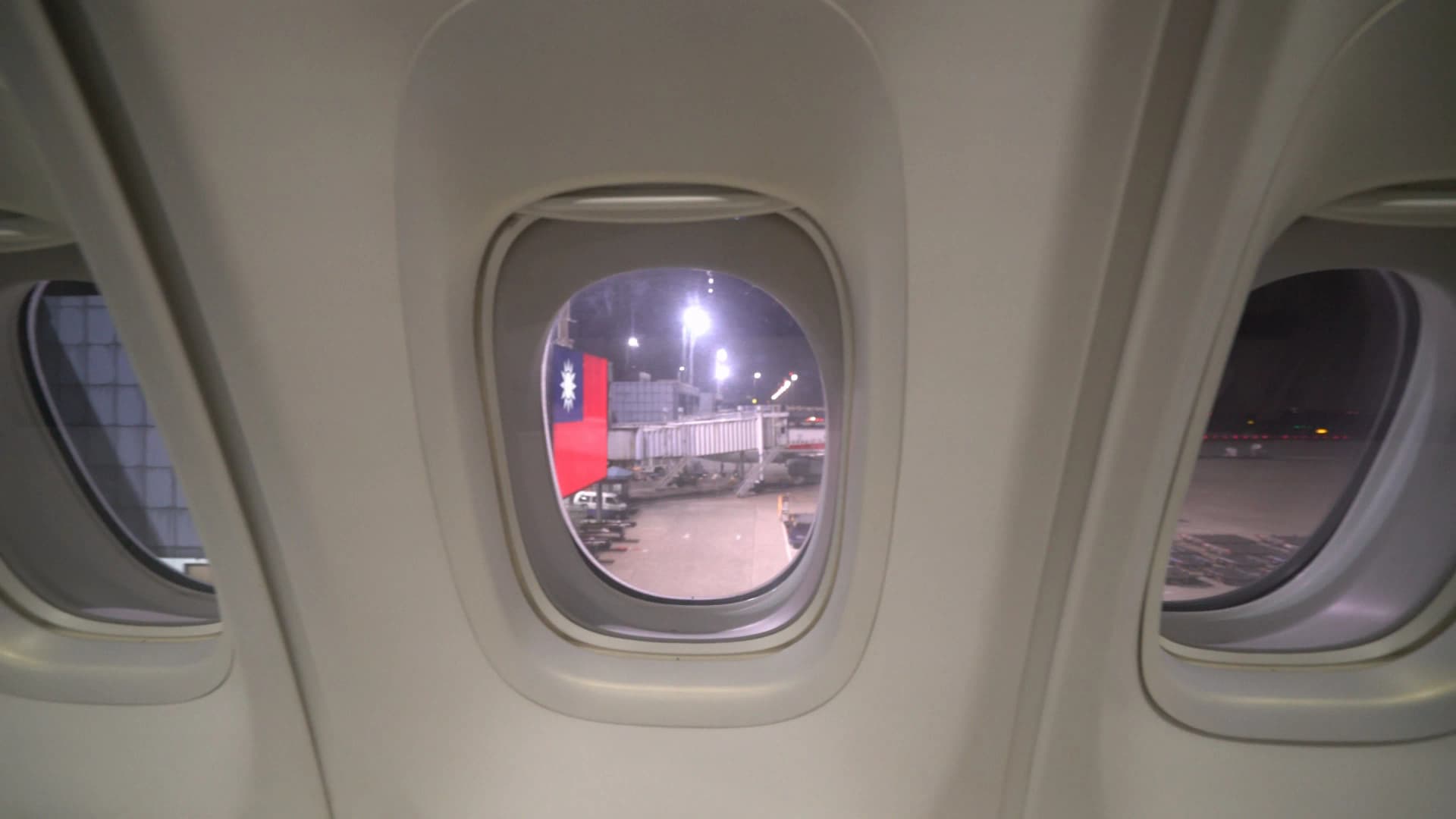
Before departure, I could see Taoyuan Airport through all four windows. The runway lights were glowing against the night sky, and the panoramic view of the airport unfolding across those windows made me completely forget I'd ever been annoyed about the delay.
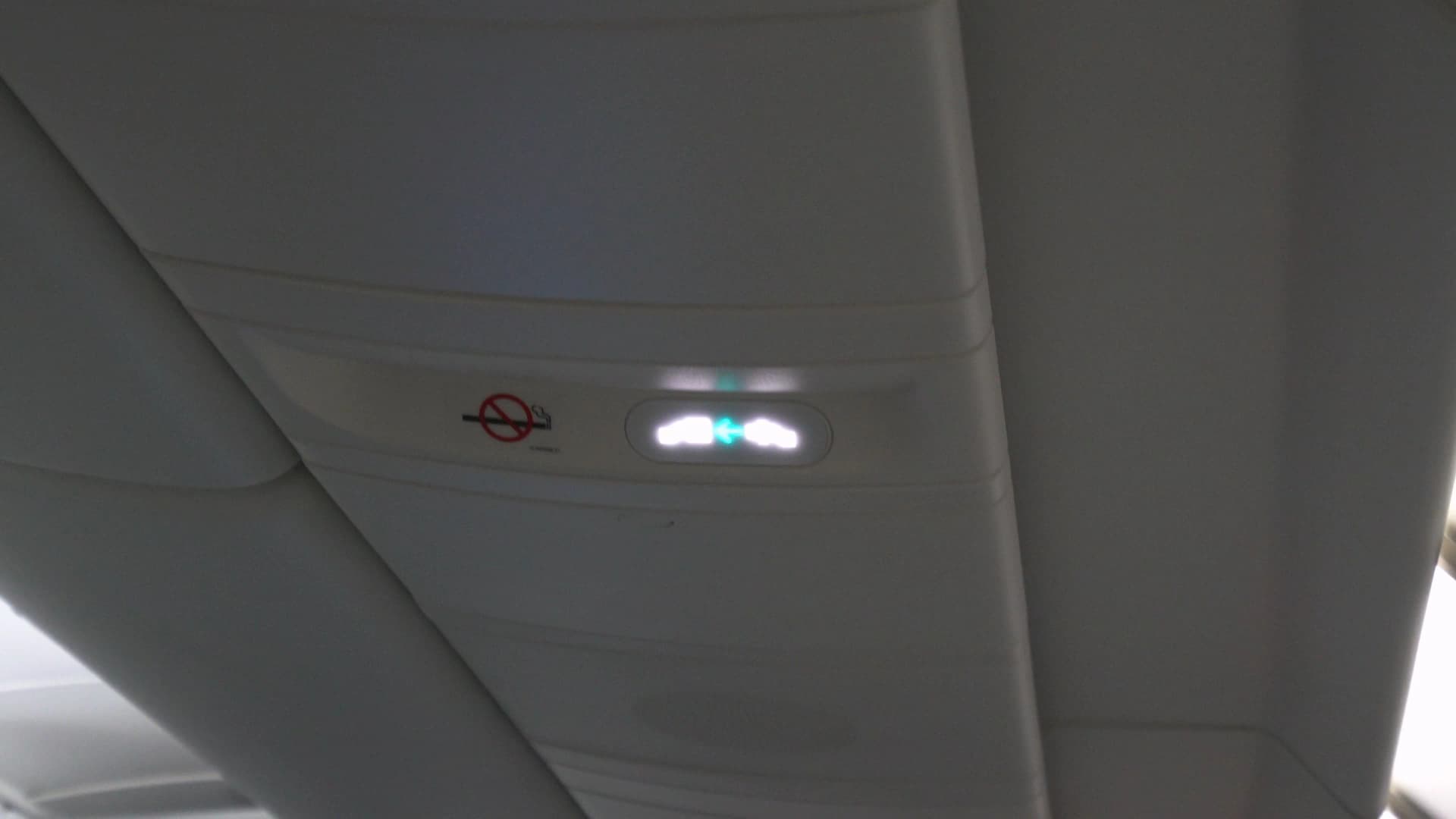
Oh, and here's a minor thing — the no-smoking sign and seatbelt indicator lights. Turbulence can hit without warning, so keeping your belt fastened even when the sign is off is always a good idea. I have to be honest though — the design of these indicator lights looked pretty dated. I remember thinking, "This is a 2019 flight and the signs look like this?" Newer aircraft like the Airbus A350 or Boeing 787 have electronic window dimming and sleek, modern signage. The 747-8i may be the final iteration of the 747 series, but its fundamental design traces back to the 1960s, so some things just show their age.
Korean Air In-Flight Entertainment and the Remote Control Air Show
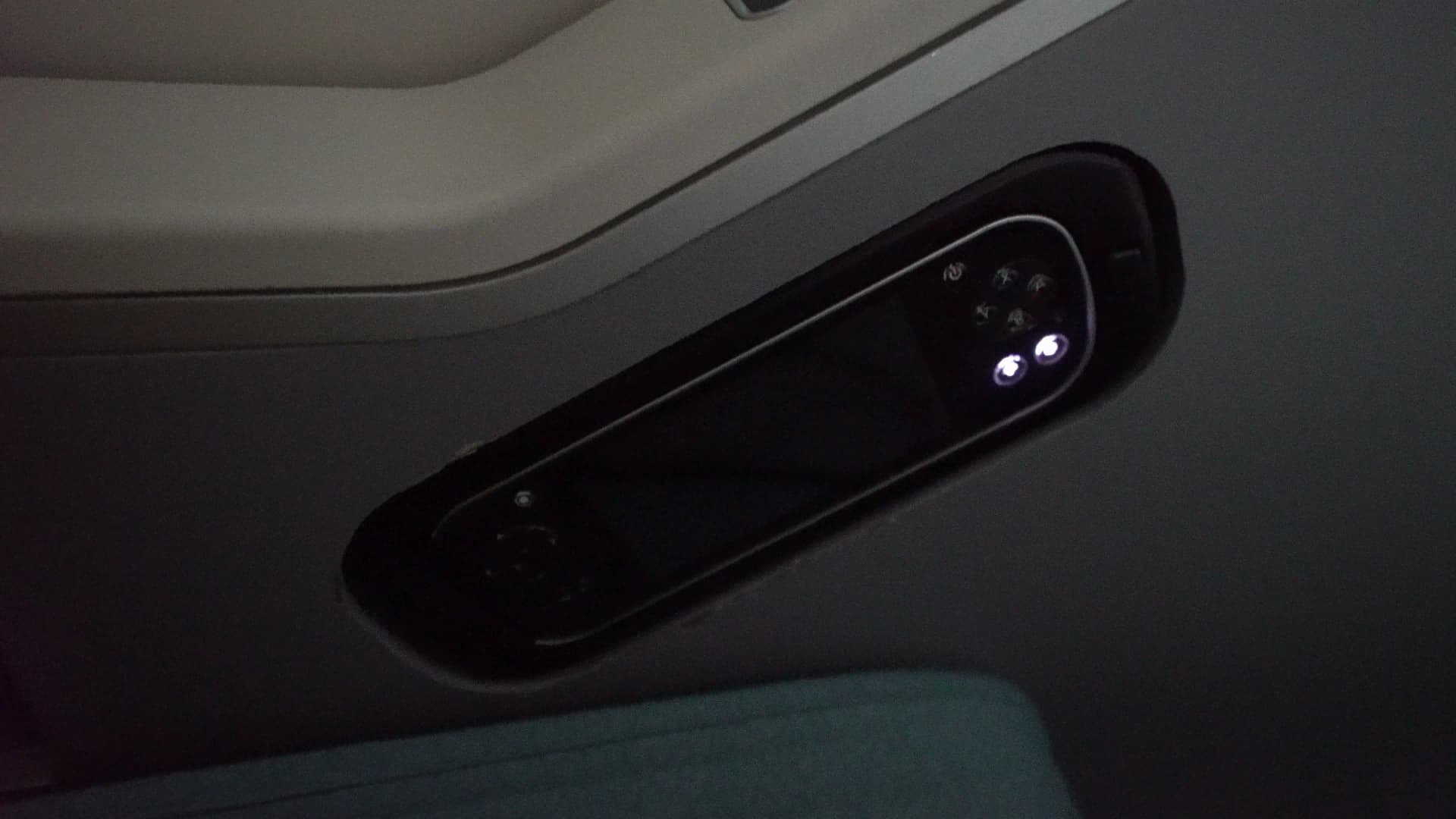
There was a wired remote control attached to the seat armrest. Because Prestige Class has such a wide seat pitch, you actually can't reach the main screen from your seat. There's a 17-inch HD touchscreen mounted in front of you, but in practice you end up using this remote for everything.
This was Korean Air's in-flight entertainment system screen. The interface was the 2019 version, so it may look different now, but the selection of movies, music, and games was more than enough.
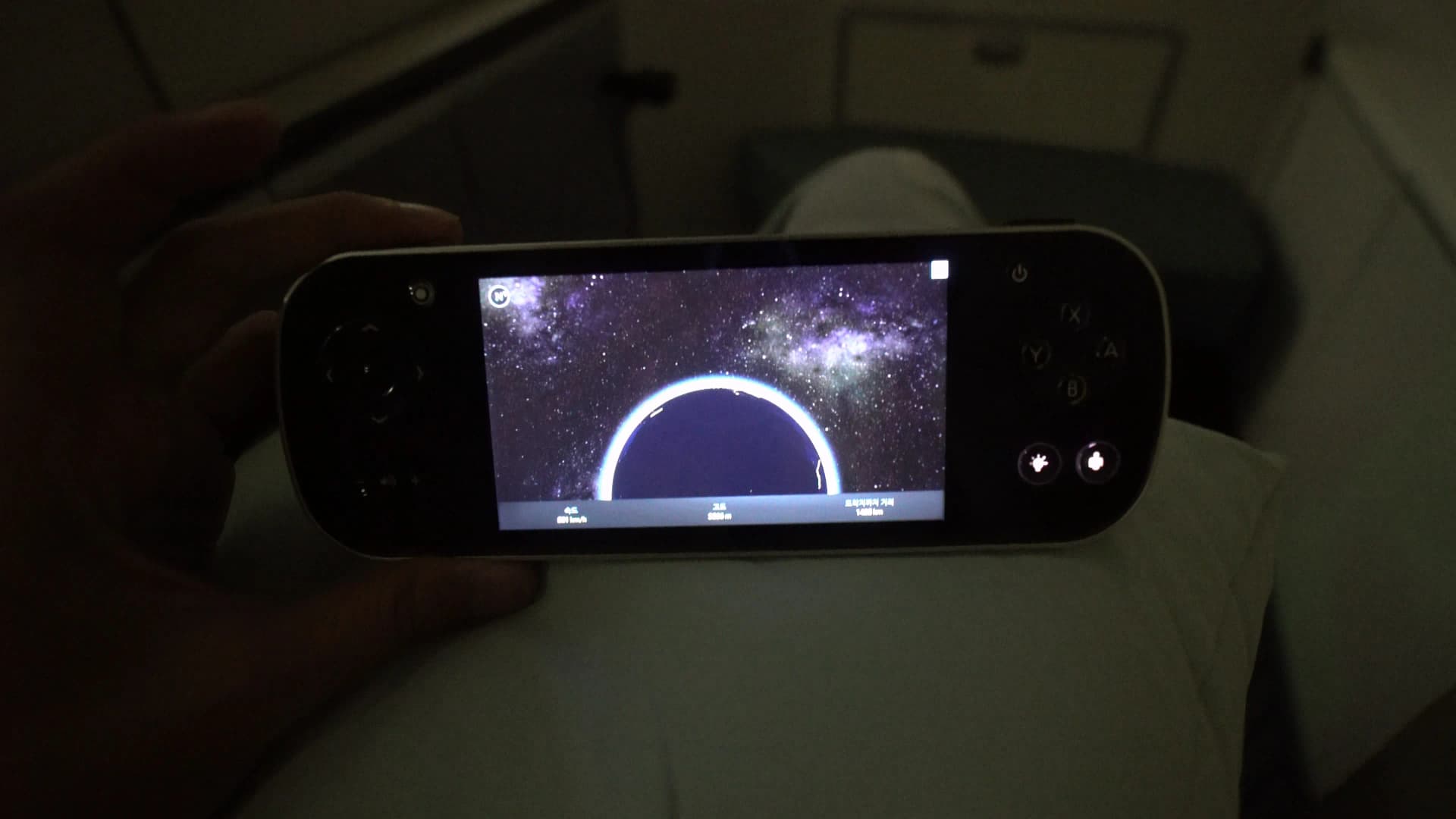
The remote had its own built-in screen, which displayed the Air Show — a real-time map of the aircraft's position. So I could watch a movie on the big monitor while tracking the flight path on the handheld screen simultaneously. We'd just departed Taipei, and the outline of Taiwan was clearly visible on the map.
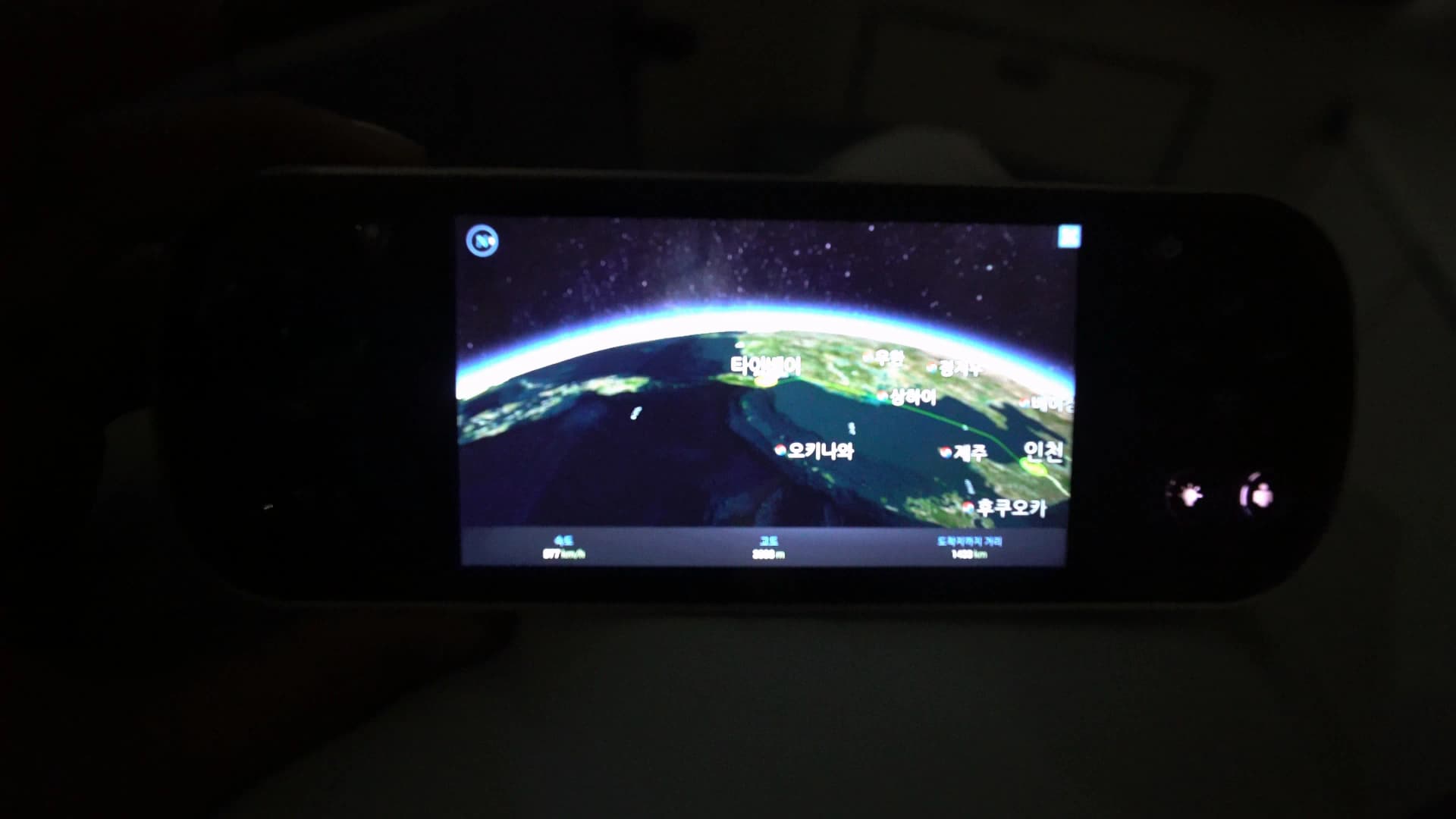
The route showed us passing over Okinawa and approaching Jeju. Watching this, I suddenly thought about the flight I took three years earlier when I left Korea. Back then I was in the very last row of economy. Now I was on the upper deck of a Boeing 747 Prestige Class, tracing the same route in reverse. It was a strange feeling.
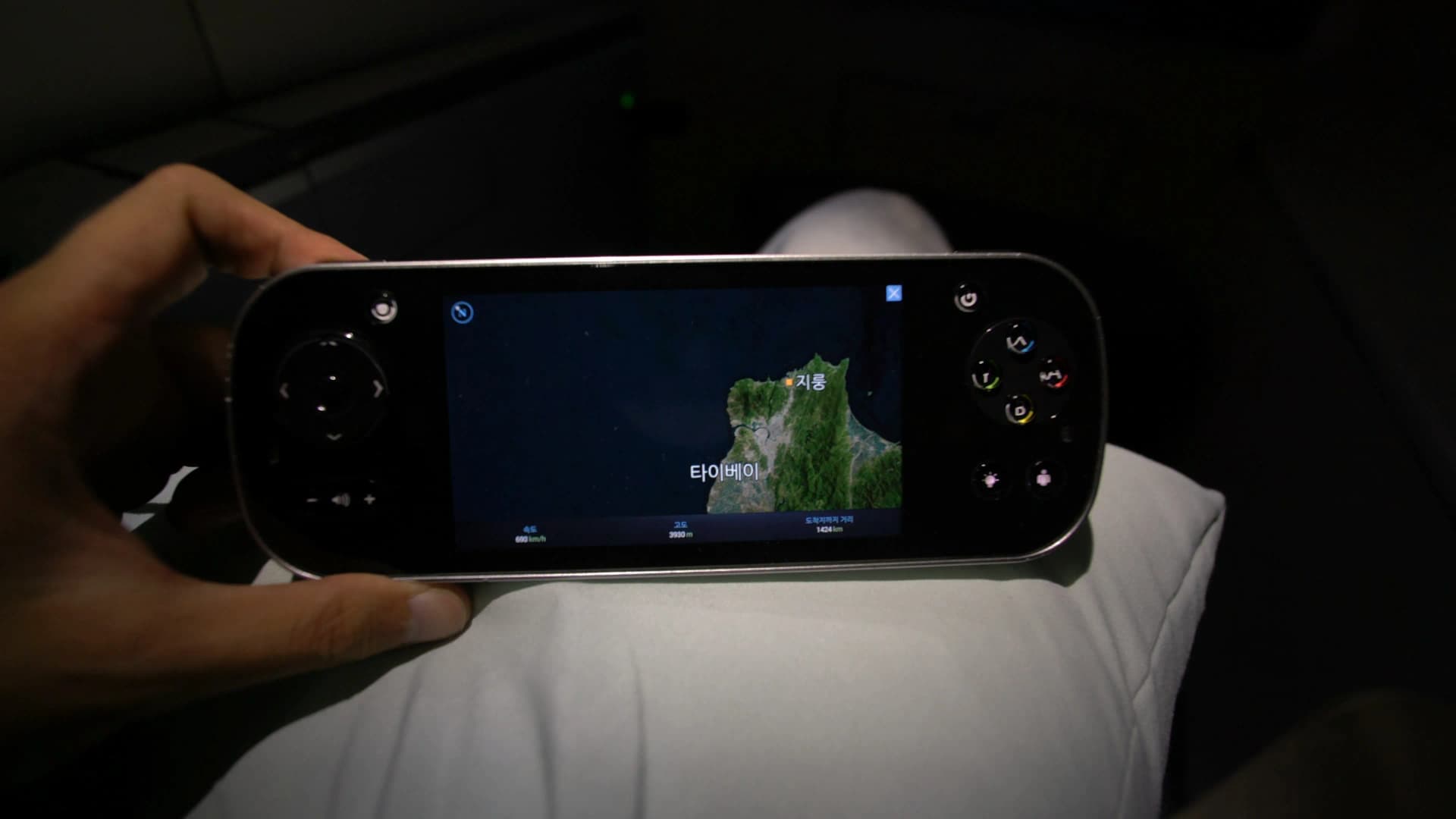
This was the full route from Taipei to Incheon, complete with speed, altitude, and remaining distance. If you're the kind of person who geeks out over flight data, these details are a treat.
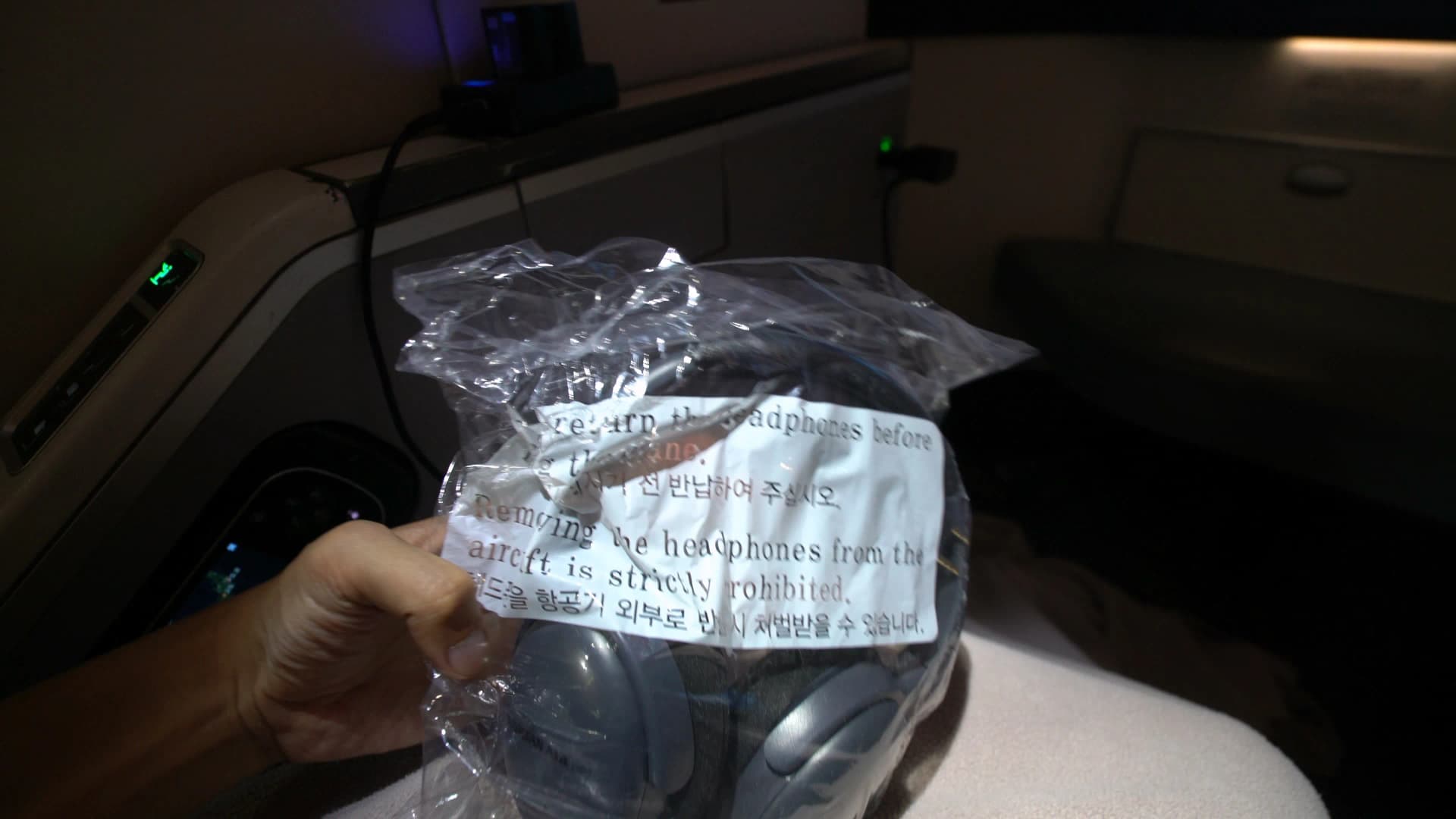
A sealed headset was waiting at my seat, still in its plastic wrapping. The flight was so short I didn't even open it. Personally, I find the Air Show map more entertaining than most in-flight movies anyway, so it wasn't a big loss.
The Personal Reading Light That Glows in the Dark Cabin

This was a surprisingly nice touch. It was a nighttime flight, so the entire cabin was dark. I turned on the personal reading light above my seat, and it gently lit up just my space without spilling over to the neighboring seat at all. In a dark cabin, with just that one soft light on, it felt genuinely cozy — almost like a private reading nook at 35,000 feet. I'm not sure whether that's a Prestige Class thing or a 747-8i thing, but it was noticeably better than any economy reading light I've used.
The 180° Lie-Flat Seat — The Heart of Korean Air's Prestige Class
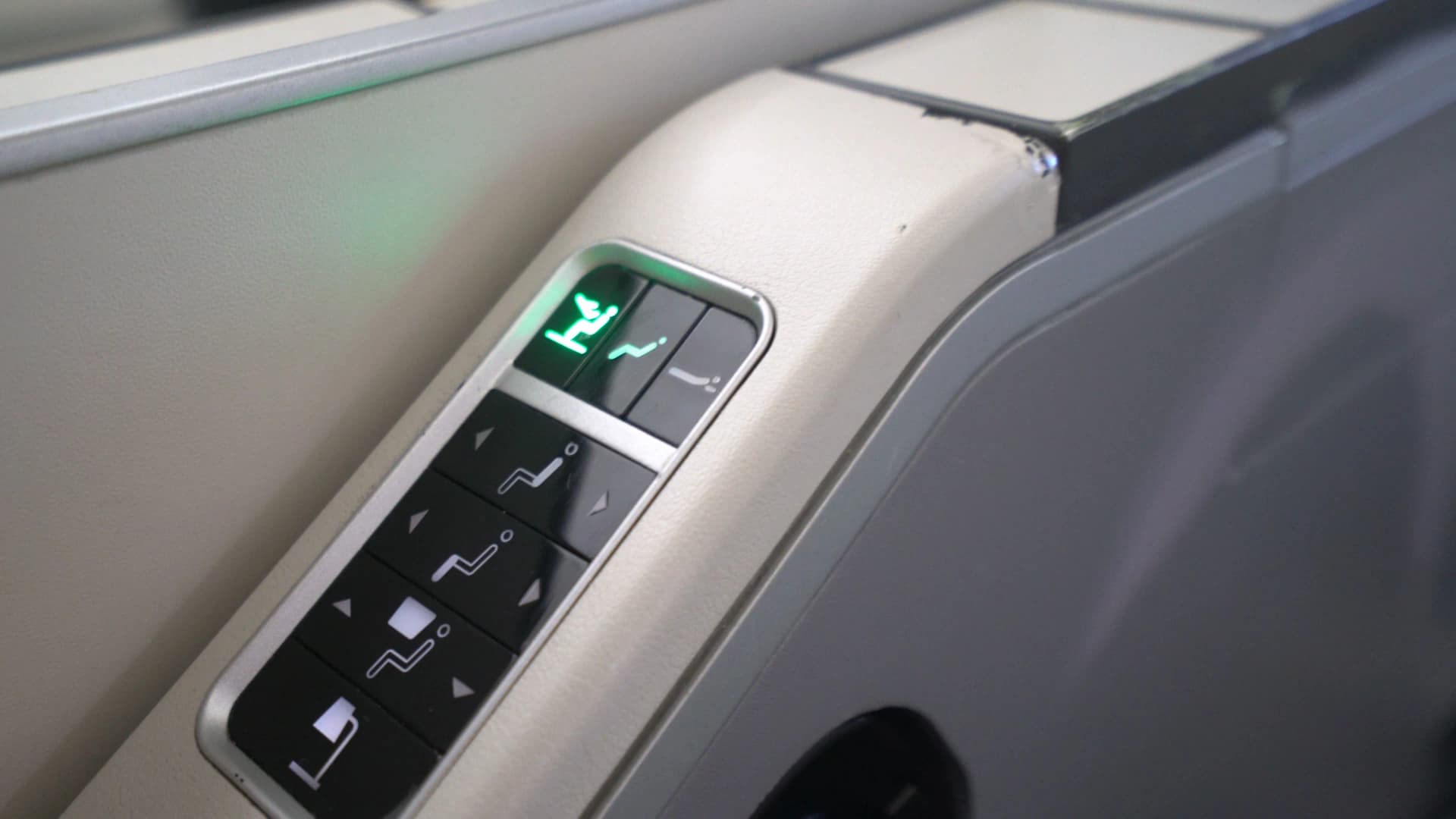
The lie-flat seat is what makes business class worth it, and Korean Air's 747-8i Prestige Class delivers a true 180-degree full-flat bed. The control panel on the armrest lets you adjust the backrest angle, leg rest, and overall recline with precision. Not all business class seats actually go fully horizontal — some airlines and aircraft still use angled-flat seats that stop a few degrees short. Korean Air's 747-8i Prestige goes completely level. The bed measures roughly 72 inches (183 cm) in length, which is enough for most adults to lie down with legs extended. When I hit the recline button, the motor made a soft whirring sound as the backrest slowly descended — it took about 10 seconds to go fully flat. Once horizontal, the cushioning was surprisingly plush. Not hard at all. The flight was only about 2.5 hours so I didn't get to properly sleep on it, but on a long-haul route, this would absolutely be a setup you could get a full night's rest on.
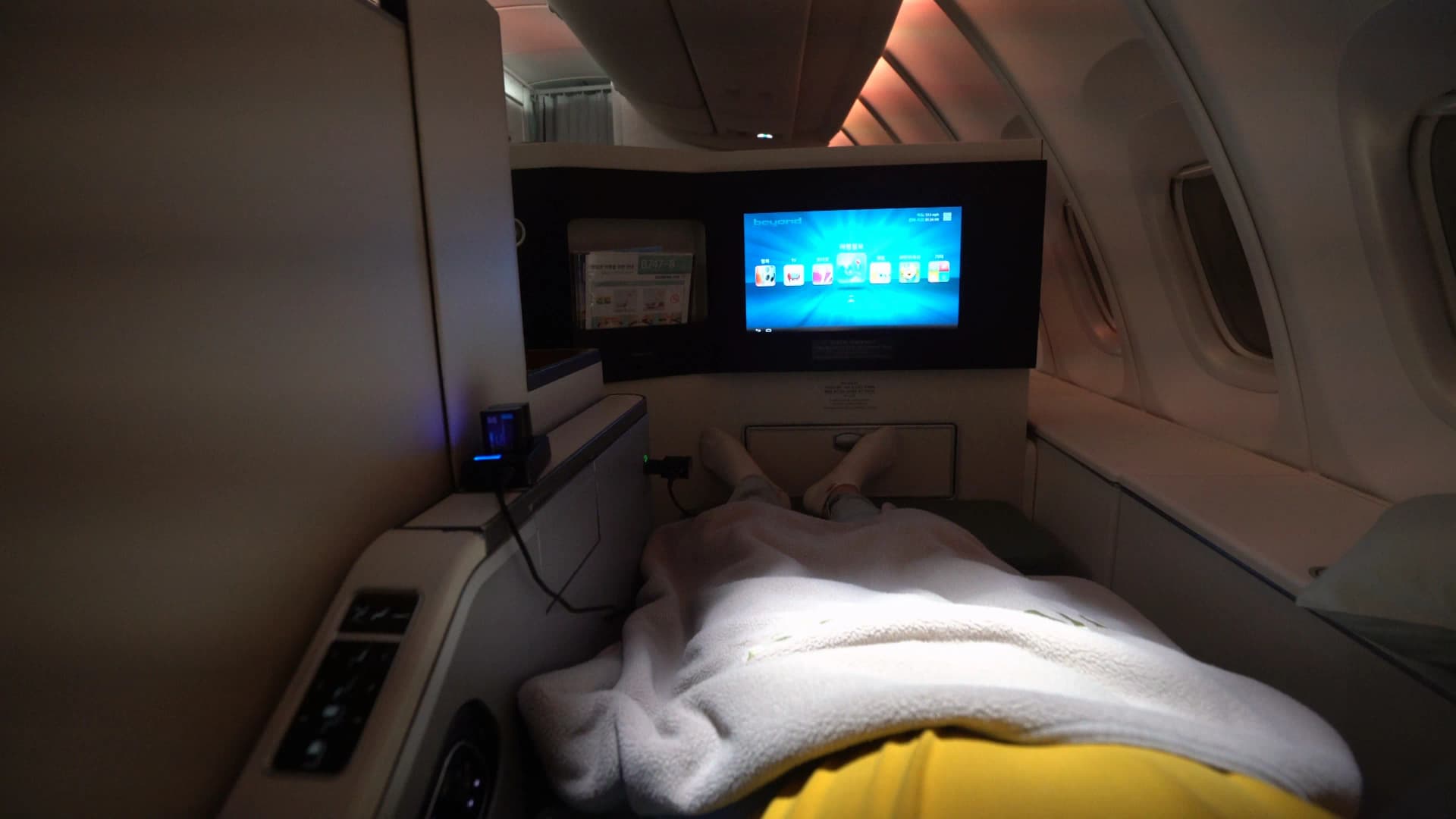
Here it is fully reclined. With the blanket draped over me and the screen playing in the background, I genuinely forgot I was on an airplane for a moment.
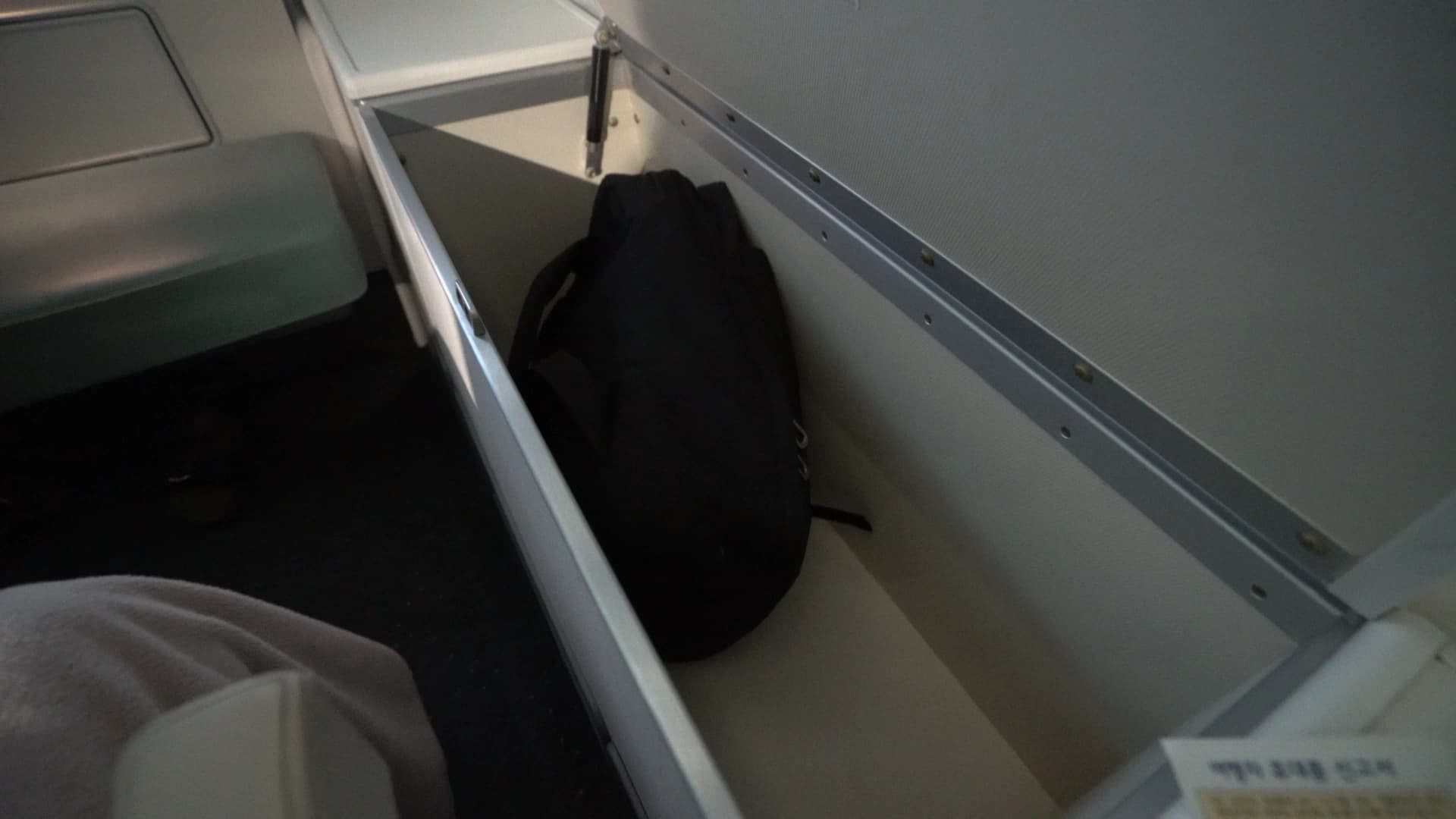
This is the personal storage shelf tucked beneath the upper deck window seat. It exists because of the 747's curved upper fuselage — a design quirk that becomes a genuine perk up here. It's big enough for a backpack, and having your essentials within arm's reach means you don't have to get up and open the overhead bin every time you need something.
Korean Air Prestige Class In-Flight Meal — The Signature Bibimbap
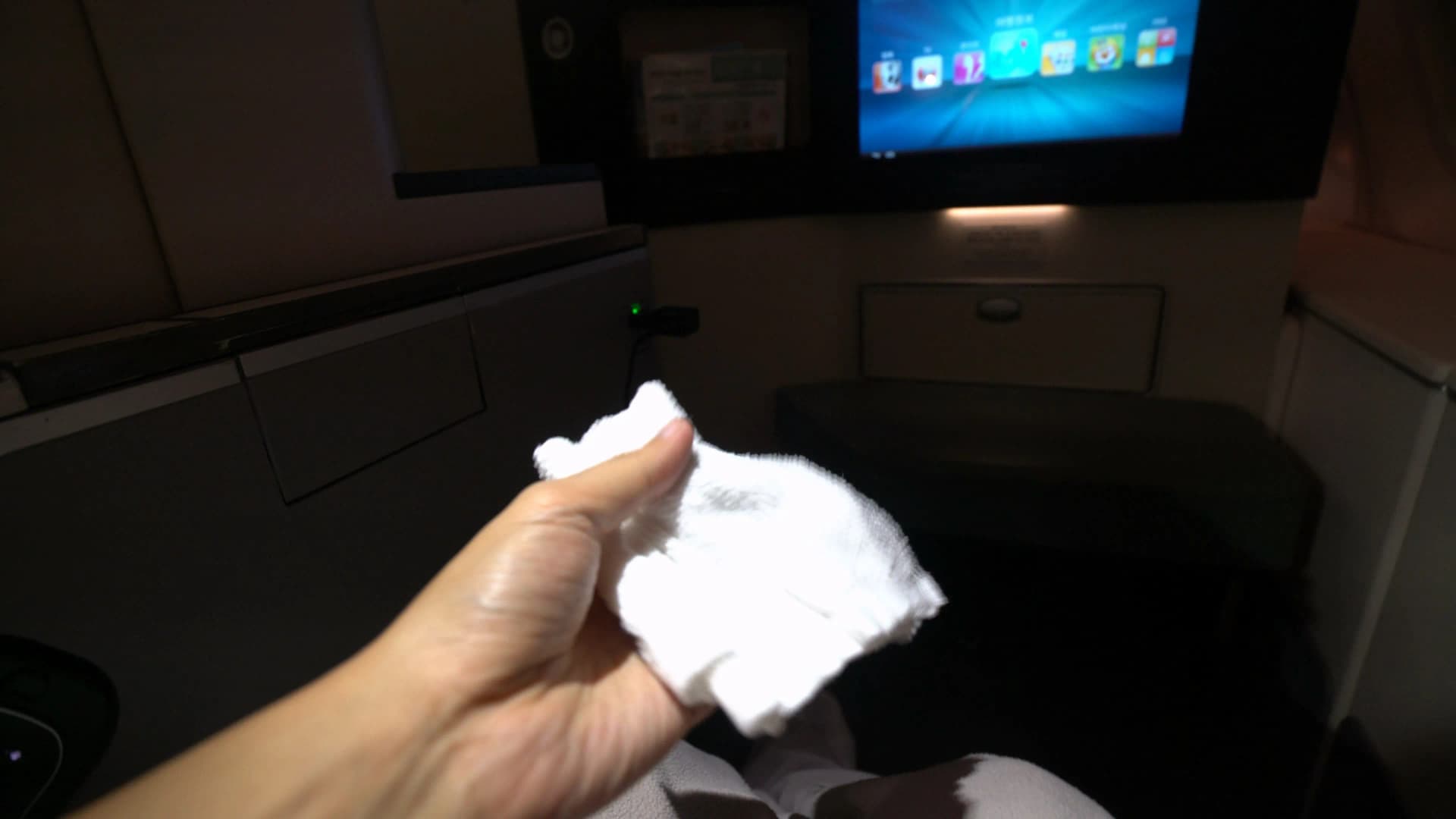
Korean Air's signature bibimbap is one of the most talked-about in-flight meals in business class, and even on this short-haul route, they served it with care. As soon as the seatbelt sign turned off after takeoff, the flight attendant began drink service. Instead of just asking "What would you like?" she brought over the full menu for me to browse — and they didn't skip this step even on a short flight. I asked for orange juice, and she placed the glass on a napkin with smooth, precise movements. The meal service followed right after. First up: a warm towel.
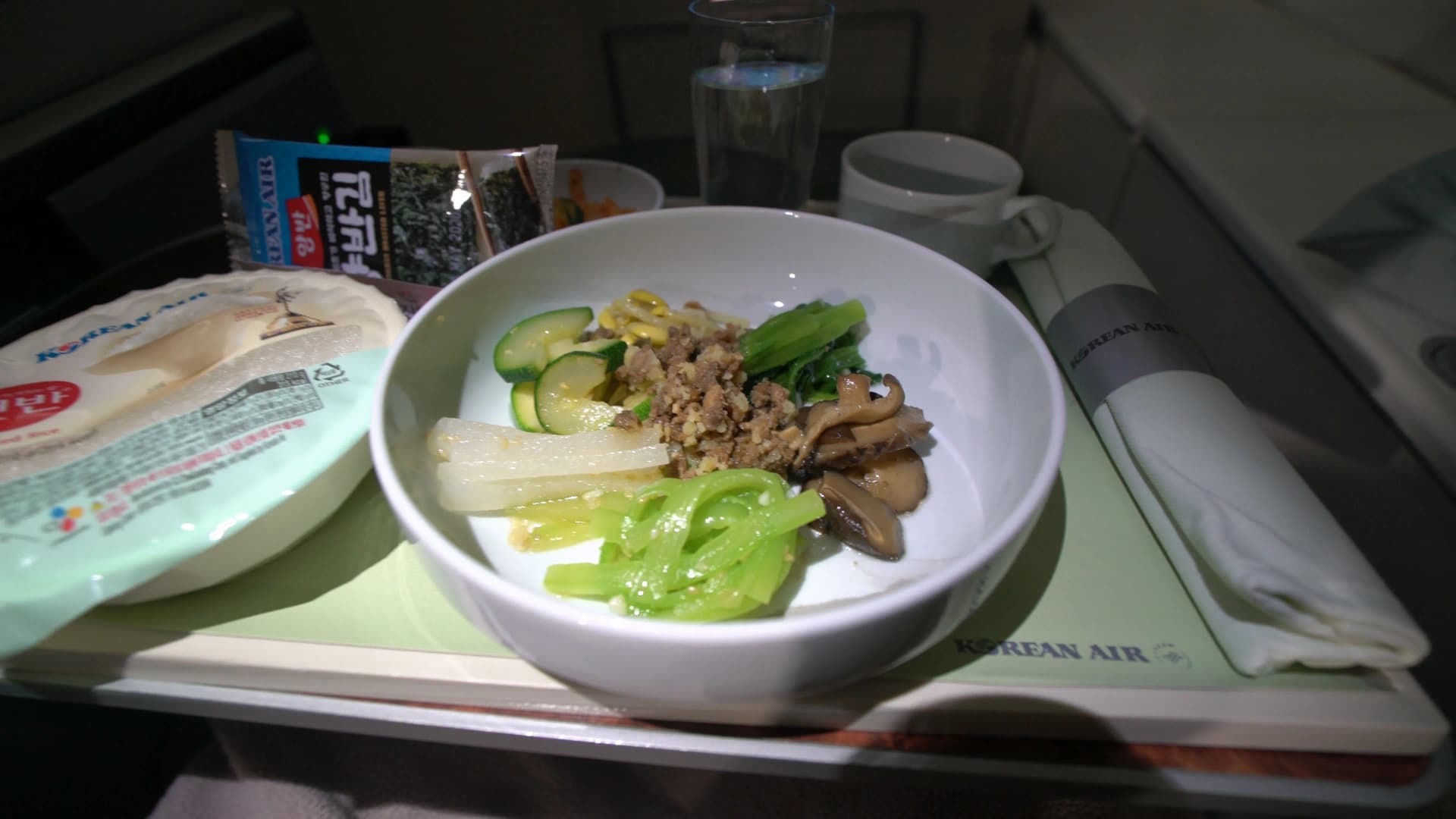
Even in Prestige Class, short-haul flights get a simplified meal compared to the full appetizer-main-dessert courses you'd see on long-haul routes. That said, I chose Korean Air's signature dish: bibimbap.
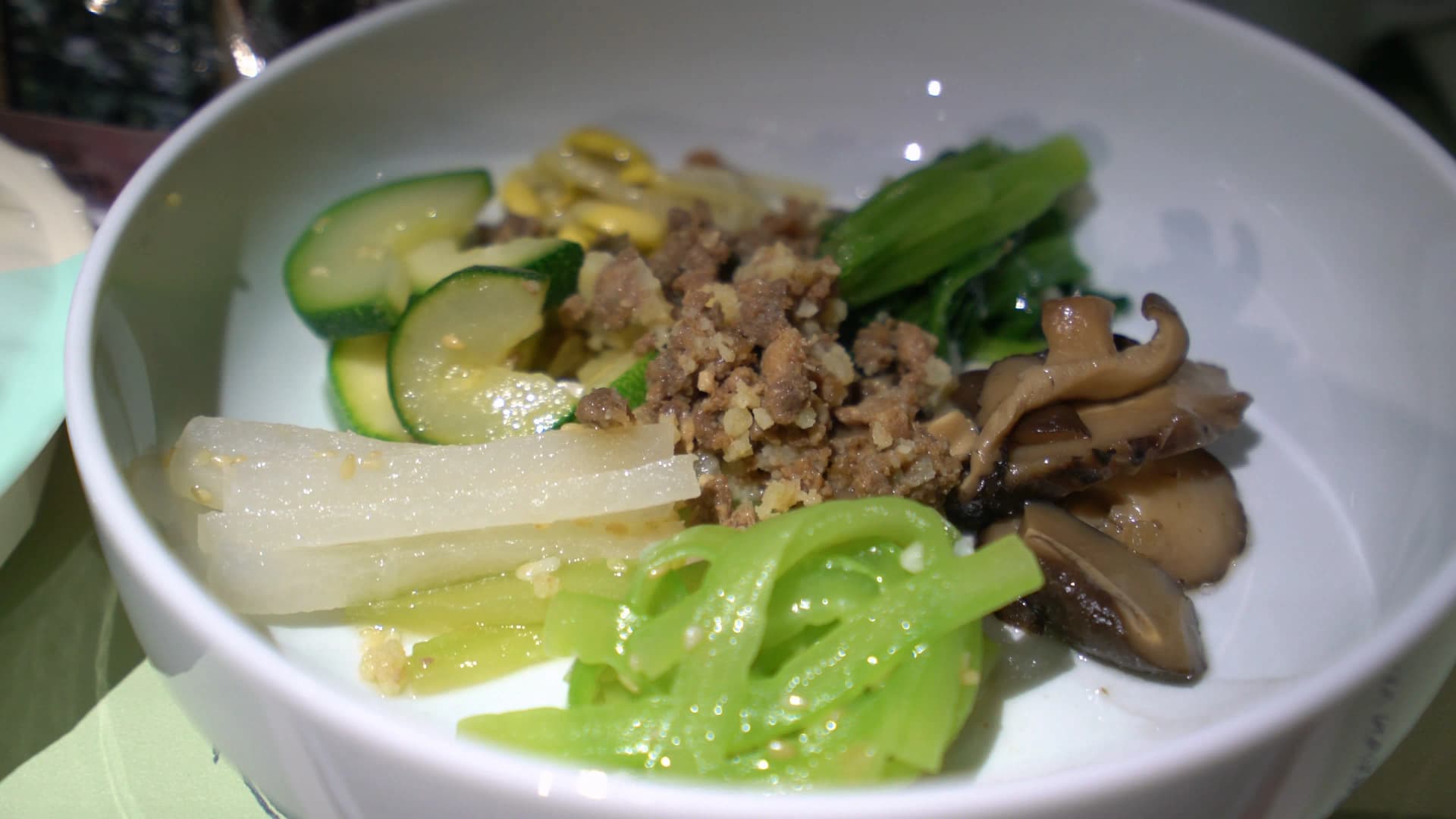
The bibimbap toppings came in individual containers — zucchini, bean sprouts, spinach, mushroom, balloon flower root, bracken fern, and beef. You mix it all together with gochujang (Korean chili paste). The flight attendant asked me, "Do you like a lot of gochujang?" as she set everything up, and that kind of small question is what makes an in-flight meal feel like an actual dining experience rather than just food distribution. The toppings were in decent condition for airplane food, though I'll be honest — compared to the China Airlines business class meal I'd had on the previous leg, the overall spread was a bit simpler. But that's not really a fair comparison since the China Airlines flight was about 4 hours, and this one was barely 2.

The rice came as Korean Air's own branded instant rice. I was skeptical at first — instant rice? In business class? But the grain quality was consistently sticky and well-formed, actually better than what you'd get from rice cooked in a galley at altitude. Apparently Korean Air uses the same method on long-haul bibimbap service too.
Side Dishes with the Bibimbap, Plus Dried Pollack Soup
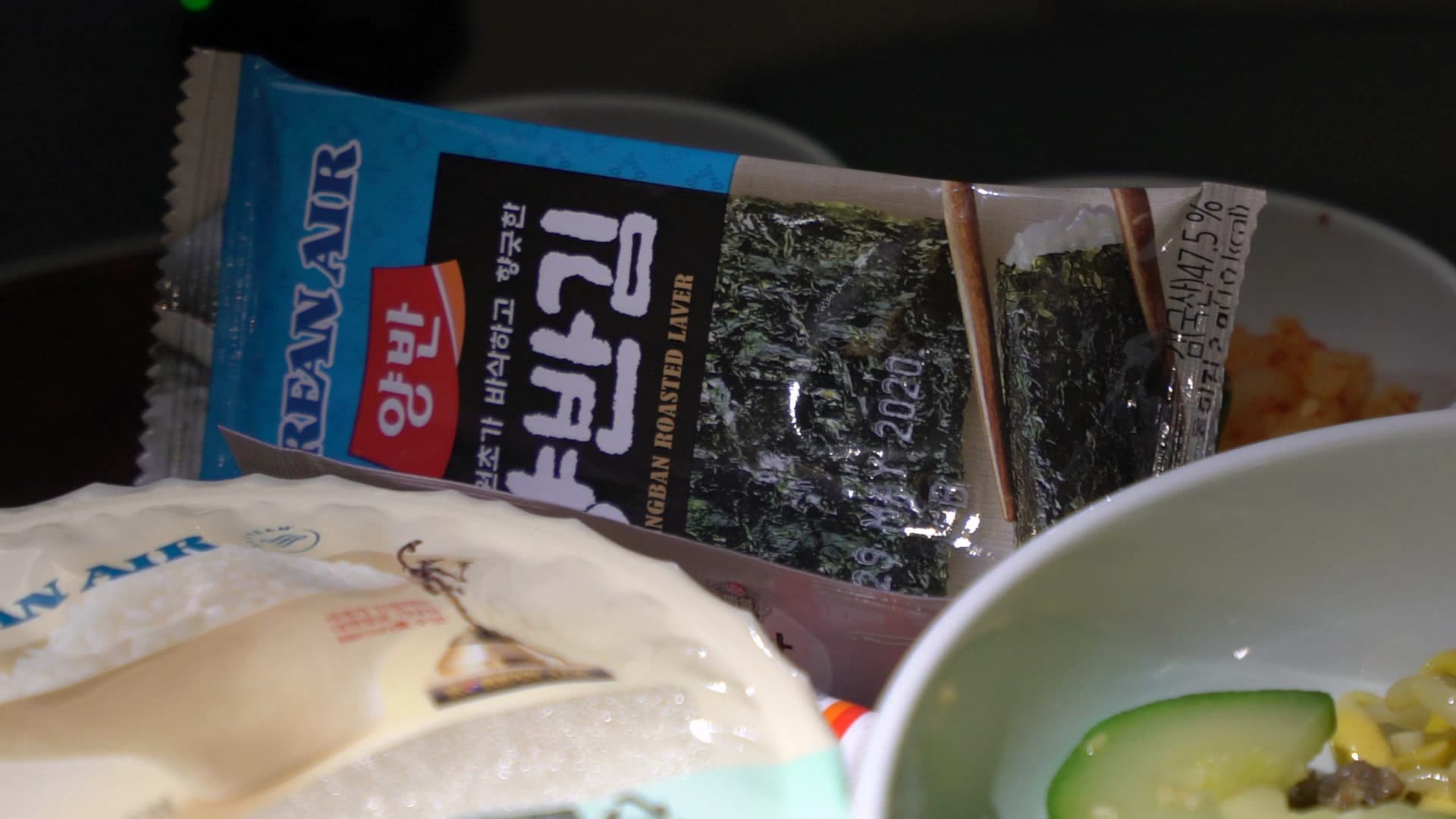
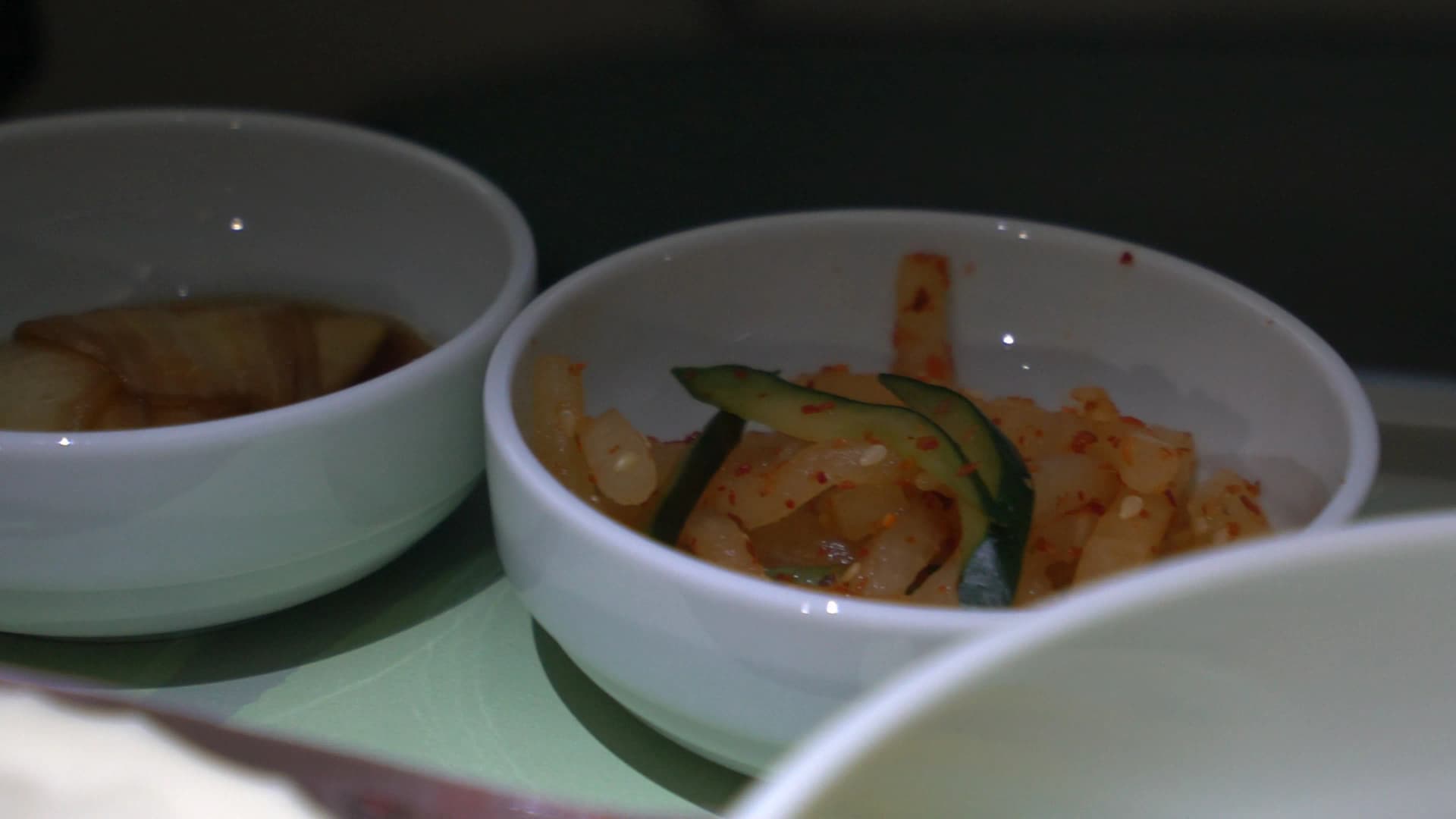
The side dishes included gim (Korean roasted seaweed), pickled onion, and spicy radish salad. Crumble the gim into your bibimbap and it adds a nutty, savory depth. The pickled onion cuts through the richness with its tangy bite, and the spicy radish salad had a nice crunch with a kick — a perfect rice companion. Apparently even international passengers are fans of the gim.
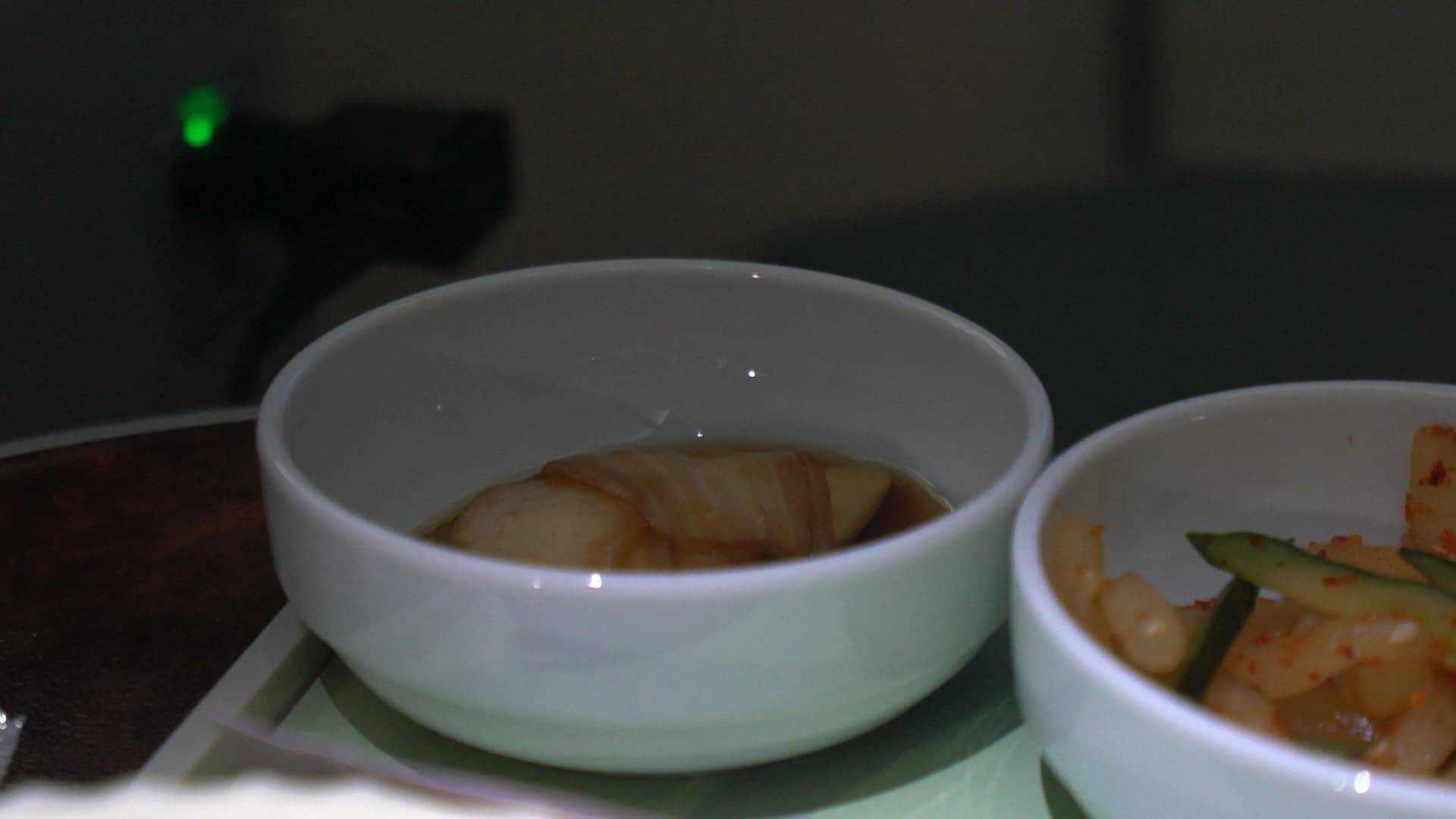
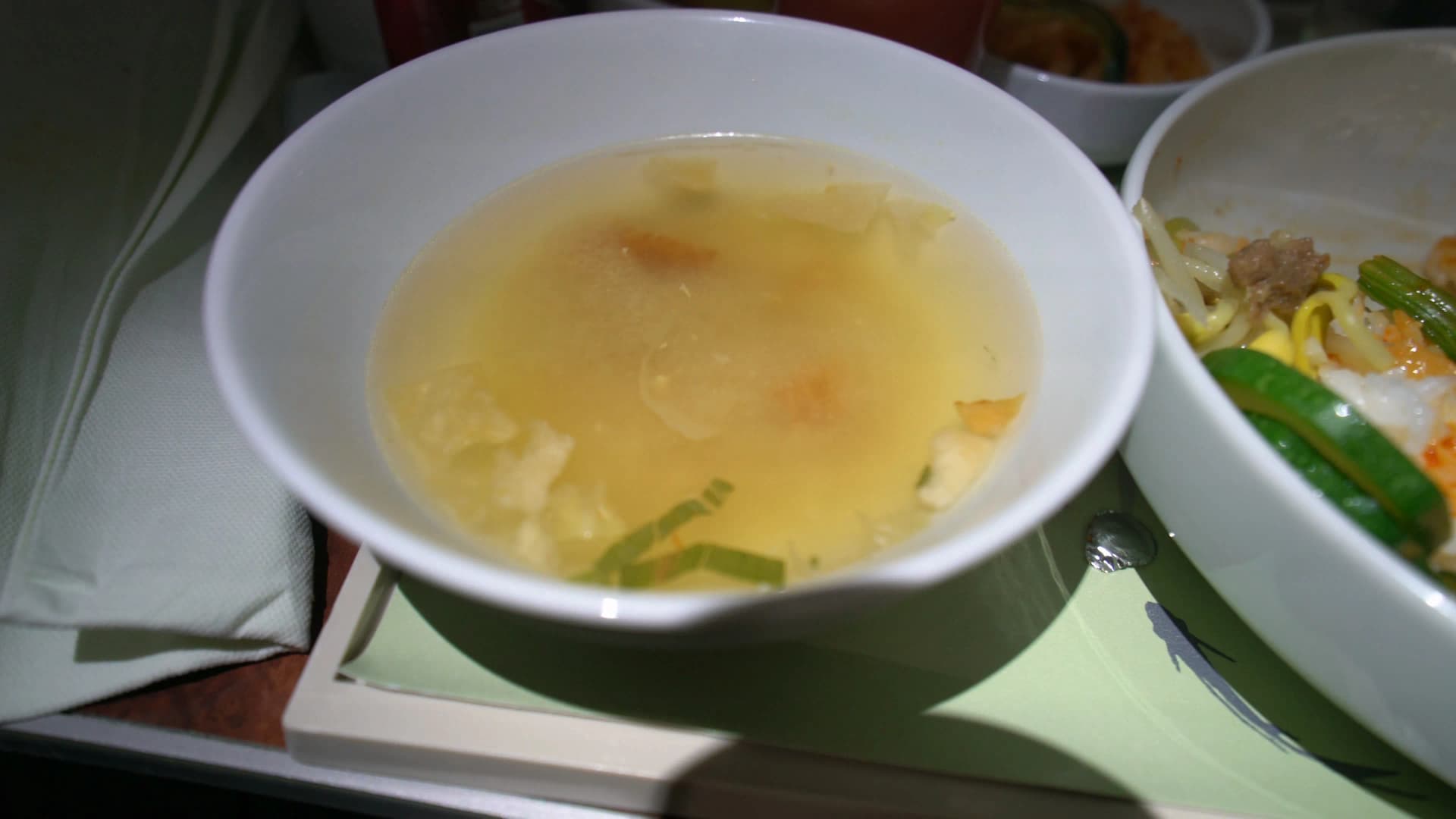
The soup was dried pollack soup — a clear, light broth that paired well with the bibimbap. Overall it was a modest meal, but for a short-haul flight, getting a hot meal at all is something to appreciate. On ultra-short routes like Fukuoka, even Prestige Class only gets a cold meal.
Arriving at Incheon Airport — Setting Foot in Korea After 3 Years
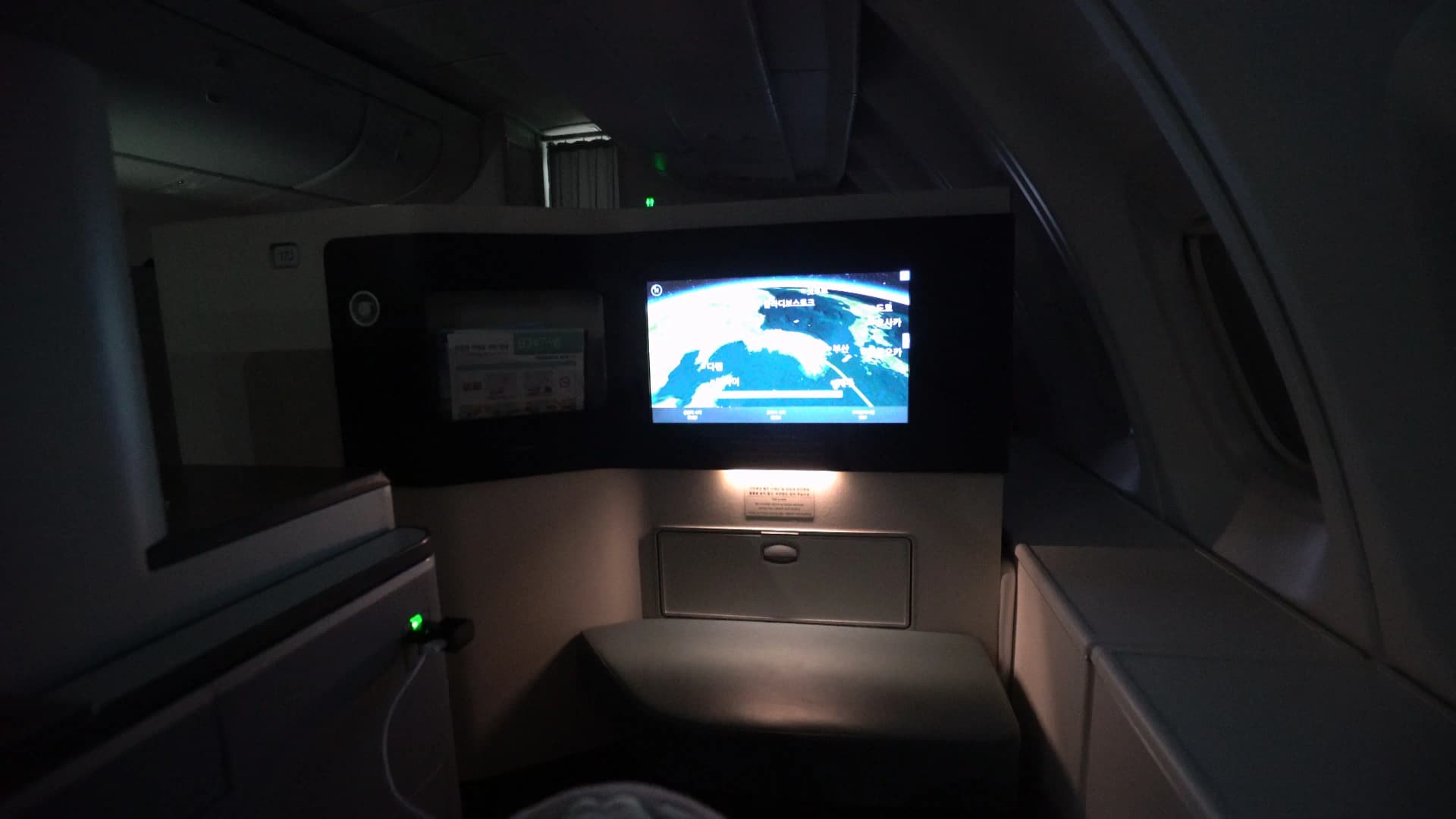
After finishing the bibimbap, drowsiness hit. The cabin lights were already off. I reclined the seat flat and closed my eyes — and what felt like just a few minutes later, I opened them to find we were already past Jeju. It was bittersweet. I wanted another 10 hours in this seat, but reality was a 2.5-hour short-haul.
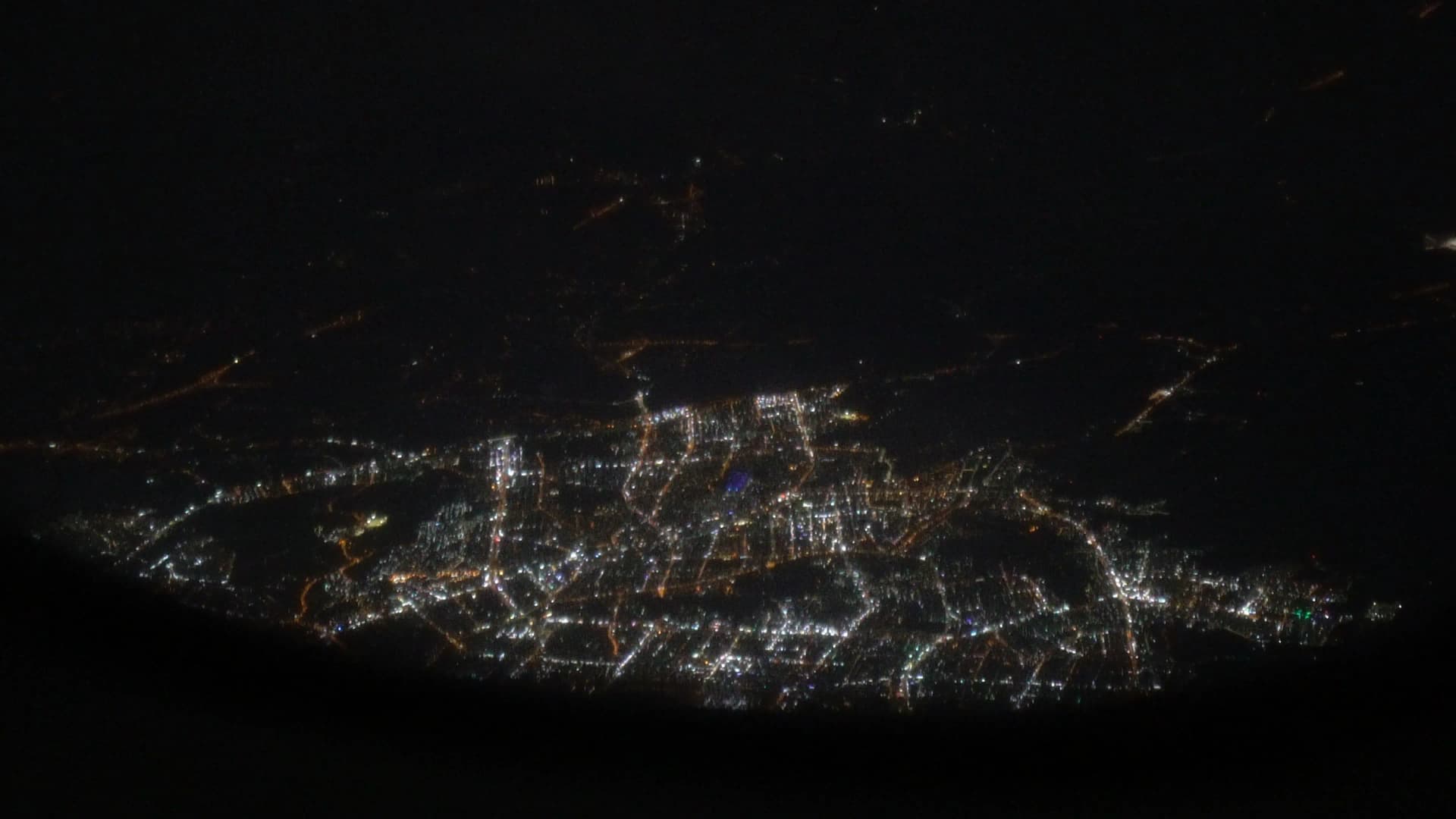
City lights started appearing through the window. After three years in Thailand, seeing those lights again just made me happy. Nothing complicated about it — just relief and warmth.
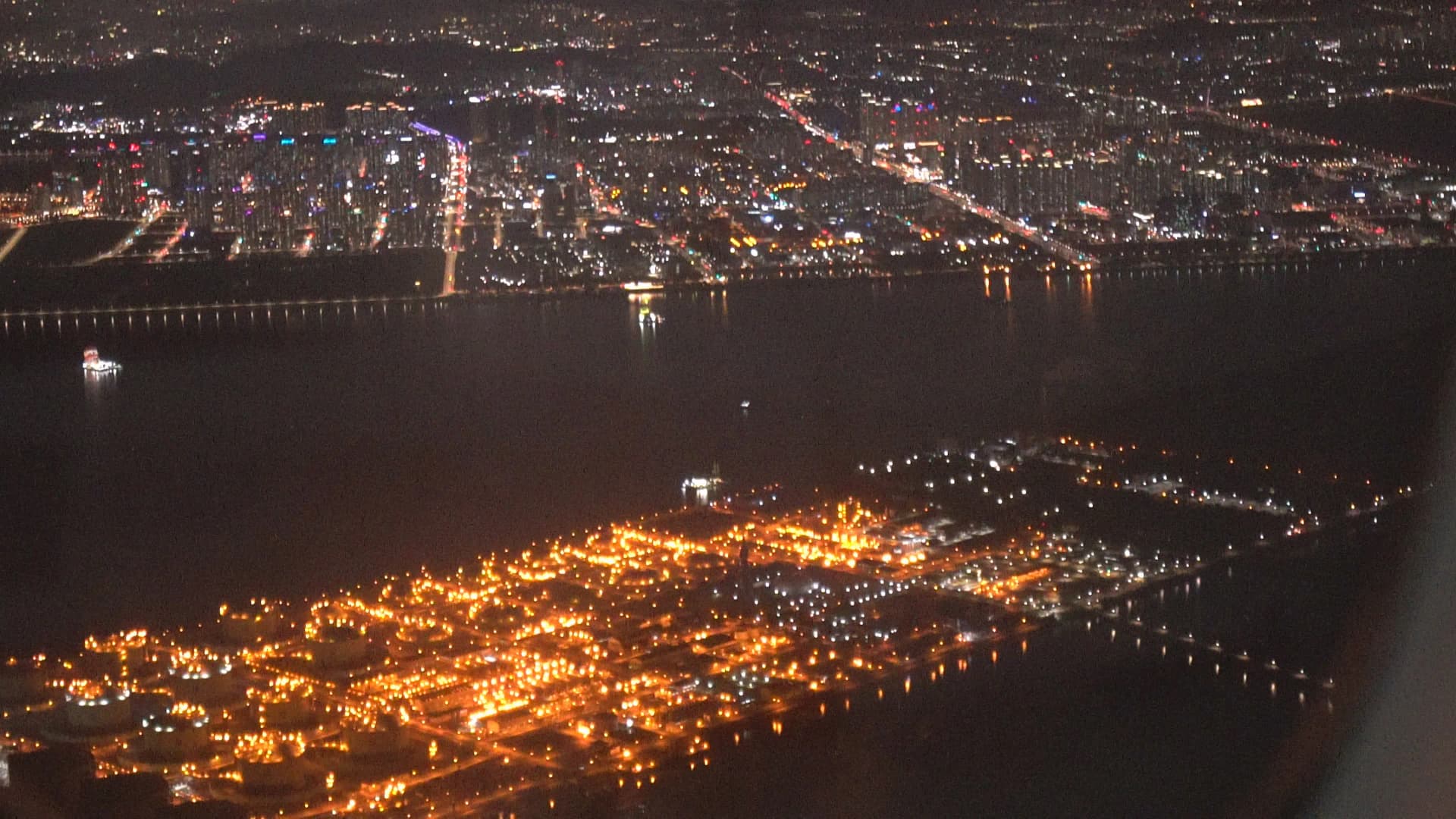
This is the view you always get when approaching Incheon from the south. Orange lights spill across the water, with the urban skyline stretched out beyond. I've seen it every time I've flown into Incheon, and it never gets old. This was the moment it finally hit me: I'm home.
We landed at Incheon safely.
Flight Details Summary
Date: November 2019
Route: Taipei Taoyuan (TPE) → Incheon (ICN)
Airline: Korean Air — rebooked from China Airlines due to delay
Aircraft: Boeing 747-8 Intercontinental (747-8i)
Class: Prestige Class (Business Class)
Seat Location: Upper deck window
Flight Time: Approximately 2 hours 30 minutes
Time of Day: Nighttime
In-Flight Meal: Bibimbap + Dried Pollack Soup
Looking Back on That Flight, 6 Years Later
I'm writing this in 2026 — more than six years after that flight. The reason I'm finally putting this review together now is that the Korean Air 747-8i is about to disappear from the skies.
At the time, I just thought I'd gotten lucky with a nice seat. But as the years went by, I started realizing how truly special that flight was. I experienced the upper deck business class of a plane that only 48 were ever made of — and I got it as a rebooking from a delay.
The crew service sticks with me too. Both the China Airlines attendants and the Korean Air attendants that day weren't just polite — they genuinely seemed to care about each individual passenger. You hear about Korean airlines being highly rated internationally, and when you actually fly them, you feel why. Korean Air has maintained its Skytrax 5-Star Airline rating for five consecutive years since then, and in 2026 won the APEX Best Cabin Service award. The level of service I experienced on that 2019 rebooking wasn't a one-off — it's just how this airline operates.
The spacious 2-2 layout on the upper deck, four windows all to myself, 75-inch seat pitch with a 180-degree lie-flat bed — even though the flight was barely over 2 hours, every minute felt too precious to waste on a seat that good.
If I had to name two regrets, they'd be these: the flight was too short, and the meal was simplified because it was a short-haul route. If I'd had this same seat on a long-haul flight to the U.S. or Europe, I could've experienced the full-course meal and 8 hours of sleep. That'll have to wait for next time.
Korean Air 747-8i Retirement and the U.S. 'Doomsday Plane' Conversion
Except that next time is getting harder and harder to come by. Korean Air has been actively retiring its 747-8i fleet since 2025. In May 2024, the airline sold 5 of its 747-8i aircraft to U.S. defense contractor Sierra Nevada Corporation for approximately $674 million. According to CNN and other international outlets, those 5 aircraft are being converted into the next-generation "Doomsday Plane" — officially called the Survivable Airborne Operations Center — replacing the aging E-4B "Nightwatch" fleet. These are the aircraft designed to serve as an "Airborne Pentagon" during a nuclear war or other national emergency. The planes where regular passengers once ate bibimbap and watched movies are now being reborn as America's last-resort command aircraft. Knowing that the very jet I sat in might be one of them gives me a strange feeling I can't quite describe.
Starting in December 2024, routes like Incheon-to-Atlanta began transitioning to 777-300ER aircraft, and the remaining 747-8i fleet continues to shrink. One aircraft remains in service as the South Korean presidential jet (Code One).
Korean Air Boeing 747-8i Retirement Timeline
2012: Korean Air begins 747-8i service (10 aircraft total)
2021: Chairman Cho Won-tae announces plan to retire all 747-8i within 10 years (FlightGlobal interview)
January 2022: 1 aircraft leased long-term as the South Korean presidential jet (Code One)
May 2024: 5 aircraft sold to Sierra Nevada Corporation for ~$674 million — to be converted into USAF "Doomsday Planes"
December 2024: Incheon-Atlanta (ATL) and other long-haul routes begin switch to 777-300ER
March 2025: Additional routes begin 747-8i replacement
As of April 2026: ~5 in Korean Air passenger service, 1 serving as presidential aircraft
Sources: FlightGlobal, Gate Checked, Simple Flying, CNN, YTN, News Tomato reporting
The era of the "Queen of the Skies" is coming to a close. Only three airlines worldwide still fly the Boeing 747-8i as a passenger aircraft — Lufthansa, Air China, and Korean Air — and Korean Air's count keeps dropping. This post may end up being a record of a plane that some readers will never get the chance to fly.
If Korean Air still has any 747-8i routes operating when you read this, I'd genuinely encourage you to book one while you can. The upper deck window seat, in particular, is an experience no other aircraft can replicate. Once the Boeing 747 disappears from passenger service entirely, the only double-decker wide-body left will be the Airbus A380 — and that's being retired too. Sitting on the upper deck of a 747 with four windows all to yourself, watching the world pass by at 35,000 feet — the window for that experience is closing fast. Honestly, I'd pay out of my own pocket to do it one more time. I just don't know if the plane will still be around when I get the chance.
This post was originally published on https://hi-jsb.blog.