
Pork Bone Hangover Soup: Korea's Best Solo Meal Under $9
Table of Contents
23 items
Gamjatang Is Delicious, but the Price for Two Can Sting
I talked about gamjatang (Korean pork bone stew) last time. It's seriously delicious. But let me be honest with you. When you're traveling in Korea, eating it as a pair can get pricey. A small pot starts around $22, medium runs about $27, and a large can hit $35–37. It's a hot pot dish, so ordering it solo doesn't really work either.
But today I'm introducing a dish that takes all that pressure away. Think of it as the single-serving version of gamjatang — it's called byeodaegui haejangguk, a pork bone hangover soup. Same bone broth, same deep flavor, but you can comfortably demolish a whole bowl by yourself. For solo travelers eating alone, this is honestly perfect.
Pork Bone Hangover Soup — It Looks Serious from the Start
This right here is byeodaegui haejangguk — "byeodaegui" means "pork bone" and "haejangguk" means "hangover soup" in Korean.
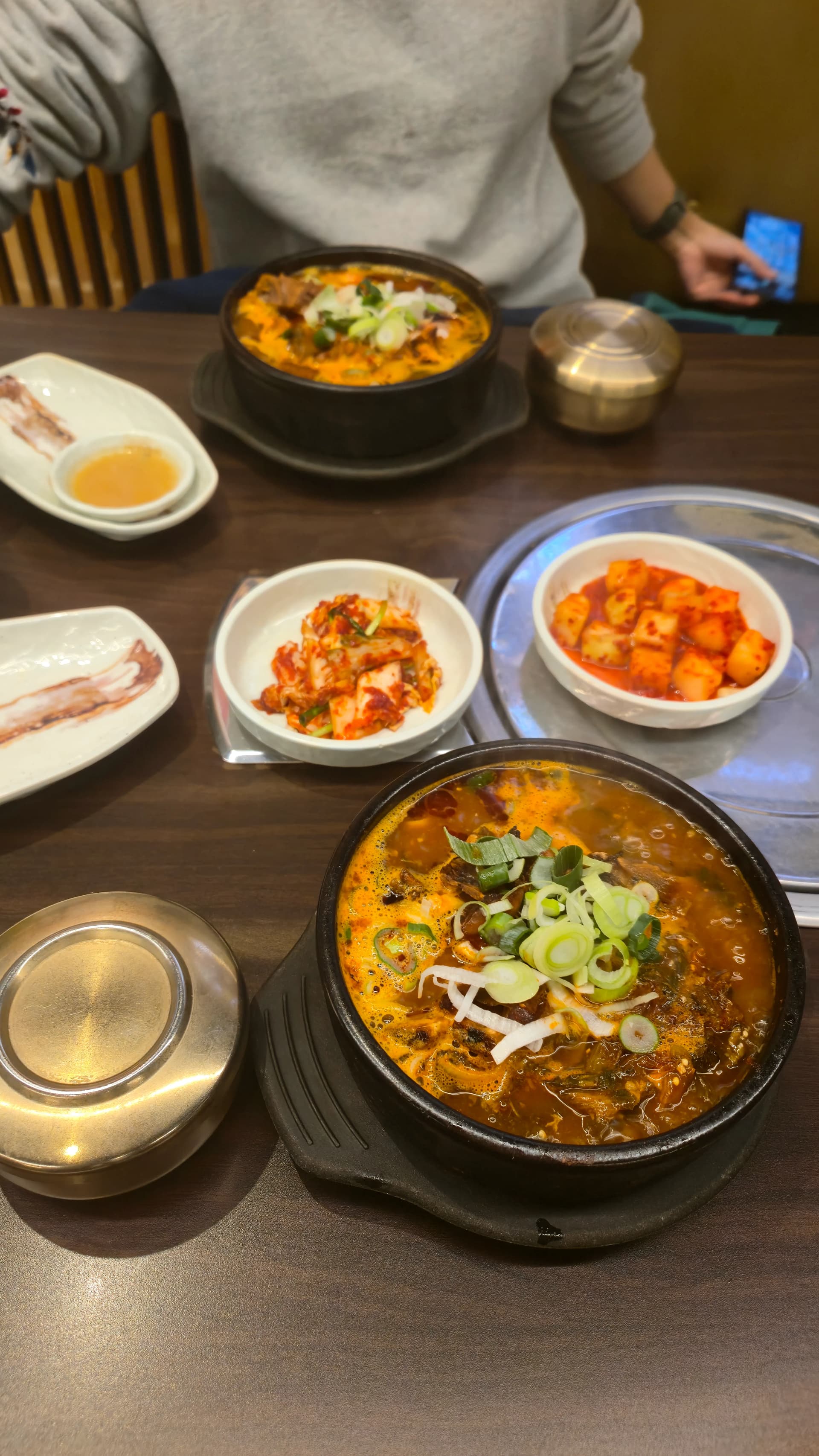
A dark reddish broth is bubbling away inside a scorching hot stone pot, topped with green onions and bean sprouts. You can tell just from the color — this is no joke. Behind it, you can see another bowl of the same pork bone soup. That's right, one pot per person. And that's the biggest difference from gamjatang. One person, one stone pot — you can eat it solo with zero awkwardness.
You can also see the side dishes (banchan) laid out next to it. Kimchi and kkakdugi (cubed radish kimchi) come as standard. And in Korea, all these side dishes are completely free. That's something you'd never see in most other countries.
Gamjatang
Pork Bone Stew
- 👥 Hot pot for 2+ people
- 💰 Small ~$22 / Medium ~$27 / Large $35–37
- 🦴 Pork spine + potato as main ingredients
- 🌶️ Rich and heavy broth
- 🍽️ Shared family-style dining
- ❌ Not great for solo dining
Byeodaegui Haejangguk
Pork Bone Hangover Soup
- 🙋 Individual stone pot per person
- 💰 Around $6–9 per serving
- 🦴 Pork bone + dried radish greens as main
- 🌶️ Spicy yet clean broth
- 🍽️ Served in a personal stone pot
- ✅ Perfect for solo dining
If the Gas Burner Lid Is Closed, Your Food Is Ready to Eat
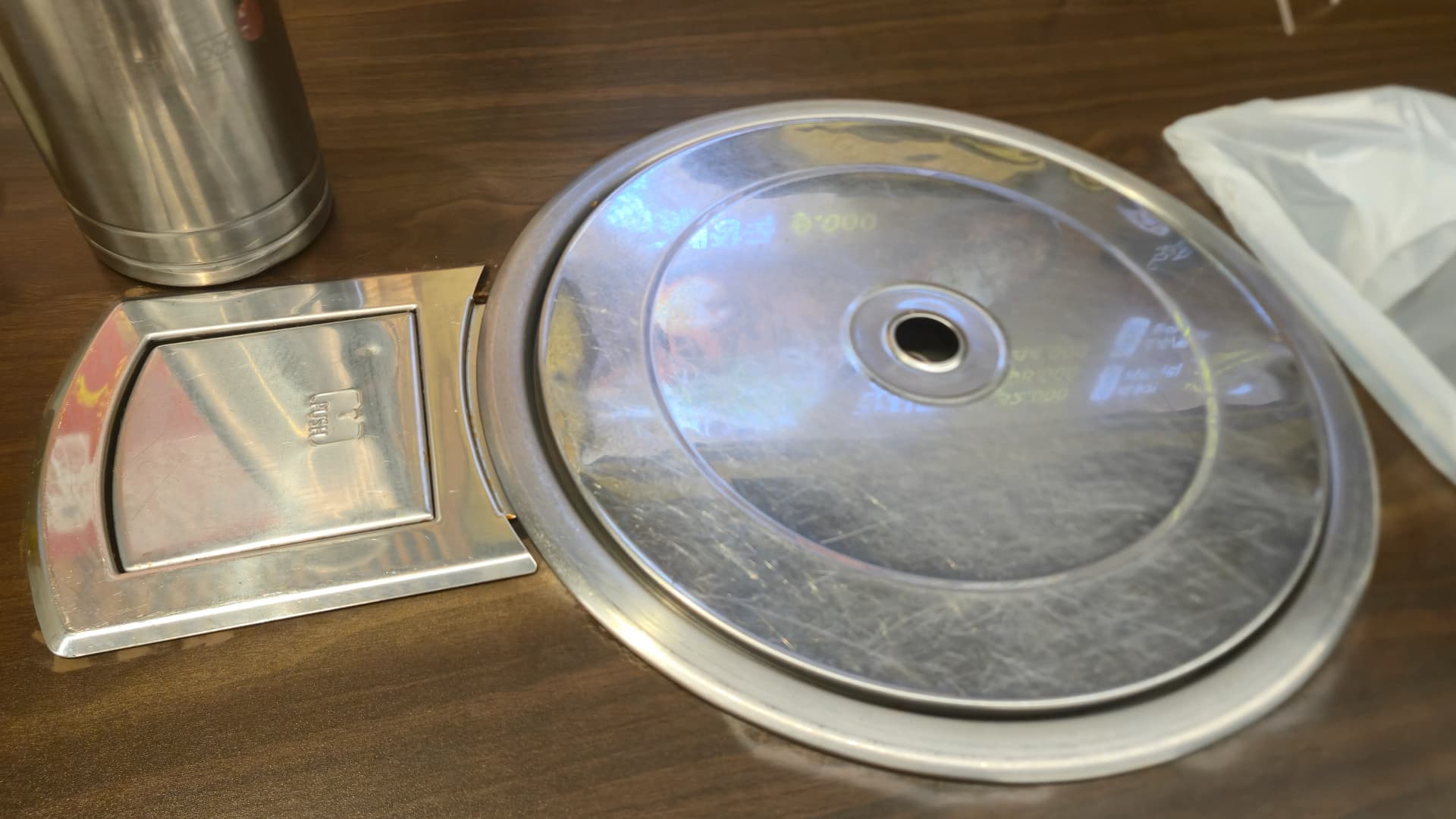
You can tell right away by looking at the table. There's a gas burner, but the lid is closed. Gamjatang is a cook-at-your-table kind of dish — you boil the pre-cooked bones and ingredients yourself, so the gas flame is essential.
But byeodaegui haejangguk is different. It comes out already fully cooked from the kitchen. So the gas burner just stays shut. You sit down and eat immediately. No waiting. Just pick up your spoon.
Here's a handy tip for traveling in Korea: if the gas burner at your table is closed, it means the dish is coming out fully prepared. Good to know.
Geotjeori and Kkakdugi — The Meal Isn't Complete Without These
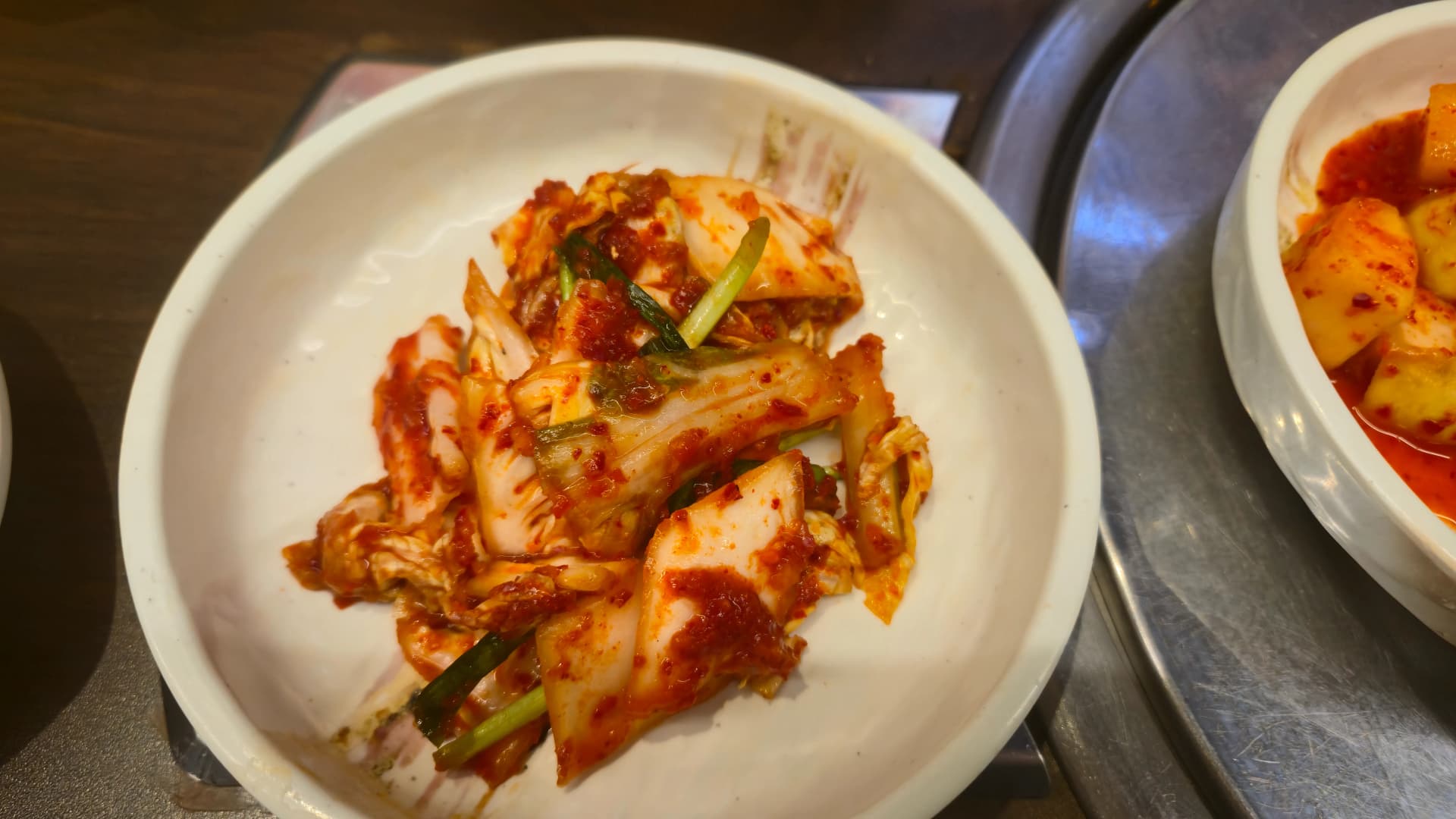
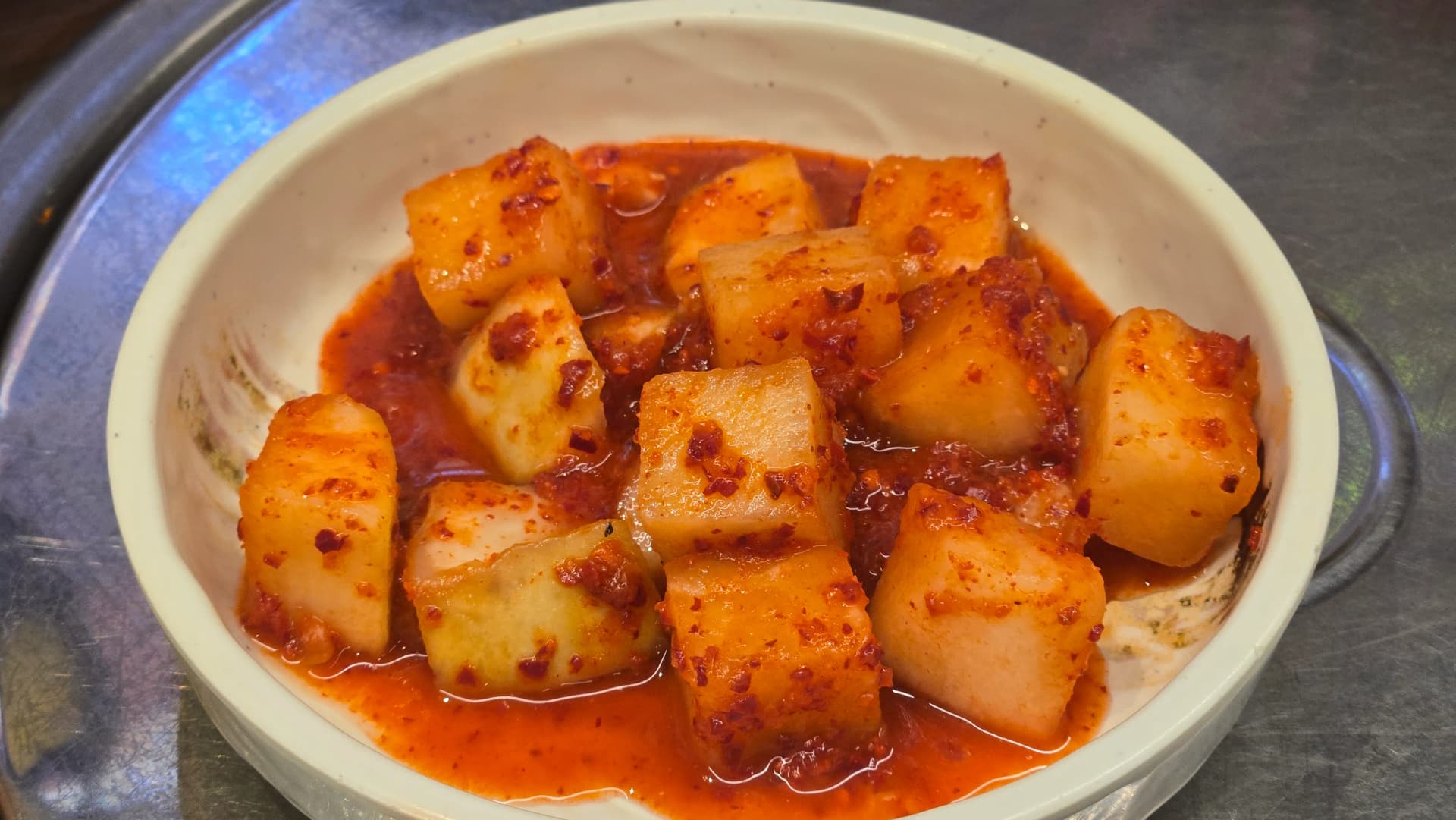
These two side dishes (banchan) — do not skip them. Whether it's gamjatang or byeodaegui haejangguk, the meal isn't complete without this combo.
On the left is geotjeori (fresh kimchi), and on the right is kkakdugi (cubed radish kimchi). They're both types of kimchi, but honestly the taste and texture are completely different.
Geotjeori
Fresh Kimchi
- 🌿 Freshly made cabbage kimchi
- 😊 Seasoned without fermentation
- 🌶️ Spicy with a crisp, crunchy texture
- 💧 Almost no sour tang
- ✨ Pairs especially well with soup dishes
Fermented Kimchi
Aged Kimchi
- ⏰ Kimchi aged over a long time
- 😮 Deep, rich fermented flavor
- 🌶️ Spicy with a tangy sourness
- 💧 Lots of rich, concentrated juice
- ✨ Perfect harmony with heavy, rich soups
Kkakdugi
Cubed Radish Kimchi
- 🥕 Made with Korean radish instead of cabbage
- 😄 Cut into chunky cube shapes
- 🌶️ Spicy with a hint of sweetness
- 💎 Known for its satisfying crunch
- ✨ One sip of broth + one bite of kkakdugi = the perfect combo
Take a sip of that rich, heavy pork bone soup, then pop a piece of geotjeori in your mouth — it instantly cleanses your palate. Follow that up with a cube of kkakdugi, and suddenly you're craving another spoonful of broth. It's an infinite loop. Seriously. 😄
Rice Is Always Included — No Need to Order It Separately
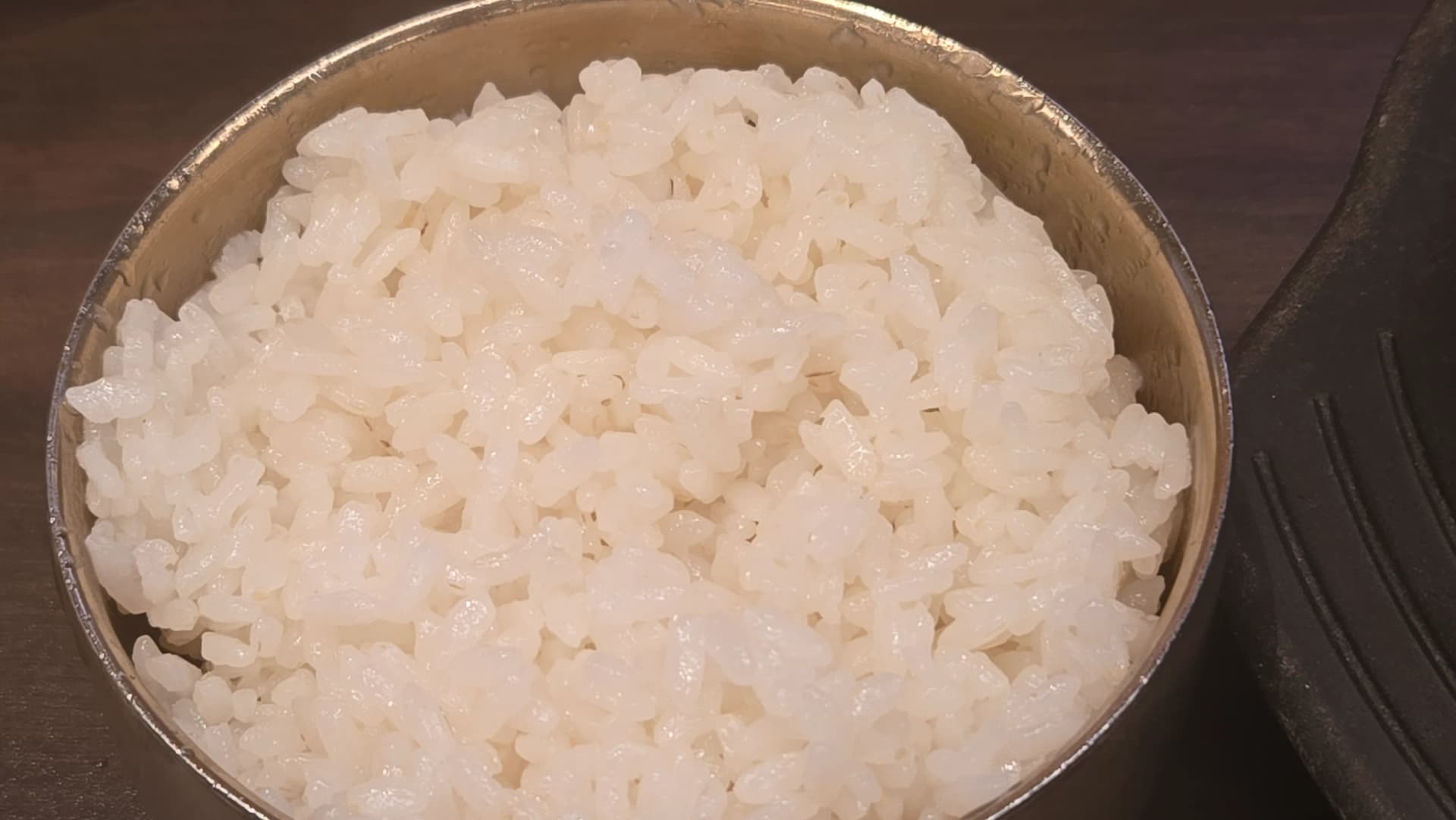
Rice (bap — steamed white rice) comes included as standard. In Korea, soup dishes always come with rice as a set. No need to order it separately. Scoop some rice into that pork bone broth, and that right there is a complete Korean meal.
It Arrives in Under 10 Minutes — The Key Difference from Gamjatang
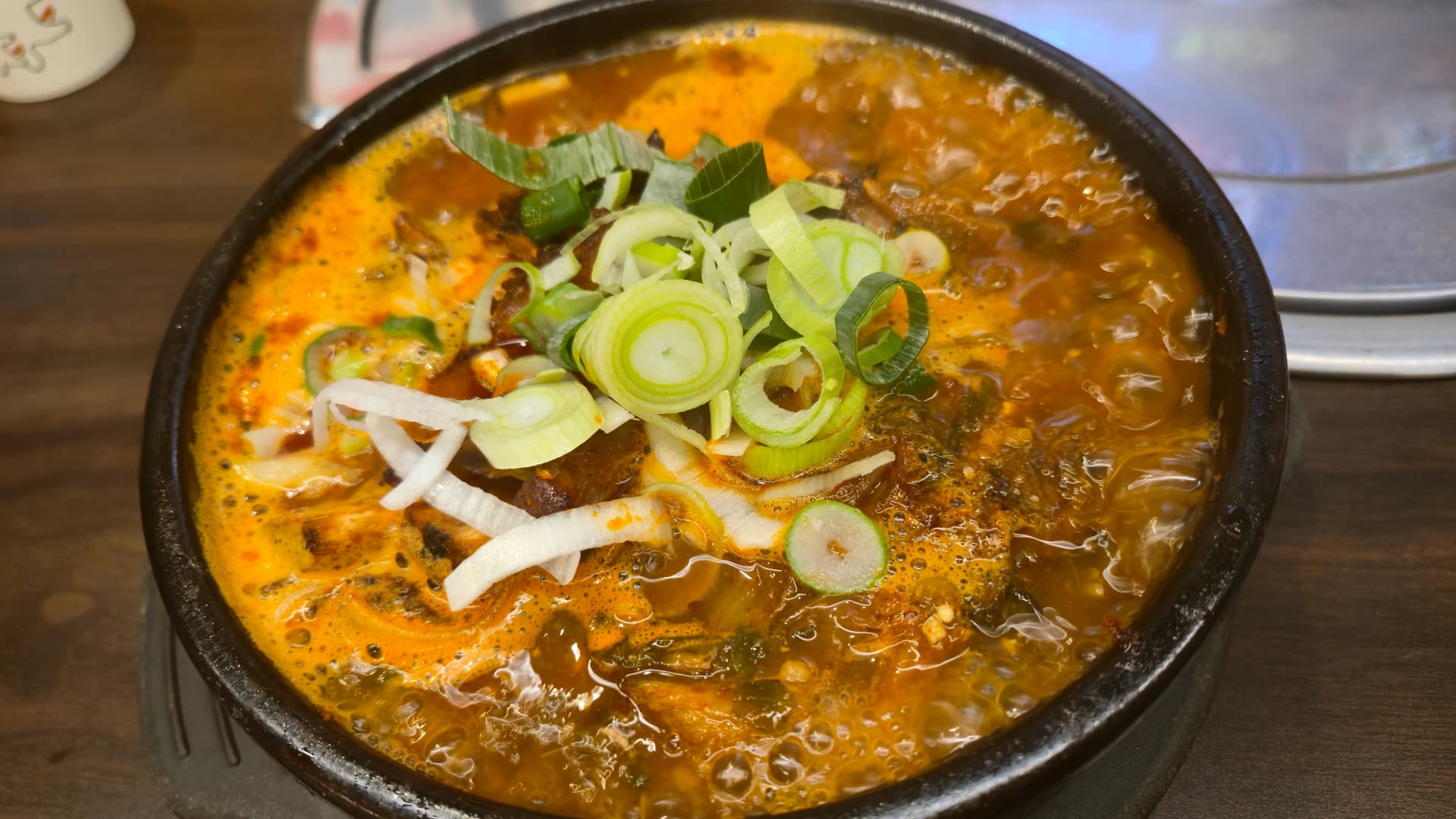
This is the real deal — byeodaegui haejangguk in the flesh. It arrives already boiling hot. A rich, orange-tinted broth is loaded with green onions and bean sprouts, the liquid filled to the brim like it's about to overflow. Is this even real?
This is where the biggest difference from gamjatang shows up. After you order, this arrives at your table in under 10 minutes. No waiting around. That makes it perfect for office workers with short lunch breaks. And for travelers who are short on time, it's an ideal choice too.
Gamjatang, on the other hand, is different. It's a cook-at-your-table dish, so it takes a while. But the trade-off is that it's great for leisurely meals with good conversation. It suits gatherings or couple dates — situations where you're deliberately taking your time to enjoy the experience.
Another big advantage of byeodaegui haejangguk is that everyone gets their own individual pot. You don't have to worry about anyone else's pace — just eat at your own speed. The one downside, though? You can't add fried rice (bokkeum bap) or extra noodles (sari) at the end. With gamjatang, there's that fun ritual of making fried rice with the leftover broth, but with this pork bone hangover soup, you don't get that finishing move. It's a bummer, but that's the limitation of a single-serving pot.
$6–9 Per Serving — Is This Price Even Real?
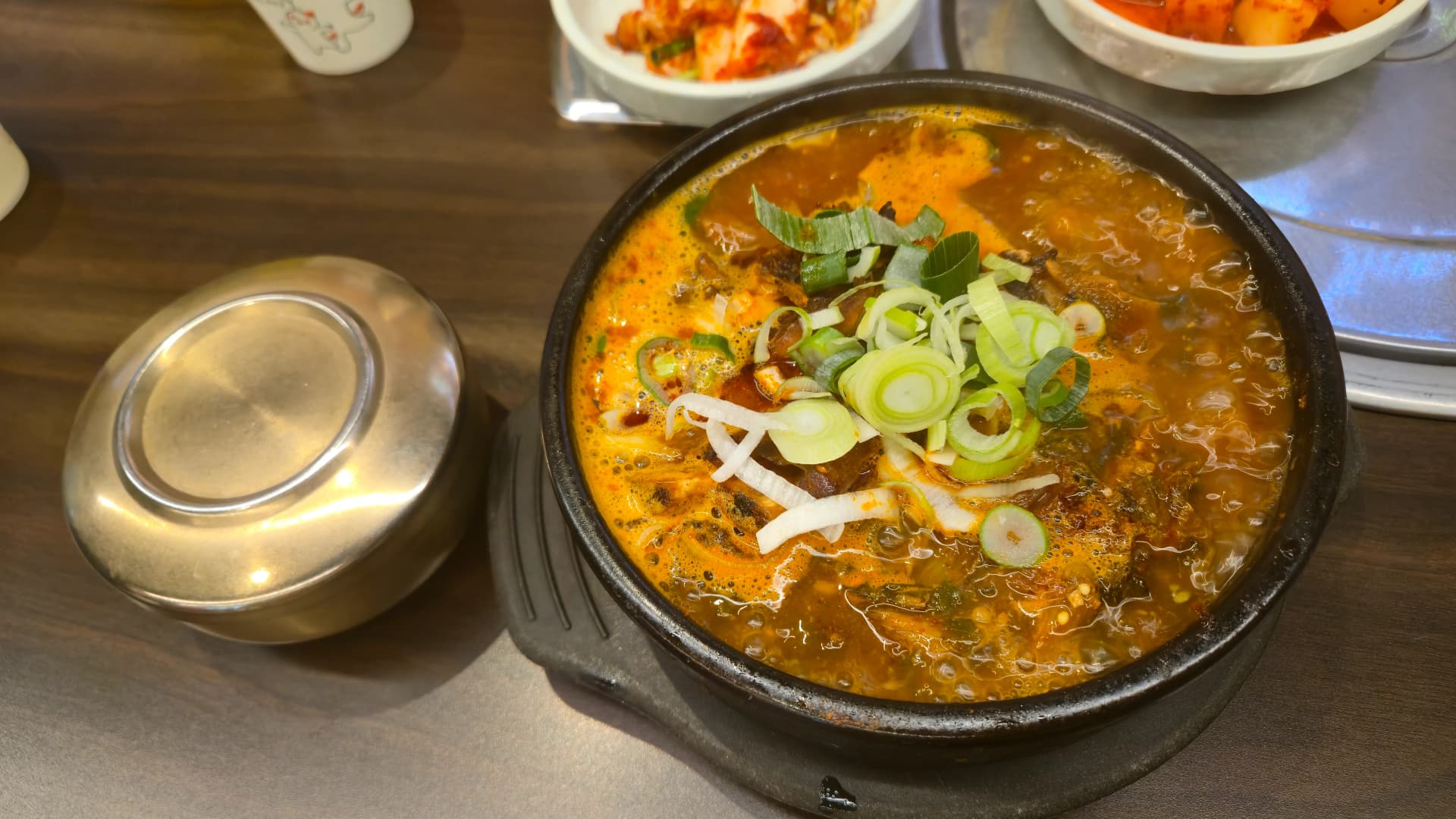
A stainless steel bowl of steamed rice (gonggi bap) is set up right next to the stone pot. This is the default. You don't order it separately. When you order byeodaegui haejangguk, rice automatically comes with it. Scooping rice into the broth and taking a big spoonful — that's the proper way to eat it.
But the truly jaw-dropping part is the price. One serving runs about 8,000–12,000 won, which is roughly $6–9 USD. Even if two people eat, that's only $12–18 total. That's cheaper than a single small gamjatang pot. And you each get your own stone pot, rice included. How is this value even real?
If you want a filling meal during your Korea trip that keeps your wallet happy too, pork bone hangover soup is the answer.
The Raw Green Onion Aroma Hits You First — Appetite Activated Before You Even Eat
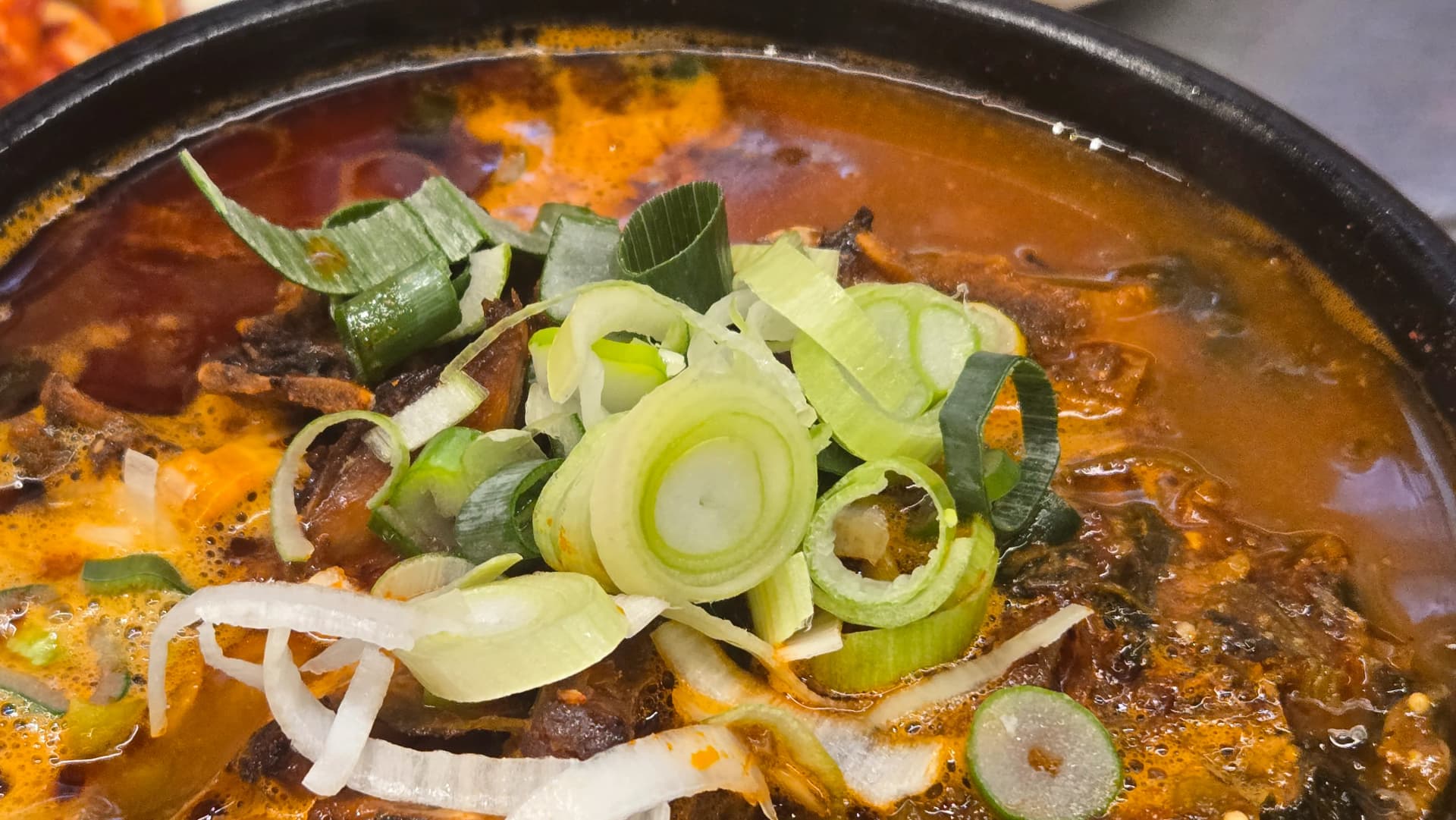
Up close, it looks like this. Freshly sliced raw green onions are sitting right on top of the bubbling stone pot (ttukbaegi). They've been chopped and placed straight on — completely uncooked.
That's the whole point. As the heat from the boiling broth slightly wilts the green onions, their distinctive aroma spreads across the entire bowl. The scent reaches your nose before you even take your first bite. Seriously, your appetite kicks in before you've touched the spoon.
Siraegi — The Unsung Hero of Pork Bone Hangover Soup
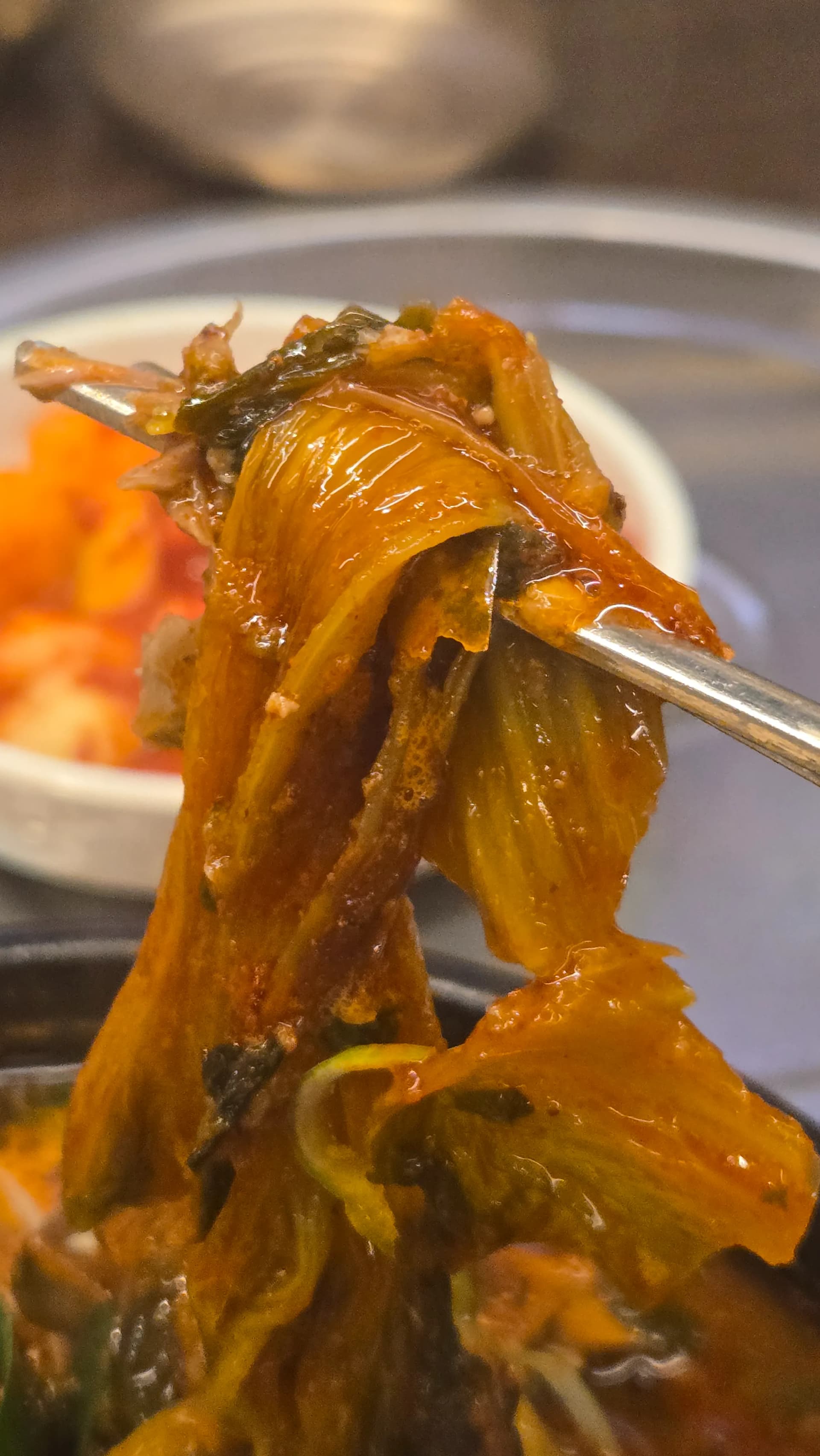
See what I'm lifting up with chopsticks? This is siraegi — dried and fermented radish greens. It's just as important as the bones inside byeodaegui haejangguk. It looks like it might be mushy and limp from soaking in the broth all that time, but one bite will change your mind.
Siraegi
Dried & Fermented Radish Greens
These are radish greens that have been dried in the winter wind and naturally fermented. It's a traditional Korean ingredient that transforms what would be food waste into the deepest flavor imaginable.
A nutty, earthy aroma. The longer it simmers in the broth, the more intense the fragrance becomes.
It absorbs every drop of the pork bone broth. The soup flavor is literally concentrated inside each strand.
💡 What about the texture? There's no crunch here. It's been simmered until it's soft and saturated with broth, chewing down gently. The pork bone broth has seeped into every fiber, so the more you chew, the more soup flavor releases. It's strangely addictive.
One chopstickful of siraegi, one spoonful of broth. Keep repeating that combo and before you know it, you're staring at the bottom of an empty bowl.
The Meat on the Bone Is the Real Star — Good Restaurants vs Disappointing Ones
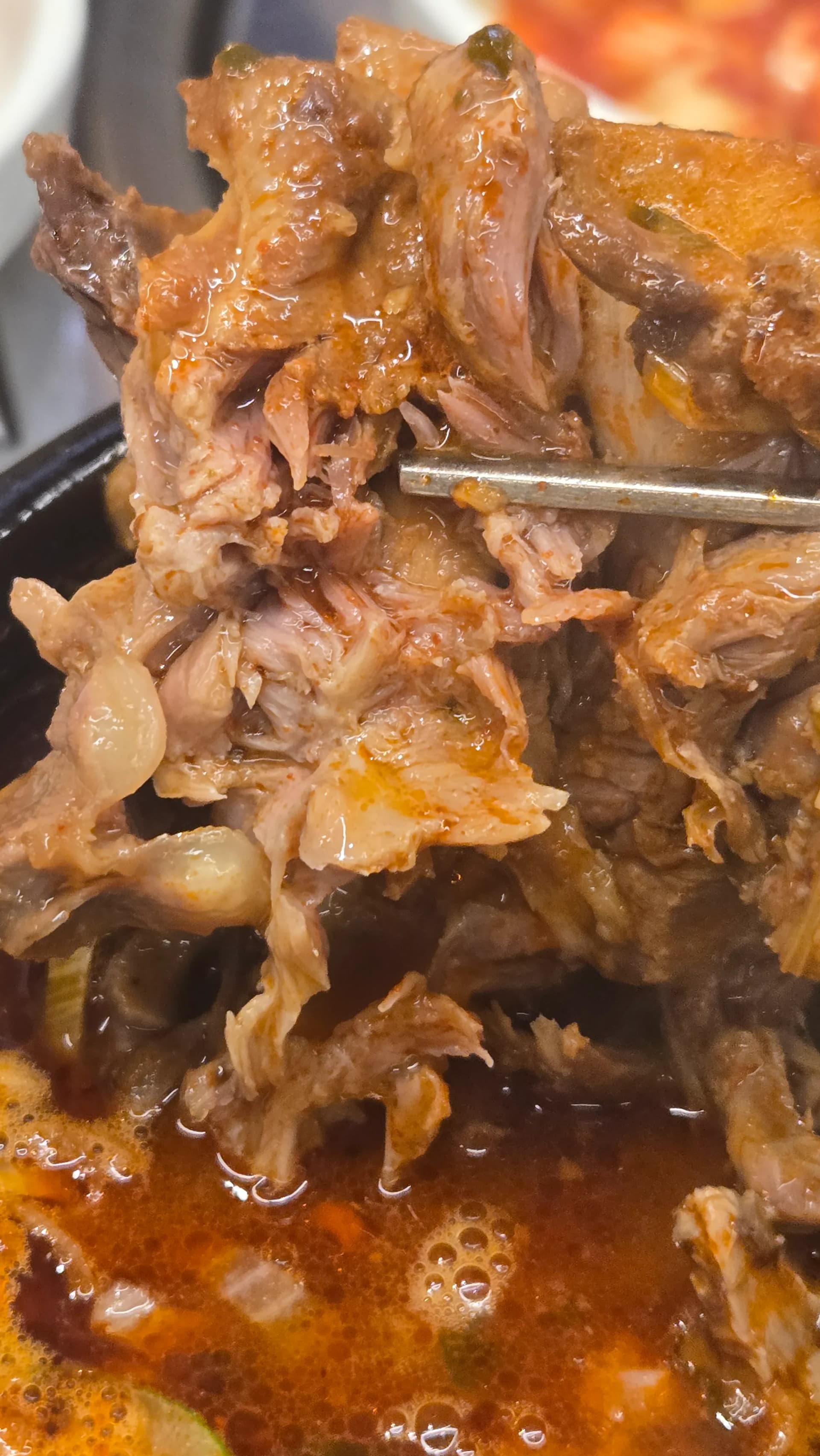
This right here is the real star of byeodaegui haejangguk. You're not eating the bone. You're eating the pork meat attached to the bone. Just look at the photo. There's this much meat on it.
When you barely touch it with your chopsticks, the meat should slide right off along the grain. That's the sign of a good restaurant. They've slow-simmered it until the meat naturally separates from the bone — that's the mark of quality. The texture should be tender and moist.
But let me be real with you. It varies from place to place.
A Great Restaurant
The Real Deal
- 🦴 Meat slides off the bone with just a touch of chopsticks
- 🥩 The grain of the meat is intact — tender and moist
- 🍲 The broth flavor has soaked deep into the meat
- 😍 You can pick the bone clean effortlessly the whole time
A Disappointing Restaurant
Not Worth It
- 🦴 The meat clings stubbornly to the bone — a real struggle to pull off
- 🥩 What you do manage to pry off is dry and tough
- 🍲 The broth tastes fine, but the meat itself has no flavor
- 😓 You end up spending more time wrestling the bone than actually eating
💡 Pro tip — As soon as you sit down, check the broth's color and aroma first. If the broth is clear (not murky) with a deep, rich orange hue, there's a high chance the meat is properly done too. Restaurants that nail the broth rarely disappoint with the meat.
Pork bone hangover soup is half about the broth, half about the meat. Finding a place where the meat is perfectly tender — that's the real key to discovering a great restaurant.
Siraegi + Pork Meat = A Flavor That's Only Complete Together
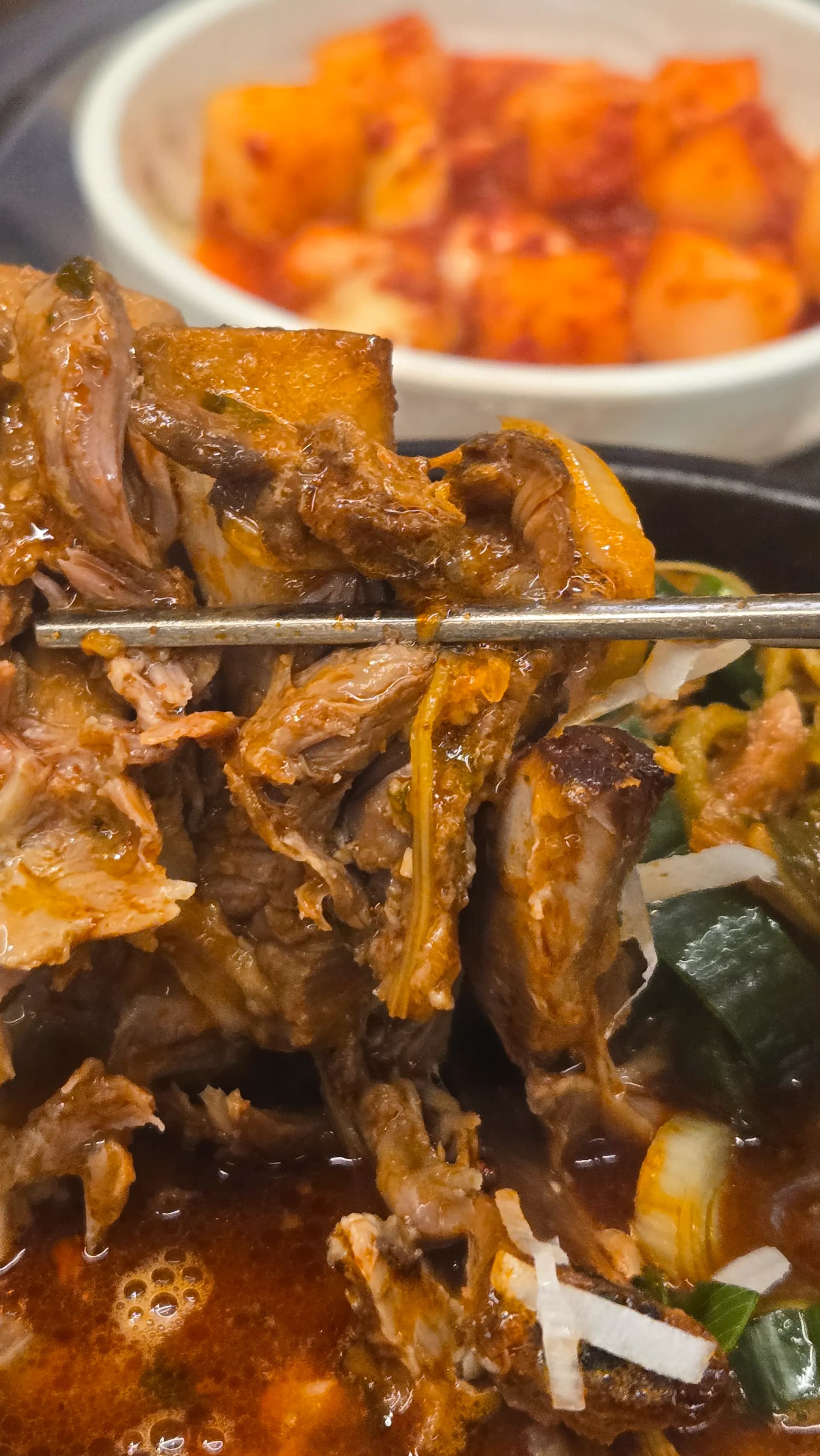
See what the chopsticks are lifting up? Siraegi and pork meat came up together. That's not a coincidence. You're meant to eat them together.
Eat the meat alone and it's rich and heavy. Eat the siraegi alone and you get that deep, earthy broth flavor rising up. But when you put both in your mouth at the same time, the taste completely transforms. The nutty aroma of siraegi spreads between bites of tender meat, and they balance each other out perfectly. Separately they're good — together they're on another level.
Once you experience this combo, it's seriously hard to forget.
Geotjeori and Kkakdugi — The Palate Reset That Keeps the Infinite Loop Going
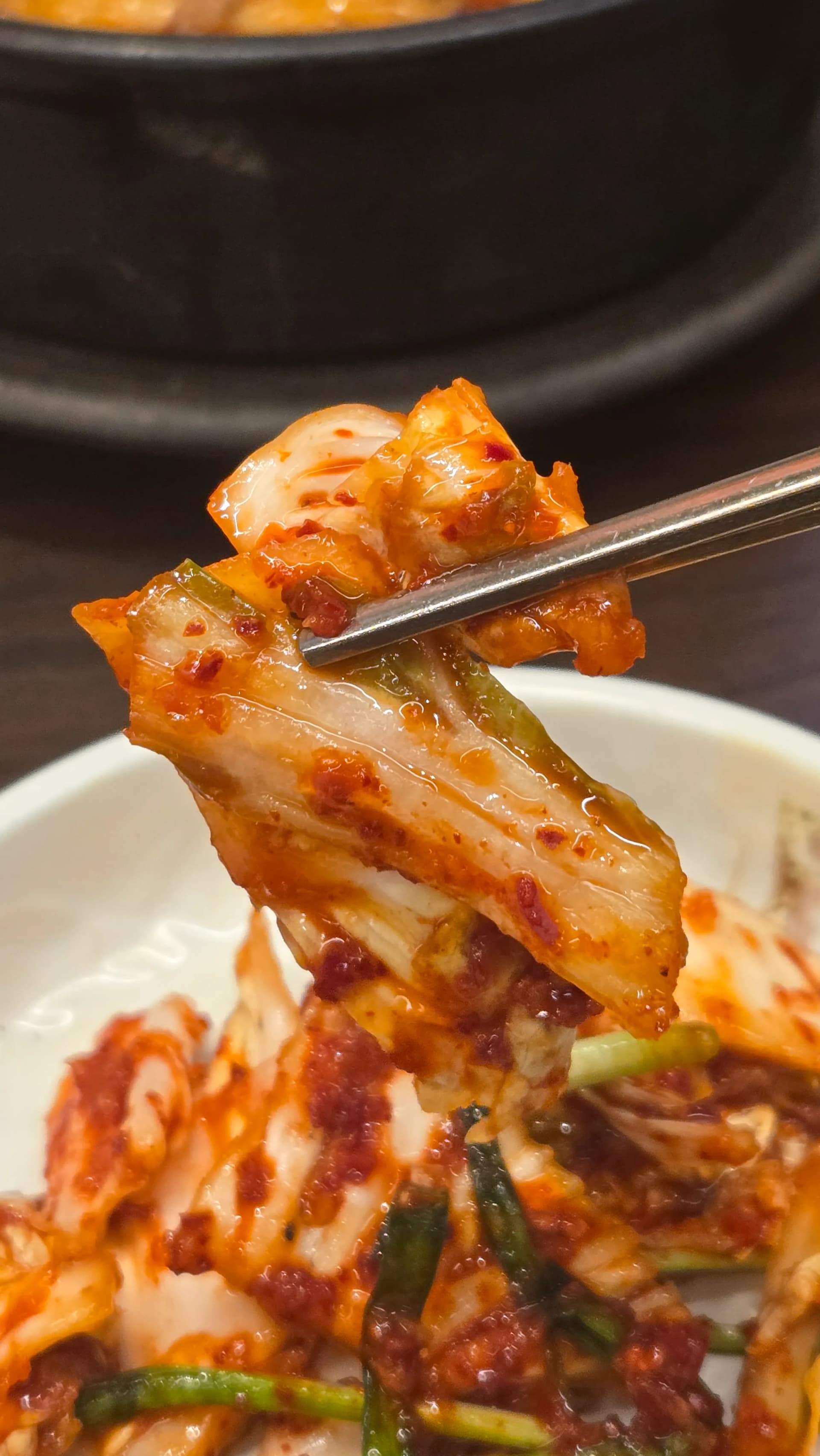
And then you grab a bite of geotjeori (fresh kimchi). This is what resets your palate. After slurping that rich pork bone broth, one bite of geotjeori — spicy and crunchy cabbage — wipes your mouth completely clean. And then you're craving the broth again. This infinite loop is the secret behind why you end up finishing every last drop of byeodaegui haejangguk.
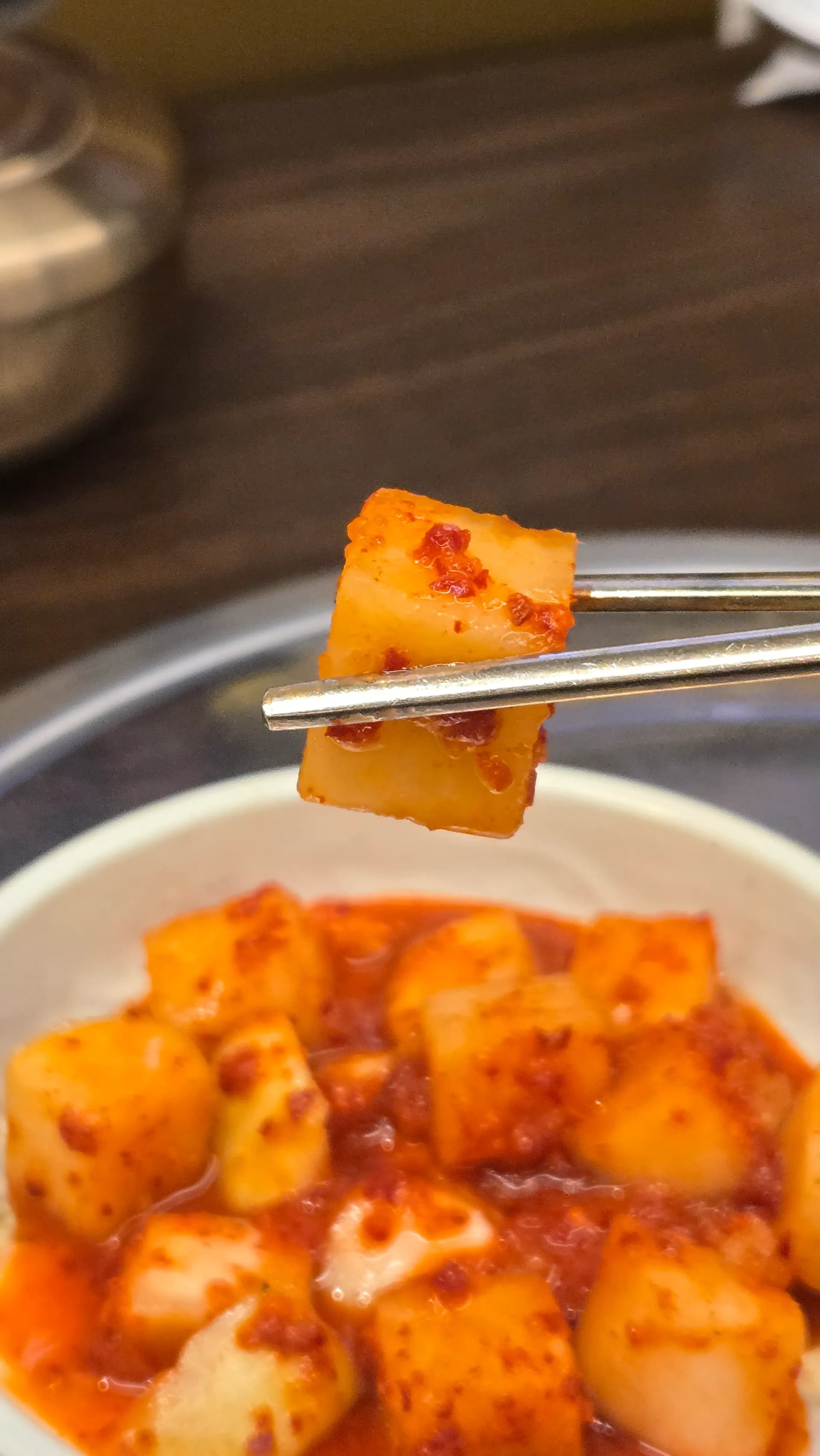
Now for the kkakdugi (cubed radish kimchi). It looks similar in color to the geotjeori, but it's a completely different food. First-time visitors from abroad often glance at it and think it's just red radish chunks and pass right over it. Big mistake.
Unlike regular kimchi made from cabbage, kkakdugi is made by cutting Korean radish (similar to daikon) into chunky cubes and seasoning it with red pepper flakes, garlic, and green onion before fermenting it. That translucent, slightly yellowish flesh you see in the photo? That's the radish.
One bite and you'll know immediately. First comes that satisfying crunch, then a spicy-sweet flavor follows. When you're eating that heavy pork bone broth and pop a cube of kkakdugi, the cool, refreshing bite of the radish cuts right through the richness. There's honestly no side dish that pairs better with Korean soup dishes.
Korea's Banchan Culture
Free Side Dishes in Korea — What Every Visitor Needs to Know
🎉 In Korea, side dish refills are completely free.
Yes, FREE. No extra charge. Always.
😟 Common Worries Foreign Visitors Have
"I finished all the side dishes... will I get charged if I ask for more? 😰"
"Wouldn't it be rude to ask for extra? 🥺"
"Won't they think I'm placing a separate order? 😅"
✅ Here's the Answer
- 🆓 Side dish refills are 100% free. At any restaurant.
- 🙋 Just raise your hand and say "Can I get more of this?"
- 😊 There's absolutely no need to feel awkward. It's totally normal.
- 🌍 This is a uniquely Korean food culture you won't find anywhere else in the world.
🗣️ How to Ask for Refills
🇰🇷
"이거 더 주세요"
Igeo deo juseyo
🇺🇸
"Can I get more of this?"
Just point at the dish and say it — easy
⚠️ Etiquette You Should Follow
Just because it's free doesn't mean you should go overboard with refills.
Only ask for as much as you can actually finish — that's basic manners.
Leaving behind lots of uneaten food isn't great for the restaurant or the environment.
A little at a time, only what you need — that's the right way to enjoy Korea's banchan culture. 🙏
Fermented Kimchi + Mustard Sauce — An Unexpected Combo That Keeps You Coming Back
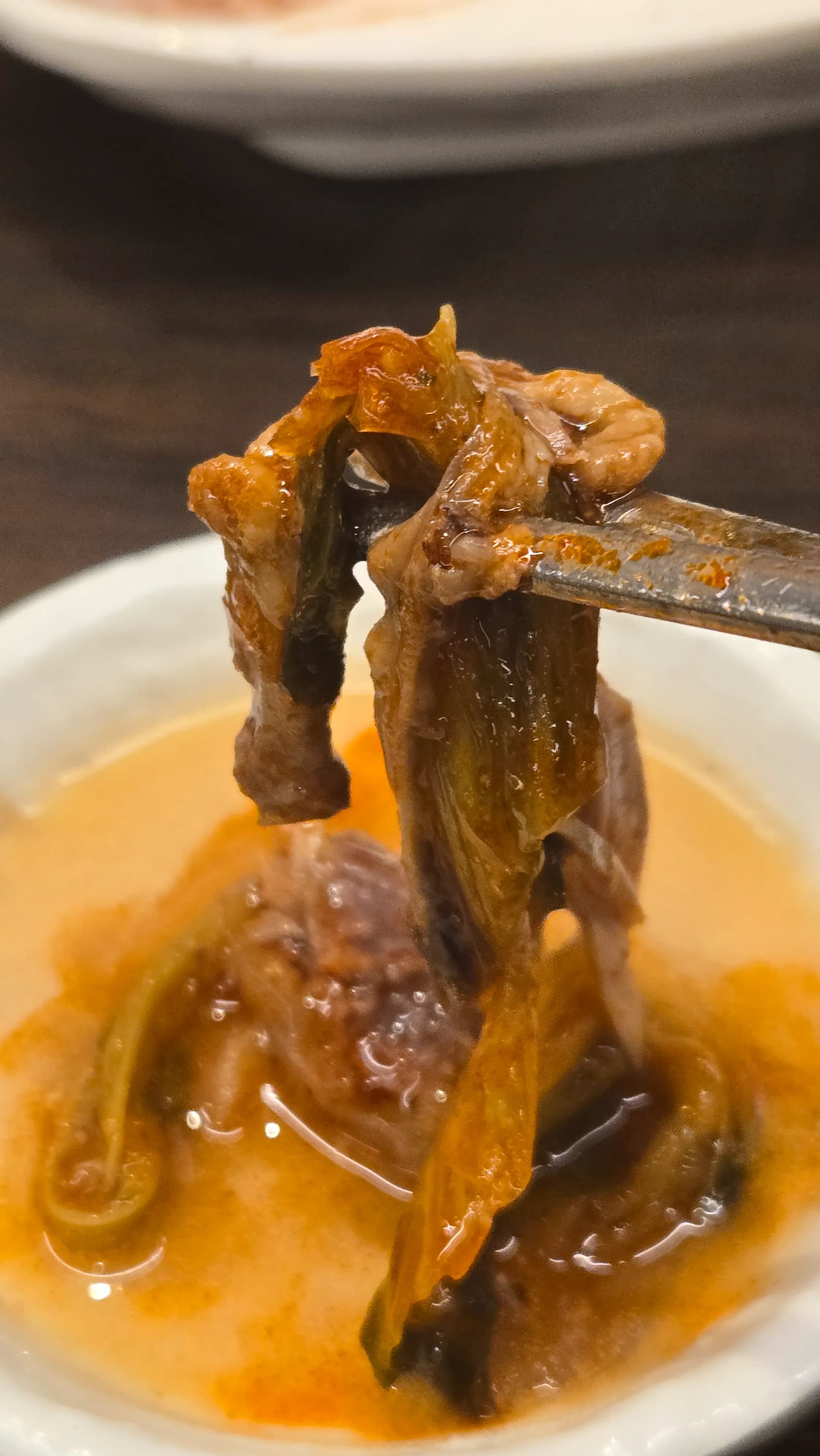
This is aged fermented kimchi that comes submerged in kkakdugi liquid. It has a completely different depth compared to geotjeori. Kimchi that's been fermented for a long time looks different from the start — it has this deep brownish hue, and the texture is soft and settled.
It's delicious on its own, but here's the twist. Dip it in the mustard sauce that's served alongside, and the flavor completely transforms. The deep sourness of the fermented kimchi meets the sharp, nose-tingling kick of the mustard, and somehow they work together brilliantly. You might think it's a weird combination at first, but once you try that first dip, you won't stop reaching for it. Definitely give it a try.
What Does the World Think of Pork Bone Hangover Soup?
American Reactions
What Americans Say
The first thing Americans always say is "The meat literally falls right off the bone." Americans already have a BBQ rib culture, so pulling meat off bones isn't foreign to them. But they say the deep, rich broth of gamjatang and pork bone hangover soup is a completely different experience. On Reddit especially, you'll see "the GOAT of Korean soups" popping up over and over. One common source of confusion is the name — since "gamjatang" literally translates to "potato soup," you get a lot of reviews saying "I ordered potato soup and there's only one potato in it?" with a laugh.
"It's the GOAT of Korean soups. The meat just melts — I've been eating this for 15 years and still love it."
Japanese Reactions
What Japanese Visitors Say
The word that comes up most in Japanese reactions is "コクがある (koku ga aru)" — meaning "it has deep, rich flavor." Japan has its own pork bone broth dishes, but they say the spicy and earthy flavor profile of gamjatang and pork bone hangover soup is a completely different direction that feels refreshingly new. There are multiple YouTube videos of Japanese people bringing their parents to Korea for the first time and treating them to pork bone soup, only for the parents to not be able to stop eating. Siraegi doesn't exist as an ingredient in Japan, so you'll find tons of curious comments about the texture too.
"辛いのに止まらない。スープが骨の中まで染みてる感じ。" (It's spicy but I can't stop. It feels like the soup has soaked into the very core of the bones.)
French Reactions
What French Visitors Say
The French are surprisingly passionate about this dish. There's a viral YouTube video of a French woman calling gamjatang "the most delicious thing in the world." France has its own tradition of bouillon — slow-simmered bone stock — so they seem to instinctively understand and appreciate the depth of a bone broth. There was even a French reviewer asking if they could get it to-go, which tells you just how badly they wanted more.
"C'est le meilleur plat que j'ai mangé en Corée. Le bouillon est incroyable." (It's the best dish I've had in Korea. The broth is unbelievable.)
Spanish Reactions
What Spanish Visitors Say
There was a viral TikTok story about this. A Korean expat living abroad brought their Spanish parents to a gamjatang restaurant for the first time, and the parents were shocked at first when the bones came out, but once they tasted it, they ended up stealing their kid's food too. Spain has its own bone broth stew culture with dishes like cocido, so the consensus was that they adapt to the taste quickly. A lot of the comments were especially stunned that the geotjeori and kkakdugi side dishes were free.
"¡Me robó la comida de mi hijo! No podía parar de comer." (She stole her son's food! She couldn't stop eating.)
Top 3 Universal Reactions Across All Countries
Confused by mustard sauce → instantly addicted
Everyone goes "Mustard with pork?" at first, then after one dip they can't stop. It's a universal pattern across every nationality.
Mind-blown by the free unlimited side dishes
"Wait, this is ALL free?" shows up in reviews from every single country. Kkakdugi refills were especially popular.
Absolute disbelief at the value for money
Once people find out it's only about $6–9 per serving, the reaction across the board is "How is this price even possible?" This was especially common among European travelers.
This post was originally published on https://hi-jsb.blog.