
Stunning Underground Cave You Didn't Know Existed in Korea
Table of Contents
21 items
Gangwon-do, Korea — If You Haven't Been, Start With This Cave
I love reviewing popular tourist spots and restaurants, but sometimes I also want to introduce places that foreign travelers haven't really discovered yet.
Korea has so many spots like that — places you've never heard of, but once you actually visit, you're like "How did I not know about this?" This post is exactly one of those places. Hwaam Cave, located in Jeongseon, Gangwon-do — about a 2.5-hour drive from Seoul.
Hwaam Cave
Hwaam Cave · Natural Monument No. 557
In 1934, while digging a gold mine shaft, they accidentally discovered a limestone cave.
The traces of forced mining during the Japanese colonial period and a cave formed by nature share the same space — an incredibly rare site even within Korea.
Monorail Ride
Take the monorail up to the entrance. Separate fee from cave admission.
365 Stairs
90m elevation drop, 365 steep stairs. You'll need some stamina.
Stalactites & Cave Flowers
Flowstone waterfalls, stalagmites, columns, and cave flowers — all visible up close.
5 Themed Zones
Hall of History → Gold Vein 365 → Fairytale Land → Wonders of Nature → World of Gold, totaling 1,803m.
· Inside the cave it's about 59°F (15°C) year-round — bring a jacket even in summer
· Watch out for slippery surfaces on the 365-stair section
· If you have claustrophobia, check conditions in advance
Important Notes Before Visiting
Please read before your visit
Hwaam Cave spans a total walking distance of 1,803m — that's over a mile. The entire route is on foot, so please check the following before you go.
Visitors with Mobility Issues
We respectfully advise that this cave may not be suitable for those with physical disabilities, elderly visitors with limited mobility, or pregnant women who have difficulty walking for extended periods. The entire route is on foot, and some sections involve steep staircases. Please carefully consider your physical condition before visiting.Visiting with Infants & Young Children
The cave's interior is complex and it's easy to get disoriented. There are also sections with steep drops and sharp staircases. Guardians must stay right beside children at all times. Taking your eyes off them even for a moment could be dangerous.Monorail Schedule
Monorail Schedule · Closed every Wednesday
Departs at :10 · :30 · :50 every hour · Last boarding 16:30
Monorail Fare
Monorail Fee · Separate from cave admission
- 🧑 Adult$2.20
- 🧑🎓 Youth / Military$1.50
- 👶 Child$1.10
※ Even exempt groups (seniors, disabled, veterans) must pay the monorail fare separately
🎫 Hwaam Cave Admission
Hwaam Cave Admission · Closed every Wednesday
| Category | Adult | Youth / Military | Child |
|---|---|---|---|
| Individual | $5.00 | $4.00 | $3.00 |
| Group (30+) | $4.70 | $3.60 | $2.50 |
| Mining area / Jeongseon hotel guests | $4.00 | $3.30 | $2.50 |
Free admission: children under 6, adults 65+, disabled persons, veterans (ID required)
Operating hours: Last entry 16:30 · Walk-in entry closes at 16:00
Take the Monorail Up — Seriously, Trust Me
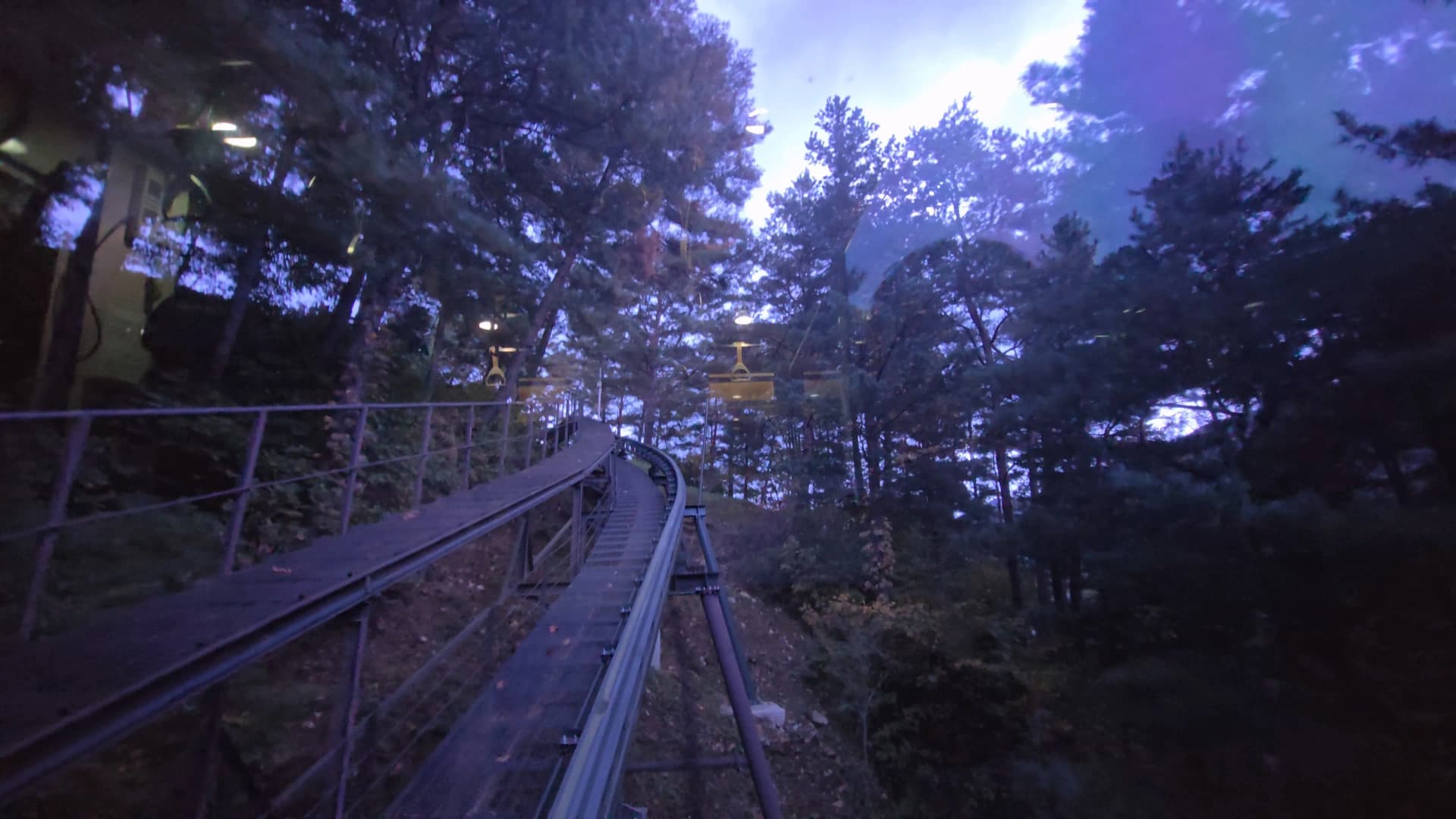
Can you see that incline? If I'd walked up, I would've been completely out of breath. Riding the monorail up through the trees, I just sat back and enjoyed the view. The fare is only about $2.20 for adults, so there's zero reason to hesitate. Monorail going up, walk coming down. That's the winning formula.
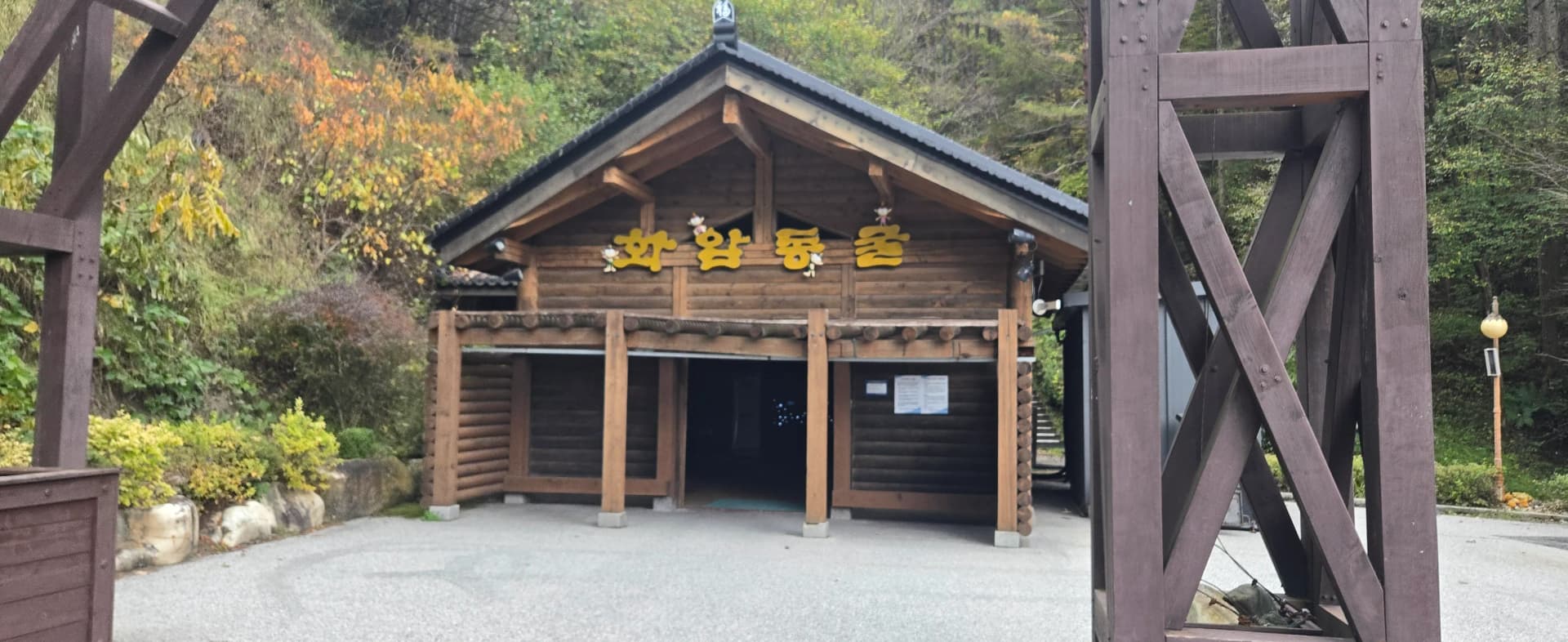
As soon as you get off the monorail, you see this building. It's the entrance to Hwaam Cave. A cozy little log cabin structure — but the moment you step through that door, a completely different world begins.
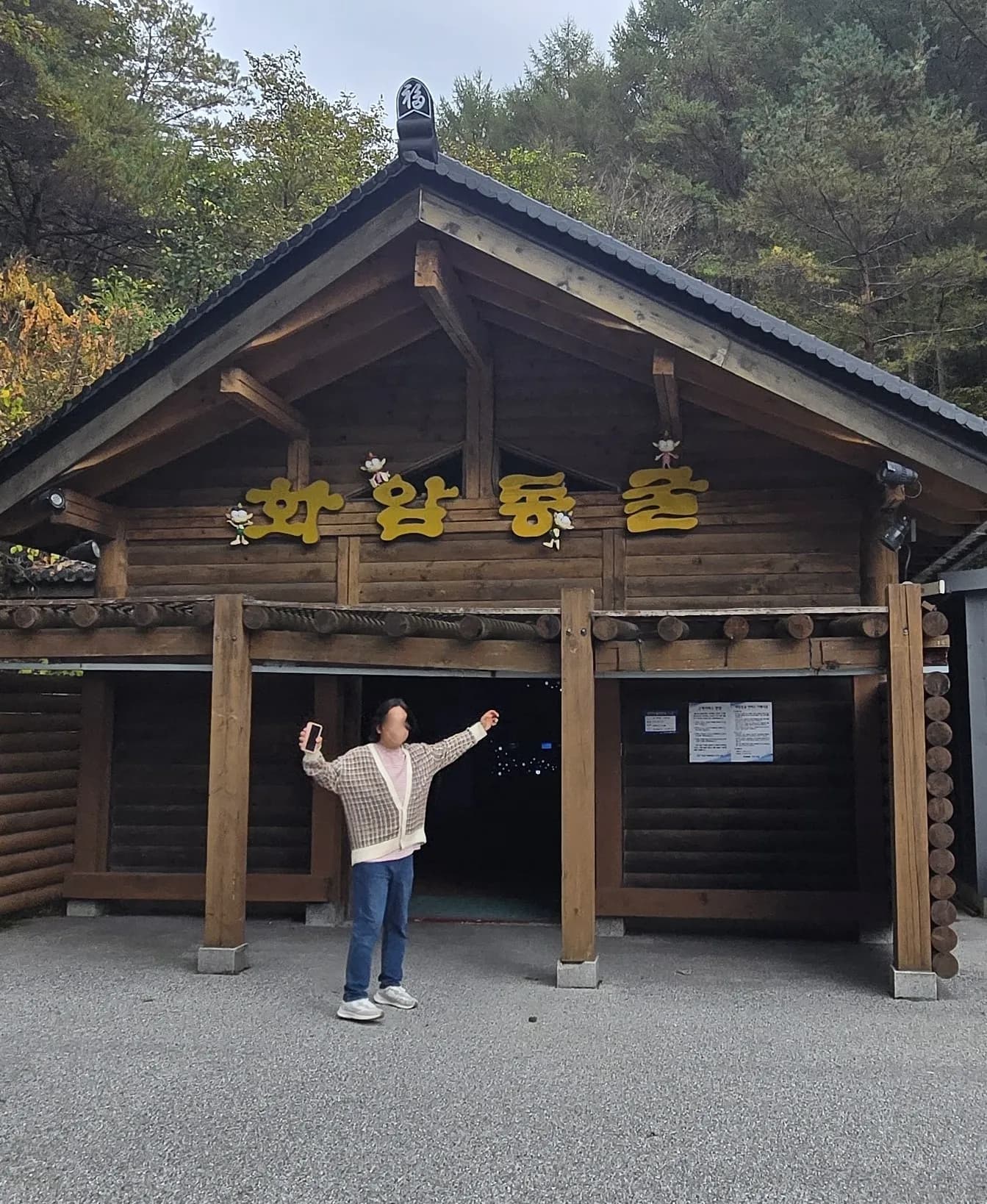
Snap a photo at the entrance — it's a must. By the time you come back out, your legs will be jelly.
It's 59°F Inside the Cave — Don't Let Summer Fool You
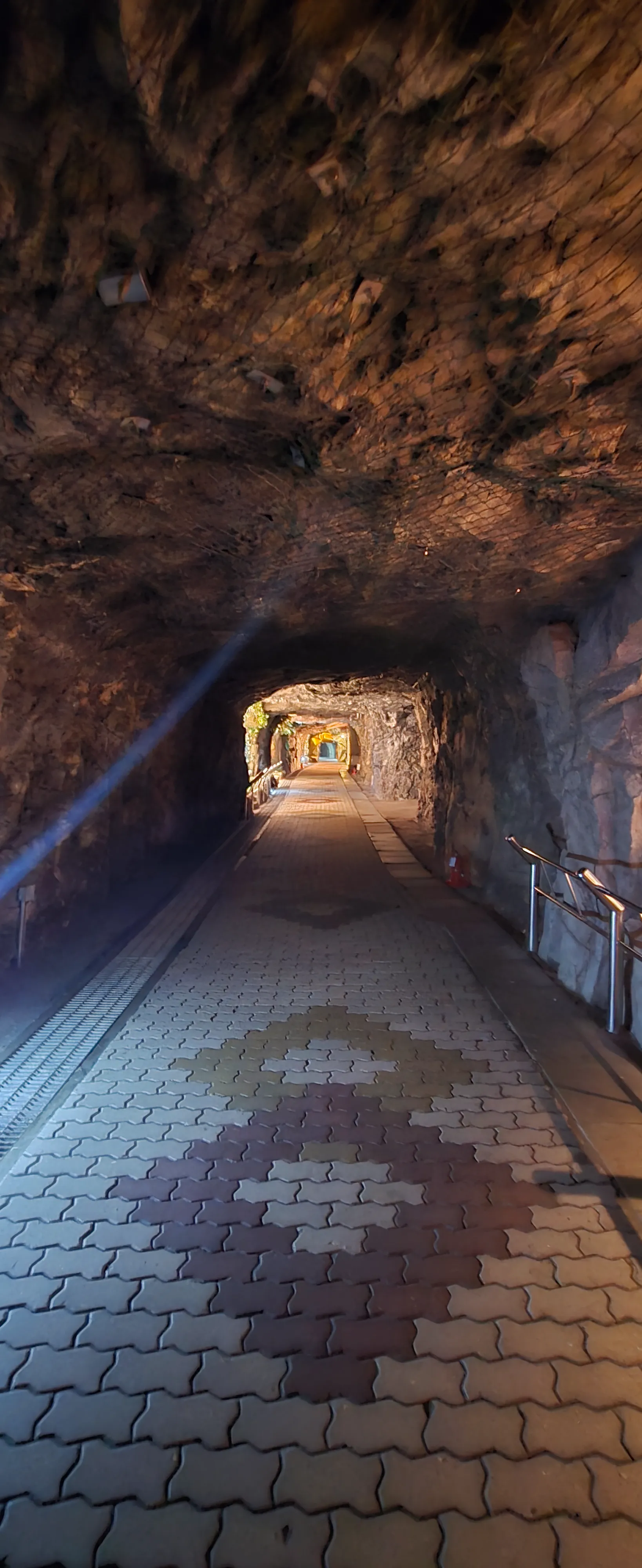
Right after you walk in, you're greeted by this neatly maintained pathway. There are paving stones and railings, so it's comfortable to walk. But here's the important thing — the cave stays at about 59°F (15°C) all year round. Even if you visit in summer, you absolutely need to bring at least a light jacket. I wore a t-shirt with a thin windbreaker, and I was getting chilly toward the end. My friend tried to tough it out in just a t-shirt and eventually just started speed-walking to stay warm.
And honestly, if this were just a walk-through-a-tunnel kind of cave, I'd question whether it was worth the trip. But Hwaam Cave is different. It's divided into 5 themed zones. The whole thing is structured so that a story unfolds as you walk, which keeps the entire 1,803m from ever getting boring.
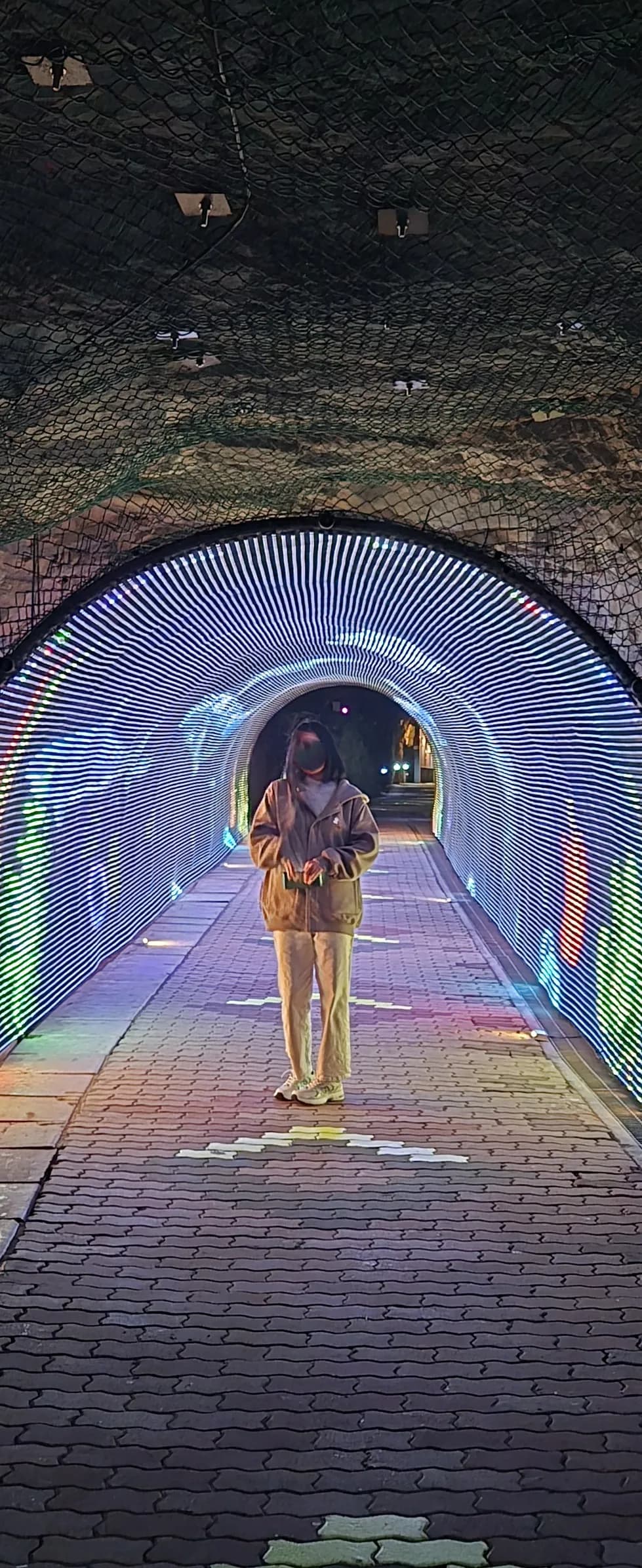
Then you hit a section like this. LED lights wrap around the entire tunnel, and the colors keep shifting. Just take one photo here. The backdrop does all the work for you.
The Upper Shaft — Where Gold Mining History Remains
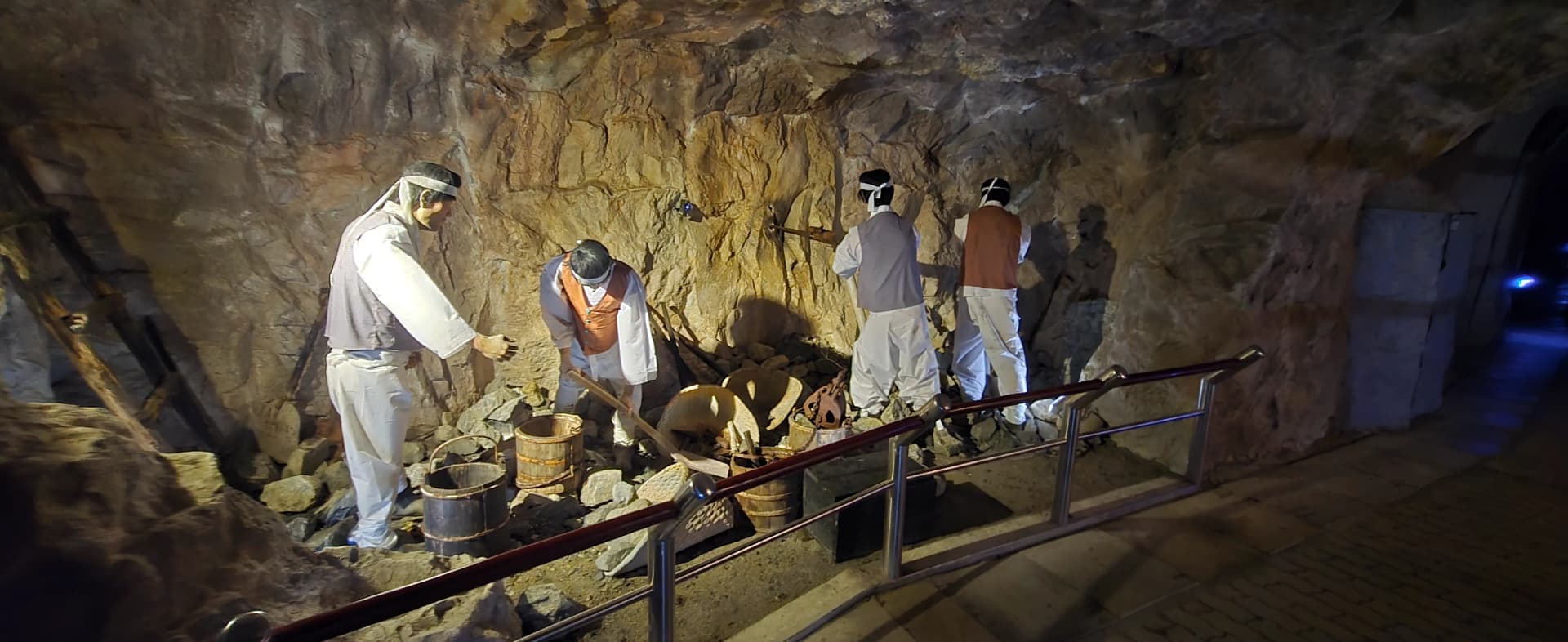
This section is what elevates Hwaam Cave beyond just another cave tour. It's a gold mining scene recreated with mannequins, showing exactly what tools the miners used and how they worked. Hwaam Cave was originally Cheonpo Gold Mine, operated during the Japanese colonial period in the 1930s. In 1934, while digging mine shafts for gold, they accidentally discovered the limestone cave.
So two histories coexist inside this cave. The history of the natural limestone cave formed over millions of years, and the history of humans who forcibly dug into that land.
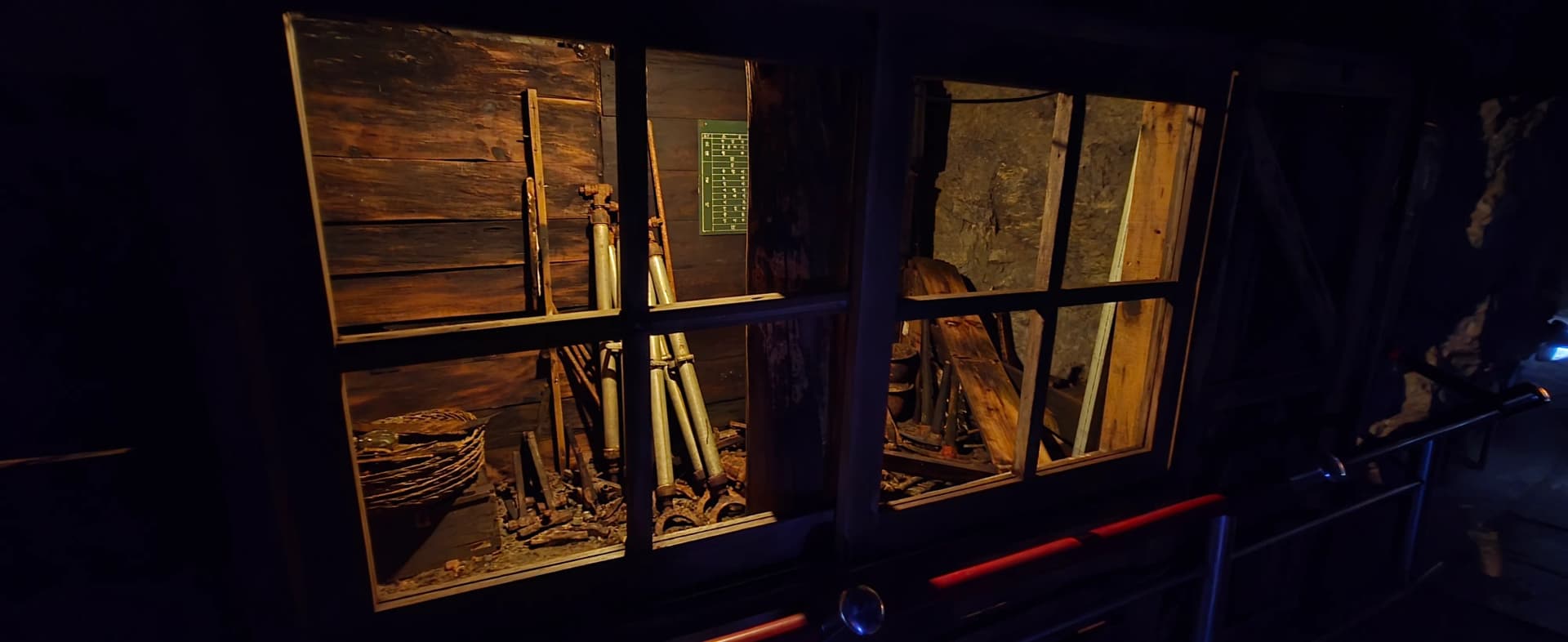
Behind the glass, the actual tools used during that era are preserved just as they were. Tripods, buckets, pipes, wooden structures. It feels like they sealed off an old storage room and left everything exactly in place.
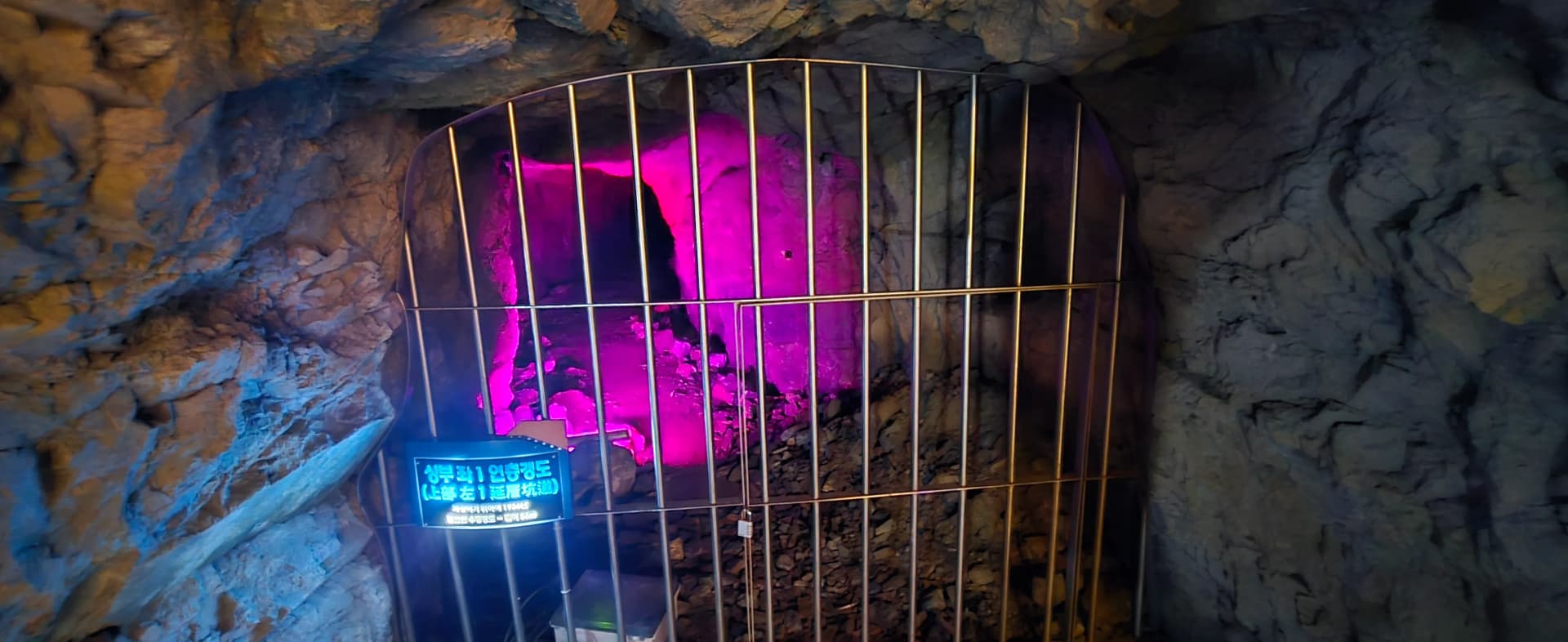
This is an actual mine shaft. It's blocked off with iron bars for safety. Pink lighting illuminates the inside, which creates this eerily beautiful atmosphere. There are spots like this scattered throughout the cave.
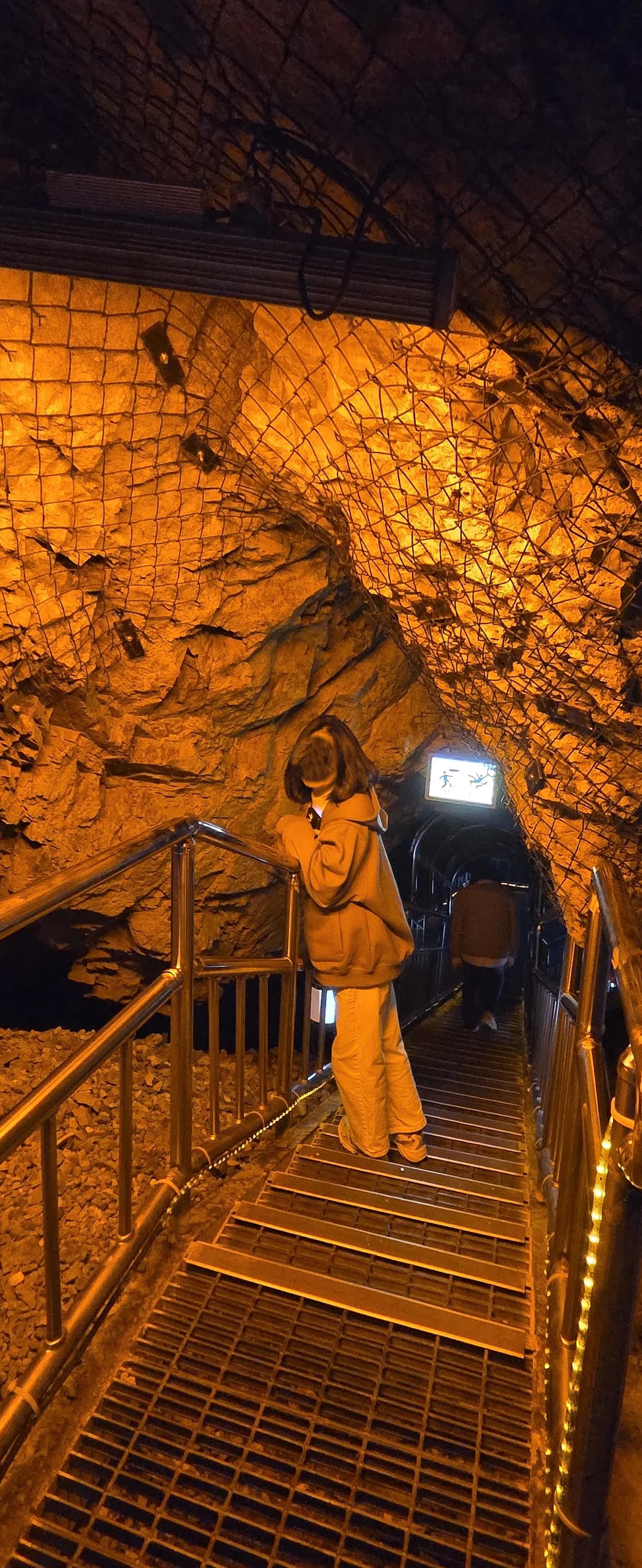
The cave's interior is way more intricately connected than you'd expect. Stairs go up and down, narrow passages lead to yet another space. It's like a spider web of corridors — but every single section has safety fencing installed, and there are even rock-fall prevention nets on the ceilings. It's a well-maintained cave.
Why the Ceiling Height Keeps Changing
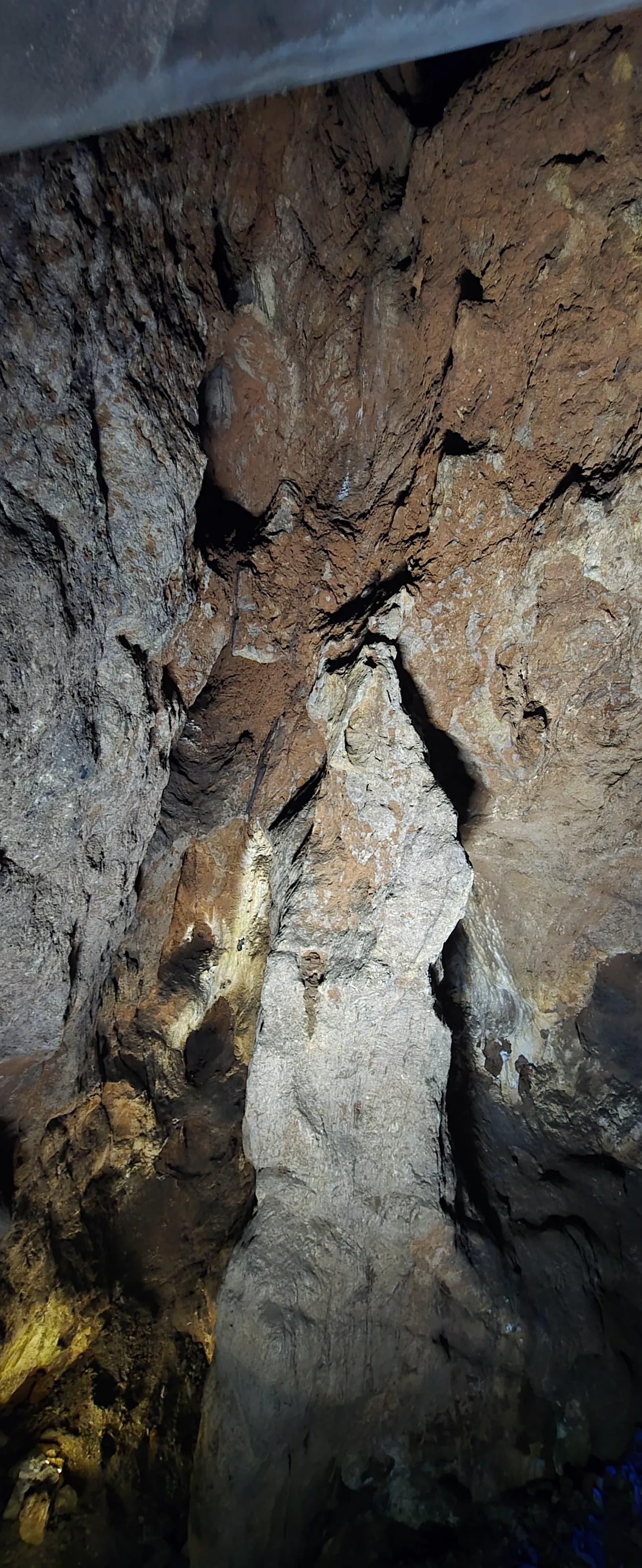
One thing you'll notice walking through Hwaam Cave is that the height is never consistent. Some sections have high, open ceilings, then the very next moment you have to crouch down. The natural limestone cave sections were carved by groundwater and erosion, so the ceilings are irregular. The gold mine shaft sections are narrow and low because miners dug following the gold veins. These two types alternate throughout the entire cave.
Honestly, if you go in expecting a prettily polished tourist cave, you might be caught off guard by how raw and primal some of the spaces feel. Just a heads up for anyone with bad knees or back issues.
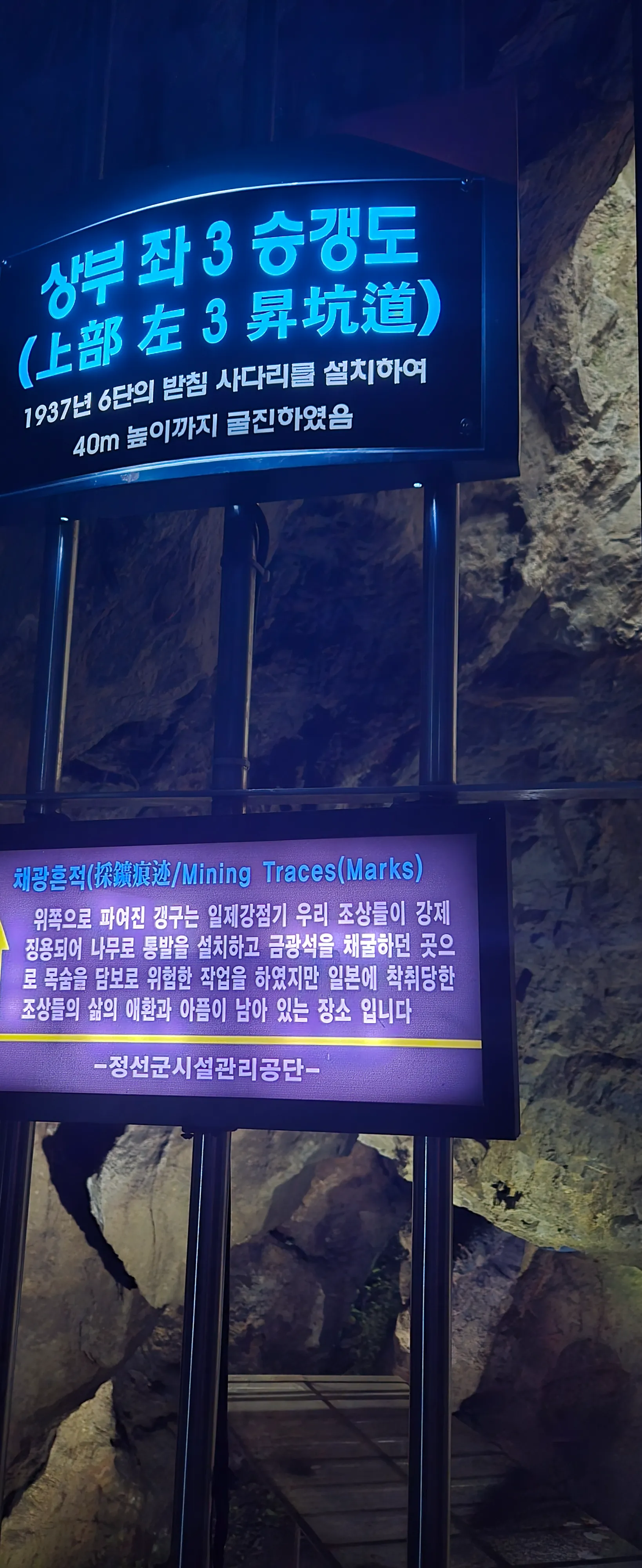
The sign reads "Upper Left 3rd Ascending Shaft" — in 1937, they installed 6-tier support ladders and dug 40 meters up. The mining history panel below explains that during the Japanese colonial occupation, Korean workers were forcibly conscripted to mine gold ore at this site. I stood in front of that sign for a long time. The fact that the path we're casually strolling through as tourists still holds the traces of those people's lives — I just couldn't walk past it.
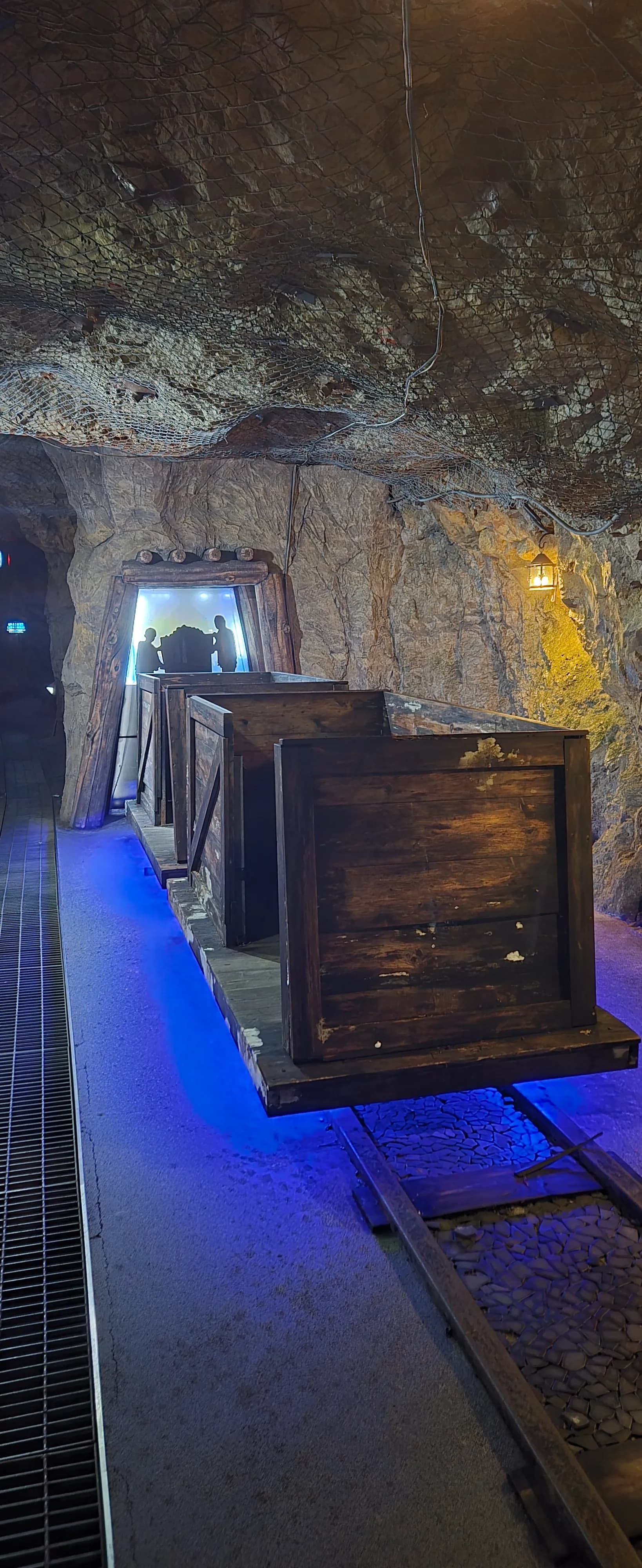
A mine cart sits right there on the rails, displayed just as it was. Blue LED lighting underneath gives it an almost surreal atmosphere.
The 365 Stairs — Way Scarier Than the Number Suggests
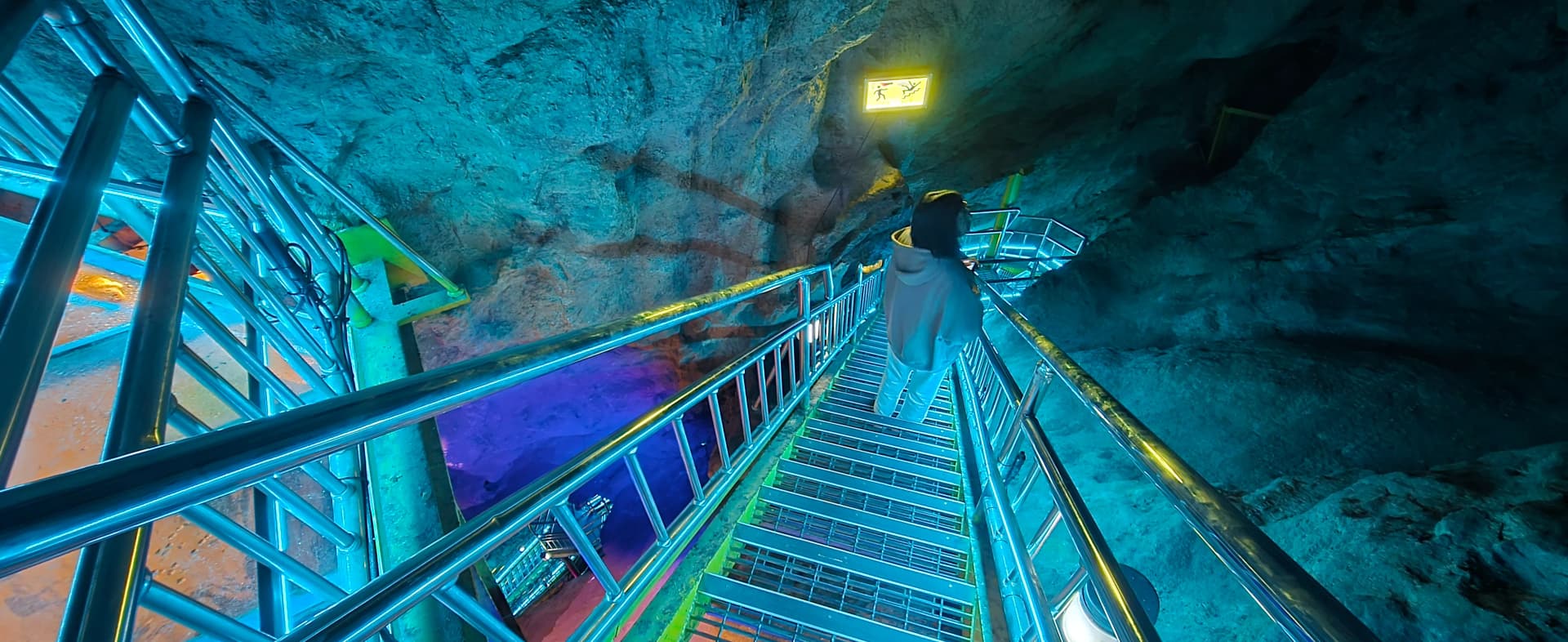
You can see just how steep these stairs are in one glance. Down below, a blue-lit space opens up — this is the actual 90-meter elevation drop section. In photos it looks like just stairs, but when you're actually standing there, your legs start to shake a little. An older lady ahead of me going down said "Oh lord, my knees are done for" and I chuckled... then later I caught myself saying the exact same thing.
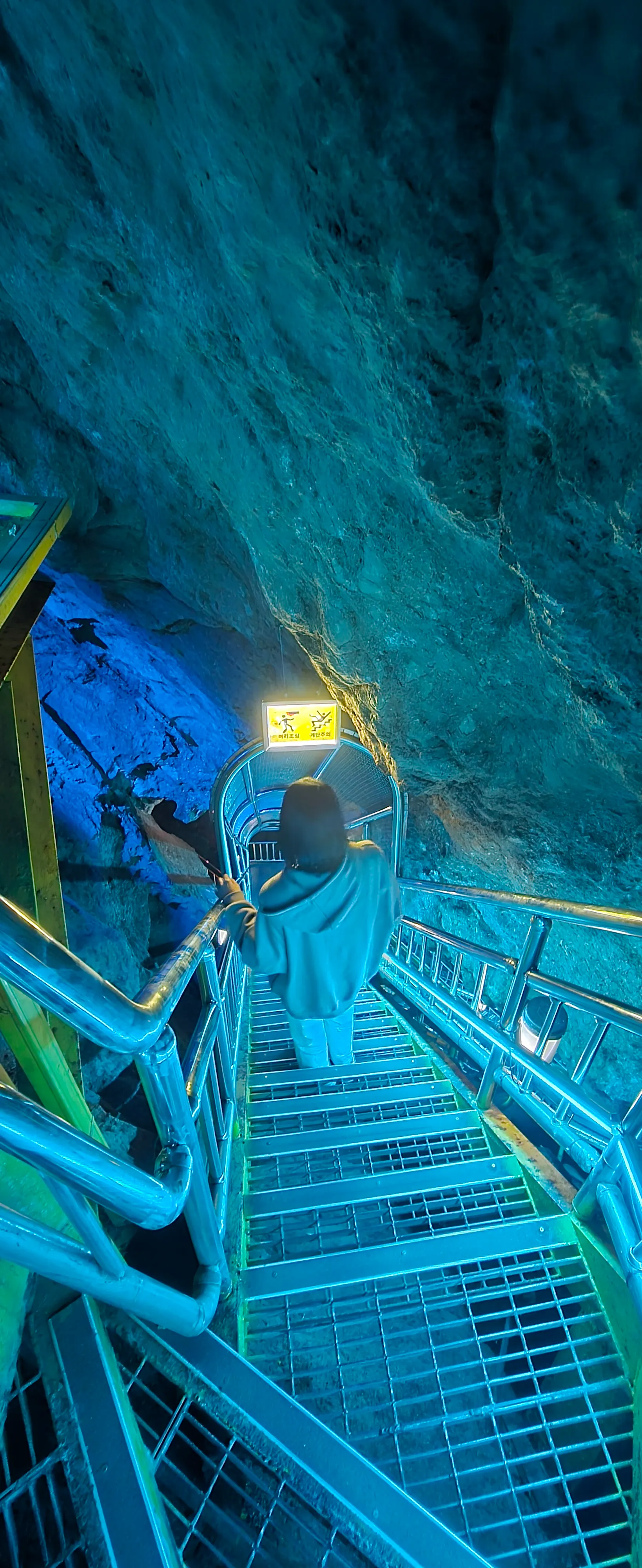
A section where the rock ceiling presses right down above your head.
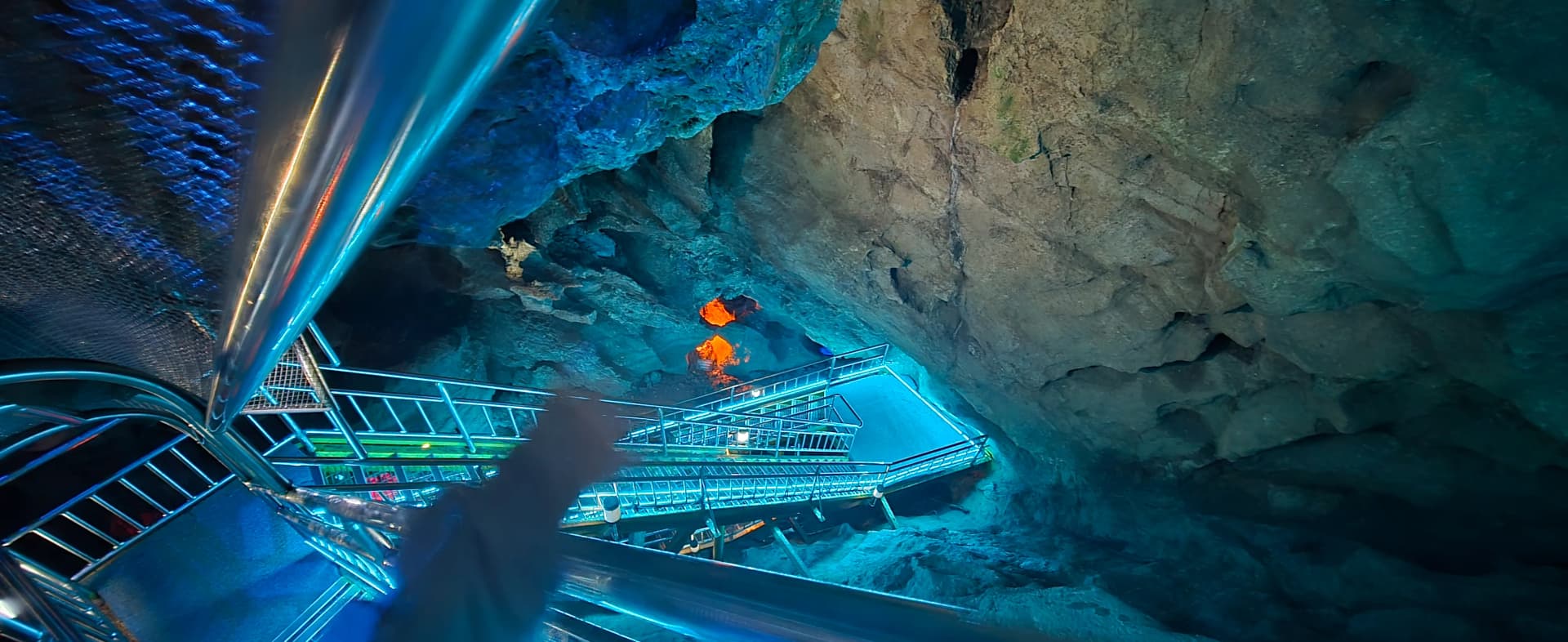
Looking up from the bottom, you can see the stairs and iron railings stacked layer upon layer. This is the angle where you really grasp the scale of this place.
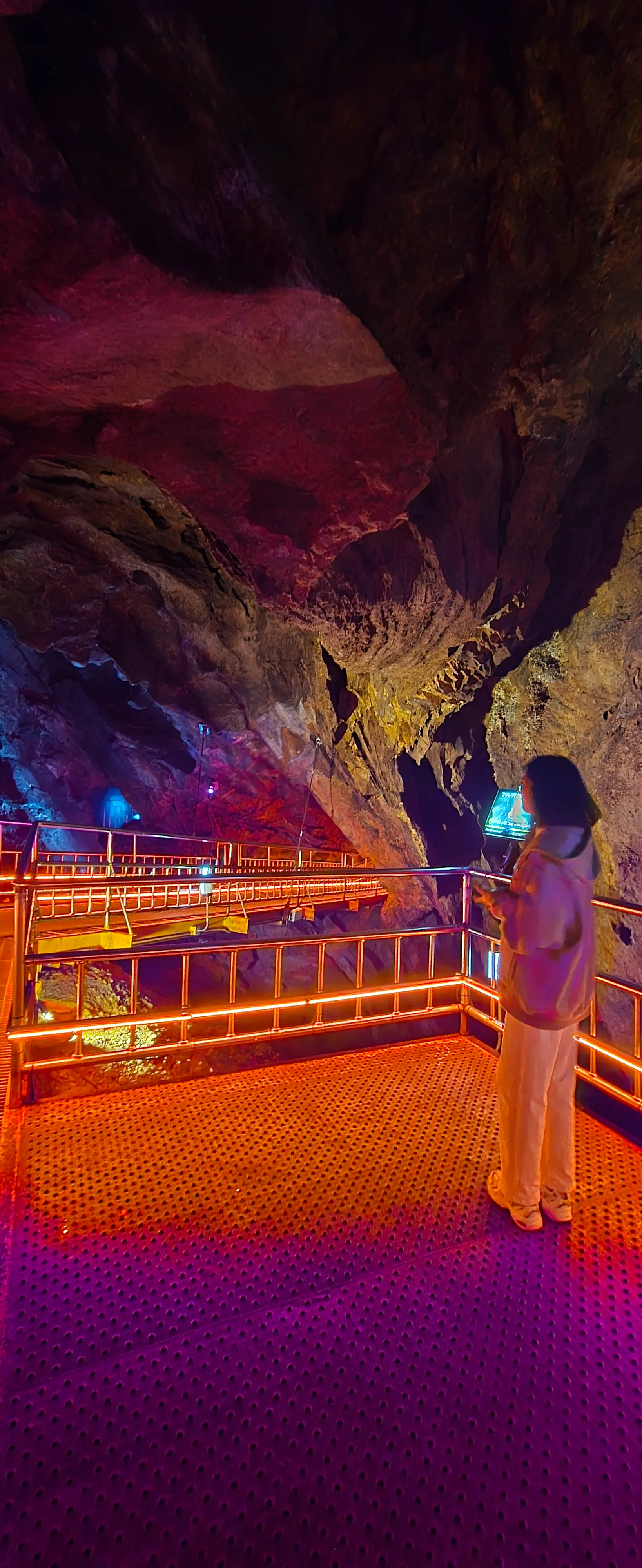
Once you've made it all the way down, the space suddenly opens up wide. Red lighting washes over the rock walls, and the ceiling is so high you can't even tell where it ends. After coming through those cramped, low mine shafts above, the contrast with this wide-open space hits hard. I just stood there for about 5 minutes looking around. Beyond the railing, you can see the lower section of the cave dropping deep below, and far off in the distance, blue lights tell you there's still more to go.
Fairytale Land — A Paradise for Kids
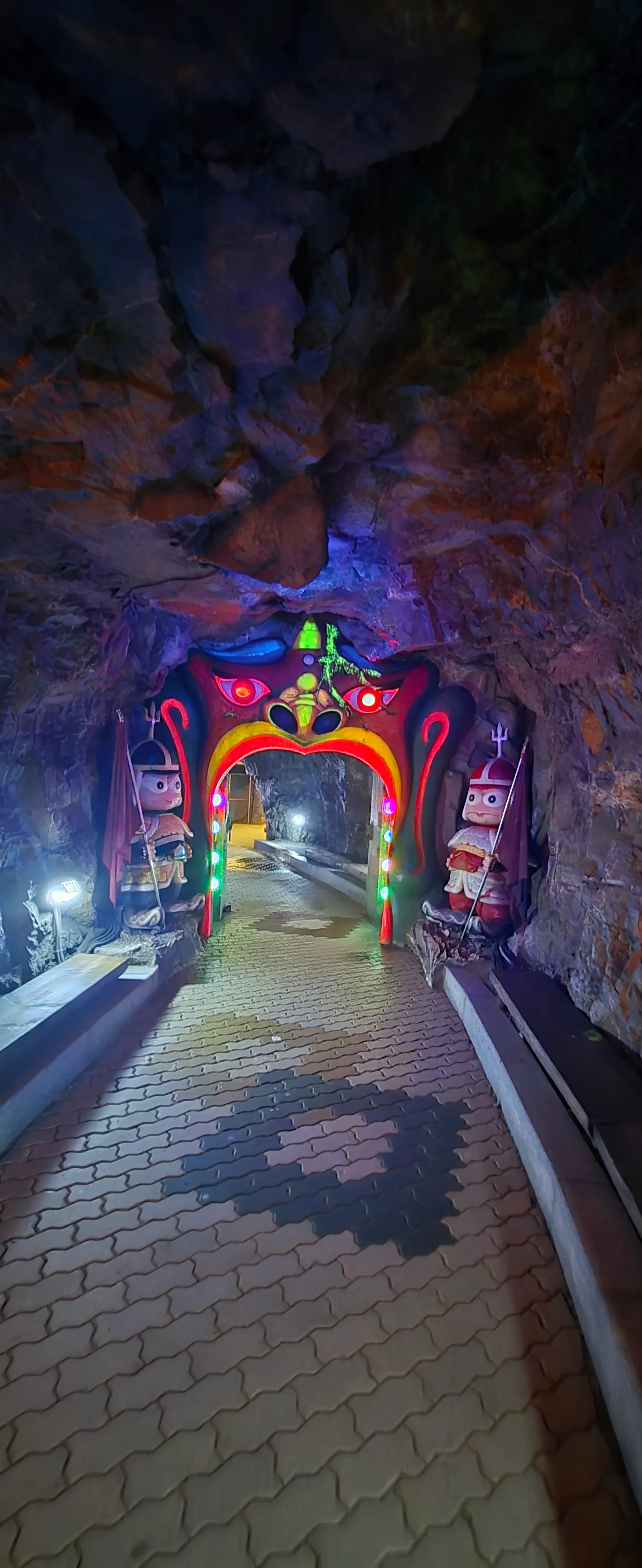
The deeper you go into the lower section, the atmosphere completely transforms. There's this goblin-gate-style archway decorating the tunnel entrance — more fairy tale than scary. Kids tend to get curious rather than frightened, and they just get pulled right in. From an adult perspective, it might feel a bit kitschy, but if you're here with children, this is where you'll end up taking the most photos.
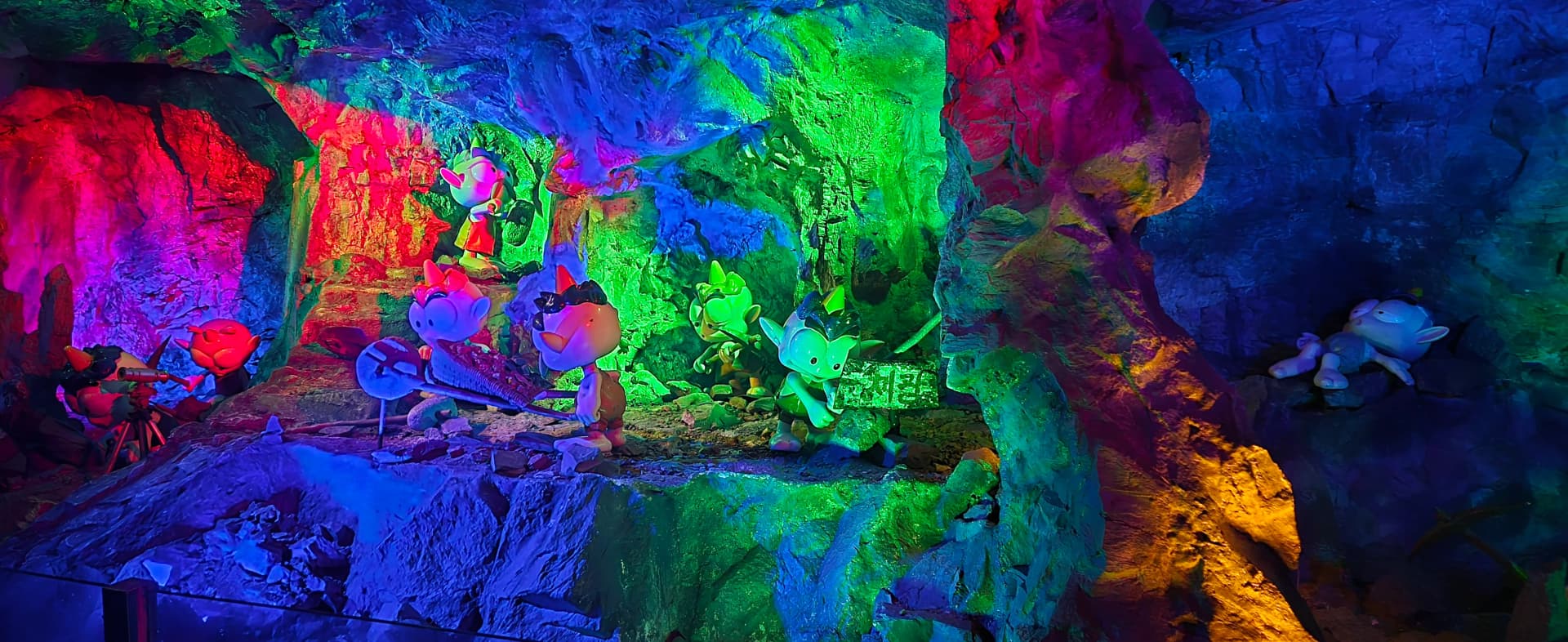
Animal characters huddled together in a little diorama scene. Everything's placed right at kids' eye level.
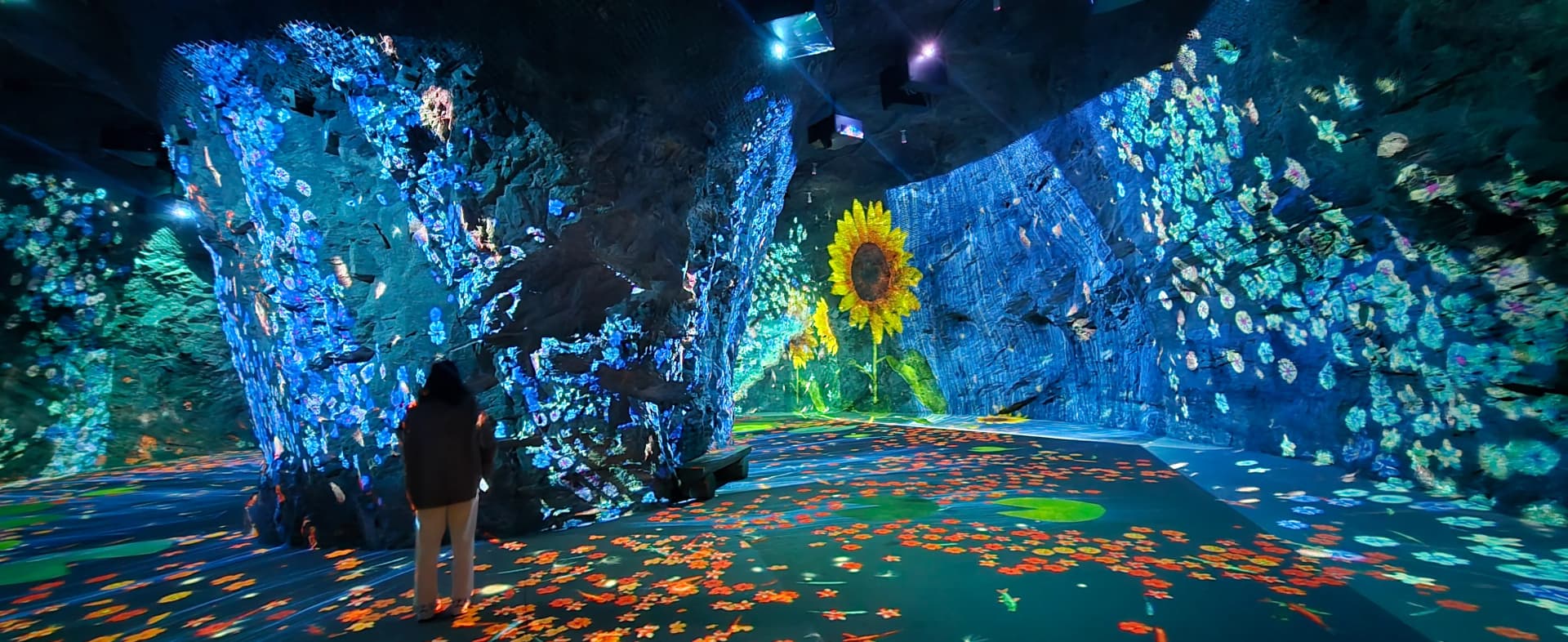
This part genuinely surprised me. There's a media art projection covering the entire rock wall — flowers and plants seem to flow and cascade down like they're alive, filling the floor with light. A giant sunflower blooms at the center, and the way it blends with the raw rock texture creates this surreal fusion of nature and digital art. I honestly never expected to see something like this inside a cave. This was personally the section where I lingered the longest. I must have taken like ten photos, but when I looked at them later they all came out looking the same, which was kind of annoying.
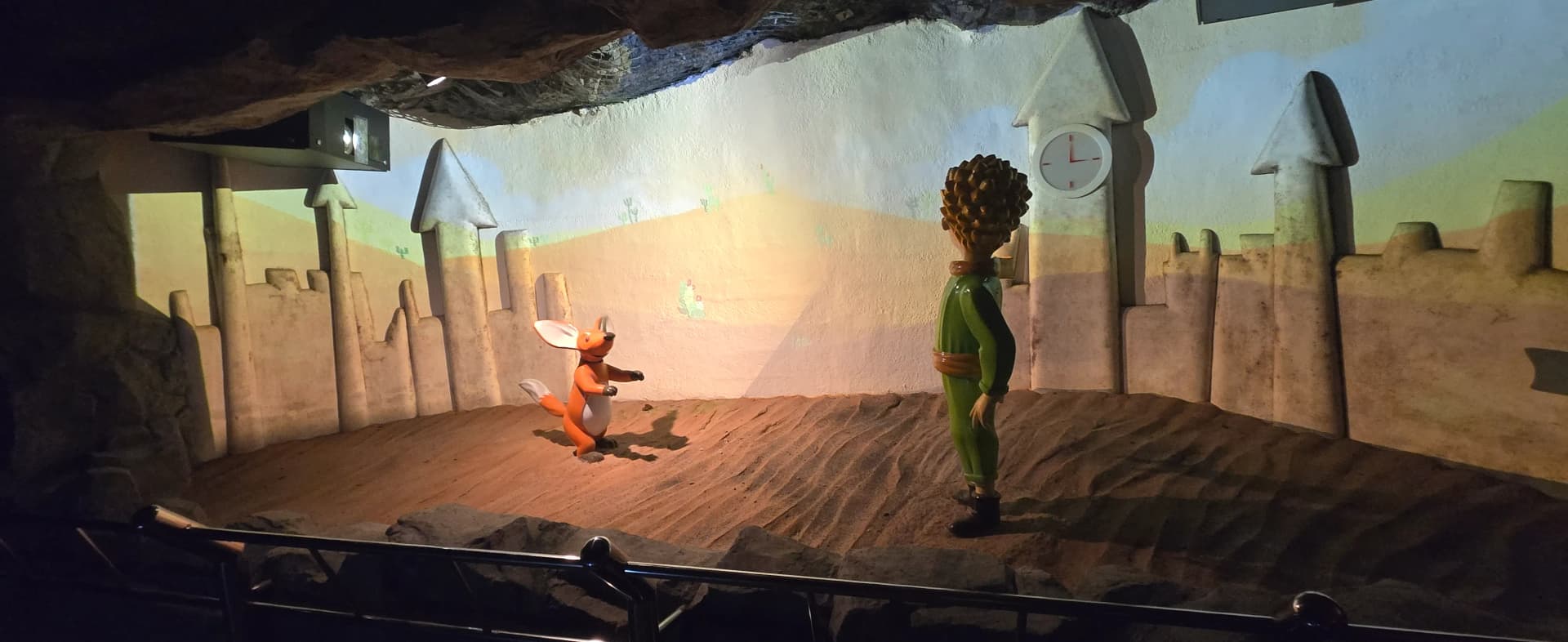
A Little Prince and the Fox diorama. Short but well done.
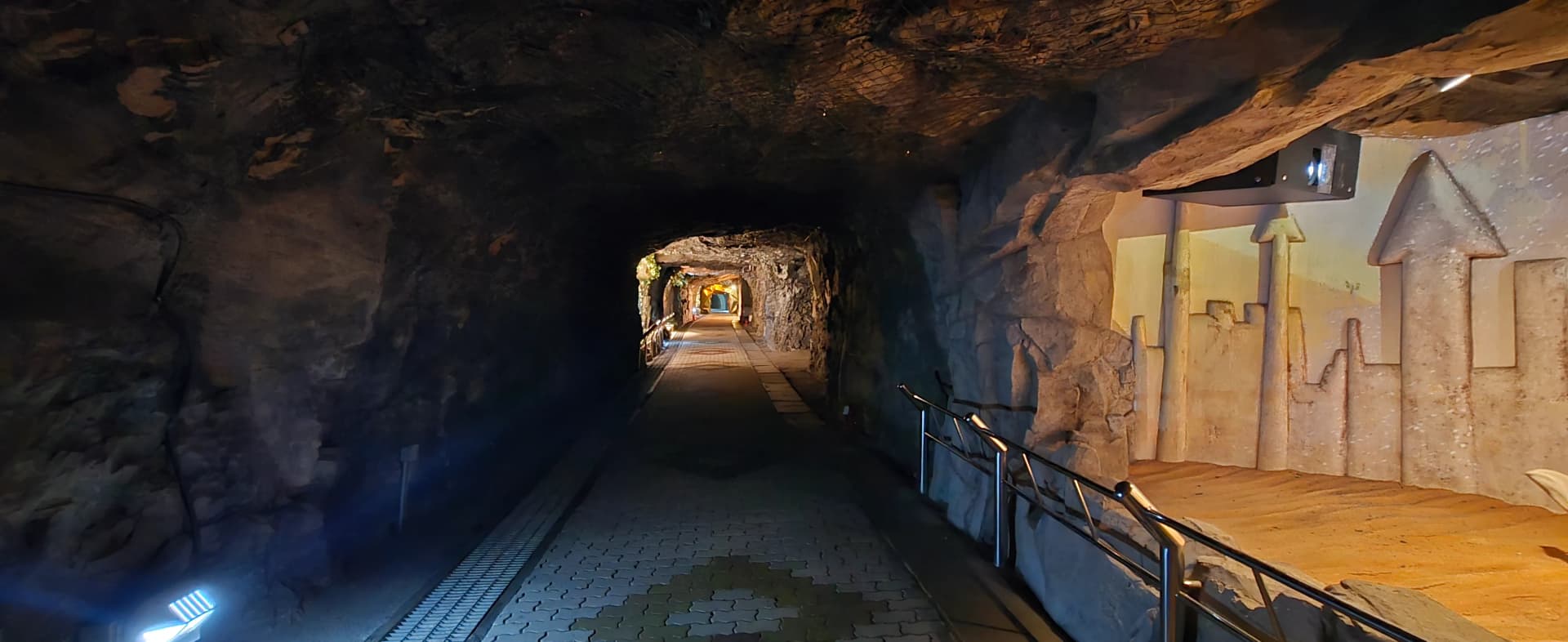
After the diorama, you're back to the original mine shaft look. Low ceiling, no end in sight.

Alice in Wonderland tea party. Alice, the Mad Hatter, animal characters all seated around a table, complete with mushroom sculptures — they really put some effort into this one.
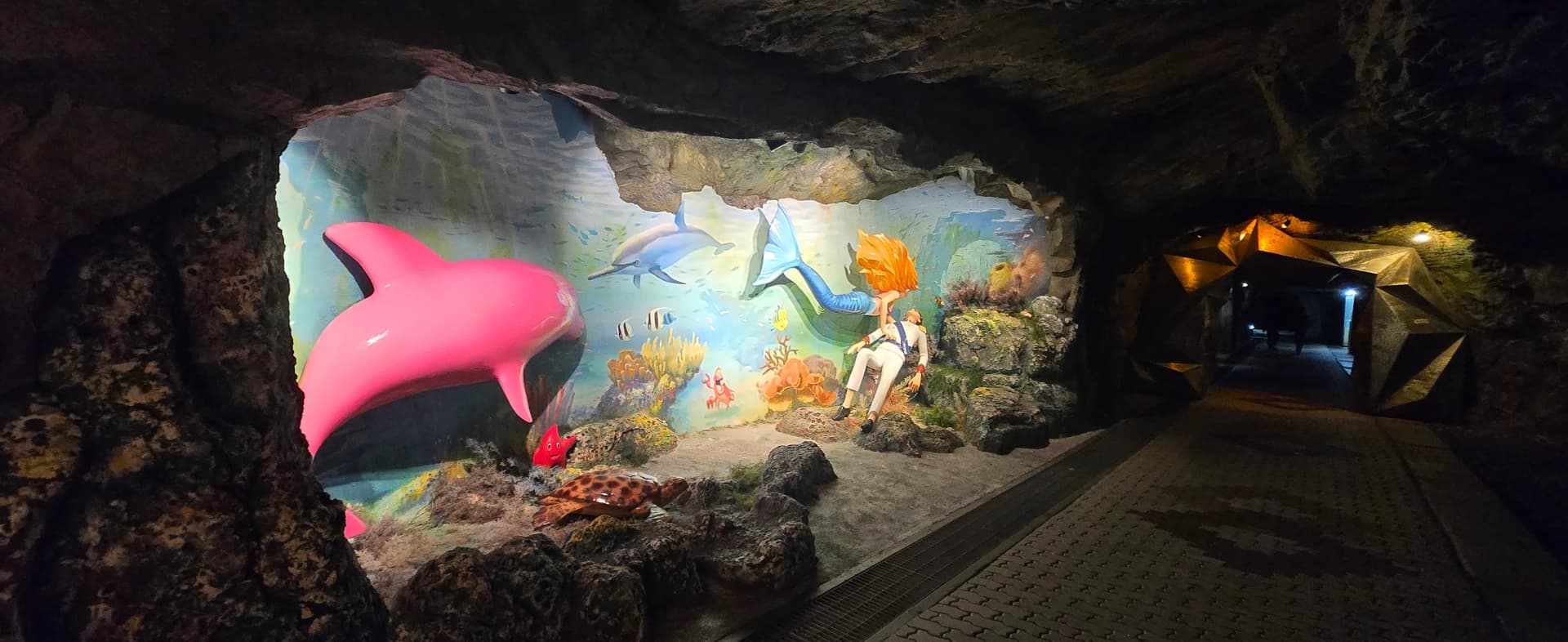
Pink dolphins, mermaids, coral reefs. Another passage continues off to the right.
Wonders of Nature — This Is the Real Highlight
Wonders of Nature Section
After passing through the gold mine shafts and themed zones, this final section is the real showstopper. No artificial sculptures, no LED effects — just pure nature, shaped over tens of millions of years, laid bare before your eyes.
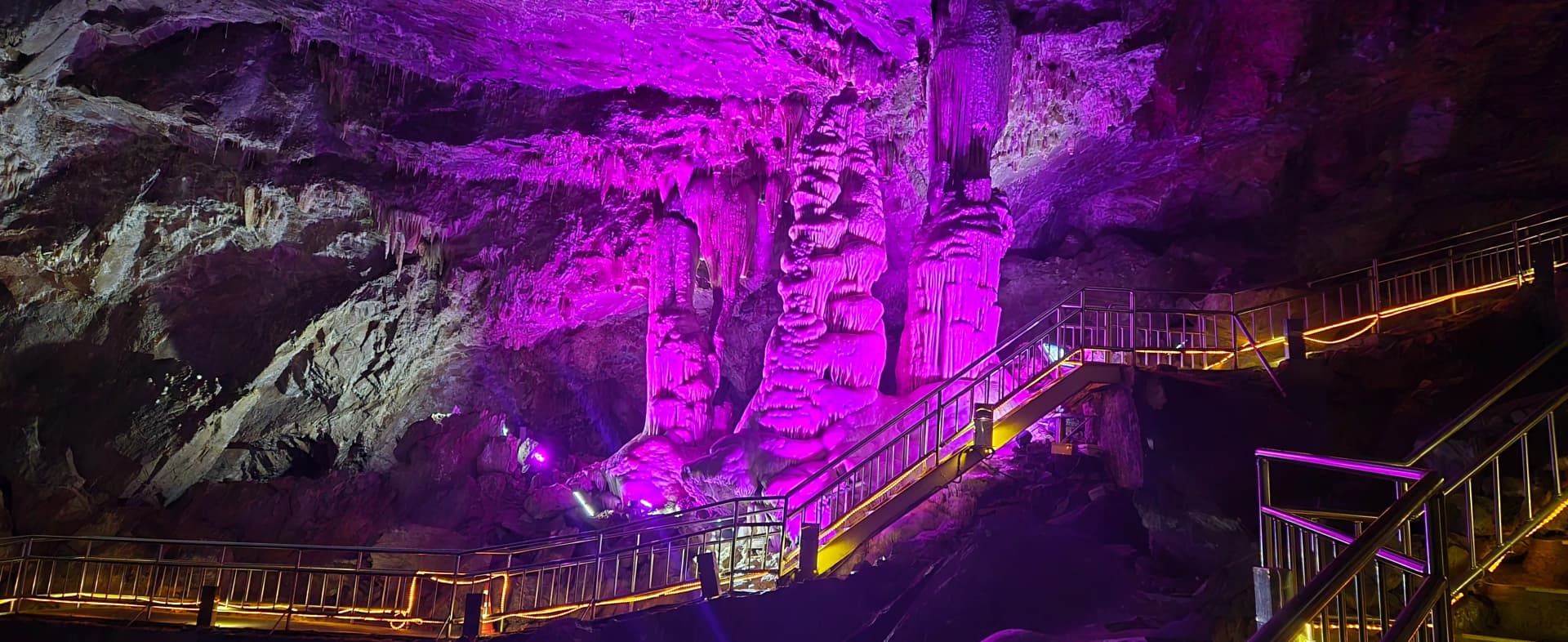
Under purple lighting, enormous stalagmites and columns reveal themselves. Without the lighting, they'd just be dark chunks of rock — but this single hue of purple transforms the entire space into something from another dimension.
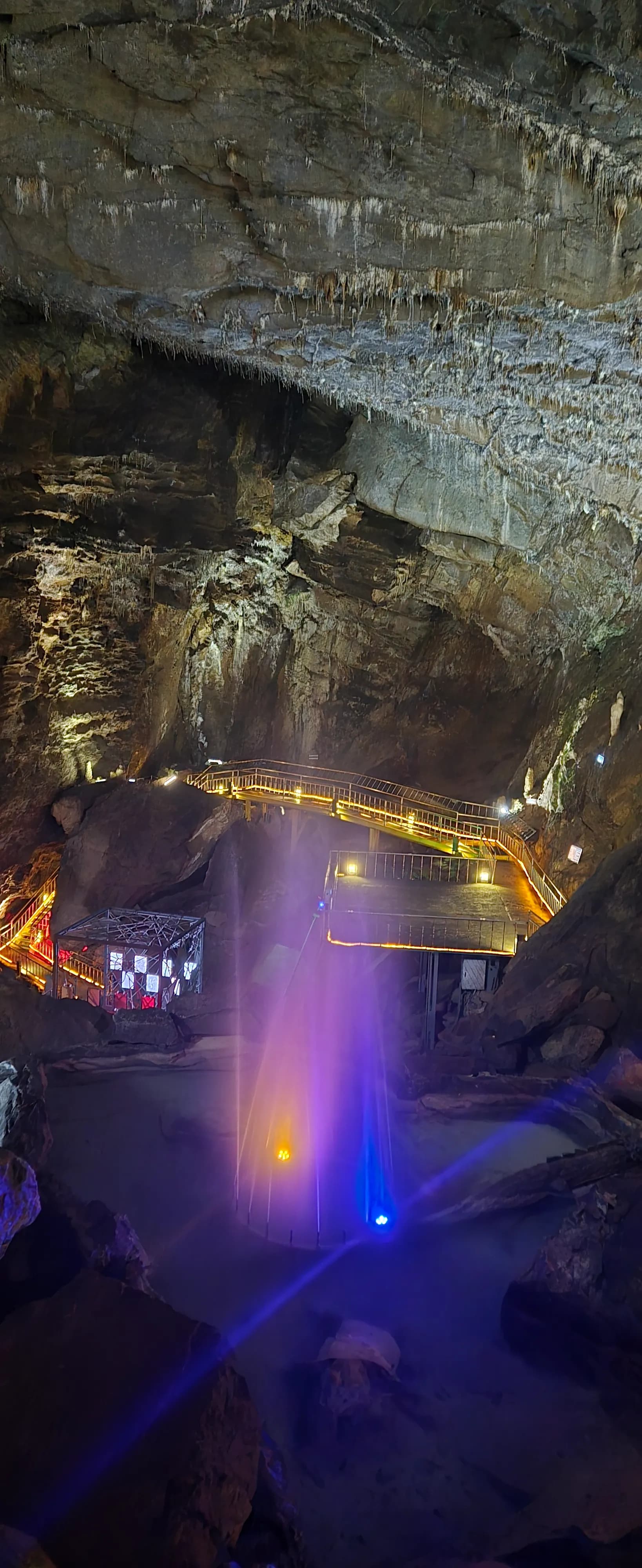
Looking down from above. The trail winds and curves through the rock formations below.
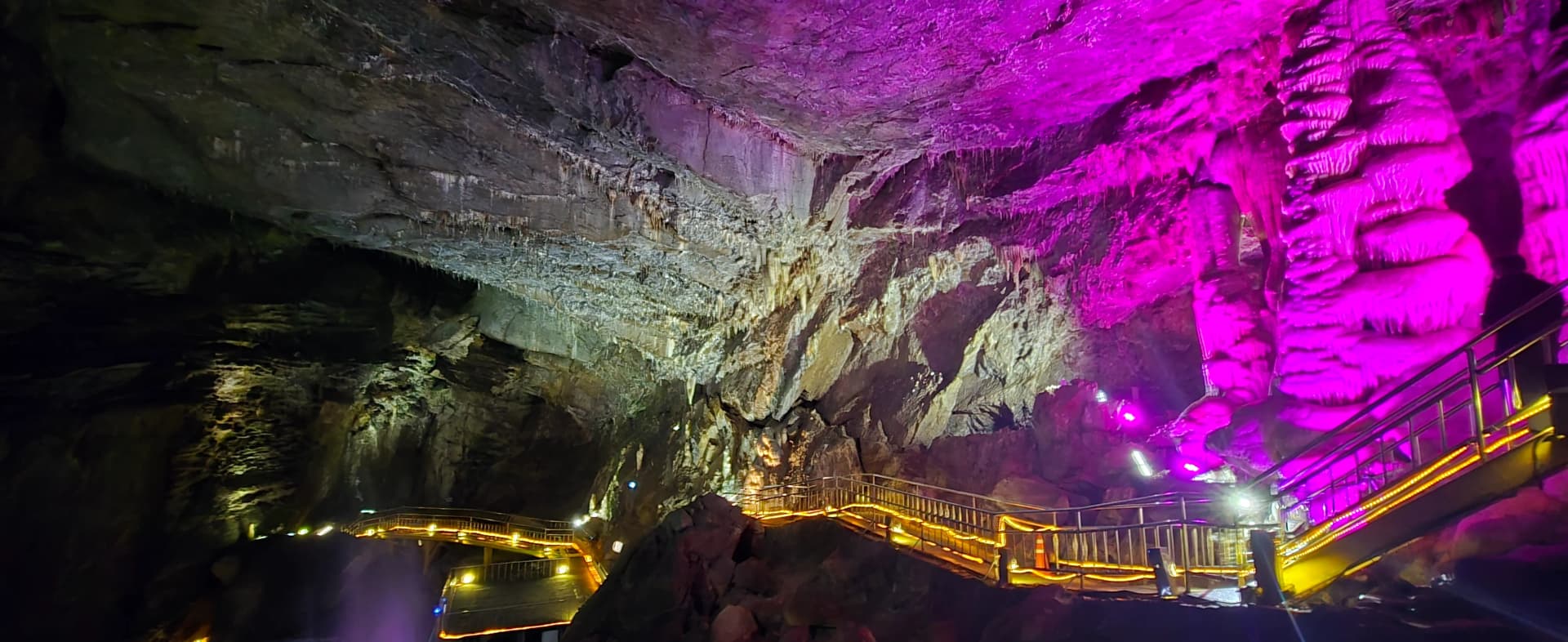
On the left, stalactites cling densely to the ceiling. On the right, a massive column stands tall. One photo can't capture it all. Seriously.
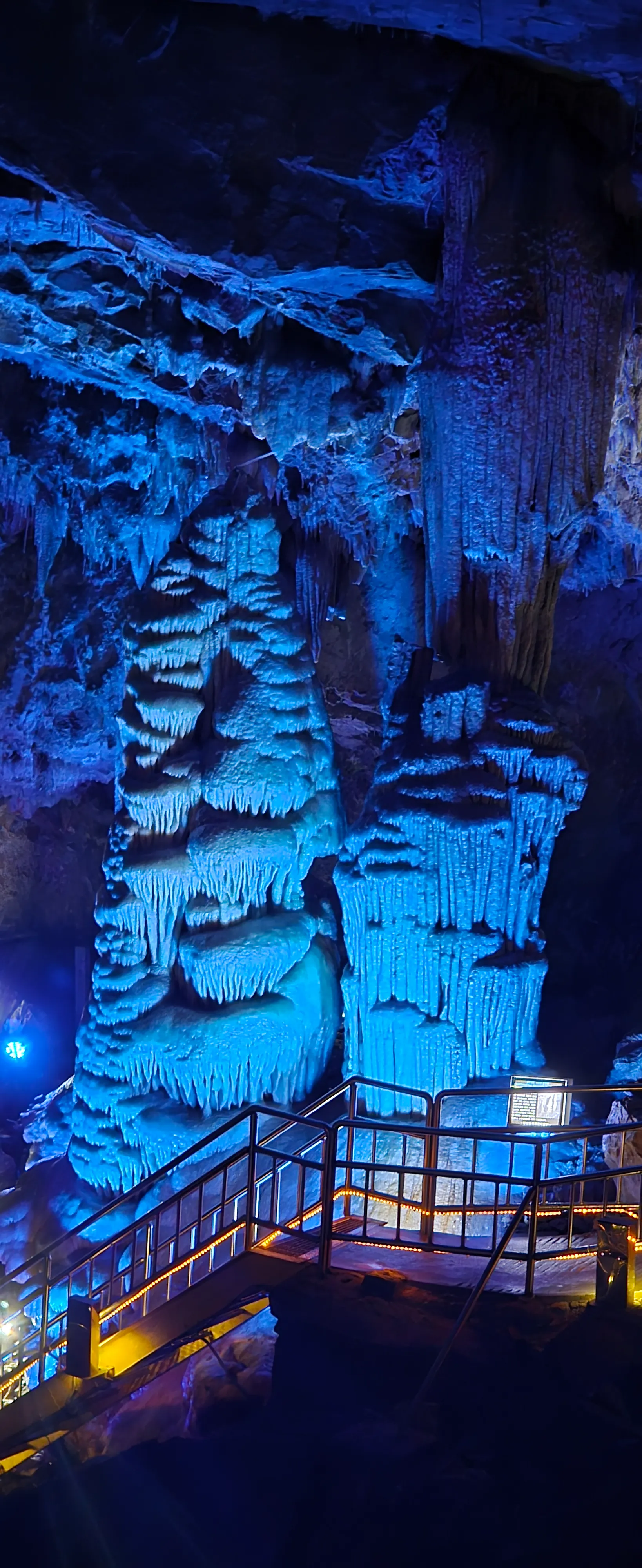
16 feet around, 26 feet tall. When you hear those numbers, you think "okay, sure." But when you're actually standing in front of it, words fail you. The layered sediment lines are etched right into the surface, so you can almost read how much time has accumulated. I stood there staring up for a while. The person next to me asked "How old do you think this is?" and we read the information panel together — tens of millions of years, it said. We both just laughed. The scale was just too absurd to process.
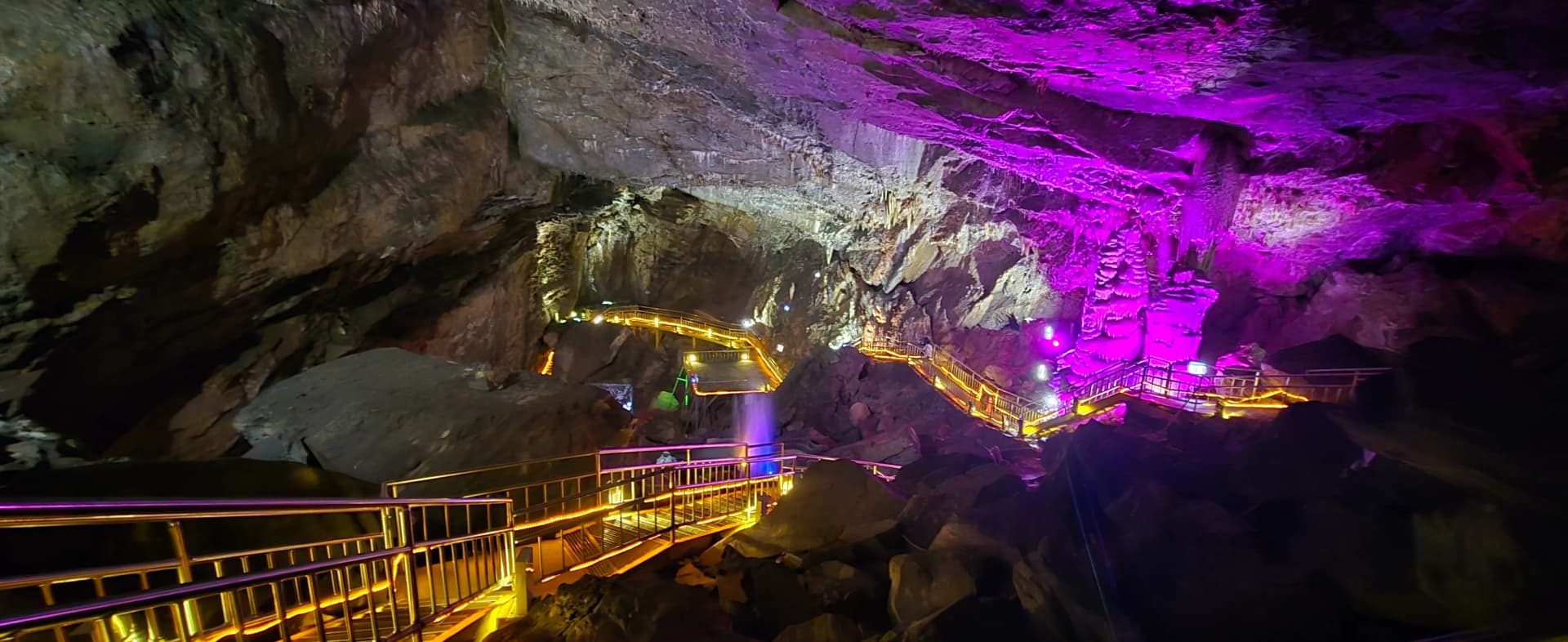
Beyond the railing, raw rock formations jut up naturally, and further ahead, lights illuminate yet another geological landscape.
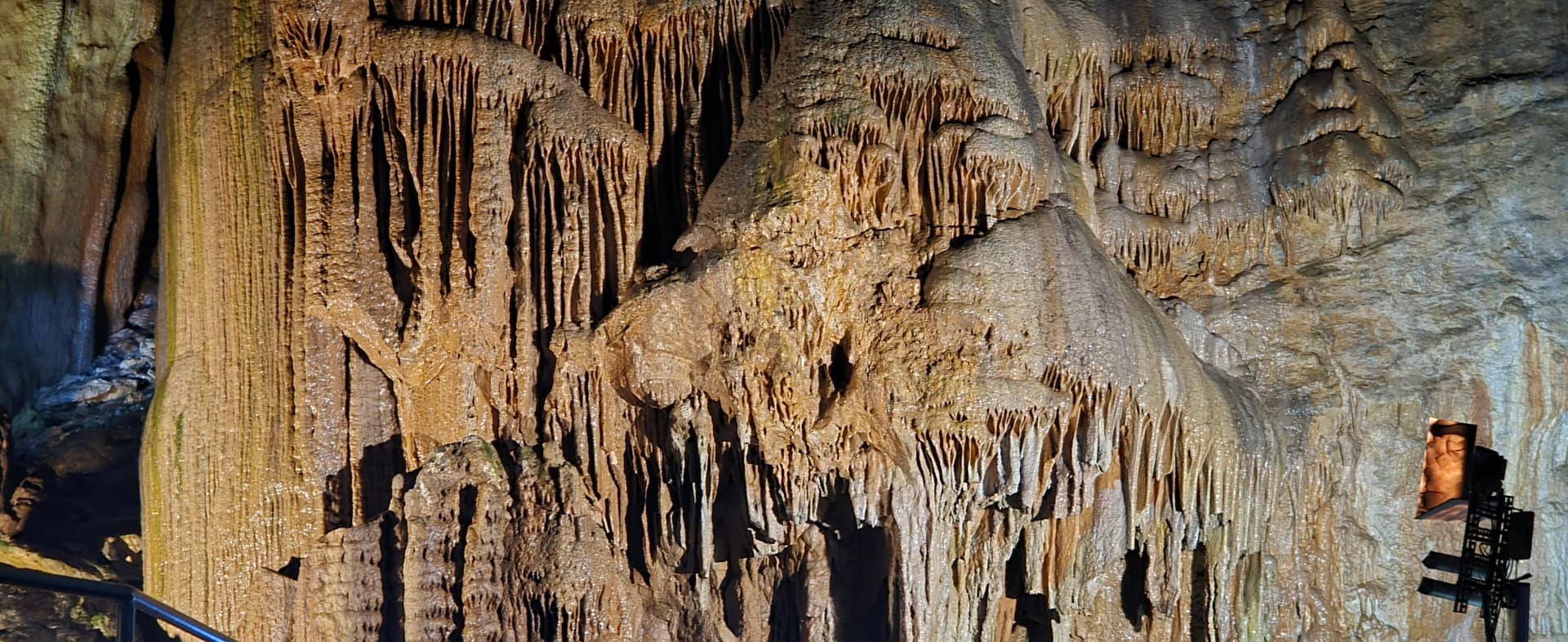
This is it. This is the real deal. The flowstone waterfall, said to be the largest in Asia. A 92-foot wall of limestone crystal formations cascading down the rock face — and up close, the surface texture genuinely looks like flowing water. They say calcium carbonate flowed down this wall and solidified over tens of millions of years. Out of the entire cave, this was the most overwhelming spot. Honestly, the other sections are kind of fuzzy in my memory now, but this one? I can still see it vividly.
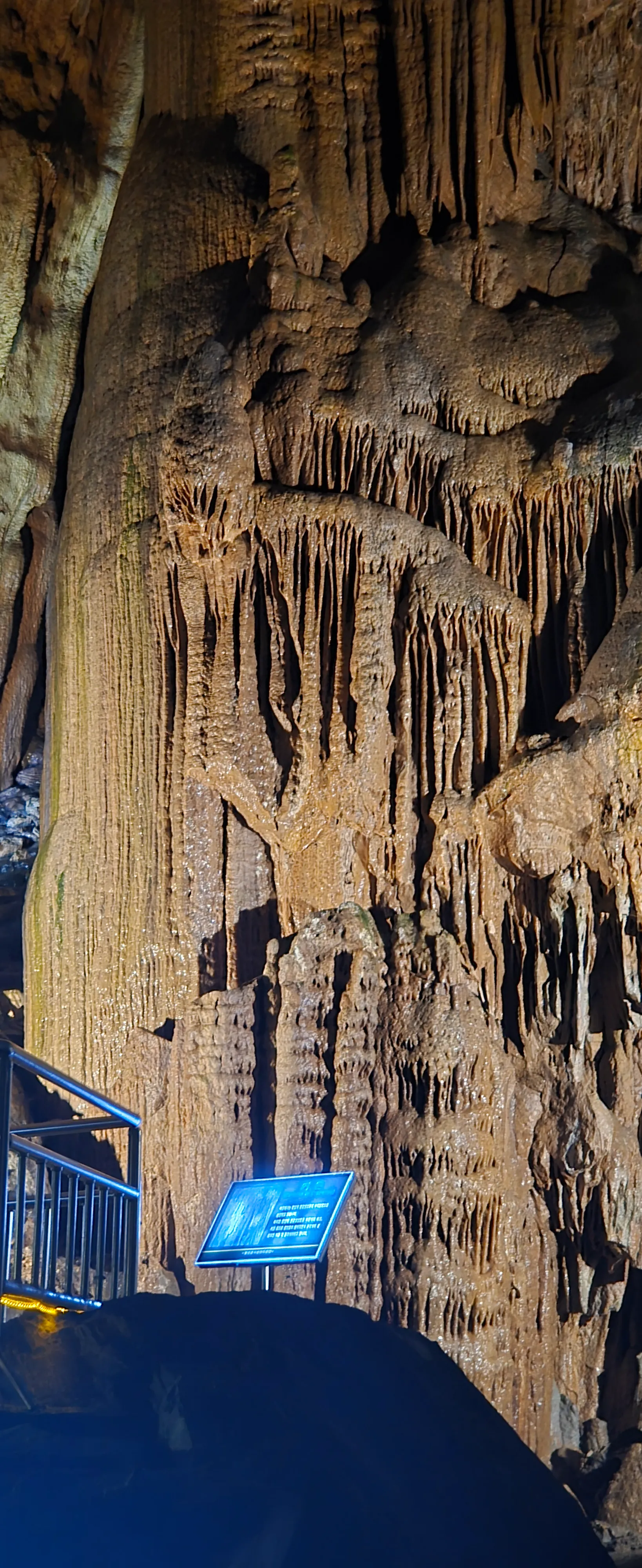
Stopped for a moment to read the information panel here.
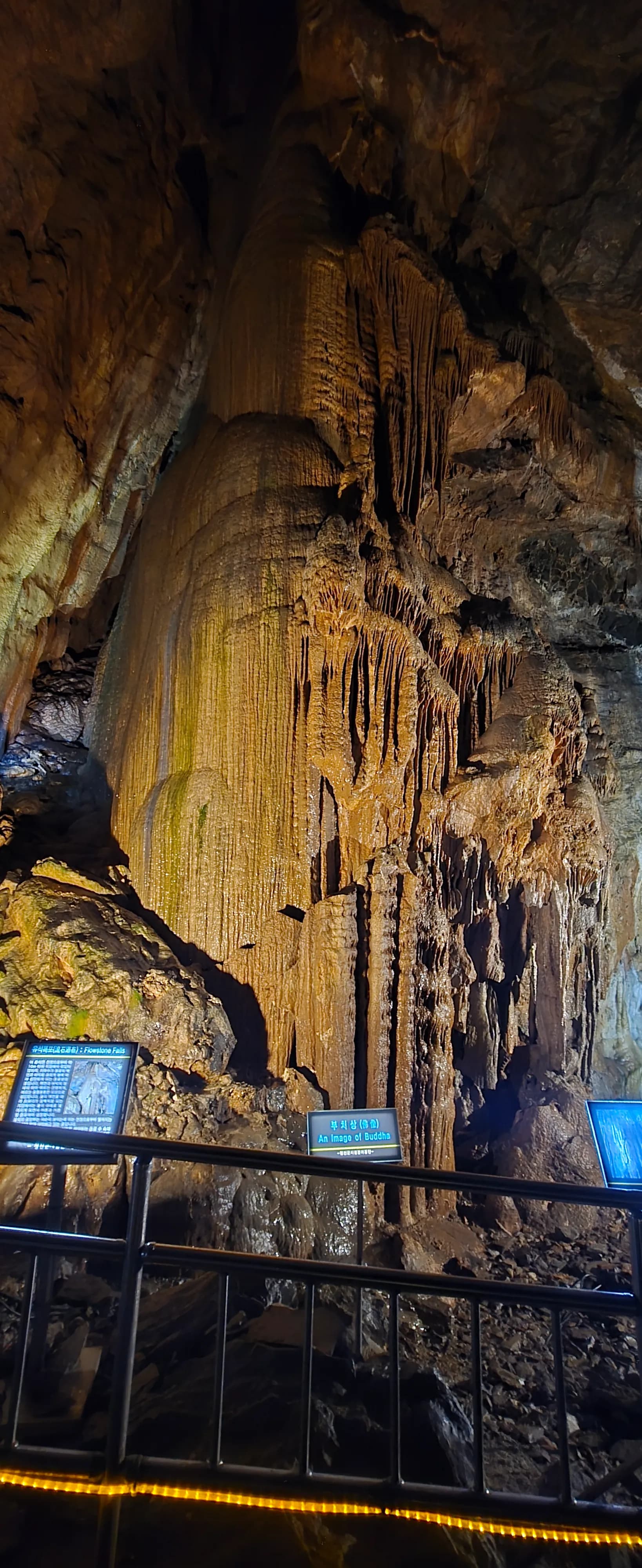
See that person standing there? Compare them to the rock formation next to them and you immediately feel how tiny humans are. The trail branches off in multiple directions, with lights illuminating each geological feature — it looks like an underground city.
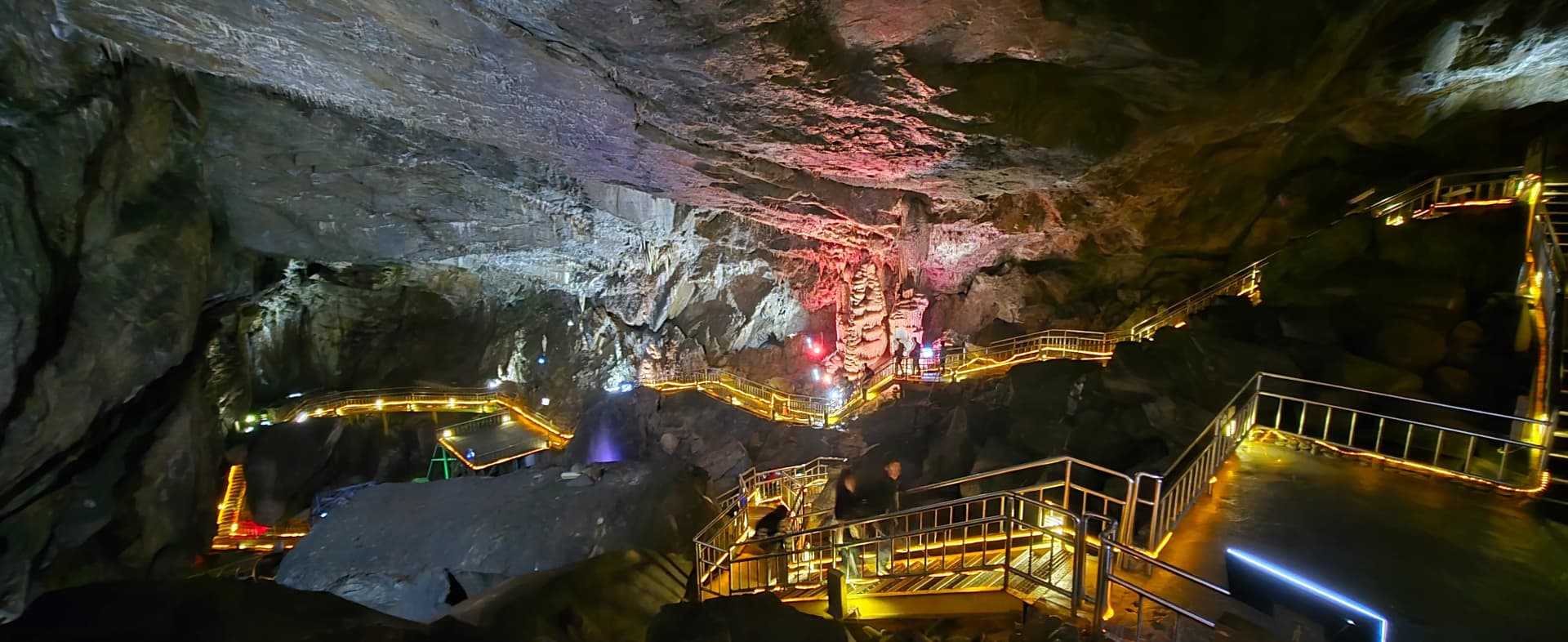
The very end of the trail. Once you've made the full loop and stand in this spot, there's a real sense of accomplishment.
Thoughts After Coming Out
Walking in, I figured I'd just see a cave and head out. But once you've done the whole thing, way more time has passed than you expected. You get this heaviness in the history section, then you're giggling like a kid in the themed zones, and then in the final natural cave section you just stand there with your jaw on the floor. You experience three completely different things in one visit, so by the time you leave, both your body and your mind feel pretty full.
1,803 meters total, 90-meter elevation drop, 365 stairs. Looking at just the numbers, it seems like a long walk. But actually doing it? That's a different story. Even without stopping, it easily takes over an hour and a half. By the time I came out, my legs were basically done — and that's when I thought, "Ah, so THAT'S why they told us to take photos at the entrance."
If you're planning a trip to Korea, it'd be a shame to only hit the famous tourist spots near Seoul. Hwaam Cave in Jeongseon is a place that even most Koreans don't know about, let alone foreign tourists. But once you actually visit, you'll wonder how this flew under the radar — the content is seriously solid. The drive to Jeongseon in Gangwon-do might feel long, but this one cave alone is more than enough reason to make the trip.
How to Get to Hwaam Cave (From Seoul, Busan & Gangneung)
Getting to Hwaam Cave from Seoul
📍 About 190km · ⏱️ Approx. 2.5–3 hours
※ GPS search: "Hwaam Cave" or "12 Hwaamdongul-gil, Hwaam-myeon, Jeongseon-gun, Gangwon-do"
Jeongseon Bus Terminal → Local bus toward Hwaam Cave (about 35 min)
💰 Bus fare: approx. $12
※ Local buses run infrequently — check the schedule in advance
Jeongseon Station → Local bus or taxi
🚕 Taxi from Jeongseon Station to Hwaam Cave: about 15–20 min
※ Jeongseon Arirang Train (A-train) — advance booking recommended
Getting to Hwaam Cave from Busan
📍 About 380km · ⏱️ Approx. 4–4.5 hours
※ Long drive — rest stops along the way recommended
Or: Busan Station → KTX → Seoul Station → Cheongnyangni Station → Train to Jeongseon
⏱️ Total approx. 5.5–6 hours (including transfers)
※ Driving is significantly faster than public transit from Busan
Getting to Hwaam Cave from Gangneung
📍 About 80km · ⏱️ Approx. 1 hour 20 min–1 hour 40 min
※ Closest of the three cities — easy to combine with a Gangneung day trip
Jeongseon Bus Terminal → Local bus toward Hwaam Cave (about 35 min)
⏱️ Total approx. 2–2.5 hours
※ Buses run infrequently — check the schedule before departure
Things to Do Near Hwaam Cave
It'd be a waste to come all the way to Jeongseon and only see Hwaam Cave. Here are a few nearby spots that pair well with a cave visit.
Frequently Asked Questions About Hwaam Cave
Having actually visited Hwaam Cave myself, I've compiled the things I was curious about before going. Since there's not a ton of information out there about this place, knowing these ahead of time really helps.
Q. Do I have to take the monorail?
Q. Can I take photos inside?
Q. Can I visit in winter?
Q. Is it okay for kids? What about strollers?
Q. How long does the visit take?
Q. Parking / Restrooms / Reservations
This post was originally published on https://hi-jsb.blog.