Crispy Korean Fried Chicken Done Right — 60 Gye Menu Review
Table of Contents
12 items
60 Gye Chicken — the Hottest Brand Among Korea's 600+ Fried Chicken Chains
60 Gye Chicken. In a country with over 600 fried chicken franchises and nearly 40,000 chicken shops nationwide, this is the name you hear the most right now. BBQ, Kyochon, BHC, Goobne, Cheogajip, Nene, Pelicana… South Korea is genuinely called the "Chicken Republic," and Korean fried chicken delivery culture is so advanced you can order via an app at two in the morning without a second thought. Even if you tried a different brand every single day of a week-long trip, you wouldn't scratch the surface. Stay a full month and you'd still not get through them all.
I'm Korean, born and raised here, but since I live with my foreign wife, I've found myself explaining Korean food more and more. "What's this one? What's that one?" — eventually I ended up making a blog. This isn't a sponsored promotion for any particular brand. It's a series where I review chicken brands I've actually eaten, one at a time. I'm not reviewing specific branches either — these are nationwide chains you can get delivered or pick up pretty much anywhere in Korea.
Today's the first instalment: 60 Gye Chicken. With quirky menu names like Tiger Chicken, Gochu Chicken, Keu-keu-keu Chicken, and 6-Second Chicken, the branding alone grabs your attention. Based on several orders I placed throughout 2025, let me talk you through why this crispy fried chicken brand is blowing up in Korea right now.
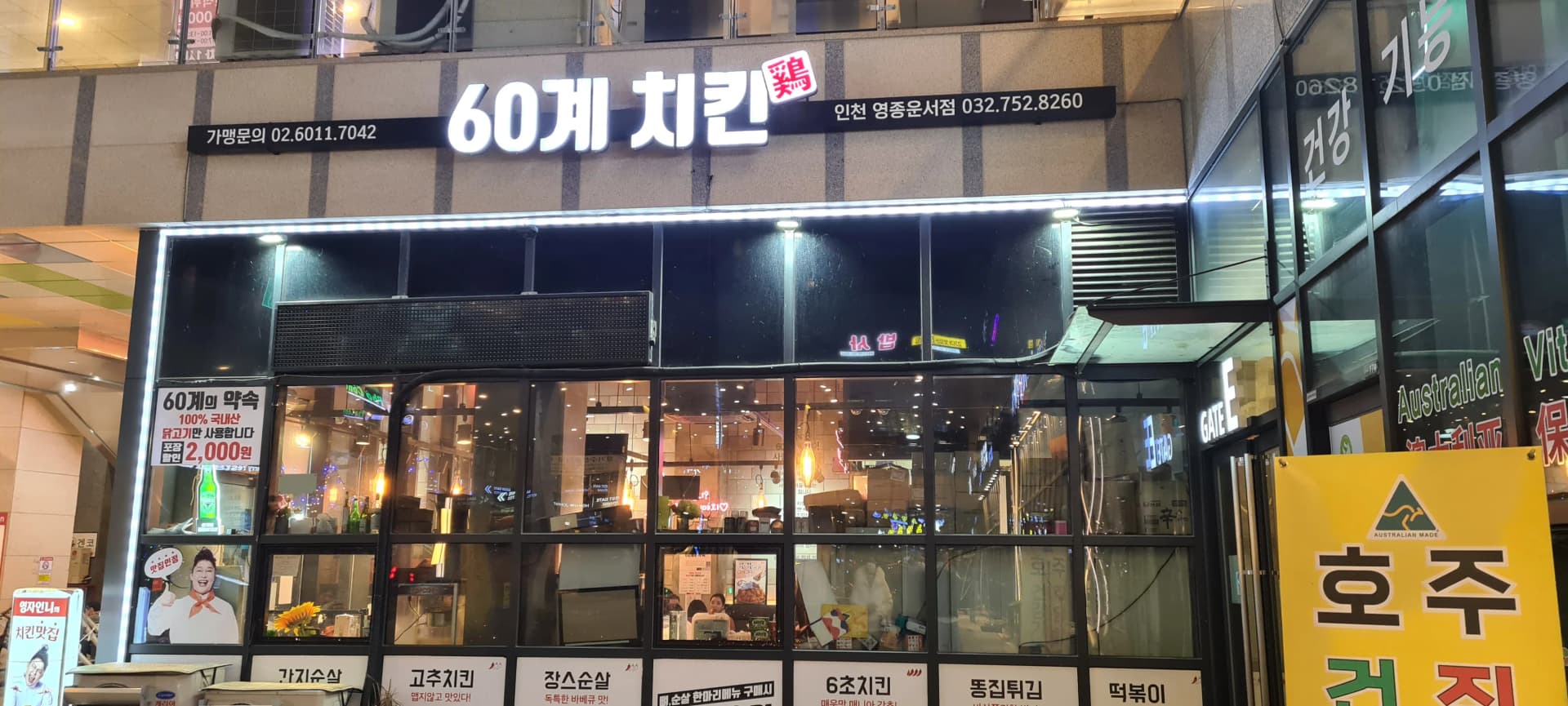
Why 60 Gye Chicken Is Popular With Visitors to Korea
This brand first caught international attention in 2023 when BTS's Jungkook ate 60 Gye's Keu-keu-keu Chicken during a Weverse live broadcast. It wasn't even a sponsorship — he'd just bought it himself with his own money. The next day, search volumes on delivery apps absolutely skyrocketed. After that, it became one of those "must-eat" fried chicken spots among K-pop fans visiting Korea.
But celebrity hype alone doesn't explain the staying power. On Reddit, expats living in Korea regularly call it one of the best value-for-money chicken brands around, and the fact that potato wedges come included as standard scores surprisingly well with international visitors — it's a familiar combo. With over 660 branches across the country, whether you're in Seoul, Busan, or Daejeon (a major city roughly 1.5 hours south of Seoul), just open a delivery app and there'll almost certainly be one nearby. You can even order through services like Creatrip, which cater specifically to visitors, meaning you can get it delivered to your accommodation without a Korean phone number. Doesn't matter how good a restaurant is if you can't actually order from it, does it?
The Half-and-Half Menu — Two Flavours in One Order
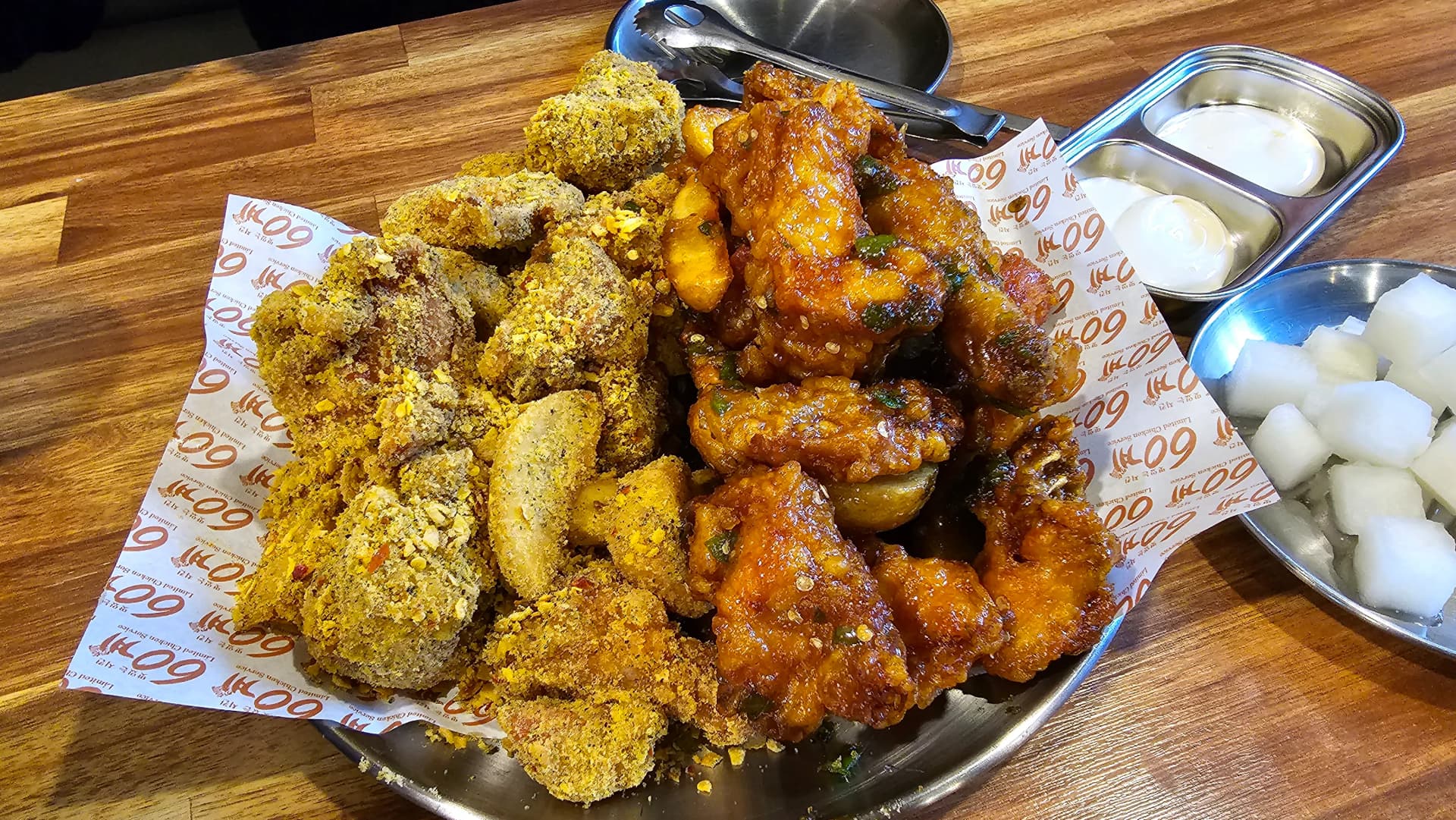
The half-and-half — or "banban" in Korean — lets you split a single whole chicken order into two different flavours, served on one plate for the price of one. This is something I ordered with my wife when we ate in-branch in early 2025. Rather than committing to just one flavour, we went for the banban: half Tiger Chicken, half Gochu Chicken. The bill for bone-in banban came to ₩22,900 (roughly £11.50).
When my wife first learned about the half-and-half concept, she said, "Why doesn't every country do this?" Honestly, fair point. It's a genuinely sensible system.
🍗 What Is Half-and-Half (Banban)?
When you order a whole chicken in Korea, you can choose two different flavours — half of each — and get them served together on a single plate. It's a uniquely Korean fried chicken ordering style.
For example: half fried + half yangnyeom (sweet-spicy), half fried + half Ganji Chicken, or half Gochu Chicken + half Tiger Chicken — you're free to mix and match however you like.
The price is based on whichever flavour is more expensive. Bone-in banban is about ₩22,900 (≈£11.50), and boneless banban is about ₩23,900 (≈£12).
💡 You can easily get bored eating just one flavour, so if you're trying Korean fried chicken for the first time, I'd recommend going with banban.
In the photo, the side covered in yellow crunch powder is Tiger Chicken, and the side coated in red sauce is Gochu Chicken. It came with chicken mu (pickled radish — think of it like a palate cleanser, similar to the ginger that comes with sushi, but tangy and sweet) and mayo dipping sauce on the side. This combo is apparently one of the most popular banban pairings at 60 Gye.
Tiger Chicken — A Blizzard of Grain Crunch Powder
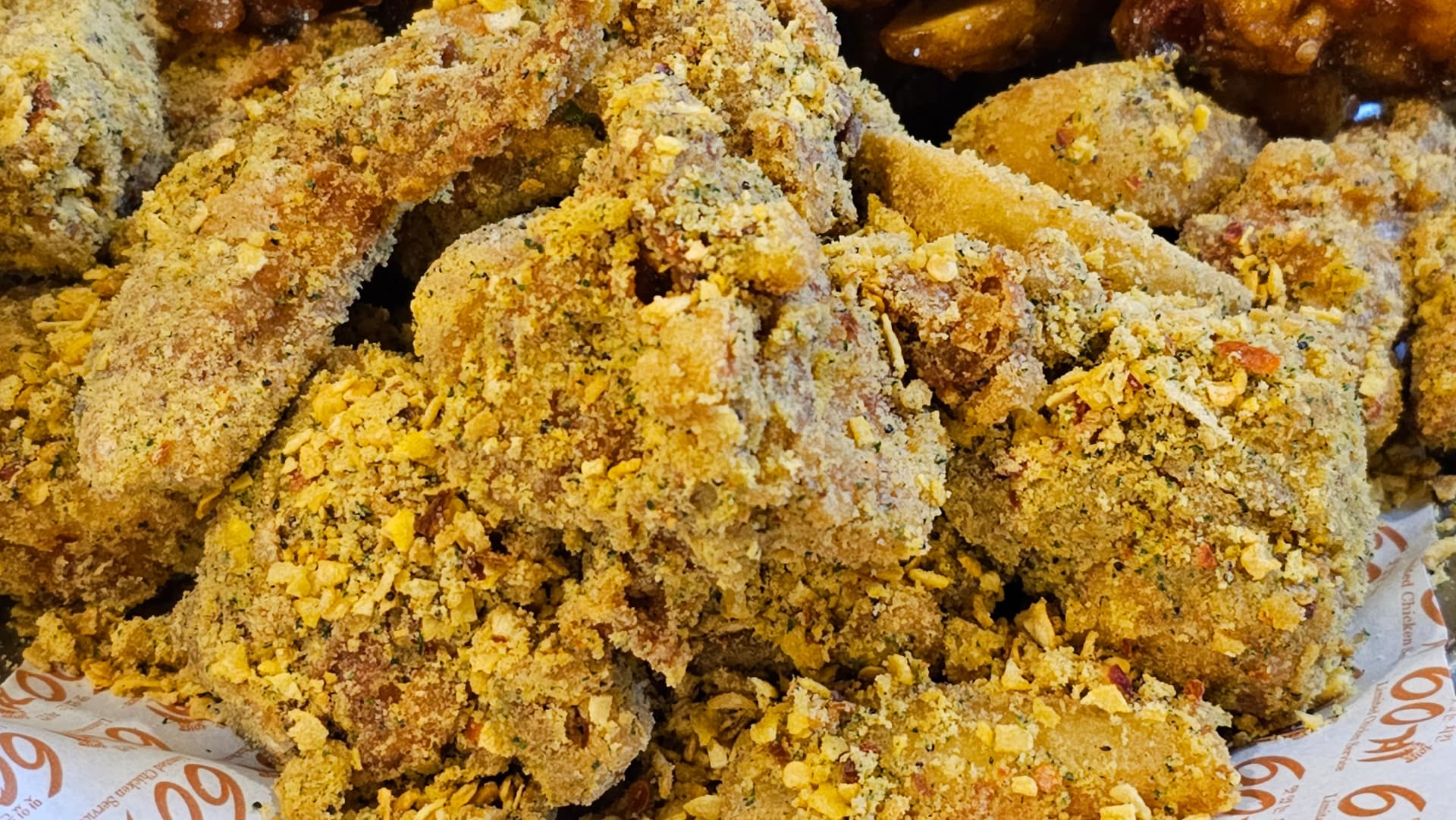
Tiger Chicken. You can see it from the photo — that sheer amount of powder. The grain crunch seasoning is piled on top of the crispy chicken like a dusting of snow.
When it first arrived, my honest reaction was "How am I supposed to eat this?" Pick a piece up and the powder cascades off everywhere, showering onto the 60 Gye branded paper on the table — which, in a strange way, is almost charming. The flavour is a sweetish seasoning with a proper punch of garlic. If you've ever tried Puringkle from another Korean brand, it's in the same family, but less intense and more on the savoury, nutty side. There's a surprisingly strong black pepper kick lurking underneath, which made it absolutely brilliant as a beer snack. That salty, savoury powder is ridiculously moreish — your hand just keeps reaching for more without you noticing. My wife went straight for the Tiger Chicken side before touching anything else.
One gripe, though. If you order bone-in, you're tearing powder-coated chicken off the bone with your fingers, and within seconds your hands turn into yellow crumby disasters. One wet wipe won't cut it — you'll need three or four at minimum. If you want to eat tidily, order boneless.
Gochu Chicken — Sweetness Hiding a Spicy Sting
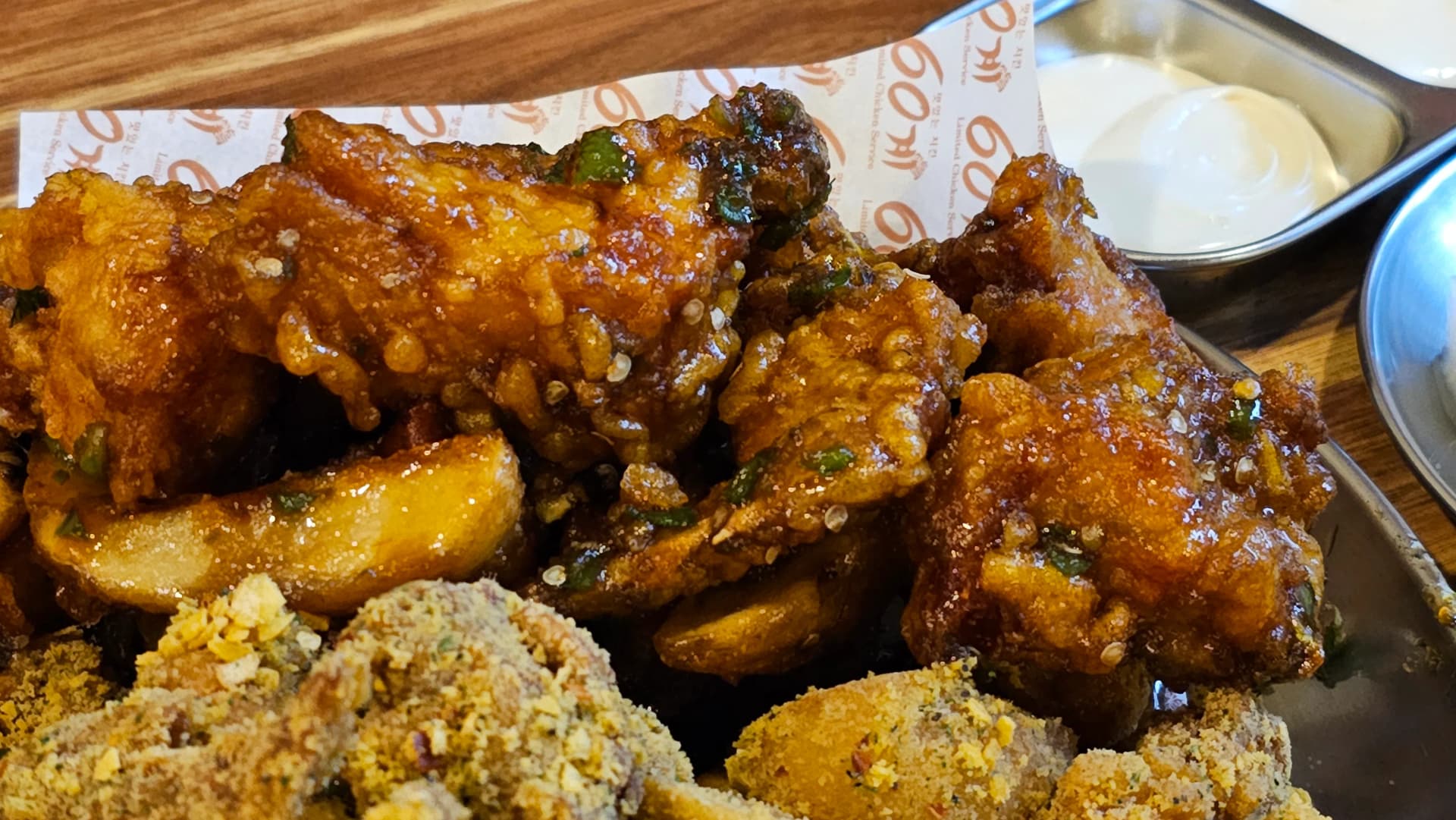
On the other side of the plate sat the Gochu Chicken. "Gochu" means chilli pepper in Korean, and it lives up to the name. That glossy red sauce with chopped cheongyang chilli peppers scattered across the top — you could smell the heat wafting up the moment it arrived.
First bite and you get this sweet, sticky sauce flavour up front. Just as you're thinking "Oh, this isn't too bad actually" — the spice hits you from behind like a sucker punch. A proper Korean tingling-lips kind of heat. My wife ate two pieces and immediately started dunking everything in the mayo. Doing that tones the spice down enough to keep going, and honestly, that's exactly what the accompanying mayo sauce is there for.
If you haven't got much spice tolerance, ordering a full portion of Gochu Chicken on its own might be a bit reckless. That's precisely why the banban exists. Eat a few savoury Tiger Chicken pieces, and when your mouth fancies something different, grab a piece of Gochu Chicken, then retreat back to Tiger. That rhythm was the winning formula for the evening.
Does the Half-and-Half Mix the Sauces Together?
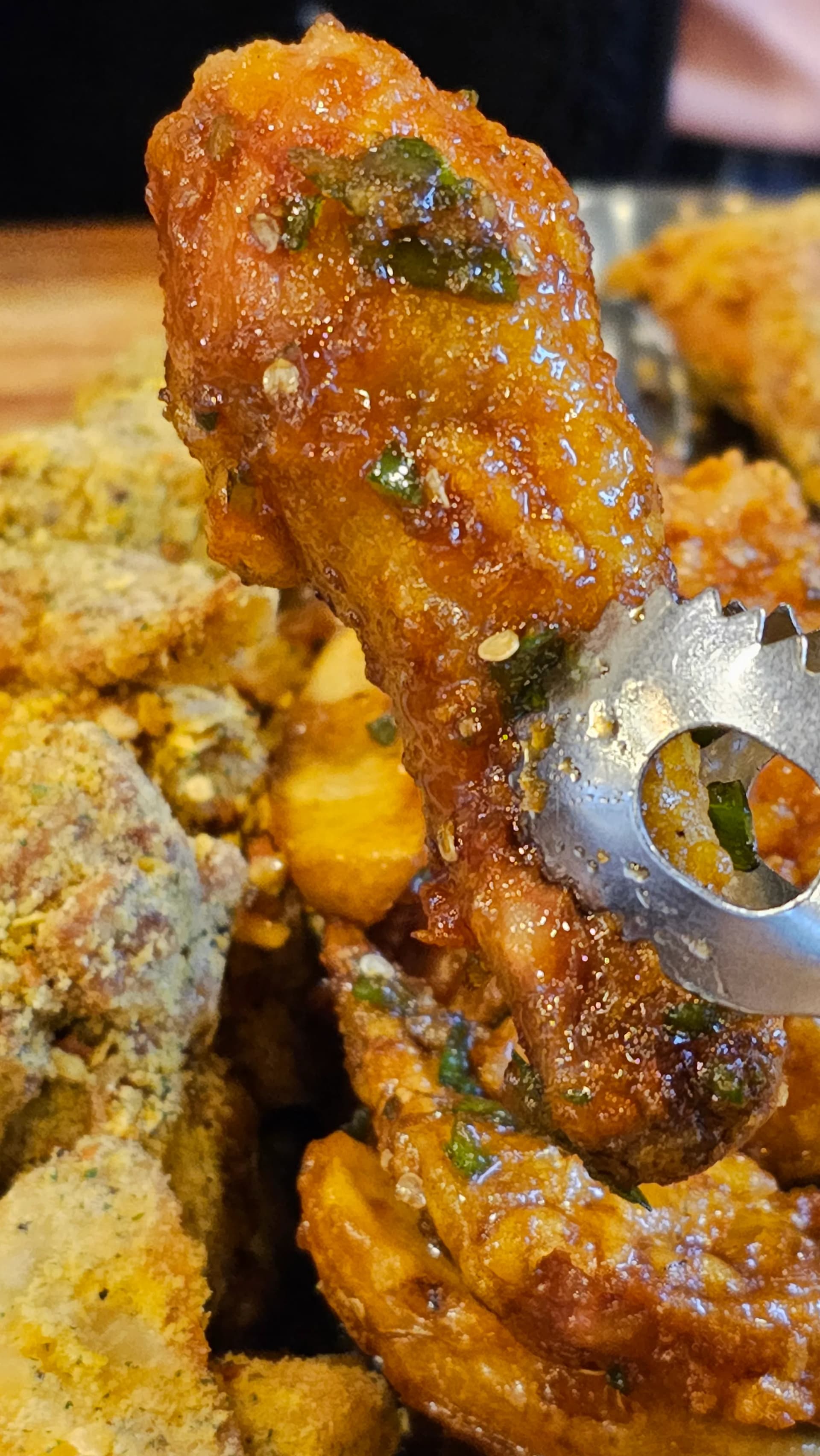
One thing people always wonder about banban orders: don't the two sauces bleed into each other? Actually, they come neatly separated by piece, with a bit of paper dividing the two halves. This is a drumstick piece — you can see how the Gochu sauce is evenly coated across the surface with flecks of cheongyang chilli clinging on. When you tear into it, the outside is moist from the sauce but the batter underneath stays properly crispy, and that textural contrast was genuinely lovely.
The Full 60 Gye Chicken Spread — What Comes as Standard
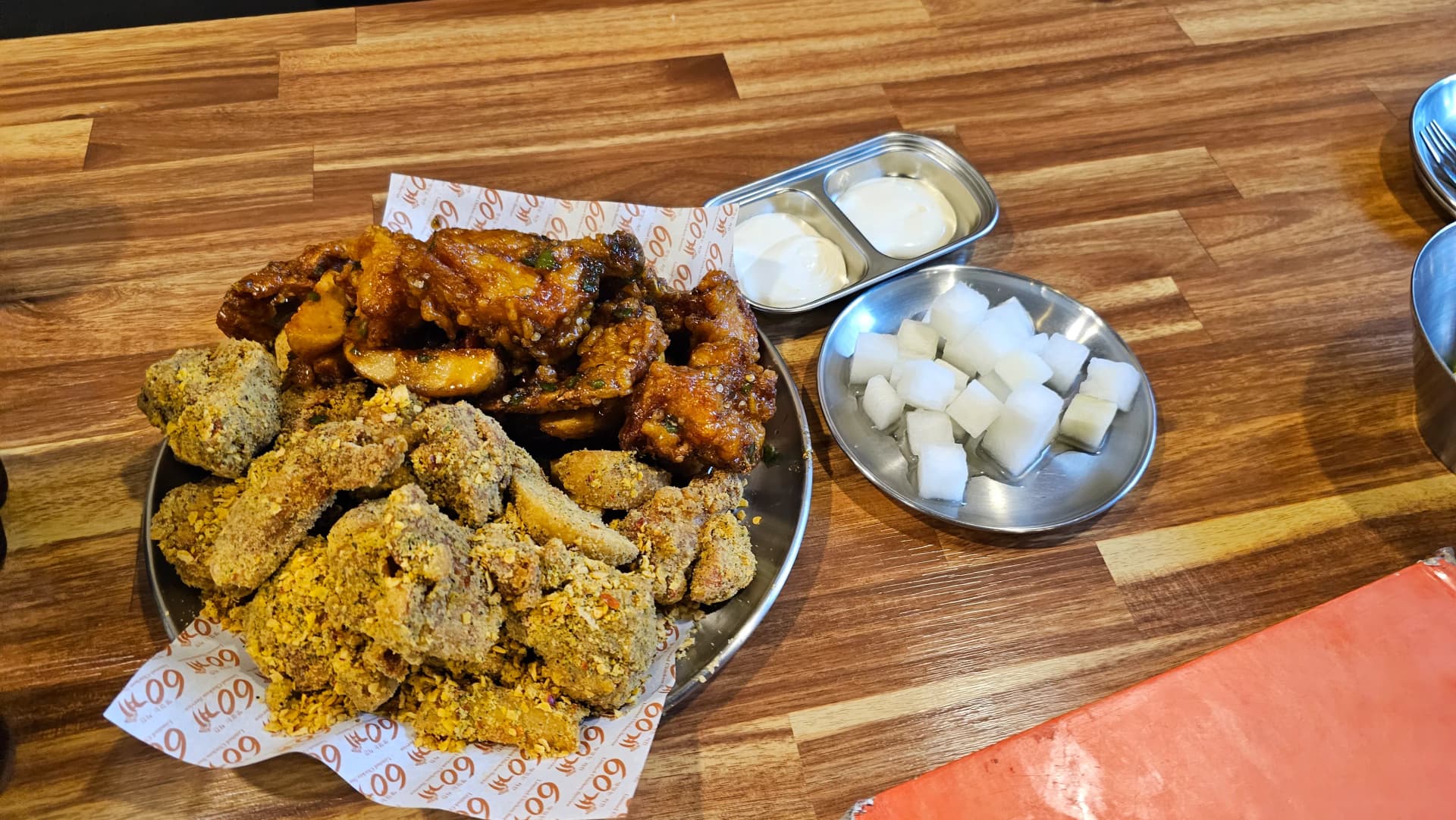
Here's what the full setup looks like. Tiger Chicken and Gochu Chicken sit side by side on a stainless steel plate, with chicken mu (pickled radish) and two types of mayo sauce served separately. You can also spot potato wedges tucked in amongst the chicken pieces. This is the standard serving at 60 Gye — no need to order sides separately, because the wedges come included. Pretty generous, all told.
Wooden table, stainless plate. It's not fancy, but it's comfortable and practical — that quintessential Korean chicken shop atmosphere. It was the perfect amount for two people sharing with a beer each on the side.
6-Second Chicken — The Spice Hits Six Seconds Later
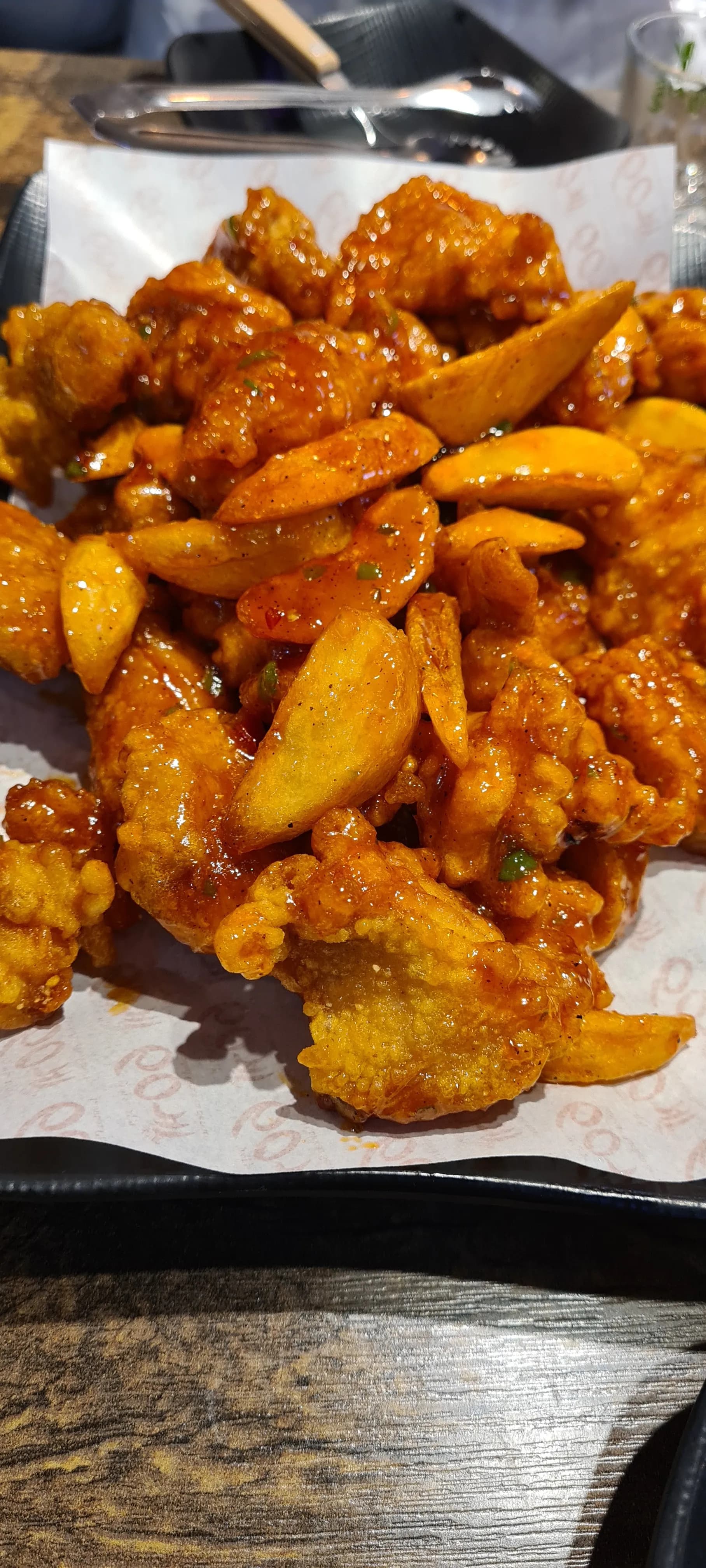
This is the 6-Second Chicken, which I tried around mid-2025. I can't remember the exact date, but I definitely remember the menu. The name is brilliant — it means the spiciness kicks in six seconds after you swallow.
Boneless chicken pieces and potato wedges, all tossed in a glossy, sticky spicy sauce. At first glance, I thought it was just a regular sweet yangnyeom-style chicken. But after swallowing, a slow burn starts creeping up the back of your throat. Is it spicier than Gochu Chicken? In my experience, roughly the same or maybe a touch hotter. The real difference is in how the heat arrives. Gochu Chicken doesn't pretend to be anything other than spicy from the get-go. 6-Second Chicken lulls you into a false sense of security and then ambushes you — which is somehow more alarming.
The name definitely delivers on its promise.
The potato wedges come completely coated in the same sauce, which might divide opinion. I personally liked the spicy wedges, but if you prefer your potatoes plain and simple, you might find it a bit much. My wife actually picked out just the wedges that day and left me all the chicken — turns out the spicy sauce-soaked potatoes were unexpectedly her thing.
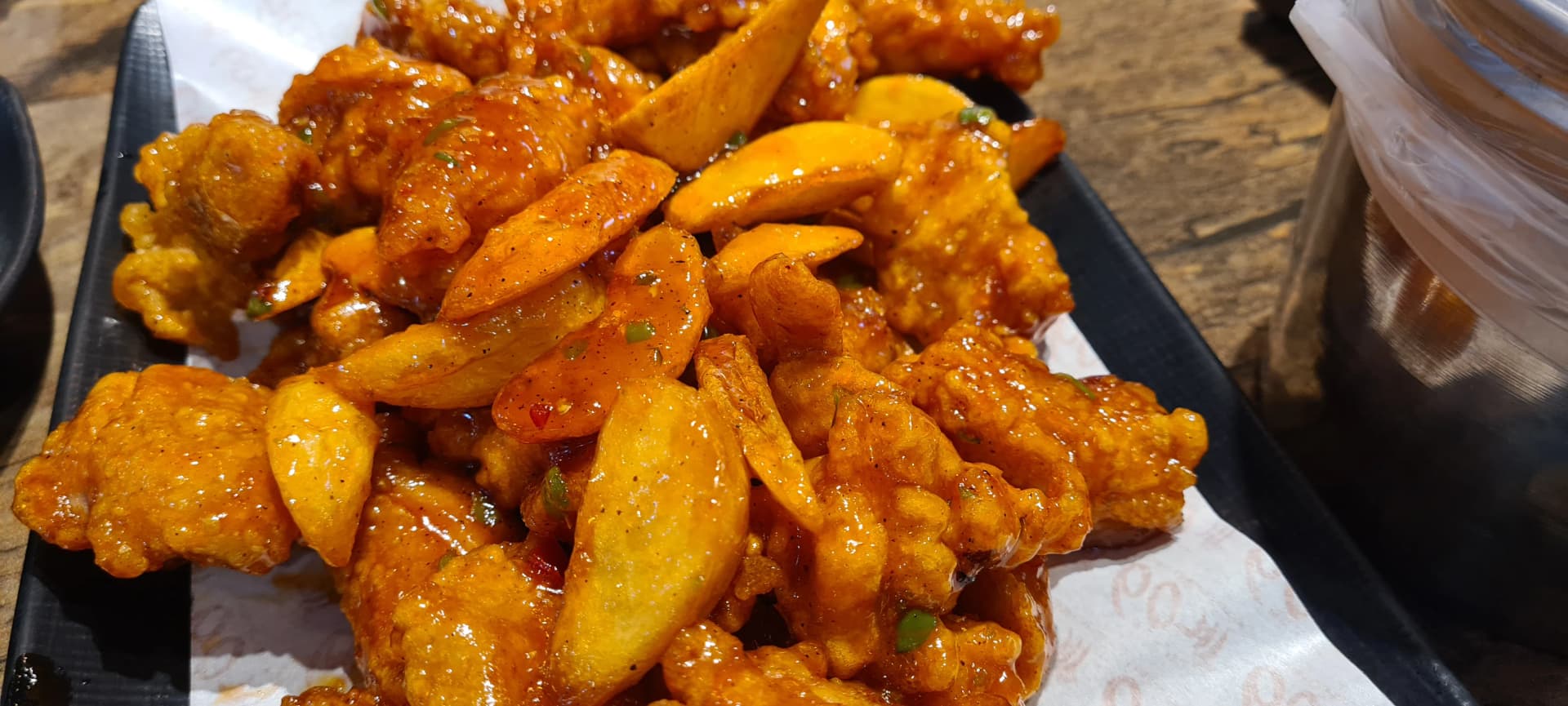
Different angle, slightly different vibe. From here you can really see just how thoroughly the boneless pieces and wedges are swimming in sauce. There's a cola cup peeking in on the right — and honestly, fizzy drinks are essential with spicy chicken. Without it, this would've been a struggle.
60 Gye Chicken Full Menu & Price Guide
Beyond the items I personally tried, 60 Gye Chicken has a pretty extensive menu. I've put together the prices below based on what I've seen on delivery apps and in-branch menu boards.
60 Gye Chicken — Key Menu Items & Prices
Based on 2025–2026 pricing; may vary slightly by branch and platform
🍗 Bone-In Chicken
Fried Chicken
Classic crispy fried. A great starting point for beginners.
₩18,900–21,000 (≈£9.50–£10.50)
Yangnyeom Chicken
Sweet and spicy sauce coating. The quintessential Korean fried chicken flavour.
₩24,900 (≈£12.50)
Tiger Chicken
Smothered in grain crunch powder. The ultimate crispy chicken experience.
₩20,900–24,900 (≈£10.50–£12.50)
Gochu Chicken
Spicy chilli sauce + cheongyang pepper topping. A proper heat challenge.
₩20,900–24,900 (≈£10.50–£12.50)
Ganji Chicken
Soy-based sweet and savoury glaze.
₩24,000–24,900 (≈£12–£12.50)
Keu-keu-keu Chicken
Extra-loaded crunch seasoning. Famous from BTS Jungkook's live broadcast.
₩25,000–25,900 (≈£12.50–£13)
Ha-ha-hot Chicken
One level above Gochu Chicken on the spice scale.
₩25,500–25,900 (≈£12.75–£13)
6-Second Chicken
Delayed-onset spiciness that hits 6 seconds later.
₩18,900–19,900 (≈£9.50–£10)
🍖 Boneless
Boneless Fried
No bones, no fuss. For when you want a cleaner eating experience.
₩22,900 (≈£11.50)
Boneless Yangnyeom / Ganji / Gochu / Tiger
Boneless versions are roughly +₩2,000 compared to bone-in.
₩24,900 (≈£12.50)
🔀 Half-and-Half & Sets
Bone-In Banban
Two flavours, one plate. Priced at whichever flavour costs more.
₩22,900–25,900 (≈£11.50–£13)
Boneless Banban
Same half-and-half concept, boneless style.
₩23,900–26,900 (≈£12–£13.50)
Wings & Drumettes 24-Piece Set
All wings and drumettes. Ideal for sharing at a gathering.
₩23,000–24,900 (≈£11.50–£12.50)
🧀 Sides
Cheese Balls
₩5,000 (≈£2.50)
Cheese Sticks
₩4,000 (≈£2)
Chewy Corn Dog
₩5,000 (≈£2.50)
Potato Wedges
Included free
* Prices are based on 2025–2026 figures and may vary by ₩1,000–3,000 depending on location and delivery platform.
Chicken Mu and Mayo Sauce — The Essential Korean Fried Chicken Sidekicks
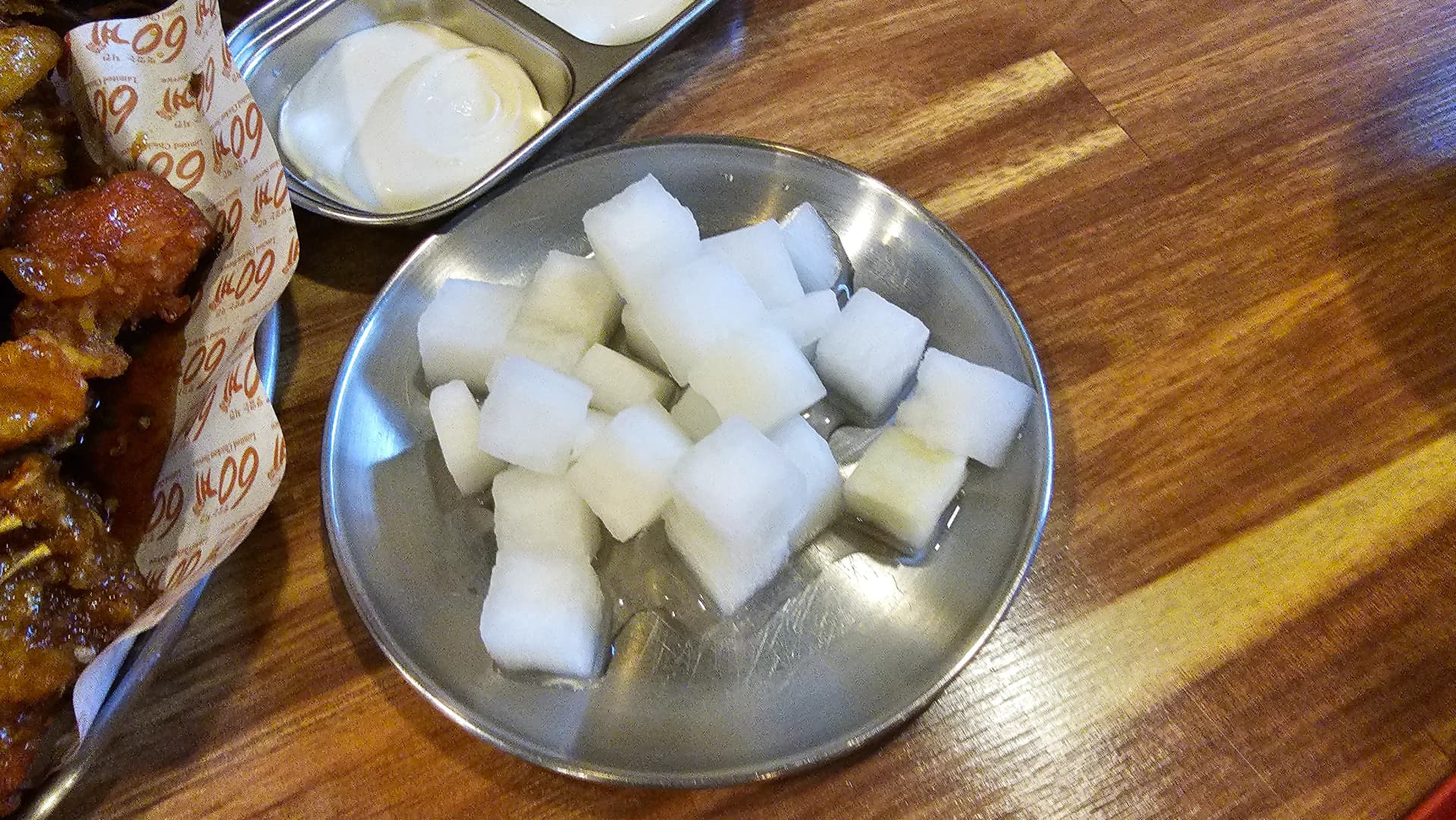
Chicken mu — pickled radish — is the side dish that comes with every single fried chicken order in Korea, without exception. Cubed white radish, served cold in a stainless steel bowl. Koreans will genuinely tell you they can't properly enjoy chicken without it. It's a sweet-and-sour vinegar pickle, and popping a piece between greasy chicken bites completely resets your palate. When you're eating something as intensely seasoned as Tiger Chicken, a single cube of chicken mu provides a contrast that's honestly hard to beat.
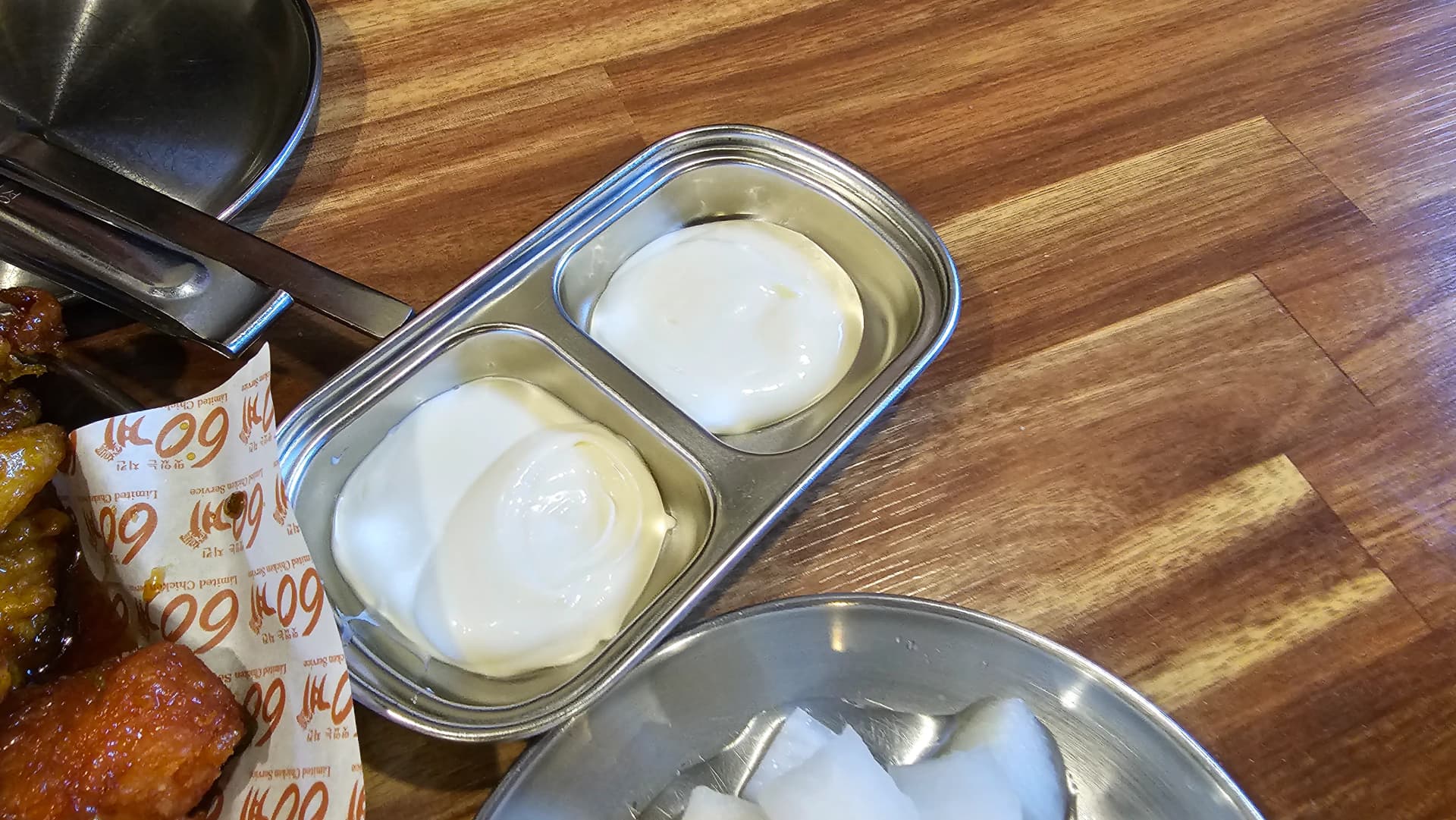
The mayo sauce. It comes in a stainless steel two-compartment tray, and 60 Gye fills both sections generously. They're quite heavy-handed with the mayo here, which means you won't run out halfway through — always appreciated. Dip a piece of plain fried chicken in and the richness doubles instantly. And when the Gochu Chicken spice gets too much, the mayo swoops in as your rescue. It's a lifesaver.
In Korean fried chicken culture, the chicken mu and dipping sauces are just as important as the chicken itself. They come included at no extra charge, so whether you're eating in or getting delivery, if they're ever missing from your order, just ask — they'll sort it.
Is 60 Gye Chicken Available Outside of Seoul?
60 Gye Chicken isn't limited to major tourist cities like Seoul or Busan. As of 2022, there were already over 660 branches across the country, and the number has only grown since. Roughly 80 in Seoul, over 160 in Gyeonggi Province (the region surrounding Seoul), 37 in Incheon, and even 28 in Gangwon Province (the mountainous northeast where the 2018 Winter Olympics were held). From Daegu to Gwangju to Jeju Island — if a city has a reasonable population, 60 Gye is almost certainly there.
I've ordered from multiple locations around the country, and the taste has been consistently the same everywhere. That's the beauty of a franchise, isn't it? Even if your travel itinerary takes you from Seoul out to the countryside, just search "60 Gye" on a delivery app and you'll nearly always find a branch nearby.
Final Verdict — Would I Recommend 60 Gye as a Korean Fried Chicken Starting Point?
If you ask me whether 60 Gye Chicken is the single best out of Korea's 600+ fried chicken franchises, I honestly couldn't say. Nobody's tried them all. What I can say with confidence, though, is that the prices are reasonable, the menu variety is wide, and that makes it an easy recommendation for someone trying Korean fried chicken for the first time. The half-and-half lets you sample two flavours in one go, and with delivery available virtually everywhere in the country, your travel plans don't limit your options. For roughly £11.50 — less than a meal deal at most British high street chains — you get a whole chicken with wedges, pickled radish, and dipping sauce included.
My wife has tried a fair few Korean chicken brands at this point, and 60 Gye has one of the highest reorder rates in our household. Tiger Chicken especially — she orders that one entirely of her own accord now.
I'll be reviewing more Korean fried chicken brands one by one as I eat my way through them, so keep an eye on this series. The next brand is still a secret, though.
This post was originally published on https://hi-jsb.blog.