Boeing 747-8i Upper Deck Business Class — A Seat on a Dying Icon
Table of Contents
14 items
A China Airlines Delay, and an Unexpected Boeing 747-8i Business Class Upgrade
Korean Air's Prestige Class aboard the Boeing 747-8i is one of the most unique business class experiences still available — a lie-flat seat on the upper deck of an aircraft so rare that only 48 passenger versions were ever built. I ended up on this flight entirely by accident, thanks to a delay on another airline, and it turned into one of my most memorable flights ever.
It was November 2019, and I was heading back to South Korea after living in Thailand for three years. The original plan was to fly China Airlines business class from Bangkok's Suvarnabhumi Airport, connecting through Taipei Taoyuan International Airport to Incheon. At the check-in counter in Bangkok, the staff informed me that a delay on the Bangkok–Taipei leg would cause me to miss my connection to Incheon. They said the details would be sorted once I arrived in Taipei. Honestly, I was rather annoyed.
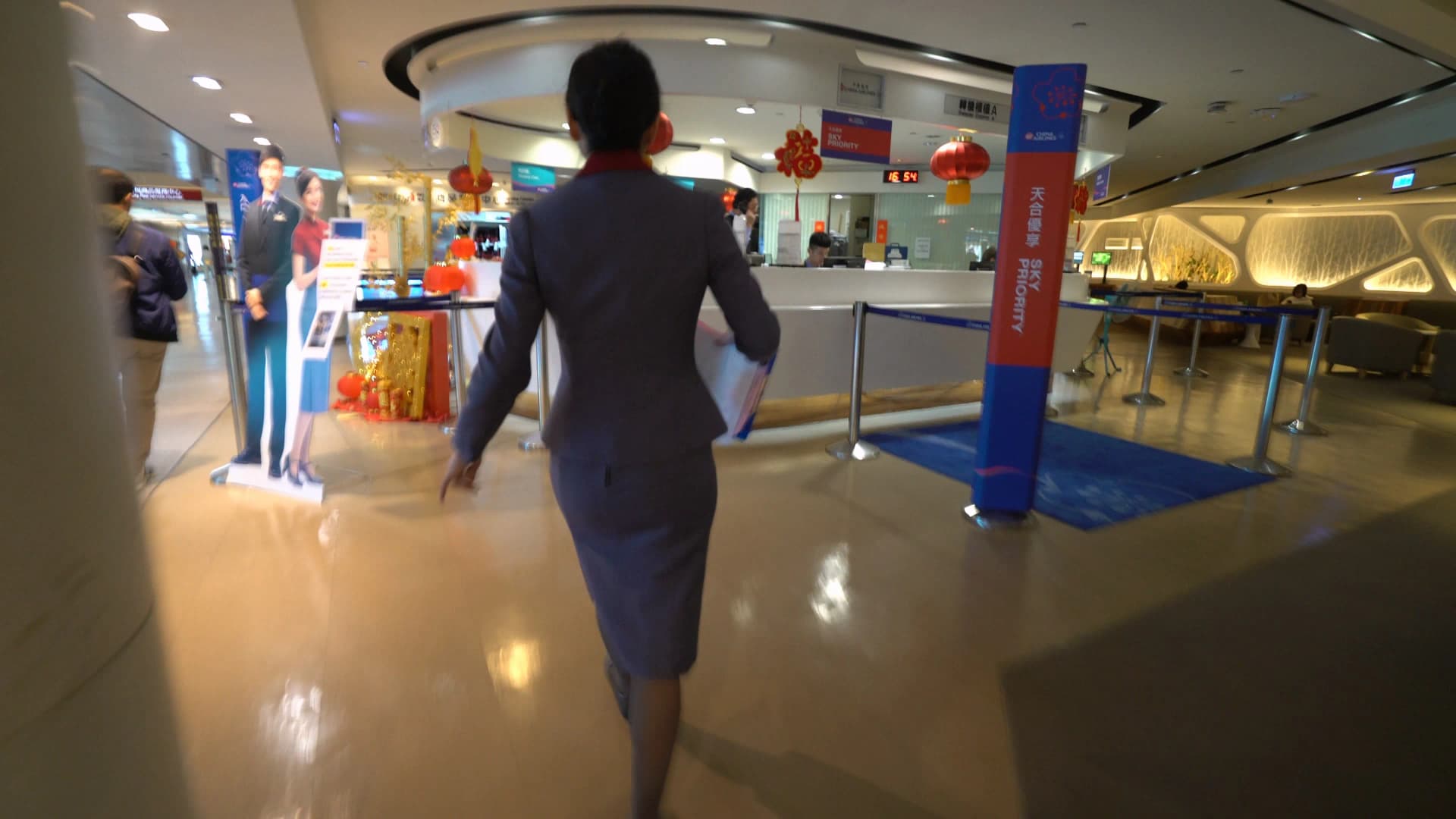
I boarded the Taipei-bound flight regardless, and the China Airlines cabin crew on that leg were genuinely impressive. Passengers were understandably tense about the delay, but the crew walked through the cabin individually explaining the situation to each affected traveller. It wasn't even technically their job, yet they reassured everyone with a look of genuine concern, saying things like "it will definitely be sorted in Taipei." I felt calmer by the time we landed at Taoyuan Airport and headed straight to the China Airlines service counter. The agent apologised and handed me a replacement ticket. I looked down at it — Korean Air, Boeing 747-8i, Prestige Class. Korean Air's Prestige Class is essentially their brand name for business class, the same tier you'd find labelled "business" on other carriers. A 747-8i in Prestige? Every trace of irritation vanished on the spot.
Why the Boeing 747-8i Is One of Aviation's Rarest Passenger Jets
The Boeing 747-8 Intercontinental is the final passenger variant of the 747, the legendary "Queen of the Skies" that defined commercial aviation for over half a century. Boeing delivered just 48 passenger 747-8i aircraft worldwide before ending production entirely in 2017, making it one of the rarest wide-body jets ever to carry fare-paying travellers.
Lufthansa was the first airline to operate the type commercially in 2012, and Korean Air became one of the largest operators, running 10 of them at the time of my flight. But here's what makes it truly special: those 48 airframes are all there will ever be. No more are coming off the production line. By the time I'm writing this in 2026, the situation has become even more dramatic. Only three airlines in the world still fly the 747-8i with passengers: Lufthansa with 19, Air China with 7, and Korean Air with roughly 5. That's it. Korean Air was operating 10 just a few years ago, but sold five of them — and where those five ended up is a rather jaw-dropping story I'll come back to at the end.
The 747-8i also serves as a head-of-state aircraft for several nations. South Korea's presidential jet "Code One" is a Korean Air 747-8i on long-term lease, and the United States' next-generation Air Force One (the VC-25B) is based on the 747-8 platform, currently under construction. Brunei, Morocco, Kuwait, and Turkey also operate VIP-configured 747-8i aircraft for their heads of state, and a Qatar royal family example was reportedly offered to President Trump in 2025 as a potential interim Air Force One. Think of it like Concorde in reverse — not famous for speed, but for sheer rarity and prestige. It's a passenger airliner and a flying presidential office at the same time. The fact that I ended up on one as a rebooking from a delayed flight gives you a sense of just how absurdly lucky that day was.
Boeing 747-8i — Just How Rare Is This Aircraft?
Total built (passenger variant): 48 worldwide — production ended in 2017
Airlines still flying passengers (2026): Lufthansa (19) / Air China (7) / Korean Air (~5) — just 3 airlines globally
Government/VIP operators: South Korea (Code One), USA (VC-25B under construction), Brunei, Morocco, Kuwait, Turkey, Qatar royal family
Nickname: Queen of the Skies — the last ever passenger model of the Boeing 747 series
Sources: Simple Flying, Gate Checked, Wikipedia, Planespotters.net, various government announcements (April 2026)
Korean Air Boeing 747-8i Prestige Class — Key Specifications
Aircraft: Boeing 747-8 Intercontinental (747-8i)
Total capacity: 368 seats (First 6 / Prestige 48 / Economy 314)
Upper deck Prestige layout: 2-2 staggered (approx. 22 seats)
Main deck Prestige layout: 2-2-2 (approx. 26 seats)
Seat pitch: 75 inches / 191 cm
Seat width: 21 inches / 53 cm
Bed mode length: Approx. 72 inches / 183 cm
Recline: 180° fully flat
Seat manufacturer: B/E Aerospace (now Collins Aerospace)
Monitor: 17-inch HD touchscreen + remote control with built-in secondary display
Power: 110V AC outlet + USB-A port
Sources: SeatMaps.com, Business Traveller, Korean Air official website
Boarding the 747-8i — Climbing the Iconic Staircase to the Upper Deck
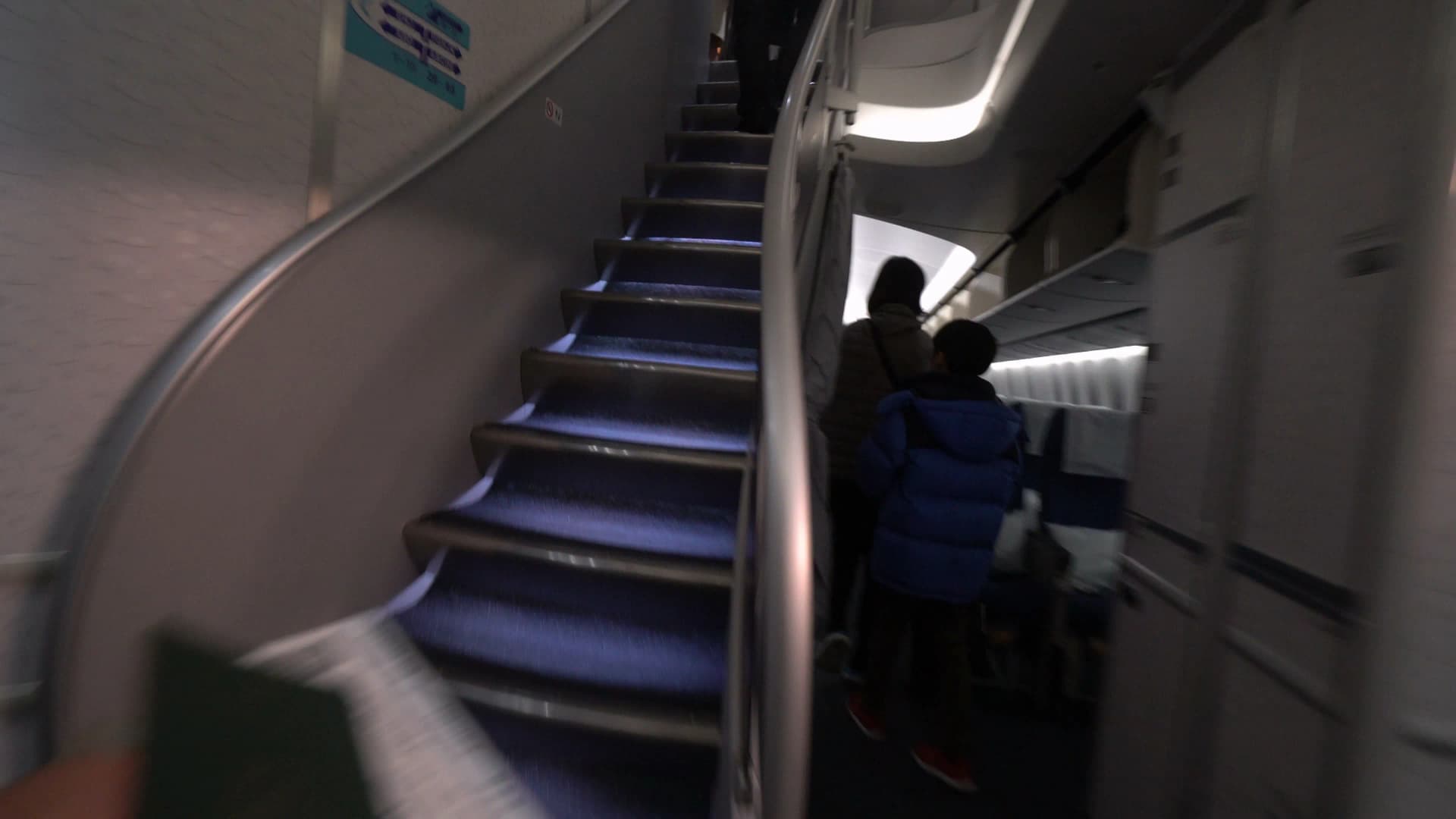
The Boeing 747's internal staircase is one of aviation's most recognisable features, and walking up it to reach the upper deck business class cabin remains a genuinely thrilling experience. Stepping through the L1 door, the familiar scent hit me immediately — that unmistakable blend of new-aircraft smell mixed with in-flight meal preparation. Anyone who flies regularly knows the one. It's the moment it becomes real.
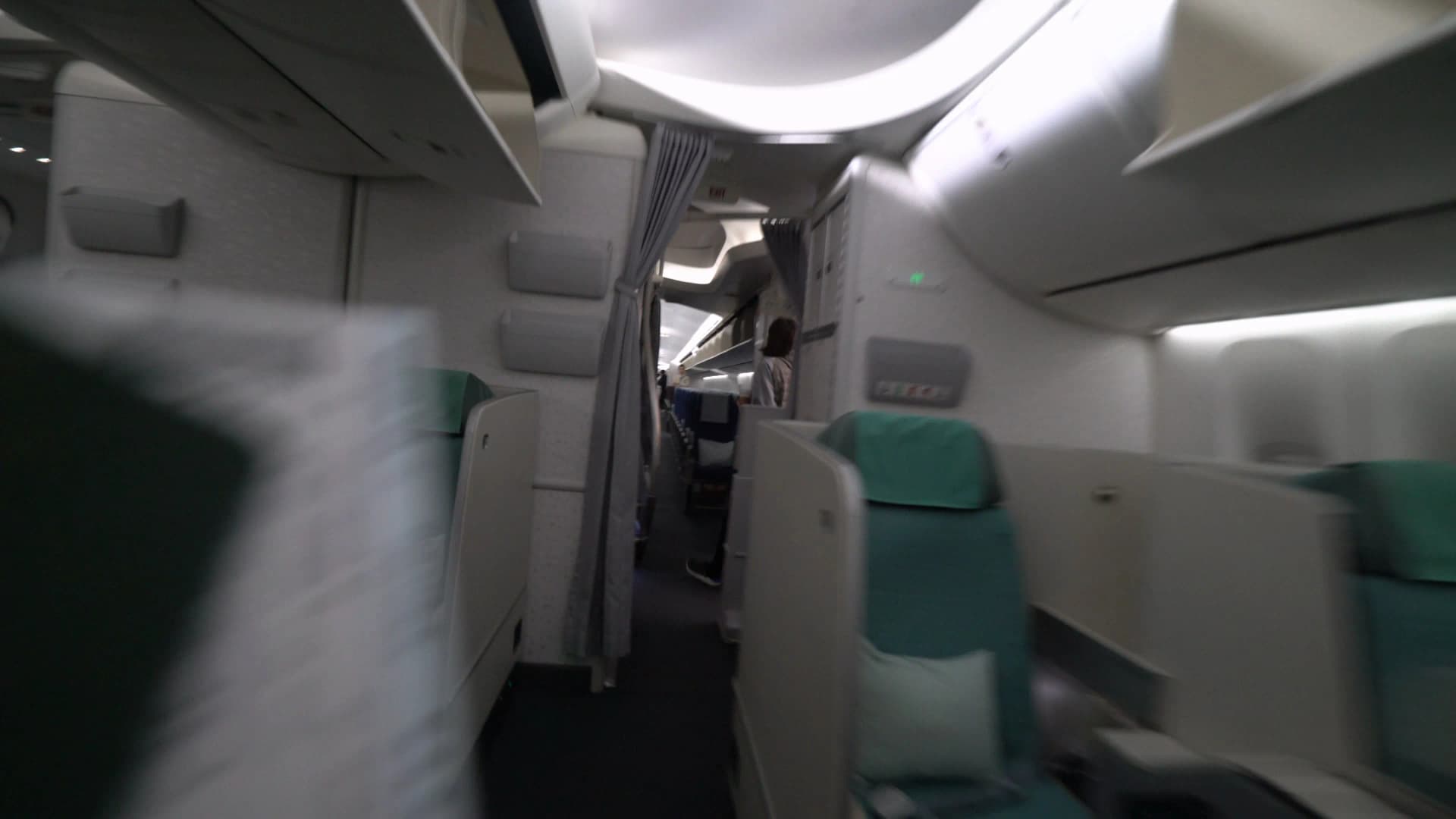
Straight ahead was the main deck Prestige section, but my seat was upstairs on the upper deck. I walked through the main deck Prestige cabin towards the rear, where the staircase to the second level awaited. Climbing those stairs felt properly special. It's worth noting that Korean Air hadn't yet completed its cabin interior refresh at this point, so if you've flown them more recently, the colour scheme may look different from my photos. Back then, the palette was deep blue and beige throughout.
First Impressions of the Upper Deck Prestige Class Seat
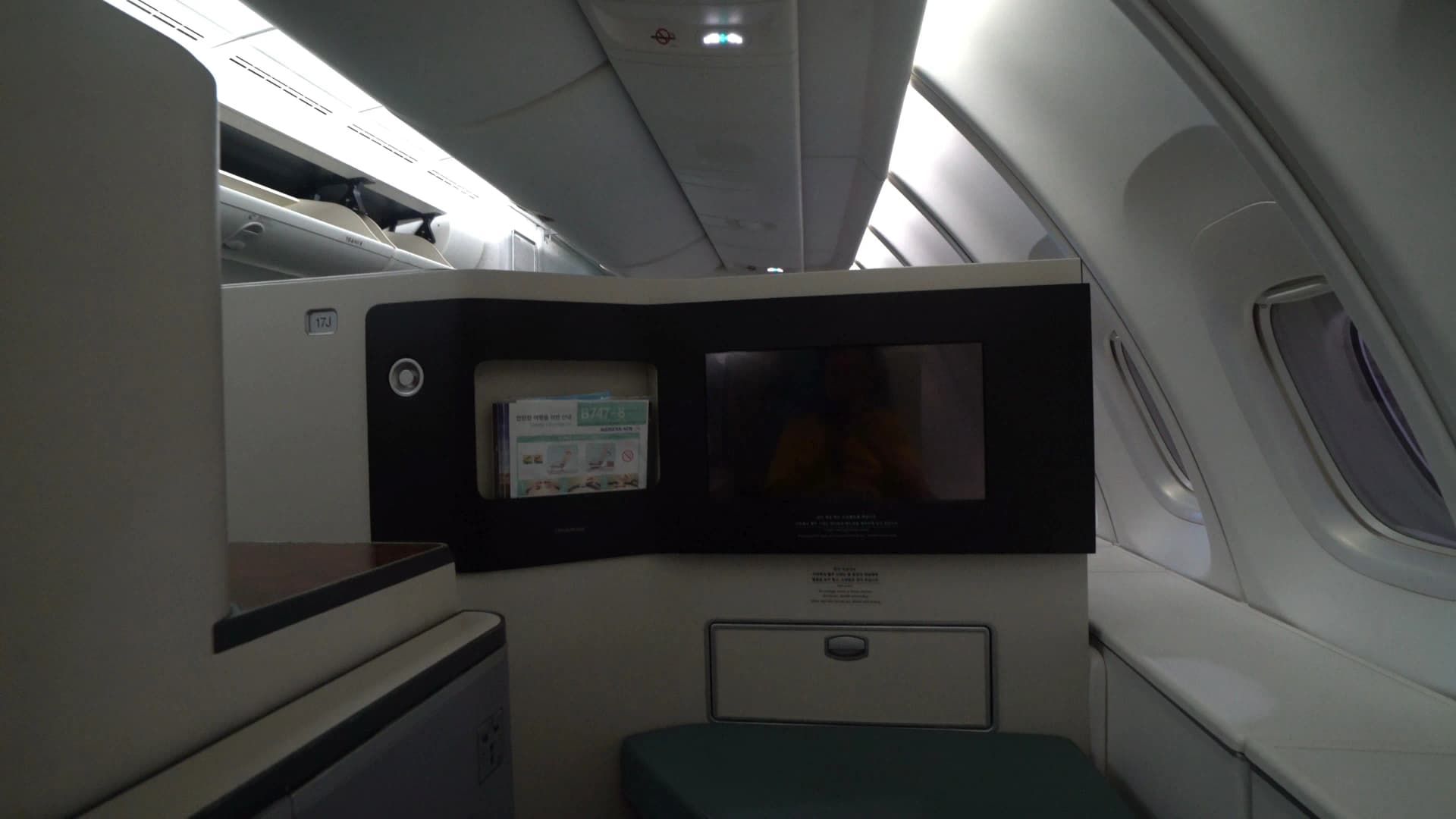
Korean Air's upper deck Prestige Class on the 747-8i features a 2-2 staggered layout with roughly 22 seats — noticeably more spacious and quieter than the 2-2-2 arrangement on the main deck below. The moment I sat down, the sense of space was immediately apparent, and a dedicated cabin attendant greeted me by name.
I found my window seat and settled in. The assigned crew member came over straight away, addressed me by name, and said "thank you for flying with us today." Bear in mind I was a last-minute rebooking from a delayed China Airlines flight, yet they treated me as though I'd been booked for weeks. Coming off the back of the warm service from the China Airlines crew on the previous leg, it struck me how consistently excellent Asian carrier service tends to be. When foreign friends ask me why Korean airlines get such high marks internationally, crew service is almost always the first thing they mention.
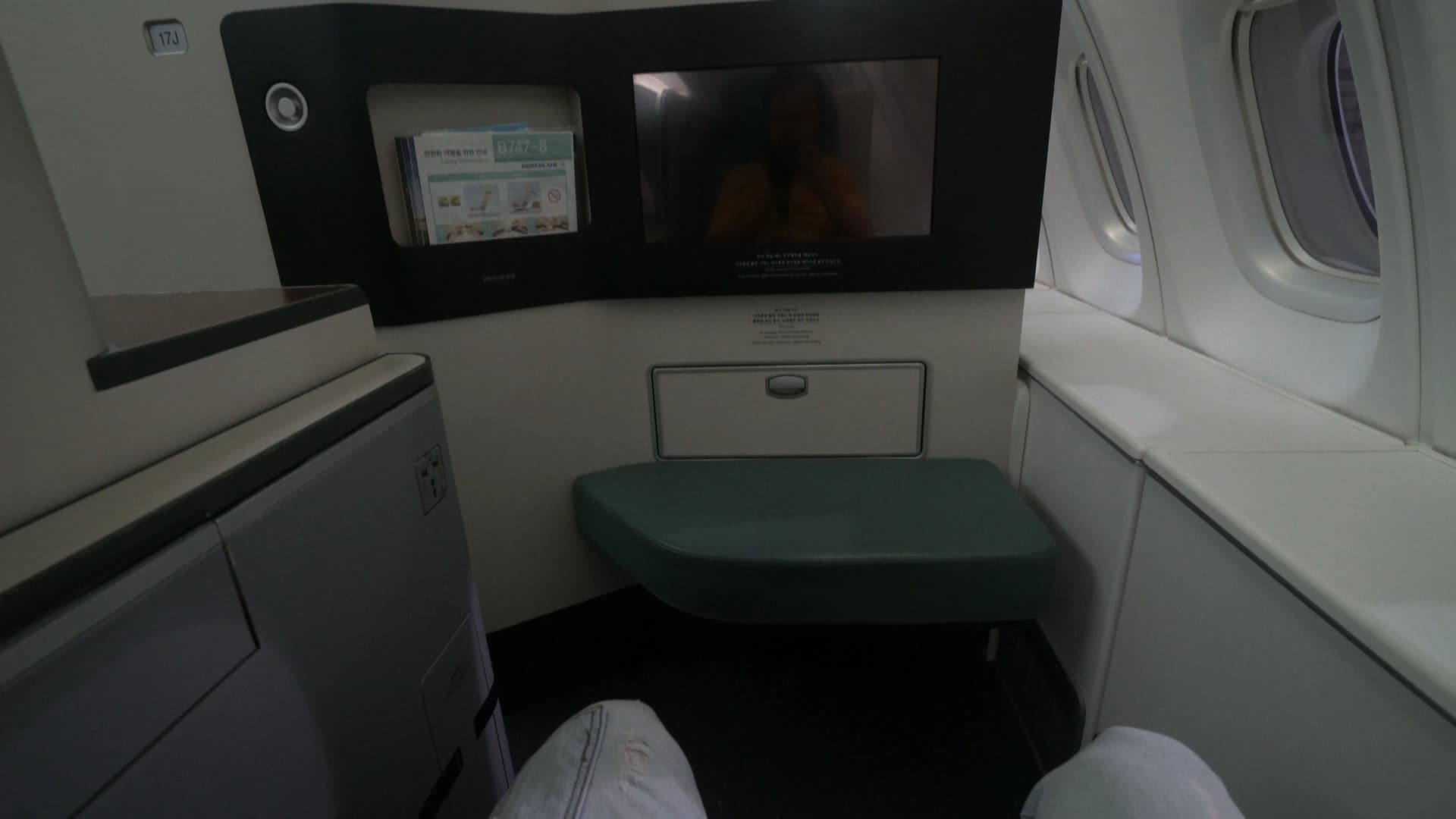
75-Inch Seat Pitch — Not Far Off First Class in Practice
Without exaggeration, a 75-inch (191 cm) seat pitch means your legs don't touch anything in front of you. I'd previously flown Korean Air first class on a mileage redemption, where the seat pitch is 83 inches (211 cm) — an 8-inch difference on paper. But in practice, the Prestige seat let me fully extend my legs onto the footrest, and the perceived gap between the two classes felt smaller than the numbers suggest. It helped that I'd just stepped off a China Airlines Boeing 777-300ER business class seat, so the jump in space on the 747-8i upper deck was immediately noticeable.
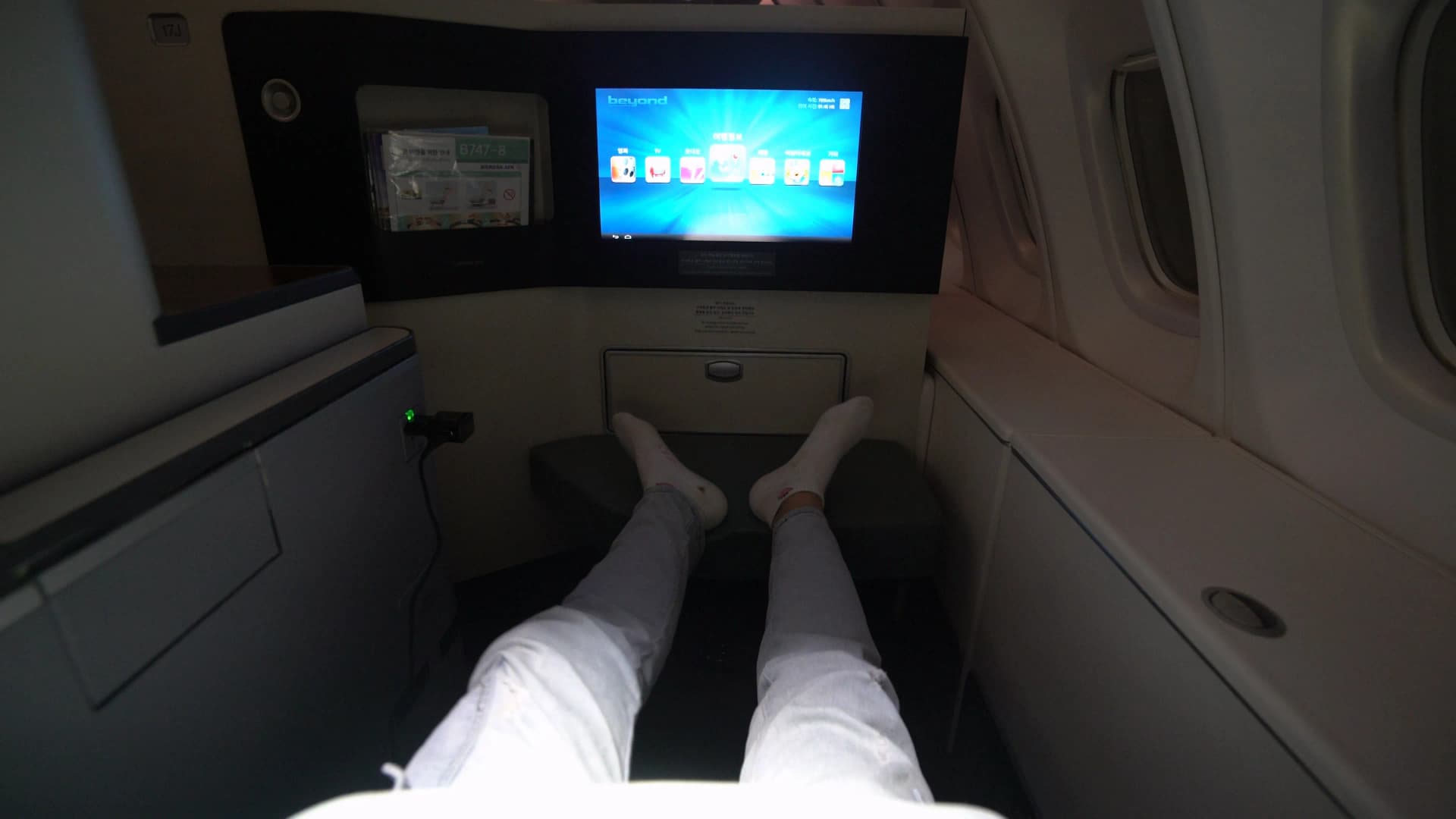
I stretched my legs out fully and they didn't reach the end. For reference, I'm 178 cm (5'10"). I spent the entire flight in this position watching a film, and honestly, two hours felt like a waste of such a brilliant seat.
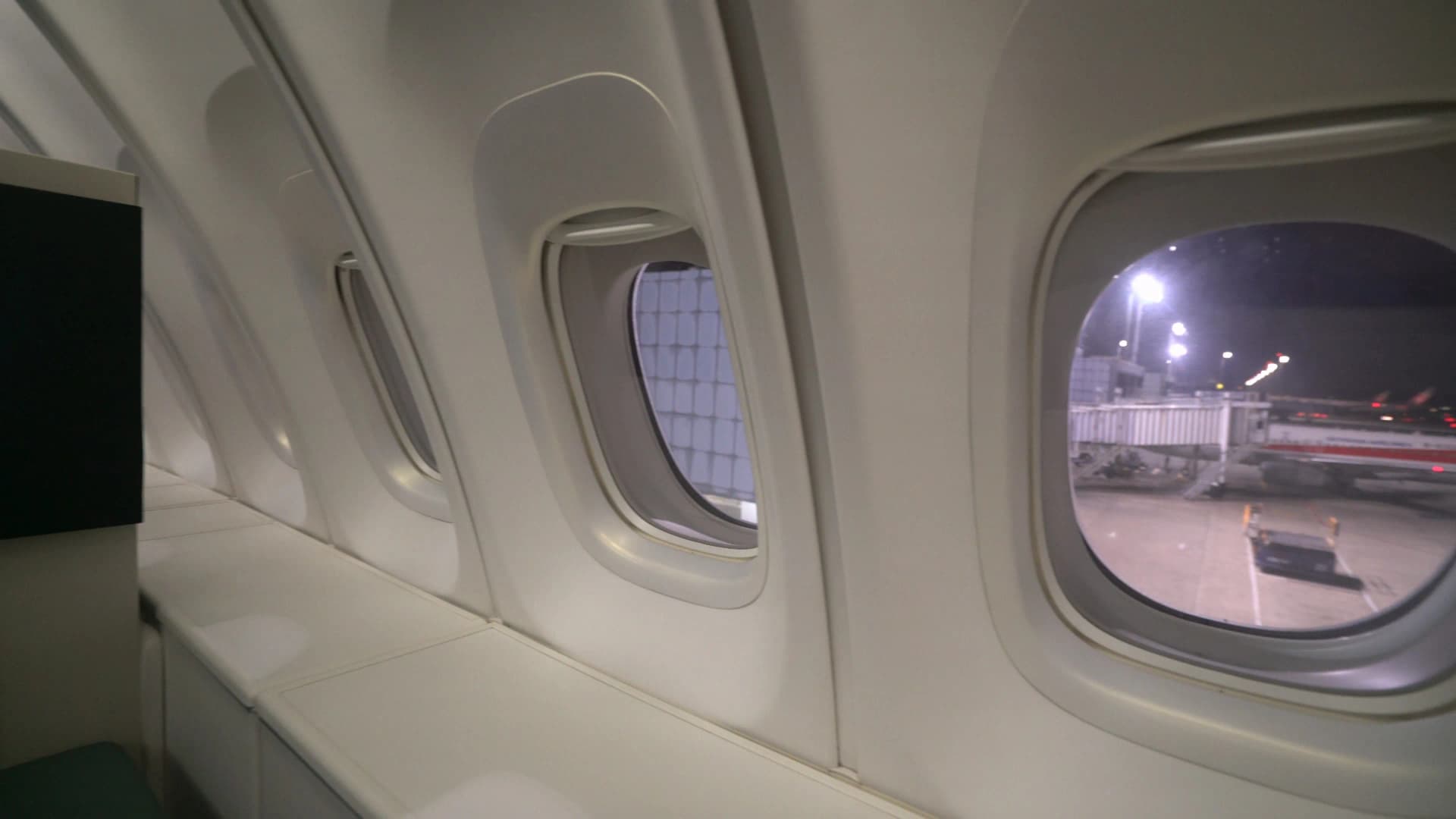
Four Windows All to Yourself — The Real Perk of an Upper Deck Window Seat
The other major advantage of the window seat was the number of windows. I had four to myself. In economy, you're lucky if one window lines up with your seat, but here I had a panoramic view all of my own. The upper deck window seats also benefit from the 747's distinctive curved fuselage wall, which creates a cosy, almost cocoon-like feel, plus a deep personal storage compartment along the lower wall. It was large enough to comfortably fit a rucksack.
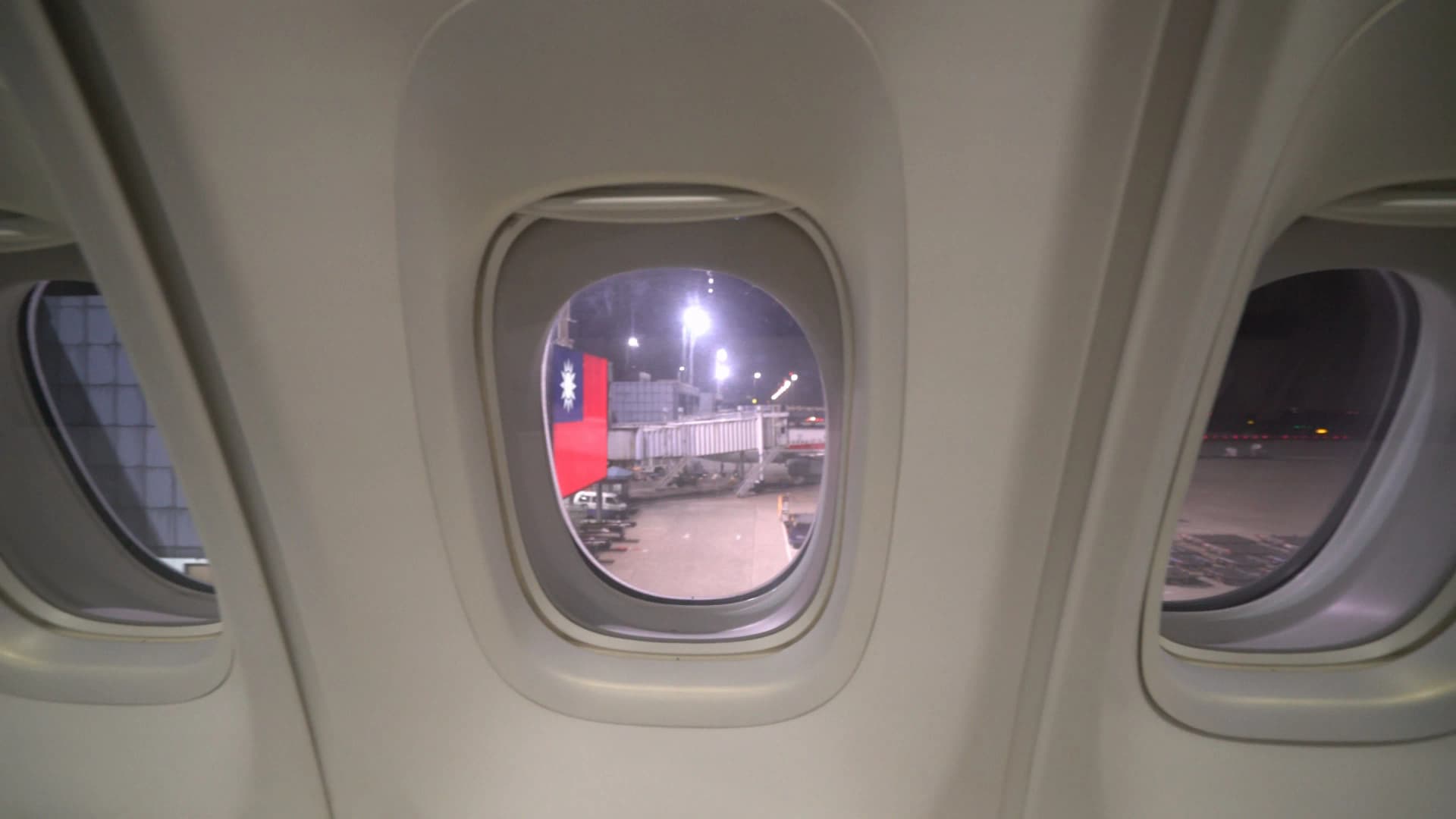
Before departure, the view through those four windows showed Taoyuan Airport's runway lights stretching out in a nighttime panorama. By that point, any memory of the delay-induced frustration had well and truly evaporated.
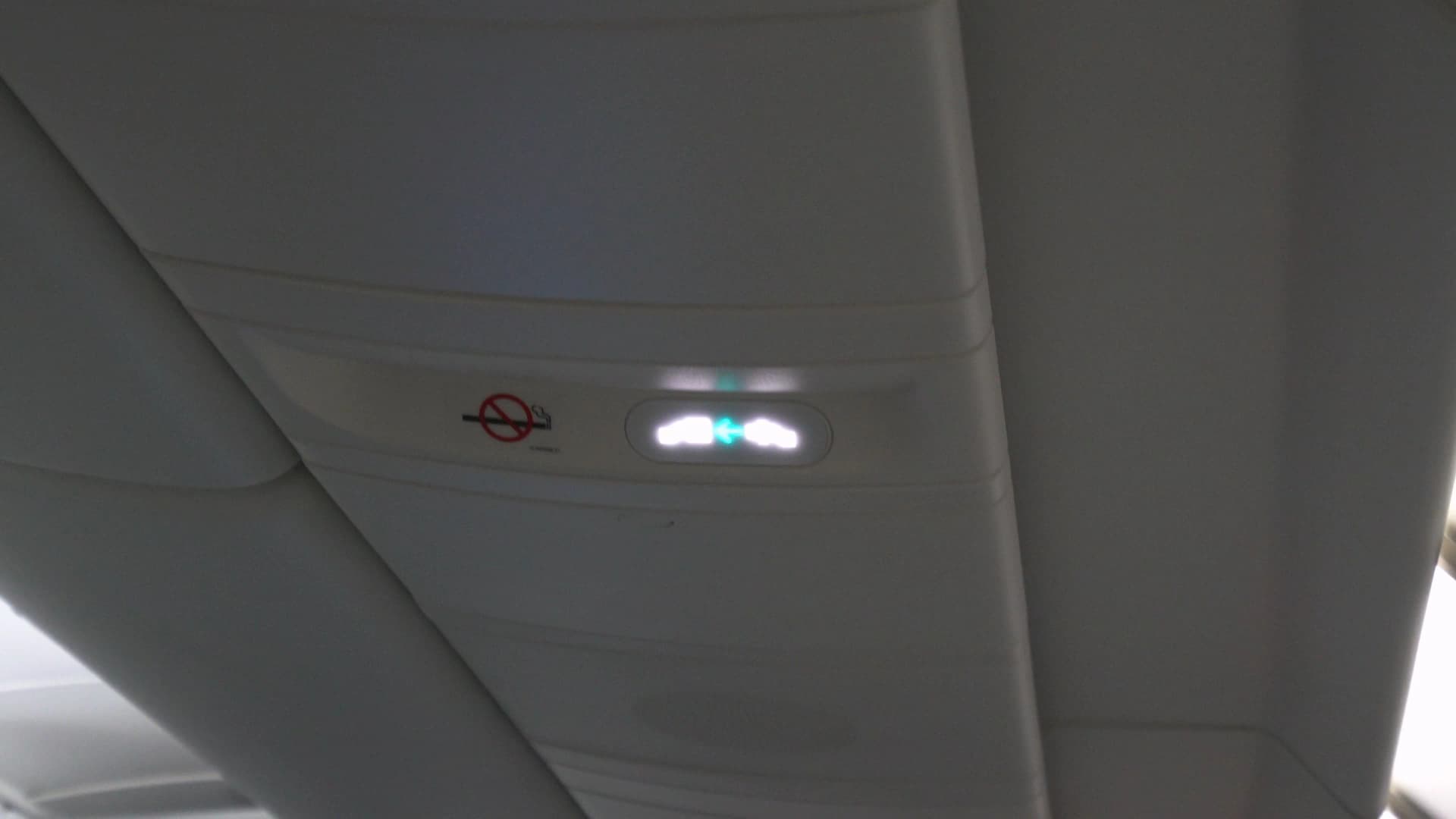
One small aside — here's the no-smoking and seatbelt sign. Turbulence can strike without warning, so keeping your belt fastened even when the sign is off is always sensible. I'll be honest, though: this sign panel looked a bit dated. For a flight in 2019, it felt behind the times. Newer aircraft like the Airbus A350 or Boeing 787 Dreamliner have electronic window dimming and far sleeker indicator designs. The 747-8i may be the final evolution of the 747, but the underlying design traces back to the 1960s, and in small details like these, it shows.
In-Flight Entertainment and the Remote Control Air Show
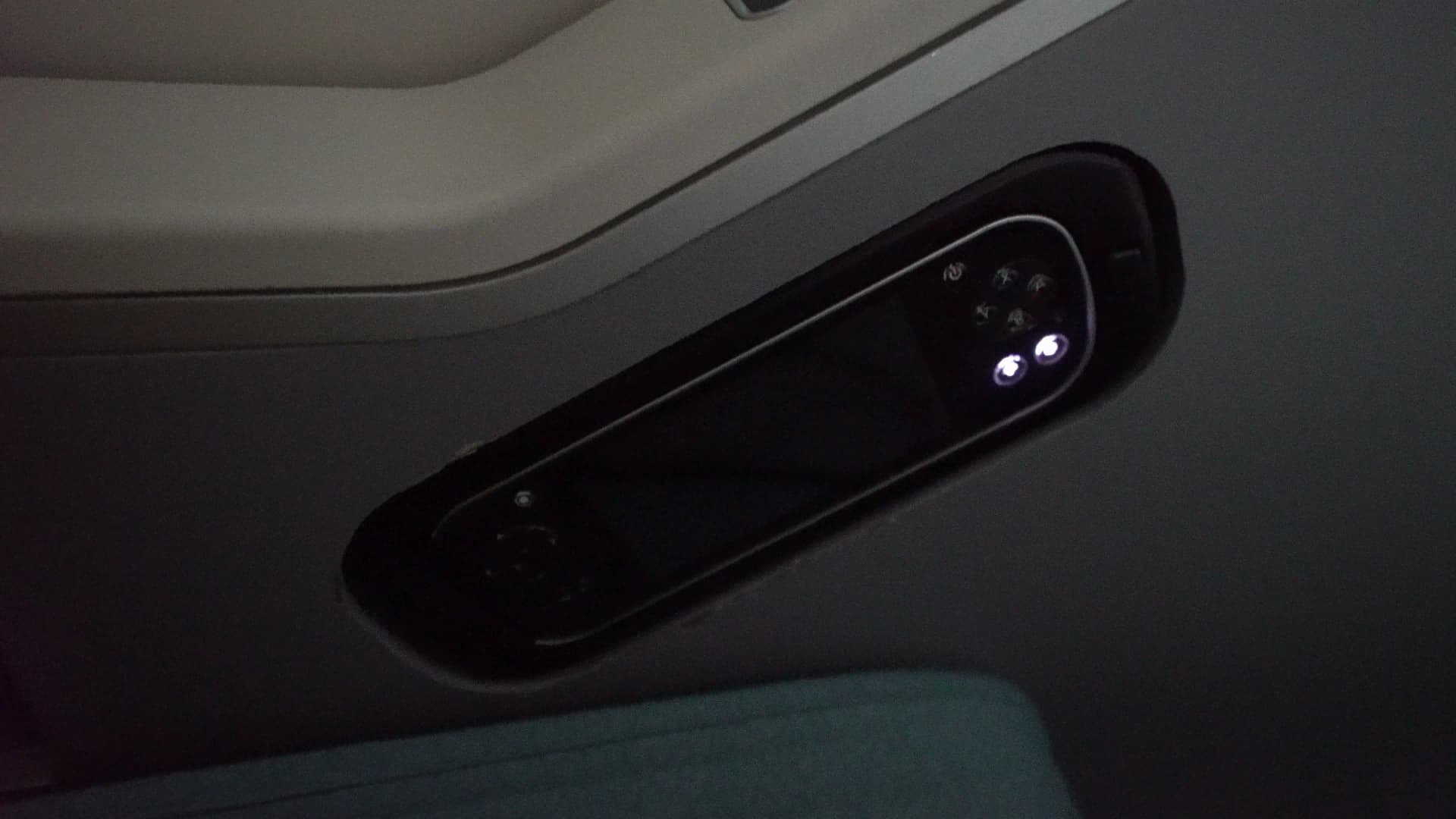
Korean Air's in-flight entertainment system on the 747-8i Prestige Class comes with a 17-inch HD touchscreen and a tethered remote control, which is how you'll actually operate everything. The seat pitch is so generous that the main screen is beyond arm's reach, so the remote becomes essential rather than optional.
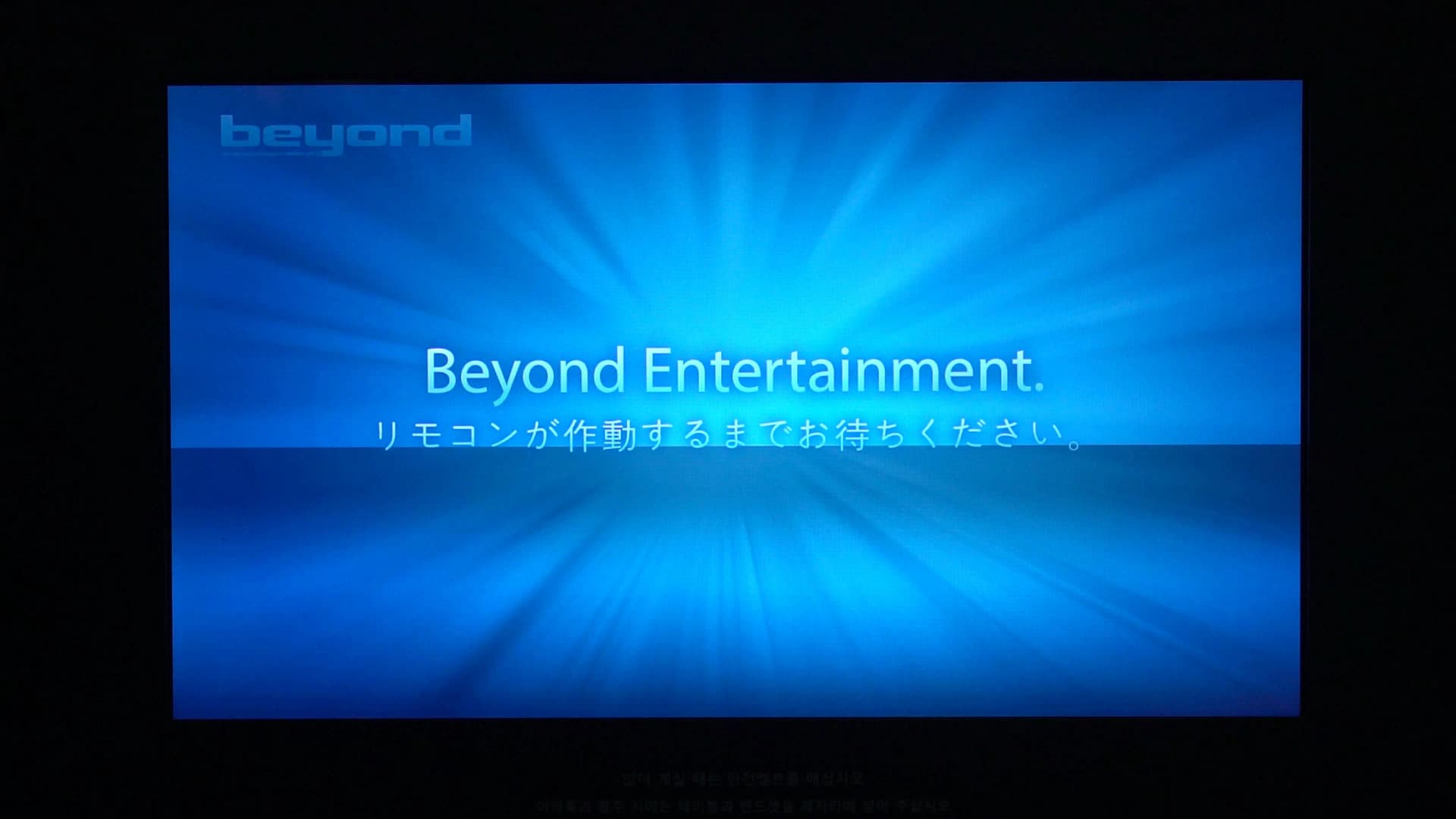
This was the main entertainment system interface as it appeared in 2019, so it may well look different now. The content library — films, music, games — was perfectly adequate for the flight.
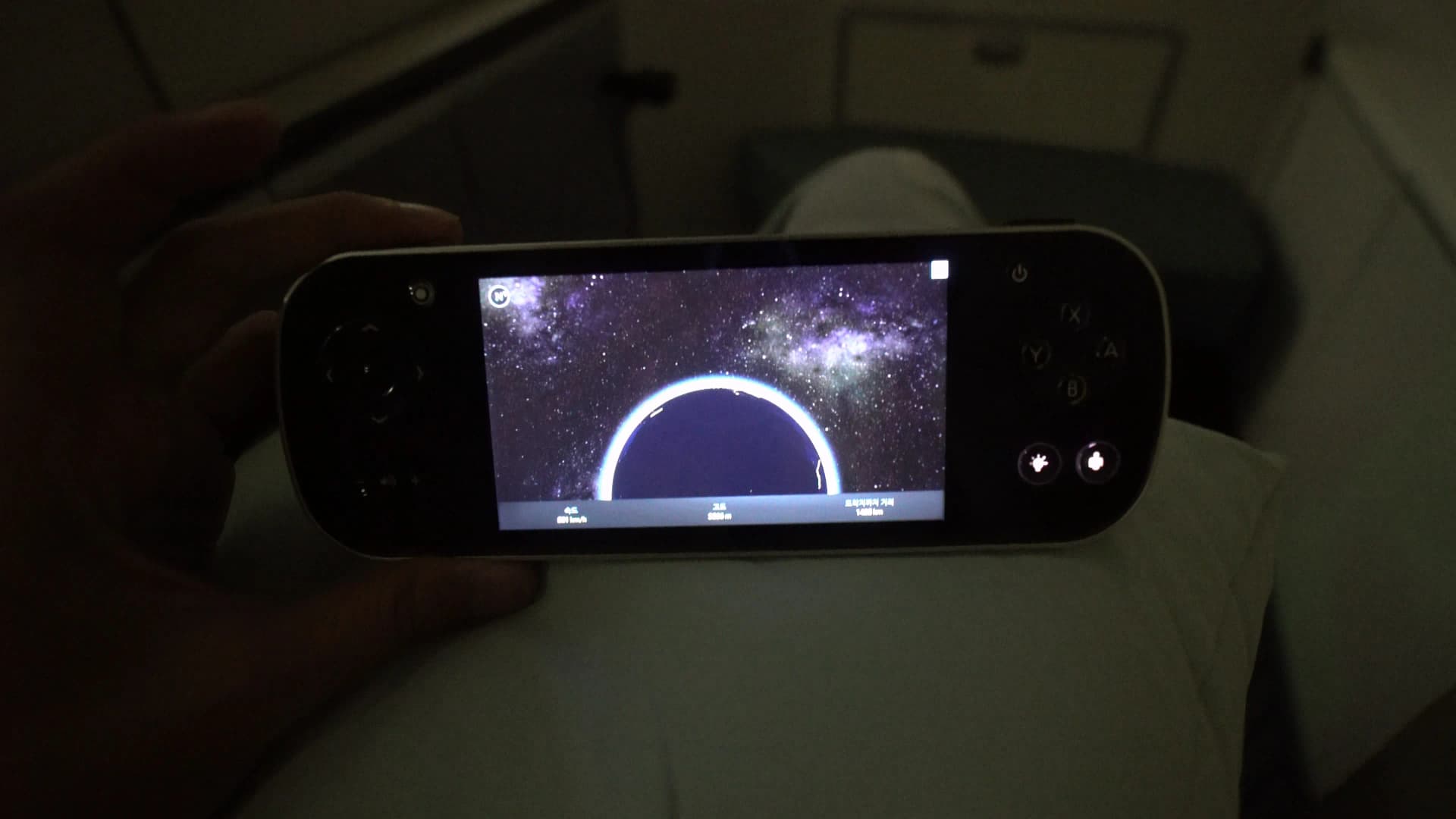
The remote control had its own built-in screen, which displayed the Air Show — a real-time map of the aircraft's position. This meant I could watch a film on the main monitor whilst tracking our flight path on the handheld screen simultaneously. We'd just departed Taipei, and the outline of Taiwan was clearly visible on the display.
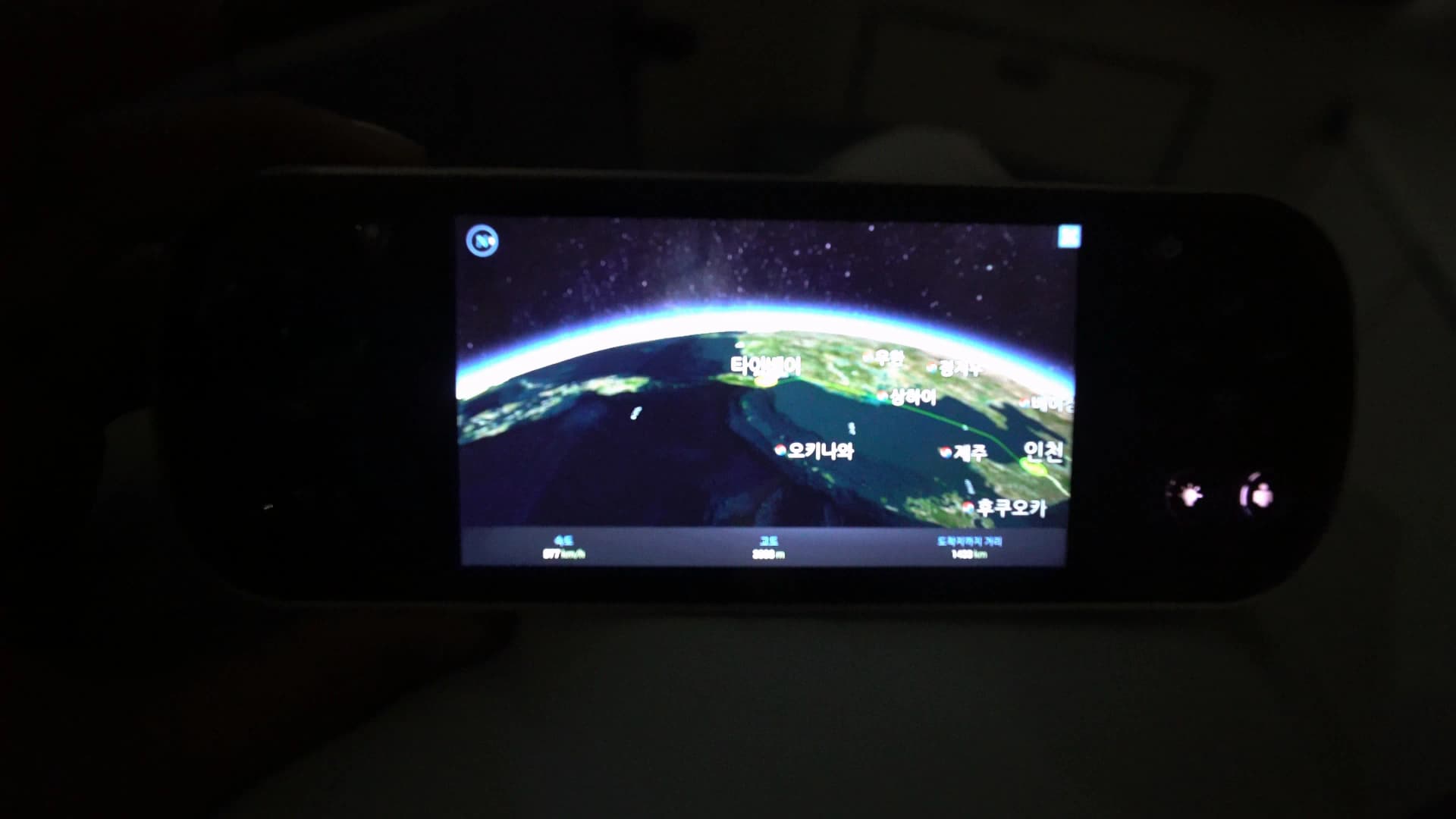
The route took us past Okinawa and towards Jeju, all tracked in real time. Watching the map, I found myself thinking about the flight I'd taken three years earlier when I left South Korea — economy, back row. Now here I was, retracing the same route in reverse from the upper deck of a 747-8i. Life's funny like that sometimes.
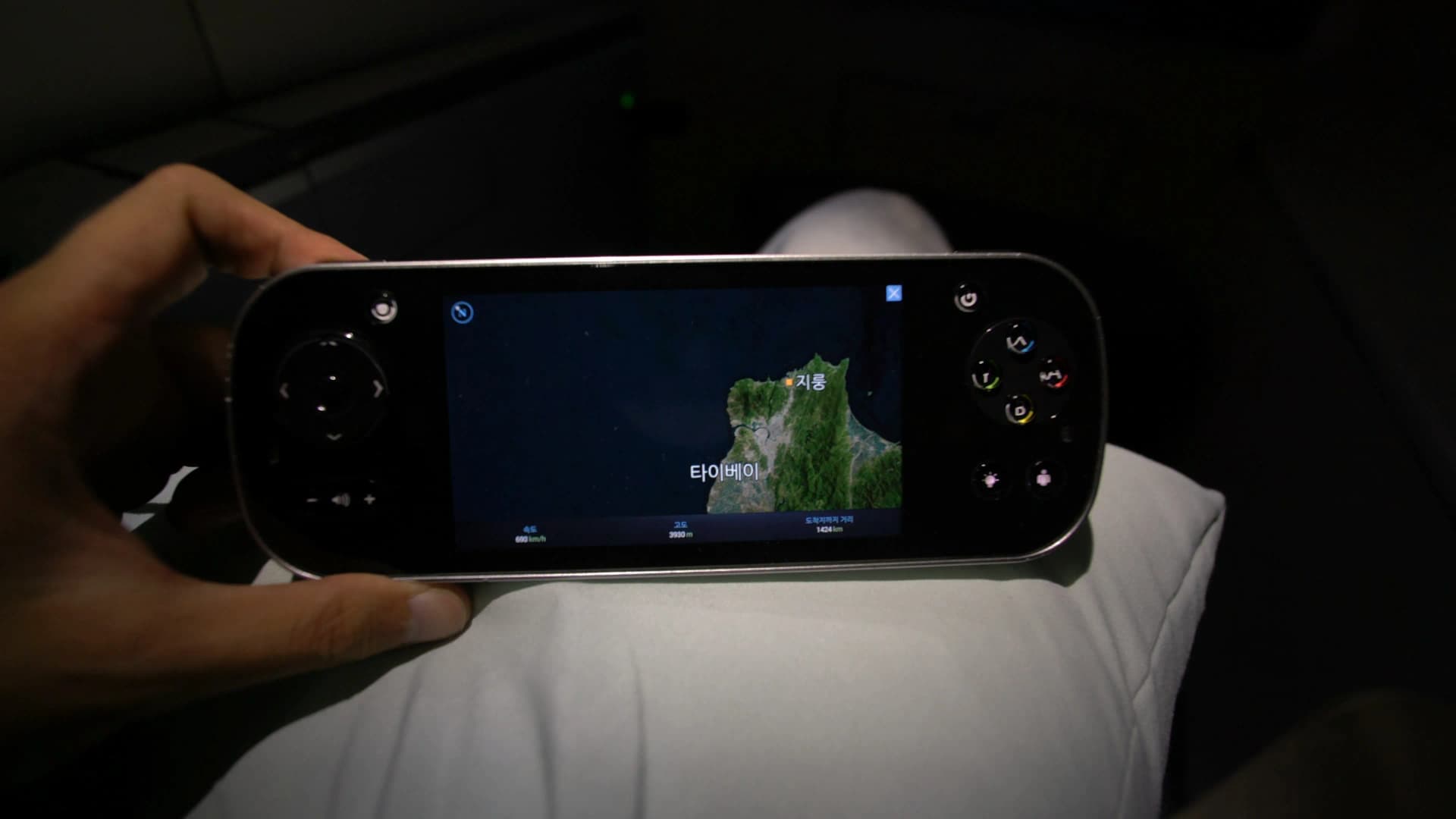
The full route from Taipei to Incheon, complete with speed, altitude, and remaining distance. If you're the sort of person who finds flight data oddly satisfying, this kind of detail is a treat.
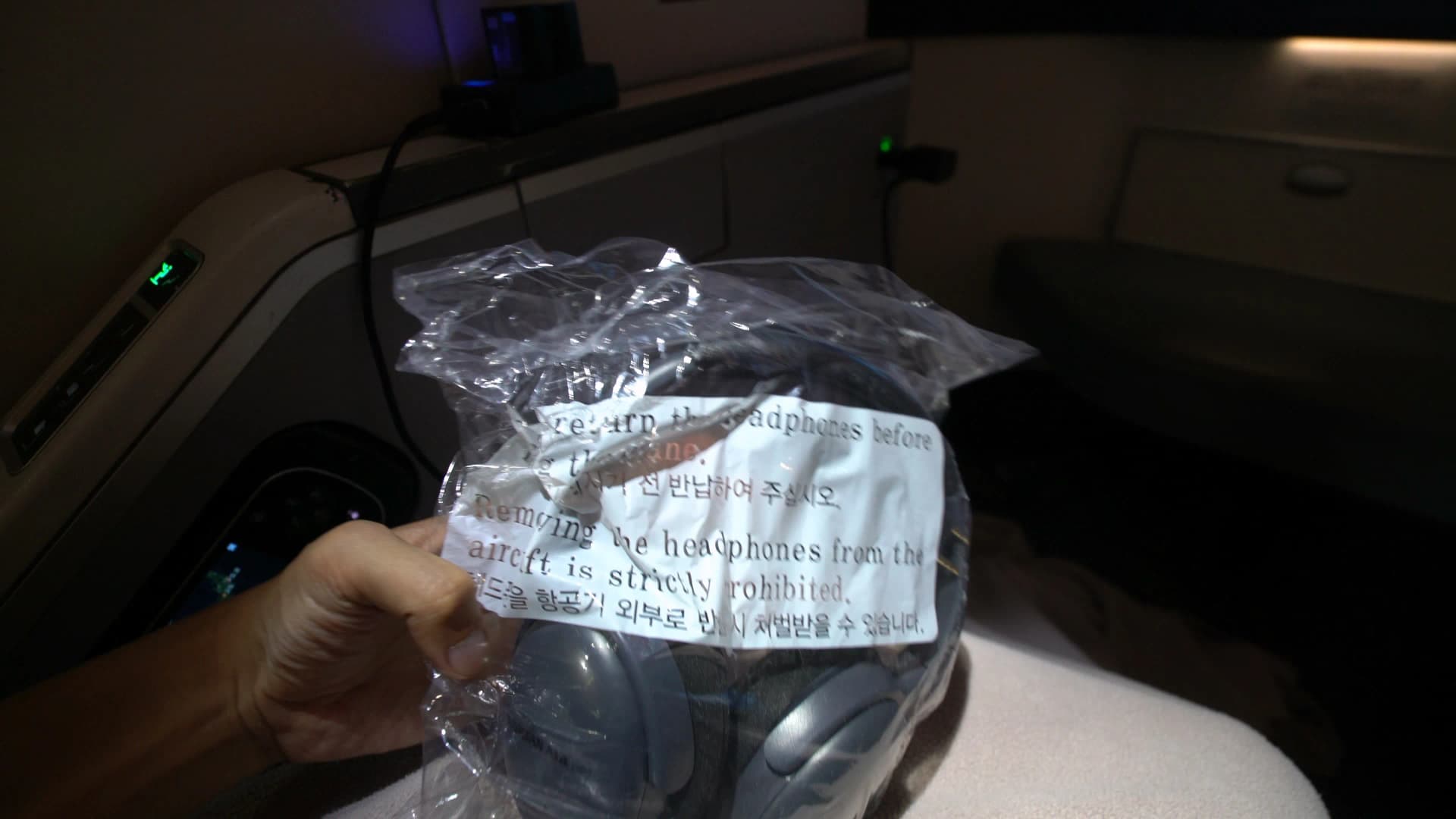
A sealed headset was waiting on the seat, but the flight was so short I never even opened it. I'm the kind of person who finds the Air Show map more entertaining than any film anyway, so it wasn't much of a loss.
The Personal Reading Light in a Darkened Cabin

This was an unexpectedly pleasant detail. It was a night flight, so the cabin lights were all switched off. I turned on the personal reading light above my seat, and it cast a soft, focused glow over just my space without spilling into the neighbouring seat at all. With everything else dark around you and just this single pool of light, it felt genuinely cosy. Whether that's a Prestige Class feature or a 747-8i design touch I'm not sure, but it was noticeably better than any economy reading light I've used.
The 180° Lie-Flat Seat — The Heart of Korean Air's Prestige Class
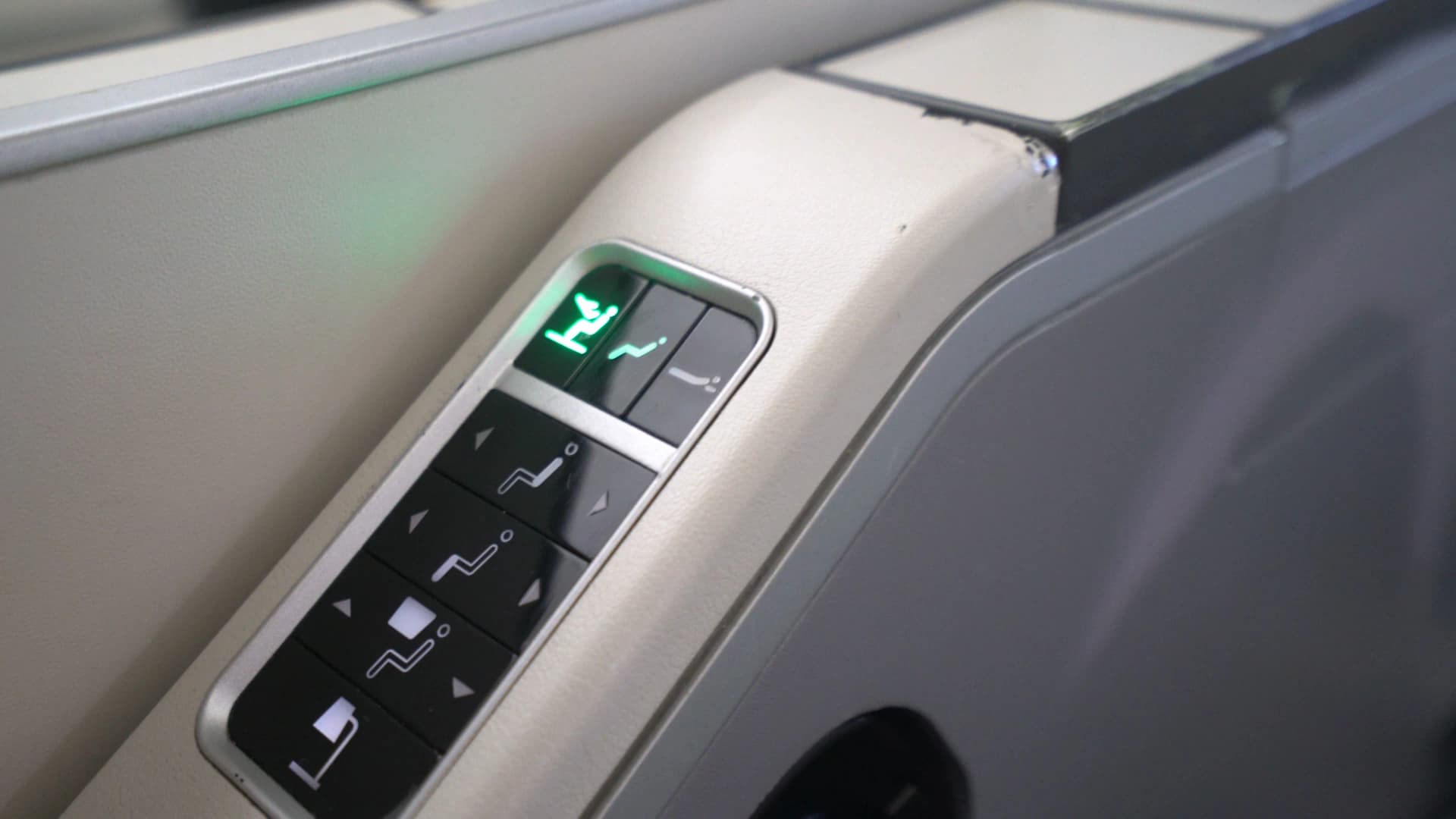
The lie-flat seat is the centrepiece of any business class product, and Korean Air's 747-8i Prestige Class delivers a full 180° flat bed. The control panel beside the seat lets you adjust the backrest angle, leg rest, and overall recline with precision. Some business class seats on other airlines only go to an "angled flat" position — not quite horizontal — but this one goes completely level.
The bed measures roughly 72 inches (183 cm) when fully extended, which means most adult men can lie flat with legs outstretched. When I pressed the button, there was a gentle whirring sound as the motor lowered the backrest — it took about 10 seconds to reach fully flat. Once horizontal, the cushioning was surprisingly decent. Not firm, not too soft. The flight was only around two and a half hours, so I never got a proper sleep, but on a long-haul route this would absolutely be a bed you could get a full night's rest on.
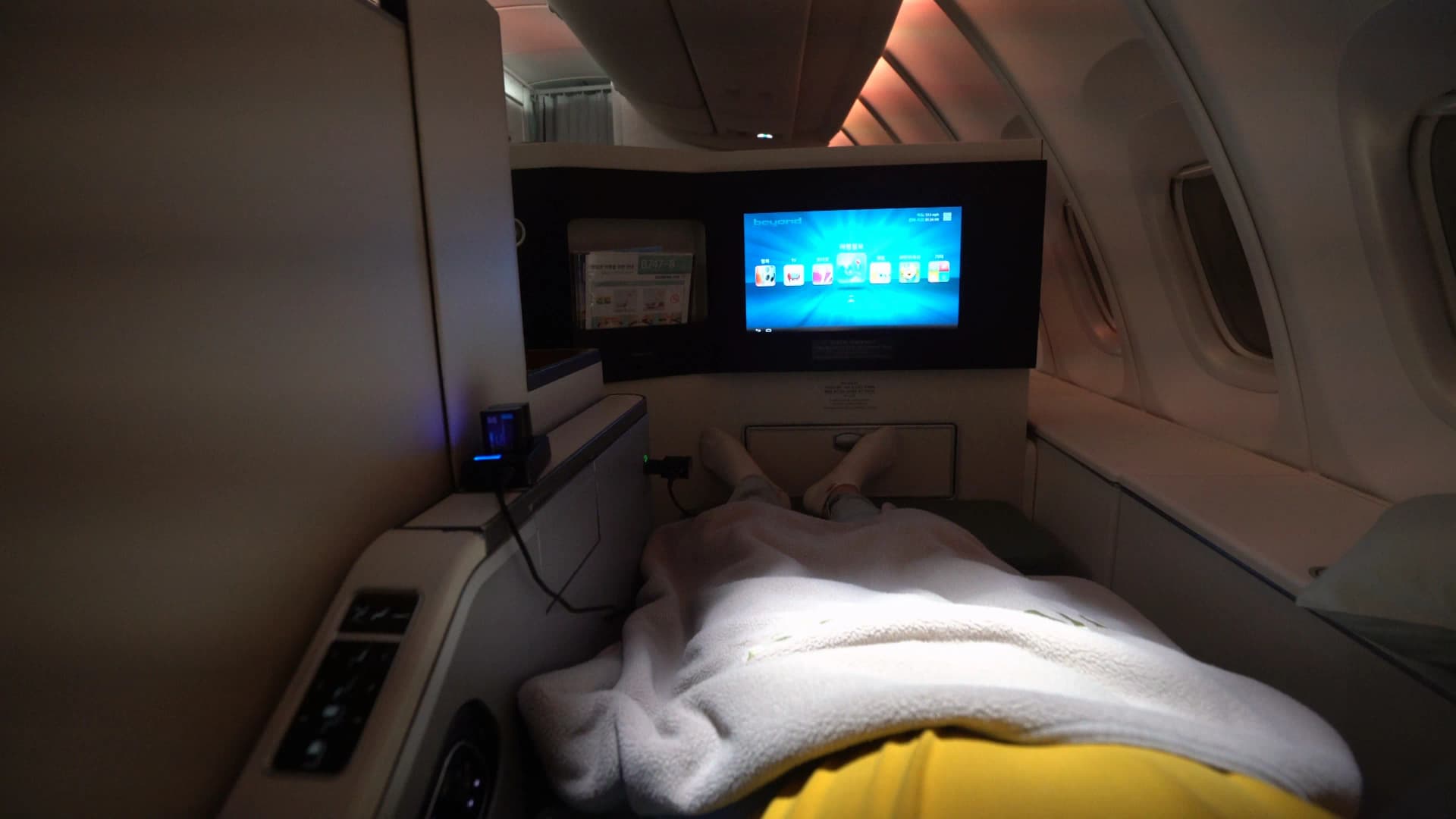
Here it is fully reclined. Blanket on, monitor playing — for a moment you forget you're on an aircraft at all.
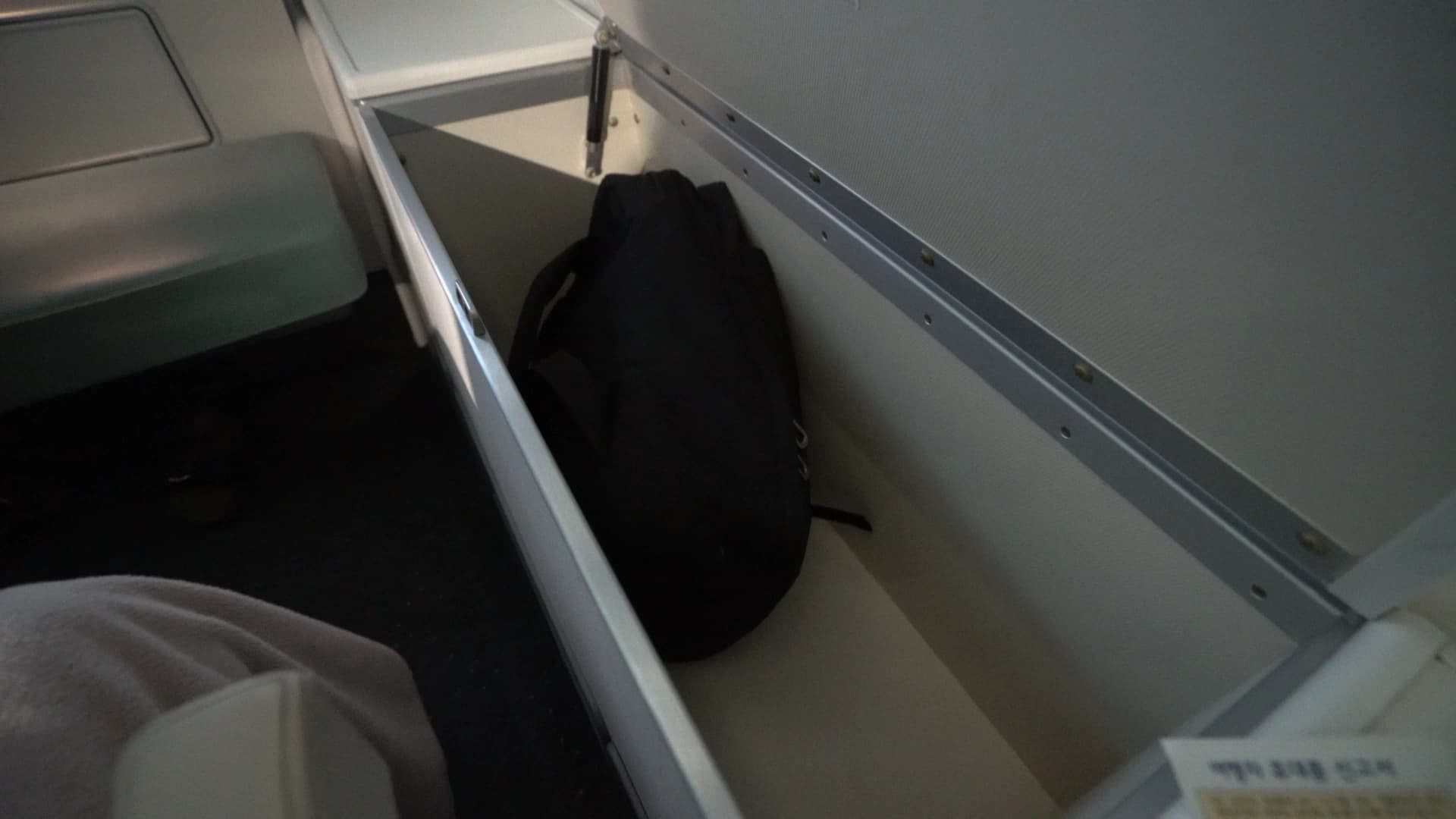
Beneath the window seat is a personal storage shelf, courtesy of the 747's curved upper deck wall. It's big enough for a rucksack and means you can keep essentials within arm's reach without fiddling with the overhead bin. One of those small conveniences that makes a real difference during a flight.
Korean Air Prestige Class In-Flight Meal — The Signature Bibimbap
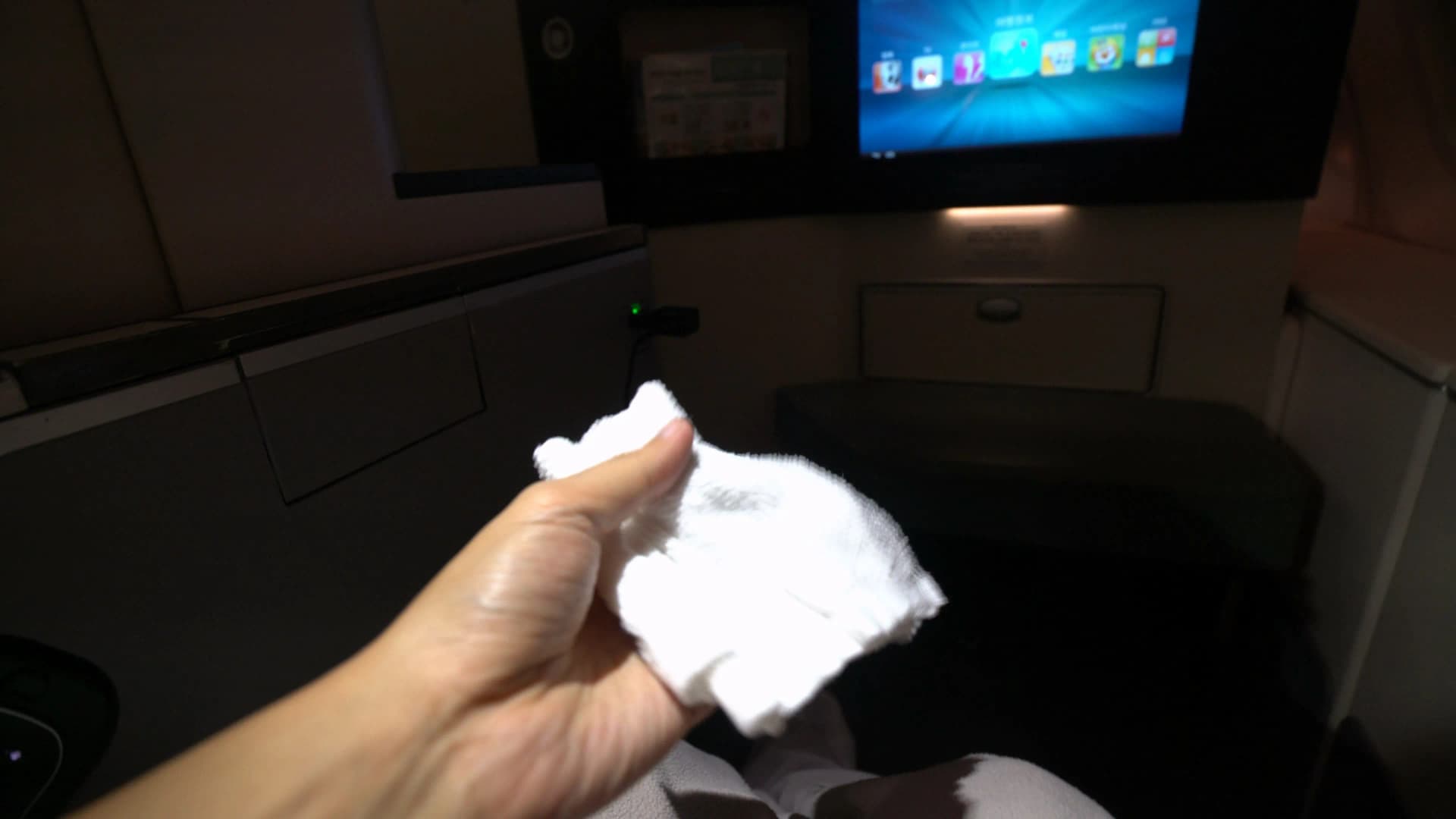
Korean Air's Prestige Class bibimbap is arguably the airline's most famous in-flight dish, served with individually portioned vegetables, gochujang chilli paste, and a clear dried pollack soup. Even on this short-haul route, a warm meal was served — something not guaranteed on flights under three hours.
As soon as the seatbelt sign switched off after take-off, the crew began drink service. Rather than simply asking "what would you like?", they brought a proper menu to choose from — a touch I appreciated given this was only a short hop. I asked for orange juice, which arrived in a glass on a napkin, every movement precise and unhurried. The meal service followed immediately, starting with a warm towel.
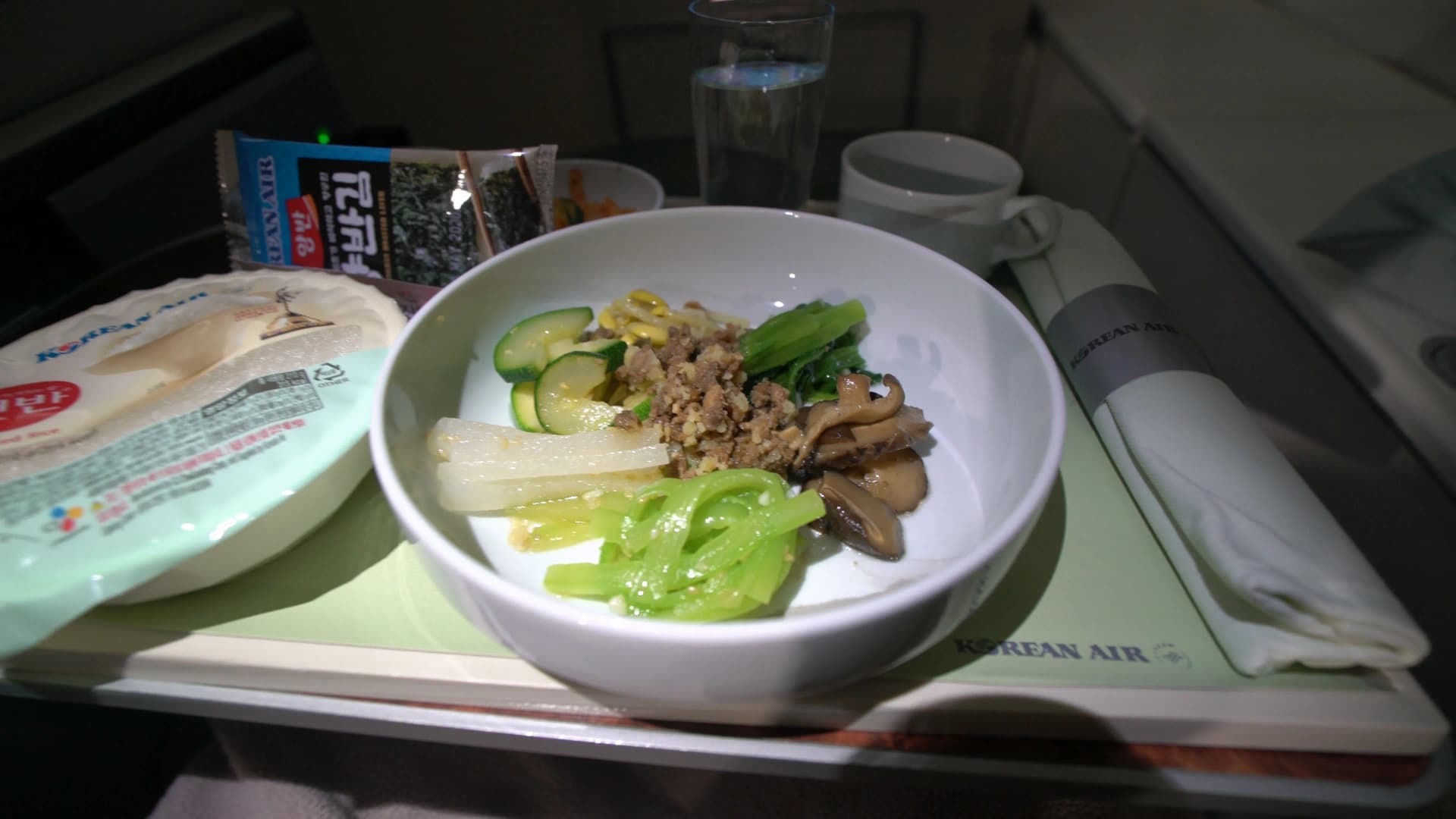
Being a short-haul route, the meal was simpler than the multi-course starter-main-dessert affair you'd get on long-haul Prestige. I chose the signature bibimbap — Korean Air's most iconic in-flight offering.
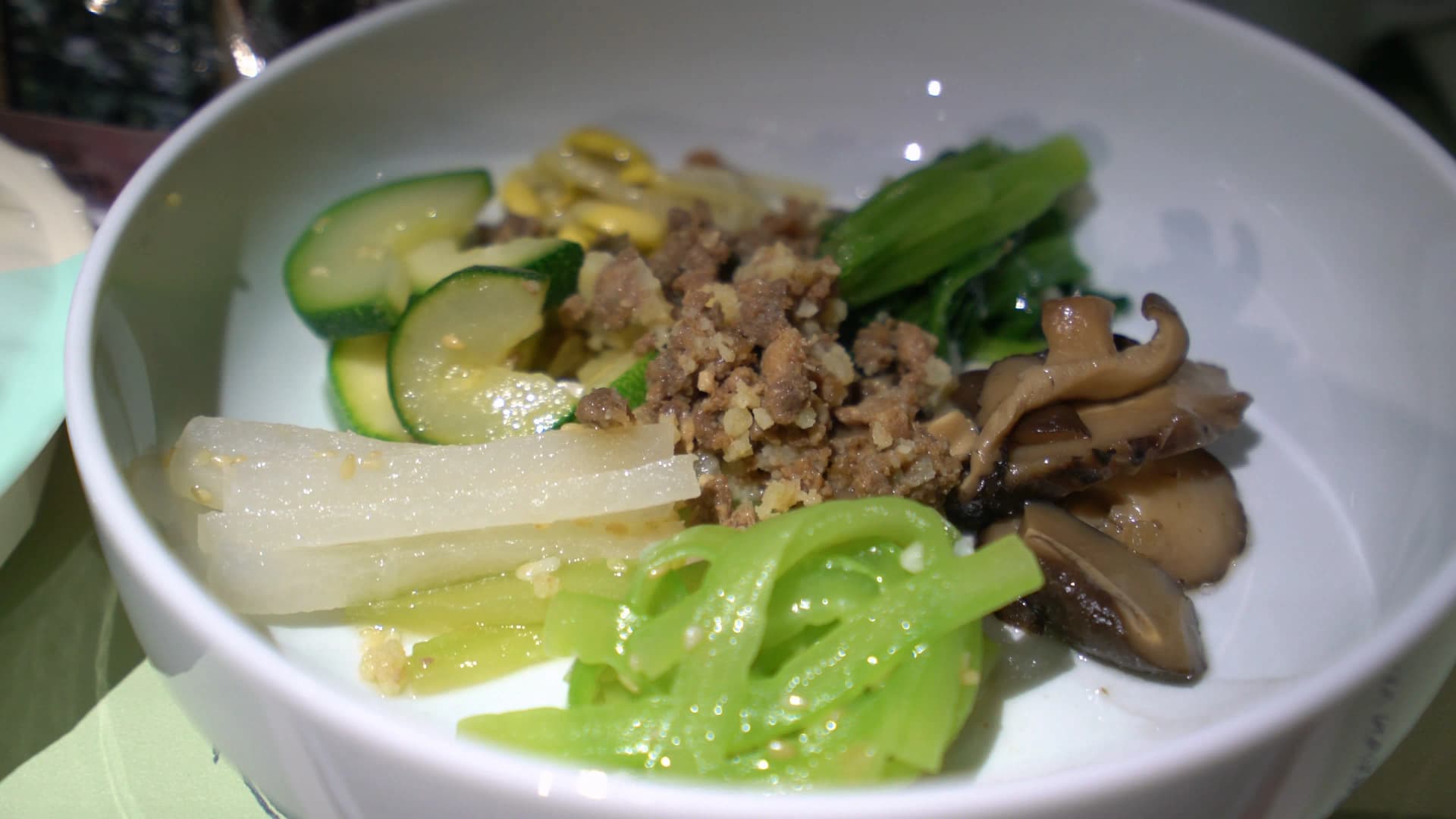
The bibimbap vegetables arrived in individual containers: courgette, bean sprouts, spinach, mushroom, balloon flower root (doraji), bracken fern (gosari), and beef. You mix it all together with gochujang, Korea's fermented chilli paste. The attendant asked "do you like a lot of gochujang?" as she set it up — a small detail that turned what could feel like mass catering into something closer to an actual meal. The vegetables were in surprisingly good condition for airline food. Though in fairness, compared to the China Airlines business class meal I'd had on the previous four-hour leg, the overall spread was more modest. But comparing a two-hour short-haul service to a four-hour mid-haul one isn't really fair.

The rice came as Korean Air's own branded instant rice. I was slightly sceptical at first, but the grain quality was consistent and pleasantly sticky — arguably better than rice cooked on board. Apparently they use the same method on long-haul bibimbap services too.
Side Dishes and Dried Pollack Soup Alongside the Bibimbap
The side dishes included gim (Korean roasted seaweed), pickled onion, and spicy radish salad (musaengchae). Crumbling the seaweed into the bibimbap adds a lovely nutty flavour, the pickled onion cuts through with a sharp tang, and the radish salad brings crunch and a gentle kick. International passengers are apparently quite fond of the seaweed in particular.
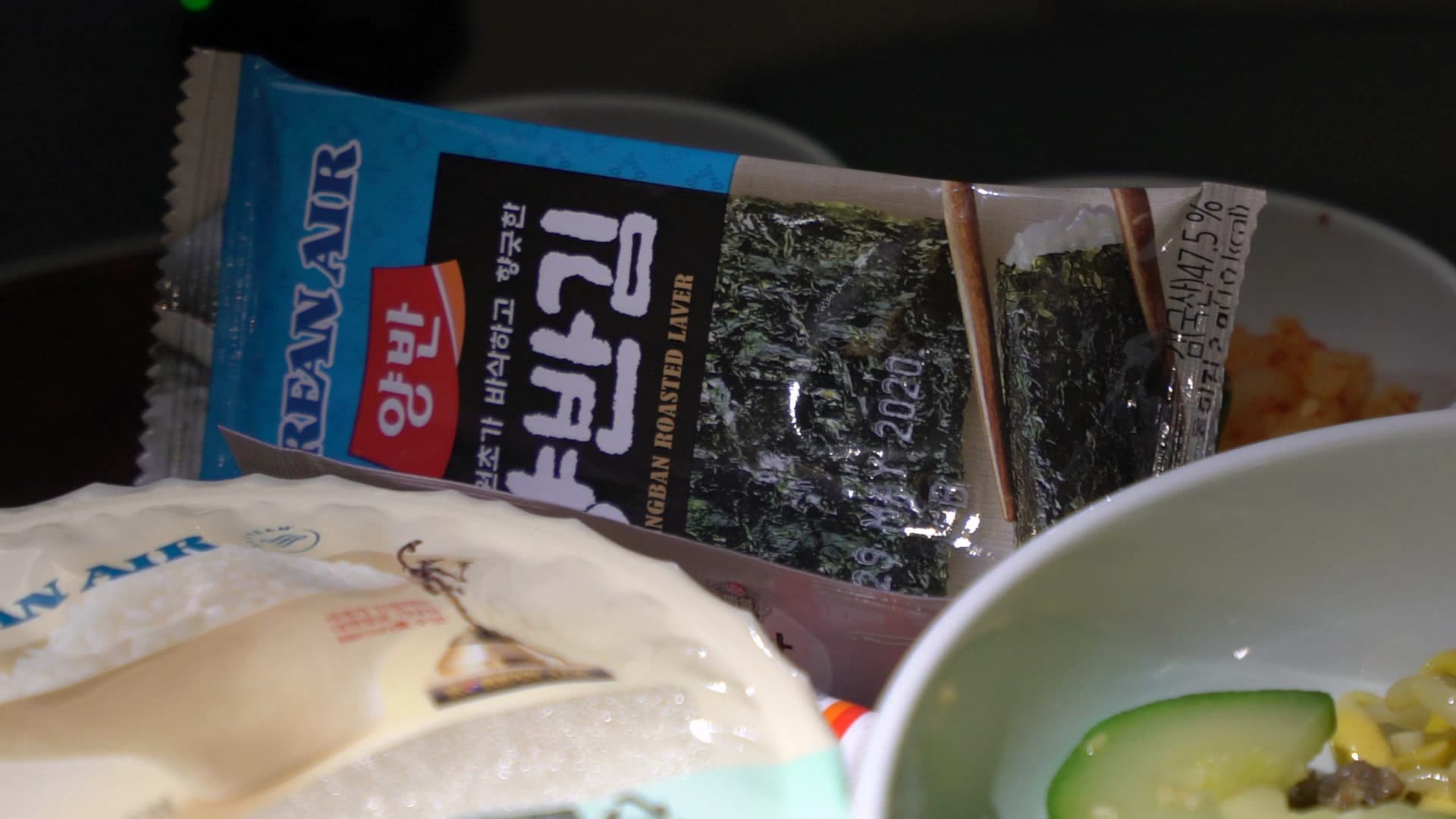
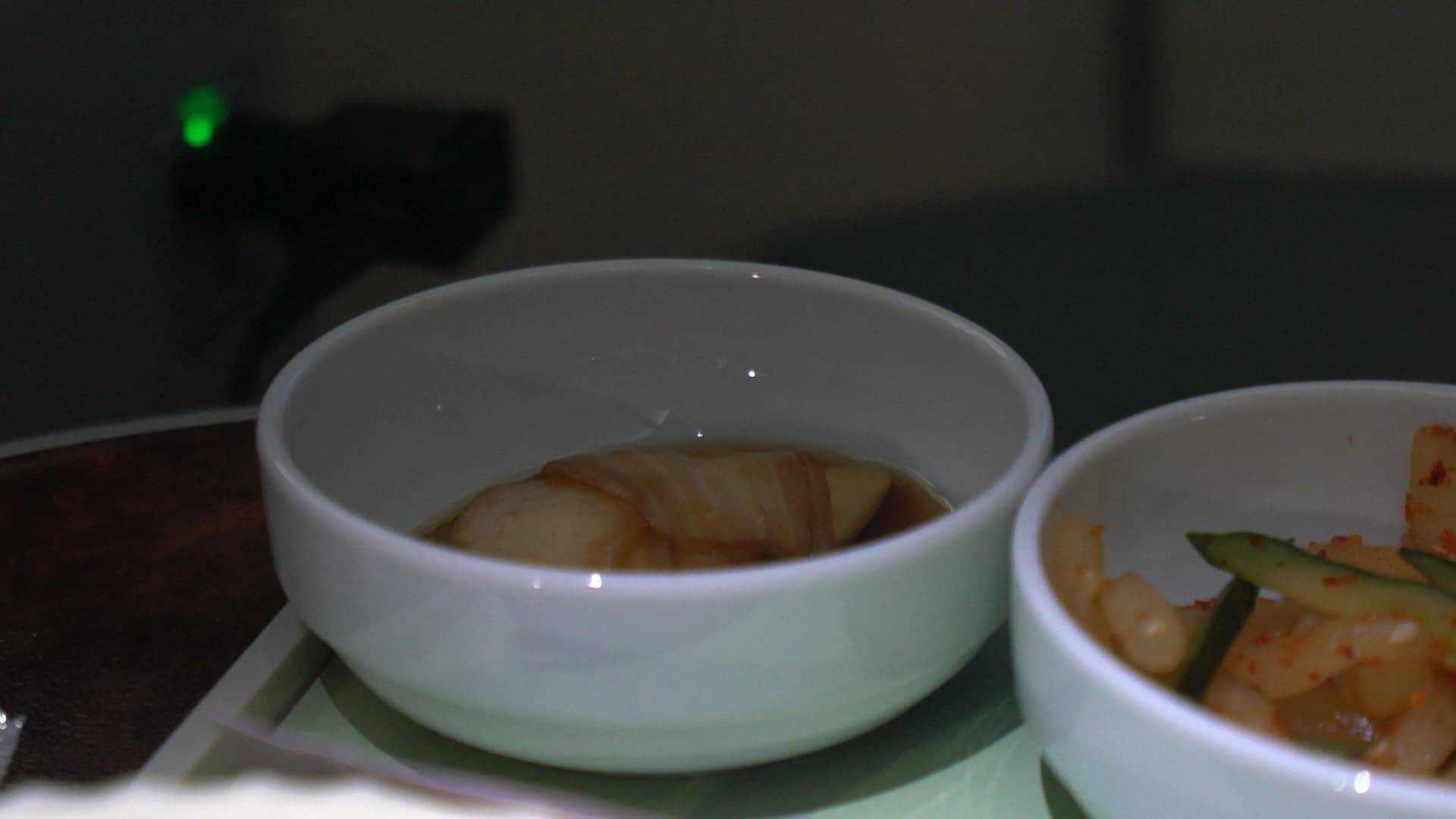
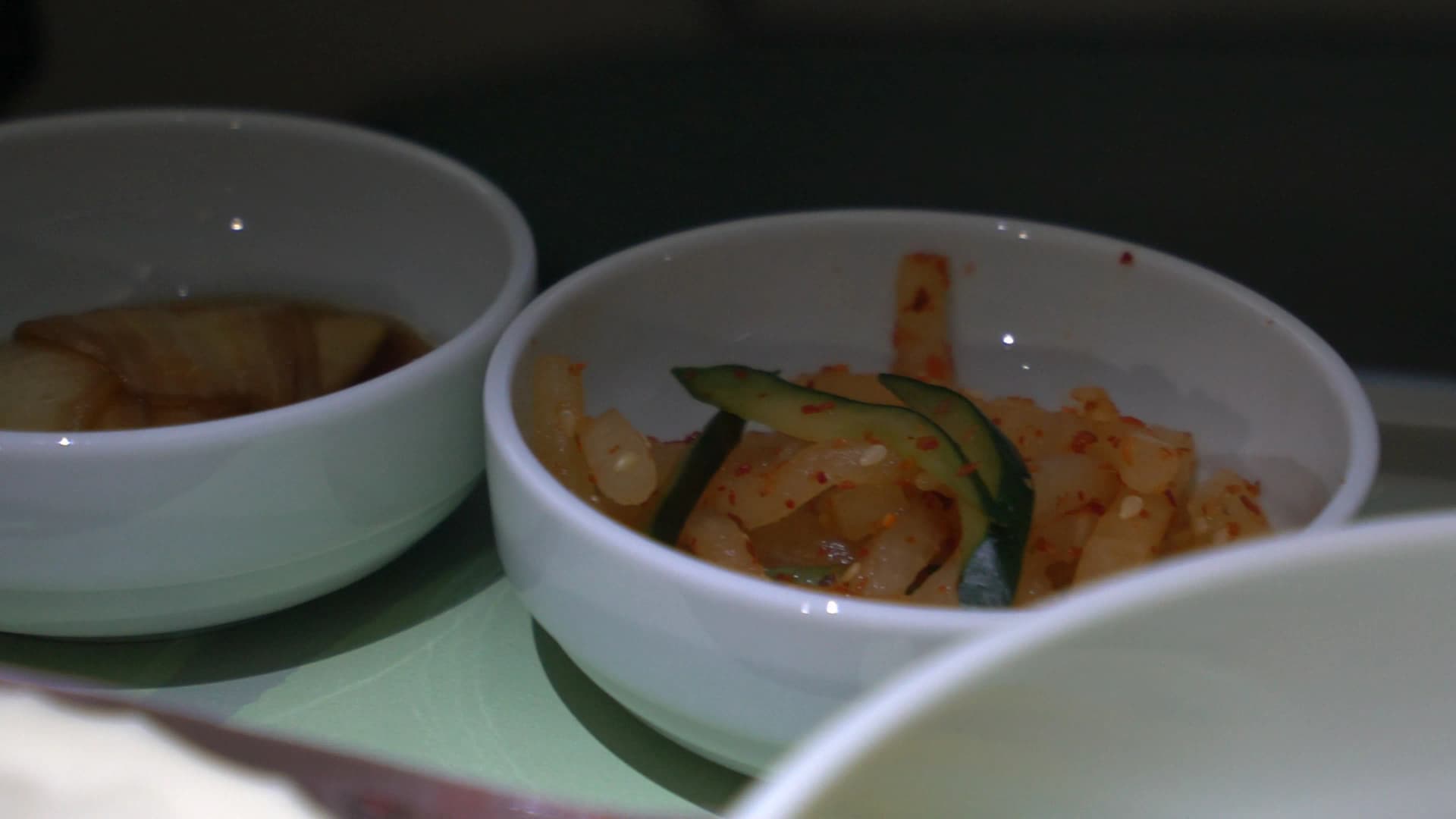
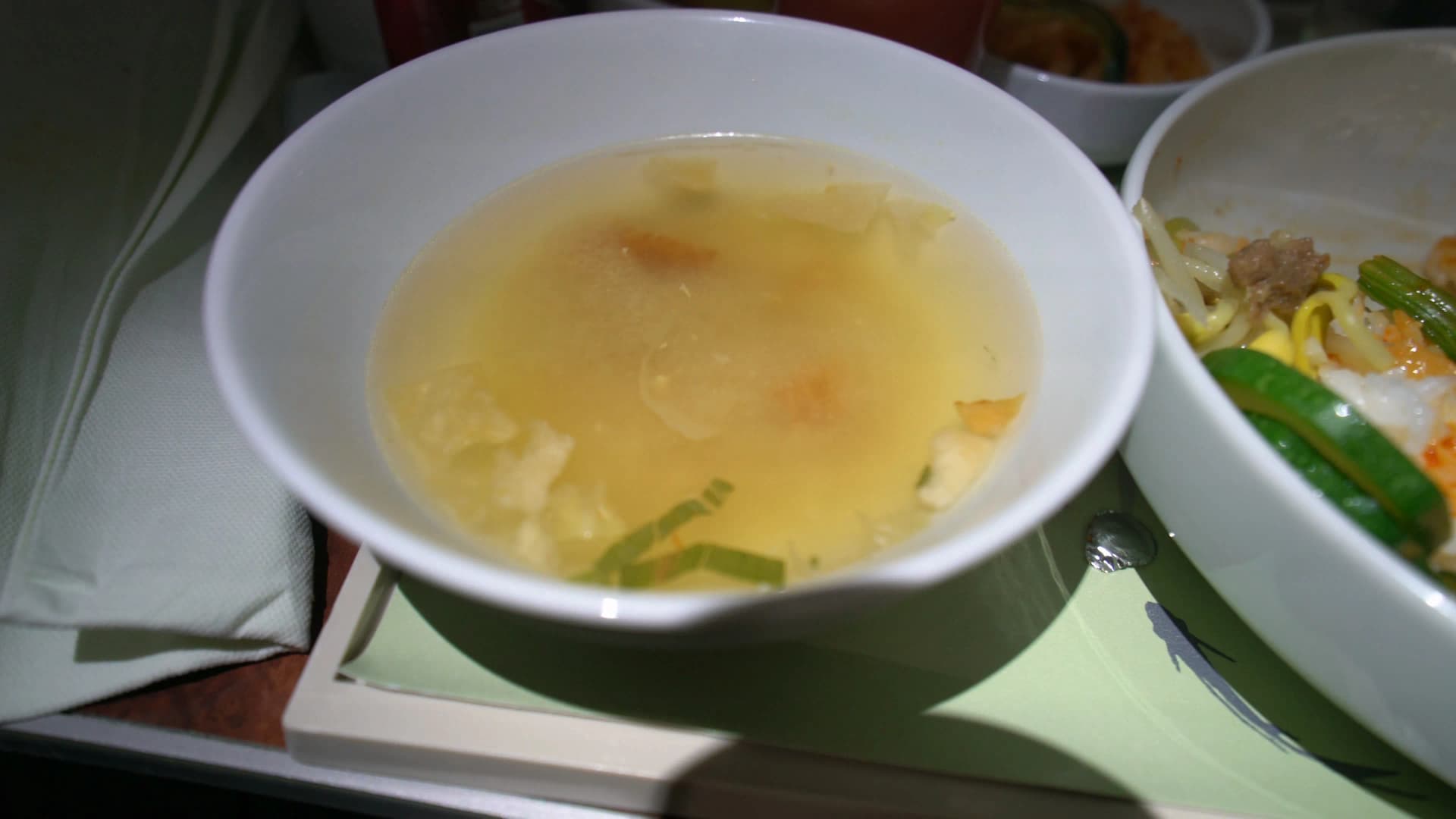
The soup was hwangtaeguk — a clear, light dried pollack broth that paired nicely with the bibimbap. Overall it was a modest but satisfying meal, and for a short-haul flight, having a hot meal served at all felt like a bonus. On ultra-short routes like Fukuoka, even Prestige Class only gets a cold meal.
Arriving at Incheon — Setting Foot in South Korea After Three Years
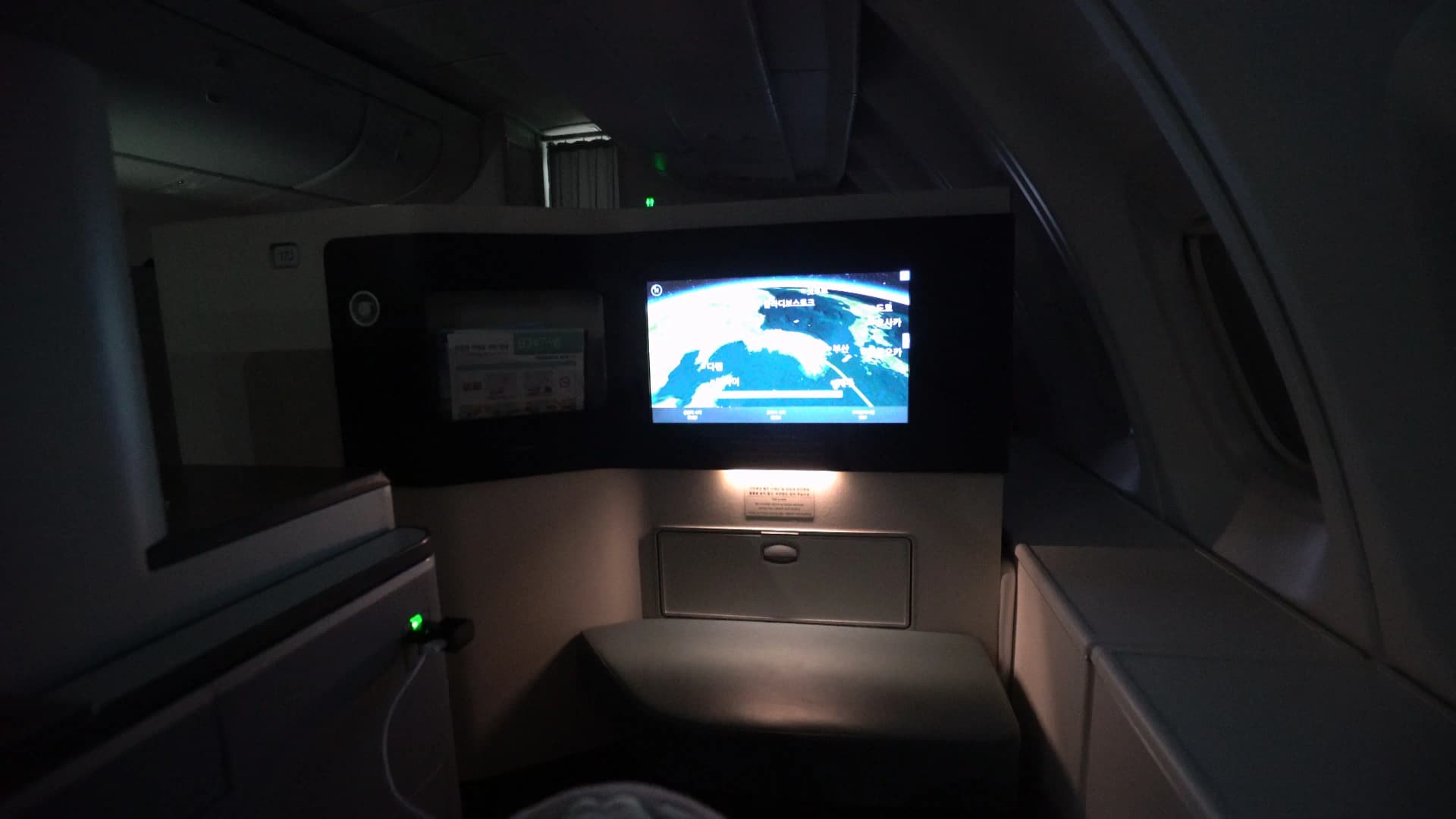
After the bibimbap I started to feel drowsy. The cabin lights were already off. I reclined the seat flat, closed my eyes, and what felt like mere minutes later we were already passing over Jeju. I was gutted. I could've happily spent another ten hours in that seat, but reality was a two-and-a-half-hour short hop.
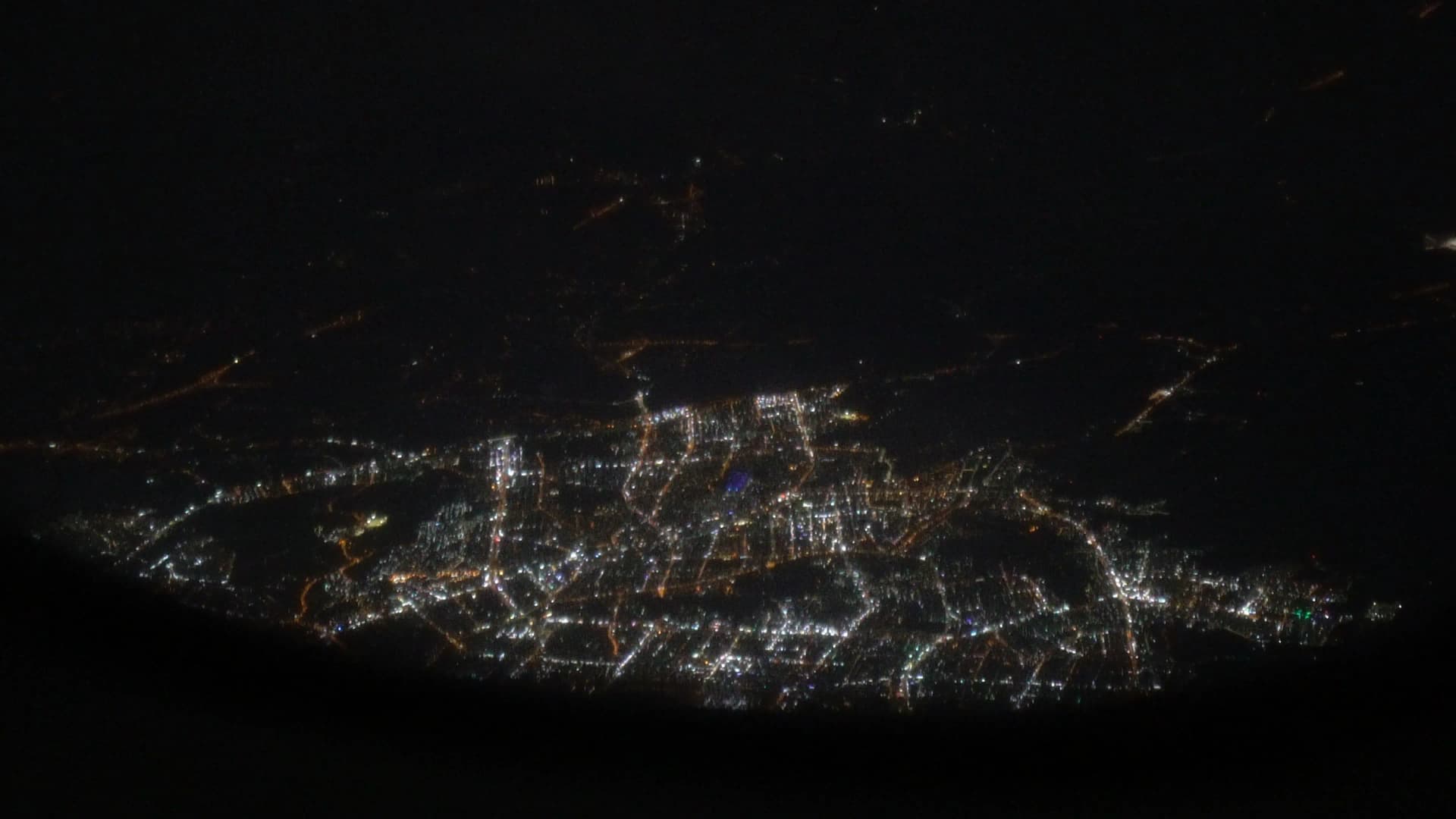
City lights began appearing through the window. After three years in Thailand, seeing those lights again was unexpectedly moving.
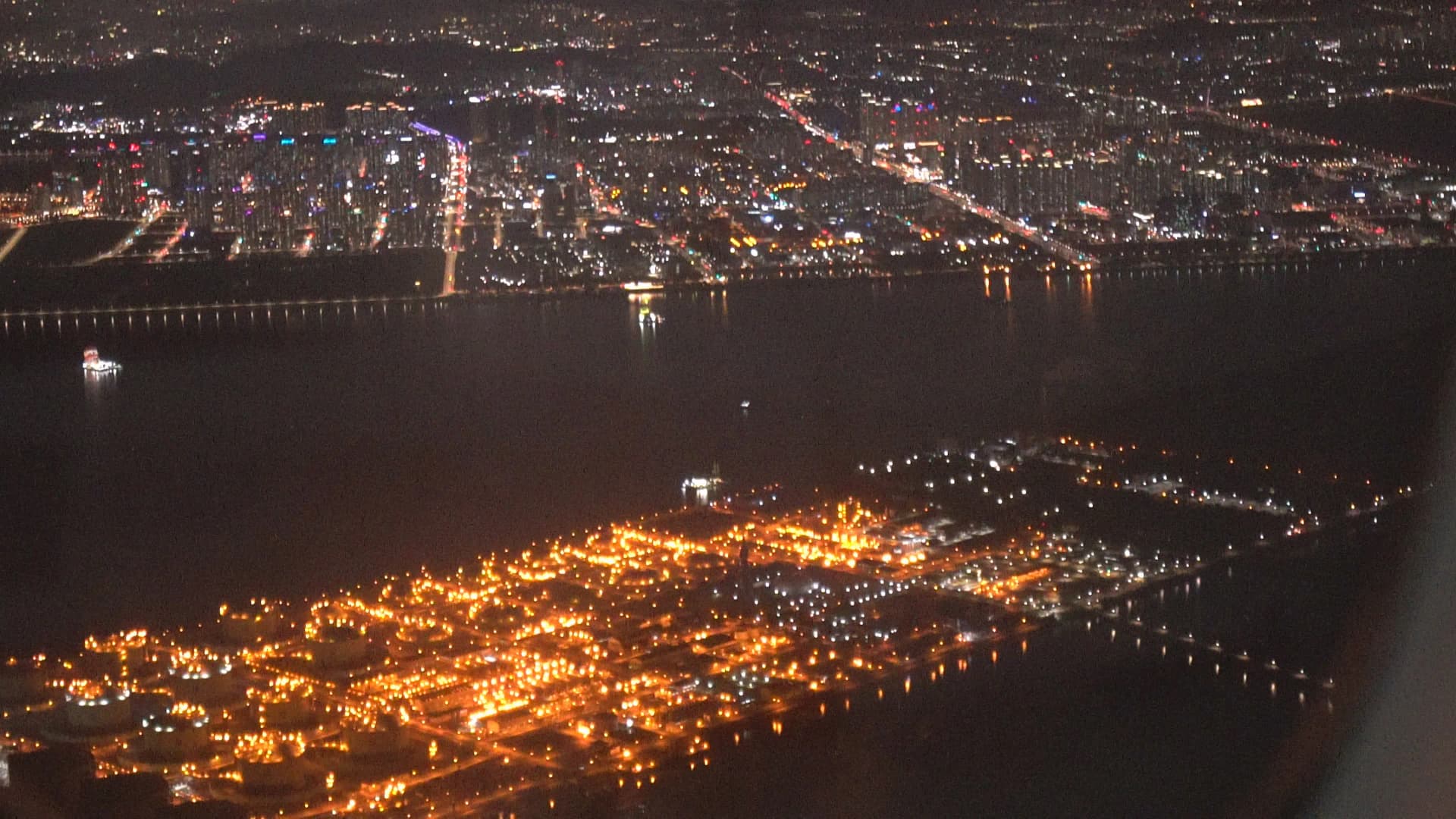
This is the view you always get when approaching Incheon Airport from the south — orange-tinged lights spreading across the water, with the city skyline beyond. I've seen it dozens of times and it never gets old. This was the moment it properly sank in: I was back in Korea.
We landed safely at Incheon Airport.
Flight Information Summary
Date of travel: November 2019
Route: Taipei Taoyuan (TPE) → Incheon (ICN)
Airline: Korean Air — rebooked due to China Airlines delay
Aircraft: Boeing 747-8 Intercontinental (747-8i)
Class: Prestige Class (Business Class)
Seat location: Upper deck window
Flight time: Approx. 2 hours 30 minutes
Time of day: Night
In-flight meal: Bibimbap + dried pollack soup (hwangtaeguk)
Looking Back Six Years Later
I'm writing this in 2026. It's been over six years since that flight, and the reason I'm finally putting this review together is because the Korean Air 747-8i is about to disappear from the skies for good.
At the time, I simply thought I'd been lucky with a decent seat assignment. But as the years passed, I came to realise just how extraordinary that flight actually was. A lie-flat business class seat on the upper deck of one of only 48 aircraft ever built — handed to me as a rebooking from a delay.
I think about the crew service too. Both the China Airlines attendants and the Korean Air cabin crew that day weren't just polite — they were genuinely attentive, the kind of service where you feel like an actual person rather than a boarding pass number. It's the sort of thing that explains why Korean carriers consistently score so highly internationally. Korean Air has since maintained its Skytrax 5-Star Airline rating for five consecutive years, and in 2026 picked up the APEX award for Best Cabin Service. What I experienced as a random rebooking passenger in 2019 wasn't a one-off — it's simply how this airline operates.
The spacious 2-2 layout on the upper deck, four windows to yourself at a window seat, 75 inches of seat pitch, and a 180° lie-flat bed. It was only a two-hour-odd flight, but every minute felt too short.
If I had to pick faults, there are two. The flight was far too brief, and the short-haul catering was inevitably simpler than what you'd get on a long-haul service. Had I flown this seat to the US or Europe, I'd have had a full multi-course dinner and eight hours of sleep. That'll have to wait for another time.
Korean Air's 747-8i Retirement, and Its Rebirth as America's Doomsday Plane
Korean Air began formally retiring its 747-8i fleet from 2025 onwards, and five of these aircraft have been sold to the US defence contractor Sierra Nevada Corporation for conversion into the next-generation "Doomsday Plane" — a nuclear-survivable airborne command centre designed to replace the ageing E-4B Nightwatch fleet.
And that next opportunity is shrinking fast. In May 2024, Korean Air sold five of its 747-8i aircraft to Sierra Nevada Corporation for approximately £530 million. According to CNN and other outlets, these five jets are being converted into the successor to the US Air Force's E-4B "Nightwatch" — the next-generation Survivable Airborne Operations Center, colloquially known as the "Doomsday Plane." In the event of a nuclear conflict or national emergency, these aircraft would serve as an airborne Pentagon. So the very planes where ordinary passengers once ate bibimbap and watched films are being reborn as America's last-resort command aircraft. There's every chance the exact airframe I flew on is among those five. That's a strange thought to sit with.
From December 2024, routes like Incheon–Atlanta began switching from the 747-8i to the Boeing 777-300ER, and the remaining fleet continues to shrink. One aircraft remains on long-term lease as South Korea's presidential jet (Code One).
Korean Air Boeing 747-8i Retirement Timeline
2012: Korean Air begins 747-8i operations (10 aircraft total)
2021: Chairman Cho Won-tae tells FlightGlobal: plans to retire the 747-8i within 10 years
January 2022: 1 aircraft leased to the South Korean government as presidential jet (Code One)
May 2024: 5 aircraft sold to Sierra Nevada Corporation for approx. £530 million — to be converted into USAF "Doomsday Plane" replacements
December 2024: Incheon–Atlanta (ATL) and other long-haul routes begin switching to 777-300ER
March 2025: Further route substitutions begin
April 2026: Approx. 5 remain in Korean Air passenger service, plus 1 presidential aircraft
Sources: FlightGlobal, Gate Checked, Simple Flying, CNN, YTN, News Tomato
The age of the Queen of the Skies is drawing to a close. Only three airlines worldwide — Lufthansa, Air China, and Korean Air — still operate the 747-8i for passengers, and Korean Air's fleet is dwindling by the month. There's a real chance this review will eventually serve as a record of a flight that can no longer be taken.
If there are still Korean Air 747-8i routes operating when you read this, I'd urge you to book one while you can. The upper deck window seat, in particular, offers an experience no other aircraft can replicate. Once the Boeing 747 disappears from passenger service entirely, the only double-decker wide-body left will be the Airbus A380 — and that's being retired too. Four windows to yourself on the upper deck of a 747, lie-flat seat, watching the world slide by below. The window to experience that is closing fast. Honestly, I'd pay my own money to do it again — I'm just not sure the aircraft will still be around by the time I get the chance.
This post was originally published on https://hi-jsb.blog.