
Stunning Island Garden You Never Knew Existed in Korea
Table of Contents
7 items
Oedo Botania & Haegeumgang — A Cruise to Korea's Secret Island Garden
Oedo Botania — my wife and I went there ourselves, just the two of us.
When you're buried in work all the time, there are moments when you just genuinely need a break, you know? Same here. So we make it a point to travel regularly together, but the problem is we've already been to so many places. "Let's go somewhere new this time." And that's how we pulled out the Geoje Island card.
If you look at foreign travelers coming to Korea, the itineraries are always so predictable. Seoul means Myeongdong, Gyeongbokgung, Hongdae. Busan means Haeundae, Gamcheon Culture Village. Jeju means Seongsan Ilchulbong, Hyeopjae Beach. Recently, more people have caught on to Gyeongju and Jeonju Hanok Village too.
Don't get me wrong — they're all great places. They're popular for a reason.
But the thing is, Korea has so many incredible spots that most foreign visitors have never even heard of. Places that Koreans flock to, but that you'd rarely see on travel blogs or YouTube. Most travel content just ends up being the same destinations, the same routes, over and over again.
So today I want to introduce you to somewhere a little different. An island floating in the middle of the sea off the southern coast of Geoje Island — Oedo Botania. And Haegeumgang, often called "the Geumgangsan of the sea" (basically, ocean cliffs so beautiful they rival Korea's most legendary mountain). A place where you won't get crushed by tourist crowds, where you can actually feel the raw beauty of Korea's nature.
We drove ourselves and boarded a cruise boat from Wahyeon Port. We did the full course — Haegeumgang scenic cruise first, then landing on Oedo Botania. I've got the full breakdown for you: a comparison of all 5 departure ports, costs, the best seasons to visit, and on-the-ground tips you can only learn by actually going.
Let's go.
OEDO BOTANIA
What is Oedo Botania?
It's an island floating right in the middle of the sea — and the entire island is a garden. The second you step off the cruise boat, you'll catch yourself saying "Wait, this is still Korea?"
It looks like someone picked up a chunk of the Mediterranean and dropped it here. Palm trees, cacti, exotic tropical flowers you can't name — with white sculptures standing among them, and behind it all, the deep blue southern sea stretching out endlessly.
One couple spent over 50 years cultivating this private garden. When you climb to the observation deck at the top of the island, the line between sea and sky disappears — and on a really clear day, they say you can even see Japan's Tsushima Island in the distance.
HAEGEUMGANG
What is Haegeumgang?
The name literally means "Geumgangsan of the Sea" — and trust me, it lives up to the hype.
Tens of thousands of years of waves and wind have carved out towering rock cliffs that jut dozens of meters above the ocean. The Cross Cave is especially wild — a rock formation with a cross-shaped hole carved right through the middle. When the cruise boat passes between those cliffs, your jaw just drops.
You don't even have to go separately. The cruise to Oedo Botania swings by Haegeumgang first for a scenic boat tour, then continues to the island — so you get both in one trip.
Everything You Need to Know Before Departing from Wahyeon Port
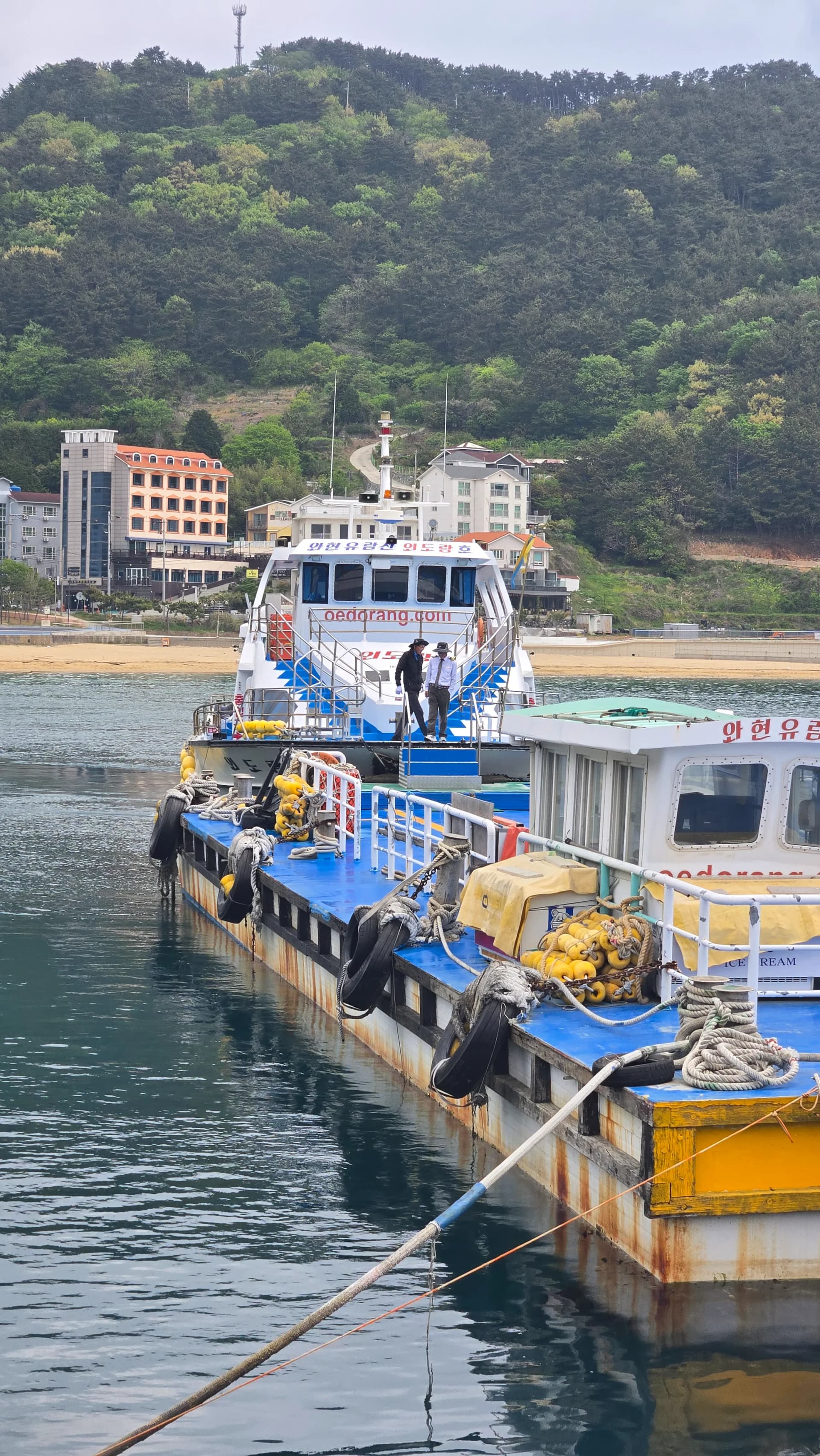
Today, we're setting sail from Wahyeon on Geoje Island. Wahyeon — remember that name. There are multiple ports where you can catch a cruise to Oedo Botania, and I picked Wahyeon. Actually, I came here on a travel agency package years ago and boarded from the same port. The memory was good, so I came back. You can see "oedorang.com" written on the side of the boat, right? That's the one taking us out to an island in the middle of the ocean.
By the way, we arrived about an hour before departure and the parking lot was practically empty. Wahyeon Beach is right in front of the port, so it was perfect for killing time watching the waves while we waited.
There are a total of 5 ports on Geoje Island where you can catch a cruise to Oedo and Haegeumgang. Each port has slightly different departure times, prices, and routes, so just pick the one that fits your situation best.
Jangseungpo Port
The biggest port of the bunch. It has a large parking lot and big cruise boats, so a lot of group tour travelers use it. Plenty of hotels and restaurants nearby, which makes it convenient — but that also means more crowds.
Jisepo Port
Popular for its route that includes a scenic cruise past the Haegeumgang Cross Cave. Reviews say the boats are big and clean, but the trade-off is that boarding wait times can be a bit long.
Wahyeon Port ← The one I took!
Word is that the cruise boats here are the same ones Oedo Botania's own staff use for their daily commute, so people say they feel stable and reliable. Wahyeon Beach is right out front, so you can take a stroll before or after your cruise. The parking lot is spacious, making it really convenient if you're driving.
Gujora Port
The closest port to Oedo — you'll arrive in about 10 minutes. The free parking lot is big, and there's a famous seafood noodle restaurant right next door, so you can eat and hop straight on the boat. If you're worried about seasickness, the short travel time makes this a great pick.
Dojangpo (Haegeumgang) Port
The closest port to popular Geoje Island attractions like Windy Hill and Sinseondae. After seeing Oedo and Haegeumgang, you can get off and walk right over to Windy Hill — perfect for planning a full day itinerary.
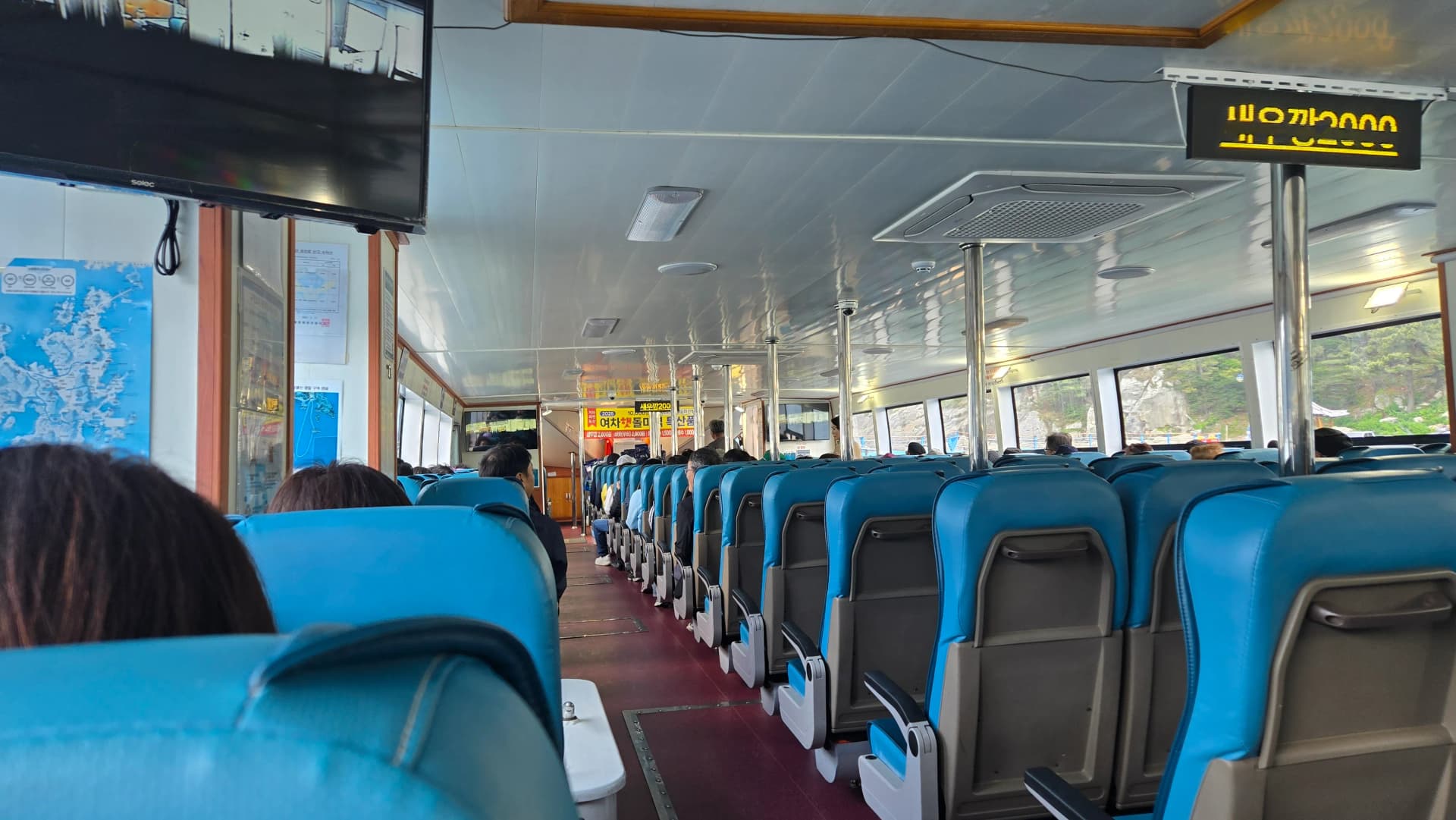
Here's what the inside of the Wahyeon cruise boat looks like. Blue seats line both sides, and it's surprisingly spacious and clean. The feel is similar to airplane seating, so you can sit comfortably for the ride. There are big windows on both sides so you can see the ocean even while seated, and there's a monitor on the ceiling that plays route info and sightseeing videos. It takes about 20–30 minutes to reach Oedo, but honestly, you'll be too busy watching the sea to notice.
Must-knows before boarding
Bring your ID. No exceptions. Adults need a national ID, driver's license, or passport. For children, a health insurance card or family registry screenshot will do.
The total cost = cruise fare + Oedo admission fee. Cruise fares vary by port, and the Oedo entrance fee (about $8 for adults) is paid separately at the ticket counter. You can sometimes get a discount by booking online in advance.
Arrive at least 30 minutes before departure. If you're late, they will leave without you. No refunds either.
No outside food or drinks allowed. You'll have to buy even water on the island. There are cafes inside, but brace yourself for tourist-spot pricing.
Motion sickness pills are available at the ticket counter for about $1. I personally don't get seasick so I was fine, but if you're sensitive, take one before boarding. Going up to the open deck and getting some fresh air helps a lot too.
Haegeumgang Scenic Cruise — The Sea Cliffs They Call "Ocean Geumgangsan"
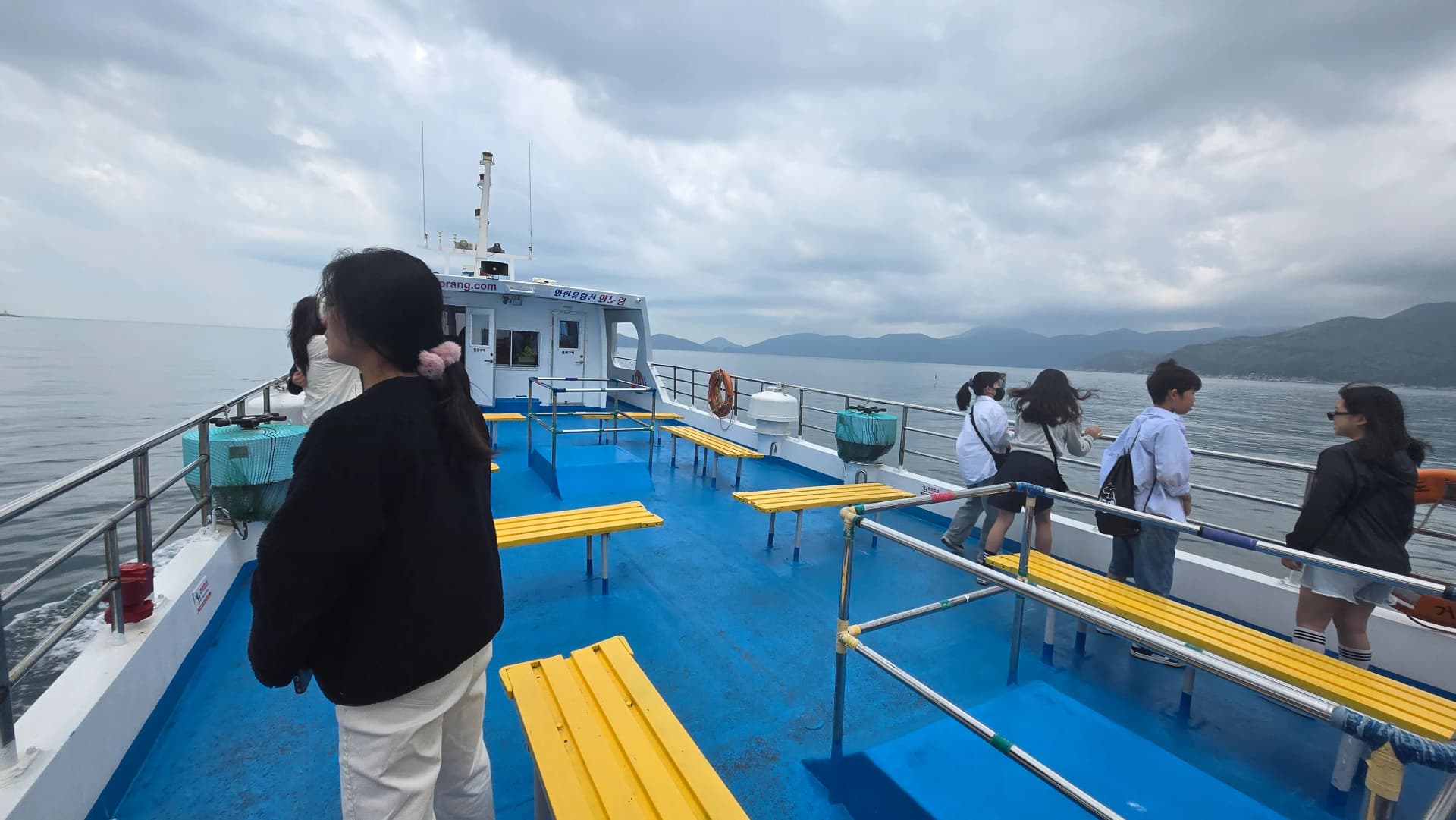
Once the boat departs, you can head up to the open deck like this. The cruise from Wahyeon first loops around Haegeumgang for a scenic boat tour, then heads to Oedo. Standing in the middle of the ocean with the wind hitting your face feels pretty amazing. Mountains and islands layer up in the distance, and seagulls trail the boat. Some passengers had bought shrimp crackers to toss to the seagulls — they sell bags on board for about $1.50.
The sea was pretty calm that day. Apparently, on rougher days, it can be hard to even stand on the deck. I've seen reviews saying you'd have to just stay inside and watch through the windows on days like that.
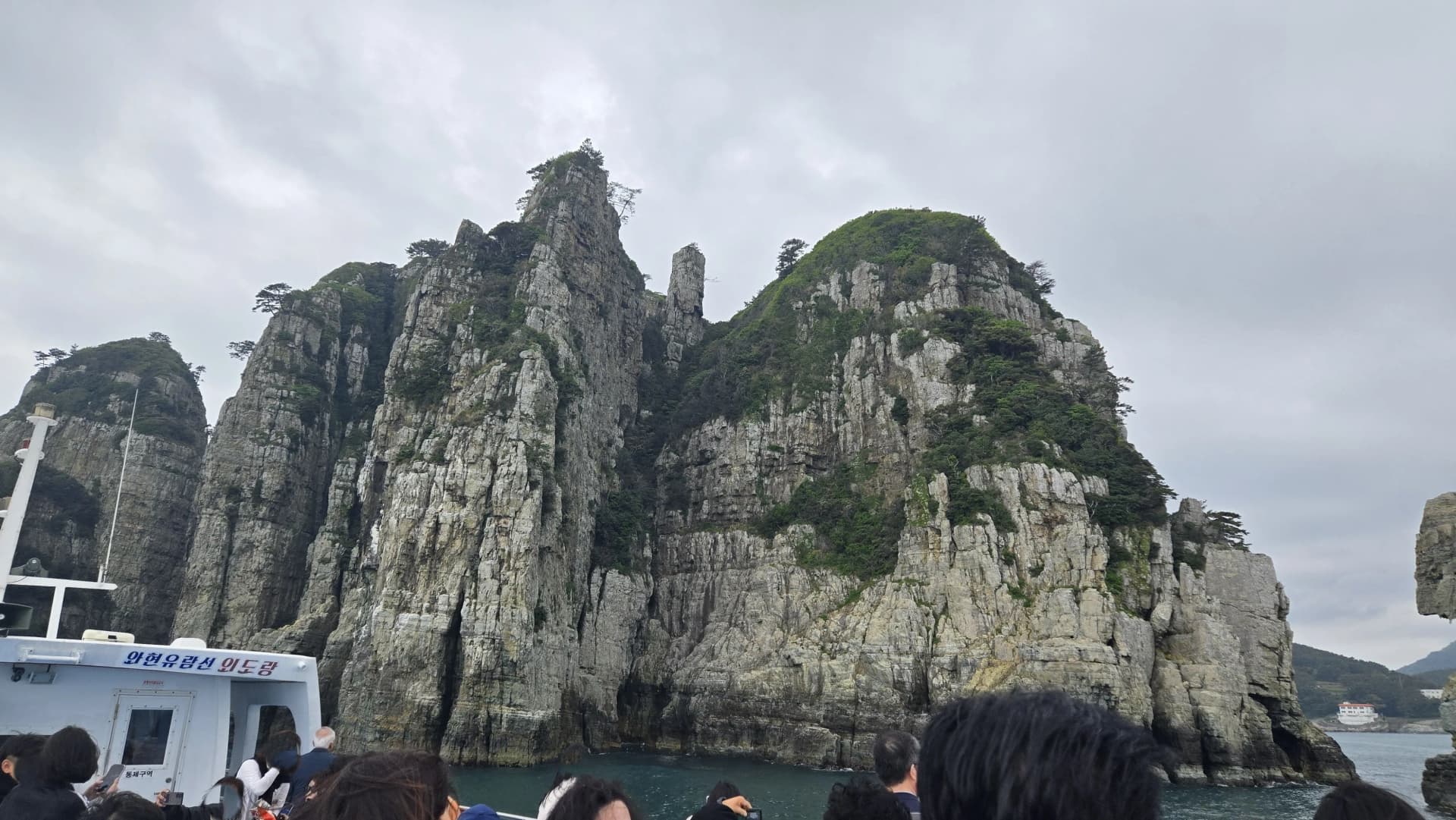
As the boat approaches Haegeumgang, these massive cliffs suddenly appear right in front of you. They look impressive in photos, but the real-life scale is on a completely different level. Rocks carved by tens of thousands of years of waves and wind tower dozens of meters above the sea, with pine trees clinging to the crevices. The cruise boat pulls right up close, so you get to see these overwhelming Haegeumgang sea cliffs in incredible detail.
I'll be honest — this was my third time seeing Haegeumgang, so it didn't make me go "WOW" this time. But for first-timers, it'll be different. When everyone on the boat simultaneously raises their cameras at the same moment, that's when it hits you: oh, so this is the "Geumgangsan of the sea." The captain does a narrated broadcast explaining the name and legend behind each rock formation, and his distinctive delivery really sticks with you.
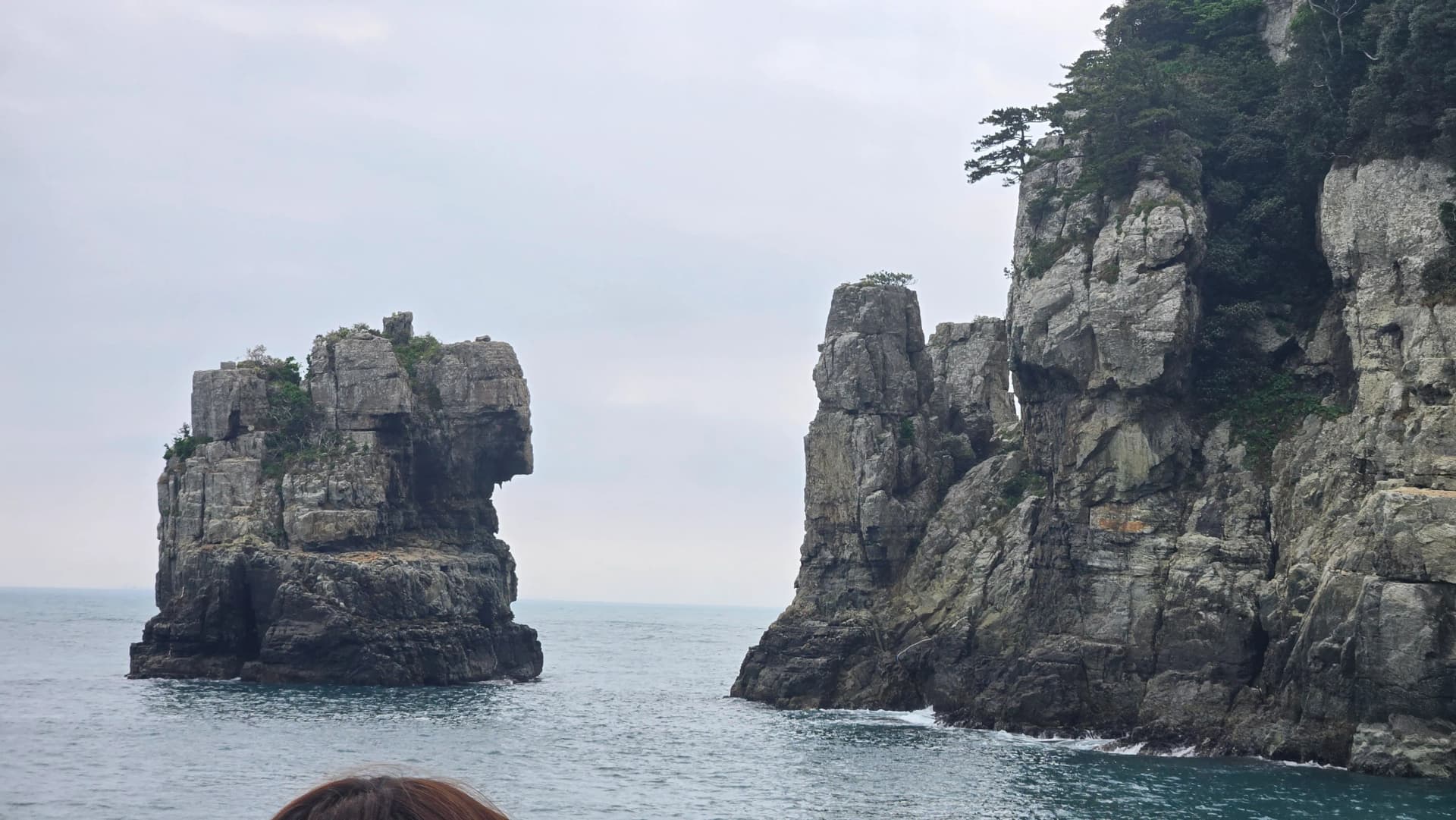
This is the famous Lion Rock at Haegeumgang. See that separate rock standing on the left? It looks exactly like a lion with its mouth wide open, gazing out at the sea. Can you see it? Once someone points it out, you can't unsee it.
Apparently, cruise boats used to go right inside the Cross Cave back in the day, but they've stopped doing that now due to safety concerns. It looked like smaller boats still go in, but that seems to be a separate tour package.
Landing on Oedo Botania — The Entire Island Was a Garden
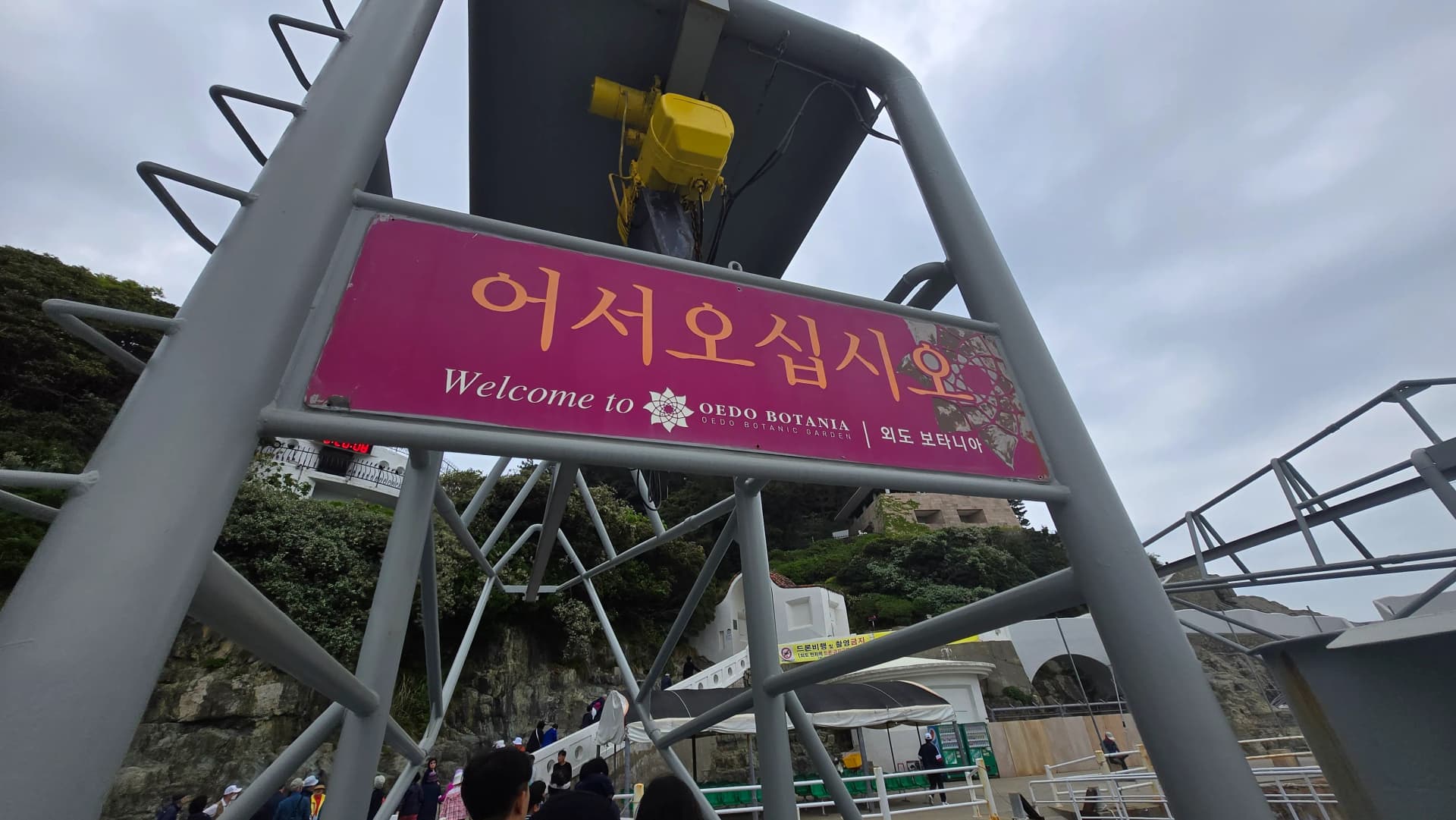
After the Haegeumgang scenic cruise wraps up, you finally arrive at Oedo. Step off the boat and you're greeted by a sign that reads "Welcome to OEDO BOTANIA."
Do NOT lose your name tag
When you get off the boat, they give you a name tag. It has your specific boat's departure information on it. When you finish exploring Oedo, you return this tag and board the same boat you came on. If you accidentally get on the wrong boat, you'll end up at a completely different port — not the one where you started.
There are 5 different ports on Geoje Island, remember? Mess this up and you'll end up at a harbor nowhere near where you parked your car. "Can't I just catch the next boat?" Nope, you can't. You have 2 hours to explore, and you absolutely must get back on the same boat.
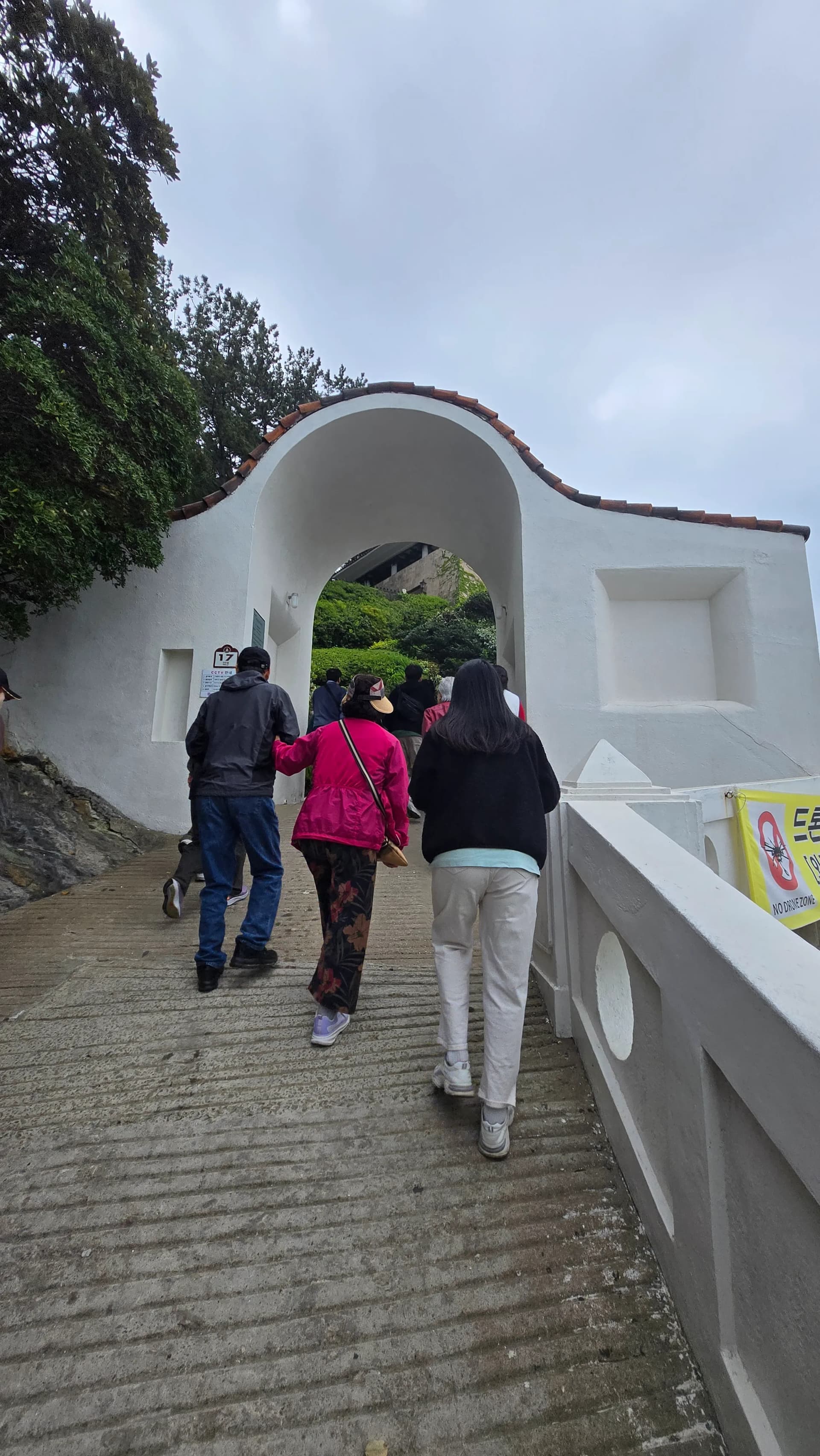
Walking up from the dock, you'll come across this white archway. This is where the real Oedo Botania exploration begins — and as you can see, it's uphill. Oedo isn't a big island, but the terrain itself is hilly, so expect quite a few inclines and stairs.
I was fine, but my wife was huffing and puffing on the way up.
Real talk about fitness level & what to wear
For anyone with mobility issues, elderly visitors, or parents with strollers — this visit could be genuinely tough. There are no elevators or ramps anywhere. There are benches scattered around to rest on, but fundamentally you'll be going up and down hills for 2 hours straight.
Sneakers are a must. Forget sandals or heels. There are stone paths and stairs everywhere. If you're visiting in summer, definitely bring a parasol or hat and a portable fan. There's less shade than you'd expect, and it gets absolutely brutal in the peak of summer. Since you can't bring water in, bring some cash too. There are vending machines on the island, but some don't accept cards.
Spring and fall are the best seasons, hands down. In spring, the flowers are in full bloom and the colors are insane. In fall, the autumn foliage mixed with palm trees creates this totally unique vibe. Summer… honestly, you'll be battling the heat the entire time. I strongly recommend spring or fall over summer or winter.
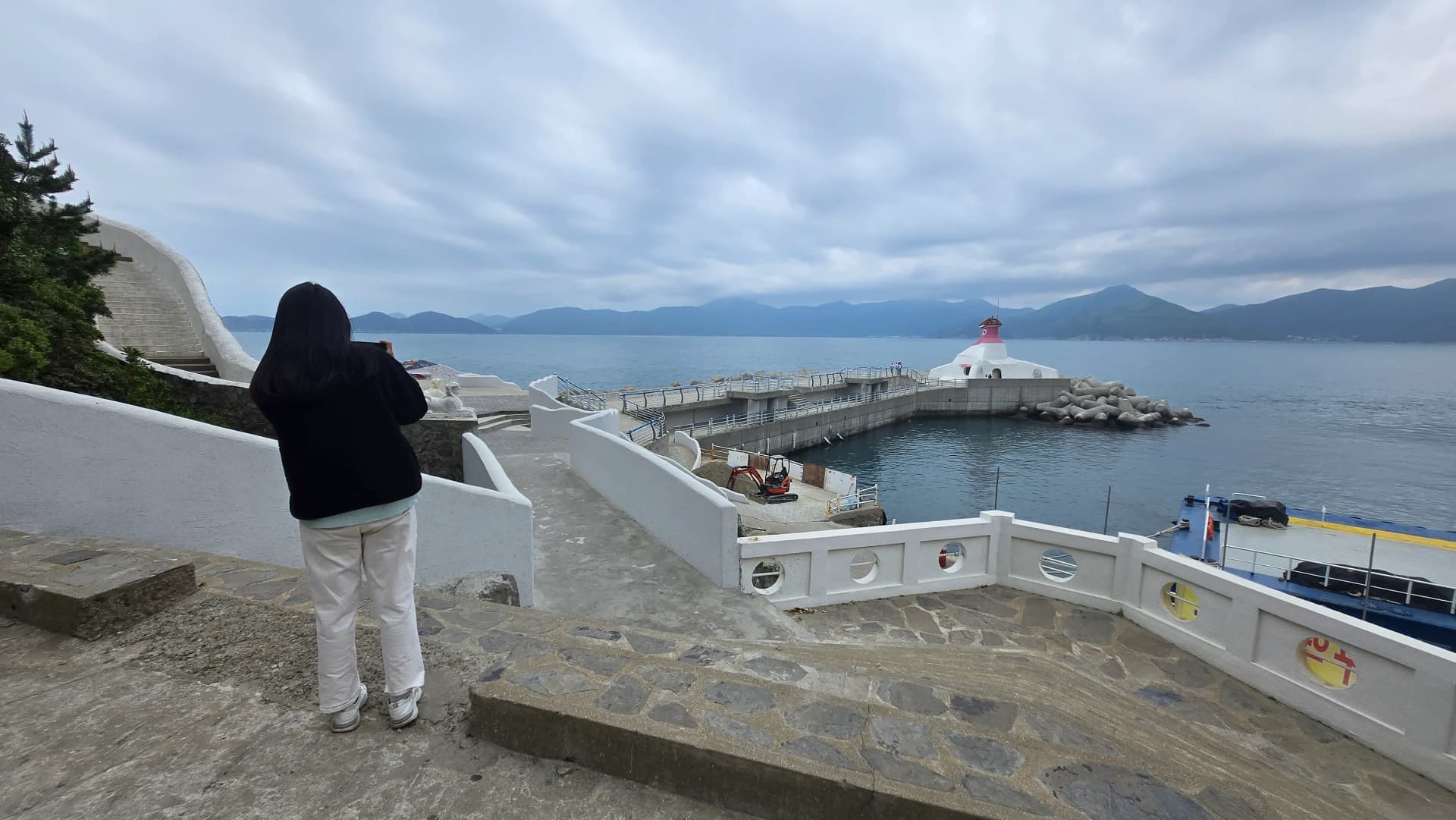
Walk up just a little and this view opens up immediately. Turn around and you can see the boat you just arrived on, with the mountain ridges of Geoje Island's main island stretching long across the sea behind it. Below the white railing, you can spot the breakwater and a small lighthouse. And this is still just the entrance — the views are already this good.
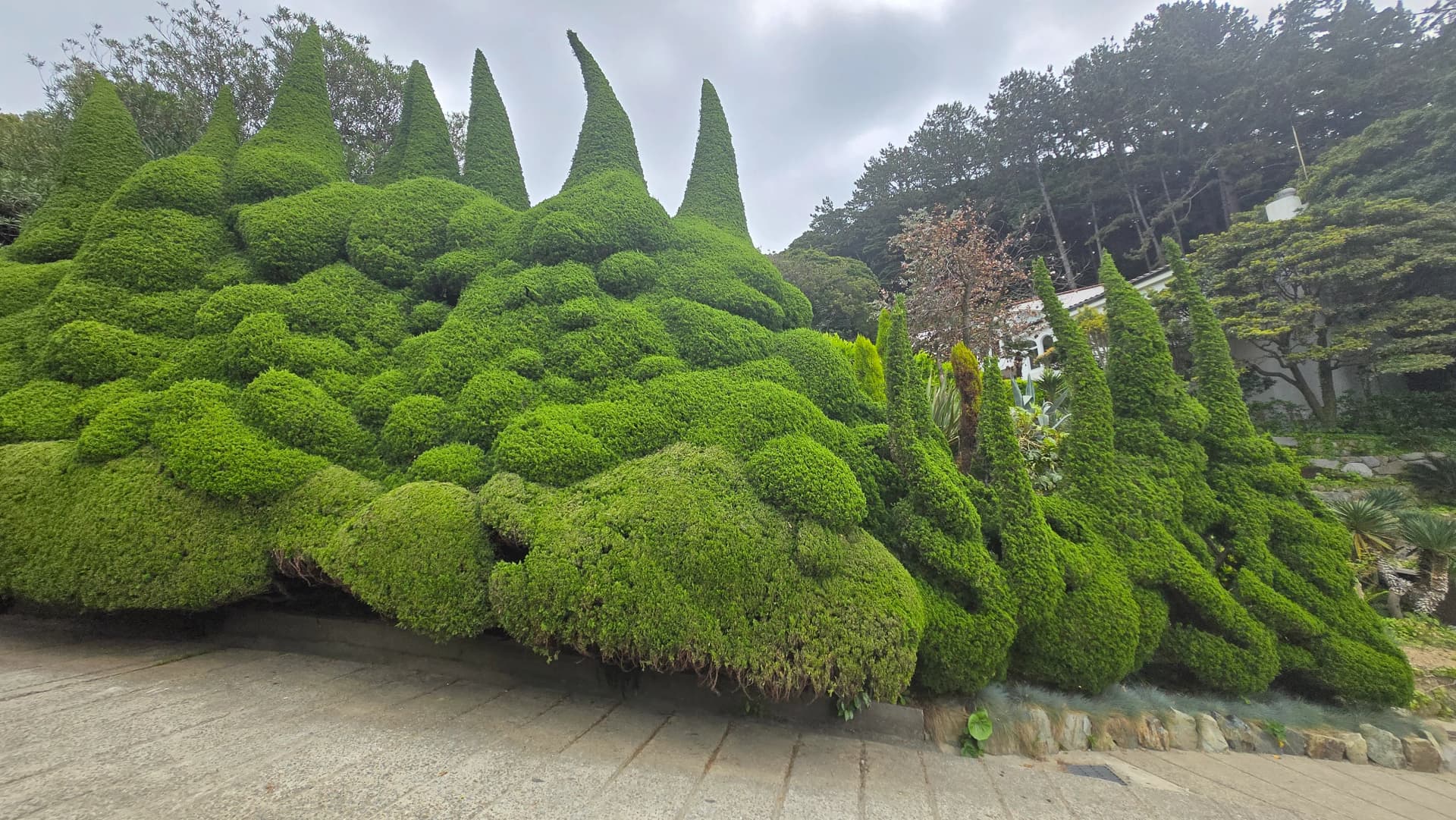
Walking up, this suddenly appeared out of nowhere. A massive dinosaur sculpture carved from wood — and the size of this thing is no joke. It looked several times taller than me. Everyone stops here. I stood there for a good while too, shifting angles and snapping photos from every direction. It was an overcast day, but honestly the green looked even richer because of it.
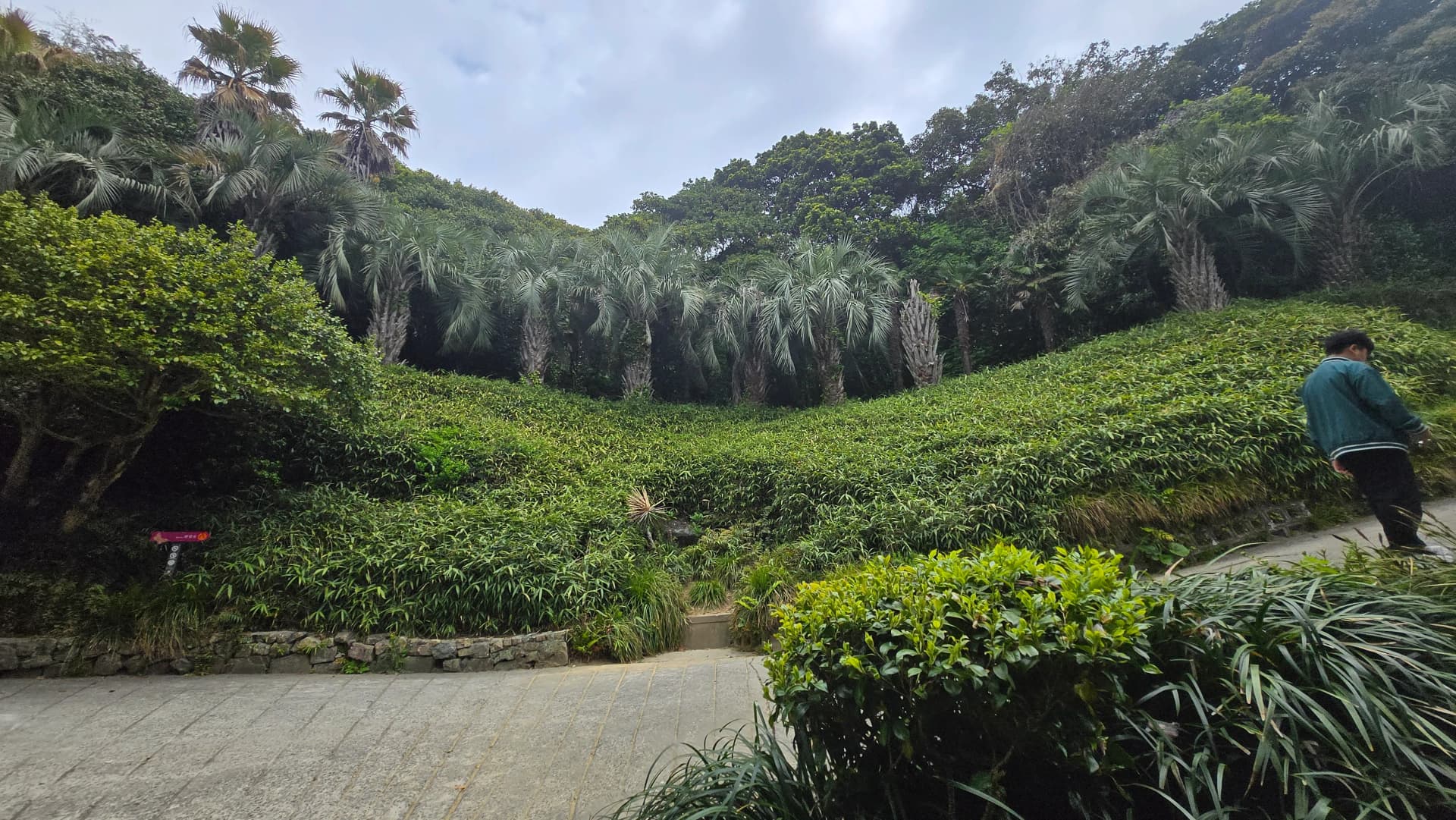
Palm trees lining the hillside path one after another — I honestly thought I was somewhere in Southeast Asia for a second. Because Oedo sits in the middle of the ocean, the climate is apparently warmer than the mainland. That's why palm trees and subtropical plants thrive so well here. I'd never seen scenery like this in Korea outside of Jeju Island, but Oedo felt different from Jeju too. It's a tiny island just packed with plants, so the density is on another level. It felt like walking through a jungle.
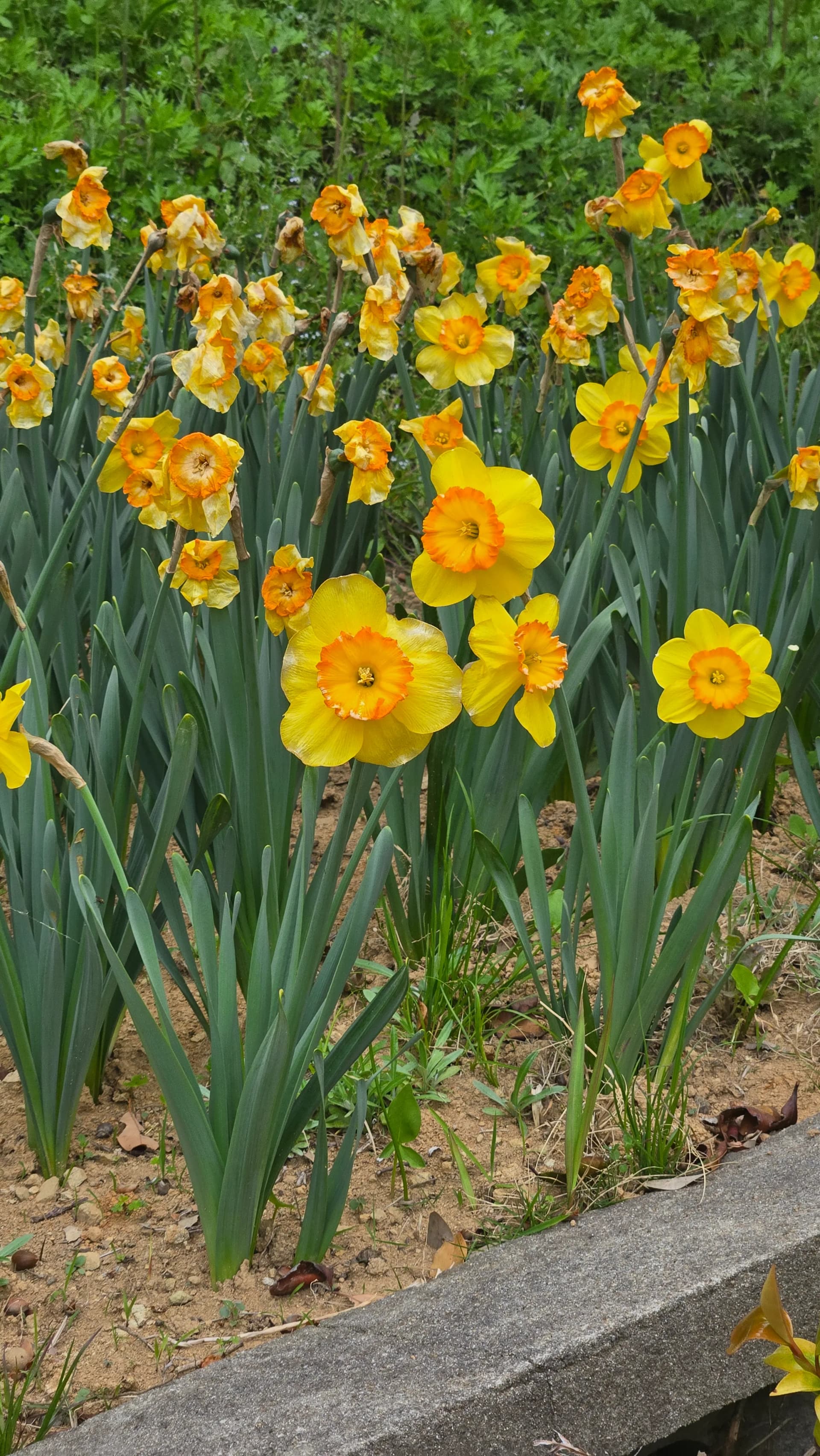
Daffodils were blooming all along the path. They're even prettier up close. I kept crouching down to get a better look as I walked. Oedo Botania is famous for having flowers in bloom year-round, and after actually being there, I can confirm that's no exaggeration. I went in spring and the daffodils were at their peak. In summer they have hydrangeas, in fall it's lantana and bush sage, and winter brings camellias.
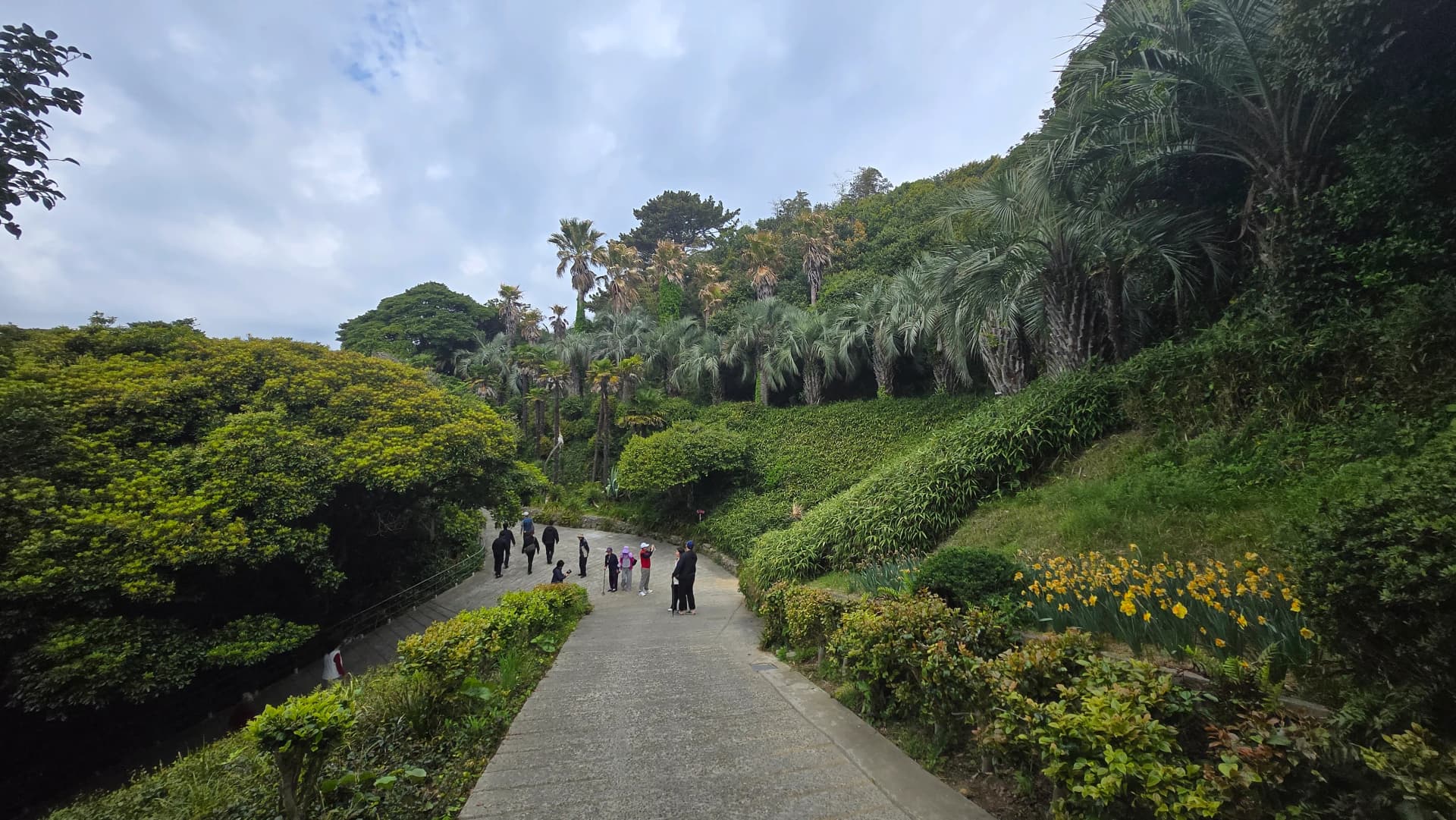
This path was seriously amazing. Personally, this was my favorite stretch of the entire Oedo Botania visit. Lush green on both sides with you walking through the middle — it felt like a scene straight out of a movie. Yellow flowers lined up along the right, and when you looked up, palm trees canopied the sky.
But here's the problem. I wanted to take a photo with every single step, so I literally could not move forward. And it wasn't just me — everyone ahead was doing the exact same thing. Stop, snap, walk two steps, stop again. I went on a weekday during off-season so it was manageable, but on weekends or holidays, people flood in from all 5 ports and it gets seriously packed. Go on a weekday if you possibly can. I mean it.
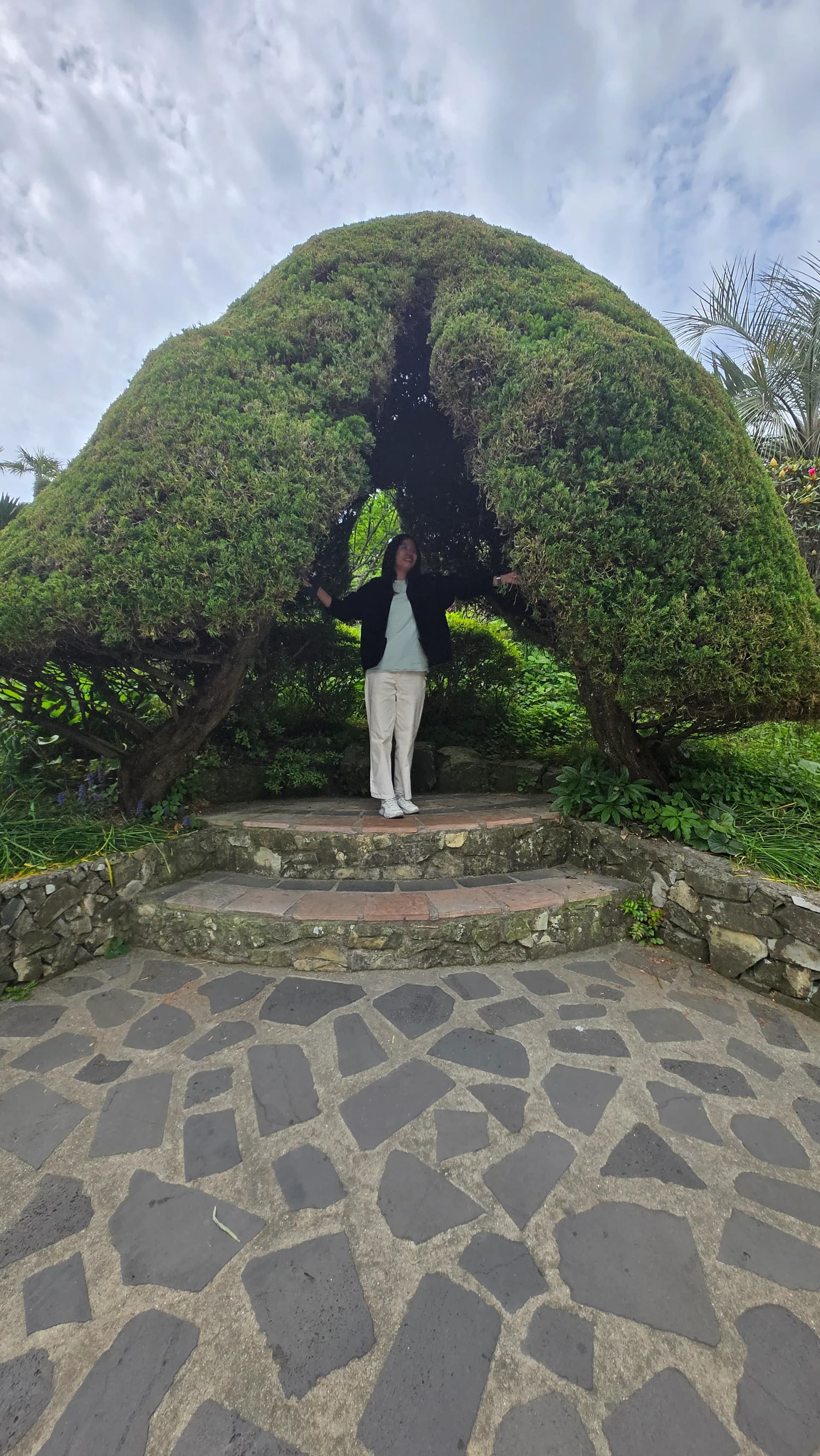
The second I saw this tree, I said "We HAVE to take a photo here." A massive tree split right down the middle, with just enough space for one person to stand inside. If you stand in there, the photo comes out looking like the tree is hugging you. People were lining up to take their turn. Don't skip this one.
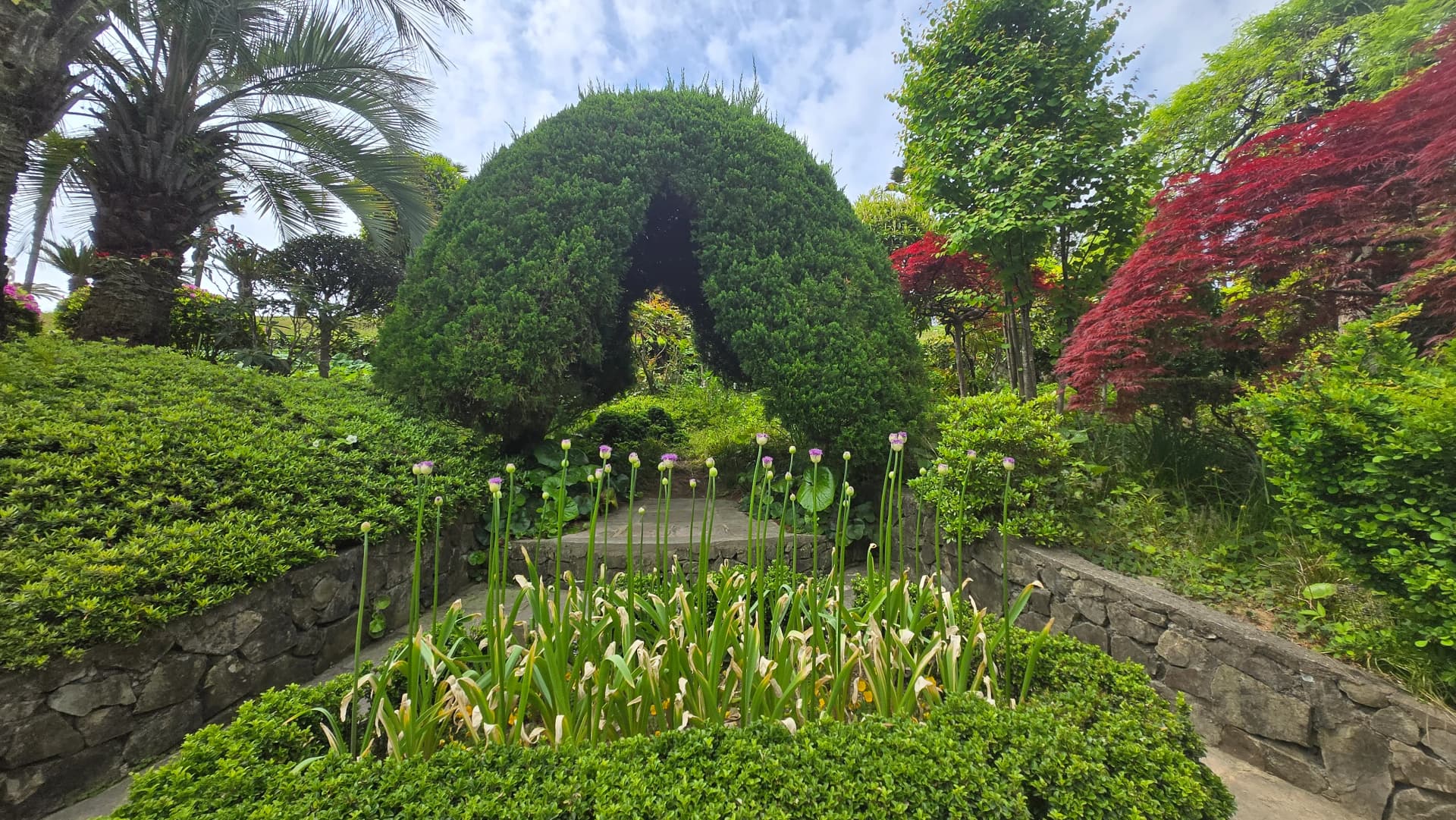
From the other side of that tree, it looks like this. Round flower buds reaching up in a row at the front, with red maple trees and palm trees standing side by side on either flank. Maple leaves and palm trees in the same frame? Seems weird, right? But at Oedo, it's totally natural. Temperate and subtropical plants coexisting in one space — that's the unique charm of this island.
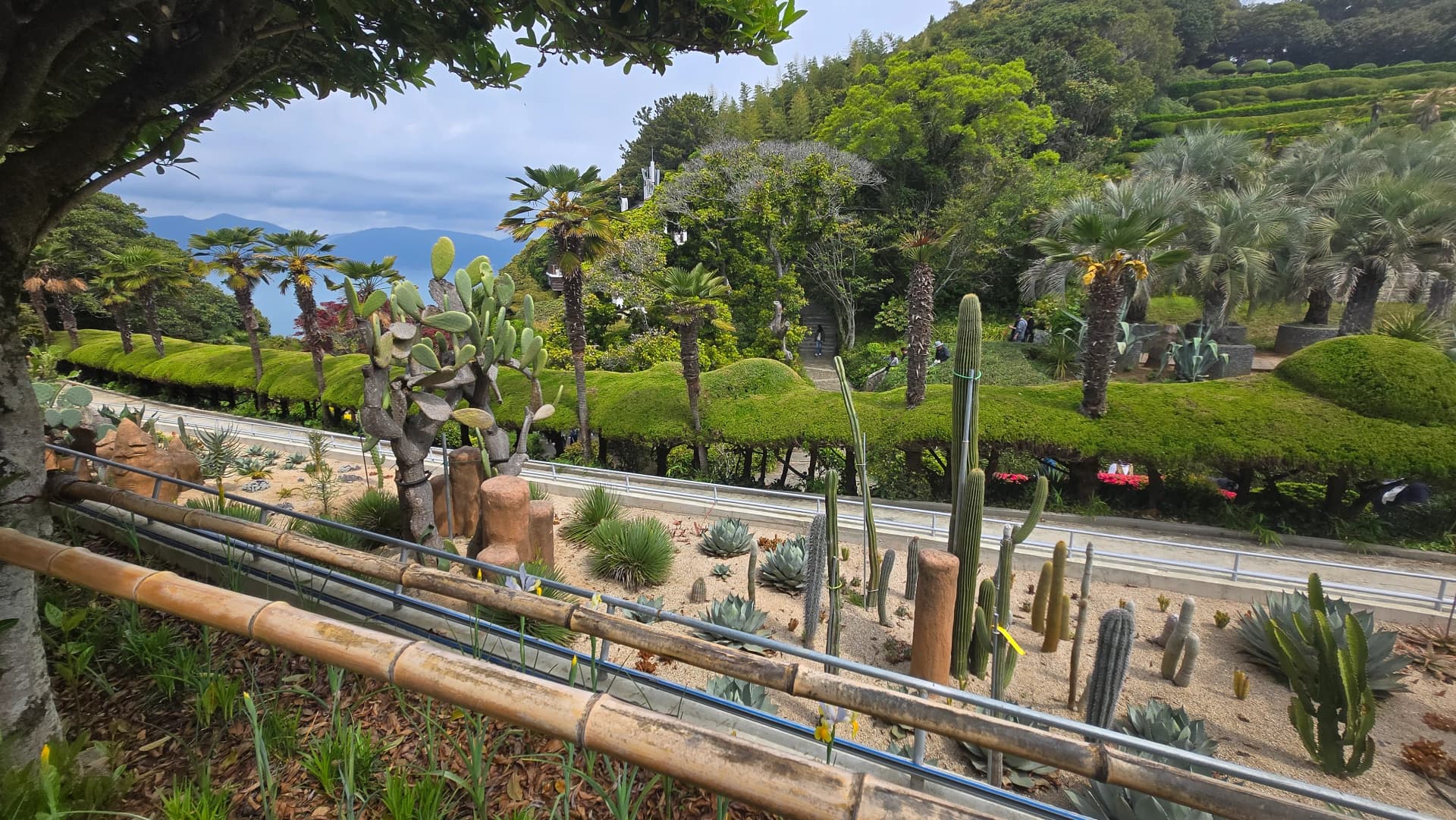
This is the Cactus Garden. The vibe shifts completely here. One second you're in a green jungle, and the next you're in a sandy area lined with cacti — it suddenly feels like you teleported to somewhere in Mexico. The atmosphere keeps changing like this all over the island, so there's zero chance of getting bored.
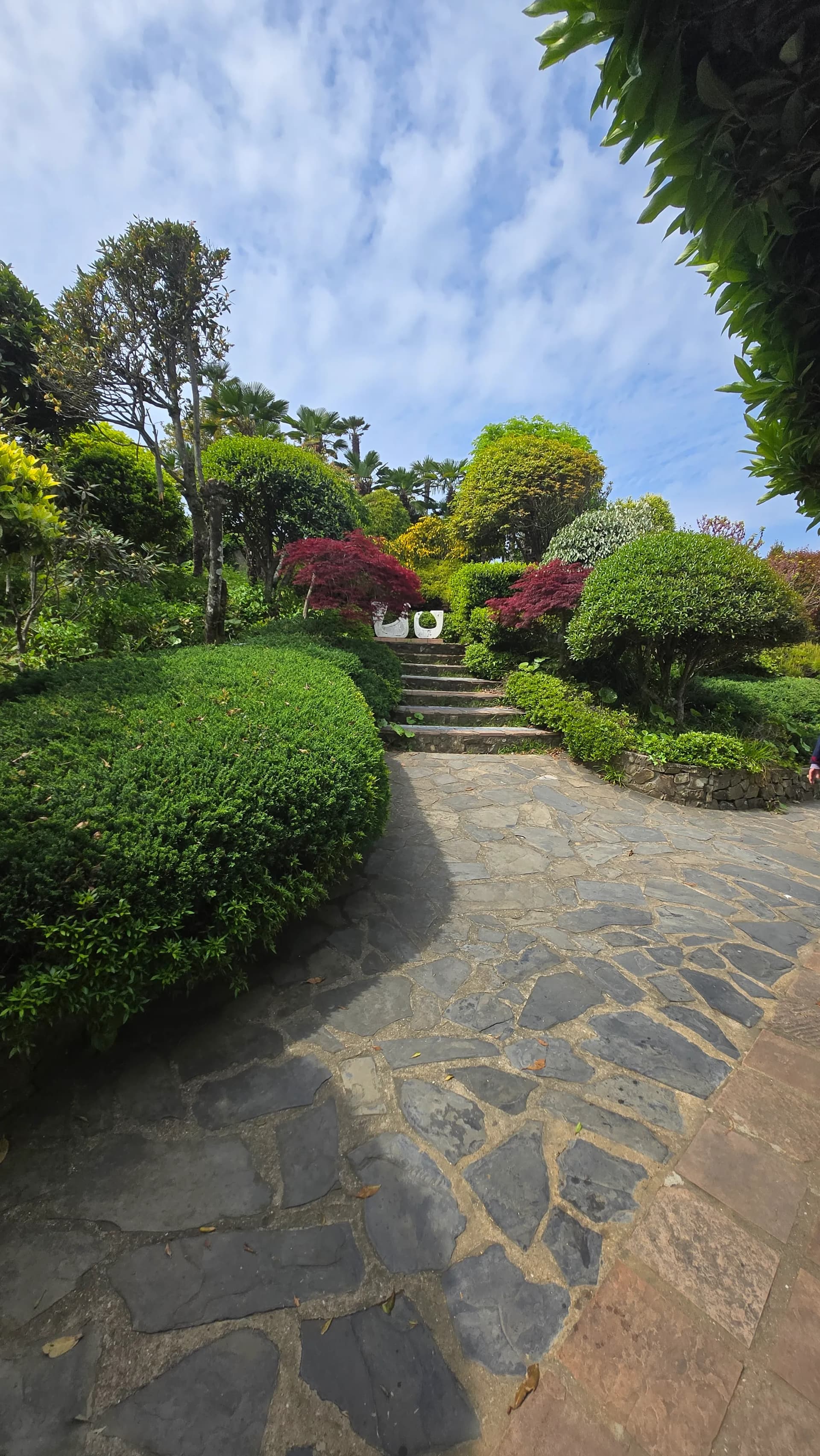
Follow the stone path upward and you'll find perfectly rounded green trees, red maples, and white sculptures all blending together on either side. The clouds happened to be floating just right that day — it genuinely looked like a painting.
Best photo timing tip
If you go during peak hours, getting clean photos on this path gets tough. Try to catch the first boat of the morning if you can. Walk this path when it's quiet and you'll feel like the whole island belongs to you. Weekends and holidays are apparently wall-to-wall people no matter what time slot you pick, so a weekday visit during off-season is ideal.
From Venus Garden to the Summit Observatory, and the Walk Down
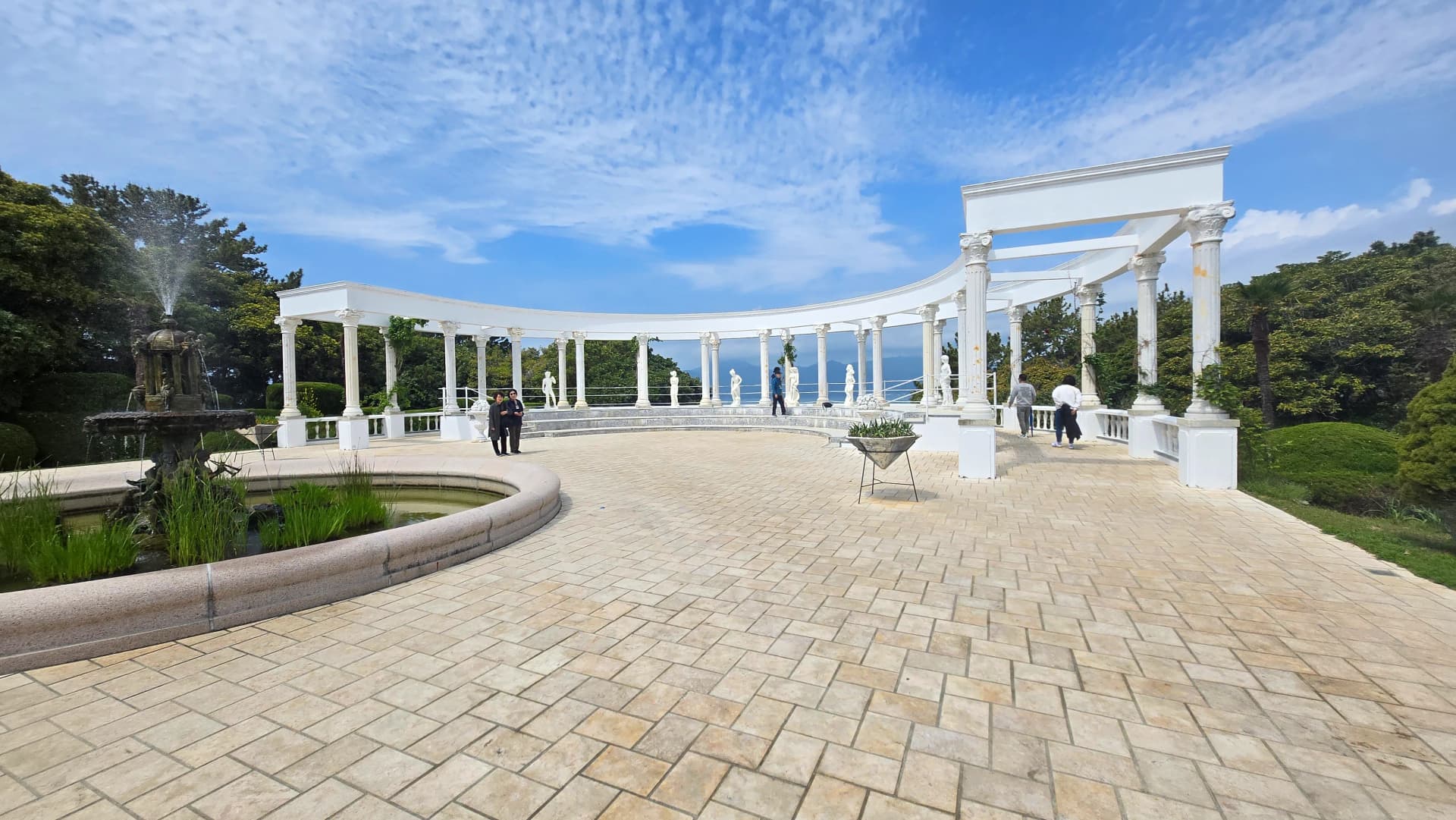
There it is. Venus Garden. The absolute highlight of Oedo Botania.
White columns arranged in a semicircle, with sculptures standing between each one. A fountain sits to the left. Apparently it was modeled after the rear gardens of Buckingham Palace. They renovated it in 2020, and the maintenance was impeccable.
When I first saw it, it reminded me of a Greek temple, or maybe the garden of some Italian palazzo. But then you turn around and there's the southern Korean sea right behind you. It looks European, but the ocean is unmistakably Korean. That contrast is weirdly captivating.
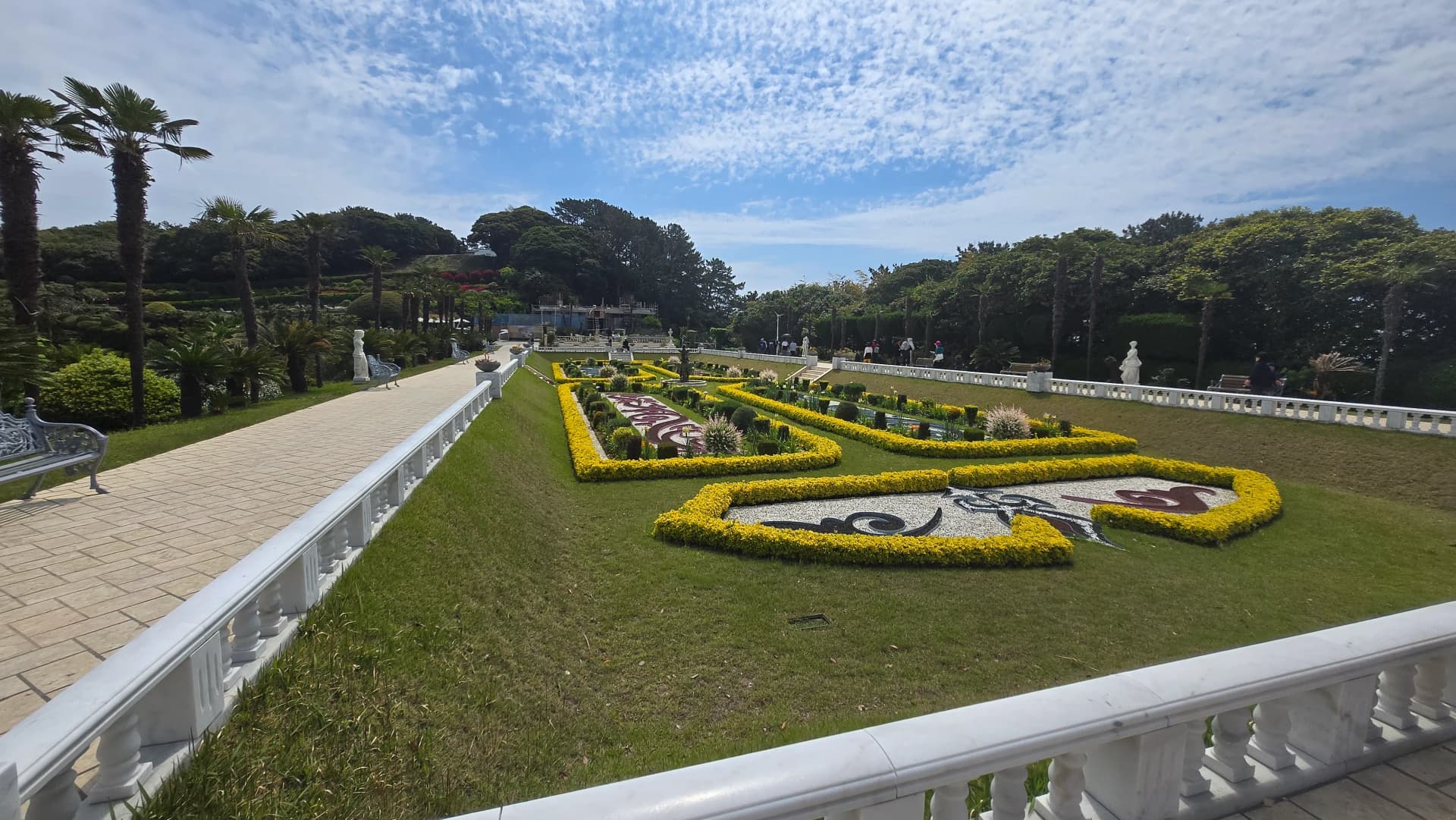
This is Venus Garden seen from above. Yellow flowers form decorative patterns inside the garden beds, and a promenade stretches along the white railing. Looking at this, all I could think was: a private individual really made this? This spot was apparently the playground of an elementary school annex before they transformed it into this. The weight of 50 years of dedication felt like it was captured entirely in this single shot.
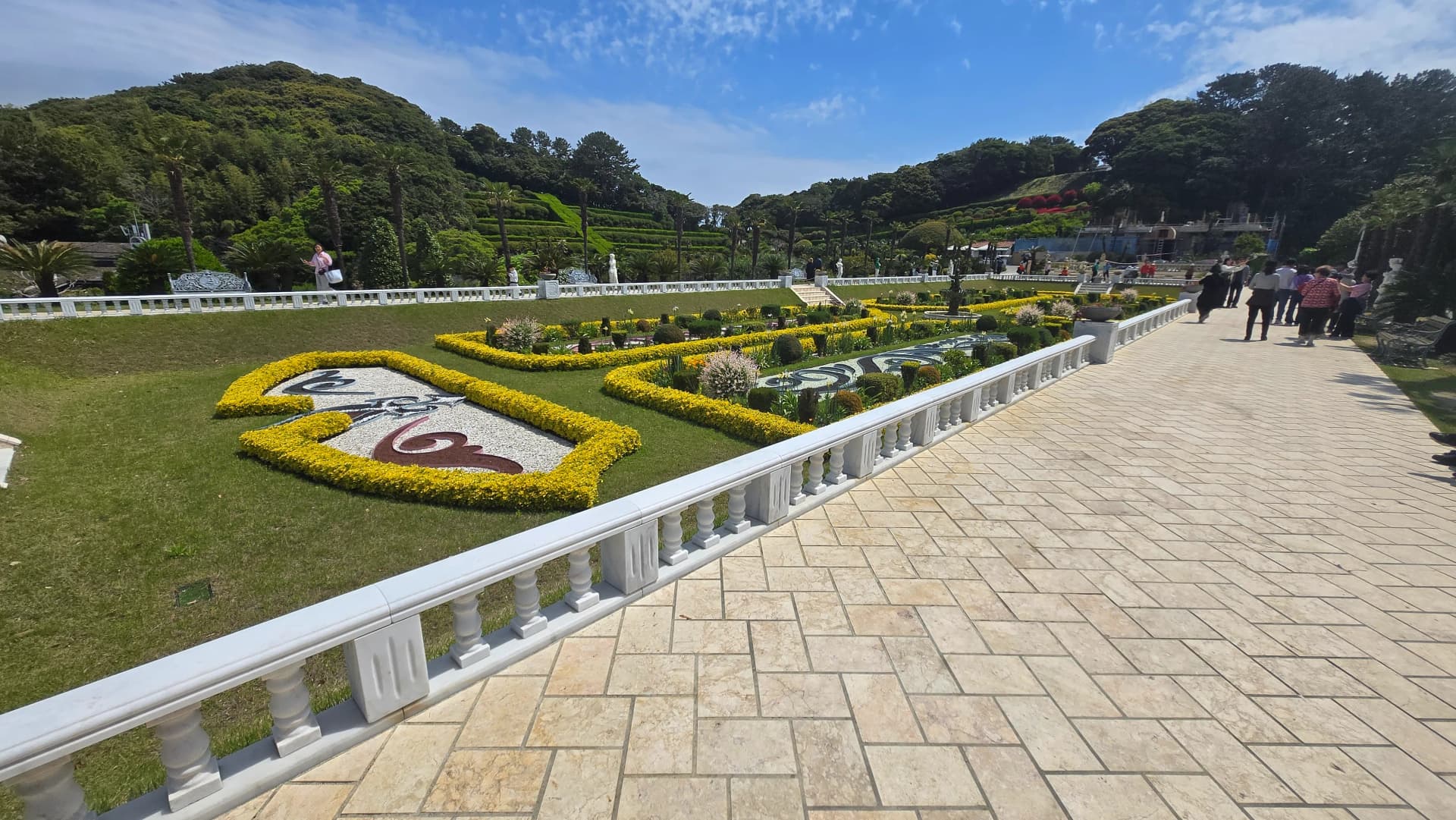
Venus Garden from the other side. Same spot, but it looks completely different depending on the angle. Here's a tip: walk both sides of Venus Garden. A lot of people only walk one path and move on, but the view from the opposite side is totally different, and you'd be missing out.
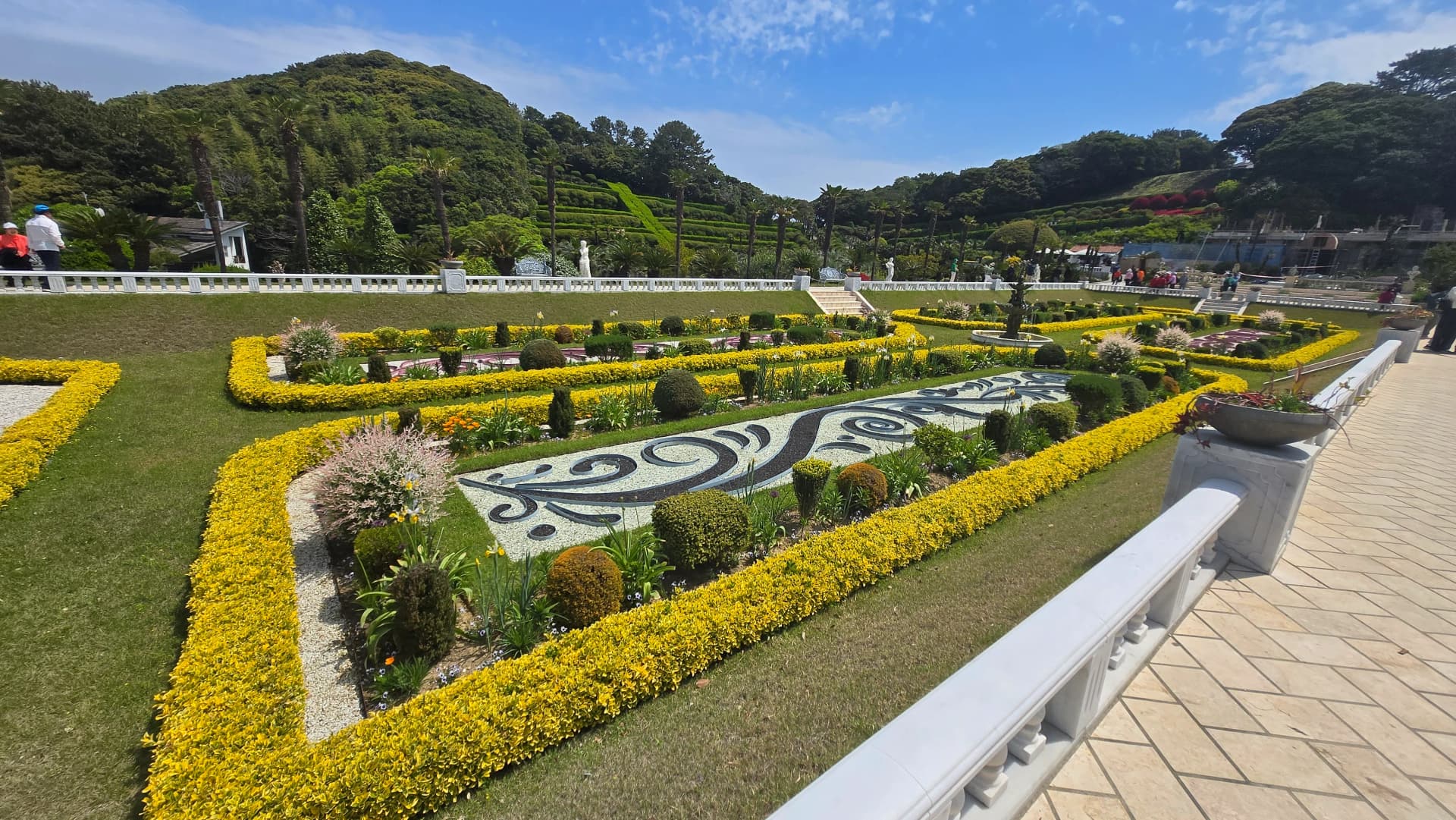
Look closely and you'll find these hidden details. Inside the yellow flower borders, pebble patterns are laid out — and every single one is different. Lower your eye level and walk slowly. If you just breeze through, you'll miss all of this. I noticed gardeners walking around constantly maintaining everything.
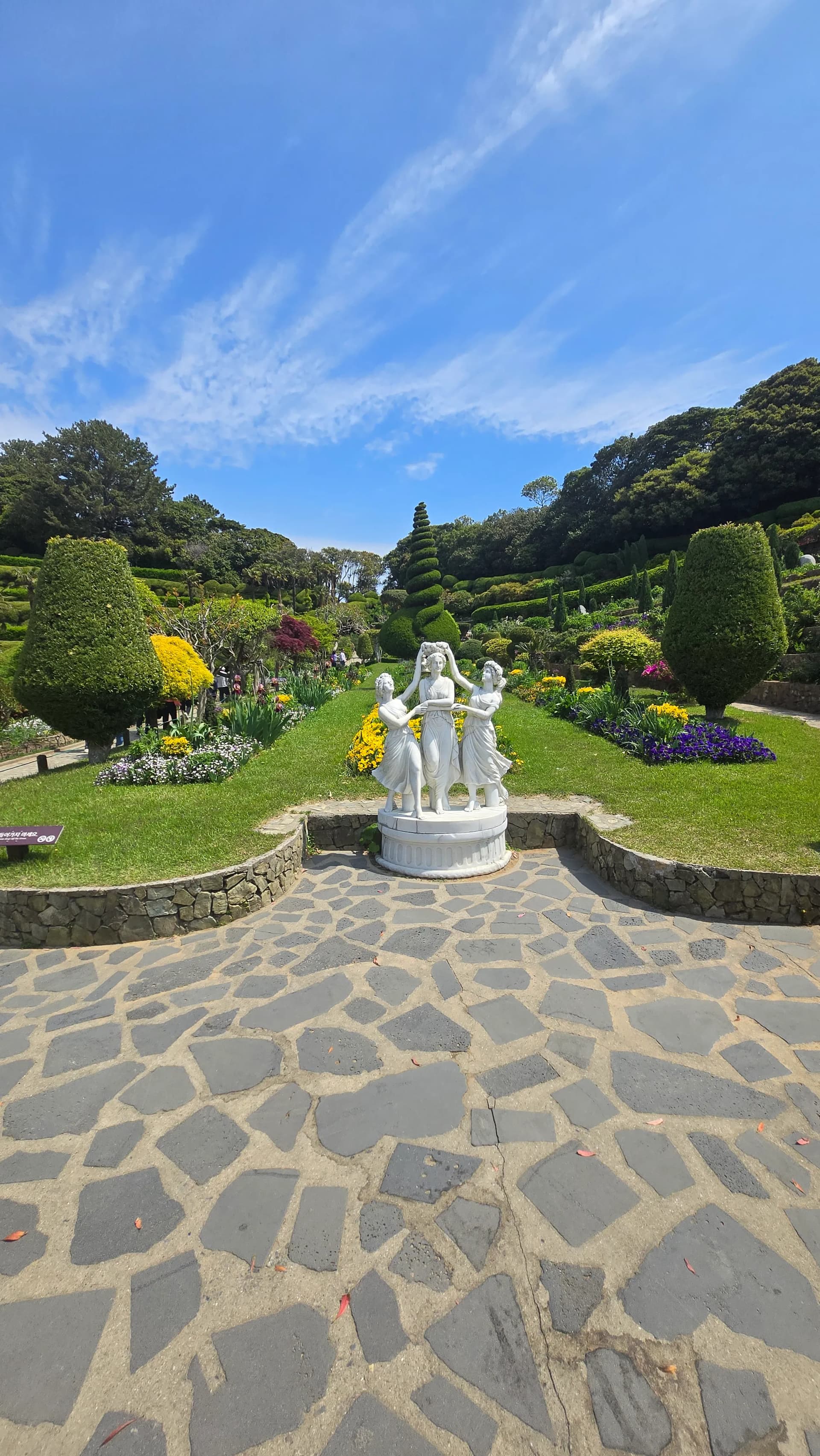
Past Venus Garden and further uphill, you reach a space like this. Three white sculptures holding hands, spinning in a circle, with yellow flowers, purple flowers, and green lawns cascading up in terraces behind them. Right around this point, the sky started clearing up. Oedo under overcast skies and Oedo under sunshine felt like two completely different places.
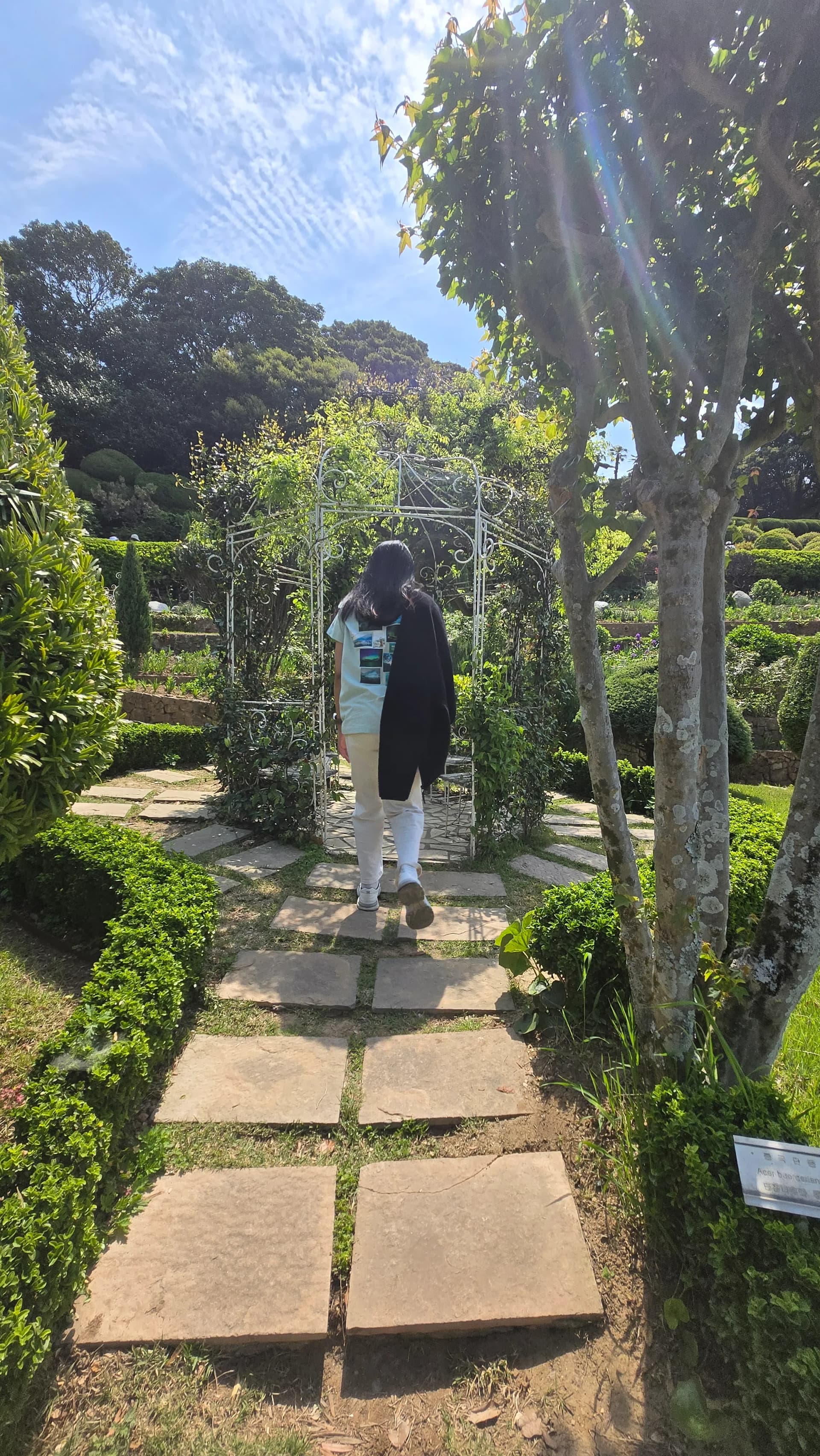
I spotted a white iron archway and wandered in to see what was there. It's a small herb garden kind of space, and barely anyone goes in. Most people just follow the main path. But step inside and it's quiet, with sunlight filtering through the greenery — really lovely. If you have time to spare, explore these side paths too.
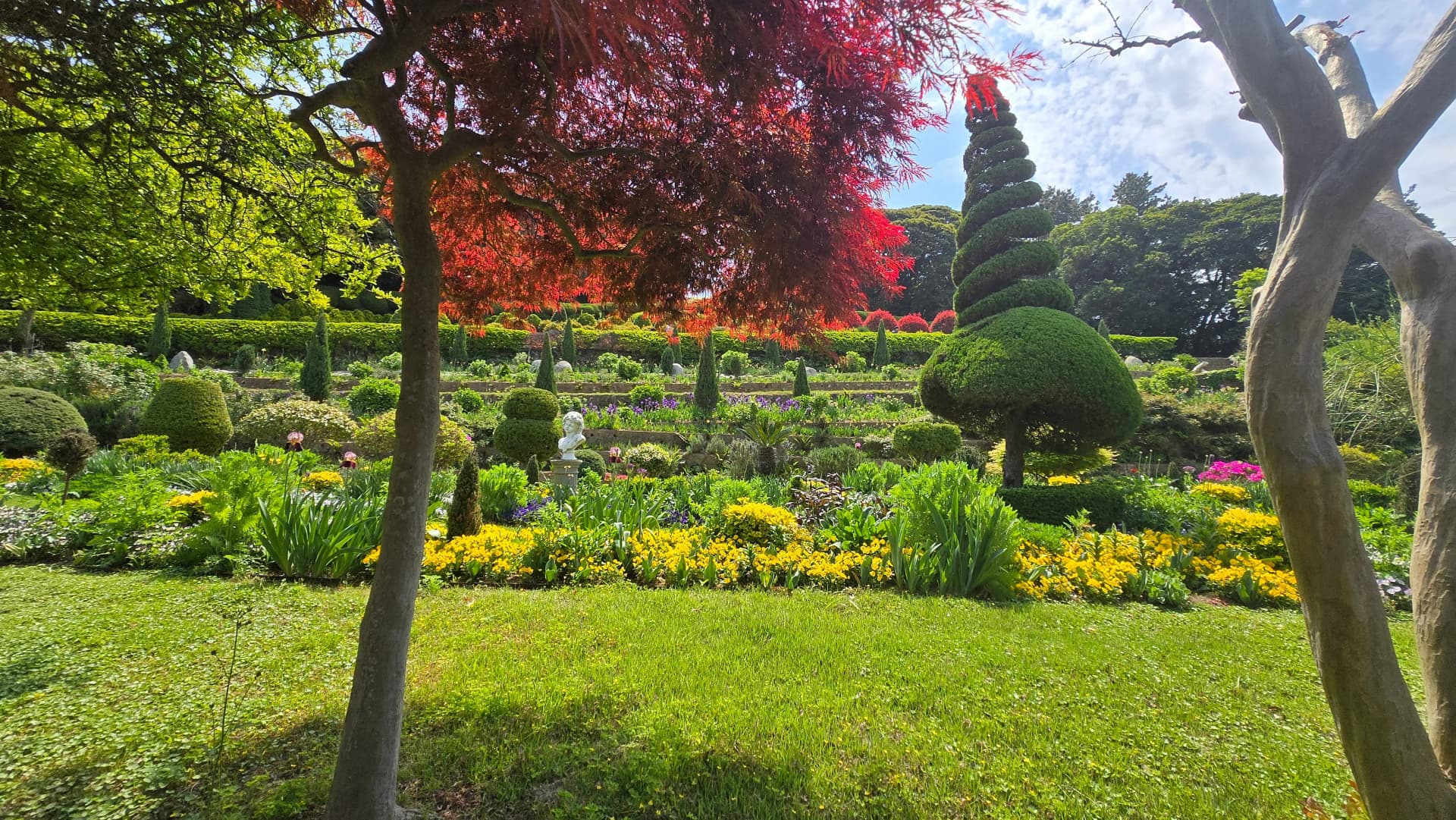
This photo is my absolute favorite from everything I took on Oedo. Yellow flowers carpeting the ground beneath a red maple tree, with spiral-trimmed green trees rising in layers behind it. Red, yellow, green, purple — all in one frame. No editing at all. And honestly, it was about ten times more intense seeing it with my own eyes than through a camera lens.
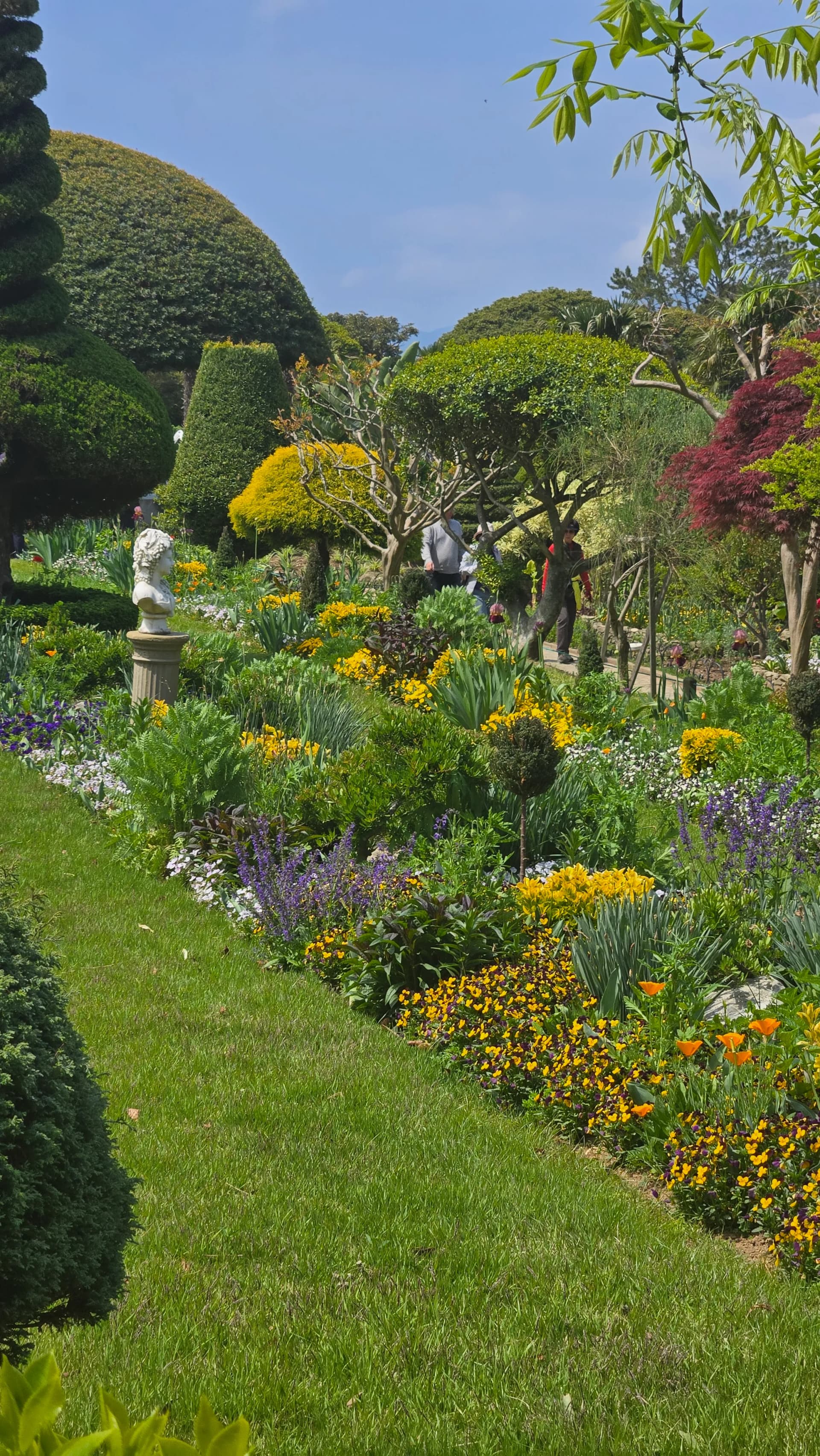
I couldn't name a single one of these flowers, but yellow ones, purple ones, orange ones — all jumbled together, figuring out how to be gorgeous all on their own. Someone is maintaining all of this, every single day, at this scale. Genuinely impressive, if I'm being honest.
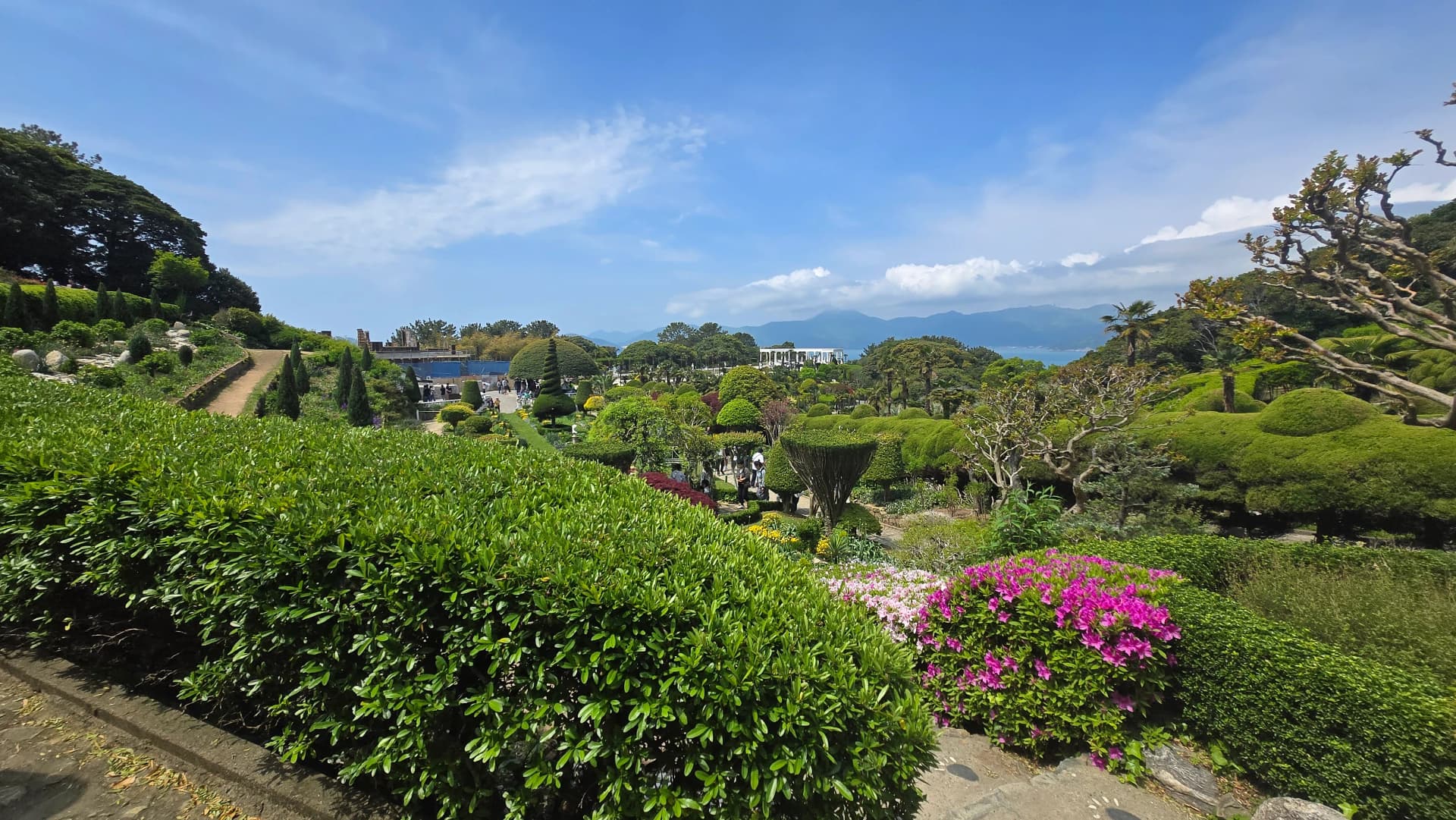
Climb higher and the entire island unfolds below you. Down there you can see the white columns of Venus Garden, then the sea beyond, and the mountain ridges of Geoje Island stretching across the horizon. Pink azaleas blooming in the foreground framed the view like a natural picture frame.
I stood here for a while. I'd come up to take photos, but I put the camera down and just looked. My wife was standing next to me, silent too. These are the moments from a trip that really stay with you, you know?
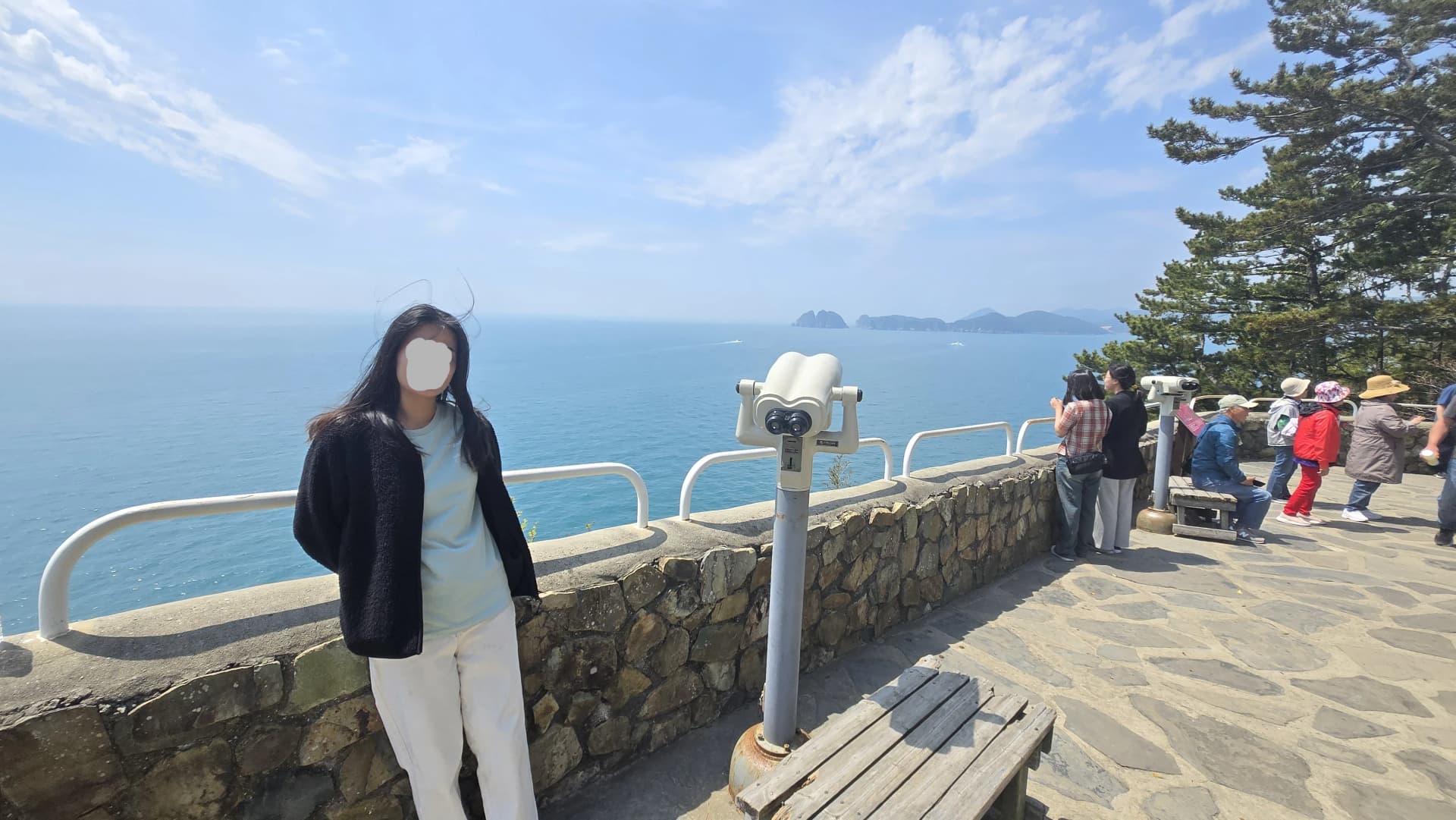
Made it to the summit observation deck. This is the highest point of Oedo Botania. There's a telescope up here, and you can lean against the railing to take in the sea. I was hot from the climb, but the wind was blowing pretty strong up here and it felt great. Islands dot the distance, and on a perfectly clear day, they say you can see Japan's Tsushima Island. I couldn't see that far on this day, but it was more than enough.
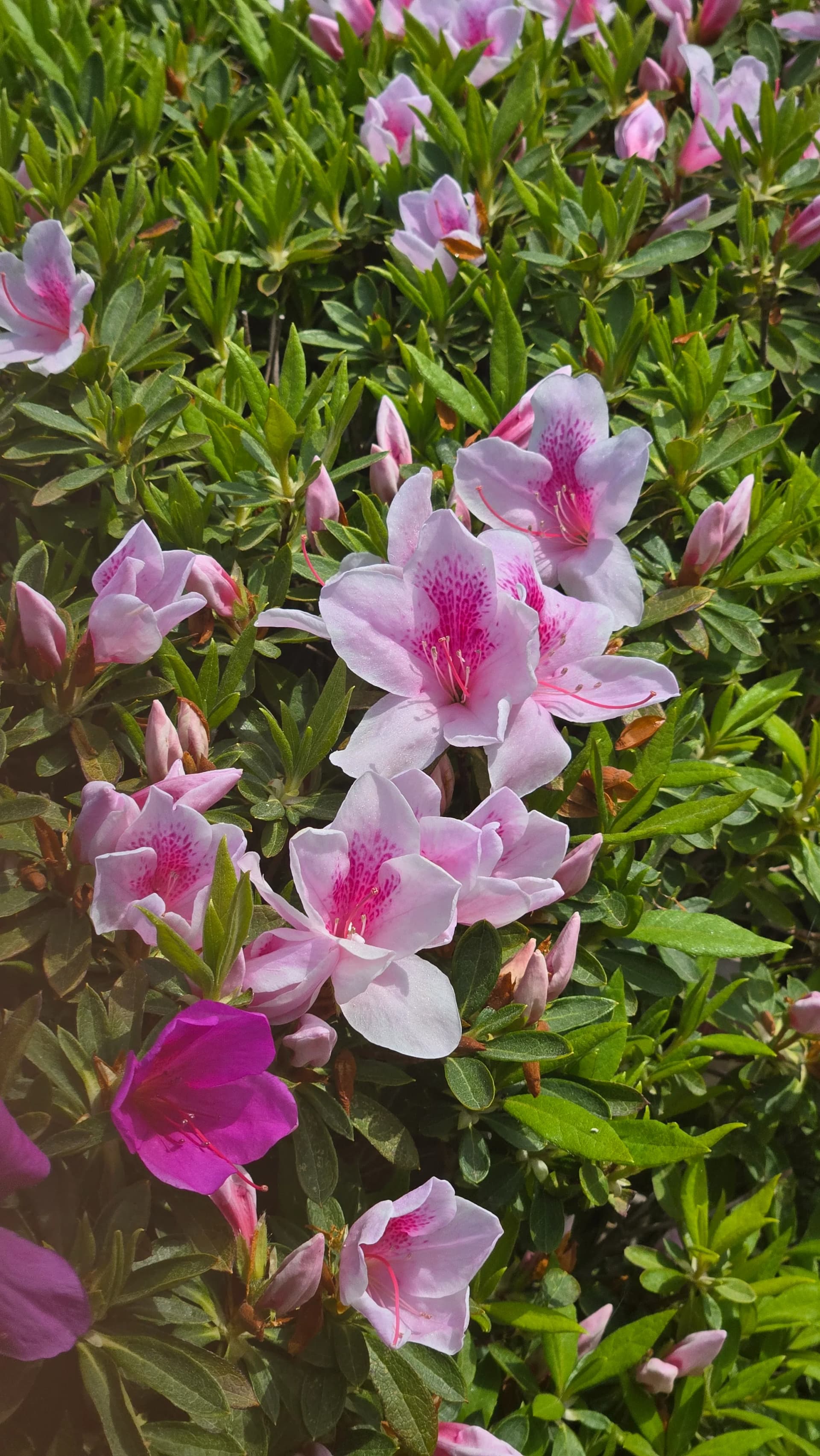
Azaleas were in full bloom near the observation deck. Light pink with little dark pink speckles — up close they're incredibly delicate. I normally never take flower photos, but I must have snapped about ten just here.
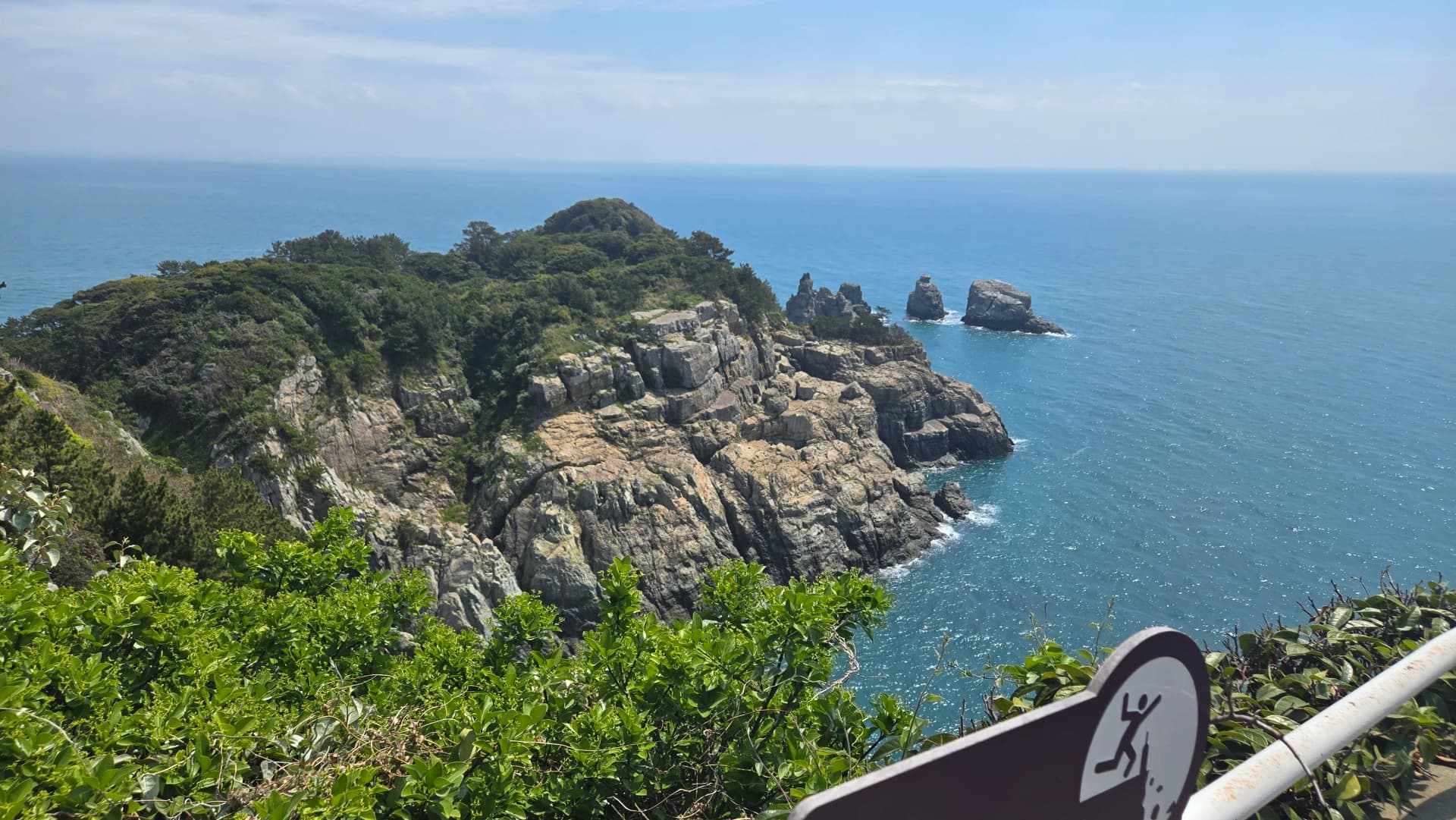
From the observation deck, look the other way and you see Oedo's eastern side. This part hasn't been turned into a garden — it's raw, untouched nature. Waves crash against the cliffs below, and small rocky islets jut out at the edge. Same island, but one side is a European-style botanical garden and the other is wild, rugged sea cliffs. That contrast is what makes Oedo feel even more special.
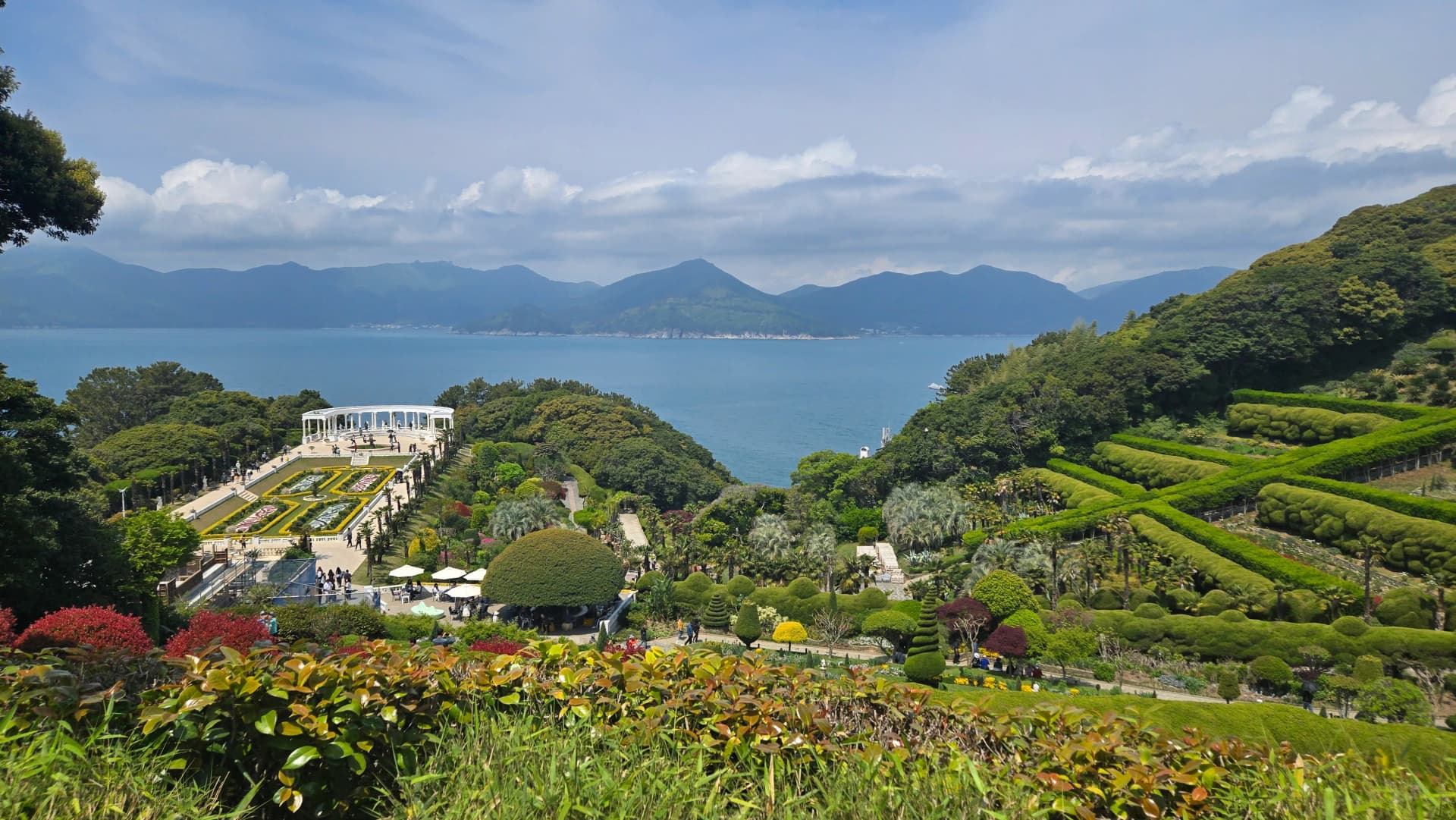
Time to head back down. From up here, you can take it all in at once. Venus Garden's white columns on the left, perfectly rounded trees in the center, terraced gardens on the right, and the sea and Geoje Island mountains stretching out behind it all. The fact that all of this fits on one small island still blows my mind even now. The climb up was tough, but the moment I saw this view, everything was worth it.
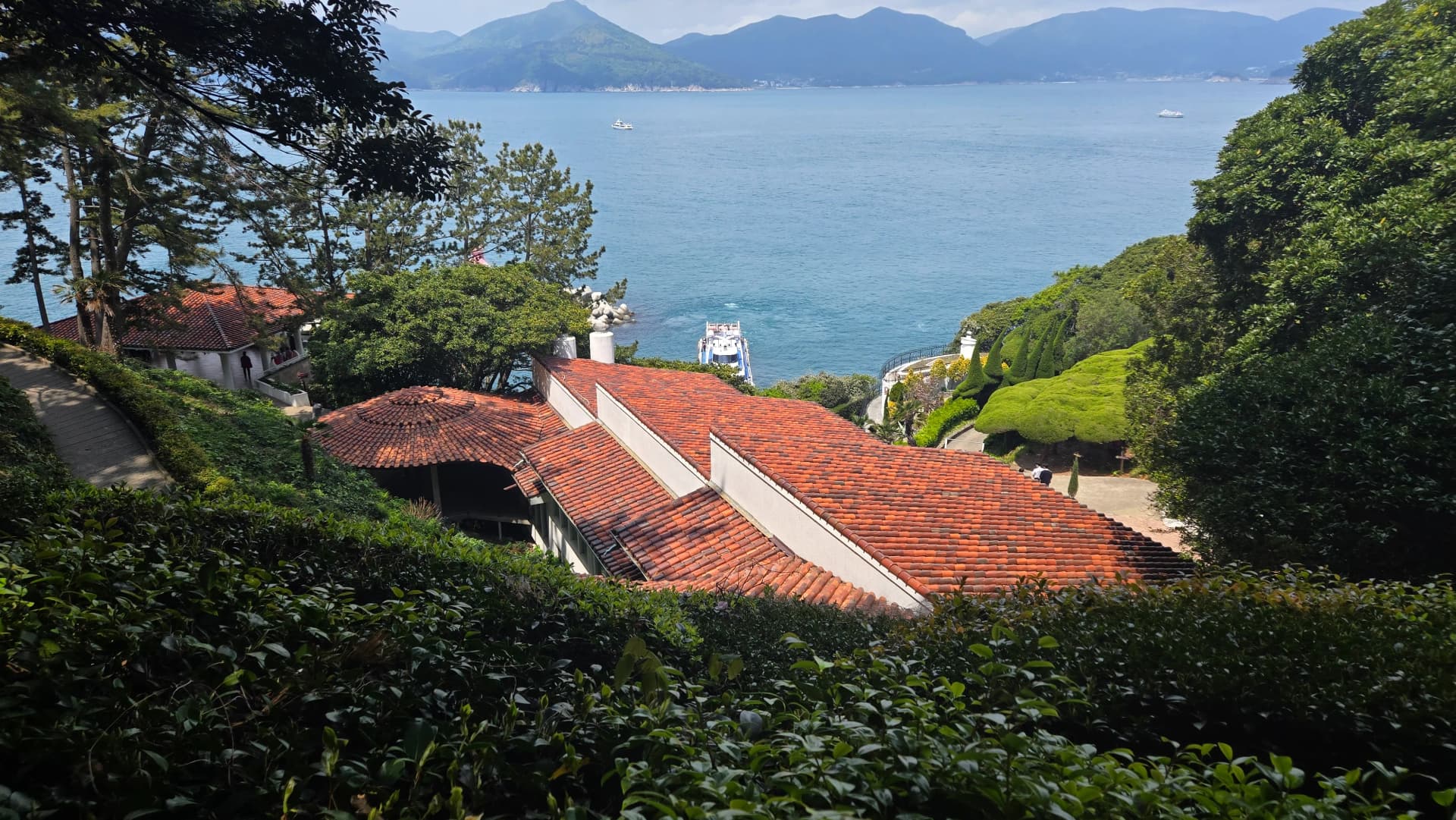
On the way down, an orange tile-roofed building comes into view. Peeking through green vines like this, doesn't it look like a Mediterranean coastal village? The views going down are different from going up, too. On the way up, you're focused on the gardens, but on the way down, the sea and the whole island open up before your eyes.
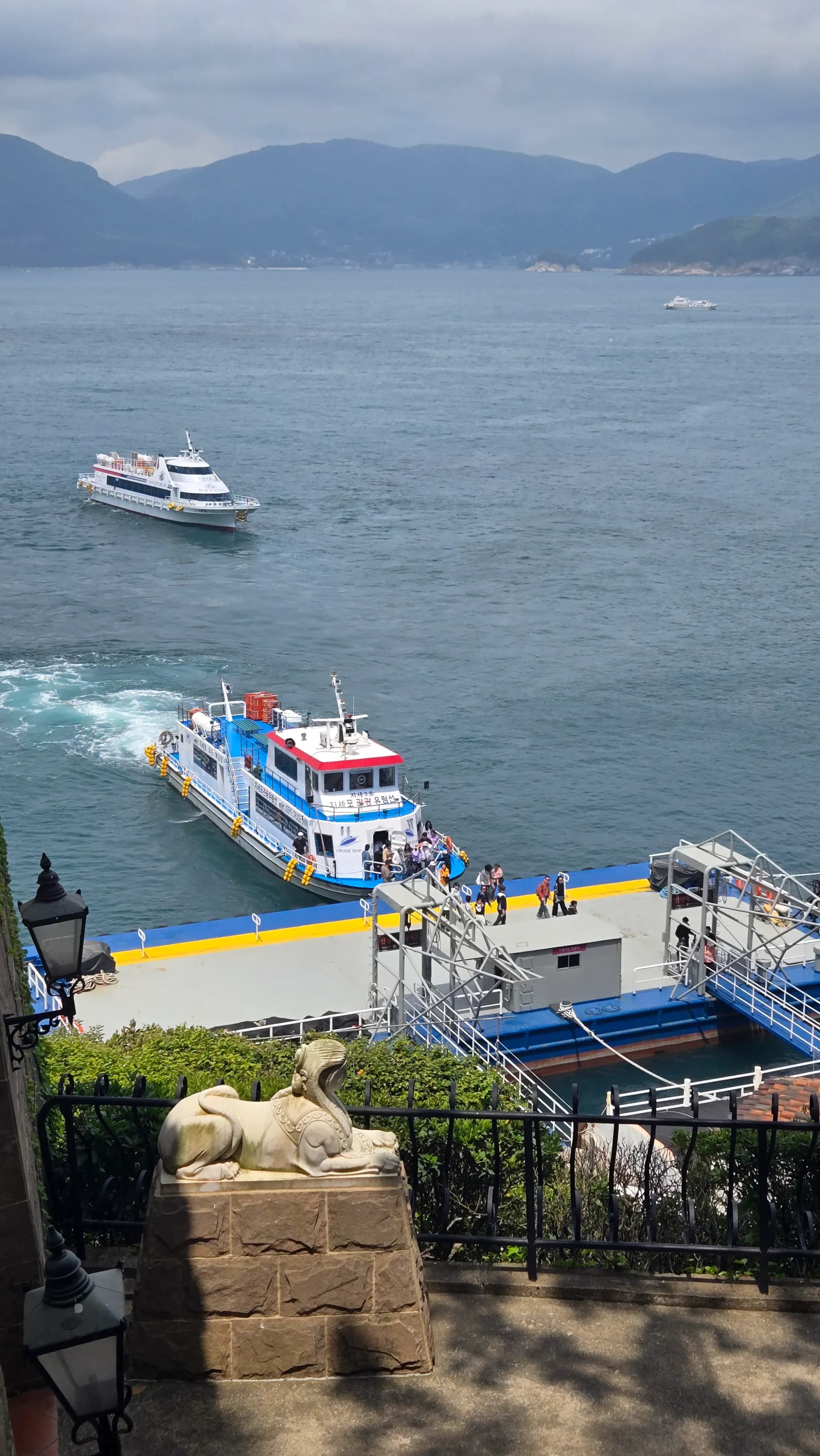
Down at the dock, boats were buzzing with activity. One was dropping off passengers, another was waiting at sea. Each one came from a different port. This is where that name tag I mentioned earlier becomes crucial. You need to find YOUR specific boat among all of those and get on it.
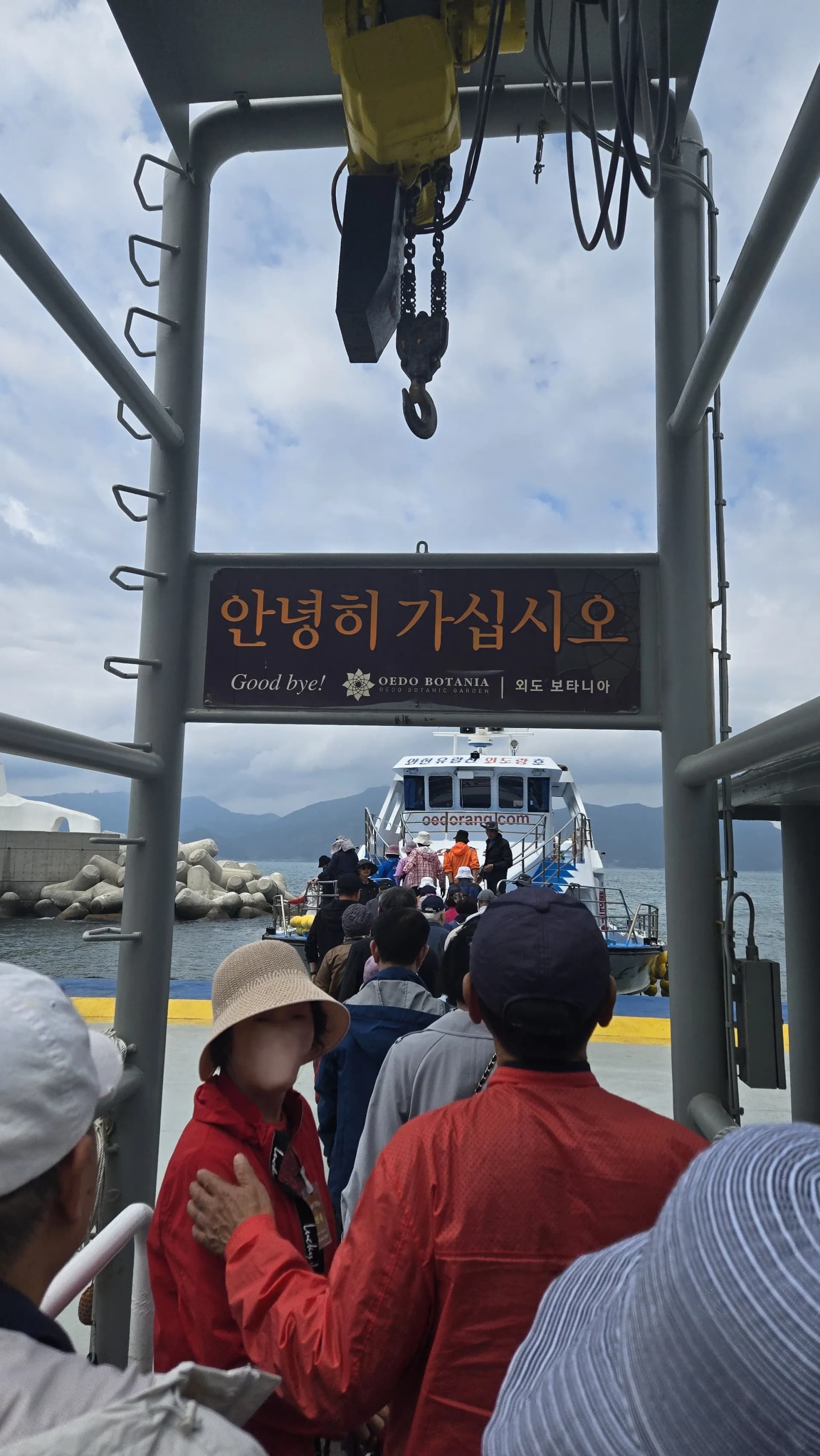
"Good bye!" The sign that said "Welcome" when you arrived flips to this on your way out. Seeing it gave me an unexpected pang of sadness.
I had no idea 2 hours would fly by that fast. Honestly, I'd initially assumed it was a small island and we'd see everything in no time. But looking back, we actually ran out of time. There were side paths we never explored, and I'd wanted to sit at a cafe and just watch the ocean for a while. For reference, there are two cafes inside Oedo Botania. One is the Venus Garden Cafe around the midpoint, and the other is a cafe called "Oh! Beautiful" near the summit — their shaved ice and Dutch coffee are apparently the signatures. The view is supposedly incredible, but we were too pressed for time to stop in. Next time, I'm definitely sitting down there for sure.
Best Season
Spring (March–May) and fall (September–November) are the best. In spring, daffodils, tulips, and azaleas are in full bloom. In fall, autumn foliage blends with palm trees for a truly unique landscape. Summer is honestly sweltering — you'll struggle without a parasol, portable fan, and ice water. Winter has fewer flowers, so it can feel a bit underwhelming compared to spring and fall.
Best Day of the Week
Weekdays during off-season are ideal. I went on a weekday and the crowds were manageable. On weekends or holidays, people pour in from all 5 ports and it turns into a sea of people. Taking photos becomes a hassle, and you might end up shuffling through narrow paths shoulder-to-shoulder with strangers.
Cost
You need both the cruise fare and the Oedo admission fee. Cruise fares vary by port (roughly $11–$16 per adult), and Oedo admission is about $8 for adults. Booking online in advance often gets you a discount, so search ahead of time. If you buy snacks or drinks at the cafes on the island, that's additional. Bring cash.
Time Required
Boat ride there + Haegeumgang scenic cruise + 2 hours exploring Oedo + boat ride back adds up to roughly 3–4 hours round trip. Factor in parking and buying tickets, and you should plan to spend half a day on the Oedo Botania experience.
Rules & Restrictions
The entire Oedo Botania island is a strict no-smoking, no-alcohol zone. Stepping into flower beds for photos is prohibited, and collecting plants or stones can get you kicked out. No outside food or drinks allowed. Pets are not permitted either.
A place I want to come back to
On the boat ride back, I asked my wife, "Want to come again?" The answer came immediately. "Let's come back in spring. When even more flowers are blooming." I was thinking the exact same thing. The fact that 2 hours felt too short means it was that good.
If you've made it all the way to Geoje Island and skip Oedo Botania, honestly, that's a waste. Having to take a boat to get there might seem like a hassle, but once you actually go, that inconvenience is exactly what makes this island feel so special. Because it's not easy to reach, the moment you arrive hits that much harder.
Next time I go, I want to grab a coffee at the cafe and just watch the ocean for a while, explore more side paths, and walk at a more leisurely pace.
Frequently Asked Questions (FAQ)
Q. How much is the Oedo Botania admission fee?▼
Oedo admission is about $8 for adults, $6 for middle and high school students, and $4 for children (25 months to elementary school age). The cruise fare is separate and varies by port. Cruise fares run roughly $11–$16 per adult. You can often get a discount by booking online in advance, so check ahead of time.
Q. Where do I catch the cruise to Oedo?▼
There are 5 ports on Geoje Island: Jangseungpo, Jisepo, Wahyeon, Gujora, and Dojangpo (Haegeumgang). Each port has different departure times and fares, so check before you go. If you're worried about seasickness, Gujora Port is your best bet — it's the closest to Oedo at just about 10 minutes.
Q. How long does the entire Oedo Botania visit take?▼
Free exploration time on the island is about 2 hours. Add the boat ride there, the Haegeumgang scenic cruise, and the return trip, and the whole thing takes roughly 3–4 hours round trip. Include parking and buying tickets, and you should set aside a solid half day.
Q. What's the best season to visit Oedo Botania?▼
Spring (March–May) and fall (September–November) are hands down the best. Spring brings daffodils, tulips, and azaleas in full bloom, while fall pairs autumn foliage with palm trees for a one-of-a-kind landscape. Summer is extremely hot and humid, draining your energy fast. Winter has fewer flowers, so it can feel a bit less spectacular compared to spring and fall.
Q. Can I bring food and drinks onto Oedo Botania?▼
Outside food and drinks are not allowed. There are 2 cafes and snack stands on the island. They sell Dutch coffee, shaved ice, ice cream, udon noodles, and other simple items. Just be warned — prices are tourist-level steep, and some vending machines don't accept cards, so bringing cash is a smart move.
Q. I get really seasick — will I be okay?▼
It depends on sea conditions, but the southern coast generally doesn't have severe waves. If you're still worried, motion sickness pills are available at the cruise ticket counter for about $1. Staying inside the cabin can make you feel queasy, so going up to the open deck for fresh air helps a lot. For those who are really sensitive, Gujora Port is the way to go — the ride to Oedo is only about 10 minutes.
Q. Is the island accessible by stroller or wheelchair?▼
Honestly, it's very difficult. The island's terrain is hilly with lots of inclines and stairs, and there are no elevators or wheelchair ramps. If you have mobility challenges or need a stroller, please factor this in seriously before planning a visit.
This post was originally published on https://hi-jsb.blog.