Hidden Hanok Village Walk — Korea's Quietest Secret
Table of Contents
14 items
When people think of hanok villages in Korea — those clusters of beautiful traditional tile-roofed houses — the usual names come up: Jeonju, or Bukchon in Seoul. But there's a quiet residential neighbourhood with no tourists, no entry fee, and real people actually living in traditional houses, tucked away in Sejong, Korea's newest administrative capital about 90 minutes' drive south of Seoul. It's called Goun-dong Hanok Village (세종 고운동 한옥마을). Roughly 46 hanok houses sit together in a small residential pocket, and if you're coming from Daejeon — a major city about 30 minutes south of Seoul by KTX — it's barely a 30-minute drive. If you fancy a quiet traditional architecture walk without the selfie-stick crowds, or you're on a long drive between Seoul and Busan and want somewhere nicer than a motorway service station to stretch your legs, this is the spot.
My wife and I visited last autumn. We live fairly close, yet had no idea a hanok village was there until embarrassingly recently. That's the thing about Sejong — even most Koreans go, "What's actually there?" It has a strong reputation as a soulless new town full of government buildings and tower blocks. On this particular day, we popped into a hanok cafe called Hemel right next to the village first, then wandered through the lanes on our way out. I'll write a separate review of the Hemel cafe, but in brief — it's a traditional house converted into a tea and dessert spot, and it's perfectly placed to pair with a village stroll.
Traditional tile-roof lanes in the middle of a new town
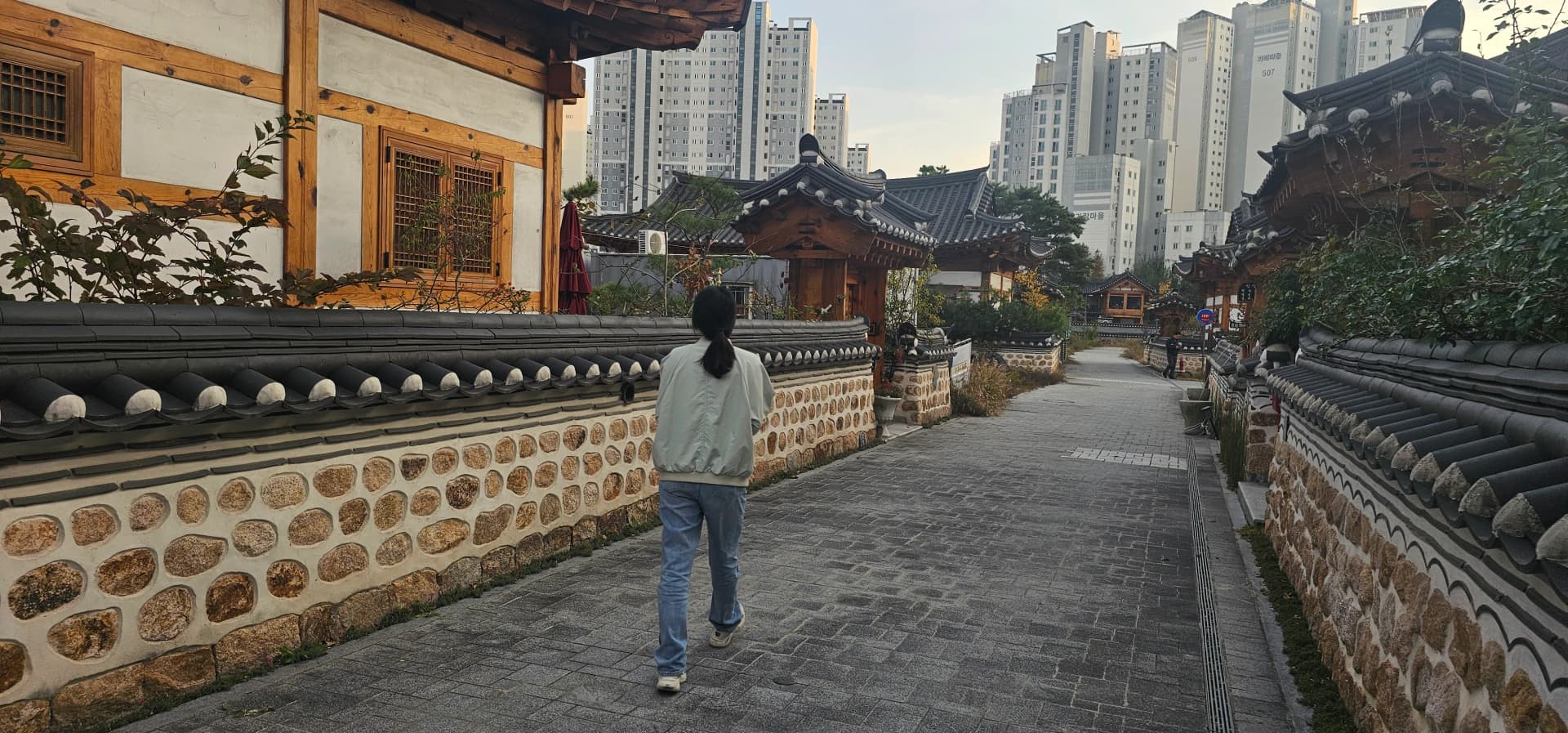
Goun-dong Hanok Village is a pocket of about 46 traditional Korean houses built to strict heritage guidelines, sitting in the middle of Sejong's modern new-town district. The moment you step into the inner lanes, low stone walls run along both sides and curved tile roofs fill your line of sight. But lift your head and there's a 20-storey apartment block standing right behind. That's the first impression — undeniably a new town, yet the air inside these lanes feels different. My wife turned to me and said, "Are we really still in a new town?" I was thinking the exact same thing.
Walking between stone walls and dried hydrangeas
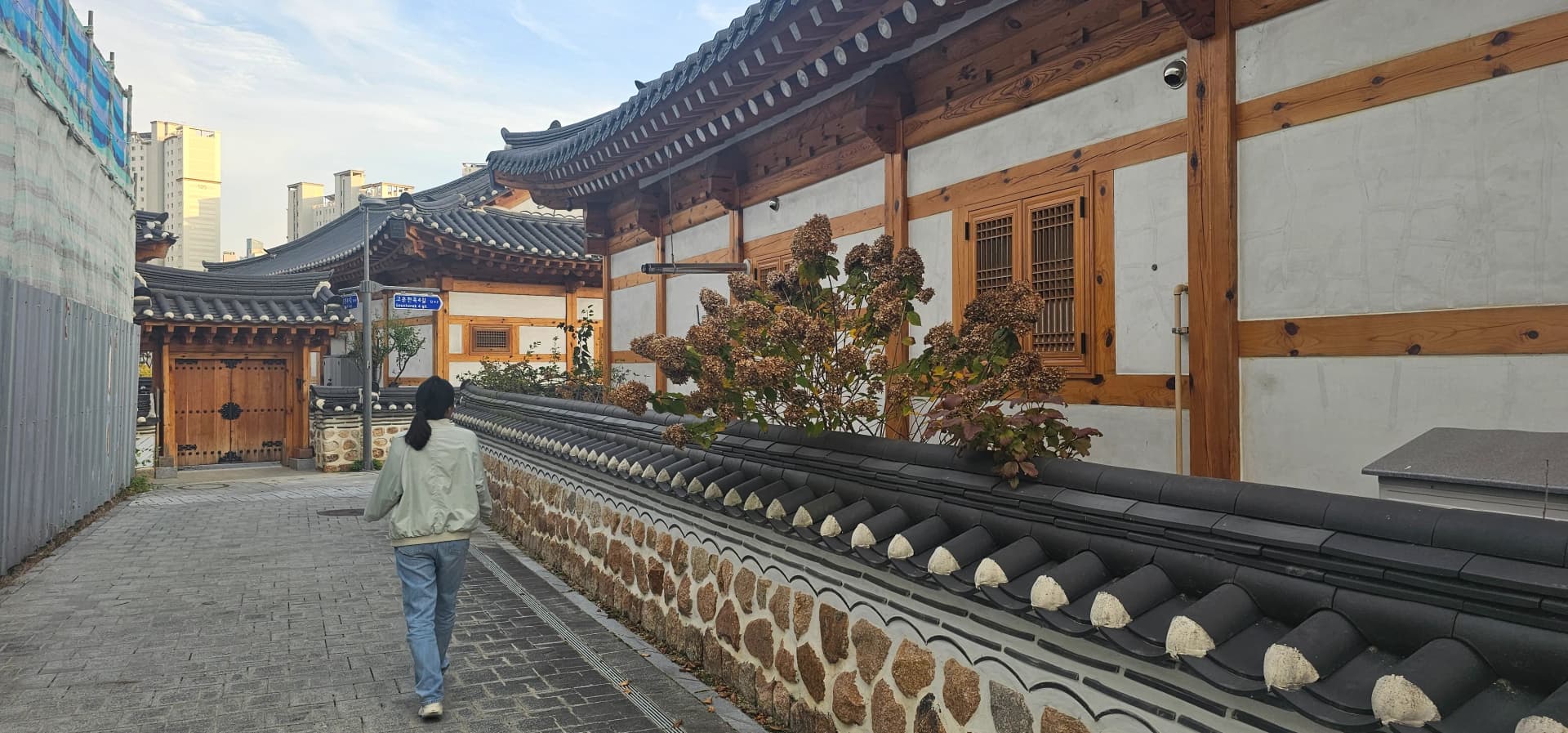
Go a bit further in and the tower blocks gradually disappear from view. Instead, dark-tiled stone walls stretch ahead on both sides, and dried hydrangea heads poke over the top of the walls. In summer these would have been a brilliant blue, but it was late autumn, so they were all dried to a crisp brown. Oddly enough, that had its own charm — hanok walls with papery dead hydrangeas, beautiful in a way nobody was bothering to notice. The lane was so quiet that the only sound was our footsteps on the stone path. It felt a bit like stumbling into a Cotswolds village lane, except the rooflines were Korean and the silence was somehow even deeper.
Not a tourist attraction — a real neighbourhood where people live
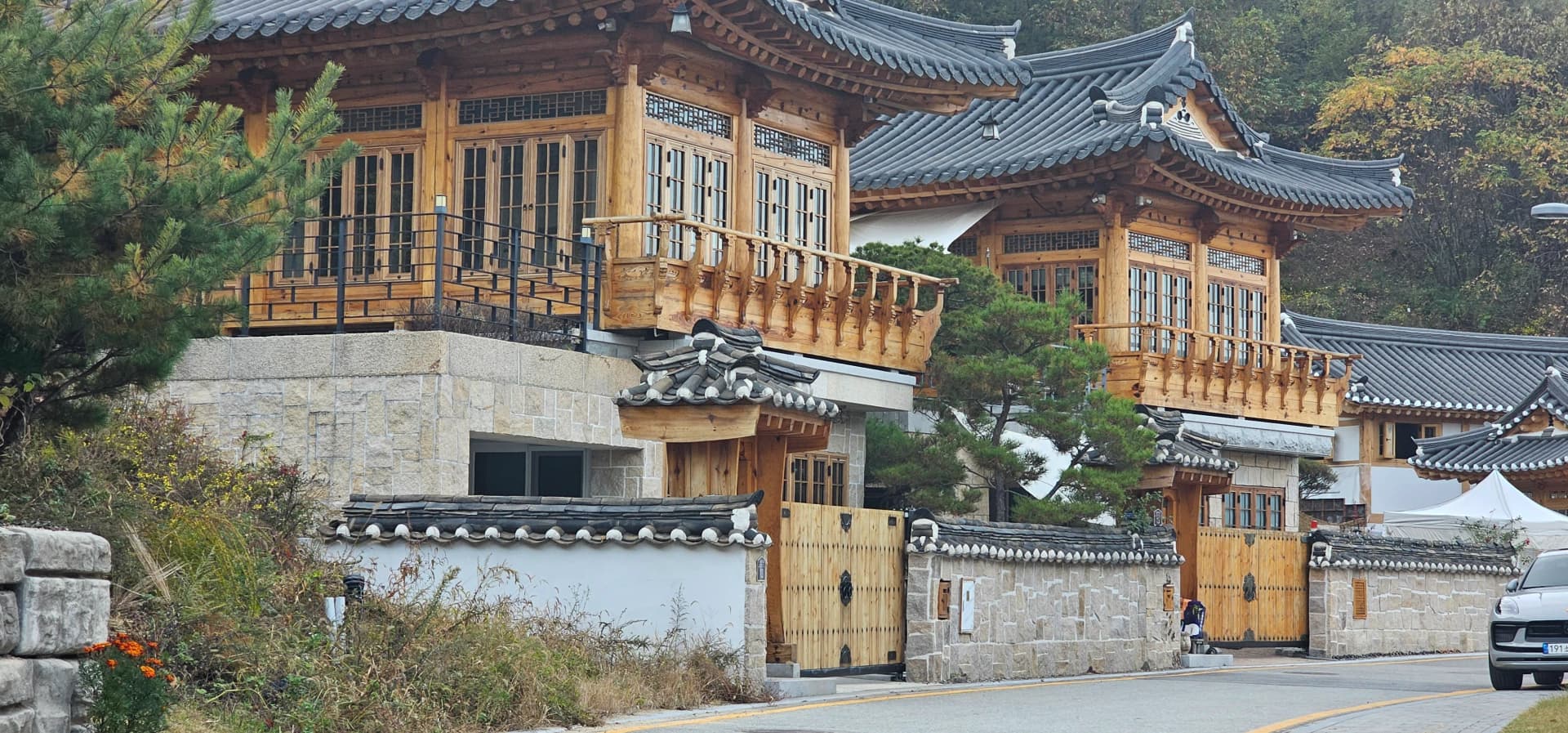
This is genuinely someone's home. A two-storey hanok with a wooden-railed balcony — at first glance you'd think it's a boutique guesthouse or a heritage site, but people actually live here. What makes this place special is that these aren't preserved old houses. They were purpose-built from scratch in a traditional hanok style, following official design guidelines covering structure, roofing and boundary walls. That's why the entire village has a cohesive look — not a single building jars with the rest.
If you've travelled around Korea, you'll have noticed how quickly old buildings get demolished to make way for new apartment towers. Outside palaces and temples, it's genuinely rare to encounter traditional architecture in everyday life. In that sense, Goun-dong is an unusual example of traditional Korean aesthetics applied to modern residential living — homes people actually come back to each evening, not buildings roped off behind a museum ticket counter.
Pine trees and tile roofs on stone terraces
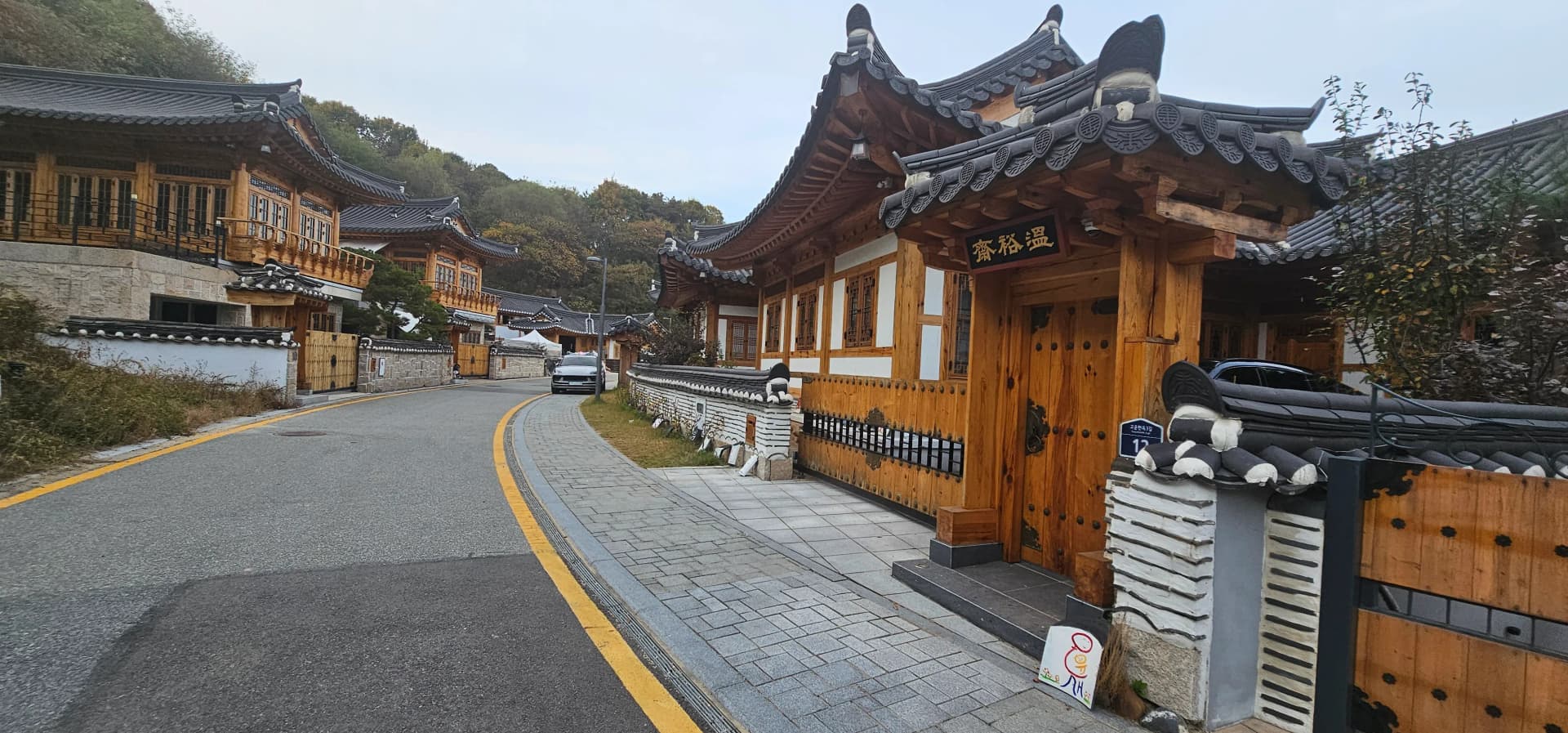
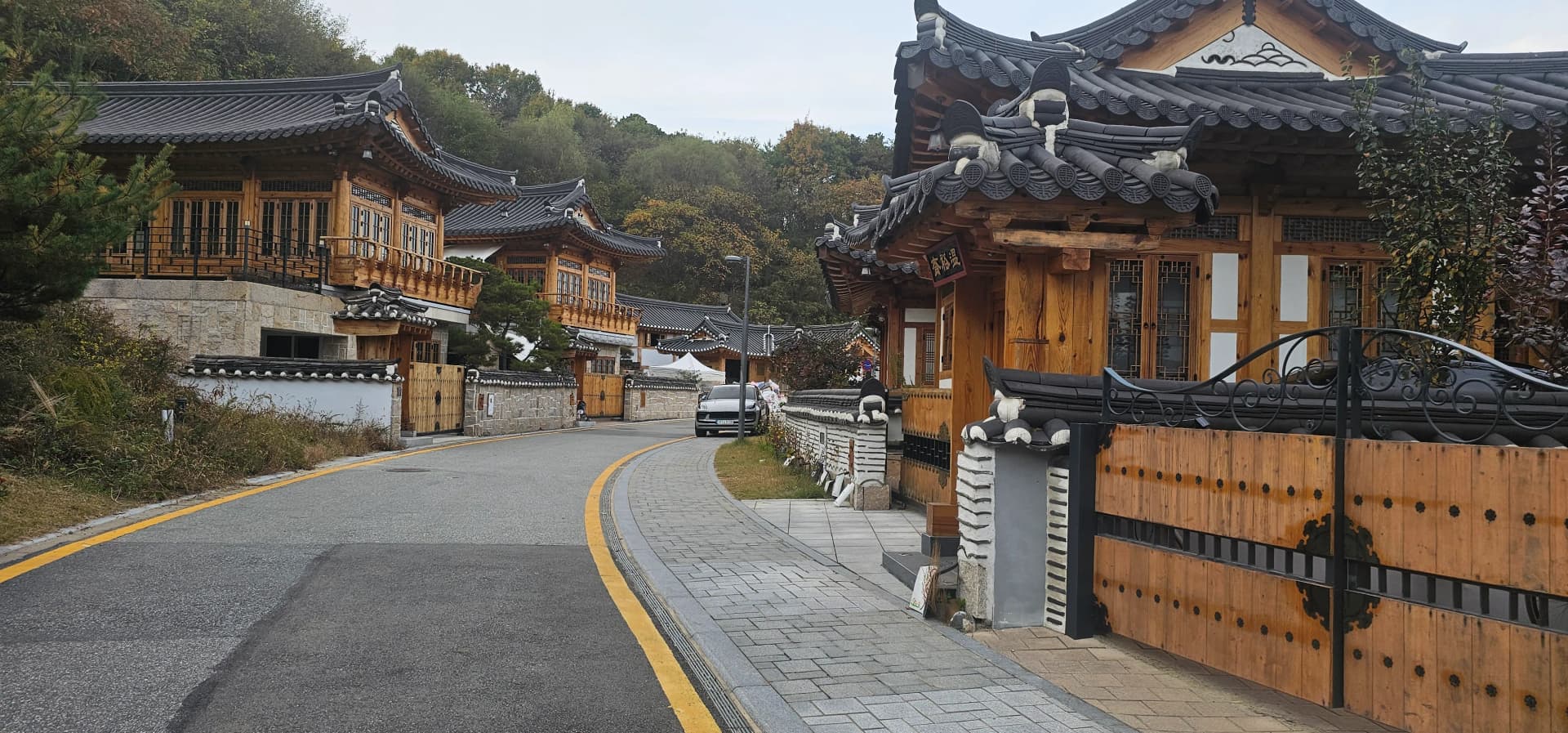
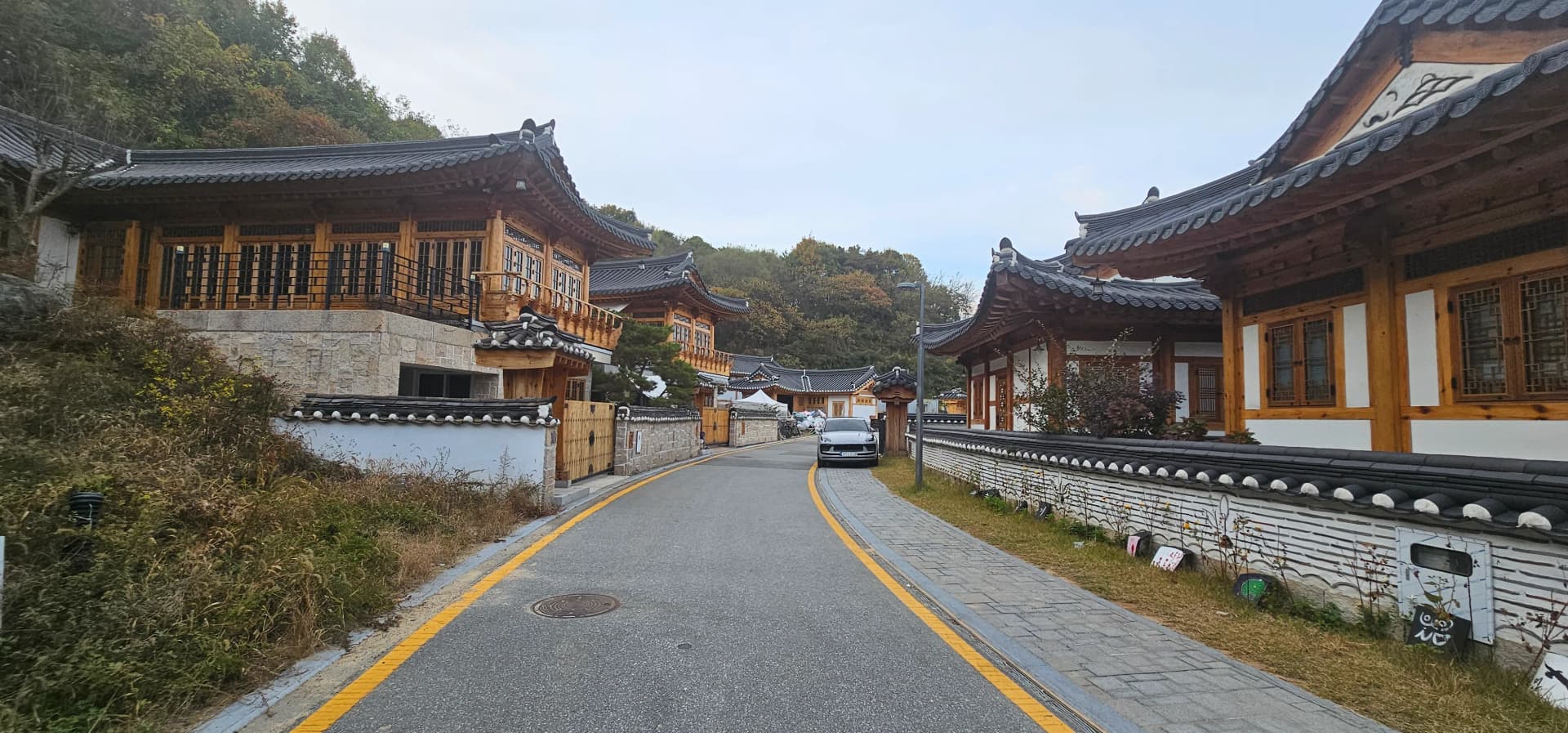
The tile-roof lines visible through the pine trees, the timber frames sitting atop stone terracing — the craftsmanship is convincing and there's nothing half-hearted about it. If you've only ever seen traditional Korean houses in photos, this is probably the cleanest way to see the real thing in person. Not a hanok dressed up for tourists, but one that somebody actually walks into with their shopping bags every day.
The outer road — a hillside neighbourhood that looks like a hanok resort
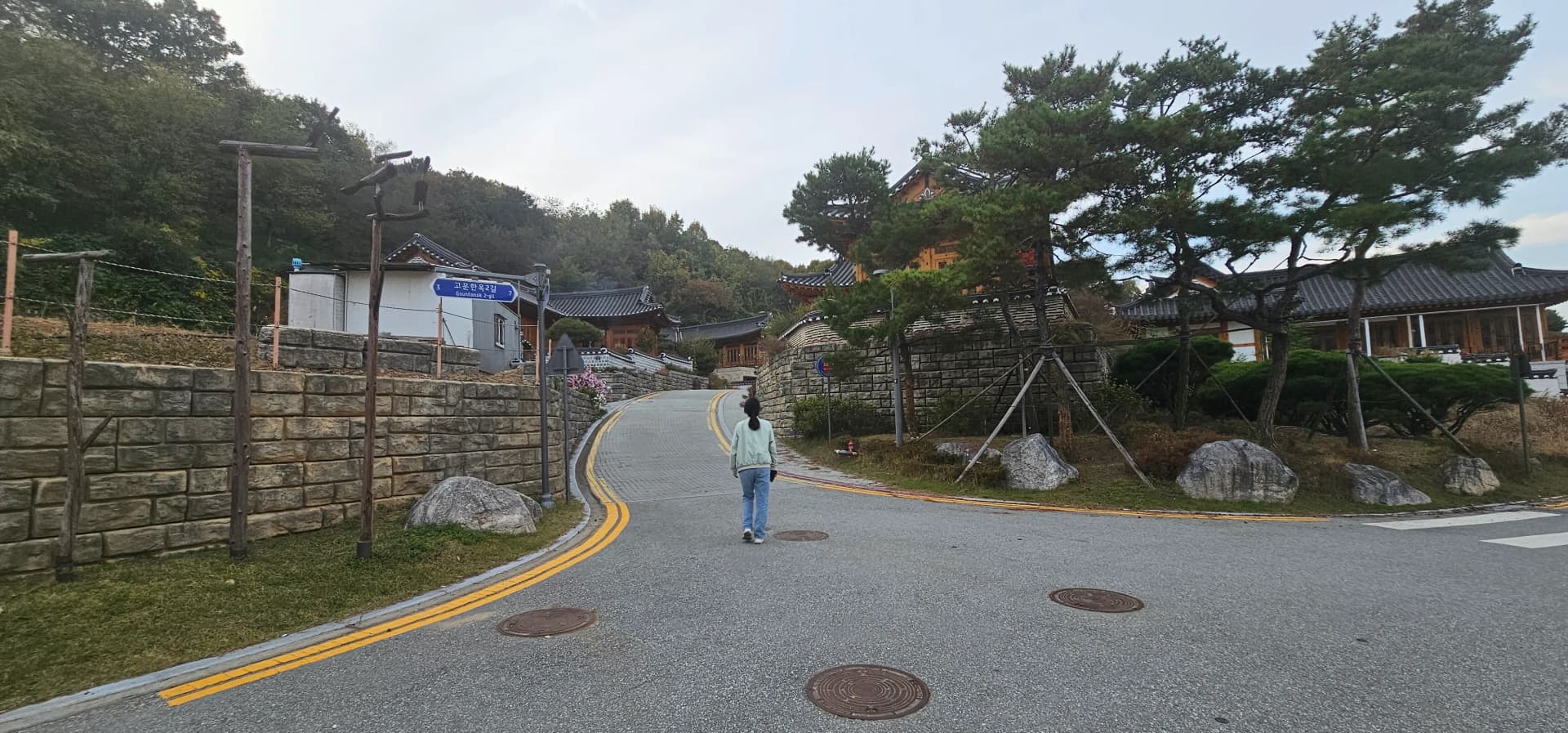
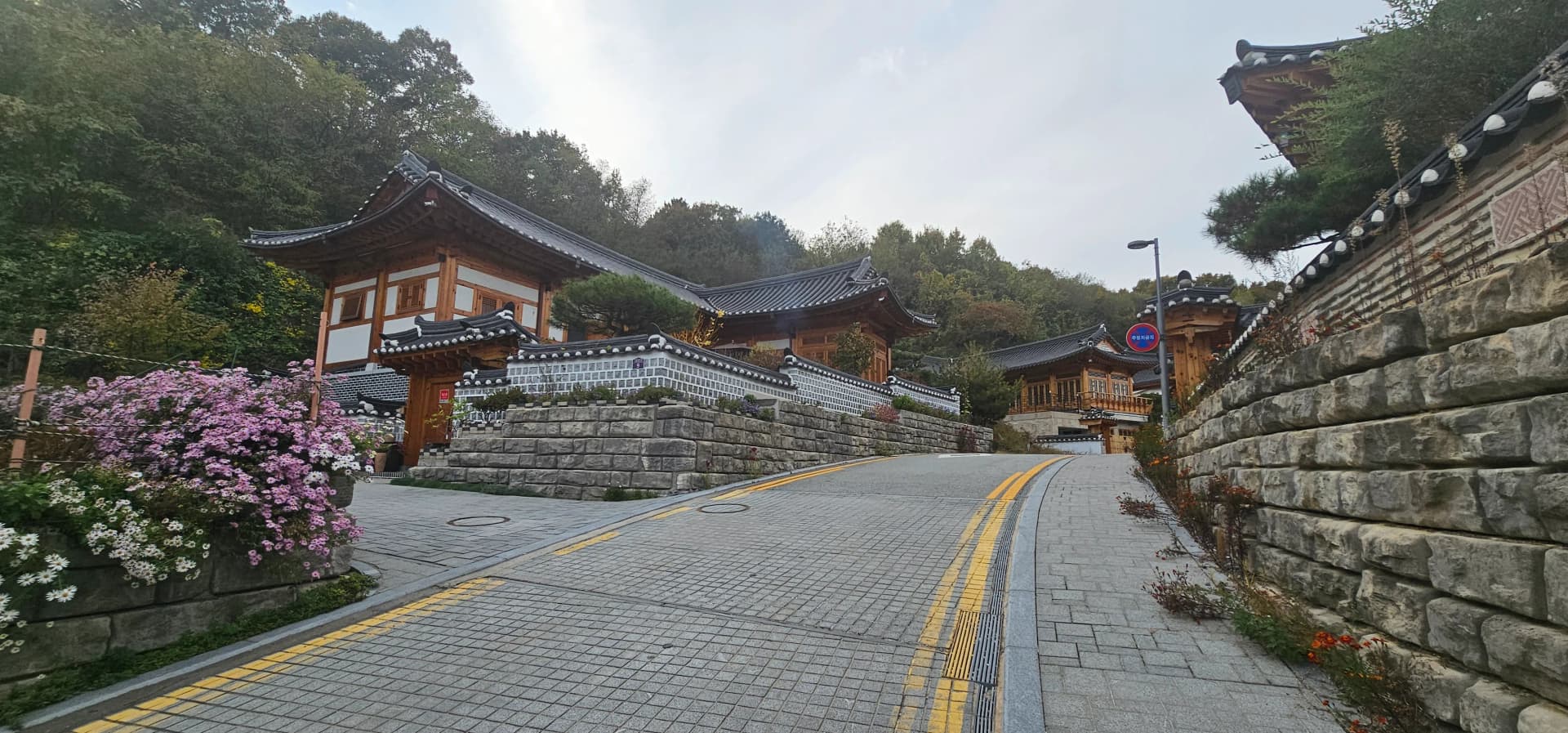
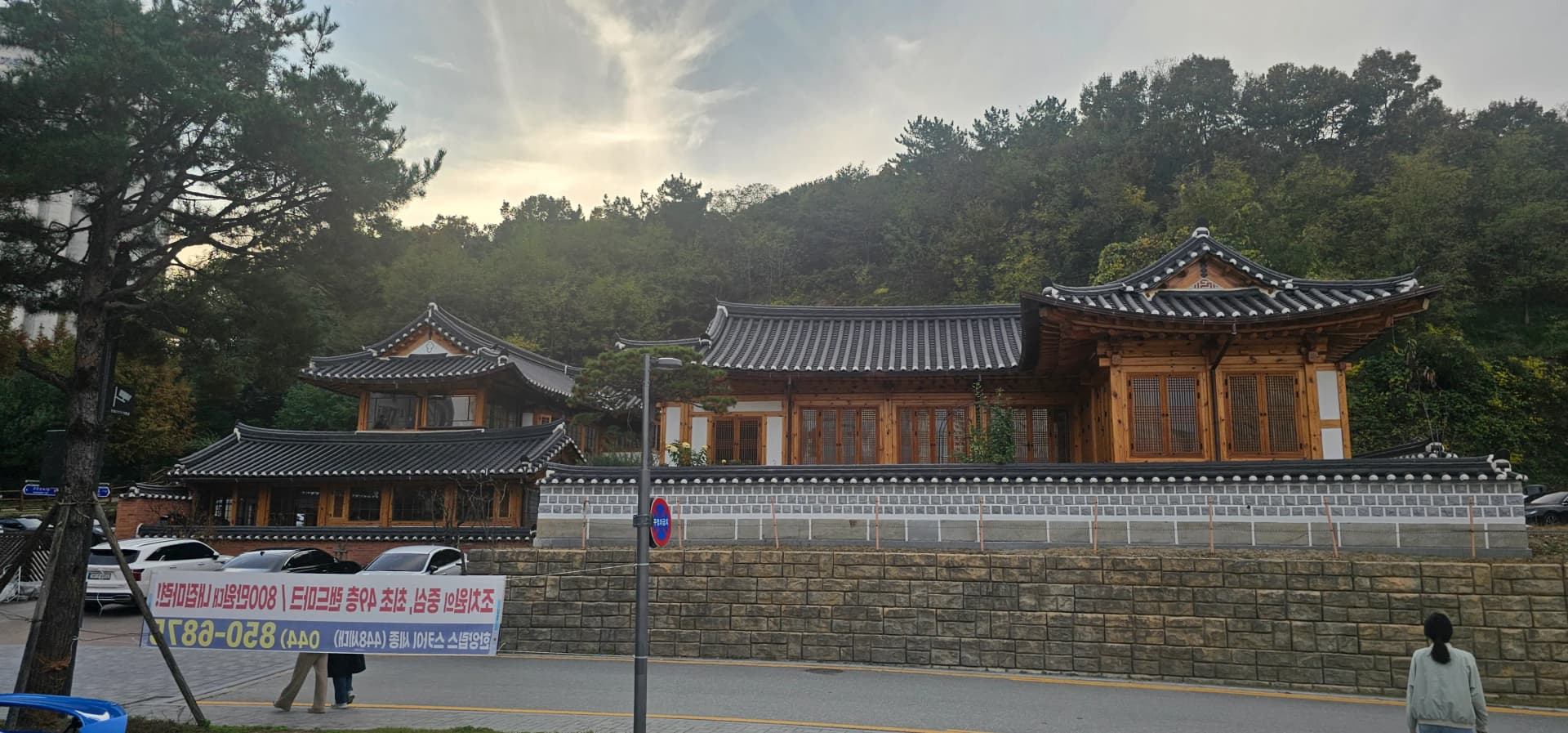
Come out to the outer road and the feel changes. The inner lanes were narrow and intimate between stone walls, but out here the road is wider and hanok houses climb up the hillside on both sides. Each front gate has the house name written in Chinese characters, and two-storey hanok sit up on stone terraces — honestly, my first thought was that it looked more like a hanok resort than a residential street. But see that car parked in front of the gate? That belongs to someone who lives here.
Behind the houses, the hillside was just starting to turn with early autumn colour, and the way it layered against the tile-roof line was rather picturesque. There was nobody on the road but us. Quiet doesn't even cover it — it was borderline awkward, like we'd wandered into someone's private estate. But the village is set up to welcome walkers, so there's no need to feel guilty about having a wander.
The hilltop edge of the village — the best spot for photos
Follow the road uphill and you reach the far edge of the village. From here the wooded hillside sits right behind the houses, so the view shifts from "hanok between apartment blocks" to "hanok nestled into a mountainside." It actually felt more like a countryside nobleman's estate than a suburb. There were azalea bushes blooming in a cluster beside the stone terracing — just sitting there on a path nobody walks, which felt like a bit of a waste. The combination of hanok walls, pink flowers and green hillside behind made this the best spot for photographs. But hardly anyone comes up this far. Most visitors only get as far as the cafe near the entrance and turn back, so we had this whole upper section entirely to ourselves.
Golden hour silhouettes along the rooftops
Looking up from the lower road, two or three hanok sit side by side on the stone terrace above, and because the sun was just dropping behind the hill, the rooflines were backlit into clean silhouettes. The timing was spot on. If you visit in the late afternoon, you'll catch this kind of scene. It's honestly worth planning your visit around this light — arriving between 2pm and 5pm gives you the best chance of golden-hour photos along the rooftops.
Wall details — things you only notice when you slow down
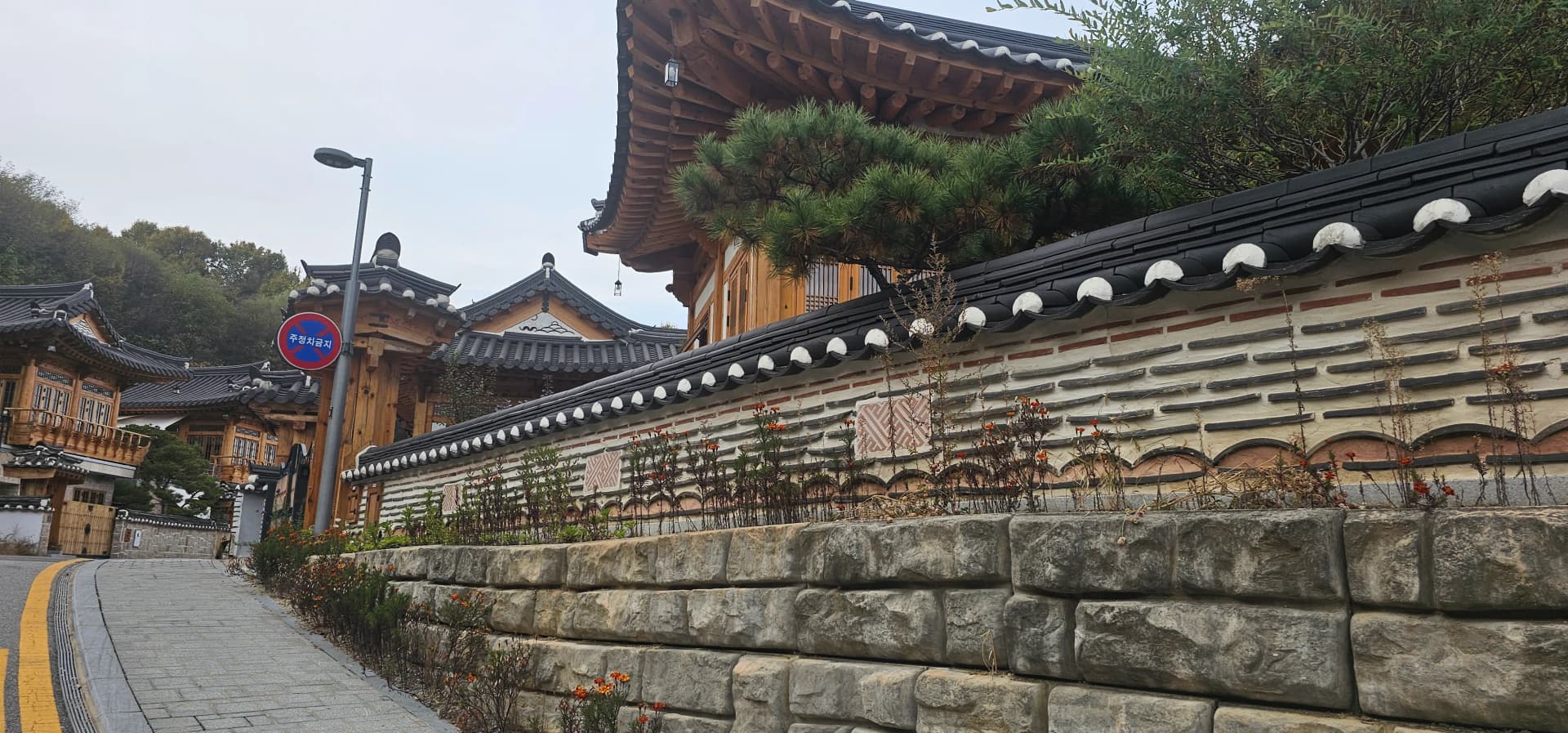
I noticed the wall detailing and went in for a closer look. The boundary walls use a traditional technique of mixing broken tile pieces with brick to create geometric patterns, with pine trees jutting out above and small flowers planted at the base. These are the sort of details that don't show up well in photos — you only really catch them when you're there, walking slowly with nothing else competing for your attention.
Parking warning — don't leave your car inside the village
One thing to flag: most roads inside the village are no-parking zones. In Korea, if you park where these signs are posted, you will get fined. If you've hired a car, don't leave it on the village lanes — use the car park at Hemel cafe or the public car park in the centre of the village instead. The lanes look charming and you might be tempted to just pull over, but you could find a fine waiting for you when you return the rental. I parked at Hemel's car park and there were plenty of spaces.
Hanok and new town in a single frame
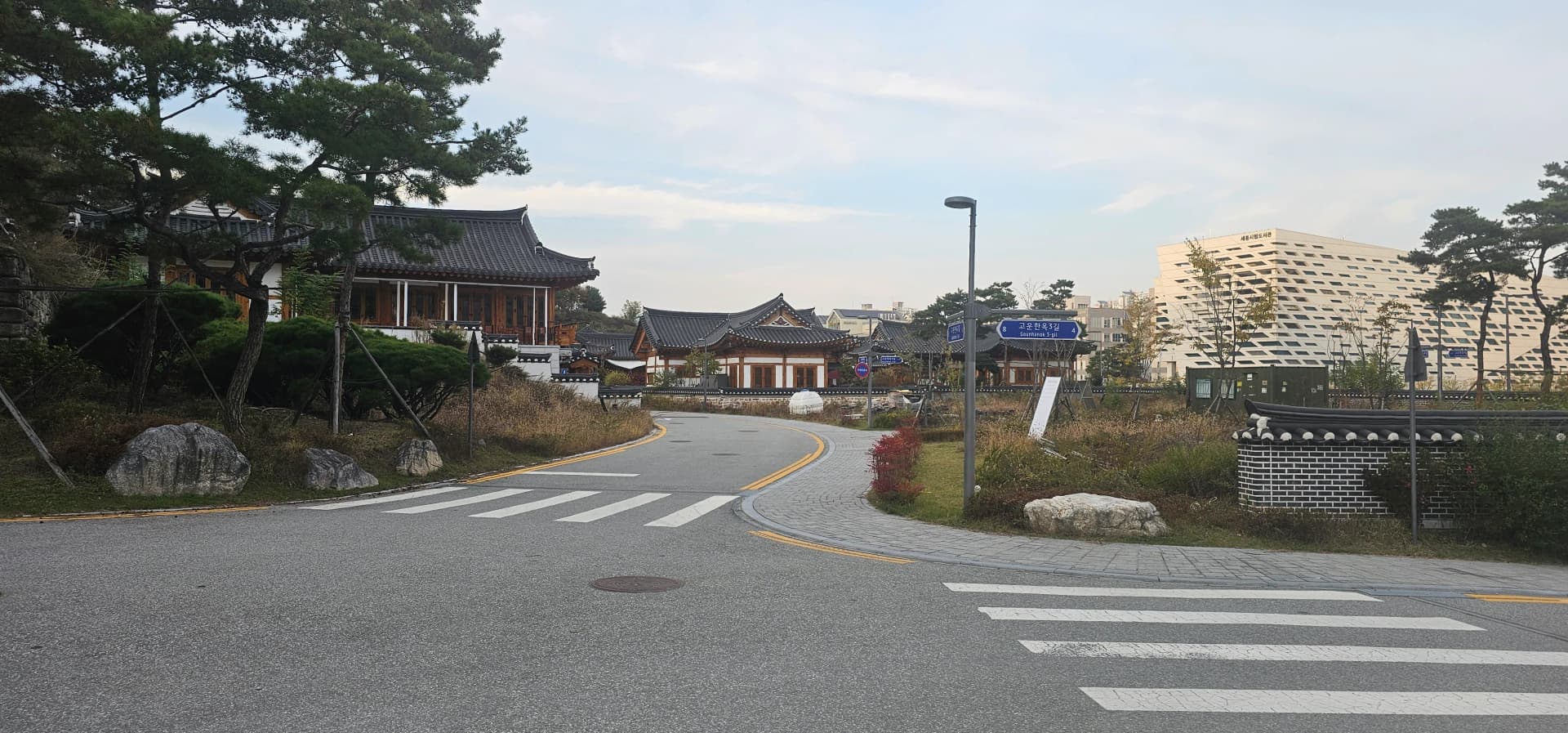
Step back from the village entrance and you get this: pine trees and hanok rooflines on the left, a modern building poking up in the distance on the right. That single view basically sums up Sejong as a city. Having a traditional village and a new town coexist in the same frame is the defining character of this neighbourhood. Cross one pedestrian crossing and it feels like you've stepped into a different century — a genuinely odd sensation.
Is it worth a visit — honest verdict
I'll be honest: this village alone isn't worth a dedicated trip all the way to Sejong. It's small — you can walk the entire thing in about 20 minutes. But if you're already passing through, the story changes. Anyone driving from Seoul towards Busan, Gwangju or Daejeon will pass through the Sejong area. Come off the motorway and you're here in 10 to 15 minutes, so instead of another service-station coffee, you spend 30 minutes to an hour stretching your legs through hanok lanes and having a proper cup of tea at the cafe next door. That's the sweet spot.
If you live nearby like I do, it's a lovely low-key outing for an afternoon wander. If you're passing through on a trip, it's a pleasant detour — walk the lanes, have a cuppa, get back on the road. It's not a place that's been dressed up to impress visitors. It's a real neighbourhood you walk through quietly, and that's precisely the charm of Goun-dong Hanok Village.
How to get to Goun-dong Hanok Village
📍 Address
Goun Hanok-gil area, Goun-dong, Sejong Special Autonomous City, South Korea
Goun Hanok-gil, Goun-dong, Sejong Special Autonomous City, South Korea
🔍 Navigation search terms
Search "세종 한옥마을" or "고운동 한옥마을" or "헤이믈 카페" (Hemel Cafe) in Naver Map or Kakao Map
🅿️ Parking
Use Hemel Cafe car park (free with cafe purchase). A free public car park is also available at the village centre.
Park at Hemel Tea House (free with cafe purchase). Free public parking also available at village center. Street parking inside the village is prohibited — fines apply.
🎟️ Entry fee
Free
🚗 Driving times from major cities
Seoul → approx. 1.5–2 hours (via motorway)
Daejeon → approx. 30 minutes
Sejong city centre → approx. 10 minutes
🚶 Walking time
Full village loop: approx. 20 minutes. Including the cafe, allow 1–1.5 hours.
📸 Best time to visit
Afternoon, 2–5pm, for golden-hour backlit rooftop shots. Weekdays are much quieter than weekends.
Worth visiting nearby
If the village alone feels a bit quick, there's enough nearby to fill a solid half-day. Here's what's within easy reach.
Hemel Hanok Cafe (헤이믈 한옥카페)
Right next to the village. Traditional tea, coffee and desserts served inside a hanok building. The car park is spacious, making it the easiest place to leave your car when visiting the village. Separate review coming soon.
Address: 3 Goun Hanok 1-gil, Sejong | Hours: Weekdays 09:30–18:00 / Weekends 10:00–20:00
Hemel on Instagram →National Sejong Arboretum (국립세종수목원)
Korea's first urban arboretum. The four-season greenhouse is genuinely impressive, and the outdoor gardens are expansive. About a 10-minute drive from the hanok village.
Address: 136 Sumogwon-ro, Sejong | Entry: Adults £3 / Teens £2.50 / Children £2 | Closed Mondays
Summer 09:00–18:00 / Winter 09:00–17:00
National Sejong Arboretum official site →Sejong Lake Park (세종호수공원)
One of the largest man-made lake parks in Korea. Walking paths, cycle lanes and a floating stage. Free entry, free parking. About a 5-minute drive from the hanok village.
Address: 216 Dasom-ro, Sejong | Open: 05:00–23:00 (year-round)
Suggested half-day itinerary
Goun-dong Hanok Village half-day itinerary
Arrive at Hemel Cafe → park → tea or coffee (approx. 40 mins–1 hour)
Stroll through Goun-dong Hanok Village (approx. 20–30 mins)
Drive to National Sejong Arboretum or Sejong Lake Park (5–10 mins by car, approx. 1–2 hours)
Lunch in Sejong, then head to your next destination
This post was originally published on https://hi-jsb.blog.