
Spicy Korean Dakgalbi: The Ultimate Guide
Table of Contents
19 items
Welcome to the World of Dakgalbi
Today I want to introduce one dish I genuinely, wholeheartedly recommend to anyone visiting Korea: dakgalbi. This spicy Korean stir-fried chicken is one of those meals I can confidently say you absolutely must try at least once while you're here. Trust me on this one.
What Exactly Is Dakgalbi?
Before the Heat Hits — The First Look at Dakgalbi
How It Looks on the Griddle Before Cooking
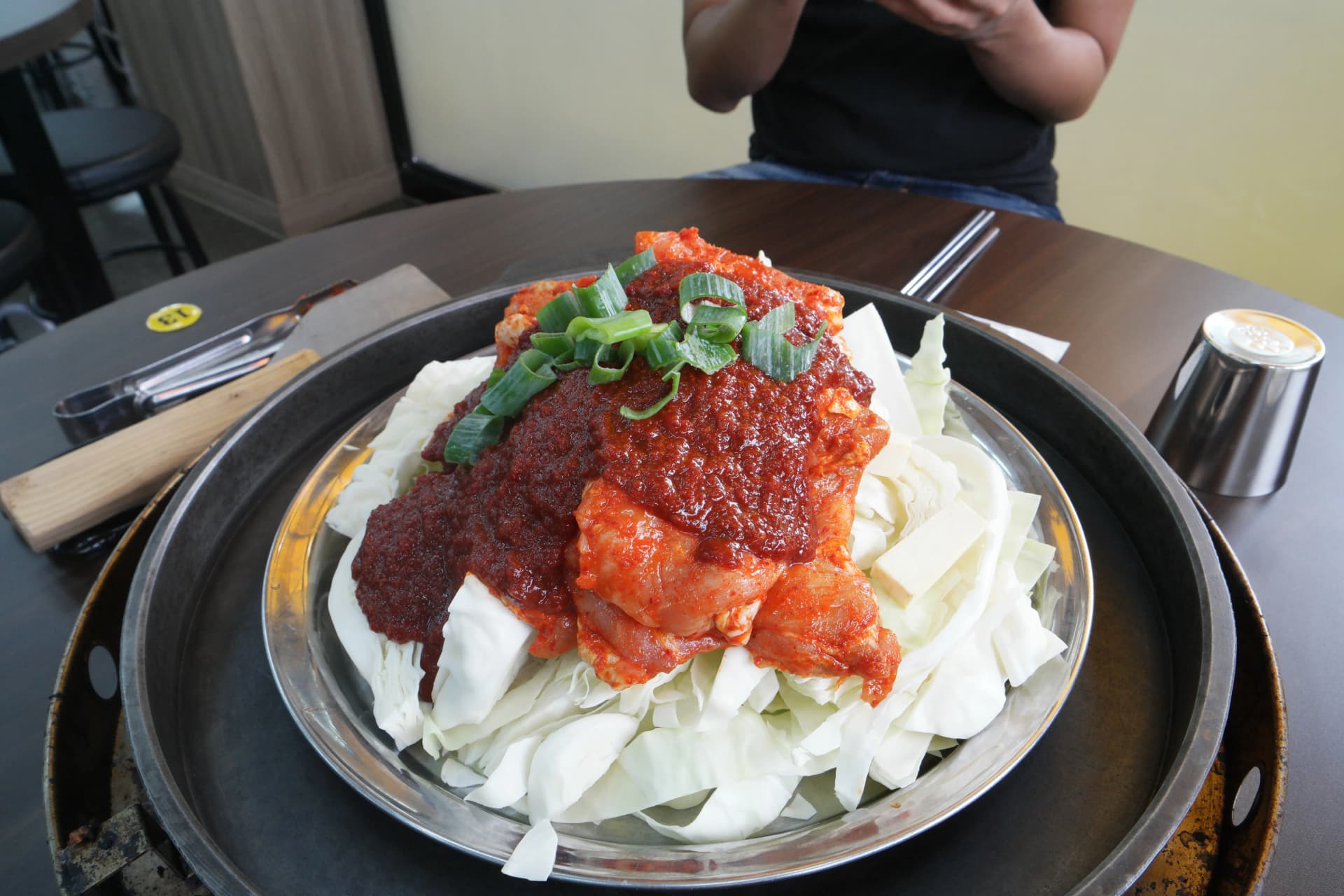
The food has arrived at the table and the burner isn't even on yet. But look at that portion size — it's already overwhelming. The white layer at the very bottom of the griddle is cabbage. Piled on top of that, slathered in that vivid red sauce, is the marinated chicken. That red sauce is the heart of the whole dish — it's a gochujang-based marinade. Gochujang is a Korean fermented chili paste, and the easiest way to think about it is like the Korean equivalent of ketchup: it's a foundational condiment used in all kinds of Korean cooking. If you love spicy food, just looking at this is enough to make your mouth water. If you're not a heat person, it might look a little intimidating — but don't worry, spice level can be adjusted when you order.
A Closer Look at the Gochujang Marinade
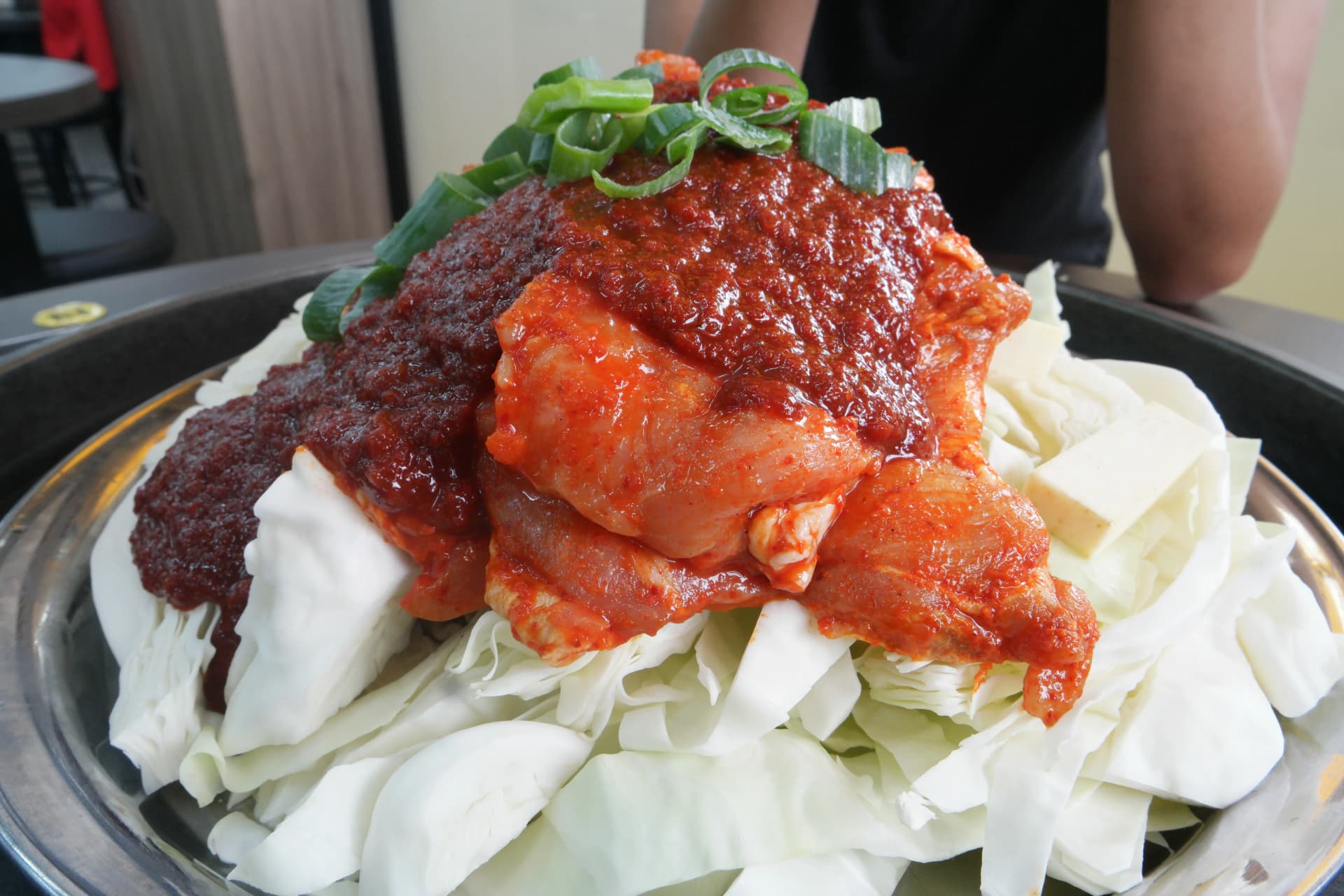
Up close, you can really see it — that thick, deep-red mound sitting on top of the chicken is the gochujang marinade. Doesn't it look like a volcano about to erupt? Right now it's still raw, but once this hits the heat, the marinade melts down and spreads across the entire griddle, coating the chicken and cabbage in one gorgeous, glossy sauce. And those white cube-shaped pieces you can see on the side? Those are tteok — Korean rice cakes. They're chewy, slightly dense, and when they soak up that spicy marinade, the combination is honestly way better than you'd expect going in.
The Marinade Is More Than Just Sauce
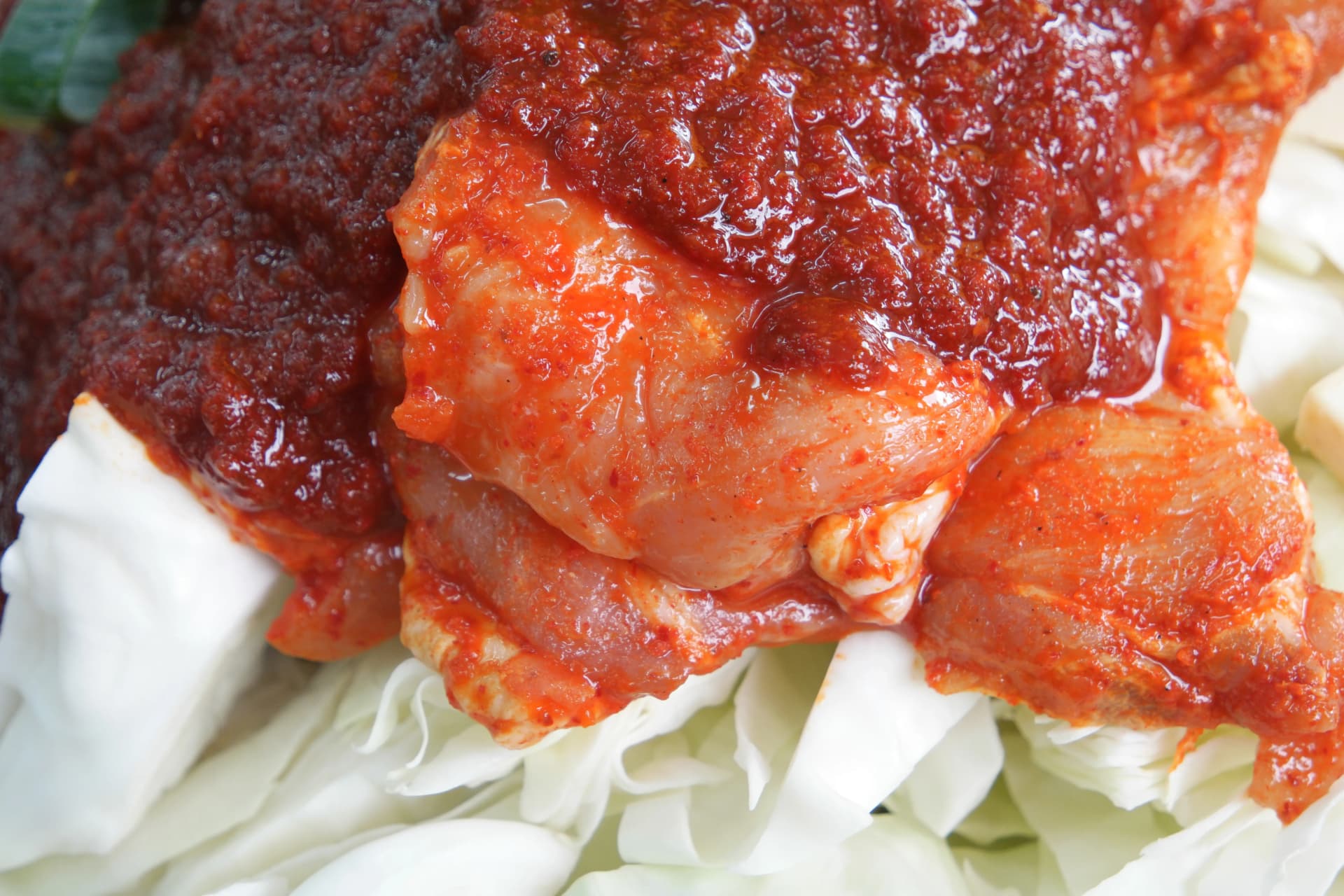
See how thick that marinade coating is on the chicken? This isn't just a quick sauce drizzle right before serving. The chicken has been soaking in this marinade for at minimum a few hours — often from the day before. So even before cooking begins, the flavor has already worked its way deep into the meat.
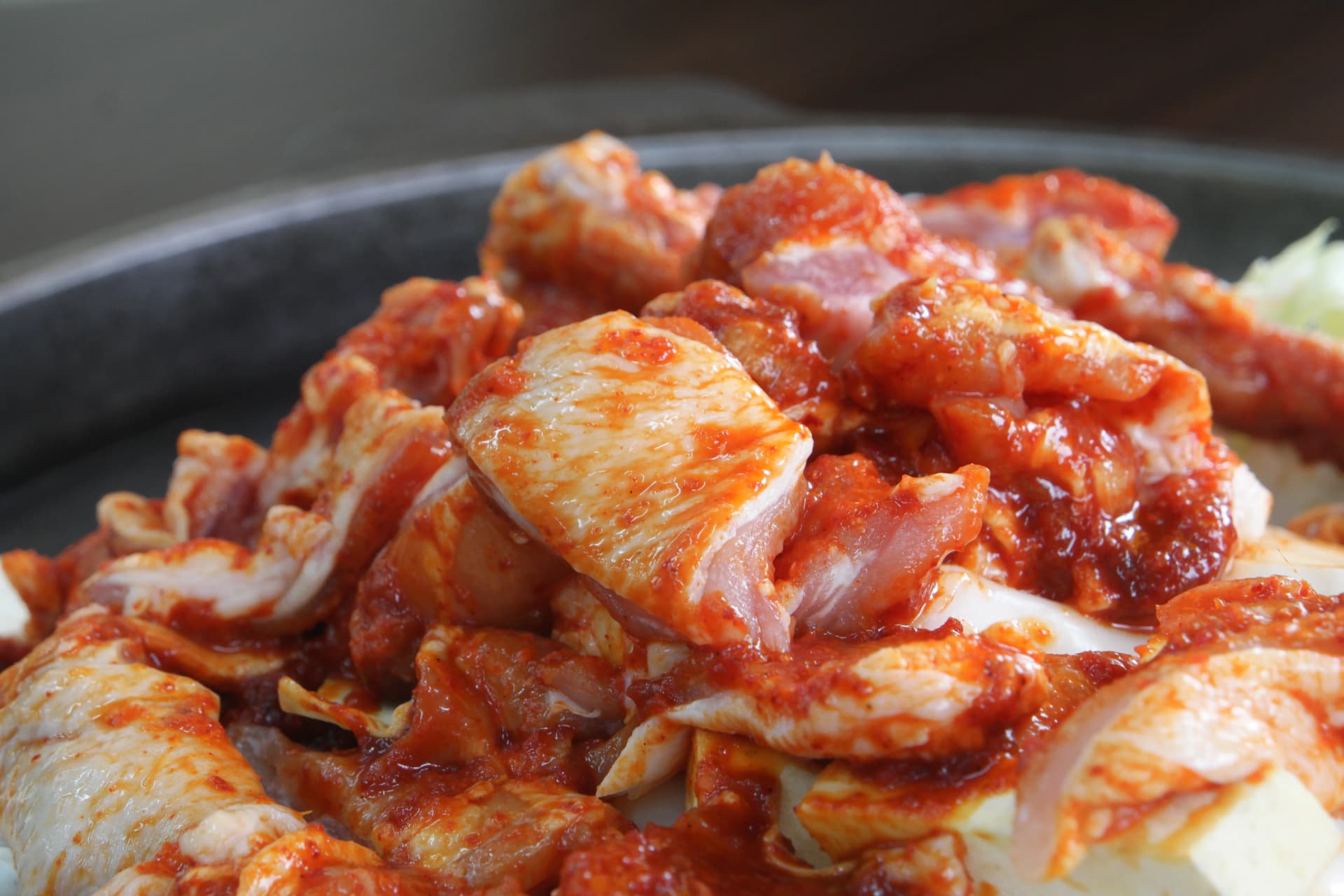
Look at how generously the chicken is cut. In Korea, dakgalbi typically uses a combination of boneless chicken thigh and chicken breast. The thigh meat is tender and naturally juicy, while the breast is leaner and milder in flavor. Having both cuts in the same dish means you get two completely different textures in one serving — and the contrast works really well together.
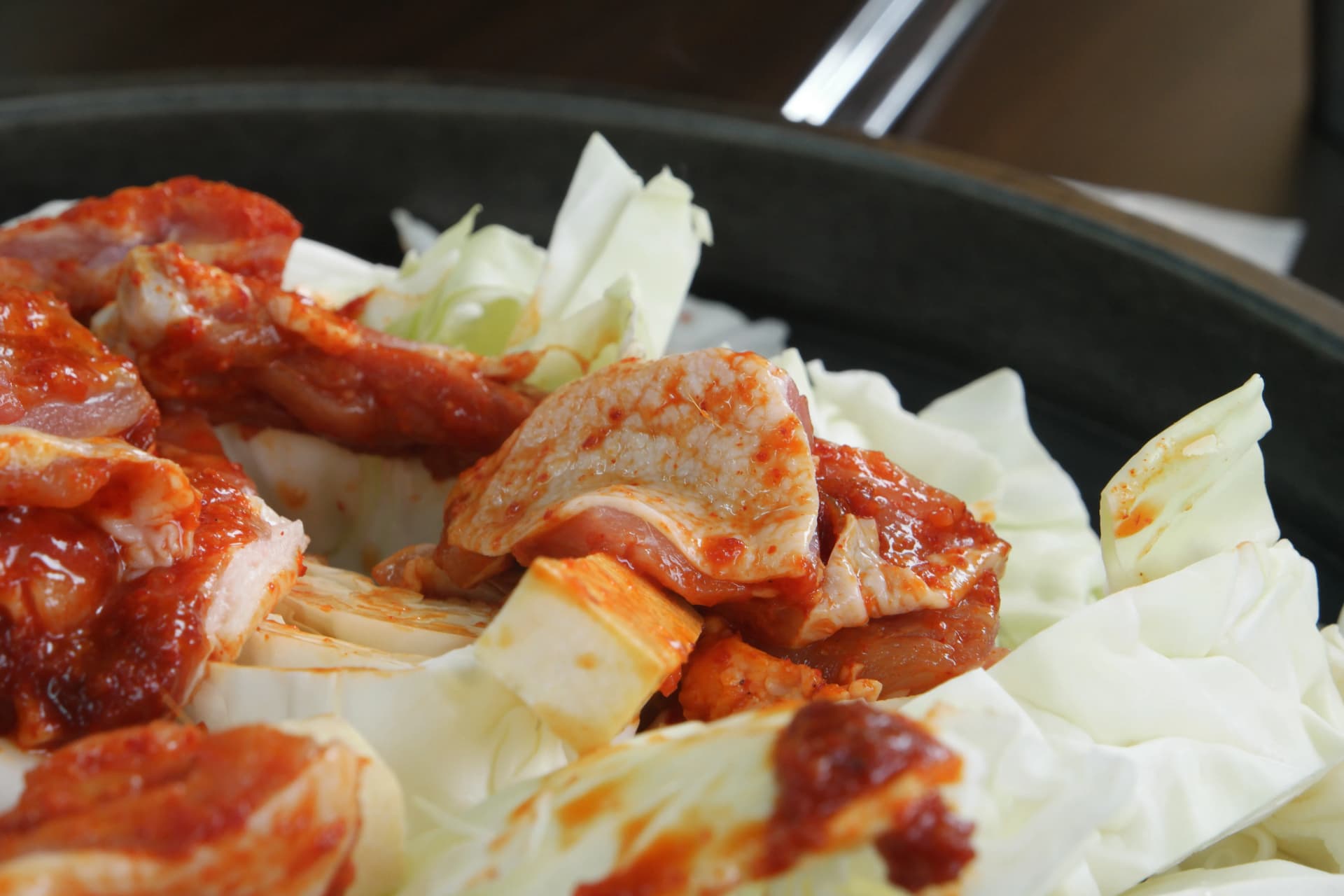
Notice how the cabbage is spread around the outer edges of the griddle. Once the cooking starts, the chicken and marinade in the center slowly spread outward and mix into the cabbage. The cabbage is doing an important job here — it acts as a natural buffer for the heat and spice of the marinade, and the dish just wouldn't be the same without it.
Choosing Your Dakgalbi Toppings
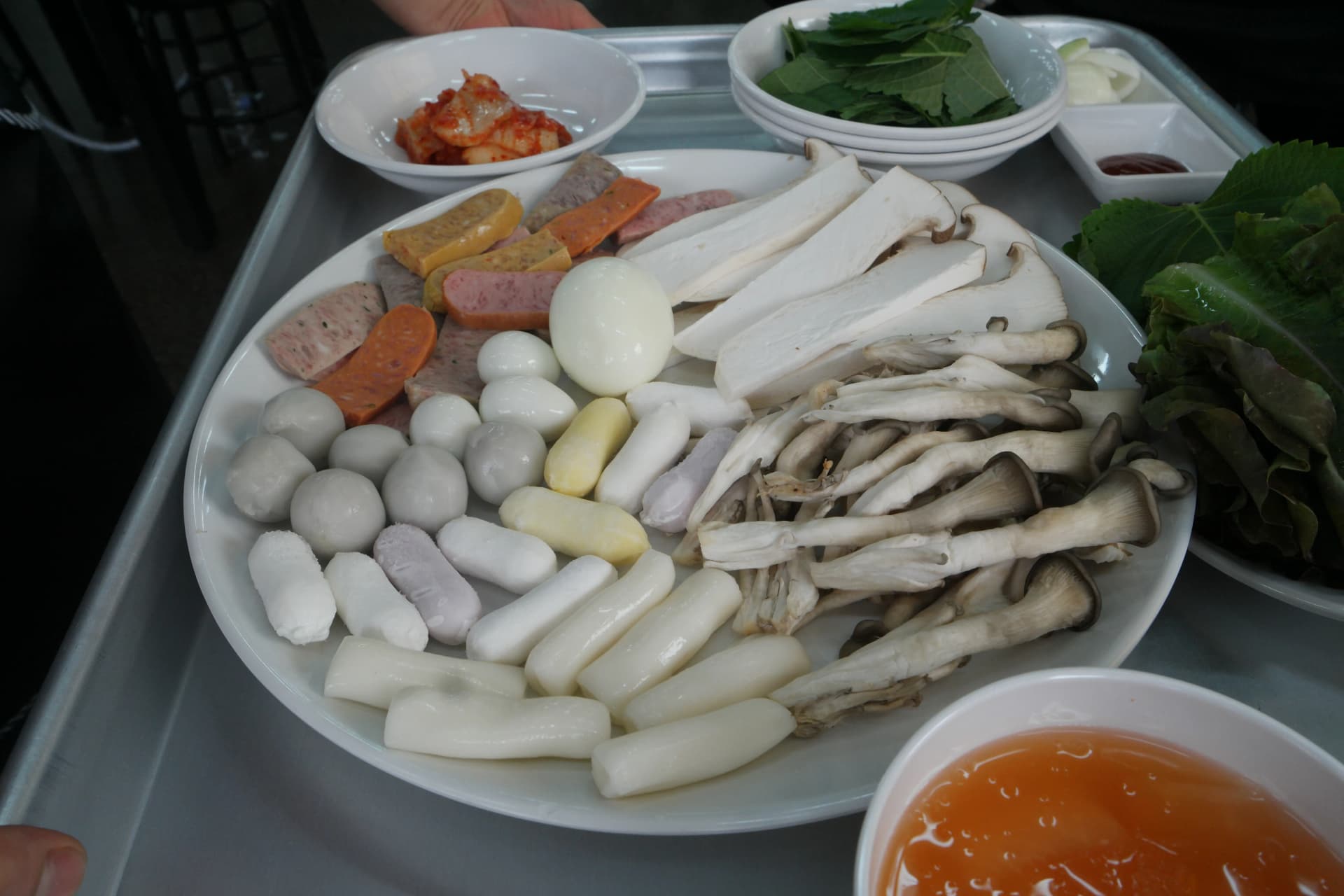
The standard dakgalbi setup is already delicious on its own — but add-on toppings take it to a completely different level. Most dakgalbi restaurants let you choose extra toppings for an additional cost.
Perilla Leaves — The Ingredient That Confuses Everyone
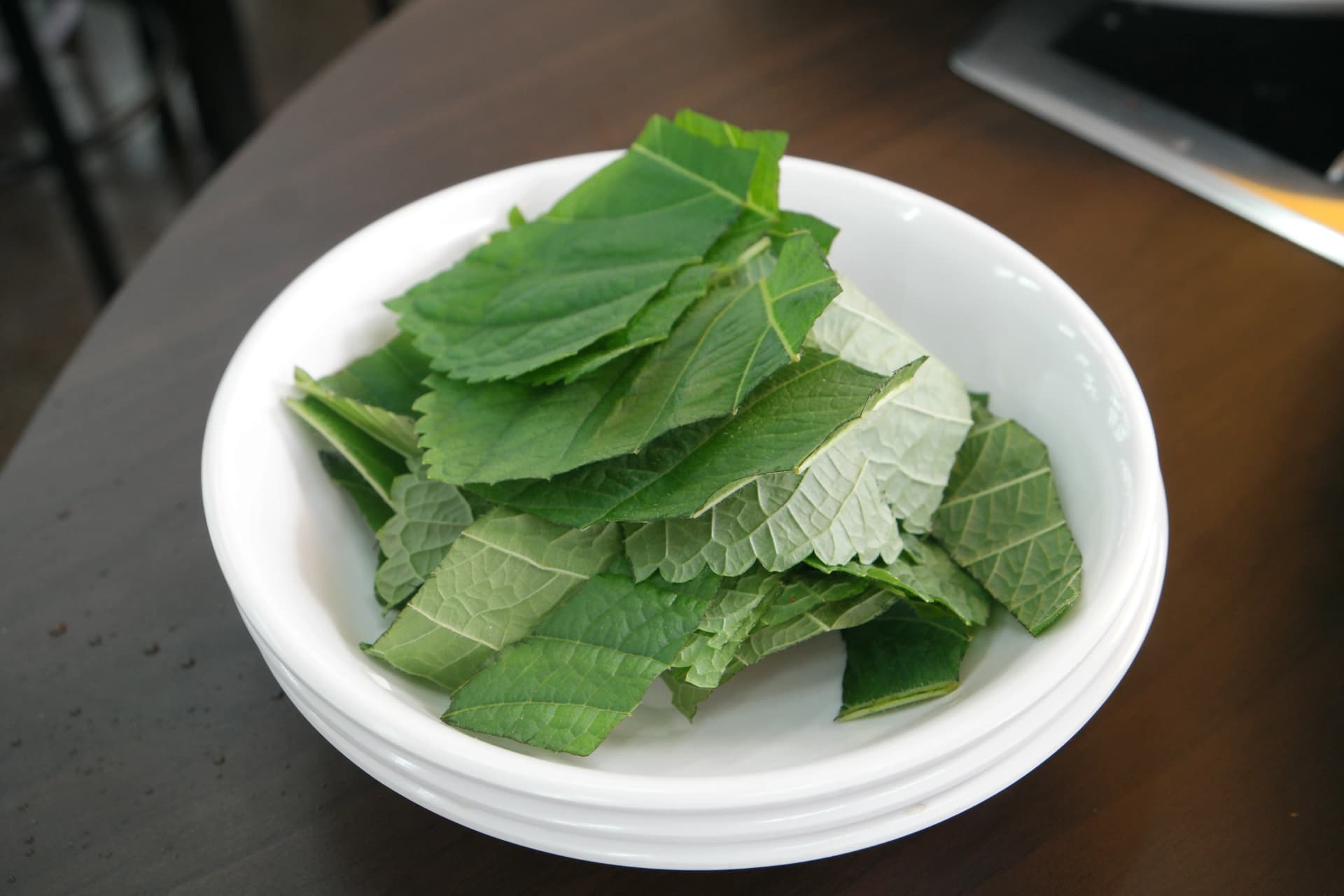
Those large green leaves piled on the plate? That's kkaennip — perilla leaves. It's a vegetable eaten almost exclusively in Korea, and it's genuinely one of those ingredients that exists on virtually no other country's dinner table. With dakgalbi, you can either wrap the chicken in a leaf before eating it, or toss the leaves straight onto the griddle to cook with everything else. The thing is — the smell. Most non-Koreans describe it as somewhere between mint and herbs, but it's actually much stronger and more distinctive than either of those. It's kind of like the Korean experience of eating cilantro for the first time — that "wait, what is this flavor?" moment. There's actually some evidence that certain genetic profiles make people more sensitive to the scent of perilla, which is why reactions to it can be so dramatically different from person to person. If you're feeling adventurous, try just one leaf first before committing.
The Heat Goes On — Dakgalbi Starts Cooking
The Moment the Burner Ignites
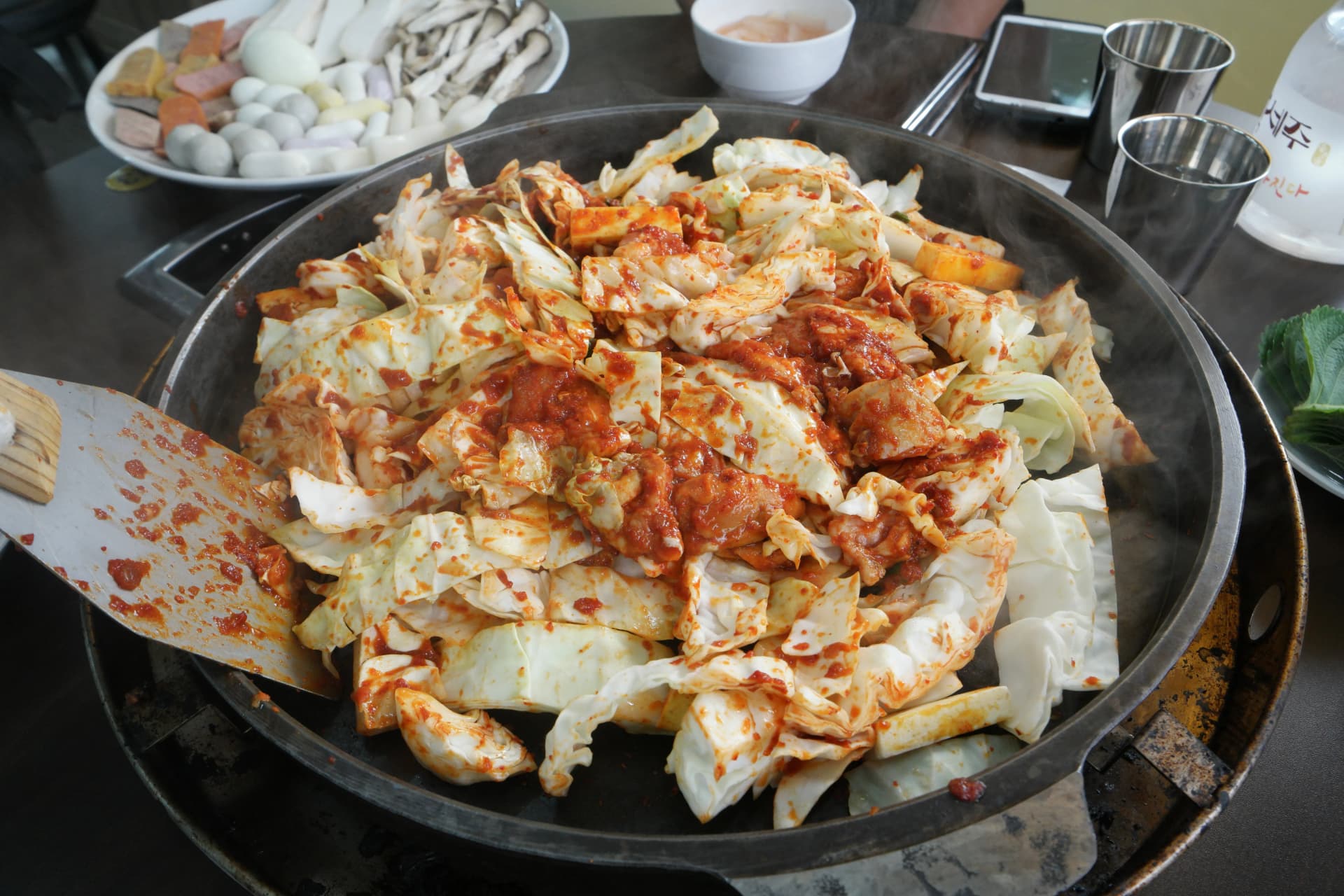
The burner is on. That mountain of raw ingredients from before is now starting to respond to the heat — the cabbage is beginning to wilt and turn translucent, and the marinade is melting down and spreading across the entire surface of the griddle. This is the stage where the whole restaurant starts to smell incredible. That rich, spicy, caramelizing aroma is basically a free advertisement — people at neighboring tables catch a whiff and suddenly find themselves waving down the server to place an order.
Everything Starts Coming Together
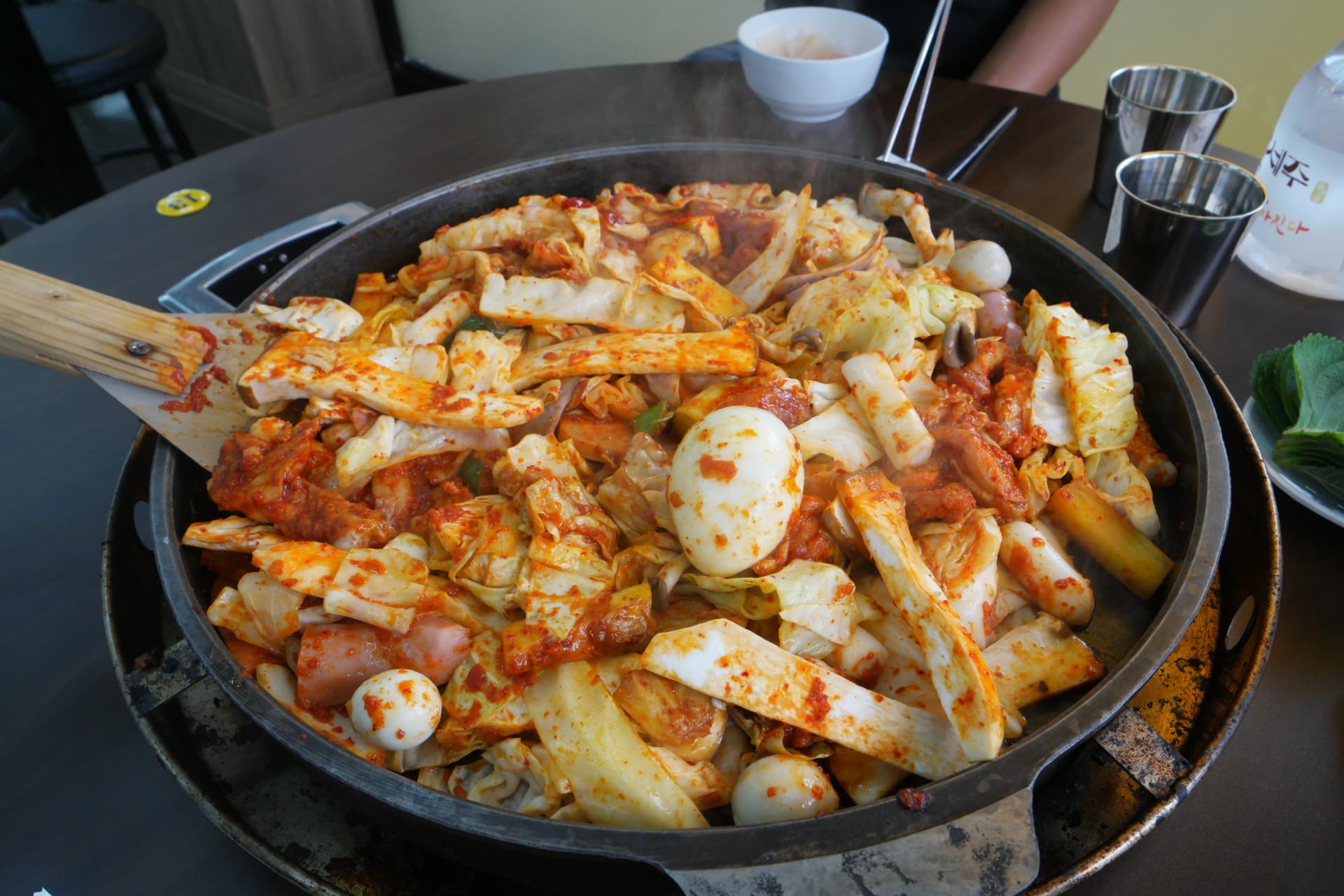
The stir-fry is in full swing now. That towering pile of raw ingredients from earlier has completely transformed. The tteok, egg, mushrooms, and Spam are all merging into the marinade, flavors bleeding into each other as everything cooks through together. Honestly, just watching this scene unfold is enough to make your stomach grumble. And that's really the magic of dakgalbi — there's no chef hidden away in the kitchen. The entire dish is completed right in front of you, on your own table. It's dinner and dinner theater rolled into one.
The Most Satisfying Moments of the Cook
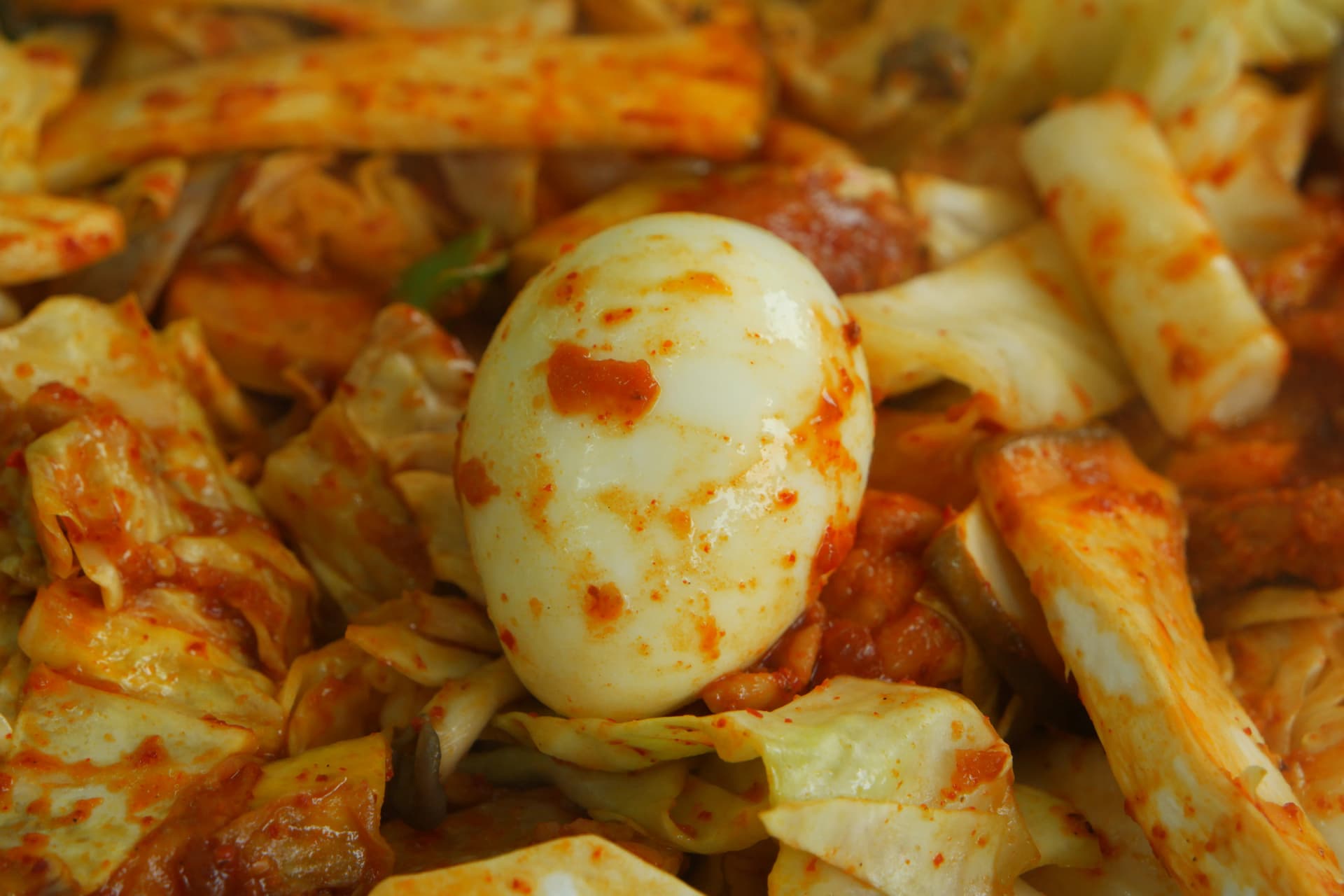
Mid-cook, there's a boiled egg holding its ground right in the center of the griddle. Everything around it is this intense, fiery red, and there it sits — perfectly white and round, completely unbothered. It's weirdly majestic. And then comes one of the best moments of the whole meal: splitting that egg open. The yolk runs out, mixes into the spicy sauce, and just like that, the heat level drops a notch and the flavor becomes richer and smoother. Highly therapeutic, genuinely delicious.
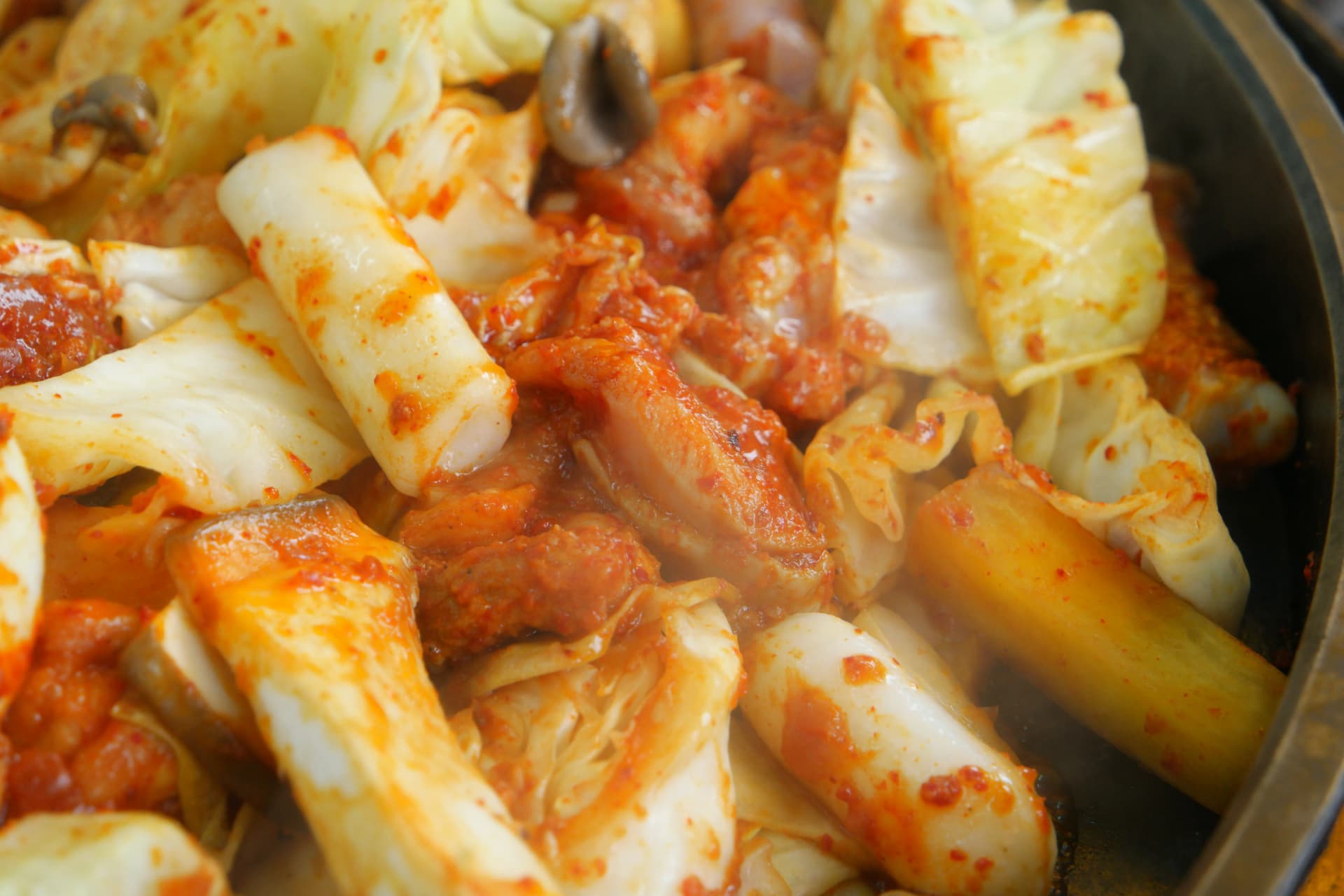
The marinade has now soaked into everything on the griddle. The rice cakes are plump and glossy, absolutely saturated with flavor, and the chicken's surface is starting to caramelize ever so slightly, giving off this warm, nutty aroma that layers on top of the spice. This is the stage where you keep reaching for your chopsticks, then stopping yourself, then reaching again. The answer to "can I eat it now?" is technically: almost. Give it one more minute. Just one.
The Color Has Changed — Dakgalbi Is Ready
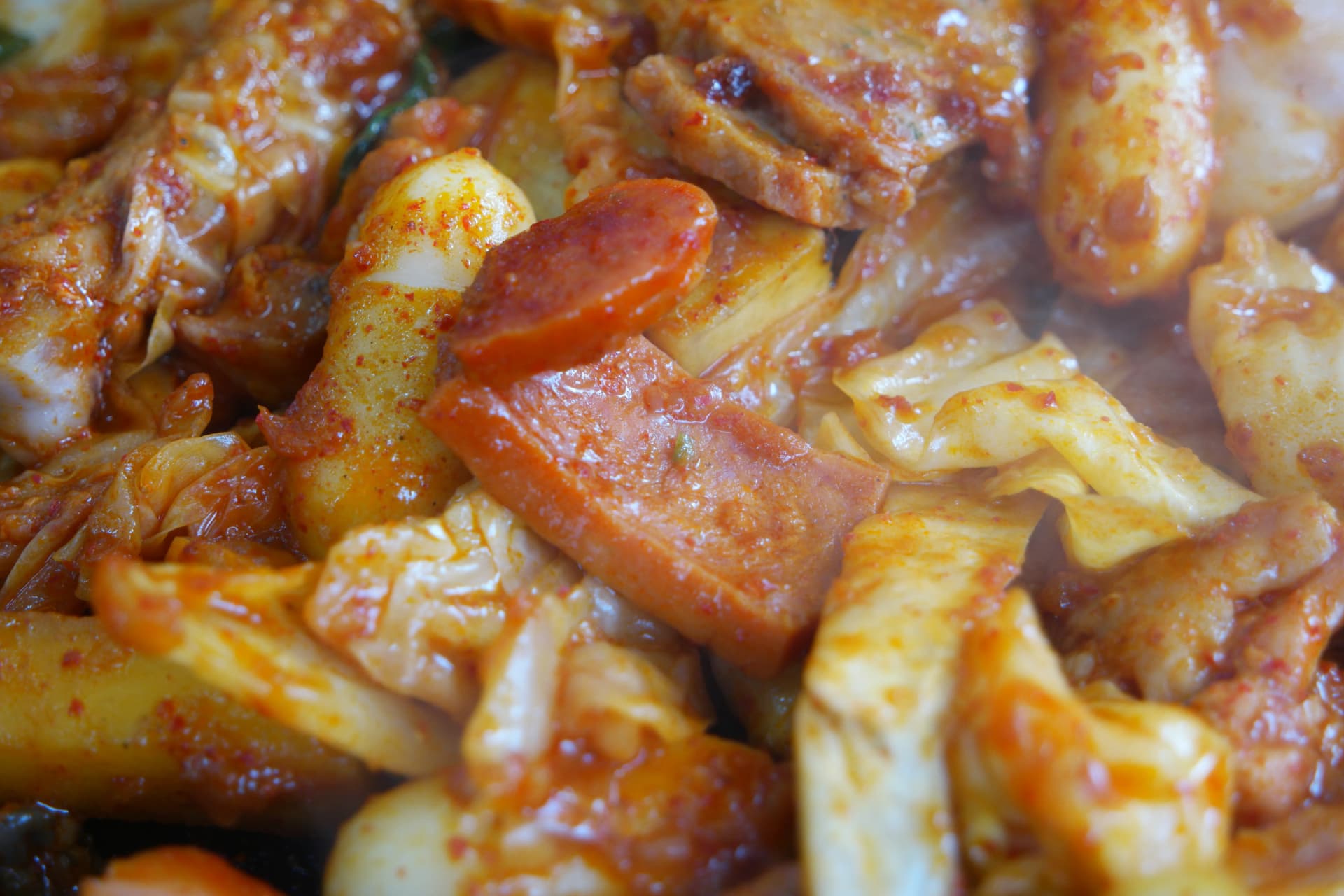
Remember how the chicken and rice cakes looked at the start? Pale, raw, almost timid? Look at them now. The tteok has soaked up so much marinade it's turned deep red all the way through. The Spam has developed a slightly seared, glossy surface. Every single ingredient has been unified into the same rich color palette — and that's the visual cue that it's time to eat.
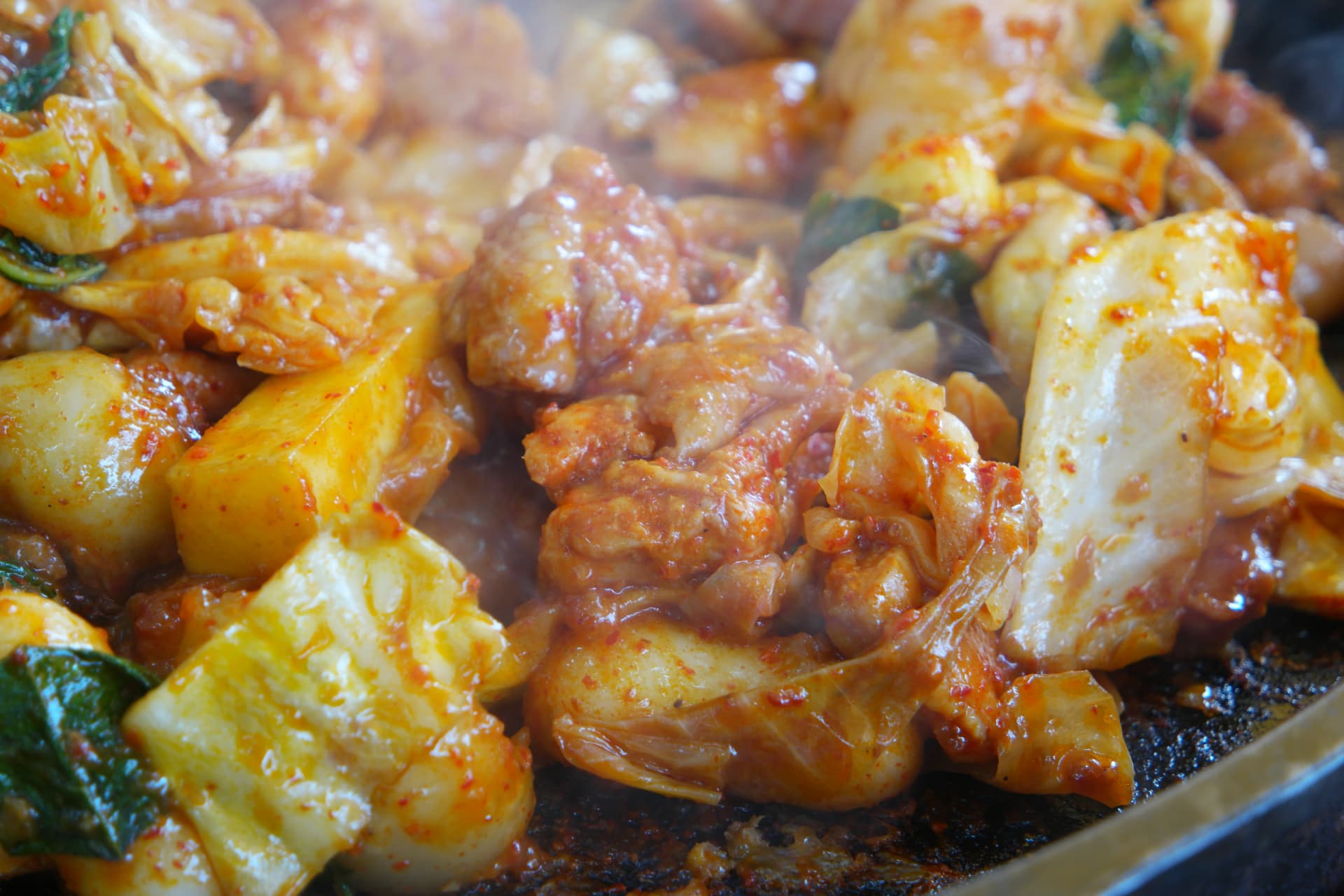
Compare this to the first photo and the difference is night and day. The chicken started out a faint pink, barely colored. Now it's this gorgeous deep orange-brown, the gochujang marinade fully absorbed into every fiber. The surface has just enough texture from the light searing to give it a little bite, and you can see the steam rising. This is it. This is the moment. You can eat now — for real this time.
Picking It Up with Chopsticks
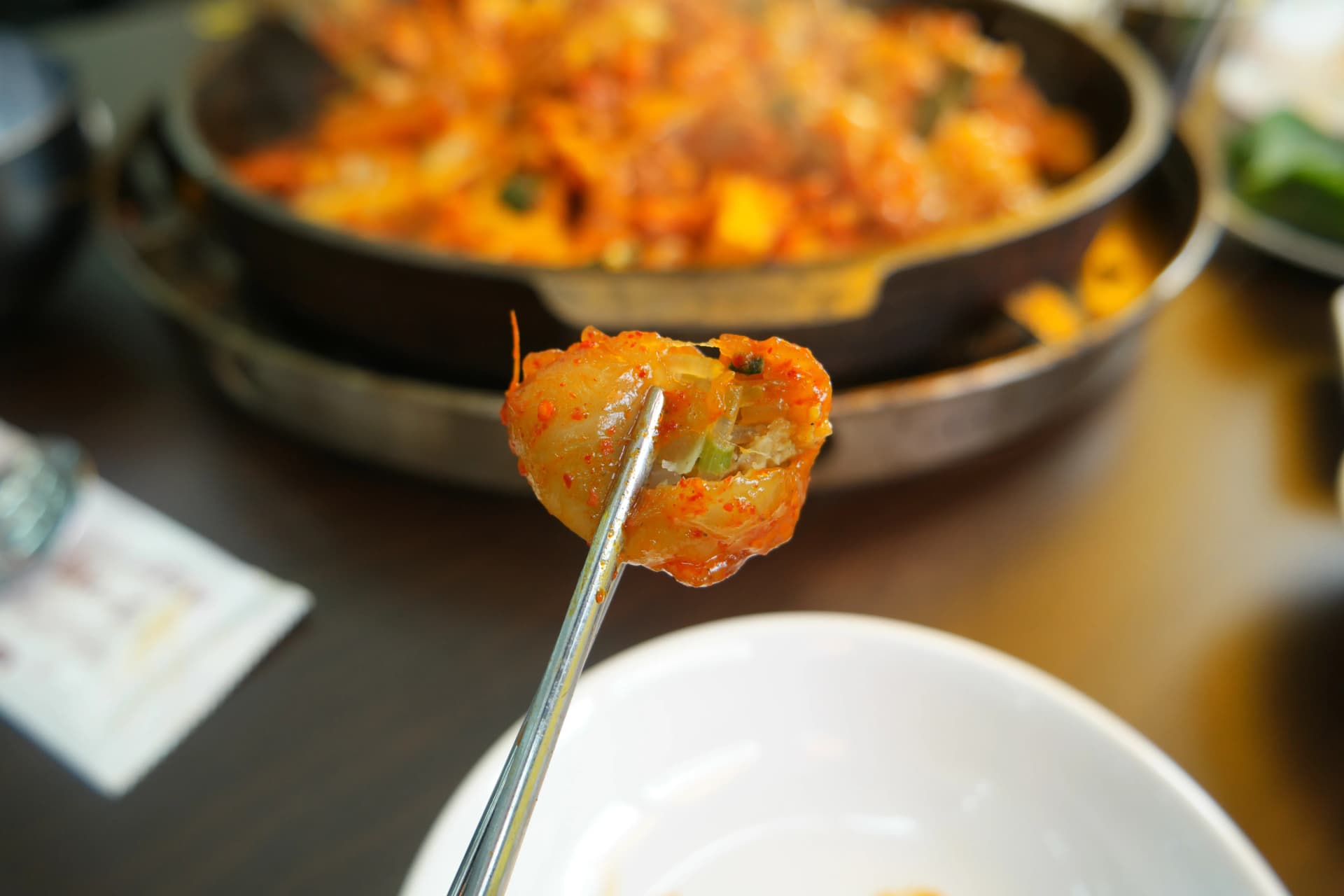
That piece being lifted by chopsticks is the Spam. Look at how the marinade has caramelized right onto the surface — that's not just a coating, it's practically fused on. Can you imagine what salty, savory Spam tastes like after being cooked in spicy gochujang sauce? It's one of those combinations that sounds like it shouldn't work and then absolutely does. You take one piece thinking you'll just try it, and then you keep going back for more without quite understanding why.
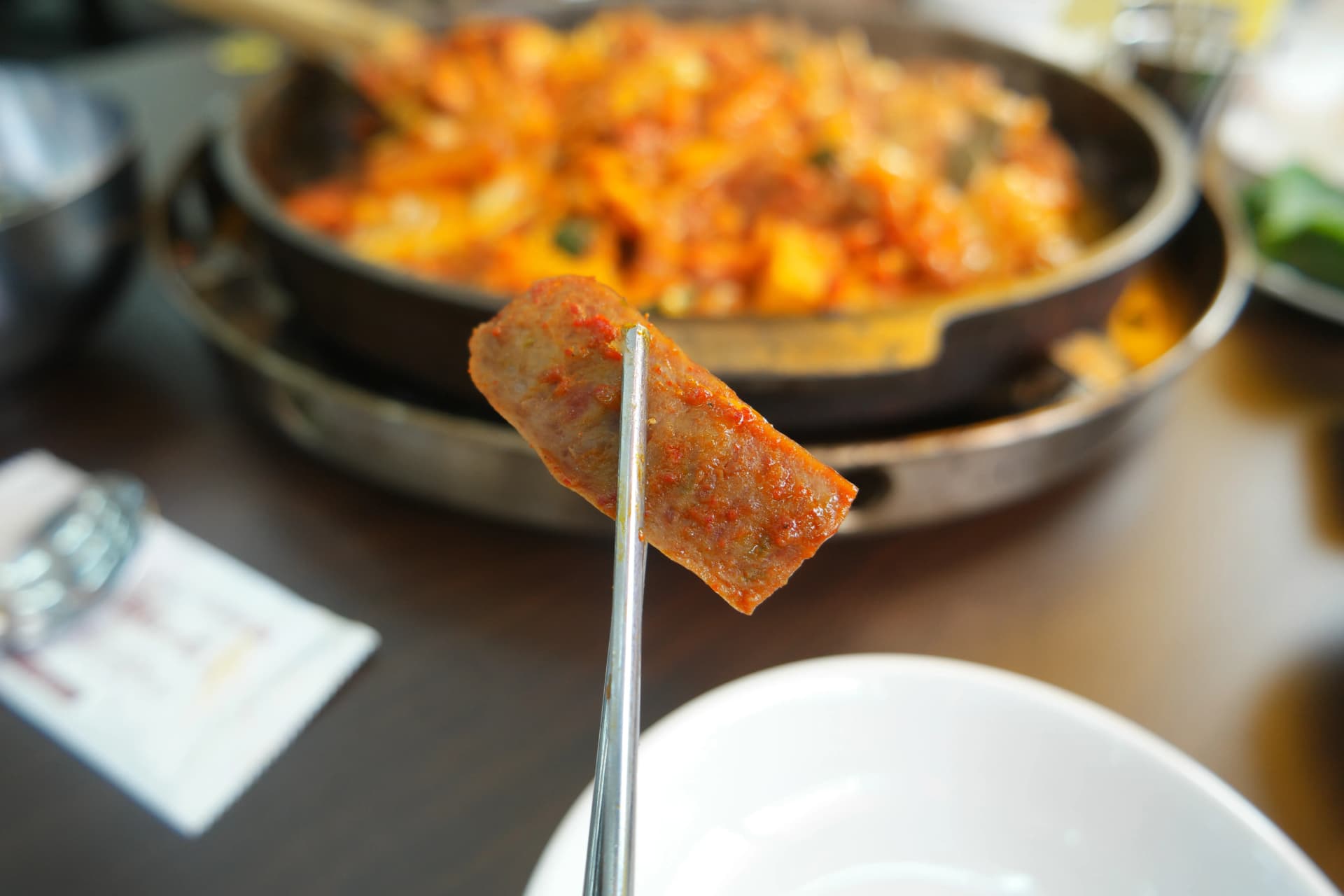
This is the cabbage. It started out as a plain white vegetable layered at the bottom of the griddle — now it's translucent, completely saturated with marinade, and soft all the way through. The crunch is gone, but in its place is this silky, sauce-drenched texture that actually pairs with the chicken better than the raw version ever could. In dakgalbi, cabbage isn't just filler. It's a quiet hero — absorbing and softening the intensity of the spice so the whole dish stays balanced.
It's Not Over Yet — Dakgalbi Fried Rice
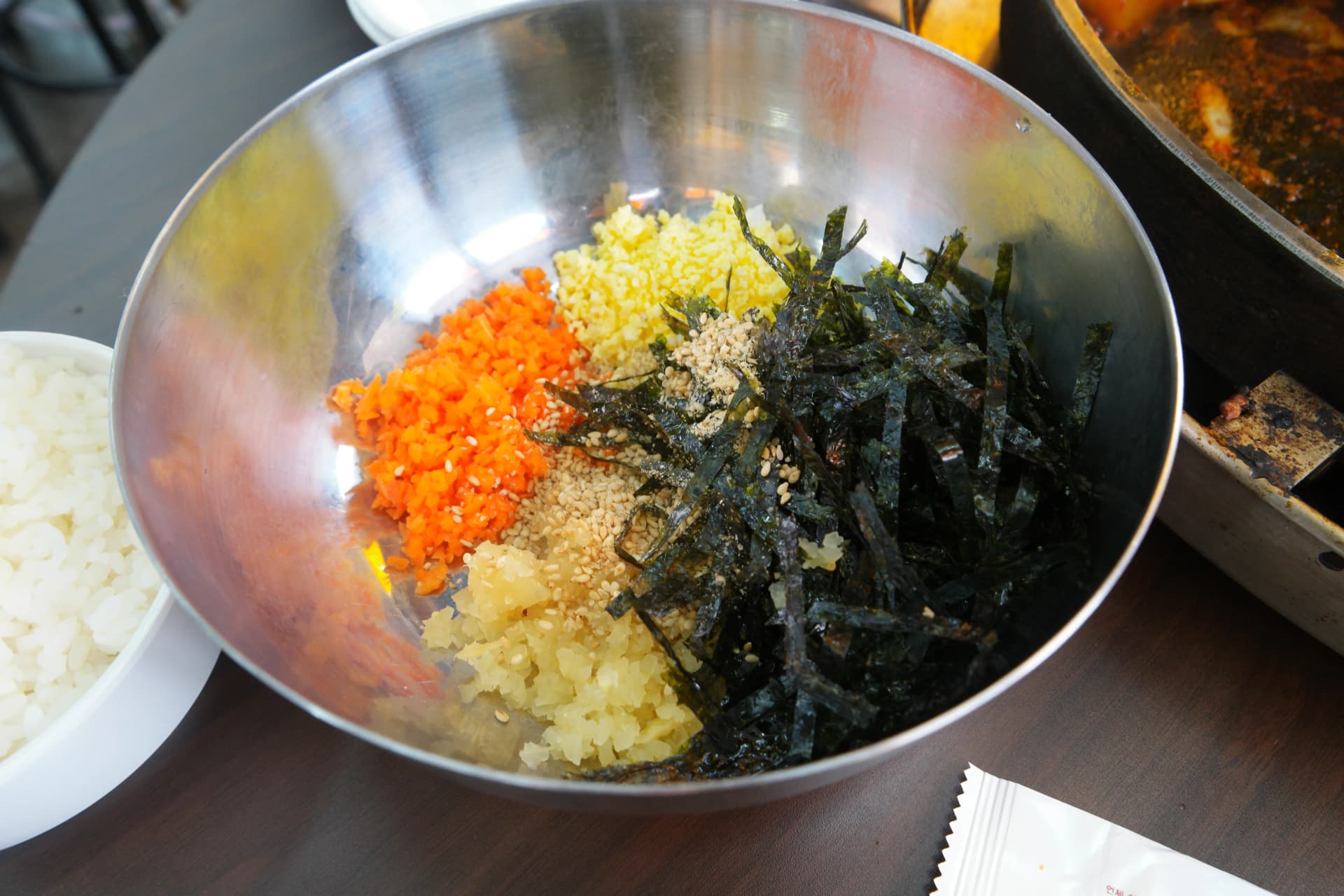
Here come the fried rice ingredients. Carrot, egg yolk, dried seaweed, and sesame seeds — all prepped and ready to go.
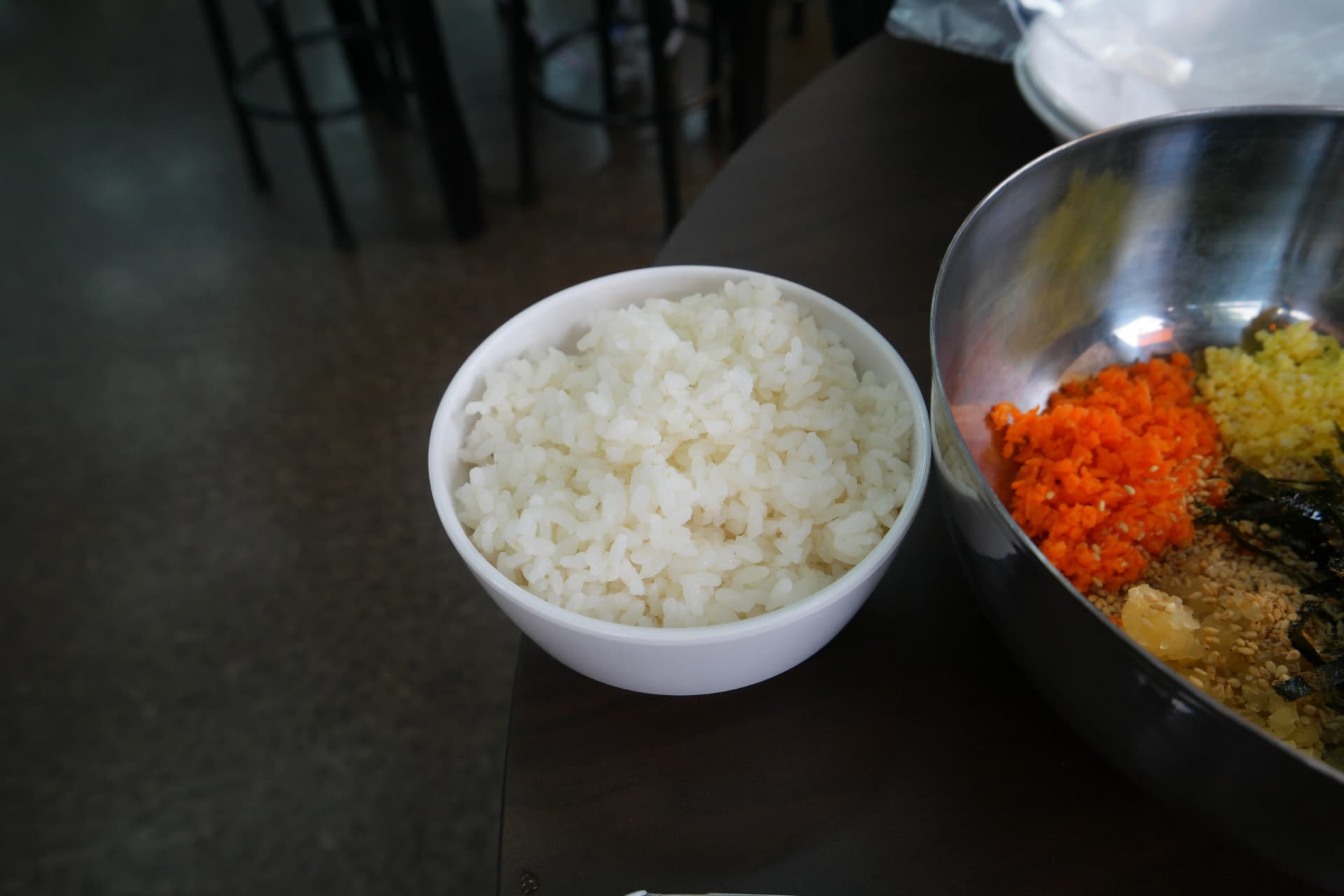
And there's the bowl of steamed white rice. What happens when these two things meet? The next photo says it all.
Dakgalbi Fried Rice — The Grand Finale
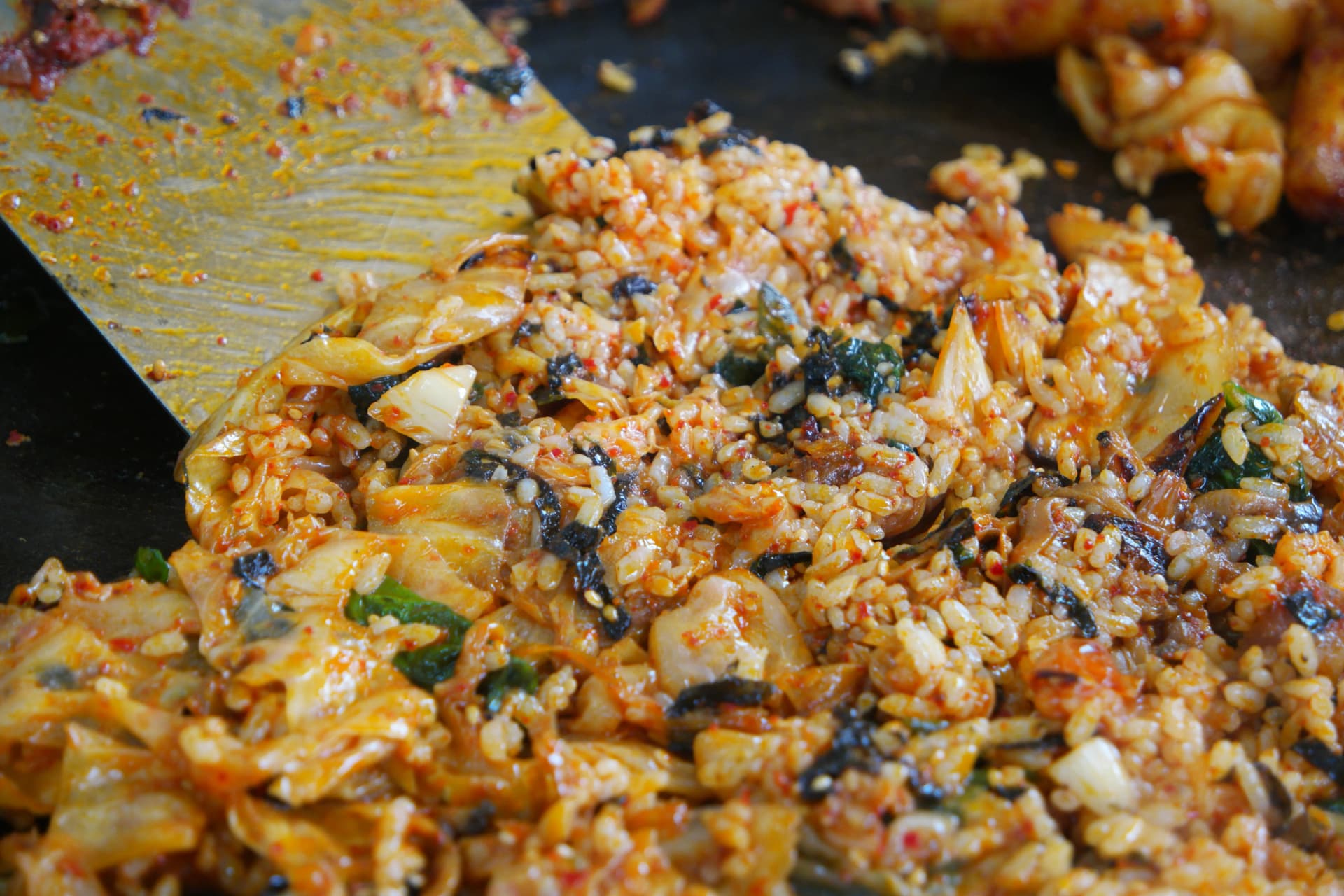
This is the result. Rice tossed onto the griddle with all the leftover dakgalbi sauce and caramelized bits, stir-fried until every single grain is coated in that spicy, smoky, savory goodness. It becomes something completely new — technically a fried rice, but really more like a distillation of everything great about dakgalbi compressed into one dish. Honestly, the thought of coming back just for this fried rice alone is completely valid. That's how good it is.
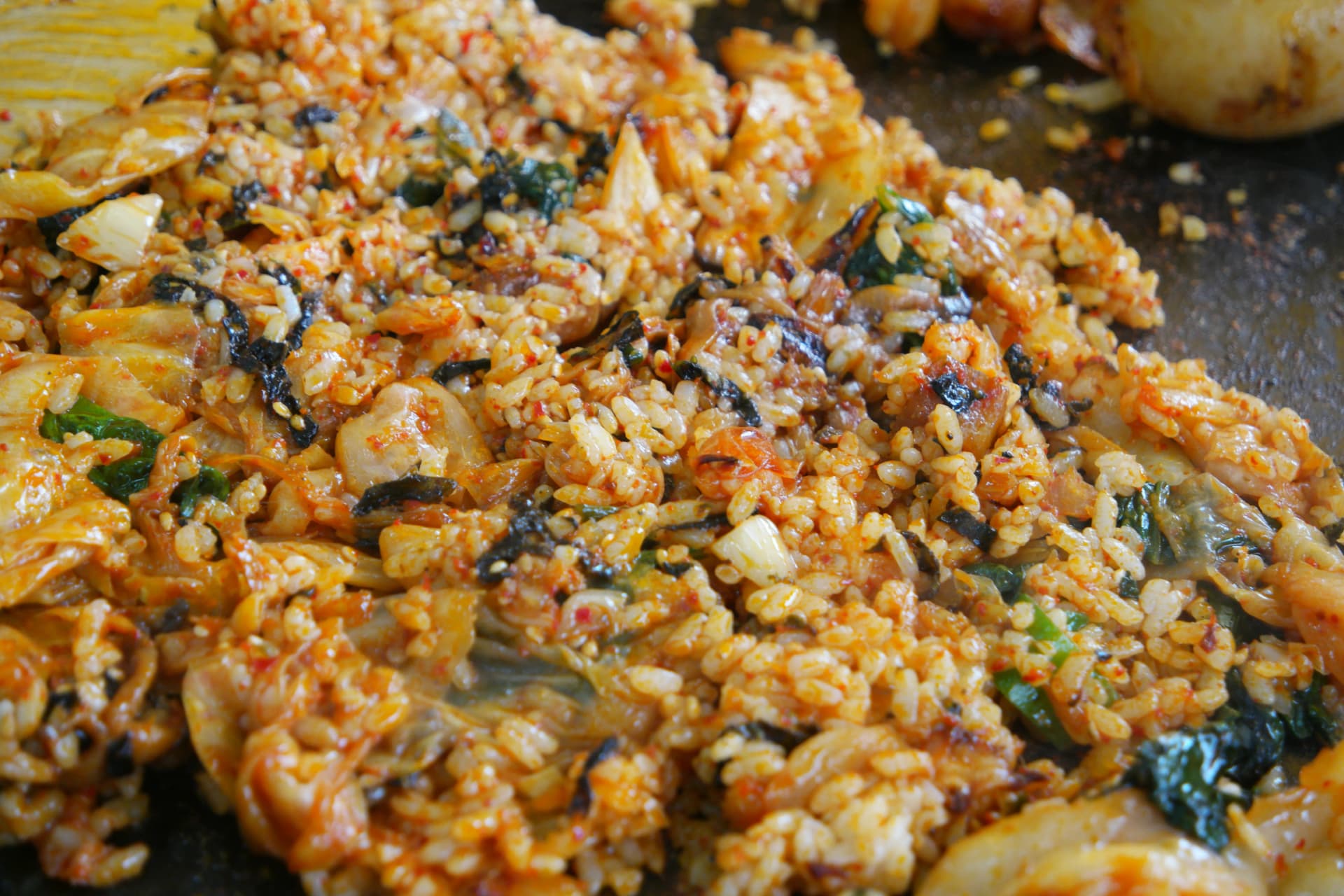
Up close, you can see pieces of dried seaweed, perilla leaf, and sesame seeds scattered throughout the fried rice. This is not a basic fried rice — it's a compressed version of the entire dakgalbi experience in rice form. The pro move? Make sure to scrape the slightly crispy, scorched bits from the bottom of the griddle. That's where the most concentrated flavor lives.
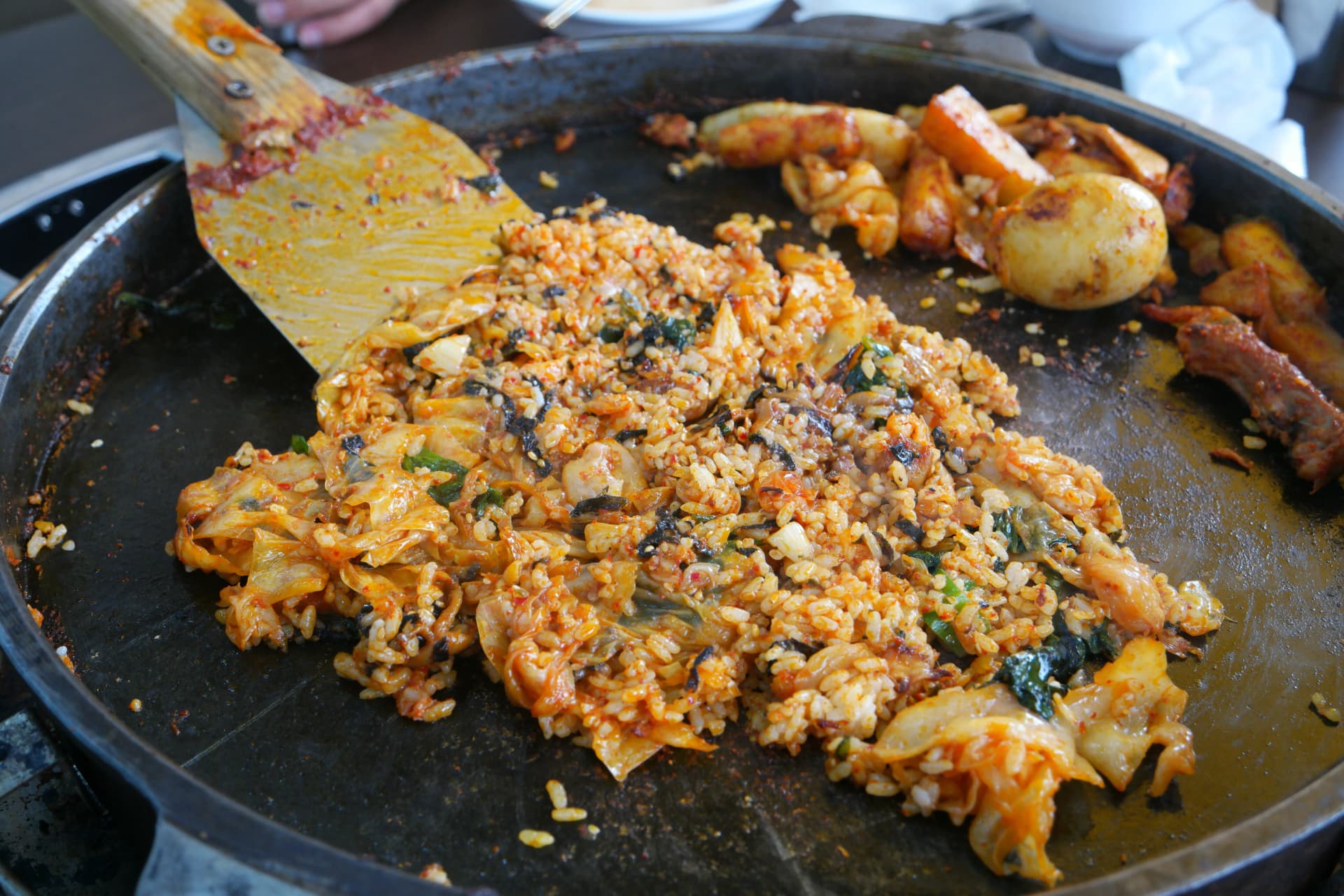
You already know just by looking at this. Even if you were completely full from the main event, putting the spoon down in front of this is genuinely difficult. There's a saying among Korean food lovers: if you eat dakgalbi and skip the fried rice, you've only eaten half the meal. After seeing this, I think that's actually an understatement.
Final Thoughts
From that dramatic mountain of raw red-marinated chicken before the burner even turned on, through the sizzling, fragrant stir-fry process, all the way to the fried rice finale — you've just seen the complete dakgalbi experience from start to finish. And that's the thing about this dish: it's not just about the taste. It's the full experience of watching your meal come alive right in front of you, on your own table, in real time. That kind of interactive cooking is something special. If you're heading to Korea, put dakgalbi high on your food list. I can say with complete confidence: you won't regret it.
How to Find a Good Dakgalbi Restaurant
When you're in Korea and looking for a place to try spicy Korean stir-fried chicken, here are some search terms to plug into Google Maps:
Google Maps will pull up nearby restaurants along with reviews and hours all in one place. A solid rule of thumb: look for places with a rating of 4.0 or above and at least 100 reviews — that combination significantly lowers your chances of a disappointing meal.
Dakgalbi Franchise Chains Across Korea
If you're not sure where to start, trying a well-established nationwide chain is a great entry point — consistent quality, easy to find, and usually beginner-friendly.
This post was originally published on https://hi-jsb.blog.