
Step Back in Time: Mr. Sunshine Filming Location Guide
Table of Contents
23 items
The Moment You Step In, Time Stands Still
Admission Info
Ticket Prices
- 🧑 Adult ~$7.50
- 🧑🎓 Youth ~$6.00
- 👶👴 Child · Senior ~$4.50
Weekday group discount for 20+ people · On-site ticket purchase only
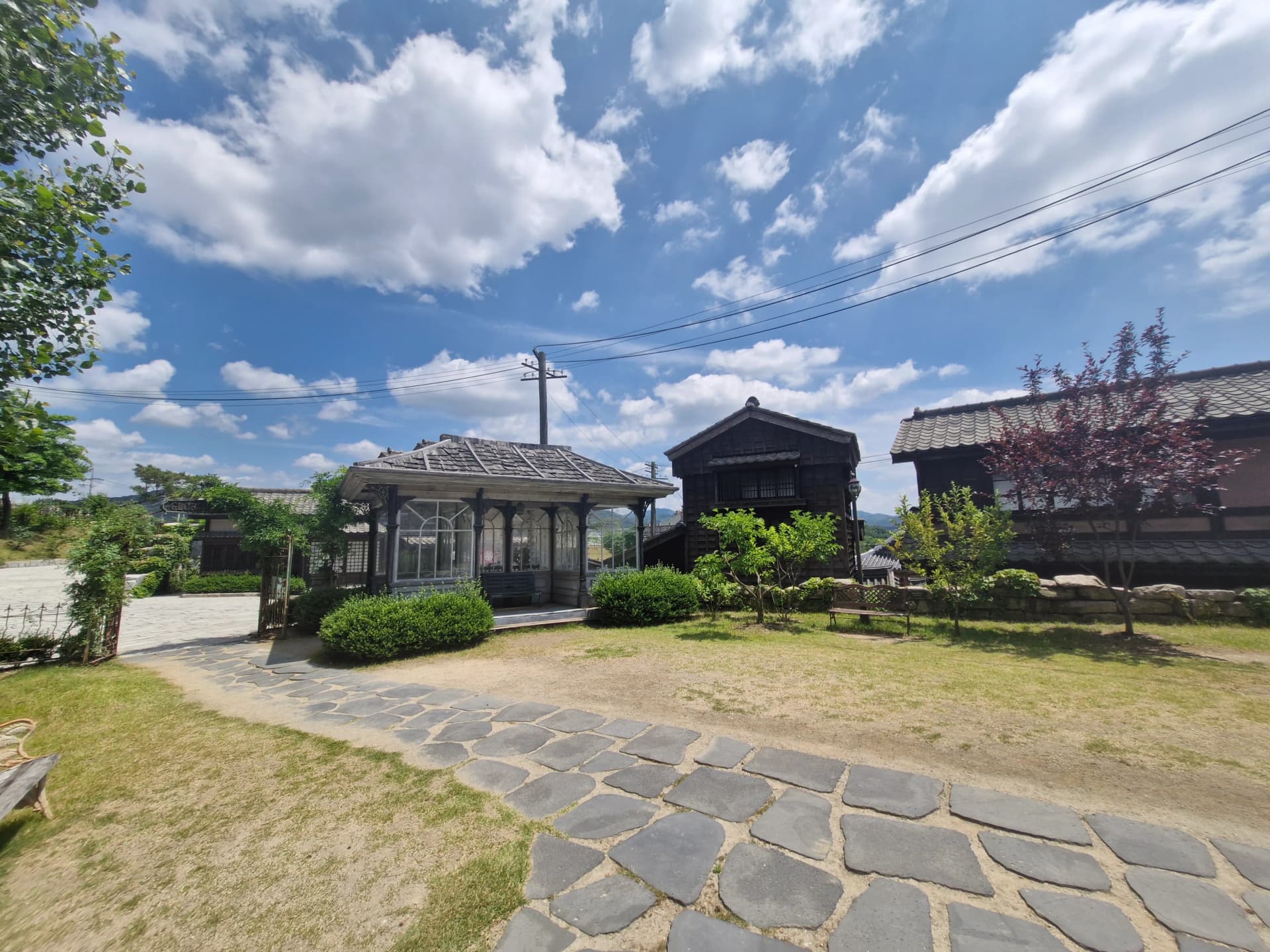
The second you walk past the ticket gate, it feels like time just… stops. This place is a full-scale recreation of Hanseong — that's what Seoul was called back in the early 1900s, during Korea's "Enlightenment Period" when the country was rapidly opening up to the outside world. The cobblestone paths look like they were laid by hand, the wooden buildings carry the weight of a bygone era, and summer sunlight spills across the green lawns. But hey, see that telegraph pole way in the back? They left that there on purpose. Telegraph poles actually existed in 1900s Korea. They went so far as to historically verify and include telegraph poles on a film set. That one detail alone should tell you something — this place was not thrown together carelessly.
Glory Hotel — The Heart of the Mr. Sunshine Filming Location
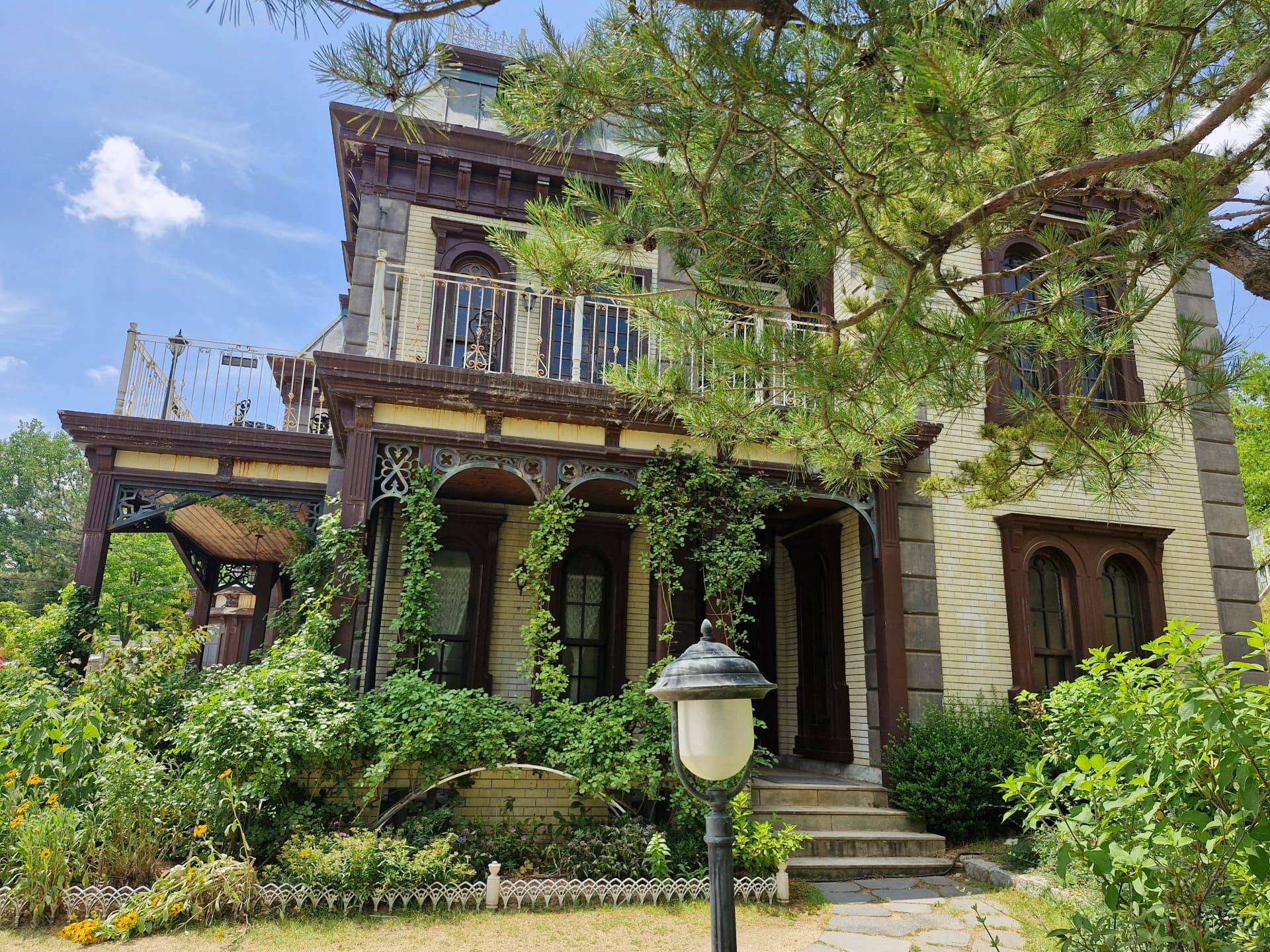
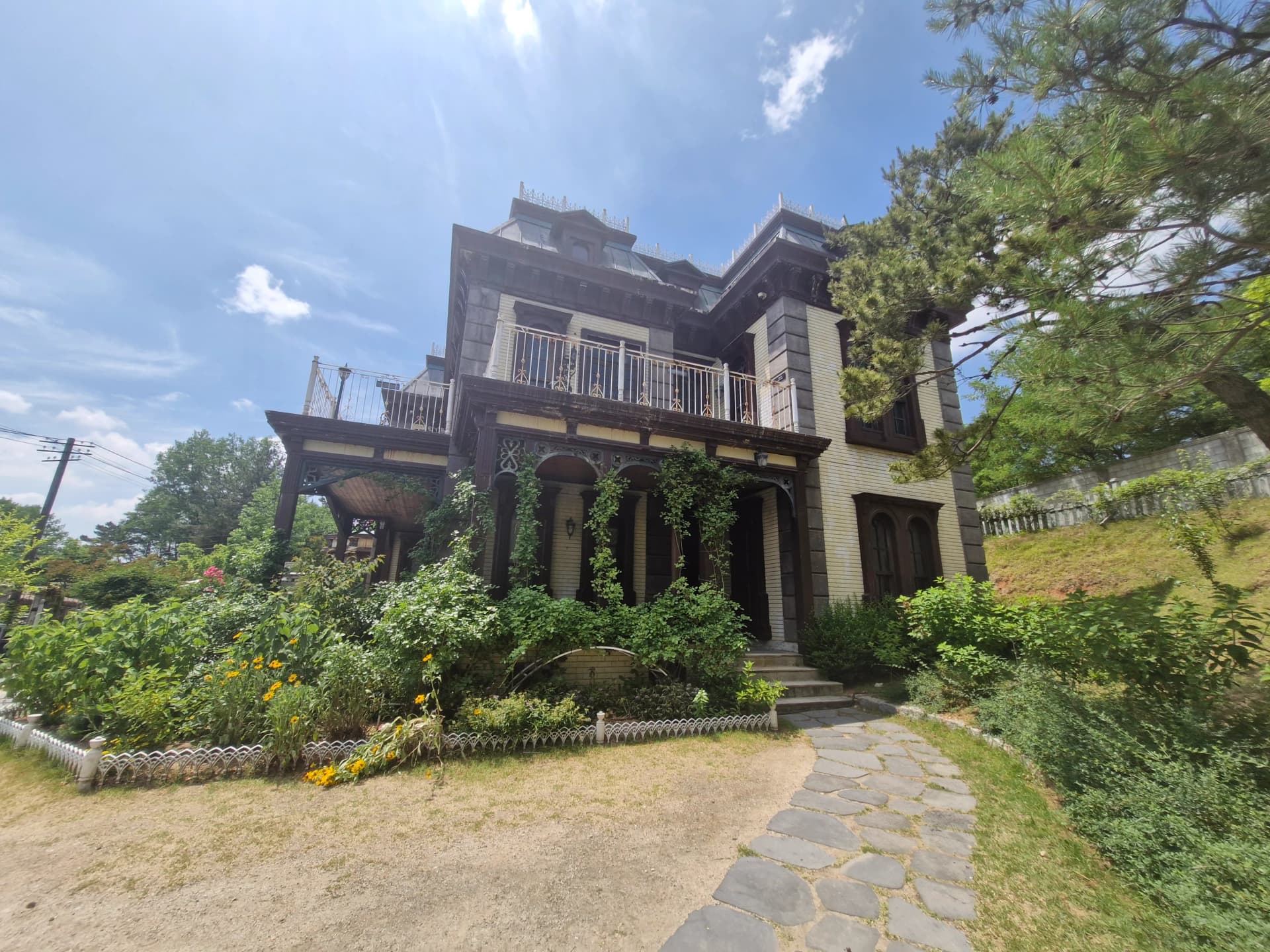
This building right here is the Glory Hotel. It's the very first thing that catches your eye at Sunshine Studio. Ivy crawls up the exterior walls, and there's a vintage street lamp standing in the front yard. The first time I saw it, I swear it looked like a movie poster come to life. Is this even real?
This building is modeled after the real Sontag Hotel. The Sontag Hotel actually existed in Jeong-dong, Seoul in the early 1900s — it was Korea's very first Western-style hotel. It was run by Antoinette Sontag (1854–1922), a German woman of French descent, and it operated as a private hotel exclusively for the Korean royal court. It's also a historically significant site because in 1905, Japanese envoy Ito Hirobumi stayed at this hotel while pressuring Korea into signing the Eulsa Treaty — an agreement that effectively stripped Korea of its diplomatic sovereignty.
In the K-drama Mr. Sunshine (2018), this was the central hub where the main characters came and went. Today, the first floor houses a highlight reel screening room and prop exhibits from the drama. The second floor has been converted into a working cafe. You can literally sip coffee by the very same windows you saw on screen. Seriously, don't skip this — you'll regret it.
Inside Glory Hotel — The Drama Props Are Still There
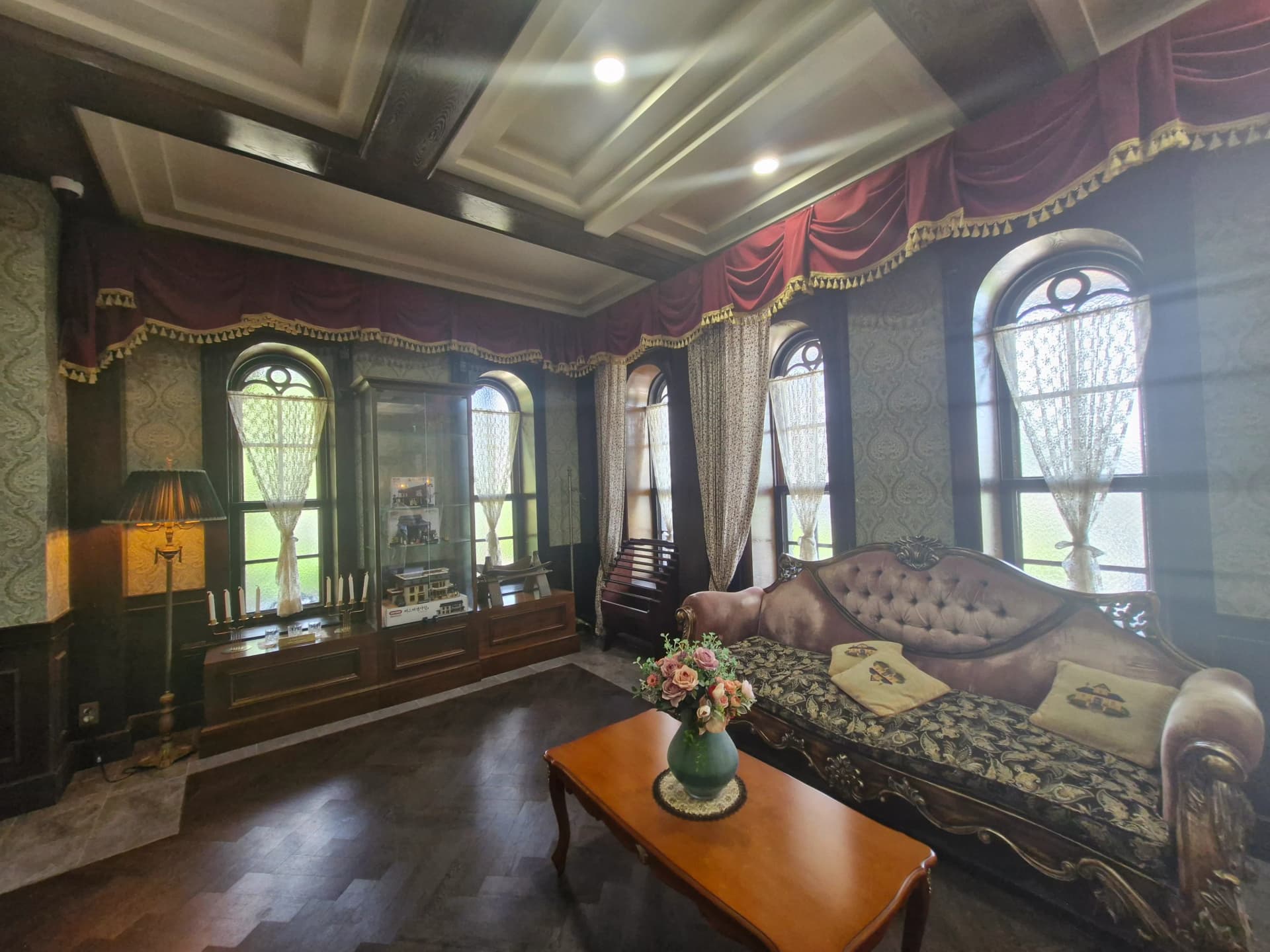
Step inside and you'll freeze again. That atmosphere you felt from the outside? It's alive in here too. Dark hardwood floors, heavy velvet curtains, natural light streaming through arched windows. The sofas and furniture that were actually used during filming are still sitting right where they were. They never tore down this set — they preserved it exactly as it was. Sit down and snap a photo, and you genuinely feel like the lead character of the drama. Not just a feeling — for real.
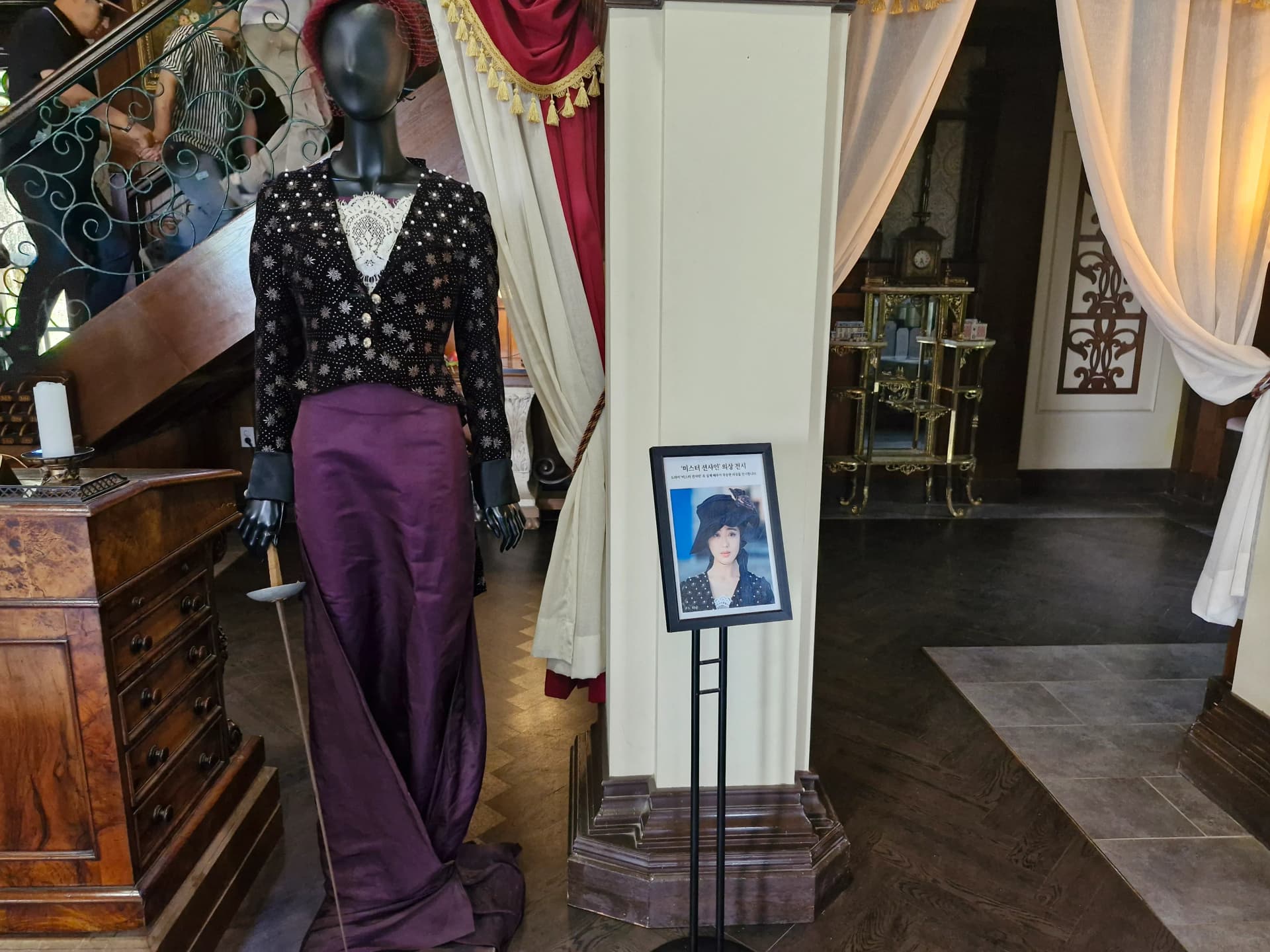
The actual costumes worn by the actors during filming are on display too. That dress on the mannequin? It's not just a random prop. It's the real outfit an actor wore while shooting Mr. Sunshine. When you compare it with the framed photo next to it — showing the actor in that exact scene — it gives you chills. Seriously. The moment you realize "this dress appeared in that scene," reality and the drama start overlapping in the most surreal way.
Glory Hotel 2F Cafe — Coffee in the 1900s
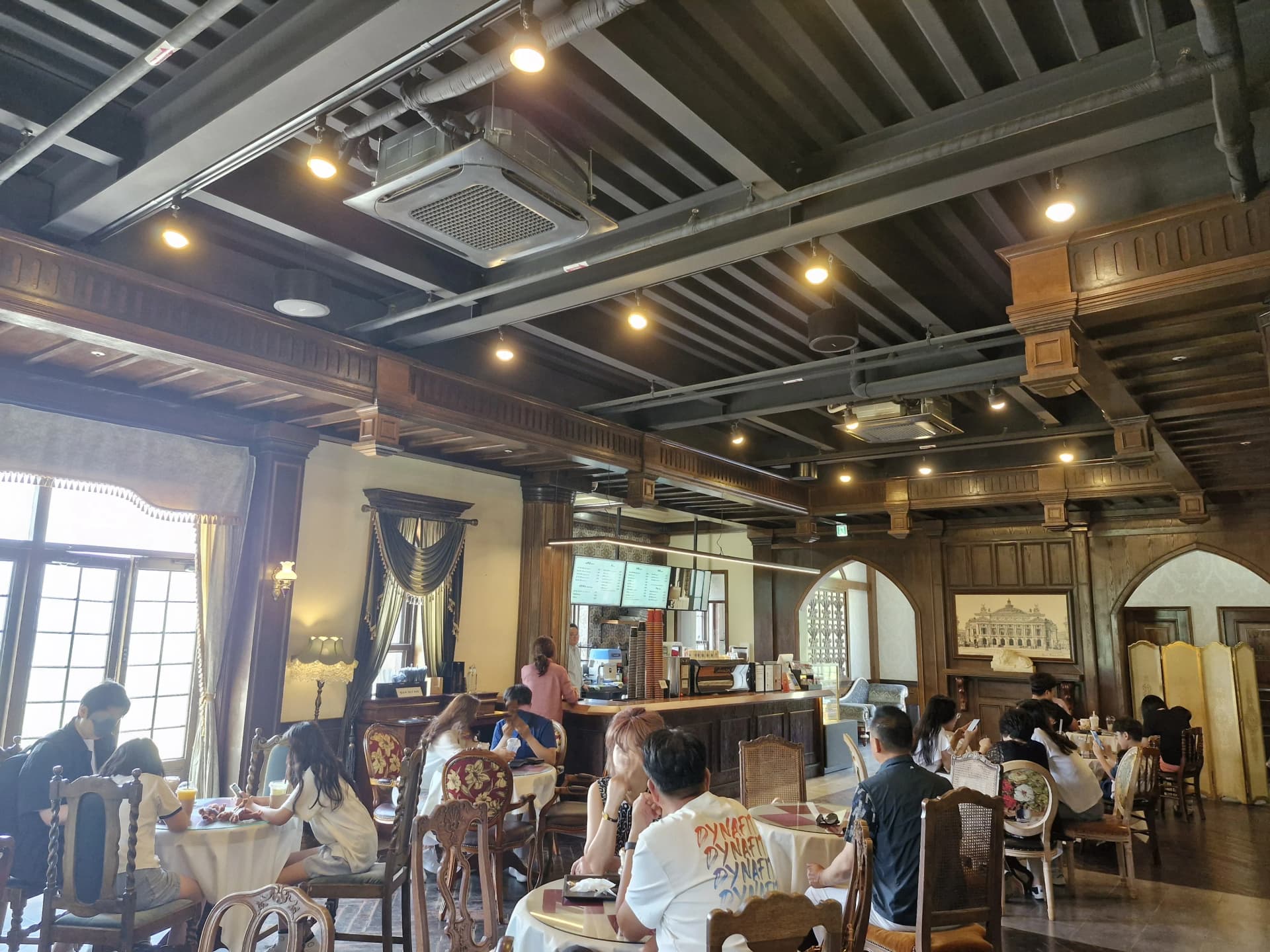
This space right here? It's a cafe. For real. The exact same interior from the drama, the exact same tables, the exact same ambiance — and it's operating as a working cafe. Dark wooden pillars, elegant antique chairs, light filtering through the windows. Order a coffee, sit down, and honestly you won't be able to tell if you're in 2025 or the 1900s.
But listen. Let me be real with you.
If you come here in regular clothes, you're only getting half the experience.
Wear something from the 1900s Enlightenment era. Think long skirts, lace blouses, corset jackets — that whole turn-of-the-century vibe. Don't just leave your hair down either. Pin it up. And skip the modern dewy makeup — go with something more classic and muted. Then sit down at the window seat in this cafe with a cup of coffee in your hand, and in that moment, you ARE the main character. No camera crew needed — you're already a scene. You don't need to be a professional actor to pull this off.
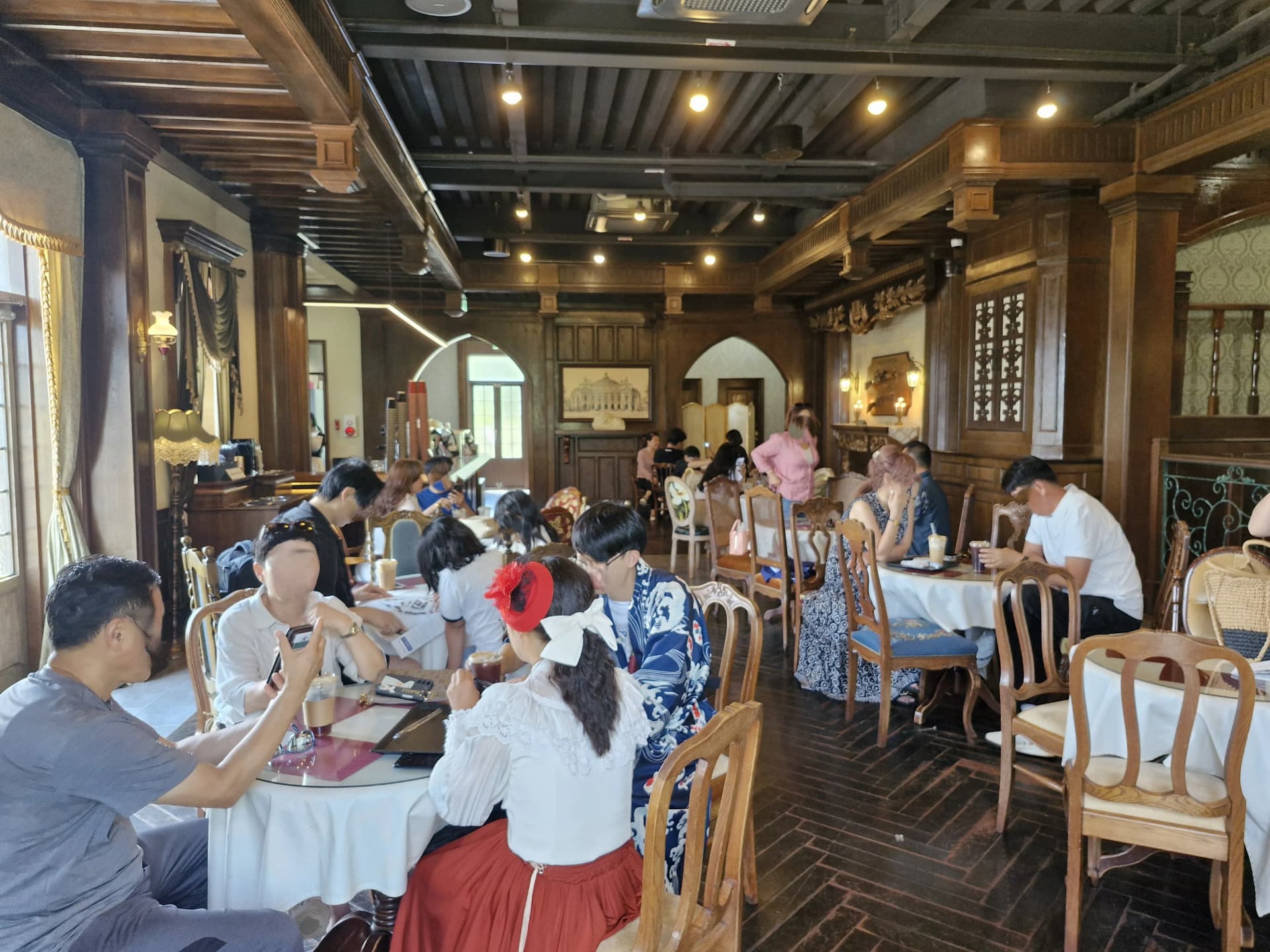
See? Nobody showed up here in regular clothes. Red hats, traditional Japanese yukatas, lace blouses — the people who come here already know. They know how to enjoy this space. Dark wood interiors, antique lighting, a single drink on a white tablecloth. The ambiance completes whatever outfit you're wearing. Even if you don't go all out with a perfect period costume, that's fine. Just sitting in this space already makes you part of the picture.
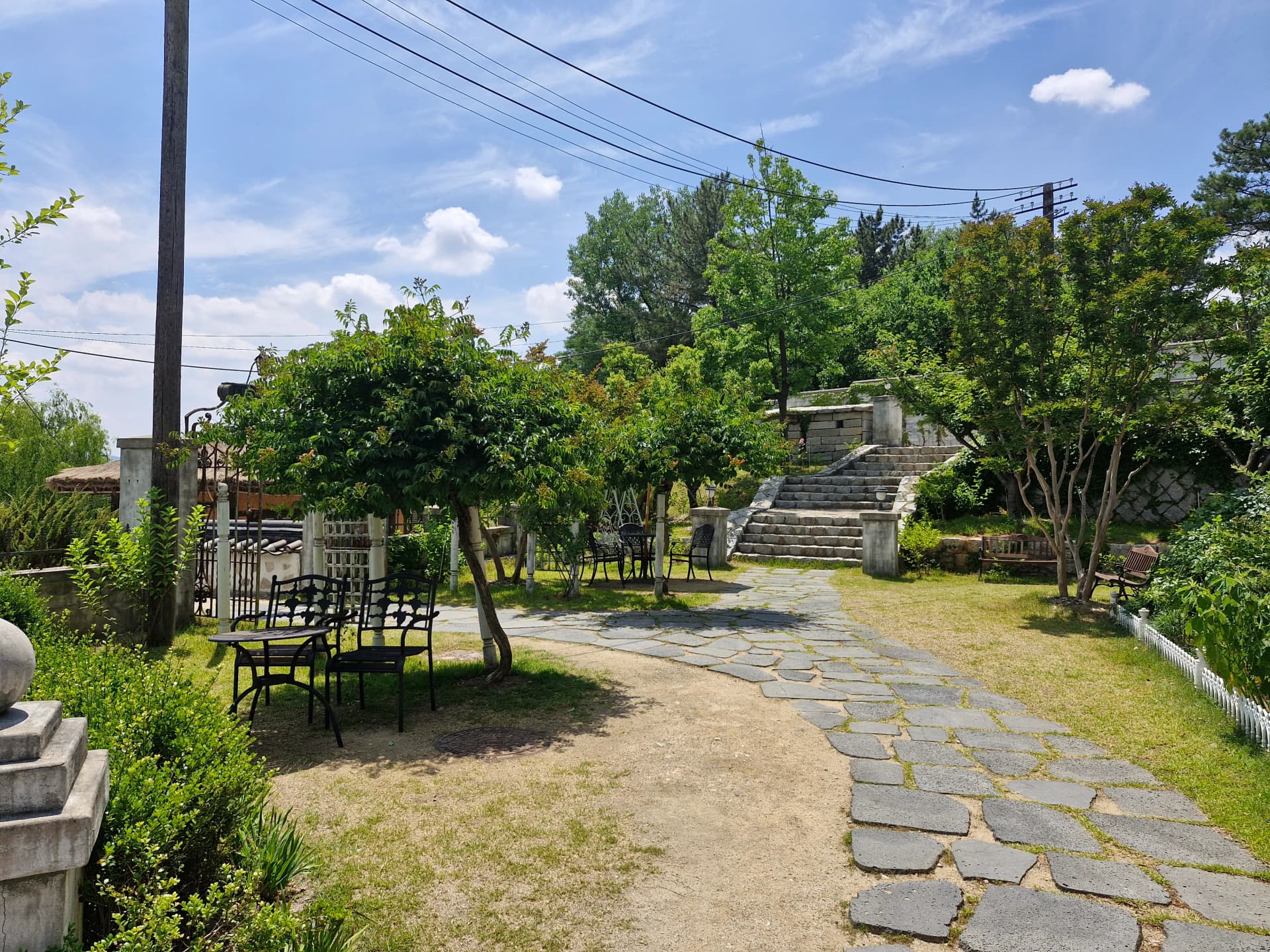
Step outside the Glory Hotel and this is the view. Wrought iron antique chairs, stone steps, green trees filling in the gaps. Nothing overwhelming. Just quiet and relaxed. The kind of spot where you can sit down and do absolutely nothing, and that's enough.
Hanok Street — A Different Era with Every Step
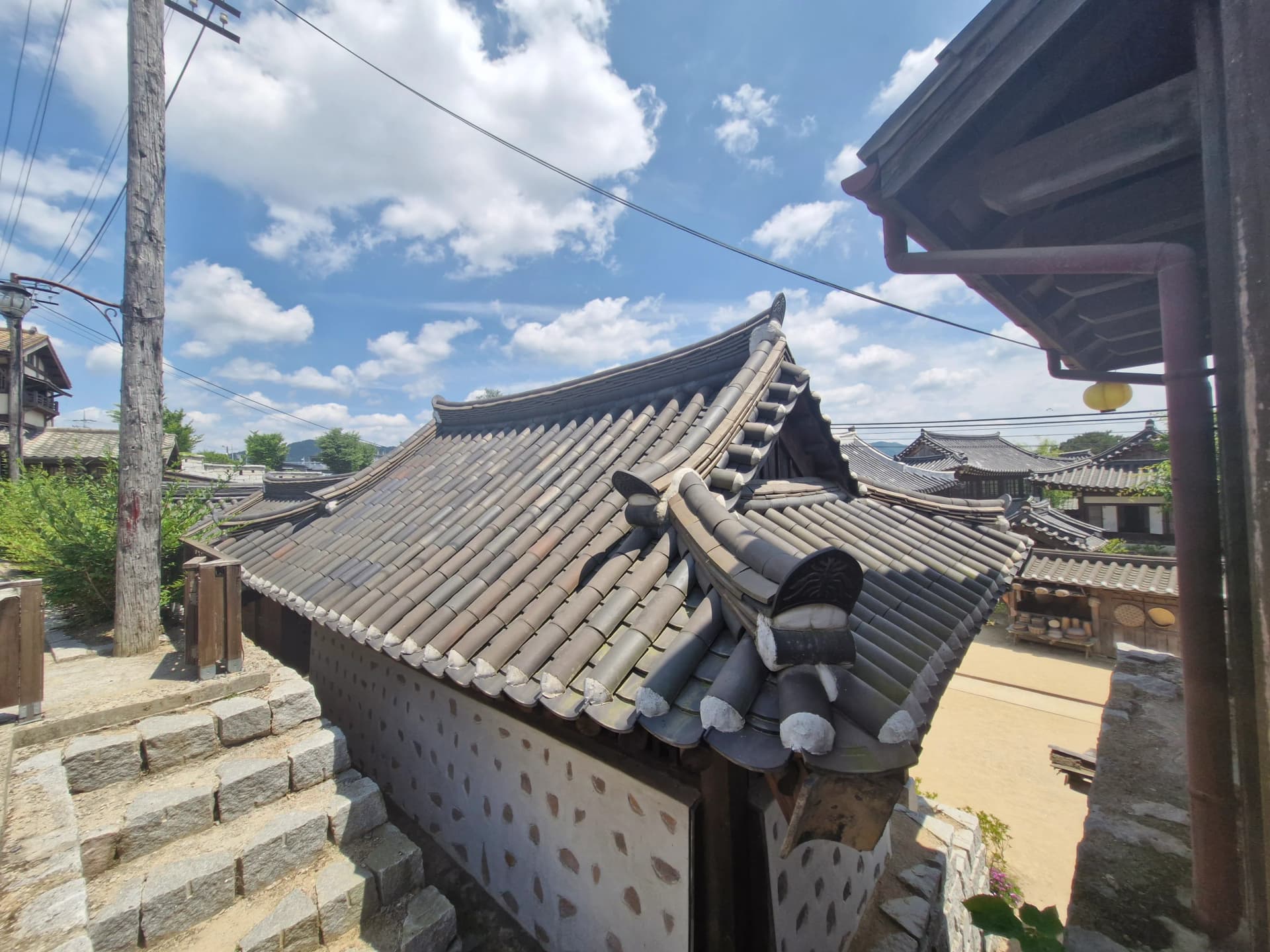
Walk a bit further and the scenery changes completely. Now you're on Hanok street — a row of traditional Korean houses with their signature curved tile rooftops stacked one after another. This is exactly what makes Sunshine Studio so special. Western-style buildings, Japanese-style buildings, and traditional Korean hanoks — all in one place. In the early 1900s, these three cultures genuinely coexisted in Korea. And here, you can see all of them in a single location. Every few steps, it feels like you've crossed into a different era.
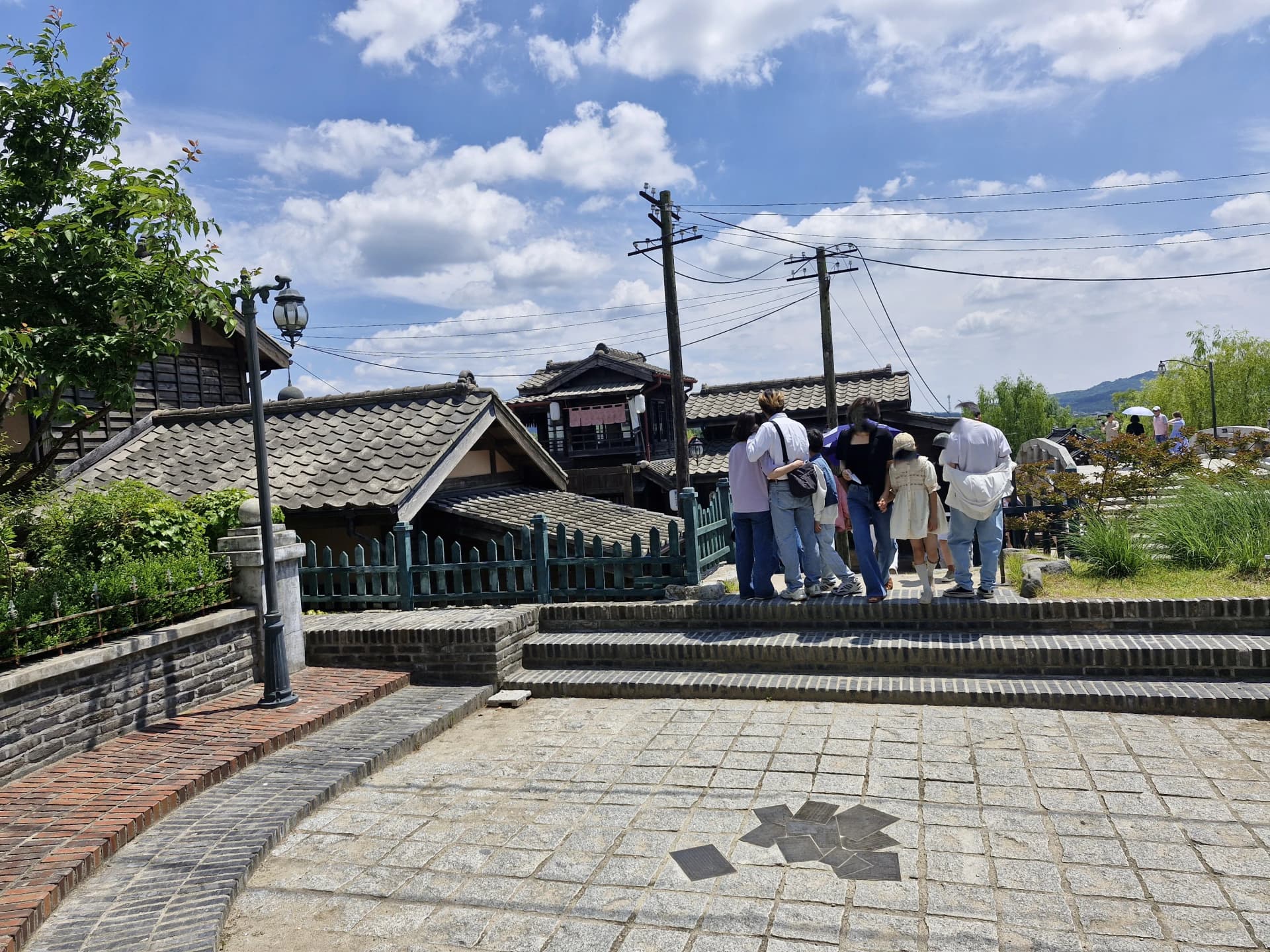
Look at this scene. People are crossing that small bridge and walking into the alley beyond. Weathered street lamps, wooden buildings, telegraph poles. This kind of streetscape barely exists in Korea anymore.
Korea is one of the fastest-modernized countries in the world. The entire urban landscape transformed in just 50 years. So 1900s street scenes mostly only survive in old photographs. That's what makes Sunshine Studio so remarkable — it's one of the only places where you can see these vanished streetscapes with your own eyes. If you're a foreign traveler, this will feel even more exotic. It's one of the rare spaces where Korea's present and past coexist side by side.
Japanese-Style Street — An Alley Where Colonial Memories Linger
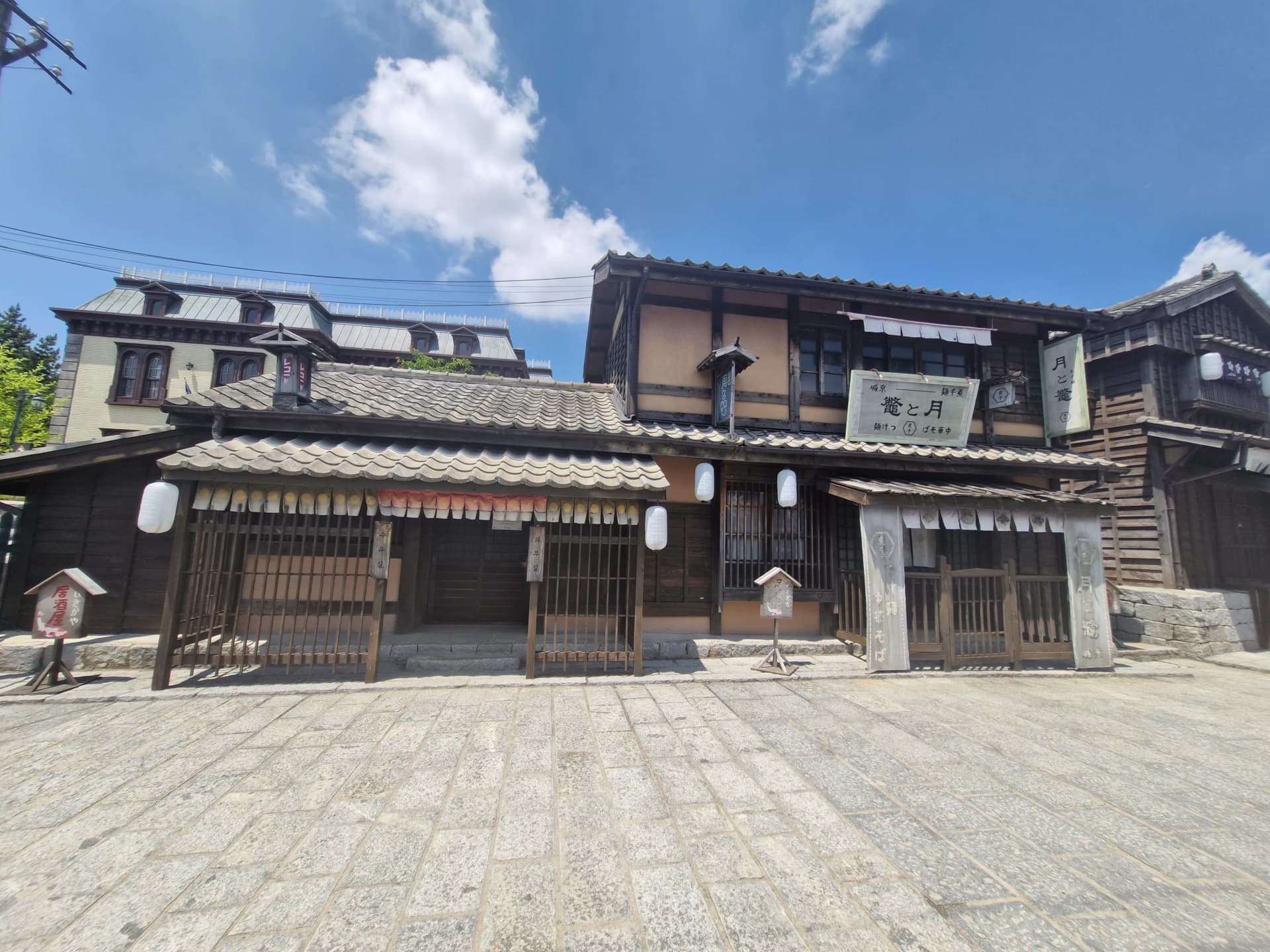
Keep walking through the alleys and you'll come across Japanese-style architecture. White paper lanterns, wooden lattice doors, signs written in Japanese. It might feel jarring at first.
But this is historically accurate. Korea was under Japanese colonial rule from 1910 to 1945. During that era, Japanese-language signs hung on every corner, and Korean script coexisted with Chinese characters on storefronts. What you're seeing here is what the streets of Hanseong actually looked like back then. Sunshine Studio recreated it faithfully. It might not all look pretty to you. But that's history. Feeling that discomfort is actually the right way to experience this space.
Bullangseo Bakery — A Film Set That Became a Real Bakery
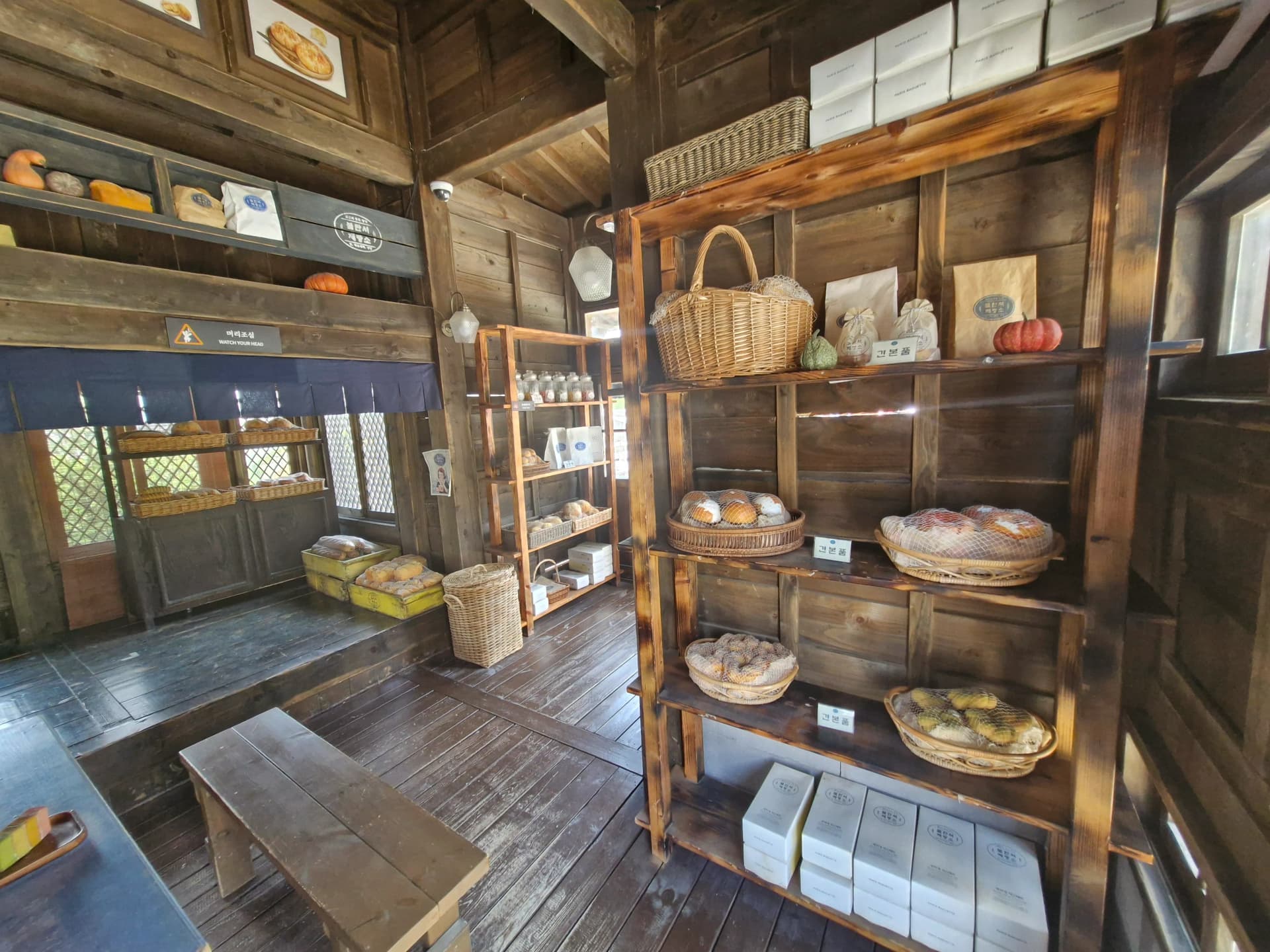
This is Bullangseo Bakery. The exact same space that appeared in the Mr. Sunshine drama is now operating as an actual bakery. Bread sits in baskets on weathered wooden shelves, and honestly, this scene alone is already a photograph.
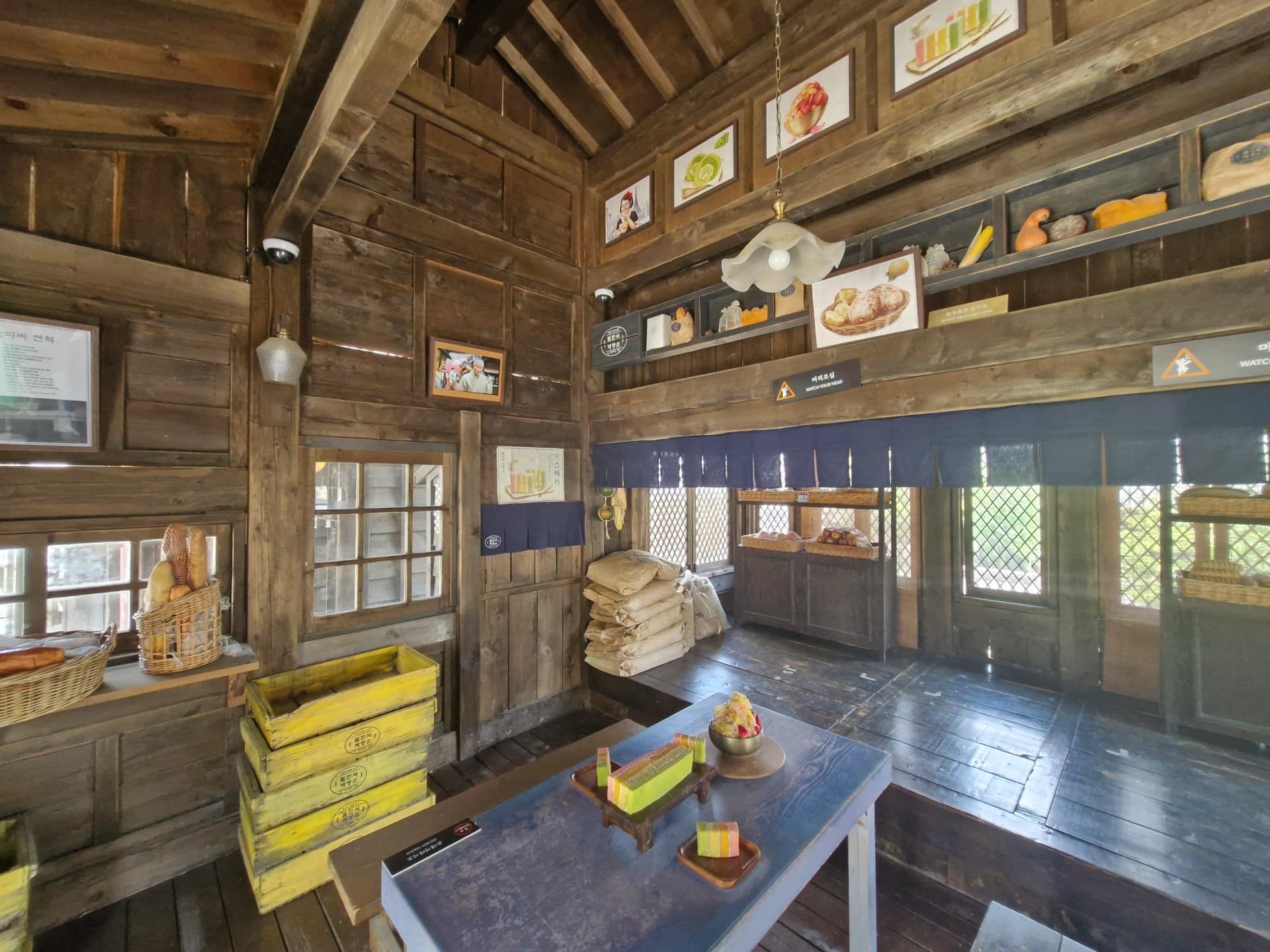
Step inside and you'll notice the tall, open timber-frame structure stretching up to the ceiling. Photos from drama scenes hang on the walls, and below them are stacked bread wrappers and ingredient sacks. The charm is in not being able to tell whether you're in a film set or a bakery. Buying a piece of bread here is an experience in itself.
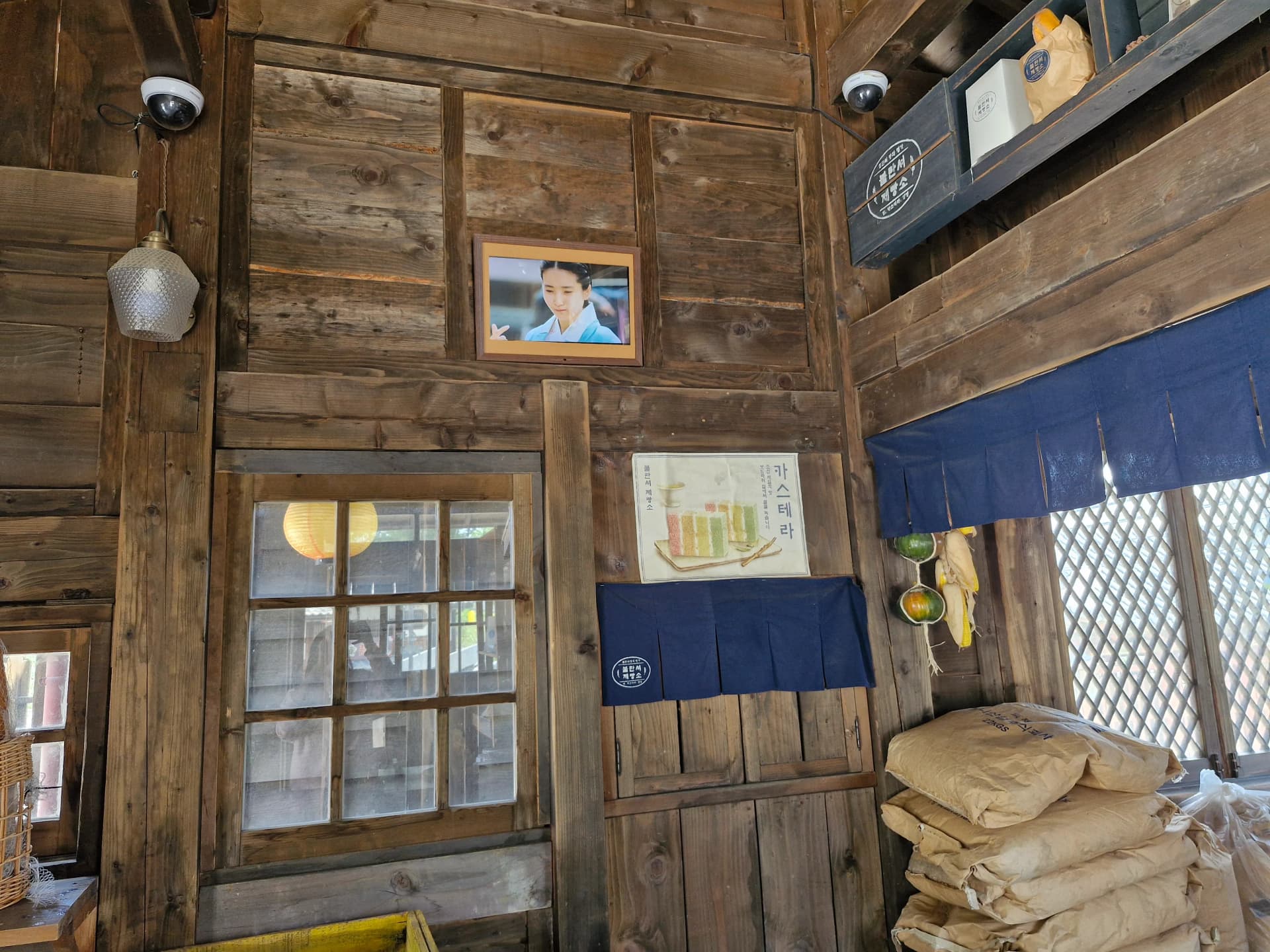
See those actor photos on the wall? That's proof that actual filming took place right in this very space. Next to them is a poster for castella — a sponge cake that originated in Portugal, traveled through Japan, and eventually made its way to Korea. It was one of the first Western foods introduced to Korea during the Enlightenment Period in the 1900s. The fact that this bakery existed in that era isn't just a random set choice.
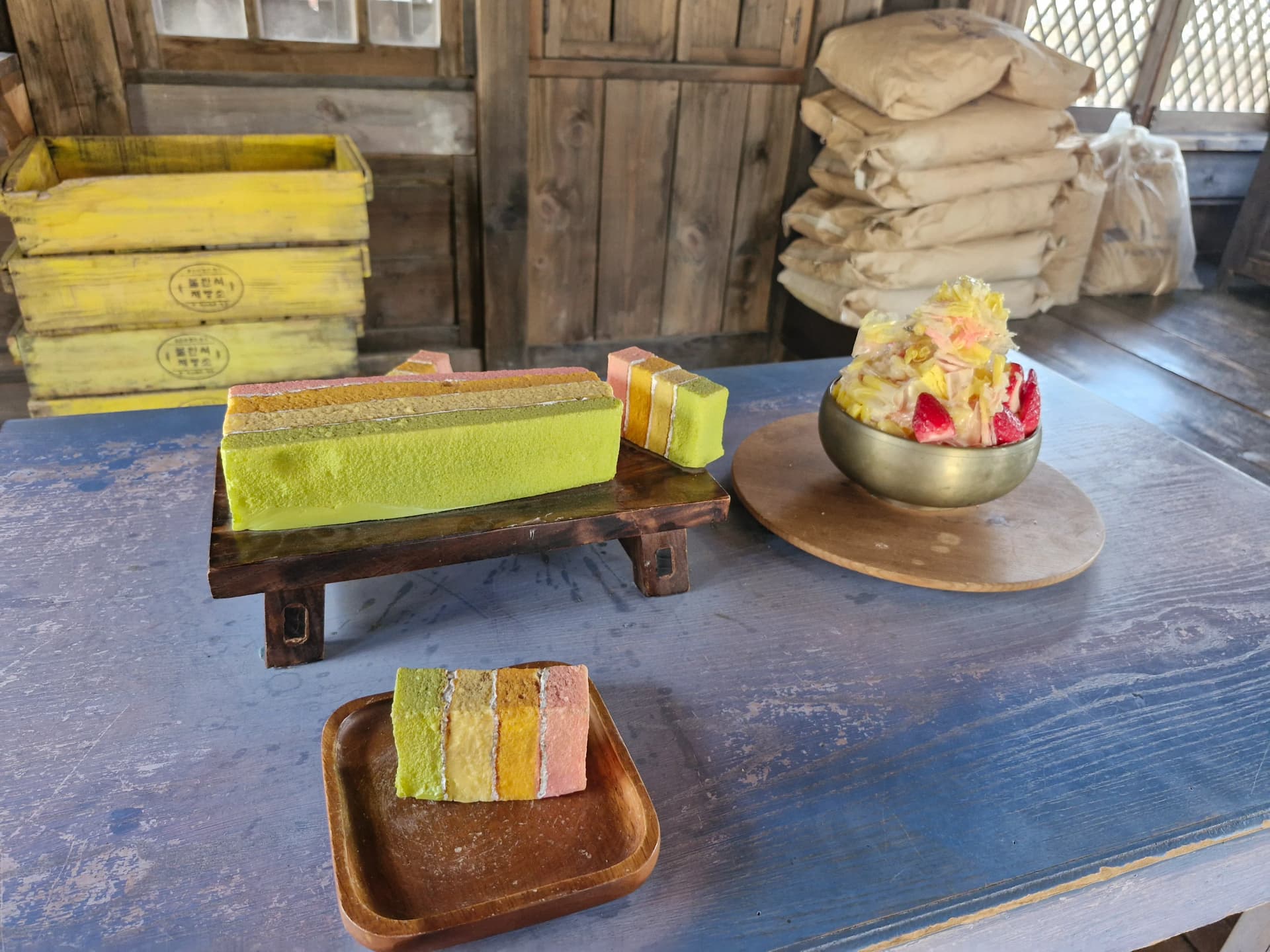
These are display models, but they're ridiculously pretty. On the left is castella, and on the right is bingsu — Korea's beloved shaved ice dessert. See those colorful cross-sections of castella sitting on the little wooden tray? Green, yellow, orange, pink. And you eat this inside a space that oozes 1900s charm. Sure, the taste matters, but honestly it feels like you're consuming the entire scene, not just the food.
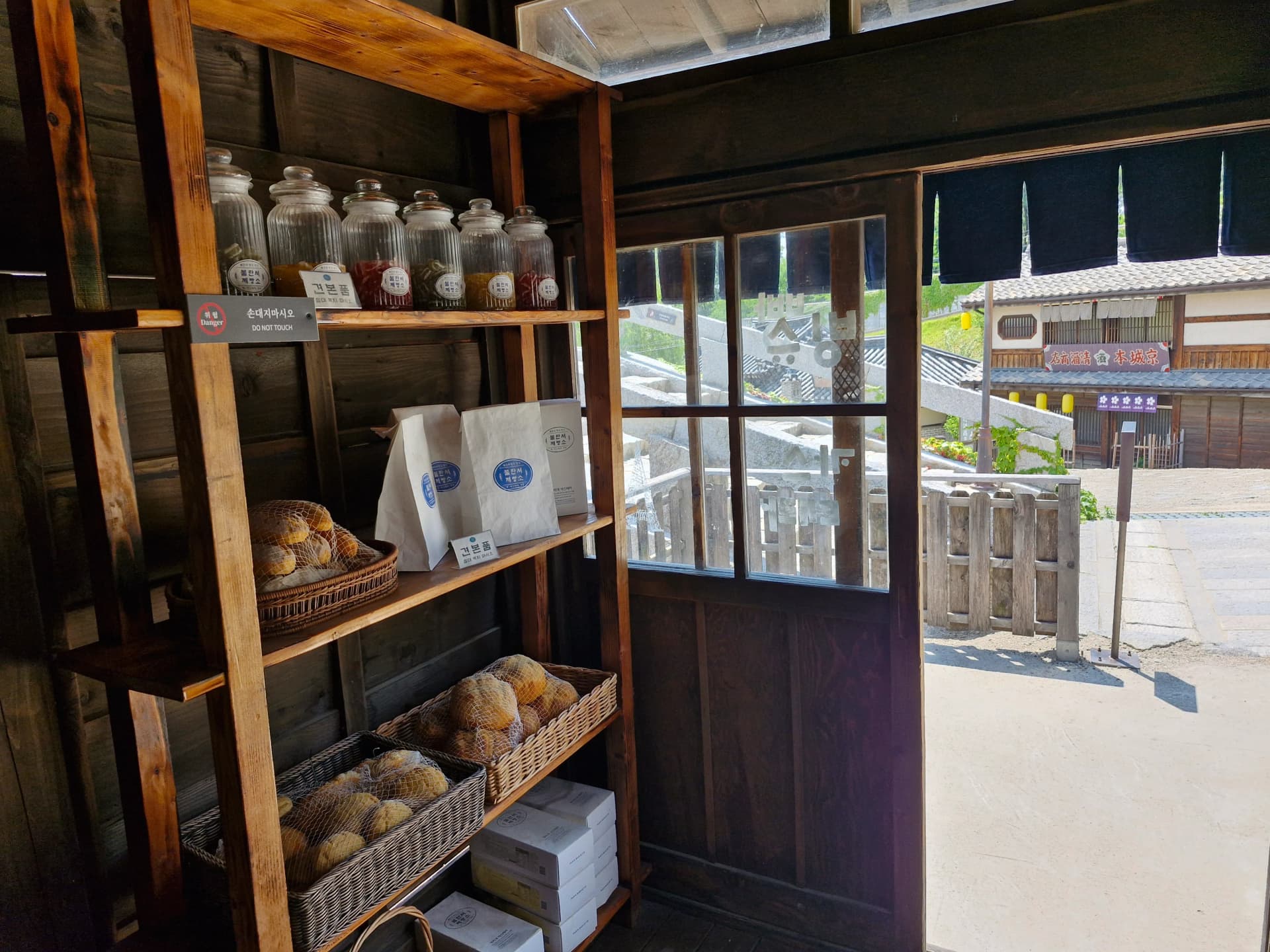
Even the view through the doorway was calculated. While you're picking out bread, the old-fashioned street naturally comes into view through the window. Glass jars filled with ingredients, baskets of bread, and beyond that, a street lined with signs in Chinese characters. The front door of this bakery feels like the boundary line between the present and the past.
Japanese Tavern and Oden Street Stall — Daily Life in 1900s Hanseong
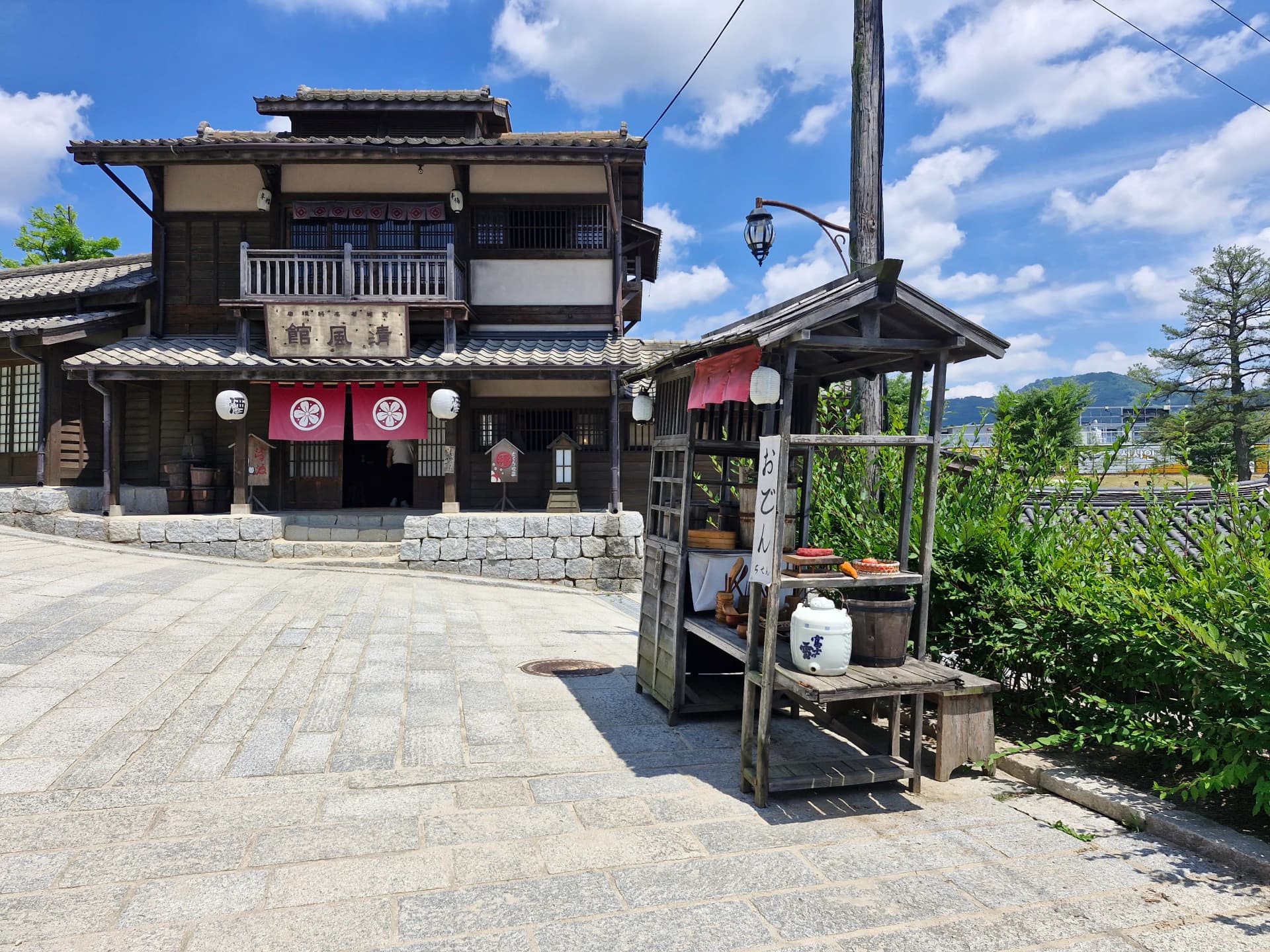
This is a two-story Japanese-style building. A red noren — a traditional Japanese fabric curtain hung at shop entrances — drapes over the doorway, and white paper lanterns decorate the front. On the right, there's a small street stall with おでん (oden) written on it. Oden is a Japanese street food where various ingredients are simmered in a savory broth. It's still hugely popular in Korea today. It's one of those foods that naturally became part of Korean food culture during the Japanese colonial period in the 1900s.
The wood grain on the building's exterior, the curves of the tile roof, the structure built atop a stone wall — there's too much detail to just walk past. As you stroll down this street, you'll have moments where you genuinely can't tell if you're in Korea or on a 1900s Japanese street. That's exactly the point. Streets like this actually existed in Hanseong back then.
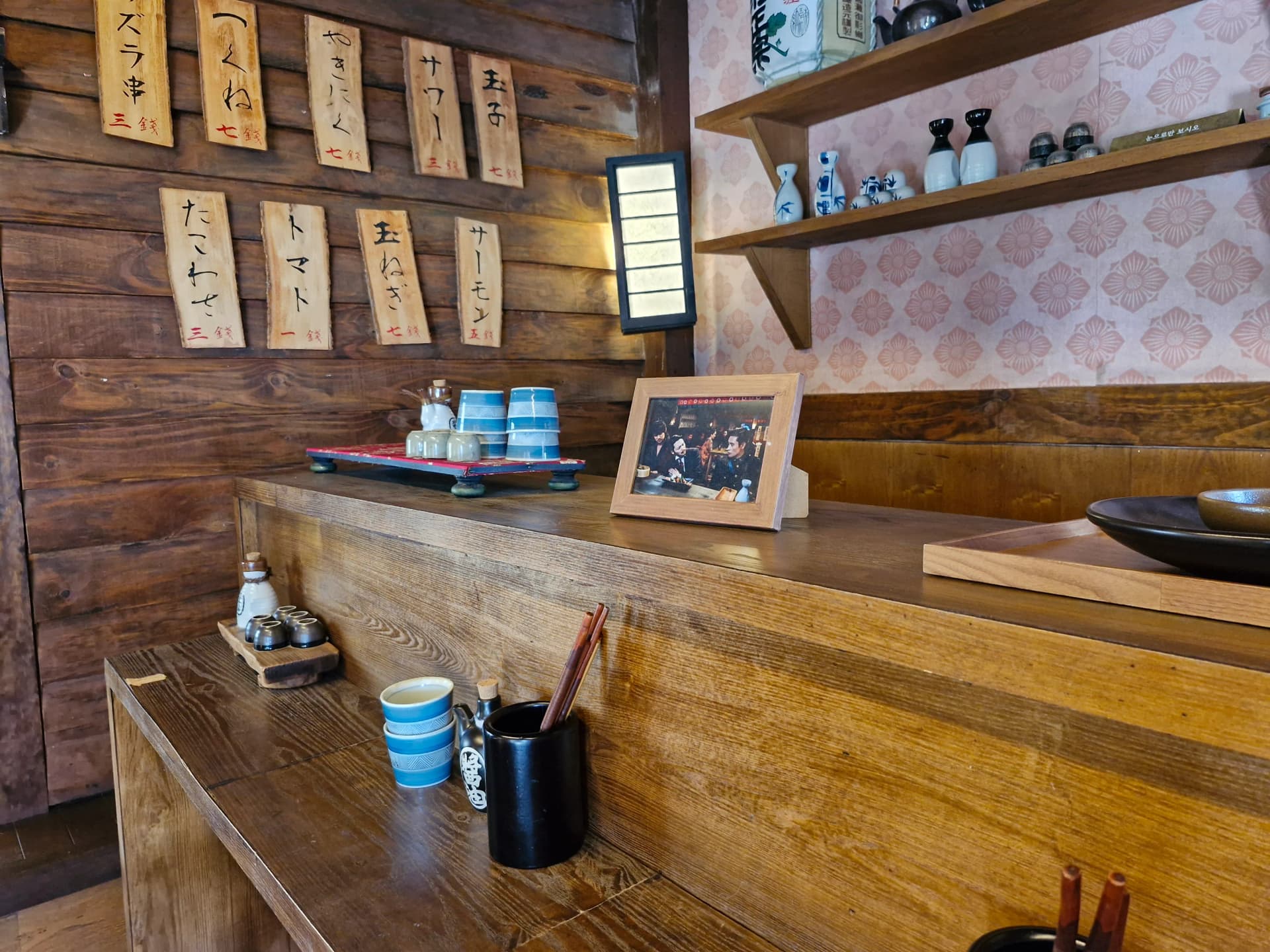
Check out the wooden menu board on the wall. Food names written in Japanese, with prices listed in 錢 (jeon) — an actual currency unit used in the 1900s. On the counter sits a framed photo from the drama shoot. Every single detail here is too good to just breeze past.
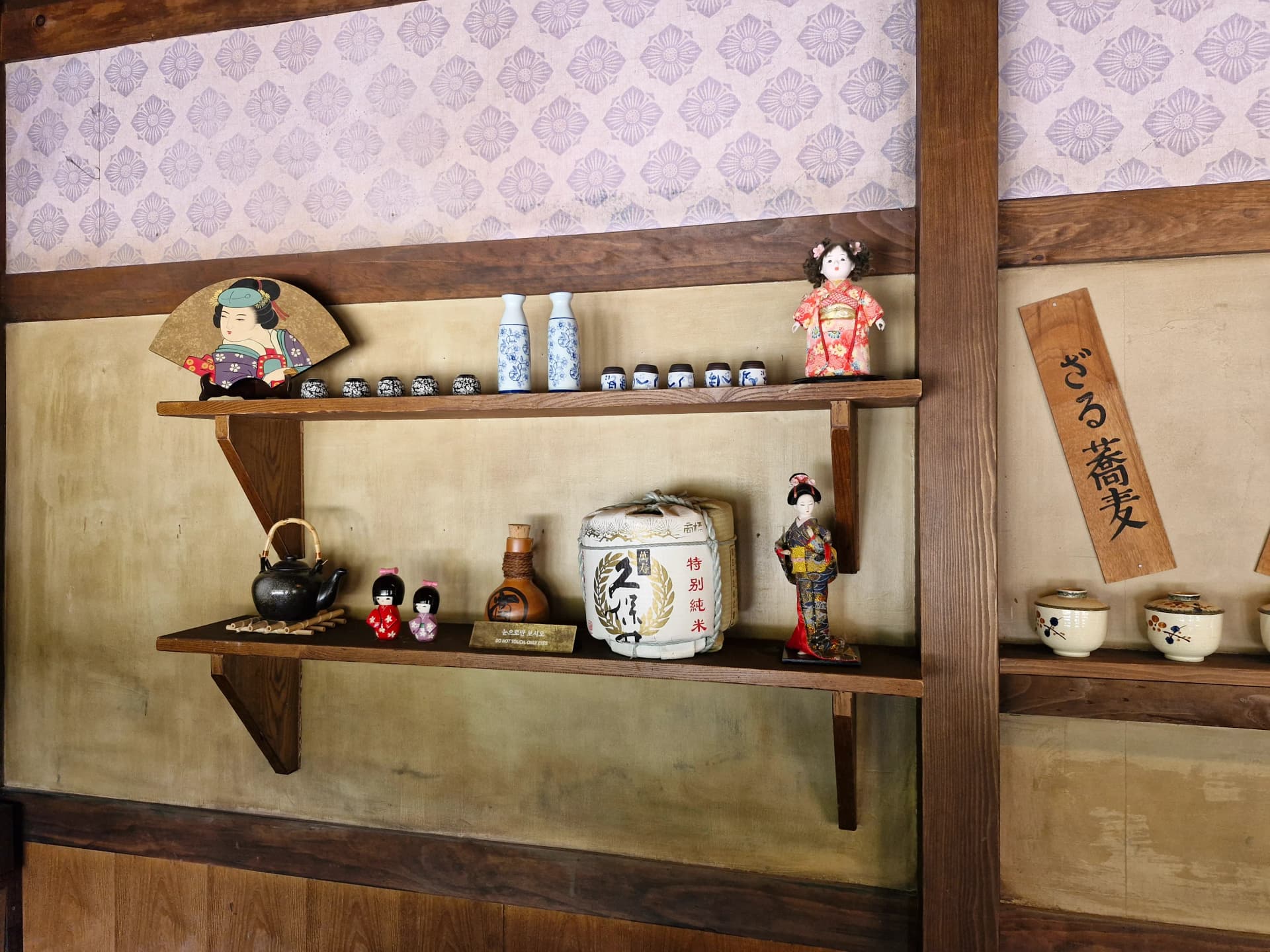
Look at the shelves — a kimono doll, a folding fan, a sake barrel, a teapot. This is exactly what a 1900s Japanese-style tavern looked like. This isn't just random prop placement. Spaces like this genuinely existed throughout Hanseong back then. What you've only seen in history books is now right in front of your eyes.
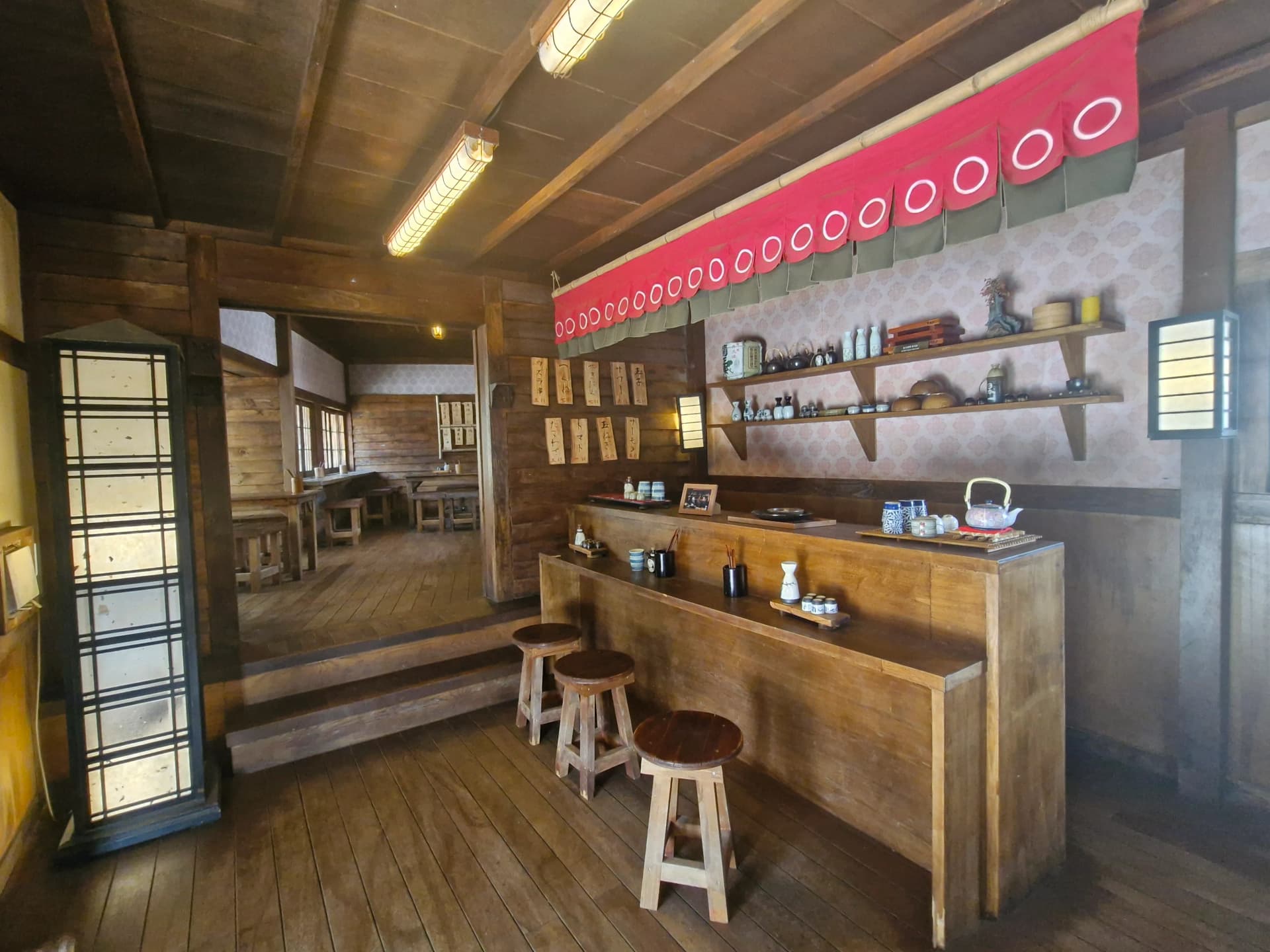
Wooden stools line up beneath the red noren curtain. This quiet, empty space somehow says more than a crowded one ever could. Sit in one of those chairs and imagine the conversations the drama characters had here. If you've watched Mr. Sunshine, this scene won't feel unfamiliar at all. And if you haven't? That's fine too. This space starts telling you its story first.
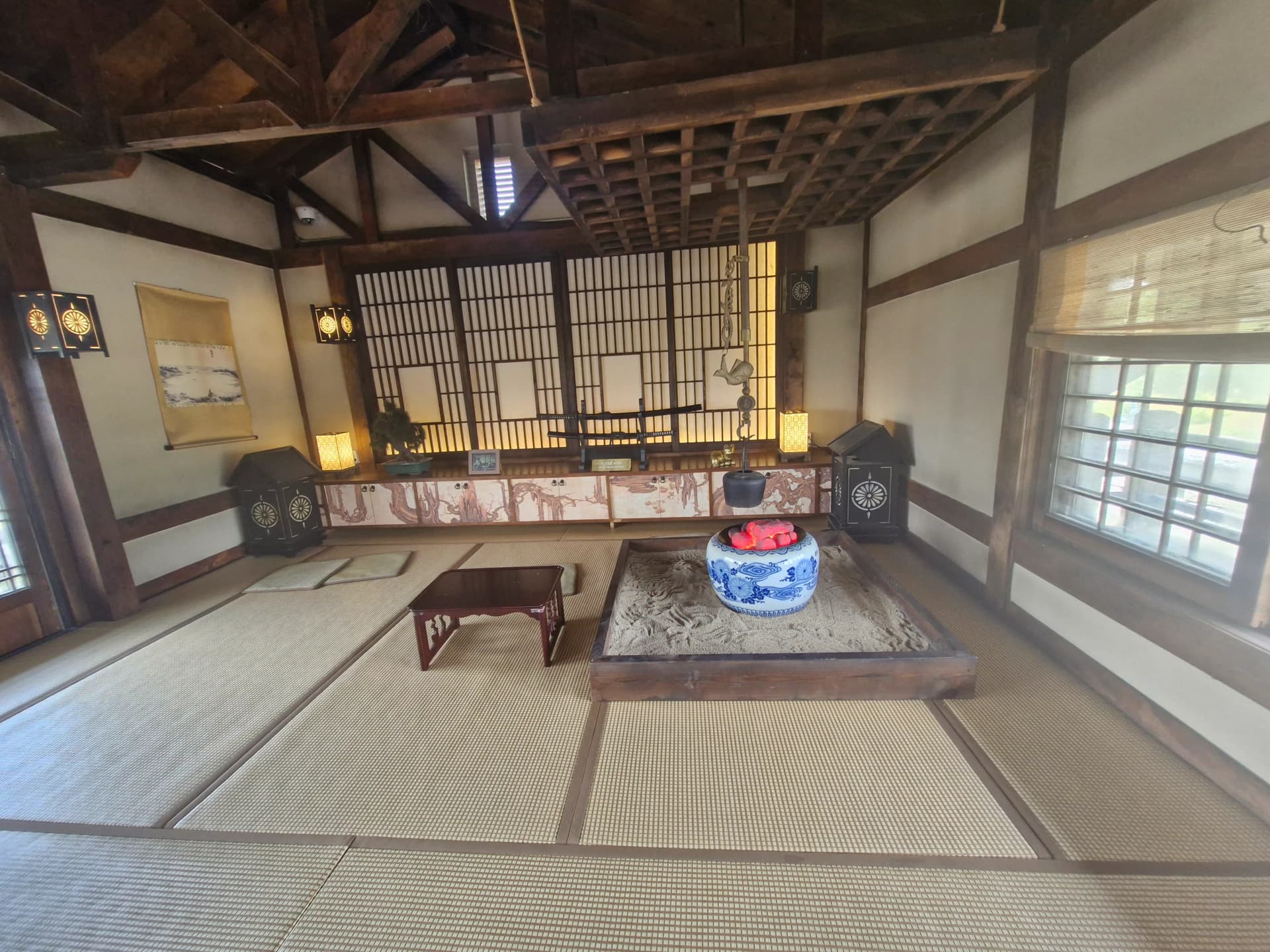
Tatami floors, lattice paper sliding doors, and a hibachi fire pit in the center. This is the room that appeared in Mr. Sunshine as the residence of Kudo Hina — a Japanese character rooted in Korean soil. The atmosphere is completely different from a traditional Korean space. It's cold, meticulous, and carries this subtle undercurrent of tension. If you've seen the drama, the scenes will come flooding back the second you step into this room.
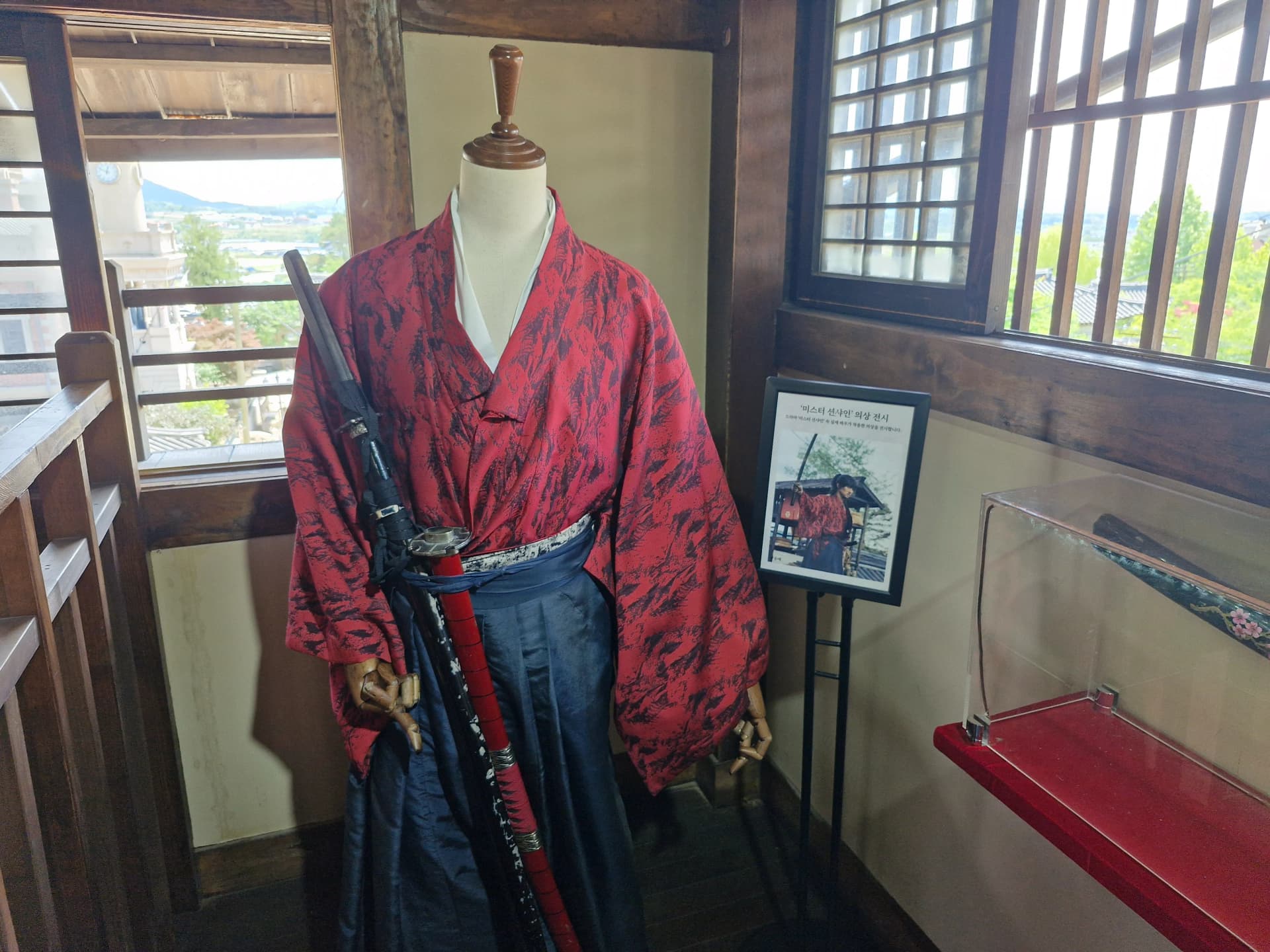
A red kimono with a sword. This is the actual costume worn by the actor during filming. Compare it with the photo in the frame beside it and it'll give you goosebumps. This outfit appeared in that exact scene. It doesn't feel like you're standing in a set — it feels like you're standing before a real piece of history.
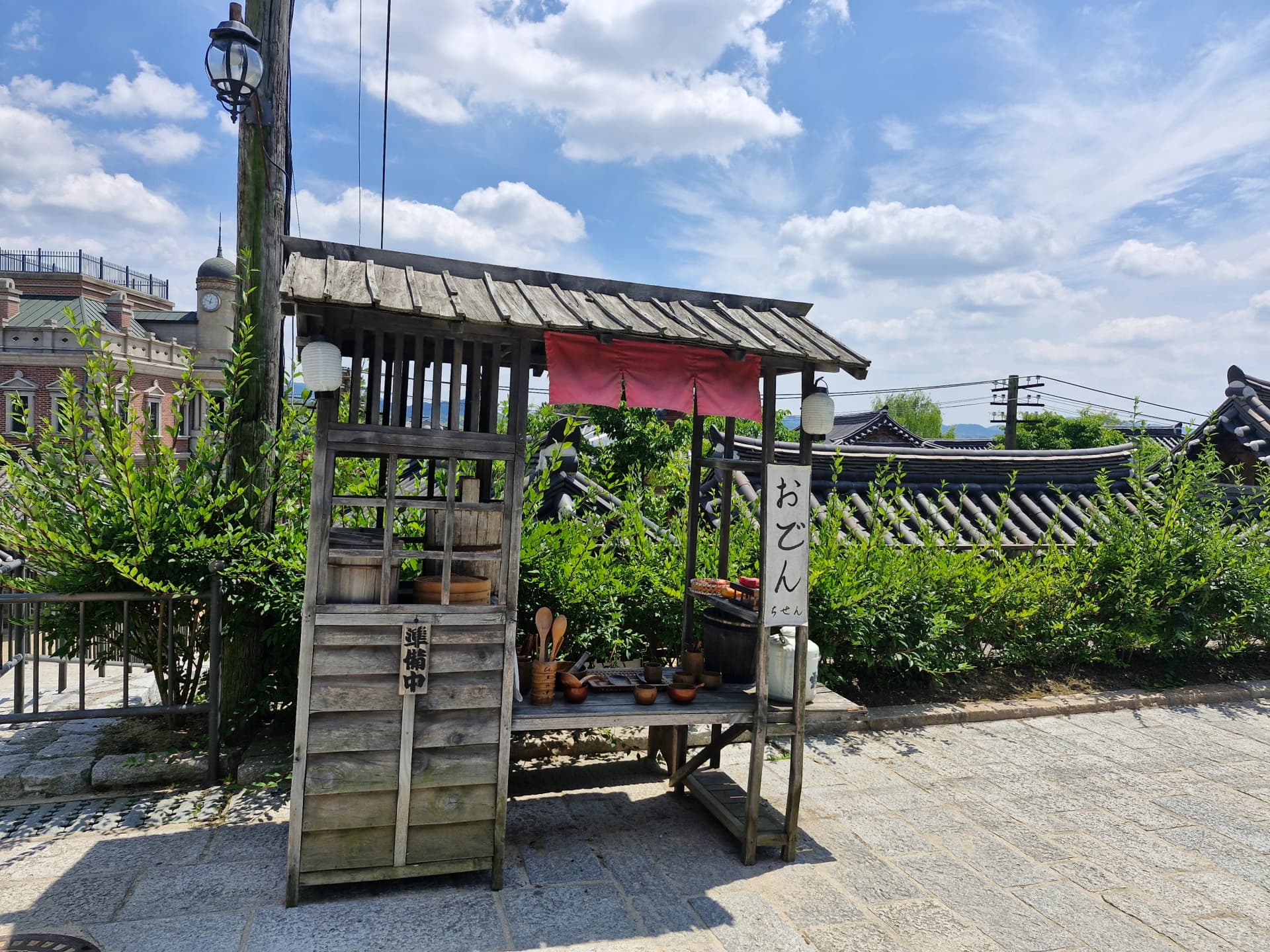
An oden stall standing all alone in the middle of the street. おでん, 準備中 (Preparing). It's not even open yet, but this scene alone is more than enough. Behind it, traditional Korean tile rooftops; to the left, a red-brick Western-style building — all captured in a single frame. Korean, Japanese, and Western architecture coexisting in one photo. This is what 1900s Hanseong actually looked like. No matter which direction you point your camera, it's a shot.
Hanseong Electric Company and Jongno Street — The Scale of This Set
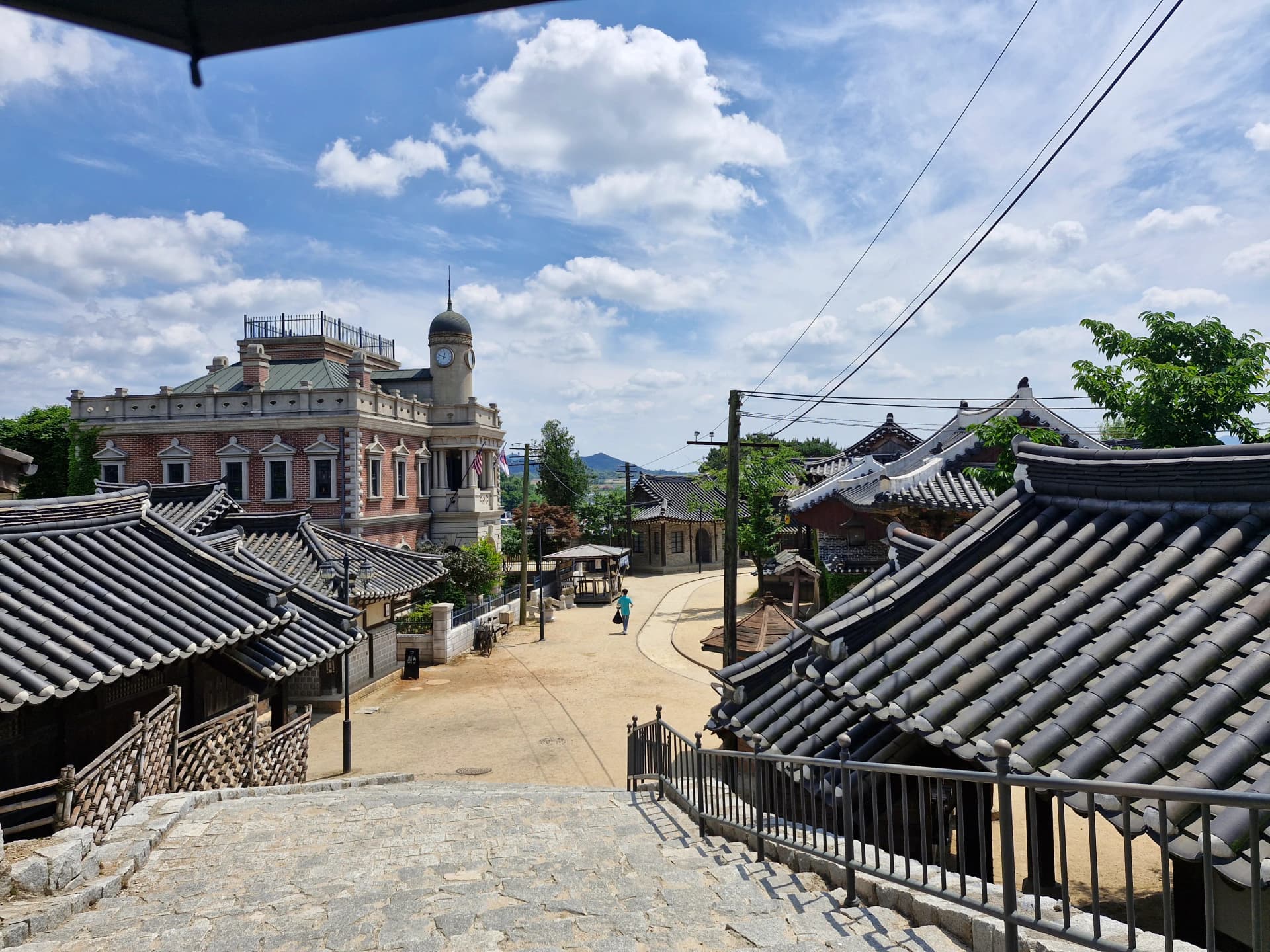
Here's the view of Sunshine Studio from up high. On the left, the red-brick building with a clock tower is the Hanseong Electric Company. On the right, traditional Korean tile rooftops stretch out one after another. Western-style modern architecture and traditional Korean buildings coexisting in one frame — this is exactly what 1900s Hanseong looked like in real life. Back then, these two styles truly stood side by side.
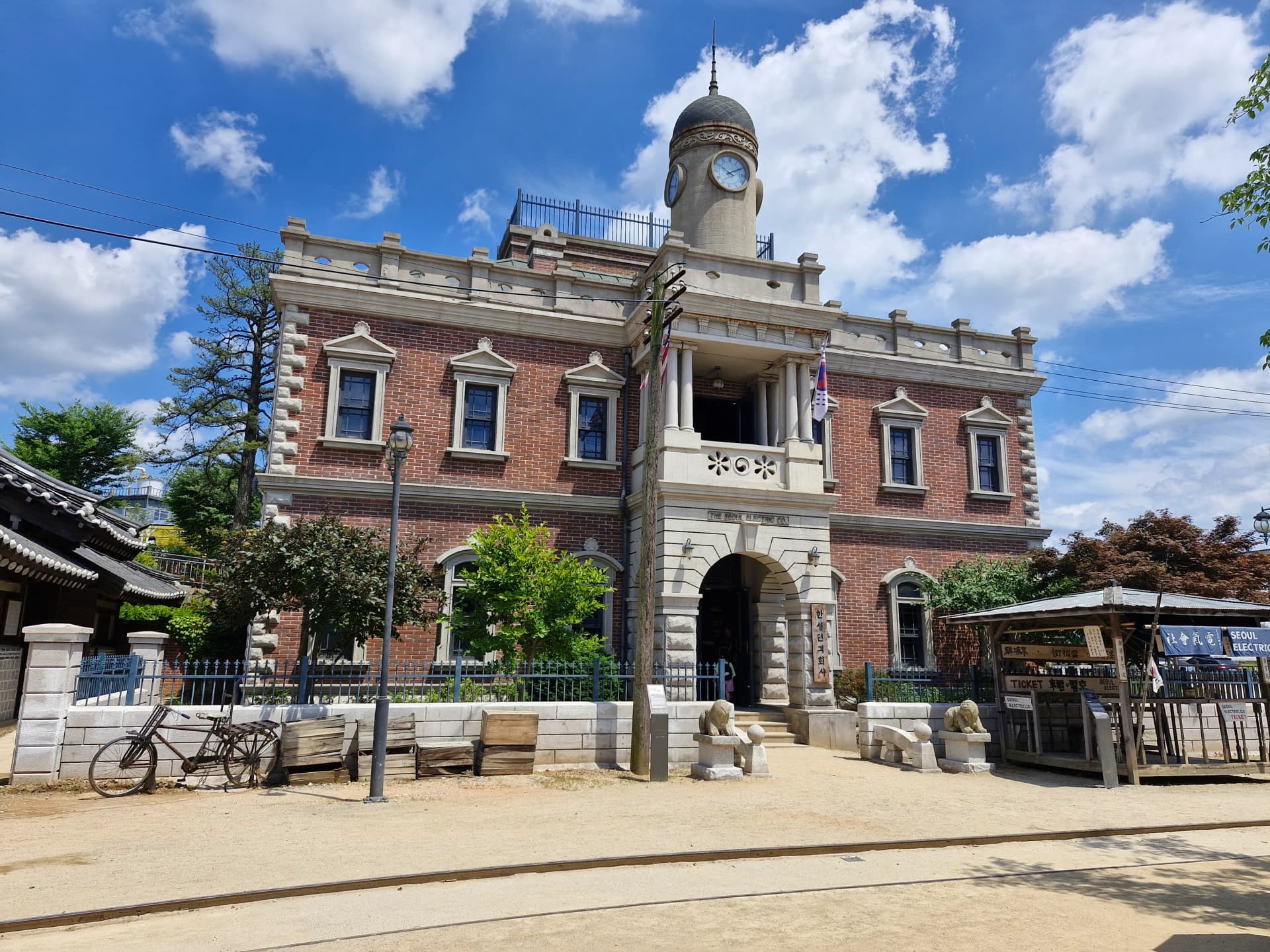
The front of the Hanseong Electric Company. Red brick, a rounded dome clock tower, arched windows. Founded in 1898, this was Korea's very first electric company — the building that brought electricity to the streets of Hanseong for the first time. This isn't just a set piece; it's a restoration of real history.
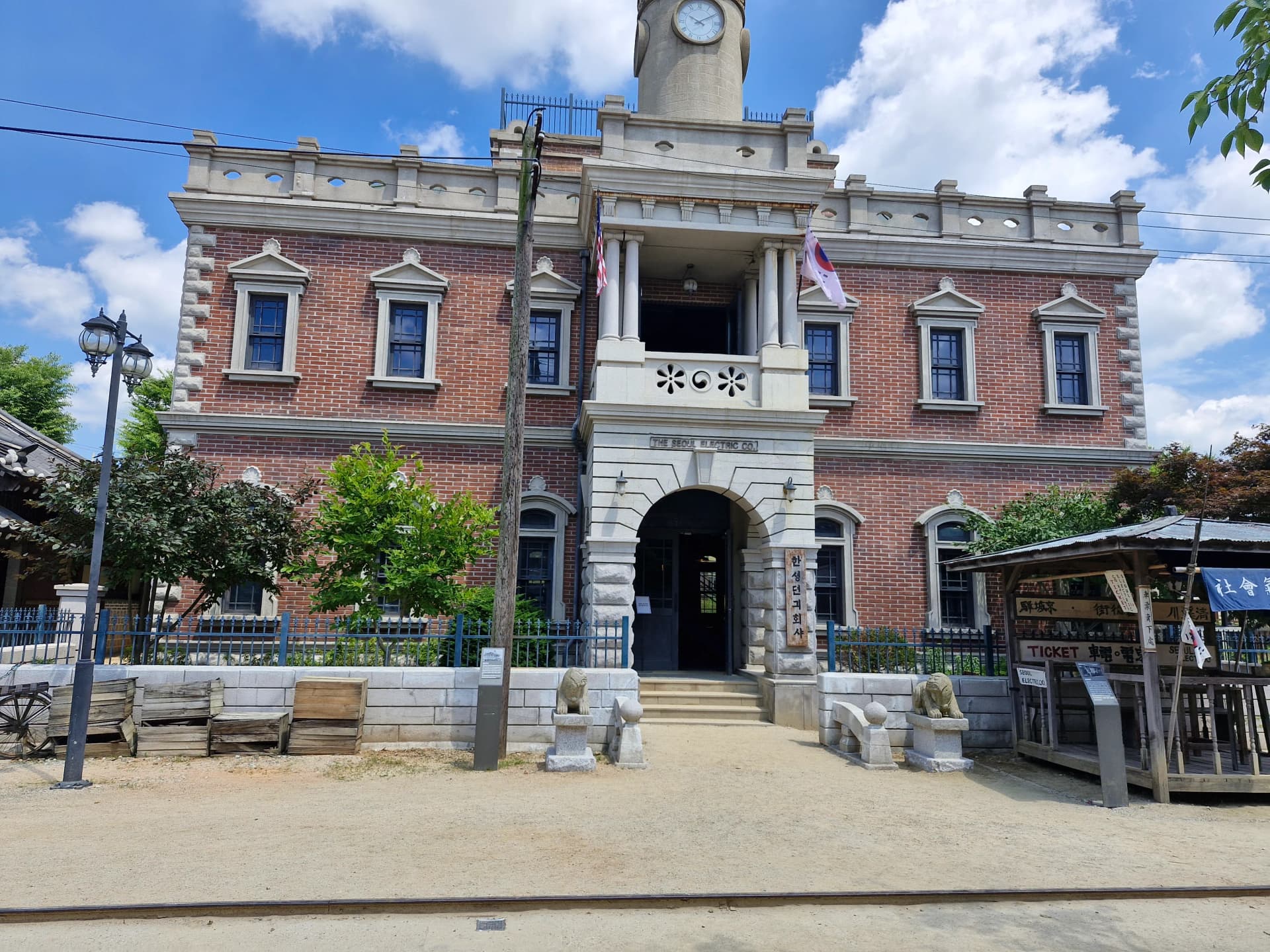
Get closer and the details come alive. The brick texture of the exterior walls, the ironwork on top of the clock tower, the delicate carvings around the arched windows. Stand in front of this building and you immediately understand why drama directors chose this set.
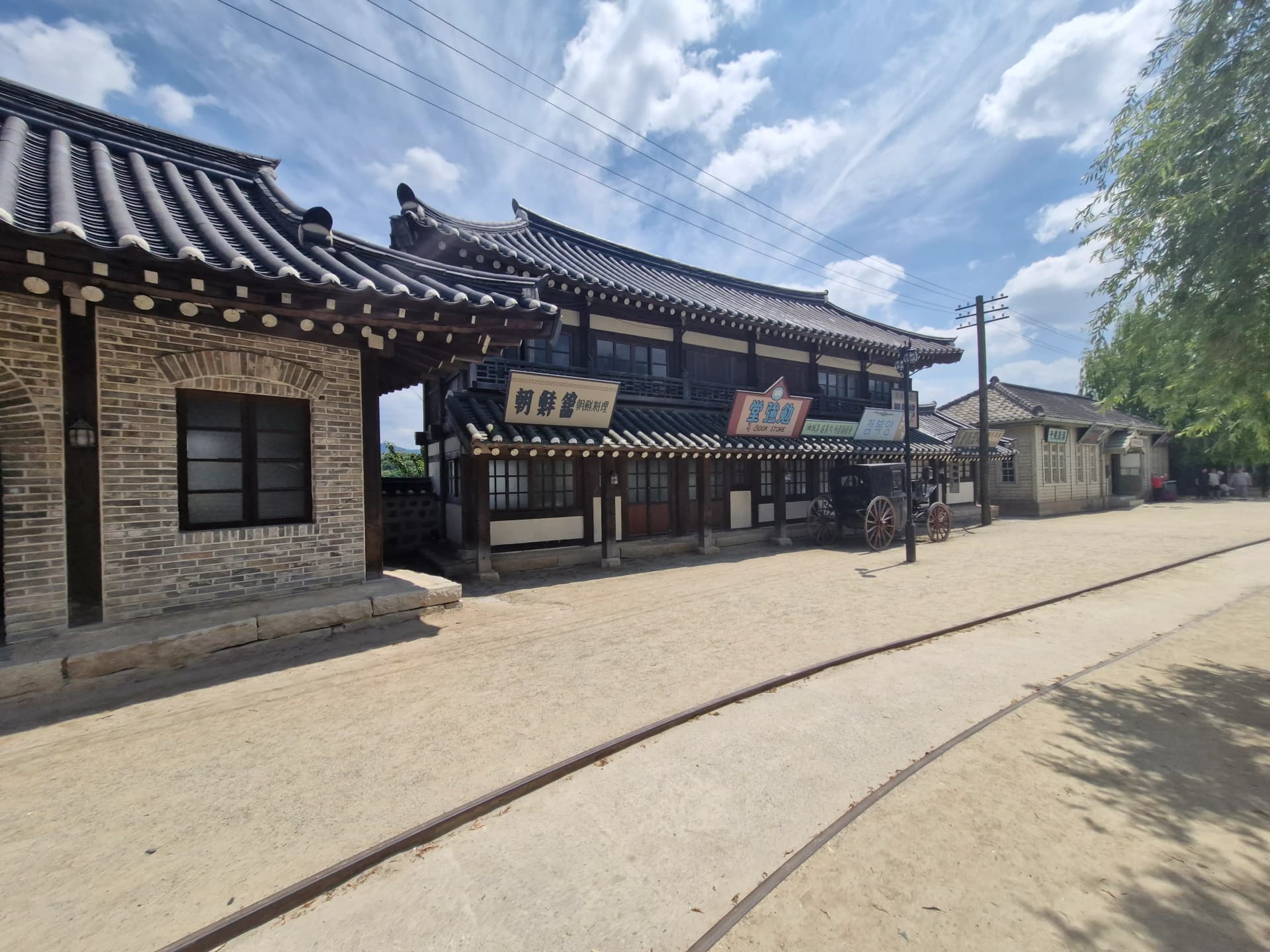
Tram rails are embedded right in the middle of the road. The Hanseong Tram started running in 1899 as Korea's first-ever streetcar, traveling between the east and west gates of Seoul. A building sign reads "朝鮮銀" (Joseon Bank) in Chinese characters, and a carriage wheel leans against the wall nearby. This single street captures the chaotic yet dynamic atmosphere of an era when trams, horse carriages, and hanoks all coexisted.
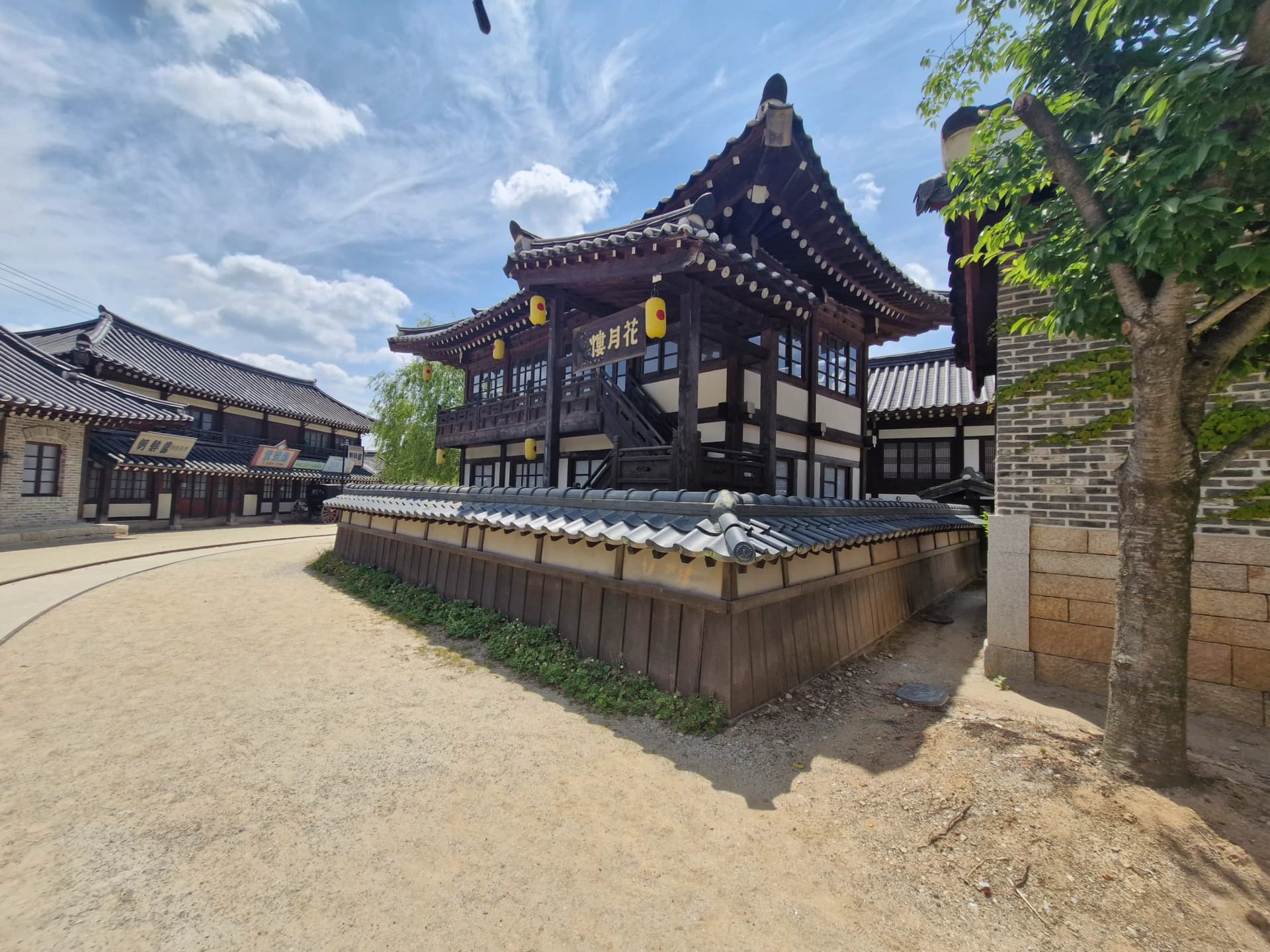
花月樓 (Hwawollu). A striking two-story wooden building with Chinese character signage and yellow lanterns. In Mr. Sunshine, Hwawollu appears as a high-end traditional restaurant — the kind of place where the upper class and powerful figures came and went. The white walls crisscrossed with dark timber frames reflect the hybrid architectural style of that era, blending Korean and Japanese elements. Imagine this place at night when those yellow lanterns are lit — the atmosphere must be something else entirely.
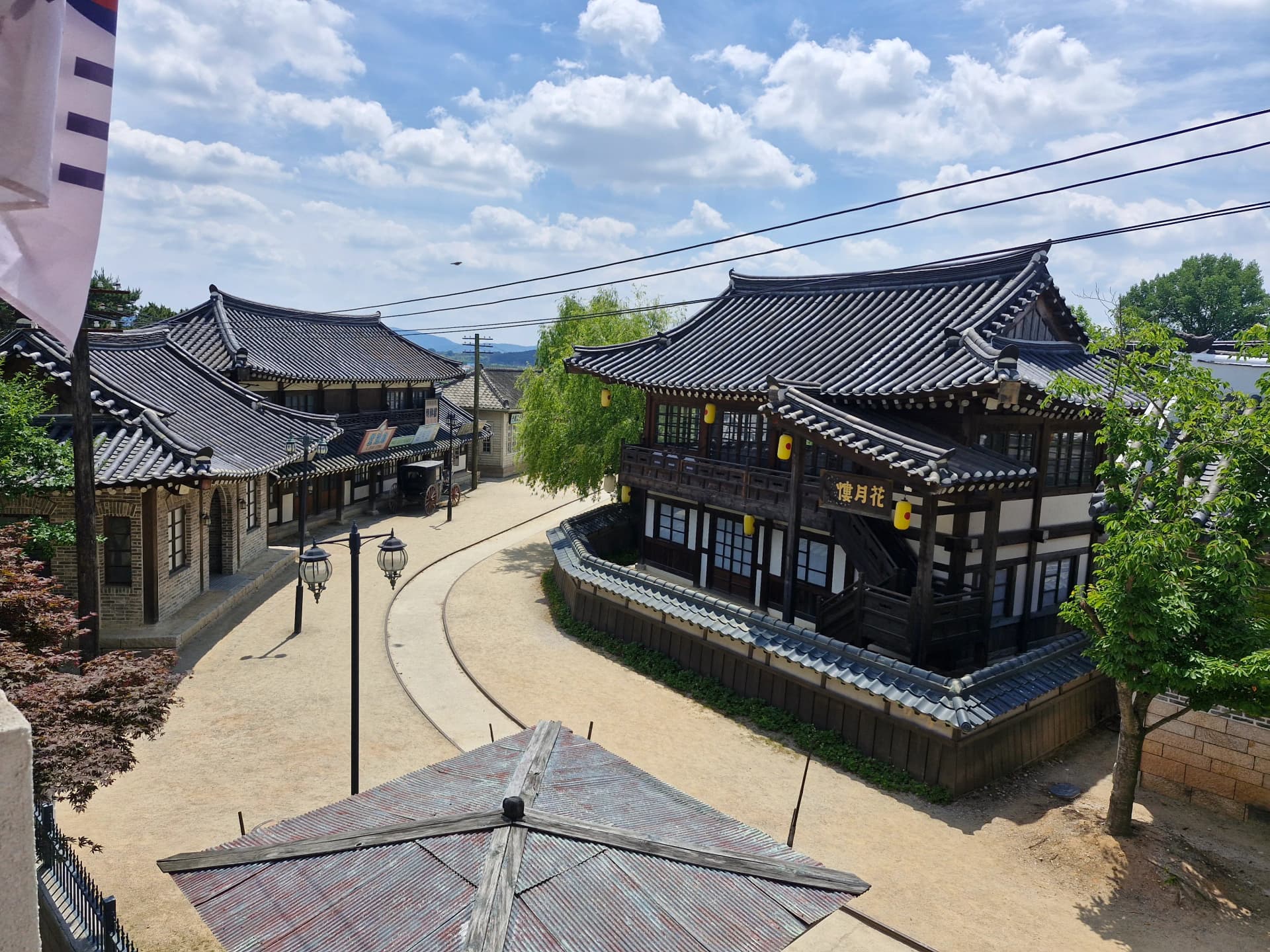
Here's the panoramic view of Jongno street from above. The Taegukgi — the Korean national flag — anchors the left side of the frame, while tram rails curve around Hwawollu and the entire street unfolds like a panorama. From this angle, it doesn't feel like a set at all — it genuinely feels like you're looking down at a real 1900s street. If you have time, definitely come up here and take in this view.
Hanseong Tram and Daeanmun Gate — Symbols of Modern Korea
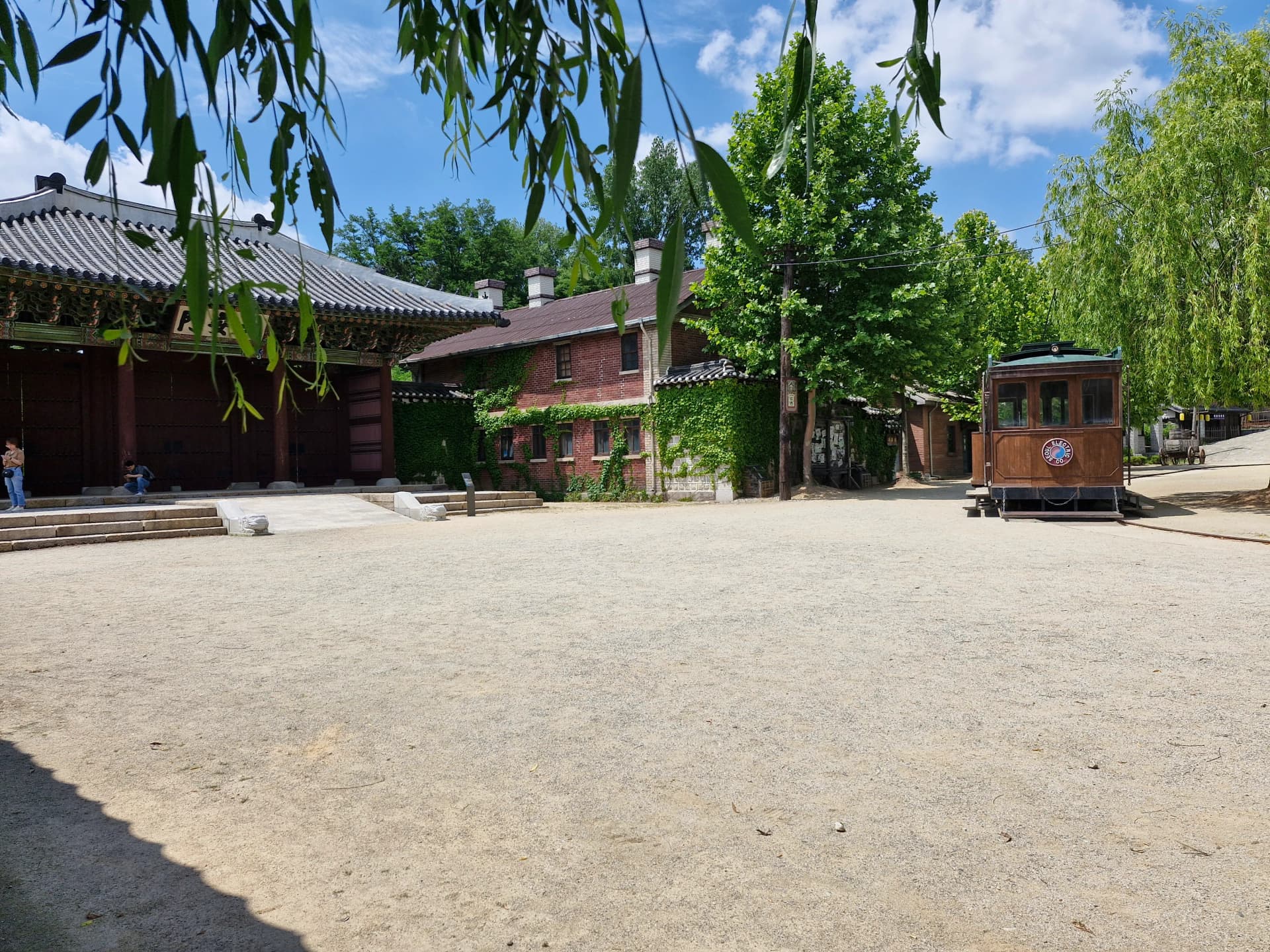
Through the drooping willow branches, a plaza opens up. On the right stands a wooden replica of the Hanseong Tram — Korea's first streetcar, which actually ran in 1899. When Seoul citizens first saw this tram, they reportedly gasped that "a steel monster was running through the streets." It stands quietly now, but its presence still fills the space.
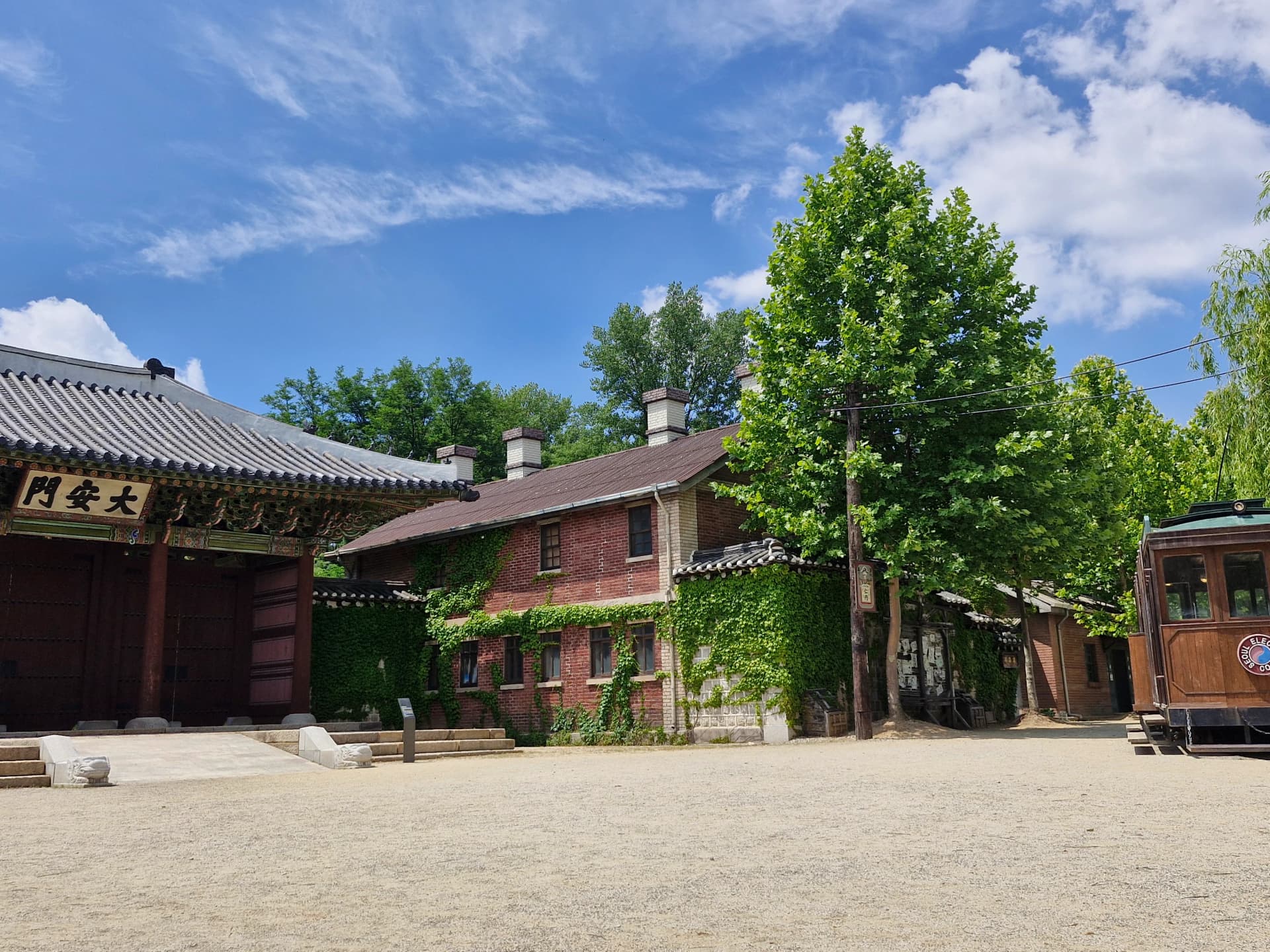
大安門 (Daeanmun). This is the former name of Daehanmun Gate, which still stands today at Deoksugung Palace in Seoul. The Chinese characters are boldly written on the plaque of the massive wooden gate, and right beside it, an ivy-covered red brick building and the Hanseong Tram stand side by side. A traditional Korean gate, Western architecture, and a streetcar all in one frame — that's a scene you can only find at this filming location set.
Jongno Shopping Street — The Joy of Walking Through a 1900s Street
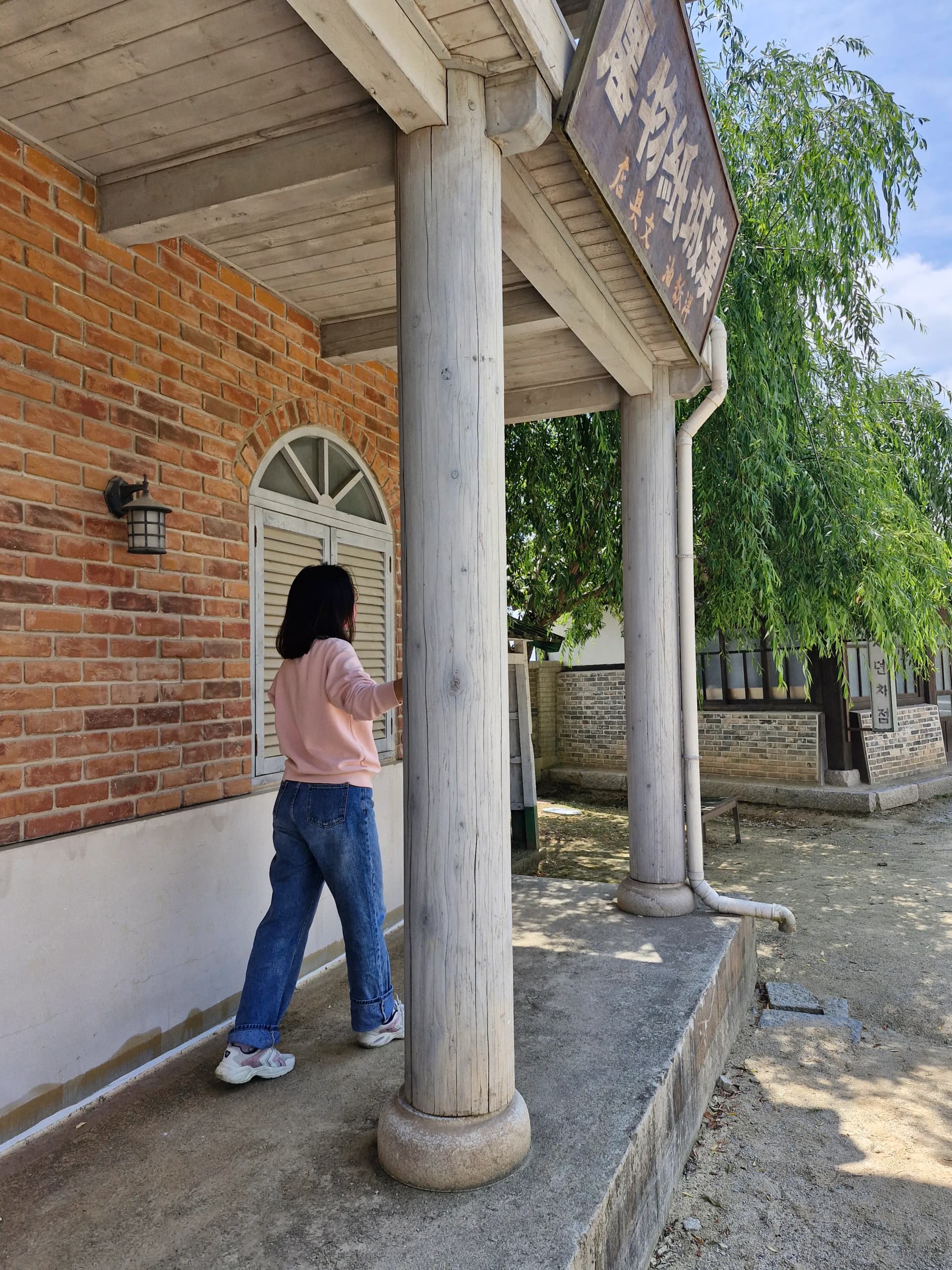
A visitor standing in front of red brick columns. Chinese character signboards crowd the space above, and up close, the texture of the columns and the details of the arched windows are even more impressive. In a space like this, you don't even have to try — just standing there and you're already a photograph. Put even a little thought into your outfit and the background does the rest.
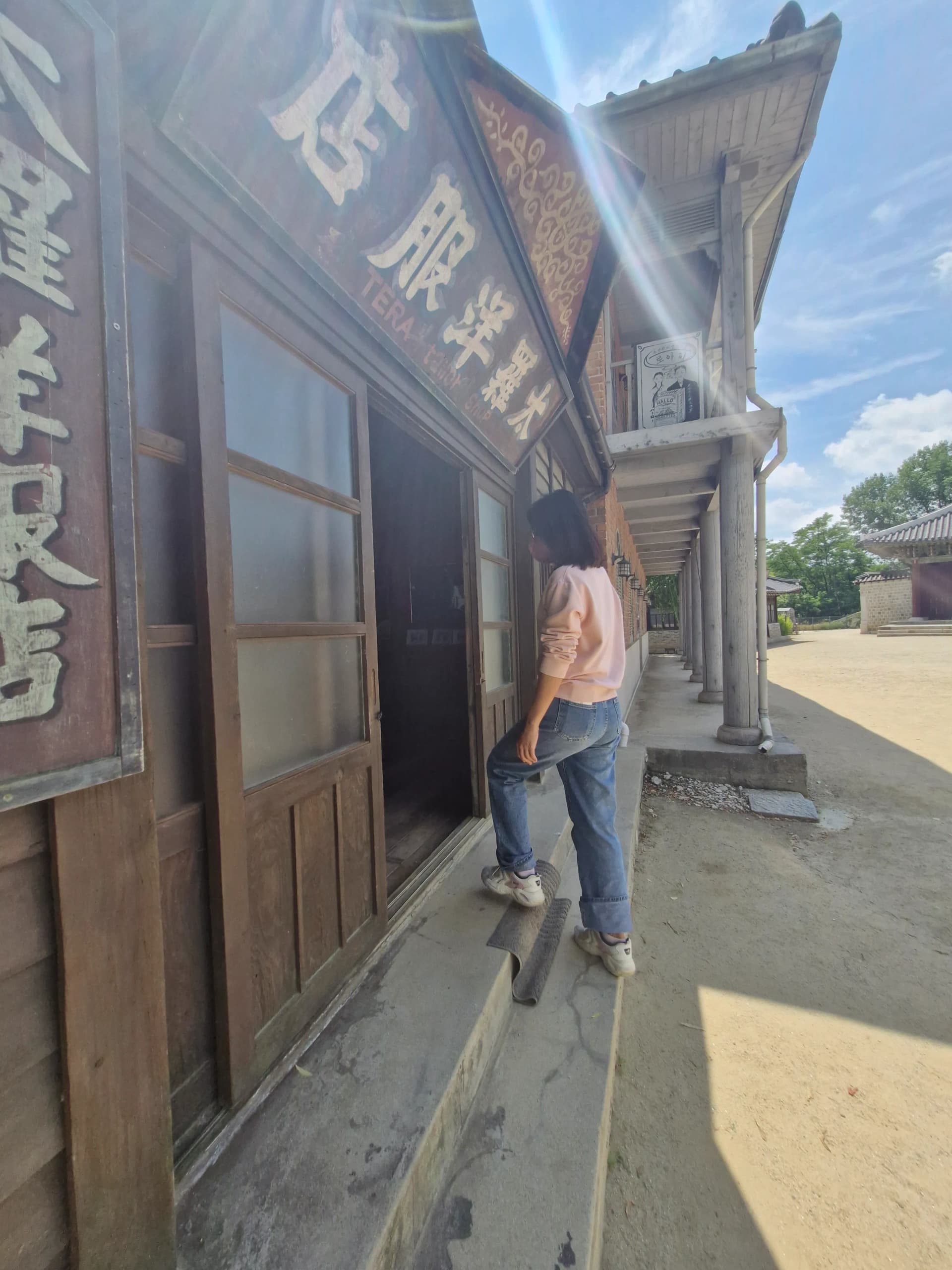
洋服裁縫店 — a Western clothing tailor shop. Beneath the Chinese character sign, wooden sliding doors and lined-up eave columns form a charming shopping alley. You can picture the upper class of the Enlightenment era coming here to get their first Western-style suits fitted. Just lingering in front of this doorway is already a scene worth capturing.
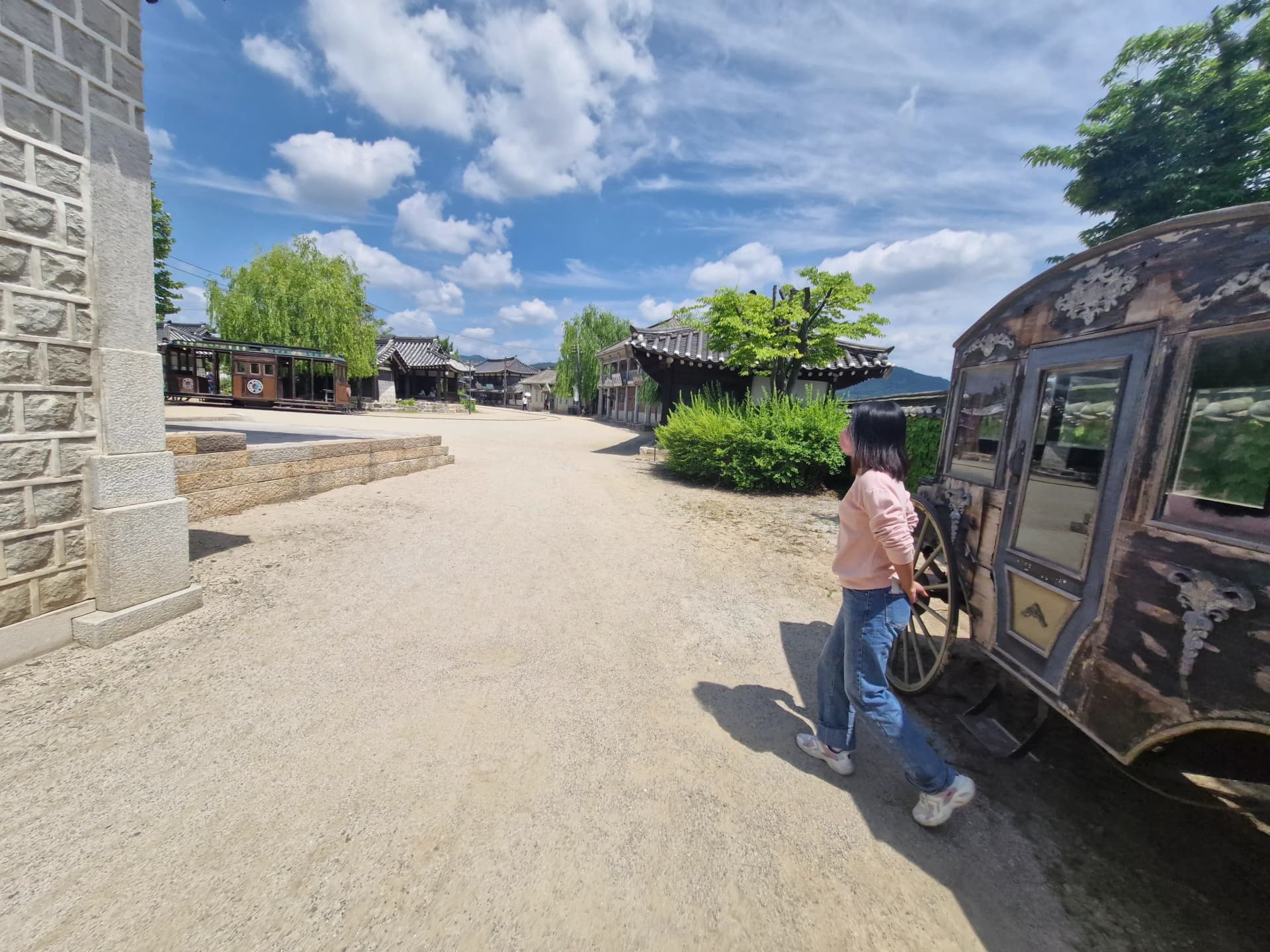
Walking down the road, I came across an old horse carriage. The paint is peeling and the wood is slowly decaying — left exactly as time wore it down. In early 1900s Hanseong, this was the actual mode of transportation for the upper class. Before trams came along, horse carriages were the fastest way to get around. This is a relic of that era.
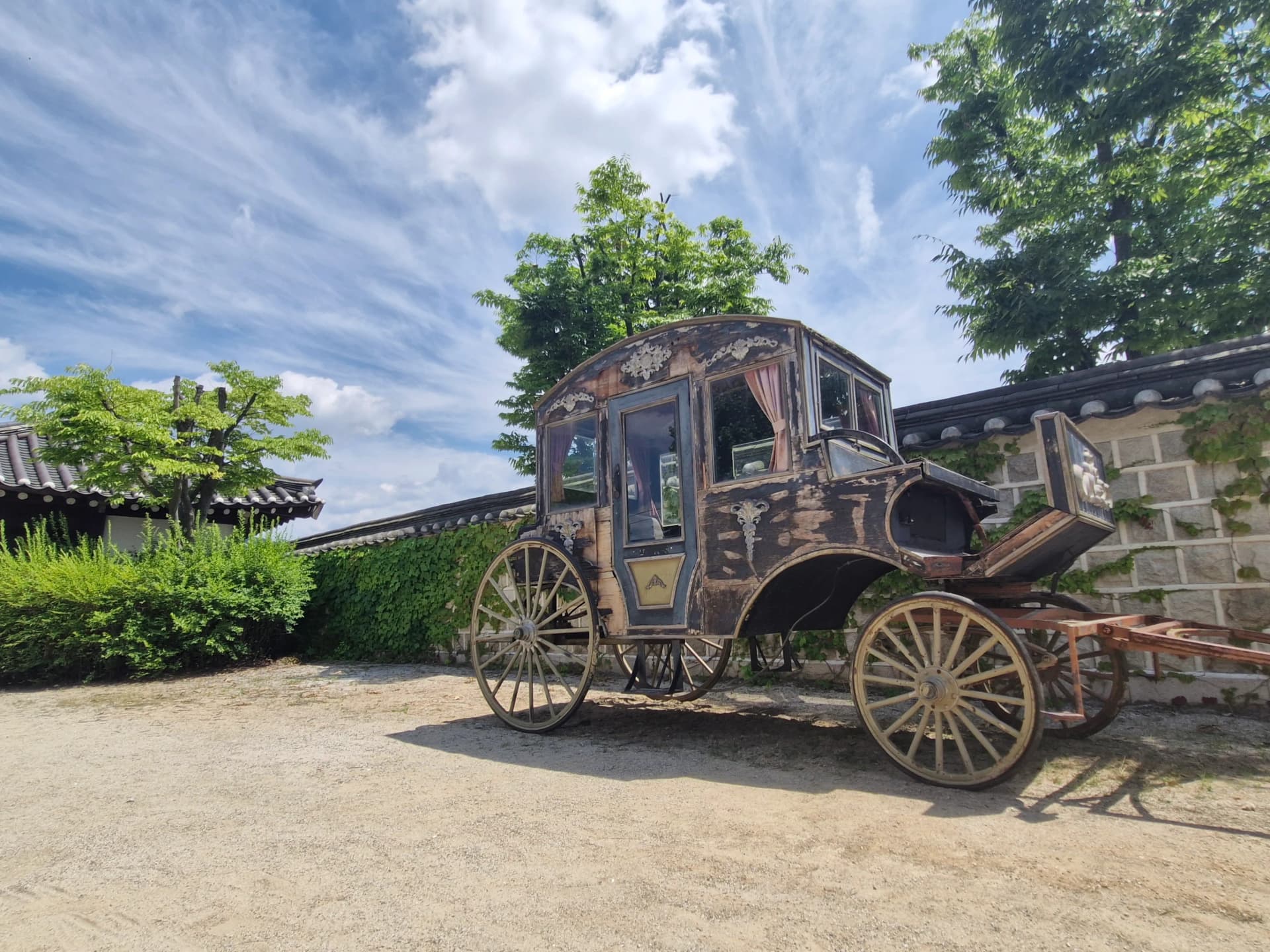
Up close, the details are incredible. The grain of the wooden wheels, the carved decorations on the doors, the faded curtain visible inside. At this level of detail, it's less of a set prop and more like an actual historical artifact. A photo with this carriage is a must at the Sunshine Studio Mr. Sunshine filming location.
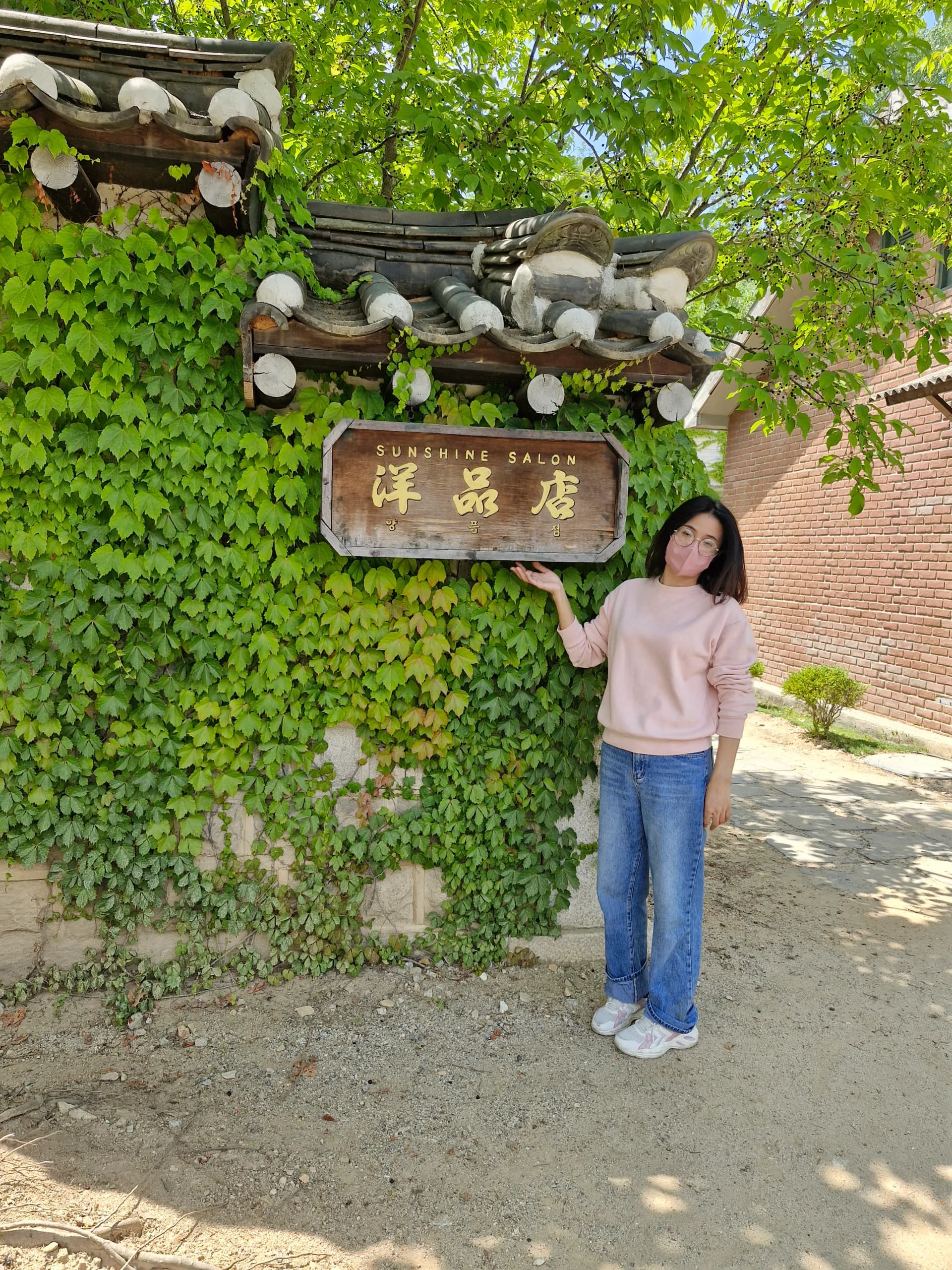
洋品店 — a Western goods store. Ivy crawls over the traditional Korean tile wall and half-covers the signboard. The fact that "SUNSHINE SALON" is written in English right alongside Chinese characters perfectly captures the vibe of that era. Take a photo in front of this and the background does all the work for you.
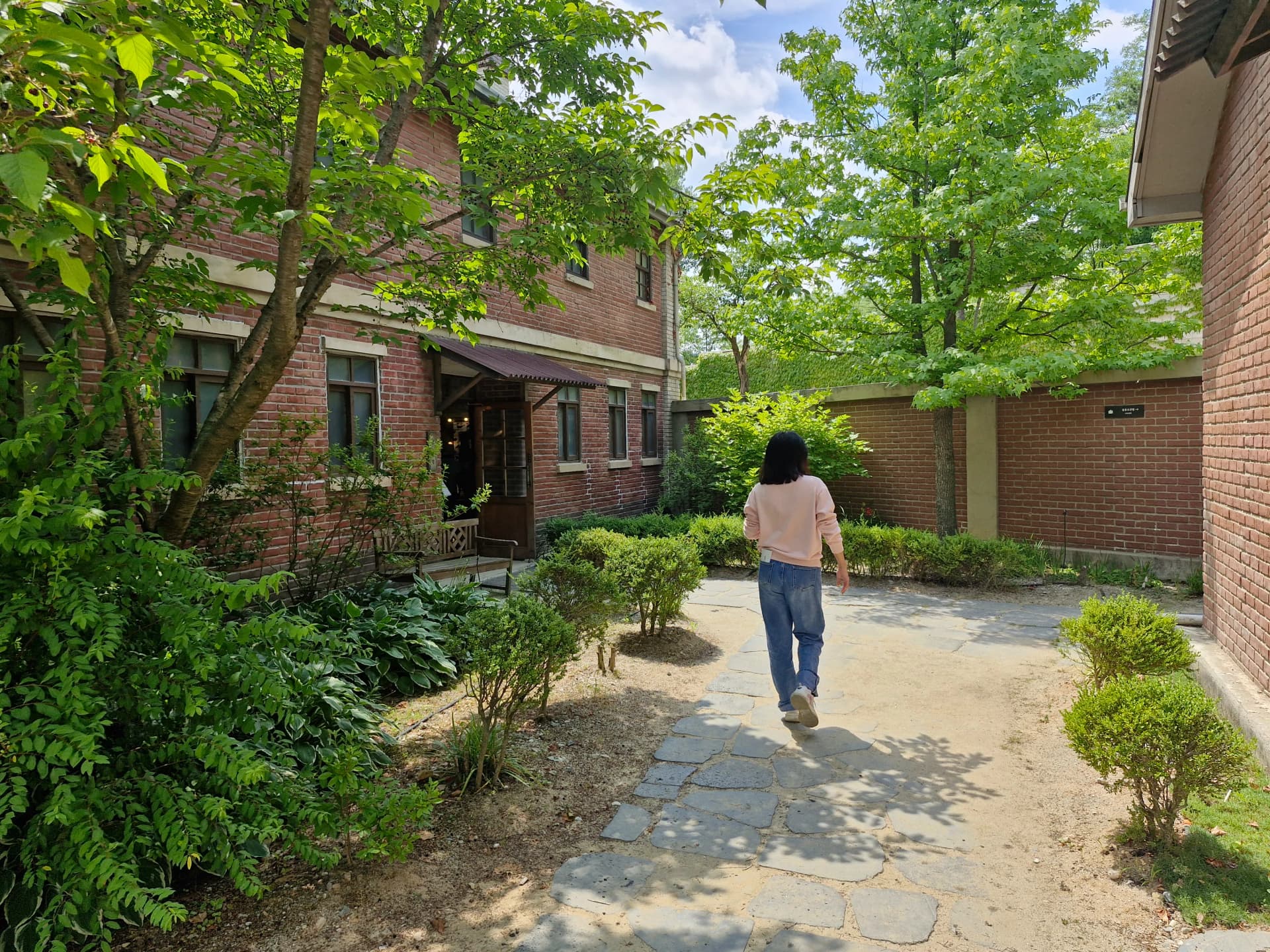
A cobblestone path leading into the courtyard of a red brick building. Neatly trimmed trees and flower beds line both sides, and someone walking alone down the path naturally becomes a scene. No need to rush here.
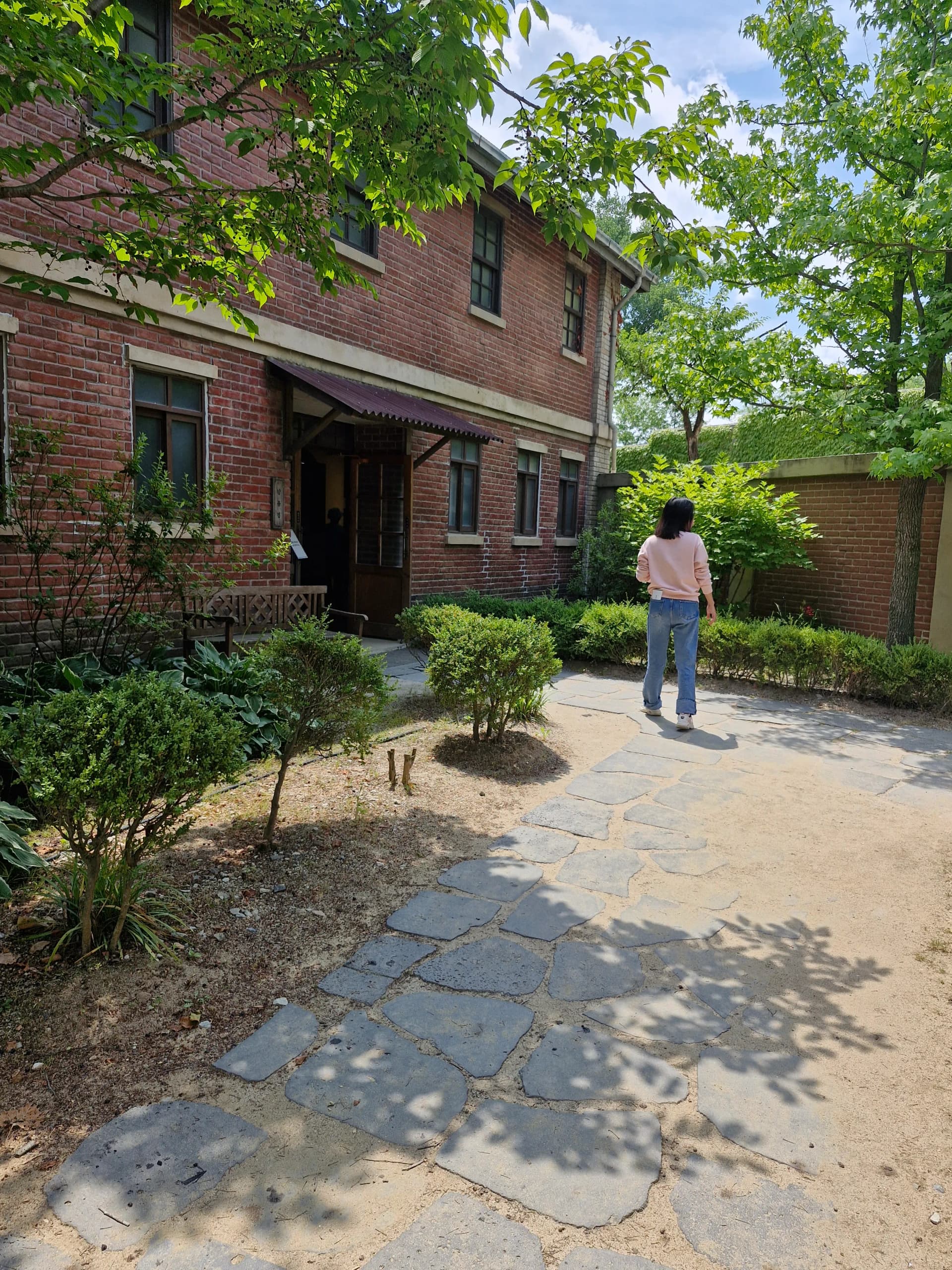
Same cobblestone path, just from a closer angle. The building walls and garden are more vivid from here, and you can spot a bench by the window. The kind of place where you'd want to sit down and just zone out for a while.
Costume Rental — Transform Into the 1900s Right Here
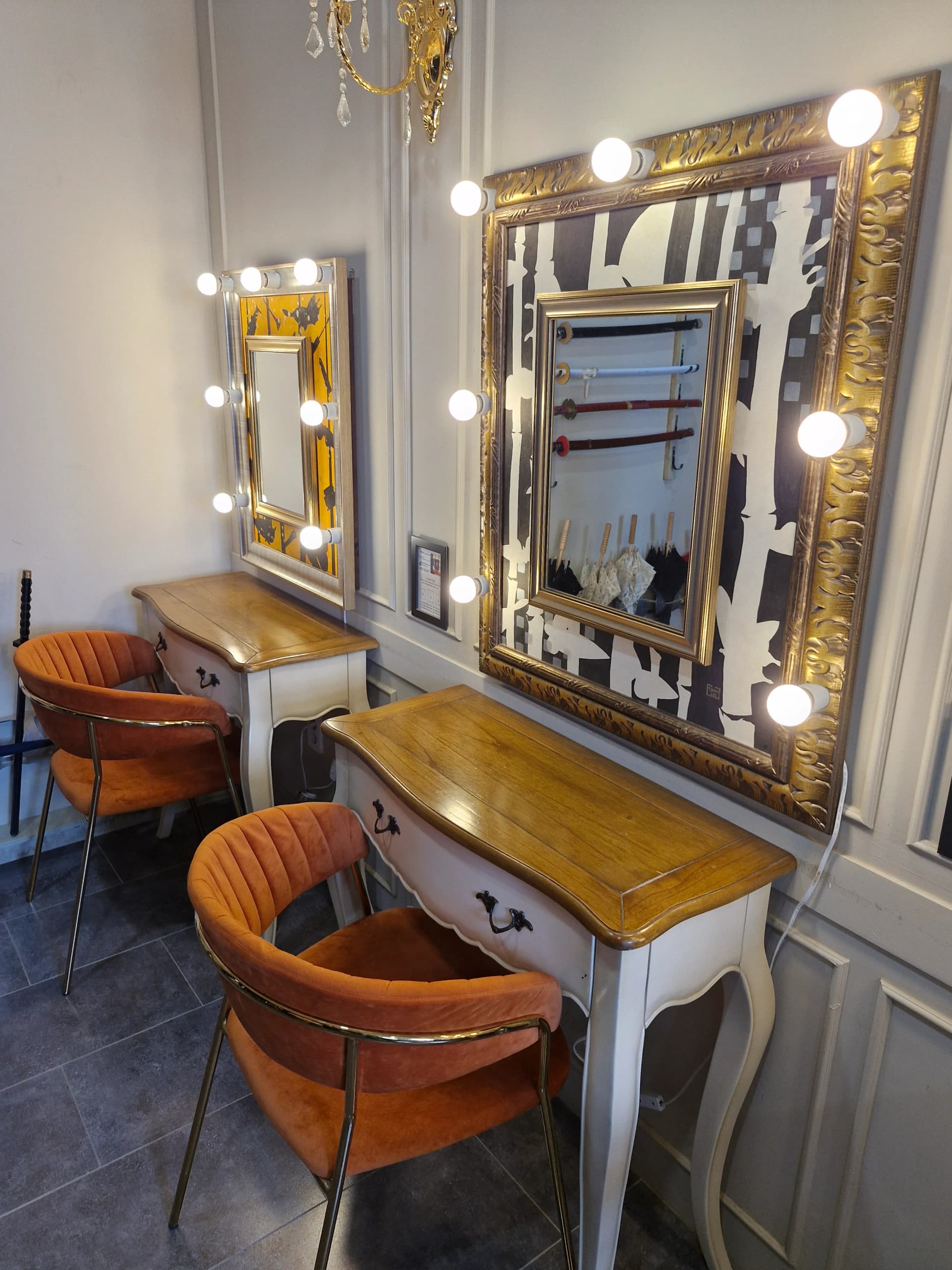
This is the costume rental space inside the Western goods store. A gold-framed carved mirror, round bulb lighting, an orange velvet chair — it has total dressing room vibes. Sit in front of the mirror after putting on a costume and you'll genuinely feel like an actor getting ready for a scene.
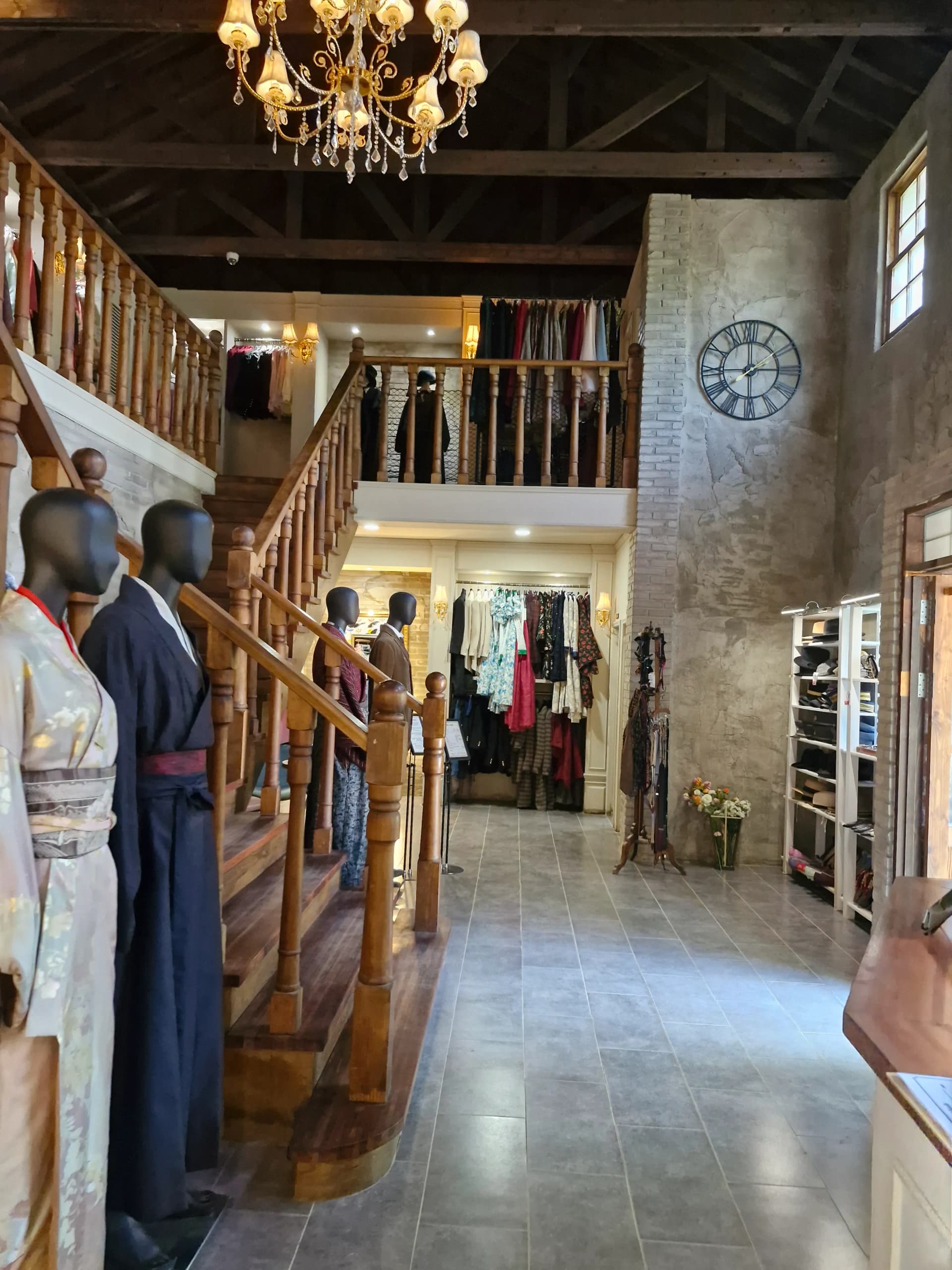
This is the two-story costume rental hall. A wooden staircase reaching to the ceiling, chandelier lighting, and mannequins dressed in kimonos, hanboks (traditional Korean dress), and Enlightenment-era Western dresses all in one view. Both floors are packed with rental costumes. No matter which style you pick, the space itself becomes your backdrop.
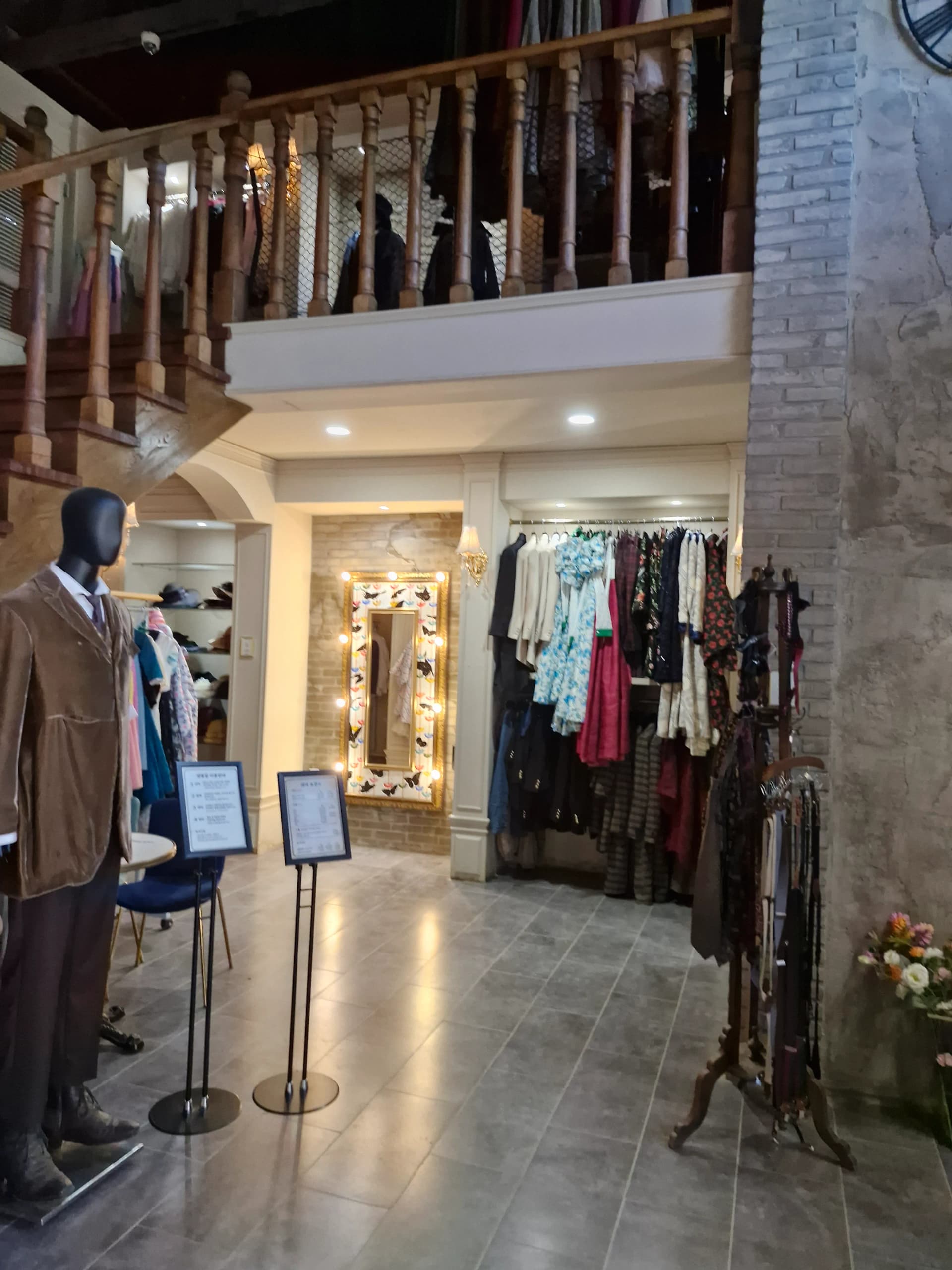
There's a rental guide board alongside a mannequin dressed in a 1900s Western suit. On one side hang colorful dresses and hanboks, and you can try them on in front of a full-length mirror. Rental time is 2 hours. You don't need a perfect outfit — in this space, everything just works.
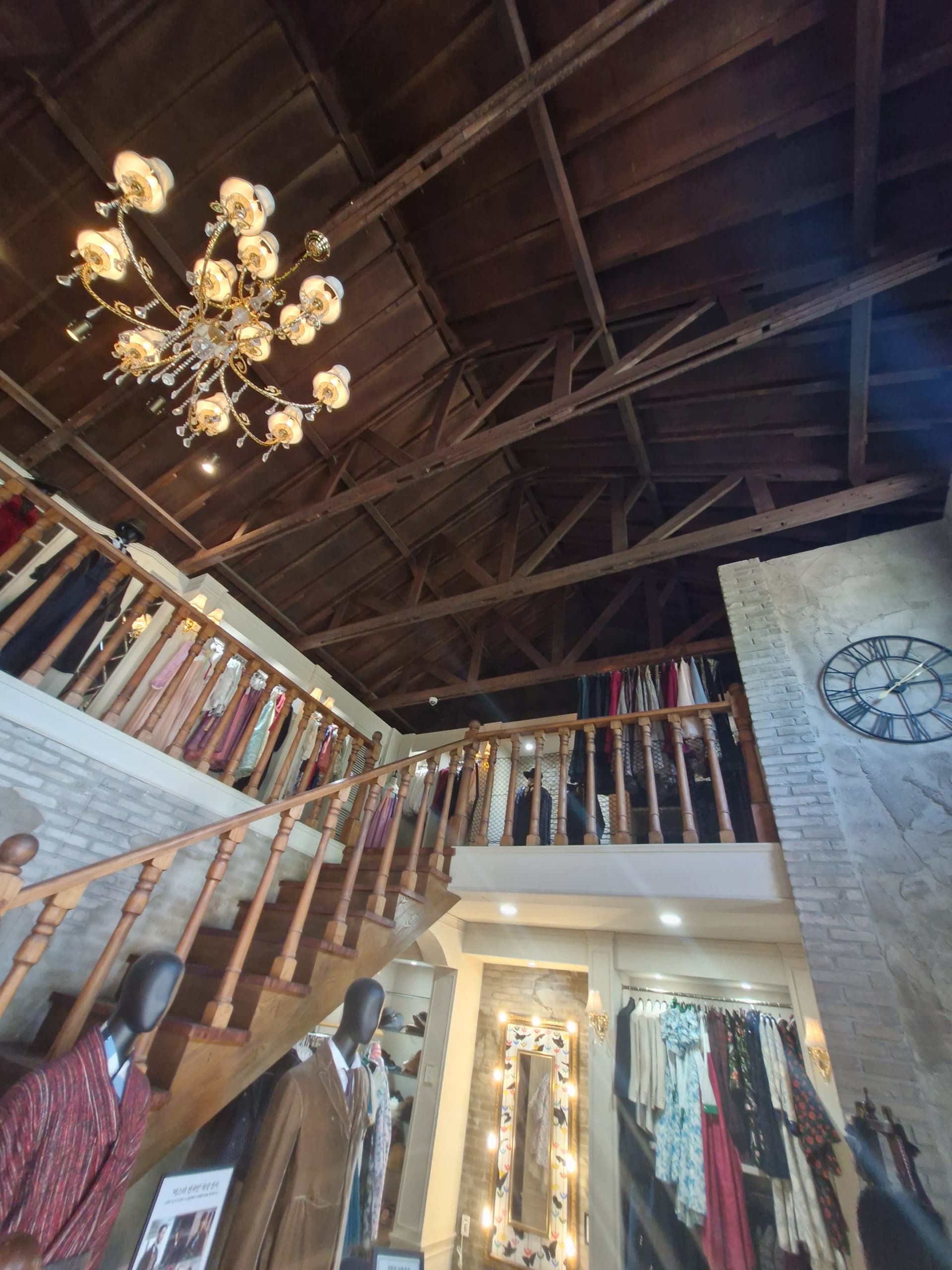
Look up and you'll see an exposed wood truss ceiling with a chandelier. It's got that converted-warehouse feel, preserved as-is. Costumes are packed on the first floor, even more on the second. Just the ceiling alone gives the whole place a movie-set vibe.
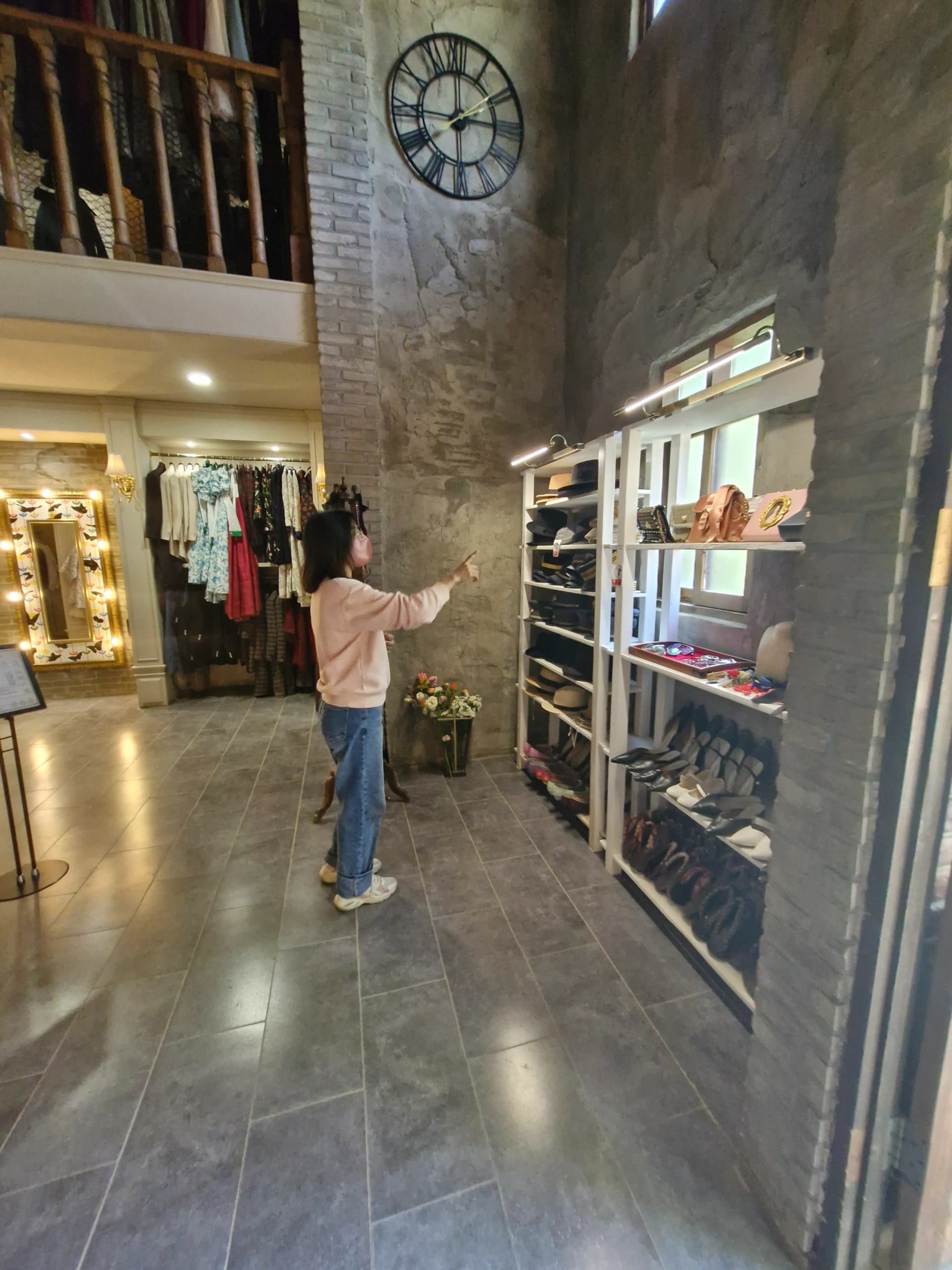
A visitor pointing at something on the shoe and accessory shelves. You can rent hats, bags, and shoes too. It's not just about the outfit — you can complete the look from head to toe. I mean, if you're going to dress up, why do it halfway?
Where Three Cultures Collide — The Real Face of 1900s Hanseong
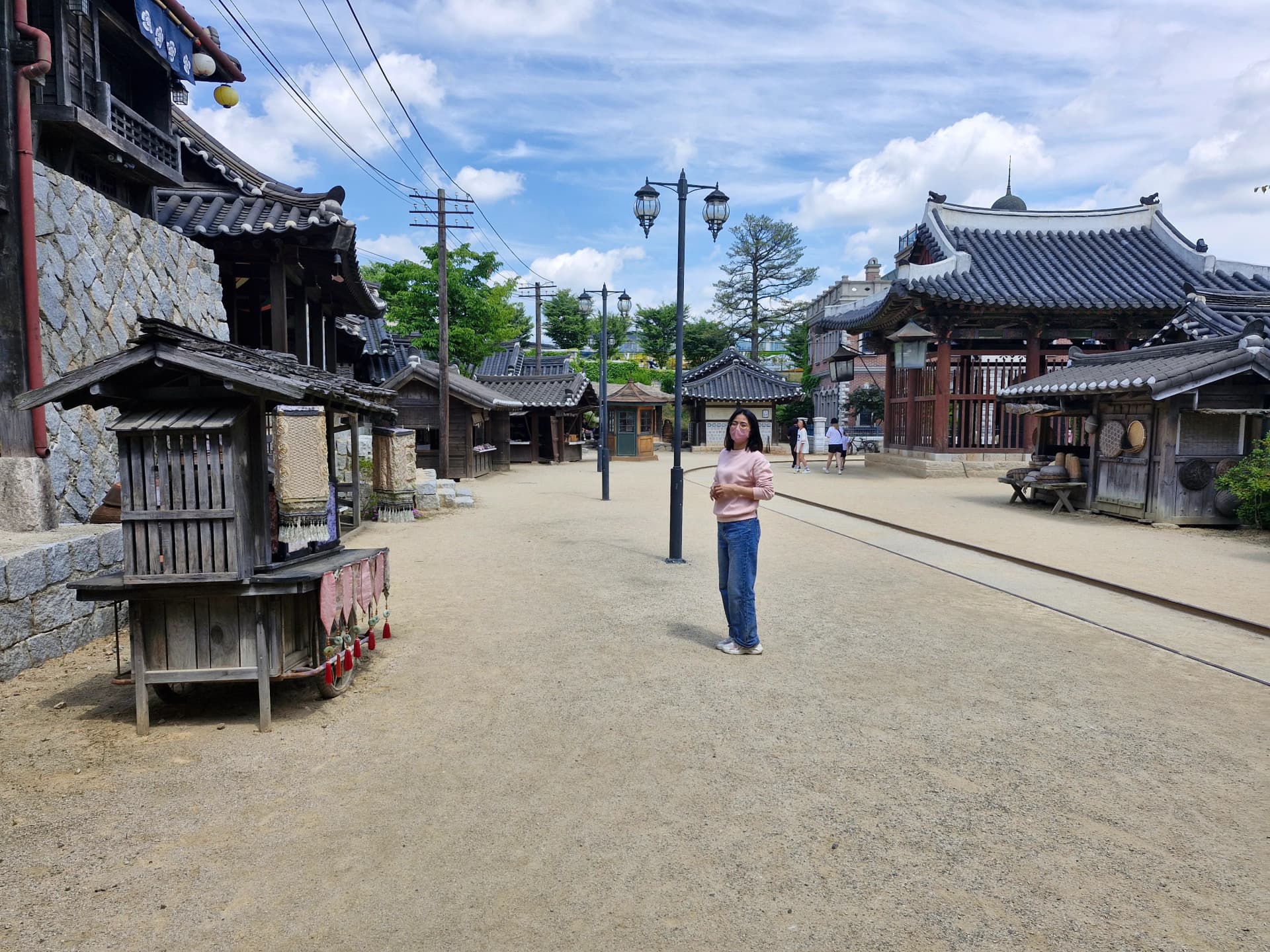
Stand in the middle of the wide street on the tram rails and this is what you get. Japanese street stalls on the left, traditional Korean hanok eaves on the right. An antique street lamp straight ahead. An entire era packed into one street. This is exactly what 1900s Hanseong was like — Japanese, Western, and Korean styles all crammed into a single city block during a chaotic, complicated time in history.
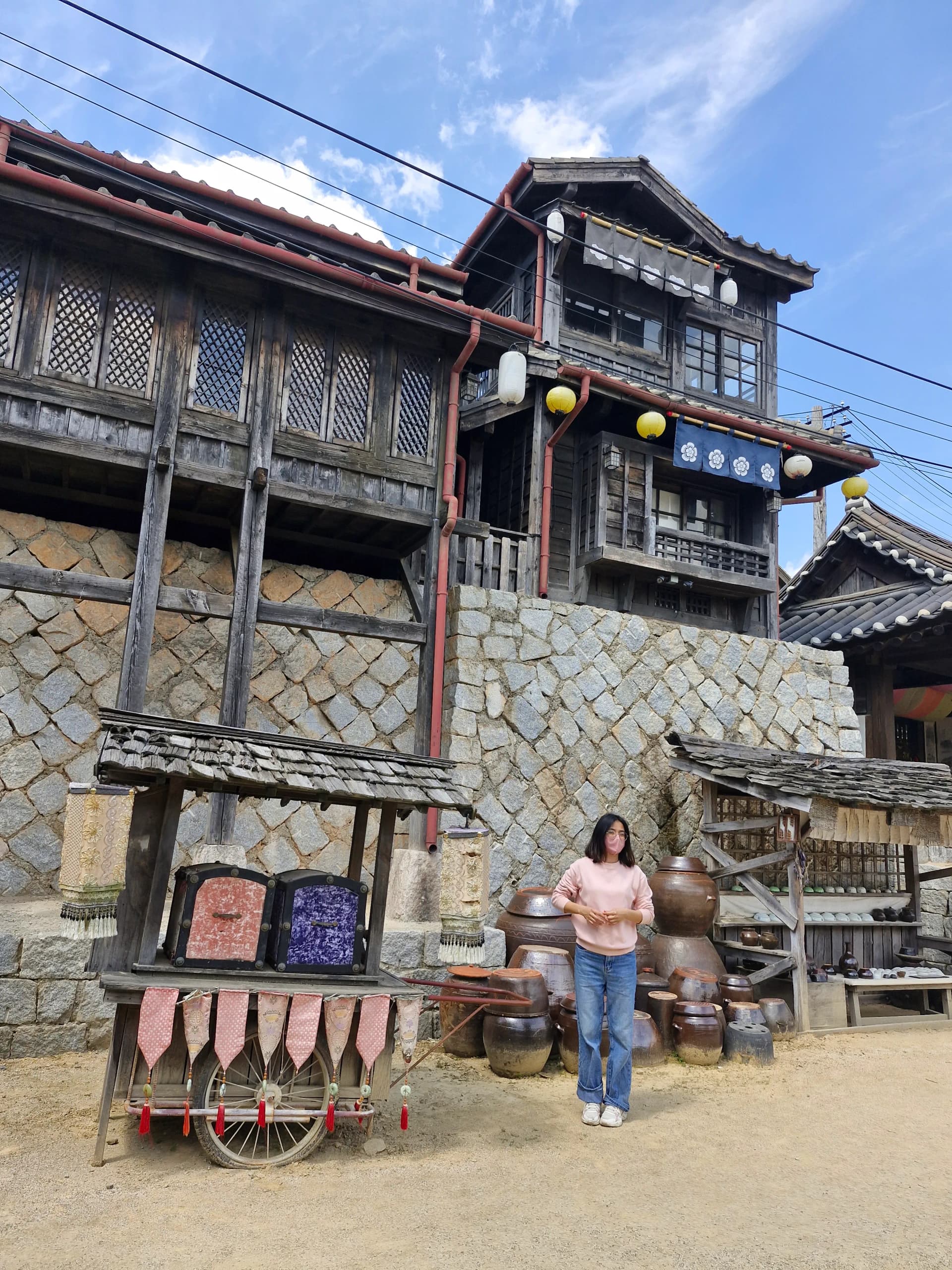
A three-story Japanese wooden building standing right next to a pile of onggi — traditional Korean earthenware jars used for fermenting soybean paste and soy sauce. It might look awkward, but it's not at all. This was actually the real-life scene back then. Korean fermentation jars sitting in front of a Japanese building — that was just everyday life in that era. The set recreated it honestly.
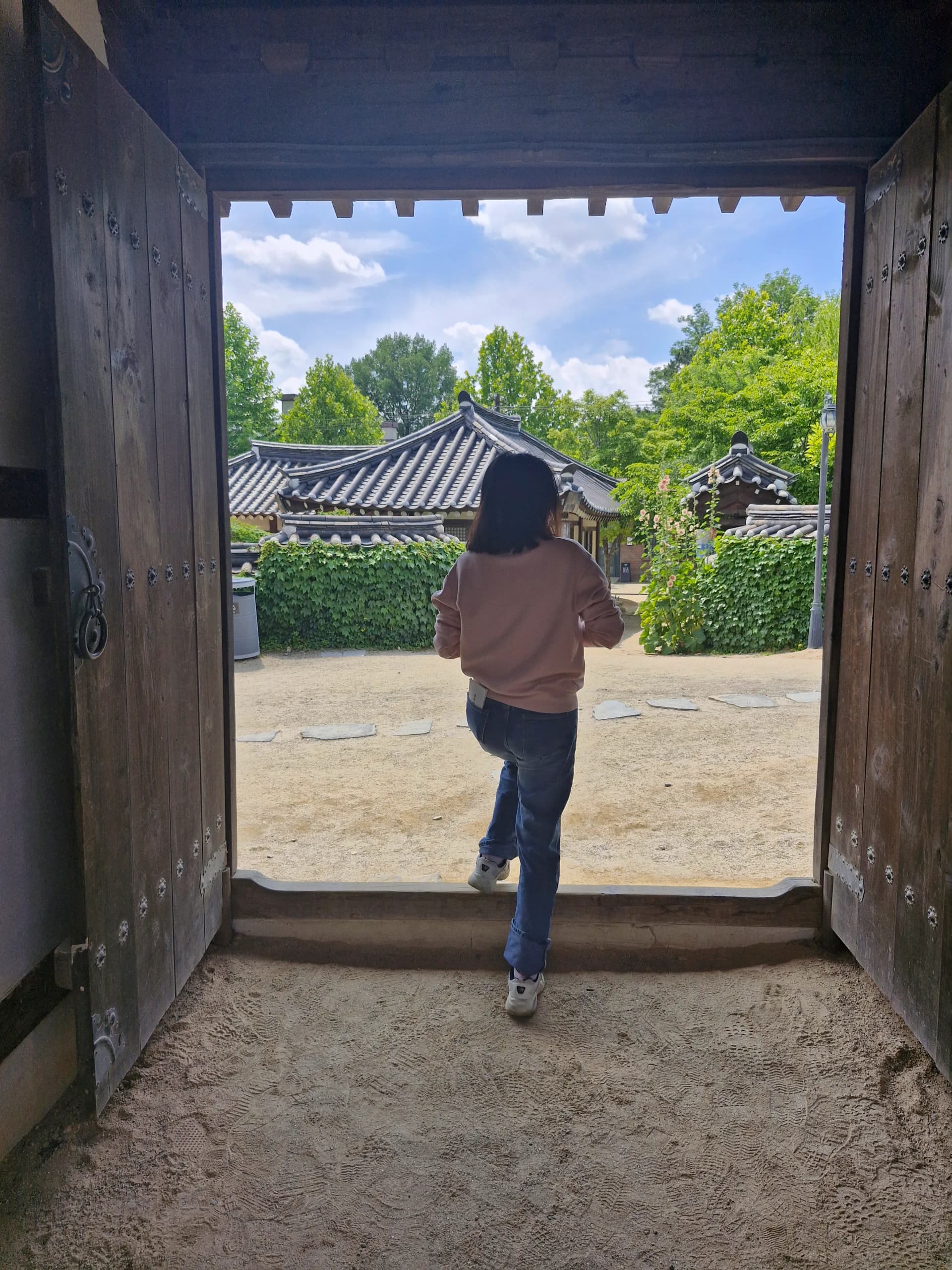
Through the gap between heavy wooden gates, a hanok courtyard reveals itself. The view through the doorway frames the scene like a photograph. A single silhouette walking through is already a complete shot. This is why you don't need to search for photo spots at Sunshine Studio. Just stand anywhere and the background handles the rest.
Inside the Hanok and Autumn Foliage — Where Joseon-Era Spaces Live On
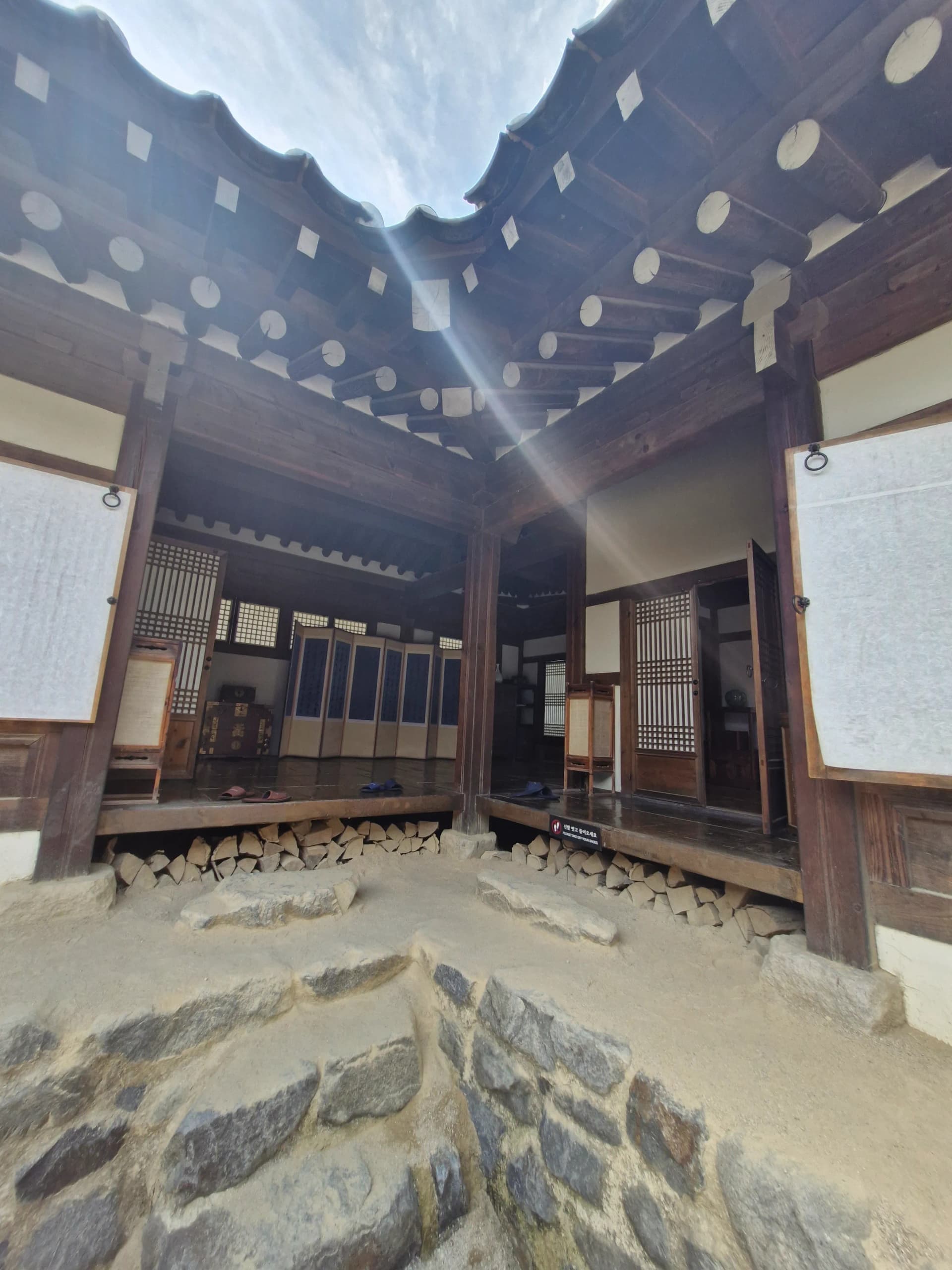
This is the interior of a traditional Korean hanok. Tile roof eaves, jangji-mun (paper sliding doors made from hanji, traditional Korean paper), and firewood stacked beneath the wooden floor. If you were starting to feel like the Japanese-style areas were dominating, this space brings the balance right back. Sunshine Studio isn't just about the Japanese aesthetic. Traditional Korean architecture and living spaces hold their ground firmly here. The fact that these two coexist in the same location IS the history of that era.
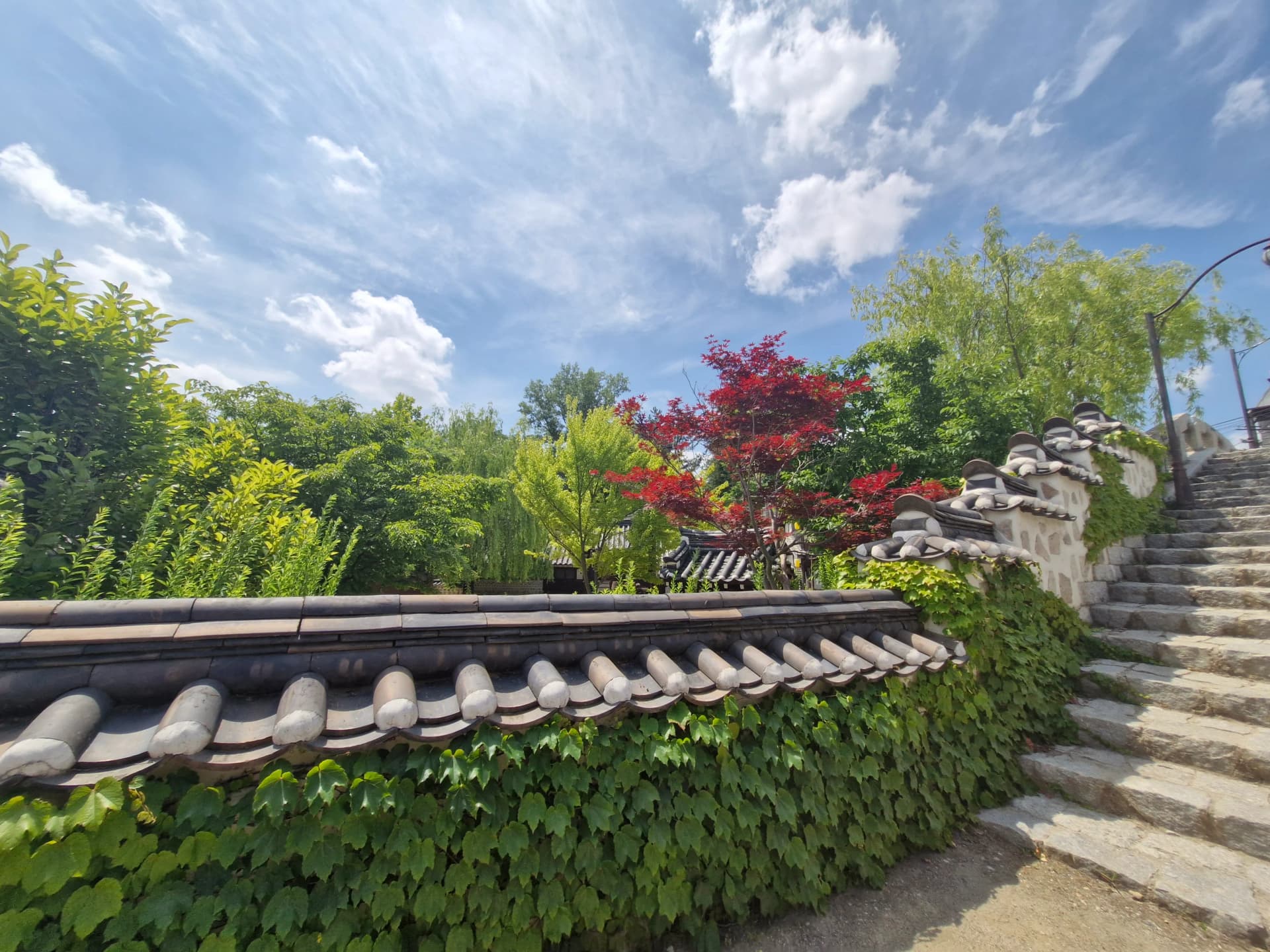
Green and red maple trees burst over the tile wall. Ivy creeps up the traditional wall, and stone steps lead upward. This scenery must look completely different depending on the season. Light green in spring, deep green in summer, and in autumn, those red maples must absolutely blaze.
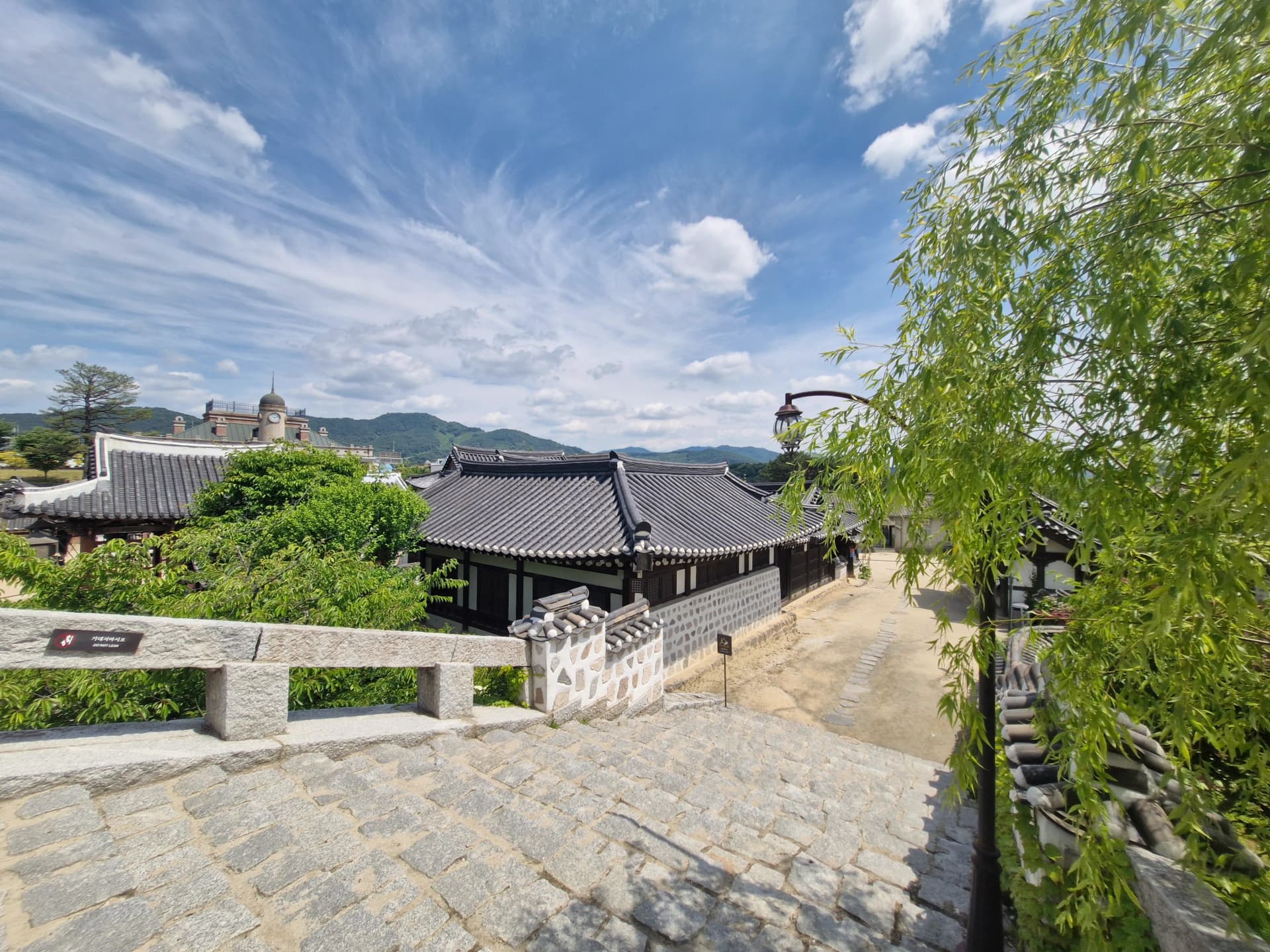
Here's the panoramic view looking down from above Hanok street. The clock tower dome of the Hanseong Electric Company is visible in the distance, willow trees droop on the right, and the cobblestone path winds downward. From up here, you can really feel it. This space isn't just Japanese-feeling. It's not just Korean-feeling either. The two blend together to become what the streets of 1900s Hanseong actually were. That's the real magic of the Sunshine Studio Mr. Sunshine filming location.
How to Get to Sunshine Studio from Seoul
Getting There from Seoul
From Seoul to Sunshine Studio
🅰️ KTX + Taxi — Fastest Option
Yongsan Station → Nonsan Station (KTX, ~1 hr 30–40 min)
💰 One-way ~$11–20 (depending on seat class)
Nonsan Station → Sunshine Studio (Taxi, ~20–25 min)
💰 ~$10–11
⏱️ Total travel time: ~2 hours · Total cost: ~$22–30
🅱️ KTX + Local Bus — Cheapest Option
Nonsan Station exit → Bus stop across the street
🚌 Bus 201, 205, 211, 212, 216, or 221
📍 Get off at "Training Center Induction Battalion" stop → Walk ~15 min
💰 Bus fare ~$1.20
⚠️ Buses run only every 30 min to 1 hour.
If you're short on time, just take a taxi.
🅲 Express Bus — No Transfers
Seoul Express Bus Terminal (Subway Line 7) → Yeonmudae Terminal
⏱️ ~2 hours · 💰 ~$7.50–8
Yeonmudae Terminal → Sunshine Studio (bus or taxi)
💡 Cheapest option, but takes the longest.
📍 Sunshine Studio address: 90 Bonghwang-ro, Yeonmu-eup, Nonsan-si, Chungcheongnam-do (about 2 hours south of Seoul)
How to Get to Sunshine Studio from Busan
Getting There from Busan
From Busan to Sunshine Studio
⚠️ There is no direct KTX from Busan to Nonsan
You'll need to transfer. Choose one of the two options below depending on your situation.
🅰️ Via Daejeon Station — Fastest but Tricky Transfer
Busan Station → Daejeon Station (Gyeongbu Line KTX, ~1 hr 20 min)
💰 ~$25
Daejeon Station → Must transfer to Seodaejeon Station
🚕 Taxi ~10–15 min · ~$7–8
🚌 Bus ~25 min
Seodaejeon Station → Nonsan Station (Honam Line KTX/Mugunghwa, ~20–30 min)
⏱️ Total travel time: ~2.5–3 hours (including transfer wait)
🚨 Warning: Daejeon Station (Gyeongbu Line) and Seodaejeon Station (Honam Line) are completely different stations. They're about 3 km apart — you can't walk between them. During rush hour (5–7 PM), traffic on the main road can push the taxi ride past 20 minutes. Leave at least 40 minutes to 1 hour for the transfer.
🅱️ Via Sintanjin — Stress-Free Transfer
Busan Station → Sintanjin Station (Mugunghwa train)
💰 ~$14
Sintanjin Station → Nonsan Station (Mugunghwa transfer)
💰 ~$3
✅ No need to travel between Daejeon and Seodaejeon stations
❌ Total travel time is longer (~3.5–4 hours)
💡 If a smooth transfer matters more than speed, go with this option.
Nonsan Station → Sunshine Studio: Taxi 20 min (~$10) or local bus 30 min (~$1.20)
Nearby Attractions to Pair with Sunshine Studio
What Else to Visit Near Sunshine Studio
Nearby Attractions & Day Trip Ideas
Honestly, going all the way there just for Sunshine Studio and heading back feels like a waste.
Nonsan isn't exactly a tourist city, so pairing it with nearby spots makes for a much fuller day.
📍 Nearby — 20–30 min by car
Ganggyeong Jeotgal Market
🚗 ~20 min · One of Korea's top 3 fermented seafood markets
Perfect for grabbing lunch or dinner on the same trip.
Hit up a seafood noodle soup spot nearby for the full experience.
Tapjeongho Suspension Bridge
🚗 ~15 min · Nonsan's most popular photo spot
Gorgeous lake panorama from the bridge.
Donam Seowon
🚗 ~20 min · UNESCO World Heritage Site
A premier Joseon-era Confucian academy. Great for a peaceful stroll.
📍 Medium Distance — 30–50 min by car
Buyeo — The Last Capital of the Baekje Kingdom
🚗 ~30–40 min
Baekje Cultural Land (admission ~$4.50 · allow ~2 hrs)
Busosanseong Fortress · Gungnamji Pond · Jeongnimsa 5-story Pagoda
If you're into ancient Korean history, this is a must for a half-day trip.
Gongju — The Second Capital of Baekje
🚗 ~40–50 min
Gongsanseong Fortress (admission ~$2.25 · walk ~1–1.5 hrs)
Royal Tomb of King Muryeong · Gongju National Museum
Combine with Buyeo for a perfect 2-day/1-night itinerary.
📍 A Bit Further — 50 min to 1 hour by car
Jeonju Hanok Village
🚗 ~50 min to 1 hour
Wear hanbok for photos · bibimbap · choco pie · makgeolli (rice wine)
Half a day flies by here.
⚠️ It's not exactly close. If you're trying to do Sunshine Studio + Jeonju in one day, you need an early start. Honestly it's tight, but not impossible.
💡 Recommended combo: Morning at Sunshine Studio → Lunch at Ganggyeong Market → Afternoon in Buyeo or Gongju
Frequently Asked Questions (FAQ)
Frequently Asked Questions
FAQ
Q. How long does it take to look around?
Without costume rental, about 1 to 1.5 hours is plenty. With costume rental, plan for 2 to 2.5 hours. If you're the type who takes lots of photos, a generous 3 hours works too.
Q. Can I enjoy it even if I haven't watched Mr. Sunshine?
Absolutely. If you've seen the drama, you get the fun of recognizing "oh, THIS is where that scene was shot!" But even without that, walking through a recreated 1900s Korean street is a pretty unique experience on its own. If you love photography, you'll have a great time regardless.
Q. Is renting a costume a must?
Not required, but it's a completely different experience if you do. 1900s-era Enlightenment costumes aren't something you can rent at most tourist spots, so the novelty factor is real. A 2-hour costume + accessories set runs about $24. There's a good range for women's outfits, but the men's selection is a bit lacking.
Q. Are pets allowed?
No. Even in carriers or bags, pets are not permitted.
Q. Can I bring a stroller?
You can bring one in, but I wouldn't recommend it. There are lots of cobblestone sections and some areas with stairs, making stroller navigation pretty rough. A baby carrier or holding your child is the better call.
Q. Where's the best place to park?
There are multiple parking lots, but Parking Lot 2 or Parking Lot 3 are closest to the ticket booth. Parking Lot 1, despite the name, is actually the farthest from the entrance. Parking is free.
Q. Is it worth visiting in summer or winter?
Spring (April–May) and fall (September–October) are the sweet spots. In summer, there's not much shade and the heat radiating off the stone paths can be brutal. Bring a parasol, water, and sunscreen — non-negotiable. In winter, being an outdoor set, the wind is biting. Take breaks in the indoor spaces (Glory Hotel cafe, costume rental shop, etc.) as you go.
Q. Are Sunshine Land and Sunshine Studio the same thing?
Sunshine Land is the name for the entire complex. Inside it, there's Sunshine Studio (paid), 1950 Studio (free), a military experience center, and more. The Mr. Sunshine filming location is the Sunshine Studio section, and that's the only part with an admission fee (~$7.50 for adults). The 1950 Studio is free to explore.
Q. Is there a cafe or restaurant inside?
There's a cafe on the 2nd floor of the Glory Hotel (called Sunshine Gabaejeong). They serve basic drinks like americanos and lattes. There are no sit-down restaurants inside. You can bring snacks or a packed lunch, but cooking equipment is not allowed. I'd recommend eating before you come in.
Q. Are there English guides or signs?
There are no dedicated English guided tours. Some signs have partial English text, but most are in Korean. If you're a foreign visitor unfamiliar with the drama, reading a quick summary of the Mr. Sunshine plot before visiting will make the experience much more enjoyable.
This post was originally published on https://hi-jsb.blog.